Categories
Interesting stuff The Green Machine Well I thought it was neat!

Stolen from My Daily Kona – The Battle of Palmdale

When a WW II drone embarrassed the USAF
I remembered reading a book called “The Skunk Works” and the F117 fighter and the phrase Kelly Johnson or Ben Rich used when it came to the United States Air Force fascination with missiles.   he commented…”If the missiles did as advertised, they would be called “hittles” not Missles”.  This prompted the development of the Stealth fighter.
The United States Military had this fascination with Missiles hoping to find the single thing that would shoot down the enemy plane and make it easier than dog fighting.  Unfortunately it took Vietnam before they really started dog fighting and not super reliance on technology.
The United States military does not like to talk about the Battle of Palmdale. It is undoubtedly one of the most embarrassing American military defeats in history – and it happened right over U.S. soil.
Although not a single soul was lost, over 1,000 acres of American land was destroyed, the military was left embarrassed, and several Americans nearly perished in their own homes and vehicles.
All of this from a single enemy who could not even shoot back. This formidable foe was never defeated, or even damaged, by the American military.
Who was this foe, and why did the United States military so thoroughly fail to defeat it?
The Cold War arms race between the United States and the Soviet Union requires little introduction: the two superpowers of the world constantly wanted to ensure they had a military advantage over the other in the case of conflict.
One element of this race was the development of guided air-to-air missiles in the 1950s.
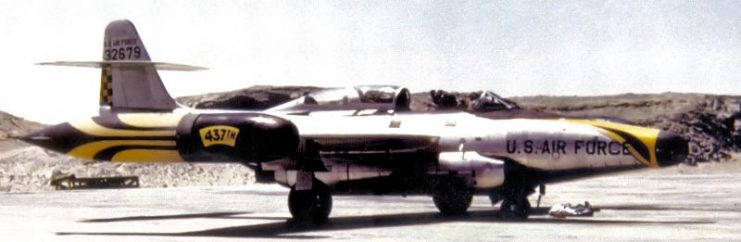
437th Fighter-Interceptor Squadron Northrop F-89D-70-NO Scorpion 53-2679 1956. Stationed at Oxnard AFB, California. At Nellis AFB, California.

The United States seemingly won this race, with the Air Force and Navy introducing missiles on their fighters in 1956, a year before the Soviets. However, these missiles needed extensive testing and were severely flawed.
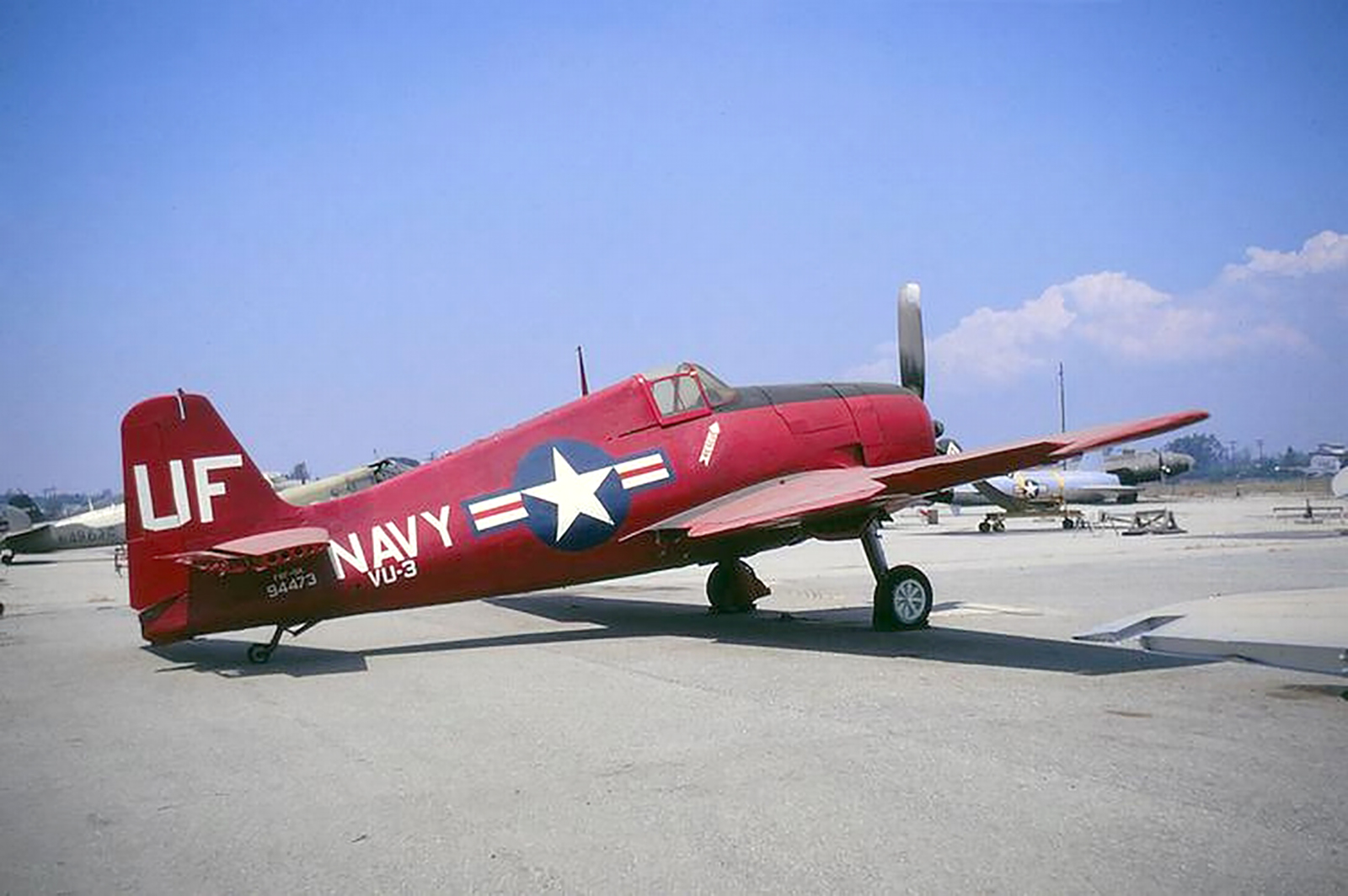
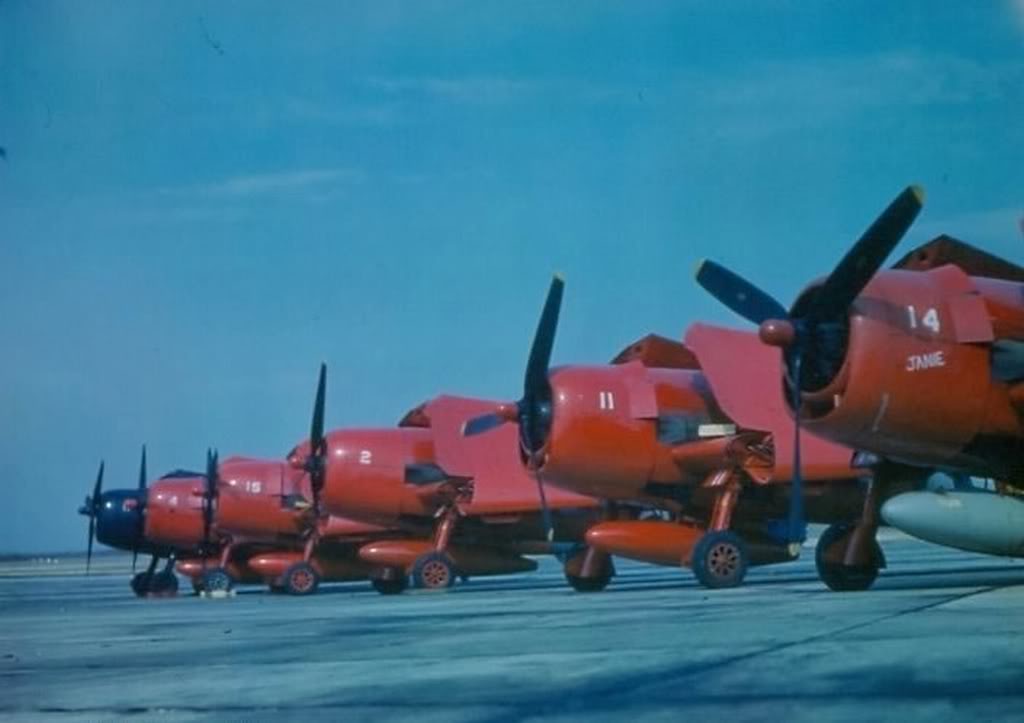
By 1956, in the late stages of testing, live fire tests became necessary. These were conducted against remote-controlled planes (“drones”), including the Grumman F6F-5K Hellcat.
Although the Hellcats were well-regarded during World War 2, they were obsolete by 1956, and this made them great practice targets.
On August 16, 1956, one of the Hellcat drones was launched from Naval Air Station Point Mugu in California. It was painted bright red to make it an easier target for the Navy which was to take it down with their new air-to-air missiles.

F6F Hellcat
                                                                            F6F Hellcat

However, the drone had other plans. The Hellcat broke from its course early in the mission. Instead of heading over the ocean, it took a turn towards Los Angeles and continued to climb in altitude.
For some reason, the drone was no longer responding to its controls. In response, the Air Force scrambled two fighters to take it down using unguided air-to-air rockets.
The relative strength of forces seemed firmly in the Air Force’s favor. The Air Force selected two Northrop F-89 Scorpions from nearby Oxnard Air Base for the task. The Scorpions were early jet-powered fighters – more than a match for a propeller plane.
Between them, the Scorpions had 208 rockets. On the other side stood an unarmed, unmanned, bright red, outdated drone.
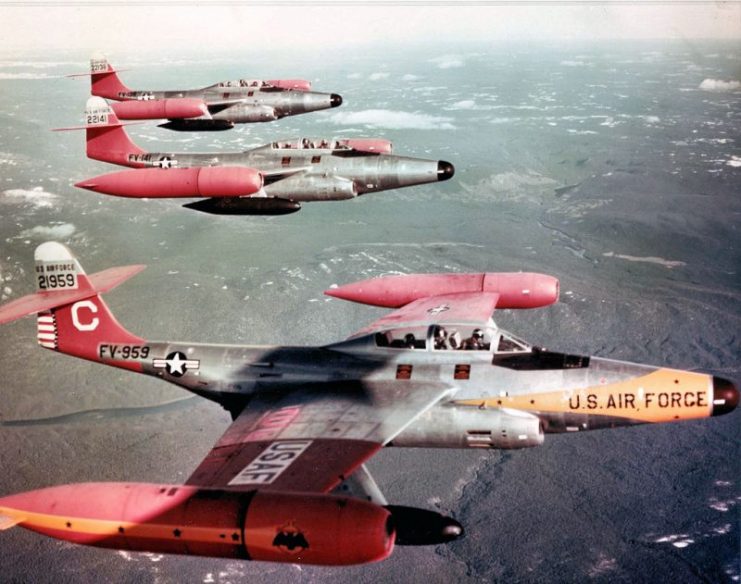
U.S. Air Force Northrop F-89D-45-NO Scorpion interceptors of the 59th Fighter-Interceptor Squadrons, Goose Bay AB, Labrador (Canada), in the 1950s. 52-1959 in the foreground, now in storage at Edwards AFB, California

Although the Scorpions’ rockets were not guided, they made use of a brand new computerized fire control system.
The Air Force obviously did not want to shoot down the drone over a populated area, so they waited for it to pass over Los Angeles. It continued to turn until it approached the sparsely populated Antelope Valley, at which point the Scorpions engaged.
Or at least they tried to. It turned out that the new fire control system was not all it was cracked up to be, and the rockets failed even to fire. However, the fighters were able to revert to a manual control mode not using the computerized system.
Unfortunately, the planes’ gun sights had been removed due to their supposed obsoleteness after the computerized system was added. In addition, the rockets in question, the MK 4 “Mighty Mouse,” were notoriously inaccurate.
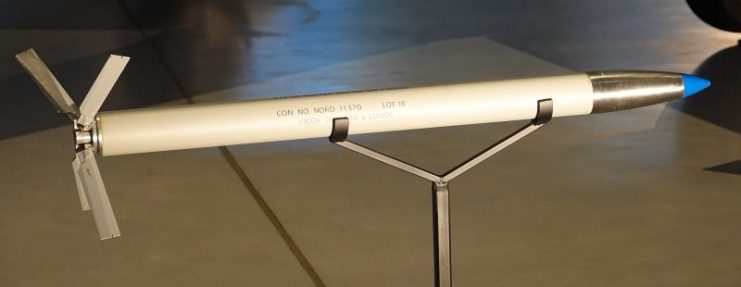
Mighty Mouse Missile at Steven F. Udvar-Hazy Center Virginia USA Photo by Sanjay Acharya CC BY-SA 4.0
Mighty Mouse Missile at Steven F. Udvar-Hazy Center Virginia USA

When the drone continued turning, back towards Los Angeles, the pilots knew they needed to act quickly. With 208 rockets, the odds still seemed in their favor. They each launched a volley of 42 rockets, several of which connected.
However, the rockets only glanced against the drone’s fuselage, failing to detonate.
With 124 remaining rockets, the fighters made another pass, and each launched 32 rockets. This time none even made contact.
With only 60 rockets remaining, the pilots decided to recalibrate their intervalometer, hoping to increase the effectiveness of their rockets. This would be their last chance to take down the drone as they were running out of fuel as well as ammunition.
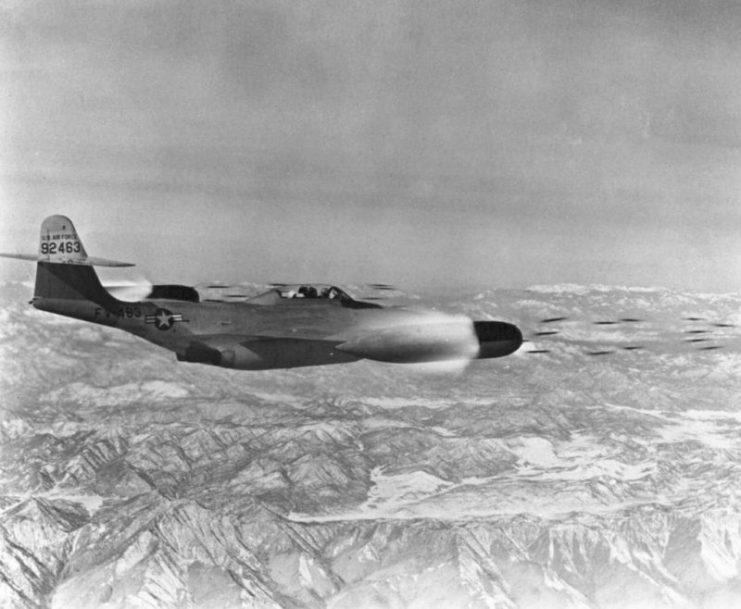
F-89D firing Mighty Mouse Rockets

The pilots made one final pass, each launching their remaining 30 rockets as the drone approached the city of Palmdale. The last of the Scorpions’ 208 rockets again failed to make contact… at least, with the drone.
As the pilots returned to base, it became clear that their rockets had made contact, just not with the drone. Although the Mk. 4 rockets, if they missed their target, were supposed to disarm as their speed decreased, something went wrong with this system.
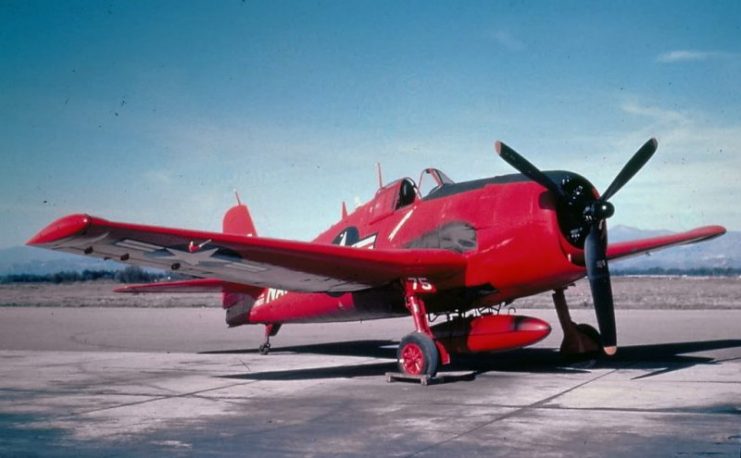
Grumman F6F-5K drone
                                                      Grumman F6F-5K drone

The vast majority, possibly as many as 193, of the rockets detonated. These rockets caused several major fires and nearly caused several fatalities. Although the area around the battle was sparsely populated, the destruction was widespread.
The first fire was around Castaic and destroyed 150 acres. Another rocket fell near Placerita Canyon, where it set a number of oil sumps on fire. That fire nearly reached the Bermite Powder explosives plant, but fortunately was contained around 300 feet away.
At Soledad Canyon, an additional 350 acres went up in smoke, and several smaller fires added to the destruction. All-in-all, over 1,000 acres were destroyed by the fire.
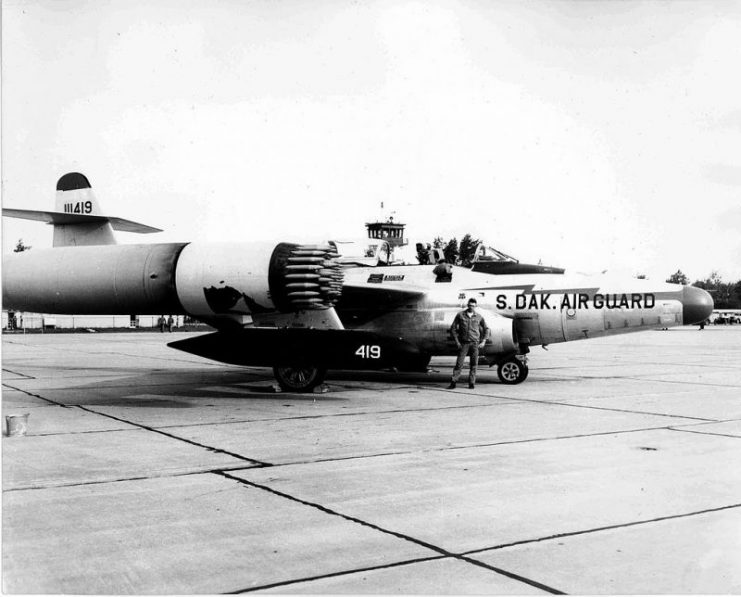
F-89D loaded with rockets. 114th Fighter Interceptor Group, headquartered at Sioux Falls, in 1958.

A number of the rockets hit houses, nearly causing several fatalities. One piece of shrapnel flew through a woman’s window, bounced off her roof, and eventually smashed into a kitchen cabinet, where it came to rest.
Another house was hit with several fragments, which sliced through the garage and living-room, nearly hitting the woman who lived there.
Another rocket detonated right in front of a man and his mother who were driving along the road, destroying the front of the vehicle. Miraculously, neither was seriously injured.
Finally, a rocket scored a direct hit on another truck, totally destroying it. Fortunately, its occupants had just gotten out.
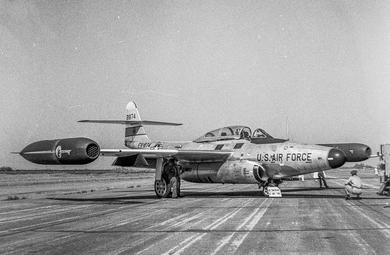
Scorpion in Fresno California July 1957, with front of rocket pods exposed

The drone itself caused only minor damage when it finally ran out of fuel and crashed. Although within sight of the Palmdale Airport, it crashed near an unpaved road, destroying several power lines in the process.
Its remains were eventually recovered in 1997, although it largely disintegrated upon impact.
One thousand acres of land was consumed by fires that took two days and 500 firefighters to extinguish.
Although there were no fatalities, the incident was certainly embarrassing for the U.S. military. Not only had they accidentally inflicted significant damage on American soil and failed to shoot down their target but also many of the brand-new technologies they had developed had proven faulty.
The fact that the remote controls for the Hellcat stopped working in the first place was unfortunate, but the Scorpions’ computer failure was another concern altogether. All of this technology, created to keep ahead in the Cold War arms race, had utterly failed.
However, the United States government learned from these failures. Fire control systems continued to advance, guided air-to-air missile technology became more practicable, and eventually, fail-safes were added to unmanned vehicles.
It would be nearly impossible for another “Battle of Palmdale” to happen today, as modern drones are equipped with fail-safes that will either return them to base if they are not destroyed quickly or cause them to self-destruct at a high altitude.

Categories
Well I thought it was neat!

Well I thought it was neat!

Related image Someday I would like to go there! Grumpy


Categories
Ammo Well I thought it was funny! Well I thought it was neat!

What my idea of Diversity is like!

Categories
A Victory! Well I thought it was funny! Well I thought it was neat!

Well I REALLY liked this one!

Categories
A Victory! Born again Cynic! Well I thought it was neat!

BAHAHAHA!!! LPD: Woman arrested for turning in husband's firearms to Lakeland police

Image result for Courtney Irby

LAKELAND — A 32-year-old woman was arrested on June 15 when she gathered her husband’s guns to turn them over to the Lakeland Police Department.
According to Courtney Irby’s arrest affidavit, she told police her husband had been taken to jail for trying to run over her with a car. Irby said she went to Joseph Irby’s apartment on Village Center Drive in Lakeland and searched for the guns she knew he had.
When she told a Lakeland police officer she had the guns with her to turn them in, he replied, “So are you telling me that you committed an armed burglary?” and Irby answered, “Yes, I am, but he wasn’t going to turn them in, so I am doing it,” according to reports.
Police verified Irby had never stayed at her husband’s apartment until the day of the burglary.
Officers made contact with Joseph Irby, who was still incarcerated at the Polk County Jail, and he said he wanted to press charges against his wife for entering his apartment and taking the guns, reports say.
Court records show that Irby applied for a temporary injunction against her husband and the two were in the process of a divorce.
She was charged with armed burglary of a dwelling and grand theft of a firearm.
Kathy Leigh Berkowitz can be reached at kberkowitz@theledger.com or at 863-802-7558. Follow her on Twitter

LAKELAND — A 32-year-old woman was arrested on June 15 when she gathered her husband’s guns to turn them over to the Lakeland Police Department.
According to Courtney Irby’s arrest affidavit, she told police her husband had been taken to jail for trying to run over her with a car. Irby said she went to Joseph Irby’s apartment on Village Center Drive in Lakeland and searched for the guns she knew he had.
When she told a Lakeland police officer she had the guns with her to turn them in, he replied, “So are you telling me that you committed an armed burglary?” and Irby answered, “Yes, I am, but he wasn’t going to turn them in, so I am doing it,” according to reports.
Police verified Irby had never stayed at her husband’s apartment until the day of the burglary.
Officers made contact with Joseph Irby, who was still incarcerated at the Polk County Jail, and he said he wanted to press charges against his wife for entering his apartment and taking the guns, reports say.
Court records show that Irby applied for a temporary injunction against her husband and the two were in the process of a divorce.
She was charged with armed burglary of a dwelling and grand theft of a firearm.
Kathy Leigh Berkowitz can be reached at kberkowitz@theledger.com or at 863-802-7558. Follow her on Twitter
Categories
Allies Hard Nosed Folks Both Good & Bad Leadership of the highest kind Soldiering The Green Machine Useful Shit War Well I thought it was neat!

For all the Folks who wonder why we Lost in Nam – Some interesting thoughts to ponder upon

Why America Is Losing Its Wars

William Slim

William Slim

Daniel N. White.  Introduction by William Astore.
Unbeknownst to most Americans, the U.S. military has embraced special forces (SEALs, Green Berets, and the like) and has been deploying them globally to at least eighty different countries.  There’s an allure to special forces and the special ops community captured in the country’s admiration of SEAL Team 6 and Hollywood productions like Act of Valor
Yet some of history’s finest military leaders haven’t been as enamored of special forces as Hollywood and the American public.  Count William Slim among their ranks.  Slim was a British field marshal who rescued Britain from certain defeat in Burma during World War II, a man deeply respected within military circles for his leadership and wisdom. 
Slim, as Dan White shows, has a lot to teach the US military about the danger of placing too much faith in special ops, especially when larger political and strategic purposes are misguided or lacking.  W.J. Astore
Why America Is Losing Its Wars
Daniel N. White
There are two big reasons why the US military continues to lose its wars.  The first is an uncritical embrace of special forces; the second is a complete lack of clear and achievable political and military objectives.  Both reasons are best exposed through the writings of one of the great military leaders of the 20th (or any other) century: Field Marshal Viscount William Slim.
Let’s take the first point first.  Currently, the US military is undergoing an unprecedented boom in special forces manpower.  Special forces now number a stupendous 63,000 (with expansion plans to 72,000) when the US Army numbers only 546,000.  This push to create a huge special forces establishment and to make it the apex of the US military’s operational forces has gone largely unnoticed and uncommented on.  And that’s a shame, since it’s perilous both for our military and our country.
In this conclusion I’m supported by Field Marshal Slim.  Slim led the Imperial British forces in Burma, a composite army of more than a dozen nationalities, from defeat in 1942 to an overwhelming victory in 1945.
Americans celebrate our defeats of the Japanese in World War II, but our battles—tough as they were—were against Japanese forces outnumbered and cut off from supply and reinforcement on Pacific island battles.
Slim inflicted the largest defeat ever in the history of the Japanese military, and did it on an open battlefield with no great superiority in men and materiel with a defeated army he personally rebuilt and retrained.
Slim’s thoughtful critique of special ops, based on hard-won military experience, is worth quoting at length:
Special forces, according to Slim, “formations, trained, equipped, and mentally adjusted for one kind of operation only, were wasteful.  They did not give, militarily, a worthwhile return for the resources in men, material, and time that they absorbed.”
“To begin with, they were usually formed by attracting the best men from normal units by better conditions, promise of excitement, and not a little propaganda.
Even on the rare occasions when normal units were converted into special ones without the option of volunteering, the same process went on in reverse.  Men thought to be below the standards set or over an arbitrary age limit were weeded out to less favored corps.
The result of these methods was undoubtedly to lower the quality of the rest of the Army, especially of the infantry, not only by skimming the cream off it, but by encouraging the idea that certain of the normal operations of war were so difficult that only specially equipped corps d’elite could be expected to undertake them.”
“Armies do not win wars by means of a few bodies of super-soldiers but by the average quality of their standard units.  Anything, whatever short cuts to victory it may promise, which thus weakens the Army spirit is dangerous.
Commanders who have used these special forces have found, as we did in Burma, that they have another grave disadvantage—they can be employed actively for only restricted periods.
Then they demand to be taken out of the battle to recuperate, while normal formations are expected to have no such limits to their employment.  In Burma, the time spent in action with the enemy by special forces was only a fraction of that endured by the normal divisions.”
“The rush to form special forces arose from confused thinking on what were, or were not, normal operations of war…The level of initiative, individual training, and weapon skill required in, say, a commando, is admirable; what is not admirable is that it should be confined to a few small units.
Any well trained infantry battalion should be able to do what a commando can do; in the Fourteenth Army they could and did.  The cult of special forces is as sensible as to form a Royal Corps of Tree Climbers and say that no soldier who does not wear its green hat with a bunch of oak leaves stuck in it should be expected to climb a tree.”
Let’s recap.  We have the US military, the Army in particular, embarked on an unprecedented explosion of special forces within its ranks.
One of the great military leaders of the 20th century says that special forces are expensive in resources and generally don’t deliver on what they promise.  This doesn’t look good.
It looks worse when you consider that this explosion of special forces has coincided with two military defeats against what charitably must be called third rate opponents in Iraq and Afghanistan.
Slim provides additional reasons why our military’s excessive reliance on special forces contributed to these defeats:
“The question of control of these clandestine bodies is not without its pitfalls.  In the last war among the allies, cloak-and-dagger organizations multiplied until to commanders in the field—at least in my theater—they became an embarrassment.
The trouble was that each was controlled from some distant headquarters of its own, and such was the secrecy and mutual suspicion in which they operated that they sometimes acted in close proximity to our troops without the knowledge of any commander in the field, with a complete lack of coordination among themselves, and in dangerous ignorance of local tactical developments.
It was not until the activities of all clandestine bodies operating in or near our troops were coordinated and where necessary controlled, through a senior officer on the staff of the commander on the area, that confusion, ineffectiveness, and lost opportunities were avoided.”
Special forces, with their unique and often secretive lines of command, generate severe operational problems in the field, a problem which the US military has experienced in its own, most recent, wars in Iraq and Afghanistan.
Slim’s critique supports the notion that the US military’s recent rush to special forces has contributed to its defeats of late.  The question is why this rush to special forces occurred.   The major reason is our confused thinking about war.  Any war as incoherent and objectiveless as a global war on “terror” must inevitably spawn confused thinking about what normal military operations are in such a war.
The US military simply has no coherent military or political objective for these wars.  I’ve written elsewhere about this, see HERE and HERE.
For the US military, confused thinking at the higher echelons provided special forces enthusiasts with their chance to expand beyond all necessity because they claimed (falsely) to have all the answers for the current uncharted seas we were sailing. They had a plan when others didn’t, and that’s a large part of the rush to special forces—no firm hand was on the tiller.
Here again we should turn to Slim, because he brings to the fore the dire consequence of fighting without coherent objectives:
“For the poor showing we made during the first phase of  the war in Burma, the Retreat, there may have been few excuses, but there were many causes, some of them beyond the control of local commanders.
Of these causes, one affected all our efforts and contributed much to turning our defeat into disaster—the failure, after the fall of Rangoon, to give the forces in the field a clear strategic object for the campaign….
Yet a realistic assessment of possibilities there and a firm, clear directive would have made a great deal of difference to us and to the way we fought.  Burma was not the first, nor was it to be the last, campaign that had been launched on no very clear realization of its political or military objects.  A study of such campaigns points emphatically to the almost inevitable disaster that must follow.  (Italics mine)   Commanders in the field, in fairness to them and their troops, must be clear and definitely told what is the object they are locally to attain.”
Future discussions of why the US has been defeated in its two most recent wars should use these words of Slim as the starting point for any explanation of US failure.  The US military’s rush to special forces is a contributing factor to our current military defeats, but the lead cause is as painfully obvious as it is almost completely ignored: the total lack of clear and coherent political and military objectives for our wars.
The US military’s mania for special forces bothers no one in Washington’s political circles, let alone within the Pentagon.  But from what Slim has taught us, it’s all going to end badly.  Just how badly depends on our future military adventures.
We will certainly have a less effective military because of our special forces mania.  In peacetime that’s regrettable but not fatal.  But come wartime we will ask too much of our special forces and they will fail.  Meanwhile, the regular military, weakened by years of special forces mania, may fail as well.  It’s a sure-fire recipe for defeat.
Unlike Slim, the US military—weakened by structural faults driven by special forces mania and befuddled by a lack of clear and achievable objectives—won’t be able to turn defeat into victory.
Daniel N. White has lived in Austin, Texas, for a lot longer than he originally planned to.  He reads a lot more than we are supposed to, particularly about topics that we really aren’t supposed to worry about.  He works blue-collar for a living–you can be honest doing that–but is somewhat fed up with it right now.  He will gladly respond to all comments that aren’t too insulting or dumb.  He can be reached at Louis_14_le_roi_soleil@hotmail.com.

Categories
A Victory! Hard Nosed Folks Both Good & Bad I am so grateful!! Leadership of the highest kind Manly Stuff Soldiering Stand & Deliver The Green Machine This great Nation & Its People War Well I thought it was neat!

A Great Story about the Rangers

They Didn’t Do It for Medals
 8th Ranger Company during the Korean War (courtesy of U.S. Army Heritage & Education Center in Carlisle, PA)
“Only you — only you! — could manage to get shot in the ass!”
The year was 1987. A group of middle-aged men sat under the umbrellas at the cheap fiberglass tables of the Holiday Inn in Columbus, Georgia not far from Fort Benning. They deserved a Ritz-Carlton, but this would have to do. The sign out in front of the hotel, the letters hanging somewhat askew, read:

WELCOME 8TH AIRBORNE RANGER COMPANY

The comment about taking an unfortunate enemy round in the gluteus maximus was an affectionate jab from one member of the company to another, and it was met with howls of protest and laughter.
“Son,” a grizzled old veteran said gripping my shoulder while the other men tried to interrupt him. “Hush! Hush!” he said to them in mock annoyance before turning back to me. “I mean it went in one cheek and came out of the other just as neatly as could be! No bone, just flesh!”

The index finger of his right hand poked one of his own cheeks while the thumb of his left hand moved up and out on the other side, indicating the bullet’s exit.
The conversation turned to a man with an even more unfortunate war wound.
“I tell ya, he thought his life with the ladies was over.” The other men listened expectantly for the ending of a story they knew well. “There was so much blood, we feared he had been gut shot! But, nooo!”
“No!” bellowed another, like a member of the choir in a good Pentecostal church.
The teller of the story continued: “So, I pull his pants down and guess what? It was just nicked!”
Again, howls of laughter.
My father finished the story: “We just told him he’d have a good story to tell when it came to explaining how he got that scar.”
Men wiped their eyes and guffawed.
This was a reunion of the 8th Airborne Ranger Company, or what remained of it. The end of the American spear in Korea 1950-51, they were the handpicked elite from all airborne and subsequent Ranger units. Not surprisingly, 8th Company had the highest qualification scores in the history of the Ranger Training Command (RTC).
Over the course of that weekend, the Ranger School at Fort Benning would honor them with a demonstration of modern Ranger skills and tactics. The latest generation of Rangers would rappel from helicopters, make a practice jump, and tour them around Benning, the place where 8th Company was born in 1950. And, not coincidentally, it was where I was born.
The men of 8th Company were much older now and not as lean as the men — boys, really — who appeared in the photos from 1950-51. Most carried extra weight around the middle, had the leathery skin that came with years of overexposure to the sun, and old tattoos that had purpled with age on biceps and calves that were not as hard and chiseled as they once were — but you didn’t try to tell them that. Like old athletes, they spoke with as much bravado as ever.
I had to smile. It had been my privilege to be raised in the company of such men. They could be profane and the jokes were always off-color. They were, to a man, hard-drinking and chain-smoking. They incessantly complained about the army and were fiercely proud of their part in it. Ornery and ready to fight each other, they were nonetheless ready to die for each other, too. Their vices were ever near the surface and yet, I cannot imagine where America would be without their kind.
I was 20 years old and sat silently watching and listening as I so often did when my father swapped war stories with other veterans. But this time it was different. These weren’t just any veterans; these were the men with whom he had shed blood. This would be his last reunion and it was important to him that I be there. As the son of an 8th Company Ranger, I was, like other sons, an honorary member of this very exclusive club and therefore allowed to participate on the periphery of their banter — and fetch them beer. Lots of beer. Ranger reunions were impossible without beer. And with middle-aged men, that meant frequent trips to the bathroom.
With my father away for a moment on just that sort of mission, one of his old buddies leaned in as if to tell me a secret:
“If any man was ever born to be a soldier, it was your father. Some men have an instinct for the battlefield, and he damn sure did. Absolutely the best shot I ever saw. Could hit flies at a hundred yards. And, man, he was fearless…”
My father, returning, rolled his eyes: “That’s bulls–t, Mike. I was as afraid as any man.”
He turned to me. “It’s as I’ve told you before, son, a man who is truly fearless will get you killed. There’s something wrong with him. His instincts don’t tell him to be afraid when he should be. You want a man on point who wants to stay alive just like you do and whose senses are telling him ‘something’s not right here’ when there’s reason to believe you’re walking into an ambush. Now Mike here, was a helluva point man…” This was all very typical. They extolled each other’s battlefield heroics, but not their own.
Graduates of the 1950 RTC should not be confused with the more than 10,000 military personnel who wear Ranger tabs today and who do not serve in Ranger units. This is no slight to those who wear them. But as any Ranger will tell you, there is a difference between passing the Ranger course and serving as a Ranger, especially today where the standards have been watered down for political reasons. These men were truly elite as indicated by the high washout rate and the fact that of the 500,000 soldiers of the United Nations serving in the Korean War, there were never more than 700 Rangers.
Just as my father indicated, I had heard stories like this before, this old battlefield wisdom. My whole life, in fact. More stories followed. More laughter, backslapping, and beer. Indeed, the cans in the center of the table began to pile up and lips became looser.
Those of us who have heard a lot of old war stories, the wives, the sons and daughters, learn to distinguish the authentic from the fictional. Because the men who did the real fighting as these men had — and I mean the really brutal, prolonged, on the ground stuff where the sight and smell of the dead forever sears memories — they don’t like to talk about the details. Not even with each other. The guy who talks casually about what he did in combat? You can bet that he’s either a fraud or that battle has unhinged him.
“When your dad came home from Korea,” my Uncle recently told me, “he had a chest full of ribbons. He was a hero. But he wouldn’t talk about it in anything but general terms.” And nor did the rest of 8th Company who had their share of ribbons, too. The stories they told on this reunion weekend were mostly amusing, but to the veteran listener of veterans’ stories, you knew that the humor masked a horror.
All of these men dealt with the psychological wounds of war whether they ever received a Purple Heart or not. My mother tells me that my father suffered from hideous nightmares to the day he died, a recurring one being that he had fallen into a thinly covered mass grave full of bodies in a state of decomposition. Though he fights to climb out over the bodies, the rotten flesh slides off the bones as he grips them and their flesh remained on him for days until he could bathe, a luxury not afforded to men behind enemy lines. Though he would never say, she thinks the nightmare reflected an actual occurrence. I wager all of these men had nightmares of war.
Years later, as he lay on his deathbed delirious from the heavy doses of morphine, he returned to the battlefield. I will never forget his words, a command shouted with urgency and authority: “Cover the left flank! Cover the left flank! Move! Move! Move!” The order was repeated along with something about laying down suppression fire. Whatever the battle he was in, he was reliving it and he was determined to hold the line. In that moment, I prayed that the Lord would take him. He was suffering the horror of war all over again.
The next afternoon, his chest, heaving and belabored for days, relaxed and the air left his lungs in one long sigh. My father was dead.
A few days later, I sat solemnly with my mother going through his things. It was a joyless task. Buried among his memorabilia we found a letter from a fellow member of 8th Ranger Company, Thomas Nicholson. It was an award of sorts, but deadly earnest, and, again, the humor here serves a purpose — it makes a terrifying memory more tolerable to recollect. It read:

During combat operations in the Republic of South Korea, Charles Taunton bravely, but unknowingly, earned life membership in The Noble & Ancient Order of the Combat Boot…. He deserves the acclaim and friendship of all who learn that he unselfishly, and with little regard for his own safety, went behind enemy lines to assist a fellow soldier. This act of courage, which epitomizes the U.S. Army tradition of ‘never leaving an injured or deceased soldier in enemy territory,’ is worthy of great praise. Be it therefore known that I, Thomas Nicholson, was the injured soldier he carried back to friendly lines, and that it is with everlasting gratitude that I certify the truth of this citation.

Napoleon said that “Men will fight long and hard for a bit of colored ribbon.” Some men perhaps. But I never got the impression that the men of 8th Company cared about such things. They valued, above all, the opinions of the other men in 8th Company. To have the respect of the man who fought to your right and to your left, well, that meant something. In an interview with NBC News many years later, radio operator E.C. Rivera spoke with great emotion about his fellow Rangers and other Korean War veterans: “Nobody gave a rat’s ass about us. Nobody cared. They [i.e., people in America] were very cold to us.”
On July 27, 2013, the surviving members of the 8th Airborne Ranger Company gathered at the Army Heritage and Education Center in Carlisle, Pennsylvania. Led once again by their former captain, James Herbert, who was now a retired Brigadier General, the half dozen men sat with their wives and families. Before them stood Son Se-joo, the Consul General for the Republic of Korea, who had come to honor them:

In the face of overwhelming danger, your stories of valor and sacrifice saved our country and made it what it is today. As we pay tribute to you, I can confirm that the Korean War is not a ‘Forgotten War’ and that the victory is not a forgotten victory. The Korean people will never forget your sacrifice.

It was an honor long overdue, but too late for most. Coming as it did sixty years after the end of the war, most of the men of 8th Company were, by now, dead. Many had died on hills with no names, only numbers, in a country that was not their own, but in defense of principles they held dear. Others died later from wounds received in battle. And still more passed away as old men who fought in a war no one seemed to care about. Historian Thomas H. Taylor writes of 8th Ranger Company:

[Their] only tribute has been from their own post-war lives. Their collective lack of bitterness. Their forbearance from bitching about the lack of deserved recognition. This may be because they were mobilized but their nation was not. They went to war while their countrymen remained at peace. They fought, they bled, they won. Then they returned. Having given their all, they asked for nothing — and that’s just what they got.

I would add to this that satisfaction for the men of 8th Airborne Ranger Company came from something much more important to them than ribbons or recognition. It is something that only those who have known the battlefield can fully appreciate, but that the rest of us can glimpse in the terrible and inspiring story behind Thomas Nicholson’s humorous letter.
According to the Ranger Hall of Fame at Fort Benning:

On the 22nd of April 1951, 350,000 CCF [Chinese Communist Forces] troops launched their largest offensive of the Korean War. The attack broke the 6th Republic of [South] Korea Division that retreated 21 miles, leaving the right flank of the U.S. 24th Infantry Division exposed. The Commanding General of the 24th Infantry Division sent the 90 men of the 8th Ranger Infantry Company into this void.

It was in that void, on Hill 628, a godforsaken, bleak mass, that Thomas Nicholson was shot up badly. Wounded and expecting to die as the battle raged around him, he sat propped against a tree, bleeding to death and holding a hand grenade. His plan was to pull the pin when the enemy that surrounded them drew near, thus killing himself and as many of the CCF as possible.
But that’s not what happened.
Instead, his fellow Rangers came for him just as they came for every other wounded or dead American on that hill. Calculating that the CCF who surrounded them would not expect them to abandon their fixed positions on 628 and attack, the Rangers closed ranks, formed a spearhead, put the wounded in the middle, and assaulted the side of the hill between them and a company of tanks in the valley below (see no. 2 on this list of most heroic acts of bravery). One platoon remained on the hill to provide cover fire as the other two platoons slammed into the unsuspecting Chinese. The effect was devastating. Writes Taylor: “As the Rangers approached, Chinese came out of their holes in a banzai attack. They were mowed down — nothing was going to stop 8th Company unless every man took a bullet.”
They carried him off of Hill 628 just as a U.S. Navy gull wing Corsair fighter bomber descended, banked, and hit the mountain with napalm. Ranger Robert Black recalled it years later: “A black canister fell from beneath the plane and a moment later a towering gout of flame erupted from behind the hill.” For over a mile the Rangers fought their way through CCF lines until they reached the tanks where their wounded could be evacuated.
Thomas Nicholson spent the next 18 months in hospitals. He never rejoined 8th Company, but he did live to become a husband and father. He also became a helicopter pilot in Vietnam. Thirty years after the war was over, he issued “citations” to the men responsible for his rescue. My guess is that this included every man who fought to get all of the dead and wounded — a third of 8th Company — off of Hill 628.
When my father spoke with pride of his war record, it was never with a medal in mind. It was not in the recollection of some heroic act or a promotion. And it wasn’t in the body count of enemy dead, a statistic of which he never spoke. If I may borrow a phrase from E.C. Rivera, my father “didn’t give a rat’s ass” about any of that. No, he took great pride in one simple fact: in the history of 8th Ranger Company, they never left a man behind be he wounded or dead. Never. And if I had to bet, I would wager that the rest of the men in this remarkable company felt the same way.
Perhaps that explains why his mind went back to a specific moment in battle as death, the enemy he could not escape, closed in on him. Even in dying, the men of the 8th Airborne Ranger Company maneuvered to protect:
“Cover the left flank! Cover the left flank! Move! Move! Move!
Larry Alex Taunton is an author, cultural commentator, and freelance columnist contributing to The American Spectator, USA Today, Fox News, First Things, the Atlantic, and CNN. You can subscribe to his blog at larryalextaunton.com.

Categories
This great Nation & Its People Well I thought it was neat!

Some American TV Flashback!

Categories
Allies Well I thought it was neat!

God Bless Texas!

Categories
Allies N.S.F.W. Well I thought it was neat!

Banned Black Rifle Coffee Commercial