Category: Well I thought it was neat!

The Mediterranean was to Churchill what the Mississippi River was to Lincoln – a vital strategic lifeline. Churchill biographer Martin Gilbert wrote: “The removal of these armoured troops from Britain to Egypt, at the very moment when Britain herself seemed so vulnerable, was a decision of courage by all concerned, principally Churchill, Eden and the Chiefs of Staff, constituting, as John Martin has written, the despatch, ‘of precious troops and arms, including nearly half our best tanks….’”49
Historian David Dilks wrote “it was to [the Mediterranean] theatre that from August 1940, long before anyone could be confident that the threat of invasion had abated, the British government sent a large proportion of its armoured strength. The decision entailed a calculated and bold risk and originated with the CIGS, General [John] Dill and the Secretary of State for War, [Anthony] Eden.
It was first opposed by General [Alan] Brooke, who was then C.-in-C. Home Forces and later to succeed Dill. The Prime Minster, once convinced gave his indispensable support. Without that decision and a series of similar actions in 1941, the Middle Eastern position might well have been lost.”50 Historian Andrew Roberts wrote: “The constant fear of both the American and British High Commands centred on what would happen if the Germans moved south-eastwards into the Caucasus and Iraq at precisely the same time that Japanese naval and air forces managed to close the Gulf of Persia and thus the southern exit of the Suez Canal.”51 The loss of these oilfields would have been devastating to the Allied effort.
In July 1940, CIGS John Dill and Churchill clashed over the prime minister’s criticism of Wavell attached to a report from theMideast commander: “One of the clearest impressions I get from General Wavell’s statement is that, as is his habit, he is taking blame to himself which properly belongs to his subordinates, particularly those who were taken prisoner and are therefore unable to state their case,” wrote Dill to Churchill.
The prime minister responded: “I must retain the right to address my own Cabinet colleagues as I think fit upon such information as is before me at any time.”52 Churchill and Wavell would never understand each other. Historian Carlo D’Este noted: “In Wavell, Churchill had a bright, aggressive commander – of the sort that was in desperately short supply in the moribund British army of the 1940 and 1941 – to tackle one of the most difficult command assignments ever handed a British officer.”53
Communication and personality were key problems between Churchill and his commanders. Historian Corelli Barnett argued that Churchill disdained Archibald Wavell because he was “absolutely tongue-tied” and disdained Claude Auchinleck as defeatist.54 General Ulysses S. Grant, too, was taciturn. Lincoln respected him. Wavell was taciturn. Churchill was annoyed. As Wavell once observed, “Winston is always expecting rabbits to come out of empty hats.”55 Churchill’s impatience was understandable; it was also often unreasonable. “Resentment and distrust now coalesced in Churchill’s mind,” wrote historian Ronald Lewin.
“Twice, in 1940 and 1941, Wavell had opposed shipment of armour through the Mediterranean; though he had accepted support for Greece, he had failed to submit to London a precise military appreciation to justify that acceptance, and Crete appeared to have collapsed because energetic measures for its defence had not been undertaken from Cairo; over Iraq, and again over Syria, he had been reluctant to intervene when instance action seemed critically important; and now, in an operation which, for Churchill, was the inevitable preliminary to the relief of Tobruk and the abolition of Axis in Africa nothing had happened but fumbling and defeat.”56
Like Lincoln, Churchill placed a high premium on aggressive military action by his subordinates. In mid-August, 1940, Secretary of War Anthony Eden wrote Churchill: “Dill and I were much perturbed at your judgment of Wavell. Neither of us know of any General Officer in the army better qualified to fill this difficult post at this critical time.”57 In the fall of 1940, Anthony disclosed to the Defence Committee “that Wavell had decided not to await [General Rodolfo] Graziani’s attack at Mersa Matruh, but to take the offensive himself at an early date; and he followed up this startling announcement with an explanation of Wavell’s plans [the successful attack on Italian forces called Operation Compass].
Every one of us could have jumped for joy, but Churchill could have jumped twice as high as the rest. He has said that he ‘purred like six cats.’ That is putting it mildly. He was rapturously happy. ‘At long last we are going to throw off the intolerable shackles of the defensive,’ he declaimed. ‘Wars are won by superior will-power. Now we will wrest the initiative from the enemy and impose our will on him.”58
In late 1940 Wavell secretly planned a major operation against the Italians in Libya. Keegan wrote that “Wavell also intended to ensure Churchill would not interfere in the operational details and, despite the latter’s chafing at the lack of action by the ‘Army of the Nile’, Wavell kept his silence.”59
In his communication with Mideast leaders at the end of 1940, wrote Ismay, Churchill “wanted, perhaps above all else, to impart to the commanders his own ‘impetuous, adventurous and defying character.’ He wanted them to feel that they were always in his thoughts, and that he was sharing their failures as well as their successes. He wanted them to tell him in what way he could help them, and he wanted them to understand that, provided they showed a sincere desire to engage the enemy, he would back them to the limit, whatever the result.”60
Churchill was, however, determined to pester regardless of whatever his generals did. Churchill worried in December 1940: “General Wavell is only playing small, and is not hurling in his whole available forces with furious energy, he will have failed to rise to the height of circumstances.”61
In early 1941, Churchill agonized over Greece, wanted to keep British commitments to the country made by Chamberlain but saying in October 1940 “that it would be wrong and foolish to make them promises which we could not fulfill.” A few days later Churchill said: “Aid to Greece must be attentively studied lest whole Turkish position is lost through proof that England never tries to ‘keep her guarantees.’”62
Writing to President Franklin D. Roosevelt in January 1941, Harry Hopkins acknowledged that Churchill “thinks Greece is lost – although he is now reinforcing the Greeks – and weakening his African Army.”63 The tradeoff was clear and difficult. The British War Cabinet decided on February 24 to move three British divisions to Greece to fight the Italian invasion. Churchill was ambivalent on what to do and looked to Dill, Eden, and Wavell to advise him. They advised aid to Greece “partly because of the misreading of German intentions and capability by Wavell’s intelligence staff in Cairo, and partly because of a sudden change of heart in Athens,” wrote historian Robin Edmonds.64
Churchill was dubious. Churchill wired Eden on March 6: “Difficult for Cabinet to believe that we now have any power to avert fate of Greece unless Turkey and/or Yugoslavia come in, which seems most improbable….We do not see any reason for expecting success, except that of course we attack great weight to opinions of Dill and Wavell….Loss of Greece and Balkans by no means a major catastrophe for us provided Turkey remains neutral.”65 Eden and Dill concluded otherwise. “In Cairo, Eden and Dill found that Wavell, Longmore and Cunningham were as emphatic as the Ambassador in feeling that ‘Lustre’ should go ahead.”66 Australian Prime Minister Robert Menzies was in London during the cabinet discussions regarding Greece and objected vehemently to the initiative proposed by Dill and Eden.67
An unsympathetic historian R. W. Thompson wrote: “Why Wavell gave in remains for most of us a mystery. Four precious British divisions, the very means of complete victory in the desert, were on their way to experience a second Dunkirk on the shores of Greece, followed by a devastating blow upon them from the airborne enemy in Crete, 15,000 men were lost with all their valuable equipment, and the naval resources in the Mediterranean were dangerously extended in the work of rescue.”68 Thompson charged: “Eden had been a poor and dangerous counsellor, for he lived in a rarified political air of his own, incapable of relating political ends to military means, a condition that would bring him to ruin.”69
Admiral Andrew Cunningham recalled the deliberations regarding Greece: “We, the naval element, thought roughly as follows. We were bound by treaty to help Greece if she were threatened, so there was no question at all that it was, politically, the right thing to do. On the other hand, we had serious misgivings if it was correct from the military point of view. We doubted very much if our Naval, Military and Air resources were equal to it.”70
The cabinet met on March 7 to evaluate the situation – with strong support from Eden in a telegram, saying what British leaders believed: “Collapse of Greece without further effort on our part to save her by intervention on land, after the Libyan victories had, as all the world knows, made forces available, would be the greatest calamity….No doubt our prestige will suffer if we are ignominiously ejected, but in any event to have fought and suffered in Greece would be less damaging to us than to have left Greece to her fate.”
Colville diaried about British support for Greece in March 1941: “It was thrust upon us partly because, in the first place, the PM felt that our prestige, in France, in Spain and in the US, could not stand our desertion of Greece; partly because Eden, Dill, Wavell and Cunningham (who has now telegraphed to point out the extreme length to which his resources are stretched) recommended it so strongly. But the danger of another Norway, Dunkirk and Dakar rolled into one looms threateningly before us.”71
General Hastings Ismay, the prime minister’s top military aide, wrote that Churchill repeatedly advised Wavell that the desert campaign should have priority over Greece. Eden and Dill were dispatched to the area to make a first had evaluation. “Scarcely had Eden and Dill arrive22 in Cairo when the Prime Minister warned them that the Cabinet were in no mood to press the matter of help to Greece.” Eden repeatedly said that help should be sent to Greece: “We are all agreed that the course advocated should be followed and help given to Greece.”72 Biographer Martin Gilbert wrote, however “Churchill’s desire to reinforce Crete and Wavell’s concern for his own strength in Egypt could not be reconciled.”73 Churchill concluded that Britain “should go forward with a good heart.”74
Evacuation from Greece began on April 24 under severe German attack. Not only did Britain lose Greece and Crete, it also lost the gains it had made against the Italian army when Rommel counterattacked in April. Greeks surrendered on April 24 – leading to an evacuation of 50,000 British soldiers. David Dilks noted that “early in May the House of Commons debated a motion of no confidence. Lloyd George attacked the Prime Minister fiercely for surrounding himself with yesmen’. Churchill replied by comparing Lloyd George to Pétain.
In the resulting division the Government won by 447 votes to 3.”75 Wavell’s support for British intervention in Greece would prove his undoing. Historian Robin Edmonds wrote: “This was his first major failure since he became Prime Minister and Minister of Defence. Not only did British forces lose on land, both in Greece and Libya, but the defence of Crete in particular cost the Royal Navy ships that were badly needed in the Atlantic and the Pacific Oceans.”76
Historian Carlo D’Este argued: “However noble British intentions, the Greek campaign did not make good military sense and was little more than a futile political gesture.”77 Churchill observed that the Greece operation had served a purpose: Without it, “Yugoslavia would not now be an open enemy of Germany. Further, the Greek war had caused a marked change of attitude in the United States.”78
After the Greece debacle, attention turned back to the desert war in North Africa. Churchill wrote General Ismay on April 30, 1941: “All concerned are reminded that we have in the Middle East an army of nearly half a million men, whose whole fighting value may be frustrated and even destroyed by a temporary hostile superiority in tanks and aircraft. The failure to win the battle of Egypt would be a disaster of the first magnitude to Great Britain. It might well determine the decisions of Turkey, Spain and Vichy. It might strike the United States the wrong way, i.e., they might think we are no good.”79
Dill wrote Wavell on May 21, “My attitude has always been that if the P.M. has lost confidence in you he should at once replace you. I have told him this several times because I felt he was losing confidence in you; and yet in spite of that I am sure, as I have already said twice, it would be disastrous for you to go now. It is odd how difficult it is to apply simple principles, such as trust or sack. [Lloyd George] didn’t trust Haig and couldn’t sack him. At least I don’t think he could. Too many people had complete confidence in him. Is history going to repeat itself?”80
Biographer John Connell wrote that Churchill’s War Cabinet system “was not a system that brought out the best in Wavell” and “the trust and confidence which Wavell was given so fully by his subordinates he could never get from Churchill.” Connell concluded that Wavell “fought all his campaigns against odds, and in averse circumstances such as few could have surmounted.”81
Churchill was oblivious to the physical problems faced by Wavell as he organized his beleaguered forces – but Wavell was probably insensitive to the political problems that Churchill faced as he rushed tanks through the dangerous waters of the Mediterranean to Cairo. Military historian John Keegan wrote: “What proved the final breaking point was the further development of the desert campaign. With news of more German tanks reaching Tripoli in late April,
Churchill had rushed the ‘Tiger’ convoy through the Mediterranean, a total of 238 new tanks for Wavell reaching Alexandria on 12 May. Churchill expected his ‘Cubs’ to be used immediately, especially as Ultra had revealed the parlous state of [German General Erwin] Rommel’s logistics. Wavell intended to go on to the offensive and launched Operation Brevity on 15 May in anticipation of making good losses from the newly arrived tanks. Unfortunately, Brevity failed as did a second operation – Battleaxe – launched with the new tanks of 15 June.”82 Historian Corelli Barnett wrote that “Battleaxe had been hopelessly premature.”83 In May 1941 Colville noted that Churchill “said some very harsh things about Wavell, whose excessive caution and inclination to pessimism he finds very antipathetic.”84
After the failure in June 1941, of Operation Battleaxe, an operation whose success Wavell diplomatically described as “doubtful,” Churchill axed the Mediterranean commander. Dill warned Wavell on May 21, “My attitude has always been that if the P.M. has lost confidence in you he should at once replace you. I have told him this several times because I felt he was losing confidence in you; and yet in spite of that I am sure, as I have already said twice, it would be disastrous for you to go now. I is odd how difficult it is to apply simple principles, such as trust or sack. [Lloyd George] didn’t trust Haig and couldn’t sack him. At least I don’t he could. Too many people had complete confidence in him. Is history going to repeat itself?”85
Writing on June 20, Churchill declared: “I have come to the conclusion that a change is needed in the command in the Middle East. Wavell has a glorious record, having completely destroyed the Italian Army and conquered the Italian Empire in Africa. He has also borne up well against the German attacks and has conduced war and policy in three or four directions simultaneously since the beginning of the struggle. I must regard him as our most distinguished General. Nevertheless, I feel he tired, and that a fresh eye and an unstrained hand is needed. I wish therefore to bring about a change-over for temporary war time conditions between him and Auchinleck.”86
Churchill had agonized over the decision to his Mideast commander before writing Wavell on June 21: “I have come to the conclusion that the public interest will best be served by the appointment of General Auchinleck to relieve you in the Command of the armies of the Middle East. I have greatly admired your command and conduct of these armies both in success and adversity, and the victories which are associated with your name will be famous in the story of the British Army and are an important contribution to our final success in this obstinate war. I feel however that after the long strain you have borne a new eye and a new hand are required in this most seriously menaced theatre.”87 Always the gentleman, Wavell responded: “I think you are wise to make the change and get new ideas and action on many problems in Middle East and am sure Auchinleck will be successful choice…..I appreciate your generous references to my work and am honoured that you should consider me fitted to fill post of C-in-C India.”88 Still, the dismissal hurt.
Wavell biographer John Connell wrote: “Wavell…was not unaware of the extraordinary linking of the man and the hour, and was far from unresponsive to its poetic and patriotic implications. But never could he give what Churchill asked. Far more subtle and complex in character than Churchill, and far better educated, he was steeled by a lifetime of strong self-discipline. He was cool and reticent where Churchill was warm and overflowing with emotion. He obeyed orders as readily as he gave them, but always with a clear, far-sighted understanding of their full consequences.”89 General John N. Kennedy, who was assistant chief of staff for the British army, wrote of Wavell’s dismissal that “his biggest mistake had been his failure to take the right line with regard to the instructions he had received from London. How far was a commander in the field justified in opposing directives from his Government with which he disagreed? We felt that he must expect to be abused, and to be reproached for lacking initiative, and that he ‘must be prepared to resign if his advice on major questions were over-ruled.’”90 Writing of frustration with the Middle East campaign in the fall of 1941, military strategist Kennedy wrote: “To cope with the situation adequately, it would almost have been worth while to have two staffs: one to deal with the Prime Minister, the other with the war. His domination over the Chiefs of Staff seemed greater than ever; and Dill, on whom fell the brunt of opposing him, now began to show signs of great exhaustion.”
When Churchill’s projects were finally thrown aside, after the useless expenditure of much labour and energy, he obviously did not realize that he had been saved from disasters. On the contrary, he seemed to think he had been thwarted by men who lacked initiative and courage. At such times as this, we often felt that we would give almost anything for a less colourful occupant of No. 10.91
Churchill was worried about the political impact of returning Wavell to London, so Wavell was sent to India instead. Historian R. W. Thompson wrote maintained that “to Churchill, any such person as Wavell must be either a rival or in a position to do him some potential harm.”92 Harold Nicolson, then an official in the Information Ministry wrote in his diary: “Grave public apprehension will be caused by the dégommage of Wavell, and we have not handled it properly. The P.M. simply does not understand that one cannot land the public with shocks.”93 In September 1941, Wavell visited London. “Why does Winston dislike me, Joan?,” Wavell asked Joan Bright as he walked the Defence Department aide back to her office. She wrote: “It was a tragedy that Churchill had lost confidence in Wavell but more of a tragedy that Wavell was so inarticulate, so unable to make out a case for himself. He was a soldier’s soldier, a poet, a philosopher, but he was not astute when it came to dealing with his brilliant Prime Minister.”94
“Dismissal of Wavell, in fact if not in intention, made him a scapegoat for Churchill’s own mistakes,” wrote historian Corelli Barnett. “Now the Commander-in-Chief was gong, Churchill could recognise that he had asked too much of him, and could ease the responsibilities of his successor.” Churchill later wrote: “It was only after the disasters had occurred in Cyrenaica, in Crete, and in the Desert that I realised how overloaded and under-sustained General Wavell’s organisation was. Wavell tried his best; but the handling machine at his disposal was too weak to enable him to cope with the vast mass of business which four or five simultaneous campaigns imposed on him.”95 At the time, Churchill wrote to the viceroy of India of Wavell: “I feel he is tired, and that a fresh eye and an unstrained hand is needed. I wish therefore to bring about a change-over for temporary war time conditions between him and Auchinleck.” Churchill added: “I feel sure Auchinleck would infuse a new energy and precision into the defence of the Nile Valley, and that Wavell would make an admirable Commander-in-Chief in India, who would aid you in the whole of the great sphere which India is now assuming as our flank moves eastward.” Years Later, Generals Ian Jacob and Pug Ismay discussed why Churchill replaced Wavell: “I can see you now, holding out both your hands as though you had a fishing rod in each of them, and you said: ‘I feel that I have got a tired fish on this rod, and a very lively one on the other.”96
General Claude Auchinleck was a general of competence, diligence, diplomacy, class, and ill luck. “As a soldier he was a complete professional and highly talent. He had a distrust of politicians which is shared by many soldiers, and he would not compromise his principles or adopt methods which appeared to be dishonest. “He could not accept the thesis that the end justifies the means; from his background, upbringing and training, honesty was not merely the best policy, but the only policy, concluded military historian John Keegan.97 “Auchinleck was an able and strong-minded officer always ready to attempt the bold and novel course,” wrote historian Corelli Barnett.98 “Auchinleck, with the character of the preux chevalier to which Churchill always responded, handsome, open, frank, a soldier of the firing-line, suffered not so much from distrust as from dissatisfaction,” wrote historian Ronald Lewin. “Like Lincoln in the crisis of the Civil War Churchill sought commanders who could deliver, and Auchinleck’s tragedy was that his great and manifest gifts aroused too great hopes – some of which, unfortunately, might have been fulfilled had the Prime Minister been less exigent, and his general more sophisticated in both his relations with Downing Street and his conduct of the battle. Dill was no deranged Cassandra when he observed, at the time of the switch of appointments, that ‘Auchinleck, for all his great qualities and his outstanding record on the Frontier, was not the coming man of the war, as the Prime Minister thought’.”99
General Ismay wrote that Auchinleck “was not a gambler, but never shrank from taking a calculated risk if the situation so demanded. His whole heart and soul were in the battle, and he was an apostle of the offensive. Time and again he would quote from Nelson’s Trafalgar memorandum: “No captain can do very wrong if he places his ship alongside that of an enemy.”100 However, noted historian Tuvia Ben-Moshe, when “Auchinleck refused to open his offensive before the autumn of 1941, Churchill recalled him to London, where he informed the general that it would be most unpleasant were the Russians to bear the main burden of the war while Britain did nothing at all.”101 In fairness, Churchill keenly felt his obligations to allies. He wrote the Chiefs of Staff in May 1942 about a pending convoy to Russia. “The operation is justified, if a half gets through. Failure on our part to make the attempt would weaken our influence with both our major Allies. There are always the uncertainties of weather and luck, which may aid us. I share your misgivings, but I feel it is a matter of duty.”102
Auchinleck resisted hasty action – understanding better than Churchill the realities of desert warfare. General Hastings Ismay wrote in his memoirs that Auchinleck “had retrieved the battle of Side Rezegh [in November 1941] when all seemed lost, and more recently he had saved Cairo. On both occasions he had show resolution and tactical skill of an exceptional order.”103 One of the biggest decisions Auchinleck had to make was choosing a commander for the critical Eighth Army facing Rommel. On November 26, 1941, Auchinleck dismissed General Alan Cunningham from that position after Cunningham recommended halting Operation Crusader he was leading against Rommel. Historian Correlli Barnett wrote that the pipe-smoking General Neil M. “Ritchie appeared the best possible candidate for the command of the Eighth Army. There was no time for a new Army Commander to fly out from England; Cunningham must be replaced in a matter of hours.”104 Ritchie was meant to be a temporary fix, but he served for seven months until Auchinleck relieved him. Ismay wrote that Auchinleck “may have been perfectly right to put Ritchie in temporary command of the Eighth Army when Cunningham broke down, but was it wise to keep him there as a permanency. If no one on the spot seemed the right man, there was nothing to prevent his asking for a replacement from England; and there is little doubt that even so senior a man as Alexander would have jumped at the opportunity.”105 Auchinleck observed that “Ritchie was perforce pitch-forked into a command at a desperate moment, knowing little or nothing of his subordinate commanders or troops and told to retrieve an apparently lost battle. I, therefore, thought it only right to ‘hold his hand’ and make myself very readily available for consultation at a short notice.” The assignment against one of the war’s toughest generals was nearly impossible for Ritchie, who was being asked to command subordinates who were both senior to him and far better informed about battlefield conditions.106 General Ismay wrote: “In London it was expected and hoped that Auchinleck would take personal control of the battle; but to the general astonishment, he appointed Major-General Ritchie.”107 Ritchie was the wrong man for the job but it took seven more months to discover how wrong.
Under the press of German General Erwin Rommel’s Desert Corps in the first half of 1942, Auchinleck soon lost Churchill’s confidence in the general’s will to be act aggressively. In May 1942, Churchill wrote Auchinleck: “There are no safe battles. But this one arises from an enemy attack and your forestalling or manoevring counter-stroke, or whether it has to be undertaken by you on its own, we have full confidence in you and your glorious army, and whatever happens, we will sustain you by every means in our power.’”108 Churchill had limited respect for Auchinleck, whom he wrote was “obstinate.” General Ismay wrote of Auchinleck: “Only those who knew him well realised that he was shy and sensitive. He was as much an introvert as his political chief was an extrovert, and there were likely to be misunderstandings between them unless they got to understand each other.” At Chequers, Ismay once tried to help Auchinleck understand Churchill, telling: “Churchill could not be judged by ordinary standards; he was different from anyone we had ever met before, or were ever likely to meet again. As a war leader, he was head and shoulders above anyone that the British or any other nation could produce. He was indispensable and completely irreplaceable. The idea that he was rude, arrogant and self-seeking was entirely wrong. He was none of these things. He was certainly frank in speech and writing, but he expected others to be equally frank with him. To a young brigadier from Middle East Headquarters, who had asked if he might speak freely, he replied, ‘Of course. We are not here to pay each other compliments.’ He was a child of nature.”109 When Auchinleck delayed the Churchill-demanded counterattack against Rommel in January, Churchill called it “intolerable.”110 In May 1942, Churchill wrote Auchinleck: “There are no safe battles. But this one arises from an enemy attack and your forestalling or manoevring counter-stroke, or whether it has to be undertaken by you on its own, we have full confidence in you and your glorious army, and whatever happens, we will sustain you by every means in our power.’”111
The prime minister always thought that Cairo was overstaffed with non-combatants and support personnel. He thought that superiority in numbers should count for something. Churchill’s lack of patience was obvious when he wired Auchinleck: “You have over 700,000 men on your ration strength in the Middle East. Every fit male should be made to fight and die for victory; there is no reason why units defending Mersa Matruh position should not be reinforced by several thousands of officers and the administrative personnel ordered to swell the battalions.” Lamb contended: “It was malicious of Churchill to bombard Auchinleck in this way at the height of the battle” especially when “Auchinleck was in the unpleasant position of having to sack Ritchie and take over command of the Eighth Army in person. It was the worst possible moment for Churchill to nag.” One of the serious problems that the Mideast commanders faced was that their tanks were inferior to the Germans’ tanks. One of Churchill’s problems was that he had told Parliament that British equipment was as good as that used by the Germans. That was not true. Lamb wrote that on May 6, “Auchinleck stated that he could not start his offensive until 15 June. Not until then, he said, would he have the necessary superiority in tanks. And should the fresh Italian division Littorio arrive in the battle zone, the offense would have to be postponed until August, while he had to divert forces to aid Turkey no offensive was possible at all. Lamb maintained that “Auchinleck’s conduct of his desert campaign was definitely first-class; he was defeated not because of his strategy or tactics, but because Rommel’s tanks and guns were superior.”112
Rommel’s strategy was also superior to Ritchies – leading to the envelopment of Tobruk. On June 21, Prime Minister Churchill learned of the fall of Tobruk and the loss of nearly 35,000 British and Dominion soldiers when he was meeting with President Franklin Roosevelt at the White House. In his memoirs, Churchill wrote: “This was one of the heaviest blows I can recall during the war.”113 Tobruk had obsessed Churchill. Martin Gilbert wrote: “Intent on following the defence of Tobruk as closely as possible, Churchill asked Ismay to prepare both a large-scale plan and a model for him, and, meanwhile, ‘the best photographs available, both from the air and from the ground.’”114 Historian Richard Lamb wrote: “After the fall of Tobruk Churchill plainly had little confidence in Auchinleck, but it is hard to understand why he thought that prodding and pinpricking would help the battle. After the war Auchinleck commented mildly: ‘I was not afraid of Churchill. Some people were. But his interference was a disturbing influence on a chap like myself who was concentrating the whole day and night on one thing. I did not need encouragement to beat the enemy although I was glad to get it if things went well.’ That is the nearest Auchinleck ever went to criticizing Churchill.”115
The fall of Tobruk might have been the very unfortunate result of Churchill’s meddling, according to some commentators. Historian Richard Lamb argues that Auchinleck had made it clear on January 10: “It is NOT my intention to try to hold permanent Tobruk or any other locality west of the frontier.” Neither Churchill nor Brook commented. Auchinleck repeated that intention a month later when he wrote: “If for any reason, we should be forced at some future date to withdraw from our present forward positions, every effort will still be made to prevent Tobruk being lost to the enemy, but it is not my intention to continue to hold it once the enemy is in a position to invest it effectively.”116 Lamb noted: “On 15 June the Prime Minister cabled Auchinleck to ask if the War Cabinet should interpret his telegram to mean that, if the need arose, Ritchie would leave as many troops in Tobruk as were necessary ‘to hold the place for certain. The following day Auchinleck replied that this was a ‘correct interpretation’, adding that Rommel was not strong enough to invest Tobruk and ‘mask’ British forces on the frontier.” Lamb contended: “Churchill’s insistence on Tobruk being defended pushed his general into a gross tactical mistake against his better judgement at the eleventh hour.” He argued: “Tobruk ought to have been abandoned, and the disastrous loss in prisoners and equipment must be laid at Churchill’s door.” Lamb wrote: “Auchinleck was also furious when Churchill wanted him to ‘depute’ a senior officer on his staff to conduct an enquiry into the fall of Tobruk. He protested vigorously to Churchill who climbed down, saying in excuse that it was a War Cabinet request, not his personal one.”117
Auchinleck biographer John Connell placed much of the blame for the Tobruk disaster on General Neil Ritchie’s tendency to listen to subordinate, General William Gott, rather than his superior, General Auchinleck. Neither accurately assessed the seriousness of the situation. “Auchinleck’s advice was good advice,” wrote Connell, “and when Ritchie took it he was a successful general. When he rejected it, when he fell under other influences, he failed. Men who were subordinate to him, but were sure of themselves and had a greater faith in their own judgment than he in his, could sway his opinion.” Gott’s advice had been to withdraw the Eighth Army and let Tobruk withstand the German siege. “With dismal frequency the British commanders were obliging Rommel by doing what he expected and wanted,” noted Connell.118 In his war memoirs, Churchill clearly placed the blame: “The personal association of Auchinleck and Ritchie did not give Ritchie a chance of those independent conceptions on which the command of violent events depends. The lack of clear thought and the ill-defined responsibility between General Auchinleck and his recent staff officer, General Ritchie, had led to a mishandling of the forces which its character and consequences constitutes an unfortunate page in British military history.”119
The British prime minister received the news of Tobruk’s fall while he was visiting the White House and sitting with the American president. “Tobruk has surrendered, with twenty-five thousand men take prisoners ” read the telegram that President Franklin D. Roosevelt received at the White House on June 21, 1942. “Nothing could exceed the sympathy and chivalry of my two friends,” wrote Churchill of Hopkins and Roosevelt who were in the room with him when he received the news. “There were no reproaches; not an unkind word was spoken. ‘What can we do to help,’ said Roosevelt. Meeting in his White House study with Winston S. Churchill, FDR wordlessly gave the telegram to the prime minister. “Neither Winston nor I had contemplated such an eventuality and it was a staggering blow. I cannot remember what the individual words were that the President used to convey his sympathy, but I remember vividly being impressed by the tact and real heartfelt sympathy that lay behind these words,” wrote Field Marshall Alan Brooke.120 Churchill’s physician remembered that Churchill declaring: “What matters is that it should happen when I am here” before moving to the White House window. “I am ashamed. I cannot understand why Tobruk gave in. More than 30,000 of our men put their hands up. If they won’t fight —‘ The P.M. stopped abruptly.”121 The next day, Churchill declared: “I am the most miserable Englishman in America – since Burgoyne.” In his memoirs. Churchill wrote of Tobruk: “Defeat is one thing; disgrace is another.”122 The loss of Tobruk also led to a confrontation with Churchill’s critics in the House of Commons – his second of 1942.
Churchill and CIGS Alan Brooke went to Cairo at the beginning of August 1843. “Both believed that there was something radically wrong with the Command; but the Prime Minister had not apprehended that whatever previous shortcomings there had been, whatever reverses had occurred (for which he, with his impetuosity and his interference, bore no small responsibility), the Axis forces had been decisively defeated during July. In Brooke the deep and steadfast awareness of his duty, of his personal and professional responsibilities, were tinged with a cautious, somewhat sombre foreboding,” wrote John Connell. “The Prime Minister, as he unashamedly confessed, was looking forward to a rare and exciting jaunt.”123 The delegation also included Field Marshal Jan Smuts, prime minister of South Africa, on whom Churchill relied for military and command advice. Many of the soldiers captured at Tobruk had been South African.
Auchinleck had in effect been serving as both Mideast commander and commander of the Eighth Army on the front lines fighting Rommel. Churchill and Brooke wrestled over new leadership – including at one point a Churchill suggestion that Brooke take over the Eighth Army. Brooke knew he did not have the desert war experience the job required; he preferred Bernard Montgomery for the job. After meeting with Auchinleck, however, Brooke wrote in his diary: “I had expected some opposition, but I felt some serious doubts as to whether an Auk-Monty combination would work. I felt that the Auk would interfere too much with Monty; would ride him on too tight a rein, and would consequently be liable to put him out of his strike. As I was anxious to place Monty in command of the Eighth Army, I felt this might necessitate moving the Auk to some other command.”124
Churchill was intent on a game of changing military chairs. Ideas were thrown out, discarded, adopted, and in one case ended in disaster. On August, 6, Brooke wrote about “[o]ne of the difficult days of my life.” The general recorded: “Whilst I was dressing and practically naked, the PM suddenly burst into my room. Very elated an informed me that his thoughts were taking shape and that he would soon commit himself to paper! I rather shuddered and wondered what he was up to! Ten minutes later he burst into my room again and invited me to breakfast with him. However, as I was in the middle of my breakfast by then he asked me to com as soon as I had finished my breakfast. When I went round he made me sit on the sofa whilst he walked up and down. First of all he said he had decided to split the ME Command in two. A Near East taking up to the canal, and a Middle East taking Syria, Palestine, Persia and Iraq. I argued with him that the Canal was an impossible boundary as both Palestine and Syria are based administratively on Egypt. He partially agreed, and then went on to say that he intended to remove the Auk to the Persia Iraq Command as he had lost confidence in him. And he wanted mt to take over the Near East Command with Montgomery as my 8th Army Commander! This made my heart race very fast! He said he did not require an answer at once, and that I could think it over if I wanted. However, I told him without waiting that I was quite certain that it would be a wrong move. I knew nothing about desert warfare, and could never have time to grip hold of the show to my satisfaction before the necessity to attack became imperative.”
Churchill decided on August 6 that General William Gott would take charge of the Eighth Army. It was a bad choice – Churchill was influenced by the general’s surface characteristics rather than military acumen. Reluctantly, Gott agreed and then flew off to Cairo. En route, his plane was shot down by a German fighter. Churchill was forced to adopt Brooke’s earlier suggestion of Bernard Montgomery to head the Eighth Army. Although Churchill made the decision, it required ratification by the War Cabinet meeting in London with Deputy Prime Minister Clement Atlee in the chair. With Brooke’s support, Churchill decided on another change at the top of the Mideast command – suddenly replacing General Auchinleck as Mideast commanders. General Ian Jacob was dispatched to deliver the news to Auchinleck in a letter which offered him the Near East command. “I felt as if I were just going to murder an unsuspecting friend,” wrote Jacob in his diary. “He opened it and read it through two or three times in silence. He did not move a muscle, and remained outwardly calm, and in completely control of himself. He then asked me whether it was intended that Persia should be under India. I told him that it was not so, the whole idea being that there should be three independent Commands. We discussed this for a bit, and then he led me out into the open, and we wandered about while he cleared his mind by talking to me. He said that it was a very evenly balanced question as to whether Iraq and Persia should come under India, or under the Middle East, but that it would never work to make an independent Command in those two countries. He felt that sooner or later they would inevitably come under India.” He decided that he could not accept the new post because his demotion meant “He could hardly in these circumstances retain the confidence of the troops, and by reason of this invidious position he could hardly have confidence in himself.” Jacob concluded: “I could not have admired more the way General Auchinleck received me, and his attitude throughout. A great man and a great fighter.”125 Auchinleck biographer John Connell viewed Auchinleck’s dismissal as reflecting a difficulty in distinguishing the roles of Mideast commander and Eighth Army leader: “An obstinate refusal to pay much regard to the established procedure of commands and staffs in the Army could be construed as a properly vigorous contempt for red tape and unnecessary convention, and, therefore, not merely pardonable but praiseworthy,” wrote Connell. More damnably, Churchill “blinded himself to the truth, which was that for the past six weeks Auchinleck had not been sitting in Cairo, while great events were occurring in the Desert, attending to matters appropriate to either a Minister or a quartermaster, but at the Tactical Headquarters of Eighth Army, directing those great events and beating Rommel to a standstill.”126
“It was a terrible thing to have to do [dismissing Claude Auchinleck]. He took it like a gentleman. It is difficult to remove a bad General at the height of a campaign: it is atrocious to remove a good General,” wrote Churchill. “We must use Auchinleck again. We cannot afford to lose such a man from the fighting line.”127 After relieving Auchinleck by letter, Churchill “then took off all of my clothes and rolled in the [Mediterranean] surf. Never had I had such a bathing.”128 Auchinleck retired (albeit temporarily) rather than be reassigned to Iraq. Historian Corelli Barnett wrote: “What was Auchinleck’s and [Eric] Dorman-Smith’s crime? It was to tell Churchill to his face in Cairo in August 1942 that his demand for an early offensive against Rommel was simply not militarily reasonable, and that the Eighth Army could not be properly re-trained and re-equipped until late September 1942.”129 Ironically, the excuse that Auchinleck used was not dissimilar to the excuse that Churchill himself used for postponing a frontal invasion of France by Anglo-American forces.
Auchinleck was one of many officials who would be awarded the “Order of the Boot” by Churchill. His predecessor, Archibald Wavell, commented at the time: “The P.M. is in his most Marlburian mood, and sees himself in the periwig and red coat of his great ancestor, directing Eugene (for which part Alexander is now cast) to begin the battle of Blenheim. Heads are falling so fast that the supply of chargers to put them on must run short soon, and the last Reinforcements Camp of Superior Commanders must be almost empty.”130 Auchinleck meanwhile returned to India where on Jun 18, 1943, he was again appointed commander-in-chief of British forces, serving until 1947. Having shaken up the Mideast command, Churchill left immediately for Moscow by plane for consultations with Josef Stalin.
Auchinleck was replaced by General Harold Alexander, who had been commander of British forces in Burma but was preparing for the joint Allied invasion of northwest Africa. Alexander John Colville wrote of General Alexander: “Widely respected for his gallant First War record as an officer of the Irish Guards, Alexander had commanded, with cool efficiency, first the rearguard on the Dunkirk beaches, and the fighting retreat of the British Army in Burma….he had a personal charm which enabled him to allay discord. He explained his plans with a quiet confidence that won immediate attention without seeming to demand it; and he stuck to his guns with as much courage in the Council Chamber as on the field of battle.”131 Historian John Keegan concluded that Alexander “was not a great soldier, though he was a strategist of some insight. Alexander was not a great diplomat, though he had a remarkable facility for making divergent and powerful personalities work together. Alexander was not a great battlefield commander, though he never lost a battle. Alexander could never be said to be a master of detail, nor a managerial wizard, though his armies operated over the most difficult terrain encountered in the European theatre of operations, and yet they were universally regarded as well administered.”132 After the British Eighth Army recaptured Tobruk in November 1942, Churchill declared: “This noble Desert Army, which has never doubted its power to beat the enemy, and whose pride had suffered cruelly from retreats and disasters which they could not understand, regained in a week its ardour and self-confidence. Historians may explain Tobruk. The Eighth Army has done better: it has avenged it.”

(PHASE IV OF BASIC RIFLE MARKSMANSHIP)
The procedures and techniques for implementing the Army rifle marksmanship training program are based on all soldiers understanding common firing principles, being proficient marksmen, and being confident in applying their firing skills in combat. During preliminary marksmanship instruction, instructors-trainers emphasize initial learning by reviewing, reinforcing, and practicing the basics. This chapter concentrates on advanced techniques and procedures the soldier will need to participate in collective training during unit live-fire training exercises. Areas discussed in this chapter include advanced firing positions, combat firing techniques, NBC firing, unassisted night fire, moving target engagement, short-range marksmanship (SRM) training, and squad designated marksman (SDM) training.
|
NOTE: |
The unit METL and STRAC allocation will determine which ARM tasks will be trained. |
Section I. ADVANCED FIRING POSITIONS
After mastering the four marksmanship fundamentals in the two basic firing positions, the next step is to master the four fundamentals while firing from a variety of advanced firing positions. The following paragraphs demonstrate the most common firing positions a soldier may be required to fire from. The firer’s position may change but the application of the remaining three fundamentals applied from a stable position never changes. Ultimately, any firing position that aids the firer in applying the fundamentals is acceptable, as long as it is applied consistently each time it is used to avoid changing the firer’s sight picture.
7-1. ALTERNATE PRONE FIRING POSITION
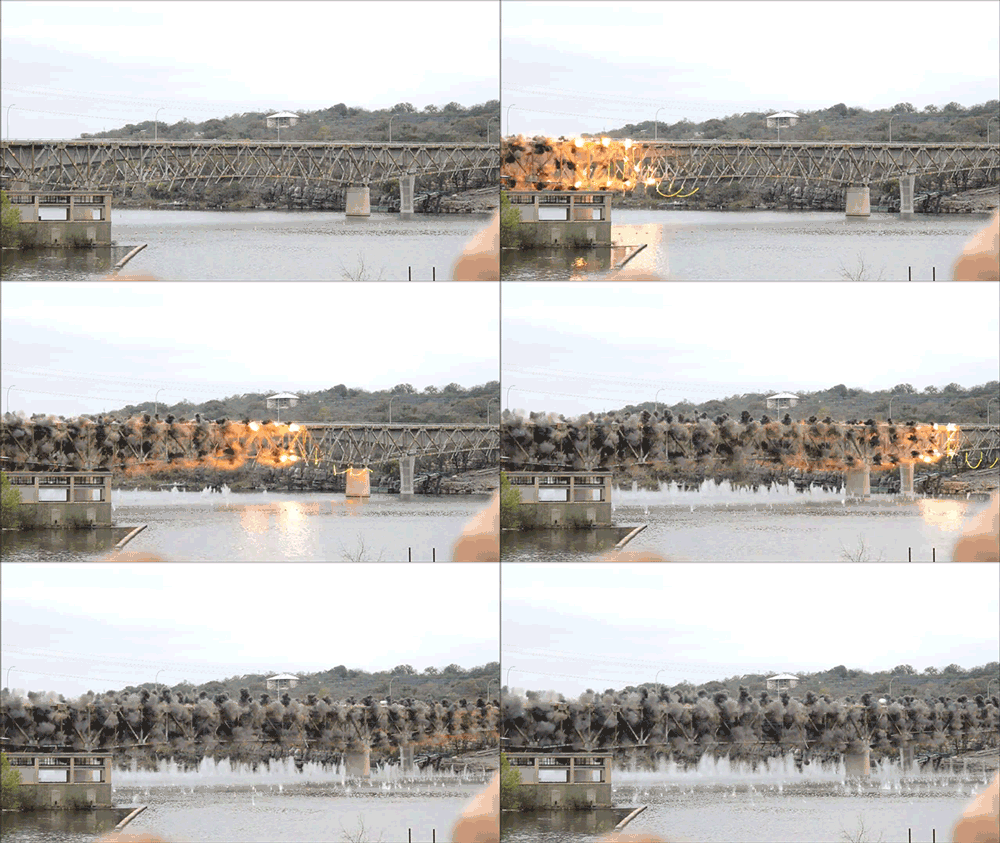
This position is an alternative to both prone supported and unsupported firing positions (Figure 7-1). The firer can assume a comfortable position while maintaining the same relationship between his body and the axis of the rifle. This position relaxes the stomach muscles and allows the firer to breathe naturally.

Figure 7-1. Alternate prone firing position.
7-2. KNEELING SUPPORTED FIRING POSITION
This position allows the soldier to obtain the height necessary to observe many target areas, taking advantage of available cover (Figure 7-2). Solid cover that can support any part of the body or rifle assists in firing accuracy.

Figure 7-2. Kneeling supported firing position.
7-3. KNEELING UNSUPPORTED FIRING POSITION
This position is assumed quickly, places the soldier high enough to see over small brush, and provides a stable firing position (Figure 7-3). The nonfiring elbow should be pushed forward of the knee so the upper arm is resting on a flat portion of the knee to provide stability. The trailing foot should be placed in a comfortable position.

Figure 7-3. Kneeling unsupported firing position.
7-4. STANDING FIRING POSITION
To assume the standing firing position, the soldier faces his target, executes a facing movement to his firing side, and spreads his feet a comfortable distance apart (Figure 7-4). With his firing hand on the pistol grip and his nonfiring hand on either the upper handguard or the bottom of the magazine, the soldier places the butt of the rifle in the pocket formed by his firing shoulder so the sights are level with his eyes. The weight of the rifle is supported by the firing shoulder pocket and nonfiring hand. The soldier shifts his feet until he is aiming naturally at the target and his weight is evenly distributed on both feet. The standing position provides the least stability but could be needed for observing the target area since it can be assumed quickly while moving. Support for any portion of the body or rifle improves stability. More stability can be obtained by adjusting the ammunition pouch to support the nonfiring elbow, allowing the rifle magazine to rest in the nonfiring hand.

Figure 7-4. Standing firing position.
7-5. MODIFIED SUPPORTED FIRING POSITION
Once the basic firing skills have been mastered during initial training, the soldier should be encouraged to modify positions, to take advantage of available cover, to use anything that helps to steady the rifle, or to make any change that allows him to hit more combat targets. The modified prone firing position uses sandbags to support the handguard and frees the nonfiring hand to be used on any part of the rifle to hold it steady (Figure 7-5).

Figure 7-5. Modified supported firing position.
7-6. URBAN OPERATIONS FIRING POSITIONS
Although the same principles of rifle marksmanship apply, the selection and use of firing positions during urban operations (UO) requires some special considerations. Firing from around corners could require the soldier to fire from the opposite shoulder to avoid exposing himself to enemy fire.
a. The requirement for long-range observation can dictate that positions be occupied that are high above ground. Figure 7-6 shows a soldier firing over rooftops, exposing only the parts of his body necessary to engage a target.
b. Figure 7-7 shows a soldier firing around obstacles. Figure 7-8 highlights the requirements for cover and rifle support and the need to stay in the shadows when firing from windows while making sure the muzzle of the rifle does not protrude out of the opening.

Figure 7-6. Firing over rooftops.

Figure 7-7. Firing around obstacles.

Figure 7-8. Firing from windows.
c. With minor modifications, the dry-fire exercises taught during preliminary marksmanship instruction can effectively train and evaluate a soldier’s ability to apply the fundamentals while in advanced firing positions. Repetitive training (muscle memory) will make the soldier knowledgeable in the types of corrections needed to keep the same point of aim consistently in all of the different firing positions. This increases first time target hits and soldier survivability.
7-7. MODIFIED AUTOMATIC AND BURST FIRE POSITION
Maximum use of available artificial support is necessary during automatic or burst fire. The rifle should be gripped more firmly and pulled into the shoulder more securely than when firing in the semiautomatic mode. This support and increased grip help offset the progressive displacement of weapon-target alignment caused by recoil. To provide maximum stability, prone and supported positions are best when firing the M16-/M4-series weapon in the automatic or burst fire mode. (If the weapon is equipped with the RAS, the use of the vertical pistol grip can further increase the control the soldier has over the weapon.) Figure 7-9 demonstrates three variations that can be used when firing in automatic or burst fire. The first modification shown involves forming a 5-inch loop with the sling at the upper sling swivel, grasping this loop with the nonfiring hand, and pulling down and to the rear while firing. The second modification involves grasping the small of the stock with the nonfiring hand and applying pressure down and to the rear while firing. The third modification shown is the modified machinegun position when a bipod is not available. Sandbags may be used to support the rifle. The nonfiring hand may be positioned on the rifle wherever it provides the most stability and flexibility. The goal is to maintain weapon stability and minimize recoil.

Figure 7-9. Modified automatic and burst fire positions.
Section II. COMBAT FIRE TECHNIQUES
The test of a soldier’s training is applying the fundamentals of marksmanship and firing skills in combat. The marksmanship skills mastered during training, practice, and record fire exercises must be applied to many combat situations (attack, assault, ambush, UO). Although these situations present problems, only two modifications of the basic techniques and fundamentals are necessary: changes to the rate of fire and alterations in weapon-target alignment. The necessary changes are significant and must be thoroughly taught and practiced before discussing live-fire exercises.
7-8. RAPID SEMIAUTOMATIC FIRE
The most important firing technique during modern, fast moving combat is rapid semiautomatic fire. Rapid-fire techniques are the key to hitting the short exposure, multiple, or moving targets described previously. If properly applied, rapid semiautomatic fire delivers a large volume of effective fire into a target area. The soldier intentionally fires a quick series of shots into the target area to assure a high probability of a hit. (Figure 7-10 shows the current training program for rapid semiautomatic fire.)

Figure 7-10. Rapid semiautomatic fire training program.
a. Effectiveness of Rapid Fire. When a soldier uses rapid semiautomatic fire properly, he sacrifices some accuracy to deliver a greater volume of effective fire to hit more targets. It is surprising how devastatingly accurate rapid fire can be. At ranges beyond 25 meters, rapid semiautomatic fire is superior to automatic fire in all measures (shots per target, trigger pulls per hit, and even time to hit). The decrease in accuracy when firing faster is reduced with proper training and repeated practice.
b. Control of Rapid Semiautomatic Fire. With proper training, the soldier can properly select the appropriate mode of fire; semiautomatic fire, rapid semiautomatic fire, or automatic/burst. Leaders must assure proper fire discipline at all times. Even in training, unaimed fire must never be tolerated, especially unaimed automatic fire.
c. Modifications for Rapid Fire. Increases in speed and volume should be sought only after the soldier has demonstrated expertise and accuracy during slow semiautomatic fire. The rapid application of the four fundamentals will result in a well-aimed shot every one or two seconds. This technique of fire allows a unit to place the most effective volume of fire in a target area while conserving ammunition. It is the most accurate means of delivering suppressive fire. Trainers must consider the impact of the increased rate of fire on the soldier’s ability to properly apply the fundamentals of marksmanship and other combat firing skills. These fundamentals and skills include:
(1) Marksmanship Fundamentals. The four fundamentals are used when firing in the rapid semiautomatic mode. The following differences apply:
(a) Steady Position. Good support improves accuracy and reduces recovery time between shots. A somewhat tighter grip on the hand guard assists in recovery time and in rapidly shifting or distributing fire to subsequent targets. When possible, the rifle should pivot at the point where the non-firing hand meets the support. The soldier should avoid changing the position of the non-firing hand on the support, because it is awkward and time consuming when rapidly firing a series of shots.
(b) Aiming. Sighting and stock weld do not change during rapid semiautomatic fire. The firer’s head remains on the stock for every shot, his firing eye is aligned with the rear aperture, and his focus is on the front sight post. In slow fire, the soldier seeks a stable sight picture. In the fast moving situations requiring rapid semiautomatic fire, the soldier must accept target movement, and unsteady sight picture, and keep firing into the target area until the target is down or there is no chance of a hit. Every shot must be aimed.
(c) Breath Control. Breath control must be modified because the soldier does not have time to take a complete breath between shots. He must hold his breath at some point in the firing process and take shallow breaths between shots.
(c) Trigger Squeeze. To maintain the desired rate of fire, the soldier has only a short period to squeeze the trigger (one well-aimed shot every one or two seconds). The firer must cause the rifle to fire in a period of about one-half of a second or less and still not anticipate the precise instant of firing. It is important that initial trigger pressure be applied as soon as a target is identified and while the front sight post is being brought to the desired point of aim. When the front sight post reaches the point of aim, final pressure must be applied to cause the rifle to fire almost at once. This added pressure, or final trigger squeeze, must be applied without disturbing the lay of the rifle. Repeated dry-fire training, using the Weaponeer device, and live-fire practice ensure the soldier can squeeze the trigger and maintain a rapid rate of fire consistently and accurately.
|
NOTE: |
The soldier can increase the firing rate by firing, then releasing just enough pressure on the trigger to reset the sear, then immediately fire the next shot. This technique eliminates some of the time used in fully releasing the pressure on the trigger. It allows the firer to rapidly deliver subsequent rounds. Training and practice sessions are required for soldiers to become proficient in the technique of rapid trigger squeeze. |
(2) Immediate Action. To maintain an increased rate of suppressive fire, immediate action must be applied quickly. The firer must identify the problem and correct the stoppage immediately. Repeated dry-fire practice, using blanks or dummy rounds, followed by live-fire training and evaluation ensures that soldiers can rapidly apply immediate action while other soldiers initiate fire.
d. Rapid-Fire Training. Soldiers should be well trained in all aspects of slow semiautomatic firing before attempting any rapid-fire training. Those who display a lack of knowledge of the fundamental skills of marksmanship should not advance to rapid semiautomatic training until these skills are learned and mastered. Initial training should focus on the modifications to the fundamentals and other basic combat skills necessary during rapid semiautomatic firing.
(1) Dry-Fire Exercises. Repeated dry-fire exercises are the most efficient means available to ensure soldiers can apply modifications to the fundamentals. Multiple dry-fire exercises are needed, emphasizing a rapid shift in position and point of aim, followed by breath control and fast trigger squeeze. Blanks or dummy rounds may be used to train rapid magazine changes and the application of immediate action. The soldier should display knowledge and skill during these dry-fire exercises before attempting live fire.
(2) Live-Fire Exercises. There are two types of live-fire exercises.
(a) Individual. Emphasis is on each soldier maintaining a heavy volume of accurate fire. Weapon downtime (during immediate action and rapid magazine changes) is kept to a minimum. Firing should begin at shorter ranges, progressing to longer ranges as soldiers display increased proficiency. Exposure or engagement times are shortened and the number of rounds increased to simulate the need for a heavy volume of fire. Downrange feedback is necessary to determine accuracy of fire.
(b) Collective. Rapid semiautomatic fire should be the primary means of delivering fire during a collective live-fire exercise (LFX). It is the most accurate technique of placing a large volume of fire on poorly defined targets or target areas. Emphasis should be on staggered rapid magazine changes, maintaining a continuous volume of fire, and conserving ammunition.
7-9. AUTOMATIC OR BURST FIRE
Automatic or burst fire delivers the maximum amount of rounds to a target area. It should be trained only after the soldier has demonstrated expertise during slow and rapid semiautomatic fire. Automatic or burst fire involves the rapid application of the four fundamentals while delivering from one to three rounds per second into a designated area. This technique of fire allows a unit to place the most fire in a target area (when conserving ammunition is not a consideration). It is a specialized technique of delivering suppressive fire and may not apply to most combat engagements. The M16A1/A3 and M4A1 rifle has a full automatic setting. (The M16A2/A4 and M4 use a three-round burst capability.) Soldiers must be taught the advantages and disadvantages of automatic firing so they know when it should be used. Without this knowledge in a life-threatening situation the soldier will tend to switch to the automatic or burst mode, which can be effective in some situations. It is vital for the unit to train and practice the appropriate use of automatic or burst fire. (Figure 7-11 shows the current training program for automatic or burst fire.)

Figure 7-11. Automatic or burst fire training program.
a. Effectiveness of Automatic or Burst Fire. Automatic or burst fire is inherently less accurate than semiautomatic fire. The first full-automatic shot fired may be on target, but recoil and a high-cyclic rate of fire often combine to place subsequent rounds far from the desired point of impact. Even controlled (three-round burst) automatic or burst fire may place only one round on the target. Because of these inaccuracies, it is difficult to evaluate the effectiveness of automatic or burst fire, and even more difficult to establish absolute guidelines for its use.
(1) Closely spaced multiple targets, appearing at the same time at 50 meters or closer, may be engaged effectively with automatic or burst fire. More widely spaced targets appearing at greater distances should be engaged with semiautomatic fire.
(2) The M16-series rifles and the M4-series should normally be employed in the semiautomatic mode. Depending on the tactical situation, the following conditions would be factors against the use of automatic or burst fire:
- Ammunition is in short supply or resupply may be difficult.
- Single targets are being engaged.
- Widely spaced multiple targets are being engaged.
- The distance to the target is beyond 50 meters.
- The effect of bullets on the target cannot be observed.
- Artificial support is not available.
- Targets may be effectively engaged using semiautomatic fire.
(3) In some combat situations, the use of automatic or burst fire can improve survivability and enhance mission accomplishment. Clearing buildings, final assaults, FPF, and ambushes may require limited use of automatic or burst fire. Depending on the tactical situation, the following conditions may favor the use of automatic or burst fire:
- Enough available ammunition. Problems are not anticipated with resupply.
- Closely spaced multiple targets appear at 50 meters or less.
- Maximum fire is immediately required at an area target.
- Tracers or some other means can be used to observe the effect of bullets on the target.
- Leaders can maintain adequate control over weapons firing on automatic.
- Good artificial support is available.
- The initial sound of gunfire disperses closely spaced targets.
(4) Trainers must ensure soldiers understand the capabilities and limitations of automatic or burst fire. They must know when it should and should not be used.
b. Modifications for the Automatic or Burst Fire Position. Trainers must consider the impact of the greatly increased rate of fire on the soldier’s ability to properly apply the fundamentals of marksmanship and other combat firing skills. These fundamentals and skills include:
(1) Immediate Action. To maintain automatic or burst fire, immediate action must be applied quickly. The firer must identify the problem and correct it immediately. Repeated dry-fire practice, using blanks or dummy rounds, followed by live-fire training and evaluation, ensures soldiers can rapidly apply immediate action.
(2) Marksmanship Fundamentals. The four fundamentals are used when firing in the automatic mode. The following differences apply:
(a) Steady Position. Maximum use of available artificial support is necessary during automatic or burst fire. The rifle should be gripped more firmly and pulled into the shoulder more securely than when firing in the semiautomatic mode. This support and increased grip help offset the progressive displacement of weapon-target alignment caused by recoil. To provide maximum stability, prone and supported firing positions are best (see Figure 7-9). One possible modification involves forming a 5-inch loop with the sling at the upper sling swivel, grasping this loop with the nonfiring hand, and pulling down and to the rear while firing. Another modification involves grasping the small of the stock with the nonfiring hand and applying pressure down and to the rear while firing. If a bipod is not available, sandbags may be used to support the rifle. The nonfiring hand may be positioned on the rifle wherever it provides the most stability and flexibility. The goal is to maintain weapon stability and minimize recoil.
|
NOTE: |
If the weapon is equipped with the RAS, using the vertical pistol grip can further increase the control the soldier has over the weapon. |
(b) Aiming. The aiming process does not change during automatic or burst fire. The firer’s head remains on the stock, his firing eye stays aligned with the rear sight aperture, and his focus is on the front sight post. Although recoil may disrupt this process, the firer must try to apply the aiming techniques throughout recoil.
(c) Breath Control. Breath control must be modified because the firer will not have the time to breathe between shots. He must hold his breath for each burst and adapt his breathing cycle, taking breaths between bursts.
(d) Trigger Squeeze. Training and repeated dry-fire practice will aid the soldier in applying proper trigger squeeze during automatic firing. Live-fire exercises will enable him to improve this skill.
- M16A1. Trigger squeeze is applied in the normal manner up to the instant the rifle fires. Because three-round bursts are the most effective rate of fire, pressure on the trigger should be released as quickly as possible. The index finger should remain on the trigger, but a quick release of pressure is necessary to prevent an excessive number of rounds from being fired in one burst. With much dry-fire practice, the soldier can become proficient at delivering three-round bursts with the squeeze-release technique.
- M16A2/3/4 and M4-series weapons. Trigger squeeze is applied in the normal manner up to the instant the rifle fires. Using the burst-mode, the firer holds the trigger to the rear until three rounds are fired. He then releases pressure on the trigger until it resets, then reapplies pressure for the next three-round burst.
|
NOTES: |
1. The trigger is not slapped or jerked. It is squeezed and pressure is quickly released. |
|
2. Depending on the position of the burst cam when the selector is moved to the burst mode, the rifle may fire one, two, or three rounds when the trigger is held to the rear the first time. If the rifle fires only one or two rounds, the firer must quickly release pressure on the trigger and squeeze again, holding it to the rear until a three-round burst is completed. |
d. Training of Automatic or Burst Fire Techniques. Initial training should focus on the modifications to the fundamentals and other basic combat skills necessary during automatic firing. Repeated dry-fire exercises are the most efficient means available to ensure soldiers can apply these modifications. Multiple dry-fire exercises are needed, emphasizing a stable position and point of aim, followed by breath control and the appropriate trigger squeeze. Blanks or dummy rounds may be used to train trigger squeeze, rapid magazine changes, and application of immediate action. The soldier should display knowledge and skill during these exercises before attempting live fire.
|
NOTE: |
Soldiers should be well trained in all aspects of slow semiautomatic firing before attempting any automatic training. Those who display a lack of knowledge of fundamental skills should not advance to automatic or burst fire training until these skills are learned. |
7-10. SUPPRESSIVE FIRE
In many tactical situations, combat rifle fire will be directed to suppress enemy personnel or weapons positions. Suppressive fire is rifle fire precisely aimed at a definite point or area target. Some situations may require a soldier to place suppressive fire into a wide area such as a wood line, hedgerow, or small building while, at other times, the target may be a bunker or window. Suppressive fire is used to control the enemy and the area he occupies. It is employed to kill the enemy or to prevent him from observing the battlefield or effectively using his weapons. When a sustained volume of accurate suppressive fire is placed on enemy locations to contain him, it can be effective even though he cannot be seen. Effectively pinning the enemy down behind cover reduces his ability to deliver fire and allows friendly forces to move. (Figure 7-12 shows the current training program for suppressive fire.)

Figure 7-12. Suppressive fire training program.
a. Nature of the Target. Many soldiers have difficulty delivering effective suppressive fire when they cannot see a definite target. They must fire at likely locations or in a general area where the enemy is known to exist. Even though definite targets cannot be seen, most suppressive fire should be well aimed. Figure 7-13 shows a landscape target suitable for suppressive fire training. When this type of target is used, trainers must develop a firing program to include areas of engagement and designated target areas be credited as sustained effective suppressive fire. At 25 meters, this target provides the firer an area to suppress without definite targets to engage.

Figure 7-13. Landscape target.
b. Point of Aim. Suppressive fire should be well-aimed, sustained, semiautomatic fire. Although lacking a definite target, the soldier must be taught to control and accurately deliver fire within the limits of the suppressed area. The sights are used as when engaging a point-type target with the front sight post placed so each shot impacts within the desired area (window, firing portal, tree line).
c. Rate of Fire. During most phases of live fire (grouping, zeroing, qualifying), shots are delivered using the slow semiautomatic rate of fire (one round every 3 to 10 seconds). During training, this allows a slow and precise application of the fundamentals. Successful suppressive fire requires that a faster but sustained rate of fire be used. Firing full automatic or bursts (13 rounds per second) for a few seconds may sometimes be necessary to gain initial fire superiority. Rapid semiautomatic fire (one round every one or two seconds) allows the firer to sustain a large volume of accurate fire while conserving ammunition. The tactical situation dictates the most useful rate of fire, but the following must be considered:
(1) Applying Fundamentals. As the stress of combat increases, some soldiers may fail to apply the fundamentals of marksmanship. This factor contributes to soldiers firing less accurately and without obtaining the intended results. While some modifications are appropriate, the basic fundamentals should be applied and emphasized regardless of the rate of fire or combat stress. Strategies to enhance marksmanship skills during combat stress include shooting prone as opposed to standing, and providing a high carbohydrate and or moderate sodium diet. Factors that contribute to combat stress are:
(a) Environmental. Environmental stressors have been shown to degrade marksmanship accuracy up to 20 percent. Such stressors include heat and altitude.
(b) Operational. Operational stressors have been shown to degrade marksmanship accuracy from 17 percent to 136 percent. Such stressors include MOPP gear; tasks that require carrying rucksacks, litter patients, and other equipment on the body; and sleep deprivation.
(2) Making Rapid Magazine Changes. One of the keys to sustained suppressive fire is reloading the rifle rapidly. Rapid magazine changes must be correctly taught and practiced during dry-fire and live-fire exercises until the soldier becomes proficient. Small-unit training exercises must be conducted so soldiers who are providing suppressive fire practice magazine changes that are staggered. Firing is, therefore, controlled and coordinated so that a continuous volume of accurate suppressive fire is delivered to the target area.
(3) Conserving Ammunition. Automatic or burst fire should be used sparingly and only to gain initial fire superiority. Depending on the tactical situation, the rate of fire should be adjusted so that a minimum number of rounds are expended. Accurate fire conserves ammunition, while preventing the enemy from placing effective fire on friendly positions.
7-11. QUICK FIRE
The two main techniques of directing fire with a rifle are to aim using the sights and to use weapon alignment, instinct, bullet strike, or tracers to direct the fire. The preferred technique is to use the sights, but sometimes quick reflex action is required. Quick fire is a technique used to deliver fast, effective fire on surprise personnel targets at close ranges (25 meters or less). Quick-fire procedures have also been referred to as instinctive firing or quick kill. (Figure 7-14 shows the current training program for quick fire.)

Figure 7-14. Quick fire training program.
|
NOTE: |
Quick fire will only be conducted by soldiers in basic training. Short-range marksmanship will be conducted at unit level. |
a. Effectiveness of Quick Fire. Quick-fire techniques are appropriate for soldiers, who are presented with close, suddenly appearing, surprise enemy targets; or when close engagement is imminent. Fire may be delivered in the SEMIAUTO or AUTOMATIC/BURST mode. For example, a point man in a patrol may carry the weapon on AUTOMATIC/BURST. This may also be required when clearing a room or bunker. Initial training should be in the SAFE mode. Two techniques of delivering quick fire are:
(1) Aimed. When presented with a target, the soldier brings the rifle up to his shoulder and quickly fires a single shot. His firing eye looks through or just over the rear sight aperture. He uses the front sight post to aim at the target (Figure 7-15). Using this technique, a target at 25 meters or less may be accurately engaged in one second or less.

Figure 7-15. Aimed quick fire.
(2) Pointed. When presented with a target, the soldier keeps the rifle at his side and quickly fires a single shot or burst. He keeps both eyes open and uses his instinct and peripheral vision to line up the rifle with the target (Figure 7-16). Using this technique, a target at 15 meters or less may be engaged in less than one second.

Figure 7-16. Pointed quick fire.
(a) The difference in speed of delivery between these two techniques is small. Pointed quick fire can be used to fire a shot about one-tenth of a second faster than aimed quick fire. The difference in accuracy, however, is more pronounced. A soldier well trained in pointed quick fire can hit an E-type silhouette target at 15 meters, although the shot may strike anywhere on the target. A soldier well trained in aimed quick fire can hit an E-type silhouette target at 25 meters, with the shot or burst striking 5 inches from the center of mass. This variance of target hit for this type of engagement reinforces the need for well-aimed shots.
(b) The key to the successful employment of either technique is practice. Both pointed and aimed quick fire must be repeatedly practiced during dry-fire training. Live-fire exercises provide further skill enhancement and illustrate the difference in accuracy between the two techniques. Tactical considerations dictate which technique is most effective in a given situation, and when single shot versus burst fire is used.
(c) Pointed and aimed quick fire should be used only when a target cannot be engaged fast enough using the sights in a normal manner. These techniques should be limited to targets appearing at 25 meters or less. Modern short-range combat (SRC) techniques emphasize carrying the rifle with the butt high, so the rifle sights can be brought into display as quickly as firing a hasty unaimed shot. In extremely dangerous moments, special reaction teams (SRTs) commonly advance with weapons shouldered, aiming as they advance.
b. Four Fundamental Modifications for Quick-Fire Techniques. Quick-fire techniques require major modifications to the four fundamentals of marksmanship. These modifications represent a significant departure from the normal applications of the four fundamentals. Initial training in these differences, followed by repeated dry-fire exercises, will be necessary to prepare the soldier for live fire.
(1) Steady Position. The quickness of shot delivery prevents the soldier from assuming a stable firing position. He must fire from his present position when the target appears. If the soldier is moving, he must stop. Adjustments for stability and support cannot be made before the round is fired.
(a) Aimed. The butt of the rifle is pulled into the pocket of the shoulder as the cheek comes in contact with the stock. Both hands firmly grip the rifle, applying rearward pressure. The firing eye looks through or just over the rear sight aperture. The firer’s sight is placed on the target.
(b) Pointed. The rifle is pulled into the soldier’s side and both hands firmly grip the rifle, applying rearward pressure.
(2) Aiming. This fundamental must be highly modified because the soldier may not have time to look through the rear sight, find the front sight, and align it with the target.
(a) Aimed. The soldier’s initial focus is on the target. As the rifle is brought up, the firing eye looks through or just over the rear sight aperture at the target. Using his peripheral vision, the soldier locates the front sight post and brings it to the center of the target. When the front sight post is in focus, the shot is fired. Focus remains on the front sight post throughout the aiming process.
(b) Pointed. The soldier’s focus is placed on the center or slightly below the center of the target as the rifle is aligned with it and is fired. The soldier’s instinctive pointing ability and peripheral vision are used to aid proper alignment.
|
NOTE: |
Using either aiming technique, bullets may tend to impact above the desired location. Repeated live-fire practice is necessary to determine the best aim point on the target or the best focus. Such practice should begin with the soldier using a center of mass aim. |
(3) Breath Control. This fundamental has little application to the first shot of quick fire. The round must be fired before a conscious decision can be made about breathing. If subsequent shots are necessary, breathing must not interfere with the necessity of firing quickly. When possible, use short, shallow breaths.
(4) Trigger Squeeze. Initial pressure is applied as weapon alignment is moved toward the target. Trigger squeeze is exerted so when weapon-target alignment is achieved, the round is fired at once. The soldier requires much training and practice to perfect this rapid squeezing of the trigger.
Section III. NUCLEAR, BIOLOGICAL, AND CHEMICAL FIRING
All soldiers must effectively fire their weapons to accomplish combat missions in an NBC environment. With proper training and practice, soldiers gain confidence in their ability to effectively hit targets in full MOPP equipment. MOPP firing proficiency must be part of every unit’s training program. (Figure 7-17 shows the current training program for NBC firing.)

Figure 7-17. NBC fire training program.
7-12. MOPP EQUIPMENT FIRE TRAINING
Firing weapons is only part of overall NBC training. Soldiers must first be familiar with NBC equipment, its use, and proper wear before they progress to learning the techniques of MOPP firing. Trainers must consider the impact of MOPP equipment (hood or mask, gloves, overgarments) on the soldier’s ability to properly apply the fundamentals of marksmanship and combat firing skills.
a. Operation and Function Modification. Handling the rifle, performing operation and function checks, loading and unloading, and cleaning are affected by MOPP equipment. Movements are slowed, tasks take longer to complete and often require more effort. Vision is impaired, and care is needed to avoid damaging MOPP equipment and possible exposure to lethal agents. Because of the great differences between no MOPP and MOPP4, soldiers must be trained in all aspects of operation and maintenance of the weapon while practicing at the highest MOPP level. Only through repeated training and practice can the soldier be expected to perform tasks efficiently.
b. Immediate Action. Under normal conditions a soldier should be able to clear a stoppage in three to five seconds. Under full MOPP, however, this may take as long as ten seconds to successfully complete. Dry-fire practice under these conditions is necessary to reduce time and streamline actions. Hood or mask and gloves must be worn. Care must be taken not to snag or damage the gloves or dislodge the hood or mask during movements. Applying immediate action to a variety of stoppages during dry fire must be practiced using dummy or blank ammunition until such actions can be performed by instinct.
(1) Vision is limited to what can be seen through the mask lenses or faceplate. Peripheral vision is severely restricted. The lenses or faceplate may be scratched or partly fogged, further restricting vision.
|
NOTE: |
Soldiers requiring corrective lenses must be issued insert lenses before training. |
(2) Scanning movement may be restricted by the hood or mask. Any of these factors could adversely affect the soldier’s ability to quickly and accurately detect targets. Additional skill practice should be conducted.
c. Marksmanship Fundamentals. Although the four marksmanship fundamentals remain valid during MOPP firing, some modifications may be needed to accommodate the equipment.
(1) Steady Position. Due to the added bulk of the over garment, firing positions may need adjustment for stability and comfort. Dry and live firing while standing, crouching, or squatting may be necessary to reduce bodily contact with contaminated ground or foliage. A consistent spot or stock weld is difficult to maintain due to the shape of the protective mask. This requires the firer to hold his head in an awkward position to place the eye behind the sight.
(2) Aiming. Wearing a protective mask may force firers to rotate (cant) the rifle to see through the rear aperture. The weapon should be rotated the least amount possible to see through and line up the sights. The center tip of the front sight post should be placed on the ideal aiming point. This ideal aiming procedure (Figure 7-18) should be the initial procedure taught and practiced.
(a) If this cannot be achieved, a canted sight picture may be practiced. The normal amount of cant needed by most firers to properly see through the sights has a limited influence on rounds fired at ranges between 75 meters or less.
(b) Rifle ballistics causes the strike of the bullet to impact low in the direction of the cant (when a cant is used) at longer ranges. Due to this shift in bullet strike and the many individual differences in sight alignment when wearing a protective mask, it is important to conduct downrange feedback training at ranges beyond 75 meters on known-distance ranges. This allows soldiers to determine what aiming adjustments are needed to achieve center target hits. Figure 7-19, shows what might be expected for a right-handed firer engaging a target at 175 meters with no cant and a certain amount of cant, and the adjustment in point of aim needed to move the bullet strike to the center of the target. Figure 7-20, shows what might be expected for a right-handed firer engaging a 300-meter target. The adjustments in point of aim for left-handed firers are the opposite of those shown in Figures 7-19 and 7-20.
(c) Although bullet strike is displaced when using a cant, individual differences are such that center-of-mass aiming should be used until the individual knows what aiming adjustment is needed. When distant targets are missed, a right-handed firer should usually adjust his point of aim to the right and high; a left-handed firer should adjust to the left and high. Then, the aiming rules are clear.
(d) All targets should initially be engaged by aiming center mass, regardless of cant. When targets are missed while using a cant, firers should adjust the point of aim higher and opposite the direction of the cant. Actual displacement of the aiming point must be determined by using downrange feedback targets at ranges beyond 75 meters.
(3) Breath Control. Breathing is restricted and more difficult while wearing the protective mask. Physical exertion can produce labored breathing and make settling down into a normal breathing rhythm much more difficult. More physical effort is needed to move around when encumbered by MOPP equipment, which can increase the breath rate. All these factors make holding and controlling the breath to produce a well-aimed shot more energy and time consuming. Emphasis must be placed on rapid target engagement during the limited amount of time a firer can control his breath.
(4) Trigger Squeeze. Grasping the pistol grip and squeezing the trigger with the index finger is altered when the firer is wearing MOPP gloves. The action of the trigger finger is restricted, and the fit of the glove may require the release of the swing-down trigger guard. Because the trigger feels different, control differs from that used in barehanded firing. This difference cannot be accurately predicted. Dry-fire training using dime-washer exercises is necessary to ensure the firer knows the changes he will encounter during live fire.

Figure 7-18. Sight picture when canting the rifle
while wearing a protective mask (75-meter target).

Figure 7-19. Engagement of 175-meter target.

Figure 7-20. Engagement of 300-meter target.
7-13. NBC DRY-FIRE AND LIVE-FIRE EXERCISES
Repeated dry-fire training and live-fire exercises are the most efficient means to prepare the soldier for successful target engagements at any range while in MOPP4 during MILES exercises and in live-fire training. The soldier must follow these procedures and applications to be combat effective in a NBC environment.
a. NBC Dry-Fire Exercises. As with all marksmanship training, the soldier must start at the basics in order to become proficient at NBC fire. Modified fundamentals can be taught anywhere and are done before the soldier does a live-fire exercise. The dry-fire exercises, which are used during NBC training, are the same ones that are used during initial rifle marksmanship (dime-washer exercise, target box, SPORTS, and Weaponeer). The soldier must conduct dry-fire exercises in MOPP4 so he can train at the highest degraded level and adjust his shooting technique to increase his marksmanship ability in a NBC environment. The instructor-trainer can be imaginative in his modifications of the dry-fire exercises to challenge the soldier and improve his marksmanship skills while making the training interesting.
b. NBC 50-Meter Live-Fire Exercise. The basic NBC live-fire exercise allows all soldiers to gain confidence in their abilities to effectively engage targets in a NBC environment. Practice and proficiency firing can be conducted on any range. Practice can also be accomplished by the use of MILES equipment during force on force training. When a Remote Electronic Target System (RETS) range is used for this exercise the two 50-meter mechanisms are used. For the NBC live-fire exercise, the soldier will perform the following scenario after the command of “GAS – GAS – GAS” is given.
(1) Each soldier will be issued 20 rounds of ammunition.
(2) The soldier engages targets from 50 to 300 meters from the foxhole supported firing position using Table II of the Record Fire Qualification firing table (DA Form 3595-R).
(3) Each soldier must achieve 11 hits out of 20 target exposures.
c. NBC Alternate Fire Exercise. The NBC alternate fire course uses the 25-meter scaled silhouette timed-fire target. The benefits of using the 25-meter scaled silhouette is that it can be used on any 25-meter range, the target provides feedback to the firer on where the strike of the round impacts the target, and it increases the soldier’s knowledge and skill in delivering accurate well-aimed fire using the modified NBC fundamentals. It is conducted in the same manner as the 25-meter alternate course. This exercise is scored as a GO/NO GO.
d. NBC Downrange Feedback. The purpose of the NBC downrange feedback is to give the soldier confidence, knowledge, and skills required to consistently deliver accurate, well-aimed fire against combat targets out to 300 meters in MOPP equipment while using the modified fundamentals associated with NBC firing. On a KD range, the soldier will perform the following scenario:
(1) The soldier will be issued six magazines. The first and second magazine will have 5 rounds each, the third magazine and fourth will have 10 rounds each, and the fifth and sixth magazine will have 5 rounds each.
(2) The soldier engages the 75-meter (100-yard) target with one 5-round magazine from the prone supported position. He then engages the 75-meter target from the prone unsupported position with the second 5-round magazine.
(3) The soldier engages the 175-meter (200-yard) target with one 10-round magazine from the prone supported firing position and then engages the 175-meter target from the prone unsupported firing position with the second 10-round magazine.
(4) The soldier engages the 300-meter target with one five-round magazine from the prone supported firing position and again engages the 300-meter target from the prone unsupported firing position using the last 5-round magazine.
(5) The soldier must obtain 8 hits out of 10 shots on the 75-meter target; 14 hits out of 20 shots on the 175-meter target; and 5 hits out of 10 shots on the 300-meter target.
|
NOTES: |
1. The KD range scorecard is used for the NBC KD range. |
|
2. The ammunition allocated for advanced skill training can be used for the NBC downrange feedback scenario. |
Section IV. NIGHT FIRE TRAINING
All units must be able to fight during limited visibility. All soldiers must know how to employ their weapons during such time. Soldiers must experience the various conditions of night combat from total darkness to the many types of artificial illumination. All units must include basic, unassisted night fire training annually in their unit marksmanship programs. Combat units should conduct tactical night fire training at least quarterly. This tactical training should include MILES, during force-on-force training, as well as live-fire training. The many effects darkness has on night firing are discussed in this section. This section will provide units guidance on training soldiers to be effective in total darkness without using iron sights and using iron sights during limited visibility. (Figure 7-21 shows the current training program for unassisted night fire training.) (See Appendix H for more detailed information on night fighting.)

Figure 7-21. Unassisted night fire training program.
7-14. UNASSISTED NIGHT FIRE TRAINING
Trainers must consider the impact of limited visibility on the soldier’s ability to properly apply the fundamentals of marksmanship and combat firing skills. During limited visibility, a firer cannot generally use his sights in most situations and without artificial illumination the sights block his field of vision. These fundamentals and skills include:
a. Operation and Maintenance of the Weapon. Handling the weapon, performing operation and function checks, loading and unloading, and maintenance are all affected by nighttime conditions. Movements are slower, tasks take longer to complete, vision is impaired, and equipment is more easily misplaced or lost. Because combat conditions and enforcement of noise and light discipline restrict the use of illumination, soldiers must be trained to operate, service, and clean their weapons in total darkness. Although initial practice of these tasks should occur during daylight to facilitate control and error correction, repeated practice during actual nighttime conditions should be integrated with other training. Only through repeated practice and training can the soldier be expected to perform all tasks efficiently.
b. Immediate Action. Under normal conditions, a soldier should clear a stoppage in three to five seconds. After dark this task usually takes longer. Identifying the problem may be difficult and frustrating for the soldier. A hands-only technique of identifying a stoppage must be taught and practiced. Clearing the stoppage using few or no visual indicators must also be included. The firer must practice applying immediate action with his eyes closed. Dry-fire practice (applying SPORTS) using dummy or blank rounds under these conditions is necessary to reduce time and build confidence. Training should be practiced first during daylight for better control and error correction by the trainer. Once the soldier is confident in applying immediate action in darkness, he can perform such actions rapidly on the firing line.
c. Marksmanship Fundamentals. The four marksmanship fundamentals apply to night firing. Some modifications are needed depending on the conditions. The firer must still place effective fire on the targets or target areas that have been detected.
(1) Steady Position. When the firer is firing unassisted, changes in his head position and or stock weld will be necessary, especially when using weapon-target alignment techniques. His head is positioned high so that he is aligning his weapon on the target and looking just over the iron sights. His cheek should remain in contact with the stock. Repeated dry-fire practice, followed by live-fire training, is necessary to learn and refine these modifications and still achieve the steadiest position.
(2) Aiming. Modifications to the aiming process vary. When firing unassisted, the firer’s off-center vision is used instead of pinpoint focus. Both eyes are open to gather the maximum available light, and are focused down range.
(4) Trigger Squeeze. This fundamental is not affected by unassisted night fire conditions. The objective is to not disrupt alignment of the weapon with the target.
d. Unassisted Night Firing Positions. The recommended firing position for use during limited visibility is the supported firing position. This position, when used during limited visibility, differs slightly from the supported position taught in earlier periods of instruction because the firer cannot use his sights during limited visibility; in fact, the sights block his field of vision. To effectively engage targets during limited visibility, the firer assumes a supported firing position, establishes a raised stock weld (looks 2 to 3 inches above the sights level with the barrel), points the weapon at the target, and fires in the semiautomatic mode. To obtain optimum results, the firer should keep his eyes open, and his head, arms, and rifle should move as one unit.
e. Unassisted Night Fire. The firer must detect and engage targets without artificial illumination or night vision devices. Potential target areas are scanned. When the target is detected, the firer should engage it using a modified quick-fire position. The firer should take a few seconds to improve weapon-target alignment by pointing slightly low to compensate for the usual tendency to fire high (Figure 7-22). Tracer ammunition may provide feedback on the line of trajectory and facilitate any adjustments in weapon-target alignment.

Figure 7-22. Lower weapon-target alignment.
7-15. UNASSISTED NIGHT FIRE TARGET DETECTION
Trying to detect a target during the day is difficult enough but at night it becomes even more so. In order for an individual to see targets at night, he must apply the three principles of night vision.
a. Dark Adaptation. This process conditions the eyes to see under low levels of illumination. The eyes of the average person take about 30 minutes to acquire 98 percent night vision in a completely darkened area. Moving from illuminated to darker areas will decrease night vision until the eyes have adjusted to the surrounding area again.
b. Off-Center Vision. During the daytime when an individual looks at an object, he looks directly at it. However, if he did this at night he would only see the object for a few seconds. In order to see this object for any length of time, he must look 6 to 10 degrees from this object (Figures 7-23 and 7-24) while concentrating his attention on the object. This allows the light sensitive area of the eye, which can detect faint light sources or reflection, to be used.
c. Scanning. The act of scanning relates to the short, abrupt, irregular movement of the firer’s eyes every 4 to 10 seconds around an object or area. Be aware that scanning ranges vary according to levels of darkness.

Figure 7-23. Daytime field of view using pinpoint focus.

Figure 7-24. Nighttime field of view using off-center vision
7-16. TRAINING WITH ARTIFICIAL ILLUMINATION
The soldier should be able to fire his weapon effectively in total darkness, in bright sunlight, and under all conditions between these two extremes. Provide a variety of night and limited visibility conditions when marksmanship training is scheduled. The battlefield may be illuminated by ground flares, hand held flares, M203 flares, mortar and artillery illumination, aerial flares, searchlights, exploding rounds, burning vehicles, and so forth. The battlefield may be obscured by smoke, fog, and various environmental conditions. The well-trained soldier should have experienced a number of these conditions and be confident that he can effectively employ his weapon when required. (Figure 7-25 shows the current training program for artificial illumination training.)

Figure 7-25. Artificial illumination training program.
a. When artificial illumination is used, the eyes lose most of their night adaptation and off-center vision is no longer useful. Aiming is accomplished as it is during the day. Artificial illumination allows the firer to use the iron sights as he does during the day using the 0-2 rear sight aperture.
b. Engaging targets under artificial illumination allows for better target detection and long-range accuracy than the unassisted technique. When the light is gone, time must be spent in regaining night vision and adaptation. Only when the level drops enough so that the target cannot be seen through the iron sights should the firer resume short-range scanning, looking just over the sights.
c. To preserve night vision while artificial illumination is being used, the soldier closes his firing eye and scans his sector for enemy targets with his nonfiring eye. This allows the soldier to have night vision in at least one eye after the artificial illumination has burned out to keep scanning his sector for enemy targets. However, keeping one eye closed to preserve its night vision results in a drastically altered sense of perception when both eyes are opened following illumination burnout. Repeated dry-fire training and target detection practice are the keys to successful engagement of targets out to 250 meters or more during live-fire under artificial illumination.
7-17. UNASSISTED NIGHT DRY-FIRE AND LIVE-FIRE EXERCISES
Repeated dry-fire training, target detection, and live-fire exercises are the most efficient means to ensure the soldier can successfully engage short-range targets. The soldier must adhere to the following procedures and applications to be effective in combat.
a. Night Dry-Fire Exercises. These exercises are the same as the day dry-fire exercises (load, SPORTS, rapid magazine change, and clear). Repeated training and dry-fire practice are the most effective means available to ensure all soldiers can function efficiently after dark. Dry-fire exercises should be conducted before the first live round is fired.
b. Unassisted Night Live-Fire Exercises. The basic unassisted live-fire exercise allows all soldiers to apply night fire principals and to gain confidence in their ability to effectively engage targets out to 50 meters. Practice and proficiency firing can be conducted on any range equipped with mechanical lifters and muzzle flash simulators (Figure 7-26). The muzzle flash simulator provides the firer with a momentary indication that a target is presenting itself for engagement. Practice can also be accomplished using MILES equipment. When a RETS range is used for this exercise the two 50-meter mechanisms are used. For the unassisted night live-fire exercise, the soldier will perform the following scenario:
(2) The soldier engages the F-type silhouette target at 50 meters while in the foxhole supported firing position. The soldier uses one magazine of 15 rounds (10 rounds ball; 5 rounds tracer). The soldier will detect and engage 15 target exposures at 50 meters.
(3) The F-type silhouette target is engaged at 50 meters from the prone unsupported position. The soldier uses a second magazine of 15 rounds (10 rounds ball; 5 rounds tracer). The soldier will detect and engage 15 target exposures at 50 meters.
(4) Each soldier must achieve 7 hits out of 30 target exposures.

Figure 7-26. Night-fire target.
(5) When the automated range is used, the soldier’s performance is recorded in the tower. If automatic scoring is not available, a coach can observe and score the number of target hits the firer achieves using NVDs.
c. Unassisted Night Live-Fire Exercise with Artificial Illumination. The unassisted live-fire exercise with artificial illumination allows all soldiers to apply night fire principals and to gain confidence in their abilities to effectively detect and engage targets out to 150 meters and beyond with artificial illumination using the night record fire scenario:
(1) Each soldier will be issued two 15-round magazines with the appropriate tracer and ball combination.
(2) During night, each soldier will detect and or engage 20 E-type silhouette target exposures from 50 to 250 meters with one magazine of 15 rounds (10 rounds ball; 5 rounds tracer) while in the foxhole supported firing position.
(3) During night, each soldier will detect and or engage 20 E-type silhouette target exposures from 50 to 250 meters with the second magazine of 15 rounds (10 rounds ball; 5 rounds tracer) while in the prone unsupported firing position.
(5) It is important for the soldier to understand that all of the exposed targets do not have to be engaged by fire. The soldier may hone his target detection skills on the distant targets and engage them only when he is confident of achieving a hit. This allows the soldier to understand his limitations, his skill level, and skills that he needs to work on to improve his nighttime marksmanship ability. (Refer to Appendix F for more information on the night record fire table.)
Section V. MOVING TARGET ENGAGEMENT
In combat situations, enemy soldiers do not stand still. The enemy moves by rushes from one covered or concealed position to another. While making the rush, the enemy soldier presents a rapidly moving target. However, for a brief time as he begins, movement is slow since many steps are needed to gain speed. Many steps are needed to slow down at the new position. A moving target is open to aimed fire both times. (Figure 7-27 shows the current training program for moving target engagement training.)

Figure 7-27. Moving target engagement training program.
7-18. MOVING TARGET FUNDAMENTALS
The fundamentals needed to hit moving targets are similar to those needed to hit stationary targets. The main skill is to engage moving targets with the least changes to procedures. Soldiers in combat do not know if their next target will be stationary or moving, they must fire immediately at whatever target occurs.
a. The fundamentals for engaging stationary targets (steady position, aiming, breath control, and trigger squeeze) are also used to engage moving targets. Considering the environment and the variables of the rifle and ammunition, the well-trained soldier should be able to hit 300-meter stationary silhouette targets. When the target has lateral movement, hits at 150 meters may be 7 out of 10 times, which is a good performance. Therefore, twice as much variability, twice as much dispersion, and a few more erratic shots are expected when soldiers are trained to hit moving targets.
(1) Steady Position. When firing from a firing position, the firer should be in the standard supported position and flexible enough to track any target in his sector. When a target is moving directly at the firer, directly away, or at a slight angle, the target is engaged without changing the firing position. When targets have lateral movement, only minor changes are needed to allow effective target engagement. Most moving targets are missed in the horizontal plane (firing in front of or behind the target) and not in the vertical plane (firing too low or too high). A smooth track is needed on the target, even if the support arm must be lifted. Other adjustments include the following:
(a) Nonfiring Hand. The grip of the nonfiring hand may need to be increased and more pressure applied to the rear. This helps to maintain positive control of the rifle and steady it for rapid trigger action.
(b) Nonfiring Elbow. The nonfiring elbow is lifted from the support position only to maintain a smooth track.
(c) Firing Hand. Rearward pressure may be applied to the pistol grip to steady the rifle during trigger squeeze.
(d) Firing Elbow. The firing elbow is lifted from support only to help maintain a smooth track.
|
NOTE: |
The rifle pocket in the shoulder and the stock weld are the same as for stationary targets. |
(2) Aiming. The trailing edge of the front sight post is at target center.
(3) Breath Control. Breathing is locked at the moment of trigger squeeze.
(4) Trigger Squeeze. Rearward pressure on the handguard and pistol grip is applied to hold the rifle steady while pressure is applied to the trigger. The trigger is squeezed fast (almost a controlled jerk). Heavy pressure is applied on the trigger (at least half the pressure it takes to make the rifle fire) before squeezing.
b. The procedures used to engage moving targets vary as the angle and speed of the target vary. For example, when a target is moving directly at the firer, the same procedures are used as would be used if the target were stationary. However, if it is a close, fast-moving target at a 90-degree angle, the rifle and entire upper body of the firer must be free from support so the target can be tracked.
7-19. SINGLE-LEAD RULE FOR MOVING TARGETS
For the firer to apply precise lead rules he must accurately estimate speed, angle, and range to the target during the enemy soldier’s brief exposure. The single-lead rule (place the trailing edge of the front sight post at target center) places effective fire on most high-priority combat targets. At 100 meters, the rule begins to break down for targets moving at slight and large angles.
a. Lead Requirements. To effectively engage moving targets on the battlefield, soldiers must understand lead requirements. Figure 7-28 shows the amount of lead required to hit a 300-meter target moving 8 miles per hour at a 90-degree angle. Aiming directly at the target would result in missing it. When an enemy soldier is running 8 miles per hour, 90 degrees to the firer, and at a range of 300 meters, he covers 4 1/2 feet while the bullet is traveling toward him. To get a hit, the firer must aim and fire at position D when the enemy is at position A. This indicates the need for target lead and for marksmanship trainers to know bullet speed and how it relates to the range, angle, and speed of the target. Soldiers must understand that targets moving fast and laterally must be led by some distance if they are to be hit.

Figure 7-28. Lead requirement based on distance and approach angle.
(1) To hit a target moving laterally, the firer places the trailing edge of the front sight post at target center. (The sight-target relationship is shown in Figure 7-29.) The single-lead rule automatically increases the lead as the range to the target increases. (Figure 7-30, shows how this works, with the front sight post covering about 1.6 inches at 15 meters and about 16 inches at 150 meters.) Since the center of the front sight post is the actual aiming point, placing the trailing edge of the front sight post at target center provides a .8-inch lead on a 15-meter target and an 8-inch lead on a target at 150 meters.
(2) This rule provides a dead-center hit on a 15-meter target moving at 7 miles per hour at a 25-degree angle because the target moves .8 inches between the time the rifle is fired and the bullet arrives at the target. A 150-meter target moving at 7 miles per hour at a 25-degree angle moves 8 inches between the time the weapon is fired and the bullet arrives. This rule provides for hits on the majority of high priority combat targets.

Figure 7-29. Single-lead rule.

Figure 7-30. Lead increasing at greater ranges.
b. Target Speed. Figure 7-31 reflects the differences in lateral speed for various angles of target movement for a target traveling at 8 miles per hour at a distance of 150 meters from the firer. The angle of target movement is the angle between the target-firer line and the target’s direction of movement. An 8-mile-per-hour target moves 24 inches during the bullet’s flight time. If the target is moving on a 15-degree angle, it moves 6 inches (the equivalent of 2 miles per hour).

Figure 7-31. Target movement (distance) at various angles.
(2) Since the target lead is half the perceived width of the front sight post, at 100 meters the standard sight provides 5.4 inches of lead for the M16A1/2/3/4 and M4 front sights (Table 7-1).

Table 7-1. Angle of target movement.
c. Target Distance. The front sight post covers only a small part of close-in targets, providing hits on close targets moving at any angle and any speed. However, if the lead rule is applied on more distant targets moving at a slight angle-for example, 5 degrees at 100 meters-the bullet strikes forward of target center, about 4 inches with standard sights and about 7 inches with LLLSS sights. Soldiers must be taught to fire at targets as though they are stationary until lateral movement is observed (15 degrees).
(1) The rule provides for many speed-angle combinations that place the bullet within 2 inches of target center (Table 7-1). Since the soldier is expected to fire a 12-inch group on moving targets at 100 meters, the rule provides for hits on the majority of targets. Even the worst case (a 90-degree target moving at 8 miles per hour) would result in the shot-group center being located 9.8 inches behind target center. If bullets were evenly distributed in a 12-inch group, this would result in hitting the target 40 percent of the time.
(2) Soldiers should be taught to increase their lead if they miss the targets, which increases their probability of hitting all targets. The amount of additional lead required should be developed through experience with only general guidance provided. For example, if there is much lateral movement of the target and the soldier feels, by applying the lead rule and firing fundamentals, he has missed the target, he should increase his lead.
(3) The training program must be simple and provide soldiers with only relevant information to improve their performance in combat. All soldiers should understand and apply the single-lead rule in the absence of more information. Soldiers should understand that moving targets coming toward them or on a slight angle (0 to 15 degrees) should be engaged as stationary targets. Information should be presented and practice allowed on applying additional lead to targets for soldiers who demonstrate this aptitude.
d. Target Angle. The single-lead rule does not apply to targets moving at small and large angles (Table 7-2).
(1) A walking enemy soldier at 250 meters is hit dead center when he is moving at 40 degrees. Hits can be obtained if he is moving on any angle between 15 and 75 degrees. When he is running, a center hit is obtained when the target is on an angle of 18 degrees; misses occur when he exceeds an angle of 30 to 35 degrees.
(2) The information provided in Figure 7-31 and Table 7-1 is designed to enhance instructor understanding so proper concepts are presented during instruction. For example, a target at 100 meters moving at 6 miles per hour receives a center hit when moving at 29 degrees. When moving at an angle less than 29 degrees, the bullet strikes somewhat in front of target center. When moving at an angle of more than 29 degrees, the bullet strikes somewhat behind target center.

Table 7-2. Target angle when dead center;
hits occur using the single-lead rule.
7-20. MOVING TARGET LIVE-FIRE EXERCISE
A firing scenario is engaged once for practice and then for qualification. Soldiers who fail to qualify on the initial day of qualification receive only one refire the same day.
7-21. MOVING TARGET TECHNIQUES
The two primary techniques of engaging moving targets are tracking and trapping.
a. Tracking is a more accurate technique of engaging targets by experienced firers. It involves establishing and maintaining an aiming point in relationship to the target and maintaining that sight picture (moving with the target) while squeezing the trigger. As the target moves, this technique puts the firer in position for a second shot if the first one misses.
b. Trapping is the setting up of an aiming point forward of the target and along the target path. The trigger is squeezed as the target comes into the sights. This is a technique that works on targets with slow lateral movement. It does not require tracking skills. It does require that the firer know precisely when the rifle is going to fire. Some soldiers can squeeze the trigger without reacting to the rifle firing, and they may fire better using this technique. Another technique is to use a modified 25-meter scaled timed-fire silhouette (Figure 7-32). Trainers evaluate performance based on where shot groups are placed when the lead rule is applied. This target can be used for both the M16-series rifles, and the M4 carbine.

Figure 7-32. Timed-fire targets.
Section VI. SHORT-RANGE MARKSMANSHIP TRAINING
Short-range marksmanship (SRM) training provides the individual soldier with the ability to quickly and effectively engage targets at ranges less than 50 meters. A soldier’s ability to successfully identify, discriminate, and engage targets during short-range combat (SRC) is essential for soldier survival and mission accomplishment. Although normally associated with UO, SRM techniques are also used during operations in restrictive terrain such as clearing a trench line, the final assault across an objective during an attack or raid, or when fighting in dense vegetation or during periods of limited visibility. Short-range marksmanship instruction consists of four components: Phase I, reflexive firing training (blank fire day and night); Phase II, target discrimination (blank fire day and night); Phase III, marksmanship qualification (day and night live fire); and Phase IV, shotgun and automatic firing familiarization. (Figure 7-33 shows a current training program for SRM training.)

Figure 7-33. Short-range marksmanship training program.
|
NOTE: |
This section addresses the components of SRM not found in doctrinal manuals. SRC TTPs addressed in Appendix K of FM 3-06.11 are addressed as a component of this section for shoot house training. |
7-22. CONDUCT OF SHORT-RANGE MARKSMANSHIP TRAINING
Short-range marksmanship requires individual infantrymen to be trained to standard in reflexive firing, target discrimination, and on all necessary BRM fundamentals prior to semi-annual qualification. An explanation of the base level proficiency requirements is provided with each course of fire. As a minimum, infantrymen should be qualified on their individual weapon within the previous six months. Shotgun and automatic firing is required for annual familiarization only. Reflexive MILES dry-fire drills are an essential part of the training process and should be conducted by the team leader or squad leader during troop-leading procedures and before any SRC or SRM training.
7-23. FUNDAMENTALS OF SHORT-RANGE MARKSMANSHIP
During SRC, there is little or no margin for error. Too slow a shot at the enemy, too fast a shot at a noncombatant, or inaccurate shots can all be disastrous for the soldier. There are four fundamentals: proper weapon ready positions and firing stance, aiming technique, aim point, and trigger manipulation. Mastery of these fundamentals is key to the soldier’s ability to survive and accomplish his mission in close quarters. All SRC- and SRM-related training should begin with a review of the principles of safe weapon handling-assume the weapon is always loaded and never point the weapon at anything you do not intend to destroy.
a. Firing Stance and Ready Positions. Regardless of the ready position used, soldiers must always assume the correct firing stance to ensure stability and accuracy when engaging targets. The two weapon ready positions are the high ready and low ready
(1) Firing Stance. The feet are kept approximately shoulder-width apart. Toes are pointed straight to the front (direction of movement). The firing side foot is slightly staggered to the rear of the nonfiring side foot. Knees are slightly bent and the upper body is leaned slightly forward. Shoulders are square and pulled back, not rolled over or slouched. The head is up and both eyes are open. When engaging targets, the gunner holds the weapon with the butt of the weapon firmly against his shoulder and the firing side elbow close against the body (Figures 7-34 and 7-35).
(2) High Ready Position (Figure 7-34). The butt of the weapon is held under the armpit, with the barrel pointed slightly up so that the top of the front sight post is just below the line of sight but still within the gunner’s peripheral vision. The nonfiring hand grasps the handguards toward the front sling swivel, the trigger finger is outside of the trigger well, and the thumb of the firing hand is on the selector lever. To engage a target from the high ready, the gunner pushes the weapon forward as if to bayonet the target and brings the butt stock firmly against the shoulder as it slides up the body. This technique is best suited for the lineup outside of a building, room, or bunker entrance.
(3) Low Ready Position (Figure 7-35). The butt of the weapon is placed firmly in the pocket of the shoulder with the barrel pointed down at a 45-degree angle. The nonfiring hand grasps the handguards toward the front sling swivel, the trigger finger is outside of the trigger well, and the thumb of the firing hand is on the selector lever. To engage a target from the low ready, the gunner brings the weapon up until the proper sight picture is achieved. This technique is best suited for movement inside of buildings.
(4) Movement Techniques. Soldiers must practice moving with their weapons up until they no longer look at the ground but concentrate on their sectors of responsibility. Soldiers must avoid stumbling over their own feet. The low ready method is the best method to use when moving or turning. To execute a left turn the soldier places his firing foot forward, shifts all his weight to the firing foot, and pivots, bringing the non-firing foot forward to complete the turn. To turn to the right the firing foot is to the rear, the weight is evenly distributed between the feet, and the body pivots on both feet. To turn to the rear, the firing foot is forward, the weight is placed on the firing foot and the body pivots similar to the drill movement “rear march.”
(5) Kneeling Position. Although short-range engagements generally take place from the standing position a soldier may be required to engage targets from the kneeling position. The kneeling position is generally used when correcting a weapons malfunction.

Figure 7-34. Weapon held at the high ready.

Figure 7-35. Weapon held at the low ready.
b. Aiming Techniques. Four aiming techniques are used during SRC. Each has advantages and disadvantages and the soldier must understand when, how, and where to use each technique.
(1) Slow Aimed Fire. This technique is the slowest but most accurate. It consists of taking a steady position, properly aligning the sight picture, and squeezing off rounds. This technique should only be used to engage targets in excess of 25 meters when good cover and concealment is available or when the need for accuracy overrides the need for speed.
(2) Rapid Aimed Fire. This technique utilizes an imperfect sight picture. When using this technique the soldier focuses on the target and raises his weapon until the target is obscured by the front sight post assembly. Elevation is less critical than windage when using this technique. This aiming technique is extremely effective on targets from 0 to 15 meters and at a rapid rate of fire.
(3) Aimed Quick Kill. The aimed quick kill technique is the quickest and most accurate method of engaging targets up to 12 meters. Experienced soldiers may use the technique at greater ranges, as they become familiar with it. When using this technique, the soldier aims over the rear sight, down the length of the carry handle, and places the top 1/2 to 3/4 of an inch of the front sight post assembly on the target.
(4) Instinctive Fire. This is the least accurate technique and should only be used in emergencies. It relies on instinct, experience, and muscle memory. The firer concentrates on the target and points the weapon in the general direction of the target. While gripping the handguards with the nonfiring hand he extends the index finger to the front, automatically aiming the weapon on a line towards the target.
c. Aim Point. Short-range engagements fall into two categories based on the mission and hostile threat. Most short-range engagements will be decided by who hits his target with the first round first. During this type of engagement it is more important to knock the enemy soldier down as quickly as possible than it is to kill him immediately. During this type of engagement soldiers must aim at the “lethal zone” (center mass) of the target as in regular rifle marksmanship. Although shots to the center of the target may prove to be eventually fatal they may not immediately incapacitate the enemy. During SRC a shot that does not immediately incapacitate the enemy may be no better than a clean miss. Because of this, and the possible presence of military equipment or protective vests, soldiers must be able to not only engage soldiers in the “lethal zone” but also to engage them with “incapacitating” shots.
(1) Lethal Shot Placement. The lethal zone of the target is center mass between the waist and the chest. Shots in this area maximize the hydrostatic shock of the round (Figure 7-36). Due to the nature of SRC, soldiers must continue to engage targets until they go down.

Figure 7-36. Lethal zone aim point.
(2) Incapacitating Shot Placement (Figure 7-37). The only shot placement that guarantees immediate and total incapacitation is one roughly centered in the face, below the middle of the forehead and the upper lip, and from the eyes in. Shots to the side of the head should be centered between the crown of the skull and the middle of the ear opening, from the center of the cheekbones to the middle of the back of the head.

Figure 7-37. Incapacitation zone aim points.
d. Trigger Manipulation. Short-range combat engagements are usually quick, violent, and deadly. Due to the reduced reaction time, imperfect sight picture, and requirement to effectively place rounds into threat targets, soldiers must fire multiple rounds during each engagement to survive. Multiple shots may be fired either through the use of a controlled pair or automatic weapons fire.
(1) Controlled Pair. A controlled pair is two rounds fired in rapid succession. The soldier fires the first round and allows the weapon to move in its natural arc without fighting the recoil. The firer rapidly brings the weapon back on target and fires a second round. Soldiers must practice the “controlled pair” until it becomes instinctive. Controlled pairs should be fired at single targets until they go down. When multiple targets are present the soldier must fire a controlled pair at each target, then reengage any targets left standing. Rapid, aimed, semiautomatic fire is the most accurate method of engaging targets during SRC.
(2) Automatic Fire. Automatic weapons fire may be necessary to maximize violence of action or gain fire superiority when gaining a foothold in a room, building, or trench. When properly trained, soldiers should be able to fire six rounds (two three-round bursts) in the same time it takes to fire a controlled pair. The accuracy of engaging targets can be equal to that of semiautomatic fire at 10 meters with practice. The key to firing a weapon on burst or automatic is to squeeze the trigger, not jerk it.
(a) For the majority of soldiers, fully automatic fire is rarely effective and can lead to unnecessary noncombatant casualties or fratricide. Not only is fully automatic fire inaccurate and difficult to control, but also rapidly empties ammunition magazines. A soldier who finds himself out of ammunition with an armed, uninjured enemy soldier during SRC will become a casualty unless a fellow soldier intervenes.
(b) Controlled three-round bursts are better than automatic fire but they are only slightly faster and not as accurate or effective as rapid, aimed, semiautomatic fire.
(3) Failure Drill. To make sure a target is completely neutralized, soldiers should be trained to execute the failure drill. A controlled pair is fired at the lethal zone of the target, then a single shot to the incapacitating zone. This type of target engagement is particularly useful when engaging targets wearing body armor.
7-24. PRELIMINARY MARKSMANSHIP INSTRUCTION
As with all other forms of marksmanship training, PMI must be conducted to establish a firm foundation on which to build. Soldiers must be taught, and must understand, the fundamentals of SRM described in paragraph 7-23. Blank fire drills are conducted to ensure a complete and through understanding of the fundamentals as well as to provide the trainers with valuable feedback as to the level of proficiency of each soldier. It is important during this training to emphasize basic force protection issues such as muzzle awareness and selector switch manipulation. Soldiers must be drilled on these areas to ensure that future training and performance during combat situations is done in the safest manner possible. The risk of fratricide or noncombatant casualties is greatest during SRC. Preliminary marksmanship instruction should include, at a minimum, the following tasks.
a. Weapon Ready Positions and Firing Stance. Ensure that each soldier understands and can properly carry his weapon.
b. Moving with a Weapon. Ensure that the soldier can move at a walk and run and turn left, right, and to the rear as well as move from the standing to kneeling position and the kneeling back to the standing position.
c. Weapons Malfunction Drills. Ensure soldiers instinctively drop to the kneeling position, clear a malfunction (using SPORTS), and continue to engage targets. This drill can be performed by issuing each soldier a magazine loaded with six to eight rounds of blank ammunition with one expended blank round.
d. Target Engagement Drills. These drills teach soldiers to move from the ready position to the firing stance, emphasizing speed and precision movements. Soldiers must be observed to ensure that the finger is outside the trigger well and that the selector switch remains on the “safe” position until the weapon is raised to the firing position. This is a force protection issue and must be drilled until all soldiers can perform to standard.
7-25. PHASE I, REFLEXIVE FIRE TRAINING
Reflexive fire training provides the fundamental skills required to conduct short-range marksmanship. It involves the practical application of all four of the fundamentals of SRM. All soldiers must receive a go on the task Conduct Reflexive Firing, before proceeding with training. Reflexive firing should be conducted as refresher training as often as possible to insure that soldier’s skills are always at the highest possible level. This is a perishable skill that must be constantly reinforced.
a. Reflexive Firing Targets. Targets can be locally purchased (FBI style) or manufactured by the unit (bowling pin targets). E-type silhouettes may be painted as shown in Figure 7-38.

Figure 7-38. Dimensions and placement of bowling pin targets.
b. Range Setup. The range must be at least 25 meters in length with identification marks at the 5-, 10-, 15-, and 25-meter distances. Each lane should be marked in a way that prevents cross firing between lanes. A lane safety-coach is assigned to each lane to observe and evaluate the soldier’s performance as well as ensure the safe conduct of firing. All firing cues are given by the tower or line safety.
c. Conduct of Training. Each soldier will conduct a dry-fire exercise and a blank-fire exercise prior to conducting the live-fire exercise. The dry-fire and blank-fire exercises will give the soldier the repetition needed to successfully engage targets quickly and accurately. Soldiers start at the 25-meter line at the low ready facing the targets. The soldier is then told the engagement position (for example, facing left, turn right) and, once in position, is given the cue to fire. The soldier must, on cue, assume the proper firing position and stance, place the selector lever on semi, use the correct aiming technique for the target’s distance, and engage the target. After engaging the target the soldier will continue to cover the target to reinforce firing until the threat is eliminated. Rounds fired after the time standard will be scored as a miss. The number of rounds fired after the time standard will be subtracted from the total number of hits the soldier has scored. The soldier will be evaluated on a “GO/NO GO” basis based on the standards in the training and evaluation outline (T&EO) and scoring table. Soldiers must complete a blank fire iteration before being allowed to live fire.
(1) Each soldier will identify and engage the proper targets at ranges from 5 to 25 meters from the stationary position, while turning and walking. Soldiers must score a GO on the familiarization firing tables (Table 7-3 and Table 7-4) before attempting to qualify.
|
NOTE: |
All rounds must impact on the E-type silhouette. Hits are defined as being in the lethal zone (bowling pin). |
(2) All tables are fired at night, with and without protective mask, and using automatic fire for familiarization. The tables are also fired using night vision devices. The standard for protective mask firing is 60 percent day and 50 percent night. Unit commanders should conduct training continually to first establish and then sustain levels of proficiency in reflexive firing.
|
NOTE: |
If the soldiers will be engaging targets with either lasers, optics, or the protective mask, they should complete all steps using the same equipment. Do not have the soldier’s familiarize with iron sights and then fire the live exercise while wearing the protective mask. |

Table 7-3. Familiarization (stationary).

Table 7-4. Familiarization (moving).
7-26. PHASE II, TARGET DISCRIMINATION TRAINING
Target discrimination is the act of distinguishing between threat and non-threat targets during SRC. During SRC, there is little or no margin for error. A shot at a noncombatant or friendly soldier, or slow inaccurate shots can all be disastrous. Target discrimination is an inescapable responsibility and must be stressed in all situations regardless of mission. It is essential that this training be aimed at instilling fire control and discipline in individual soldiers. The first priority is always the safety of the Infantryman.
a. Target Discrimination Targets. Target discrimination is best taught using two or more E-type silhouettes with bowling pins painted on each side of the silhouette (such as brown side and green side). The instructor calls out a color for the shooter to identify on the command “READY, UP” or at the “whistle blast.” The shooter quickly scans all targets for the color and engages using a controlled pair. This is the standard that all Infantrymen train to. It will effectively train Infantrymen to accomplish missions under the expected ROE. The OPFOR will wear distinctive uniforms during force-on-force training, which will prepare Infantrymen to eliminate threats based on enemy uniforms and reduce the chances of an Infantryman hesitating and becoming a casualty. Using realistic targets displaying threat and nonthreat personnel is another variation.
(1) Alternative methods include using multiple E-type silhouettes with different painted shapes (squares, triangles, and circles). The instructor calls out a shape for the firers to identify. On the command “READY, UP,” or at a whistle blast, the shooters quickly scan all three targets searching for the shape and engage using the controlled pair technique. This is repeated until one shape is mastered. Subsequently, a sequence of shapes are announced, and the firers engage accordingly.
(2) Another variation is to paint a series of 3-inch circles on the E-type silhouettes. The instructors call out which circle to engage (for example, top left) and firers react accordingly. Marksmanship is emphasized using this technique.
(4) A good technique for teaching soldiers target discrimination is to have them focus on the target’s hands. If a target is a threat, the first and most obvious indicator is a weapon in the target’s hands. This is also the center of the uniform, which soldiers should focus on. The soldier must mentally take a “flash picture” of the entire target because an armed target could possibly be a fellow soldier or other friendly, which is why soldiers train on uniforms (green or brown silhouettes). This level of target discrimination should not be trained until soldiers are thoroughly proficient in basic SRC and SRM tasks.
b. Range Set-up. The range must be at least 25 meters in length and each lane should be at least 5 meters wide. Each lane should have target holders and should be marked in a way that prevents cross firing between lanes. A coach/safety is assigned to each lane to observe and control the soldier’s performance. The tower, lane safety, or senior instructor gives all firing commands.
c. Conduct of Training. Each soldier must complete a dry-fire exercise and a blank-fire exercise before moving on to the live-fire portion. (Table 7-3 will be used to score this exercise.) Regardless of the type of target used, the following method will be used to conduct training. The soldier will begin all engagements facing away from the target, which requires the soldier to identify and discriminate, and reinforces skills used during reflexive firing training. The soldier will be given a target description and, on the command “READY,” begins to scan for the target. On cue (“Up,” voice command, or whistle blast), the soldier will turn toward and engage the target.
(1) Instructors should vary commands and targets so that the soldier does not fall into a pattern. Intermixing “no fire” commands will add to realism.
(2) A soldier will be scored as a “NO GO” if he fails to engage a target or engages a target other than the one called for by the instructor. Soldiers will complete a blank fire validation on this task before live firing. Soldiers will also receive a “NO GO” if at any time their weapon is pointed at another soldier or they fail to keep their weapon on safe before acquiring and engaging the targets. The first priority is always the safety of the soldier.
(3) All soldiers must receive a “GO” on this task before SRM qualification. Targets must be scored and marked after each firing distance.
|
NOTE: |
Initial training and sustainment training may be conducted by changing the uniform in the standards statement. |
7-27. PHASE III, SHORT-RANGE MARKSMANSHIP QUALIFICATION
Each soldier will conduct a blank-fire exercise under the same conditions as the actual qualification. Each soldier will have a coach to ensure that he is acquiring the target; that the weapon remains on safe until time to engage the target and is then placed back on safe; and that he maintains muzzle awareness throughout the exercise. If a soldier is having difficulty during the blank-fire exercise, he will not continue with the qualification and will be retrained. Soldiers should conduct SRM qualification semiannually. In addition to qualification, commanders should conduct familiarization using the same qualification standards while altering the conditions. Firing the qualification tables in protective masks and during periods of limited visibility should be included. Soldiers should train as they fight-that is with all MTOE equipment. Although the qualification is intended to be fired with open sights only, iterations using laser aiming devices, close-combat optics (CCO), and NVDs is highly encouraged. Soldiers must complete a blank fire iteration of the qualification tables before conducting live-fire qualification.
|
NOTE: |
If the soldiers will be engaging targets with either lasers, optics, or the protective mask, they should complete all steps using the same equipment. Do not have the soldier’s familiarization with iron sights and then fire the live exercise while wearing the protective mask. |
Each soldier engages the target IAW the firing table (Table 7-5) and scores 16 hits day and night. The standard when wearing a protective mask is 14 day and 12 night. For scoring purposes, a hit is a round that impacts within the “lethal zone.” In addition to achieving a qualifying score, all 20 rounds must hit the E-type silhouette in order to qualify.

Table 7-5. Record and practice fire.
7-28. PHASE IV, SHOTGUN AND AUTOMATIC FIRING FAMILIARIZATION
Shotgun and automatic firing familiarization is no different for SRM than for BRM. (Refer to TM 9-1005-303-14 for information on shotgun firing familiarization. Refer to paragraph 7-9 of this chapter for information on automatic firing familiarization.)
Section VII. SQUAD DESIGNATED MARKSMAN TRAINING
With the advances made in computer technology in today’s world, “smart” weapons systems are constantly being developed that are increasingly more accurate and able to engage targets at much longer ranges. Conversely, today’s combat soldier is trained to engage targets only out to 300 meters. This 300-meter limit is well short of the weapon/ammunition combination’s capability. Snipers engage targets at 600 meters and beyond. The squad designated marksman (SDM) will be able to engage targets in the “no man’s land” gap that exists between that of the average combat soldier and the sniper. Possessing the ability to estimate range, detect targets, and place effective, well-aimed fire on those intermediate range targets, the SDM will play a vital role on the modern battlefield.
7-29. MISSION OF THE SQUAD DESIGNATED MARKSMAN
The primary mission of the SDM is to deploy as a member of the rifle squad. The SDM is a vital member of his individual squad and not a squad sniper. He fires and maneuvers with his squad and performs all the duties of the standard rifleman. The SDM has neither the equipment nor training to operate individually or in a small team to engage targets at extended ranges with precision fires.
The secondary mission of the SDM is to engage key targets from 300 to 500 meters with effective, well-aimed fires using the standard weapon system and standard ammunition. He may or may not be equipped with an optic. The SDM must, therefore, possess a thorough understanding and mastery of the fundamentals of rifle marksmanship as well as ballistics, elevation and windage hold-off, sight manipulation, and range estimation.
7-30. SQUAD DESIGNATED MARKSMAN PROGRAM
The SDM program will provide the squad with a designated marksman that has been trained to engage targets from 300 to 500 meters. He will operate and maneuver as a rifleman, but will have the added responsibility of engaging targets with effective, well-aimed fires out to 500 meters. He can also be used to help direct the fires of other squad members into enemy positions. Due to the increased skill level required for his position, the SDM must maintain a high level of proficiency through continued training of the required skills.
a. Selection. The platoon sergeant and squad leaders must take special consideration in selecting the SDM. The SDM must have a solid marksmanship performance, must have a clear understanding of the fundamentals, and must be able to apply these fundamentals consistently during dry-fire and live-fire training.
b. Concept. There are five phases to complete to be a qualified SDM. Each phase stresses marksmanship fundamentals and specific skill areas required to perform as an SDM. Soldiers must receive a “GO” in each phase to continue training. Should a soldier fail any area, he should be removed from training.
7-31. SQUAD DESIGNATED MARKSMAN SKILLS PROGRESSION
The skills progression program for the SDM is based on the M16-/M4-series weapons systems and 100 rounds per man ammunition requirement. The program will assess the soldier’s ability to apply the fundamentals of marksmanship and train and assess the soldier in several key areas in which he must be proficient to successfully perform his mission. These areas include basic ballistics, mechanical elevation and windage adjustments, elevation and windage hold-off (adjusted aiming points), and range estimation. The firing events will also serve to both reinforce and assess these areas. All weapons used during training will be the assigned weapons of each soldier participating in the training. The firing events will be conducted with the iron sights or back-up iron sights (BIS) only. The firing events will be conducted on a KD range that enables firing out to 600 meters at a minimum.
|
NOTE: |
If an optic is issued for use, the phase dealing with adjusted aiming points and its record fire will be removed and relevant optics training and testing will be substituted. |
a. PHASE I-Position Evaluation. Phase I of the training consists of assuming the proper firing positions and demonstrating the ability to consistently assume each position. The proper positioning of the soldier is vital in completing his mission of delivering accurate, well-aimed fire. The foxhole supported and prone unsupported firing positions will provide the soldier with the smallest target exposure and will be used during this training cycle. The prone supported position can be substituted for the foxhole supported position dependent on range configurations.
|
NOTES: |
1. Ensure weapon is cleared and that no ammunition is loaded prior to training. |
|
2. Ensure weapon is zeroed prior to training. |
|
|
3. Ensure the soldier is able to assume a steady firing position. |
(1) Foxhole Supported. The soldier must be able to successfully assume a proper supported position while firing from a foxhole. The trainer must ensure that the soldier has a good steady position. To accomplish this, the trainer must do the following:
(a) Eye Relief. Ensure that the soldier demonstrates a consistent eye relief by checking the placement of the soldier’s cheek on the butt stock of the weapon. Check to make sure that the soldier’s eye is the same distance from the rear sight each time he is evaluated.
(b) Trigger Finger. Not all soldiers will place their finger on the trigger in the same place; ensure that the soldier uses his own style. Check to ensure that the soldier places his finger on the trigger the same way each time he is evaluated.
(c) Elbows. The elbows should be placed firmly on the outside edge of the foxhole a comfortable distance apart. A sandbag, and not the arms, should take the weight of the weapon. Slightly nudge the soldier to ensure that his position is stable each time he is evaluated.
(d) Nonfiring Hand. The nonfiring hand should be placed in such a way that the soldier is comfortable and that it provides the best stability for the weapon on the support. Show the soldier different ways this can be done. After the weapon has been stabilized, nudge the soldier to ensure that the weapon is being supported properly.
(e) Legs. The legs will be inside the foxhole while firing. The legs should be planted firmly enough so that the soldier can maintain a stable position while firing. Slightly nudge the soldier to make sure that his legs are firmly planted in the foxhole.
After the soldier has assumed a good supported position in the foxhole, the trainer checks his position and takes notes on all of the above characteristics using the Position Evaluation Checklist in Appendix B. After all characteristics have been noted, have the soldier lay his weapon down, relax, and then assume another supported position. The soldier will assume another good supported position in the foxhole and the trainer will evaluate the position by comparing his notes from the original supported position. The soldier should maintain the same characteristic in the second evaluation as he did in the first. Once the trainer is satisfied that the soldier has demonstrated the proper position and is able to show it in two consecutive attempts, the soldier will move to the unsupported prone position. The trainer will have the soldier assume a good unsupported firing position.
|
NOTE: |
The main areas that will differ between the foxhole supported and the prone supported positions are in the placement of the elbows, legs, and non-firing hand. These body positions will be similar to those of the prone unsupported position. |
(2) Prone Unsupported. The trainer will have the soldier assume a good unsupported firing position, then check the same characteristics as with the supported firing position with the exception of the elbows, the nonfiring hand and the legs.
(a) Elbows. The elbows should be placed on the ground a comfortable distance apart. The bone, and not the muscles, should support the weight of the weapon. This will prevent any unnecessary muscle fatigue and will allow for a steadier firing position. Slightly nudge the soldier to ensure that his position is stable.
(b) Nonfiring Hand. The nonfiring hand will be placed in a comfortable position on the hand guards. The nonfiring hand will not be supported on the ground, sandbag or anything that would create a supported position.
(c) Legs. Not all soldiers position their legs the same way while shooting from the prone position. Ensure that the soldier’s legs are positioned in such a way that he has a stable position. Spread the legs a comfortable distance apart with the heels on the ground or as close as possible without causing strain.
The trainer then checks the same characteristics as with the supported firing position and taking special care to observe the positioning of the elbows, the non-firing hand and the legs. The trainer will then take notes on the soldier’s unsupported prone firing position checking the above characteristics using the position evaluation checklists in Appendix B. Once the trainer has noted the soldier’s position he will have the soldier lay his weapon down, stand up, relax, and then get back down into another unsupported prone position. The soldier should maintain the same characteristic in the second evaluation as he did in the first evaluation. The trainer should let the soldier hold this firing position for approximately 15 seconds to check for shaking. If the soldier starts to shake, have him relax, then reposition himself. Once the trainer is satisfied that the soldier has demonstrated the proper position and is able to accomplish it in two consecutive attempts, the soldier will move on to the next phase of training.
(3) Follow-Through. Applying the fundamentals increases the chances of a well-aimed shot being fired. When mastered, additional skills can help to increase the accuracy of that well-aimed shot. One of these skills is follow-through.
(a) Follow-through is the act of continuing to apply all the marksmanship fundamentals as the weapon fires as well as immediately after it fires. It consists of:
- Keeping the head in firm contact with the stock (stock weld).
- Keeping the finger on the trigger all the way to the rear.
- Continuing to look through the rear aperture.
- Keeping muscles relaxed.
- Avoiding reaction to recoil and or noise.
- Releasing the trigger only after the recoil has stopped.
(b) A good follow-through ensures the weapon is allowed to fire and recoil naturally. The soldier/rifle combination reacts as a single unit to such actions.
b. PHASE II-Dry-Fire Training. During the dry-fire training portion the soldier must demonstrate that he can apply the fundamentals of marksmanship correctly. SDMs must have a solid grasp on the fundamentals to successfully engage targets at longer ranges. If the soldier does not receive a “GO” in this phase of training then he will be dropped from the course.
|
NOTES: |
1. Ensure weapon is cleared and that no ammunition is loaded prior to training. |
|
2. Ensure weapon is zeroed prior to training. |
|
| 3. Ensure the soldier is able to consistently apply the fundamentals of marksmanship. |
(1) Borelight Exercise. If the borelight is not available, the target-box exercise will be used. The borelight dry-fire exercise will provide continuous evaluation of the soldier throughout the integrated act of firing.
(a) To start the exercise, a 25-meter zero target is attached to a flat surface and the soldier is positioned 10 meters away facing the target. The soldier assumes a good prone supported firing position with the borelight inserted in the barrel of the weapon and placed in the dry-fire mode. (The instructor, making notes IAW the SDM position record sheet [Appendix B], will evaluate the soldier’s position.) Once the instructor has evaluated the soldier’s position, the soldier will aim center mass of the silhouette on the 25-meter zero target and squeeze the trigger.
(b) The borelight will be activated as the trigger is fired and the laser will be seen on the 25-meter zero target. The 25-meter zero target will be marked exactly were the borelight laser hit the target. The soldier will get out of position and then get back into a prone supported firing position. This process will be done until a three-round shot group has been achieved. The soldier will do the same from the prone unsupported. To receive a “GO,” the soldier must place a three-round shot group in a 3-centimeter circle from both prone positions.
(2) Target-Box Exercise. The target-box exercise checks the consistency of aiming and placement of three-round shot groups in a dry-fire environment. To conduct the exercise, the target man places the silhouette anywhere on a plain sheet of paper and moves the silhouette target as directed by the soldier. The two positions must have already been established so that the rifle is pointed at some place on the paper. Twenty-five meters separate the positions. When the soldier establishes proper aiming, he squeezes the trigger to signal to the target man that the shot was fired. The target man then marks through the silhouette with a pen or pencil at the center of mass of the target. The target man then moves the silhouette to another spot on the paper and tells the firer to repeat the process twice more to obtain a shot group. (A simulated shot group covered within a 1/2-centimeter circle indicates consistent aiming.) Since no rifle or ammunition variability is involved, and since there is no requirement to place the shot group in a certain location, a 1/2-centimeter standard may be compared to obtaining a 4-centimeter shot group on the 25-meter live-fire zero range.
(3) Dime/Washer Drill. The use of the dime/washer drill is a very effective way of measuring the soldier’s trigger squeeze. Have the soldier take aim and squeeze the trigger. If the dime or washer remains in place then he has successfully squeezed the trigger. (The soldier must successfully obtain five out of five consecutive shot groups within 1 centimeter and without allowing the dime or washer to drop.) The trainer will make his own evaluation of the soldier’s performance and give the soldier a “GO” or “NO-GO.” If the soldier receives a “NO-GO,” the trainer recommends re-training, re-testing, or possible removal from the course.
After completion of both Phase I and Phase II, the soldier will conduct a firing event (Table 7-6) to zero or confirm the zero on his weapon and reinforce the fundamentals of marksmanship. This firing event will be conducted on a 25-meter range. (The soldier must zero or confirm his zero within 18 rounds.) If the soldier cannot zero within 18 rounds, the trainer recommends re-training, re-testing, or possible removal from the course. After the weapon is zeroed, any additional rounds will be fired and the coach will observe the soldier for deficiencies in his marksmanship fundamentals.

Table 7-6. Zero/zero confirmation firing event.
c. PHASE III-Range Estimation and Sight Manipulation 100 to 500 Meters. The SDMs must use range estimation methods to determine distance between their position and the target.
|
NOTES: |
1. Ensure weapon is cleared and that no ammunition is loaded prior to training. |
|
2. Ensure weapon is zeroed prior to training. |
|
|
3. Ensure the soldier knows how to adjust for wind and gravity. |
|
|
4. Ensure the soldier can manipulate the rear sight for different ranges. |
(1) Range Estimation Training. The SDM can use several different methods to determine range to the target to include the 100-meter unit-of-measure method, range card method, front sight post method, appearance of objects method, and the combination method.
(a) 100-Meter Unit-of-Measure Method. To use this method, the SDM must be able to visualize a distance of 100 meters on the ground. For ranges up to 500 meters, the SDM determines the number of 100-meter increments between the two objects he wishes to measure. Beyond 500 meters, he must select a point halfway to the object and determine the number of 100-meter increments to the halfway point, then double it to find the range to the object.
(b) Range Card Method. The SDM can also use a range card to quickly determine ranges throughout the target area. Once a target is detected, the SDM determines where it is located on the card and then reads the proper range to the target.
(c) Front Sight Post Method. Another method to estimate range is by using the front sight post as a scale. Generally, if a man-sized target is 1/2 the width of the front sight post, then he is approximately 300 meters away. If the target is 1/4 the width of the front sight post, then the target is approximately 600 meters away. This method can be used for a quick estimation and engagement.
(d) Appearance of Objects Method. This method is a means of determining range based on the size and visible characteristics of an object. To use this method with any degree of accuracy, the SDM must be familiar with the appearance and visible detail of an object at various ranges. However, some common guidelines can be used in relation to a human target to determine range.
- At 200 meters a human target is clear and details can be seen.
- At 300 meters the target is still clear, but no details can be seen.
- At 400 meters the target’s outline is clear; however, the target itself is blurry.
- At 500 meters the body tapers and the head disappears.
- At 600 meters the body resembles a wedge shape.
(e) Combination Method. In a combat environment, perfect conditions rarely exist. Therefore, only one method of range estimation may not be enough for the SDM’s specific mission. For example, terrain with much dead space limits the accuracy of the 100-meter method. By using a combination of two or more methods to determine an unknown range, an experienced SDM should arrive at an estimated range close to the true range.
(2) Factors Affecting Range Estimation. Three factors affect range estimation: nature of the target, nature of the terrain, and light conditions.
-
- Nature of the Target. An object of regular outline, such as a house, appears closer than one of irregular outline, such as a clump of trees. A target that contrasts with its background appears to be closer than it actually is. A partly exposed target appears more distant than it actually is.
-
- Nature of the Terrain. As the observer’s eye follows the contour of the terrain, he tends to overestimate distant targets. Observing over smooth terrain, such as sand, water, or snow, causes the observer to underestimate distant targets. Looking downhill, the target appears farther away. Looking uphill, the target appears closer.
- Light Conditions. The more clearly a target can be seen, the closer it appears. When the sun is behind the observer, the target appears to be closer. When the sun is behind the target, the target is more difficult to see and appears to be farther away.
The trainer will have a range estimation course set up for the soldier to practice on using E-type silhouettes at ranges from 100 meters out to 700 meters. Give the soldiers time to find the method that works best for them. Once the soldiers have had time to practice, they will be tested on their ability to estimate range. The soldiers will be given six targets to estimate the range for. The soldier must estimate the range within 50 meters of the actual range to receive a “GO.” The soldier must estimate range correctly six out of six targets to move on to the next portion of this phase.
(3) Elevation Knob Training. Elevation knob training is nothing more than being able to adjust the rear elevation knob to adjust for various ranges that the SDM will have to engage. The rear elevation knob adjusts the point of aim from 300 to 800 meters on the M16A2, and 300 to 600 meters on the M16A4 and M4. The soldier must take his weapon and determine how many adjustments (clicks) there are between the different range settings on his rear elevation adjustment knob (Tables 7-7 and 7-8). With this knowledge he can better determine his range settings for the different distances between the 100-meter adjustments.

Table 7-7. M16A2/3 and front sight post of an M16A4.

Table 7-8. M4/M4A1 and windage of an M16A4.
Once the soldier has an understanding of how to manipulate his rear elevation knob to set the proper aiming point for his target, have him conduct another range estimation course, but this time not only estimating range but having to set the rear elevation for the range that he has estimated. (The soldier must estimate range and set his rear elevation knob properly six out of six times to receive a “GO.”) If the soldier receives a “NO-GO,” then the trainer recommends re-training, re-testing, or possible removal from the course. Once the soldier has an understanding of range estimation and sight manipulation, he is able to begin the live-fire training exercise (Table 7-9). The soldier will be given 20 rounds in which to engage 20 targets at ranges from 100 to 500 meters using mechanical sight adjustments.

Table 7-9. Known distance (Mech. Adj.) firing event.
|
NOTES: |
1. Ensure weapon is zeroed prior to training. |
|
2. Ensure the soldier knows how to adjust for wind and gravity. |
|
|
3. Ensure the soldier can manipulate the rear sight for different ranges. |
d. PHASE IV-Hold-Off 100 to 500 Meters. Hold-off is shifting the point of aim to achieve a desired point of impact. Certain situations, such as multiple targets at varying ranges and rapidly changing winds, do not allow proper windage and elevation adjustments. This technique is used only when the SDM does not have time to change his sight setting. The SDM rarely achieves pinpoint accuracy when holding off, since a minor error in range determination or a lack of a precise aiming point might cause the bullet to miss the desired point. Therefore, familiarization and practice of elevation and windage hold-off techniques prepares the SDM to meet these situations.
|
NOTES: |
1. Ensure weapon is cleared and that no ammunition is loaded prior to training. |
|
2. Ensure weapon is zeroed prior to training |
|
|
3. Ensure the soldier knows how to adjust for wind and gravity. |
|
|
4. Ensure the soldier can manipulate the rear sight for different ranges. |
(1) Elevation. The SDM uses hold-off to hit a target at ranges other than the range for which the rifle is presently adjusted. When a soldier aims directly at a target at ranges greater than the set range, his bullet will hit below the point of aim. At lesser ranges, his bullet will hit higher than the point of aim. If the SDM understands this and knows about trajectory and bullet drop, he will be able to hit the target at ranges other than that for which the rifle was adjusted. For example, the SDM adjusts the rifle for a target located 500 meters downrange and another target appears at a range of 600 meters. The hold-off would be 25 inches; that is, the SDM should hold off 25 inches above the center of visible mass in order to hit the center of mass of that particular target. If another target were to appear at 400 meters, the SDM would aim 14 inches below the center of visible mass in order to hit the center of mass.
The chart in Figure 7-39 shows the projectile’s trajectory when fired from the M16A2 and the M4 carbine. The red line shows the trajectory of the M4 carbine and the blue line shows the trajectory of the M16A2. This demonstrates the drop of the round at various ranges. This diagram will also assist the trainer in teaching vertical hold-off during this phase.

Figure 7-39. Bullet trajectory comparison.
As the chart shows, the hold-off at 400 meters is about half the height of the standard E-type silhouette; therefore, to hold-off at 400 meters you must aim half the height of the target over the target to hit it. The drop at 500 meters is considerably larger, so holding off will not be practical. The shooter will have to adjust his rear elevation knob to get the proper aim point for that distance.
(2) Windage. When firing during windy conditions and there is no time to make sight adjustments, the SDM must use hold- off to adjust for windage (Figure 7-40). When holding off, the SDM aims into the wind. If the wind is moving from the right to left, his point of aim is to the right. If the wind is moving from left to right, his point of aim is to the left. Constant practice in wind estimation can bring about proficiency in making sight adjustments or learning to apply hold-off correctly. If the SDM misses the target and the point of impact of the round is observed, he notes the lateral distance of his error and re-fires, holding off that distance in the opposite direction. Table 7-10, shows calculated adjusted aiming points based on wind speed.

Figure 7-40. Windage effects of a 10-mph crosswind.

Table 7-10. Calculated adjusted aiming point based on wind speed
(full value).
The firers can demonstrate that they understand holding off by using an M15 sighting device. The firer aligns the sights on the silhouette on the proper adjusted aiming point. Once the firer has an understanding of elevation and windage hold-off, he is able to begin the live-fire training exercise (Table 7-11). The firer will be given 20 rounds in which to engage 20 targets at ranges from 100 to 500 meters using elevation and windage hold-off.

Table 7-11. Firing event, known distance (hold off).
|
NOTES: |
1. Ensure weapon is zeroed prior to training. |
|
2. Ensure soldier knows how to adjust for wind and gravity. |
|
|
3. Ensure soldier can manipulate the rear sight for different ranges. |
e. PHASE V-Field Fire 100 to 500 Meters. Field fire will consist of both a Record Fire I and a Record Fire II course. The field-fire events (Table 7-12) will test the individual’s marksmanship, range estimation, and target detection skills. Each Record Fire course will have targets at ranges from 100 to 500 meters. Each firer will engage a total of 20 targets with 20 rounds. Soldiers will fire the table using both the foxhole supported or prone supported position (sandbags) and the prone unsupported firing position. An individual must attain a total of 14 hits out of 20 targets to pass. The Record Fire I course requires the individual to use mechanical elevation and windage adjustments. The Record Fire II course requires the individual to use elevation and windage hold-off (adjusted aiming points). If the SDM is issued an optic, the Record Fire II course will substitute use of that optic instead of using adjusted aiming points.
|
NOTES: |
1. Ensure weapon is zeroed prior to training. |
|
2. Ensure soldier is able to assume a steady firing position. |
|
|
3. Ensure soldier is able to consistently apply the fundamentals of marksmanship. |
|
|
4. Ensure soldier knows how to adjust for wind and gravity. |
|
|
5. Ensure soldier can manipulate the rear sight for different ranges. |

Table 7-12. Firing event, Record Fire I and II.
|
NOTE: |
The firer must engage 14 out of 20 targets at 100 to 500 meters during each field-fire exercise. (See Appendix B for a reproducible scorecard.) |
f. Certification. Once the firer has successfully completed the SDM program, he is designated as an SDM and will be able to perform all duties and responsibilities set forth by these guidelines.
|
NOTE: |
The skills of the SDM are highly perishable and sustainment training should be conducted to ensure retention of the skills. At a minimum, sustainment training should be conducted semiannually. |