
Category: Well I thought it was neat!
Categories
Impressive

Categories
Someday…………

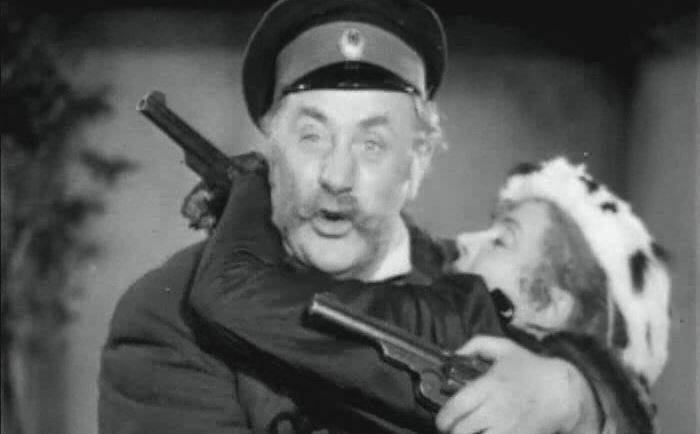
A still from the 1938 comedy “The Bear” with the participation of wonderful actors Mikhail Zharov, Olga Androvskaya and two revolvers “Smith and Wesson”!
“My father drank like a barrel,
And he died from wine.
I am the only daughter left
And I am called “Mamzel Na-na”.
(A song from the Soviet film “Bear” (1938) directed by Isidor Annensky based on the play of the same name by A.P. Chekhov)
And he died from wine.
I am the only daughter left
And I am called “Mamzel Na-na”.
(A song from the Soviet film “Bear” (1938) directed by Isidor Annensky based on the play of the same name by A.P. Chekhov)
Weapon and firms. And it so happened that after the Crimean War, the Russian imperial army, or rather not the army itself, but the ranks who commanded it, finally realized that the need to arm with modern weapons is not a whim, but a severe necessity. Well, there is not enough for our entire army made on the model of the Kolt revolvers, of which only 400 were made in our country in 1855. True, the initiative was taken by the gendarmes, armed with a Lefosche revolver in 1860, and all the same sailors who requested Galan’s revolvers for themselves in 1869 … But the army still did not have a revolver. But time and money prevail over everything. And now (albeit a little delayed) and the army finally received a weapon of the first class for that time – a cartridge revolver of the firm “Smith and Wesson” caliber .44 under the so-called “Russian cartridge”.
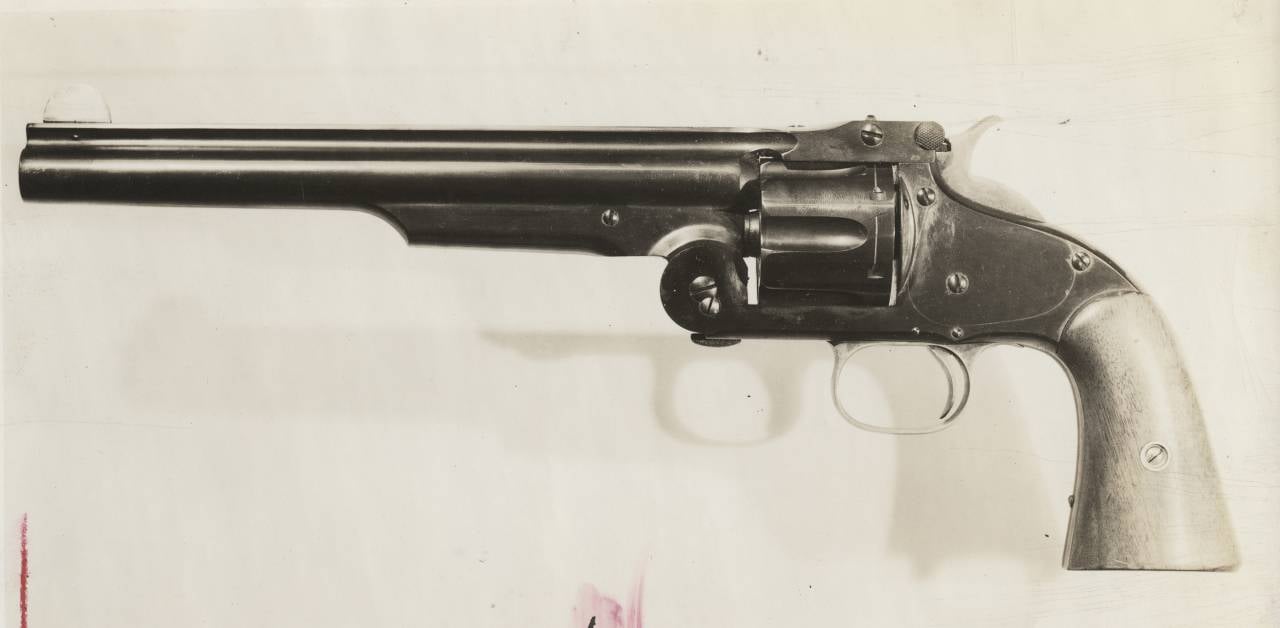
Revolver “Smith and Wesson” model 1870. Photo from the site of the firm “Smith & Wesson”
There was already an article here on VO, where it was told about the role that a certain Grand Duke and two of our colonels who were well versed in weapons played in the fact that this particular revolver came into service – we will not repeat ourselves. It is important to emphasize that one of the most important requirements that the army presented to the new weapon was its lethality! The revolver was supposed to kill the horse at a distance of 50 steps and thus incapacitate the rider! The firing speed of their revolver was also important, because they were supposed to arm the cavalry first of all, and there speed is of particular importance.

Revolver “Smith and Wesson” No. 3 Russian (“S&W Russian”)
The revolver was tested and here are the results it showed:
when shooting at boards (pine) with a thickness of 25 mm at a distance of 25 steps with a distance of one inch, 3,65 boards were pierced, that is, three through and through, and in the fourth the bullet got stuck;
at a distance of 50 paces, the bullet pierced 2,75 boards;
but for 100 steps only one, however, and this seemed quite enough!
Accuracy was also considered satisfactory:
At a distance of 15 paces, the radius of the best half of the bullets was 8,9 cm;
25 steps – 12,6 cm;
and 50 steps – 21 cm.
Well, his rate of fire was such that from a soldier’s model (that is, without self-cocking), the shooter could release all six charges in just ten seconds (!), And then, reloading the revolver, 24 shots in two minutes.
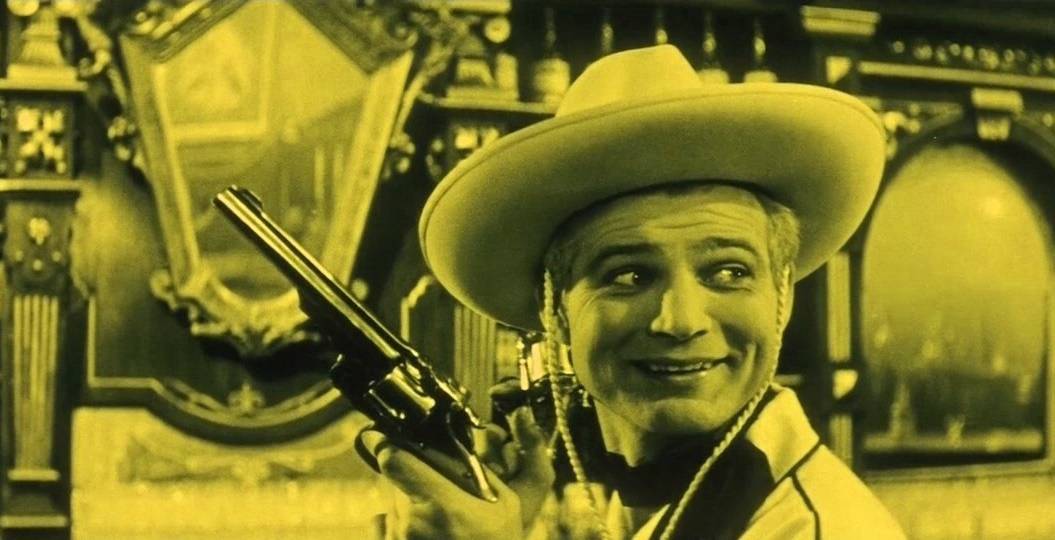
Lemonade Joe is a wonderful 1964 parody of Western Westerns, filmed in Czechoslovakia. By the way, Joe is holding a Smith and Wesson revolver of the “Russian model”
The adopted model of 1869 in Russia received the official name “4,2-line revolver of the Smith-Wesson system” and had the following main features: a 4,2 line caliber (10,67 mm), a six-round drum, an eight-inch barrel (203 mm) and a cartridge with a Berdan primer for center ignition. A very important quality of the revolver was its quick reloading.
The revolver was designed in such a way that it “broke” in half, and at the same time all spent cartridges were simultaneously (and automatically) removed from the drum. True, the revolver originally had a trigger mechanism of only single action, but this was again the requirement of our military. After all, a loaded revolver weighed about 1,5 kg, which, in their opinion, made self-cocking firing from it inaccurate.
The first model that came to Russia was designated by the index I. And in total, the Smith & Wesson company supplied us with more than 250 thousand of their revolvers. And for a long time (because of this) it was a little-known enterprise in the United States itself, since she worked tirelessly on the Russian order.
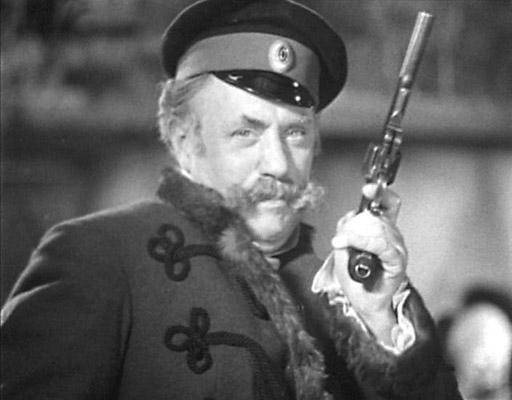
The hero of our film, although they are not comparable in content, is certainly “more epic”!
In total, the Russian imperial army used three models of revolvers, respectively, 1871, 1872 and 1880. release, which primarily differed from one another in barrel length: 203 mm, 178 mm (seven inches), 165 mm (six and a half inches) and a number of small parts.
By the way, the model III of 1880, although it had the shortest barrel in comparison with all the others, nevertheless had quite sufficient destructive power: its bullet at a distance of 20 m pierced four inch pine boards.
The external difference (and the most noticeable one that distinguished the “Russian model” from all the others) was a protrusion on the body behind the trigger, which prevented the handle from “sliding” when firing into the palm, and a “spur” on the trigger guard (which increased the convenience of using the revolver when shooting from a horse ), introduced (as they say!) with the filing of the Grand Duke Alexei Alexandrovich, who was hunting buffalo with a Smith and Wesson revolver!
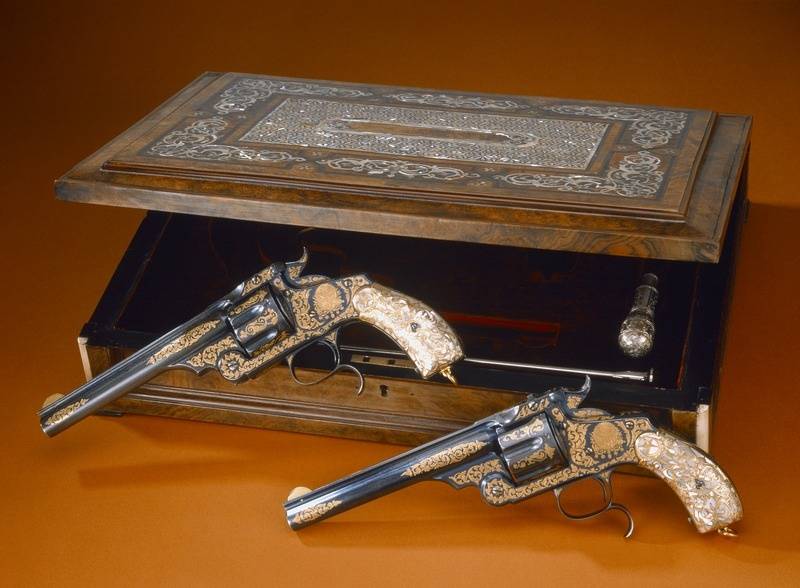
Smith and Wesson No. 3, Turkish Model, c. 1879 to 1880. Weight 1230 g, barrel length 159 mm (6,25 inches), overall length 304 mm (11,96 inches). Royal Arsenal, Copenhagen
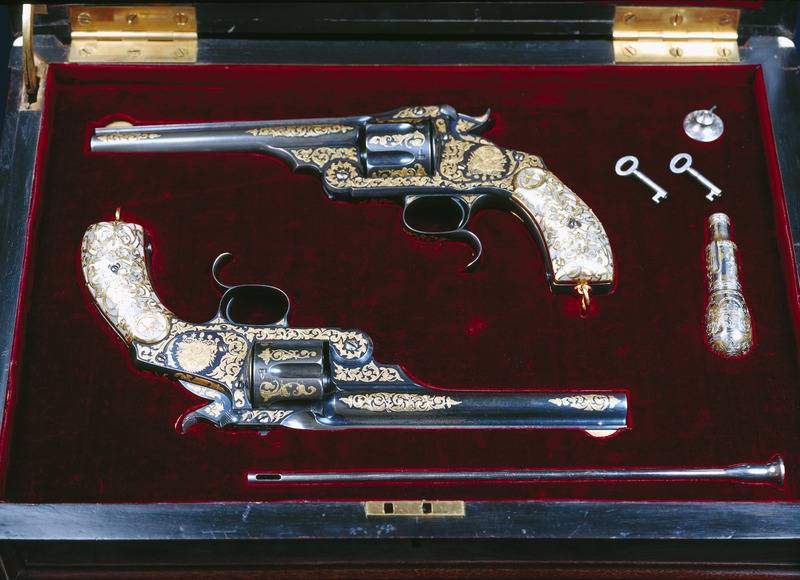
And this is how they look in the box!
In addition, for the officers in the mid-1880s in the United States ordered a small batch of self-cocking “Smith and Wesson” No. 3 model 1880, which had a double action trigger. He received the name “Smith-Wesson revolver, officer’s standard, triple action.” Why “triple action”? Yes, because the trigger on it could also be put in the “third position” – that is, on the safety platoon. Therefore, these revolvers had a developed trigger, which made it possible to create strong pressure on it with a finger, and the bracket around it was large.
The cartridge had a brass sleeve, which contained a charge of black powder in 1/3 of the spool (1 spool – 4,265 grams), and a bullet that had a length of 1,5 calibers and a weight of 3,5 spool. The bullet was provided with three annular grooves stuffed with “cannon fat”, which made it possible to lubricate the barrel and protect it from the harmful effects of powder gases. Well, his bullet speed was quite decent – about 210 m / s.
By the way, it soon became clear that the destructive power of the revolver bullet is even higher than the bullets of the Berdan rifle, which had the same caliber, precisely because of its lower initial velocity! That is, the Russian imperial army received at its disposal extremely powerful and modern weapons at that time. And yet she was unhappy with him.
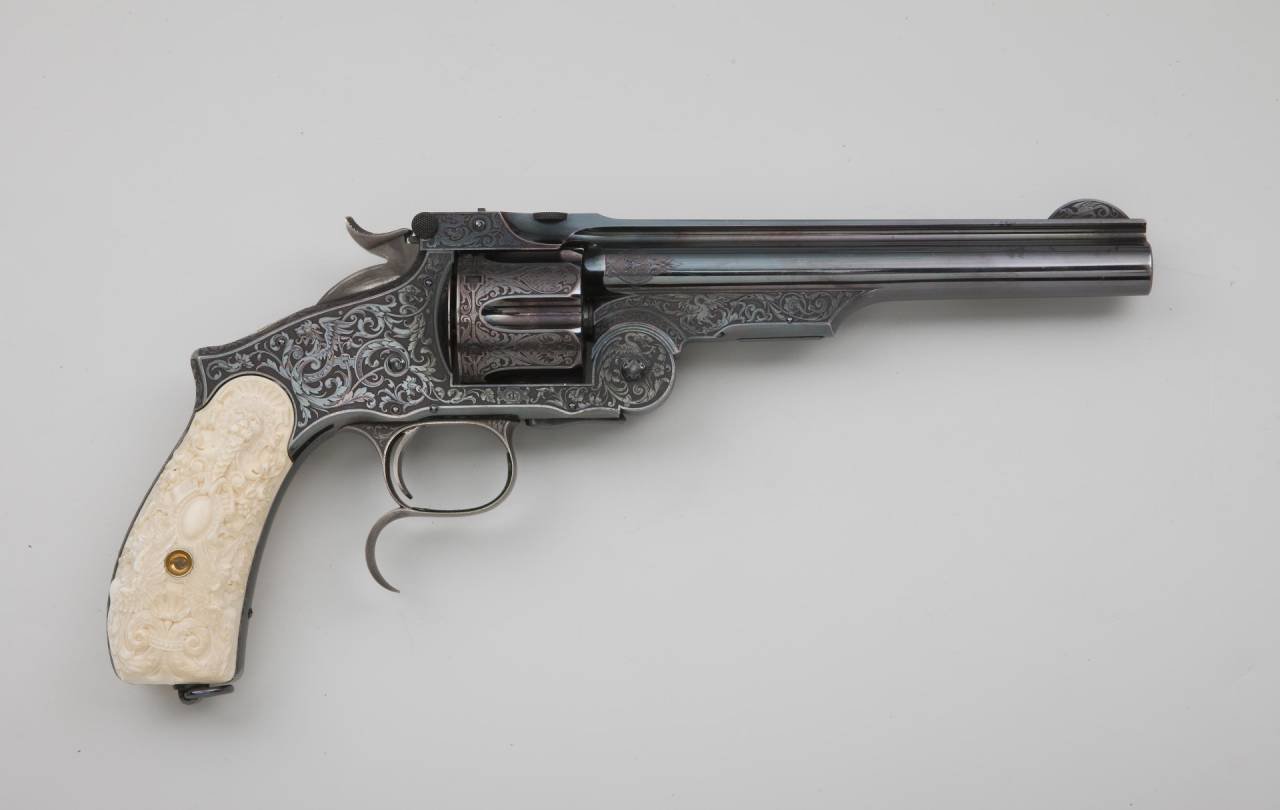
“Smith and Wesson” No. 3, model 1880, gift copy. Made in Germany by order of the Russian government at Ludwig von Loewe & Co, between 1880 and 1885. Technique: engraving, gilding, niello, ivory carving. Overall length: 30,7 cm; barrel length: 16,7 cm; caliber: 10,7 mm. State Hermitage, St. Petersburg
I am dissatisfied, however, not at all with its ballistic characteristics and convenient reloading (although there were also complaints about it). No, the revolver was disliked for being too heavy.
It soon became clear that soldiers and officers did not have to use it in battle so often. But carrying one and a half kilograms of iron on your side is inconvenient. The belt with the holster slid to one side, and for some reason they did not think of two shoulder belts that appeared in the Russian army in the XNUMXth century.
The cord (so as not to lose the revolver!), Fixed to its handle, was inconvenient, since it looped around the neck and created a direct threat of suffocation of the shooter. So many scolded “Smith and Wesson”, but there were those who praised him.
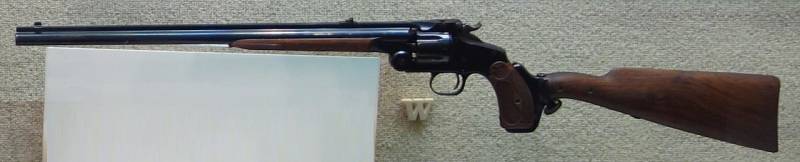
Revolver carbine, 1871 with a long barrel and wooden stock (Hatington Museum of Art, West Virginia)
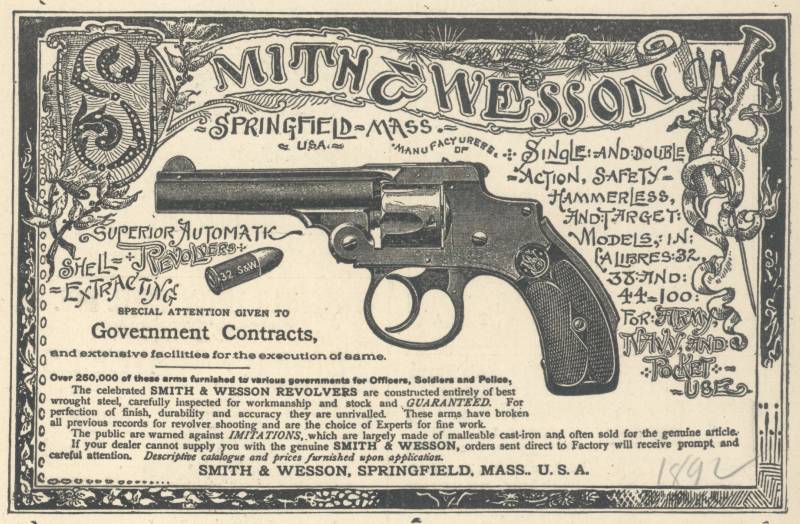
An advertisement for a Smith & Wesson “triple action” hammerless revolver, 1887. Photo from the Smith & Wesson website
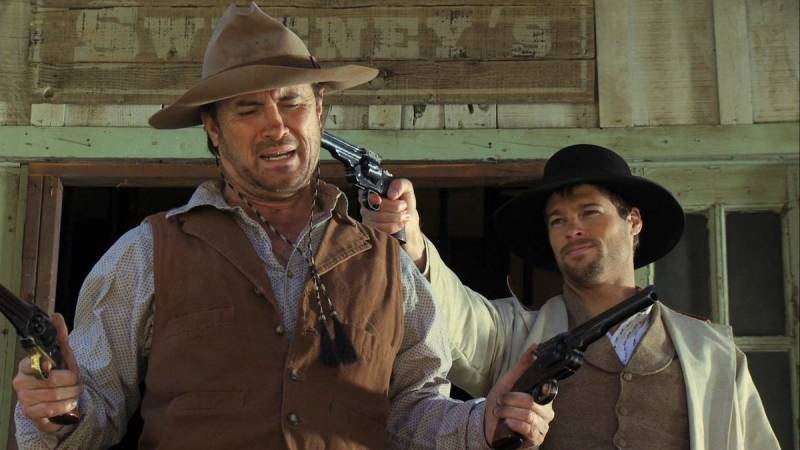
Still from The Last Days of Frank and Jesse James. Everyone has a Smith & Wesson in their hands!
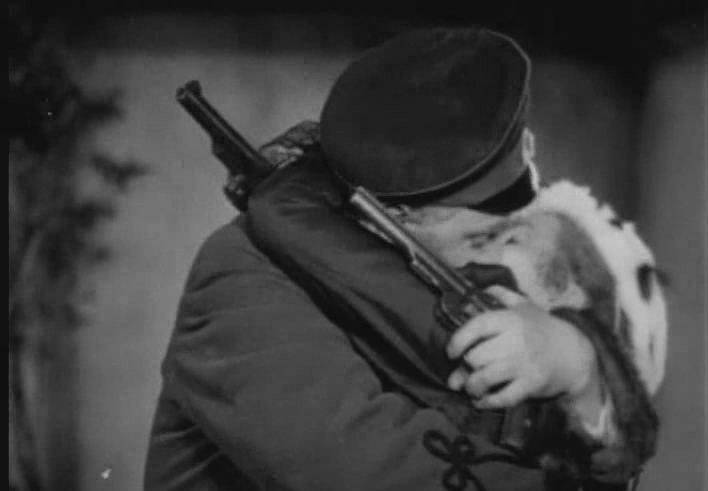
Well, for our “Bear” everything ended well, just very well!
For example, in No. 32 of the magazine “Russian invalid” for 1892, it was written:
“And so the system of carrying a revolver in a holster on a waist belt should have been kept unchanged, the revolving cord should be abolished; the Smith and Wesson revolvers should be left as before, because, in addition to excellent fighting qualities, in fact, as a firearm, this revolver in hand-to-hand combat is an equally excellent edged weapon in its massiveness and in the crushing blows it inflicts.
And yes, indeed, this revolver, taken by the barrel, was a real club, although its creators hardly planned it for such use.
Therefore, it so happened that in 1895 “Smith and Wesson” replaced the Nagant revolver, which was much lighter and smaller in size, although it was reloaded in the most primitive way, through the “Abadi door” that closed the drum chambers by turning sideways , and on the right side, by analogy with Colt’s revolvers in the early 1870s, which made him completely uncomfortable for the same cavalry.
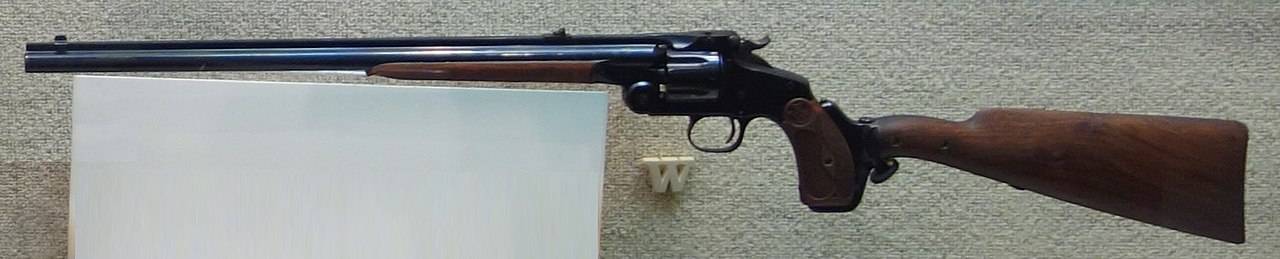
Revolver carbine, 1871 with a long barrel and wooden stock (Hatington Museum of Art, West Virginia)
The Small Russian Model Smith-Wesson was also produced – as a civilian weapon of caliber 38 (9,7 mm), with a short barrel and even without a trigger bow.
In addition to the USA and the Tula Arms Plant, these revolvers chambered for the “Russian cartridge” .44 were also produced by some European firms. For example, a self-cocking lightweight sample with a short barrel was made in Belgium. And among the officers of the Russian army, it was very popular precisely because of its reduced weight.
In general, the Smith and Wesson revolvers served a long service in Russia. When they were taken out of service by the army, they were handed over to the Russian police. During the First World War, the “Smith-Wessons” remaining in the army warehouses were given to the militia, rear and auxiliary services of the army, and some part were converted into rocket launchers. Until 1917, foresters and road rangers served with them, since they were not given guns, so that there would be no temptation to engage in poaching.
In 1879 Russia transferred 2000 revolvers of the 1874 model and 100 cartridges to the Bulgarian army. In November 000, on the eve of the war with Serbia, it was armed with 1885 revolvers, and before its entry into the First World War – 1612. Then one thousand revolvers mod. In 1112, Japan purchased from the USA and used them during the Russo-Japanese War. And then on the basis of this revolver in the Land of the Rising Sun they created their own model – the Hino revolver.
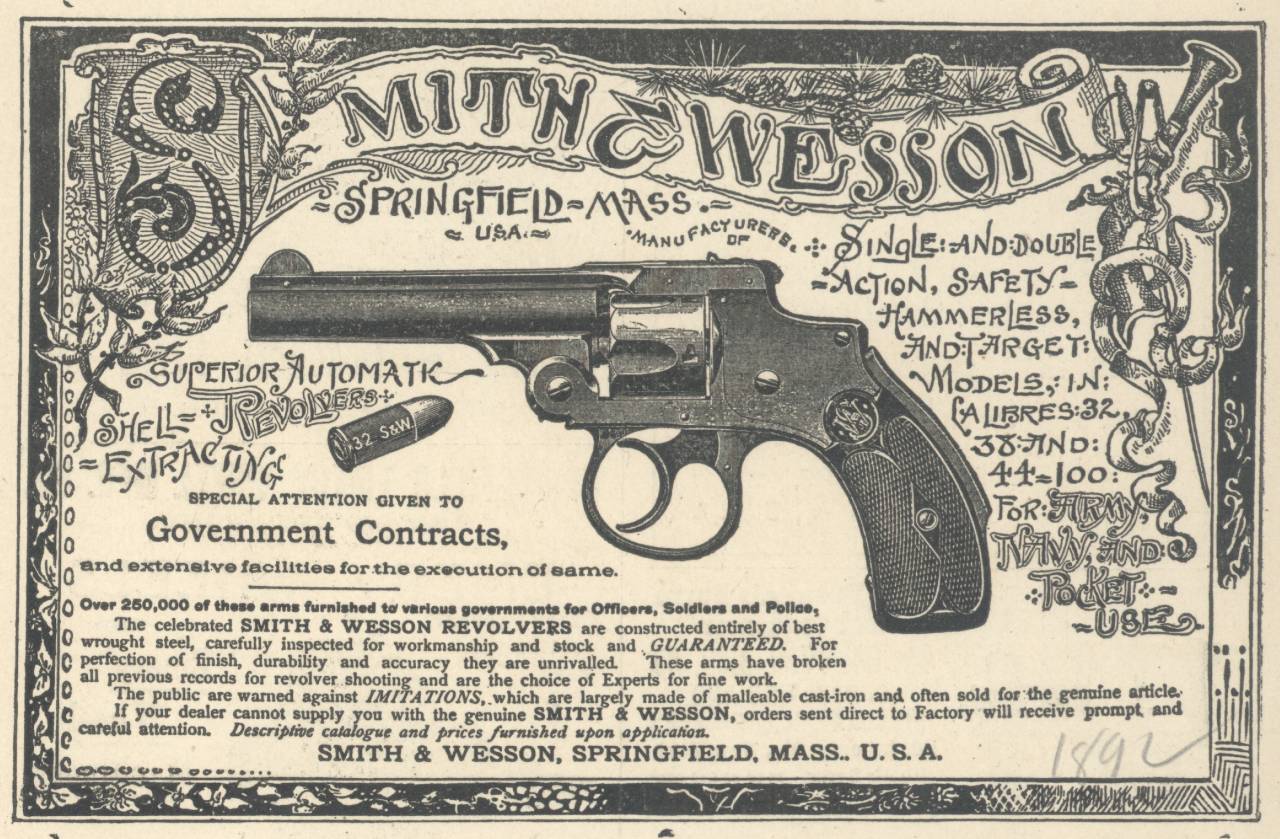
An advertisement for a Smith & Wesson “triple action” hammerless revolver, 1887. Photo from the Smith & Wesson website
They sold Smith-Wessons to Turkey, Mexico and even Australia, as well as to China. However, in no other country in the world have they been found in such numbers as here, in Russia!
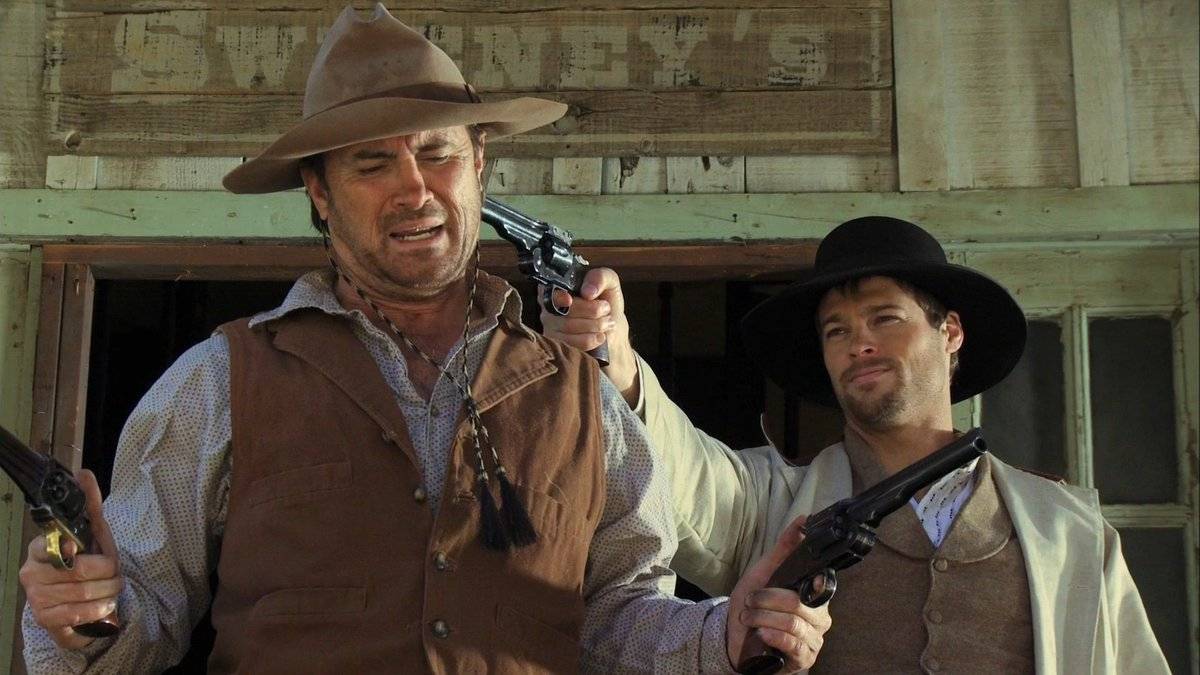
Still from The Last Days of Frank and Jesse James. Everyone has a Smith & Wesson in their hands!
By the way, despite its rarity in the USA, “S&W Russian” and similar models were very popular in the Wild West. So, in different years such famous personalities were armed with them – shooters and law enforcement officers like Wyatt Earp, his brother Virgil, Pat Garrett and others, and on the other hand, equally well-known criminals like Billy Kid and John Hardin, Jesse James and Bob Ford. So, it was from this .44 caliber revolver that Ford shot in the back and killed Jesse James …
Well, for our “Bear” everything ended well, just very well!
- Author:
- Vyacheslav Shpakovsky

The Van de Graaff generator is the most entertaining piece of kit in any high school physics lab.
In general, soldiers aren’t stupid. We weren’t necessarily the smartest kids on the block, but it never was really a lack of intelligence that got us into trouble. It was rather the synergistic combination of some fairly difficult technical tasks combined with a lot of pressure and a healthy sprinkling of testosterone. The pressure was an integral part of the equation. Combat is stressful, so the Big Green Machine did its utmost to prepare us for that.
Uncle Sam had lots of stress enhancement tools. Sleep deprivation was the most common. It didn’t cost anything, and it worked like a champ. A little hunger added flavor. The real engines behind the chaos, however, were the Black Hats, ranger instructors, drill sergeants, and the like. They were harder than woodpecker lips and absolutely merciless. These guys can smell weakness at a slant range of three clicks in hard dark. Tying a knot in a piece of rope while sitting in your living room watching Netflix is painless. That same task dangling from a cliff with these sadists screaming at you is another thing entirely. It’s supposed to be hard. It’s their job to make it so.

The Boeing CH47D Chinook helicopter is a lot of cool things. It is also the
mother of all Van der Graaf generators. Photo by Daniel Klein via Unsplash
The Setting
I was flying in support of Air Assault school. Air Assault teaches operations in and around combat helicopters. Descending out of a hovering helicopter on a rope is a perennial crowd pleaser. Learning how to prep an external sling load is another. There’s a great deal of physical training along with some legendary ruck marches thrown in just to keep things spicy.
If something is too bulky to fit inside the aircraft you just rig it up with some heavy nylon slings and hook it underneath the helicopter. This day, we were a flight of two CH47D Chinooks. The loads were Conexes, those big steel boxes the Army uses to hold just about everything.
The six 30-foot blades on a Chinook helicopter are made from fiberglass. When slaved to 9,000 shaft horsepower worth of Lycoming fortitude they will move a simply breathtaking volume of air. They also collect a fair number of electrons.
The physics lab counterpart is the Van de Graaff generator. American physicist Robert J. Van der Graaff thought this rascal up in 1929. This delightful trinket sports an electrically-driven belt and a big silver Kojak ball up top. Turn it on and the thing builds up a massive static electrical charge. Grab it and your hair will stand straight up. Put one hand on the ball and touch a buddy and that guy will reliably come to Jesus.

Lighting is undeniably pretty, but you really don’t want to get any of that on you.
Photo by Brandon Morgan via Unsplash
A Van de Graaff generator instantly transforms the skinniest Physics nerd into an acne-ridden, lightning bolt-shooting god of thunder. It was the highlight of my high school physics experience. A Chinook helicopter in dry air is the same thing — only way more so.
Uncle Sam knows this, so the first step whenever you are hooking up a sling load is to touch the cargo hook with a grounding pole. As the aircraft in flight isn’t grounded and the tires are rubber this zillion-volt electrical charge is harmless to the flight crew. However, grab that hook without grounding the aircraft and you’re in for the ride of your life.
We had been picking up those big boxes for an hour or more. Our station was shut down for a few minutes while they cycled in another group of trainees, so I pivoted the aircraft to give us a clear view of the other bird, set down, and pulled the engine condition levers back to save gas. That’s when I saw it.
There were two guys standing on top of the big steel box as our sister aircraft maneuvered into position. This was the era before Kevlar so they both wore WW2-vintage steel helmets. I noted to my fellow pilot that neither man had the grounding rod.
It’s not necessarily that these guys were stupid, though that could quite possibly have been the case. They were just stressed and forgot something important. Before I could get on the radio an arc of static electricity several times brighter than the sun leapt from the cargo hook into the nearest man’s head.
This poor slob convulsed and flew backwards like, well, he had been struck by lightning. He dropped off the tall metal box and began flopping about like a beached carp. I could swear his uniform was smoking.
After a few minutes they got him up and walking, albeit at a pronounced list. In classic Army fashion, the instructors put him at the back of the line to try once more. I bet he never forgot that grounding rod again.

The before and after when the Army shaved our heads! Grumpy

I used to be an Army pilot, and I maintain a small plane today. In early August of 2019, one of my adult kids and I flew to Dayton, Ohio, to spend the weekend walking around the Air Force museum. Theirs is likely the greatest collection of vintage warplanes in the world. As quality time with the family goes, it was epic.

In the evening we went into Dayton for dinner and a movie. These were the days before Covid, so we could just wander about taking in the sights without worrying about contracting some ghastly disease. Ohio enjoys concealed carry reciprocity with my home state so I packed a nice carry gun, in this case a Springfield Armory Hellcat charged with fourteen SIG SAUER 147-grain V-Crown 9mm hollowpoints. The trip was great, and we made it home without incident.
One Week Later…

One week after we had been strolling around the Oregon Historic District in Dayton, Connor Betts was hanging out in a nearby bar with his 22-year-old sister Megan. He had been texting a former girlfriend earlier in the evening and seemed to her to be fairly normal. After a couple of hours in the club, Betts disappeared. He returned in short order wearing body armor and some kind of creepy mask while carrying an AR15 pistol.

For reasons that are not well understood, Betts then opened fire on the revelers in the street outside Ned Peppers Bar. In thirty seconds he fired forty-one rounds. In that half-minute, he killed nine people and injured another seventeen. One of the dead was his sister Megan. One of the severely wounded was his best friend Chace.

At the first sounds of gunfire, the partiers in the streets fled indoors through any handy doorway. People streamed into establishments around the neighborhood trying to avoid Betts and escape his rampage. Betts made a beeline for Ned Peppers, now packed with terrified people.

There were several Dayton police officers nearby when Betts opened fire. They responded immediately, running to the sounds of battle. Miraculously, the cops engaged Betts a mere 32 seconds after he fired his first shots. An autopsy determined that Betts had been hit by thirty rounds fired by police. He collapsed at the threshold of Ned Peppers and died at the scene.
The Gun

Much hay has been made over the details of Connor Betts’ firearm. A no-frills Anderson Arms AR15 pistol with an 11.5-inch barrel and unremarkable round forearm, the gun featured a flat top upper and a red dot sight. Betts fed his gun via an imported 100-round drum magazine. Betts’ AR also included a Shockwave Pistol Stabilizing Brace (PSB).

Betts had no criminal record and bought the gun legally from a supplier in Texas. The weapon transferred to him via a local FFL. When Betts was gunned down by the Dayton cops he dropped a thirty-round magazine onto the ground.

PSB’s are curious things. Initially developed by Alex Boscoe of SB tactical to aid disabled shooters in running heavy handguns one-handed, these accessories have spawned an entirely new genre of firearms. By including a PSB on an otherwise unremarkable AR or AK pistol, these short-barreled weapons become easier to operate despite their stubby barrels. These weapons also transfer like regular handguns rather than heavily regulated short-barreled rifles. PSBs have subsequently been fitted to shotguns and pistol-caliber weapons like the CZ Scorpion EVO and SIG MPX as well. There are estimated to be in excess of four million brace-equipped handguns in circulation in America. At the time of this writing, Connor Betts’ shooting was the only example I could find of a PSB having been used in a crime.

One subsequent headline screamed, “Dayton Shooter Used Gun That May Have Exploited an ATF Loophole.” The presupposition on the part of the less durable members of society that a guy who would willingly undertake mass murder might somehow inexplicably be motivated to adhere to gun laws seems utterly bewildering to me. However, in the aftermath of the Dayton shooting the loudest voices on the Left were screaming not about the psychopath Connor Betts but rather for enhanced restrictions on firearms. There was relatively little furor over what might have been practically done to stop the deranged shooter himself.
The Shooter

Connor Betts never was quite right. A bully in high school, Betts was bipolar and carried a diagnosis of Obsessive Compulsive Disorder. He also admitted to hearing voices, though apparently he had not been formally diagnosed with schizophrenia at the time of his crime.

Betts took rejection poorly. While at Bellbrook High School he kept a list of girls who had spurned him and anyone else he perceived to have slighted him in some way. He told friends he intended to rape the girls and kill the boys on his list as the opportunities arose. He also told fellow students he intended to shoot up his school. Betts was suspended for a year as a result in 2012 and subjected to a police investigation. He worked at a local gas station as well as Chipotle.

Betts was an avid supporter of Antifa and regularly retweeted posts espousing extreme left-wing, anti-police views. He was a vocal supporter of Elizabeth Warren and Bernie Sanders. He was tepid toward Kamala Harris based upon her historical connections to Law Enforcement. On his Twitter bio he described himself as a “Metalhead Anime-fan Leftist.” He wrote, “I’m going to hell and I’m not coming back.” He often used the hashtag #HailSatan.

Betts was the lead singer in a pornogrind metal band called Menstrual Munchies. His lyrics orbited around violence, gratuitous gore, and necrophilia. His music glorified sexual violence.

A former classmate of Betts had this to say about him, “Connor Betts was a psychopath…I remember when he threatened to shoot up our school and had a hit list of people that he wanted to kill. I’ve worked with him, too, and he scared the employees on a daily basis.

“Everyone who knew him knew he had issues. I would tell people all the time to just stay away from him because he’s threatened to kill people. When the customers didn’t tip him, he would threaten to go to their house and kill them. I thought he was just all talk but then I would be at work by myself with him and hear him chanting things that sounded like he was worshiping the devil. I would be calling his name for him to stop and he wouldn’t answer.”
Ruminations

This devil-worshipping Antifa loser exhibited all the hallmarks of a dysfunctional mass shooter from an early age. He was aggressively investigated by Law Enforcement fully ten years prior to his murder spree. He was being treated for serious mental health issues and was the lead singer in a band that screamed about killing women and then copulating with their corpses. And the primary problem is that he had a pistol brace on his firearm? As a society could we really be that naïve?

Hating the cops is both in vogue and in the news these days. However, Connor Betts’ final moments were captured on surveillance footage from outside the Ned Peppers Bar. The Dayton PD simply could not have been any faster. They were on-site and engaging less than a minute after the first shots were fired. They killed this guy literally seconds before he made it into a bar packed with terrified humanity.

When Betts was shot he presumably had 59 rounds left onboard his weapon and carried his next 30-round magazine ready to go. I think this may be the finest example of tactical police work I have ever seen. It is literally impossible to determine how many lives were saved by the bravery and selflessness shown by Dayton’s finest that fateful evening. And yet the Left persists in denigrating police in general while minimizing the importance of the services they provide.

I was walking these same streets with my child a week prior to this event. But for the grace of God, we weren’t there when Connor Betts detonated. There are some 400 million firearms in America. If all guns were outlawed tomorrow under pain of death, psychopaths like Connor Betts would still be armed a century from now.

I don’t carry a gun to prove anything. If I’m doing it properly nobody will ever know. I carry a gun because my family and I share the world with anarchist Satan worshippers who are lead singers for pornogrind bands that celebrate murdering people and then desecrating their corpses. Some people study the Dayton shooting and see a desperate need for more gun control. I narrowly miss experiencing the same thing and give thanks that I live in a place where I don’t have to walk among such predators unarmed. Had I been there that fateful night I likely would have been killed along with the rest of them. However, I would have nonetheless had the means, the skill, and the will to fight back.

GEAR READY FOR HUNTING? GOOD, REMEMBER TO VOTE
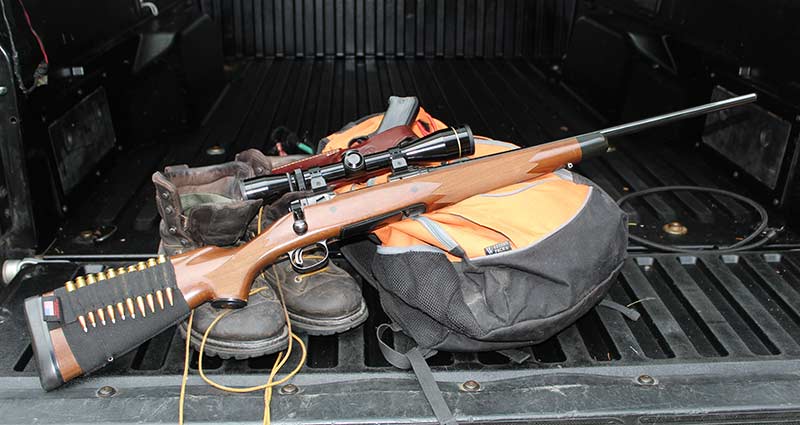
Got your hunting gear together already? Great, because now you’ve got plenty
of time to study your voter’s pamphlet, get an absentee ballot if necessary,
and make sure you vote on or before Nov. 8.
Traditionally, I’ll be in the midst of an elk season one month from now, and I’ve got all of my hunting gear together, the truck is gassed up, my rifle is clean, got gas for the camp stove, which means I’ve got plenty of time to fill out a ballot and vote.
Around the rest of the country, many of you may be just getting into whitetail deer seasons, or waterfowl and upland bird hunting is heating up. So, since this is a reminder, there’s no excuse for not voting. If you’re going to be in the field, now’s the time to get an absentee ballot, fill it out, and stick it in the mail or a drop box.
It’s pretty easy to get an absentee ballot. Contact your local city or county election office and get the details on applying.
So, consider yourselves reminded. There is no excuse for not voting, especially this year, when much is at stake, including Second Amendment rights.
That said, this column’s readers seem to like numbers, and this week we’ve got a bunch of them.
Self-Defense Incidents
A major report in Reason last month revealed what it called “the largest and most comprehensive survey of American gun owners ever conducted.”
This report “suggests” people use firearms in self-defense “about 1.7 million times a year,” and that AR-15-style rifles and magazines holding more than 10 rounds “are in common use for lawful purposes.” The study “was based on a representative sample of about 54,000 adults, 16,708 of whom were gun owners.”

A major survey reported last month estimates armed citizens
use firearms for self-defense about 1.7 million times annually.
The survey was commissioned by William English, a political economist at Georgetown University, as part of a book project, Reason said.
The research estimated there are some 415 million firearms in private ownership, including an estimated 171 million handguns, 146 million rifles and 98 million shotguns. Pretty impressive, huh?
Well, check this out: “The survey suggests that up to 44 million AR-15-style rifles and up to 542 million magazines with capacities exceeding 10 rounds are already in circulation,” the Reason report revealed.
Speaking specifically of “assault rifles,” Reason said the survey found that two-thirds of survey respondents who acknowledged owning a semi-auto long gun used them for “recreational target shooting.” Fifty percent “mentioned hunting,” refuting claims by the White House and Capitol Hill anti-gunners that nobody hunts with an AR-15. And one-third “mentioned competitive shooting.” This might include high-power matches, 3-gun competitions or some other rifle discipline.
A whopping 62% said their rifles are also used for home defense, and 35% “cited defense outside the home.”
No question about it, we own a lot of hardware, so if Congress were to somehow pass legislation banning so-called “assault rifles” and “high capacity magazines,” they’ll have a heck of a time enforcing it.
Keep this in perspective: Long before anybody tried to collect any of those firearms, there would be a herd of attorneys lining up to file so many civil rights lawsuits, it would jam the federal courts for years.
Homicides Up in ‘21
Just as this column was being written, a publication called Grid published a report stating “provisional data” from the Centers for Disease Control and Prevention estimating 48,000 deaths from “gun-related suicides, homicides, accidents and other incidents” in 2021.
It’s an 8% increase over the firearm-related fatalities in 2020, which was a fairly violent year with urban unrest and outright riots. According to the Grid article, “The death rate per 100,000 residents climbed to 14.8 last year, eclipsing decades-old rates of high gun violence, according to the CDC.”
By now, the FBI has released its Uniform Crime Report for 2021, which was to have been available just a few days ago. Insider will have some interesting data to share shortly, once we’ve had a chance to digest the report.
One thing the Grid story acknowledged is “Suicides are still the most common gun death in the United States.” In 2012, the ration was 62% of gun-related deaths were suicides and 35% were homicides, with a handful of deaths being presumably accidents or justifiable shootings. By last year, the ratio had narrowed, with 55% being suicides and 43% homicides.
Source of the data, according to the Grid article, is ‘CDC Wonder,’ a collection of online databases.
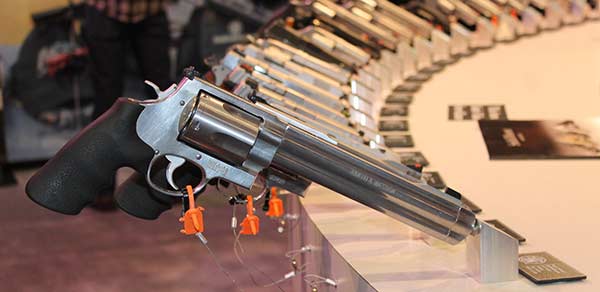
Gun sales may change dramatically now that three credit card firms have
adopted a new merchandising code to isolate and identify gun and ammunition purchases.
Cash and Carry
When news broke recently about a decision by Visa, MasterCard and American Express to create a new “merchant category code” (MCC) to help isolate and identify gun-related charges, the firearms community was justifiably peeved.
These financial institutions were under pressure from the gun prohibition lobby and a pair of anti-gun politicians, Sen. Elizabeth Warren (D-MA) and Rep. Madeleine Dean (D-PA), to institute this scrutiny. Warren and Dean issued a press release touting their effort. They refer to “suspicious activities including straw purchases and unlawful bulk purchases” as a reason for credit card transactions to be weaponized against gun owners.
When this story first broke, a phone call from an old colleague offered an interesting suggestion: Cash-only gun purchases. If you don’t have enough cash to pay for a particular firearm, maybe put some money down and come back with more greenbacks when available to settle the balance. No credit card record, no foul.
This started with an early-September decision by the Geneva-based International Organization for Standardization (ISO) to create the new MCC for firearms retailers. While on the surface, proponents describe this scheme as an effort to prevent mass shootings by monitoring credit card activity, but some critics in the gun rights movement think this could be a backdoor registration scheme.
Jim Shepherd, a colleague and editor of The Outdoor Wire, called it “a calculated move to circumvent regulations preventing federal tracking of gun sales.”

Rep. Karen Bass, an anti-gun California Democrat, lost two handguns from her
Los Angeles home to burglars. (Official image from Bass’ congressional website.)
Call it Karma, Karen
U.S. Representative Karen Bass (D-CA), who has been representing California’s 37th District and is now running for the office of Los Angeles mayor, is an anti-gunner based on the “F” grade she recently received from the National Shooting Sports Foundation.
So, when Bass reported a burglary at her Los Angeles home, she wound up with egg on her face because two guns were part of the loot taken. Bass claimed the guns were safely stored.
According to various published reports, the perps took nothing else, even though they could have taken cash, electronics and “other valuables.”
Bass told reporters the guns had been purchased years ago. According to a Fox News affiliate in Los Angeles, Bass said the guns had been for personal protection, a right her voting record suggests she wasn’t concerned about for her constituents.
Don’t Rob Cops
Here’s a bit of advice to would-be robbers: Don’t try ripping off undercover cops because it will not end well.
This is a lesson learned the hard way by a 19-year-old suspect in a drug deal gone really bad in Prince William County, Va., according to The Washington Post. The newspaper said a man identified as Jaiden M. Carter was one of three people involved in the caper, which an attorney for the Carter family quickly declared was “another example of unnecessary police brutality.”
Carter and another man, identified as Jalil M. Turner, were allegedly involved in a drug buy, but instead tried to rob the undercover cops of their buy money. They allegedly took the money and “additional property,” before returning to their own car. About that time, backup officers arrived and “converged on the car.” There was “an exchange of gunfire,” the newspaper reported. Carter was fatally wounded.
The Post quoted a statement from police, which said two handguns were recovered at the crime scene and one of the guns had been “illegally modified to be fully automatic with an extended magazine.”