
Category: Well I thought it was neat!
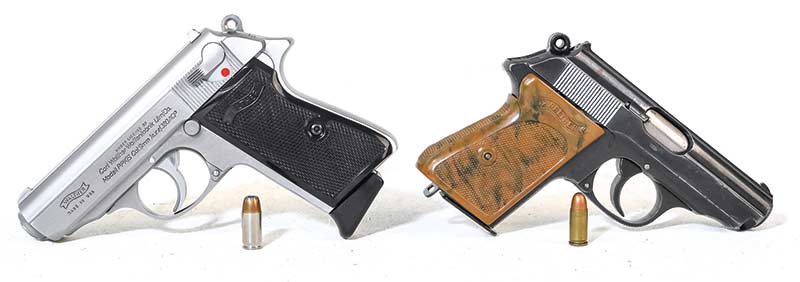
The modern Walther PPK/S (left) is an evolutionary development of this pre-war Walther PPK in .32 ACP.
I had signed into Fort Rucker, Ala., a few days prior to my actual report date. It left a long weekend to kill before settling into the grind at our new Army post. As the beach was a mere hour and a half south, we decided to go sample the sugar white sand of Panama City.
On the drive back north, we stopped at the shopping mall in Dothan to stretch our legs and grab a bite. My son was a toddler. As a result, either my wife or I had to be physically managing him all the time lest he wander into traffic. This meant we went to the restroom in shifts.
When it was my turn, there was one other guy in the john. I don’t make a habit of studying guys in the restroom, so I just knew he was an older gentleman. As he left the institutional mall bathroom, a group of a dozen or so boisterous young men piled in.
They were loud and obnoxious as young men in herds typically tend to be. They were cursing and slamming into things. They went from one end of the restroom to the other, kicking in the stall doors to ensure no one was lurking therein. Then they got to me.
I was still facing the urinal doing my business when one of the young men came up behind me and popped me with a quick rabbit punch between the shoulder blades. I leaned forward but caught myself reflexively before becoming one with the urinal. I then put myself together and turned around to face the assembled crowd.
At the time, I was young, fit and hard — a trained soldier. However, they outnumbered me a dozen to one. They now stood silent in a semicircle, facing me, their arms collectively crossed. We exchanged stares, and they said not a word.
It was then I realized I might be about to die in a restroom in the Dothan, Ala. shopping mall. I might have taken a couple of them on a good day, but these were rangy 17-year-olds wearing gang colors. There was no way I was going to best them all collectively.
I slipped my hand into my right front pocket, slipped the latch on the butterfly knife that was my constant companion and said a little prayer. Without a word, I walked toward the largest of the lot, turning sideways to squeeze between him and his nearest companion. Throughout the episode, they all remained inexplicably fixated on the urinal. I’m fairly certain it was the prayer that got me out of that restroom alive.
Once outside, I found my precious wife innocently beaming. The elderly gentleman who had been in the restroom originally was apparently considerably more street-savvy than was I. He had posted himself outside the restroom and was telling others to find another venue. He said there was a gang meeting going on inside.
I gathered my family and left. However, I found I did not much care for the feeling of helplessness I had experienced during this sordid little episode. I drove directly from the shopping mall to the nearby county seat to apply for my very first concealed carry permit.
The FIE Titan .25 ACP that was Will’s first concealed carry weapon really is a silly little gun.
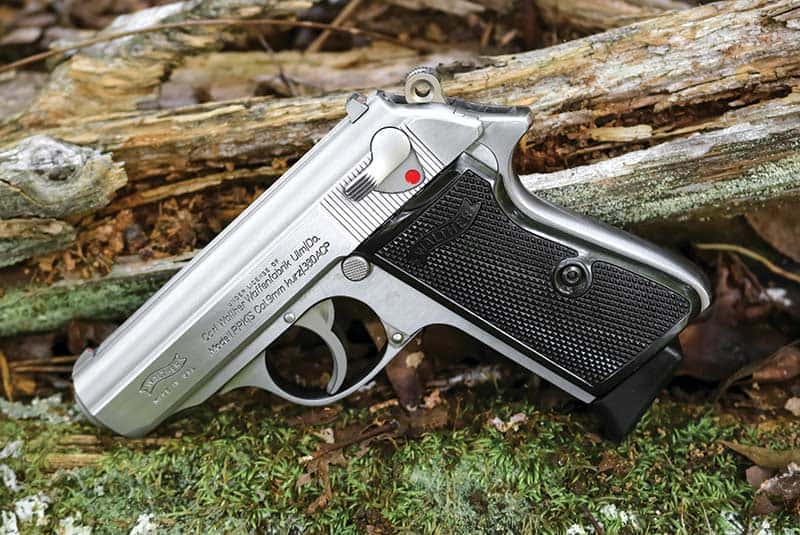
Will’s first serious concealed carry pistol was a stainless steel PPK/S in .380 ACP.
Though a bit heavy, the trim little Walther carried well and packed some proper horsepower.
Administrative Details
Back in the early ’90s in Alabama, the application for a concealed carry permit was but a single page. The permit was good for a year and cost $15. You filled it out at the local sheriff’s office.
I documented the demographic data and got to the part about supplying three references. As these were the days before cell phones and I had not come prepared with my address book, I struggled to come up with addresses and phone numbers for three people who were not family members. When the sweet lady behind the counter saw I was struggling, she said, “Son, don’t fret about that stuff. We ain’t calling any of those people anyway.”
The plan was to leave the application with the sheriff. They would run a background check overnight while it was slow, and then I could pick up the permit the following day. When I arrived the next morning, the same lady apologized and said they had been too busy to run the checks the night before. As it was a half-hour drive from home, and I would soon be really short on discretionary time, I was clearly disappointed. She said, “Aww, hell, you look like an honest guy,” and signed my form.
I was both surprised and grateful. When she noted my confusion, she asked me if I had ever been frisked by the police. I replied I had not. She went on to explain I could have carried a concealed weapon every day from first grade to the present and no one ever would have known. She said the fact I was standing there meant I needed it and criminals didn’t make a habit of asking the police for permission to carry a gun. Hers was the most profound wisdom I have ever heard from a government servant.
Finally, Firepower
Now that I had the paper, I needed a gun. Mine was a hunting family. I had a bunch of long guns to include an AR-15 and a Chicom Type 56 AK. However, I had not grown up with handguns. The only pistol I owned was an FIE Titan in .25 ACP.
My precious wife bought me the tiny little gun for my birthday the previous year for $50. I liked it because it was a pistol. She liked it because it was cute. This diminutive .25-caliber heater was all the gun we could afford at the time.
The Titan was technically the Tanfoglio GT27. This single-action, blowback-operated semi-automatic pistol fed from a seven-round magazine and weighed three quarters of a pound loaded. The lightweight cast frame was formed from some weird cheap alloy called Zamak. Production began in 1962.
The GT27 fell prey to the import restrictions imposed by the 1968 Gun Control Act. The GCA was intended to restrict availability of cheap “Saturday Night Specials.” I was living proof sometimes cheap “Saturday Night Specials” were all a working man could afford. As a result, the American companies Excam and FIE (Firearms Import and Export) brought the parts in from Italy and assembled them domestically as a workaround.
I carried the little gun loose in my right front pocket where my butterfly knife used to ride. I kept the chamber empty and practiced charging the weapon as part of its retrieval. I couldn’t afford a better pistol, but I stoked it with Glaser Safety Slugs.
Safety Slugs were serious defensive medicine back then. Basically, a formed bullet jacket packed with fine lead shot and topped with a polymer tip, these flimsy little 1/4″ bullets likely would not have penetrated much past a T-shirt. Regardless, I was finally packing heat.
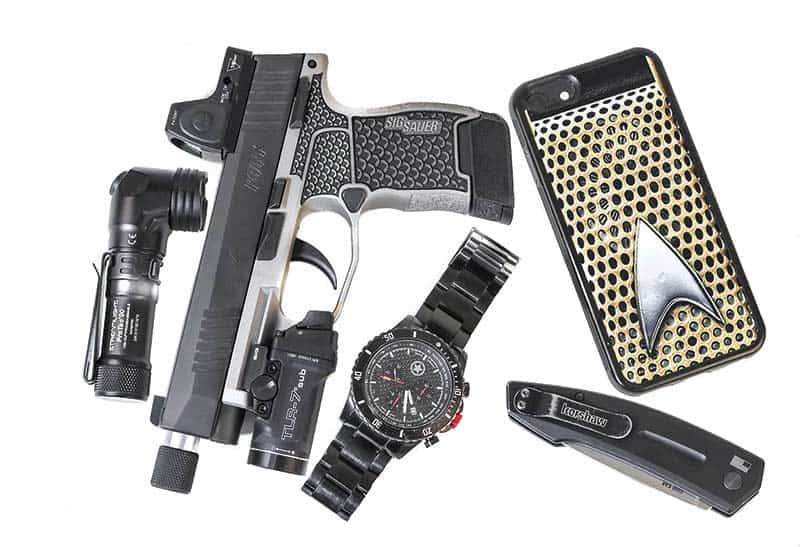
Like roughly one-tenth of the American adult population, a nice, concealed carry handgun is an integral part of Will’s daily loadout.
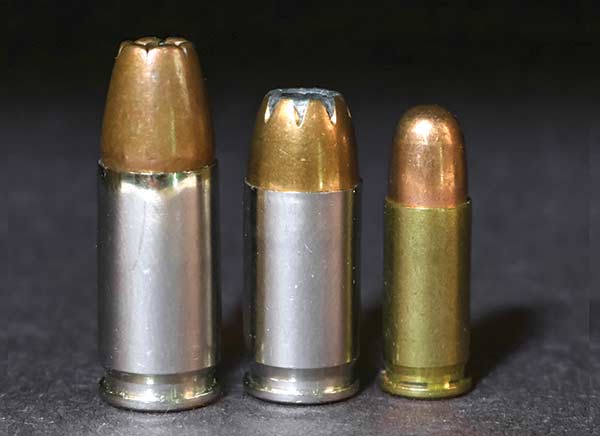
Left to right: 9mm Parabellum, .380 ACP and .25 ACP. Modern hollowpoints are quite capable.
Evolution
I saved up my pennies and bought a stainless steel Walther PPK/S in .380 ACP. I packed it in a small-of-the-back leather holster I borrowed from a friend. I recall the first time I went to the local Walmart with that thing underneath a T-shirt feeling like I was glowing orange. After a while, I came to appreciate folks either couldn’t tell I was packing a gun or didn’t care. It was, after all, the point of the exercise.
The PPK/S with its steel frame and seven-round magazine capacity was fairly heavy. However, the superb single-action/double-action trigger allowed me to carry the gun safely with a round in the chamber. I kept the slide-mounted safety on just in case and trained to flick it off on the draw. Then as now, I am diagnosable-paranoid about negligent discharges. It’s one of the reasons over many decades of shooting and hundreds of thousands of rounds, I’ve yet to have one.
I pack something high capacity, lightweight and plastic these days. I am armed whenever I am not asleep or in the shower. I have had need of a gun twice for real since then and found myself prepared both times. Had I faced that gang with nothing but my trusty FIE Titan they likely would have killed me. However, I would have at least had the means to make them work for it.
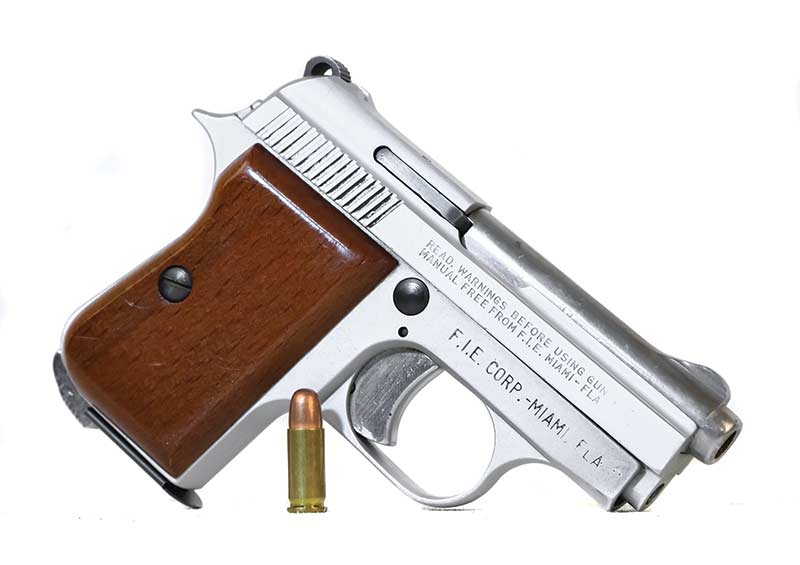
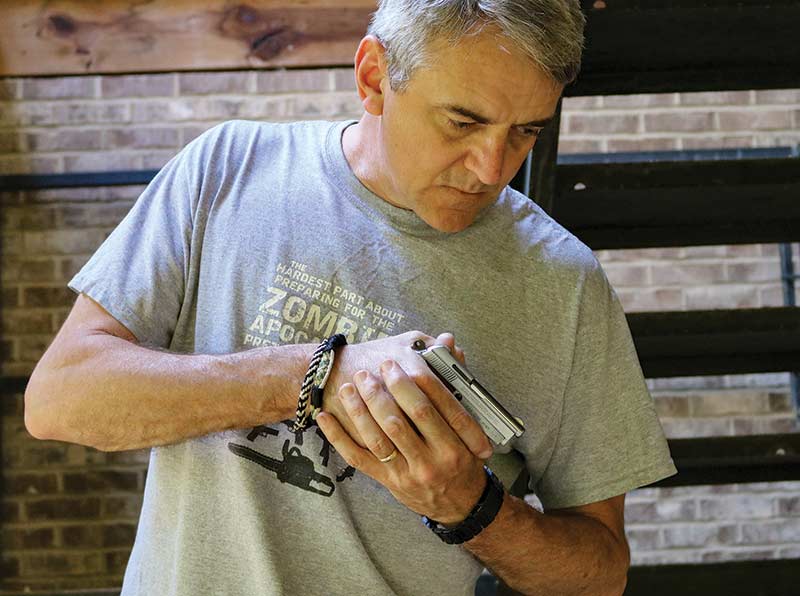
Will’s first concealed carry pistol was this truly pathetic FIE Titan in .25 ACP.
This diminutive little heater might have been preferable to foul language or
pleading, but not by much.
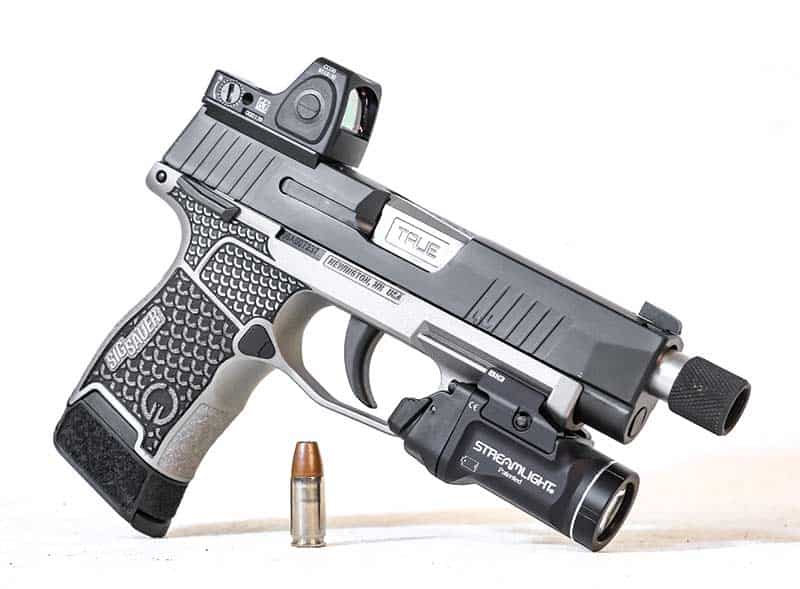
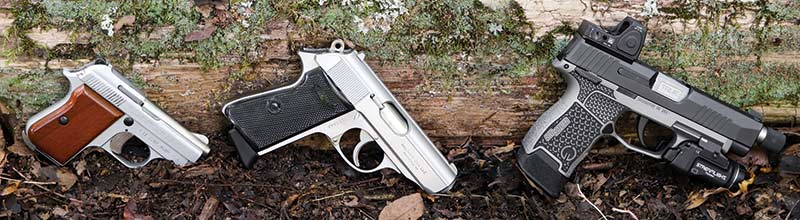
Modern concealed carry pistols like this tricked-out SIG SAUER P365
are hugely more capable than previous offerings.
Ruminations
Just before Christmas 1984, Bernie Goetz used a J-Frame Smith & Wesson revolver to wound four hustling teenagers on a New York subway train. Though they played themselves as victims at the time, the teens later admitted their intent had been to rob Goetz. When Goetz was tried for the shooting, fully half of his jurors had themselves been victims of New York street crime. He was acquitted of everything but illegal weapons possession.
This watershed event really birthed the concealed carry movement in America. Like me, many to most Americans were fed up with being defenseless in the face of criminals who ignored the law. Nowadays more than 19 million Americans hold a valid concealed carry license, and 20 states allow concealed carry without a permit. In a nation with 196 million adults, it means at least one-tenth of the population packs heat. It’s been an interesting trip getting here.

Categories
Flying Gas Stations



I’m old enough to remember what a dial tone sounds like — and a busy signal. I’m so old, I remember picking up the phone every hour for five hours to tell my sister, “Hey, I need the phone!”
That’s right — every house had one phone, one phone line.
I’m so old I remember my childhood friends’ telephone numbers — Tony Salvatore was 657-8566, Jon Hulbert was 654-4503, Joel Adler was 657-5005, and my own phone number was 652-7693. Those have been in my head now for nearly 50 years.
But when I lost my phone over the weekend — I figured I left it in the men’s grill at the golf club after our round — I had to call my friends. But how?!
I have no idea what my friends’ phone numbers are, even though I call them all the time. Google was a nightmare; endless links came up when I searched their names, most wanting me to pay for the privilege of finding their numbers. And you’d be shocked to find out how many people have the same name as all of your friends.
But I tried several numbers anyway — all of them were the wrong people. The last guy I talked to said he didn’t know who I was, joked that he didn’t know where my phone was, but in a kind gesture, said he hoped I’d find it soon.
Of course I tore my car apart, nothing. And I scoured the house, taking every cushion off the couch. Then I headed to the golf club. They didn’t have it, with the manager saying no phone was turned in. The pro shops’ guys likewise said no phone was left in a cart.
At this point, I began to get suspicious. My phone is, after all, worth $1,000, and with eBay, anyone who found it could make a small fortune selling it. Someone must have it; it didn’t just disappear. Someone stole it!
Eventually, I was able to find the phone number of one golf buddy and he sent out a group text. Still nothing. No one saw it, no one had it.
All that by mid-morning. So, I just had no phone. I checked prices to buy a new one ($1,100), but decided to give it some time, maybe my phone would miraculously turn up.
Thus my phoneless life began. I decided to run some errands and, with any luck, get in a quick nine holes. Off to the grocery store.
But once there, I went to check my “notes” for my running grocery list. No phone. No list. Then I needed to ask my wife if we needed a few things. Couldn’t. No phone. And then I couldn’t find an item, so I reached for my phone to check the app for its location. No phone.
And that’s when one wonderful thing about phoneless life happened. I asked a random person if she happened to know where my item was. She told me what aisle to try. I said thanks, then complimented her shirt — she was wearing a Team Iran shirt, and this was before the big U.S.-Iran match in the World Cup.
The woman said she was born in Iran but moved to America as a young girl. She said she still loves Iran, but is supporting protesters rallying nationwide after the death of 22-year-old Mahsa Amini, who was allegedly beaten in police custody for failing to properly wear a hijab. And she said that she’ll be happy with whoever wins the game.
I would’ve never had that conversation if I’d had my phone. Head down, I would’ve just looked up the app — and likely wouldn’t have even seen her.
Errands done, I hit the golf course. But instead of turning music on via my phone, as usual, I just played in silence — well, not silence because wildlife everywhere was making a cacophonous racket. But that, I realized later, gave me a wonderful sense of ease.
And, unlike every other round, I didn’t reach for my phone between shots to see if someone had emailed or texted. Please, I’m not that important and nothing’s really that urgent, is it?
In the evening, we gathered to watch a movie. But I couldn’t just pick up my phone at a boring part to flip through, so I watched every second intently. I realized then, too, how often I split my attention — for no reason.
In one-last ditch effort, I stripped the couch again and my wife spotted the phone, shoved way down. I had my phone back!
But that night, I didn’t take it upstairs to bed. I didn’t scroll it for an hour before going to sleep. And when I woke up, it wasn’t there to pick up right away to read email and texts.
And that’s when I realized that little by little, my phone had gotten the best of me. Without thinking about it, I often just mindlessly flipped through my phone. But I learned (again) that it’s simply a tool, one that I can decide when (and more importantly, when not) to use. I control my phone, it doesn’t control me.
And I’ll probably always remember that conversation with the Iranian woman, knowing that it would’ve never happened if I’d had my phone.
The views expressed in this piece are the author’s own and do not necessarily represent those of The Daily Wire.
Joseph Curl has covered politics for 35 years, including 12 years as White House correspondent for a national newspaper. He was also the a.m. editor of the Drudge Report for four years. Send tips to josephcurl@dailywire.com and follow him on Twitter @josephcurl.

What’s the toughest job you’ve ever known? Being a garbage man has some unique challenges, though those of that profession whom I have known well through work are invariably fit and chipper souls. Nursing in a big urban hospital is arguably the nastiest of human pursuits, but you do at least stand a decent chance of going home alive in the evening.
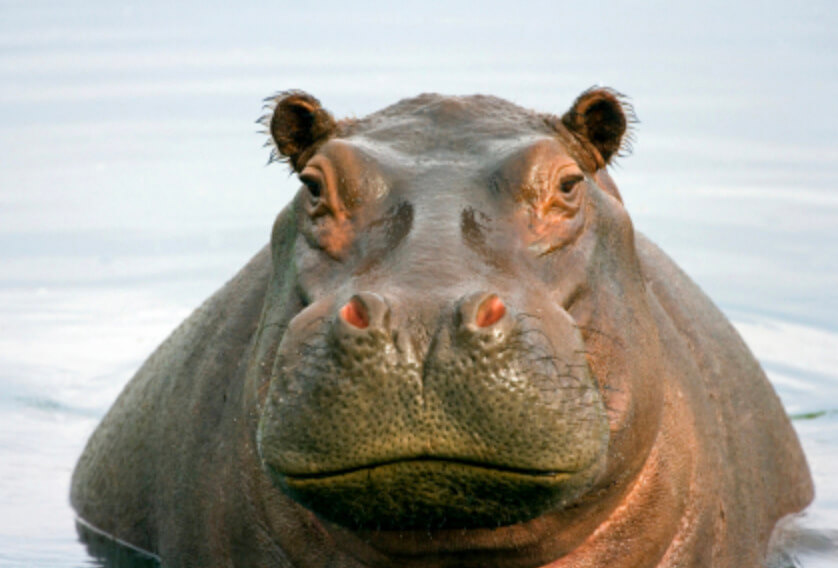
Colombia is supposedly overrun with hippos nowadays thanks to Pablo Escobar. After he was gunned down like a dog, many of his weird exotic animals escaped into the surrounding countryside. As hippos have no natural predators in Colombia they breed like gigantic aquatic bunnies. You can read about it here.

One of the brilliant solutions proposed to address Colombia’s thorny hippo problem was to catch the males and castrate them. An adult male hippo weighs 4,000 pounds. I don’t know if you go to some special school to become a professional hippo castrator, but that sounds like a pretty craptastic job to me. All that pales, however, in comparison to the plight of Hurricat pilots during the early days of World War 2. Those were some seriously manly guys.
The Setting

It’s tough for us modern folk to imagine what it must have been like to live in England in 1940. The Germans had overrun most of mainland Europe in a matter of weeks. Operation Dynamo had saved much of the British Expeditionary Force from the bloody beaches at Dunkirk, but those that were rescued were mostly bereft of weapons. As Great Britain is a big honking island, she found herself cut off and alone.

Her buddies in America meant well, but to get stuff from the US to the UK meant crossing the U-boat-infested waters of the North Atlantic. The Battle of the Atlantic was the longest single campaign of the war, spanning from September 1939 through May 1945. During that time technological advances in naval combat transformed the battlespace. By the end of the war, fully 75% of German U-boat crews were dead. In 1940, however, the North Atlantic was an unopposed killing ground for these undersea German marauders.
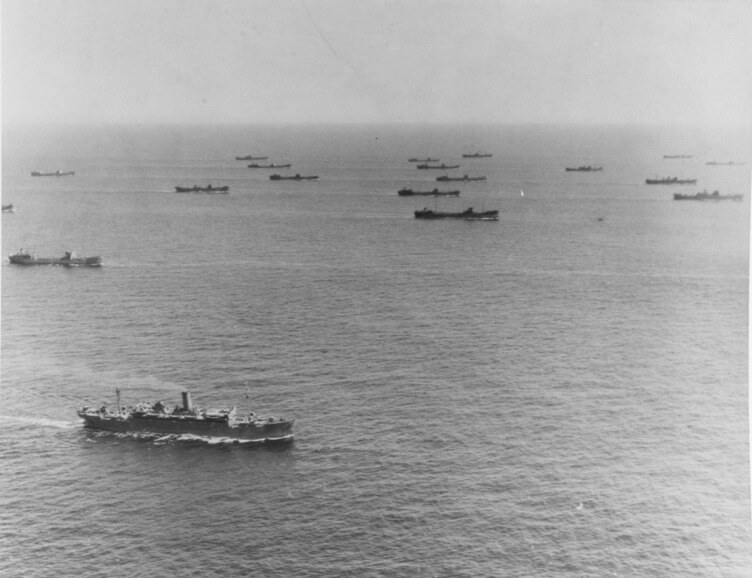
British merchant vessels plied the frigid waters of the North Atlantic far beyond the range of Allied fighter cover. The Royal Navy provided what armed escort they could, but the advantages all fell to the U-boats. Part of that was due to superb coordination and aerial intelligence.

The four-engined German Focke-Wulf Fw-200 Condor had an unrefueled range of nearly 2,000 nautical miles. Operating out of the Bordeaux-Merignac Airport in Western France, these massive patrol planes could range across the northern shipping lanes, vectoring in U-boat wolf packs to their greatest advantage. Without the sorts of escort carriers that would come later in the war, the Allied convoys were powerless to intervene. So long as the Fw-200 crews flew above effective antiaircraft range they could shadow the British vessels with impunity. In addition to coordinating the wolf packs, these Condors dropped bombs from high altitudes as well.
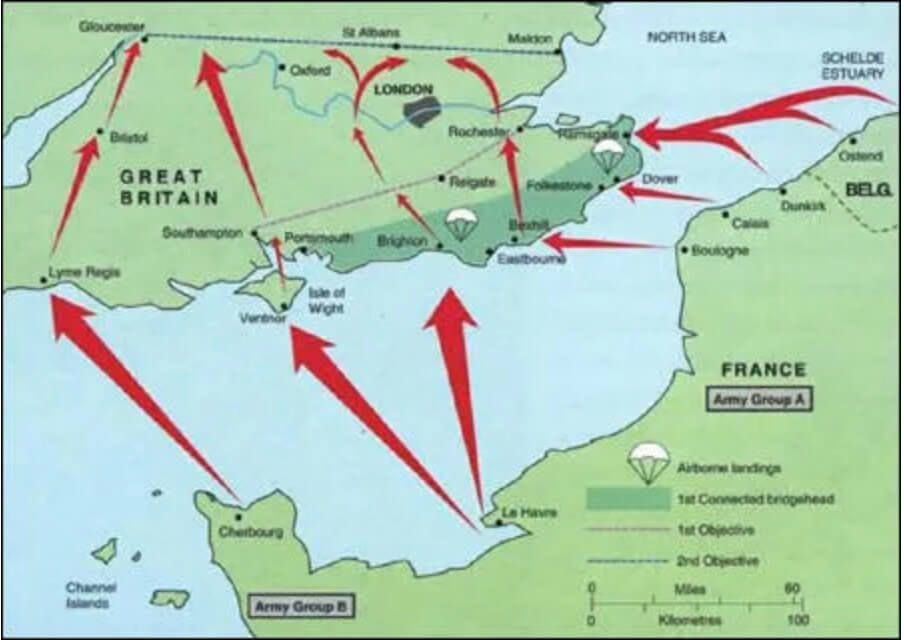
The British realized that they could conceivably lose the war in the absence of a critical lifeline to the United States. In the first half of 1942, the Germans sank 585 Allied ships with a gross weight of more than 3 million tons. Without the war material flowing out of American factories, the British would be unable to resist the German amphibious invasion when it came. The Germans had dubbed this massive proposed undertaking Operation Sea Lion, and they were rabid to get it done. Amidst such dire straits, the Brits took drastic action.
The Solution

The answer, such as it was, seemed to be the CAM ship. CAM stood for Catapult Aircraft Merchant ship, and it represented a bold move indeed. CAM ships began as otherwise unremarkable British merchant vessels. The proof of concept was undertaken via five Royal Navy vessels titled Fighter Catapult Ships. These vessels were crewed by uniformed Navy personnel. The CAM ships, however, still retained civilian Merchant Navy crews.

The British ordered fifty catapult sets for installation aboard merchant vessels. Each catapult consisted of a rail assembly upon which a Hawker Hurricane Mk IA fighter might be arrayed. The Condors were slow lumbering machines that were ready prey for a fast fighter plane like the Hurricane. Once an enemy aircraft was sighted and the crew and pilot were in agreement, the Hurricane was flung into the air via rockets. The Hurricane pilot then had his full fuel load to sow as much mischief as he could. When his gas ran low, however, the best he could hope for would be to parachute or ditch near an escort ship. If all worked as advertised he would be picked up, dried off, and ready to do it all over again on the next trip. However, these were the dark, cold, foreboding waters of the North Atlantic. There’s a lot of stuff that could go wrong with that plan.

The administrative organization was titled the MSFU or Merchant Ship Fighter Unit. All the pilots were volunteers, which was clearly insane. The crews consisted of one pilot, an FDO (Fighter Direction Officer), one fitter, one rigger, one radio-telephone operator, and a seaman torpedo man whose job it was to service the catapult itself. The airplane was considered disposable.

Believe it or not, this insane gimmick actually worked. After meeting success in the North Atlantic these vessels were deployed on runs to Gibraltar and Freetown as well as on Arctic convoys to Archangelsk. Russian missions took along two pilots, while all others used only one per plane. Once within range of their arrival destinations the pilots typically launched their aircraft and landed at handy airfields near the destination port to service their machines and get in a little flight time. Pilots rotated out of the duty after two round-trip voyages simply because the lack of flight time left them rusty. The RAF established modest maintenance facilities on both ends to support the airplanes in such harsh environments.
The Aircraft

The Hawker Hurricane was developed eight months before the more elegant and more familiar Supermarine Spitfire. Those early Hurricanes sported a hybrid fuselage structure built from steel, aluminum, and wood covered in doped fabric. Early wings were wood covered in fabric, while later versions were all metal. The metal wings were rated 80 mph faster than the cloth sort.

Those early Hurricanes sported eight .303 Browning machine guns in the wings. These Brownings were adapted to fire from the open bolt. In practice, the outermost guns tended to freeze up at high altitudes due to a toxic combination of the cold combined with dirty cordite propellant used in British cartridges. As a result, ground crews would dope on a layer of red fabric over the muzzle ports between missions. A Hurricane returning to base with tattered muzzle covers had obviously seen action. Mk IA Hurricanes adapted to the CAM ship mission were called Hurricats or Catafighters.
The Missions

During the course of the CAM ship missions, there were ten combat launches. These ten missions accounted for a total of nine German aircraft destroyed. These remarkable RAF Hurricane pilots bagged four Fw-200 Condors, four Heinkel He-111’s, and a Junkers Ju-88. They also damaged a tenth aircraft and caused another three to flee.

Of these ten launches, two of the planes were within range of airfields ashore and were safely recovered. Flight Officer JB Kendal launched from the SS Empire Morn on April 26, 1942, and successfully downed a Ju-88 while chasing away a Blohm and Voss BV 138. However, when he tried to bail out of his aircraft he was struck by some piece of the plane and killed. Miraculously, every other pilot who launched and then bailed out or ditched actually survived. Flight Officer Taylor very nearly drowned during his mission on November 1, 1942, but once he dried out he returned to active service. Considering the risks associated with these particularly perilous missions, I find the fact that there was but a single casualty among the Hurricat pilots strains credulity. It’s just amazing that it actually worked.
The Rest of the Story

Of the thirty-five converted CAM ships, twelve of them were sunk during the course of 170 round-trip voyages. CAM ship support was discontinued on Russian and North American missions in the summer of 1942. The planes and equipment remained in use on the southern runs for another year. Once US escort carriers came online they provided fairly safe and responsive air support that could travel with the convoys. This, combined with long-range American heavy bombers used in anti-submarine roles and the breaking of the Enigma codes, was the beginning of the end for the German U-boat menace in the North Atlantic.


The American industrial behemoth that awakened for World War 2 was without precedent. There has never been anything like it before or since. The US entered 1942 with eight aircraft carriers. We stopped building capital ships by D-Day in the summer of 1944. By then we had 111 aircraft carriers of all types in service. The war was lost for the Axis as soon as the first bomb was dropped on Pearl Harbor. It just took a great deal of time and suffering to work out the details.

There really is no limit to what young men will do for a good cause. At a time when bombs rained down on their homes and loved ones, a few unimaginably brave RAF pilots strapped into their Hurricanes and blasted off over the North Atlantic with the full knowledge that their missions would end with them bobbing around in the dark frigid waters hoping and praying they wouldn’t be lost. Such incredible bravery quite literally boggles the mind.