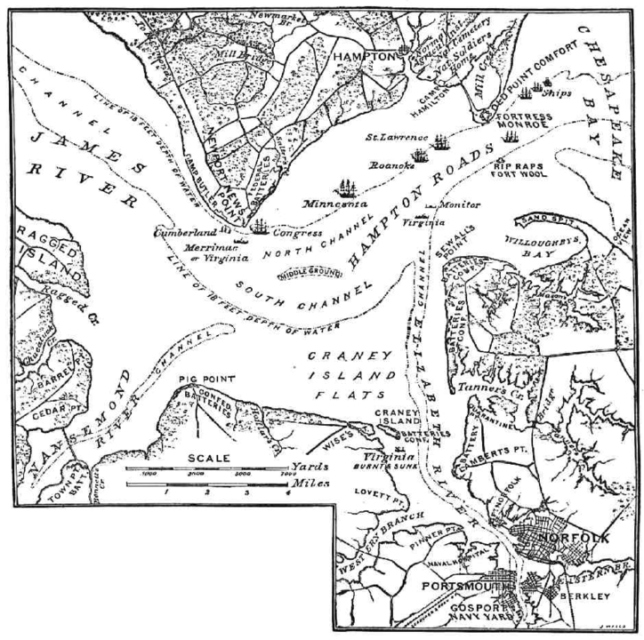
It was March 8, 1862, a Saturday. On the waters of Hampton Roads off Newport News, Virginia – where the Chesapeake Bay empties into the Atlantic Ocean – the Federal warships Cumberland and Congress bobbed easily on a light chop.
The sky was blue, the day warming, the morning uneventful. Drying wash flapped on a light breeze, harmonicas offered-up pleasant tunes, as sailors went about their usual duties. Then, abruptly, around 12:30 in the afternoon, all that changed.
Across the Bay, far to the south, emerging from the Elizabeth River at Norfolk, something odd, something never seen before, had just been spotted. Heads turned, fingers pointed, as binoculars and telescopic glasses were quickly yanked from their cases. A trail of black smoke could be seen rising from a smokestack, below that what appeared to be an enormous hull moving very slowly, bearing WNW.
“I wish you would take the glass and have a look over there, sir,” said the quartermaster of the watch. “I believe that thing is a-comin’ down at last.”
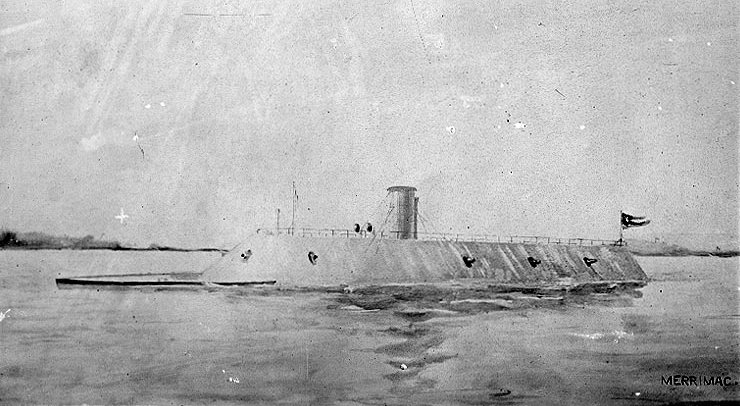
CSS Virginia (ex-USS Merrimack)
General Quarterswas sounded. Drums beat the rhythm as men scurried cross decks, pulling down laundry, racing to the guns, preparing for battle. Truthfully, there was no rush. It would take almost an hour before the hulking mass would be near enough to spot the gun tubes that lined its casemate, or the iron that covered its hull.
At that point there was no doubt, however, it was the rechristened USS Merrimack, clearly identifiable now by the Confederate, seven-star, blue naval jack flying from her stern. The Confederates had renamed her Virginia, but everyone – friend and foe alike – still called her Merrimack.
She had been joined by several vessels of the Confederacy’s James River Squadron – Raleigh, Beaufort, Jamestown, Patrick Henry, along with the tug, Teaser – all of them smaller, and far less formidable than the Merrimack.
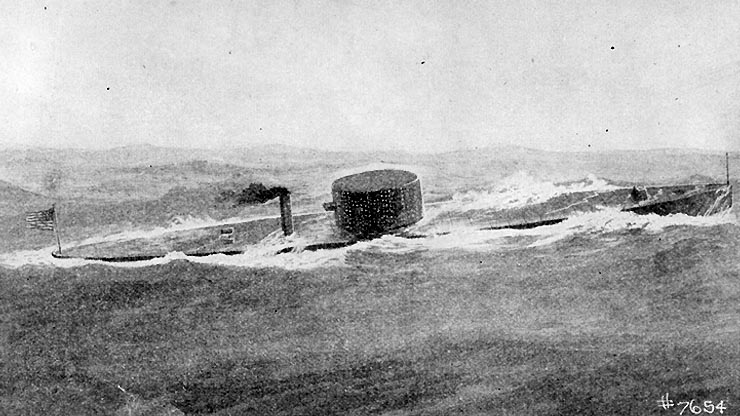
USS Monitor
The Merrimack had been a frigate under construction at the Federal Navy’s yard in Norfolk at the beginning of the war. That yard was then put to the torch when the Navy decided to abandon Norfolk to the Confederacy, but much of the Merrimack survived the flames. Salvaged and retooled as an ironclad, the vessel, now a lumbering, iron monster with sloping sides, and a formidable collection of guns, looked far more like some leviathan risen from the deep, than any recognizable vessel of the day.
As Cumberland and Congress cleared decks for action, the other wooden ships of the North Atlantic Blockading Squadron – St. Lawrence, Roanoke, and Minnesota attempted to get underway and escape as quickly as possible. Cumberland, a powerful sloop-of-war, was the flagship of the Home Fleet, a wood-and-sail vessel of the Raritan-class. She had been recently streamlined and refitted with twenty-two 9” Dahlgren smoothbore cannon, one 10” Dahlgren, and a 70 lb. naval rifle – a daunting array of weaponry.
But the Virginia – now armed with three 9” Dahlgren guns on each broadside, a Brooke rifle fore and aft, and an additional Brooke rifle on each broadside –appeared unimpressed. The ironclad churned-on slowly but steadily, straight at Congress, a wood and sail frigate bearing 48 32 pounder guns, and four 8” smoothbore cannon.
Map of events of the Battle of Hampton Roads
The crews of both Federal warships looked-on in amazement as the Virginiaclosed to within two hundred yards. “The Congress then fired a full broadside point-blank. Nine hundred pounds of hurtling metal smashed fully home. In horror the gunners saw the balls ricochet into the air likes pebbles off a roof.”
The Virginia was not only unscathed by the broadside, but unfazed. Hardly a metal plate had been rattled loose. The ironclad then came about and unleashed a four-gun broadside, tearing Congress to pieces. Below decks, smoke billowed, men screamed, and blood pooled like water. The era of the wooden warship – an era that had reigned for at least five thousand years – had just been brought to an abrupt and frightful end. The age of the iron warship had dawned.
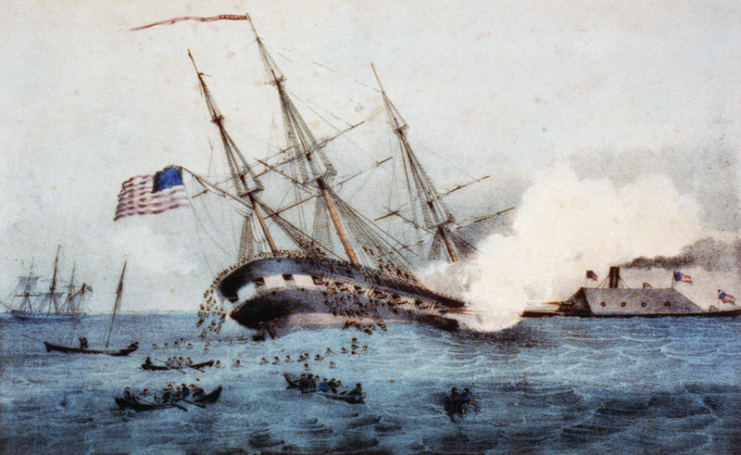
As Congress took on water, Virginiacame about, then headed straight for the Cumberland. Attached to her prow was an iron ram – a weapon not used widely since the days of Greece and Rome – with which she intended to dispatch the Federal sloop-of-war.The ironcladfired one shot with its forward gun which exploded below decks, then rammed Cumberland dead on the bow.
Sinking of Cumberland by the ironclad Virginia
Mayhem reigned onboard the Federal sloop as the ironclad backed away full astern, turned slightly, and found a comfortable position just off Cumberland’s shattered bow where she raked the Federal warship with impunity. The Cumberland soon went-up in smoke and flames. That accomplished, the ironclad returned to the wounded Congress, which was trying to limp away to safety.
But Virginiacaught her easily and turned broadside. Raking the frigate from stem-to-stern, the ironclad simply tore her to shreds, and the Congress eventually blew to pieces when her magazines took fire
By day’s end the Federal squadron had been virtually annihilated. Both Congress and Cumberland were on the bottom, while the other three Federal vessels had run aground in their haste to escape. For those looking on, it appeared the Confederacy had developed a superweapon.
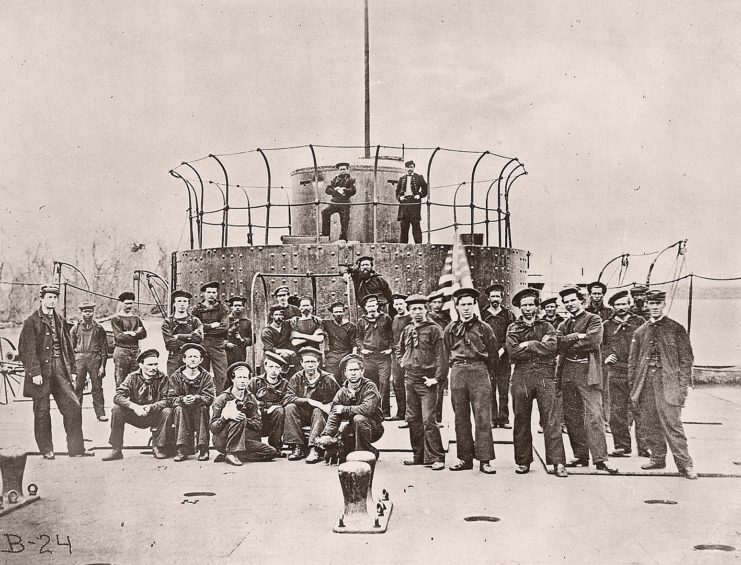
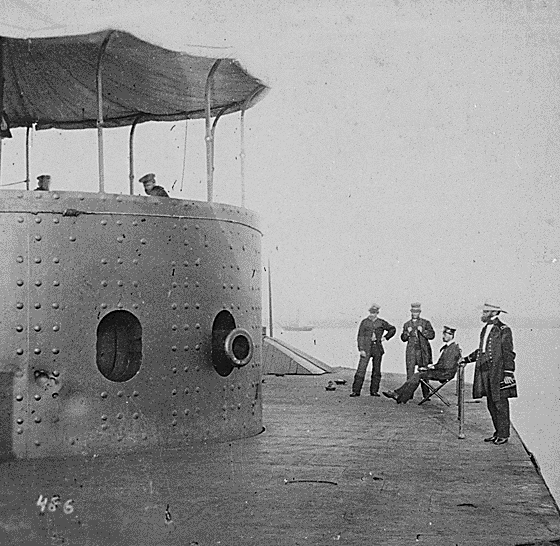
Photo of crew members aboard the USS Monitor
Thus, as the Virginia returned to its berth that evening –intent on returning the following morning to finish-off the stranded Federal squadron – it appeared the Confederacy had engineered a new weapon that would, not only break the Federal naval blockade, but revolutionize naval warfare entirely.
As the Virginia slipped away on the evening tide, however – and unknown to everyone present – another ironclad was then steaming-up Bay. As if Neptune, with an eye for high drama, had written the script himself, this ironclad finally cut its engines, dropped anchor, and took-up a position in defense of the stranded Minnesota. It was, of course, the USS Monitor.
The brainchild of Swedish engineer John Ericsson, his design was so radical that initially the navy board hardly knew what to make of it. The Monitor was only 172’ in length, 41’ abeam. On the deck sat a small pilot house, a revolving turret sporting 2 11” Dahlgren naval rifles, and nothing more. Constructed on New York’s East River in just over 100 days, having received reports of the Virginia’simminent completion, Monitor had shoved-off for Virginia in early March.
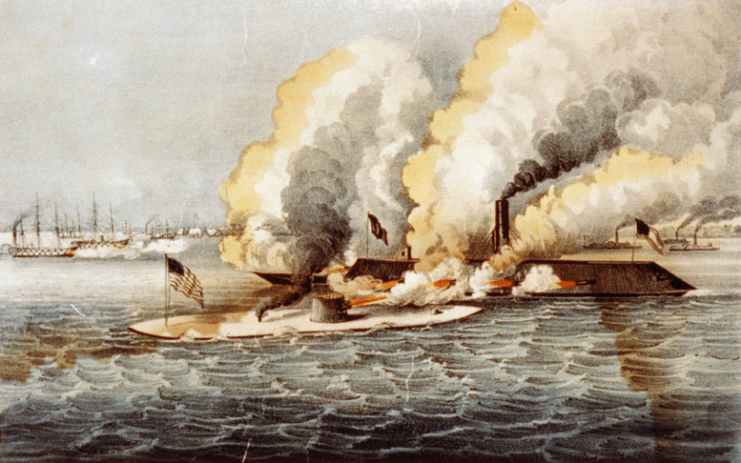
Ironclads engaged in terrific combat by Currier and Ives
Meanwhile, in Washington, President Lincoln, along with his cabinet, having received telegraphed reports of the prior day’s calamity, sat in benumbed silence. No one had the slightest idea what to do. Lincoln was reportedly so overwrought he could barely speak.
Secretary of War Edwin Stanton finally broke the silence, railing: “The Merrimack would sink every vessel in the navy, capture Fort Monroe, cut off Burnside in the Carolina sounds, retake Port Royal, and lay New York and Boston under ‘contribution.’” Then he threw-open a window, half-expecting to see the Merrimac steaming-up the Potomac River, presumably to open fire on the White House. According to Gideon Welles, then Secretary of the Navy, it was “the worst day of the war.”
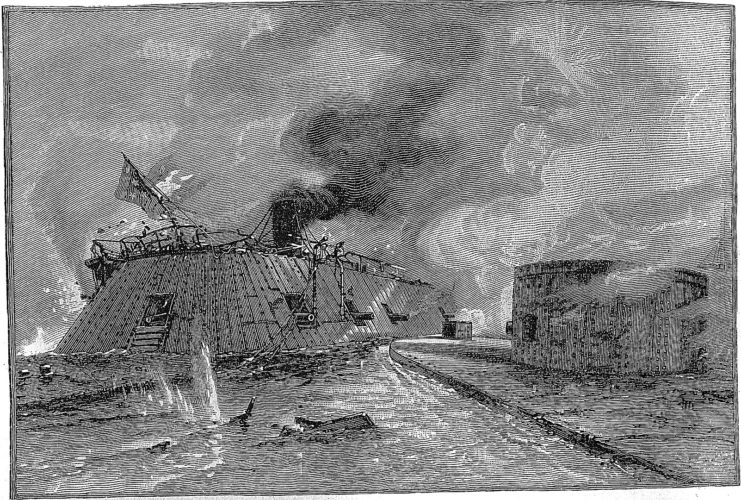
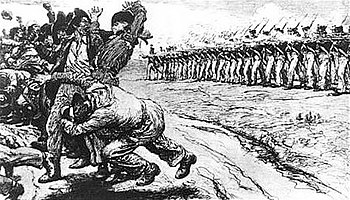
The heart of battle, from an 1871 wood engraving published by A.S. Barnes & Co.
The morning following the Virginia’sfrightening debut, March 9, the Confederate ram again journeyed across the Bay with the intention of destroying the stranded Minnesota, only to discover the tiny Monitor bobbing in the water like “a cheese on a raft,” gamely prepared to give battle. Much like a heavyweight fight, crowds jammed and jostled along the shoreline to watch as the spectacle unfolded.
The Virginia opened the engagement with a broadside that flew high, and the Monitor returned fire, striking Virginia, but doing little damage. Then, for hours-on-end, the combatants circled at close quarters, repeatedly scoring hits, but neither able to strike a decisive blow. Virginia attempted to ram, but the more maneuverable Monitor dodged away, unharmed.
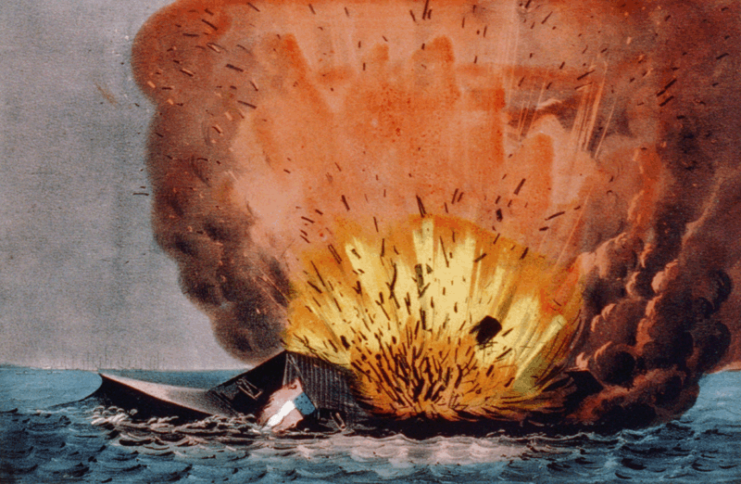
Destruction of the rebel monster Merrimac off Craney Island, May 11, 1862, by Currier and Ives
Damage was done to both vessels, but nothing disabling. In fact, at one point during the confrontation, the Virginia’s guns fell oddly silent. Catesby Jones, the ironclad’scommander, inquired as to the pause. From the gundeck Lieutenant Eggleston responded wryly, “I find that I can do her as much damage by snapping my thumb at her every two minutes and a half.”
A shot finally struck the Monitor’s pilot house, momentary blinding the captain, and the vessel withdrew momentarily to make a change in command. It soon returned to combat, however, only to discover the Virginia’s– thinking its foe had given-up the fight – departed. Both sides subsequently claimed victory, but there is little question the first clash of iron warships had ended in a draw.
Stereograph of Monitor after the battle, July 1862
Regardless of wins and losses, however, every wooden warship then in existence had been instantly rendered obsolete, naval blueprints altered forever. And while Virginia’s had made a fine showing, it would be the gritty little Monitor with its low silhouette and revolving gun turret, that would inspire naval concepts of the future.
Indeed, it would not be overstatement to suggest that every battleship of the 20th Century – from Dreadnaught to Bismarck to Missouri – had direct bloodlines back to John Ericsson’s innovative design, and that on March 9, 1862 a page in the book of naval warfare had been emphatically turned.
Davy Crockett’s last words to General Santa Anna: “I’m willing to discuss the terms of surrender, if you tell your men to lay down their weapons and assemble peacefully, I promise to take you all to General Houston and I’ll try my best to save most of your lives, That said Sams’ a might prickly”
I ran across this description of the battle of the JAVA Sea, and how roughly the Allies were handled by the Japanese. After Reading this, I can see why. And Our torpedo’s really sucked and I keep wondering how those turds were ever foisted on the Naval services, both the Submarines, Planes and Ship torpedo’s were garbage, now the Japanese Torpedo’s worked exceedingly well. I now know more about the battle of the Java Sea.
The ships left just before sunset on February 26, 1942, passing out of a harbor jammed with wreckage, battered docks, fires, the stench of burning oil, and Dutch women, children, and old men—most of them relatives of the crews heading out—waving their men goodbye and good luck. On the outgoing ships, there were answers back, American sailors cheering, Dutch sailors playing bugles, British and Australian warships hoisting their immense battle White Ensigns fore and aft, the heavy cruiser HMS Exeter’s loudspeaker system blaring a familiar song: “A-Hunting We Will Go.”
A combined force of American, Australian, British, and Dutch warships was heading out to sea from Surabaya Harbor in the Dutch East Indies to stop a massive Japanese force from invading the capital island of the 300-year-old Dutch possession. On this motley collection of warships stood all hope of stopping the Japanese advance.
Since the outbreak of war in the Pacific, Japan’s forces had proved virtually invincible. From Hawaii to Singapore, the emperor’s men had crushed all their opponents, conquering Hong Kong, Malaya, Wake Island, Guam, and most of the Philippines.
Now, like a giant octopus, their tentacles were spreading to surround Java, the administrative headquarters of the Dutch East Indies, their primary target in the invasion of Southeast Asia. Two prongs of Japanese warships, transports loaded with seasoned soldiers and powerful aircraft, were headed for Java’s opposing ends.
As Japan’s swords swung down on Java, the Allies had created their first joint command, called ABDA, for the American, British, Dutch, and Australian forces involved.
This attempt at a unified command turned out to be a disaster from the start because of its improvised nature, the lack of Allied forces, and the onrushing Japanese.
British Field Marshal Sir Archibald Wavell, commanding ABDA from Java, could only helplessly watch Japanese troops storm into Singapore, Sumatra, the Celebes, Borneo, and Timor before admitting that the idea was a failure. He fled to Ceylon, leaving Dutch Admiral C.E.L. Helfrich in charge of a dwindling and poorly equipped band of British, Dutch, American, and Australian troops, airmen, and sailors.
There were good reasons for that. The Dutch troops in the Indies were among their best, the King’s Netherlands Indies Legion, a veteran force that had policed the colony for centuries, battling native uprisings. And while the Dutch airmen flew poor aircraft like Brewster F2A Buffalo fighters that were easy meat for Japan’s nimble Mitsubishi Zero fighters, their long-service sailors manned modern destroyers, highly effective submarines with torpedoes that worked (unlike their American counterparts), and two tough light cruisers, the East Indies fleet flagship De Ruyter and her older sister Java.
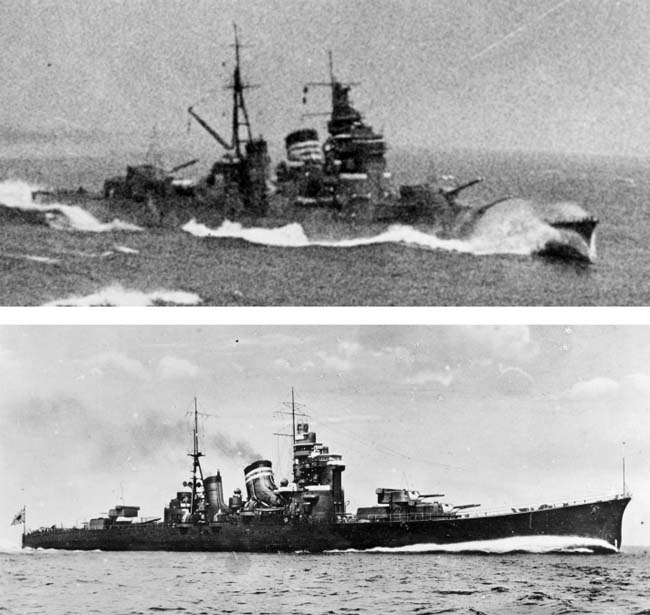
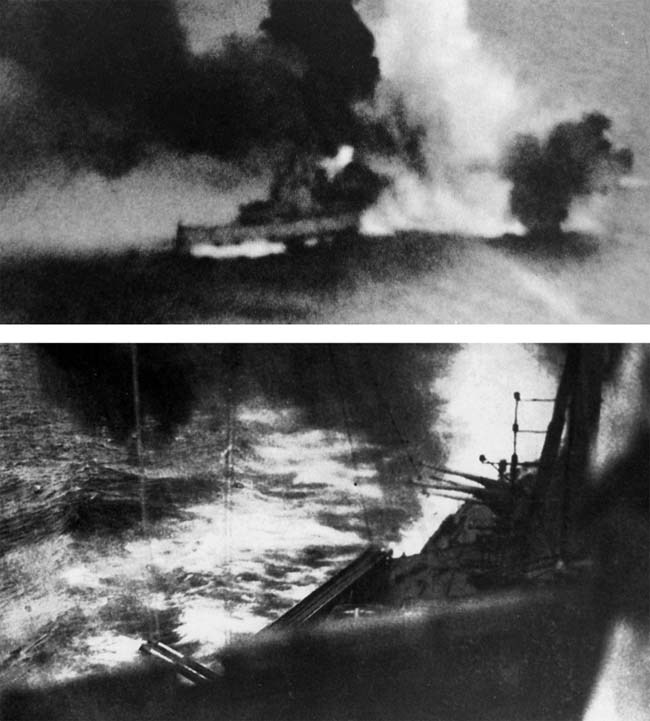
TOP: The Japanese heavy cruiser Haguro steams at high speed. Haguro was one of the cruisers engaged at the Battle of the Java Sea guarding transports and firing its heavy guns and torpedoes. ABOVE: The Japanese heavy cruiser Nachi was heavily engaged at the Battle of the Java Sea as the Imperial Japanese Navy inflicted a stinging defeat on ABDA naval forces.
Equipped with two seaplanes, depth charge launchers, torpedoes, and the sophisticated Hazemeyer fire control system for her seven 5.9-inch guns and her 10 40mm antiaircraft guns, De Ruyter was built specifically for East Indies service. Now De Ruyter’s hour had come. She would not be the only defense of Java. The surviving ships of Britain’s Far Eastern Fleet, Australian warships, and the U.S. Asiatic Fleet had been
ordered under Dutch command into “ABDA Float,” which created additional punch.
Among the ships was the heavy cruiser USS Houston, the Asiatic Fleet’s longtime flagship, distinctive by her tall foremast, and HMS Exeter, which had run the German pocket battleship Graf Spee into Montevideo in 1939.
The British provided the light cruisers Danae, Dragon, and Durban, Australia the more modern light cruisers Hobart and Perth, and the Americans the old light cruiser Marblehead and new Boise. The British, Americans, and Dutch also offered a collection of destroyers.
But there were still numerous weaknesses. The British and Dutch destroyers were fairly modern ships. The three elderly British light cruisers were withdrawn. USS Boise ran aground on an uncharted reef, tore up her keel, and had to be sent home, taking her radar with her. Marblehead endured numerous bomb hits and had to depart as well.
When the Japanese attacked Houston with medium bombers, the American cruiser’s crewmen discovered that most of her antiaircraft shells were duds. Before Boise headed for stateside yards, she handed over all her AA ammunition to Houston.
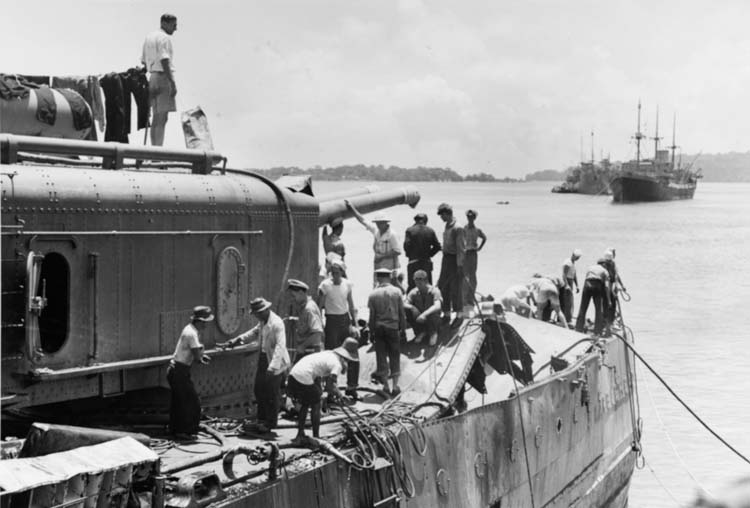
The Australian cruiser HMAS Perth was a survivor of the disaster at the Battle of the Java Sea but was lost in action at the Battle of Sunda Strait a month later.
The heavy cruiser badly needed it—she had seen endless action in the weeks since Pearl Harbor. Worse, a Japanese bomb had slammed through her quarterdeck and exploded in the base of her aft 8-inch turret. Quick work by a veteran crew prevented a fire that would have sunk the ship, but the three aft 8-inch guns were put out of action, and Java lacked any facilities to repair them.
To make matters worse for the four navies concerned, they had no common ammunition, language, communications, or procedures. While the British and Australians shared the same procedures, and the Americans, Australians, and British the same language, there were still great differences.
Rear Admiral Karel Doorman, who commanded the surface naval forces of ABDA, had to use simple flag or radio signals to communicate with his ships’ captains. Doorman could signal by blinker light in plain English, but in battle, with smoke and confusion, that was dangerous. He would then relay his orders by high-frequency radio to Houston, where a Dutch liaison officer would translate them to Houston’s skipper, Captain Albert Rooks.
He in turn could relay them by American “Talk-Between Ships” short-range radio to other American vessels, but that did not help the British or Australians, whose flag signals were different from those of the Dutch and the Americans. An American officer called the communications situation “farcical.”
Lieutenant Harold Hamlin of Houston put it bluntly: “Everyone knows you cannot assemble 11 football players who have never seen each other before and go out and beat Notre Dame. Two hours after it assembled, it was out on patrol.”
But that was all the Allies had, and they defied Japanese strength and odds. In January, four ancient American four-stack destroyers swooped in on a collection of Japanese transports anchored off Balikpapan and sank three of them, a morale-boosting victory. American and Dutch submarines knocked off the occasional freighter, and Admiral Doorman himself led a night strike in Badung Strait on Japanese shipping on February 19.
Doorman, 53, a Utrecht native, had been a naval officer since 1910 and a pilot since 1915; he was one of the Dutch Navy’s first flying instructors. In 1938, he headed the Dutch Navy’s air arm. In 1940, he was promoted to rear admiral and assigned to command the fleet forces in the East Indies.
An experienced deck sailor, he had a logical and sound approach to problems and understood the value and impact of airpower in the modern age.
He led his ships to Badung Strait in three packets, relying on darkness to cover his advance, attack, and retreat. Chaos reigned from the start. A Dutch destroyer ran aground. The three packets could not communicate with each other. Allies and Japanese hurled broadsides and torpedoes back and forth, but the only result was the damaging of a Japanese destroyer, the same to the American destroyer Stewart, and the sinking of the Dutch destroyer Piet Hein.
Doorman took his ships home to Java’s main naval base, Tjilatjap, and Stewart was placed in a 15,000-ton floating drydock where she promptly rolled over on her port side, taking the destroyer and the drydock out of the game. The Japanese captured Stewart after conquering Java and use her for the rest of the war as a patrol ship.
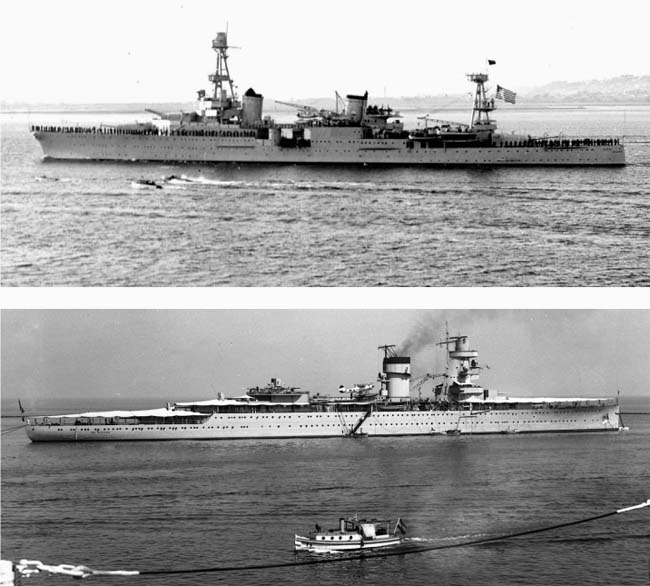
TOP: The cruiser USS Houston sustained damage at the Battle of the Java Sea but was later sunk at Sunda Strait. ABOVE: The Dutch cruiser De Ruyter was a casualty of the Battle of the Java Sea, sunk by enemy gunfire and effective Long Lance torpedoes.
The remaining vessels prepared for the next round, but it was difficult. American destroyers’ numbers were being whittled down: Stewart was gone, Whipple was out of action from a collision, Pillsbury and Parrott were out of torpedoes and needed overhaul, and Pope had developed feed-water leaks—she was losing more water from her condensers than they could take in.
The Americans could only marshal four destroyers, all “flush-deckers” from the 1920s: Ford, Edwards, Alden, and Paul Jones. They lacked an elevated forecastle, so they could not fire their forward 4-inch gun in rough seas or at top speed. On Houston, engineers shoved the wrecked after 8-inch turret into normal position and slapped a steel roof over it, hoping to fool the Japanese into believing it was operational.
Meanwhile, the Japanese forces descended on Java. From the west came 56 transports and freighters guarded by four heavy cruisers, two light cruisers, and a light aircraft carrier. From the east came 41 transports covered by two heavy cruisers, one light cruiser, and seven destroyers, under Rear Admiral Takeo Takagi, a fairly routine officer by Japanese standards.
Behind this power, as deep cover, was even more power: the mighty carriers that had shattered the American battle line at Pearl Harbor, a battleship, and nine more heavy cruisers.
Takagi’s force got down to business on February 26, forming a two-column convoy with ships a mile apart, the convoy 20 miles long. The merchant ships were handled poorly by ill-trained civilian crews, and Japanese destroyers struggled to keep order.
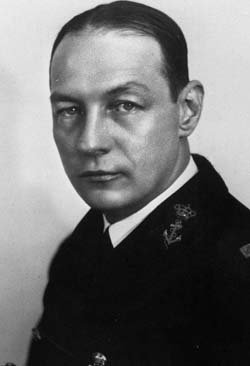
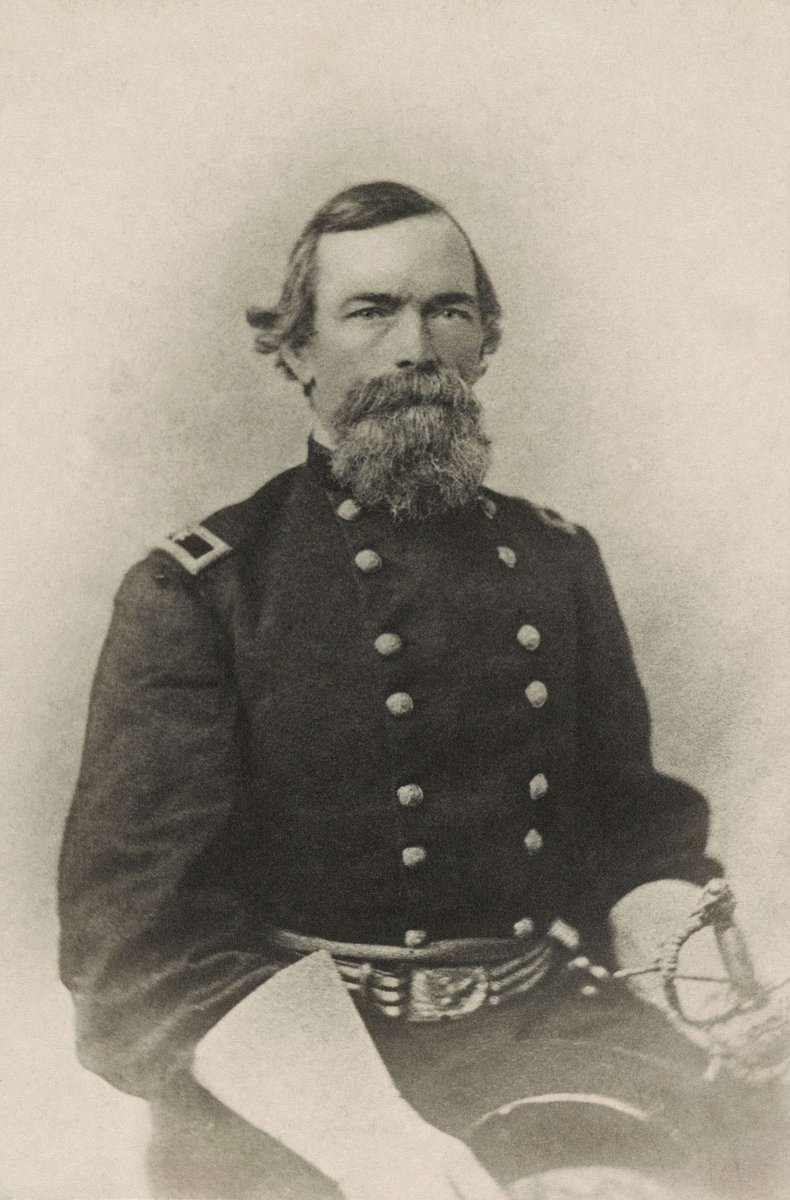
Dutch Admiral Karel Doorman, photographed in 1930, was killed in action while commanding ABDA naval forces at the Battle of the Java Sea.
Among the tin cans shepherding these vessels was the Amatsukaze, under Commander Tameichi Hara, who was annoyed at the merchant vessels’ lack of discipline. They emitted huge clouds of black smoke, ignored blackout regulations, and defied rules on radio silence.
“The weather was beautiful; sparkling sun by day, and bright moonlight silvered the sea every night. Even at night, trained eyes could span the length of the entire force. Five Allied submarines had been observed by our reconnaissance planes, but none menaced our ships. To this day, I do not understand why enemy submarines failed to come out,” Hara wrote later.
Actually, there was a good reason. The American submarines’ torpedoes stubbornly refused to work, so the sub skippers were reduced to reporting on the Japanese movements, which were confirmed by British codebreaking teams operating in Ceylon and London.
With this information in hand, Doorman could prepare. He recalled Exeter, Perth, and three destroyers from Tandjong Priok in western Java to Surabaya, and crewmen on Pope, watching the Anglo-Australian ships steam in, their White Ensigns flying, let out hearty cheers.
When Exeter tied up and shifted colors, her skipper, Captain Oliver Gordon, was summoned with his Perth counterpart, Captain Hector “Hec” Waller, to meet with Doorman and the other senior officers at Dutch naval headquarters, the requisitioned Netherlands Indies Electricity company building. All hands showed up in proper uniform, befitting long-service officers.
Doorman shook hands with every ship captain. He gave the briefing in English, but there was not much to say. He intended to leave harbor and attack the enemy convoy southwest of the Celebes. With Houston’s after gun turret knocked out, she would not be the last ship in line. With the Dutch destroyer Kortenaer suffering leaking boilers, the whole fleet’s top speed would be 25 knots.
On the evening of the 26th, Doorman’s Combined Striking Force sailed from Surabaya, battle flags streaming. Chaos reigned again as De Ruyter collided with a tug and water barge in the harbor, sinking both, but doing no damage to the flagship. They found no enemy forces, and by noon the destroyers were short of fuel. He headed back to Surabaya to refuel, dodging Japanese bomber aircraft on the way home. Houston’s new AA gun load helped fend off the Japanese.
When Doorman reached port, there were messages from Helfrich ordering him back to sea as soon as fueling could be completed. The Japanese were definitely on their way.
Doorman signaled back: “This day the personnel reached the limit of endurance. Tomorrow the limit will be exceeded.” But at 2:27 pm on February 27, the Combined Striking Force headed for sea once again, following a contact report that put the Japanese convoy just 90 miles to the north. Doorman signaled his ships in a plain English semaphore: “Am proceeding to intercept enemy unit, follow me, details later.”
The Striking Force formed up into two columns—one led by Doorman on De Ruyter, with Exeter, Houston, Perth, and Java trailing. The British destroyers steamed ahead of De Ruyter as a screening force, while the American and Dutch destroyers were a separate column on the cruisers’ rear and port quarter, held back by their older engines and kept back because of their weak armor, which made them susceptible to enemy fire.
The American four-pipe destroyers coughed up black smoke.
On the other side, Japanese reconnaissance planes were hard at work searching for Doorman’s force. Takagi had issues of his own. His combat group consisted of heavy cruisers Nachi and Haguro, the light cruiser Jintsu, and eight destroyers, including Hara’s Amatsukaze. The two forces were evenly matched, but Takagi had the burden of escorting 41 transports and freighters.
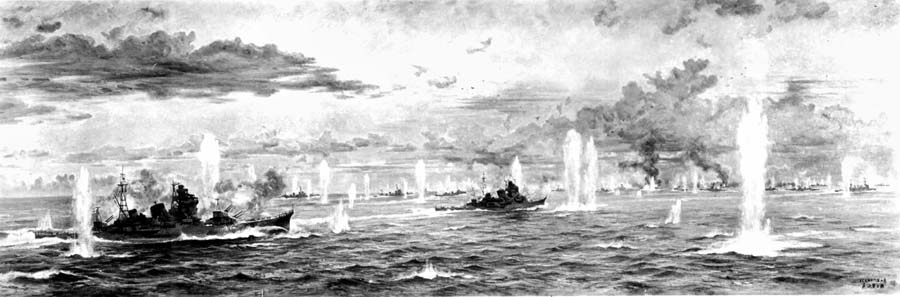
A depiction of the action at the Battle of the Java Sea
Takagi followed Doorman’s movements closely, mystified by his slow advance (12 knots) and odd courses.
There was reason for that. As the afternoon wore on and the Allies lost touch with the Japanese, Doorman was concerned that his battered ships and exhausted men might simply get ambushed. He decided to head back yet again for Surabaya and refuel and take on more ammunition.
At 3 pm, Doorman stood on his flagship’s bridge, heading into Surabaya’s outer harbor. At that moment, he received a signal from Helfrich. The Japanese Eastern Force had been sighted north of Surabaya near Bawean Island. Helfrich was ordering Doorman to attack immediately.
Despite his fatigue and that of everyone else in the fleet Doorman followed orders, signaling, “Follow me. The enemy is 90 miles away.” The ships turned back into the preset formation and shuffled north without refueling.
As Doorman’s ships headed north, the Japanese had their eye on them. One of Nachi’s scout planes reported to Takagi: “The enemy fleet has turned around again. The double column formation is now shifting to single column. The enemy is gaining speed and is headed on a course of 20 degrees.” A signal 10 minutes later confirmed the Allied speed: 22 knots.
Takagi reacted immediately. He shot off his cruisers’ remaining observation planes, ordered his minesweepers and patrol craft to herd the transports into order and away from the Allied fleet, and formed battle line: Rear Admiral Raizo Tanaka’s light cruiser Jintsu heading the eight destroyers, behind that another flotilla headed by the light cruiser Naka with six more destroyers under Rear Admiral Shoji Nishimura, Nachi and Haguro behind them.
Next, the human preparations: sailors put on working uniforms and helmets, officers white dress uniforms; many men went to their ship’s shrines for a quick prayer and to don hachimaki headbands, and finally, immense Rising Sun battle ensigns were broken from every masthead.
At 3:30 pm, the visibility was perfect, the sea was calm, and the two forces pounded toward each other, heading into the biggest surface action since the Battle of Jutland in 1916.
At first the officers on Exeter thought they had spotted the invasion convoy and not its screen, but then Electra reported at 4:12 pm: “One cruiser, unknown number large destroyers bearing 330 degrees, speed 18, course 220 degrees.” Electra had spotted Jintsu and Amatsukaze.
On Amatsukaze, Warrant Officer Shigeru Iwata, one of Hara’s top lookouts, yelled “Enemy ship!” and everyone trained their binoculars to the south. Hara recognized the lead cruiser from his recognition books as De Ruyter, and Iwata confirmed it: “De Ruyter is 28,000 meters [20 miles]. Closing rapidly.”
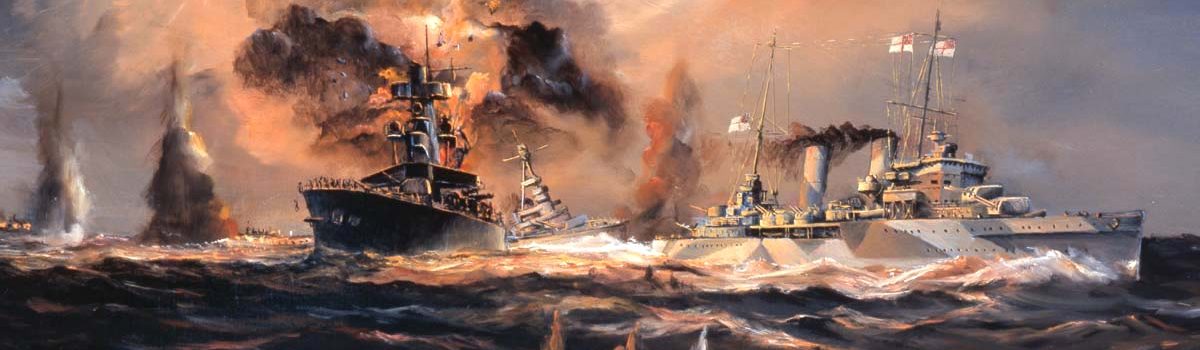
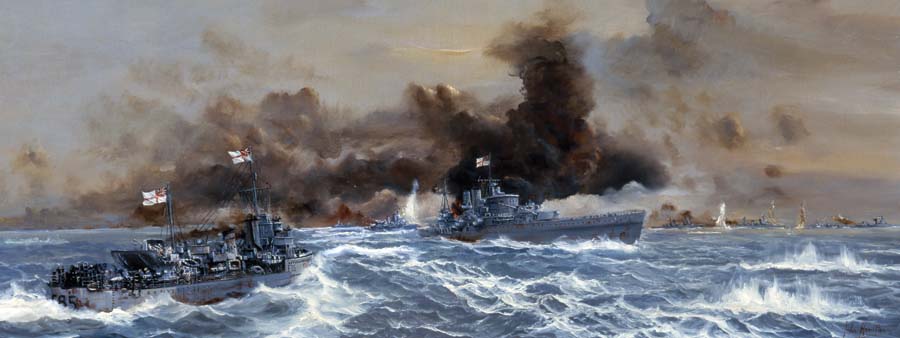
In defense of the damaged cruiser HMS Exeter, the British destroyers Encounter, Jupiter, and Electra dash toward the enemy amid a smokescreen at the Battle of the Java Sea. Painting by John Hamilton.
Hara yelled, “Gunners and torpedomen, get ready. Our target is the lead cruiser in the enemy column!” Hara realized he was heading into his first major sea battle.
At 4:14 Electra reported: “Two battleships, one cruiser, six destroyers.” Before the various officers had time to react, Electra amended the report: “Two heavy cruisers.”
Heavy cruisers they were. At that moment, Nachi and Haguro entered gun range, and at 4:16 pm both cruisers opened a full broadside with a combined 20 8-inch guns at a range of 28,000 yards. The Allied ships answered back, with Houston’s after turret silenced by damage and Exeter’s simply unable to train on the Japanese, who were trying to cross Doorman’s “T,” the oldest naval maneuver to gain tactical supremacy since the invention of gunpowder.
Now the problems of communication came in. In the Royal Navy, ships did not open fire until the senior officer gave the word, and Doorman had not done so yet. On Exeter, Gordon puzzled over what to do. “Had we been in company with a British Senior Officer, I could and probably would, have hoisted a very brief flag signal—if I had received no order—asking permission to open fire but in this case I knew the limitations of inter-ship communication.”
The first Japanese 8-inch shells fell short at 30,000 yards. The Japanese gunners were too excited. This was their first surface action.
Doorman ordered course 20 degrees left to parallel the Japanese ships, putting the three leading British destroyers on the cruisers’ starboard bow. The Japanese hurled shells at Electra, and Doorman ordered the destroyers to head to the Allied column’s port side to await their moment with their torpedoes. He also sent a radio message to Surabaya for air support, but the few bombers the Dutch and Americans had on Java headed straight for the transports.
Now Doorman gave the order, and the two Allied heavy cruisers opened fire. Houston’s shells had a crimson dye to assist spotting, and the blood-red geysers of her first short shots frightened some Japanese officers on Nachi. The concussion of Houston’s guns opening fire hurled Winslow against a bulkhead and ripped his “soup-bowl” steel helmet from his head. Winslow, shaking with excitement, recovered his tin hat and realized that his tension of waiting for battle had ended.
On the Japanese side, Jintsu led her column directly toward Electra. At 18,000 yards, her group opened fire and straddled the British destroyer. Electra and Jupiter opened up at 16,000 yards and straddled the Japanese.
The last ship to open fire was Perth, at the tail of the Allied line, equipped with 6-inch guns. Captain Waller told an officer on the bridge that waiting for his moment to open fire in a surface engagement was more terrifying than enduring the Luftwaffe’s bombing in the Mediterranean.
After eight minutes, Doorman changed course at 4:29 pm to 248 degrees, so that both columns were parallel and the Allied light cruisers could open fire. All of the ships were being straddled. Nobody was scoring any hits yet.
At 4:31, the Japanese scored a hit; an 8-inch shell slammed into De Ruyter’s armored deck and down into her auxiliary engine room where it failed to explode. Four minutes later, Doorman closed the range on a course of 267 degrees, at which point Nishimura, aboard the light cruiser Naka, ordered his seven destroyers forward to unleash 43 “Long Lance” torpedoes at the enemy. The rest of the fleet joined in as well, except Nachi, whose crew had left the stop valve on their compressed oxygen system open too long by accident.
Houston had a reputation as one of the U.S. Navy’s best gunnery ships, but her rangefinders were outdated by World War II’s rapidly advancing standards. She lacked radar and remote-control servo motors to enable crews to train and elevate guns without using sweat and muscle. Ranges were triangulated visually. In the overheated gun houses in the dim red light, 70 gunners cranked wheels to train guns, open breeches, and stuff shells and powder bags.
On the fifth salvo, a fuse box was jarred loose from the Turret One bulkhead, disabling the electro-hydraulic ramming mechanism. The crew now had to load and ram the breech by hand, an almost impossible task in peacetime. But they accomplished it in wartime, almost keeping pace with Turret Two, for 65 salvos until repairs were accomplished.
Up above, Lieutenant Winslow watched the shellfire and saw the dull red glow of exploding shells. Convinced Houston had beaten up the enemy, he yelled down a voice-tube into the turrets, “We’ve just kicked hell out of a 10-gun Jap cruiser.” The men cheered back. One of the enemy cruisers seemed to withdraw.
But then, a frayed electrical lead in the forward main gun director, abetted by the whipping back and forth of the towering foremast housing, caused problems with gunnery deflection adjustments. Houston’s rangefinders and gunners no longer knew where their shells would land.
While this went on, a Japanese shell hit Houston’s main deck aft of the anchor windlass, zoomed through the second deck, and out the starboard side above the waterline without exploding. Another hit ruptured an oil tank on Houston’s port side after, but it failed to explode. The Americans wondered if the Japanese suffered from dud shells, too.
“Salvo after salvo exploded into the sea around us,” Lieutenant Winslow wrote. “I was mesmerized by the savage flashes of enemy guns, and the sigh of their deadly shells flying toward us like giant blackbirds.”
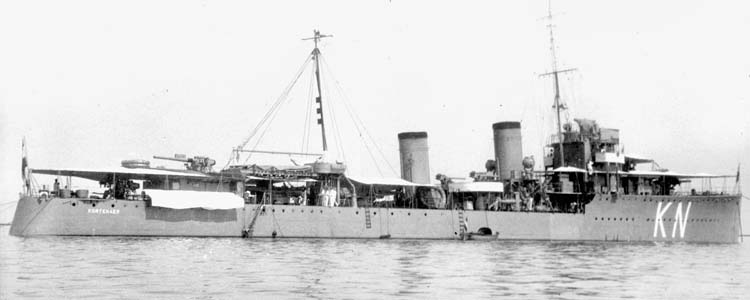
The Dutch destroyer Kortenaer was among the ABDA ships sunk in a hail of Japanese shells and torpedoes during the night Battle of the Java Sea in February 1942.
Meanwhile, Exeter took 12 salvos to get a straddle. Then Gordon saw the orange flash of a shell bursting on a cruiser’s superstructure. He yelled, “That’s a hit!” It sure looked like one to everyone, but it wasn’t … the Japanese cruisers suffered no damage in the action. The destroyer Asagumo did—an Allied shell hit her, killing five and wounding 19, disabling her engine.
Exeter, on the other hand, did take hits. At 5:07 pm, a shell passed through the S2 4-inch gun shield and killed the four members of the gun crew. The shell kept going and entered the No. 1 boiler room ventilator and exploded in the boiler room, killing all 10 of its crewmen. Steam vented through the waste pipe, and Exeter began losing speed. It felt like “a mighty can-opener being driven into the ship.”
Six of Exeter’s eight boilers were put out of action. Electrical power failed, and the cruiser’s speed fell to 11 knots. Damage control parties moved in, but the great heat from the explosion and superheated steam made it impossible to enter the boiler room until the next day.
Gordon realized his ship could not hold its place in line at 11 knots, and he altered course to port to get out of the battle line and avoid collision. Unfortunately, the shellfire and concussion had knocked out Houston’s TBS radio and damaged her signal lights. Heavy smoke obscured her alphabet flags and halyards, as well as the Aldis lamps used for signaling. Commander Henry E. Eccles, skipper of the destroyer Edwards, wrote, “From then on, all communication was by flashing lights obscured by gun smoke, smoke screens, and hampered by rapid movements.”
Not knowing what was going on, thinking he had missed an order from Doorman, Rooks followed Exeter in column, turning to port. As Houston turned, the ship had to check fire. On Perth, Waller, seeing the two cruisers ahead of him maneuver and Exeter blow off steam, headed in a counterclockwise loop to the north to cover the heavy cruisers’ retreat with a 30-foot wall of smoke that gave them a reprieve, while Java followed Houston.
Doorman, sailing off without a column behind him, heeled De Ruyter over to port and closed Exeter, signaling, “What is your damage?”
Gordon flagged back: “Hit in one boiler room. Maximum speed 15 knots.” Doorman ordered Exeter to head for Surabaya and reformed the other cruisers on a northeasterly course.
Before anyone had much time to react, smoke, squalls, and fog came down on the action. Doorman retired at 5:20, trying to regroup. Nobody on the Allied side seemed to know what was going on. Eccles wrote later, “The crystal ball was our only method of anticipating the intention of Commander Combined Striking Force.”
Tanaka, however, took advantage of the squalls and Allied confusion, ordering eight destroyers to “to close and charge the enemy” behind his cruiser Jintsu to hurl torpedoes and shells at the nearest Allied ships, the American destroyers.
The Allied ships opened fire at 7,000 meters, and in seconds everybody was covered in smoke—American smoke screens on their side, missed Allied shells on the Japanese side. The Japanese closed to 6,000 meters, then 5,000 meters, and a tense Hara gripped the rail of his bridge, sweat streaming down his face, his knees trembling.
At 5:27, Tanaka ordered his ships to open fire. Hara yelled “Fire torpedoes!” As the Long Lances swished through the water, the Allied ships turned to the west.
The Japanese torpedo salvo finally closed its targets, and at least one smacked home, blasting the Dutch destroyer Kortenaer. The 1928-built destroyer jackknifed in two and sank almost immediately, scattering survivors—including her skipper—across the water. It was the first time the Allies had met up with the Japanese Long Lance torpedo in a surface action, and all hands were stunned.
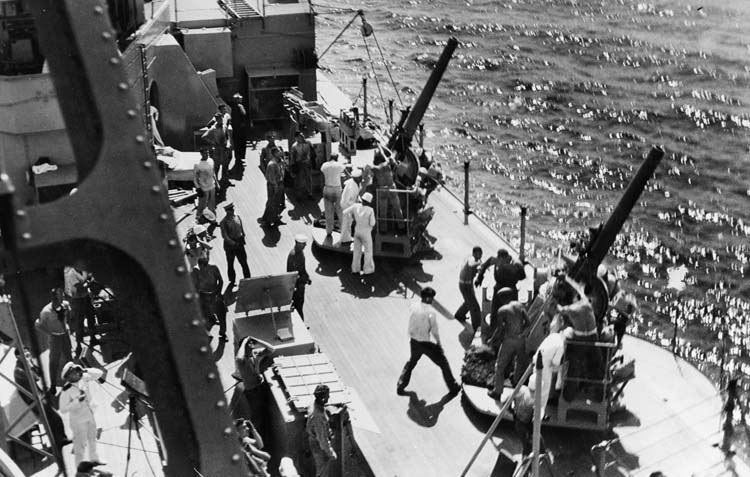
The 5-inch antiaircraft gun crews of the cruiser USS Houston dash to their posts during a firing exercise. The Houston was reported sunk several times before the ship was actually lost at Sunda Strait.
On Houston, Ensign Smith watched Kortenaer’s two split sections slide into the water, looking like the twin towers of a cathedral.“There was only 15 or 20 feet separating her bow from the stern,” he said later. Another seaman next to Winslow yelled, “Jesus Christ, look at that!” Winslow saw a tremendous geyser of water rising 100 feet into the air.
Lieutenant Commander A. Kroese, commanding Kortenaer, reported later, “On the stern the doctor was sitting, dressed in a khaki suit, life belt and steel helmet. As a result of the explosion, the smoke apparatus had begun to work and heavy white clouds were rising from the ship. The doctor sat in the midst of it all like some kind of fire-god.
“After a short time the stern turned over on its side, and those who were still clinging to it jumped hastily into the sea. Soon half of the Kortenaer sank from sight, but the bows of the ship floated for a long time sticking straight up in the air.
“After the ship had gone down, a number of rafts, sufficient to support all the survivors, began to float up. The Commander gave orders to tie the rafts together so that we would form a group easily visible to a rescuer…. Our situation was far from comfortable, for much of the surface of the water was covered with a heavy film of black fuel oil from the ship’s bunkers.”
With Kortenaer sunk and Exeter severely damaged, Doorman’s battle plan and fleet were in serious trouble, even though the Japanese had scored only one hit out of 64 torpedoes launched. Doorman turned his flagship to join his other ships and regroup. Everybody on the Allied ships wondered how they could have been torpedoed at such an incredible distance from the Japanese warships. Not knowing about the Long Lance, the Allied skippers presumed there were Japanese submarines in the neighborhood.
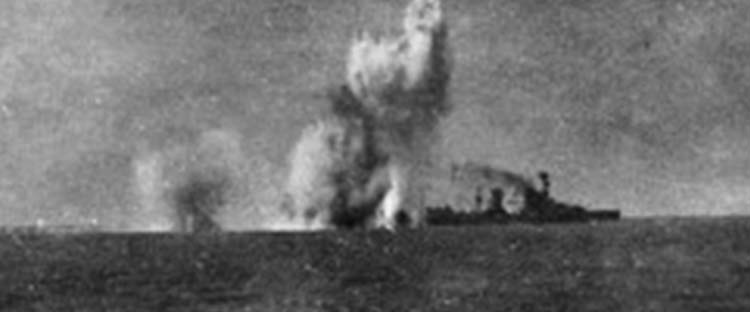
Splashes from Japanese shells bracket the Dutch cruiser Java during the Battle of the Java Sea. The ship fell victim to enemy torpedoes and sank during the February 1942 fight.
On the other side, Nishimura’s 4th Destroyer Flotilla maneuvered to port to link back up with Tanaka’s ships for another attack. Doorman responded by ordering his ships to follow him southeast and then northeast, spewing smoke to cover his moves, to put his main force between the enemy and the battered Exeter, giving that cruiser a chance to escape.
As the Japanese regrouped, Doorman realized he had to strike first, sending in his three British destroyers, Electra, Encounter, and Jupiter, to make independent attacks. After doing so, they would join the Dutch destroyer Witte de With and escort Exeter to Surabaya.
On Electra, Commander C.W. May told his men on the main loudspeaker at 5:25, “The Japanese are mounting a strong torpedo attack against the Exeter. So we are going through the smoke to counterattack.” While this went on, Exeter’s crew restored power to the guns and steam to 15 knots. With that, her guns opened fire on Jintsu, which made smoke and maneuvered away from Exeter’s 8-inch shells.
Electra, ahead of her sisters, sprinted forward to the northwest, into the smoke, and emerged through the murk and gloom to find the pagoda-like superstructure and bulbous funnel tops of Jintsu leading six destroyers toward her. Gunner Cain felt naked to the enemy.
The Japanese opened up with dozens of shells, most of which were near misses that rocked the destroyer. Electra returned the fire, gun crews doing so with veteran experience. But a Jintsu shell hit below the bridge, followed by more that broke the after boiler room mains, and Electra slowed to a halt. A Japanese destroyer blazed away at the immobile British ship, but Electra fired torpedoes back—to no avail. All of them missed.
Jintsu poured more shells into Electra, and Gunner Cain fired his turret under local control. Soon the guns were out: A Turret knocked out … B Turret evacuated when a fire started beneath it … the searchlight platforms demolished … a fire started aft that blocked ammunition supply to the X and Y Turrets … the ship’s whaler and motor boat smashed. Commander May ordered “Abandon ship.”
Electra’s self-sacrifice saved Exeter and scored a single hit on Jintsu that killed one man and injured four, and also bought time for Encounter and Jupiter to pop through the smoke and hurl torpedoes at the Japanese.
Encounter’s skipper, Lt. Cmdr. Morgan, saw the hordes of Japanese ships and heeled his destroyer hard over after launching torpedoes, followed by Jupiter and Witte de With. The three tin cans formed up around Exeter to escort the battered cruiser out of harm’s way. On the way, Witte de With was damaged when one of her depth charges broke loose in the maneuvering, fell overboard, exploded abaft, and shook the ship like a hammer blow.
Up on De Ruyter’s flag bridge, Doorman faced more impending disaster. As Exeter steamed off, she took six 8-inch guns, half of Doorman’s such armament. With Electra and Kortenaer sunk, Doorman was down to six destroyers.
Doorman reformed his line to find himself on the Japanese side of the smoke screen, parallel to the heavy cruisers Nachi and Haguro. The Japanese cruisers closed the range and opened fire, aiming at Houston.
Now it was the American ship’s turn to be in trouble, as she was running short on ammunition. Houston had sortied without time to rebunker her magazines, and now had fired off 303 rounds per turret, leaving only 50 rounds per gun.
Most importantly, the remaining shells were in the aft magazine for the useless No. 3 Turret. Chief Petty Officer Otto Schwarz and his shipmates hauled greasy shells out of storage racks abaft and hand carried the 260-pound projectiles in slings through the narrow passageways and up ladders, across decks, and into the two forward handling rooms.
In addition, the life of an 8-inch gun of the time was about 30 rounds. That level had been exceeded, and the liners of the gun barrels had crept out of the guns an inch or more. The gun casings were so hot it would be hours before they could be touched.
Doorman would not give up. Neither would the Japanese. The Japanese ordered their transports to turn south and head for Java’s beaches while the combatant ships polished off the Allied Striking Force.
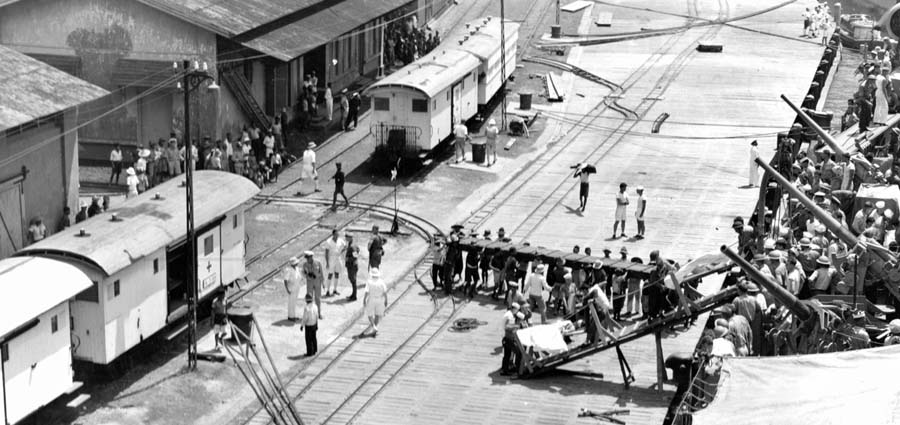
Crewmen of the cruiser USS Marblehead view damage from a Japanese bomb hit. Marblehead managed to limp into port after sustaining the damage.
At 6 pm De Ruyter’s after port lookouts spotted Jintsu. The Dutch cruiser opened fire, but the gathering dusk and smoke obscured the Japanese. The Japanese closed to 4,400 yards of the Allied ships and launched torpedoes. The Japanese ships heeled over to avoid the shells that their officers knew would be returned. Doorman, realizing the danger, ordered his ships to turn south, and the torpedoes shot harmlessly past his ships.
At 6:21, the sun set on the battle, but the fighting went on through twilight. In the dark, Allied communications worsened—signal lights were broken from shellfire damage, and flags were useless. At 6:06, De Ruyter signaled Edwards with her signal lamps to “Counterattack.” Moments after Edwards acknowledged the order, De Ruyter flashed “Cancel counterattack,” followed by “Make smoke.”
Commander Binford of Edwards was baffled. As leader of the American destroyers, he had taken them on the requested counterattack course. Then came a last signal: “Cover my retirement.” Binford was even more puzzled. Did that mean make smoke? Steam protectively across Java’s stern as it turned away? Binford decided that the only way to cover a cruiser column’s retirement was with the greatest U.S. Navy tradition: attack, even though his ships were 32 years old.
Binford’s tin cans charged toward two ships visible in the dusk to the northwest—the cruisers Nachi and Haguro, which were guarding the invading transports. On the U.S. destroyer Alden’s bridge, a sailor said, “I always knew these old four-pipers would have to go in and save the day.”
Up on Nachi’s bridge, Takagi saw the American destroyers advance. He could also see Surabaya’s lighthouse in the distance, its glass windows reflecting in the sunset.
Binford ordered his destroyers by flag signal to make a torpedo attack. The tin cans raced through the smoke, nearly colliding. They sprinted through and cracked on top speed, set up for broadside torpedo attack on the Japanese cruisers to starboard, and Binford ordered the fusillade of fish. Then Binford’s destroyers changed course 180 degrees, maintaining full speed to fire their port tubes at the Japanese.
Wounded crewmen of the cruiser USS Marblehead are removed from the ship after coming into port in Java. The elderly Marblehead was an obsolete design at the beginning of World War II.
Incredibly, all the American torpedoes missed. The Japanese changed course to “comb” the American torpedo tracks and avoided damage.
Binford ordered his ships to full speed to clear the area, steaming off at 32 knots into the darkness toward Doorman. As the destroyers closed with Doorman, Binford saw a new signal from the Dutch admiral: “Follow me.”
Binford was happy to comply but wondered what was going on now.
The American torpedo attack had accomplished little materially but put a little fear into Takagi. The American counterthrust had not damaged any of his ships but showed that they were still fighting and could inflict more damage. They were not routed.
Takagi tried to figure out what Doorman would do next: he might break off and head for Surabaya for fuel and ammunition or head around to the north and attack the transports. Worrying about the latter possibility, Takagi broke off the action and turned away to guard his transports.
Doorman saw Nachi and Haguro turn back and at 6:30 radioed Helfrich at Lembang: “Enemy retreating west. Where is convoy?” Helfrich radioed that he had no current information.
Across the water, the Japanese were confused, too. Amatsukaze’s skipper, Tameichi Hara, wrote, “Almost every man in Tanaka’s Destroyer Squadron 2 was disgruntled at the order to break off action. Our ships had not expended as much ammunition as the others and I also felt that we had forfeited a chance of giving hot pursuit and finishing off the enemy.”
Even so, Takagi took advantage of the break to recover his five seaplanes—a difficult task in peacetime, let alone wartime—which left them nearly immobile when Doorman’s force reappeared.
At first, Takagi and his crews thought the approaching ships were the Japanese battleships Haruna and Kirishima of Battleship Division 3, which had been in the Indian Ocean only two days before. It was unlikely such ships, no matter how powerful their engines, could have reached the Java Sea in such time.
On Nachi’s bridge, an officer asked that very question, and Commander Ishikawa screamed in rage, “Damn! Those are enemy ships, and four of them are heading toward us. They are only 12,000 meters away.”
Takagi’s men were no longer at action stations, and it took him three minutes to realize the situation. Biting his lip, Takagi ordered his men back to action stations. Bugles and loudspeakers gave the order, warship engines cranked up to battle speed, and the heavy cruisers made smoke to hide their movements. It took three minutes for the fleet to haul in the last seaplane and power its engines up. With only two cruisers against four Allied cruisers, Takagi knew he was outnumbered. And the enemy might be headed for his transports.
Doorman had set off to the northeast, then to the northwest, groping in the dark to find the enemy. He had no idea Takagi’s ships were sitting there, recovering aircraft. He was down to four cruisers and the British destroyer Jupiter in column; Exeter and her two escorts were headed for Surabaya. The four American destroyers were in a separate column, trying to keep up, lacking torpedoes and running short of fuel.
The new skirmish broke out when Jintsu dropped a flare to illuminate the target. At 7:33 PM, Perth and Houston opened fire, but their shells fell short.
The Japanese hit back with star shells to further illuminate their target. On Perth, Waller saw the flashes in the enemy column and assumed they were torpedoes. He ordered a harsh turn to starboard, and all the Allied ships did the same. Both sides checked fire. On Houston, Winslow and his shipmates saw the flares burst over their heads with an eerie, greenish light. “Helpless as pinioned ducks in a shooting gallery, we stood by, fearful that the enemy was closing in for the kill,” he wrote later.
Doorman, it is thought, was influenced by his lack of information about the location of the Japanese convoy, so he feared that the convoy would head southward and make landfall. He chose to reverse course and head for the Java coast to be in a better position to intercept the convoy.
At 7:55, the Allied force swung south to the coast of Java amid increasing moonlight. At about 9 pm, the force turned to starboard to parallel the coast. Behind Doorman’s column of cruisers, Binford’s four American destroyers puffed along, gulping fuel. Binford told the officer of the deck on Edwards, “I’m not going in there after Doorman. That Dutchman has more guts than brains.” He ordered his ships to head for Surabaya to refuel and reload ammunition. Unable to contact Doorman directly, he radioed the shore bases and asked them to relay the message to Doorman. They didn’t. So Doorman steamed along, unaware that four of his destroyers were no longer under his command.
With that going on, the night was rent at 9:25 pm when a gigantic explosion tore into the hull of Jupiter, the destroyer at the tail of Doorman’s column, sending fire and smoke into the air. Jupiter’s skipper signaled: “I am torpedoed.” Actually, Jupiter wasn’t. The destroyer had smacked into a stray Dutch mine, part of a field laid only that day, which had blasted open her forward bulkhead in the engine room and sent water gushing in. Damage control parties kept the destroyer afloat for four hours. That enabled Jupiter’s crew to abandon ship properly, using lifeboat davits and Carley floats. Some 78 members of her crew survived the sinking and piloted their boats to the nearby Java coast.
TOP: HMS Exeter is fatally struck by the guns of four Japanese cruisers on March 1, 1942. Exeter was a veteran of the sinking of the German pocket battleship Graf Spee. ABOVE: The Japanese heavy cruiser Myoko fires on the cruiser HMS Exeter at the Second Battle of the Java Sea on March 1, 1942.
Doorman received this latest piece of bad news and altered course north, entering an area littered with life rafts from the earlier losses at 10:17. On Houston, Winslow had been relieved as officer of the deck and had gone to the forward AA director tower in the mainmast to take a few minutes’ nap before the next stage of the battle. He had just closed his eyes when he heard shrill whistles and shouting to starboard. He leaped to his feet and saw groups of men in the drink, yelling in Dutch.
Doorman ordered Encounter to release itself from escorting Exeter and race back to the scene to pick up survivors. Houston fired off flares to mark the area, and Encounter found 113 survivors of Kortenaer, including their commanding officer, Lt. Cmdr. A. Kroese.
Back in Surabaya, Exeter and Witte de With arrived by 11 pm and began repairs and refueling. Binford and his four ships were about to enter the harbor when he received a message from Doorman through the complex communications chain to head for Tanjong Priok to refuel and rearm. Binford turned about and then realized the futility of such action. He conferred with his other skippers, and they agreed that racing to Batavia in the face of Japanese ships and planes without ammunition and fuel would lead to disaster. He ordered his ships into Surabaya to refuel and rebunker and then head south out of the Java Sea.
Back on De Ruyter, Doorman was headed for the last and most dramatic hour of the battle and his life. Lacking destroyer protection, short on ships and ammunition, the Allied force was steaming north on a slight zigzag course. Headed on a slightly converging course but southerly direction was Takagi, still trying to keep between the Allied ships and the transports. Nobody knew where the other side was, as both sides lacked radar and reconnaissance planes.
At 11 pm, both sides sighted each other, with Nachi and Haguro heading south, De Ruyter, Perth, Houston, and Java headed north, in order. Bright moonlight illuminated the battle, and both sides opened fire at extreme range. After a full afternoon of combat action and steaming, neither side’s gun crews were effective. Both sides closed the range to 8,000 yards.
At 11:22 pm, Nachi launched eight torpedoes and Haguro hurled four at the Allied column. One of them hit De Ruyter a few minutes after 11:30 pm and set off an explosion that enveloped the flagship’s stern in a sea of flame. The fire hit the pyrotechnics locker and sent flares and rockets flying into the night sky in a garish and ghastly fireworks display. De Ruyter’s crew raced to their ship’s bow to flee the explosion.
De Ruyter “blew up with an appalling explosion and settled aft, heavily afire,” Waller observed. “It happened with the suddenness and completeness that one sees in the functioning of a good cigarette lighter—a snap and a burst of flame.” A Perth sailor said, “I thought it would fry us. It was so close you could smell burning paint and a horrible stink like burning bodies.”
On Perth, behind De Ruyter, Paymaster Commander Owen watched the fire before him and thought it was the most fearsome thing he had ever seen. On Perth’s bridge, Waller threw his cruiser into a tight turn to avoid colliding with De Ruyter, which threw Owen off his feet. Perth barely missed smacking into the flagship. On Houston, Rooks took evasive action as well.
As the two cruisers maneuvered, another Japanese torpedo hit Java, setting off a massive fire in the other Dutch cruiser. Crewmen on Perth felt the heat.
Java slid to a halt, and Captain P.B.M. Van Staelen ordered his men to abandon ship. Water flooded Java’s compartments, and the cruiser rose up almost vertically. Dutch sailors scrambled and leaped over the sides and into the water as the cruiser went to the bottom.
More than 500 sailors survived Java’s sinking and the oil-soaked waters, giving three cheers for their ship and Queen Wilhelmina.
On De Ruyter another massive explosion rocked the cruiser, and the ship’s distinctive superstructure vanished. The ship’s 40mm antiaircraft ammunition started exploding, and a senior officer ordered the crew to abandon ship.
As De Ruyter sank, Doorman sent off one last signal: all ships were not to stand by but to leave survivors and make for Batavia. Admiral Karel Doorman then joined 344 officers and men of the Royal Netherlands Navy and U.S. Navy Lieutenant Otto F. Kolb of his staff at the bottom of the Java Sea. Another American sailor was luckier. Signalman First Class Marvin E. Sholar slid into the water and was pulled from the drink by the U.S. submarine S-37, which was returning from a patrol.
On Perth Waller realized he was now senior officer present afloat and in the best traditions of the Royal and Royal Australian Navies took decisive action. He ordered Perth and Houston to break off action, feint southeast, and then steam at high speed to Tanjong Priok for fuel, ammunition, and orders.
Winslow wrote, “The Houston and Perth raced on into the night. Behind us blazed the funeral pyres of our comrades-in-arms, whom we deeply mourned.”
The Battle of the Java Sea, the biggest surface naval battle since Jutland, was over. The Japanese had won easily; their invasion of Java had been delayed by exactly one day. And now there was no longer any Allied naval force capable of contesting the Japanese invasion of Java.
Soon there would no longer be any Allied naval force. With ammunition and fuel running short, leadership gone, and two cruisers badly damaged, it was time to flee.
Perth and Houston left first, fueling at Tandjong Priok on February 28 and heading out that afternoon, trying to slip through the Sunda Strait by darkness. Instead they met up with a Japanese force invading Java from the west and blazed away in a doomed “Fireaway-Flanagan” for nearly two hours.
The Allied cruisers damaged three destroyers while sinking a minesweeper and a transport and forcing three transports to beach themselves. But a broadside of Japanese guns and torpedoes tore apart Perth and Houston, sinking both. A total of 307 Perth men and 368 Houston men survived to endure the horror of Japanese POW camps.
At Surabaya, Exeter refueled and repaired. Joined by Encounter and Pope, which still had a full torpedo load, having missed the Java Sea battle, Exeter sailed late on February 28. She headed northeast and then west, hoping also slip through Sunda Strait. The three ships never got there. Four Japanese cruisers ambushed the ships and overwhelmed all three. Only 800 men survived the two British ships, and 149 men from Pope survived.
Binford’s four American destroyers had a better fate. They left Surabaya late on February 28, and sailed through the Bali Strait eastward and reached Fremantle in Australia on March 4. All four ships spent the rest of the war on convoy duties in the Pacific and Atlantic.
On the night of February 28, Japanese troops landed on Java and began moving on their objectives. Despite the best efforts of American artillery, British tanks, and Australian and Dutch troops, the defenses collapsed. On March 9, the Dutch East Indies surrendered. The Japanese had expected to conquer the oil- and resource-rich archipelago in six months. They did it in three.
Many things contributed to the failure of the Allies at the Battle of the Java Sea. Foremost was the inferiority of Allied numbers and power to the Japanese force. The Japanese vessels were modern, equipped with powerful torpedoes, and had crews well trained in using them. The Allied sailors were long-service veterans, but they had not trained or worked together for any length of time and were operating elderly ships with inefficient weapons.
The American destroyers dated back to 1916, and their torpedoes did not detonate.
Most importantly, the command structure in the Dutch East Indies was the first such attempt by the Allies to create a unified multinational force. It lacked unity, cohesion, common communications procedures, and clear chains of command and authority.
Later in the war, when multinational Allied forces invaded Sicily, Italy, France, Burma, and Germany, the command procedures were more authoritative and clear, weaponry and communications unified, tactics simplified. The multinational Allied fleet that returned to Java to bombard and shell Japanese installations and oil fields in 1944 would bear little resemblance to the fleet that went down at the Java Sea beyond the national flags that flew over the attacking warships.
Debunking the Myth of Southern Hegemony: Southerners who Stayed Loyal to the US in the Civil War
On April 1, seven states – Alabama, Florida, Georgia, Louisiana, Mississippi, Texas, and Virginia – will begin their celebration of Confederate Heritage Month. As a counter to this narrative of southern hegemony, I’d like to take a moment and celebrate those Southerners who remained loyal to the United States and who –
if they were currently serving U.S. military officers at the time – did not break their oaths. The war is often portrayed as a North versus South narrative. As we will see, it was far more complex, with the Southern states being far from united in their cause.
First off, we have Virginia-native General Winfield Scott, senior officer in the U.S. Army at the outset of the Civil War. A veteran of the War of 1812 and the Mexican War, his strategy eventually won the war and who kept his oath to his country. When Robert E. Lee turned down Scott’s offer to command the land forces being assembled to put down the rebellion, Scott said “I have no room in my army for equivocal men.”
Nicknamed “Old Fuss and Feathers,” he was considered one of the greatest strategic minds of his day.
Next, Alabama brothers David and William Birney. David would rise to division and corps command while William commanded black troops in combat. Both rose to the rank of major general and managed to be true to their country – despite their state of origin.
One of my favorites: Solomon Meredith, born in North Carolina but who later moved to Indiana, “Long Sol” would eventually command the Iron Brigade, the only all-Western brigade in the Army of the Potomac, some of the toughest fighters in the army.
Solomon Meredith
Then there’s Georgian Montgomery Meigs. West Pointer, engineer, and a compatriot of Robert E. Lee. At secession, he stayed true to the US, became the chief logistician of the US Army (Secretary of State Seward called him the key to victory), and – in an ultimate act of defiance – established the U.S. National Cemetery at Arlington literally in Lee’s back yard. Sure, it might be petty but the man also lost his son, Lieut. John Rodgers Meigs, to the war, and that does something to a man.
George H. Thomas
And of course, Virginia-born George C. Thomas, also known as the “Sledge of Nashville” and the “Rock of Chickamauga.” With nicknames like that, you have to be a badass. Which he was. Thomas was disowned by his family for staying true to the US.
One of the most brilliant strategic minds of the war, Thomas often gets little praise although U.S. Grant considered him one of his best generals.
John Gibbon
There’s also almost-southern John Gibbon, who grew up in North Carolina in a slave-owning family. A career Army officer, he stayed true to the U.S. after three of his brothers took up arms against it. He was an artillerist and the first commander of the Iron Brigade. In August of 1862, the Iron Brigade destroyed “Stonewall” Jackson’s division almost by themselves. Later on, it would be his division that halted Pickett at Gettysburg.
Georgian John C. Fremont, noted explorer and politician, who was given command of the Department of the West. A better self-publicist than he was a good general, Fremont did one thing no one else had done – trust some guy named Ulysses S. Grant to be a good general.
John C. Fremont
Missouri-born Frederick Tracy Dent was a career Army officer who decided against turning on his country and ended up as aide-de-camp to Ulysses S. Grant. It helps when your sister is married to the commanding general, of course.
Frederick T. Dent
I’ve been too Army-centric. How about the good gentleman from Tennessee, David “Damn the Torpedoes” Farragut? He thumbed his nose at the rebellion and went on to become the victor of New Orleans and Mobile Bay, forcing the U.S. Navy to create the rank of full admiral for him.
David Farragut
Next is South Carolinian Stephen Hurlbut who became commander of the Department of the Gulf in 1864. In 1861, he was sent to South Carolina by Lincoln to try to get a feel for the sentiment of the people there. His response: “There is positively nothing to appeal to — the Sentiment of National Patriotism always feeble in Carolina, has been extinguished and overridden by the acknowledged doctrine of the paramount allegiance to the State. False political economy diligently taught for years has now become an axiom & merchants and business men believe and act upon the belief — that great growth of trade and expansion of material prosperity will & must follow the Establishment of a Southern Republic. They expect a golden era, when Charleston shall be a great commercial emporium & control for the South as New York does for the North.”
Stephen Hurlbut
General John Buford was born in Kentucky and made a career in the regular Army. When his state became divided in the Civil War, Buford stayed true to the U.S. Commanding a cavalry division at Gettysburg, his actions to delay the Rebels were critical in preserving key terrain. He is known as being one of the fathers of modern cavalry because of his skill at reconnaissance, counter-reconnaissance, and screening.
John Buford
Joseph Holt from Kentucky – anti slavery and pro Union – was the Judge Advocate General for the U.S. Army and later was the chief prosecutor in the Lincoln Assassination trial
Joseph Holt
John Ancrum (what a name) Winslow was born in North Carolina but upheld his oath and stayed with the U.S. Navy during the Civil War. On June 14, 1864 he commanded the USS Kearsarge in her victory over the notorious rebel commerce raider CSS Alabama.
John A. Winslow
Enough with the dudes, though. Elizabeth van Lew of Richmond, Virginia, spent all her available money freeing slaves. When war came she remained loyal and set up a spy ring in Richmond, helped rescue US soldiers in Libby prison, and raised the first US flag over the city after it fell.
Elizabeth van Lew
Who’s this fellow? Oh, just the Virginian Rear Admiral Samuel Phillips Lee, U.S. Navy. Yes, THAT Lee. Robert’s cousin. Unlike his cousin, Samuel remained true to his nation and served honorably through the Civil War.
Samuel P. Lee
Oh, and look, it’s Major John Fitzgerald Lee. Yes, that’s right, another cousin of Bobby Lee. John F. allegedly stated, “There was no Virginia in my commission, only the United States.” He would serve as Judge Advocate for the U.S. Army in the Civil War
John F. Lee
Unfortunately, there’s no picture of Virginian Louis Henry Marshall, Robert E Lee’s nephew, who stayed true to his oath and served as aide de camp to U.S .General John Pope during the Civil War. Bobby Lee’s sister and sister-in-law both stayed loyal to the U.S. – belying the myth that Lee could do nothing but go with Virginia when it turned against the U.S.
This is Brigadier General Philip St George Cooke, a Virginian who stayed loyal to the U.S. Constitution even though his son-in-law JEB Stuart turned his back on it. Stuart said his father-in-law would regret his choice, but once, and that was always; but then, Stuart got killed in 1864 so what did he know.
Philip St George Cooke
Virginian and West Pointer John Davidson was offered a position in the Confederate Army. He declined and stayed true to his oath, fighting through the duration of the war in both the east and west. After the war, served as lieutenant colonel in the 10th Cavalry “Buffalo Soldiers” – an all-black unit.
John Davidson
Next is Major General Alexander Dyer, a Virginian, who commanded the Springfield Arsenal during the war, boosting output so much that he was eventually made Chief of Ordnance for the U.S. Army.
Alexander Dyer
West Pointer and Tennessean Alvan C. Gillem didn’t betray his country at the outset of the war, serving with George H. Thomas and rising to the rank of brigadier general.
Alvan C. Gillem
Son of a Virginian career politician, John Newton stayed loyal to the U.S. when war began. An engineer, Newton would lead units in combat, taking over the I Corps when Major General John Reynolds was killed at Gettysburg. After the war, he became Chief of Engineers for the Army. Essayons!
John Newton
Jesse Reno was born in then-Virginia, now West Virginia. He was a West Point classmate of Stonewall Jackson who elected not to betray his country and who rose to rank of major general. Known as a soldier’s soldier, he was killed in action in 1862.
Jesse Reno
Next up is Edmund J. Davis. Born in Florida, raised in Texas, he fought against secession as a judge before a mob forced him to flee the state. He then enlisted in the US Army and rose to the rank of brigadier general. After the war he became Governor of Texas, fighting for civil rights; as part of this effort, he hired African-American law enforcement officers into the Texas State Police.
Edmund J. Davis
George D. Ramsay was of an old Virginian family, yet disdained treason’s call and remained loyal. A regular Army man, he rocketed from major to brigadier general in just a few years, becoming Chief of Ordnance for the U.S .Army until 1864.
George D Ramsay
When the Civil War began, Virginian William R. Terrill wired D.C., “I am now and ever will be true to my oath and my country. No one has any authority to tender my resignation. I will be in Washington as soon as possible.” He was killed in action at Perryville, leading his brigade.
William R. Terrill
John C. Black from Mississippi enlisted into the U.S. Army two days after Fort Sumter. He was wounded in action at Prairie Grove, Arkansas in 1862. For this action he was later awarded the Medal of Honor. After the war, he became a Congressman for Illinois.
John C. Black
John B .McIntosh, from Florida, served in the U.S. Navy before the Civil War. When the Civil War began he joined the U.S. Army and was leading a brigade of cavalry by the time of Gettysburg. Here, he played a major role in stopping the Confederate cavalry action on July 3. He lost a leg in 1864.
John B .McIntosh
John P. Bankhead was born in the heartbed of secession, South Carolina, of an old South Carolina and Virginian family. He remained true to his Navy and the United States, as did one brother, again demonstrating that it was *always* a choice.
John P. Bankhead
Virginian William T. Ward moved to Kentucky as a young man where he represented the state in Congress in the 1850s. When war came, Ward remained loyal to the U.S .and rose to the rank of major general. He accompanied Sherman on his March to the Sea.
William T. Ward
This is the Napoleon Bonaparte Buford, from Tennessee, half brother of John Buford. Like his half brother, he stayed loyal to the US. He commanded troops in the Western theater through the Civil War.
Napoleon Bonaparte Buford
As we can see, it was hardly a unanimous decision for individuals to choose between their Nation and their State. In fact, one quarter of the entire U.S. Army during the Civil War was made up of Unionist southerners and those from the border states. Forty percent of West Pointers from Virginia stuck to their oaths. Unionists dominated the mountainous areas of the South, sending soldiers north, helping escapees from Confederate prisons, and raiding Confederate supply lines. One entire section of Virginia remained loyal – we know this today as the state of West Virginia.
So why then do we have images of the South as one, united entity, fighting against a purely Northern, largely immigrant invader? Narrative, mainly. And not a narrative that was mere happenstance either.
George H. Thomas noted in 1868, “[T]he greatest efforts made by the defeated insurgents since the close of the war have been to promulgate the idea that the cause of liberty, justice, humanity, equality, and all the calendar of the virtues of freedom, suffered violence and wrong when the effort for southern independence failed. This is, of course, intended as a species of political cant, whereby the crime of treason might be covered with a counterfeit varnish of patriotism, so that the precipitators of the rebellion might go down in history hand in hand with the defenders of the government, thus wiping out with their own hands their own stains; a species of self-forgiveness amazing in its effrontery, when it is considered that life and property—justly forfeited by the laws of the country, of war, and of nations, through the magnanimity of the government and people—was not exacted from them. “
The Confederate States of America cost our nation dearly, in blood and treasure. Those that promulgated its rise, carried its spirit into the 20th century as Jim Crow legislation, the Klan, and the Myth of the Lost Cause. That, therefore, is the true heritage of the Confederacy – and not one that should be honored. What we can do, however, is take note of those individuals who did not bow to the mob and stayed true to their oaths. We can only hope that we would have such constancy for the Republic.
Enjoy what you just read? Please share on social media or email utilizing the buttons below.
About the Author: Angry Staff Officer is an Army engineer officer who is adrift in a sea of doctrine and staff operations and uses writing as a means to retain his sanity. He also collaborates on a podcast with Adin Dobkin entitled War Stories, which examines key moments in the history of warfare. Support this blog’s Patreon here.
Cover Photo: George H. Thomas, Library of Congress. Thanks to the Library of Congress and the National Archives for the photos for this post.
I have Blogged many times about the Boer War and the indifferent British commanders that were in the Army at the time. I had commented that the British Soldiers were unmatched but their commanders were with few exceptions unremarkable to put it politely.
I bought a book in the early 90’s called “The Zulu Wars” and a bit later a book called “The khaki and the Red”. These books were fascinating to read the different history and battles that the Victorian era British army faced in defending the empire and “PAX BRITANNIA”.
Those books along with a book I used in college called “The Defense of Duffers Drift” which talked about small unit tactics during the Boer war. Some of the stuff was no longer relevant but it encouraged critical thinking. One of my favorite movies is “Zulu”, having the British soldiers stand and fight the word I remember from the movie was “Get some good pikeman”, for the use of the bayonet would be needed.
As I recall part of the British soldier to deal and adapt was part of the Victorian heritage that was prevalent at the time, the British soldiers and the culture believed that they were superior to everyone because they were British, it was part of the DNA.
For this reason they pushed the sphere of influence to a point where it was said that “The Sun never sets on the British Empire“. Also I remembered another movie with Michael Caine and Sean Connery “The man who would be King”
The Movie “The Man who would be King” was written by Rutyard Kipling, the same person that wrote the “Jungle Book” and he wrote ““Tommie” and many other things.
I ran across this article and I figured that it would tie on good with stuff that I had written.
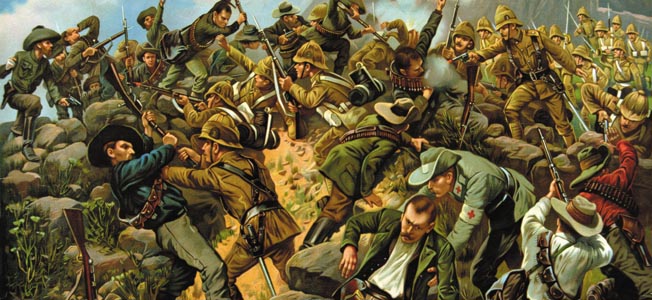
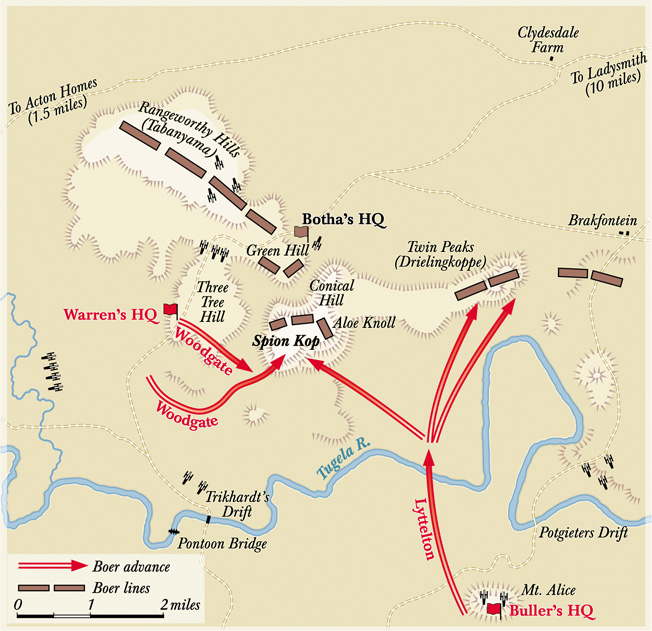
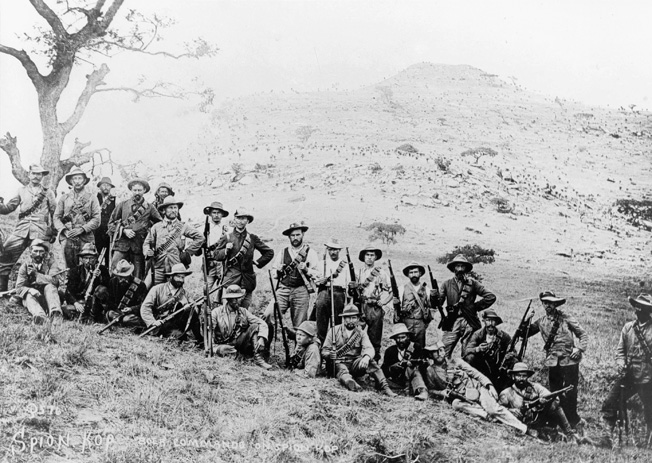
DURING THE SECOND BOER WAR’S BATTLE OF SPION KOP, THE BRITISH EMPIRE CAME FACE TO FACE WITH AN INDIGENOUS ENEMY THAT EASILY MATCHED IT IN FEROCITY.
by Herman T. Voelkner
The century of conflict that would introduce the concept of total war to the world had its bloody roots on an obscure hilltop in the remote South African veldt. The Boer War, the last imperial struggle of the British Empire, would serve as the dividing line between the era of small, localized wars fought largely at the speed of hoof and foot and the global, mechanized slaughter that would follow. It would also prefigure the dismaying pattern of conflicts to come—the use of barbed wire, the introduction of concentration camps to contain Boer prisoners and their families, and industrial-age innovations in human-killing weapons. “War, which was once cruel and glorious, has become cruel and sordid,” globetrotting adventurer Winston Churchill would complain after observing the short, sharp conflict between his nation and the Republic of South Africa. It was—literally and figuratively—the beginning of the 20th century. The war had a golden pedigree. When the precious metal was discovered in enormous quantities in the Transvaal region of South Africa in the 1880s, it roiled an already troubled situation. The Boers, itinerant Dutch-descended farmers, already had voted with their feet 60 years earlier in the “Great Trek” northward away from the growing British presence in the south. Now they were growing increasingly restive. Fiercely independent, they wanted no part of British intrusion into their public and private affairs, particularly the accompanying moral lectures on the burghers’ need for kinder, gentler relations with their slaves and servants. In 1881, Boer militia had ended the first armed conflict with Great Britain by hacking to pieces a British force at Majuba Hill. Humiliated, the British government acceded to self-government in the Boer republics of Transvaal and the Orange Free State. (The South African colonies of Natal and Cape Colony continued to fly the Union Jack.) Two decades of uneasy peace followed.
GOLD RUSH LEADS TO WAR
The ensuing gold rush into the Witwatersrand upset the delicate political balance, bringing an unwanted influx of English prospectors into the heart of the Transvaal. These “Uitlanders,” as they were called, were close to forming a majority in the region. During an era when the world’s economy ran on gold, Great Britain saw in the large expatriate presence a heaven-sent opportunity for expanding its influence in its former territories. The Boers were well aware of the demographic danger. A clear indication of that danger came in the notorious Jameson Raid of 1895. Instigated by Cape Colony Prime Minister Cecil Rhodes—creator of the DeBeers diamond fortune—the raid began when Rhodes protégé Starr Z. Jameson led a force of Cape Colony volunteers into the Transvaal to coordinate an attack with restive Uitlanders in the boomtown of Johannesburg. The plan went disastrously awry when the rebellion did not spread as expected—opposition to Boer rule had been overestimated. Jameson and his men were quickly rounded up and handed over to British authorities, who gave them a mere slap on the wrist, further outraging Boer sensibilities.
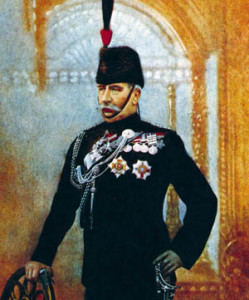
General Sir Redvers Buller was the commander-in-chief of British forces in South Africa.
Weapons and ammunition poured into the Boer republic from the Netherlands and Germany, which was eager to see Britain humbled again by the Boers. Old Martini-Henry rifles were replaced with modern German-made Mausers, and “God and the Mauser” quickly became the Boer war cry. Meanwhile, Transvaal President Paul Kruger roughly suppressed the Uitlanders, refusing them the right to vote and resisting intense British diplomatic pressure. Diplomatic entreaties might be ignored, but as Kruger and his countrymen gazed across the border, they saw something they could not control: shiploads of British Army reinforcements steadily disembarking in Cape Colony and Natal. The Boers must act or face a swelling tide of British soldiers. Kruger issued an ultimatum: Unless the British buildup ceased and its forces withdrew from the frontier, the Transvaal would fight. On October 11, 1899, the ultimatum expired, and war for control of the fabulously wealthy region began. The words Kruger had spoken to his countrymen after the discovery of Transvaal gold—“Instead of rejoicing you would do better to weep, for this gold will cause our country to be soaked in blood”—were now sadly prophetic.
The Natal-based garrison at Ladysmith, where colonial governor Sir George White was in residence, was one of the keys to the British defense; Kimberly and Mafeking were the others. The three cities ringed the perimeter of the Boer republics. The Boers understood this and took immediate steps to forestall any offensive moves by the British. Kimberly and Mafeking were surrounded. (In the latter township, Lord Baden Powell would organize the boys of the town into the first troops of Boy Scouts.) In the British cantonment at Ladysmith, White and 12,000 troops were under imminent threat of capture. A British general of great renown, Sir William Penn Symons, already had been killed by a Boer sniper; his infantry brigade, reeling back from the extreme north of Natal, was now retreating toward Ladysmith. Feeling that destiny was on their side, the Boer inhabitants of the two British colonies were now rising in rebellion, turning the preexisting political demographic on its head.
For the British, the news everywhere was grim. Winston Churchill, who sailed over to Cape Town from England with General Sir Redvers Buller, the commander-in-chief of British forces in South Africa, reported back caustically that the British could “for the moment, be sure of nothing beyond the gunshot of the Navy.” It was far from clear that Buller was the right man for the job. Although he had four decades of military experience behind him, as well as a Victoria Cross, Buller was unused to fighting any enemy with a level of sophistication higher than that of the Zulus. Engaging him now was a highly motivated mounted force both nimble and armed with modern weapons. In a moment of candid self-appraisal before the war, Buller had said, “I have always considered that I was better as second in command in a complex military affair that as an officer in chief command.” This was the man who now faced the daunting military task, defending the two British colonies in South Africa from a determined and resourceful enemy equally at home on the veldt or in the mountains.
CHURCHILL TRAVELS TO THE FRONT AND GETS CAUGHT
Winston Churchill in South Africa.
While Buller remained at Cape Town to sort things out, an impatient Churchill teamed with journalistic colleague John B. Atkins of the Manchester Guardian to go to the front at Ladysmith before other journalists could do so. The two took a 700-mile train ride on an undefended rail line that brushed against Boer strongpoints along the way. They then boarded a small steamer bound for Durban and immediately sailed into the teeth of an Indian Ocean storm. After several harrowing and wretchedly seasick days, the pair arrived at Durban to learn that Ladysmith was completely surrounded by Boers. Still determined to get to the fighting, Churchill and Atkins made another dangerous train ride of 60 miles that brought them to the end of the line at Estcourt. From there, they could hear the cannonfire at Ladysmith reverberating in the distance against tin-roofed shacks.
On November 14, Churchill was invited to participate in a reconnaissance by armored train, a dubious venture vulnerable to the simplest of countermeasures—a blocked track, a disturbed rail, or a blown bridge. The Boers, under their new commander, Louis Botha—two months earlier a Boer private—speedily obliged. A blockade sufficed; the train rammed boulders strewn along the track. Heavy rifle fire and shrapnel rained down from the hills. For over an hour the train was under fire as Churchill assisted in the defense and attempted escape. “I was very lucky in the hour that followed not to be hit,” he recounted later. “It was necessary for me to be almost continuously moving up and down the train or standing in the open, telling the engine-driver what to do.”
Churchill personally directed the recoupling of the cars in an attempt to ram the blockade, and when that failed, he led a group of wounded soldiers to relative safety beyond a nearby trestle. He was returning to lead more away from danger when he met some figures clad in slouched hats—Boers, he realized—leveling their rifles at him from a hundred yards away. He turned and ran in the other direction, bullets striking all around him. Minutes later a horseman appeared and pointed his rifle at the Englishman, who automatically reached for his pistol, only to find that he had left it on the train. He was taken prisoner after managing at the last second to discard two magazines of prohibited dum-dum bullets. With that, England’s preeminent warrior-journalist was led away to prison, his slyly discarded magazines very likely saving him from drumhead execution.
‘BLACK WEEK’ FOR THE BRITISH FORCES
While Churchill languished in Boer custody, depressing news filled the grim dispatches from South Africa to England. In the space of one week—December 10-15—the British suffered consecutive defeats at Stormberg, Magersfontein, and Colenso. From Buckingham Palace, a vexed Queen Victoria announced, “We are not interested in the possibilities of defeat; they do not exist.” But bold pronouncements could not obscure the truth arriving from the outer reaches of the Empire. The British had suffered their worst losses since the Crimean War a half-century earlier. All too clearly, the innate conservatism of the British military establishment had begun to take its toll. The cavalry had hitherto despised the carbine in favor of the sword—this in the dawning age of magazine-fed rifles and quick-firing guns. Few senior British officers realized that the old ways of open-order drill and carrying the day with regimental discipline and esprit de corps alone were now a prescription for outright slaughter.
At Stormberg, an attempt to wrest control of a railway junction from the Boers miscarried when the British forces were purposely misled by a native guide during a night march. Seven hundred British soldiers were missing or captured. Magersfontein was even worse. The much-vaunted Highland Brigade made an assault across an open plain in virtual parade formation against an enemy whose positions were hidden behind undiscovered barbed wire. The Boers had devised a new battlefield tactic: digging trenches dug down the front of a hill, known as the military crest, rather than at the top. By the time the attempt at Magersfontein to relieve the garrison at Kimberley was called off, 900 dead and wounded members of the Black Watch littered the battlefield.
Lt. Gen. Charles Warren wanted to bombard Boer positions on Tabanyama Ridge before launching his main assault. He was overruled by General Sir Redvers Buller who was stationed several miles to the rear.
At Colenso, Buller’s attempt to relieve Ladysmith also failed. The Irish Brigade, which was to have crossed the Tugela (“Terrible”) River three miles away, was misled by another guide, this time into a bend of the river where they were enfiladed from all sides by Boer riflemen. To make matters worse, Buller had deployed 12 field guns at Colenso without an infantry screen. In the face of withering rifle fire, the guns had to be abandoned. A handful of heroic British volunteers tried to recover them, but only two guns were brought back successfully. Casualties were relatively light, in comparison to the earlier two battles—only 150 killed. Meanwhile, Ladysmith remained under siege, and the hard-pressed British troops encircled there had begun to eat their horses and mules.
Until “Black Week,” as the English newspapers dubbed the six terrible days in mid-December, the worst of Britain’s casualties in the region had been suffered at Majuba nearly 20 years earlier, when fewer than 100 of her soldiers were killed. Now they were dying by the hundreds in battle after futile battle. These were not the usual native combatants on the fringes of the Empire—the Zulus, Pathans, or Dervishes. The Boers knew the ground far better than their foe, and they also knew the value of entrenching themselves within it. “Dig now, or they’ll dig your grave later” was their watchword. They were fiercely determined and well armed. A heavy Maxim gun firing one-inch shells, dubbed the “Pom-pom,” ranked alongside German-built Krupp howitzers, 75mm field guns, 155mm “Long Toms” firing 40-pound shrapnel shells, and the ubiquitous Mausers, effectively shredding the serried British ranks. Slowly, it dawned on the British that this was to be no “splendid little war” such as the United States had enjoyed against Spain the year before, but a grinding fight to the death against a seriously underestimated enemy.
BULLER DEMOTED; ROBERTS TAKES CHARGE
Buller was badly shaken, wiring home the despairing judgment that “I ought to let Ladysmith go.” He then sent a message to the encircled White, ordering him to burn his ciphers, fire off his ammunition, and seek whatever terms he could with the enemy “after giving me time to fortify myself.” What happened instead was a change in leadership. Buller was demoted, although he continued to command the forces in Natal, and he was told to persist in trying to lift the siege at Ladysmith. The new British commander-in-chief was retired Field Marshal Lord Frederick Roberts, 67 years old when he was recalled to active duty. Lord Horatio Herbert Kitchener—“Kitchener of Khartoum”—would serve as Roberts’ chief of staff. Roberts had already had at least one communication from Buller before he departed from London for his South African command: “Your gallant son died today. Condolences, Buller.” Such was the epistolary epitaph of the younger Roberts, who had been killed trying to save Buller’s guns at Colenso.
While Roberts and Kitchener were taking charge of the overall situation, Buller was reinforced in Natal by Lt. Gen. Charles Warren and the 5th Infantry Division. Warren was an odd choice to aid Buller—the older general despised him from Warren’s days as a commander in Malaya, when he had bombarded Buller with demands and complaints while Buller was serving as British adjutant general. (“For heaven’s sake, leave us alone,” Buller had finally told Warren, in utter exasperation.) Now he gave Warren the task of crossing the Tugela River and moving on the Boer right at Tabanyama Ridge, 12 miles southwest of Ladysmith. Meanwhile, Buller would attack the enemy center at Potgeiter’s Drift. Once through the hills beyond the river, the two English columns would reunite for a last-ditch drive across the open plains to Ladysmith.
Warren, who had spent much of his career excavating historical sites in Palestine, had grown accustomed to the painstaking pace of archaeology. Given two-thirds of Buller’s ponderous army to command—11,000 infantrymen, 2,200 cavalry, and 36 field guns—he took the better part of nine days to reach Trichardt’s Drift on the Tugela, the jumping-off point for the coordinated attack. Another day was wasted ferrying guns and supplies across the river.
A Boer commando unit poses for a photo in front of Spion Kop. Aside from being skilled fighters, they also had intimate knowledge of South African terrain.
The Boers, with their crack contingent of scouts, knew every move the British were making. They responded by strengthening their defenses and shifting troops from the siege of Ladysmith to the line of hills overlooking the Tugela. Louis Botha was dispatched to take command of the burghers’ defense. Reasoning correctly that the British always attacked head-on, Botha paid particular attention to the large hill in the center of his line—Spion Kop. Aptly named, the boulder-bedecked “Spy Hill” rose to a height of over 1,400 feet, the centerpiece of several hills that commanded the veldt and the approaches to Ladysmith north of the river. Sixty years earlier, the first hardy voortrekkers had climbed its prominence during the Great Trek northward. Then, as now, they were fleeing the British, but this time they were better armed and better fortified. When the time came, they would be ready.
On January 20, Warren finally attacked the Boer positions on Tabanyama Ridge. The khaki-clad British troops managed to carry a hill or two before halting amid a cyclone of Mauser fire. Ahead of them lay a thousand yards of open grassland, more than enough distance to give them pause, particularly in the face of the quick-firing Boers. Warren wanted to conduct a leisurely bombardment before making another attack, but he was overruled by Buller, who ordered him to attack again immediately. The order came with an explicit “or else.” Buller threatened to call off the entire campaign if Warren did not do as he was told. Thinking quickly—or at least as quickly as he was capable of thinking—Warren suggested an alternative plan. Instead of renewing his attack on the Boer right, he would move on Spion Kop. Buller was not appeased. “Of course you must take Spion Kop,” he told his hated subordinate, but he neglected to supply him with any new troops or ideas on how to accomplish it. It was going to be left to Warren alone, much to the detriment of the men he commanded.
BRITISH TAKE SPION KOP
Lieutenant Colonel Alexander Thorneycroft, commanding a contingent of mounted infantry, was selected to spearhead Warren’s attack. On the evening of January 23, Thorneycroft and his men surreptitiously climbed the slope on the near side of Spion Kop and seized the sere moonscape of the summit, a flash of Lee-Enfields and total surprise winning them the strategic position with very few casualties. Three cheers went up for Queen Victoria—the prearranged signal for success—and the way to Ladysmith lay before them at last. But first they must hold on to their prize. Maj. Gen. Edward Woodgate, senior commander on the hill, quickly got the men busy digging trenches in the moonlight, before the eagle-eyed Boers could zero in on their position. He sent a note to Warren informing him of the success, adding that he expected that Spion Kop could be “held till Doomsday against all comers.”
After taking Spion Kop, British forces made the ghastly discovery that they were sitting ducks for the Boer sharpshooters above them.
The hill had been shrouded in fog, and when the mists slowly cleared with the dawn it became all too evident to the British that they did not hold the hilltop at all, but only a small, acre-wide plateau ringed on three sides by higher hills that afforded the enemy perfectly sited, boulder-protected firing positions. The Boers, who had watched the leisurely progress of the British with tight-lipped satisfaction, were even now creeping into those positions. Botha ordered his men to retake the position before the British had time to move up their own heavy guns. His burghers quickly poured devastating salvos into the densely packed British troops. The Englishmen, hunkering down in shallow trenches in a confined space comparable in size and dimension to Trafalgar Square, had little cover. The Boers’ artillery, signaled by heliograph, directed intense fire at Spion Kop from the surrounding hills. Shells rained down on the British position at the rate of 10 per minute. Meanwhile, the British heliograph had been knocked out, and they had no comparable artillery support from their own crack gunners. The soldiers atop Spion Kop were on their own.
THE MASSACRE BEGINS
Responding to Botha’s call for reinforcements, Commandant Henrik Prinsloo led his 88-man Carolina Commando onto Aloe Knoll, 400 yards east of the British position. From there, Prinsloo’s marksmen unleashed a deadly fire on the unsuspecting men of the Lancashire Fusiliers, who were on the extreme right flank of the British trench. The Khakis, as the Boers called them, never knew what hit them. Seventy were later found lying dead with bullet holes in the right side of their heads—they had not even had time to turn around. Also struck dead was their commanding general, Woodgate, who fell mortally wounded with a shell splinter above his right eye. His replacement, Colonel Malby Crofton, sent a hasty message down the hill to Warren: “Reinforce at once or all lost. General dead.” Warren, unhelpful as always, signaled back: “You must hold on to the last. No surrender.” His entire career depended on it.
Grimly, the British held on to the 400-yard-wide battlefield. No one on the British side had given much thought to what to do after seizing Spion Kop; asked what his force should do next, Buller had answered dogmatically, “It has got to stay there.” It stayed there all right, stolid and immobile, absorbing a horrific beating. Many of the officers were killed, victims of the Victorian-era code that prohibited a gentleman from taking cover under fire. The men in the ranks, less hidebound and conventional, squirmed into every square inch of cover they could find in the rocky topsoil. It did little good. Boer artillery shells dismembered entire files of soldiers where they lay, while those foolish enough to raise their heads off the ground were immediately shot dead by enemy snipers.
On the morning after the bloody fighting at Spion Kop, a large trench serves as a makeshift grave for some 400 dead soldiers who perished there.
On the command level, all was chaos. At one time or another, four separate senior British officers believed themselves to be in command. In his only direct action of the day, Buller recommended to Warren that he “put some really good hard fighting man in command on the top. I suggest Thorneycroft.” Warren, glad for any assistance, promoted Throneycroft to brigadier general and gave him operational control of the battle. Thorneycroft’s first move was to countermand an attempt by the Lancashire Fusiliers to surrender to the Boers who were bedeviling them. “Take your men back to hell, sir!” Thorneycroft roared at the Boer officer who had approached to accept the surrender under a white flag. “I allow no surrender.” Shamefaced, some of the Fusiliers skulked back to their own lines; others, having no wish to commit state-sanctioned suicide, dashed into the Boer lines and surrendered.
Returning to the forefront now was Winston Churchill, who besides bearing journalist’s credentials also carried a new commission in the South African Light Horse given to him by Buller after Churchill’s extraordinary escape from a Boer prison (see sidebar). Churchill climbed Spion Kop and assayed the scene for himself, conveying it later in words that would find their echo on the Western Front in Europe 15 years later: “Corpses lay here and there. Many of the wounds were of a horrible nature. The splinters and fragments of the shells had torn and mutilated them. The shallow trenches were choked with dead and wounded.” As Churchill climbed and re-climbed the hill, ferrying messages from Buller’s camp, he was “continually under shell and rifle fire and once the feather in my hat was cut through by a bullet. But in then end I came serenely through.”
Little else was serene on the bloody hilltop. Boers and Britons faced each other across a landscape of butchered bodies and heaped wreckage. Battalions were hopelessly intermixed. Messages between the hilltop and Buller, four miles away, were sporadic and confused, and several messengers fell dead with vital information unread in their hands. No one below knew the situation above. Some officers thought the hilltop overcrowded, while others thought there was a vital need for reinforcements. Thorneycroft, for his part, seemed dazed and utterly exhausted. He sent another message to Warren, from whom he had not heard in five long hours. “The troops which marched up here last night are quite done in,” he reported. “They have had no water, and ammunition is running short. It is impossible to permanently hold this place so long as the enemy’s guns can play on the hill. It is all I can do to hold my own. If casualties go on at the present rate I shall barely hold out the night.”
THORNEYCROFT ORDERS A TOTAL WTHDRAWAL
After a hurried conference with Crofton and Lt. Col. Ernest Cooke of the newly arrived Scottish Rifles, Thorneycroft ordered a total withdrawal. A last-second message from Warren promising that help was on the way fell on deaf ears. “Better six good battalions safely down the hill than a bloody mop-up in the morning,” Thorneycroft said. “I’ve done all I can, and I’m not going back.” In vain, the upstart Lieutenant Churchill argued the point, and the retreat began. Abandoning the hard-won hill, the British survivors met their reinforcements massing at the bottom, en route to assist them in consolidating their position. It was too late—surely the Boers had already retaken the hilltop—and Thorneycroft turned these troops around as well. Survivors and reinforcements alike trudged back down the hillside.
Unknown to the British, the Boers had also lost the will to fight, and they too had begun to melt away, in part because they were startled by a sudden move across the Tugela by the King’s Royal Rifle Corps east of Spion Kop at Acton Homes. Barely a handful of Boers remained on hand to threaten the British. The hilltop so fiercely contested at such human cost was discovered by two joyful Boer scouts to be empty. After the British had spent 16 days and suffered almost 2,000 casualties on the campaign, Botha’s burghers were atop Spion Kop once more as if nothing had happened. Only the three-deep piles of British dead remained to dispel that illusion. In soldierly admiration, a Boer doctor examined the human carnage and said, “We Boers would not, could not, suffer like this.”
Botha, returning to the hilltop the next morning, beheld “a gruesome, sickening, hideous picture.” Some 400 dead British soldiers lay sprawled in a shallow trench that would serve double-duty as their grave; another 1,400 were wounded or in captivity. Boer losses were considerably lower—58 dead and 140 wounded, including 55 of Prinsloo’s 88 hard-fighting Carolina Commando. Botha sent a humble telegram back to President Kruger: “Battle over and by the grace of a God a magnificent victory for us. The enemy driven out of their positions and their losses are great. It breaks my heart to say that so many of our gallant heroes have also been killed or wounded. It is incredible that such a small handful of men, with the help of the Most High, could fight and withstand the mighty Britain.”
BRITISH NUMBERS FINALLY PREVAIL
Finally, with his artillery in full support, Buller managed to throw a pontoon bridge across the Tugela, and overwhelming British infantry turned the key in the Ladysmith lock, seizing the last remaining hilltop barring their way. The siege of the British forces there had lasted 118 days. It was lifted on February 27, 1900, ironically the anniversary of the defeat the British had suffered at Majuba 19 years earlier.
Lord Roberts now took center stage as overall commander after the protracted drama of Ladysmith. His forces totaled over 200,000 against 88,000 Boers. The latter began to abandon the Transvaal, retreating into the hinterland in another Great Trek. Churchill, as ever marching to the sound of the guns, carried by bicycle a crucial dispatch to Roberts through a Johannesburg still occupied by Boers; the slightest challenge by a wary burgher might have caused him to be executed as a spy. His audacity endeared him to yet another commander-in-chief. As the Boers withdrew to the east, yielding large parts of the Transvaal, Roberts allowed Churchill to enter Pretoria at the front of the column. One of Churchill’s singular pleasures was to hoist the Union Jack over the place where he had been held as a prisoner of war.
In a still taken from a newsreel of the fighting at Spion Kop, Buller’s shellshocked columns retreat over the Tugela River via pontoon bridge after losing the Battle of Spion Kop.
Other combat followed in the form of desultory running fights with the Boers who, despite having been defeated in the field, refused to capitulate. Raiding deep into British territory, the Boers fought for two more years in the newly developed irregular fashion called guerrilla warfare—another dubious innovation bestowed on the newborn century. Buller, for his part, had managed no such innovative thinking. He could have followed up the British cavalry’s success at Acton Homes and exploited its mobility to outflank the Boers and open the road to Ladysmith, but he could not get his main force there quickly enough, and thus had to fight a battle that grossly favored the enemy. Churchill’s biting description of Buller’s traveling camp was apt: “Within striking distance of a mobile enemy whom we wish to circumvent, every soldier has canvas shelter. Rapidity of movement is out of the question. It is poor economy to let a soldier live well for three days at the expense of killing him on the fourth.”
The laborious and cumbersome movements doomed hundreds of regular British soldiers to a Mauser bullet in the head at Spion Kop, and the hidebound conventions of the Victorian era—sneering at the use of cover and demanding an unflappable hauteur in the presence of the enemy—left their bloody epitaph stitched across the chests of their gentlemanly commanders. Few British survivors of Spion Kop would have disputed the mordant words of Manchester Guardiancorrespondent John Atkins, who was there that day and later summed up the battle as “that acre of massacre, that complete shambles.” Indeed it was.