Category: War

The building was busy that afternoon. A hastily erected structure of corrugated sheet metal with concrete floors, it was a veritable Hilton Hotel compared to the thatched-roof shacks and occasional Quonset nearby. Alongside a very busy airfield made of those interlocking steel plates, the building offered limited shelter for Americans going about their business. The business was that of an airline passenger terminal in wartime Vietnam, specifically Da Nang, I Corps—and everybody had a gun.
Armies of various ideologies had been scrapping for decades in Vietnam before America got into it. In 1965, when I first saw the battered building that was the Da Nang air terminal, the detritus of other armies and earlier wars was much in evidence. I passed through there several times and often saw personal firearms of many types. Lots of different rifles, many varieties of handguns (including a puzzling variety of Smith & Wesson revolvers) and even a few shotguns were all present.
Somehow though, the submachine gun seemed to be the odds-on favorite for the varied personnel who waited for their flight to places unspecified and used the makeshift benches at this Terry-and-the-Pirates facility. Since regular soldiers and other personnel from a host of countries had done their thing in the green hills of Vietnam, the variety of submachine guns (SMGs) was not surprising. There were a lot of British STEN guns of various models present, even one with an early suppressor.
The reliable, if somewhat bulky, German Schmeisser was pretty ordinary, as was that superb French MAT 49. Most of those had been converted to the .30 Mauser cartridge in NVA armories, but I also saw them in the original 9 mm. Australian soldiers had their Austens.
Several models of Italian Berettas in both World War II and later models might be seen. American M3 grease guns? Sure, a common gun. But, the grand-old Thompson of many variants, to include a commercial 1928 with twin pistol grips and the iconic drum magazine?
Submachine guns have fallen from favor in this 21st century world of battle rifles, but they were all the rage in the 1960s. As a guy who looked at, handled, fired, disassembled and studied all kinds of infantry small arms, this part of my Vietnam experience was interesting.
It got quite so one day when I was passing through Da Nang and saw a guy in civilian clothes carrying a unique SMG suspended from a braided-leather strap. I could clearly see the gun was a Danish Madsen M50 9 mm. The gun’s owner was not disposed to converse about his gun or any other topic, so I never got the full story of how a Danish SMG made its way to this exotic locale. That story, I never knew. But, as a longtime reader of W.H.B. Smith’s “Small Arms of the World,” I knew exactly what the gun was.
Many countries of the post-World War II period experimented with new designs in small arms. This was particularly true of all-metal SMGs. Denmark’s Madsen was first offered for police/military users in 1946. Their basic design was improved several times over the years, but the 1950 version was probably the most-widely distributed. In limited numbers, the gun sold in South and Central America. A strict, slam-fire blowback, the M50 fired from an open bolt and had no provision for selective fire.
Unlike several contemporary SMGs that used heavy steel tubing for the basic receiver shape, the M50 worked around a pair of matching so-called “clamshell” halves. Hinged at the back end, the matching left and right halves provide a track for the reciprocating bolt and a seat for the trigger mechanism. A loading device came with each gun, housed in the rear pistol grip.
To strip for cleaning, the shooter removed the magazine and unloaded the gun. He then unscrewed and removed a knurled nut at the base of the barrel. The clamshell halves now open like a book and the barrel, bolt, recoil spring and guide lift out.
It’s really simple—you can pull the gun apart for field maintenance in less than a minute. A buttstock, made of heavy steel tubing covered with stitched-on leather, folds forward along the right side of the receiver. I had never handled or fired one of the elusive Madsen M50s, so all of this was purely academic.
Then, under circumstances I cannot relate, but during my tour of Vietnam, I made a trade that gave me—you guessed it—a Madsen M50 in used, but sound mechanical condition. After a few days of handling and stripping, etc., I was impressed with this unique mechanism. I was also intrigued by the fact that my new gun bore no markings as to maker or other identifying characteristics—no serial number. My best efforts to scrounge some 9 mm ammunition were not productive. Nine millimeter was not in the USMC supply system, and I had changed jobs that didn’t have me traveling all that much.
Then, I stumbled on an extremely small quantity of old French-made 9 mm, some 19 rounds in a deteriorating cloth tobacco sack. I immediately found an open spot somewhere along Route One (yeah, the Street Without Joy) and loaded her up. I got off a short burst and…disaster. Instead of the characteristic crack, I got a louder boom. Looking down at the gun, I saw the right side of the receiver bulged slightly outward. After much forensics, I figured out what happened.
For some reason, the preceding shot created a complete case-head separation. The rear portion was torn completely free, leaving the front portion lodged in the chamber. The next shot was blocked from completely fitting into the chamber and fired out of battery. Although we tried to fix it, the gun never fired again.
Many years later, my pal the late Chuck Karwan told me that other Madsens in the hands of his Special Forces buddies did exactly the same thing and the gun had a poor reputation among them. It was traced to a small batch of improperly finished barrels with rough chambers.
That’s a shame, because the gun worked well with a good chamber. Madsens were used in movies, showing up in the first two “Godfather” films and numerous TV shows. Before I left Vietnam, I destroyed mine, albeit reluctantly, as it was a machine gun and I was not allowed to bring that back in any condition. Besides, a gun that doesn’t shoot just isn’t proper fightin’ iron.
A really interesting historical site in Saint Malo (Saint Servan), France dating from the Roman period, although the most obvious relics of its past are the extensive WW2 German fortifications making it one of the most significant elements in Festung St Malo.
Having a couple of hours to spare in St Malo before catching the ferry or the train, the Fort de la Cité d’Alet, St Malo is well worth a visit. For those who have an interest in the international boundary and front line which existed in the area around the Channel Islands between warring England / Britain and France over the seven and a half centuries, it’s a reminder of the defences the French put up to repel frequent English raids.
For those with an interest in twentieth century history, it’s a massive German fortified position to defend St Malo, the Germans’ main gateway from occupied France to the occupied Channel Islands, from Allied attack.
The area of la Cité d’Alet dates back to the Roman period when the promontory was topped by a fortified town, of which little remains except a few small sections of “Roman” walls. By the end of the seventeenth century, it was known as “la Cité d’Alet” and was fortified by a gun battery to protect the entrance to the Rance river.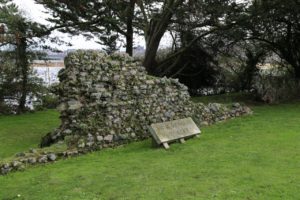
For those with an interest in twentieth century history, it’s a massive German fortified position to defend St Malo, the Germans’ main gateway from occupied France to the occupied Channel Islands, from Allied attack.
The area of la Cité d’Alet dates back to the Roman period when the promontory was topped by a fortified town, of which little remains except a few small sections of “Roman” walls. By the end of the seventeenth century, it was known as “la Cité d’Alet” and was fortified by a gun battery to protect the entrance to the Rance river.
Cité d’Alet, Roman walls
Vaubin, the well-known French Inspecteur Général of Fortifications from 1678, was, however, not satisfied by the defences of la Cité d’Alet, and he advised that additional mortars to be mounted. Apparently, this advice was not followed.
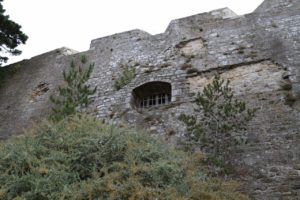
It was not until the next century when in 1759, during the Seven Years War, after numerous English incursions into the bay of St Malo, the decision was taken to build a very large artillery fort at the Cité d’Alet, capable of defending not only the bay, but also the town, the port, the Rance estuary as well as the area to the rear. That fort built by Mazin, the Chief Engineer of St Malo is still very much in evidence today, albeit that it now has some significant twentieth century additions.
Cité d’Alet, 18th century fort
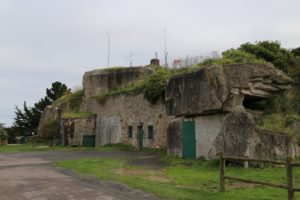
Those additions, built by the Germans after June 1940 and the fall of France, dwarf the original fort in scale. St Malo, quickly appropriated by the Kriegsmarine as the primary port for the supply of the occupied British Channel Islands, saw extensive fortification from 1941 onwards as part of Hitler’s Atlantic Wall to become “Forteresse St Malo” or “Festung St Malo”.
Cité d’Alet with WW2 German additions
By that time, the German occupied Channel Islands had become an obsession of Hitler, with him vowing that they were never to be returned to Britain when final German victory came, and destined to become part of the German Thousand Year Reich forever. As a result of that obsession, a staggering one twelfth of all the cost and materials expended in building the whole of the Atlantic Wall (i.e. from the Artic in Norway all the way down to the French/Spanish border) was ploughed in the Islands! It is therefore hardly surprising that the French port which served those islands was also destined to have more than its fair share of fortifications.
Around St Malo, La Varde, Saint-Ideuc, la Montagne Saint-Joseph, la Garde Guérin were all fortified, as were the islands of Grand-Bé and Cézembre (more of the latter later). But probably the most important element of the fortress was the Cité d’Alet.
From 1942 to 1944, the promontory became a huge building site into which tonnes of reinforced concrete were poured. Incorporated into la Cité was an artillery battery with a range-finding position, a fortress PC, extensive defensive positions, 1350 metres of underground tunnels and shelters for about 200 men.
All in all, there were a total of 32 bunkers built and 8 heavy machine gun turrets (Sechsschartentürms) installed. The latter 50-ton 6 port armoured steel cupolas, mounted with MG 34s, were reserved for those places deemed by the Germans to be at most risk from Allied group attack.
The Cité d’Alet saw severe bombardment in August 1944 at the hands of the American forces who had entered Brittany from Normandy on 31 July. By the 4th August, the Americans headed by the 83rd Infantry Division had reached St Malo and by the 9th August, the city and the Germans in it, were encircled. It took two murderous infantry assaults by the Americans, as well as blanket bombing which left the fabulous old walled city of St Malo in ruins, before the German defenders surrendered on 17th August. The last remaining Germans of the Fortresse St Malo, held out on the island of Cézembre until early September, partially supplied from Jersey, until ground and aerial bombardment, including the first use of Napalm, forced their surrender.
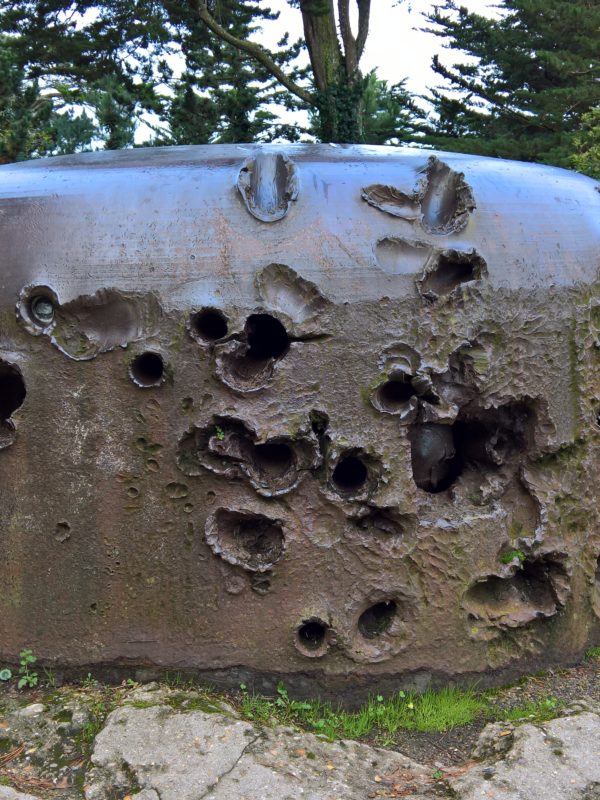
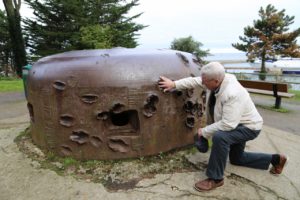
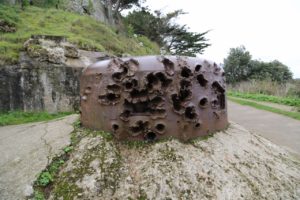
Cité d’Alet, St Malo. The heavy machine gun turrets are peppered with shell hits.
The most striking things that you will see at the Cité d’Alet are the armoured steel turrets along what is a very picturesque walk around the promontory. They are literally peppered by shell fire. But the vast majority of the shell fire is not as a result of the battle which raged around St Malo for nearly two weeks.
Cité d’Alet- German heavy machine gun turret after US attempt (post battle) to destroy them
No it’s a demonstration of the strength of these turrets, as after the battle, the Americans brought up various tanks and other anti-tank weapons into range and fired at them to see how much punishment they would take. It is incredible to see that virtually all the hits show shells bouncing off or merely embedding themselves into the armoured steel without penetrating it. I found only one shell hole which had penetrated the cupola straight through, whilst one other shell appears to have found a way in at the point where the moveable gun port shield slots into the turret.
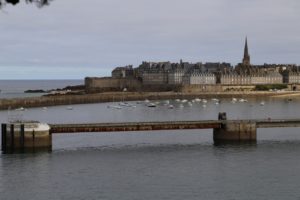
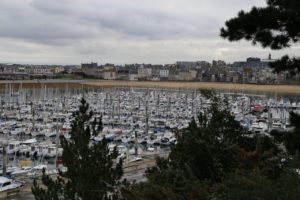
An interesting thing also seems apparent when you compare the direction from which the US shots have been fired at the first two turrets as you come to along the path at la Cité d’Alet . Whoever was firing at each of these two turrets was doing so from different positions – my guess is one was below the old city walls and the other, several hundred metres away, was on the beach at St Servan, the adjacent area next to St Malo. Were the two different sets of gunners having a competition perhaps? I don’t know but perhaps somebody else does know?
One of the likely firing positions of US forces below old city walls of St Malo
Second of the likely firing positions of US forces on the beach at St Servan
Memorial 39-45 Museum, la Cité d’Alet, St Malo
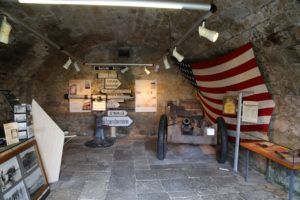
Finally, in the interior of the old fort of la Cité d’Alet, you can clamber around different battle-scarred bunkers and gun positions, as well as visiting the “Memorial 39-45” housed in the bunkers which have been built into the ancient walls. Unfortunately, on the day of my “spare time” visit, the museum was only open in the afternoon. Open regularly everyday only in July and August, it’s generally afternoons only in the shoulder months of April, May and October (closed Mondays) and the same afternoons and Sunday mornings in June and September. November to March, it is closed.
For further information, contact Jersey Military Tours
www.jerseymilitarytours.je
Categories
The Lessons of Force Z by Chris Kolakowski
The destruction of Prince of Wales and Repulse was the first time major capital ships had been sunk solely by aircraft in the open seas while actively defending themselves. Their loss shocked the world and psychologically crippled the British Empire in the Far East. Aside from the historical importance, their sinking also offers lessons relevant to today – especially how these large ships were overtaken by a swarm of small aircraft.
Major capital ships, such as World War II battleships or modern aircraft carriers, are large systems, made up of several interlocking elements that together answer the commands of the leadership. Their large crew sizes and complexities rival the size of corporations, large computer networks, or government agencies. These systems function very well on a large scale, but can be vulnerable to small disruptions in key areas. Alternately, a swarm of small actors moving in coordination can overwhelm and pressure the systems until they crack.
Today, technology and social media increasingly enables small actors to affect large systems. Social media creates “flash mobs” and can quickly mass a group to move toward a common goal, such as the street protests in Cairo that ultimately brought down Egyptian President Hosni Mubarak in 2012. Alternately, a single motivated and skillful hacker can compromise key systems and render serious damage to a large system – much like the Target data compromise in December 2013.
The fate of Force Z is a metaphor to help understand how small actors can destroy larger foes. It also offers lessons applicable to both military and corporate leaders.
The Story of Force Z
In the fall of 1941, Singapore and Malaya represented the keystone of the British Empire in Asia. As tensions rose with Japan, Britain strained to enhance the defenses in this area. British strategy hinged on the entire main fleet arriving from England to assist in the defense of Singapore, and a large naval base had been built on Singapore Island capable of handling the bulk of the Royal Navy. This base was central to the entire defense plan; the stated purpose of the 88,000 troops and 141 aircraft in Malaya was to defend the naval base.
These plans ignored the possibility that the fleet might be busy elsewhere when needed, and Britain faced just this problem in the summer of 1941. Battles in the Atlantic and Mediterranean stretched available modern ships to the limit, with little to spare for Singapore.
After much debate with the Admiralty (who wanted to send four older battleships), Prime Minister Winston Churchill dispatched Prince of Wales, one of his newest battleships, and Repulse, one of his best battlecruisers, under the command of Admiral Sir Thomas S. Phillips, former Vice Chief of the Naval Staff. Rounding out Phillips’ little fleet, designated Force Z, were the British destroyers Electra, Express, Encounter, and Jupiter. Force Z had a dual mission, to defend Singapore and also give the Japanese second thoughts about attacking. Churchill said Force Z was to be a “vague menace” but also confidently declared that Prince of Wales could “catch and kill” any like Japanese ship. To increase the political effect, maximum publicity attended Phillips’ movements to Malaya.
[1]

Force Z’s leadership. Admiral Sir Thomas S. Phillips (right) and his Chief of Staff, Rear Admiral Sir Arthur F. E. Palliser, on the dock at Singapore, 2 December 1941. (Imperial War Museum)
Force Z arrived in Singapore on 2 December 1941 to much fanfare. While his men and ships refitted and acclimated to Southeast Asia, Admiral Phillips flew to Manila to confer with his U.S. counterparts about combined operations. He returned on 7 December 1941 (6 December in Hawaii). The war started the next day in Malaya with the bombing of Singapore and landings at Singora on the Thailand coast.
After consultation with his staff and ship captains, Admiral Phillips decided to sortie and engage the Japanese invasion fleet. Royal Air Force commanders promised reconnaissance on the 9th and 10th, but stated that fighter cover would be unavailable. “We must get on without it,” said Phillips. Prince of Wales and Repulse sailed in company with the destroyers Electra, Express, HMAS Vampire, and HMS Tenedos at twilight on 8 December 1941.[2]
Without air cover, Phillips depended on surprise for success. He sailed northward, hiding in weather as much as possible. Japanese aircraft and submarines detected Force Z the evening of the 9th, and Phillips reluctantly turned for home. Japanese aircraft in Saigon launched a strike, but missed the fleet entirely.
That night Phillips received a report of enemy landings at Kuantan on the Malay coast, and diverted to investigate. A Japanese sub reported Force Z’s location;in response a new airstrike took off at dawn from Saigon. At daybreak on 10 December Force Z scouted Kuantan but found nothing, and Phillips turned east to investigate some suspicious trawlers. At this point the first raiders found Force Z.
At 1107 Repulse‘s Captain William G. Tennant ordered, “Enemy aircraft approaching. Action stations!” Captain John C. Leach gave a similar order on Prince of Wales, as did his counterparts in the destroyers. All ships sped up to 25 knots, opened antiaircraft fire, and began evasive maneuvers. The first group of planes bombed Repulse from 12,000 feet, scoring one minor hit on the boat deck and several near misses. Repulse remained in action, accompanied by cheers from Electra.[3]

The first bombing attack against Force Z, 10 December 1941, seen from a Japanese plane. Repulse (left) has been bombed and taken one hit, while Prince of Wales is maneuvering to starboard. Note the calm sea. (U.S. Navy)
Shortly after the bombers departed, a wave of torpedo planes swarmed. Splitting their effort against both ships, they flew in at 400 feet and launched their torpedoes. On Repulse, Captain Tennant calmly ordered the helm about, deftly maneuvering the battlecruiser out of the way of all torpedoes. After the attack concluded, he proudly signaled Phillips: “We have dodged 19 torpedoes so far, thanks to Providence.”[4]
The flagship was not so lucky. One torpedo hit Prince of Wales’ port side aft at 1144, wrecking both port side screw shafts, flooding much of the port side engineering spaces, and knocking out power to much of the ship. Her speed slowed to 15 knots and she developed an immediate 11-degree list to port. The power loss cut most internal and external communications, and froze many turrets in place; between that and the list, most antiaircraft guns were no longer effective. Pumps stopped working, and the ship’s electric steering failed. Leach hoisted the “Not Under Control” signal. As a 2012 analysis put it, “it had taken just one torpedo and less than half an hour to turn the pride of the British Navy into an unresponsive, indefensible wreck of a ship.”[5]

Captain John C. Leach, HMS Prince of Wales. (Imperial War Museum)
Over in Repulse, Captain Tennant received no messages from the flagship. After reporting the attacks to Singapore, he deliberately slowed Repulse and maneuvered her close to Prince of Wales to render assistance. At this point, more Japanese planes struck from the east. Three torpedoes slammed into Prince of Wales’ starboard side, while Repulse took one hit amidships after dodging attacks from several directions. Another wave of nine aircraft swept in, making a coordinated torpedo attack on Repulse from several directions at once. Repulse took four hits that collectively spelled her doom. Tennant ordered his crew to abandon ship. At 1233 Repulse rolled over and sank.[6]
Prince of Wales meanwhile continued to struggle. The Japanese bombed her again, scoring one hit. All damage after the first torpedo only hastened the inevitable end. Admiral Phillips signaled for Express to take off the wounded and unneeded men. In the midst of this process, Prince of Wales rolled over to port and sank at 1320.
It had taken 85 Japanese planes less than three hours to sink two of Britain’s most powerful ships, at a cost of just three planes destroyed. Destroyers saved 2,081 men from both ships, but 840 perished. Phillips and Leach on Prince of Wales made no effort to save themselves. Tennant of Repulse had the same idea, but his staff physically pulled him away from his post and tossed him into the sea. Most of Phillips’ staff drowned. At a stroke, British naval power in the Far East had been broken.[7]
The Lessons of Force Z
Force Z’s destruction offers much for leaders to study and consider. Both military and organizational leaders can find significant lessons applicable today. This section will examine each in turn.
Military Lessons. Force Z’s fate is a warning to modern naval leaders. Large capital ships require considerable protection at all times, and past performance is no guarantee of future results. Despite several tries, the Germans and Italians had failed to sink British capital ships from the air before December 1941. This record inspired overconfidence; Churchill’s belief in his ships’ ability to defeat the Japanese trickled down to the British wardrooms, affecting strategy and tactics. The sinking’s’ psychological blow was therefore greater.[8]
Today the aircraft carrier is the preeminent capital ship in the world. Possessing one is an expression of naval power, and number of carriers is the yardstick by which major navies are compared – much like battleships had been counted before 1942. The United States Navy has not lost an aircraft carrier sunk or knocked out of combat by enemy action since 1945. Except for the USS Cole (DDG-67) attack in 2000, it has been 25 years since a cruiser or frigate was knocked out – even longer since one was sunk by enemy action. The Navy must be careful that this track record does not create overconfidence and affect strategy and tactical decision making.
Much like Japan fielded an air fleet to help counter British capital ships in 1941, Iran, North Korea, and China are perfecting missiles, submarines, and other countermeasures to neutralize U.S. capital ships. The tactic is not necessarily to sink the enemy, but simply knock them out of action – a “mission kill” or “mobility kill.” The Japanese achieved that with one torpedo hitting the right spot on Prince of Wales, as did terrorists with a single boat against the Cole. Today’s naval thinkers should ponder the implications of those events.

Prince of Wales arriving in Singapore, 2 December 1941. (Imperial War Museum)
A final lesson for military leaders is the effect of peacetime budgeting on the fleet. Because of prewar austerity, Britain did not have enough modern capital ships to answer all the crises it faced during World War II. The Royal Navy’s Captain Russell Grenfell explained: “The people of Britain set their face against spending money on armaments between the wars. They were prepared to back any policy, expedient, or nostrum that offered reduction of such expenditure.” Global conflict stretched the Royal Navy to the breaking point, forcing reuse of many obsolescent World War I-era battleships. These were the ones Churchill rejected sending to Singapore in favor of the more modern Prince of Wales – a gamble of modern quality over older quantity.[9]
Organizational Lessons. Writers like Thomas Friedman and Malcolm Gladwell have pointed out that today’s technology increasingly enables large systems to be taken down by small actors who target key areas or overwhelm by attacks from all directions. The destruction of Force Z shows that this trend is not new.
The modern equivalent of a plane torpedoing Prince of Wales’ engineering is a lone hacker (or small group) exploiting vulnerabilities in critical parts of large networks to gain access and do major damage. To cite just one recent case, the Heartbleed hack in April 2014 did not directly target main systems or databases, but rather the OpenSSL library that encrypts communications between networks and websites. Hacking OpenSSL thus provided access to sites and personal information across a wide spectrum. The result of this one hit on a key system rippled across the Internet, causing major disruption. Russian hackers did something similar when raiding the bitcoin market server in early 2014. The information technology managers working to contain the damage in both cases would understand Prince of Wales’ ordeal.
Computers and social media also enable mass gatherings (real or virtual) to move in a common purpose against a single target – much like how the Japanese attacked Repulse. Viral posts show how quickly information (and misinformation) can spread, creating a mob effect. Social media’s ability to mobilize masses of people has been demonstrated in protests around the world over the past three years, several of which have changed governments.
This mass generation of effort also shows up in the stock market, as smaller traders detect vulnerable corporations and attack them in a mass fashion from all directions. In 2008, short sellers used these methods to target and spiral the stock prices of both Bear Stearns and Lehman Brothers; as their prices fell, other investors began pulling out their money, which overwhelmed those companies to the point of collapse. Morgan Stanley barely survived a similar attack. “Shorts are destroying great companies,” observed CNBC’s Jim Cramer at the time.[10]
The Force Z Solution
The story of Force Z also offers a solution as to how large systems can survive against smaller actors, be they planes, hackers, short sellers, or something else. Passive defense alone does not work; it is impossible to close all vulnerabilities or to anticipate all threats in terms of timing or direction.
The answer is to stay agile and vigilant. HMS Repulse dodged 19 torpedoes due to her maneuverability and the alertness of her bridge crew in spotting the incoming planes. Just as the Japanese released their weapons, Captain Tennant made a hard turn and avoided incoming torpedoes. Prompt and disciplined damage control kept the ship in action after hits. Repulse only succumbed after she voluntarily restricted her mobility to stay by the stricken Prince of Wales.

William G. Tennant of Repulse, shown later as a Vice Admiral. (Imperial War Museum)
In the corporate world, an example of this concept is the famed “fortress balance sheet” strategy, advocated most prominently by JPMorgan Chase’s chief executive, Jamie Dimon. “The fortress balance sheet demands nothing less than full attention to the reality of the situation and a constant focus on the risks,” described one of Dimon’s biographers. It is structurally designed to anticipate threats, operate with discipline, and preserve flexibility through good times and bad. This vigilance enabled JPMorgan Chase to weather the financial hurricane of 2008, while having the ability to acquire several major companies and exploit opportunities to move forward.[11]
Force Z’s Legacy
The sinking of Prince of Wales and Repulse shocked the world and reverberates today. Psychologically, Britain and her regional allies never fully recovered from this blow. Force Z’s destruction “marked, in fact, the end of an epoch; that of British pre-eminence as a sea power,” according to Captain Grenfell. Militarily, the loss of this fleet knocked out the centerpiece of British defense in the Far East.
Suddenly vulnerable, Australia and New Zealand turned to the United States for defense assistance, planting the seeds of today’s alliance. Grenfell explained, “The . . . resultant passing of the command of the south-west Pacific to the Japanese was never redeemed, at least by the British. When redemption came, it was the achievement of the Americans.”[12] This fact continues to influence Asian geopolitics.
Today Prince of Wales and Repulse rest on the floor of the Gulf of Thailand, with naval ensigns attached to each. Passing Royal Navy ships pay their respects. Aside from periodic visits by divers, they and their men sleep undisturbed. These wrecks are monuments to the twilight of the British Empire, but also symbolize much more than that. Leaders should ponder their stories and lessons, for they have much to teach, even from the deep.

Repulse leaving Singapore on the evening of 8 December 1941. (Imperial War Museum)

Prince of Wales about to roll over, seen from the destroyer Express. (Imperial War Museum)
[1] Russell Grenfell, Main Fleet to Singapore (London: Faber and Faber 1951) p. 92-97; 133-136. Because of his short stature, Phillips was nicknamed “Tom Thumb.” His official title was Commander-in-Chief of the Eastern Fleet, but his squadron was known as Force Z. Repulse was commissioned in 1916, and served prominently between the wars worldwide, often in company of battlecruiser Hood. Prince of Wales entered service in May 1941, and immediately accompanied Hood on the hunt for the German battleship Bismarck; after Hood was sunk during the Battle of the Denmark Strait, Prince of Wales inflicted key damage on the German ship before breaking off the action. In August 1941 she carried Churchill to Newfoundland and a face-to-face meeting with President Franklin D. Roosevelt.
[2] John Toland, But Not In Shame (New York: Ballantine 1961) p. 79. Force Z was supposed to include the aircraft carrier Indomitable, but she ran aground in November 1941 and went to Norfolk, Virginia, for repairs.
[3] Grenfell, p. 119-120; Toland, p. 90-92. See also Cecil Brown, Suez to Singapore (New York: Halcyon 1942), p. 314-319.
[4] Grenfell, p. 119-120; Toland, p. 90-92; Brown, p. 314-319.
[5] William Garzke, Robert Dulin, and Kevin Denlay, Death of a Battleship: A Re-analysis of the Tragic Loss of HMS Prince of Wales. (2012). Available on www.pacificwrecks.com. Copy in the author’s collection. The quote comes from p. 27.
[6] Grenfell, p. 121-124.
[7] Grenfell, p. 124-125, and Toland. Captain Tennant later was promoted to Admiral, and led the transport and construction of the Mulberry harbors along the Normandy coast in 1944. Captain Leach’s son Henry served as First Sea Lord during the Falklands War in 1982.
[8] Brown, p. 306-308 relates a conversation on this subject in the wardroom of Repulse on 9 December. Several cruisers and destroyers had been sunk by German aircraft in the Mediterranean. Two battleships and an aircraft carrier had been sunk by German submarines.
[9] Grenfell, p. 221
[10] Andrew Ross Sorkin, Too Big To Fail (New York: Viking 2009), passim. The Cramer quote is on page 98.
[11] Patricia Crisafulli, The House of Dimon (Hoboken NJ: John Wiley & Sons 2009) p. 155-207. The quote is on p. 156.
[12] Grenfell, p. 209, 210. Good perspective on Force Z’s legacy is also found in Christopher Bayly and Tim Harper, Forgotten Armies: the Fall of British Asia, 1941-1945 (London: Penguin 2004), p. 115-118.