
Categories
War

Somebody is getting smarter!

I Want To Know How To Kill': The Training Camp for Ukraine's Future Soldiers
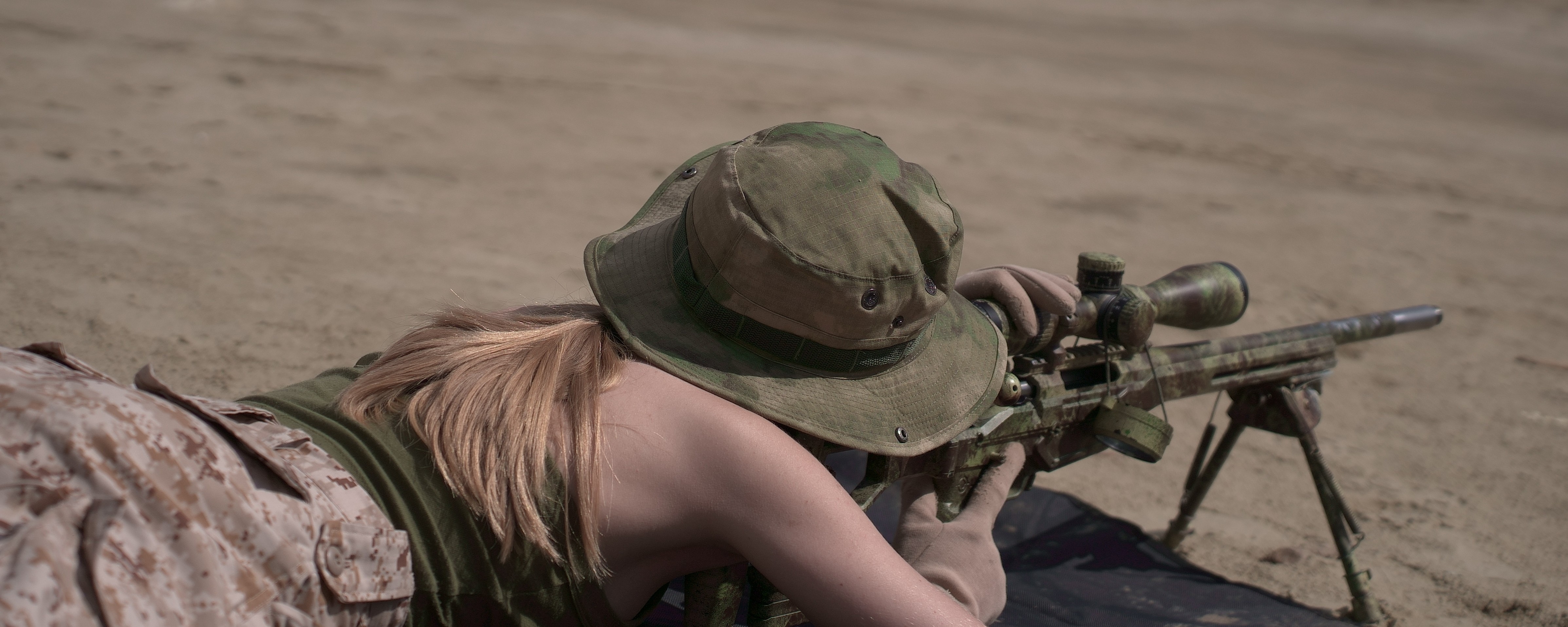
“MILEY” ADJUSTS HER SIGHTS ON HER SNIPER-RIFLE. PHOTO: MIHIR MELWANI

‘I Want to Know How to Kill’: The Training Camp for Ukraine’s Future Soldiers

At a compound in an undisclosed location in Western Ukraine, trainers with codenames like “Charon” and “Prophet” try to psychologically prepare young Ukrainians for the horrors of war.
MM

LVIV, Ukraine – “I’ll put a bag over your head, lead you into the basement, and leave you there. It’s flooded and full of obstacles… and rats,” says a large Ukrainian trainer who goes by the callsign “Charon.” “It’ll also be pitch-black. Your objective is to make it out. Be ready for me to throw simulated grenades at you.”

VICE World News is at “Everest,” a compound at an undisclosed location on the outskirts of Lviv in the west of the country, where Ukrainian Territorial Defence recruits are preparing to be bound and blinded to see if they are ready for war.

Charon, who was given his moniker after the mythical Greek ferryman of the dead, leads recruits individually into the pitch-black basement of a derelict building to see whether they are psychologically resilient enough to be sent to war. Aging remnants of the Soviet-era factory – wires, splintered wood and plastic – litter the uneven ground, while old desks and sharp grates obstruct the maze of corridors and rooms.

Charon – who along with all the recruits and trainers at Everest VICE World News is not naming for security reasons – pushes his cadets, blinded by black bags, through the narrow and obstacle-filled hallway of the basement. “Believe me, the Russians are not gonna be that polite to you,” he jokes. I have also been bound at the wrists with zip ties and blindfolded with a bag over my head to try out the so-called “stress test” that hundreds of Ukrainian volunteers are being put through. After being led through dark passages, I am left on the ground with my hands bound and legs tied. A knife is thrown nearby, the lights are shut off, and the bag comes off my head. The mission: cut myself free and find a way out.

But it doesn’t end there. Without warning, instructors begin tossing practice grenades into the hallway. About 1 second after you hear the pinging sound of a practice grenade bouncing off of the floor, there’s a loud bang and a flash of light. As an instructor throws one into the pitch-black hallway of the basement, the right move is to crouch, cover your ears, and look away. If you don’t, your eardrums start to ring painfully.

"Charon" leads us into a stress test. Photo: Jeremy Chan

“CHARON” LEADS US INTO A STRESS TEST. PHOTO: JEREMY CHAN

The aim of all of this is to simulate the stresses of war, testing the mental capacity of the recruits. The training is based on US specialised military training prep, says Charon, who trains dozens of cadets a month. This psychological test is unique to Everest, and was implemented in response to a lack of mental resilience prep in the standard training regimen.

It’s been over three months since Russian forces began their invasion of Ukraine, and as each day passes, more troops are needed to defend their homeland. Volodymyr Zelenskyy, the Ukrainian president, says up to 100 of his soldiers are being killed every day as fighting intensifies around Donbas in eastern Ukraine, with hundreds more wounded. But the many people who have been psychologically damaged are not counted in this number. As the military is being forced to draft untested fighters to the frontline, a generation of Ukrainians is being scarred by the trauma of battle. With limited time and resources, military boot-camps and training centres are rushing to train civilians on how to handle an AK-47, but few explain how to handle the horrors of war. The new volunteer-run training centre that VICE World News trained at, which is sending troops to both the Ukrainian Army and Territorial Defence Forces, has introduced a stress-test as part of its training to filter out those who are unfit for battle.

And, as VICE World News discovered, blindfolded and unable to find a knife thrown on the floor among shards of glass, the test isn’t easy. “Some of our cadets start singing, some shout, others get violent and start throwing the obstacles out of the way,” Charon explains. It can take hours for some to make it out, but instructors aren’t just interested in whether they succeed. Instead, they’re watching to see whether recruits can keep their composure during the test. Not all are able to.

Trainees conduct a room-clearance exercise at Everest. Photo: Mihir Melwani

TRAINEES CONDUCT A ROOM-CLEARANCE EXERCISE AT EVEREST. PHOTO: MIHIR MELWANI

“We had an example of a person who had a panic attack in there, and we had to stop it,” Charon says.

“[The failure of the test] shows us that in the middle of the battle, when the mines and the missiles are going to be firing and exploding, that the person is going to get too much fear and they’re just gonna get stressed out and panic,” Charon says. And in battle, panic leads to failure.

Newbie soldiers at Everest are put through an 18-day intensive training programme before being sent to fight. Advanced soldiers are sent to the Ukrainian Army, while others are sent to the Territorial Defence Force. But during the three weeks of training, instructors keep an eye out for those showing potential for greatness – they’re placed into an “elite” group, and stay behind at Everest to be trained in specialised tactics and skills.

Everest is sanctioned by the Ukrainian Ministry of Defence, but it’s run by a purely volunteer staff. Nazar, who ran a construction firm before the war, developed the operation in collaboration with two friends. Soon enough, they had former troops with significant combat experience onboard, keen to pass their wisdom on to new soldiers. One of Everest’s senior instructors, known as “Prophet”, injured his spine in combat, and can’t fight on the frontline anymore.

The necessity of psychological preparation is clear when examining what actually happens to young and inexperienced troops in combat. VICE World News spoke with Mykyta , a soldier currently on the frontline in Donetsk. He told us that six of the 30 men in his squad just couldn’t handle the stress.

He says they were “young guys, 22 to 25 years old, who just know about war by watching movies.”

Mykyta, who VICE World News is not naming in full for security reasons, said they were incapable of fighting. “In the time when everything was fine, they [were] fine. When someone was dying nearby, they [were] afraid they would die too, so they [were] just stuck,” Mykyta explained, from his battle position over a shaky phone line. “They [did] nothing when the battle [was] going on.”

Instructors prepare to hand out weapons to trainees. Photo: Mihir Melwani

INSTRUCTORS PREPARE TO HAND OUT WEAPONS TO TRAINEES. PHOTO: MIHIR MELWANI

Mykyta’s commander, an ex-Soviet officer, sent the six soldiers to the rear lines, away from the trauma of the front. “On the frontline, these guys are a little bit useless,” Mykyta said. “We had to spend some of our attention not on the enemy, but on these guys. So it’s better for all of us that the squad is without.”

At Everest, cadets go through hundreds of drills, from shooting practice to mine-clearance. Cadets even get “snake-training,” where they are taught how to deal with Ukraine’s venomous snakes, which are supposedly common in the forests where much of the fighting is happening, and to care for their habitats.

Specialised courses, such as sniper training and air intelligence, are offered only to the elite few who the instructors deem worthy.

Snake training at Everest. Photo: Jeremy Chan

SNAKE TRAINING AT EVEREST. PHOTO: JEREMY CHAN

A young recruit, codenamed “Miley”, is one of these elite trainees. She was chosen to be a sniper.

“I want to know how to kill,” she says. Before joining, Miley contributed to the war effort volunteering by making camouflage netting and molotov cocktails with a friend, who she says describes her as aggressive. “I’m aggressive because they [the Russians] made me aggressive,” she says.

She’s 23, with no combat experience. When she’s not training, Miley works in a beauty call-centre part time. Her dream is to make music – like Miley Cyrus, her favourite singer. But that comes after the war.

“I feel like after this work, I need to go to the psychologist. So yeah, so I’m worried about that,” Miley explains, “but still, I have to do it, because I’ll regret it all my life if I do not.”

Trainees conduct live-fire exercises. Photo: Mihir Melwani

TRAINEES CONDUCT LIVE-FIRE EXERCISES. PHOTO: MIHIR MELWANI

And while Everest places an unusually strong emphasis on the mental preparation required to fight before deployment, there are also serious consequences to ignoring soldier’s psychological needs after they come home. Andriy Sadoyvi, Lviv’s mayor, understands the shortfalls of how Ukraine faced combat trauma in soldiers who fought in Donbas in 2014.

Physical wounds were treated, but psychological wounds were not. “We are aware of some examples of [veterans] dating back to 2015, when wounded people received prosthesis,” Sadoyvi told VICE World News. “But they were not really offered any psychological support, and so quite a few of them committed suicide.”

Sadovyi is planning a rehabilitation centre for victims of Russia’s war on Ukraine.

“Vivaldi” is a more recent case of battlefield trauma. He was critically injured in March when a mortar landed at his feet while he was fighting in Donetsk. VICE World News spoke with him at a military hospital in Lviv, where he is being treated for injuries suffered in the blast.

"Vivaldi" draws a map to help explains the events of the day of his injury. Photo: Mihir Melwani

“VIVALDI” DRAWS A MAP TO HELP EXPLAINS THE EVENTS OF THE DAY OF HIS INJURY. PHOTO: MIHIR MELWANI

“I was afraid that an infantry attack would follow the [mortar] attack,” he said. “I urged my unit to leave me with grenades and fall back.”

His squad refused to leave him. They applied four tourniquets to him – one on each limb – and carried him to safety.

For a month after his injury, he was unable to sleep.

At night, he was stuck in ‘military mode’, hypervigilant to threat. Vivaldi’s doctors continue to prescribe him medication, which he can’t sleep without.

Vivaldi refused the optional psychological consultations offered by the military hospitals, as did two other injured soldiers who spoke with VICE World News about their trauma.

At this time, the typical Ukrainian army training regimen does not emphasise mental health. Beyond an outdated written character assessment, there is little in the way of preparation for the horrors of the battlefield – or the ghosts that inevitably haunt those after the fight.

“I go to the big mountains a lot and I know how difficult it is to prepare and climb to the top,” Nazar says. “I know how it feels when you climb to the top and come back to your family alive.”

Additional reporting by Jeremy Chan, Alicia Chen and Vlad Fisun.

This piece was supported by the Pulitzer Centre.
Categories
A Victory! All About Guns War

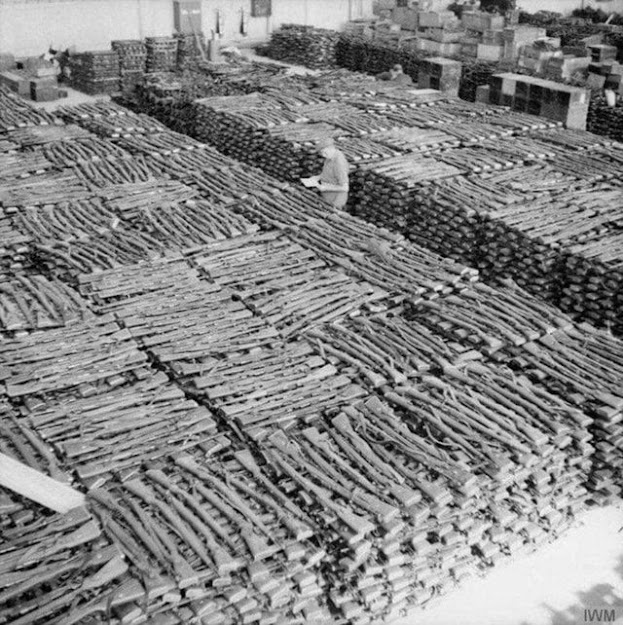
Now that is a pile of Mausers!

Piles of Rifles surrendered by German Soldiers after the End of the Second World War, 1945


Categories
All About Guns War

Hiram Berdan and his Sharpshooters by Daniel Ramos

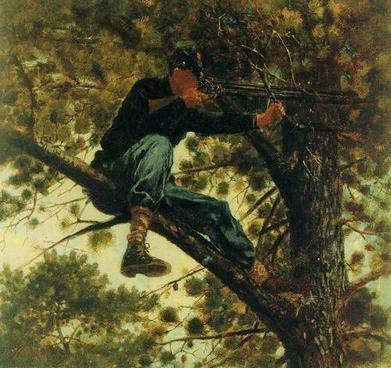
Berdan sharpshooter sitting on tree branch pointing rifle
Sharpshooter on Picket Duty by Winslow Homer 1863.

To him, war becomes a game, but instead of the gamble of his skill at the target range, the rifleman is gambling his life on his ability to kill before he is killed.

~William B. Edwards, author, Civil War Guns~

A mechanical engineer, inventor, and expert marksman, Hiram Berdan was no novice when it came to firearms and ballistics. A champion sharpshooter, his development of improved musket balls, fuse timers, shrapnel shells, range finders, and patent for repeating rifles contributed significantly to the evolution of more efficient weapons.1 But his greatest design was the formation of an elite unit of expert sharpshooters for the Union Army during the Civil War. Though it has been speculated that it was not Berdan’s original idea but that of his good friend, Caspar Trepp, a former Swiss army officer and competitive marksman, it was through Berdan’s efforts that the 1st U.S. Sharpshooter Regiment was established.2

General Hiram Berdan sitting


Brevet Brigadier General Hiram Berdan March 31, 1824 – March 31, 1893. LOC


When the Civil War broke out in 1861, Berdan, a wealthy entrepreneur with influential political and industrial connections, presented his proposal for the organization of a topnotch sharpshooter regiment to President Abraham Lincoln and wrote letters to members of the War Department. Despite his lack of military experience, on June 15, 1861, he received permission to recruit from the loyal states.3 Though slow to start, a blitz of recruitment posters pitching the unique roles of sharpshooters, some offering bounties, resulted in an overflow of volunteers. These extras were sanctioned as the 2nd U.S. Sharpshooter Regiment under Colonel Henry A. Post.4

To ensure that only the finest marksmen were selected, Berdan set high criteria for acceptance. Only those men who could make ten consecutive shots within five inches of a bullseye at 600-feet distance would be allowed to join his elite regiment. Soon, newspapers featured stories about the sharpshooters’ exceptional skills. Large crowds began to attend their target practice sessions at Camp of Instruction in Washington, D.C., including President Lincoln and high-ranking military officers.5

Though committed and driven, Berdan’s lack of military leadership experience and arrogance created some animosity among his subordinates. Having to admit to himself that he had not a scintilla of experience in military tactical training and command, Berdan requested and received the assistance of Lieutenant Colonel Frederick Mears, a seasoned officer and drillmaster who provided the sharpshooters with basic training and skirmishing, scouting, and guard duty skills. He, too, eventually resigned.6

General Order 37 issued June 25, 1861, gave the recruits the option of securing their own rifles with the promise that they would be reimbursed $60 for each weapon, a promise that was never honored. Those who chose to use standard issue weapons were to receive breechloaders with “all the requisites for the most perfect shooting that the most skillful marksman could desire.”7 Acquiring proper arms for his sharpshooters turned out to be a drawn-out nightmare for Berdan, mostly due to the cantankerous, mulish head of army weapons.

General James W. Ripley, Chief of Ordnance, who has been widely criticized for his stubborn support of uniformity in standard weapons and his refusal to consider technologically advanced firearms, insisted on the continued use of Springfield rifled muskets.8 It soon became apparent to Berdan that the motley lot of target rifles the men had chosen for themselves created an ordnance nightmare: besides necessitating an assortment of ammunition, their heavy weight (14-30 pounds) required shooting from a rest and hindered a steady hand when shooting from the shoulder. Berdan caved in to Ripley’s “suggestion” and on July 19, 1861, ordered 750 Springfield rifles equipped with telescopic sights and lugs for angular bayonets.9 But the confusion regarding weapons for the elite unit didn’t stop there.

In September 1861, at Camp of Instruction in Washington D.C., representatives from several firearms companies demonstrated their respective breechloaders, hoping to cement contracts for large sales of weapons. Pvt. Truman Head of Company C, 1st Sharpshooter Regiment, had purchased his own Sharps 1859 model rifle, a .52 caliber, single-trigger weapon with a sabre bayonet. Introduced into service in 1850, the Sharps rifle had an effective range of 300 yards. Not only was the rifle renowned for its range and accuracy, its fast breech-loading design meant that a proficient rifleman could fire up to ten rounds per minute. Berdan requested a sample from the Sharps factory in September 1861 and subsequently placed a requisition for 1,000 rifles with modifications: the new Sharps would be equipped with angular bayonets, double-set triggers and rear sights adjusted to 900 yards. Ripley, offended that Berdan failed to collect the Springfields already allocated, refused to fill the order.10

By early December 1861, only companies C and E, 1st Regiment, were armed with target rifles. Concerned by the delay in acquiring the Sharps rifles and his men’s growing unrest, Berdan placed an order for 1,000 Colt 1855 breech-loading repeating rifles via General McClellan’s chief of staff, Col. Randolph B. Marcy, with President Lincoln’s endorsement. Ripley, enraged that Berdan had gone over his head, appealed to President Lincoln to cancel the order. Lincoln responded, “Understanding this to be substantially an order of Gen. McClellan, let it [the order] be executed.”11

The first 1,000 Colt rifles were issued in February 1862, with the understanding that these would be replaced by the superior Sharps weapons upon their delivery. Unfortunately, the Colts had two major defects: a tendency to fire some or all of its chambers at once and a propensity to spray lead shavings from between the cylinder and the barrel, causing slivers to become embedded in the skin.12 But when news came that the rebels had evacuated Manassas, signaling the start of the Peninsula Campaign, the men reluctantly took up their Colt and target rifles and forged ahead.13 The sharpshooters finally received the first shipment of 100 Sharps rifles on May 8, 1862.

Berdan sharpshooter 1859 rifle


Berdan NM1859 Sharps rifle. Smithsonian National Museum of American History


On the battlefield, the sharpshooters wore distinctive hunter green, wool uniforms with green felt caps and leather leggings which served as camouflage. Gray overcoats and hats to blend in with winter’s backdrop were soon discarded lest the sharpshooters be confused for Confederates.14 Instead of forming traditional battle lines, they fought as skirmishers, spreading themselves out, making them tougher targets for the enemy. They also adopted guerrilla-style tactics that were both effective and deadly.

Berdan sharpshooter green uniform


Berdan sharpshooter’s uniform c. 1862. Smithsonian National Museum of American History


The sharpshooters saw their first action on April 5, 1862, during the Peninsula Campaign, when they picked off artillerymen manning Confederate batteries one by one during the Siege of Yorktown. Cpl. William L. Sankey wrote to his parents,

“The sharpshooters had the post of honor, the advance guard of Porter’s division … [at Big Bethel] we immediately deployed as skirmishers and closed in towards the fort…As fast as a head would appear over the earthworks, our boys would pick him off. The enemy must have thought there was a large body of us for we each had a five shooter. The rifle [Colt] did good execution that day.”15

Berdan’s Sharpshooters helped fight several rearguard actions during the Union’s retreat at the Battle of Malvern Hill. While the Peninsula Campaign ended in a humiliating Union withdrawal, the men in green quickly established themselves as the elite of the Union Army. They would continue to serve with distinction during the bloodiest battles of the war: Second Bull Run, Antietam, Fredericksburg, and Chancellorsville.16

In July 1863, they intercepted the rebels at the small farming town of Gettysburg, Pennsylvania in one of history’s biggest and bloodiest battles ever fought on American soil. At Devil’s Den and the Peach Orchard, their actions significantly delayed the Confederate assault, giving vital time for Union troops to organize defenses on the high ground outside of town. At Seminary Ridge, the 1st Sharpshooter Regiment supported by 200 troops of the 3rd Maine Infantry held off an entire Confederate brigade.17

With Lieutenant General Ulysses S. Grant in command, the Army of the Potomac and the 1st and 2nd U.S. Sharpshooter Regiments took part in the most ruthless battles of the Overland Campaign: The Wilderness, Spotsylvania Court House, and Cold Harbor. On June 9, 1864, Union troops laid siege to the rebels at Petersburg. Virginia. Berdan’s Sharpshooters again distinguished themselves, but it would be their final engagement of the war.

One of the most famous of Berdan’s Sharpshooters was Private Truman “California Joe” Head, a fifty-two-year-old, mild-mannered hunter and fur trapper from Otsego County, New York. A lifelong bachelor, Joe had made out a will upon his enlistment leaving $50,000 in trust for the care of disabled Union soldiers should he be killed. He served with distinction as a scout and sharpshooter during the Peninsula Campaign, where his exploits in the Siege of Yorktown and the first Battle of Cold Harbor were published in newspapers across the North, making him somewhat of a folklore hero. One story described how Joe and his fellow comrades picked off several Confederate troops attempting to fire a large thirty-two-pound cannon which remained silent, thanks to their efforts18. California Joe was discharged from the Army in November 1862 due to the rapid deterioration of his eyesight.19

Hiram Berdan and Truman Head standing by horse


Colonel Hiram Berdan (left) with famed sharpshooter, Truman “California Joe” Head. NYPL


On March 11, 1893, the U.S. government awarded the Congressional Medal of Honor to Vermont native, William Y.W. Ripley, a former Lieutenant Colonel with the 1st U.S. Sharpshooter Regiment. During the Battle of Malvern Hill on July 1, 1862, Ripley led a relief force to aid his sharpshooters, who were under heavy fire. A bullet struck Ripley in the leg, forcing him off the field, but his actions helped save the lives of his men and ensured victory for the Union Army that day. He was the only one of Berdan’s Sharpshooters to earn the Medal of Honor.20

As for Hiram Berdan, he resigned from his commission on January 2, 1864, and went on to develop the Berdan Rifle, a popular firearm that was the primary weapon used by the Russian Army from 1870 to 1895. Of all his many great innovations, the U.S. Sharpshooter Regiments of the American Civil War may have been his greatest creation.21

NOTES

[1] Charles Augustus Stevens, Berdan’s United States Sharpshooters in the Army of the Potomac, 1861-1865 (St. Paul: Price McGill Co., 1892), 526-527.

[2] Roy M. Marcot, U.S. Sharpshooters: Berdan’s Civil War Elite (Mechanicsburg, PA: Stackpole Books, 2007), 8-10. Frederick Phisterer, New York in the War of the Rebellion 1861-1865 (Albany: J.B. Lyon Co., 1912), 4313-4315.

[3] The 1st and 2nd U.S. Sharpshooter Regiments were recruited from the loyal states of New York, New Hampshire, Vermont, Michigan, Wisconsin, Minnesota, Pennsylvania, Maine. Massachusetts had two companies which trained with the 2nd Sharpshooters Regiment but were never a part of Berdan’s SS. An independent unit, they became known as Andrews Sharpshooters. Marcot, U.S. Sharpshooters, 22-23. Gerald L. Earley, The Second United States Sharpshooters in the Civil War: A History and Roster (Jefferson, NC: McFarland & Co., 2009), 8.

[4] Stevens, Berdan’s United States Sharpshooters , 4.

[5] Ibid., 9-13. “Colonel Berdan and His Sharpshooters,” Harper’s Weekly, August 24, 1861.

[6] Marcot, U.S. Sharpshooters, 27-28.

[7] William Y.W. Ripley, Vermont Riflemen in the War for the Union 1861-1865 (Rutland: Tuttle & Co., 1883), 10.

[8] Stevens, Berdan’s United States Sharpshooters, 7. Peter Tsouras, “Civil War Firepower Denied!” HistoryNet. Last modified June 1, 2017.

[9] Marcot, U.S. Sharpshooters, 11-12.

[10] Martin Pegler, Sharpshooting Rifles of the American Civil War (London: Osprey Publishing, 2017), 25-31. Marcot, U.S. Sharpshooters, 48. Bob Carlson, “Sharpshooter Weapons in the American Civil War,” American Society of Arms Collectors, Spring 2013, 10-13.

[11] William B. Edwards, Civil War Guns (Harrisburg, PA: Stackpole Company, 1962), 212-215. John Plaster, History of Sniping and Sharpshooting (Boulder: Paladin Press, 2008), 153.

[12] Marcot, U.S. Sharpshooters, 55-57. Jack Coggins, Arms and Equipment of the Civil War (Mineola: Dover, 2004 reprint), 36-37.

[13] Stevens, Berdan’s United States Sharpshooters, 27. Ripley, Vermont Riflemen, 15-17.

[14] Marcot, U.S. Sharpshooters, 33-37, 40-43.

[15] “From the Army at Yorktown, A Letter from a Sharpshooter,” Albany Evening Journal, April 15, 1862.

[16] Stevens, Berdan’s United States Sharpshooters, 142-245. Rob Wilson, “Trial by Fire for the U.S. Sharpshooters at Yorktown” Parts 1-3, Emerging Civil War, June 26, 2018.

[17] New York State Monuments Commission for the Battlefields of Gettysburg and Chattanooga, Final Report on the Battlefield of Gettysburg Vol. III (Albany: J. B. Lyon Co., 1902), 1071-1078. From 1st U.S. Sharpshooters Regiment’s Capt. F. E. Marble’s diary, July 2, 1863, an ode to his regiment. Timothy J. Orr, “On Such Slender Threads does the Fate of Nations Depend,” NPR: Gettysburg Seminar Papers 2006, 124-.143.

[18] Stevens, Berdan’s United States Sharpshooters, 59. Edwards, Civil War Guns, 217.

[19] Stevens, Berdan’s United States Sharpshooters, 49-51., Marcot, U.S. Sharpshooters, 30-31. “California Joe,” Harper’s Weekly, August 2, 1862.

[20] William Y. W. Ripley MOH citation, Military Times Hall of Valor Project, March 11, 1893.

[21] Stevens, Berdan’s United States Sharpshooters, 513, 526-527.

Categories
A Victory! The Green Machine This great Nation & Its People War

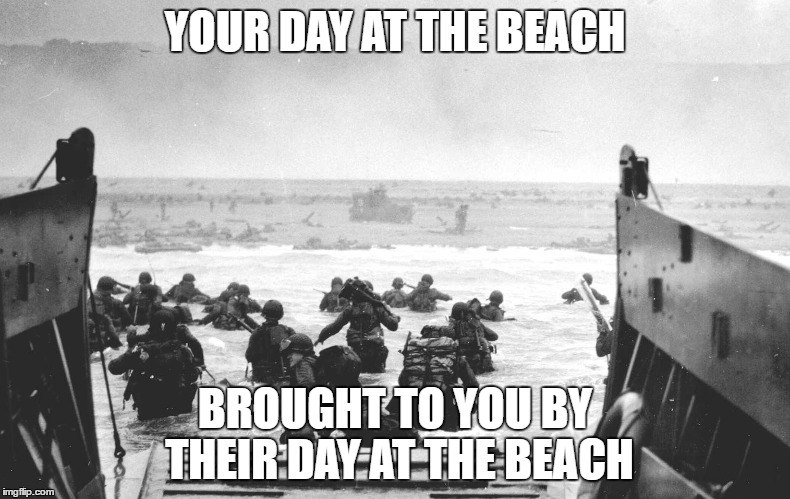
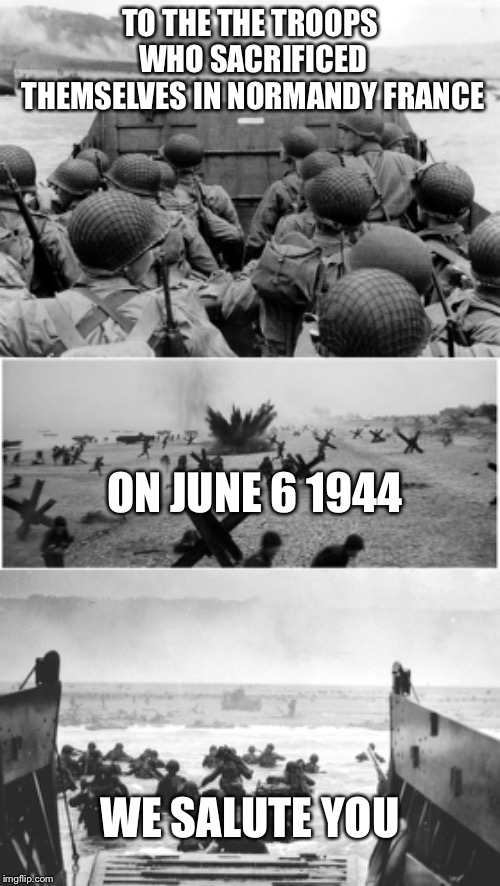
Today is the 78th Anniversary of the Invasion of Normandy & The liberation of Western Europe from Tyranny

d-day Memes & GIFs - Imgflip

Dominion Grills on Twitter: "https://t.co/crQ0HMhorY" / Twitter

The CostNo photo description available.


Categories
Our Great Kids Soldiering The Green Machine War

I still am in Awe of these Guys!

Categories
Useful Shit War

Finally: Ukraine Use Krab Howitzer To Destroy Russian Artillery

https://youtu.be/qC60Y-pZtqo

Categories
All About Guns Soldiering War Well I thought it was neat!

“SHOOT TO KILL” WORLD WAR II BRITISH ARMY INFANTRY WEAPONS TRAINING FILM BREN GUN

Categories
Hard Nosed Folks Both Good & Bad Our Great Kids Stand & Deliver The Green Machine War

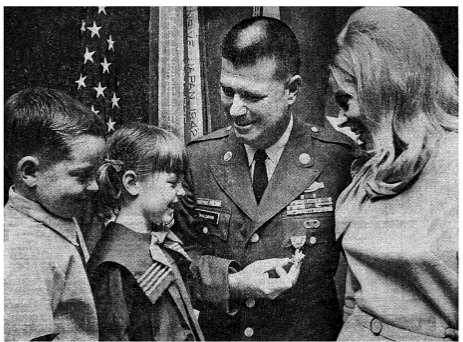
Adelbert F. Waldron III By Melvin Ewing

Delbert Waldron III, “Bert” to those that knew him, was the most accomplished U.S. sniper during the Vietnam conflict. Adelbert originally joined the U.S. Navy in 1953 where he served for twelve years and left as an E-5 in 1965. In 1968 Sgt. Waldron enlisted in the US Army as a Sergeant and headed to Vietnam as part of Company B, 3rd Battalion, 60th Infantry of the 9th Infantry Division. Sgt. Waldron qualified as an expert marksman and was sent to the now famous 9th ID sniper school that was run in country by the Army Marksmanship Unit (AMU) with the support of the 9th ID commander, General Julian Ewell. Once graduated, Sgt. Waldron then found himself back working with the Navy in the Mekong Delta in the brown water ‘Tango Boats’ and PBRs. It was in this very hostile area that Sgt. Waldron operated as a sniper.

At the end of his tour in mid 1969 the 36 year old Sgt. Waldron had 109 confirmed kills, highest among all U.S. servicemen during the Vietnam conflict. Sgt. Waldron primarily used the M-21 SWS during his time as a sniper and on occasion would use a starlight equipped M-14 or M-21 for nighttime operations. General Ewell also credited Sgt. Waldron with making a single shot confirmed kill at 900 yards from a moving Tango Boat. Adelbert ended his tour in Vietnam as a Staff Sergeant E-6 and had been awarded a Silver Star, a Bronze Star, a Presidential Unit Citation, and two Distinguished Service Crosses.

After his time in Vietnam, Sgt Waldron taught at the US Army Marksmanship Unit before leaving the Army in 1970. He worked with several questionable contractors and eventually he divorced as well. Staff Sergeant Adelbert Waldron III died on October 18, 1995 in California at the age of 62. Not much else is known about Sgt. Waldron or his military career, which was the way he wanted it. He did not publish any books or do lectures and refused many requests for interviews, he simply did not want the notoriety for what he did. Notoriety or not, he was an excellent sniper.

Categories
All About Guns Useful Shit War Well I thought it was neat!

The PBI’s Best Friend!

Categories
All About Guns This great Nation & Its People War

That Time Annie Oakley Offered to Put Together an All Female Sniper Team