Testimony of Pilot #32
On Nov. 18, 1952, Royce Williams became the top-scoring carrier-based naval aviator and the top-scoring naval aviator in a Navy jet of the Korean War.
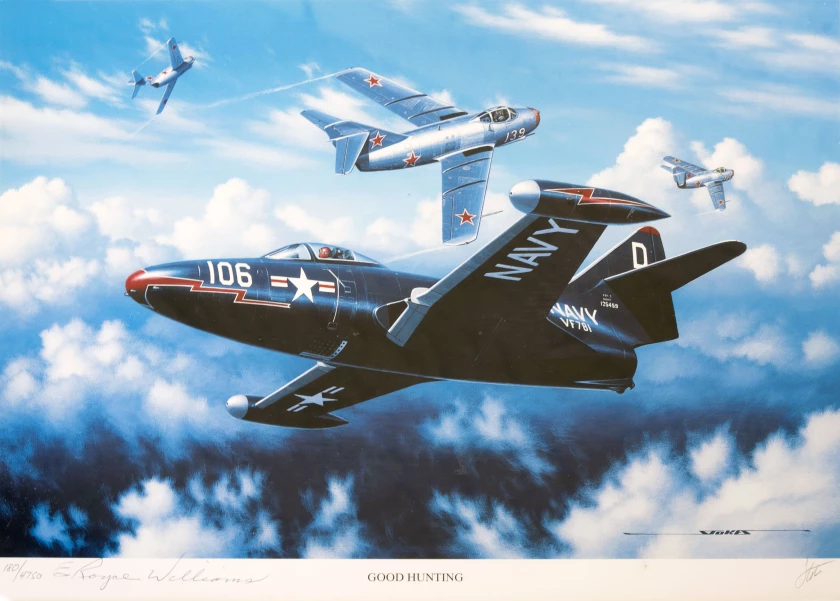
A signed print by prominent military aviation artist Stan Stokes displayed on a wall in the home of the veteran Royce Williams depicts a U.S. Navy F9F-5 Panther fighter jet, which was the plane Williams flew in a dogfight against seven Soviet MiG-15 fighters. (Charlie Neuman/For The San Diego Union-Tribune)
On Nov. 18, 1952, during the Korean War, Navy Lt. Royce Williams, along with three other pilots from his fighter squadron, VF-781, launched from the USS Oriskany into the stormy skies over the Sea of Japan. There were more than 250,000 sorties flown by the Navy during that conflict, but the ensuing engagement would end in one of the great feats of aerial combat, yet it was covered up for decades due to the tense political environment of the Cold War.
Background
BY NOVEMBER 1952, the air and ground war in Korea had been raging for two years and five months. The People’s Republic of China (PRC) had committed hundreds of thousands of soldiers to help their North Korean allies.
Four Soviet air force fighter divisions had been deployed to People’s Republic of China air bases near the mouth of the Yalu River on the western edge of the peninsula. Equipped with state-of-the-art sept wing MiG-15s, they were there to support the North Korean People’s Army (KPA) as well as the PRC’s People’s Liberation Army (PLA).
Almost every day, Soviet MiGs engaged F-86 Sabers from USAF 4th, 18th and 51st Fighter Interceptor Wings over the mouth of the Yalu River on the west side of the Korean Peninsula. On the ground, the war had stalemated to a line almost identical to the current border between the Democratic People’s Republic of Korea (North Korea) and the Republic of Korea (South Korea).
In the Yellow Sea, planes from Task Force 95 made up of Royal Navy, Royal Australian Navy and U.S. Navy escort carriers flew interdiction and close air support sorties while their U.S., Royal Navy, Canadian Navy, and Australian Navy escorts provided naval gunfire support.
In the Sea of Japan, the U.S. Navy’s Task Force 77 roamed up and down the coast. Generally, its carriers and escorts launched close air support and interdiction strikes a from within 50 miles of the coast to cut off supplies to the PLA and what was left of the KPA. By 1952, the Navy was rotating the three Essex-class carriers it had in theater so two carriers were on station off the east coast of Korea with a third refitting/rearming in Japan.
The USS Oriskany (CV-34) as part of that Navy Task Force was striking at logistics centers in North Korea and on 18 November was off the northeast coast of North Korea about 50 miles east of Chongjin and less than 100 miles southwest of the Soviet air and naval bases at Vladivostok. Chongjin was a hub for roads and railroads from the PRC and Vladivostok in the Soviet Union that allowed supplies to flow to the KPA and the PLA.
The carrier and its Air Group 102 had been on station since October 1952. Air Group 102’s pilots roamed northeastern North Korea on armed road reconnaissance missions during which they strafed convoys and trains as well as flying bombing missions to destroy bridges on the road and rail lines.
The Mission
On board Oriskany, the task force commander received a top-secret message indicating that MiGs were expected to fly south from Vladivostok and over Task Force 77. Standard U.S. Navy doctrine was then, and is today, to intercept any intruder before they reach their weapon launch envelop and escort them until they depart. The target on the 18th was the city of Hoeryong, right along the Yalu River where the borders of China, North Korea, and what was then the Soviet Union met. This made the bombing missions a risky proposition, given the possibility of violating each nation’s airspace. The weather that day was terrible. On top of the heavy snowfall that blanketed Task Force 77’s ships, the air temperature was in the 20s and the water temperature was in the mid-thirties. Without an exposure suit in 30-degree water, a pilot has about two minutes or less to get into his raft before the cold immobilized his body. Once in his raft, he still could die from exposure.
Lt Royce Williams, on his second mission of the day, was tasked as part of a combat air patrol in a Grumman F9F-5 Panther. Williams, a Naval Reservist and three others from VF-781 manned their F9F-5s and launched at 1300.
“We started to rendezvous with each other as we climbed out of the clouds,” Williams recalled “And that’s when we heard from the combat information center that there were inbound bogeys from the north.” They had been detected on radar roughly 80 nautical miles north-northeast of the task force. There appeared to be seven Russian MiG-15 fighters that were heading toward them (probably) from a Soviet base in Vladivostok. Williams’ flight was soon vectored toward the MiGs .
In this time frame, division leader Elwood reported his fuel pump warning light had come on. The Fighter Direction Officer (FDO) directed him to break off and report overhead Oriskany. Elwood passed flight lead to Williams as he and his wingman turned away and dived toward the clouds. Williams and his wingman, Lieutenant Junior Grade John Middleton, were now a two plane section.
The F9Fs had broken out in the clear at 12,000 and were climbing past 16,000 feet when Williams spotted the enemies’ contrails, 45 miles from the carrier. He estimated the Soviet fighters to be above 30,000 feet higher. Williams kept climbing and radioed to the Oriskany that he had a “tallyho” on the MiGs which were split into a three plane and a four plane group. The CIC on board Oriskany radioed Williams not to engage when suddenly the MiGs opened fire with their 23mm and 37mm cannon. Both were diving on the two F9Fs from different directions.
With tracers streaming past his F9F-5, Williams replied as he made sure his cannon were armed and ready to fire. “We are already engaged!”
The attackers were indeed swept wing MiG-15s. Comparable to the U.S. Air Force F-86, the MiGs outclassed Williams’ Panther in speed, maneuverability, climb rate, and weapons range.
Note : At that time air-air engagements were generally confined to the western half of the Korean peninsula, where the Air Force’s F-86 Sabres would patrol the approaches from China known as “MiG Alley.” The location this far to the east was one indication that these MiGs were almost certainly launched from the Soviet Union.
While the Navy had scored some early kills against the MiGs, their mission had switched to one of mostly ground attack. Williams had trained as a fighter pilot since 1944, but the primary mission of the Panthers in Korea was air-to-ground engagements.
“I flipped on my gunsight and fired a burst to test my guns,” he recalled.
“We were just going through 26,000 feet when the MiGs split up and dove out of the contrail layer,” Williams remembered. “The first ones came at us from the right side in a four-plane formation and opened fire. I pulled into a hard climbing left turn and came around on the Number Four MiG. I fired a burst and hit him solidly in the rear fuselage. He went down smoking, and my wingman then followed him, leaving me alone.” Williams, now alone, faced six fighters, probably Soviet.
As the MiGs, now in two formations, climbed for altitude to make attacking dives, Williams found himself on the tail of one and downed a second aircraft. He now had to choose his shots carefully given that the Panther carried less ammunition than the MiGs.
“In the moment I was a fighter pilot doing my job,” said Williams. “I was only shooting what I had.”
The five remaining Soviet jets were now taking turns climbing and then making passes at Williams. He could only twist and turn the Panther to the limits of its abilities, engaging a Soviet jet when it passed in front of his sights or rapidly turning to face them head on. “I was engaged mentally at the time. A lot of it was awareness of where they were and how I had to maneuver to avoid them. They were taking turns. I decided if I concentrated on shooting them down, then I’d become an easy target. So, my initial goal was to look for defensive opportunities when they made mistakes,” he said. Williams fired at another MiG and it banked out of the fight. As that Soviet pilot’s wingman turned towards Williams, he fired a long burst as the two jets passed belly-to-belly, with the Soviet aircraft crashing into the sea.
The three remaining MiGs of the first group easily accelerated away from the Panther and climbed to position themselves for another firing run. Williams saw their left wings come up as they reversed course. “They had me cold on maneuverability and acceleration – the MiG was vastly superior on those counts to the F9F. The only thing I could do was out-turn them.” He managed to cut loose a burst of fire as the MiGs flashed past, but failed to score any hits. As the first three pulled away again, the other three joined in. Williams sweated as he reversed, jinked and rolled to get away from each firing run. He glanced over his shoulder and saw a MiG locked on his six o’clock. Pulling the stick back into his gut, he threw it against his right leg as he stomped right rudder and executed a very hard wings-vertical right turn with contrails spinning off his wingtip fuel tanks. The MiG flashed past his tail.
In the rush of adrenaline, the fight seemed like it had been going on for an hour. The enemy formations became ragged and Williams got several opportunities to track an individual MiG as the pilot bored in to attack. Some rounds seemed to hit, but he couldn’t follow up as he stomped rudder and slammed ailerons to keep his six o’clock clear. “I was firing at every MiG that passed within gun range as they came by.”
Turn. Turn again. Not a second spent straight and level. Fire a quick burst to throw off their aim. Turn some more. Then again.
“Finally, the leader and his wingman went off to the right and I went after the section leader of the plane I’d shot down. He pulled up into the sun and I lost him, then I saw the leader and his wingman come around for a diving attack. I turned into them and fired at the leader. He turned away and the wingman rolled down on me and we went past belly-to-belly as I raked him with a long burst. He caught fire and went down. The section leader then came around and I turned into him and fired at him practically pointblank and he went down. The (flight) leader then came around again and I fired and parts came off him as he dove away.”
Getting Home
Eventually, Williams ran out of ammunition, and cannon fire from a MiG took out control of his rudder and hydraulics. By that point, only one of the seven original Soviet planes was still in the air with him. He managed to escape by playing cat-and-mouse in the clouds with the MiG all the way back to the protection of the fleet
“As I maneuvered to avoid the wreckage, I porpoised to try and clear my tail. I was tracking another wounded MIG when I suddenly spotted one of the other two as he slid in on my six. He fired a burst with his 37mm cannon and hit me in the wing. The shell went into the engine area and messed up the hydraulic unit in the accessory section. I suddenly lost rudder and flaps and only had partial aileron control. The only thing that really worked were the elevators. I dove toward the cloud deck below at 13,000 feet, and he was 500 feet behind me and still shooting all the way down. It seemed like it was taking forever to drop that 10,000 feet! My wingman finally got back in the fight and came in on the MiG and he pulled away as I went into the clouds.”
Williams fought to control the Panther, hoping he could pull out of the dive. “I came out of the clouds at around 400 feet. I was way too low to eject – you had to be above 1,200 feet and in a climb to successfully eject from a Panther – so I was stuck with staying in the airplane, like it or not. I soon discovered it was uncontrollable below 170 knots, so I had to maintain high speed regardless.” which made the approach precarious considering the Panther’s normal landing speed was 105 knots, or roughly 120 miles per hour. As he passed over the fleet a few hundred feet above the freezing ocean, several escorting destroyers opened fire as he flashed past.
Aboard Oriskany, the deck was ordered cleared for what was obviously going to be a crash landing. “I told them I couldn’t fly slower than 170 knots and I could see the ship visibly speed up as she turned into the wind.” Williams set himself up on final approach; the carrier was taking spray over the bow as the stern rose and fell through a 20-foot arc. “I didn’t want to ditch, because I wasn’t sure I could make a successful ditching, and that water was cold enough I knew I wouldn’t last ten minutes even in my poopy suit.”
Flying a conventional turning approach to the back end of the carrier was not possible, given his lack of control. After learning of Williams’ predicament, the captain of the Oriskany turned the ship so the Panther could make a straight in approach. “The Oriskany’s captain headed the ship just away from the wind, which gave me the opportunity to come aboard.” He kept the bucking Panther under control and continued the straight-in approach at 170 knots. With his canopy now open he flew a “Roger pass” to a three wire trap. “I caught the three wire and shut her down.”
After taking a moment to catch his breath, Williams climbed out of the riddled jet and was surprised he’d made it back when he saw the damage.
“They counted 263 holes in the airplane, mostly from 23mm hits and some 37mm hits, including the one in the wing that went into the engine accessory section. If it had been six inches forward, it would have hit the spar and blown my wing off. Eight inches to the rear and it would have blown up the engine. I had fired off all 760 rounds of 20mm I had aboard. I wouldn’t have had a chance if I hadn’t been armed with those cannons.” After the airedales pulled everything of value from F9F-5 BuNo 125459, the broken carcass was heaved overboard, where it disappeared into the dark sea.
In the fight of his life, Royce Williams had accomplished what no other American fighter pilot would ever accomplish: shoot down four MiG-15s in one fight. Given that the F9F-5 Panther was outclassed and outperformed on all points – speed, maneuverability and firepower – by the MiG-15, which was nearly 100mph faster and had a superior thrust-to-weight ratio, it was truly a performance for the record books. Williams’ air battle is now known as the longest dogfight in Naval history. Before that, the longest one was five minutes. Even in the most extreme circumstances, pilots know that if you can run, you run. And you only ever train for 3 on 1. To go 7 on 1 is beyond imagining.
“If I told you, I’d have to shoot ya”
It was then that the national security implications of the encounter began to take hold. While Soviet volunteers were known to be flying in Korea, Williams had engaged the actual Soviet Air Force. There was real fear at the highest levels of the US government and UN command that such an “incident” could change the Korean “police action” into World War III. As far as the United States Navy was concerned, the fight had never happened.
It is now known that the message to the USS Oriskany warning of the MiG flight came from a National Security Agency (NSA) team on board the heavy cruiser USS Toledo (CA-133), more than likely, the intelligence from a communications intercept. At the time, the mere existence of the newly formed NSA was still considered Top Secret which earned it the moniker “No Such Agency.”
After ordering Williams to tell no one, Vice Admiral Robert P. Briscoe, Commander Naval Forces Far East, informed him the NSA team had proof from recorded radio transmissions that he had gotten at least three of the MiGs, while the fourth had crashed in Siberia. Unfortunately, the gun camera footage had been “edited” aboard Oriskany, leaving only a portion showing two MiGs hit solidly.
Naval commanders ordered a version of the mission created that became the official account as found in the Oriskany and Air Group 102 Action Reports, though it had little connection with the facts: Williams was credited with one kill and a probable/damaged while Lt (jg) John Middleton, wingman to division leader Elwood, who had never been anywhere near the fight, was credited with a kill on the basis that, at the end of the 35-minute fight, he had been vectored toward a descending MIG whose pilot had ejected when Middleton approached it and fired a burst from out of range. Both pilots were awarded the Silver Star for their “accomplishments.” Dave Rowlands, who never fired a shot in the entire fight, was awarded a probable and the Distinguished Flying Cross. The history books have told the story that way ever since.
Royce Williams remained silent about the event for nearly 50 years, flying 70 missions during the Korean War, commanding VF-33 and then, during the Vietnam War, flew 110 missions as commander, Carrier Wing 11 (CAG), retiring as a Captain. The only official record of the engagement was Williams’ one confirmed kill and a Silver Star.
Four decades later, with the collapse of the Soviet Union, records began to emerge from Moscow confirming the engagement. Following the end of the Cold War in 1992, the Russians opened their records and revealed that Williams had indeed gotten four: Captain Belyakov, Captain Vandalov, Lt Pakhomkin and Lt Tarshinov of the VVS-PVO, the Air Defense Forces of the Red Air Force. Vandalov, Pakhomkin and Tarshinov were directly shot down in the fight, while flight leader Belyakov was badly shot up and was killed when he attempted to crash-land as soon as he was over Soviet territory. The dogfight was covered in a 2014 book by Russian historian Igor Seidov, Red Devils Over the Yalu: A Chronicle of Soviet Aerial Operations in the Korean War.
On the USS Midway, now a museum ship in San Diego, as a tribute to Williams, there is an F9F Panther with the silhouettes of four MiGs on the side under the cockpit.
There’s now a long-simmering campaign for Williams to receive the Medal of Honor. Navy veteran Steve Lewandowski gathered signatures from nearly 100 Navy, Marine, and Army flag officers supporting the action, as well as resolutions from the American Legion and Distinguished Flying Cross Association. That effort has been pushed to Congress. Please See Part 2.
***********************
Note: This post is based on multiple sources owing credit and thanks to Skip from the “The List,” Pam Kragen, Marc Liebman, Dario Leone, Max Hauptman, including The San Diego Union, and the websites Militaryhistorynow.com and Task and Purpose.
Against All Odds – Killing MiGs in the Korean War with Naval Aviator Royce Williams (Part 2 of 2)
Testimony of Pilot #33
Will he finally receive the Medal of Honor?
In San Diego Harbor on the USS Midway, now a museum ship , Capt. Royce Williams (USN, Ret) stands next to an F9F Panther with the silhouettes of four MiGs under the cockpit. The aircraft and its markings are there as a tribute to the man who downed at least four Russian MiGs in an extraordinary 35+ minutes on one mission on Nov. 18, 1952.
For over half a century his achievement was classified; nobody knew what he did that day over the skies of Korea. If you don’t know his story please see Part One.
Now retired he is one of the Korean War’s forgotten heroes. Royce Williams’ heroics in the Korean War flew under the radar for more than a half-century. Now, after his heroic engagement with seven Soviet MiG 15s – kept secret for decades – the 97-year-old retired Navy captain could be in line for the Medal of Honor based on a movement, sponsored by a U.S. Senator and several Navy flag officers.
Royce Williams accomplished what no other American fighter pilot would ever accomplish: shoot down four MiG-15s in one fight. Given that the F9F-5 Panther was outclassed and outperformed on all points by the MiG-15 – speed (nearly 100mph faster), superior thrust-to-weight ratio, maneuverability and firepower – it was truly a performance for the record books.
This was the only time that a US Pilot in a US aircraft engaged Soviet pilots in Soviet aircraft during the Korean War, and was covered up for decades due to the tense political environment of the Cold War. The event was immediately declared Top Secret and Williams was directed by the Navy to not reveal the incident.
There were more than 250,000 sorties flown by the Navy during the Korean conflict, and classification or not the ensuing engagement would end in one of the great feats of aerial combat.
There is now an effort underway to see him awarded the Medal of Honor for his actions that day.
******
There was real fear at the highest levels of the US government and UN command that such an “incident” could change the Korean “police action” into World War III. The national security implications of the encounter began to take hold. While Soviet volunteers were known to be flying in Korea, Williams had engaged the actual Soviet Air Force. Furthermore, his flight had been made aware of the Soviet jets based on intelligence from a small detachment from the National Security Agency — then less than a year old — operating on one of the other ships in the task force. As far as the United States Navy was concerned, the fight had to have never happened.
After ordering Williams to tell no one, Vice Admiral Robert P. Briscoe, Commander Naval Forces Far East, did inform him the NSA team had proof from recorded radio transmissions that indeed he had gotten at least three of the MiGs, while the fourth had crashed in Siberia. Unfortunately, the gun camera footage had been “edited” aboard Oriskany, leaving only a portion showing two MiGs hit solidly.
Rather than acknowledge an air battle that might have had the effect of drawing the Soviets into the Korean War, National Security Agency and Naval commanders ordered a version of the mission created that became the “official account” as found in the Oriskany and Air Group 102 Action Reports, though it had little connection with the facts. Both planes’ gun camera footage was immediately taken by the intelligence officers and later, Williams learned, was passed along to the newly formed National Security Agency.
The dogfight scrubbed from its records and Williams sworn to secrecy for more than 50 years, when the nation awarded 146 Medals of Honor to U.S. servicemen for extraordinary valor in the Korean War, Williams didn’t make the list.
He was credited with one kill and a probable/damaged while Ltjg John Middleton was credited with a kill on the basis that, at the end of the 35-minute fight when vectored back from Oriskany toward a descending MIG, the pilot had ejected when Middleton approached it and fired a burst from out of range. As the wingman to the division leader who had been forced to return to the Oriskany by mechanical problems he had never been anywhere near the real fight. Both pilots were awarded the Silver Star for their “accomplishments.” Dave Rowlands, who never fired a shot in the entire fight, was awarded a probable and the Distinguished Flying Cross. The history books have told the story that way ever since.
Williams went on to fly a total of 70 missions during the Korean War, later flying F-8 Crusaders and commanded VF-33 and Carrier Wing 11. He flew 110 missions during a Vietnam deployment as the “CAG,” retiring as a Captain (O-6) in 1980.
The only official record of the engagement is Williams’ one confirmed kill and a Silver Star. His aerial heroics have been a legend for decades among pilots coming up through the Navy’s Top Gun school. But no trace of Williams’ daring flight on Nov. 18, 1952, exists in the U.S. military archives.
*****************
For decades, as noted, the entire incident itself remained shrouded in mystery but over the years, pieces of the story began to emerge. In 1992, with the collapse of the Soviet Union, records began to emerge from Moscow confirming the engagement. The Russians opened records that revealed that Williams had indeed gotten four kills: Captain Belyakov, Captain Vandalov, Lt Pakhomkin and Lt Tarshinov of the VVS-PVO, the Air Defense Forces of the Red Air Force. Vandalov, Pakhomkin and Tarshinov were directly shot down in the fight, while flight leader Belyakov was badly shot up and was killed when he attempted to crash-land as soon as he was over Soviet territory.
Other unconfirmed reports surfaced that the Soviet’s actually lost six airplanes in the encounter. A fifth crashed in Soviet territory as it was limping home. Another aircraft and pilot were listed as MIA because the plane never returned to its base. All six were members of Soviet Naval Aviation.
True to his word, Williams although long since retired, had refused to discuss the dogfight. He had never told anyone about the dogfight — not even his wife, Camilla, or his pilot brother until the Russians released the downed pilots names.
But while Williams thus became the top-scoring carrier-based naval aviator and the top-scoring naval aviator in a Navy jet in the Korean War, several attempts to set the record straight have failed. The problem persists on the grounds that there is no longer an American witness alive to verify Williams’ account, this despite the Russian publication of the names of the Soviet pilots who died in the fight.
The dogfight has now been covered in a 2014 book by Russian historian Igor Seidov, “Red Devils Over the Yalu: A Chronicle of Soviet Aerial Operations in the Korean War.”
He wrote that of the seven MiGs that left Vladivostik that morning, only one returned to base. Four were shot down by a single U.S. aircraft, one plane was shot up and crashed on its way back and the seventh plane was never found.
There’s now a long-simmering campaign for Williams to receive the Medal of Honor. But because the incident officially didn’t happen, finding the necessary documentation is still an uphill battle. Nominations for the Medal of Honor are required within three years of the event. Any later nomination requires Congressional action.
Over the past eight years, after reading Seidov’s book, retired Rear Adm. Doniphan “Don” Shelton of Del Mar has tried repeatedly to get the Navy and Department of Defense to award the medal to Williams, but by not involving Congress members early enough in the process to receive a congressionally awarded medal, Shelton’s efforts ultimately failed and last October Shelton passed away .
A newly assembled delegation’s effort, nicknamed “Operation Just Reward,” is now seen as the last chance to get the medal to Williams before he passes away.
Navy veteran Steve Lewandowski who assisted Shelton’s efforts for three years has gathered signatures supporting the action from nearly 100 Navy, Marine, and Army flag officers, as well as resolutions from the American Legion and Distinguished Flying Cross Association. All five members of the San Diego U.S. Congressional delegation have joined forces to not only bring Williams’ heroism to the public’s attention, but also to right what they see as a historic wrong. Congress members Darrell Issa, Scott Peters, Sara Jacobs, Juan Vargas and Mike Levin have prepared an amendment to the 2023 National Defense Authorization Act to include the Medal of Honor for Williams,
“To me and everyone who learns his story, Royce Williams is more than the Navy’s Top Gun pilot for all time,” said Rep. Issa who initially proposed a bill to award Williams the Medal of Honor last fall and sponsored the House NDAA amendment. “His courage under fire and service to our country in a time of war should be an inspiration for all Americans. While Royce seeks neither fame nor recognition, those of us who know him and know what he did won’t give up until our mission to honor him is a success.”
“Royce Williams is a hero like no other, and his uncommon valor and resolute courage in battle is a history everyone should know,” Issa continued. “His recognition with the Medal of Honor is overdue and we’re going to get it done.” But even with the support of the bipartisan delegation, the medal award is no sure thing. Lewandowski said there are still hurdles to overcome, as the Navy and Department of Defense have already twice rejected the application. He hopes the battle for the medal can now be fought in the court of public opinion and the bipartisan coalition’s support will turn the tide.
“This is it, ‘once more unto the breach.’ It’s a ragtag, zero-resources effort, but it’s the right thing to do. This old man needs to be recognized for this unbelievable dogfight, when quite frankly anyone else would’ve run the other way. He’s the real Top Gun,” said Lewandowski, who is past commander of American Legion Post 416 in Encinitas.
Now 97 and long retired, Williams lives in a scenic mountainside home in Escondido’s Hidden Meadows community. Spinal injuries from a long-ago plane crash in El Centro make it hard for Williams to maneuver around his home, but his memory of the 1952 dogfight remains as fresh today as it was seven decades ago. Asked how it would feel to be awarded the Medal of Honor now, Williams takes a few seconds to consider his answer.
“If it happened, I would be awed,” Williams said. “I wish my dad could know. It would mean even more to my friends to know that I finally received it.”
****************
The House has passed the version of the FY 2023 National Defense Authorization Act (NDAA) that includes the amendment authorizing the award of the highest military award for valor to Williams for the California resident’s courageous actions against such long odds on November 18, 1952.
The Senate version has yet to go through that chamber’s full amendment process.
Actions Speak Louder Than Medals – the Royce Williams Story – https://www.youtube.com/watch?v=q0RzrNkx4iQ


