Categories
War Well I thought it was neat!

BOMBS AWAY THE SCIENCE (AND HISTORY) BEHIND THE ATOMIC BOMB WRITTEN BY WILL DABBS, MD

An image captured from the B29 chase plane Necessary Evil
of the actual detonation of the first atomic bomb over Hiroshima.


The law of conservation of mass states that in any closed system the ultimate mass of a system must remain constant over time. The law of conservation of energy posits that the total energy of an isolated system also must remain constant. Mass and energy are therefore said to be conserved over time. Both can change forms, but mass and energy can be neither created nor destroyed. They simply change from one state to another.

Take a match as an example. You strike a match and allow it to burn. What’s left is smaller and different from the original match. However, that excess mass didn’t just disappear. It changed forms. As the compounds in the wood degraded they gave off energy and some portion of it turned into a series of gases. That original stuff is not gone. It’s just different.

In the world of physics, this isn’t only not a good idea. It’s the law. However, there is one glaring exception. Albert Einstein codified the details within his extraordinary equation E=MC2.


Nuclear Fission


In the case of nuclear fission, a small amount of matter actually transforms directly into energy. Unlike our burning match example, some mass of fissile material consumed in a nuclear reaction no longer exists in our universe. This matter is physically transformed into energy. The ratio is driven by that equation where E is energy, M is rest mass or invariant mass, and C if the speed of light. As the speed of light is a big number and you are squaring it, the resulting amount of energy you get for a small amount of transformed matter can be truly astronomical.

As weird as all this seems, we can see the practical results clearly enough. It is this reaction that propels American aircraft carriers and nuclear submarines. It also drives nuclear power plants.

Despite their simply breathtaking size, aboard a nuclear-powered ship, a small amount of fissile material powers everything from propulsion and catapults to hot water and laundry. Producing 200,000 horsepower non-stop to power the USS Gerald Ford for a week requires less than nine pounds of enriched uranium fuel. These massive ships are expected to run for a quarter century without refueling. The tiny amount of fuel that is actually turned into energy in a nuclear reaction is even smaller yet. Now, hold that thought.


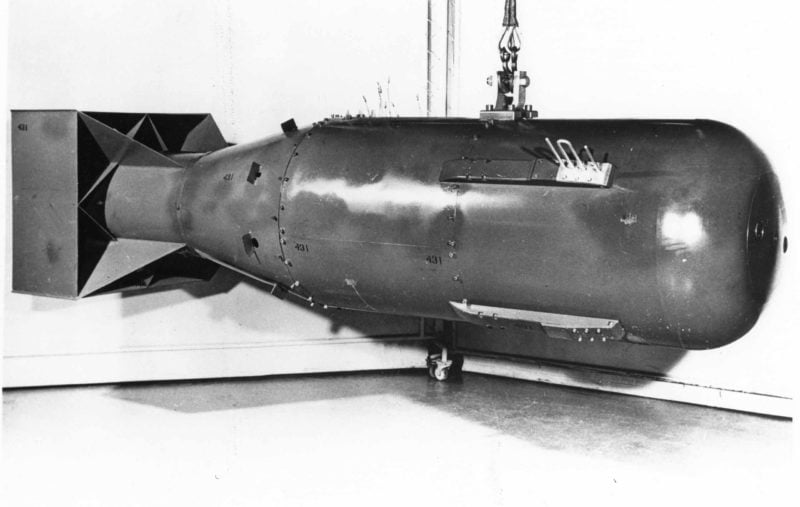
Little Boy was the first nuclear weapon fired in anger.

The Little Boy Test


The atomic bomb unleashed on Hiroshima, Japan, on August 6, 1945, was called Little Boy. This was a relatively simple gun-based device that burned enriched Uranium-235. The term enriched stems from the fact that only about one part in 140 of naturally-occurring uranium is the particular desirable U-235 isotope.

Building the bomb was fairly easy. Harvesting that specific uranium isotope was hard. That’s what the Iranians have been hell-bent on doing for the past decade.

Little Boy was little more than a stubby gun. An enriched uranium target sat at one end and a smaller uranium projectile resided at the other. At the point of detonation a chemical explosive fired the projectile down the internal barrel into the target and achieved critical mass for a spontaneous detonation.

The plutonium-based bomb, Fat Man, which dropped on Nagasaki three days later, was a more complicated implosion design. It was this mechanism that was detonated during the Trinity test in New Mexico. The first operational test of the Little Boy bomb was the Hiroshima attack. Most of the uranium used in Little Boy came from the Shinkolobwe mine in the Belgian Congo.


A Single Paperclip


Once ready to go Little Boy sported an all-up weight of 9,700 pounds. Of that mass was 141 pounds of enriched uranium. The average level of enrichment was around 80%. Upon detonation around two pounds of uranium underwent nuclear fission. Of the bit that burned, only 0.7 grams or around 0.025 ounce was actually transformed into energy. This is roughly the same mass as a dollar bill or a paperclip.

The bomb was deployed from the B29 Superfortress Enola Gay at 0815 in the morning. It fell for 44.4 seconds before its dual redundant time and barometric triggers fired the ignition charges. The weapon detonated 1,968 feet above ground, and the resulting explosion released 63 Terajoules’ worth of energy — the equivalent to 15,000 tons or 30 million pounds of TNT (Trinitrotoluene) high explosive.

The fireball was 1,200 feet in diameter with a surface temperature of 10,830 degrees Fahrenheit, roughly comparable to the surface of the sun. Every man-made structure within a mile of ground zero was instantly pulverized. The resulting firestorm was roughly two miles in diameter. Survivors reported a strong smell of ozone, as though they had been near a powerful electrical arc. This unprecedented explosion killed 66,000 people and injured another 69,000, all for the cost a single paperclip’s worth of enriched uranium.

Categories
A Victory! Allies Manly Stuff War

When the British Attacked a Russian Naval Base

Categories
All About Guns Allies Soldiering War

Stolen rom Historical Firearms (A Great Blog by the Way!)

THE MAD MINUTE

Marksmanship training in the British Army involved an exercise known as the ‘Mad Minute’ in which a soldier was expected to fire at, and hit, a Second Class figure target 300 yards out at least 15 times.   A trained rifleman could hit the target 30+ times with his Short Magazine Lee-Enfield Rifle.   At the turn of the century the British Army was the most professional in the world with each soldier trained to be an expert marksman.   The Mad Minute itself is arguably a myth surrounded by myth, its proper name was Serial 22, Table B of the Musketry Regulations classification course of fire. Which instructed a soldier to fire rapidly into a distant target with 15 rounds being a target.

However, this was not a requirement as the rifleman’s scores were calculated by aggregate with the other stages of the classification. The exercise of firing as many rounds as possible was probably a challenge set for fun to encourage pride in marksmanship and to see just how many rounds it was possible to fire in a minute. During the musketry classifications shoots of recruits and again shot each year by all infantrymen, engineers and cavalrymen to gauge how good of a shot they were.

The classification shoot was shot in several stages shot out to 600 yards, the various stages or serials were laid out in Table B, Appendix II in the Musketry Regulations Pt.1,  these included grouping with 5 rounds at 100 yards, snap shooting with 5 rounds out at 200 yards, two 5 round stages fired slowly with the first at 400 yards from the prone position and another at 300 yards from kneeling.   Then came the so called ‘Mad Minute’ stage fired from prone at a target 300 yards out.

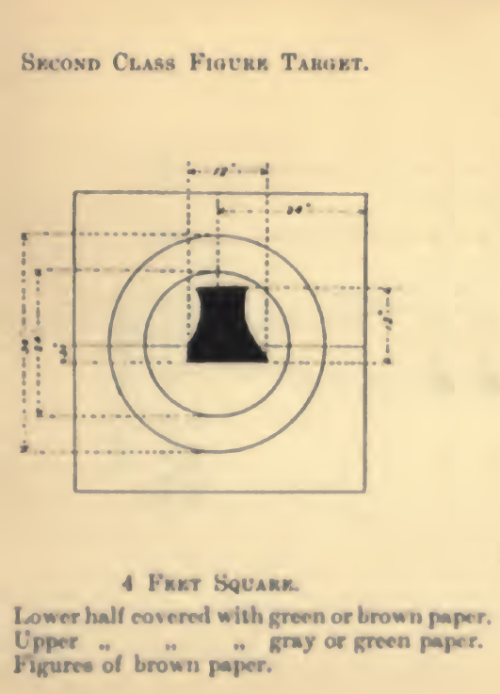
This was to be fired with 5 rounds loaded – 1 in the chamber and 4 in the magazine, the rifleman would then reload with 5-round chargers firing until 60 seconds had elapsed.  The target used for this stage was the Second Class figure target which was a 4 foot screen with a 12 inch high figure silhouette at the centre surrounded by two rings, a 23 inch inner ring and a 36 inch outer ring.   This stage was then followed by three final stages fired from prone out to 500 and 600 yards.

image

The Second Class figure target as shown in the 1910 Musketry Regulations

If the classification was completed with a high enough score the soldier would be classified as a Marksman and given a crossed rifles badge and a 6 pence a day increase in pay – so it paid to be a good shot.  The rapid fire of the ‘Mad Minute’ was accomplished by used a ‘palming’ method where the rifleman used the palm of his hand to work the belt, and not his thumb and fore finger.  Each man to shoot the classification course was allotted points for where each round hit – 4 points for a ‘bull’ figure hit, 3 for a hit in the inner ring and 2 points for an outer ring hit.

Troops could be classified as follows: Marksman (with at least 130 points out of 200 across the classification), 1st Class (105-130 points), 2nd Class and 3rd Class (sub-standard).  The majority of British troops, even cavalry, were excellent marksman with 50% of troops in some battalions scored as Marksman with the rest being 1st and 2nd class shots.

As such when the First World War began the average British rifleman could out shoot his German and French counterparts.  At the Battle of Mons it was well documented that German infantry believed they were facing British battalions heavily equipped with machine guns rather than riflemen.

The first and confirmed record for the most hits on target during a ’Mad Minute’  was set by Sgt-Major Jesse Wallingford – 36 hits at 300 yards in 1 minute in 1908.  However, this was allegedly bettered in 1914, by Sergeant-Instructor Alfred Snoxall with 38 hits within the 24 inch inner ring in 60 seconds.  It has not been beaten since although there is little documentary evidence of the feat readily available. Hitting the target 38 times would require him to fire his first 5 rounds pre-loaded in the SMLE’s magazine and then reload 7 times with 5 round chargers.

Add onto this that the rifle was a single shot, bolt action rifle which required the user to push up and retract the bolt and then return it forward pushing a new round into the chamber, then aiming and fire.  All while maintaining his cheek weld and line of sight.  This means Snoxall must have averaged around 1.5 seconds per shot to hit the target 38 times in a minute. Quite a feat.

Here is a short video of a SMLE owner attempting a very fast ’Mad Minute’, he managed to fire 10 rounds in under 10 seconds.  It certainly gives you some idea of what Snoxall and other professionals could achieve.  

Sources:

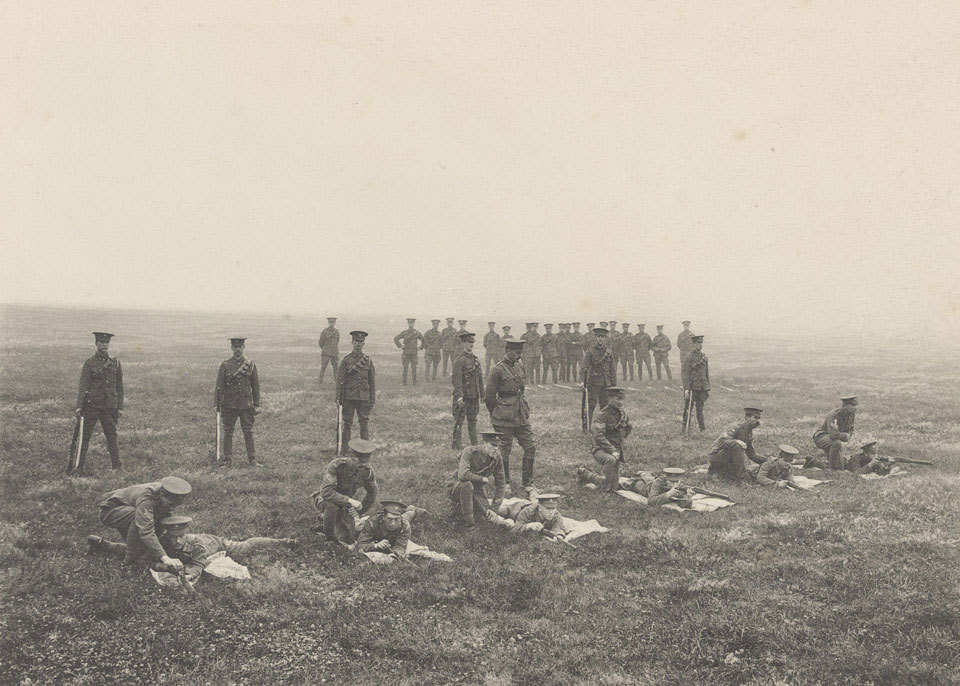
Image One Source – British Infantry firing at targets at 500 yards

Image Two Source – Recruits of the 5th (Royal Irish) Lancers at musketry training at Aldershot, August 1907

Image Three Source – Troops training on a miniature range at the School of Musketry c.1915

‘Mad Minute’, bbc.co.uk (source)

Tommy, R. Holmes (2004)

British Army Musketry Regulations pt.1 1909/1914

Thank you to Rob from Britishmuzzleloaders for his invaluable help

Categories
A Victory! Hard Nosed Folks Both Good & Bad Manly Stuff Soldiering War

Roy Benavidez: The Lazarus Soldier

Categories
Soldiering The Green Machine War

Bert Waldron: Nature versus Nurture, A Sniper’s Story by WILL DABBS

On the surface, this just looks like some GI with a really nice Vietnam-era sniper rifle. To the VC in the Mekong Delta, however, SSG Bert Waldron was so much more.

“Many GIs in Vietnam thought the night belonged to the enemy, but in the Mekong Delta, darkness belonged to Bert Waldron.” –Major John Plaster

Fear in wartime is a profoundly powerful weapon. It invariably shapes the affairs of men.

Think back to the last time you felt truly frustrated and helpless. At some point in their lives, everybody finds themselves in circumstances utterly beyond their control. It’s a terrifying sensation.

These guys were some extraordinarily effective fighters until it got dark and SSG Bert Waldron went out hunting with his night vision-enabled M21 sniper rifle.

Perhaps you were the subject of bullying. Maybe you were a little kid and got lost. For the Vietcong in the Mekong Delta in 1969, the engine behind their nightmares was SSG Bert Waldron.

What began as a source of refuge and solitude from chaos eventually became a home of sorts for a young Bert Waldron.

SSG Waldron was a broken man imbued with a dark gift. Born in Syracuse, New York, in 1933, Waldron came of age amidst chaos and despair. The product of a dysfunctional home, young Bert despised his stepfather. This antipathy drove the kid into the nearby forest in search of peace and solitude. There Bert Waldron came to think of the wilderness as home.

The most successful sniper of the Vietnam War got his introduction to military service in a place like this.

Bert Waldron’s life could be a case study of the effects of nature versus nurture. By his 23rd birthday, the man had been married three times. His unique emotional milieu apparently made him all but impossible to live with. Waldron enlisted in the US Navy and served during the Korean War. He left the Navy in 1965 after twelve years to try his hand at civilian life.

Don’t let the youthful demeanor fool you. These guys were stone-cold killers.

With the country embroiled in an increasingly bitter land war in Southeast Asia and life out of uniform not to his liking, Waldron enlisted again, this time in the Army. He completed Basic Training at Fort Benning and five months later was in Vietnam.

The most successful US sniper in Vietnam had a mere eighteen days in a place like this to learn the rudiments of his craft.

Waldron’s prior service in the Navy earned him Staff Sergeant’s stripes, but he still had very little experience with practical soldiering. Once in country, SSG Waldron attended a brief eighteen-day sniper course taught by members of the Army Marksmanship Unit. I don’t know exactly what they taught during those two and one-half weeks, but it took. In short order, SSG Bert Waldron became a holy terror behind a sniper rifle.

These hulking Tango Boats also served as proper mobile sniping platforms.

SSG Waldron was assigned to the 3d Battalion, 60th Infantry, Regiment, 9th Infantry Division under LTG Julian Ewell. Operating in close conjunction with the Navy’s Mobile Riverine Force, SSG Waldron and his fellow snipers cruised the murky waterways of the Mekong looking for trouble. Waldron’s prior service as a sailor made him a perfect fit for this joint operation with the Brown Water Navy. More often than not Waldron staged onboard ATC’s or Armored Troop Carriers. These heavily armed and armored riverine vessels were called Tango Boats and offered US forces a prickly platform for operations throughout the myriad shallow waterways of the Mekong Delta.

Tourists pay money to visit the Mekong Delta today. Back in the 1960s, this idyllic piece of jungle was a killing ground.

The Mekong was heavily populated and teeming with VC. Charlie typically played to his own strengths, conducting many operations under cover of darkness when American air power and artillery support could not be readily brought to bear. Then Bert Waldrop and his snipers hit the battlefield with high-tech sniper rifles equipped with starlight scopes. The result was unfettered carnage.

War Stories

In addition to a few basic technical skills, a successful sniper needs courage, patience, and audacity. Bert Waldron had these gifts in spades.

It takes unimaginable courage to strike out alone into the jungle in the middle of a firefight, but that was exactly Bert Waldron’s forte. In January of 1969, Waldron and his unit came under intense night attack by a force of forty well-armed VC. When his unit found itself in danger of being overrun SSG Waldron pressed out into the jungle alone to hunt. Using his accurized M21 sniper rifle and AN-PVS-2 starlight scope he could spot the enemy maneuvering in the deep foliage and pick them off as opportunity allowed. During the course of the engagement, SSG Waldron savaged the attacking force and broke the back of the assault. This fight earned him a Bronze Star with “V” device.

The accurized M21 sniper rifle fitted with the AN/PVS-2 starlight scope represented the absolute state of the art in precision night sniper systems during the Vietnam War.

Three nights later SSG Waldron discovered a large VC force moving tactically. He tracked the enemy unit using his night vision system until he gained an advantageous position to attack. SSG Waldron then sniped and maneuvered, engaging from various angles to convince the VC they were facing a larger, more organized force. Three hours later he had killed eleven of the Cong and forced them to leave the field. This night’s work earned him the Silver Star.

Thanks to SSG Waldron and his fellow snipers the VC no longer owned the night.

Eight days later SSG Waldron and his spotter were set up near Ben Tre scanning the darkness around their rice paddy with their starlight equipment. They encountered a seventeen-man VC patrol and took out their lead scout as he emerged from the treeline. Calls for artillery support were denied because of a nearby friendly village. At a range of more than 500 meters and under cover of darkness SSG Waldron killed eight VC with eight rounds from his sniper rifle. The surviving members of the VC combat patrol melted back into the jungle to safety.

This skinny little guy was a holy terror on the VC.

Four days after that SSG Waldron was deployed in support of an ARVN unit in contact. He discovered a group of six VC attempting to outflank the ARVNs and gain a position of advantage. SSG Waldron then meticulously killed all six of the insurgents, picking them off one by one in the darkness with his sniper rifle and night vision gear.

The Distinguished Service Cross is the Army’s second highest award for gallantry. SSG Bert Waldron earned one twice.

In one nineteen-day period, SSG Bert Waldron conducted fourteen successful nocturnal sniper operations. For his dedication, valor, and ruthlessness he was awarded his first Distinguished Service Cross. By now the VC were beginning to appreciate that horrible feeling of helplessness. Where previously they could move and operate in the darkness with relative impunity, now SSG Waldron and his snipers brought death from unexpected quarters. Their efforts began to take a toll.

SSG Bert Waldron just had a gift for the dark art of military sniping.

SSG Waldron’s effectiveness as a sniper clearly spawned from some innate skill. He had only had eighteen days’ worth of formal sniper training. During one engagement a VC sniper was peppering a passing Tango Boat from the top of a coconut tree some 900 meters distant. While the boat’s crew struggled to find the hidden sniper with their heavy crew-served weapons, SSG Waldron killed the man with a single round from his M21 rifle…while the boat was in motion. The Physics behind making a one-round kill from a moving boat against a camouflaged adversary nearly a kilometer distant strains credulity. However, the details were verified.

SSG Waldron’s combat record stood until it was broken during the Global War on Terror by Navy SEAL sniper Chris Kyle.

For these and similar actions SSG Waldron was awarded his second Distinguished Service Cross. Waldron’s reputation exploded among both Allied forces and the Cong, earning him the respectful nickname Daniel Boone. After eight months in country, the 9th ID rotated home and SSG Waldron with them. By the time he left Vietnam Bert Waldron had 109 confirmed kills, fully 12% of all the kills logged by all of the division’s snipers. Until Navy SEAL sniper Chris Kyle broke his record in 2006, SSG Bert Waldron was the deadliest American sniper in history.

The Weapon

The M14 would have been earth-shattering in WW2. By Vietnam the design was already badly dated.

The Army adopted the M14 rifle as a replacement for the WW2-era M1 Garand in 1959. A gas-operated, magazine-fed design, the M14 really reflected the previous generation’s technology. At 44 inches long the M14 was found to be unduly bulky for the bitter close-range jungle fighting that characterized the war in Vietnam. By the mid-1960’s the M14 was being replaced in SE Asia by the lighter, more maneuverable M16.

The M21 began life as an accurized National Match version of the M14 service rifle.

The US Army is indeed a majestically cumbersome beast. In 1955 the US Army Marksmanship Training Unit (USAMTU) embarked on a quest to incorporate snipers into the Infantry squad. In the malaise of the early 1960s, this initiative was discontinued. However, the exigencies of combat in Vietnam renewed interest in the art. That exposed the need for a dedicated precision sniper rifle.

The approaches to sniper rifles by the Army and Marine Corps were fairly disparate. The Army’s M21 offered 20 rounds of on-demand semiautomatic firepower.

While the Marines were using modified bolt-action hunting rifles, the Army contracted with Rock Island Armory to build up 1,435 National Match M14 rifles with Redfield 3-9x Adjustable Ranging Telescope (ART) sights. The ART was the brainchild of 2LT James Leatherwood and included both range finding and bullet drop compensation in its mechanism. This new rifle was formally designated the XM21 and first issued in 1969. An improved version with a fiberglass stock was classified the M21 in 1975 and served until 1988 when it was replaced by the bolt-action M24.

The AN/PVS-2 starlight scope offered unprecedented capabilities to the sniper hunting at night.

The AN/PVS-2 starlight scope was the first truly successful man-portable passive night vision weapon sight fielded by the US Army. This device amplified ambient starlight to produce a usable image in the absence of an active IR emitter. While such stuff is commonplace today, it was radical indeed in 1967 when it was first deployed to Vietnam. When combined with the early SIONICS suppressors fielded in 1969 the AN/PVS-2 offered American snipers a literally unprecedented capacity to own the night in Vietnam.

The Rest of the Story

Bert Waldron struggled to find his niche in civilian life. Here he is seen on the left instructing at Mitch WerBell’s paramilitary training school in Georgia.

Like so many true professional warriors, Bert Waldron found himself ill-suited to peacetime life at home. He served as a senior instructor for the US Army Marksmanship Training Unit (USAMTU) until his discharge in 1970. Along the way he met Mitch WerBell III through the commander of the USAMTU, COL Robert Bayard. and accepted a position as a counter-sniper advisor with Cobray International, WerBell’s weird creepy paramilitary training school in Georgia.

Mitch WerBell was one serious piece of work. We have explored his story here at GunsAmerica before.

Mitch WerBell dabbled in overthrowing third world governments for a time and made quite a few enemies along the way. In 1975 COL Bayard was found murdered outside an Atlanta shopping mall. His killer was never apprehended. Throughout it all Bert Waldron’s name was a persistent fixture.

Bert Waldron was by all accounts a profoundly committed patriot and a truly exceptional soldier.

For the next two decades, Waldron worked in the shadows, plying the dark skills he mastered in Vietnam into a livelihood. Along the way his final marriage self-destructed and he was investigated by the FBI. In October of 1995, Bert Waldron died of a heart attack at age 62. His ex-wife Betty said this of him, “Bert was a wonderful soldier. He loved his country, he would have died for his country, but he had a lot of problems as a human being.”

Our great republic cannot prevail without such men as Bert Waldron.

Bert Waldron was a “Break Glass in Case of War” type of soldier. America desperately needs such men. It is simply figuring out what to do with them when the bullets aren’t flying that seems to be the perennial challenge.

Categories
War

Pearl Harbor Day!

Categories
War

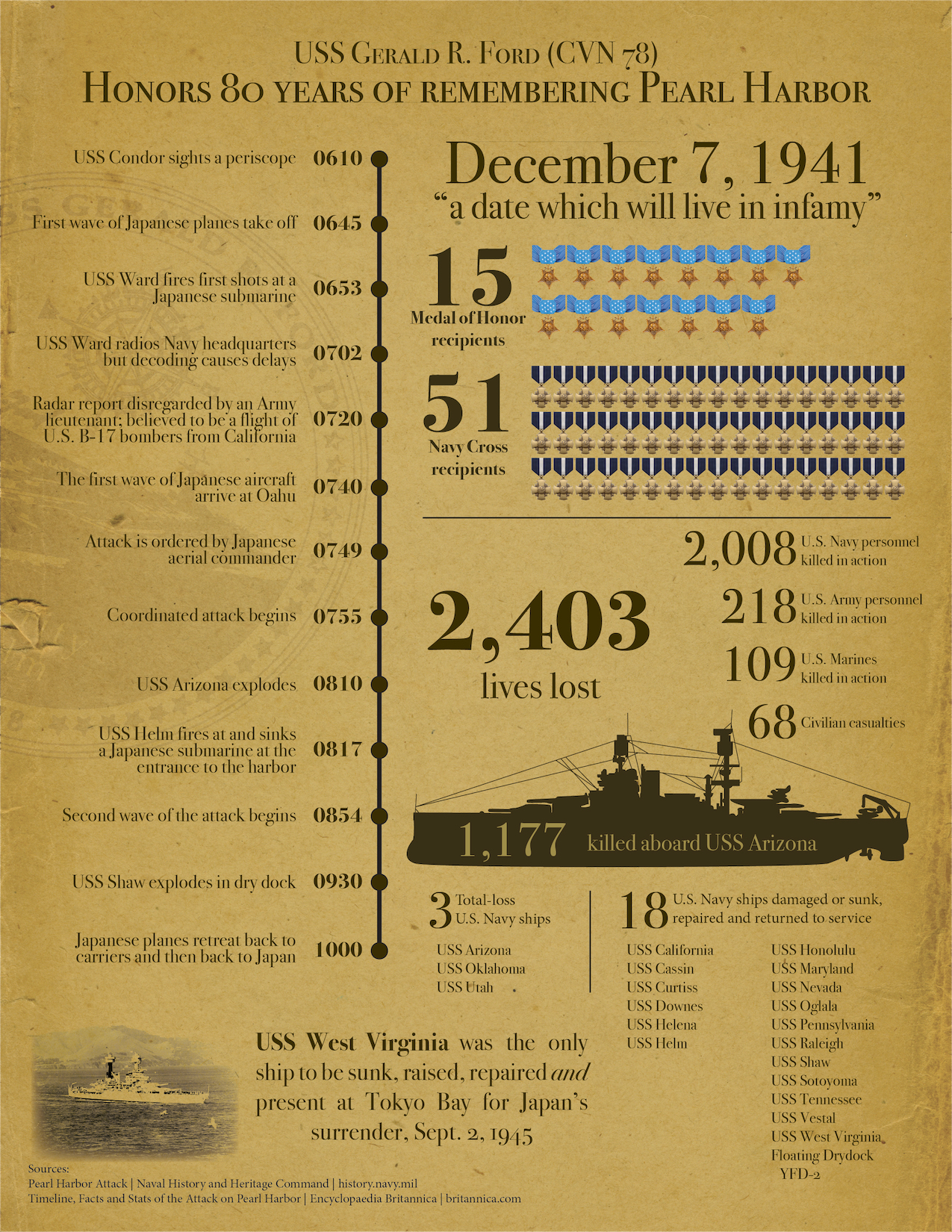
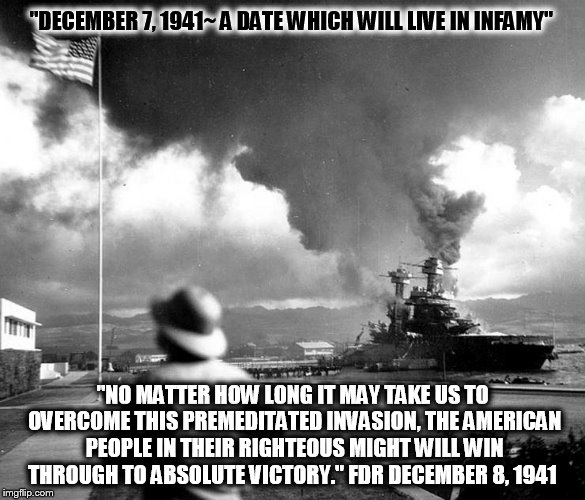
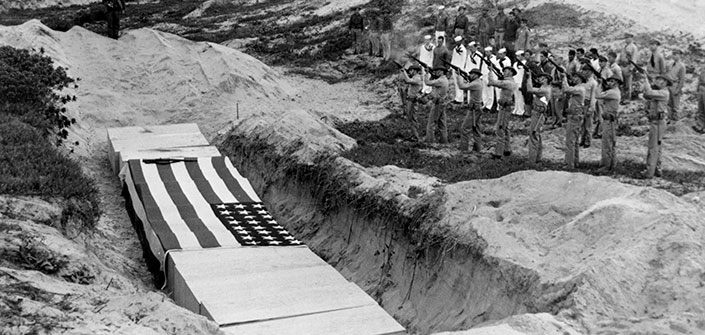
Today is Pearl Harbor Day

We are compelled to forgive. Yet to forgive is not to forget. - Imgflip

🐣 25+ Best Memes About Bombing | Bombing Memes

Categories
Soldiering War

The Pacific War

The Pacific War Just Got Intense : r/HistoryMemes

the pacific war - Imgflip

Categories
All About Guns The Green Machine This great Nation & Its People War

Remember Pearl Harbor: The Men and the Guns by MARTIN K. A. MORGAN

pearl.jpg

The crew of the 4″/50-caliber deck gun on the Wickes-class destroyer U.S.S. Ward (DD-139) sank a Japanese two-man midget submarine at 6:45 a.m. on Dec. 7, 1941. This is the gun and these are the men who fired the first shots that day. U.S. Navy photo
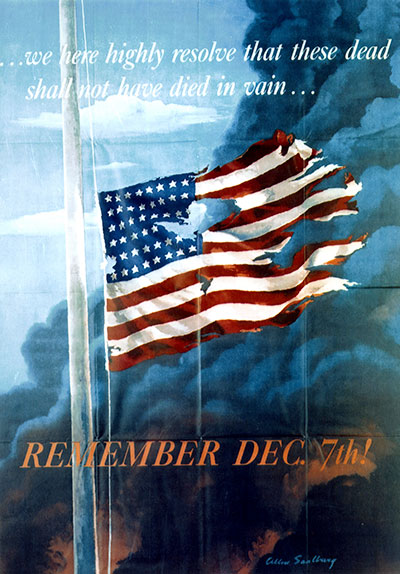
In remembrance of the Japanese Attack on Pearl Harbor on Dec. 7, 1941, this poster was designed by Allen Sandburg and issued by the Office of War Information in 1942. The poster featured a quotation from Abraham Lincoln’s Gettysburg Address: “we here highly resolve that these dead shall not have died in vain….”

The standard, popularized narrative about Dec. 7, 1941, emphasizes the Japanese attack on the U.S. Navy base at Pearl Harbor. Because of the spectacular explosion of U.S.S. Arizona, and the extremely high loss of life on Battleship Row, it is understandable that so much attention continues to be directed toward that single part of the attack. But the Japanese also targeted every other military installation on Oahu that day. From Wheeler Army Air Field to the Naval Air Station at Kaneohe Bay to the Marine Corps Air Station at Ewa, Japanese aircraft bombed and strafed military facilities across the entire island. What happened at those other locations is every bit as important as what happened around the Pearl Harbor Navy Base because lives were lost there as well, and the face of history was changed forever. But at each of those locations, U.S. personnel also fought back. They did so in the air, on land and at sea, and they did so with some of the guns that would ultimately win the war against Japan.

The first shots of Dec. 7, 1941, were fired by Americans, not the Japanese. At 6:45 that morning, the Wickes-class destroyer U.S.S. Ward (DD-139) sighted a Japanese two-man midget submarine tailing the cargo ship Antares just a few miles south of the entrance to Pearl Harbor. Ward then brought the submarine under fire with one of its 4“/50-caliber deck guns, scoring a direct hit on the starboard side of the sub’s tower that caused flooding and consequently, sinking. The Minnesota Naval Reservists manning that gun are remembered as the men who fired the opening shots on the “Day of Infamy.”
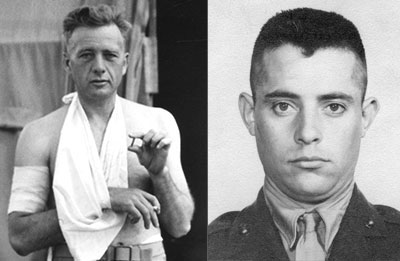
(l.) Marine Corps Tech./Sgt. Henry H. Anglin, the non-commissioned officer in charge of the Photography Section of Marine Corps Air Station Ewa, stands in front of the airfield’s dispensary on Dec. 8, 1941. Anglin is holding the Japanese 7.7 mm slug that wounded him during the attack the day before. Photo courtesy of Mike Wenger (r.) Sergeant Carlo A. Micheletto of Marine Utility Squadron (VMJ) 252 was delivering rifle fire with his M1903 Springfield when a Japanese fighter strafed him at Marine Corps Air Station Ewa on December 7th. He was 26 years old when he was killed in action.

Seventy minutes later, the first wave of the Japanese air raid started when bombs began to fall and torpedoes began to slice the waters of Pearl Harbor. Despite the early encounter between U.S.S. Ward and the Japanese midget submarine, soldiers, sailors and Marines were caught “flat-footed” by the attack when it began at 7:55 a.m. But even as explosions echoed across Oahu and combat aircraft roared overhead, some Americans on the ground began to fight back. Private First Class Melvin Thompson was on guard duty at the front gate at Marine Corps Air Station Ewa, seven miles west of Ford Island, when nine Japanese fighters, led by Lt. Cmdr. Shigeru Itaya from the aircraft carrier Akagai, began strafing the airfield. They had been given the mission of reducing Babasu Pointo Hikojo, the so-called “Barber’s Point Airdrome,” and so they came in low and fast over Ewa, attacking Marine aircraft on the ground there. Infuriated by this, Thompson walked out of the guard shack, drew his M1911A1 .45-cal. pistol, and opened fire on one of the passing fighters. At the same time, 27-year-old Lt. Yoshio Shiga’s section of nine fighters from Kaga came in over Ewa. From the cockpit of his A6M2 Zero, Shiga saw PFC Thompson facing off against him. The sight of the lone Marine shooting a handgun at a high performance combat aircraft strafing with 7.7 mm machine guns and 20 mm cannons left a powerful impression. Years later, Shiga remembered Thompson’s tenacity and fighting spirit and described the lone Marine as “the bravest American I ever met.”

U.S. M1903 Springfield Rifle


Melvin Thompson was not the only Marine returning fire at Ewa that morning. In a photograph that is now quite well-known, five enlisted Marines can be seen crouching near the foundation of a swimming pool under construction, each armed with a firearm that would do a great deal of fighting on December 7th—the M1903 Springfield bolt-action rifle. All over the field, Marines pumped fire into the air at the attacking enemy aircraft. One of those men was Sgt. Duane W. Shaw, the driver of the airfield’s fire truck. As the attack began, he attempted to drive the fire truck to the flight line to put out fires among the aircraft parked there, but the bright red vehicle attracted too much attention. All four of the fire truck’s tires were quickly shot out and the rest of the vehicle was punctured by holes from Japanese bullets before Sgt. Shaw could reach the burning flight line. Undeterred, he bailed out of the fire truck with his ’03 and started shooting. Nearby, Sgt. Carlo A. Micheletto of Marine Utility Squadron (VMJ) 252 was trying to put out fires among parked aircraft from his squadron when the final strafing attack commenced. With his ’03 Springfield in hand, the 26-year-old sergeant sought cover behind a pile of lumber and began directing rifle fire at passing enemy aircraft. One of the attackers soon thundered in toward the lumber pile firing its 7.7 mm machine guns, and a single bullet struck Micheletto in the head, killing him instantly. He was one of four Marines who made the ultimate sacrifice at Ewa Field on Dec. 7, 1941.
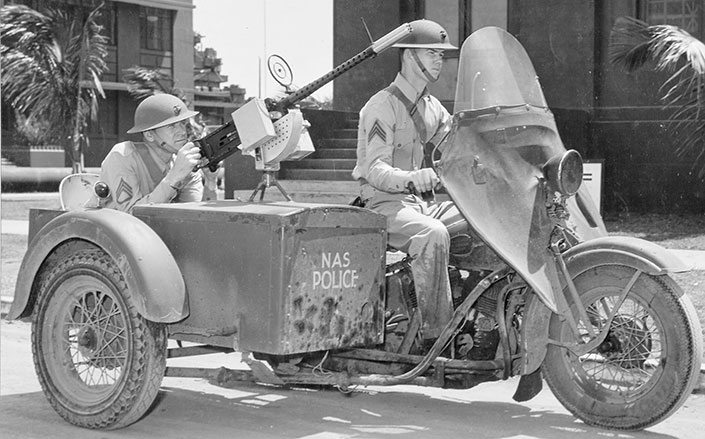
Two U.S. Marines who were part of the Ford Island Naval Air Station Police force are seen here on a motorcycle patrol in March 1942. They have parked on the quadrangle formed by the station’s Administration Building, Enlisted Barracks, Dispensary and the island’s shoreline. The aircraft carrier U.S.S. Enterprise (CV-6), which is moored at Ford Island’s Berth F-2, can be seen in the background. An ANM2 .30-cal. machine gun has been mounted to the motorcycle’s sidecar using the Mk. 9 Gun Mount Adaptor system.

From the swimming pool at Ewa, to emergency fighting positions that were hastily thrown together on Ford Island, the M1903 rifle put rounds into the air during both waves of the December 7th attack. For the Navy and the Marine Corps, the ’03 remained the standard-issue rifle, and it continued to serve in many of the Army units that were stationed in the Territory of Hawaii despite the standardization of the M1 Garand five years earlier. In fact, it was present on the morning of December 8th, when two Hawaii National Guardsmen walked down the beach near Bellows Army Airfield to investigate something that had washed ashore overnight. They were Lt. Paul C. Plybon and 20-year-old Cpl. David Akui from Company G, 298th Infantry Regiment. What the two soldiers found was one of the midget submarines that had participated in the attack on Pearl Harbor the day before. It had not managed to find its way into the harbor during the December 7th attack and, after depleting its batteries, drifted through the night, eventually washing up on the beach at Waimanalo Bay. By coincidence, the men of the 298th Infantry were nearby at Bellows Army Airfield, which is why Lt. Plybon and Cpl. Akui were sent to investigate. As they approached the derelict midget submarine, Akui noticed a Japanese man lying in the sand. It was 23-year-old Ens. Kazuo Sakamaki. Akui approached the Japanese submariner with his ’03 rifle at the ready and proceeded to take him into custody. Sakamaki was the first Japanese prisoner of war captured by the U.S. military during World War II.
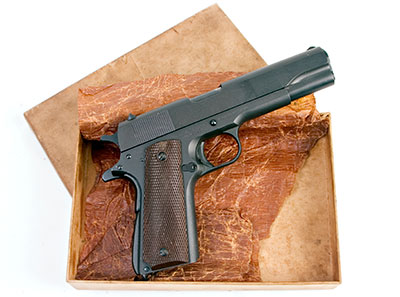
Marine PFC Melvin Thompson drew his M1911A1 .45 ACP pistol and opened fire on Japanese fighter aircraft attacking Marine Corps Air Station Ewa. It made the Japanese after-action report.

While the M1911A1 pistol and the M1903 rifle fought effectively on December 7th, the big hero of U.S. small arms that day was the ANM2. This derivative of John M. Browning’s short-recoil-operated, belt-fed machine gun was specifically engineered for use in aircraft and came in .30-cal. and .50-cal. versions that were sometimes referred to with the nickname “Stinger.” The origin of the ANM2 dates back to a requirement issued shortly after the end of World War I. Springfield Armory produced the first version as the Model 1922, but after a series of interwar budget cuts ended government production, Colt Patent Firearms Co. began manufacturing it in 1931 as the M2. When it was standardized for “Army/Navy” use in 1933, the “ANM2” nomenclature took its final form. For the most part, the .30-cal. Stinger had the physical appearance of a downsized M1919 series .30-cal. machine gun because of the slightly smaller dimensions of its receiver, barrel and barrel shroud. This brought the ANM2’s weight down to a mere 23 lbs., compared to the 31-lb. weight of the M1919A4, but the similarities ended there. In addition to having a different receiver and barrel than the M1919, the ANM2 included a backplate equipped with spade grips and a different feed cover, extractor, barrel extension and bolt. These parts were specially engineered to allow the gun to feed from either the left or right side of the receiver, a feature that made the ANM2 .30-cal. particularly well-suited for use in aircraft. The gun’s 1,300 round-per-minute (r.p.m.) cyclic rate of fire made it an especially dangerous gun because it gave the operator the ability to deliver the highest possible volume of fire during the typically brief windows of opportunity presented during modern aerial combat scenarios. Although the modest dimensions of its lightweight barrel meant that it did not did not possess the same heat dissipating characteristics as the M1919A4’s heavy barrel, the ANM2 was intended to operate in flight at high altitudes where cooler temperatures and fast-moving airflow would prevent overheating.

By December 1941, the ANM2 .30-cal. machine gun was being supplemented in both Army and Navy service with the harder-hitting ANM2 .50-cal. machine gun. Like the smaller .30-cal. Stinger, the .50-cal. version, at 61 lbs., was still lighter than its ground combat counterpart, the 84-lb. M2 Heavy Barrel. The ANM2 .50-cal. aircraft machine gun also offered a significantly higher cyclic rate of fire (than the ground model) that approached 850 r.p.m., and it could also feed from either the left or right.

At several locations across Oahu, ANM2 machine guns were swiftly put to good use against the Japanese air raid. With enemy fighters and dive-bombers swarming Ewa Field, M/T/Sgt. Emil S. Peters rushed to a Douglas SBD-2 Dauntless dive-bomber belonging to VMSB-232, and climbed into the aircraft’s radio-operator/gunner position. The 47-year old Marine then proceeded to direct accurate machine gun fire at the enemy using the aircraft’s single, flexible mount ANM2 .30-cal. Stinger. Before it was all over, Sgt. Peters had brought down two Japanese D3A1 “Val” dive-bombers.
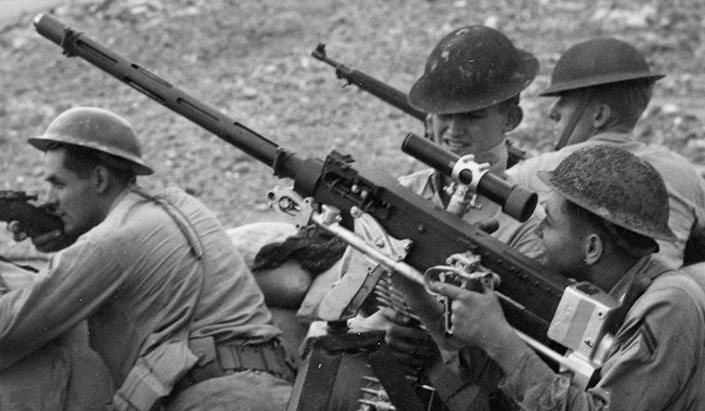
U.S. Marines and U.S. Navy sailors occupy an improvised fighting position that was thrown together on Ford Island in the aftermath of the Dec. 7, 1941, Japanese attack. In addition to four M1903 rifles, the position is armed with an ANM2 .50-cal. aircraft machine gun mounted on an instructional/training tripod. Based on earlier Browning machine gun designs, the ANM2 could be fed from either the left or right side and had a higher rate of fire than the infantry versions of the Browning.


On Ford Island, sailors and Marines retrieved .30-cal. and .50-cal. ANM2 machine guns from ordnance storage lockers for the three patrol squadrons stationed there, and they mounted them in expedient positions made of sandbags, wood and sometimes even tent canvas. Because both calibers of ANM2 were set up on flexible pintle yokes for use in hard mounts on aircraft like the PBY Catalina, the men also had to haul out special training tripods that allowed the guns to be set up at chest height. Photographic evidence showing these positions on Ford Island reveals that the ANM2 .30-cal. machine guns were equipped with spade grips and the Navy’s flash hider specifically designed for night firing. The ANM2 .50-cal. machine guns that appear in photographs from December 7th are all mounted using an adaptor system that was equipped with a rubberized buttpad fixed to the back end of the cradle assembly, a pistol grip/trigger mechanism on the side of the cradle and a tower for mounting a telescopic site. To supply these ANM2 fighting positions with ammunition, an ad hoc ammunition-loading station was established on the island where sailors went to work belting .30-cal. and .50-cal. cartridges.

Fourteen miles to the northeast, at Naval Air Station Kaneohe Bay, sailors were doing the same thing: setting up temporary fighting positions for ANM2 machine guns. In one area of the air station a ditch had been dug for the installation of a sewage line, and five sailors set up a .30-cal. Stinger and a .50-cal. Stinger in it. They did not have the training tripods, so they used some of the framing structures in the ditch as field-expedient platforms and tied sections of rope to secure the guns.
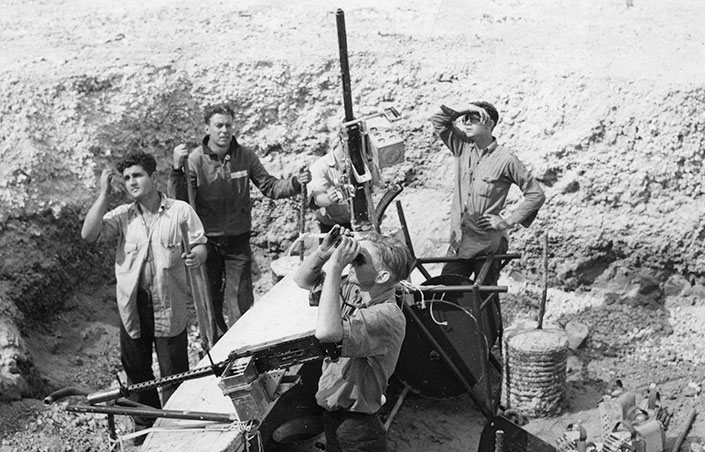
In one section of Naval Air Station Kaneohe Bay, a temporary fighting position was set up in a ditch that had been dug for the installation of a sewage line. Lacking training tripods for the .30-cal. and .50a-cal. Stinger machine guns, these five sailors improvised a way to secure the guns by tying sections of rope to framing structures that had been built in the ditch.

Nearby on the parking ramp for Patrol Squadron (VP) 11, C.P.O. John William Finn directed his sailors in setting up several ANM2 machine guns and their instructional/training tripods. As the squadron’s highest ranking aviation ordnanceman, he was not only familiar with the operation of the guns, he also had full access to them and the ammunition they needed. During the following two hours, Finn personally operated a .50-cal. Stinger, delivering effective machine gun fire against Japanese aircraft attacking Kaneohe. Because he was firing from an exposed position, the 32-year-old chief drew return fire and suffered painful wounds, but he kept on fighting. Then, after the raid was over and after he had received cursory medical attention, he supervised the rearming of returning PBY flying boats. Nine months later, Finn was awarded the Medal of Honor for his actions above and beyond the call of duty on Dec. 7, 1941.
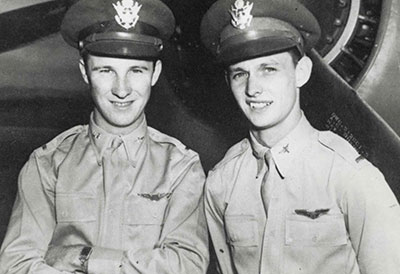
Second Lieutenant Kenneth M. Taylor (l.) and 2nd Lt. George S. Welch of the 47th Pursuit Squadron both scored victories in aerial combat over Oahu while flying P-40B Warhawk fighters on Dec. 7, 1941, and they both received the Distinguished Service Cross in recognition for what they did that day.

The Army also put the ANM2 Stinger to good use that day—namely, the U.S. Army Air Corps. When the attack began, aircraft of the 47th Pursuit Squadron were temporarily based on the north shore of Oahu, at the auxiliary airfield near Haleiwa, to conduct remote field gunnery training. As bombs began to fall on Wheeler Army Airfield, a group of pilots from the squadron rushed the 10 miles to Haleiwa and took to the air to oppose the enemy, but they faced a unique challenge: only .30-cal. ammunition was available there. Second Lieutenant George S. Welch and 2nd Lt. Kenneth M. Taylor both took off in B model P-40 Warhawk fighters, which were each armed with two ANM2 .50-cal. machine guns in the cowling and two ANM2 .30-cal. machine guns in the wings. When they first joined the unfolding air battle above Oahu that morning, only their wing guns were loaded. Second Lieutenant Harry W. Brown also took to the sky, but in an A model P-36 Hawk, which was armed with two ANM2 machine guns mounted in the cowling—one .50-cal. and the other .30-cal. For Brown, only the .30-cal. ANM2 was loaded. Nevertheless, he scored two aerial victories with it that day.
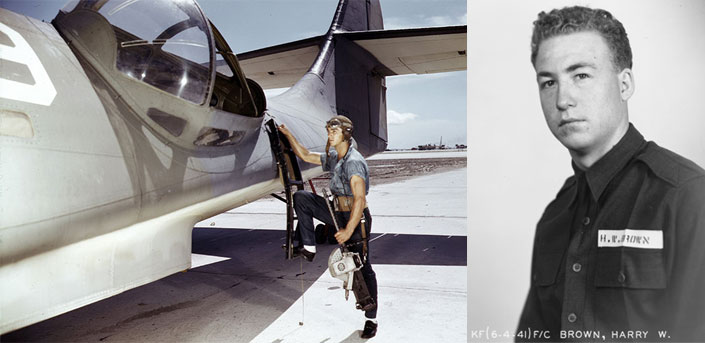
(l.) Aviation Ordnanceman (AOM) Jesse Rhodes Waller boards a PBY Catalina at Corpus Christi Naval Air Station in August 1942. Waller is holding an ANM2 .30-cal. machine gun in a Mk. 9 Gun Mount Adaptor. This hard mounting system consisted of a pintle yoke, ammunition box holder, brass catcher and link catcher. (r.) Second Lieutenant Harry W. Brown of the 47th Pursuit Squadron would use an ANM2 .30-cal. machine gun in his P-36 Hawk fighter to score two aerial victories against Japanese aircraft on Dec. 7, 1941.

Once in the air, Taylor and Welch climbed to 8,000 ft. in their P-40s and flew south to Barber’s Point. There, they observed a formation of 12 Aichi D3A1 “Val” dive-bombers and, despite six-to-one odds, they both attacked. Although each man shot down one enemy dive-bomber, they quickly ran out of .30-cal. ammunition. Both pilots then flew 13 miles to the north, landed at Wheeler Army Airfield and taxied to an ammunition replenishing point. There, ground crewmen reloaded their wing-mounted ANM2 .30-cal. machine guns, and gave both P-40s a full load of .50 caliber. They did not take on fuel—just the .30-cal. and .50-cal. ammunition that let them get back into the fight. The two pilots then roared into the air again and began dogfighting over Wahiawa. By the end of the air battle, Welch had shot down four enemy aircraft, and Taylor had scored two confirmed kills with two probables. In recognition for their extraordinary heroism in action, and their coolness under fire against overwhelming odds, George Welch and Kenneth Taylor both received the Distinguished Service Cross. Harry Brown was awarded the Silver Star for the “expertness in battle” he demonstrated from the cockpit of his P-36.

These three young airmen proved that American fighting spirit was strong on the “Day of Infamy,” and that the ANM2 aircraft machine gun was a fearsome and dangerous arm. During the following 44 months, the Empire of Japan would encounter it, as well as the other guns of Pearl Harbor, over and over again during a campaign that would ultimately carry U.S. forces all the way to Tokyo Bay.
Categories
War

December 7th (1943)