Categories
War

How Russia’s 35-mile armoured convoy ended in failure

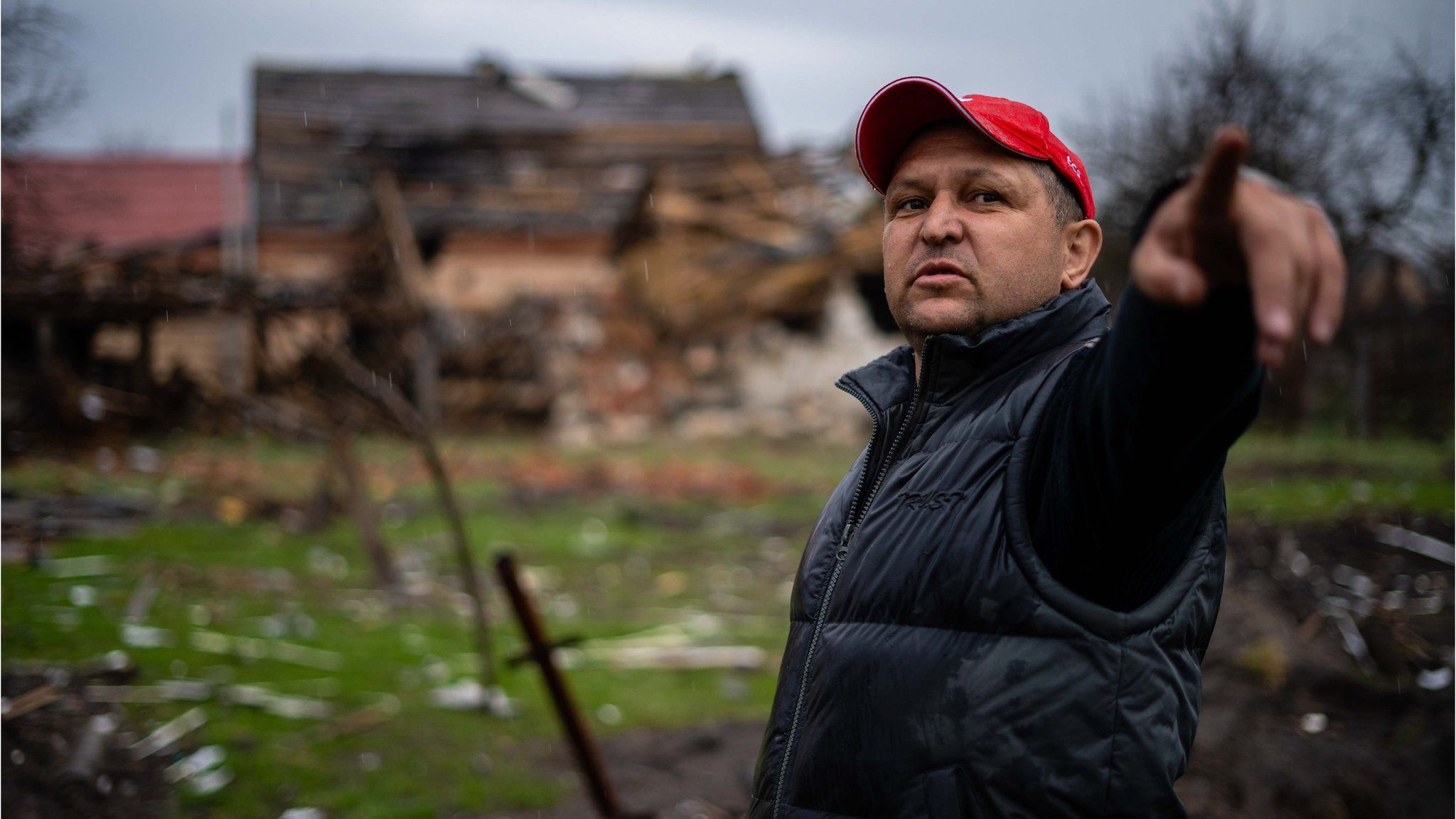
A civilian north of Kyiv points to where Russian forces destroyed his homeIMAGE SOURCE,BBC / CLAIRE JUDE PRESS

Three days into Russia’s invasion of Ukraine, a huge 10-mile (15.5km) line of armoured vehicles was spotted by a satellite in the north of the country. The very same morning in Bucha, just outside Kyiv, 67-year-old Volodymyr Scherbynyn was standing outside his local supermarket when more than a hundred Russian military vehicles rolled into town. Both Volodymyr and the satellite were witnesses to a key part of President Vladimir Putin’s plan for a quick and overwhelming victory. They were also witnesses to its failure.

The western media called it a convoy. In reality, it was a traffic jam and a major tactical blunder. Forty-eight hours after that first satellite photograph, on 28 February 2022, the line of vehicles had grown to a colossal 35 miles (56 km) long. The vehicles were stalled for weeks. Then finally they retreated, and seemingly disappeared overnight.

What happened? Why did such a massive force fail to reach Kyiv?

A BBC team spoke to dozens of witnesses; including military personnel, national and international intelligence services, civilians, veterans, and the territorial defence, all of whom came into contact with the convoy. It also gained access to Russian maps and documents that shed light on what the plan actually was, and why it went so spectacularly wrong.

Media caption,

Satellite images of the convoy captured last year © 2022 Maxar Technologies

The first hours

The story starts on the first day of the war, in the north of Ukraine at its border with Belarus.

Stepping outside for his first cigarette of the day, 23-year-old Vladyslav from Ukraine’s 80th Air Assault Brigade saw a flurry of bright lights in the night sky.

“I remember watching the lights emerge from the whole forest. At first I thought they were car headlights. But then I realised they were Grads [self-propelled multiple missile launchers]. They were firing at us.”

Camped deep within the forest of the Chernobyl exclusion zone, Vladyslav’s unit was on patrol when the first Russian vehicles crossed into Ukraine.

“The whole earth was shaking. Have you ever been in a tank? There’s no other sound like it. It’s a powerful thing.”

As planned in the event of any attack, Vladyslav and the rest of the 80th brigade blew up the bridge connecting Chernobyl to the next big town, Ivankiv.

The Russians would be forced to waste time building a replacement pontoon bridge, giving Vladyslav and his unit time to pull back to Kyiv.

“At first I was surprised, why didn’t we stop them there in Chernobyl? But we needed to learn about our enemy. So that’s what we did.”

This close to the Belarus border, the Ukrainians could not afford to open fire and risk starting another conflict. Their priority was to first understand Russia’s battle plan, before sending their troops into the line of fire.

Putin’s master plan

What Vladyslav saw were the first vehicles of what would become the convoy.

Contrary to many media reports at the time, the 35 mile-long (56 km) column was in fact 10 separate Russian tactical battalion units, according to the Ukrainian Armed Forces.

The Russian army also attacked Ukraine in the east and south, but the mission for these 10 units was specific – enter Ukraine from Belarus, overthrow Ukraine’s capital city and remove the government. In military terms: a decapitation attack.

One Russian document, seen by the BBC, shows a timetable for the plan. After the first battalion crossed into Ukraine at 04:00 am on 24 February, their orders were to advance straight to Kyiv arriving by 14:55.

Several of the battalions were to advance to Hostomel, just north of Kyiv, to back up the troops who’d been airlifted in to secure the airport.

The rest were to head straight into the centre of Kyiv.

Luibov Demydiv (R), a pensioner from Demydiv, points on the map to where she saw the convoy circling after a bridge was destroyed, stopping their advanceIMAGE SOURCE,BBC / CLAIRE JUDE PRESS
Image caption,

Luibov Demydiv (R), a pensioner from Demydiv, points on the map to where she saw the convoy circling after a bridge was destroyed, stopping their advance

The assault heavily relied on two elements – secrecy and speed.

According to the Royal United Services Institute (RUSI) (a UK-based security think tank) by keeping plans about an attack on the capital under wraps, Russian soldiers could outnumber the Ukrainian forces by 12 to one in the north of Kyiv.

However, Putin’s secrecy came at a cost. So successful was his deception, even most of his commanders did not receive their orders until 24 hours before the invasion.

On a tactical level, this left them vulnerable. They lacked food, fuel and maps. They were without proper communication tools. They had insufficient ammunition. They were even ill-prepared for the winter weather.

Kitted out with the wrong tyres and surrounded by snow, the Russians drove straight into a mud bath. Civilians close to Ivankiv describe Russian soldiers telling Ukrainian farmers to help pull their tanks out of the sludge.

Unable to progress, the Russian vehicles needed to divert to paved roads in order to avoid soft ground, forcing thousands to group into a single column.

But with limited communication between the battalions, they almost immediately converged into one almighty traffic jam.

As one military expert on the ground put it: “You don’t ever travel into hostile territory in a long convoy. Ever.”

Based on witness testimony and intelligence from the Ukrainian military, we were able to map the ground the convoy covered in the time between the outbreak of war and the end of March. By avoiding travelling across fields, vehicles ended up on most of the main roads north of Kyiv.

A map showing all the roads where the convoy travelled during February to March 2022

By the time the column had grown as long as 35 miles (56 km) it included up to 1,000 tanks, 2,400 mechanised infantry vehicles and 10,000 personnel, as well as dozens of supply trucks carrying food, fuel, oil and ammunition.

Stalled north of Kyiv and running out of food and fuel, the Russians had also underestimated their adversary.

A united resistance

For three days Volodymyr Scherbynyn and his fellow volunteers, the majority of them pensioners, had been preparing for the arrival of the convoy in their hometown of Bucha.

Armed with one machine gun between the 12 of them, they took down all the road signs, built checkpoints, and prepared hundreds of petrol bombs.

Until finally, on Sunday morning the Russian tanks rolled into town.

Maksym (L) Volodymyr (C) and 'the colonel' (R) stand in front of their bombed out office for local volunteersIMAGE SOURCE,BBC / CLAIRE JUDE PRESS
Image caption,

Maksym (L) Volodymyr (C) and ‘”the colonel” (R) stand in front of their bombed out office for local volunteers

For nearly 30 minutes, Volodymyr and his grassroots unit battered the tanks with what little they had.

“We set two of the vehicles on fire and slowed down the whole convoy,” says Volodymyr.

But then came the retaliation.

“When they saw us throwing bottles they opened fire,” says 30-year-old Maksym Shkoropar. “I was a barman. I didn’t have any military training.”

By the end of that half hour, every one of Volodymyr’s party had been shot and evacuated to hospital.

But even from the sick bay, Volodymyr kept on fighting – receiving and cross-checking sightings of the convoy from civilians all over the Kyiv region and calling them in to the Ukrainian authorities.

On the other end of the line was 23-year-old local deputy governor for Irpin, Roman Pohorily.

Lawyer and councillor by day, Roman searches for Russian posts on social media by night.IMAGE SOURCE,BBC / CLAIRE JUDE PRESS
Image caption,

Lawyer and councillor by day, Roman searches for Russian posts on social media by night.

He tells the BBC he didn’t sleep for three days.

“My colleague and I were manning the hotline at the council office, taking calls about the column, as well as saboteurs – people who were painting marks on the ground for the convoy to follow.”

A councillor by day, Roman is also an open source intelligence expert by night. Co-founder of the highly regarded website DeepState, he pools together social media and intelligence reports. He geolocates them, then reposts them on his website.

“On their way to Kyiv, the Russians were posting videos on social media. We reposted the videos to expose their movements. They were just showing off, but in doing so, they got busted.”

Most important during the assault on Kyiv, says Roman, was the sense of a united Ukraine.

Ukrainian volunteers distributing foodIMAGE SOURCE,BBC / CLAIRE JUDE PRESS
Image caption,

Ukrainian volunteers distributing food

“Everyone was doing something. I admit it was very hectic in those first few days. But there were veterans helping civilians. Everyone wanted to defend their city.”

In towns and villages all across the region, hundreds of attacks took place against the convoy, from civilians armed with homemade weapons to mechanised infantry and artillery.

Outdated tactics

In stark contrast to the Ukrainians, the Russian forces repeatedly exposed their inability to make dynamic decisions on the ground.

“The Russians were all carrying large metal boxes marked ‘secret’,” says Vladyslav from the 80th Brigade. “We seized one during an ambush. We found their maps marked with their entire route. After that we knew their whole strategy.”

Their navigation tools were also woefully out of date. In the year since the invasion, the BBC has continued to find maps left behind by Russian troops that date back to the 1960s and 70s. Whole towns exist now that were not on the maps that they were using to navigate. We also found semaphore flags, a vastly outdated way to communicate between units.

One successful tactic by the Ukrainian resistance was to blow up bridges and dams ahead of the convoy, thus forcing the Russians to reroute. Reliant on old maps and with limited communications back to their high command, the Russian units frequently became paralysed by indecision.

Several satellite images show the Russian vehicles literally driving round and around in circles.

Maxar satellite image of the convoyIMAGE SOURCE,MAXAR TECHNOLOGIES 2022

Occupation

Under pressure from Ukrainian air strikes and artillery, the Russian convoy was finally brought to a standstill just outside of Kyiv’s city boundary. For thousands of civilians living close to the stalled troops, the experience was horrendous.

“They robbed everything from everywhere. They emptied the shops,” says Vladyslav. “They also used civilians as human shields.”

What happened in many villages and towns to the north and west of Kyiv is still being investigated by numerous authorities, including the International Criminal Court.

After four long weeks the Russians finally started to withdraw.

Two of the largest remaining battalions were defeated close to Hostomel airport. Another 370 tented army trucks, seemingly abandoned in Zdvizhivka village, were destroyed by artillery.

The Ukrainian military kept on pushing them back until 19 March, after which the Russians began to retreat from Kyiv Oblast.
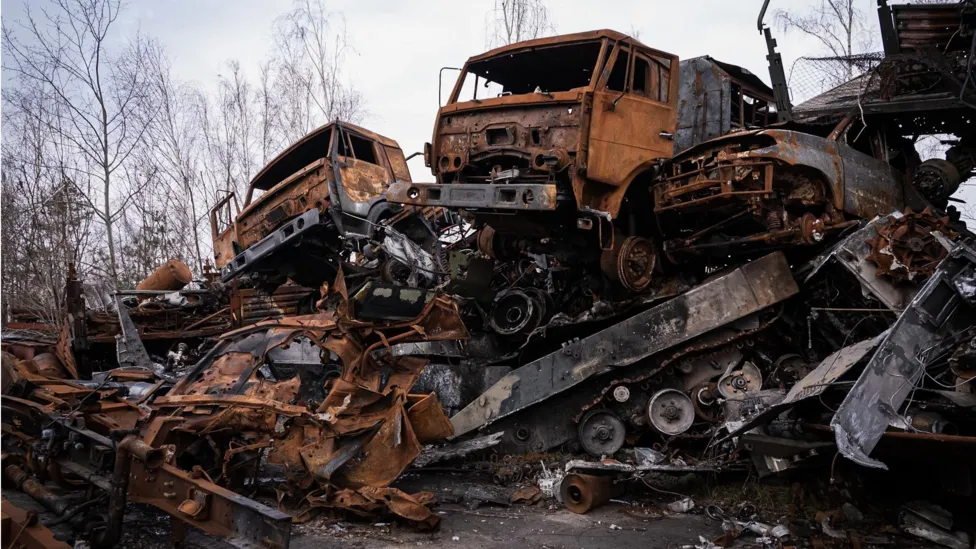
A graveyard of Russian vehicles from the convoy piled high in HostomelIMAGE SOURCE,BBC / CLAIRE JUDE PRESS
Image caption,

A graveyard of Russian vehicles from the convoy piled high in Hostomel

Russia is continuing to push into the eastern industrial heartland of Donbas, and strike in the south, in the direction of the Kherson and Zaporizhzhia regions.

Despite the speculation of a renewed attack on Kyiv, the majority of experts agree it would be unlikely as we have not seen a large-scale deployment of Russian troops to the Belarus border.

But still watching via reconnaissance drones close to the border, are the Ukrainian recruits.

“I’ll always remember that night in Chernobyl,” says Vladyslav. “When I went out to smoke with my friend. But by the time I’d finished my cigarette the war had started.

“My friend and I have this dream, that we will go on shift, just like we did that day, and as we smoke another cigarette we will hear that the war has ended. And that we won.”

Special thanks to Slava Shramovych, Marcus Buckley, Michael Whelan, Alastair Thompson, Ben Allen and Tim Coey.
Categories
All About Guns The Green Machine War

United States Empire – The Spanish American War (4K History Documentary)

Categories
All About Guns War

INCOMING!!! The single most incredible artillery video you’ll ever see.

Yeah and PEOPLE die too!

Categories
Gear & Stuff War

US Equipment in the East in WW2

Categories
All About Guns Soldiering The Green Machine War

Todays US Army Rifle Squad

Categories
Allies War

UK Equipment in the East in WW2

Categories
Interesting stuff Some Red Hot Gospel there! Some Scary thoughts War

Peace At Any Price by Laughing Wolf

Earlier this week, the always excellent and interesting Baldilocks shared a thread on Twitter dealing with the perceptions and thoughts of a certain class of Russians in regards the war. The thread is well worth reading, as are some of the comments to her tweet and my retweet.

What was reported matches what I am seeing and hearing from that class, and from others. For all that one must support the war in public, or face draconian consequences, even in private it has a lot of support. As in a WAG on my part of better than fifty percent. Yes, there are segments that don’t support and are not thrilled with things, and they tend to fall more on ethnic lines from what I’m seeing. Overall, the war has a surprising strong, wide, and deep level of support within Russia. Not universal, but pretty darn significant.

Support for Vladimir remains quite high. This varies as one goes through demographics and ethnicities, but overall strong. Two areas where this may not be true are in what I call the political oligarchia: the politicians, power brokers, oligarchs, and wanna-be oligarchs who make up the upper levels of power. The old nomenklatura concept is dead and gone. In public, this upper level is very pro-Vladimir. In private, well, it’s still not clear to me if some of what is going on behind the scenes is simply preparation for his retirement or death, or if there is something more active going on. To be fair, there are days I’m not sure those playing the great game in Russia truly know themselves. The other area is the bottom of the demographics pile, which tends to be ‘yeah, support, whatever; none of them give a damn about us.’ That may be as close to a universal concept across cultures as anything.

An important point within this is the response of that educated class to the pushback by Ukraine, NATO, and others. Note the surprise, shock even, that Europe and others not only opposed the invasion, but that they are helping Ukraine (most of whom are sadly misled and should be welcoming the return of Russia) resist. That they would potentially gut their economies to do so. This is seen as bigotry and ignorance by that class of Russians. And by others within Russia, to be honest.

That plays almost perfectly into the great Russian paranoia that everyone is out to get them. That has been a hallmark of Rus/Slav psychology going back into ancient times. They have always been treacherously set upon by others, even as they were peacefully raping, murdering, and pillaging those that set upon them. Now, Russia does have a few legitimate times when they weren’t doing something like that at the time they were attacked, but I am overall reminded of a certain criminal class here in the U.S. that was never ‘doing nothing’ when “attacked” by those they were robbing, etc.

It also brings to the fore a concept that seems to continue to elude far too many: outside reactions and considerations were not and are not a factor of consideration. The war was not started with Western or other reaction in mind, other than that it was felt that the Biden Regency and others would just go along with it and not do anything of significance against it. Token reparations maybe, but that was it. Given that the Regency and the Meat Puppet seemed to be egging it on at one point, I can see how they thought that. But, that was only a fleeting thought to them and not even a serious point of consideration.

The dynamics that drove the decision to invade are almost entirely internal. They are based in culture, politics, and other areas that create the internal dynamics that are not understood and not even being considered by far too many outside of Russia. There is no path to peace without taking those dynamics, and the overwhelming support for the war and for creating a new Russkiy Mir, into consideration.

Therein lies the problem. Outside opinions and even responses do not matter to the large majority of the population of the Russian Federation. At best, such are seen as bigotry and an attack. At worst, they were not even a consideration. That holds true for the leadership as well. For all intents and purposes, the people of the Russian Federation live in a bubble, and the upper leadership lives in an even more dense and impenetrable bubble.

Stephen Green, who does some truly great coverage I do recommend reading, has two (sadly VIP) posts up, here and here, on “Putin’s Stupid and Unnecessary War.” By our standards, completely true and valid statements. The war is stupid, unnecessary, and even foolish. From a Russian societal perspective, however, it is extremely necessary and even overdue. Stephen asks a good question that I can see before it hits the paywall, about the military leadership should have known the military was not ready and should have prevented the war as a result.

Again, by our standards and culture, an obvious point. By the standards of Russian culture, however, invalid. Keep in mind the two bubbles already mentioned, as there are more. Vladimir sacked a lot of real generals a while back so that various apparatchiks, oligarchs, and wanna-be oligarchs could get in on the fun of what we would see as outright corruption. Russians today just see it as how business is done. Those that were smart cut officers in on the take, and smart officers made sure the men didn’t starve. As it was, the troops often looted items to sell on the black so they got pay, food, etc. Gundecking reports has a long and honorable tradition in Russia going back almost to the very earliest days. Yet more bubbles, and people who needed to know things didn’t. Given the lack of esteem given to the military these days, the general public and leadership really didn’t care if they starved or not, or what was happening to them. Or what would happen if they had to go to war.

It was only when war came, and some people got a cold douche of reality, that anything began to change. Part of that change was that a number of people in demographics and ethnicity that meant they would be called up to fight decided to beat feet. Quite a few citizens of the Russian Federation, and not just the government, consider them traitors to be dealt with later and who should never ever think of returning to the Rodina. Understand, your average citizen of the Russian Federation has no problem with people dying for the war and the cause of Russkiy Mir — so long as it’s not them. Marginalized groups or ethnicities? Who cares, it will improve the gene pool.

Nuclear war? Go for it. Our mighty Russian military will protect us while devastating our enemies. We have far more bombs and missiles than they do. We have far greater, more powerful, and more accurate defenses against missiles and other attacks.

That their nuclear and nuclear defense forces might be in a shape similar to their other weapons and stockpiles has penetrated few if any bubbles as far as I can tell. How many will work (on either side)? Who knows, and I’d really rather not find out. That said, I’m in the camp of 20 percent, i.e. an 80 percent failure rate. In light of this, I also highly recommend reading this from Sgt. Mom. Our own military is in many ways in no better shape. We are not capable of fighting a one front war for more than a few days (if that), much less a two-front war as we are supposed to be able to do.

Which leads us, finally, to the growing “peace at any price crowd.” I’m seeing it a lot on social media these days, and from some surprising quarters. As I noted in posts before, putting in place a cease fire or a forced peace as things stand will only guarantee a far worse war with far worse consequences later. Even one that gives Ukraine the Donbas and Russia the Crimea will result in the same. See this post and this post for some of the previous discussion on outcomes.

Right now, I do not see any easy, good outcomes. Far too much of what is being discussed and pushed is not in touch with the reality of Russian culture and internal dynamics, much less that of Ukraine. Anything that does not take such into consideration will fail. Spectacularly. Creating something viable, or at least make each step suck the least, requires strong, informed, and capable leadership. Looking at the Biden Regency, Castreaux, Macaroon, Charles/Sunak, Shultz, Vladimir, etc., yeah, right.

Prepare, pray, and hope for the best. It’s about all we truly can do right now.

Getting hit by lightning is not fun! If you w

Categories
This great Nation & Its People War Well I thought it was neat!

ROCK AND NANS WRITTEN BY WILL DABBS, MD

Grandparents weren’t born old and wise. In their prime,
they were likely markedly cooler than we are.


“Hi, this seat taken?” the man asked.

He was unnaturally handsome. His piercing blue eyes nearly took her breath away.

“Saving it for you,” the young lady responded coyly.

She absentmindedly straightened her airline-issue blue polyester skirt. The woman was objectively gorgeous in her own right.

“I’ll have what the lady’s having,” the man gestured to the bartender. “And get her another while you’re at it, brother. Thanks.”

In moments the barkeep returned with two glasses of ice water.

“The name’s Ricky,” the big man said, extending his hand. “You a pilot?”

She smiled. “I’m Nancy Frierson and don’t be silly. I’ve been a stewardess with Pan Am since ’47.” She studied him with an experienced eye. He was fit and hard, and he had the look.

“Europe or the Pacific?” she asked.

The man diverted his gaze to his glass, though the electric smile never left his face. “Europe,” he said.

“Yeah, me, too,” Nancy responded. “I was a nurse in France for 7 months. Afterward, I lost my enthusiasm for nursing, but I enjoyed the travel, so here we are. What did you do?”

“OSS. Know anything about that?” he asked flatly.

“Not really,” she answered. He obviously didn’t much want to talk about it. “How about now? What brings you to the airport in DC?”

“I still work for the government, though I’m based out of Chicago nowadays. I have a meeting this evening then I’m likely heading back tomorrow. You?” he asked.

“I’m deadheading to London in the morning. Pan Am puts us crew up in the Omni Shoreham when we’re stuck here overnight. I’m based out of Atlanta. We cycle through Paris, Stockholm, and Oslo before rotating back to London and heading home to the States. Repeat as necessary every other week. It’s a good job. I get to meet some interesting people.”

There was that smile again. She loved the way it made her feel.

Ricky and Nancy chatted for another half an hour, burning through the standard fodder about family, hobbies, and favorite places to eat on the continent. It was clear that he was as well-traveled as she was. Ricky suddenly glanced at his watch and frowned.

“I am truly sorry,” he said with sincere regret. “But I’m going to miss my meeting if I’m not careful. It has been a genuine pleasure meeting you, Nancy Frierson from Atlanta.” He dismounted the bar stool and hefted his canvas bag. The man took the woman’s hand and then leaned forward to kiss her softly on the forehead. She squeezed his hand back. As he walked away, she wondered what sort of man had a meeting at 7:30 on a Sunday night in Washington, D.C.

The unexpected knock startled her. Nancy set her mystery book aside and made her way to the door to her hotel room, checking that the chain was fastened and that her sweatshirt was presentable. She cracked the door and was shocked to see Ricky standing alone in the hallway.

“May I come in?” he asked.

Her first inclination was to say he most certainly could not, but there was something about his face. Though she struggled to place it, she had seen that look somewhere before. Against her better judgment, she closed the door, unfastened the chain, and opened it again. Ricky pressed inside without fanfare. She subconsciously checked the hallway. No one else was around.

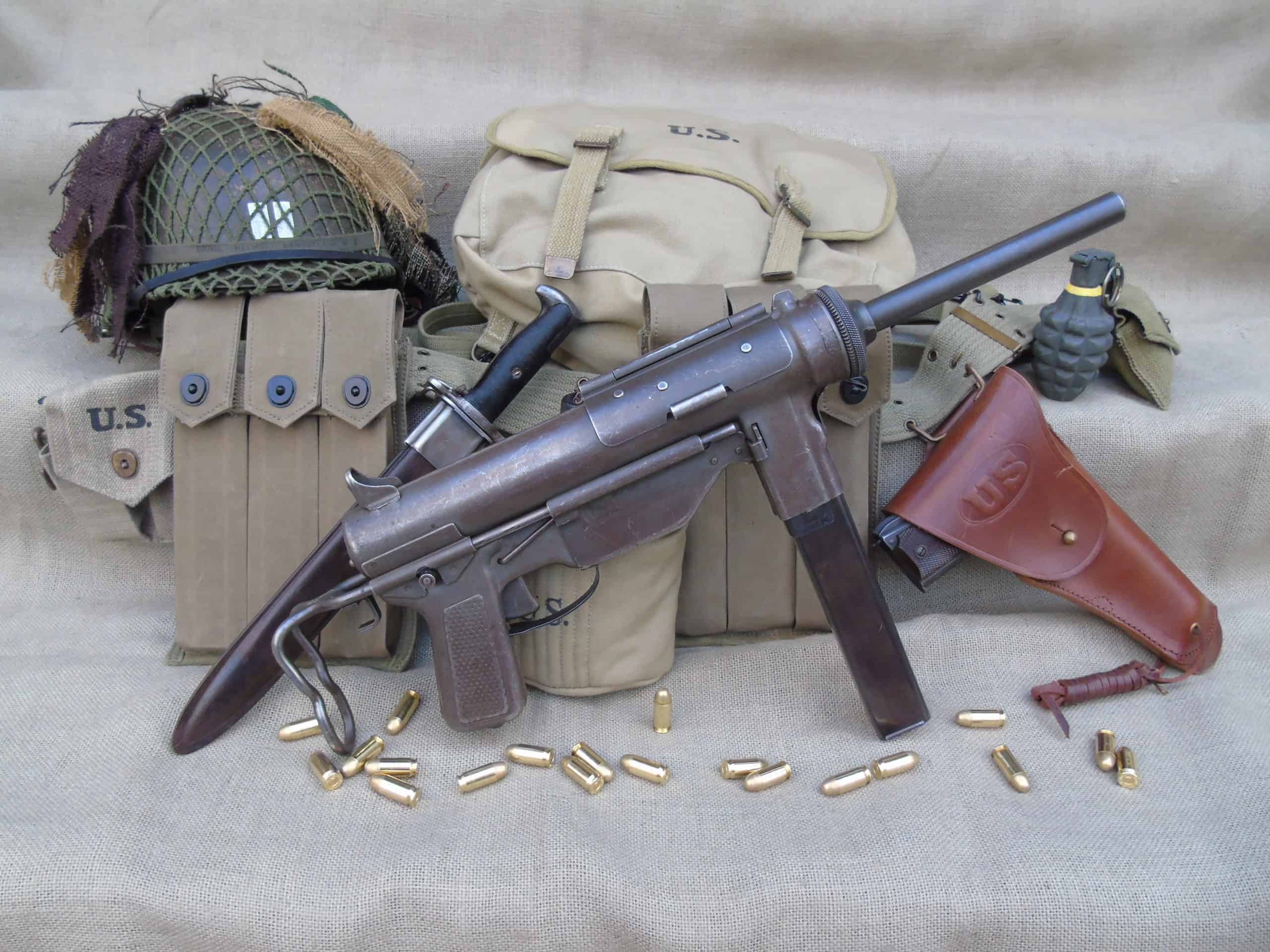
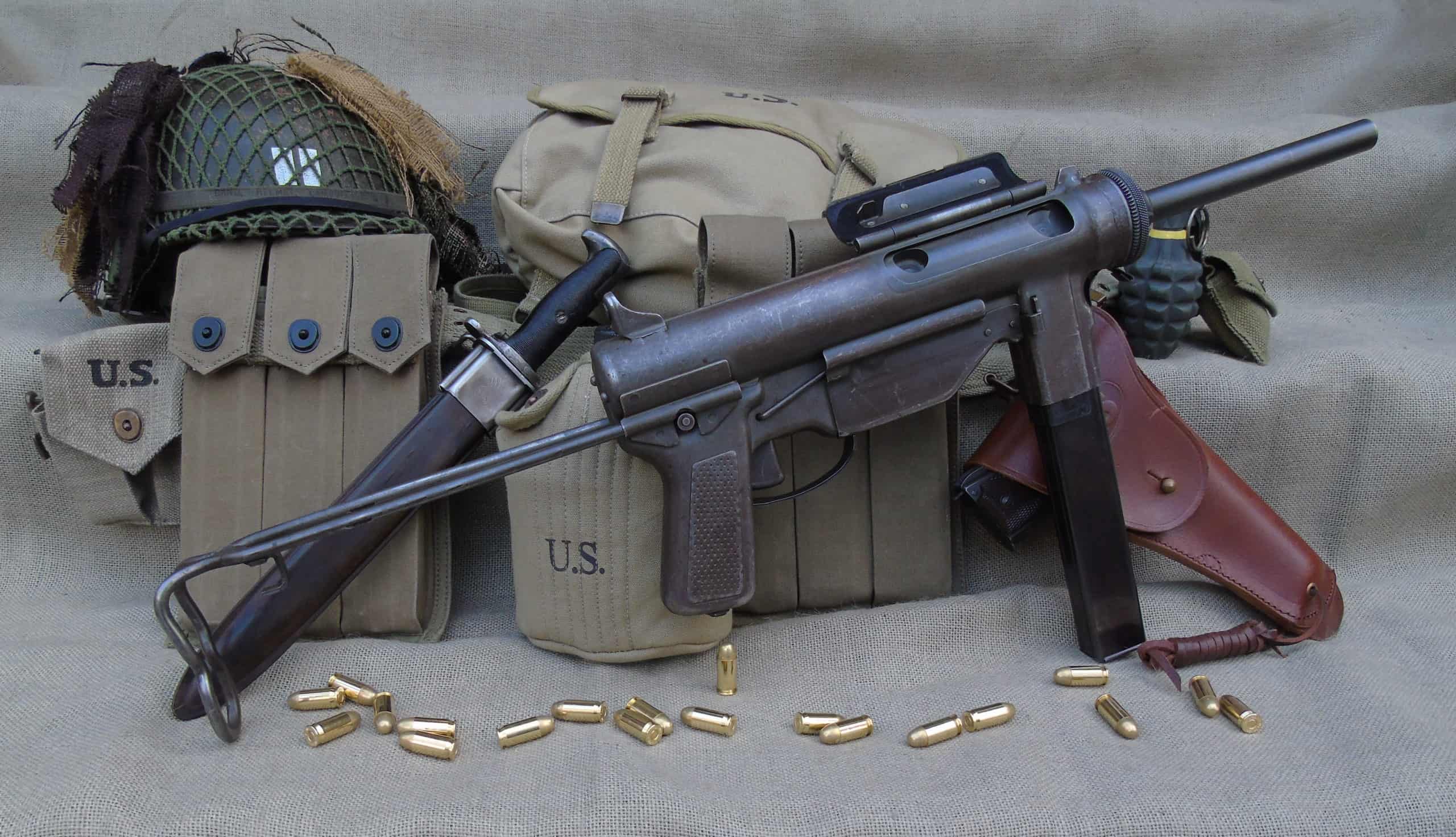
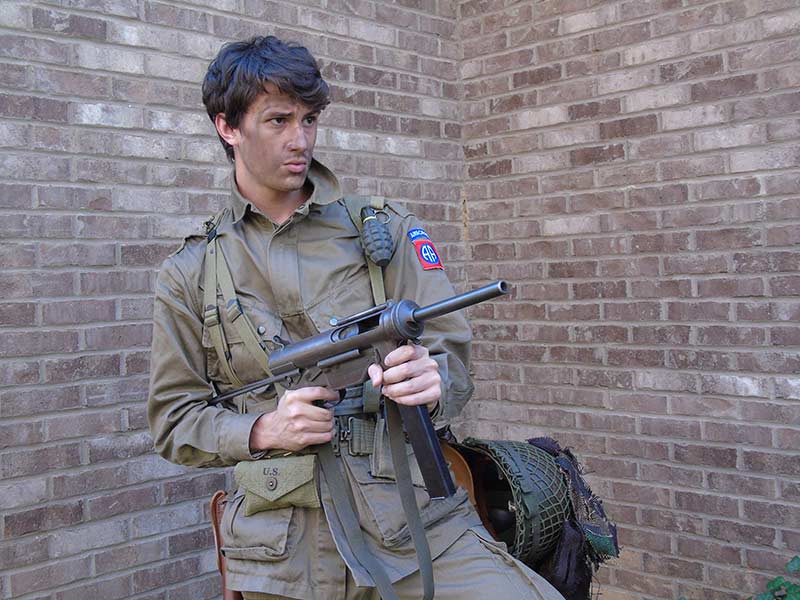
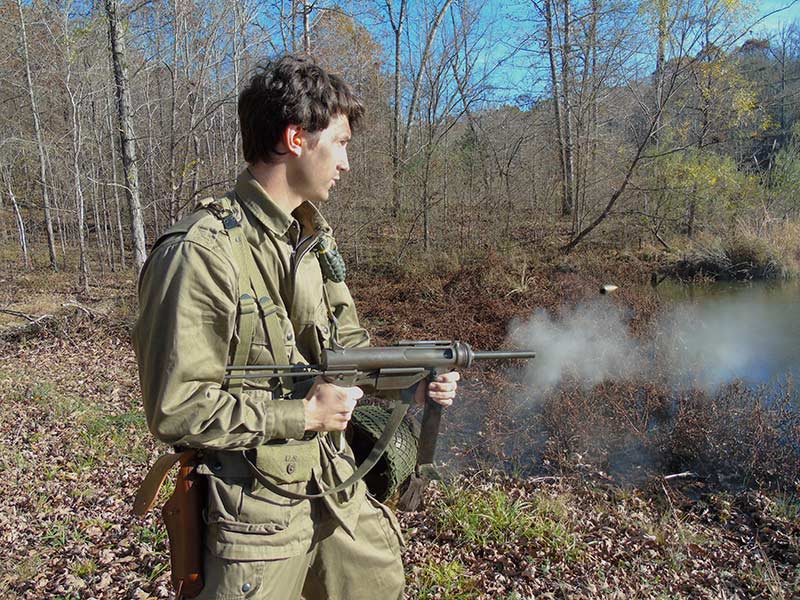
The M-3A1 Grease Gun was designed with the espionage mission in mind.


As she turned around, the man dropped his heavy bag onto the bed and removed his long coat. She then noticed the sticky black wetness on his left upper arm. There was a small corresponding tear to the man’s pea coat that she had not seen previously. The bag was open this time, and the pistol grip of an M-3 Grease Gun protruded through the slash. The man retrieved a GI-issue battle dressing from the bag before sitting heavily on the room’s small sofa.

“I am truly sorry to barge in on you like this,” the man said, fatigue now heavy in his voice. “I really do work for the government, but what I do is best kept removed from the local police.”

He dropped his flannel shirt to expose a deep ugly gouge across his left deltoid. Nancy had seen enough gunshot wounds in France to recognize this one. Without really thinking, she soaked a towel in warm water and used it to clean the wound before dressing it properly. Ricky was pleased to see that she really did know what she was doing.

Rock and Nans were the best grandparents a guy could ever hope to have. They were married for 57 years. As far as we knew, Rock’s entire adult life was spent working for the railroad. We grandchildren loved going to work with him and climbing on the trains.

Everybody wonders how their grandparents first met. Rock didn’t admit the truth to me until three weeks before he died. That last operational mission had been to interdict a meet between a turncoat American nuclear scientist and a Russian agent in rural Virginia. Grandpa Rock said he personally set the Russian H-bomb back 5 years. However, after that evening in Nan’s room, he knew it was time to settle down. An assassin’s life was no way to raise a family.

Categories
Our Great Kids War

The USS Johnston maybe the toughest ship in the USN?

Categories
All About Guns War

WW1 survivors. All three original from 1918.

No photo description available.