Category: War
When my Dad was up near the Punchbowl during Harry’s Police Action. When he saw the handiwork done by The New Jersey. He said that one time a Hill was hit by a 16 incher and then quote “The Whole f*cking hill was just lifted up and then dropped back down!”
The other amazing thing was that when the New Jersey was on the firing line. A buck private could be able to call a full broadside in with no questions asked if he had the code book & a radio that worked.
Like my Dad, I almost felt sorry for those Commies, NAH!!!!!!!!!!!!!!!! Grumpy
Rottenfuhrer Friedrich Pouls was a tool, a small but lethal cog in a gigantic killing machine. He rested in the edge of a massive shell crater covered by his zeltbahn. This triangular water-repellent piece of camouflaged material was the best piece of kit the Wehrmacht had ever devised. Though he was himself a member of the elite Waffen SS, much of his equipment came from the same sources. Rottenfuhrer Poul used his to become invisible.

Poul and his comrade Sturmmann Reist had worked together for nine months. On the Eastern Front nine months might as well have been an eternity. It was legitimately miraculous they had survived this long. Part of that was raw luck, but a great deal of it was also hard-won skill. To prevail in a place as dangerous as the Russian steppe in late 1944 demanded that a sniper team be both lucky and very, very good. Poul and Reist were indeed both.
The two men had made their way out to the crater in utter darkness. They had operated from this same crater once some 10 days before and remembered much of the route. They made a point never to shoot from the same spot on consecutive days. This was one of several reasons they were still alive.

Unlike the vast majority of their mates, neither man smoked. This gave them an advantage in that they didn’t need to feed their addiction while in a hide. They also were not so easy to smell, as was the case with their smoking counterparts. Once again, it was the aggregate little things that had kept the two men warm and breathing this long.
Poul gradually glassed the pockmarked moonscape through the four-power ZF4 telescopic sight mounted atop his spanking new K43 sniper rifle. Reist did the same thing with his superlative Zeiss binoculars. The two men’s boots rested against each other deep in the crater. They communicated via a series of nudges. When speech was necessary it was brief, soft and concise. Reist saw him first.

The Soviet KV-1 was an absolute beast of a tank. This particular example had fallen prey to an 88mm Flak 36 three days before. Wispy tendrils of smoke still curled from the open hatches atop the turret. Underneath the massive burned-out war machine nestled between the roadwheels, Poul saw the glint of glass.
The Soviet sniper wielded a scoped SVT-40 sniper rifle. Like his German counterpart, this man was the best trained and best-equipped sniper his military could produce. This fateful day, however, he was just unlucky.
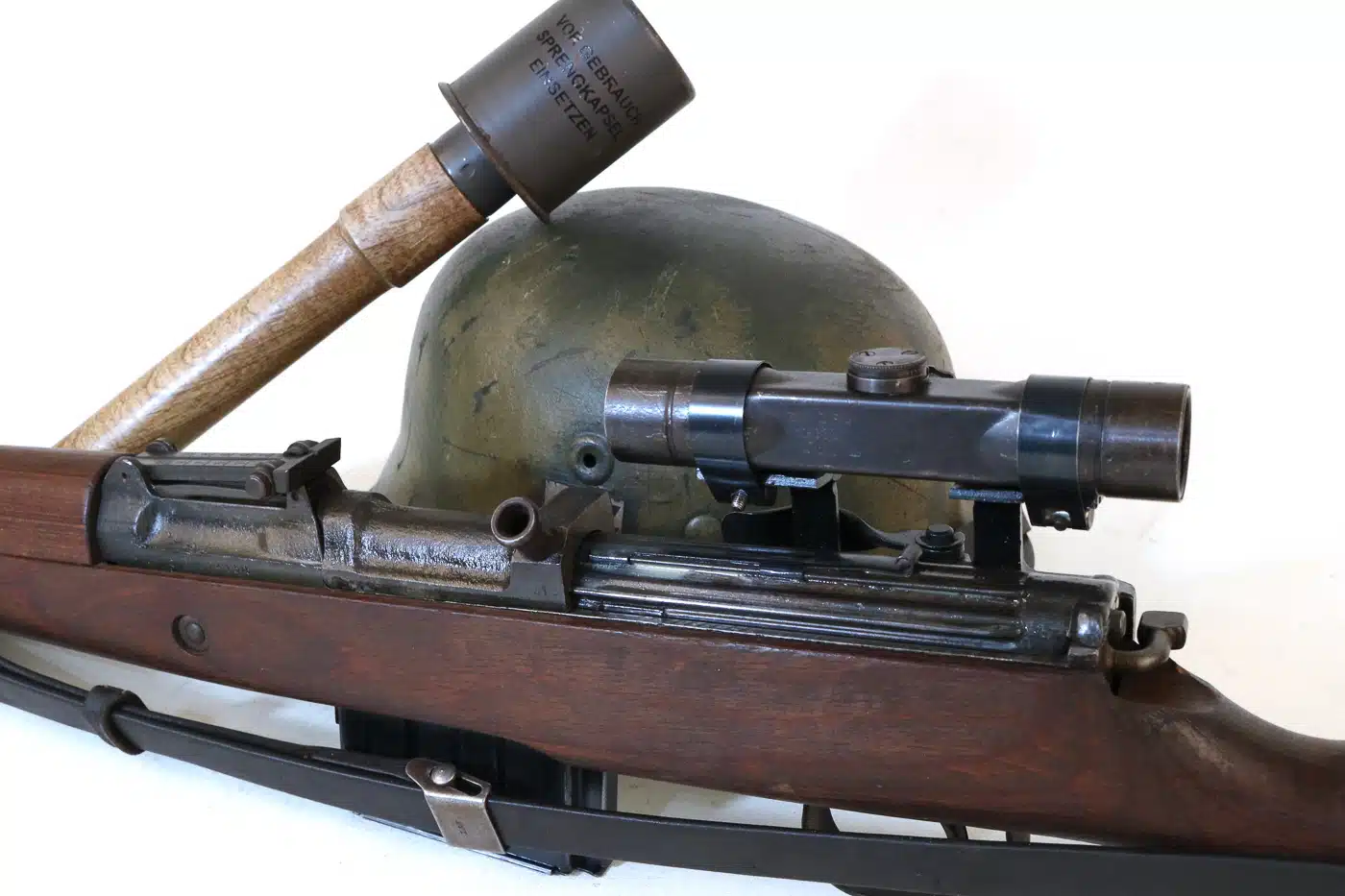
Poul could not see deeply into the shadows underneath the big tank, but he could just make out the muzzle of the rifle as it peeked out, sniffing for blood. He calmed his breathing, measured his heart rate, and nudged Reist with the toe of his jackboot. Poul centered the simple post of his ZF4 sight about five centimeters above the Russian rifle, held his breath, and gently squeezed the trigger.
The heavy marksman’s rifle rocked back in recoil and immediately returned to target. There was some mad thrashing underneath the tank, and Poul noticed a second shape jerk back from the dying Soviet sniper. That would be his spotter. Poul picked an opening some two roadwheels over and repeated the process. When he saw the shadow pass between the wheels he squeezed again and killed the second half of the Soviet sniper team.

Poul and Reist glassed the tank until they were sure there was no further movement and then stayed another two hours just to be sure. Reassured that the threat was eliminated, they slid like snakes back out of the crater and along the faint path back to the company area. The password got them back through their sentries. In short order, the two SS snipers were filling their bellies with black bread and ersatz coffee. They debriefed with the battalion intelligence officer and wandered off to grab some rack time. There would undoubtedly be more work to do tomorrow.
The Rifle
K43 is Kraut shorthand for Karabiner 43. The same weapon was also known as the Gewehr 43. A relatively simple gas-operated design, the K43 was the German answer to our M1 Garand. However, manufacturing pressures and a suboptimal design conspired to keep the K43 from reaching its full potential.

The K43 was an evolutionary development of the previous G41. Produced as the G41(M) from Mauser and the G41(W) from Walther, these two rifles suffered from an inexplicable design mandate that German engineers craft the weapons without drilling a gas port in the barrel. The end result was a gas trap design that was front-heavy, cumbersome, heavy and unreliable. About the time the Wehrmacht was convincing itself that the G41 was a dry hole, they encountered the Soviet SVT-38 and SVT-40 self-loaders in combat on the Eastern Front.
The subsequent G43/K43 featured a more conventional short-stroke piston-driven action with a flapper locking mechanism. Much of this rifle’s entrails seem eerily similar to those of the Soviet SVT-40. This system was easier to manufacture, more reliable and fairly robust. The weapon was semi-auto-only and fed from detachable 10-round box magazines that could also be charged from the top via standard stripper clips.
The K43 was designed to be relatively easy to build in bulk. The trunnion is a fairly rough casting, while many of the gun’s accouterments were stamped steel. The stock on my gun appears to be laminated birch.

The G43 was first issued in October 1944. The nomenclature change to K43 took place the following year. The two weapons were essentially otherwise identical. 402,713 copies were produced at three major manufacturing facilities by the end of the war.
Designated Marksman Rifle
The original intent was to issue 19 K43 rifles to each Wehrmacht infantry company along with ten ZF4 4X scopes. The company armorer was to exercise all 19 rifles and assign the optical sights to the 10 most accurate of the lot. The reality was that the chaotic supply situation at the end of the war precluded a full issue in most cases. Even if the weapons had been available, German infantry companies were getting chewed to pieces so quickly in the closing months of the war that they were seldom, if ever, at full strength.

Once an optic was matched to a rifle, the sight was serialized manually by the armorer. As a result, most of the vintage ZF4’s available on the surplus market will have a seemingly random number inscribed via electropencil. My rifle came with the scope mount but no optic. I found a period scope online to complete the package.
There was a prototype grenade launcher and sound suppressor designed for the K43, but neither saw production. After the war, the K43 was pressed into service in Czechoslovakia as well as East Germany. German snipers were instructed to destroy their rifles at the end of the war, so a great many were captured with splintered stocks.
German K43 Rifle Specifications
| Caliber | 7.92x57mm |
| Weight | 9.7 pounds |
| Length | 43.8 inches |
| Barrel Length | 21.5 inches |
| Action | Gas-operated, short-stroke piston |
| Feed | Ten-round detachable box, five-round strippers |
| Sights | Iron/detachable ZF4 4X optical |
Ruminations
The Nazis lost the war the moment they invaded Russia. While the Germans brought us some of the most revolutionary military advances in history, they were most typically too little, too late. The fanciest combat rifles in the world aren’t much good if your manufacturing centers are being pummeled by sky-filling bomber raids, and your enemy enjoys a limitless supply of trucks, tanks and fuel.

In the K43 sniper rifle, we see the beginnings of a stark paradigm shift. The robust nature of the design ensured it rendered reliable service, while the semi-automatic action made it a fearsome killer on the battlefield. The influence of this revolutionary weapon is still felt even today, in firearms such as today’s DMR (designation marksman rifle) and more.
Special thanks to WorldWarSupply.com for the cool period gear used by our reenactor.
Categories

It was 1861 when Michigan’s legislature dismissed the idea of George Copway — a popular Methodist minister and Chippewa — to recruit a regiment of Great Lakes Native Americans who he claimed were “inured to hardships, fleet as deer, shrewd, and cautious.” However, much had changed in the span of two years, including the imposition of a federally imposed draft, quotas to be filled by each state, and the already-spilt blood of thousands of Michiganders. As such, Michigan began to seek out Native American soldiers to support the Union war efforts.
Col. Charles V. DeLand, a veteran of the 9th Michigan Infantry, and a troop of eager recruiters were particularly interested in finding stealthy men with acute marksmanship to join a regiment of sharpshooters — particularly, in Company K of the 1st Michigan Sharpshooters. But these recruits needed an incentive, like the promise of payment, meals, and the possibility of negotiating the protection of their traditional homelands from outsider incursion.
In a time when Native Americans feared losing their homes, military service spurred a glimmer of hope. Saginaw Chippewa Chief Nockkechickfawme gave the young men of his tribe even more motivation when he sharply warned of a Confederate overtaking where “there will be no protection for us; we shall be driven from our homes, our lands, and the graves of our friends.” Ottawa Chief Pawbawme drew from his fellow chief’s influence, sparking the enlistment of approximately two dozen more men with his fiery oration.
Upon their departure by steamer, the Ottawa-Ojibwa men were seen off by a great majority of their community. Among these departing warriors was Antoine Scott, who would later be recommended twice for the Medal of Honor but would never be awarded the great recognition.
Another was Thomas Kechittigo — known to many as “Big Tom” — who had originally been refused enlistment in 1861 but would climb the ranks to become a sergeant in Company K. Recruits came from Oceana County, Bear River, Little Traverse, Charlevoix, La Croix and near Saginaw.
Of those who drove enlistments, a shining star was Second Lieut. Garrett A. Graveraet. A young man of only 23, the multi-talented Graveraet became an officer and led an impressive recruitment drive to strengthen the ranks of Company K. He even signed up his own father, the 55-year-old Henry Graveraet, who shaved off 10 years from his true age during enlistment and was the company’s only non-native soldier.
Following recruitment, the men of Company K were met with vigorous training. So, while veteran Colonel DeLand and part of the Michigan regiment sought out the Confederate raider John Hunt Morgan in Indiana, Graveraet — along with Capt. Edwin V. Andress and First Lieut. William Driggs — drilled the recruits of the new company into shape.
They were so effective that upon DeLand’s return, mustering officer Lieut. Col. John R. Smith noted that the recruits were “the stuff, no doubt, of which good sharpshooters can easily be made.” And these native troops were promised the same benefits as white soldiers, such as $13 pay a month — outweighing the $10 monthly pay that U.S. Colored Troops (USCTs) received until equal pay was mandated.
Despite that difference, those in Company K began their wartime service by defending military storehouses and guarding Confederate prisoners — a path reflective of many USCTs’ entry into military service.
Ordered to guard prisoners of war at Camp Douglas outside Chicago, the company experienced the bitter taste of camp life, as they faced not only boredom but also disease and desertion. Additionally, fellow soldiers and Chicago civilians were fascinated by the culture that accompanied Company K.
It wasn’t until March 8, 1864, that orders came in, directing the 1st Michigan Sharpshooters to Annapolis, Maryland, where they would rendezvous with Maj. Gen. Ambrose Burnside’s IX Corps of the Army of the Potomac. Arriving as Lieut. Gen. U.S. Grant started upon the Overland Campaign, the sturdy soldiers of Company K were inserted into the whirlwind of battle.
Their first foray into combat came with the Battle of the Wilderness on May 6, 1864, when the native soldiers engaged with Confederate forces south of Saunders’ Field. They used the brush and mud of their surroundings to camouflage their uniforms and, with an acute aptitude for sharpshooting and skirmishing, dove into battle with great determination. Mortally wounded in the fighting, Sergeant Charles Allen was the first casualty of war to come out of Company K.
However, the dark side of war only intensified for Company K, as days later — on May 12, 1864 — they were attacked by North Carolinians under Brig. Gen. James H. Lane during the Battle of Spotsylvania Court House. Ten more of the company’s men were lost as a result of the fighting.
By June 17, 1864, the Army of the Potomac had moved south of the James River and Company K was again swept into combat when the 1st Michigan were included in Brig. Gen. Orlando Willcox’s poorly executed attack on a Confederate salient around Petersburg, Virginia.
While the sharpshooters obtained possession of Confederate breastworks, they were also isolated and soon-to-be surrounded by enemy forces under Brig. Gen. Matthew Ransom. The already dissipated native soldiers battled on, engaging in hand-to-hand combat that covered the retreat of their fellow soldiers, but were ultimately overwhelmed by the Confederates.
Company K suffered two casualties from the incident, including Oliver Arpetargezhik and the young, bright Lieutenant Graveraet. The young Graveraet fell only days after the combat death of the elder Graveraet.
However, the impact of the June 17 fighting brought about a fate worse than death for more than 80 soldiers from the 1st Michigan, including 14 men from Company K, who were captured by the enemy. Prisoners of war, these soldiers were sent to the notorious Andersonville Prison, where about 50% of these men didn’t make it out alive.
For those who avoided Andersonville, the following month was full of picketing, sniping, and digging, and overall unsavory conditions around Petersburg. But despite the monotony, the native sharpshooters didn’t fail to impress their fellow soldiers. There was a certain instance in which Lieut. Freeman S. Bowley witnessed the sharpshooters intently watch a mile-far chimney for hours, waiting for the enemy force to show themselves. When it seemed like no development was in sight, a sudden shot was fired and a Confederate was seen falling from the chimney, after exposing a portion of his body.
By the end of July 1864, the Union Army was hell-bent on breaking the stalemate in Petersburg and devised a plan to dig a lengthy tunnel under the Confederate defenses, and then fill this space with explosives. On July 30, the Federals detonated the mine, blowing a gap in the Confederate defenses. The 2nd Brigade from Brigadier General Willcox’s division, which included the 1st Michigan, was the third unit to charge into the crater. There, they encountered masses of dazed and confused Federals, many of whom failed to reach enemy lines. They also came across Confederates who, after regrouping, fought back.
On the far left of the Federal charge, the native sharpshooters had gained a foothold on the Confederate defenses, but the circumstances prevented them from overcoming enemy forces. As those opposing soldiers rained fire into the crater, the Native American forces remained composed and determined amidst an impossible situation.
Accounts of the 1st Michigan’s actions at the Battle of the Crater are far and few between, but the regiment’s current-day historian successfully put the puzzle pieces together to understand its final actions at the fateful site. As Federal forces attempted to retreat, sharpshooters — including Sidney Haight, Charles Thatcher, and Company K’s Pvt. Antoine Scott — covered their comrades. Scott was among the last to remove himself from the chaos and was recommended twice for the Medal of Honor for his astounding bravery, but the Chippewa soldier passed in 1878 and never received recognition. At the Crater, it is estimated that Company K lost three men in battle, plus one wounded and six captured. In total, the 1st Michigan lost approximately 45 soldiers in the assault.
Following the immense devastation of the Crater, Company K’s native sharpshooters were present at the battles of Reams Station, Peebles’ Farm and — in the final year of the Civil War — Hatcher’s Run and final operations around Petersburg. Throughout the course of the conflict, about 150 native soldiers served in Company K.
The righteousness of war turns wholly upon one’s perspective. One man’s freedom fighter is another man’s terrorist. This timeless axiom is as old as mankind. The line between reviled bloodthirsty animal and celebrated warrior can at times be undeniably fine.

There is little I enjoy more than dissecting some rarefied military operation. This venue is dirty with my efforts to explore and explain the tales of heroism and refined military acumen that we as a patriotic people do so righteously venerate. However, what if the point of view is reversed? What if, instead of flint-eyed Navy SEALs infiltrating the hideout of some evil terrorist mastermind to dispense a little frontier justice, the operators are actually the terrorists, and the targets are good red-blooded Americans? I admit that this simple adjustment of source material does change everything about the narrative.

In today’s story, the Good Guys do not win. The Bad Guys perished in the effort, but, per their weird twisted moral calculus, that was likely their goal from the outset. Embedded within this narrative, however, is both a compelling story and some valuable lessons learned. That the aftermath, horrifically tragic though it was, did not turn out to be hugely worse speaks to the heroism and professionalism of the US Marines and Allied forces involved.
The Challenge

Establishing and maintaining all-around security for an aviation unit in a hostile area is a Gordian chore. It is one thing if you are a small SAS contingent tasked with occupying a modest wooded hilltop. It is yet another entirely when you must secure a sprawling airbase established in the middle of hostile territory.

Why would they put an airfield in such a place anyway? Airplanes and helicopters are fast. That’s the point. They can move troops and ordnance over long distances quickly. In this case, however, the tactical exigencies were driven by the short legs of the machines in question and the desire for rapid response times. Positioning strike aircraft as close as possible to the battle zone maximized both loiter time on station and the availability of combat assets. It also put these valuable aircraft within easy striking distance of the Taliban.

It really all comes down to geometry. Despite some simply incredible advances in military mobility, we yet remain fairly 2-dimensional creatures. We walk, run, or creep along the ground in such a way that a secure perimeter will usually grant us a proper sense of peace and security. When that perimeter grows to ungainly dimensions is when mischief ensues.
The Setting

Camp Bastion was a sprawling former British Army airbase situated in a remote portion of Afghanistan’s Helmand Province. The Brits later christened it Camp Shorabak. The facility was originally just a tactical landing zone established in 2005 by an RAF Tactical Air Traffic Control Unit. What began as a handful of tents eventually evolved into a bustling military airfield some four miles long by two miles wide. Camp Bastion was the largest British overseas military camp built since World War 2. At its apogee, Camp Bastion was home to 32,000 Allied troops from the US, the UK, and Denmark. It also played host to a substantial ANA (Afghan National Army) contingent as well as the US Marine Camp Leatherneck.

In 2012 Camp Bastion was equipped with a large number of AV-8B Harriers, AH-1W Cobra attack helicopters, UH-1Y Venom Marine utility helicopters, British AH-64 Apaches, and sundry other Allied aircraft up to and including USAF C-130 cargo planes. In support of these variegated fighting machines was a substantial runway and extensive maintenance facilities. Security for all this stuff fell to a joint UK/US force comprised of RAF personnel, Commonwealth troops, and US Marines. At the time of the attack, Prince Harry was flying combat operations out of Camp Bastion as a British Army AH-64 Apache pilot.

Maintaining security is one of the most odious aspects of the military experience. Defensive anything puts the defenders at a natural disadvantage. An attacker chooses the time and place of an engagement. To counter successfully the defenders have to remain ever-vigilant. Keeping that edge amidst long periods of tedium demands dedication, discipline, and deft inspirational leadership.

Things at Camp Bastion had fallen into a routine. We had been involved in Afghanistan for more than a decade, and the optempo of tactical aircraft in and out of the place remained monotonously steady. Roughly one month prior to the attack US Marine MG Charles Gurganus, the base commander, had reduced the number of Marines patrolling the base perimeter from 325 to 100. This turned out to be a fairly momentous decision.
The Enemy

Considering they are little more than souped-up cavemen with Kalashnikovs, the Taliban made for some formidable military opponents. Their dark religious ethos is difficult to comprehend for Western folk. Political capitulation rather than military defeat granted them ultimate victory in Afghanistan in the summer of 2021. What they have unleashed upon their country subsequent to that debacle was lamentably predictable.

A point of personal privilege–of all the twisted things the Taliban has inflicted upon their people in the name of their dark Satanic god, I think it is the plight of Afghan women that troubles me most. At a time when Americans wax apoplectic over pronoun usage, Afghan girls are prevented from advancing beyond grade school by the threat of violence. The Taliban overlords mandate that their women be treated solely by female physicians. They then ensure that there is no pipeline to replace the current profoundly limited crop of female doctors. Hijab laws are such that an Afghan woman now might live out her entire life never having felt the sun on her skin. Of all the world’s manifest injustice I fear this might be about the worst.
The Attack

The Taliban executed this attack with a team of fifteen jihadists all wearing pilfered American ACU uniforms replete with patches and name tags. They carried a variety of small arms including RPG antitank weapons as well as copious Soviet-era F-1 grenades. They later claimed that the impetus behind the assault was two-fold. The film the Innocence of Muslims had recently debuted, and they hoped to somehow kill or capture Prince Harry as well. Radical Muslims found this movie deeply offensive. Here’s a link to the film. I made it through about four minutes. It is epically bad.

The Taliban assault force penetrated the base perimeter on September 14, 2012, at around 2200 hours local time at a point guarded by Tongan and UK troops. The breach point was near the Marine aircraft hangars. They then split into three 5-man elements.

One team engaged a group of Marine aviation maintenance troops from VMM-161 before moving to attack the camp refueling stations. The second team focused on the parked aircraft. The third assaulted the post-cryogenics compound. As near as I could tell this facility managed low-temperature gases used for sighting systems and aviation support.

RAF security troops were onsite twelve minutes after the first shots were fired. The firefight went on for four hours. The second Taliban team detonated grenades in and on several Allied aircraft and engaged others with RPG fire. During the attack, aircrews scrambled UK Apaches as well as US Cobras and Venoms to lend close support. The Venom aircraft orbited the area supporting friendly troops with their door guns.

The pilots and aviation maintainers from Marine Attack Squadron VMA-211 took up their individual weapons and fought effectively as infantry in the close fight. This was the first time since the Battle of Wake Island during WW2 that US Marine aviation personnel had been called upon to do so. As the first five-man Taliban team moved down the flight line, Marines from VMM-161 cut them down, killing four and severely wounding the fifth, a 24-year-old fighter named Mohammed Nazeer.

One of the other Taliban units was eventually flushed out of hiding by a joint RAF/USMC security element and killed with small arms fire. The final group of insurgents was eventually cut down by gunfire from orbiting helicopters after being fixed in place by the RAF Quick Reaction Force. However, all this was not without cost.

The VMA-211 squadron commander, USMC LTC Chris Raible, had been in his office at the time of the attack. Running toward the sounds of battle armed with nothing but a 9mm pistol, LTC Raible was standing near their medical section when an RPG round with an antipersonnel warhead impacted a nearby wall. A piece of shrapnel struck the Marine officer in the neck, and he bled out.

USMC Sergeant Bradley Atwell was staging nearby preparing to join the base defense efforts. Frags from an RPG round killed him as well. LTC Raible was 40, and SGT Atwell was 27.
The Aftermath

Mohammed Nazeer survived, while the rest of the Taliban attackers perished. Six Harriers were destroyed and another two were damaged. These losses constituted six percent of the Marines’ active Harrier force. However, the Marines had another fourteen Harriers onsite 36 hours after the raid. The Taliban force destroyed a USAF C-130 on the ground as well.

In addition to LTC Raible and SGT Atwell, the Taliban wounded seventeen US and UK troops. Three refueling stations were destroyed, and six soft-skinned maintenance facilities were damaged. Allied losses ultimately totaled some $200 million.

At the time of the attack MG Gurganis was on the promotion list for Lieutenant General. After an investigation found that he was responsible for the degradation of base security he was quietly retired. MG Gregg Sturdivant was in command of USMC aviation assets in the area, and he got a similar treatment. Subsequent interviews with USMC personnel revealed that they had caught Tongan troops asleep on guard duty near where the Taliban breached the wire on several occasions. The British High Commissioner to Tonga vigorously disputed this allegation. The attack was the single greatest loss of US airpower since the Vietnam War.