Category: War
Categories
PPSH-41: The Soviet Bullet-Hose
Categories
Weapons of the Vietnam War

Photo by Forrest MacCormack
Early on a Sunday morning in June, a tractor-trailer backed into the rear parking lot of the Navy Arms warehouse north of Martinsburg, W.V. Inside the truck’s shipping container were four huge wooden crates containing a long-forgotten batch of British No. 4 Lee-Enfield rifles with a unique history. Two green, military-style chests, each brimming with plastic-wrapped bolts, accompanied the wooden containers. Inside the warehouse sat cardboard boxes filled with newly made No. 4 rifle magazines, waiting for their recipients to be offloaded. Valmore Forgett, III, president and CEO of Navy Arms, had shepherded these guns from their storage spot in France to this final point on a long journey that first started on C-47s, B-24s and B-17s flying over war-torn France.
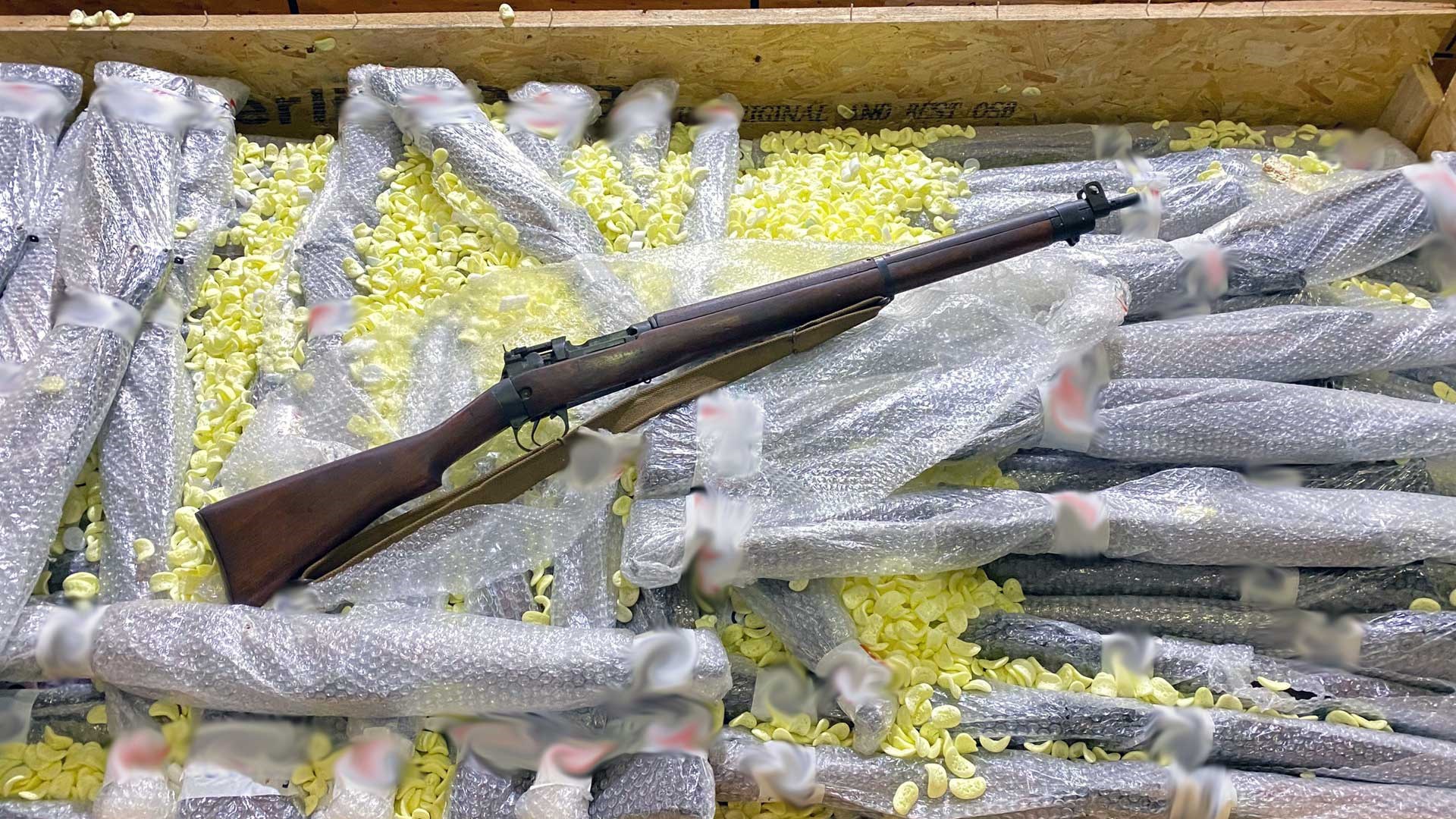
The first rifle is pulled out of its wrap and sits atop the other wrapped No. 4 rifles in one of the shipping containers. Certain identifying information has been obscured at the request of Navy Arms.
In the months leading up to D-Day, 50,000 canisters of arms and supplies were air-dropped across the country, providing sorely needed equipment to the French resistance as part of what was termed Operation Carpetbagger. A joint mission between the British Special Operations Executive and the American OSS, Carpetbagger’s aim was to provide all manner of arms, ammunition and supplies to resistance fighters behind enemy lines in the runup to D-Day and beyond. Following the Normandy landings, these airdrops continued into southern France to support Operation Dragoon, the Allied invasion of southern France on Aug. 15, 1944. Among these supplies were canisters containing British No. 4 rifles and .303 British ammunition, giving partisans cutting-edge arms that would allow them to engage German troops confidently. While their usage is not as well-documented as those rifles in the hands of British soldiers, the No. 4 nonetheless played an important role behind enemy lines in the battle to reclaim France. Following World War II, No. 4 rifles remaining in French hands were gathered up by the French government, which had no use for British arms, and placed into storage. There they remained for more than 70 years, until Forgett started the long, arduous process of getting the rifles from their longtime storage location in France to his company’s warehouse in West Virginia.
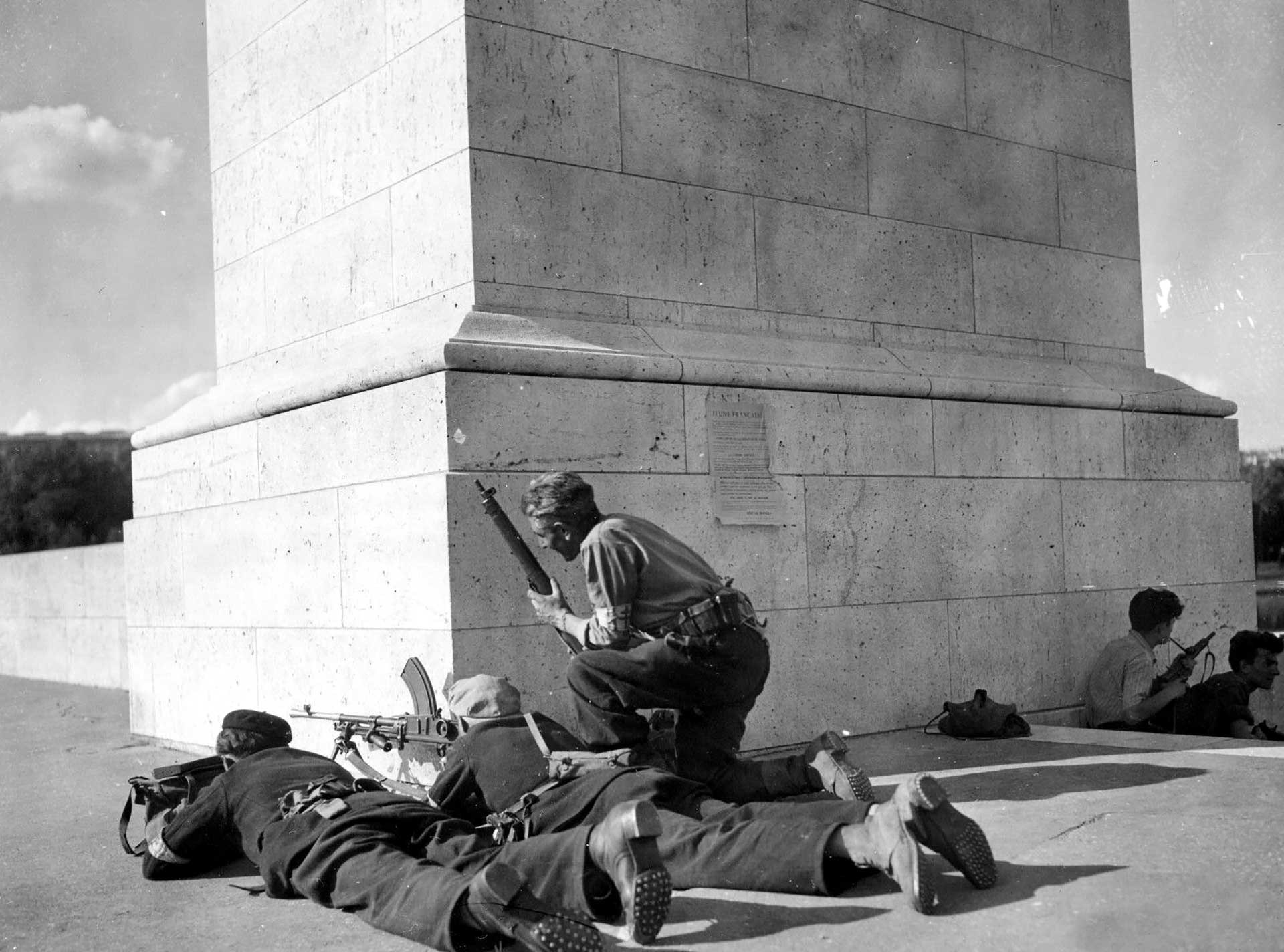
A French resistance fighter is shown armed with a No. 4 Enfield rifle. Image courtesy of Tom Laemlein.
As the crates were forklifted out of the shipping container, eager hands pried nails and loosened screws securing the plywood lids in place. Finally, the crate cover slid off, revealing a sea of bubble-wrapped rifles filling each box to the brim. It took the team at Navy Arms about a week just to unpack the carefully cocooned guns, while Val’s sons unwrapped each individual bolt from its plastic packaging, recorded its serial number and matched it to its rifle, wherever possible. After a brief wipe-down, quick swab of the bore and import-marking, the rifles were moved to a rack, where they awaited their moment under the camera lights. Each rifle is photographed and sold individually, so consumers will know the exact rifle they’re buying. There’s no “hand-select” option here or luck of the draw. What they see is what they get. And they’re getting some great finds with a fascinating history.
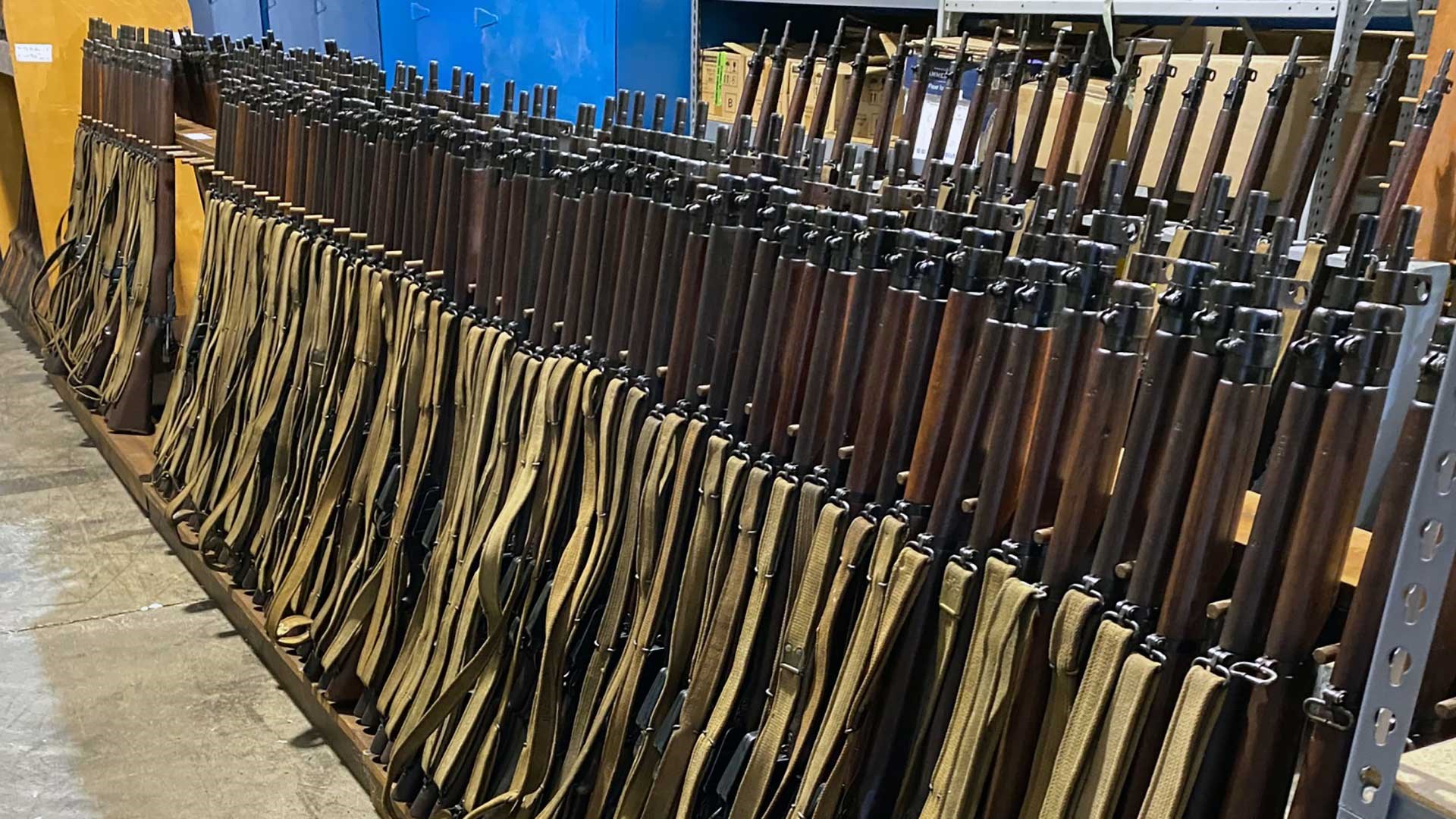
There’s no way to know definitively where each of these individual rifles served and in whose hands they were carried. If the old adage were true and these guns could talk, it’s likely that many of them would have a gripping tale to tell, but there’s little to glean from wood and steel. As far as we know, the French government never bought Lee-Enfield rifles directly from the British government. No rifles were given to the French following World War II, as they had no need for British arms. The only Lee-Enfields in French government possession were these scant few guns gathered up after the fighting was done, and most of the rifles that needed to be gathered up were those in the hands of resistance fighters who had done their job in hampering the German war machine.
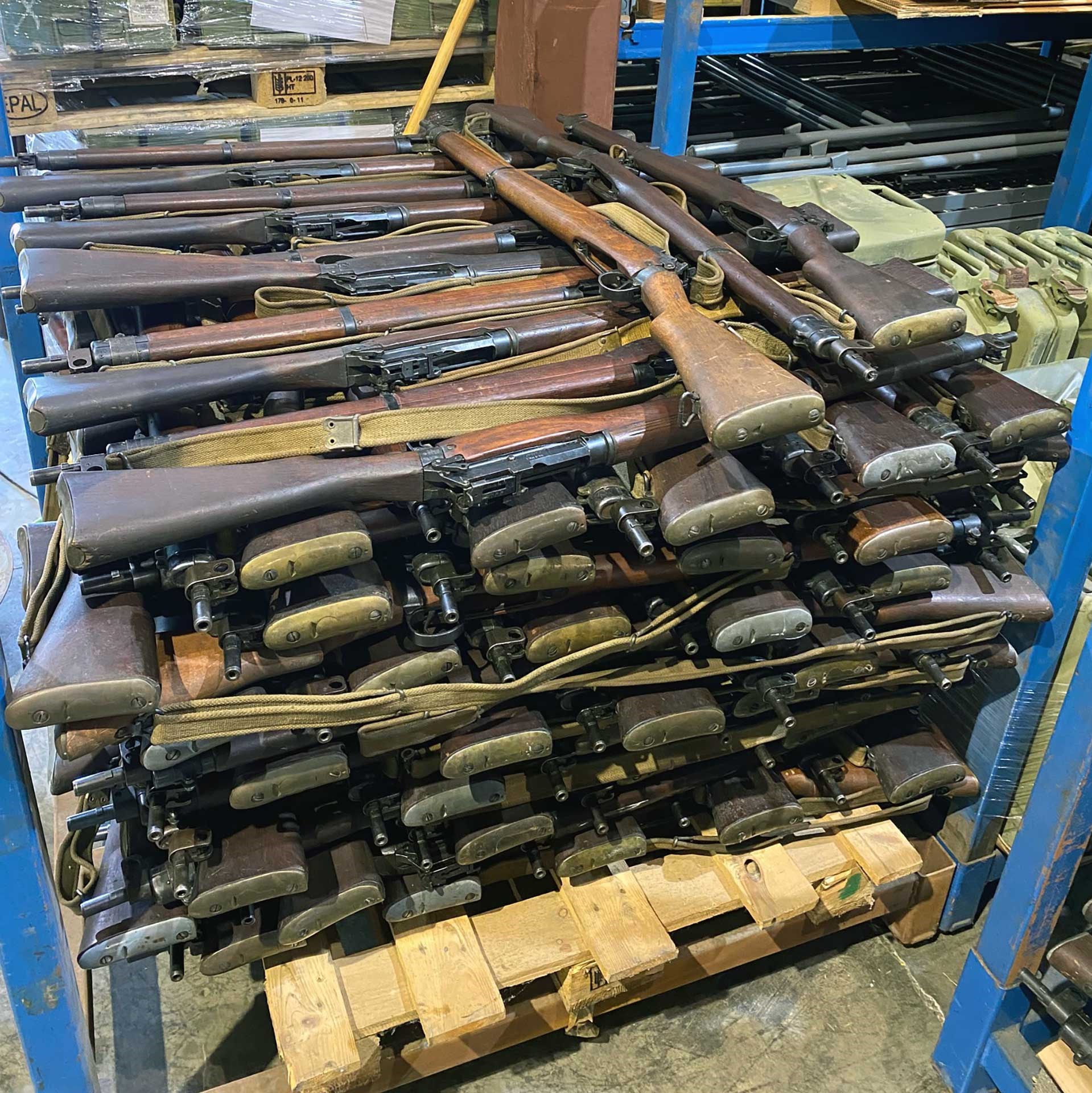
After the French finished gathering up the guns, bolts and magazines were separated from the rifles themselves and stored separately. There was no overhaul, no refurbishing. The guns range in condition from showing moderate wear to nearly factory-new and have all the crisp markings applied to the wood and metal at arms factories during the war. The French did apply their own serial number to these guns for inventory purposes, each of which begins with the enigmatic “PP” prefix. Since these are the only Lee-Enfields that remained in French military inventory following World War II, they are the only such guns marked in this way, making them unique collectors’ items for British rifle enthusiasts.
The No. 4
The British military adopted the “Rifle No. 4, Mk I,” as its official service rifle in 1941. The road to the No. 4 started far earlier than the ’40s, though, with origins stretching even back before World War I. While the Short, Magazine Lee-Enfield (SMLE) was an improvement over its longer predecessor, the Magazine Lee-Enfield, and represented a bridging between infantry and cavalry service arms, it was still very much an echo of the Victorian era. By 1913, the British had elected to move on from the SMLE, having adopted the Pattern 1913 in the smaller-bore .276 Enfield.
The onset of World War I made replacing the SMLE unfeasible, and by the end of the war, it was clear that some version of the Lee-Enfield was here to stay, as well as the .303 British cartridge. Refinements came in the form of the No. 1, Mk V of the 1920s, and early experimental variants of the No. 4 emerged in the 1930s. Unlike earlier models that shared the snub-nose profile of the metal nose cap, the No. 4’s barrel protruded from the end of the fore-end and featured dual lugs to accommodate the new No. 4 Bayonet, which replaced the earlier Pattern 1907 sword bayonet.
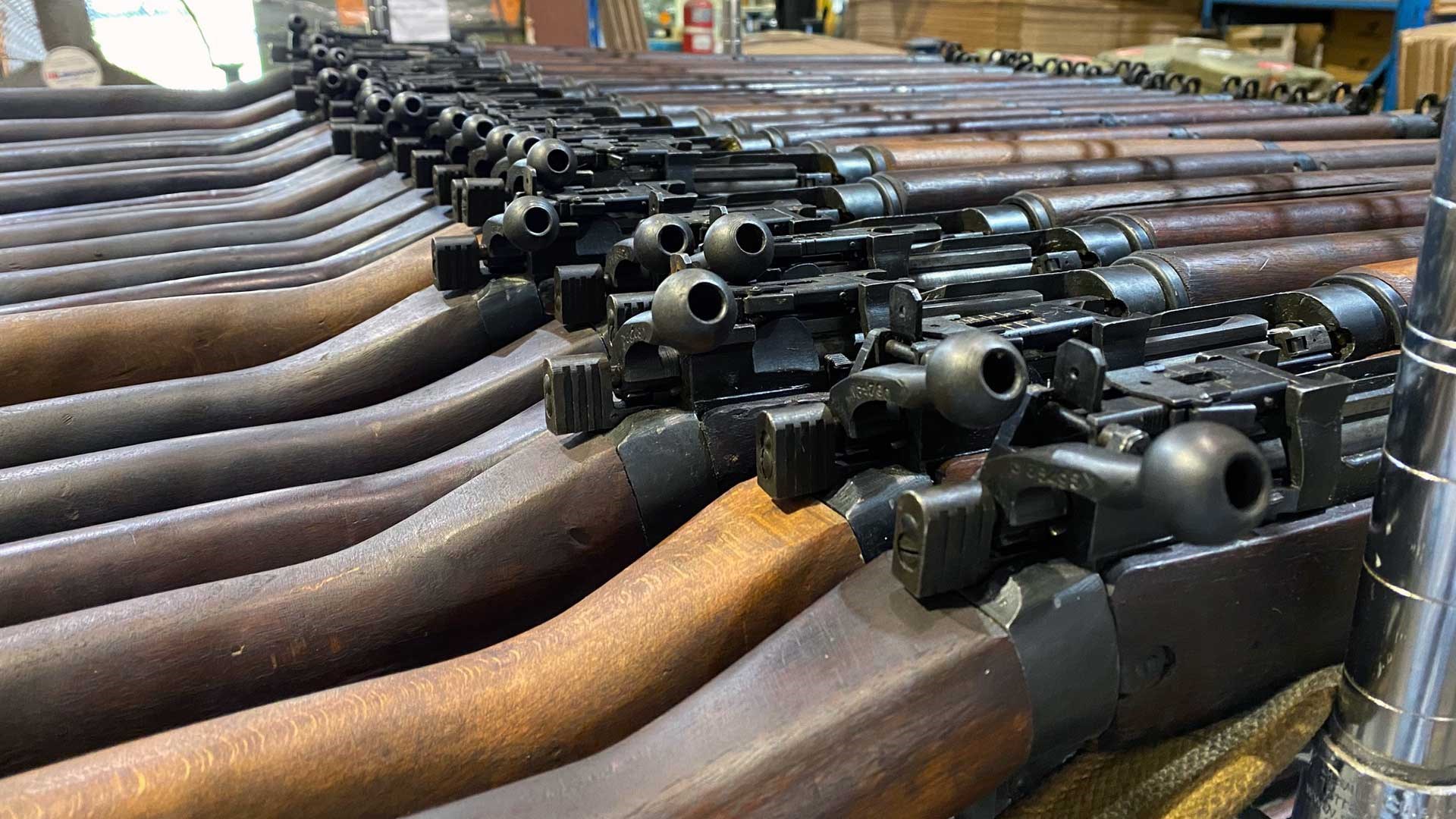
Rifles sorted for cleaning at the Navy Arms warehouse in West Virginia.
Throughout the design, elements were simplified and streamlined to ease manufacturing, including the receiver, which was similar to the redesigned action developed for the No. 1, Mk VI starting in 1926. The No. 4 lacked the magazine cut-off of its predecessors, and it featured a receiver-mounted, aperture-style rear sight, a design that saw its first iterations with the Mk V in 1922. The Mk I rear sight featured a 300-yard battle sight with a wide rear aperture for quickly engaging targets in combat and a flip-up, ladder-style sight with a fine aperture that was adjustable from 200 yards to 1,300 yards in 100-yard increments. As the war progressed, further simplifications sped up manufacturing, with the finely machined, micrometer-like Mk I rear sight replaced by simple two-position apertures and, later, stamped adjustable sights.
Evaluation & Testing
As a British rifle enthusiast, this new cache was an opportunity to grab my own example. It’s one of the cleanest No. 4 rifles I’ve ever had the opportunity to own, having functionally no marring on the wood or the metal. The bore is pristine, as is the bolt. Certainly, this particular rifle hasn’t seen any kind of significant combat use and could possibly be one of the air-dropped No. 4s squirreled away by partisan fighters as they prepared for the fight to re-take France. Of course, we’re in the realm of conjecture as to where such a gun was used and by whom, so let’s take a closer look at what is here.
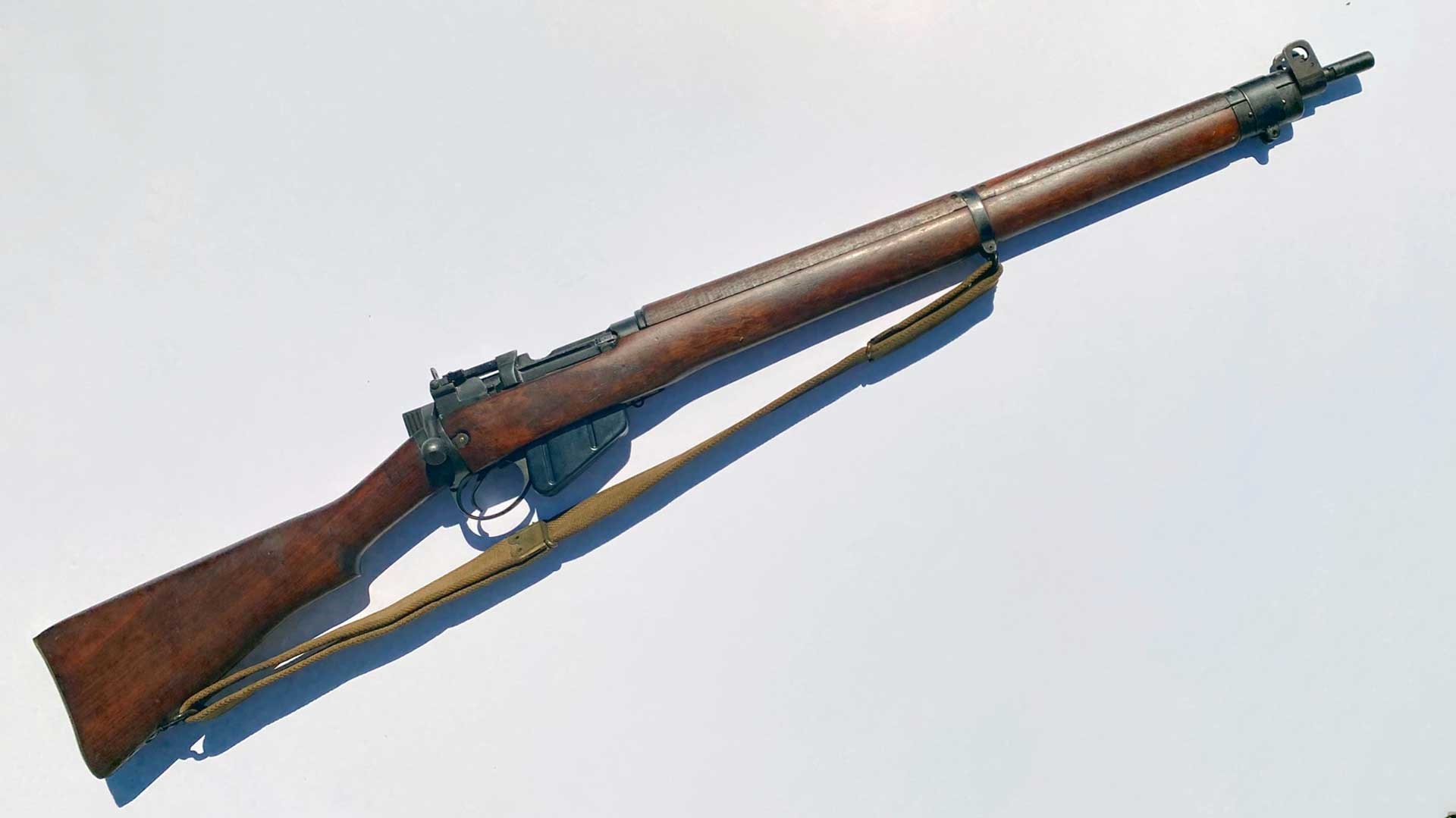
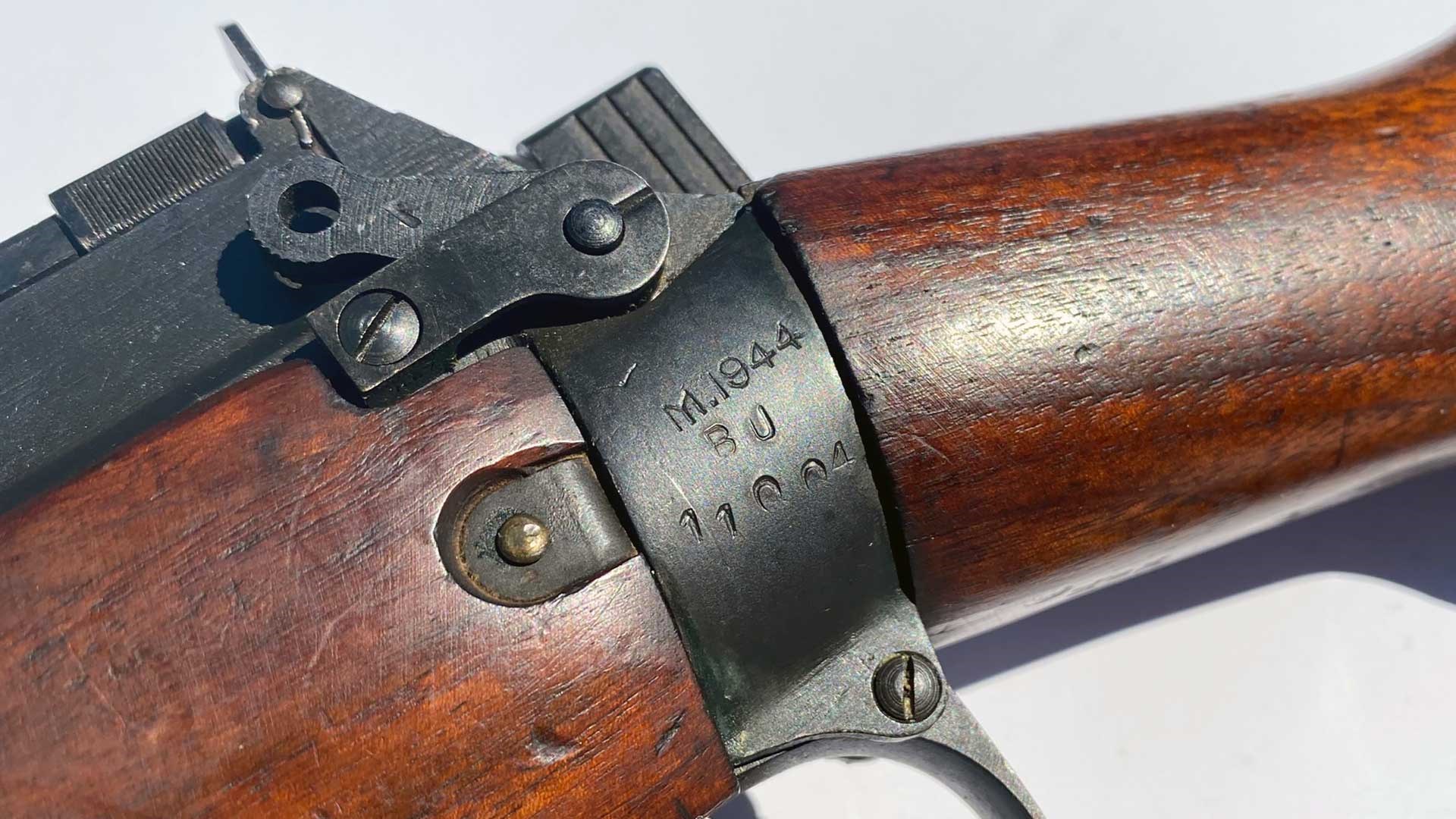
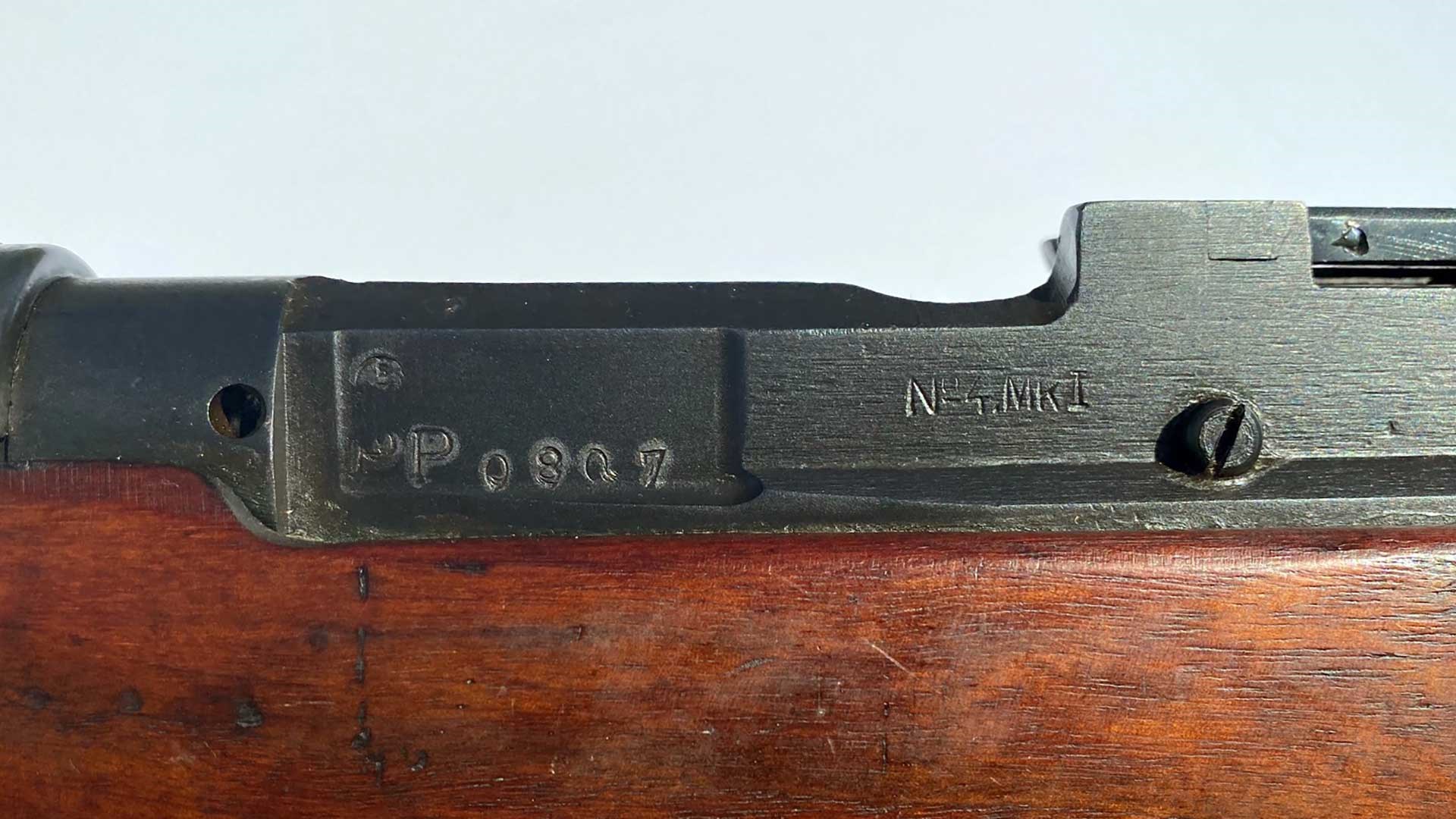
This particular example was produced by the Royal Ordnance Factory at Maltby, located in south Yorkshire. Opened in the 1930s, ROF Maltby was one of a number of British arms factories constructed in areas of the country considered less vulnerable to aerial attack. The left side of the butt socket is marked “M.1944,” denoting the year of manufacture, and the “BU” serial-number prefix, as well as the fact that the serial number starts with “1,” are other clues to its Maltby manufacture. The left side of the receiver is marked “No 4. Mk I,” and correctly for the Mk I variant of the No. 4 rifle, it retains the spring-loaded bolt catch located at the rear of the receiver raceway. Topping the receiver is a stamped Mk III rear sight, typical of No. 4s built toward the end of World War II. Also found on the left-forward portion of the receiver, unique to these particular No. 4 rifles, is the French inventory number. Each of these numbers begin with a “PP” prefix, and a four-digit number, in this case, 0807. To date, no further details regarding the purpose or meaning of this serialization has been uncovered.
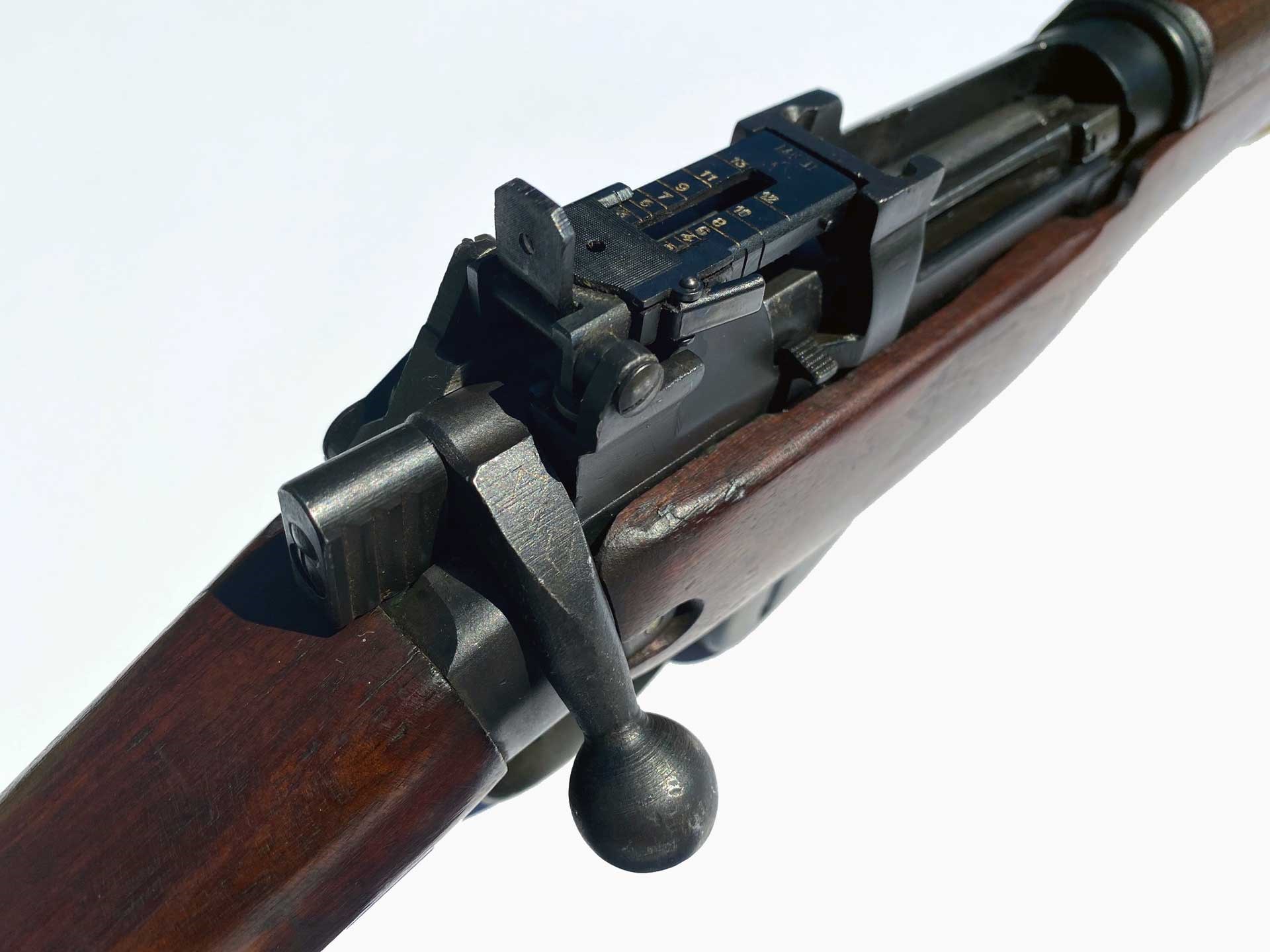
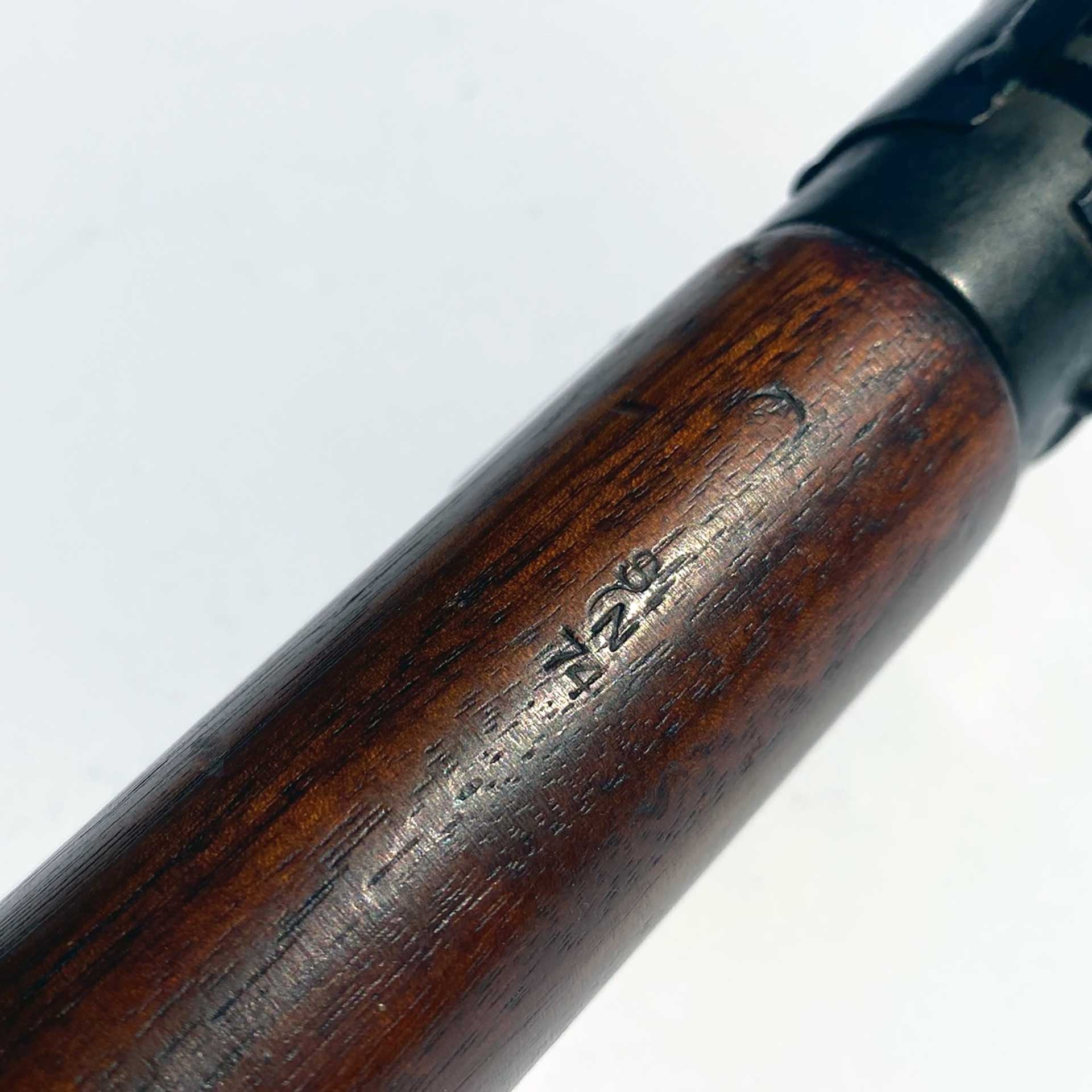
Otherwise, typical British proofmarks are found on the upper flat of the receiver, as well as crossed-flag proofs on the bolt head and top of the bolt handle. On the underside of the stock wrist and fore-end, there are sharp, clear manufacturer’s and inspection marks. Aside from providing valuable information regarding the origins of these components, the sharpness of these particular stamps highlights the fact that the gun’s walnut stock has never been sanded and refinished, as was the case with so many other No. 4 rifles that underwent refurbishing after the war. Aside from a few dents and scratches typically associated with long-term storage, this No. 4 is essentially factory-new, and many of the guns available in the Navy Arms batch of guns are in similar condition. One of the nice bonuses is the inclusion of what is an original sling, very likely the same sling installed on the gun during World War II. Most of the guns in the Navy Arms cache include original slings. While this particular sling seems to have had its markings worn away, many of the slings are 1944-dated and bear original markings.
While the Navy Arms team was able to track down the original bolts for these No. 4 rifles, a disappointment was the inability to find the original magazines, which are difficult to find in any condition, let alone a condition similar to the guns. Prior to receiving the rifles, Forgett contracted with a European manufacturer to provide reproduction magazines correct to the guns. The magazines feature the correct rib stamps for a No. 4 rifle and are treated with a blued finish that approximates the finish found on most No. 4s in this batch. On this particular example, one has to look very closely to see that the finishes aren’t quite congruous.
Of course, the opportunity to shoot what is essentially a factory-new No. 4 rifle is one I couldn’t let slip by, so part of this experience was heading to the range. Fortunately, I’ve squirreled away enough various .303 British loads to run a few different options through the gun and get a sense of its capabilities.
Firing at 50 yards on an indoor range, the best result was achieved with 1983-dated, German-made MEN .303 British, widely considered to be one of the best surplus loads on the market, though its availability is scant these days. The rifle held a 2.09” five-shot group with this load, which squares with the roughly 4-m.o.a. capability generally ascribed to No. 4 rifles using military loads. The worst group was produced by some circa-1960s Iraqi-produced Mk VII ball, likely exacerbated by the slight hangfires experienced with the old ammo. The Iraqi ball produced a 3.74” group. Modern loads measured between the two, with Hornady’s 150-grain InterLock producing a 2.23” five-shot group and Prvi Partizan’s 180-grain Soft Point load producing a 2.74” group.
When firing the rifle itself, a couple of points came up. First was the less-than-ideal performance of the reproduction magazine, which is not entirely surprising. Many reproduction magazines struggle on the reliability front when it comes to the Lee-Enfield platform, thereby requiring a bit of fine-tuning on the part of the end user. In this particular instance, the rear rib of the magazine was just a hair too long to reliably engage the rifle’s magazine catch, so it required a bit of filing to achieve the correct dimension. Additionally, the rifle had issues feeding the two soft-point loads out of the magazine, leading me to shoot the InterLock load from Hornady one round at a time. The two military-surplus ball loads fed more reliably, but both required extra force on the bolt to push the rounds out of the magazine and into the chamber. After a few magazines of ammo, I could feel it slickening up, so it’s possible that more time spent with the gun might smooth out any remaining issues on that front. All in all, it’s a minor blemish on an otherwise remarkable platform.
As it stands, Navy Arms is offering the guns through Old Western Scrounger at prices ranging from $900 for run-of-the-mill guns with some wear up to $3,500 for a remarkable pair of consecutively serial-numbered No. 4s. While these prices are more than we’ve seen for No. 4s recently, given the condition and unique history behind this limited batch of rifles, the premium is understandable. The likely ties to the French resistance notwithstanding, it’s important to recognize these guns for what they represent not only from a military history perspective but also a firearms history perspective. The golden era of military surplus is long behind us, and discoveries of these forgotten caches of guns are rarer, and the guns themselves are fewer in number each time.
Today, the collecting world is filled with World War II guns that have circulated in private hands for decades. Thanks to this latest discovery, the team at Navy Arms now offers a chance for military history enthusiasts to have a genuine, World War II-era British military rifle that has sat, untouched, since the end of the war. The odds that another opportunity like this will come up are vanishingly low, and for those who are passionate about military history and arms, it is a priceless opportunity to reach into the past and hold something that, until now, had previously only been in the hands of those fighting for their freedom from tyranny. You can find your own example by visiting ows-ammo.com.

Partisan bands had a rag-tag appearance at best. Note the SVT-40 (l.) semi-automatic rifle.
Author’s collection
Germany’s conflict with the Soviet Union represented a level of brutality not seen in the other areas of Europe during World War II. Of all the German casualties suffered during the Second World War, nearly 65 percent came in the fight against Russia. Combat on the Eastern Front proved to be an unrelenting meat grinder of men and machines.
Just like every invader before them, the Germans found themselves swallowed up by the vastness of the Russian landscape. With every meter the Wehrmacht advanced, their supply lines seemed to grow exponentially longer. The Soviet partisan groups gained strength and efficiency; meanwhile, the Germans struggled to maintain security in their occupied territory.
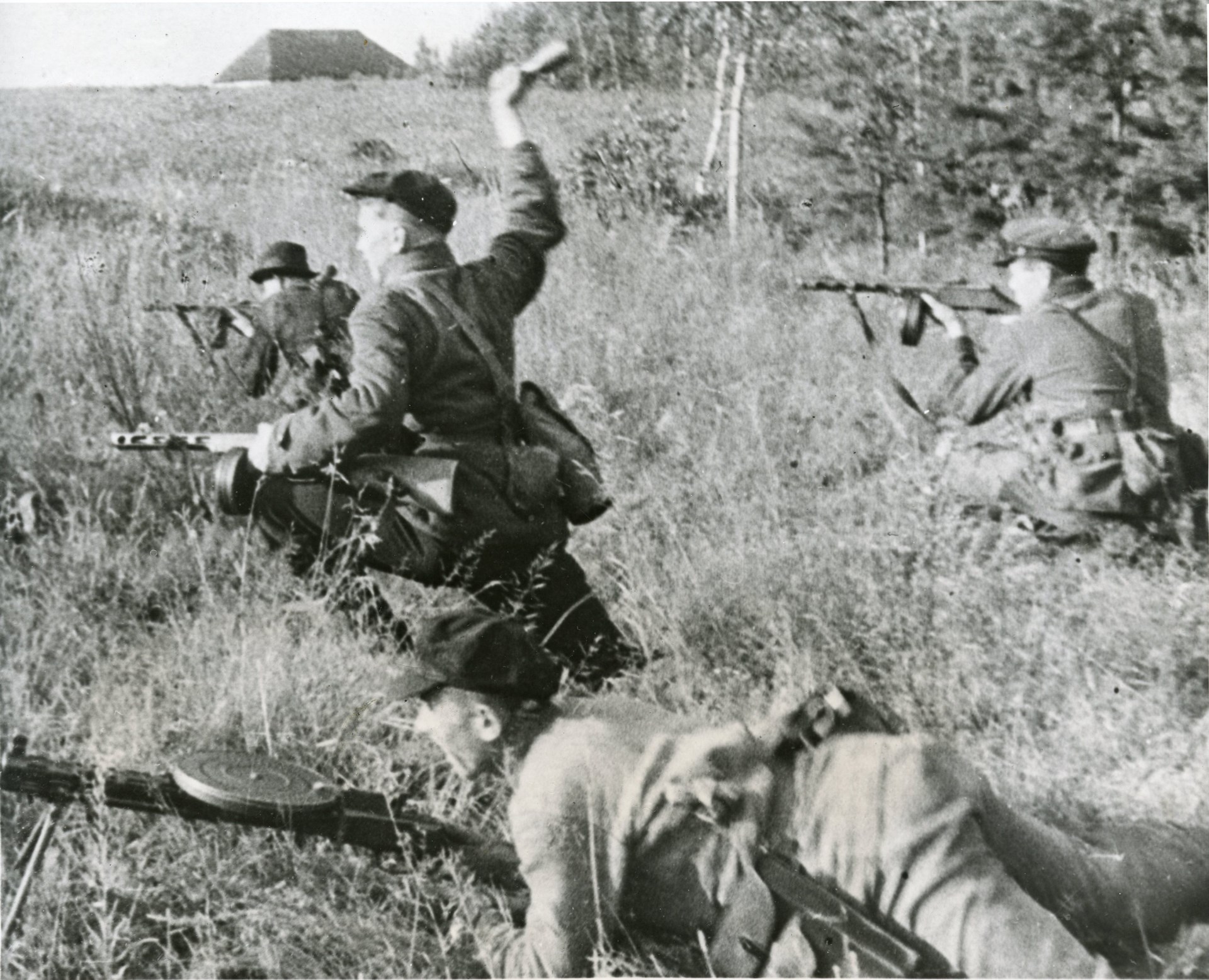 Soviet partisans with a DP-27 LMG and the ubiquitous PPSh-41 SMG. Author’s collection
Planned Partisan Resistance
Although the Soviets never expected to suffer such losses in men, equipment and territory during the German invasion of June 1941, there were still plans in place to combat the Nazi advance with irregular groups of resistance fighters in the remote areas behind German lines. The partisan bands that formed in the early days of the invasion gathered their initial supply of small arms from the edges of the massive battlefields and from the Red Army stragglers who appeared in small groups.
In the early days of the partisan war, most Soviet units used small arms typically found in Red Army service during 1941. Automatic guns were in short supply, and ammunition was always quite limited.
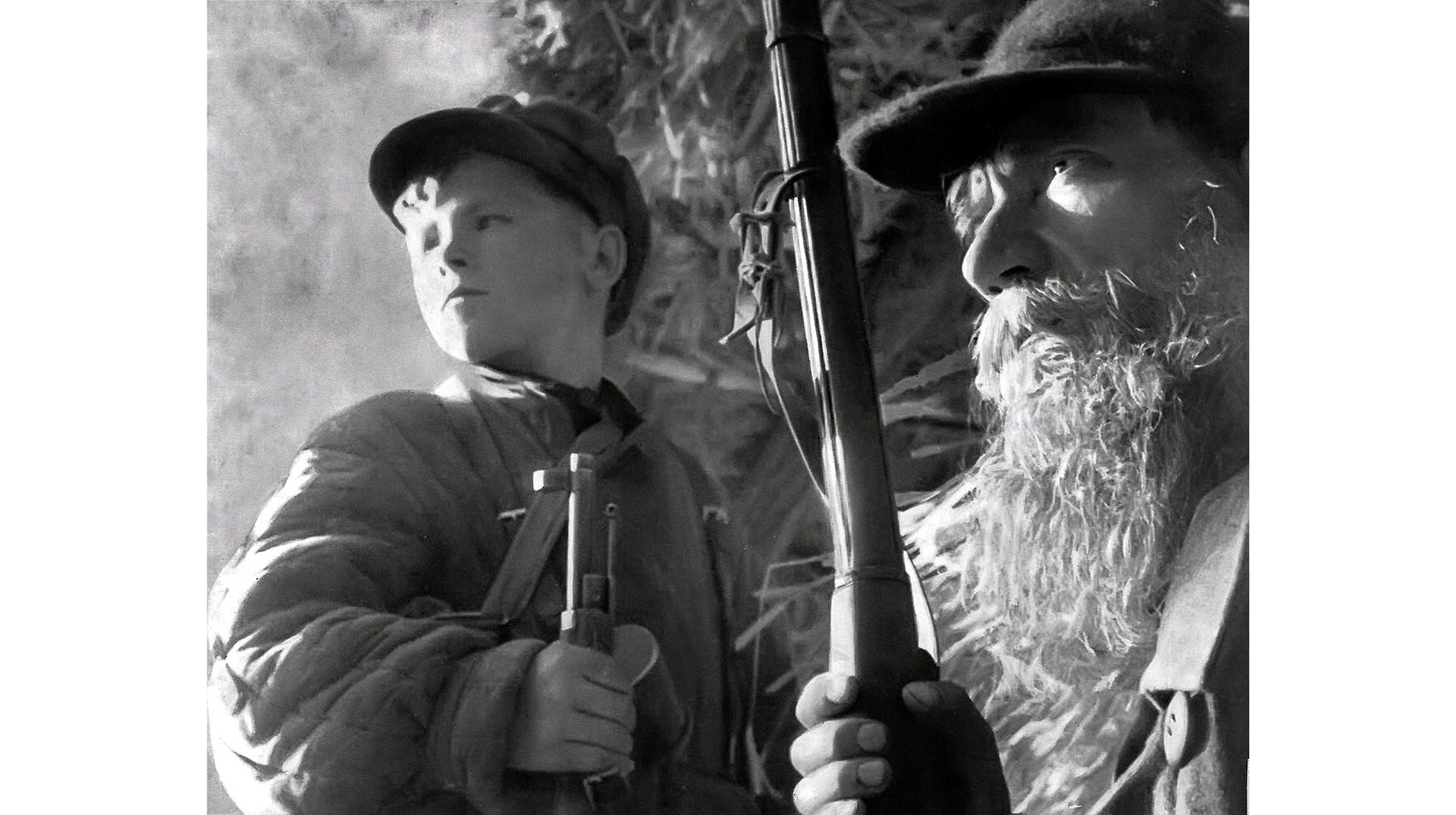 The People’s War: The very old and the very young served in the Soviet resistance; many carried the M1891 Mosin-Nagant rifle. NARA
On some occasions, the larger partisan groups were headed by Soviet army officers. These units gained access to hidden firearms, ammunition and equipment that the Red Army had left behind. The 11th Kalinin Partisan Brigade is even said to have had several tanks that had been hidden in the forests east of the Latvian border. Heavy weapons could rarely be kept in action for long, though, as the partisans lacked fuel, spare parts and ammunition. Traditional Russian frugality meant that the partisans would dig up Soviet mines and re-use them in their intended role or strip out the explosives for other demolitions. Dud artillery rounds were also recovered and used for improvised mines.
In the first phase of the war in Russia, many of the partisan groups were simply fighting for their own survival. Almost 40 percent of the Soviet population lived in territory occupied by the Germans and, in many of these areas, the Soviet commissars had abused the local populations so badly that the people greeted the Germans as “liberators.” The German high command never understood or appreciated this early advantage. A 1956 U.S. Army study titled “The Soviet Partisan Movement 1941-1944” remarked:
… poor treatment of the Russian civilian population by German political leaders created resistance instead of maintaining and exploiting the advantage of the initial confidence displayed by many elements of the population.
Even so, during 1941-42, the eastern European population was generally unsympathetic to the Soviet partisan cause. The situation grew worse when partisans attempted to deprive locals of their limited food supplies.
German Brutality Drives Partisan Support
The Germans did not consider the Soviet partisan groups to be “military units.” Consequently, they were defined as “bandits” or “terrorists,” and no quarter was given to partisans or anyone believed to be helping them. This was an important turning point in the war in Russia. Hitler’s attitude towards the partisans, and most people in Eastern Europe, is summarized in this passage from “Primordial Violence: German War on Soviet Partisans” by Maj. Gus Costas, USMC (Ret.): “Hitler’s personal enmity and hatred were apparent when he declared that the anti-partisan effort was simply an opportunity ‘to eliminate anything that opposes us,’ and to ‘shoot dead anyone who even looks at us askance.’”
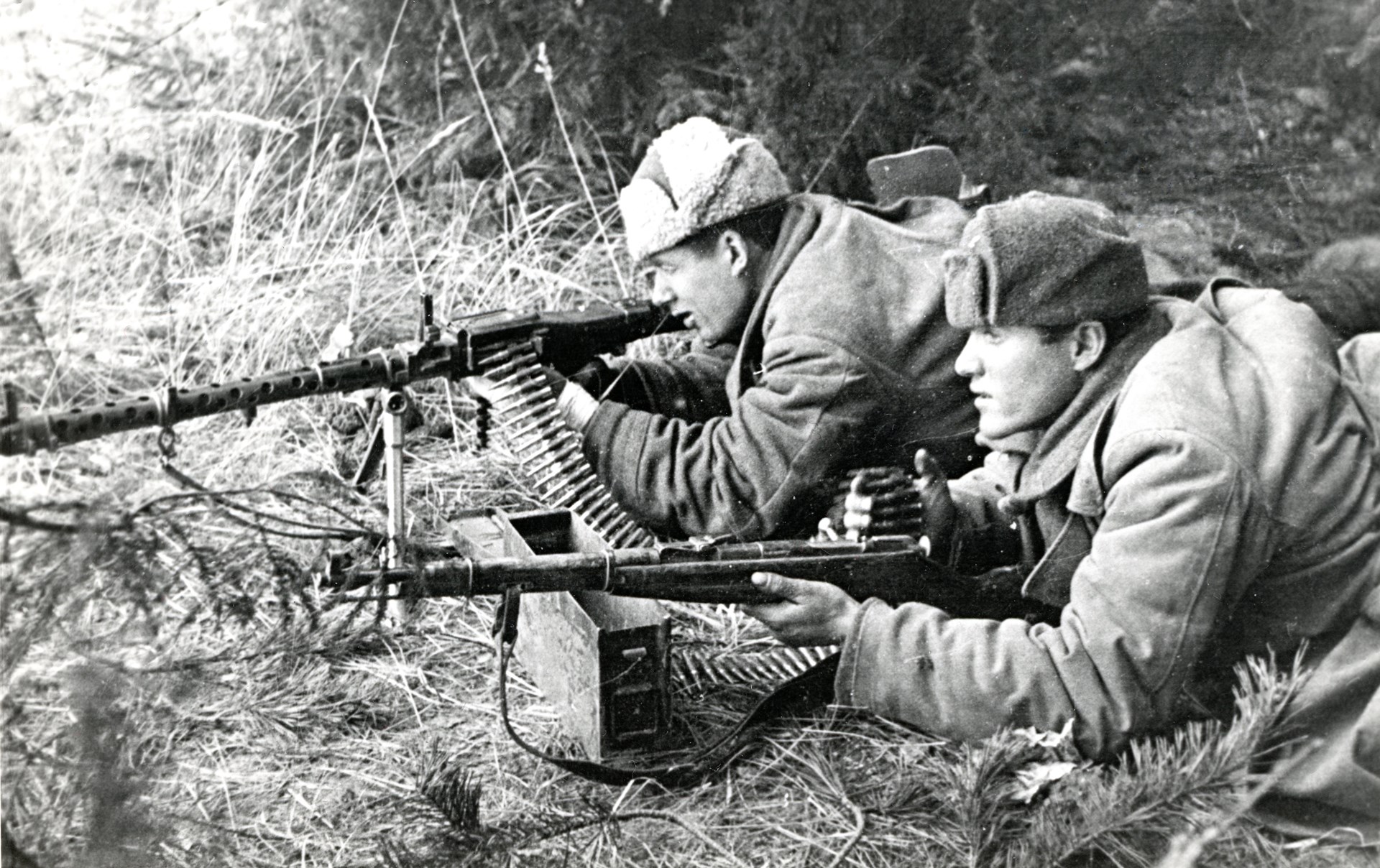 Captured firearms played an important role. Shown here, a German MG34 supports a partisan attack. The man alongside has a Mosin-Nagant Model 38 carbine. Author’s collection
Strength & Experience
The territory behind German lines represented a massive landmass, so the Soviets sought to create as great a disturbance as possible in the Nazi rear areas. In “The Soviet Partisan Movement 1941-1944” (DA-PAM 20-244, August 1956), Soviet “by-hook-or-by-crook” methods of recruiting members for partisan bands as war went on are described:
Manpower for the bands continued to be drawn from a variety of sources. Escaped prisoners of war still drifted into the partisan ranks, while German occupation policies caused many civilians to volunteer. But by and large, as the movement expanded, the larger proportion of the personnel was drafted from the native populace, forcibly when necessary.
The Central Staff constantly advised the lower echelons to foster the best possible relations with the natives as a means of facilitating such recruiting. In some areas recruits were taken systematically by age groups, and at times even women were drafted.
Special attention was paid to recruiting members of the “Komsomolsk,” the communist youth organization. These young Bolsheviks were highly desirable as combat men or political activists because of their fanaticism.
In partisan-dominated areas recruits were put through a training course. Generally, they spent several weeks on probation to prevent escape or defection of those forcibly drafted and to give attached NKVD (precursor to the KGB) agents an opportunity to check their backgrounds against the possibility of infiltration of agents in German pay. Through informants within the units the commissars also kept a constant check on all personnel. Desertions of individual partisans were reported to the Central Staff, and their families, if they could be reached, were sent to labor camps in Siberia. If a defector was apprehended, the NKVD both passed and executed sentence. In a number of cases, the NKVD terrorized German collaborators into double-dealing by forcing them under threat of death to sign oaths of loyalty to the Soviet regime and then threatening to have the oath delivered to the occupation authorities should the individual fail to cooperate with the partisans.
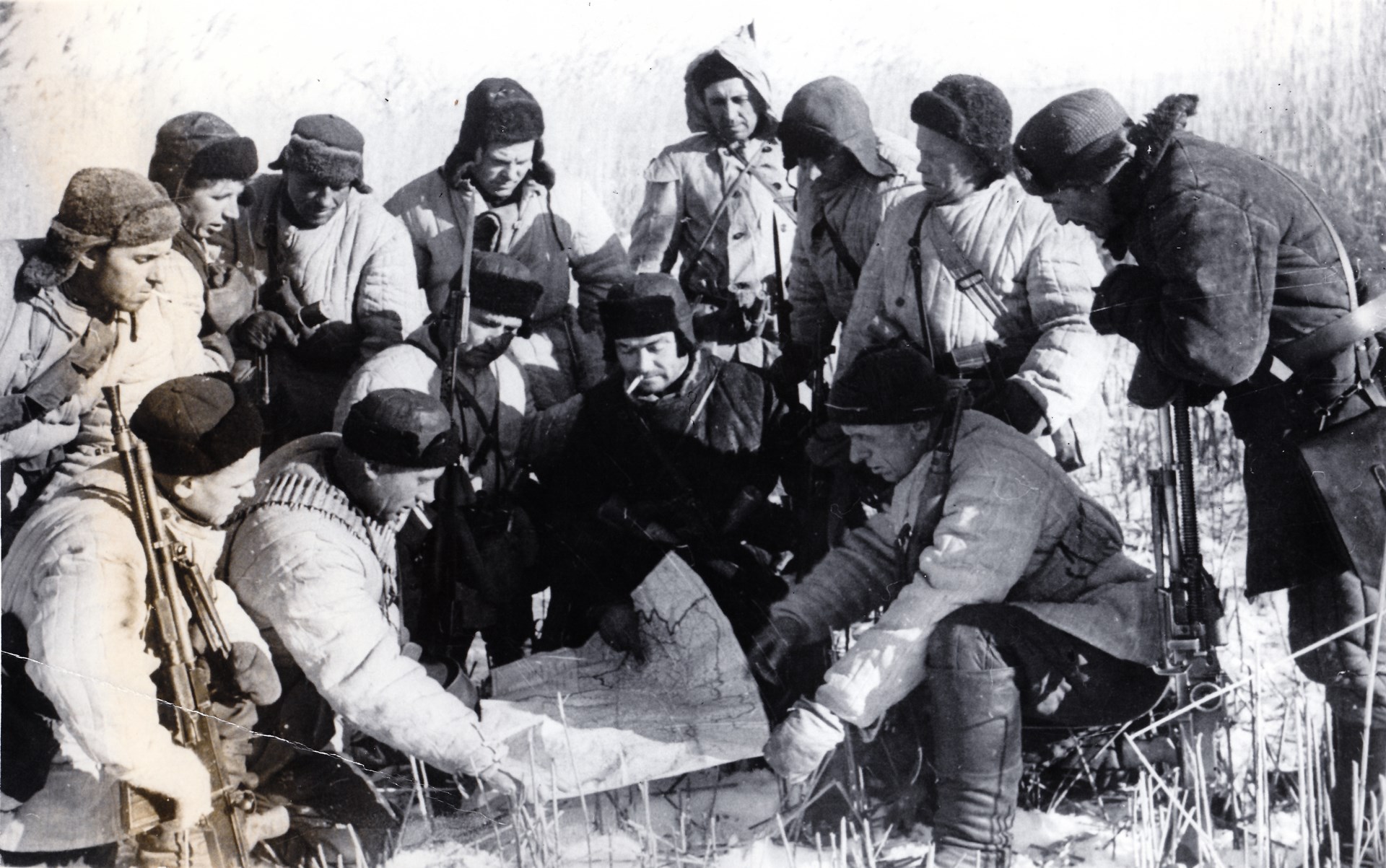 This partisan group appears to be made up of a more uniform Red Army unit. Note the Czech ZB26 LMGs (7.92×57 mm). NARA
The Red Air Force
In 1962, the US Air Force Research Studies Historical Institute produced “Airpower and Russian Partisan Warfare” written by General der Flieger D. Karl Drum. General Drum had first-hand knowledge of the Soviets’ efforts to supply partisan bands by air. He describes the effectiveness of the Red Air Force in this role:
Without the regular system of air transport established by the Red Air Force, the Soviet partisan bands could not have been organized, maintained, and controlled to any effective degree.
The Germans, of course, became increasingly aware of the vital role of airpower in partisan operations. The German Air Force could not spare the necessary aircraft, nor did it possess on the Eastern Front sufficient warning and communications equipment to make its efforts effective.
Without air transport, it would have been impossible for the Russians to supply the partisans with weapons and ammunition. Air lifting these items over the battle front was the primary mission of the air transport supply system.
Communications was another critical component in the partisans’ success. General Drum continues:
Along with the messenger service, radio equipment was indispensable for transmitting partisan intelligence information and orders both for intra-partisan liaison and with communication with the Central Command in Moscow.
Electric power plants (for radios), batteries, receiving and sending equipment, and spare parts, could only be supplied in quantity from the Zone of the Interior by airlift. Often, specially trained radio operators were airlifted or parachuted into the partisan areas.
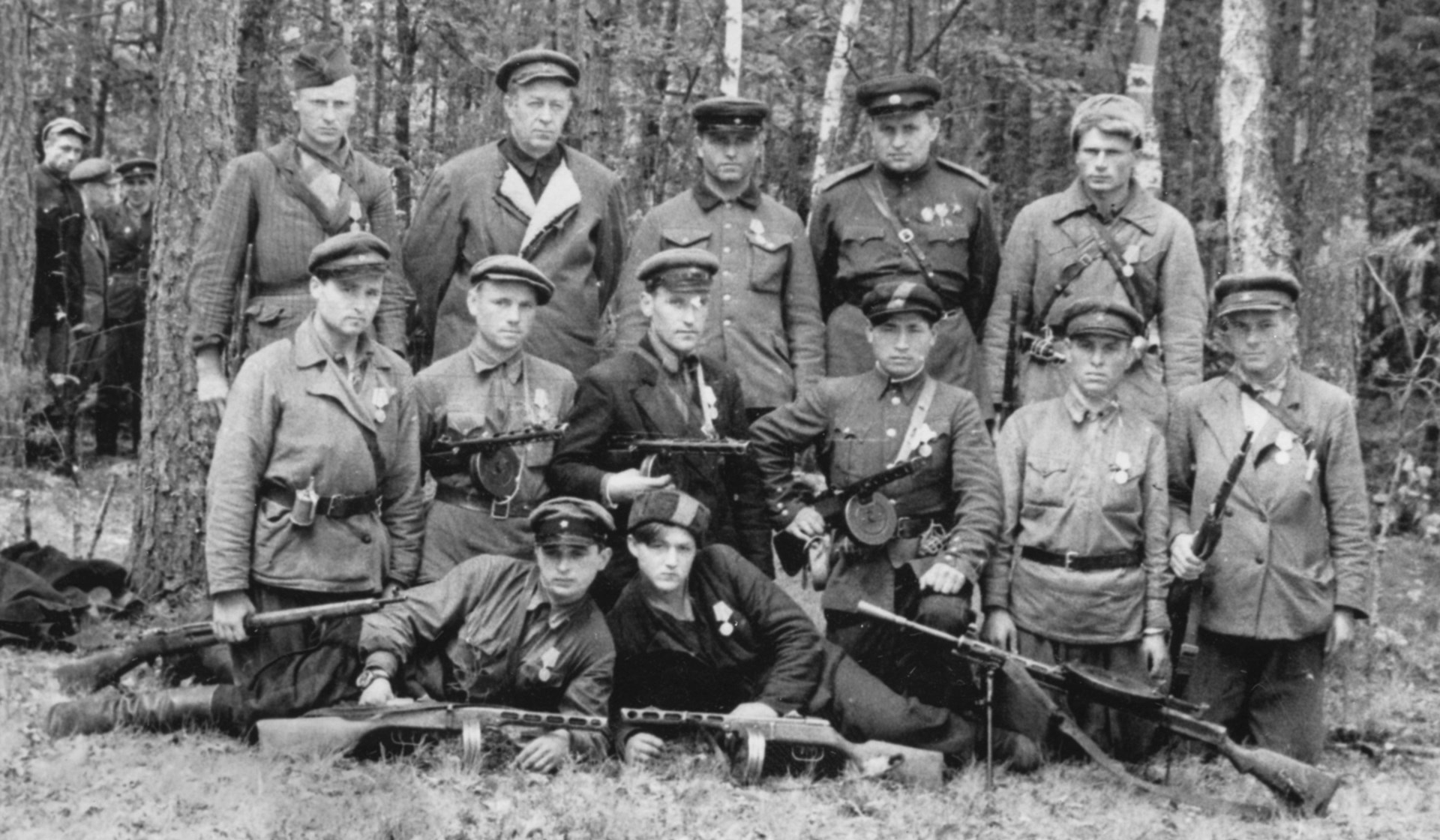
Likely another Red Army-partisan group operating behind the lines, equipped with M1891 rifles, PPSh-41 SMGs and a DP-27 LMG. Author’s collection
Partisan Targets
Beginning in 1943, there was far more coordination in the partisans’ efforts and more strategic direction in their attacks. The Soviet Central Staff issued a directive that designated the priority of partisan targets. Primary targets were rail lines and rolling stock, as well as road bridges and German transport vehicles. Additional targets were German communication lines and supply depots. It is important to note that Soviet partisans were directed to take aggressive action in force against German units only when the resistance groups had significant superiority in numbers. The partisans rarely had enough ammunition to remain competitive in an extended firefight.
The U.S. Army study titled “Rear Area Security in Russia: The Soviet Second Front behind the German Lines” (Department of the Army Pamphlet 20-240), described the progression of the armament of their supply troops as the war in the East progressed:
At the beginning of the Russian campaign the crews of Germans supply trucks had small arms, but no machine guns. Later on, after truck convoys had been helplessly exposed to surprise fire and partisan raids, they were issued machine guns which were mounted on the platform of one-half to one-ton trucks. At a still later stage of the campaign the trucks were lightly reinforced with armor plates. Shortage of personnel, however, precluded the use of special machine gun crews and placed an additional burden on the supply troops. On every trip the relief driver had to sit behind the machine gun, ready to fire, while the rest of the convoy personnel was constantly on the alert against surprise attacks. Soldiers returning from furlough were sometimes collected at security strong points along the roads and employed as escort personnel for supply convoys moving up to the front.
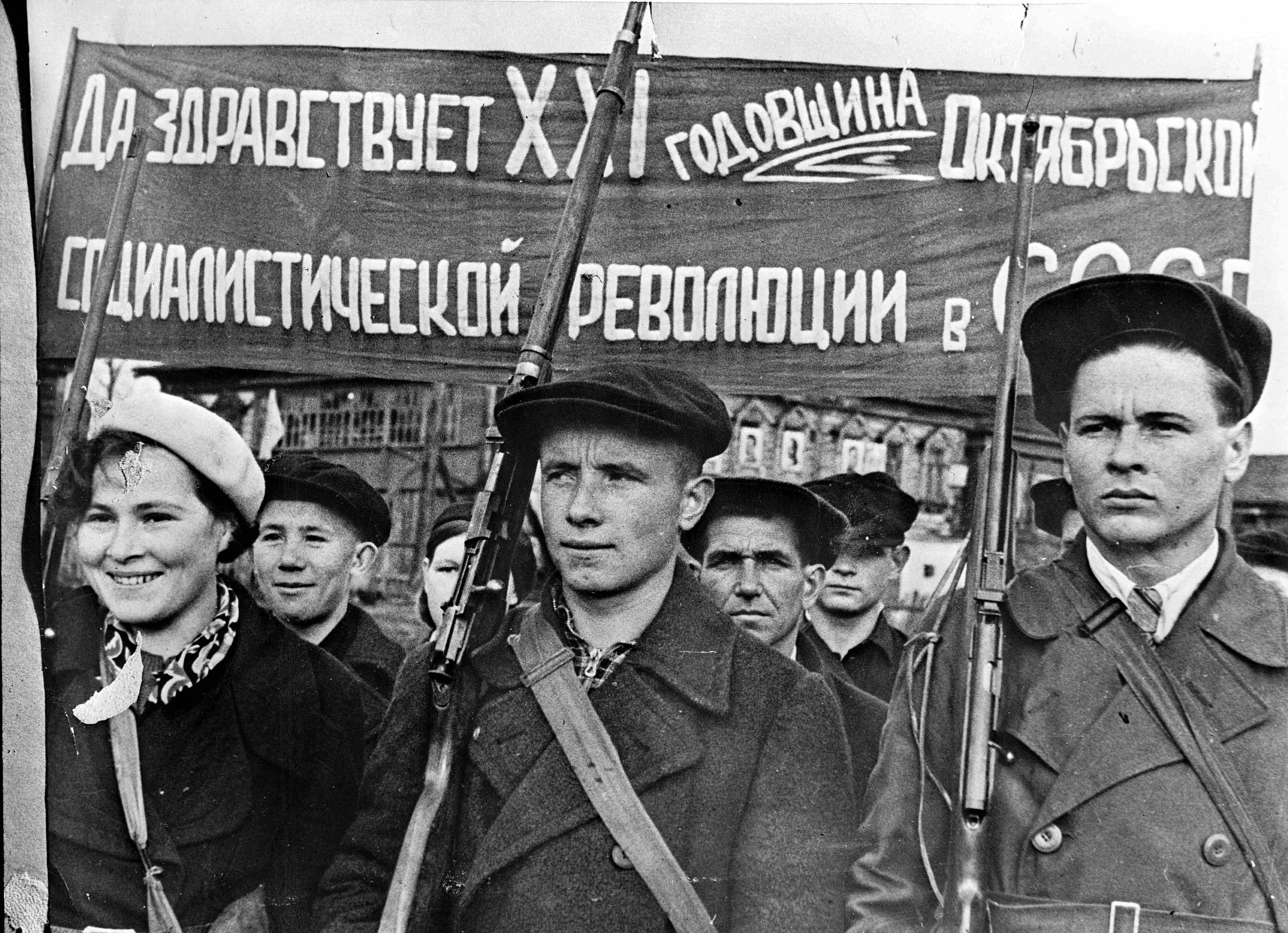
Resistance units sprang up in the country, in the towns and in the factories. Here, a man on the right carries a single-shot, .22-cal. TOZ-8 Cadet Rifle. NARA
Arms Of The Partisans
While many photographs show Soviet partisans using captured German small arms (particularly the MP40), these images were often staged propaganda tools created at the direction of the Soviet Central Staff. The use of captured guns stressed the partisans’ logistics, demanding the stockpiling of enemy ammunition and spare parts. After 1942, the expanding size of the partisan groups ultimately required the use of Soviet-made small arms. Even so, captured arms like the MP40, the MG34, the Karabiner 98k rifle, and any type of German pistol were used to supplement partisan firepower.
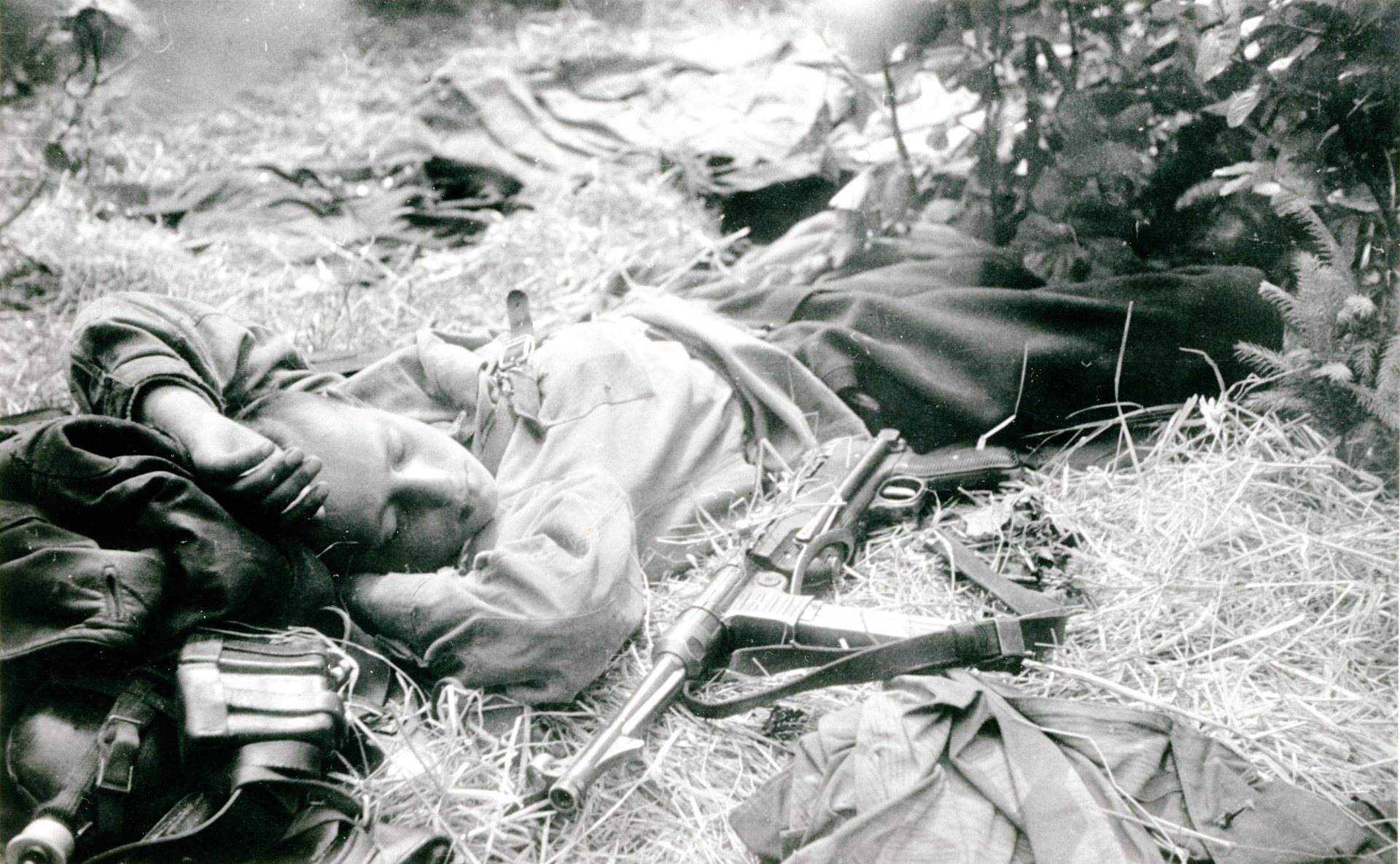
The German MP40 9 mm SMG was a popular firearm in any resistance group in Europe. Author’s collection
PPSh-41
Like most resistance formations, Soviet partisans made extensive use of submachine guns (SMGs). Luckily for the Russians, they were armed with the PPSh-41 (7.62×25 mm Tokarev), easily one of the finest SMGs of the war. The fast-firing PPSh cycled at nearly 1,000 rounds per minute, providing the partisans with a distinct firepower advantage in close-range firefights. The PPSh-41, called “Papasha,” by fighters, used either a 71-round drum or a 35-round box magazine. Simple and sturdy, it became an icon of Soviet resistance in World War II.
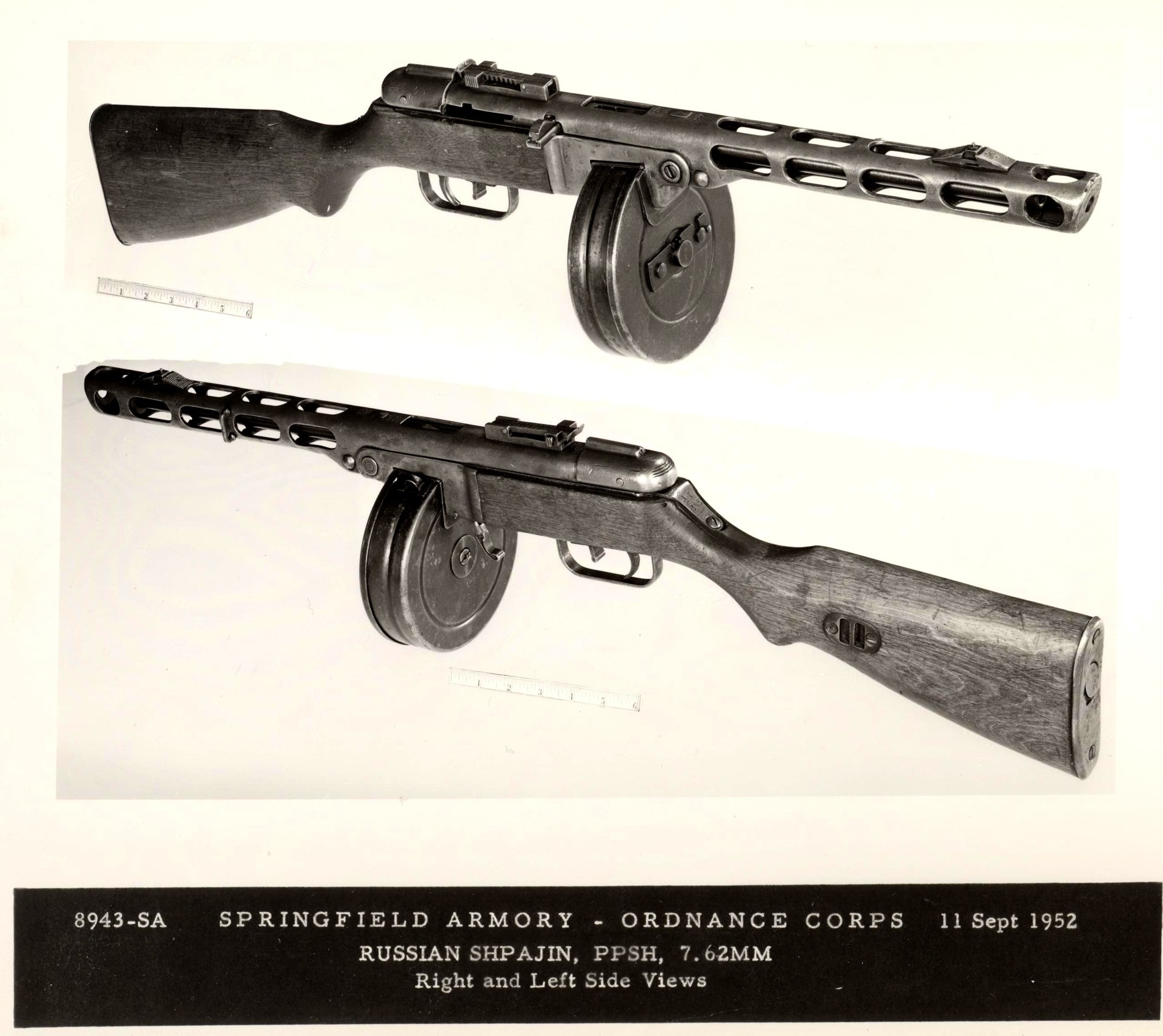 The partisan’s best friend, the PPSh-41 SMG equipped with a 71-round drum magazine. The simple PPSh offered tremendous short-range firepower. Springfield Armory
Mosin-Nagant Rifles
The venerable Mosin-Nagant M1891 (7.62×54 mm R) gave Soviet partisans a simple, reliable and accurate rifle for the light infantry makeup of their groups. One of the classic military bolt-action rifles, the M1891 served from before World War I, through both world wars, and even into the early years of the Cold War. From 1942, greater numbers of M91/30 sniper rifles became available, and Soviet marksmen used them to great effect. Equipped with a 3.5X PU scope, the M1891 was accurate out to nearly 900 yards, just right for a partisan sniper with his sights set on a German officer, truck driver or locomotive conductor.
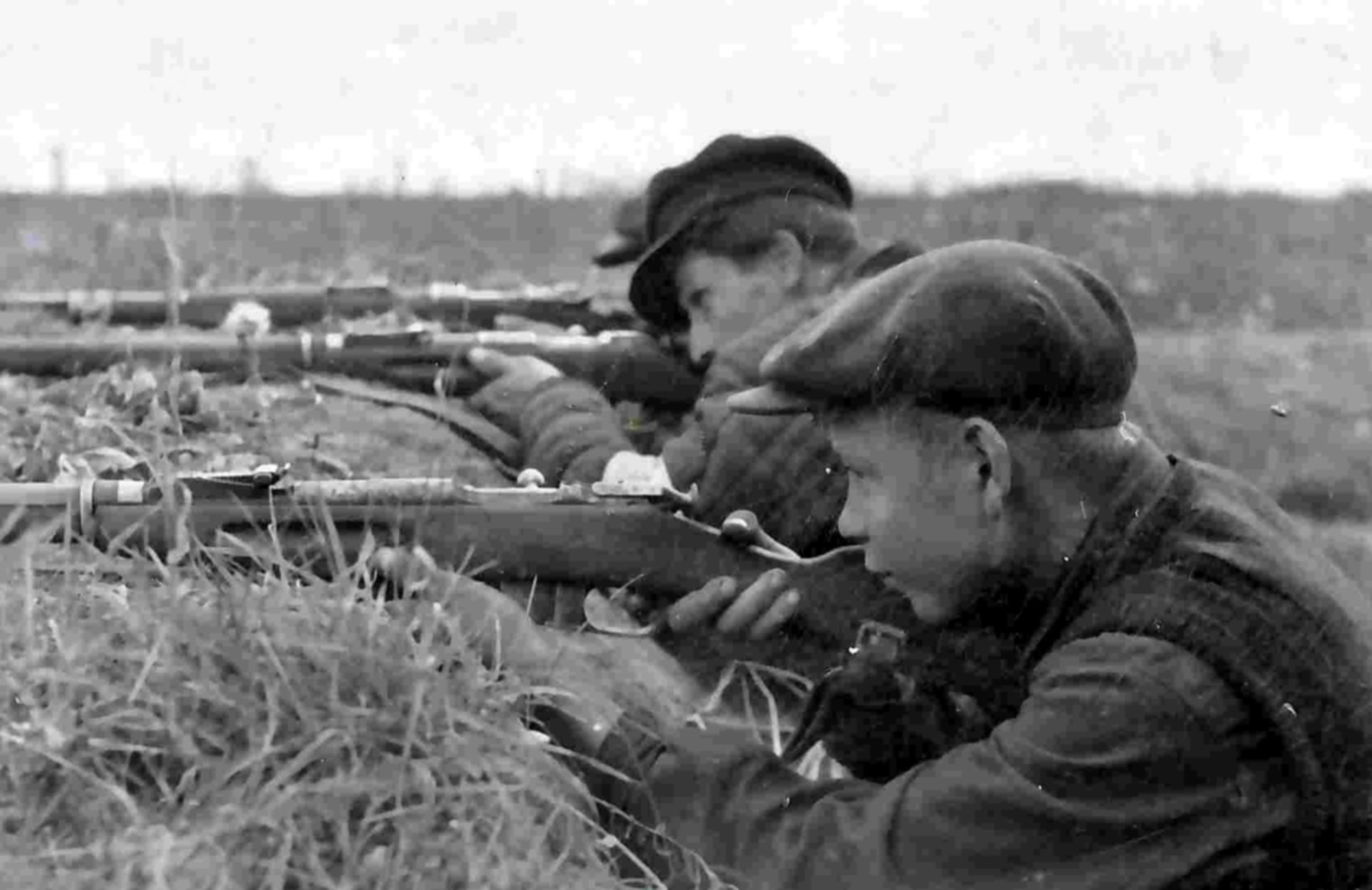 Total war on the Eastern Front knew no age limit. Shown here, a youthful partisan sights his M1891 Mosin-Nagant rifle. NARA
The Degtyaryov DP-27
The gas-operated DP-27 (7.62×54 mm R) gave partisan groups an effective base of mobile firepower. With just about 80 parts, the DP light machine gun (LMG) was simple enough for quickly trained partisan gunners. The DP-27 weighed 25 lbs. loaded, featured a folding bipod and a built-in flash hider. Rugged and practical, the DP-27 offered a manageable cyclic rate at 550 rounds per minute and was considered highly reliable—earning the nickname “Record Player” for its unique 47-round pan-shaped magazine.
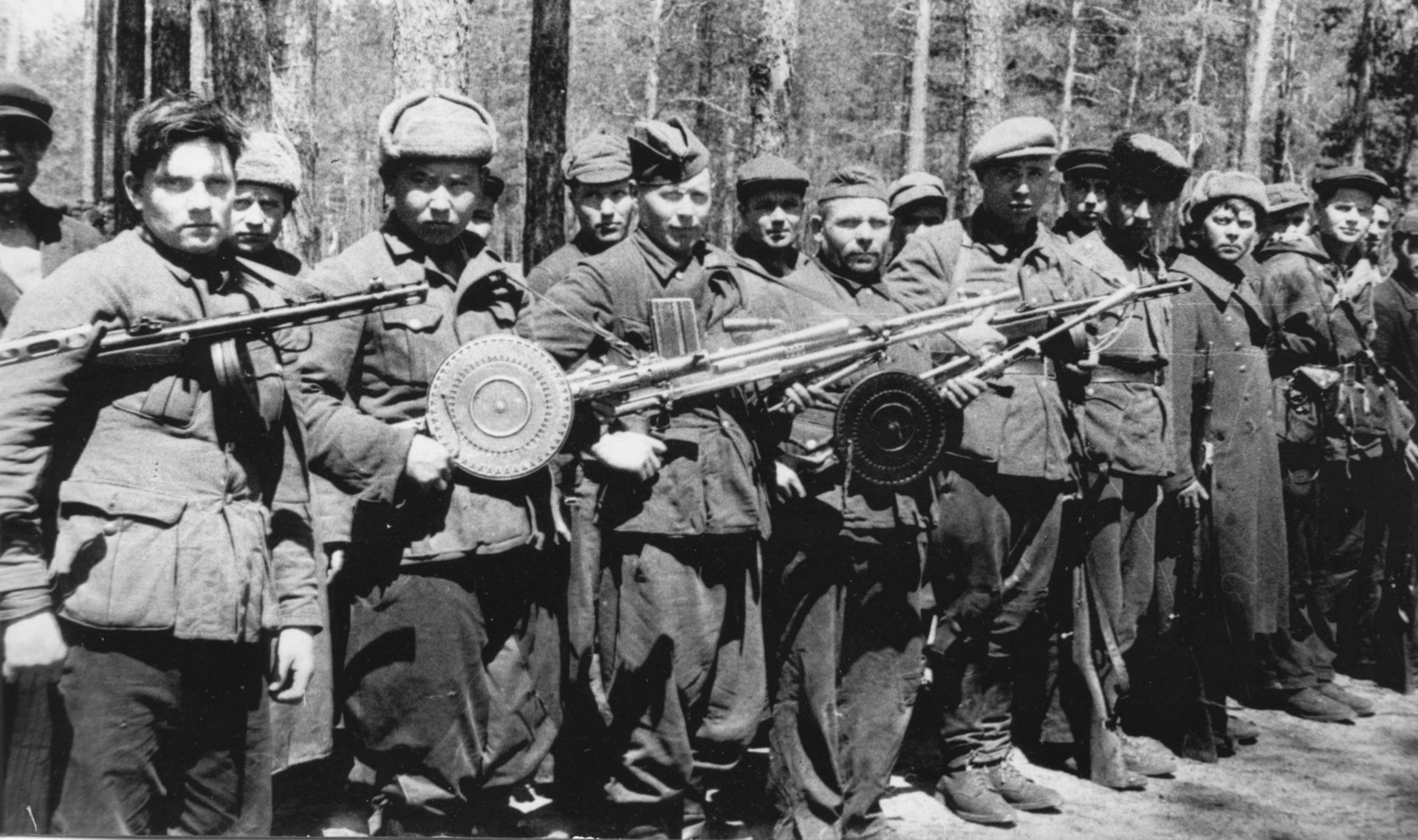
There’s plenty of firepower in this guerrilla band, with DP-27 and ZB26 LMGs to support the rifles and SMGs. Author’s collection
The PTRD-41 Anti-Tank Rifle
During World War II, the Red Army made significant use of a firearm that was considered “obsolete” by the Western Allies—the anti-tank (AT) rifle. Despite Western misunderstanding, the Soviet 14.5 mm PTRD-41 (single shot) and PTRS-41 (semi-automatic) rifles proved to be effective throughout the war when used against the side/rear armor of German medium tanks, assault guns and all lightly armored vehicles. The PTRD-41 was 79 ½” long, weighed 38 lbs., and its 14.5×114 mm rounds could penetrate up to 40 mm of armor at 100 meters. It is important to note that an experienced AT rifleman could hit the most sensitive points on an enemy vehicle and often achieve a “mobility kill.” Once immobilized, the armored vehicle was often assaulted with satchel charges and Molotov cocktails. While Soviet partisans avoided encounters with German armor whenever possible, the 14.5 mm AT rifles were excellent long-range sniping arms against some of their most lucrative targets—German supply trucks and railroad transports. Also, in many areas under partisan control, the German second-line troops used lesser armored vehicles (often French tanks captured in 1940) that were more vulnerable to anti-tank rifle fire.
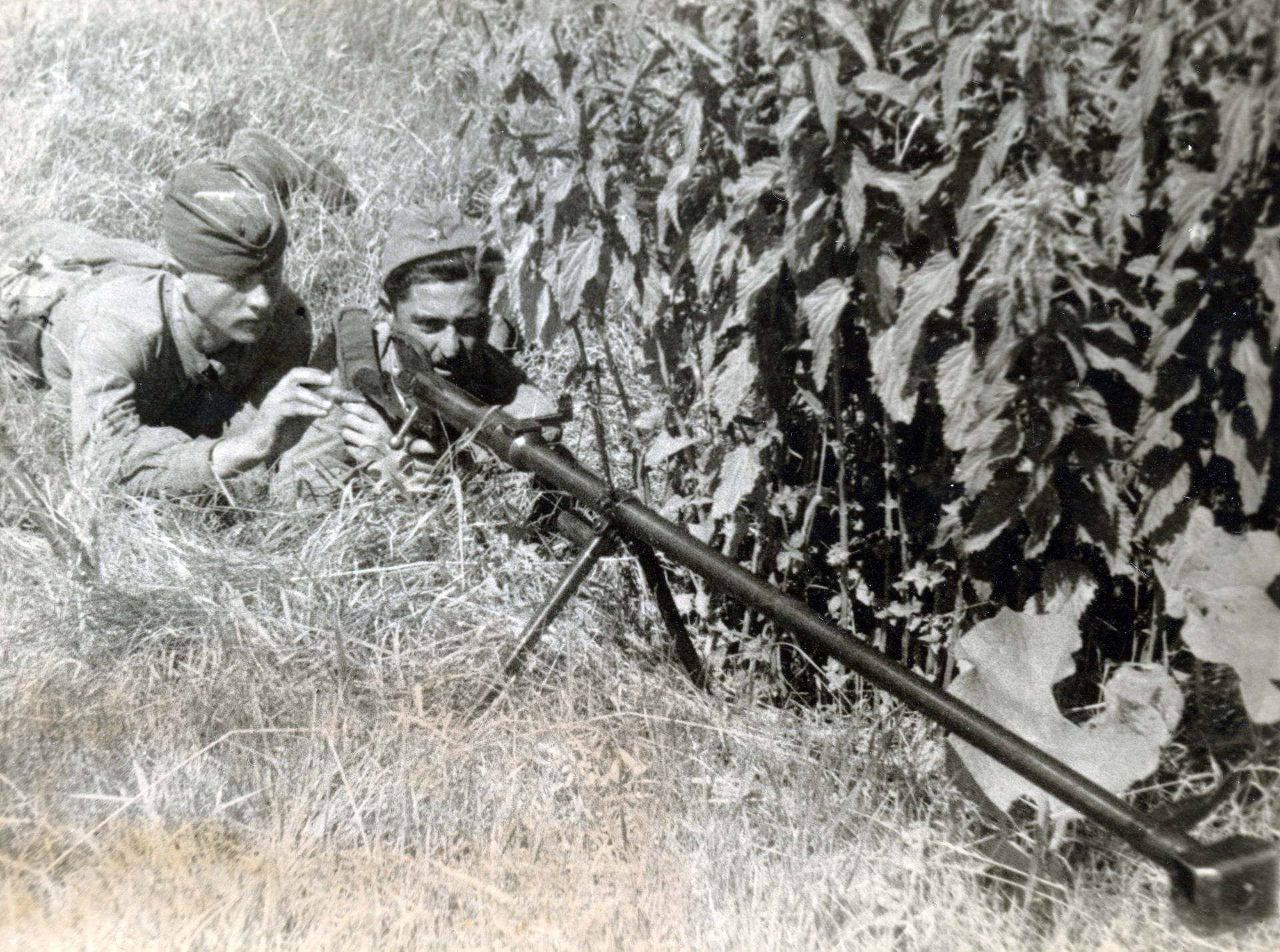
The Soviet PTRD-41 14.5 mm anti-tank rifle gave Soviet partisans a measure of anti-tank capability, along with powerful sniping and long-range bunker-busting ability. NARA
Mines & Explosives
The pamphlet “Rear Area Security in Russia” describes the Soviet partisans deadly use of mines and explosives:
Daily interruptions of traffic were caused by rail demolitions for which the Russians used various types of mines. Pressure and vibration-type mines were placed in the track, to be detonated by the locomotives. To destroy particularly valuable supplies, such as gasoline in tank cars, the partisans used mines with pull-type fuses which were set off by remote control. Retreating Russian forces often buried mines with long-delay fuses, under the tracks where they might blow up as much as three months later. Mines with simple delay-type fuses were also employed to avoid hitting the protective cars ahead of the locomotive. In order to escape the mine detectors, nearly all of these mines were placed in wooden containers, and their construction was of the most primitive type; some of them consisted of no more than a small package of explosives with a safety fuse. Occasionally, even magnetic mines were used. They served as means of sabotage in workshops and on standing trains and were mostly equipped with delay-type fuses.
Ultimately, using what firearms and supplies they could scrounge, the Soviet partisans played a vital role in hampering the German war machine until the Red Army could begin turning the tide on the Eastern Front. Today, most of the credit is given to the Red Army for Russia’s victory in the so-called Great Patriotic War, but the partisans did their job, too, often without the support or direction given to regular army troops.
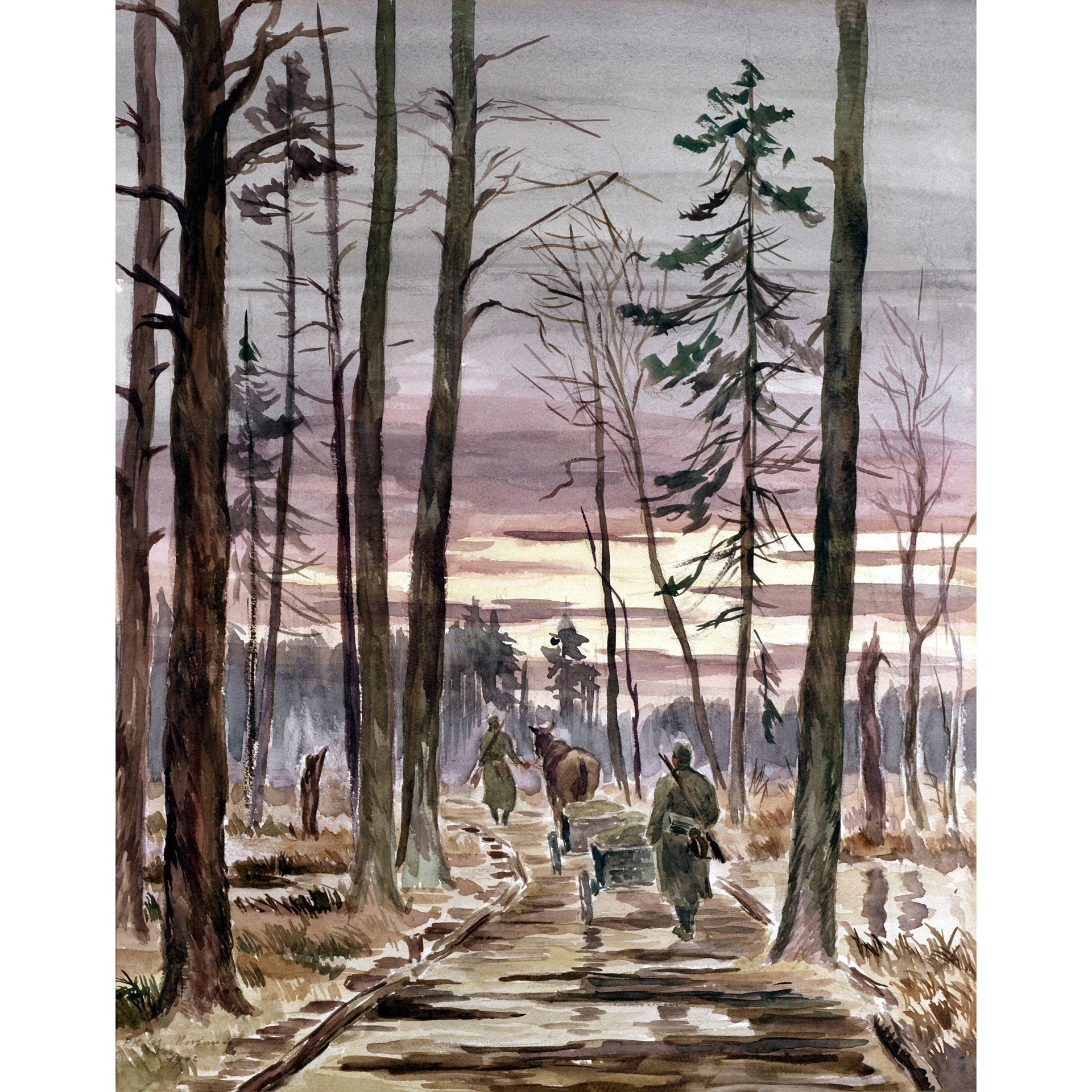
From a German wartime painting by G. Vorhauer, in the US Army Artwork Collection, the perfect environment for ambushes: Germany’s supply lines in Russia were long, lonely and difficult to defend. NARA
Greetings Me Droogs N Droogettes!
Latest word out of the Kraine via both sides is that casualty figures since June are positively abysmal. As I wrote up before, there have been (for the numbers involved) minor gaaaiinz by the AFU on a few fronts.
Of course the various Ministries of Propaganda and Lies have been spinning that out like one of Phil’s metal chip-making deee-vices in his garage… how many RPMs does one of them lathes spin up to again?

Per the article, which I won’t link because trash and total fantasy doesn’t get played here, not to that extent… but per the article : “Blinken said at a press conference in Ukraine that he is seeing “real progress” in the counteroffensive operation. “Ukrainian forces have taken back more than 50 percent of the territory seized by Russian forces since February of 2022,” he said.” (bold mine)
Nigga say what!?!
You know, back when I was in the Army, and even as a Contractor, we were subject to a LOT of drug tests…
Guess if you’re “High Enough” in the food chain, you’re exempt from the Meatgazer Brigade… (see what I did there?)
So
Let’s look at the map from CNN of all places:
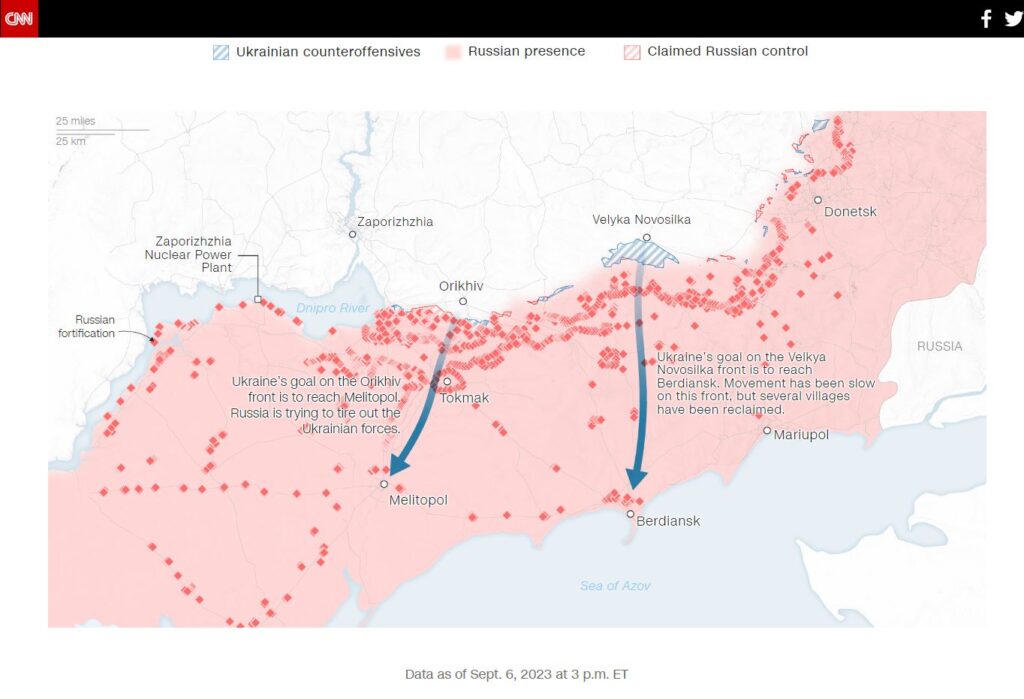
Them itty bitty blue ‘spots’?
Yepper… that’s what they’ve ‘taken’ and even then, like Blinken’s grasp of reality, it’s tenuous as fuck all. The counter-offensive has become a bit of a joke, or would be if it wasn’t so fucking tragic on how many lives are being lost.
To put it in perspective, the US lost 58000 DotMil and ‘others’ in ten years in Vietnam. According to some sources, the AFU lost 67000 since June of this year alone.
In fact, the ‘need for bodies’ is so bad, as I mentioned, the word out in the German newspaper Das Bilt is reporting that Germany has over 163,000 Krainian men of military age who may be dragged back to serve as cannon fodder for the
Krainian army. That’s a lot of bodies for the meatgrinder…
Poland is also beginning to extradite Krainian males eligible for or liable for military service who have been in Poland since the kickoff of the shitshow in question. Unlike the Krauts, the Poles are supposedly focusing on those who have entered the country illegally or have committed crimes, such as assisting illegal immigration, because they do not want such shitbags living in Poland ‘on the dole’. Word is also Krainian Kars (identified by their license plates) are being vandalized at an increasing rate, primarily because well, Poles man.
See, the Poles and Krainians, despite the face-to-face kissy-kissy their various politicos have made, they have traditionally hated each other. West Kraine used to be part of Poland, and they’d like it back, thank you very much. In fact that’s part of what’s been ‘floated’ (like the turd that it is) is that WHEN now (no longer IF) that the Kraine gets disassembled, that the Poles will take on Western Kraine as a ‘protectorate’. Otherwise? The Poles want them i’gnint fucking assholes to go back the fuck home…
Its not just limited to Poland and Krautsville either… seems the Ole Motherland Eire is getting in on the act:
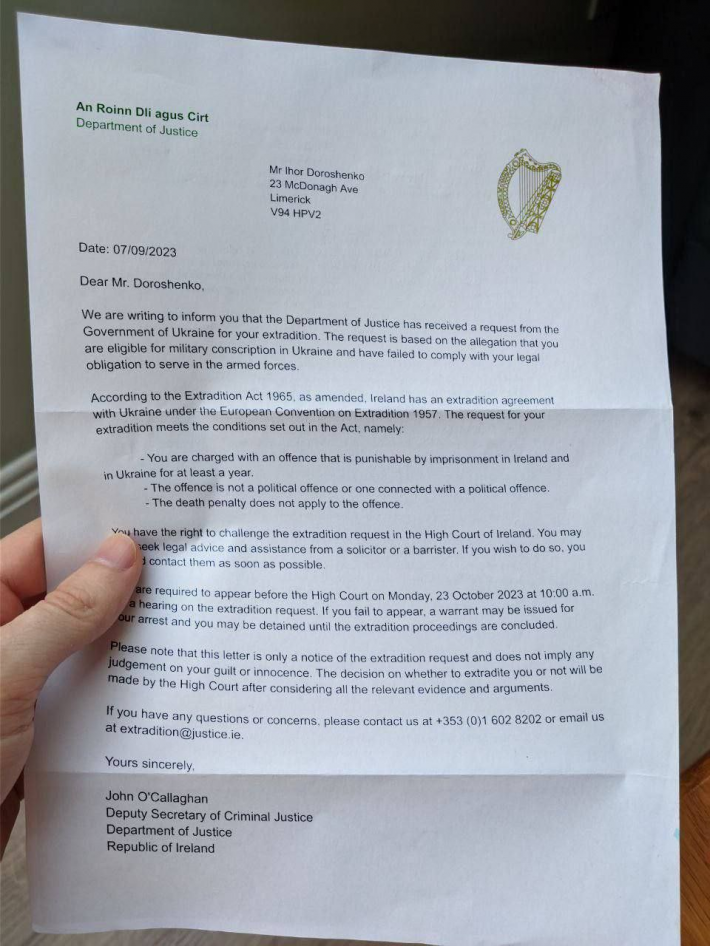
Looks like ol’ Ihor is well and truly fucked.

Truthfully, I can’t ever remember a time where a country at war officially requested the extradition of college/military aged folks back to the homeland for a War…
I mean Canada opened up and hid the draft dodgers during Nam… I did a goolag search and got bupkis using “has any country at war officially requested the extradition of college/military aged men before?” so I think this might be a modern ‘first’
It did tell me that the Krainians have also asked Belarus to send back about 60+/- guys, but the Belarusians told ’em to piss up a rope.
Good on them.
What this note tells me that when you need to forcibly bring home your men, shit is well and truly and utterly sideways as fuck.
This ENTIRE WAR at this point? It’s a losing prospect .
Already has been.
Ain’t going to be any winners, especially in the Kraine, no matter what others are saying. And it’s also starting to show in that public polls are turning against further funding. Only 9% of Germans are still behind continuing the slaughter… here in the states supposedly the polls say 43%, but these are the same polls that ALSO say 40% of Americans think that Poopypants is doing a good job as (p)Resident…

To be honest, I’d say we, as in The US, is rapidly approaching the endgame. We’re fucking broke and the world knows it, our “leadershit” is either permanently compromised/bought off/fucking retarded, and the Average Normie is even waking up… just look at the reaction to the soon-to-be Ex-Governor of New Mex-hee-co, Queen “Karen” Luzer-Cockgobbler and her utterly insane power grab. Putin has the advantages, plus time, and as I pointed out the other day, he only needs to let the Krainian DotMil keep ‘crashing uselessly at the gates’ and it’ll all be over by June of next year.
Barring any false flag/black swan events.
BTW: Keep an Eye on the 23rd of this Month
Jes’ Sayin’
As I am so fond of saying
Grab the Popcorn
Shit’s getting waaaay more entertaining.
More Later
Big Country


Categories