Category: War
10 Dark But Forgotten Parts of World War I
A POLITICO investigation finds that Russian companies have declared hundreds of thousands of rounds obtained from Western suppliers.
As gear reviews go, it was a glowing one: In a 60-second video clip posted on Telegram, a masked sniper sporting the death’s-head insignia of the Wagner mercenary army sings the praises of the Russian-made Orsis T-5000 rifle.
“The equipment comes very well recommended,” the soldier, pictured in the charred interior of a building, tells a war reporter from the Zvezda TV channel run by the Russian Ministry of Defense.
Pulling out the clip of the weapon at his side, he continues: “It uses Western .338 caliber ammunition. It works very well. It can penetrate light cover if the enemy is behind it. And, in the open, it can strike the enemy at a range of up to 1,500 meters.”
The Orsis T-5000 is made by a company based in Moscow called Promtekhnologiya that has been sanctioned by the United States.
And the “Western” ammunition?
Filings obtained by POLITICO indicate that Promtekhnologiya and another Russian firm called Tetis have acquired hundreds of thousands of rounds made by Hornady, a U.S. company that trademarks its wares as “Accurate. Deadly. Dependable.” Hornady, founded in 1949, sums up its philosophy with the phrase: “Ten bullets through one hole.”
The findings add to a growing body of evidence that supplies of lethal and nonlethal military equipment are still reaching Russia despite the West’s imposition of unprecedented sanctions in response to President Vladimir Putin’s invasion of Ukraine last year. The exigencies of war have exposed Russia’s lack of capacity to manufacture high-end sniper rounds, say defense experts, and that is fueling a flourishing black market for Western ammunition.
Information on the procurement of such gear is hiding in plain sight: Details of deals — importers, suppliers and product descriptions — can be found online by anyone with access to the Russian internet and a grasp of international customs classification codes.
Anything but bulletproof
In a “declaration of conformity” filed with a Russian government registry and dated August 12, 2022, Promtekhnologiya stated that it planned to source a batch of 102,200 Hornady lead bullets for the assembly of “hunting cartridges” used in “civilian weapons with a rifled barrel.” The specifications — .338 Lapua Magnum bullets weighing 285 grains — match those of a product in the Hornady catalog.
A second declaration bearing the same date is for a batch of “uncapped cartridge cases for assembling civilian firearms cartridges” made by Hornady with the same .338 Lapua Magnum specification.
The description is misleading: The .338 Lapua Magnum isn’t merely a “hunting cartridge;” it’s also a high-powered, long-range projectile that was developed by Western militaries in the 1980s and used by their snipers in Iraq and Afghanistan.
Reached by POLITICO, Steve Hornady, CEO of the family company based in Grand Island, Nebraska, denied selling ammunition to Russia in wartime.
“The instant Russia invaded Ukraine, we were done,” Hornady said in a brief telephone call.
Hornady declined at first to elaborate and, when asked to review the evidence, requested that it be sent by fax or courier as he did not use email. He eventually responded after POLITICO sent written requests for comment with supporting documentation by courier.
“We categorically are NOT exporting anything to Russia and have not had an export permit for Russia since 2014,” he replied. “We do not support any sale of our product to any Russian son-of-a-bitch and if we can find out how they acquire, if in fact they do, we will take all steps available to stop it.”
Hornady added that he had contacted the U.S. authorities following POLITICO’s inquiry. He pointed out that current U.S. law required that customers must obtain permission from the Department of Commerce to re-export articles made in the United States. “To the best of our knowledge, none of our customers violate that law,” he said.
Wagner chief Yevgeny Prigozhin, asked which ammunition his troops used, told POLITICO they had “a huge amount of NATO-issue ammunition left over from the Ukrainian army.” In a sarcastic voice message sent to a POLITICO journalist, the Russian warlord also asked for help procuring F-35 combat jets and U.S.-made sniper rifles, machine guns and grenade launchers.
Promtekhnologiya denied filing any customs declarations to import ammunition; said it had no relationship with Hornady; and that it had the capacity to manufacture its own ammunition. The company also said in emailed comments to POLITICO that the Orsis rifle and the ammunition the company makes are intended for “hunting and sporting” purposes and are freely available on the civilian market.
Both Promtekhnologiya and Alexander Zinovyev, listed as the company’s general director in the filings, have been sanctioned by Ukraine, which cites evidence that its Orsis rifles “have been used in Russian military operations in Eastern Ukraine.”
Promtekhnologiya is also in Washington’s sights: “We take any allegation of sanctions violation or evasion seriously and are committed to ensuring that sanctions are fully enforced,” a spokesperson for the National Security Council said in response to a request for comment from POLITICO.
“We have taken steps to hold Russia accountable for its war in Ukraine and have imposed an unprecedented sanctions regime to disrupt Russia’s ability to access funds and weapons that fuel Putin’s war machine. That includes sanctioning companies like Promtekhnologiya.”
Criminal, or wilful, violations of U.S. sanctions can trigger penalties of up to $1 million per violation, as well as up to 20 years’ imprisonment for individuals. Civil penalties can run to the higher of either twice the value of the underlying transaction or around $350,000 per violation.
Describing military-grade ammunition as for hunting or sporting use, as the filings do, amounts to a thinly veiled ruse to evade targeted “smart” sanctions aimed at starving the Russian military of the means to fight the war, said defense analyst Maria Shagina.
“Strictly speaking, smart sanctions are not supposed to target anything civilian to avoid humanitarian collateral damage,” said Shagina, a research fellow at the U.K.-based International Institute for Strategic Studies. “But the targets in authoritarian countries will really exploit this.”

Russia reloaded
Another Russian buyer of Hornady ammunition is a company called Tetis, which has disclosed two shipments since Russia’s full-scale invasion of Ukraine began on February 24, 2022. The most recent was in April for more than 300,000 “units” comprising a wide range of products that checked out with the Hornady catalog.
The main owners of Tetis, Alexander Levandovsky and Sergey Senchenko — who each own stakes of 41.1 percent — have links to the Russian military.
Both were previously listed as shareholders in another company called Kampo, which according to company filings holds licenses to make weapons and military equipment and has done business with the Ministry of Defense and the Special Flight Detachment that operates Putin’s presidential plane.
Although Tetis doesn’t offer Hornady ammo on its website, it does advertise itself as an international distributor for RCBS, a U.S. maker of reloading equipment. This is used to assemble cases, primer, propellants and projectiles into cartridges that can then be fired — as seen in this video posted by a Russian gun enthusiast.
A database check revealed that the most recent declaration of conformity filed by Tetis for RCBS, for electronic weighing scales, predated Russia’s full-scale invasion on February 24 of last year by just over a month.
Russia’s trade bureaucracy allows local firms to vouch for the goods they are importing by filing declarations of conformity, such as those that mention the Hornady products. This means that the supplier listed on the form may not be aware of specific shipments that could have been handled by an intermediary.
Tetis did not respond to an emailed request for comment.
Matt Rice, a spokesman for RCBS owner Vista Outdoor, said Tetis was no longer an international distributor for RCBS. “Following Russia’s invasion of Ukraine, our business made the decision to end all sales of goods with the country,” Rice said in an email, adding that RCBS would remove the listing for Tetis from its website.
Doing the rounds
Hornady ammunition or its components are freely available in Russia, along with other high-end foreign military gear.
Take the “Sniper Shop” on Telegram, an encrypted messaging app that is popular in Russia: It features a current offer for a full range of Hornady products, with the seller inviting buyers to visit a showroom in Sokolniki, a Moscow district, and offering delivery throughout Russia by courier or post. Contacted by POLITICO, the poster confirmed the Hornady ammo was in stock but declined to comment further on how it was sourced.
Then there is “Anton,” who advertises products from Hornady and RCBS on his profile. He also touts gear from Nightforce, maker of thermal optical sights; Lapua, which helped design the eponymous .338 ammo; MDT, a maker of chassis systems, magazines and accessories for rifles; and precision gunsmith AREA 419. All are American with the exception of Lapua, which is based in Finland and owned by a Norwegian company called Nammo.

“Anton” posted an offer for Hornady cartridges last October 24. Contacted via Telegram to ask whether he was still stocking Hornady, he replied: “We don’t do ammunition.”
POLITICO has, in the course of its research, also found declarations from several other Russian companies for ammunition made in Germany, Finland and Turkey.
The thriving black market reflects a structural deficit in Russia’s war economy. Its military-industrial complex can produce good small arms, like the Orsis rifle, but lacks the capacity to churn out the amount of ammunition needed by an army fighting a war across a front stretching hundreds of miles.
“Despite the quality of the rifles produced, a successful hit directly depends on the components used in the cartridges, and they, unfortunately, are imported,” a correspondent lamented in a post on a Russian military news site a few months into the war. Gunpowder produced in Russia lacks stability, the correspondent added, saying this is “unacceptable in the framework of high-precision shooting.”
The continuing access to specialized rifle cartridges made in the West, such as the .338 Lapua Magnum, by a sanctioned Russian small arms manufacturer like Orsis maker Promtekhnologiya is “egregious,” said Gary Somerville, a research fellow at the Royal United Services Institute (RUSI), a British defense think tank.
“At present, there is only one manufacturer of this cartridge in Russia,” he added. “Preventing the shipment of these types of ammunition from Western countries to Russia is an easy win for those seeking to constrain Russia’s ability to wage war in Ukraine.”
Balkan route
It’s not just ammunition from the U.S. that is reaching the battlefront around Bakhmut in eastern Ukraine, recently captured by Prigozhin’s mercenaries after a bloody, months-long battle.
There also appear to be cartridges from the European Union, which has imposed no fewer than 10 rounds of sanctions against Russia in a so-far inconclusive attempt to starve Putin’s war machine of the means to fight on.
Promtekhnologiya has filed four declarations since October covering shipments of 460,000 units described as “Orsis hunting cartridges” — most are of the .338 Lapua Magnum type. These identify a Slovenian company called Valerian as the supplier.
The first of the filings, dated October 13, 2022, includes an air waybill number whose first three digits — 262 — indicate that the shipper was Ural Airlines, a Russian carrier. It was not immediately possible to trace the route of the flight, however.
Valerian was founded on the eve of Russia’s invasion of Ukraine with paid-in capital of €7,500 by Gašper Heybal, who previously worked for U.S. military outfitter Voodoo Tactical. On its home page, Valerian says: “Our goal is to equip you for your mission, whatever it might be, and wherever you are going.”
In online posts over the past decade — including on a Facebook Group called EU Guns with a declared mission of “easier transfer of weapons between European gun owners” — Heybal has done little to dispel the impression that he is an active small arms dealer.

The telephone number Heybal shared publicly in those posts is the same as the one for Valerian, which is registered at an address in a village around 40 minutes’ drive southeast of the Slovenian capital Ljubljana.
Reached at that number, Heybal denied that Valerian had shipped ammunition to Russia: “We don’t sell any … firearms or ammunition, and also there is an embargo on Russia,” said Heybal.
In a follow-up email on the declarations of conformity, Heybal said: “Firstly, we must stress that we do not know, nor do we understand how the name of our company, Valerian d.o.o., appears on the document.”
“Secondly, Valerian is not listed there as a supplier but as the producer, and this is not possible, as we do not produce ammunition. That being said, it still makes absolutely no sense to us as to how our name could appear on it. We are glad you brought this to our attention so we can figure out what is going on.”
A Slovenian diplomat said that, while Valerian had never applied for authorization to export weapons or ammunition to Russia, it had shipped “individual parts” to Kyrgyzstan.
The Central Asian state is one of the countries that the EU has in mind as it discusses an 11th round of measures targeting third countries that are suspected of helping Russia evade sanctions.
“The competent services in the Republic of Slovenia have already initiated the appropriate procedures to investigate the facts concerning the company,” the diplomat told POLITICO, adding that they would verify the possible diversion of goods to the Russian Federation. “Slovenia is firmly committed to supporting Ukraine, we have been supportive of all sanctions packages and especially this anti-circumvention one.”
An official at the European Commission deflected a request for comment, saying the bloc’s member countries were responsible for implementing sanctions. “As this seems like a very specific case, these allegations need to be investigated further by the competent authorities,” the official said.
Sergey Panov reported from Spain, Sarah Anne Aarup from Brussels and Douglas Busvine from Berlin. Additional reporting by Steven Overly in Washington.
Both of these projects were the MOST expensive war programs in WWII! Several BILLION 1945 Dollars but I think that we got our monies worth. Grumpy
Weird Weapons Used in War
The foremost virtue of the combat shotgun is decisive stopping power. Nothing is 100 percent and, for all its virtues, the shotgun isn’t perfect. It kicks, especially with magnum buckshot or rifled slug loads. The recoil is more than many people can handle and requires a certain amount of size, weight, strength and experience.
I work with police on a fairly regular basis. I’ve asked recruits what part of their training is most unpleasant. Usually it is getting zapped with pepper spray and qualifying with the shotgun. Many recruits have never touched a firearm until they’ve started police training. They don’t practice with the shotgun any more than absolutely necessary to qualify, and such unfamiliarity leads to accidents.
In one case, an officer chambered a round while backing-up her partner during an arrest. After the suspect was in custody, she fumbled with the action, trying to clear the chamber before. The gun fired. A bystander on the other side of the street caught a pellet and lost an eye as a result.
The pattern of a shotgun is sometimes sold as a virtue with platitudes like “Just point it in the general direction and you’re bound to hit the bad guy.” It can also be a flaw. The shotgun loaded with buckshot puts a lot of projectiles in the air with every shot.
An officer responding to a domestic disturbance call was confronted by a woman at the door, some 18 yards away, armed with a high powered rifle. The officer took cover behind his vehicle, retrieving the shotgun from its rack and ordered the woman to put the rifle down. She fired at the officer and missed. As she reloaded for a second shot, the officer aimed center of mass and fired a fatal blast from the 12 gauge. Unquestionably the officer was justified in using deadly force. But behind the woman in the darkened room, invisible to the officer, was her six-year-old son. Two pellets from the spreading pattern struck and killed him.
Recoil and liability concerns have led many departments to rethink the role of the shotgun. Some have adopted the .223 or pistol-caliber carbines, either as replacements or in addition to the shotgun. Others are adopting new and better shotgun loads. The new low-recoil loads have solved most of our concerns with the shotgun.”
Federal, Remington and Winchester have done a terrific job in developing better loads. These low-recoil rounds kick less, increasing shooter
confidence and improving qualification scores. And with better technology they are actually more effective.
An armorer for a large police service commented, “With our old buckshot loads, on a 25-yard silhouette target, we might get only half the pellets hitting paper. With the new stuff we’ve had shotguns put all nine pellets into the head of the target at 25 yards.”
Full-power buckshot and slug loads are intended for big-game hunting. Ranges typically start at 25 yards, out to 100 yards or more with slugs. The combat shotgun is most often used at pistol ranges, often measured in feet rather than yards. The high velocity generated by hunting loads really isn’t needed.
According to the armorer, “The low-recoil ammunition isn’t just for practice. Our officers can select either buckshot or slugs, but only low recoil loads are authorized.”
This department believes low-recoil ammunition has enhanced the utility of the combat shotgun. Officers practice more, flinch less, shoot better and have more confidence. Greater accuracy and tighter patterns improve both officer and public safety.
Recent developments in recoil pads shouldn’t be overlooked. Competitive superstar Jerry Miculek called the Remington R3 recoil pad on his competition shotgun, “The best shooting accessory you can buy.” It is amazingly effective.
With better recoil pads and improved loads, the combat shotgun should do an even better job of guarding those who protect and serve.
For more information:
Federal Cartridge
Co., (800) 322-2342, www.federalcartridge.com
JP Enterprises, (651) 426-9196
www.jprifles.com
Remington Arms, (800)
243-9700, www.remington.com
Winchester Ammunition, (618) 258-2000
www.winchester.com
Wilson Combat, (870) 545-3618
www.wilsoncombat.com
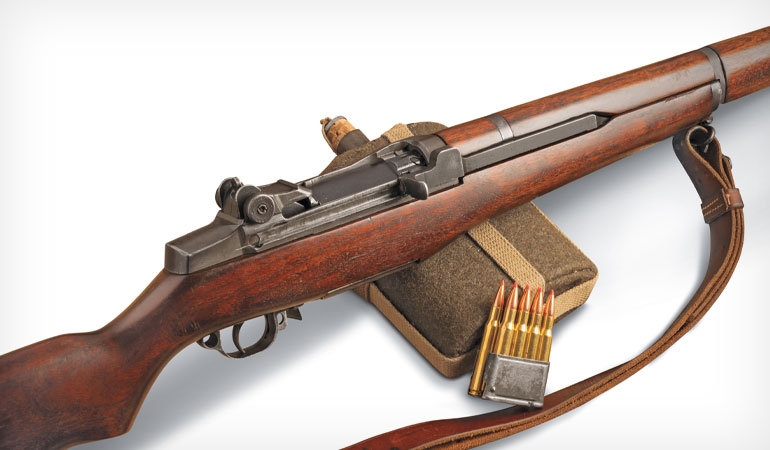
This is absolutely something that happened often enough to be notable. Although the ammunition would not be interchangeable between American and German rifles, making resupply a considerable issue, the Germans in World War II had a certain habit of scavenging just about anything they could capture and by the end of the war they had collectively captured millions of rifles from everyone they fought and ultimately lost to. In typical German fashion, nearly every foreign piece of equipment captured intact got its own designation.
For instance, the M1 Garand received the designation “Selbstladegewehr 251(a)” while the M1 Carbine received the designation “Selbstladekarabiner 455(a)” with the (a) part of the designation in both cases denoting America as the country of origin. In additions to small arms, captured foreign tanks were extensively used throughout the war and captured foreign artillery saw considerable deployment along the Atlantic Wall, the coastal fortifications which ran from Norway to the Franco-Spanish border.
There are many photographs of Germans with captured allied weapons; some are even colorized.
Seen above are numerous Garand rifles and Thompson submachineguns. Seen below is an M1 Carbine.
Seen below is a captured Soviet SVT-40.


