Categories
Category: War
Categories
Military Engineering
By Robert Barr Smith
Some Tommies swore it had been St. George, the warrior saint of England. Others said the “Angels of Mons” might have been St. Michael, since he carried a gleaming sword. A few said they couldn’t tell, but it had definitely been an angel, maybe more than one. Some men were sure they had seen three wonderful, tall figures towering above the smoke and dust of the battlefield. For others it had been a brilliant light, a golden aura against a brilliant sky, or a cloud in which indistinct but heroic figures had come and gone, aided by phantom archers from the olden days of the English warrior-kings. Whatever it was, the soldiers agreed, it had saved their lives. No amount of civilian scoffing would ever change that.
Skeptics back in England and America did scoff, but that was to be expected. Well-meaning clergymen and physicians made wise and condescending remarks about hysteria, battle fatigue, and fear. Others shook their heads knowingly and tut-tutted about superstition and overactive imaginations. Perhaps that was what had caused these “visions,” as the newspapers called them. But the naysayers and doubters hadn’t been there. They hadn’t fought against enormous odds, with comrades dying next to them, baked by a remorseless sun and drenched with rain. And they hadn’t walked the dreadful road west from Mons itself.
It was 1914 when the Angels of Mons were first reported by World War I soldiers. Europe flamed and thundered with the red ruin of war. The roads of France and Belgium swarmed with endless columns of dusty infantry, miles of horse-drawn guns and wagons, and miserable hordes of Belgian civilians trying to move what remained of their lives in carts. Over the miles, from the Swiss frontier to the Belgian fortress of Liege, the armies clashed and the casualties mounted. In those terrible days of August heat, the powerful German right wing swung like a great fist west and southwest from the Belgian frontier and struck deep into France.
The German Offensive Kept the British and French Guessing
While the French threw away much of the flower of their army in head-on assaults against the German forces, the great right hook of the German offensive struck the Allied left, falling on a segment of the French army and the small but doughty British Expeditionary Force. The BEF comprised much of Britain’s tiny regular army, a minuscule force of four infantry divisions and five cavalry brigades when compared to the multitude of German army corps advancing on Paris.
The BEF moved east toward the advancing Germans, marching across storied ground past Malplaquet, where Marlborough had whipped the French two centuries before. Up ahead was the field called Waterloo. Nobody was quite sure where the Germans’ main stroke would fall.
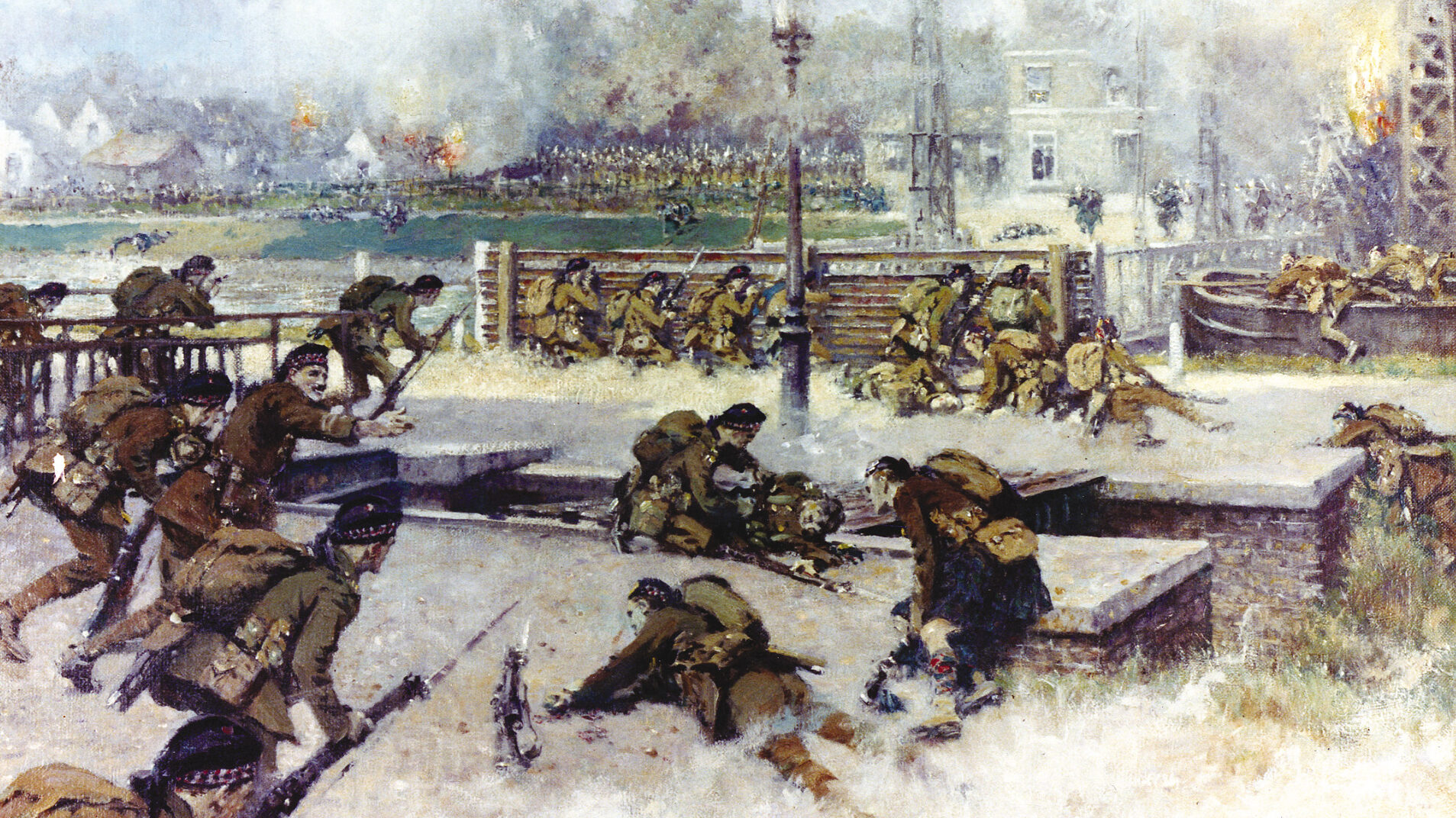
The first heavy fighting swirled around the Belgian city of Mons, a dreary industrial area studded with gray villages, dismal slag heaps, and shabby factory buildings. There, on Sunday, August 23, Sir Horace Smith-Dorrien’s II Corps took on the German juggernaut along the Conde Canal. The slimy, stinking 60-foot waterway was not much of an obstacle, but it would slow down the Germans and make them optimum targets.
Smith-Dorrien’s two divisions, stretched thin over 21 miles, found themselves attacked by two German corps, with another closely approaching and still another on the way. Although the British were badly outnumbered, their massed fire stopped the Germans cold.
In the morning, its right flank now uncovered by the French retreat, the BEF retreated, tramping down the long, hot road toward the west. Back they went in the heat and dust, occasionally turning to bloody the German corps pursuing them. Again and again the BEF’s murderous musketry reached through the shimmering heat of the French fields to drop graycoated German infantry in heaps hundreds of yards away. But there were simply too many enemy infantrymen and too much artillery. The BEF fell back from Mons step by grudging step, leaving behind them more graves, more old friends buried far from England.
The worst of the fighting was around Le Cateau, fought on the anniversary of Edward III’s great victory over the French at Crecy. It was not a place the II Corps commander would have chosen to fight, but Smith-Dorrien wisely elected to make a stand rather than try to disengage and withdraw in the face of overwhelming numbers. His men were tired, time was short, and the roads were clogged with transport columns and hordes of refugees.
The odds were 4-to-1 against the BEF in infantry, plus the usual German superiority in guns. All through the morning of August 26 and into the afternoon, Smith-Dorrien’s troops held up the German steamroller with their deadly riflefire. With the enemy lapping about his flanks, Smith-Dorrien passed the order for a fighting withdrawal.
“The Germans May be Able to Kill Them, but by God They Can’t Beat Them”
That night the BEF fell back in darkness and driving rain. Many of the men had reached the end of their endurance; some had not eaten in 24 hours. Still they slogged on. A British division commander, tears in his eyes, paid them the ultimate compliment: “The Germans may be able to kill them, but by God they can’t beat them.” But the Germans were coming on in such overwhelming numbers that rifles and courage could not hold them any longer. It was then, in a time of deadly crisis, that the Angels of Mons, of wonderful tales of heavenly help, began to appear.
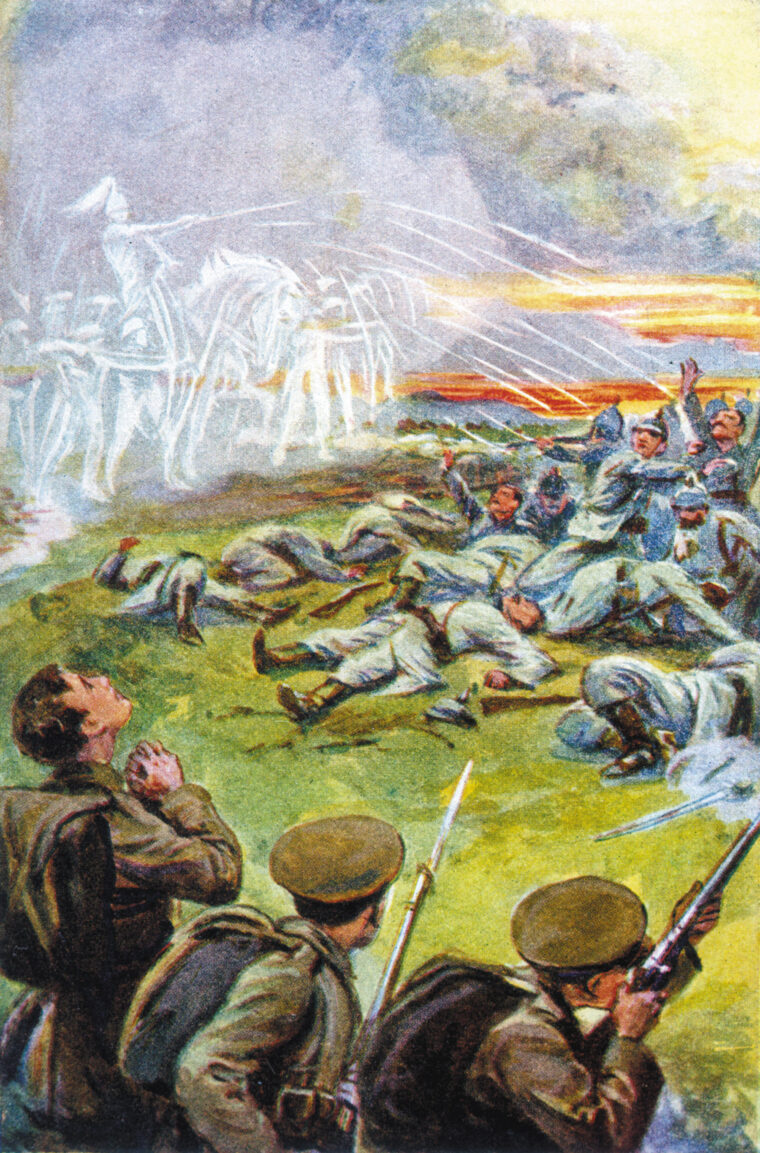
In one action during the long retreat, an understrength British battalion, about to be overrun by masses of German infantry, became aware of a shadowy army fighting beside them, an army of bowmen of the days of Agincourt, five centuries gone. These phantom men-at-arms cried aloud to St. George, and their swift arrows darkened the sky. A great voice was heard to thunder over the din of battle, “Array, Array!” German prisoners taken in the action said they were bewildered that their British opponents had reverted to wearing armor and shooting arrows.
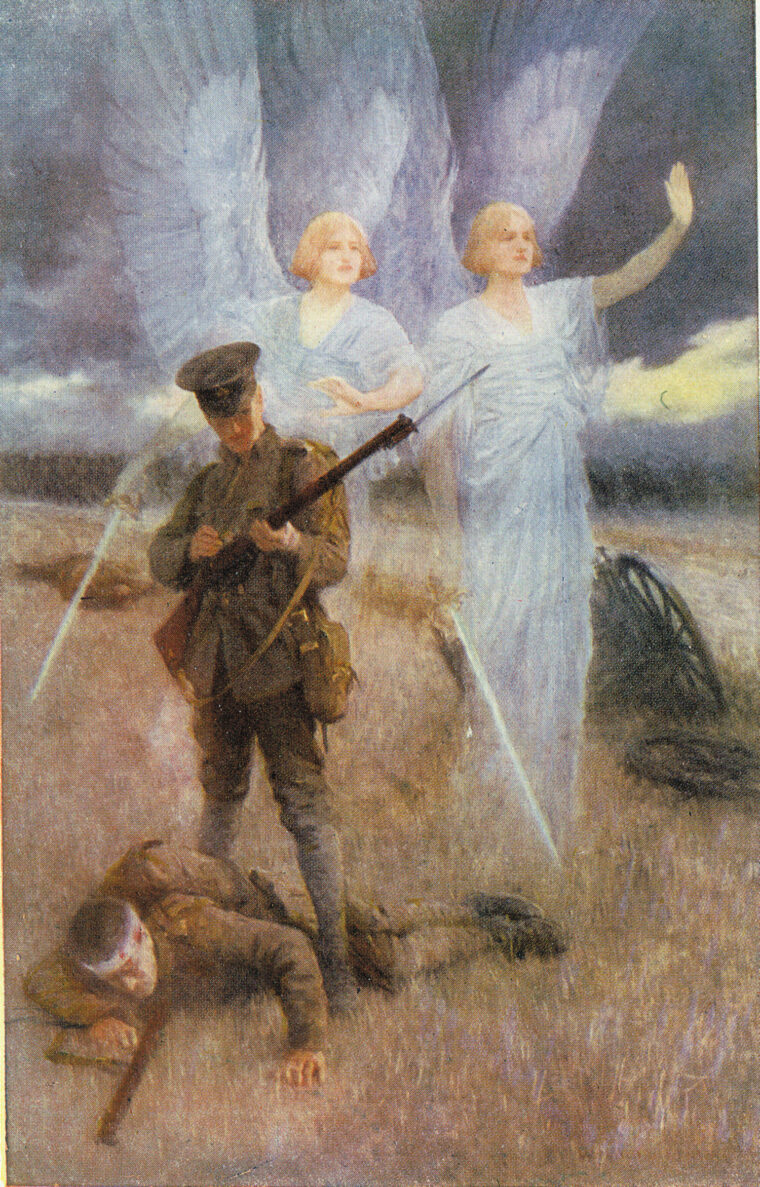
In the night of the 26th, the third day of the retreat west through Belgium, weary British soldiers saw tall, unearthly figures materialize in the gloom above the German lines. They were winged like angels, and as they hovered in the gathering darkness, the Germans inexplicably halted and the British slipped away to safety.
During the retreat, some soldiers swore that they had seen the face of the patron saint of England. A wounded Lancashire Fusilier asked a nurse for a picture or medal of Saint George because, he said, he had seen the saint leading the British troops at Vitry-le-Francois.
A wounded gunner confirmed his story. He described the saint the same way the fusilier had—a tall, yellow-haired man on a white horse, wearing golden armor and wielding a sword. Other soldiers agreed that he looked just like his image on the gold sovereigns of the day.
A story appeared in the North American Review in August 1915 about a soldier who had memorized the motto inscribed on the plates in a London restaurant. Adsit Anglis Sanctus Georgius it read, “May St. George be a present help to England.” Later, in Belgium, the soldier prayed for the saint’s help against the waves of German attackers and was rewarded by a host of shining bowmen, who charged the Germans with shouts of “Harrow! Harrow! Monseigneur St. George, Knight of Heaven, Sweet Saint, succor us!” The arrows of the phantom archers cut down the enemy en masse, and the German General Staff, finding the bodies of hundreds of their men lying on the battlefield with no discernible wounds, came to the conclusion that the British had used poisonous gas.
Saved by a The Angels of Mons: a Miracle of God
Three soldiers were interviewed separately by the vicar of a church near Keswick, in the north of England. All agreed that a miracle had saved them from a massive German force about to overrun their unit. As the hard-pressed British troops prepared to fight to the end, the Germans suddenly recoiled. German prisoners explained that the attack was aborted because they saw strong British reinforcements coming up. In fact, the ground behind the British unit was empty. The men interviewed had no doubt who authored their salvation: “It was God did it,” they said.
One lance-corporal told his nurse of the appearance of angels during the Mons retreat. He could see, he said, “quite plainly in mid-air a strange light which seemed to be quite distinctly outlined and was not a reflection of the moon nor were there any clouds. The light became brighter and I could see quite distinctly three shapes, one in the center having what looked like outspread wings. The other two were not so large, but were quite plainly distinct from the center one. They were above the German line facing us. We stood watching them for about three-quarters of an hour. All the men with me saw them. I have a record of fifteen years’ good service, and I should be very sorry to make fool of myself by telling a story merely to please anyone.”
The soldier also told his story to another woman, a Red Cross hospital superintendent who interviewed the man and believed him implicitly. So did Harold Begbie, a writer on the supernatural, who related this tale in his 1916 book, On the Side of the Angels. Begbie was impressed with the soldier’s transparent honesty. Begbie also interviewed another soldier who spoke of a “bright light in the sky.” Still another told Begbie that he had heard men in France talking about the celestial apparitions. “He was,” Begbie wrote, “definitely conscious of a supernatural presence.” The soldier in question was a Grenadier Guards NCO, hardly a type given to hysteria and delusion.
Another tale was told of a Coldstream Guards unit lost in the gloom of early morning. One man saw a glow in the darkness, a glow that became the figure of a female angel, dressed in white, with a gold band around her hair. Gesturing to the tired guardsmen, she led them through the night to a sunken road, a way out of danger that Coldstream patrols had not been able to find—and afterwards could not find again on any map.
An Englishwoman nursing in France wrote of a wounded Lancashire Fusilier who asked her for a religious medal. Was he Catholic, she asked? No, he said, he was a Methodist, but he had seen St. George mounted on a white horse, leading the British into action against overwhelming odds. “The next minute,” he said, “comes this funny cloud of light, and when it clears off there’s a tall man with yellow hair, in golden armor on a white horse, holding his sword up, and his mouth open as if he was saying, ‘Come on, boys! I’ll put the kibosh on the devils.’ Then, before you could say ‘knife,’ the Germans had turned, and we were after them, fighting like ninety.”
Accounts of heavenly aid abounded in Britain. The magazine Light ran a story entitled “The Invisible Allies” in October 1914, and followed up another column the next April reporting that during the retreat from Mons several officers and men had seen a cloud appear between them and the Germans.
The Catholic paper The Universe reported an account from a Catholic officer in which an isolated British party decided to charge the enemy head-on. Running into the open, somebody yelled, “St. George for England in the good old style,” and all around the British appeared a spectral company of archers. The British carried the German trench, and a German prisoner later asked the officer who the “officer on a great white horse” had been, for the German riflemen had not been able to hit him.
Were the Angels of Mons an Angelic Army, or Mass Hysteria?
The parish magazine of All Saints, Clifton, reported that two officers had seen a troop of angels between their men and the enemy. The same magazine told the story of another soldier who had seen the same troop of angels standing between him and onrushing German cavalry. The Germans’ horses had panicked and run uncontrollably, allowing the British soldiers to reach safety. A soldier of the Cheshire Regiment saw the angels too, and watched the German cavalry horses panic and bolt before their terrifying presence.
Throughout the spring and summer of 1915 more stories surfaced. The “luminous cloud” between Germans and British appeared again, and the Bath Society Paper quoted an extract from an officer’s letter: “I myself saw the angels who saved our left wing from the Germans during the retreat from Mons. We heard the German cavalry tearing after us and ran for a place where we thought a stand could be made. We saw between us and the enemy a whole troop of Angels.”
A soldier of the West Riding Regiment told a group of Canadians that he had actually seen the angel, and a wounded soldier described to a young woman the same thing: an angel, wings spread, standing between his unit and the Germans. The woman, unconvinced, repeated the story later, and a British colonel told her simply: “Young lady, the thing happened. You need not be incredulous. I saw it myself.”
Captain Hayward, an intelligence officer with British I Corps, referred to the Angels of Mons as “four or five wonderful beings,” robed in white, who faced the German lines in brilliant sunlight with hands upraised to halt the advancing enemy. He referred to another occasion on which “the sky opened with a bright shining light and figures of luminous beings appeared.”
A Weymouth clergyman read a letter from a soldier who had slogged through the Mons retreat. The man said he and his comrades had been trapped in a quarry by German cavalry, when suddenly angels lined the edge of the quarry and the Germans broke into panicked flight.
Those who scoffed at tales of St. George, angels, and phantom bowmen were quick to point out that it was difficult to obtain firsthand, authenticated evidence, which was certainly true.
So what inspired the stories of angels, spectral archers, the mighty figure of St. George? Was it hysteria, fatigue, fear, wishful thinking? Perhaps. But it is worth remembering that the men who told these stories, however exhausted, were tough, experienced soldiers used to such hardships. And a great many of them saw identical sights at different times and in different places. Maybe some of the stories were invented. Maybe all those who said they saw a miracle were simply hallucinating, as the scoffers said. Maybe it was, after all, merely mass hysteria.
But maybe it wasn’t.
While a broad and diverse variety of small arms were used in the Second World War, we typically only think of a list of “usual suspects” when imagining the struggle for Europe. The M1 Garand, the MP40, the Lee-Enfield, the MG42, and the M1911A1 are the guns that come to mind first and foremost.

Rarer firearms show up from time to time in photographs and motion picture film footage, but the uncommon guns remain obscure because we see less of them. This is why archived photos and footage are important documents that show us what was being used and where. Photos and video footage recording the wartime use of obscure examples of World War II firepower are worth paying special attention to.
An incident occurred in occupied Rome on March 23, 1944, during which a fascinating assortment of obscure World War II weapons were captured on film. Because of the presence of a German Army Kriegsberichter (War Correspondent) named Lutz Koch who shot about a dozen photographs, the guns that were a part of the incident can be easily observed and identified.
The Ambush
It all happened on the Via Rasella, a narrow, 850-foot-long cobblestone street leading uphill from the Via Del Traforo to the Palazzo Barberini in Rome’s Municipio I district. Shortly before 4:00 pm, 156 men from the 11th Kompanie of the 3rd Battalion of Polizeiregiment “Bozen” began to climb the Via Rasella. Although they did not know it at the time, they were walking into an ambush set by partisans in the Italian resistance.

Proceeding through the intersection with the Via del Boccaccio, the column began passing an unexceptional rubbish cart along the road. The cart did not arouse suspicion before an improvised explosive device concealed in it exploded violently, ripping into the column of troops.
As the smoke cleared from the explosion of the bomb, eleven members of a Roman resistance group known as the Gruppi di Azione Patriottica (Patriotic Action Group or GAP) launched a sharp but brief rear guard attack. Italian fighters ran out into the middle of the Via Rasella from concealed positions along the Via del Boccaccio and opened fire on the survivors of the 11th Kompanie with pistols. Three more GAP members contributed gunfire from the top of the hill at the Via Rasella’s intersection with the Via delle Quattro Fontane. Then, after only a few seconds, the partisans disappeared into the cityscape.

Just like that, the whole thing was over. The bodies of 28 dead and over 100 wounded military policemen littered the Via Rasella. Five more members of the Polizeiregiment would ultimately die due to wounds received during the attack. None of the partisans were injured during the Via Rasella attack.
Immediate Response
Reaction to the Via Rasella attack was swift and brutal as the survivors of the 11th Kompanie began shooting indiscriminately in the direction of the Via del Boccaccio. Assuming that some of the shots had come from one of the windows on the upper floors of the building on the corner, they directed rifle and submachine gun fire at all of them.

As those shots were still being fired, Koch began taking photographs at the scene. He documented the damage caused by the bomb, the debris it tossed into the street, and a mixture of troops from 11th Kompanie and policemen from the Polizia dell’Africa Italiana (PAI) and the Guardia di Finanza (GdF), and the Regio Corpo di Pubblica Sicurezza (PS).
In these initial photos taken on the Via Rasella itself, three firearms can be seen: the 9mm MAB 38 submachine gun, the 9mm P-38 pistol, and the 6.5×52mm Model 1941 Carcano rifle.

When first adopted more than five decades earlier, the Carcano had been one of the most advanced rifles in the world because it provided the Kingdom of Italy with a six-shot smokeless-powder repeater. The original 50.6-inch-long Carcano Model 1891 rifle served through the Boxer Rebellion, the Italo-Turkish War, and World War I, but then during the Mussolini era the modified Model 1941 improved the design.
It retained the same action and magazine as the old Model 1891 rifle but was equipped with a four-inch shorter barrel and a carbine-style adjustable rear sight assembly. Model 1941 Carcano rifles are conspicuously present in most of Koch’s photographs taken on the Via Rasella immediately after the attack.
As the survivors of the 11th Kompanie continued shooting toward windows at the corner of the Via Rasella and the Via del Boccaccio, the curtain rose on another drama at the top of the hill on the Via delle Quattro Fontane.

Kriegsberichter Koch soon was working his way up the street when he encountered a stop-and-search operation just outside the gates of the Barberini Palace. There, Polizia dell’Africa Italiana, Guardia di Finanza, Questure di Roma, and Carabinieri officers working alongside troops of the 11th Kompanie had lined up a group of about 75 Roman men. The troops were holding the Italian citizens at gunpoint.
The images that Koch captured on film during the minutes that followed showed more uncommon firearms. Included in the photos were additional MAB 38 submachine guns and Model 1941 Carcano rifles.

Several other noteworthy Axis firearms can also be seen. A single Carcano Moschetto Modello 1891 with its distinctive 18″ pencil barrel and folding bayonet, shows up in one photograph. This provides a reminder that this variant of the Carcano saw widespread use during the Second World War. First adopted in 1893, the Moschetto Modello 1891 gave the Italians a lightweight, compact, and more practical Carcano with a modest 36″ overall length that was more appropriate for cavalry and mechanized troops not needing a full-length rifle.
The other bolt action service rifle physically present during the dragnet operation near the palace was none other than the incomparable German Kar98k Mauser. In addition, two versions of the long-serving Pistola Rotazione Sistema Bodeo in 10.35×22mm Rimmed (10.35mm Ordinanza Italiana) show up in Koch’s photos.

A six-shot, single-action/double-action revolver, the Bodeo had been around for more than 50 years. The old workhorse was known for being reliable and simple. The first Bodeo seen at the site of the round-up was a Tipo Ufficiali (“Officer’s Model”) with a 4.53″ barrel and a trigger guard. The other was a Tipo Truppa (“Enlisted Model”) with the same length barrel, no trigger guard, and a distinctive folding trigger/safety.
These guns played a central role in presenting the intimidating police presence that characterized how the city of Rome was being controlled under German occupation. Despite all that firepower, the Roman resistance represented a real danger because it could strike anywhere and anytime.
Lasting Impact
The Via Rasella ambush on March 23, 1944, was the largest partisan attack carried out in occupied Italy. It came at a complicated time in the war. Allied forces were closing in on Rome from Monte Cassino to the southeast and from the Anzio/Nettuno beachhead to the south.

Even with Allied troops taking ground from the Nazis in Italy, the German occupation of the Eternal City was still strong. Consequently, the liberation of Rome was still more than a month away.
Koch’s photos of the aftermath of the Via Rasella attack documented the insistent grip of Germany on Rome while also showing the vulnerability of the occupiers to an insurgency. For firearms historians, the photos also document the assortment of guns that were used on the streets of the city in early 1944.
Reprisals
Luftwaffe Generalmajor Kurt Mälzer was the German Armed Forced Commandant in Rome. With the direct authorization of Adolph Hitler, Mälzer ordered the execution of ten Italians for each of the soldiers who had been killed.

The day after the Via Rasella ambush, a total of 335 Romans in German custody for other crimes — from spying to being Jewish — were taken to an abandoned quarry on the outskirts of Rome. As young as 15 and as old as 70, they were led into the abandoned tunnels and caves to be executed with a shot to the back of the head. The majority of those murdered were civilians and had no part of the resistance movement.
When the atrocity was complete, German engineers collapsed the entrances to hide the murders. Known as the Fosse Ardeatine massacre, the site is now a memorial with 336 tombs: 335 for those that were murdered there and an additional empty tomb to commemorate all who died at the hands of Nazi and Fascist forces in Italy.
Categories