Within any given cohort of humanity, a few folks being a bit outside the norm is a statistical inevitability. However, sometimes you find a lunatic who takes it to extremes.
Eccentric. That’s typically just a euphemism for crazy. In ages past, someone whose actions were outside of accepted norms was frequently just compassionately referred to as eccentric.
David Bowie dressed like a woman back when a man dressing like a woman wasn’t cool. He once said of himself, “I find only freedom in the realms of eccentricity.”
Michael Jackson was always kind of weird. Paul Reuben aka Pee-Wee Herman was just a benign sort of quirky kid’s star right up until the cops caught him pleasuring himself in a movie theater. Frank Zappa looked like an anorexic Sasquatch and was bold enough to name his three kids Moon, Dweezil, and Diva. That all sounds pretty eccentric.
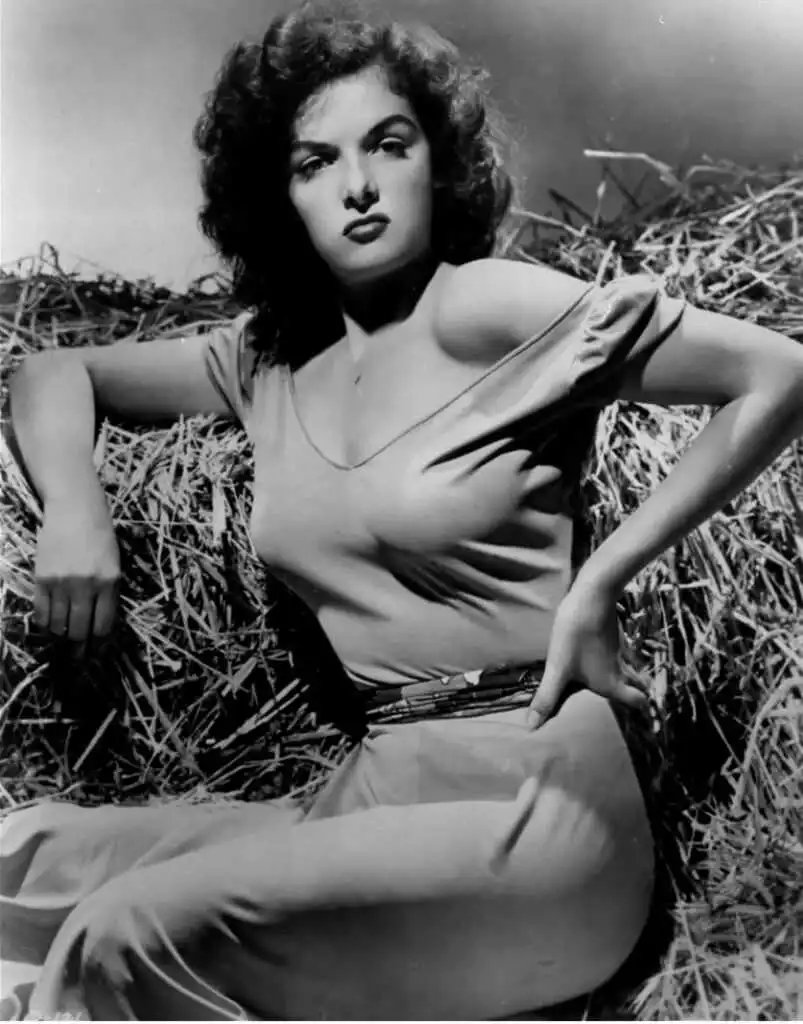
Howard Hughes took an unnatural interest in the physics behind this young lady’s physique.
Let us consider Howard Hughes. Howard Hughes personified eccentricity. When Baskin-Robbins discontinued his favorite ice cream, he paid to have them make up 350 gallons of Banana Nut just for him.
He custom designed a brassiere for actress Jane Russell to get her boobs to defy gravity in some specific way for a movie he was making called Outlaw. In 1958, Hughes rented out a Santa Monica theater and binge watched movies…for four months straight. All the while he saved his urine in jars. At the time of his death, Hughes weighed 87 pounds. Now hold that thought…
Responding to Fear
Think back to the last time you were truly afraid. I don’t mean you were concerned you might miss a deadline at work or forget to feed the fish. Cerebrate on the last time you actually feared for your life. Ponder how that made you feel.
Most adults have had a near-death experience or two on American roadways. Military service is dangerous, and, like most soldiers, I had a couple of close calls while in uniform. In each case, the beta response/fight-or-flight reaction kicked in and I instinctively sought refuge and sanctuary. That’s how most normal people respond to a potentially deadly situation. And then there was Allison Digby Tatham-Warter.
Allison Digby Tatham-Warter was old-school rich.
Digby
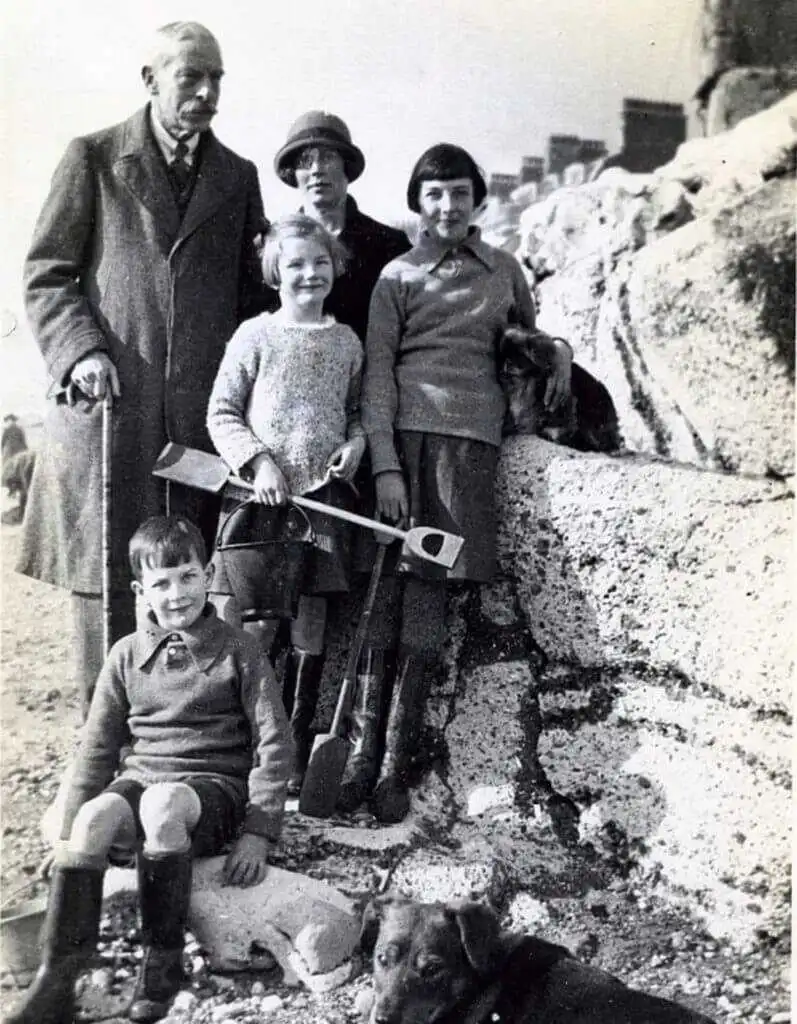
Allison Digby Tatham-Warter was just Digby to his friends. This guy was a genuine piece of work. Born into some proper money in Atcham, Shropshire, England, in 1917, Digby was the second son of Henry de Grey Tatham-Warner. Digby’s father was gassed during the trench fighting in the First World War and tragically rendered hors de combat when the little boy was only 11. Digby subsequently matriculated into Wellington College in Berkshire before attending the British Royal Military College at Sandhurst.
Digby was commissioned as a Second Lieutenant in 1937 and was assigned to the Oxfordshire and Buckinghamshire Light Infantry posted in India. His family connections to India ran deep, so this was a natural billet. Digby sought out this posting so he could pursue the fine art of recreational tiger hunting and pig sticking.
Things Get Real…
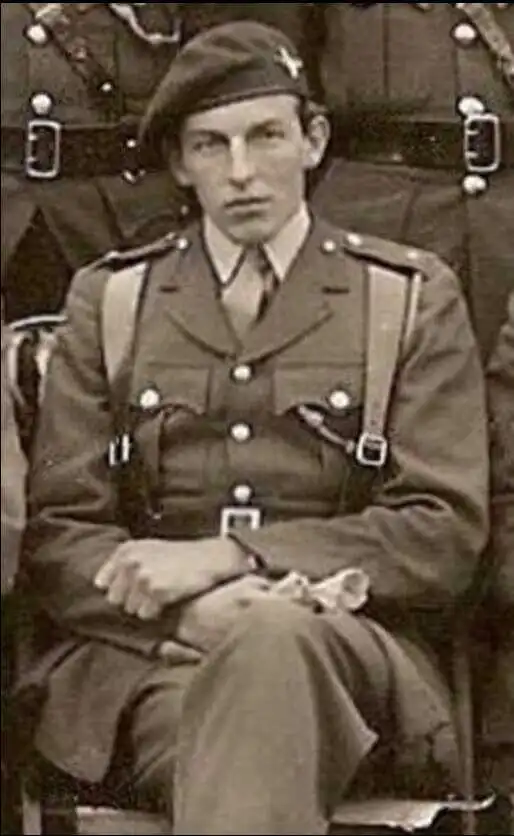
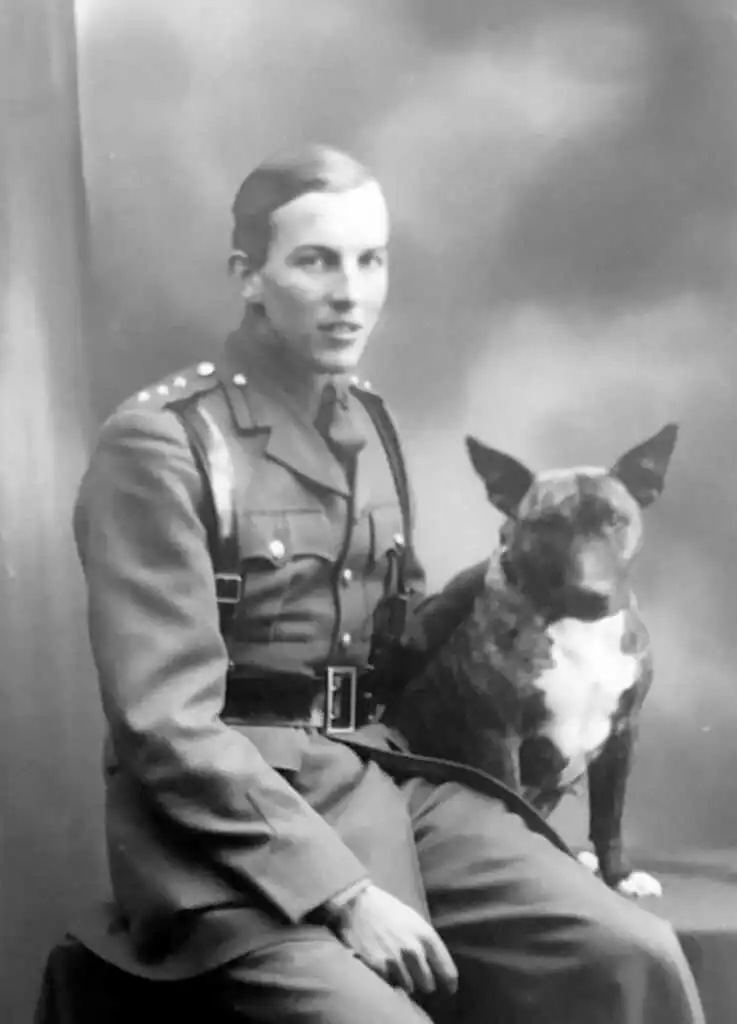
Digby looks pretty normal here in his Airborne mufti. He wasn’t.
With the onset of WW2, Digby’s sister Kit actually deployed to the North African desert, earning the French Croix de guerre. His brother John perished at the Second Battle of El Alamein with the 2d Dragoon Guards, the Queens Bays. Determined to get some payback, Digby volunteered for the Parachute Regiment. In short order he was company commander of A Company, 2d Battalion, 1st Parachute Brigade, 1st Airborne Division.
Now amidst the company of some serious warriors, Digby’s reputation shone even more brightly than his peers. His past experience as a tiger hunter set the tone. When he commandeered an Allied C47 cargo plane and flew all of the company-grade officers in their encampment to London for a party at the Ritz his social stock went through the roof.
His commanding officer, LTC John Dutton Frost, appreciated the refined young man’s audacity and aggressiveness. As a result, Digby was placed in command of the 2d Parachute Battalion for its assault into Arnhem during Operation Market Garden in 1944. Appreciating that military radios of the era were unreliable, Digby procured a small bugle and schooled his men on responding to commands in combat via bugle calls. This method of command and control had not been used since the Napoleonic Wars, but his reliance upon it was to be critical in the grueling battle to come.
The Fine Line Between Brave and Nuts…
You recall we kicked off this party talking about eccentric crazy people. Here’s why. Despite a litany of truly laudable character traits that cumulatively produced a superb combat leader, Digby was notoriously forgetful. He was legendarily calm in a crisis, but he struggled to recall details under pressure, particularly tedious stuff like challenges and passwords. As a result, he adopted a curious method of setting himself apart on the battlefield.
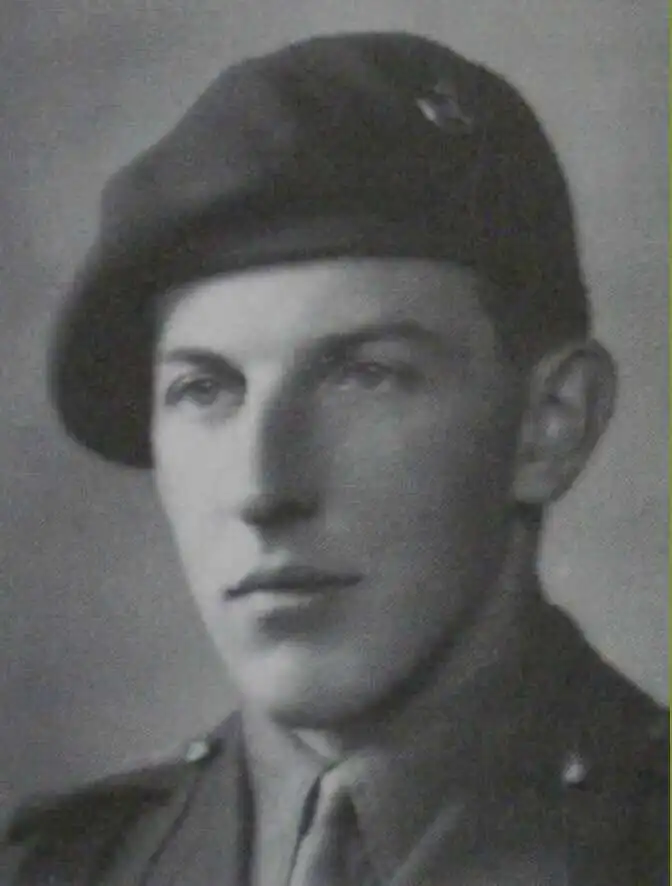
Allison Digby Tatham-Warter had no shortage of personality.
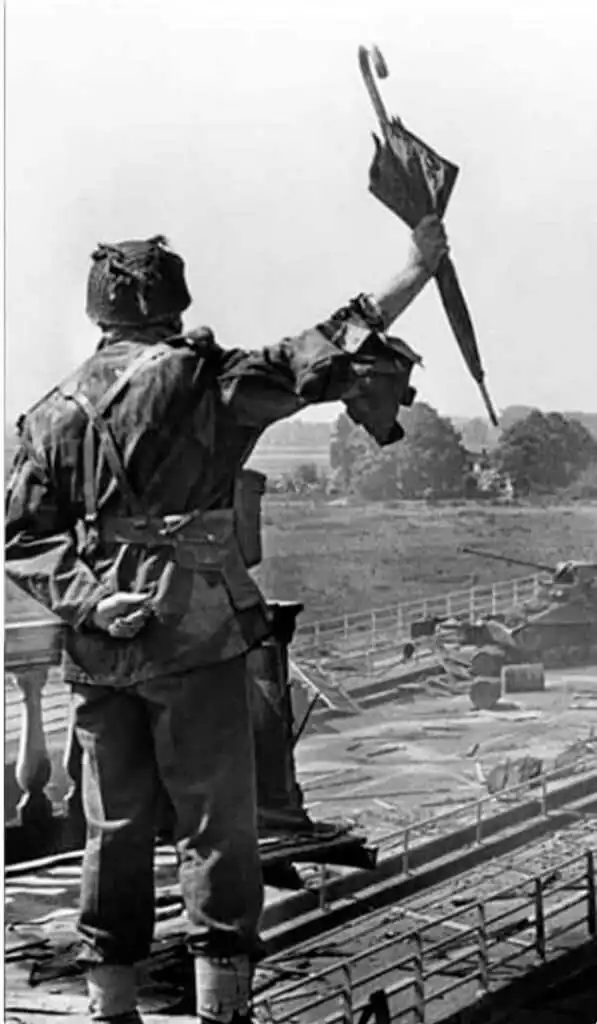
Airborne troops were trained and equipped to drop deep behind enemy lines and then hold until relieved. This meant fluid battlefield geometry and a commensurate increased risk for fratricide. Considering Digby’s job would have him moving back and forth in and around both friendly and German forces, he packed an English bowler hat and umbrella alongside his battledress, maroon beret, and Webley revolver. When queried concerning his motivations, Digby replied, “They will think, who is that bloody fool wearing a bowler hat and carrying an umbrella, and they will immediately know it’s me!”
At one point in the battle, Digby led his A Company some eight miles through contested Arnhem in 7 hours, collecting 150 Heer and Waffen SS prisoners along the way. For this part of the fight, he wore his standard issue Airborne beret. However, when things got truly bleak, it was time for desperate measures.
The Desperate Measures In Question
Running low on ammunition and facing a determined enemy in a built-up battlespace, Digby ordered a desperate bayonet charge. Before he led his men in the assault he put away his beret and replaced it with the bowler hat. This made it easy for his men to spot him leading from the front amidst the din.
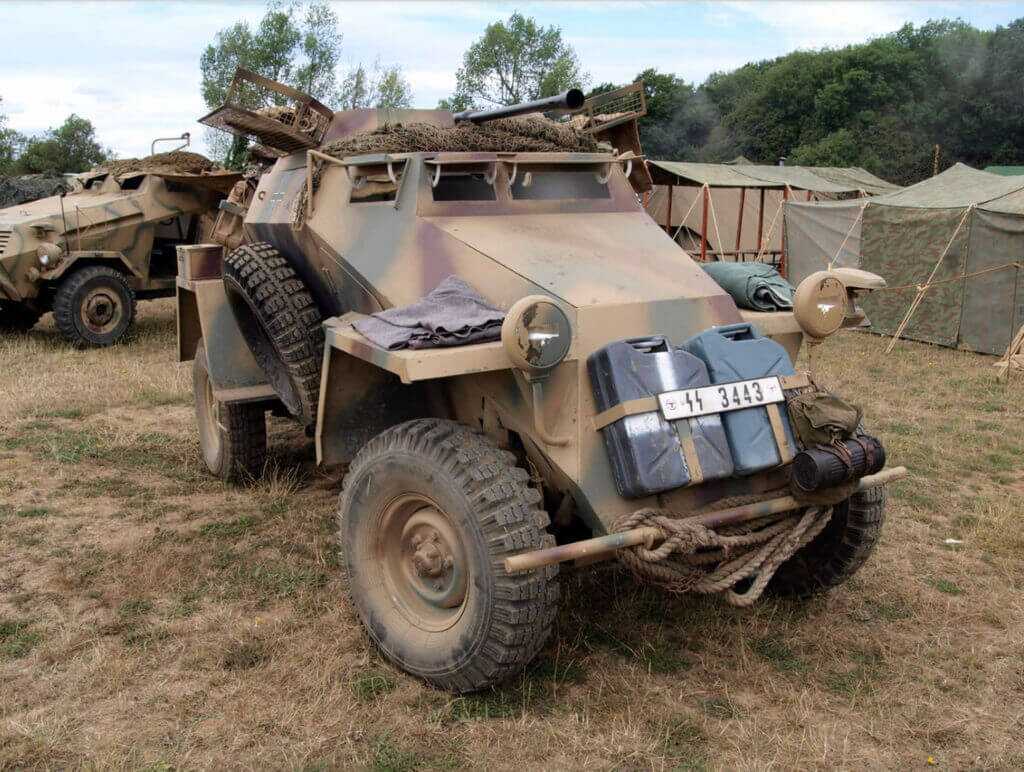
Digby immobilized something like this German armored car by poking the driver in the eye with his brolly.
Military Operations in Urban Terrain (MOUT) are some of the most dangerous undertakings in the infantry pantheon. Make your enemy a fully tooled-up Waffen SS Panzer Division, and this borders upon suicidal. At one point, Digby and his men came upon a German armored car equipped with a fast-firing 20mm autocannon. Without hesitation, Digby leapt up onto the vehicle and shoved his collapsed umbrella through the driver’s vision slit. In so doing he caught the German soldier in the eye. Digby subsequently immobilized the vehicle long enough for his men to take it out.
Down but Not Out…
As the combat wore on, Digby singlehandedly rescued several of his soldiers under fire as well as the unit chaplain, all the while wielding that beat-up umbrella. He was eventually struck by shrapnel that left a generous gash in his trousers as well as his butt. Finally at the end of his rope, his last radio call said simply, “Out of ammo, God save the King.” He was subsequently captured and transferred to the local St Elizabeth’s Hospital for treatment of his injuries.
German nurses dressed his wounds and left the room to attend to other patients. Digby and his 2IC CPT Tony Frank used the distraction to escape through a nearby window. By using a micro compass disguised in a button on his uniform, Digby and his mate broke out towards Mariendaal. Enroute they encountered a friendly Dutch woman who spoke no English but connected them with the underground.
What a stud. Allison Digby Tatham-Warter was legendarily cool under fire.
Saving The Lunatic Digby
The Dutch Resistance bodged up papers describing Digby as the deaf-mute son of a local lawyer and gave him a bicycle. He used the bike to make contract with other British paratroopers in hiding after the disastrous culmination of Market Garden. At one point he was press-ganged by the Germans into helping to push a staff car out of a ditch. German soldiers were eventually billeted in the same house where he was staying, yet he still pulled off the deaf-mute charade throughout.
Eventually, Digby bicycled all the way to the Rhine River where he flashed the V-for-Victory signal with his flashlight and successfully connected with the British XXX Corps and freedom. He had spent more than a month on the run behind enemy lines and was personally responsible for the safe repatriation of some 150 Allied soldiers. His motley band included British paratroopers, downed aviators and even two lost Russians.
The Rest of the Story…
After the war, Digby was posted to Mandatory Palestine as part of the British military contingent. In 1946 he was transferred to the 5th King’s African Rifles in British Kenya. He found Africa to his liking and bought two wilderness estates, one in Nanyuki and another in Eburre. During the Mau Mau Uprising, Digby raised a mounted militia force on his own nickel and led them in combat. Once that brushfire war simmered down, Digby embraced a well-deserved retirement.
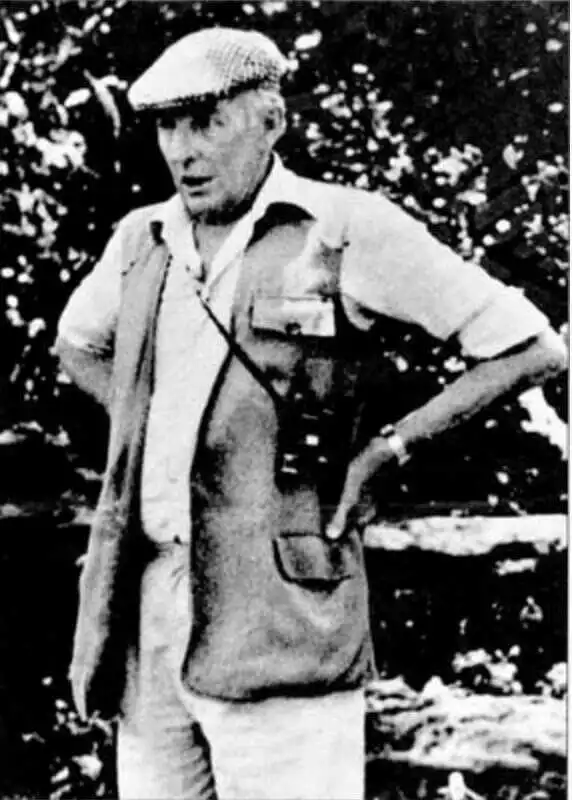
When he grew too old for military service, Allison Digby Tatham-Warter moved to Africa to try his hand at safaris.
Allison Digby Tatham-Warter pioneered the concept of the photo safari wherein paying customers would stalk animals and then photograph rather than kill them. Such stuff is commonplace now, but he’s the one who started it. He was also an outspoken advocate of African nationalism, lobbying for the Africans’ right to self-government and suffrage. During Kenyan Independence in 1962, Digby’s was an effective voice for native Africans.
Some Are Brave, Some Just Stupid
Digby married Jane Boyd, herself also an aristocrat, in 1949. Together they had three daughters and a plethora of grandchildren. One of his daughters, Belinda Rose, went on to marry a prominent member of the German aristocracy. Digby died in Nanyuki, Kenya, in 1993 at the age of 75.
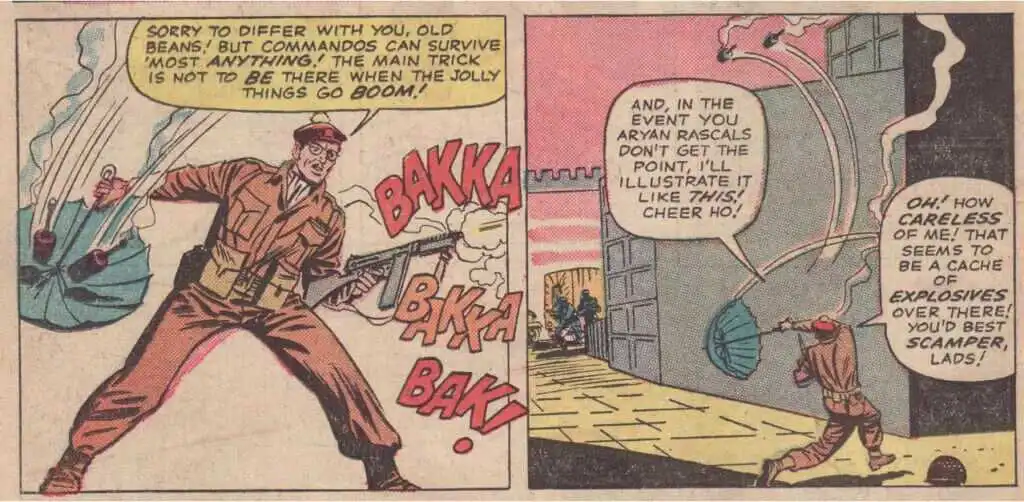
Allison Digby Tatham-Warter even made his way into SGT Fury #16. Though the details are a bit stylized, there is actually a kernel of truth here.
Countless men have worn their nations’ uniforms and tasted war. Some were unimaginably brave, while others were rank cowards. Most fall someplace in between. Allison Digby Tatham-Warter, however, was a legit wild man.
When the chips were down and death seemed inevitable, this lunatic just took up his umbrella, donned his favorite bowler hat, and neutralized a German armored combat vehicle via a stiff poke in the eye. They really don’t make them like that anymore.
50 years since the U.S. ground war began, there’s a push to remember the 134 Canadians killed
Vancouver’s Rob McSorley is one of at least 134 Canadians killed in action fighting for U.S. forces during the Vietnam War. (L Company Ranger 75th Infantry Archives)
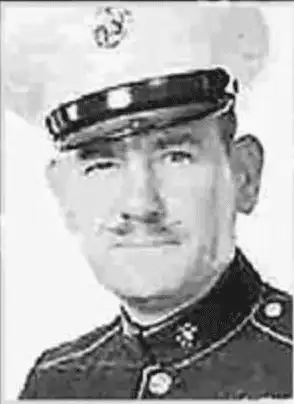
At only 17 years old, B.C.’s Rob McSorley knew he wanted to go to war, and it didn’t matter if it wasn’t in a Canadian uniform.
Now, 45 years after his death in the jungles of Vietnam, his sister is finally learning how much he mattered to the American soldiers with whom he served.
June-Ann Davies says in 1968, her brother was tired of school at Templeton Secondary in East Vancouver, and decided joining the military would cure his boredom.
The war in Vietnam was still raging and Canada wasn’t officially participating, but McSorley was determined to be at the heart of it.
“I think he wanted adventure, which he could get out of the U.S. military as opposed to the Canadian military,” said Davies, who now lives in Kamloops, B.C.
McSorley’s parents tried to reason with him: He wasn’t an American, and it was actually illegal for him to fight in a war that didn’t formally involve Canada.
But McSorley was going to Vietnam, with or without their support.
“When they were putting up a bit of a fight, that’s when he said, ‘Well, you either sign the papers, or I’m going anyways and I’ll lie about my age,’ ” Davies recalled.
Canadian Rob McSorley, left, is pictured in March 1970 with two members of his U.S. Army Ranger regiment after a dangerous reconnaissance mission. McSorley was killed in action only weeks after this photo was taken. (L Company Ranger 75th Infantry Archives)
His parents grudgingly signed the forms, and McSorley travelled just across the B.C. border to Blaine, Wash., to enlist in the U.S. army, which was accepting anyone who came through the door.
Two years later, what was supposed to be the adventure of a lifetime ended suddenly. McSorley was shot by North Vietnamese soldiers.
Davies still remembers being in bed when the doorbell rang at their Vancouver home, and a telegram delivered the news about her older brother.
“It was awful. Terrible. Yeah, it was the worst day,” she said.
“He only just started his life when it ended. Because he’d just turned 19 two weeks before.”
McSorley is remembered as a brave soldier within his unit of the L-Company Rangers. (Vietnam Veterans Memorial Fund)
According to Davies, her family felt isolated after her brother’s death. No one they knew in Canada had relatives who had joined the U.S. military, let alone gone to Vietnam.
“Afterwards, my parents didn’t say a lot about it, other than to say that my brother was a hero,” Davies said.
20,000 Canadians enlisted; at least 134 killed
McSorley was certainly not the only young Canadian to fight and die in the conflict.
Canada never officially joined the fight with U.S. forces in Vietnam, and eventually harboured tens of thousands of American draft dodgers and deserters.
But much more quietly, a steady stream of young Canadians was crossing the border in the opposite direction.
An estimated 12,000 Canadians served in combat roles in Vietnam. Pictured in a 1968 CBC News story are three Canadians: Ron Payne of Galt, Ont., Richard Dextraze of Montreal and Arthur Fisher of Niagara Falls, Ont. The men served in the same U.S. marines unit. (CBC)
The Canadian Vietnam Veterans Association estimates that about 20,000 Canadians enlisted, although other historians think that number may have been as high as 40,000.
Canadian Ron Parkes was with one of the first U.S. battalions to join ground operations in the Vietnam War in 1965. (Ron Parkes/CVVA)
The association believes 12,000 Canadians actually served in combat roles in Vietnam.
Some were dual citizens who may have been living or working in the U.S., but many other Canadians volunteered, driven by a conviction to fight communism, or by a love of adrenalin.
By the end of the conflict, it’s believed at least 134 Canadians had died or been declared missing in action.
To put that number in perspective, 158 Canadian soldiers were killed during the mission in Afghanistan.
Many Canadians came home from Vietnam with their lives completely changed.
“I’m proud of my service,” said Canadian Ron Parkes, who enlisted in the U.S. military during the Cuban missile crisis.
The Winnipeg veteran was deployed to Vietnam in the summer of 1965, serving with one of the first American brigades to join the ground war.
Today, Parkes is president of the Canadian Vietnam Veterans Association, which he co-founded in 1986.
Struggle for recognition by the legion
According to Parkes, Canadian Vietnam veterans were ignored or forgotten for years after the war.
“When I came back and brought up the subject, it was always ‘Who cares? We weren’t there. We weren’t in it,’ ” Parkes said.
“When I went down to the Royal Canadian Legion, they wouldn’t accept us, our service. So for many years they just forgot about it.”
The government of Canada has never formally acknowledged the citizens who were killed or declared missing in action in Vietnam, but according to Parkes, in 1994, the Royal Canadian Legion officially recognized Canadian Vietnam veterans for regular membership.
“It’s been a long struggle to get the word out, but we’ve persevered and accomplished quite a few things now,” Parkes said.
Canadian names still being added to memorial
The name of every Canadian who died fighting for the U.S. in the war is listed on the expansive Vietnam Veterans Memorial in Washington, D.C.
Canadian Rob McSorley’s name is on the Vietnam Veterans Memorial in Washington, D.C., alongside the 58,000 U.S. servicemen killed in the controversial war. (Patti Jette/CBC)
Some, like McSorley, are officially on record as being from Canada.
The ‘North Wall’ Canadian Vietnam Veterans Memorial was dedicated in Windsor, Ont., in 1995. (Don Davies)
Other Canadians aren’t remembered that way at all — listed only as being from the American towns or cities where they enlisted.
In 1995, some American veterans took up the cause for their Canadian colleagues and privately funded a memorial that was built in Windsor, Ont.
“The North Wall” Canadian Vietnam Veterans Memorial now lists the names of 138 Canadians who died in the war, but the number still grows today.
It includes 134 Canadians who were killed in action for the U.S. military, and four other Canadians who died in Vietnam while serving with the International Control Commission, the three-country body charged with supervising the 1954 partition into South Vietnam and North Vietnam.
“The main thing is to remember those that made the supreme sacrifice,” Parkes said.
‘Without Rob… I would be gone too.’
American Bruce Bowland says he never thought much about the idea that some men in the U.S. military were actually Canadian volunteers.
Bowland was only 19 years old when he was deployed to join the fight in Vietnam.
American Bruce Bowland, second from left, was 19 when he was deployed to Vietnam. His closest friend, Canadian Rob McSorley, was killed during a mission the two were on in April 1970. (John Burford)
That’s where he met and became fast friends with Sgt. McSorley from Vancouver, who at age 18 was actually younger than Bowland, but had already fought in a number of battles.”Rob told me he was a Canadian and he enlisted in the American army so that he could go to Vietnam,” Bowland told CBC News from his home in Gainesville, Fla.
“And I told him, ‘You’re crazy,’ ” Bowland laughed. “He was a gung-ho guy, man, a great man.”
Colleagues say B.C.’s Rob McSorley was a fearless soldier who died protecting other members of his unit on April 8, 1970. (L Company Ranger 75th Infantry Archives)
McSorley’s U.S. Army Rangers unit was sent into what was known as “Mission Grasshopper” in the A Shau Valley, when they were suddenly caught in a battle with North Vietnamese soldiers.
“[Rob] said ‘Wow, this is really cool. I feel like John Wayne!’ ” Bowland recalled.
“That’s the type of guy he was. He knew his job, he did his job, and you knew he always had your back.”
It was on that same mission on April 8, 1970, that Bowland was planning to “walk point,” leading his team toward the jungle to make sure it was safe.
But he says McSorley wanted to be the leader that day, so he took the spot from Bowland, telling him he was a more experienced soldier.
The young Canadian was checking the bush for signs of the enemy when he stumbled upon a group of North Vietnamese soldiers.
They opened fire on each other, but McSorley’s gun jammed. He was sprayed with bullets and fatally wounded.
Bowland says his life was only spared because the enemy had their sights trained on his Canadian friend.
“Without Rob sacrificing his life for me, I would be gone, too. I wouldn’t be here. I wouldn’t have a son and two daughters. I wouldn’t have a grandson,” Bowland said.
“Rob gave up a lot of things, and I often wonder what his life would have been like if he would have come back and got married and had children. But he sacrificed his whole life for us, and I’ll never, ever, ever forget that.”
June-Ann Davies of Kamloops, B.C., lost McSorley, her brother, in the Vietnam War. Her husband, Don, has thoroughly researched McSorley’s experience in Vietnam, hearing directly from the men who were there when he was killed. (Chris Corday/CBC)
‘He didn’t want to be a bystander’
In Kamloops, McSorley’s sister June-Ann Davies and her husband, Don, have spent many years learning about her brother’s service in Vietnam.
Don Davies has spent many long nights researching the war stories of a brother-in-law he was never able to meet.
“I’ve got heavy into it, finding out about him, and I do find it very emotional. Even though we didn’t meet face-to-face, I feel I know him as a man,” said Davies, holding back tears.
“He did what he thought was the right thing to do, and he didn’t want to be a bystander. And that’s Rob and everything I’ve heard about him.”
Over the last decade, June-Ann and Don Davies have made contact with Bowland and a number of the Rangers who fought alongside McSorley.
June-Ann Davies says their stories about her brother have changed her life.
“Even after all these years, it’s still emotional, but it’s also healing.”
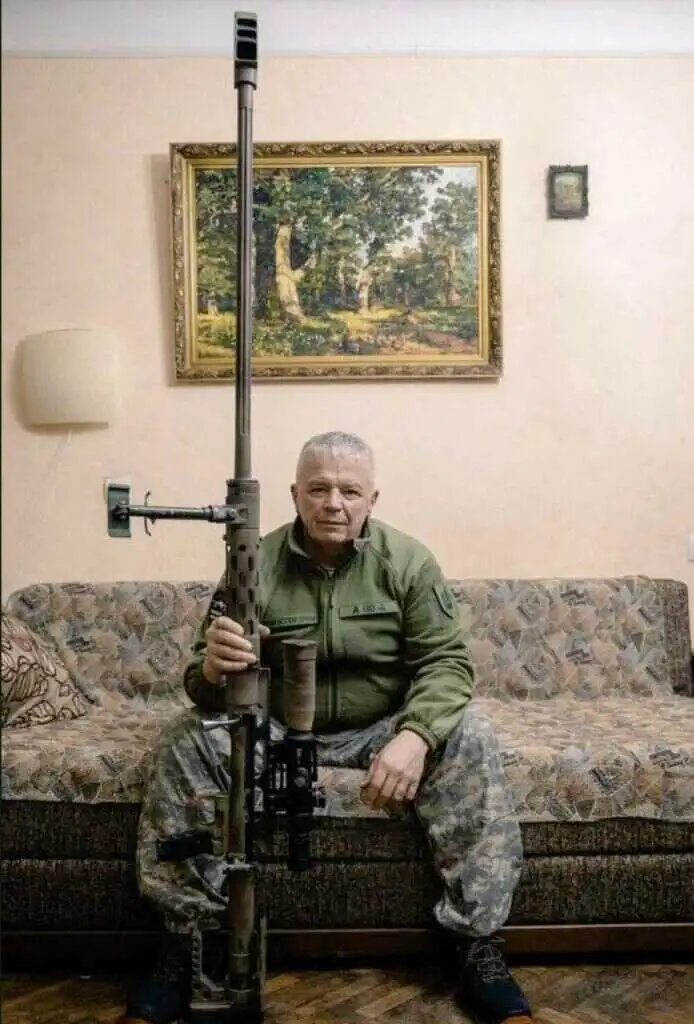
The current world record sniper shot in combat stands at 3,800 meters or 4,156 yards. That’s 2.36 miles. In November 2023, a 58-year-old Ukrainian sniper named Viacheslav Kovalskyi took out a Russian officer at that range during Putin’s lyrically flawed Special Military Operation. Kovalskyi used a custom Volodar Obriy rifle. They call this massive 12.7x114HL precision cannon the “Horizon’s Lord.” Kovalskyi’s barrel comes from Bartlein, the optic is Japanese, and everything else is custom-made in Ukraine.
The cartridge is a unique design wherein a Combloc 14.5×115 case is necked down to accept a .50-caliber projectile. They supposedly filmed the hit. Here’s a link. Check out that time of flight. Wow.
All war is hard. The grunt’s war in Korea was extra special horrible.
Kovalskyi used an experienced spotter and connected on his second round. He intentionally landed the first 300 meters short to gauge the wind. While there was undoubtedly an element of luck to that remarkable feat, it was also driven by some simply breathtaking skill and superlative fieldcraft. We may explore that shot in more detail down the road sometime if I can find enough information.
Foundations
This 58-year-old Ukrainian patriot currently holds the international record for the longest confirmed sniper kill. What an absolute monster of a gun.
The state of the art in precision combat riflery has evolved considerably since WW2. This has been the result of hard lessons learned on battlefields around the world. Viacheslav Kovalskyi’s borderline-supernatural shot is the ultimate iteration.
Back in the 1950s, a legendary Marine named John Boitnott used equipment markedly inferior to that of this Ukrainian phenom to make some comparably unbelievable sniper kills out in the frozen wastes of Korea. The fact that he was so effective given his rudimentary tools speaks to the man’s refined skills, natural talent, and peerless drive.
The Backstory of John Boitnott
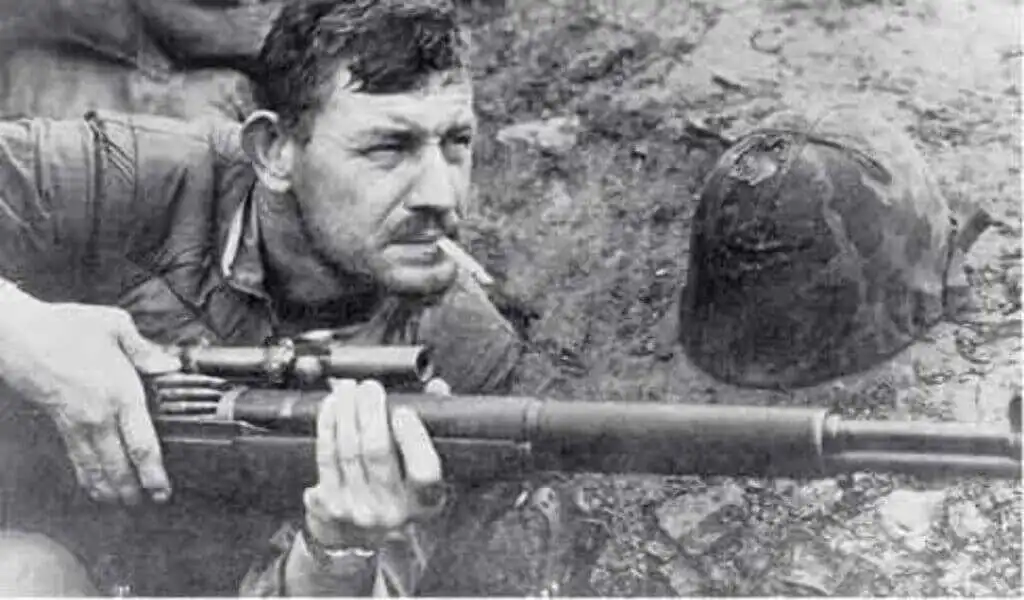
In addition to rocking a simply legendary mustache, John Boitnott was also a simply legendary combat Marine.
John Boitnott got his first taste of war on 7 December 1941 at Pearl Harbor. Serving as a Marine onboard the Northampton-class cruiser USS Chicago, he was wounded during the Japanese aerial attack. However, Boitnott recovered in short order and served in MacArthur’s amphibious vanguard as they marched inexorably across the Pacific toward Japan.
This took him through places like Guadalcanal, Coral Sea, Midway, Okinawa, and bloody Iwo. By VJ Day he had been shot to pieces, but he was as seasoned a warrior as the US Marine Corps could produce. In addition to those legendary combat skills, this Jarhead was also an incredible marksman.
At the end of the war, most American servicemen demobilized and went home to make normal lives for themselves. John Boitnott found that military service suited him, so he stuck around. By the time American forces went to war again in Korea, John Boitnott was a seasoned professional.
Korea—A Different Sort of War
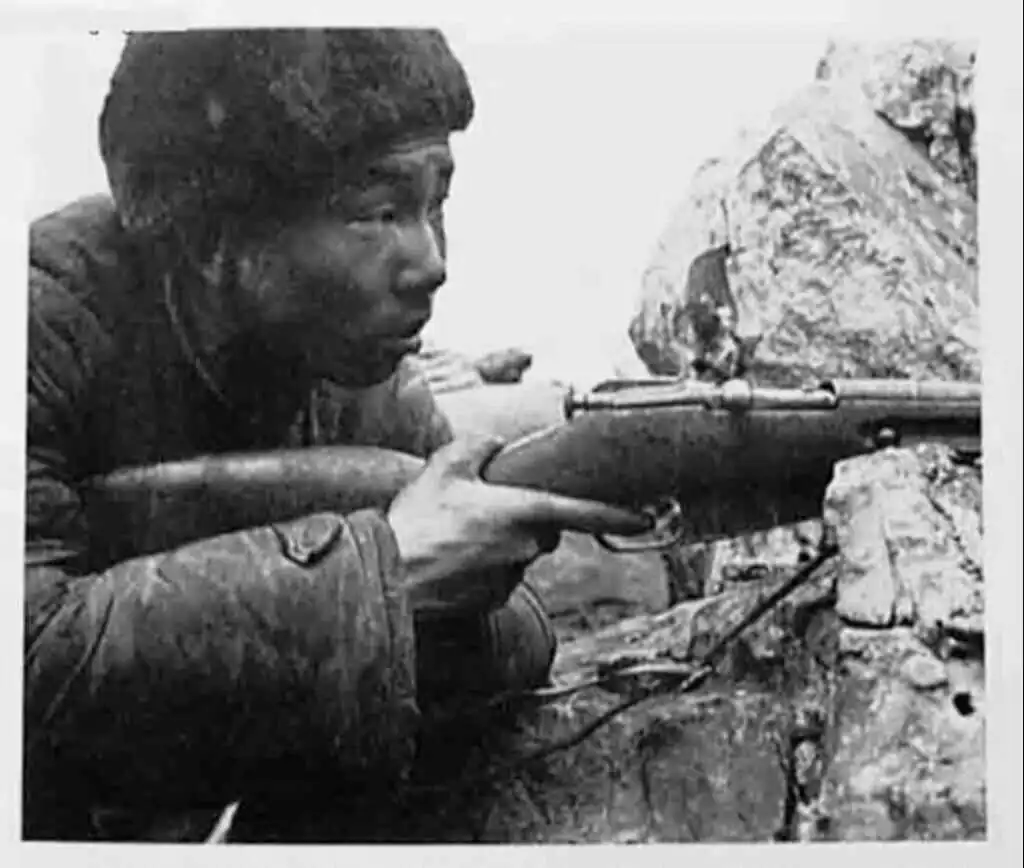
This is Chicom sniper Zhang Taofang. He purportedly used a scoped Mosin Nagant rifle to kill or wound some 214 Allied troops over the course of a mere 32 days during the Korean War. He later transferred to the People’s Liberation Army Air Force and trained to fly fighter jets.
John Boitnott had learned his craft in the fetid jungles of the South Pacific. The battlefields in which he fought in Korea were more like the surface of the moon. In many cases, the terrain was devoid of foliage and frozen rock hard. A decent trench was sometimes not more than three feet deep, and the engagement ranges often hovered around a kilometer. Operating in such forbidding spaces, the Leathernecks realized they needed snipers. When the call went out for volunteers, John Boitnott stepped up.
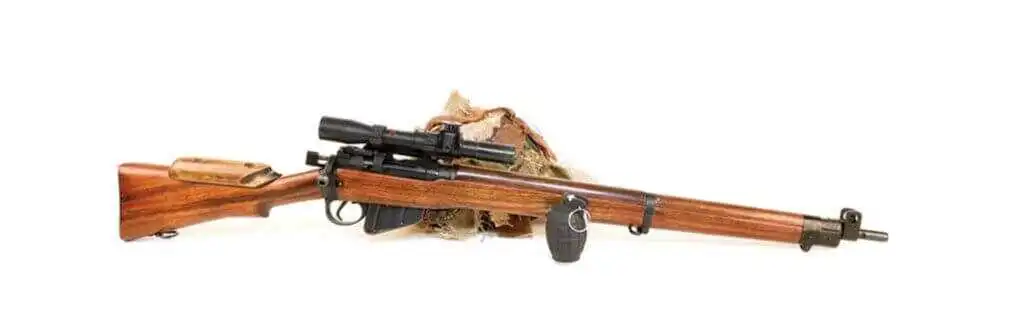
Both sides in that forsaken conflict had learned the same lessons. I have a friend who was shot in the chest by a Chinese sniper armed with a captured Lee-Enfield No 4(T) sniper rifle during the Korean War. His life was saved when the round deflected off of the M1911A1 pistol he carried in a shoulder holster and spent itself in the flak jacket he had been issued just the day prior.
A communist marksman once actually bounced a rifle round off of Boitnott’s helmet. The experience rattled him without causing any lasting damage. However, that left Boitnott quite energized. He resolved to do all that he could to mitigate the communist sniper menace.
Tools
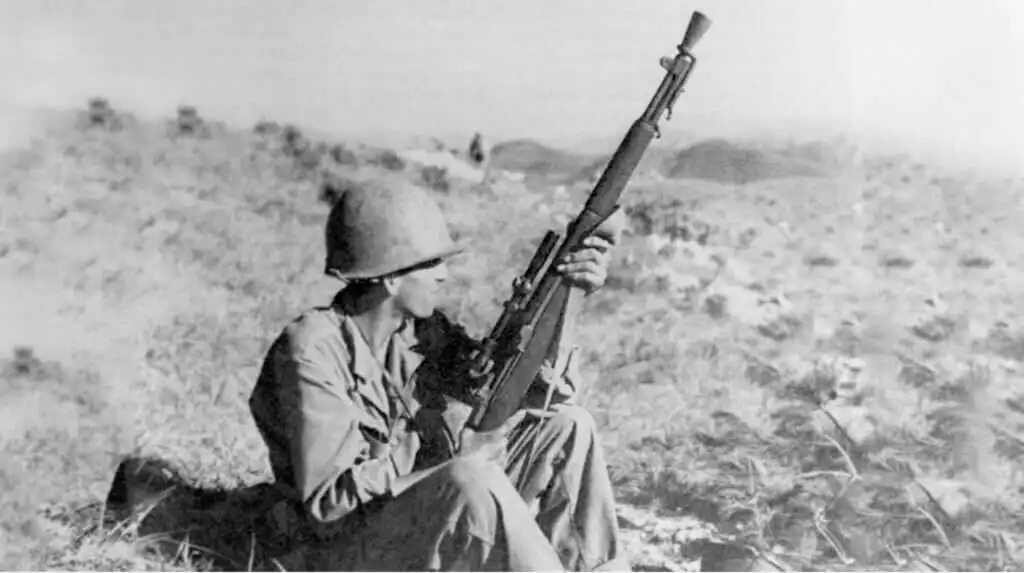
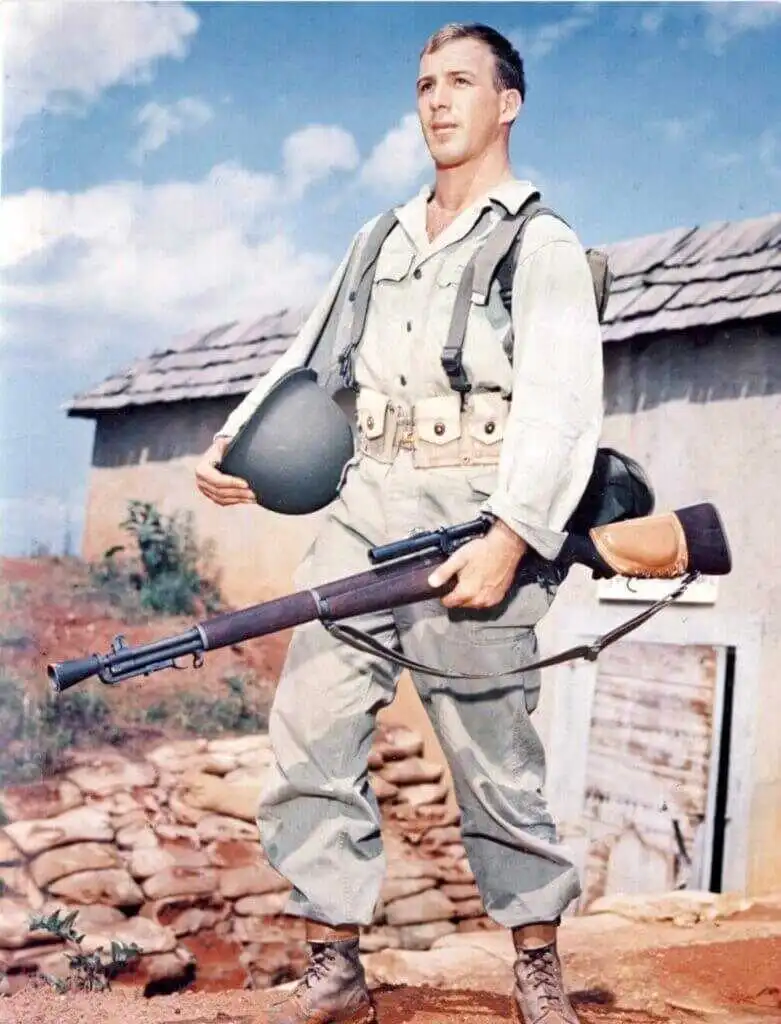
All proper gun nerds are enamored with the sniper’s tools. For the most part, the ground war in Korea was fought with WW2-surplus weapons on both sides. While the M1 Garand had occupied the cutting edge of small arms technology during WW2, by the Korean War it was getting a bit long in the tooth. It certainly did not make for an optimal sniper rifle.
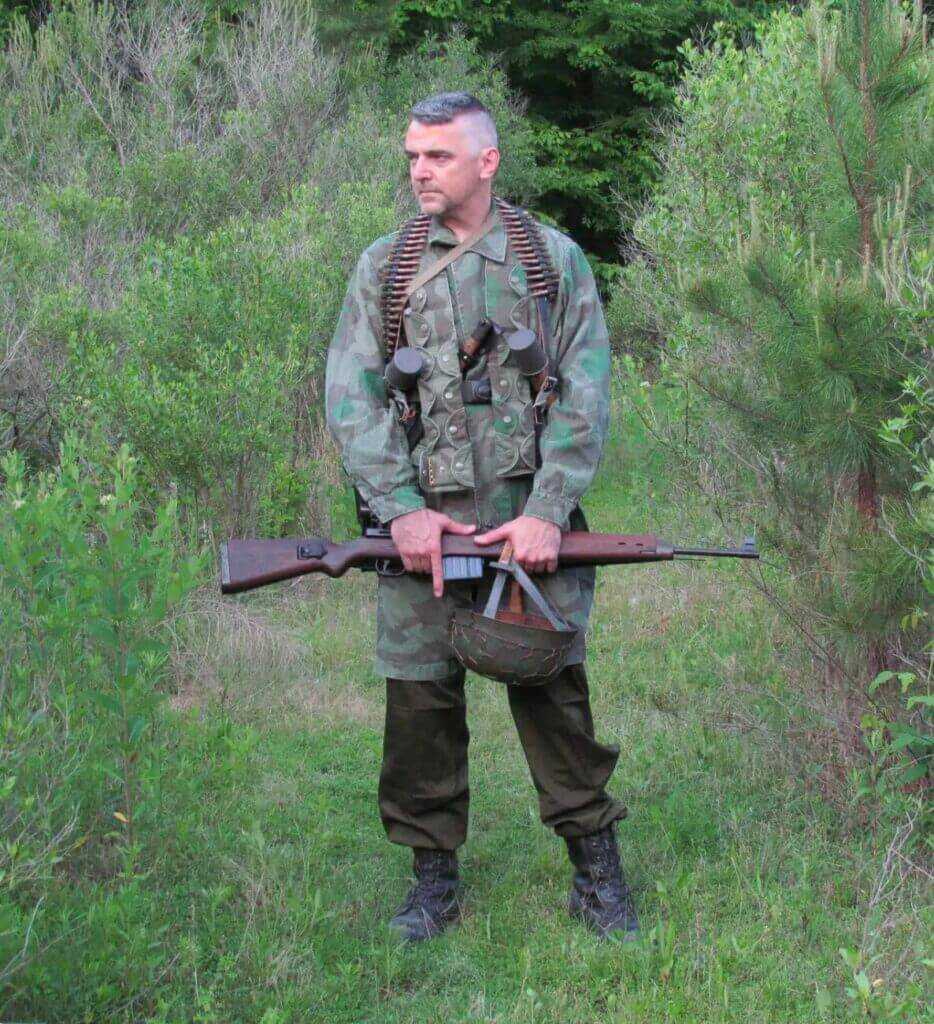
The Lee Enfield No 4(T) was arguably the finest mass-produced sniper rifle of WW2.The German G43 with its excellent 4x Zf4 scope was fine in theory. However, it is tough to make a decent precision rifle with bombs raining down on you around the clock.
Sniper Weapons
If we had to rank the mass-produced sniper weapons used during the Second World War, the British Lee-Enfield No 4(T) was likely the top of the heap. The Germans had some nice iron, but these were often Kar98k bolt guns hand-fitted with civilian sporting optics. Their semiautomatic scoped G43 was a great idea that used a splendid 4x Zf4 optic, However, it suffered from availability and quality control issues. The radically-advanced Zf41 optic was a totally dissimilar long eye relief design that didn’t work terribly well. The Zf41’s magnification was only 1.5X.
The Japanese fielded optics on many of their light machineguns, which was fairly inspired, but their dedicated sniper platforms were hardly earth-shaking. The Russians likely made the most widespread use of snipers on the battlefield of any major combatant. However, their scoped Mosin Nagant rifles were terribly antiquated. Just don’t get me started about Simo Hayha. That guy was a freak of nature.
American snipers made good use of accurized Springfield rifles which were designated the “U.S. Rifle, Caliber .30, M1903A4, Snipers.” Saving Private Ryan demonstrates such stuff in fairly graphic detail, though the optics aren’t quite right. The gun’s actual Weaver 330 scope was relatively delicate and certainly did not represent the state of the art. The bolt-action Springfield was a stopgap, interim design. The ultimate school solution was the M1C.
Heresy…
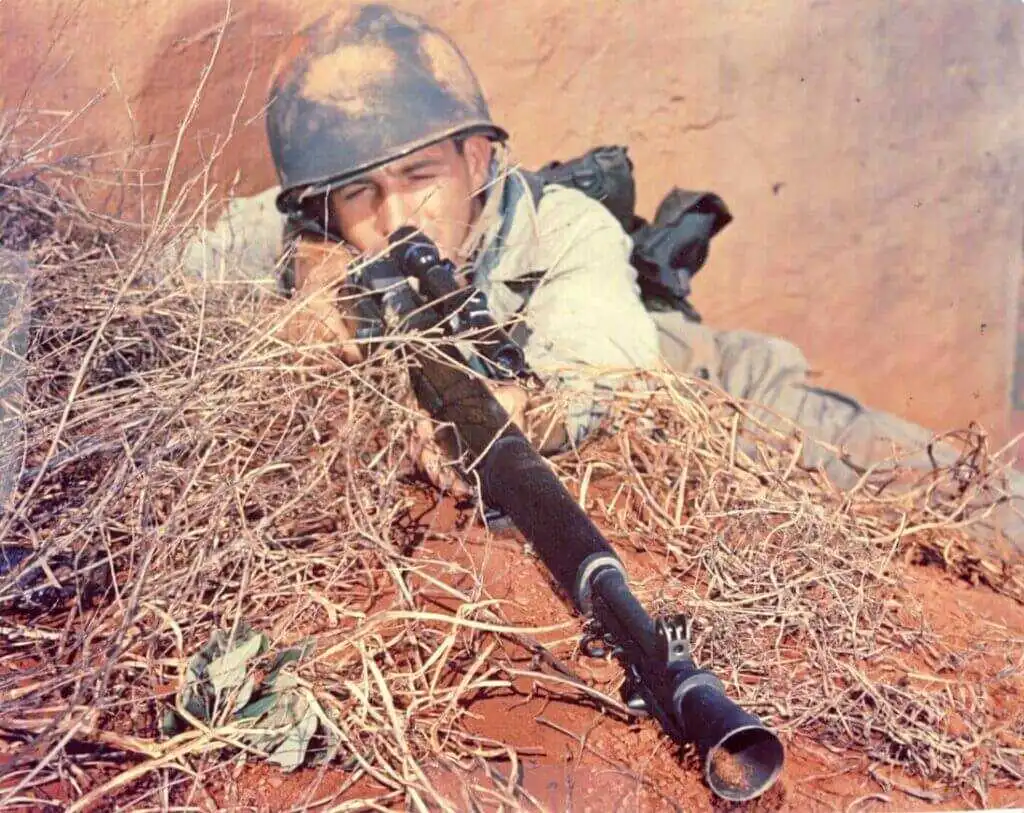
OK, if you worship at the high exalted church of John Cantius Garand, please do not burn me at effigy or curse me with some kind of ballistic hex. If suddenly my groups double in size and I inexplicably lose vision in my shooting eye I’ll know it was you. While the M1 Garand was indeed a simply magnificent battle rifle for its era, the M1C was kind of a crap sniper tool.
Here you can see how awkward it was to obtain a decent reliable cheek weld with the offset optics on the M1C rifle.
For starters, the M1 loads from the top. That means that the optic has to be offset to the side. The guys who developed the weapon actually experimented briefly with a prismatic design with a bunch of mirrors, but that didn’t work. The distinctive leather cheek pad was included to force the shooter’s head left to accommodate the offset optic.
Inadequate Supplies
Another issue was a lack of match-grade ammo. The best precision rifle in the world is rubbish without decent ammunition. While standard ball ammo pushed a bullet weighing 152 grains, that of the M2 armor-piercing sort weighed 168 grains. The extra mass made the AP ammo more reliable at long ranges. That stuff also offers some simply breathtaking penetration.
All that was a distraction, but the glass was simply inadequate. Adapted from the Lyman “Alaskan” all-weather civilian optic, the M73 begat the M81 that eventually begat the M82. Each sight differed in details like sun shades and reticle designs, but they were all only 2.2X. That just wouldn’t do for the long-range engagements encountered in Korea. However, that’s what John Boitnott had available as he peered across a thousand yards of open nothing at a bunch of fanatical enemy soldiers trying desperately to kill him.
The Campaign
The M1C wasn’t the perfect tool, but American snipers nonetheless still made good use of it.
The crummy magnification on his scope kept Boitnott from distinguishing the details on the far side of the valley that was his hunting ground. As a result, he pinged his unit for a volunteer to help him flush the hostile snipers out into the open. One certifiable lunatic named PFC Henry Friday answered that call.
Boitnott set up in his hide, while Friday strolled back and forth in a shallow trench situated between friendly positions and those of the communist troops. When the enemy snipers fired at Friday, Boitnott zeroed on the smoke and muzzle flash and answered with precision rifle fire of his own. His first effort was an amazing one-shot kill at 900 yards. And then he did something similar eight more times.
By now, John Boitnott was making a bit of reputation for himself. The local war correspondents heard the stories and made him and his nutjob buddy Friday famous. However, his commanders did not approve of PFC Friday’s suicidal death wish.
They ordered the two men to desist before Friday got his brains splashed all over the Korean countryside as well as American newspapers. Despite the loss of his favorite mental patient, Boitnott still racked up a further eight confirmed long-range kills before his war was over.
The Rest of the Story For John Boitnott
The M1C saw limited use at the very end of WW2. Variations served well into Vietnam.
The M1C was replaced by the slightly-improved M1D after the Korean War. Starting in 1952, the Marines began retrofitting their M1Cs with 4X optical sights produced by the Kollmorgen Optical Company. This scope was based upon the commercial Stith Bear Cub and was considered the finest American-made optical gun sight of the day. These upgraded weapons were redesignated as the “USMC 1952 Sniper’s Rifle,” often referred to simply as the “MC 52.” However, it is doubtful any saw active service in Korea before the cease fire.
John Boitnott was eventually wounded by mortar fire. He finally came home for good in July of 1952. He brought with him a Bronze Star with V device, a Navy Commendation Medal, also with V, and fully half a dozen purple hearts. His blues were also weighed down with two Presidential Unit Citations and a breathtaking 24 Campaign Medals.
Boitnott was promoted to Master Gunnery Sergeant and continued on active duty until 1971, retiring with fully thirty years of extraordinary military service across multiple theaters of battle. He subsequently died peacefully in his sleep in 2008 at age 86, a legitimate legend in the annals of military snipers.
17 Oct 1969, Saigon, Vietnam — 10/17/1969-Saigon, Vietnam- Members of the 11th Armored Cavalry in the rubber plantation area of Loc Ninh and Quan Loi October 17 are shown checking out their heavy artillery after their arrival.
 Within any given cohort of humanity, a few folks being a bit outside the norm is a statistical inevitability. However, sometimes you find a lunatic who takes it to extremes.