Categories
The Green Machine This great Nation & Its People War

US 40th Infantry Division soldiers advance in Guadalcanal during maneuvers of Wor…HD Stock Footage

Categories
This great Nation & Its People War

ANOTHER JUNE, ANOTHER TIME AND AN INVITATION … by JOHN CONNOR

By the time America entered World War I in April 1917, the British Imperial and French armies had been all but bled dry, having lost 2 million killed in action and over 6 million wounded. While Germany and its allies had also suffered horrendous casualties, they knew the American army was pitifully small, ill-equipped, inexperienced and an ocean away from intervention.

They were right. The process of conscripting and outfitting 2.8 million men and transporting them to France meant there was virtually no American presence on the battlefield until the spring of 1918, and even then, the Yanks initially deployed in relatively small numbers. In the meantime, Germany’s fortunes had changed dramatically. The Russian armistice on the Eastern Front freed up 50 divisions of battle-hardened troops to be thrown against the shaky and shell-shocked trenchlines of France.

The Kaiser’s staff reckoned that a breakthrough of the exhausted French and British lines and a few swift, decisive defeats inflicted on the Americans before the bulk of the expeditionary forces arrived could effectively neutralize them—and win the war. Almost lost to history is consideration of how close that effort came to success.

A massive German offensive destroyed the British 5th Army, swept the French forces aside and pushed to less than 40 miles from Paris. The capitol itself was battered with 183 shells fired by monstrous Krupp railway guns. Kaiser Wilhelm II was so pleased that he declared a national holiday. That celebration proved to be premature.

Four Australian divisions rushed into the breach and stalled the offensive, just as the overextended German supply lines were failing. The Germans reeled away from the surprisingly aggressive Aussies and drove into what they saw as easier avenues around Chateau Thierry and Belleau Wood. They had more surprises in store: the Americans they had dismissed as “amateurs, who will not fight.”

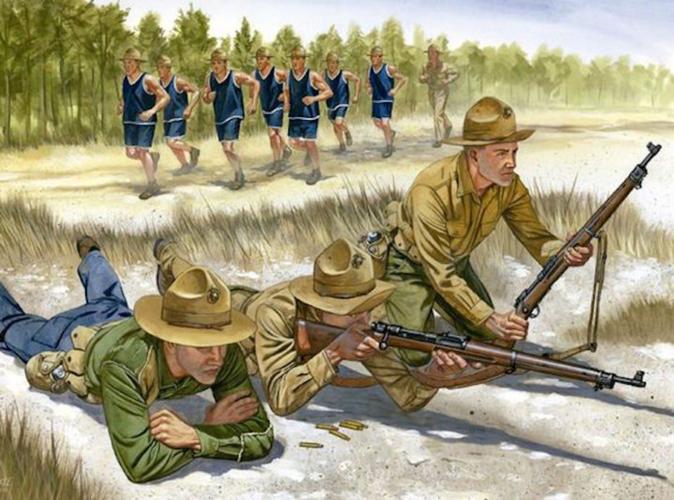
As the first units of Yanks arrived, retreating French troops urged them to fall back before the Boche onslaught. The Marine Brigade was ordered to “hold where they stand.” Lacking shovels, they dug shallow fighting positions with their bayonets at the edge of broad wheat fields. When the Germans advanced en masse, they were rudely introduced to the Springfield ’03 and American marksmanship.
“Lafayette, we are here!”

This drove the Germans back into the Belleau Wood, but left them with excellent defensive positions, a prime marshaling area for hordes of reinforcements and an ideal launching point to continue their offensive.

Interlocking fields of machine gun and artillery fire were established, and the Germans were masters of that art. But the woods had to be taken—and those deadly wheat fields crossed.

Again, the Yanks were repeatedly urged to retreat, fall back and dig in. Marine Captain Lloyd Williams’ famed reply, “Retreat? Hell, we just got here!” made its way through the ranks, putting steel in the Yanks’ spines.

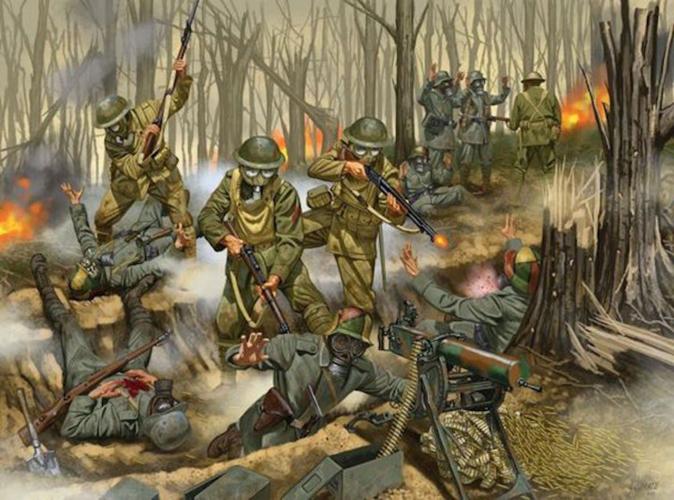
The assault on Belleau Wood is the stuff of legends, but true ones; not myths. Casualties were the worst in the Corps’ history, but the Yanks could not be stopped.

It was there, under murderous fire, that Marine First Sergeant Dan Daly leaped up with pistol in hand and yelled to his men, “Come on, you sons of bitches! Do you want to live forever?”—then led them through the carnage of the wheat fields and into the woods.

He was nominated for a Medal of Honor, but Congress denied it because he already had two, for extraordinary heroism during the Boxer Rebellion in China, and in Nicaragua in 1915. It was there, for their sheer ferocity in hand-to-hand combat, that the Germans gave the Marines their “Devil Dogs” nickname, fleeing survivors describing them as teufel hunden—“hounds from hell.”

When the great German offensive was over, they had lost 270,000 men, all the gains they had made and the ability to press another assault for the rest of the war. Americans began flowing into Europe at the rate of 10,000 men per day. Germany’s fate was sealed.

Had Paris been taken; had the French ports fallen; had the Americans failed, as so many expected them to do, then … what?

Categories
A Victory! Hard Nosed Folks Both Good & Bad I am so grateful!! One Hell of a Good Fight Some Red Hot Gospel there! This great Nation & Its People War

Thanks Guys, you did good in defeating the Biggest Empire in History!

Categories
War

The Revolutionary War in Four Minutes

Categories
Soldiering This great Nation & Its People War

Why These 2 American Soldiers Couldn’t Relate to Each Other After WW2: The Forgotten Divide

Categories
All About Guns Allies This great Nation & Its People War

V-22 OSPREY: HELICOPTER THAT IDENTIFIES AS AN AIRPLANE by Will Dabbs

The 1984 TV show Airwolf captured the imagination of a generation of young American males. I counted myself among them. The basic premise had a rogue pilot named Stringfellow Hawke stealing a classified state-of-the-art military helicopter gunship and then using it to fight crime or vanquish evil or some such.

V-22 Osprey takes off from USS Wasp LHD-1
A United States Marine Corps MV-22 Osprey executes a vertical takeoff from the flight deck of the Amphibious Assault Ship USS Wasp (LHD-1). Image: PH3 Timothy Bensken/U.S. Navy

Forget for a moment that such a machine would require vast amounts of profoundly expensive maintenance and support. Arming the thing once would cost more than I’ll make in a lifetime. Regardless, the Airwolf helicopter looked cool. It was gratuitous rotating eye candy.

Bell Boeing MV-22 Osprey USMC crisis response force kuwait
Marines assigned to Special Purpose Marine Air-Ground Task Force Crisis Response — Central Command conduct maintenance on an MV-22 Osprey in Kuwait. Image: Lance Cpl. Andrew Skiver/U.S.M.C.

The most unbelievable aspect of this homogenously unbelievable show was that the pilot could hit a button on the cyclic, light up some kind of afterburners, and accelerate his gunship to supersonic speeds. That’s not only ridiculous, it’s against the law — like the laws of the universe. That simply can’t happen.

special operations Marine waits for MV-22B Osprey to land
A U.S. Marine with a Marine Special Operations Battalion (MSOB) waits for a MV-22B Osprey during a training exercise in Colorado. Image: Lance Cpl. Ryan G. Coleman/U.S.M.C.

A Wee Bit of Physics

Generally speaking, the maximum airspeed of any helicopter is limited by the rotor tip velocity of the advancing rotor blade. The rotors on most western aircraft turn in a counterclockwise direction when viewed from above. Combloc and, inexplicably, French helicopters turn clockwise.

V-22 Osprey tiltrotor aircraft presentation 1987
This image shows part of an informational presentation on the prototype V-22 tiltrotor aircraft, circa 1987. The V-22 was a joint development effort between Bell and Boeing. Image: NARA

The absolute speed of the rotor tip of the retreating blade at the 9 o’clock position is the airspeed minus the rotational velocity of the rotor system. The absolute speed of the rotor tip of the advancing blade at the 3 o’clock position is the sum of the airspeed and the rotational velocity of the rotor system. As the advancing rotor tip approaches the speed of sound you begin to have problems with compressibility. This is the limiting factor in helicopter airspeeds.

V-22 Osprey test plane at Pax River
An off centerline front view of the V-22 Osprey tilt-wing test aircraft on the flightline at Naval Air Station Patuxent River. Image: PHCS Terry Cosgrove/U.S. Navy

Generally speaking, the more blades you have, the slower the rotor system will turn. The slower the rotors turn, the faster the helicopter will fly. For this reason, an AH-64 Apache with four rotor blades is markedly faster than an OH-58 with just two.

V-22 Osprey components chart composite materials 1988
A 1988 chart depicting the advanced composite materials of the V-22 Osprey aircraft. The aircraft combines the performance of a helicopter with that of a conventional fixed-wing aircraft. Image: NARA

Aircraft designers have forever dreamt of the capacity to create a combat aircraft that would take off and land vertically like a helicopter but then cruise at serious airspeeds like an airplane. In each case, physics invariably intervened. Then in 1989 Bell engineers finally pulled it off with the first flight of the V-22 Osprey. The Osprey is the helicopter that identifies as an airplane.

prototype V-22 US Navy and Marine Corps Pax Patuxent River
A V-22 Osprey tilt-rotor test aircraft taxiing on the flightline at Pax River on May 15, 1995. Image: PHCS Terry Cosgrove/U.S. Navy

Technical Details

The tiltrotor V-22 Osprey is a breathtakingly complex piece of machinery. For starters, while each engine is located on the wingtip behind an oversized propeller blade, it is also mechanically linked to the opposite blade. Osprey crews call these appendages proprotors. In the event of a single engine failure, the remaining engine still powers both proprotors. Twin-rotor helicopters like the CH-47 Chinook operate the same way. Each engine drives both sets of blades independently.

V-22 Osprey mid-air in-flight refueling 15th Marine Expeditionary Unit MEU
A U.S. Air Force MC-130H conducts aerial refueling for U.S.M.C. MV-22 Osprey aircraft of the 15th Marine Expeditionary Unit. Image: Staff Sgt. Trevor T. McBride/U.S.A.F.

Advanced composite materials account for 43 percent of the Osprey’s weight. The V-22 incorporates three redundant fly-by-wire flight control systems to enhance survival in a high-threat environment. The aircraft is also capable of aerial refueling.

US Army paratroopers prepare to jump from Marine V-22
U.S. Army soldiers board a Marine Corps MV-22 Osprey aircraft as part of non-tactical airborne training at Fort Bragg, NC, July 26, 2021. Image: Col. David S. Yuen/U.S. Army

To transition effectively between the hover and forward flight, the engine nacelles gimble in a synchronized fashion around the wing. Transitioning between flight modes requires about 12 seconds.

The Osprey has to land from a hover as the blades are too long to allow a running landing.

US Marine pilots conduct preflight MV-22 Osprey
Marine pilots prepare their MV-22 for takeoff from Camp Lemonnier, Djibouti on Jan. 2, 2023. They transport combat troops and equipment within East Africa. Senior Airman Bryan Guthrie/U.S.A.F.

The technical challenges required to contrive a reliable flight control system that takes advantage of the tiltrotor’s radically unconventional design simply boggles the mind. This was the first entirely new type of flying machine in decades, and it was packed to the gills with unproven technology. Two of the first six prototypes were lost to crashes.

Marines loaded in MV-22
Packed tight in a MV-22 Osprey, these Marines participate in a training mission at Marine Crops Air Station New River in December of 1999. Image: Lance Cpl. Jacob Fuller/U.S.M.C.

By the late 1990s, flight testing at Pax River Naval Air Station was proceeding apace. Then in 2000 there were a further two fatal V-22 crashes that claimed a total of 23 Marines. This resulted in a fleet-wide grounding, detailed investigation, and fairly significant redesign. The version of the V-22 that emerged from this process was both safer and more reliable.

82nd Expeditionary Rescue Squadron pararescue with Marine V-22 in Africa — A small number of parajumpers are assigned to the Air Force Special Operations Command.
Pararescuemen with the 82nd Expeditionary Rescue Squadron load onto a V-22 at Camp Lemonnier, Djibouti. Their mission is to rescue U.S. service personnel in Africa. Senior Airman Blake Wiles/U.S.A.F.

Throughout it all, this profoundly expensive aircraft became all the more so. Each airframe costs Uncle Sam between $84 and $110 million depending upon how you crunch the numbers. Policy makers threatened to cancel the project regularly. However, today’s V-22 is a capable and effective combat aircraft.

V-22 Osprey engine overhaul on USS Makin Island
Sgt. Ryan Boele (left) and Lance Cpl. Nickolas Thomsen work to remove a MV-22 engine while aboard the USS Makin Island (LHD-8). Image: Cpl. April L. Price/U.S.M.C.

Capabilities

Marine Ospreys are designated MV-22. USAF versions are CV-22. The Jarheads demurred on the designation as they already called the Navy’s aircraft carriers CV’s. The MV-22B is 57 feet long, tops out at 42,712 pounds, and will carry between 24 and 32 combat troops. Power comes from a pair of Rolls Royce T406-AD-400 turboprop/turboshaft engines. Maximum speed at altitude is 305 knots or 351 mph.

USMC MV-22 Osprey takeoff from USS Kearsarge LHD-3
AB3 Terrell T. Washington braces himself against the rotor wash as a U.S.M.C. MV-22 Osprey lifts off from the flight deck of the USS Kearsarge (LHD-3). Image: Sarah E. Ard/U.S. Navy

There was an early proposal to create a sort-of gunship version of the Osprey with a chin-mounted GAU-19 three-barrel 12.7mm machinegun along with sundry external weapons pylons, but this was scrapped. Defensive armament consists of an M240 .30-caliber machinegun or M2 Browning .50-cal mounted on the aft ramp.

US Marine fires 50-cal machine gun from MV-22 Osprey
Cpl. Braden Mileski fires a .50-cal. machine gun from a MV-22 Osprey during a live-fire exercise conducted by the 22nd Marine Expeditionary Unit. Image: Cpl. Yvonna Guyette/U.S.M.C.

The Interim Defense Weapon System (IDWS) mounted a retractable GAU-17 minigun under the nose along with remote sighting and sensor suites. 32 IDWS units were produced, and they saw combat service in Afghanistan. However, the gun assembly weighs 800 pounds and diminishes performance and payload as a result.

US Marines Special Purpose Marine Air-Ground Task Force — Crisis Response training V-22
Marines with Special Purpose Marine Air-Ground Task Force — Crisis Response — Central Command (SPMAGTF-CR-CC) conduct fast rope training from an MV-22 Osprey. Image: Cpl. Leah Agler/U.S.M.C.

Advanced terrain-following radar and directional infrared countermeasures make the V-22 a potent special operations deep-penetration platform. The V-22 has replaced the MH-53 Pave Low in Air Force special operations service. The Marines have used the MV-22 to replace their geriatric fleet of CH-46 Sea Knights.

MV-22 takeoff USS Bonhomme Richard during Cobra Gold
ABHC Patrick Dewberry braces himself as an MV-22 Osprey takes off from the USS Bonhomme Richard (LHD-6) during the Cobra Gold exercise. Image: PHA3 Michael Achterling/U.S. Navy

Ruminations

The V-22 still remains a controversial aircraft. As of late 2023, the V-22 fleet had suffered 16 full hull-loss accidents with a total of 62 fatalities out of a fleet of around 400 aircraft. Though the Osprey has been evaluated by a wide range of friendly nations, to date it has only seen operational service with the militaries of the United States and Japan. The astronomical price tag and unprecedented technology drive that train.

memorial for Marines killed in V-22 crash MV-22 Osprey
Marines killed in an MV-22 Osprey crash were represented at an April 17, 2000 memorial service by A.L.I.C.E. packs decorated with flowers and M-16A2 service rifles. Image: Sgt. Adrian Olguin/U.S.M.C.

The proprotor blades fold for storage, and the wing pivots to rest alongside the fuselage. This capability allows the V-22 to deploy onboard ships with limited storage space. The V-22 has by now logged hundreds of thousands of operational flight hours. Now that many of the bugs have been excised, the Marines claim it has the best safety record of any of their rotary-wing platforms.

V-22 Osprey lands on carrier deck
A MV-22 prepares to land aboard amphibious assault ship USS Kearsarge. It is underway for an Amphibious Ready Group/MEU Exercise (AMX). Image: Staff Sgt. Brittney Vella/U.S.M.C.

The V-22 was originally intended for use by all four services. However, the Army bowed out of the project early on for budget reasons.

USMC MV-22 landing on Royal Australian Navy HMAS Canberra L02
U.S. Marine Corps MV-22B Osprey lands on Royal Australian Navy HMAS Canberra (L02) during an exercise. Image: Petty Officer Christopher Szumlanski/Royal Australian Navy

Interestingly, the Big Green Machine recently announced its official replacement for the UH-60 Blackhawk helicopter. Drawing from a broad field of both conventional and unconventional designs, the Army ultimately settled upon the Bell V-280 Valor tiltrotor aircraft. It seems the legacy of the V-22 Osprey will indeed live on for generations to come.

Categories
Dear Grumpy Advice on Teaching in Today's Classroom War

BBC Rebels and Redcoats – The British side of the story

https://youtu.be/LDZVh15FRJ8

https://youtu.be/WnZKyw57NEM

https://youtu.be/iJeUYAJKxDw

https://youtu.be/GmB4Vhg7UtU

Categories
Dear Grumpy Advice on Teaching in Today's Classroom War

I found this and it shows how messed up is the Middle East is

CDN media

Categories
The Green Machine War

Gettyburg

Categories
All About Guns War

The Men And Guns Of D-Day: 101st Airborne Division