




Jump to navigationJump to search
The following is a list of equipment of the United States during World War II which includes artillery, vehicles and vessels. World War II was a global war that was under way by 1939 and ended in 1945. Following the Japanese attack on 7 December 1941, which led to the United States actively supporting the Allied war effort.
| Name | Image | Type | Origin | Notes |
|---|---|---|---|---|
| M1905 bayonet |  |
Bayonet |  United States United States |
|
| M1917 bayonet | .jpg) |
Bayonet | United States |
|
| Mark 1 trench knife |  |
Knife | United States |
|
| M3 fighting knife |  |
Knife | United States |
|
| Ka-Bar | .jpg) |
Knife | United States |
|
| V-42 stiletto |  |
Dagger | United States |
|
| United States Marine Raider stiletto |  |
Dagger | United States |
|
| Bolo knife | .jpg) |
Knife |  Philippines Philippines |
Used by units in the Philippines. |
| Model | Image | Cartridge | Type | Origin | Details |
|---|---|---|---|---|---|
| Colt Model 1903 Pocket Hammerless |  |
.32 ACP | Semi-automatic pistol | United States |
|
| Colt M1911A1 |  |
.45 ACP | Semi-automatic pistol | United States |
still used today |
| M1917 revolver |  |
.45 ACP | Revolver | United States |
|
| Colt Official Police |  |
Multiple | Revolver | United States |
|
| FP-45 Liberator |  |
.45 ACP | Single shot Pistol | United States |
Dropped into occupied territories for use by insurgency. |
| Smith & Wesson Model 10 |  |
.38 S&W | Revolver | United States |
| Model | Image | Cartridge | Type | Origin | Details |
|---|---|---|---|---|---|
| Thompson submachine gun |  |
.45 ACP | Submachine gun | United States |
|
| M3 submachine gun |  |
.45 ACP | Submachine gun | United States |
|
| M50 Reising submachine gun |  |
.45 ACP/.22 LR | Submachine gun | United States |
|
| United Defense M42 |  |
9x19mm Parabellum, .45 ACP (prototype model only) | Submachine gun | United States |
.45 ACP was used only in prototype model |
| Model | Image | Cartridge | Type | Origin | Details |
|---|---|---|---|---|---|
| Winchester Model 1897 |  |
Gauge (firearms) | Shotgun | United States |
|
| Winchester Model 1912 |  |
Gauge (firearms) | Shotgun | United States |
|
| Browning Auto-5 |  |
Gauge (firearms) | Semi-automatic shotgun | United States |
|
| Winchester Model 21 | No image | Gauge (firearms)/.410 bore | Shotgun | United States |
.410 bore was used only in deluxe models. |
| Remington Model 31 | No image | Gauge (firearms) | Shotgun | United States |
|
| Stevens Model 520/620 |  |
Gauge (firearms) | Shotgun | United States |
|
| Ithaca 37 |  |
Gauge (firearms) | Shotgun | United States |
| Name | Image | Type | Origin | Details |
|---|---|---|---|---|
| Mk 2 grenade |  |
Grenade | United States |
|
| M7 grenade launcher |  |
Grenade launcher | United States |
Fired smoke, fragmentation, and anti-armor grenades. |
| Model | Image | Cartridge | Type | Origin | Details |
|---|---|---|---|---|---|
| M18 recoilless rifle |  |
57×303mmR | Recoilless rifle | United States |
Was not developed until the final stages of the war, in 1945. |
| M20 recoilless rifle |  |
75 x 408 mm R HE, HEAT, Smoke | Recoilless rifle | United States |
Was not developed until the final stages of the war, in 1944. |
| Model | Image | Cartridge | Type | Origin | Details |
|---|---|---|---|---|---|
| M1A1 flamethrower |  |
Flamethrower | United States |
||
| M2 flamethrower |  |
Flamethrower | United States |
||
| Ronson flamethrower |  |
Vehicle mounted flamethrower |  United Kingdom United Kingdom |
Developed in the United Kingdom, however, was used exclusively by the United States and Canada. |
| Model | Image | Cartridge | Type | Origin | Details |
|---|---|---|---|---|---|
| M1A1 Bangalore torpedo |  |
TNT, C4 | Explosive charge | United States |
| Model | Image | Cartridge | Type | Origin | Details |
|---|---|---|---|---|---|
| Infantry and dual-purpose machine guns | |||||
| Lewis gun | .jpg) |
.30-06 Springfield | Light machine gun | United Kingdom United States |
|
| M1917 Browning machine gun |  |
.30-06 Springfield | Heavy machine gun | United States |
|
| M1918 Browning Automatic Rifle |  |
Various | Various | United States |
Was used as an: Automatic rifle, Machine gun, Assault rifle, and Squad automatic weapon. |
| M1919 Browning machine gun |  |
Various | Medium machine gun | United States |
|
| M1941 Johnson machine gun |  |
.30-06 Springfield | Light machine gun | United States |
|
| Browning M2HB (.50 BMG) | .jpg) |
.50 BMG | Heavy machine gun | United States |
|
| Bren light machine gun |  |
.303 British | Light Machine Gun | United Kingdom |
|
| .30 AN/M2 “Stinger” field modification | No image | 7.62 mm caliber | Machine gun | United States |
Used by the USMC Only |
| Vehicle and aircraft machine guns and autocannons | |||||
| M4 cannon |  |
37x145mmR M4 | autocannon | United States |
|
| M2 cannon |  |
20 mm caliber | autocannon | United States |
|
| 50 caliber machine gun (Browning M2) | |
.50 BMG | Heavy machine gun | United States |
|


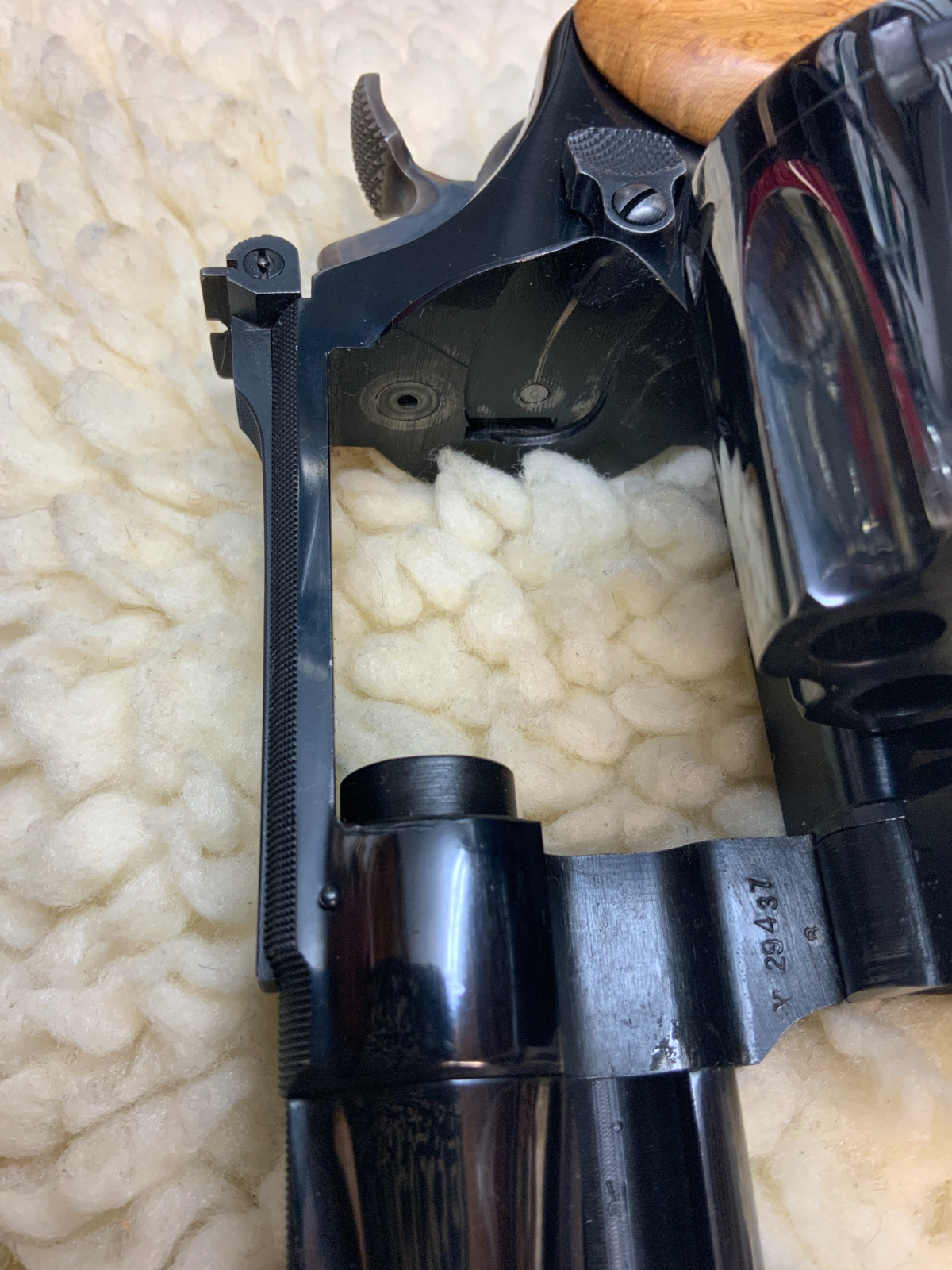


As you can guess by now. I think that this is one hell of a great Gun. That & I would just be overwhelmed to own. Grumpy
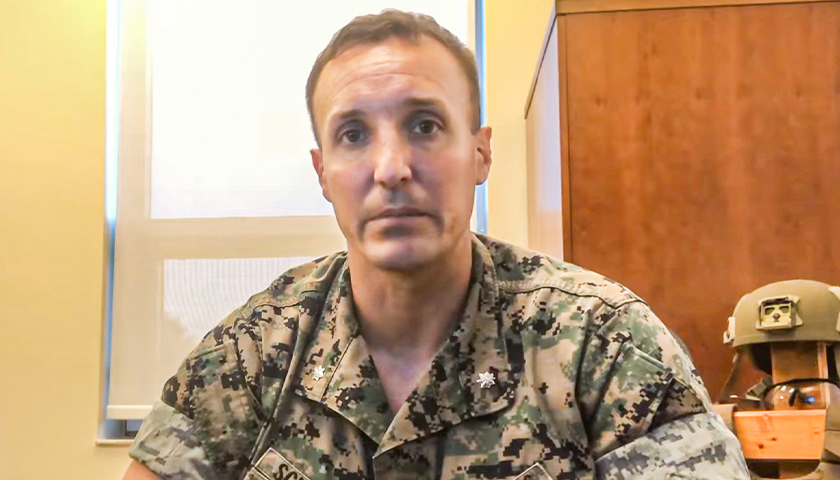
The Marine officer who received viral attention in August for posting a video on social media blasting military leadership over the botched withdrawal from Afghanistan, has been thrown in the brig, the United States Marine Corps has confirmed.
Lt. Col Stuart Scheller was taken to a military brig on Monday for violating a gag order, his father told the military blog Task & Purpose.
“All our son did is ask the questions that everybody was asking themselves, but they were too scared to speak out loud,” said Stuart Scheller Sr. “He was asking for accountability. In fact, I think he even asked for an apology that we made mistakes, but they couldn’t do that, which is mind-blowing.”
The elder Scheller said that his son is scheduled to appear before a military hearing on Thursday.
“They had a gag order on him and asked him not to speak,” the senior Scheller said. “He did, and they incarcerated him. They don’t know what to do with him.”
The Marine Corps issued a statement confirming that Scheller, a former battalion commander, has been sent to the brig.
“Lt. Col. Stuart Scheller Jr. is currently in pre-trial confinement in the Regional Brig for Marine Corps Installations East aboard Marine Corps Base Camp Lejeune pending an Article 32 preliminary hearing,” said Capt. Sam Stephenson, a spokesman for Training and Education Command. “The time, date, and location of the proceedings have not been determined. Lt. Col. Scheller will be afforded all due process.”
According to Task & Purpose, Scheller is accused of four offenses under the Uniform Code of Military Justice.
Scheller is accused of the following offenses under the UCMJ: Article 88: Contempt toward officials, Article 90: Willfully disobeying a superior commissioned officer, Article 92: Failure to obey an order, and Article 133: Conduct unbecoming, a Marine Corps spokesperson told Task & Purpose.
However, it’s not yet certain whether Scheller will face a court-martial. The Marine will go through an Article 32 hearing, which will determine whether there is enough evidence to warrant a court-martial. But no matter what the hearing finds, Scheller has already made a name for himself through his viral videos. Publicly criticizing senior leadership while still in uniform the way Scheller did was a move so bold that even members of other branches of the military are talking about it.
“People are lying if they said they didn’t feel a little bit like he did the day he posted the video,” said a commenter on the Air Force subreddit in reaction to the news on Monday that Scheller had been sent to the brig and is expected to appear before a military hearing on Thursday.
“[B]ut most of us have the better judgement than to post something like that (especially in uniform),” the commenter added.
Another commenter on the unofficial Marine Corps subreddit echoed that sentiment, writing “You don’t out-dick the Marine Corps. The green weenie always wins. This is no surprise.”
In his viral video—posted on the same day that 13 U.S. service members were killed in an ISIS bombing attack at the Kabul airport in Afghanistan—Lt. Col. Scheller expressed extreme frustration with the way the military withdrawal from Afghanistan had been handled, and demanded accountability.
“People are upset because their senior leaders let them down and none of them are raising their hands and accepting accountability and saying ‘we messed this up,’” he said.
“Did anyone raise their hand and say, ‘we completely messed this up?’” Scheller asked, going on to note that his Marine friends have been wondering if all of the lives lost over the past 20 years had been in vain.
“What I will say is, potentially all of those people did die in vain if we don’t have senior leaders to own up, raise their hand and say, ‘we did not do this well in the end,’” he said. “Without that, we just keep repeating the same mistakes—this amalgamation of the economic/corporate/political/ higher military rank not holding up their end of the bargain,” he added.
Scheller concluded: “I want to say this very strongly. I have been fighting for 17 years. I’m willing to throw it all away to say to my senior leaders, I demand accountability.”
Retired U.S. Navy SEAL Eddie Gallagher, who has been providing fundraising support for Scheller through his Pipe Hitter Foundation, posted an update in Scheller’s case in a Facebook post on Monday.
In his post, Gallagher shared a message from Scheller’s parents, Stu Scheller and Cathy Scheller, which began: “It is with a heavy heart that we, his parents, are informing you that our son, Lt. Col Stuart Scheller, has been incarcerated by the USMC this morning, September 27, 2021. He was issued a Gag order which he broke this weekend by posting on social media.”
In a post on Tuesday, Gallagher noted that Sec. of Defense Lloyd Austin, Chairman of the Joint Chiefs of Staff Mark Milley and General Kenneth McKenzie would be testifying before the Senate Armed Services Committee.
“Will they be held accountable for the debacle in Afghanistan?” he asked, sharing a tweet about the hearing by former New York City police commissioner Bernard Kerik. “Losing a 20 year war with no pull out plan that led to the death of 13 young Service Members?”
Scheller wrote a number of long posts on his Facebook page over the weekend, including one on September 25th in which he criticized Presidents Donald Trump, Barack Obama, George W. Bush and Bill Clinton, as well as Generals James Mattis, David Petraeus, Michael Flynn, Julian Alford and Francis Donovan. Scheller also called out Task & Purpose, the military blog that broke this story.
“You don’t understand me,” he wrote. “I do plan to bring the whole system down. Yes, Task and Purpose, I am brave enough to say it again. What say you now?”
Scheller ended his September 25th post by daring his commander to arrest him. “What happens when all you do is speak truth and no one wants to hear it. But they can probably stop listening because… I’m crazy… right? Col Emmel please have the MPs waiting for me at 0800 on Monday. I’m ready for jail.”
In a subsequent video, Scheller upped the ante, declaring that he would bring charges against Marine Gen. Kenneth McKenzie, the commander of U.S. Central Command (CENTCOM), for dereliction of duty.
“To recap my position, in the fallout of Afghanistan I demanded accountability in my senior leaders and I stated then that I understood that I might lose my battalion commander seat, my retirement and my family’s stability,” Scheller said. “As it has played out, I have in-fact lost all three of those things.”
Scheller indicated that rather than pursuing a court-martial over his critical remarks, the Marines had offered him a non-judicial punishment and separation under honorable conditions, so long as he is willing to give up his commission and not fight for his retirement.
“The reason I can’t let it go and the reason I’m not just taking an offer is because I feel like there are general officers in our institution who aren’t being held accountable,” Scheller said.
Addressing McKenzie, Scheller said, “You made comments that are public record on August 31st, that stated you made bad assumptions, that you left hundreds of Americans in Afghanistan, and then you itemized pieces of equipment that total hundreds of millions of dollars.”
“I know you are a great American,” Scheller continued. “I know you didn’t intend to fail. I know you have served very honorably and are probably a great leader. That doesn’t absolve you from the accountability of your bad assumptions.”
“I have read the entire UCMJ [Uniform Code of Military Justice] in the last two weeks of my purgatory, all of the punitive articles,” Scheller said. “And it turns out that all military officers are subject to the UCMJ,” Scheller said in the video. “Because it appears to me that no general officers are willing to hold each other accountable, I am submitting charges against Gen. McKenzie for his bad assumptions – not because I’m vindictive, but because the senior leaders need to be held accountable to the same standard as us.”
– – –
Debra Heine reports for American Greatness.
Photo “Lt. Col. Scheller” by Stuart Scheller.

USA – -(AmmoLand.com)- In a paper published at Loyola University Chicago, describing the make-up of people convicted for firearms possession, few surprises are found. These are the major findings listed in the executive summary of the paper, published in July of 2021. From luc.edu:
1) The majority of felony firearm possession convictions in Illinois occur in Cook County, primarily involve Black men, and are disproportionately concentrated in specific Chicago neighborhoods;
2) The majority—52%–of felony firearm possession convictions in Illinois involved Class X, 2, or 3 felony offenses of a person with a prior felony conviction possessing a firearm; 34% involved a Class 4 felony offense;
3) For the least serious felony firearm possession offense (e.g., a Class 4 felony), one-third (33%) of the statewide convictions stemmed from arrests in 11 of Chicago’s 77 neighborhoods. Of those convicted of a Class 4 felony firearm possession offense, 74% were 18-24 year-olds;
4) As a result of increased arrests, and mandatory prison sentences for most firearm possession offenses, prison admissions for these crimes increased 27% between 2014 and 2019, while admissions for all other crimes fell 38%;
5) Legislative changes in 2011 and 2018 to Class 4 felony firearm possession offenses primarily impacted sentencing practices in Cook County;
6) Of those firearm possession offenses where prison is not mandatory under all circumstances (i.e., the Class 4 felony offenses), those convicted in Cook County were more likely to be sentenced to prison than in the rest of Illinois;
7) The vast majority of those sentenced to prison for firearm possession offenses were not arrested for a violent crime within 3 years of release from prison. Having a prior conviction for a violent crime was a stronger predictor of a subsequent arrest for a violent crime, and the majority of those convicted and sentenced to prison for firearm possession offenses do not have prior convictions for violent crimes;
8) Those sentenced to probation or prison in Cook County for a Class 4 firearm possession offense had similar, and relatively low, rates of arrests for a violent crime within 3 years of sentencing after taking into account other characteristics correlated with recidivism, including age, sex, and prior criminal history.
Many young black men are being arrested for firearms possession. These men are mostly from the most dangerous neighborhoods in the United States. Most of these men would rather take the chance of being arrested compared to the chance of being defenseless when attacked. Some of these cases are arrests when the firearm is being used in defense of self and others. We do not know the percentage.
Firearm Possession Sentencing in Illinois by AmmoLand Shooting Sports News on Scribd
On Monday, 22 March, in Chicago, 15 people were recorded as being shot. Three of them were killed. One of those shot is recorded as acting in self-defense, on the South Side of Chicago.
Many of the arrests are for not having a Firearms Owner Identification card (FOID). The requirement to apply to the state to obtain permission to own a firearm is repugnant to the Second Amendment. From AmmoLand.com:
Judge T. Scott Webb, of White County, Illinois, Found the requirement to obtain a (FOID) before owning a firearm in Illinois, to be unconstitutional.
Gun Control in the United States has racist roots. The purpose of gun control was to disarm disfavored minorities, so the establishment could better control them. At first, this was mostly applied to black people. As time went on, it was applied to more and more people.
Once someone is convicted of felony gun possession, their chance of ever regaining their ability to legally exercise Second Amendment rights is almost non-existent.
This sets up a vicious feedback loop, where people in dysfunctional black communities do not trust the police. They do not get FOID cards or concealed carry licenses. They are arrested for carrying for self-defense. They are now felons. The distrust of the police and the system grows.
Shall issue permits only started gaining ground in the late 1980s. Constitutional Carry stated increasing in 2003.

The establishment in Chicago has done everything it can to perpetuate this cycle. There is not a single public range in Chicago, because of local government restrictions. Certified shooting instruction is required to obtain a concealed carry permit in Illinois. The wait time for concealed carry permits and FOID cards is measured in months, approaching years. For a young man of 18, who faces daily threats to his life in the worst of Chicago neighborhoods, carrying legally becomes an impossibility.
Because legal carry and training are exceedingly arduous in Chicago, maintaining a gun culture of responsibility and training becomes difficult, unlike much of the rest of the United States.
Training and legal exercise of Second Amendment rights could help reverse this cycle. From foxnews.com:
After last week’s appearance at CPAC, Toure told Politico that he began advocating for gun rights in the inner cities after seeing friends locked up for avoidable gun possession charges. He wants to continue the legacy of Malcolm X, the black nationalist who was assassinated in 1965, who expressed softer views on race following his pilgrimage to the holy Muslim city of Mecca.
“We go where there’s high violence, high crime, high gun control — high slave mentalities, to be perfectly honest — and inform urban America about their human right, as stated in the Second Amendment, to defend their life,” Toure told the magazine.
In spite of the barriers, some black people in the dysfunctional neighborhoods are legally arming themselves. They serve as examples of how people can protect themselves legally and have the police as allies instead of adversaries. Former Police Chief James Craig in Detroit, and Sheriff Clarke in Milwaukee County, earned much praise for championing concealed carry as a way to stop crime.
Trust in the police is paramount. Trust has to be earned. It is a feedback loop. Where there is trust in the police, crime drops too low levels. Where police are not trusted, crime rises astronomically.
The BLM and Antifa platforms seem calculated to destroy trust in the police. They appear designed to move the United States from a high trust nation to a low trust nation.
Examples of high trust nations would be Switzerland or Canada. Examples of low-trust nations would be Mexico or South Africa.
It is possible to have a high trust nation like the United States, with pockets of low trust communities, such as we exist today. Those who wish to see the United States in chaos or destroyed, are working hard to increase and spread distrust.
About Dean Weingarten:
Dean Weingarten has been a peace officer, a military officer, was on the University of Wisconsin Pistol Team for four years, and was first certified to teach firearms safety in 1973. He taught the Arizona concealed carry course for fifteen years until the goal of Constitutional Carry was attained. He has degrees in meteorology and mining engineering and retired from the Department of Defense after a 30-year career in Army Research, Development, Testing, and Evaluation.
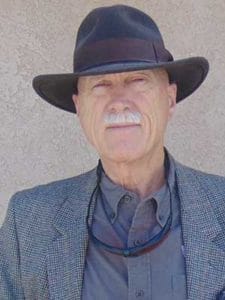
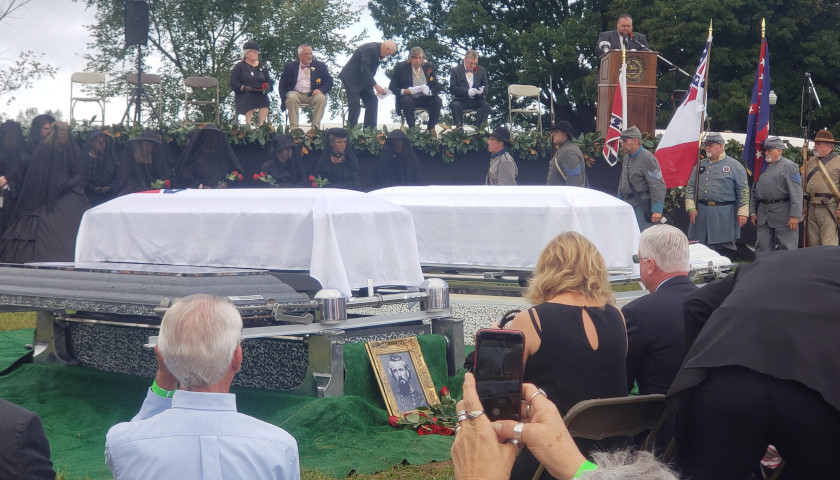
COLUMBIA, Tennessee – Confederate Lt. Gen. Nathan Bedford Forrest was “put to rest for eternity” Saturday by the Sons of Confederate Veterans (SCV) at the National Confederate Headquarters and Museum at Historic Elm Springs in Columbia, Tennessee.
The general was reinterred with his wife Mary Ann Montgomery Forrest at a private ceremony that was free to attendees but required a ticket, the number of which was limited to about 2,000.
SCV, organized in Richmond, Virginia in 1896, is a non-profit organization whose members are male descendants of Confederate veterans of The Civil War.
A torrential downpour passed over the area not much more than an hour before the official start of the event, which didn’t deter the dozens of SCV motorcycle riders.
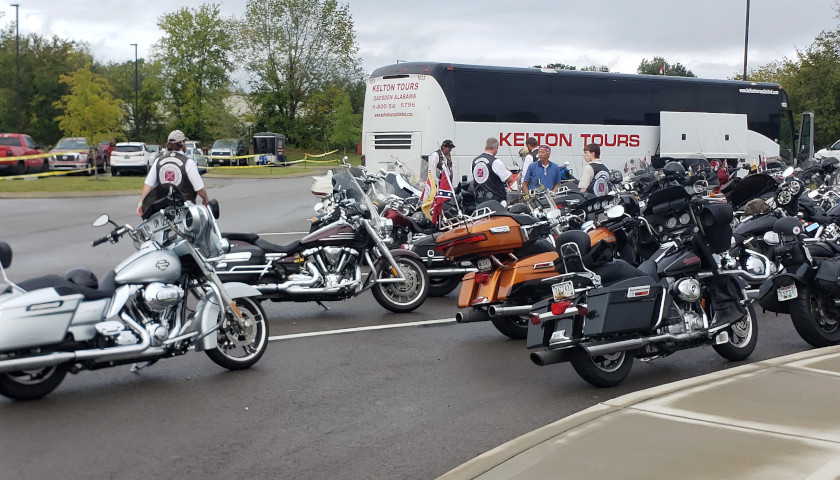
In addition to at least five tour buses observed in the parking areas, so were marker plates on passenger vehicles from Alabama, Arkansas, Florida, Georgia, Illinois, Kentucky, Louisiana, Maryland, Missouri, Mississippi, North Carolina, Oklahoma, South Carolina, Texas and Virginia.
As attendees arrived even more than an hour before the ceremony, a couple hundred re-enactors were already gathered on the grounds, representing Confederate infantry, cavalry and artillery units as well as women dressed in the attire of the day.

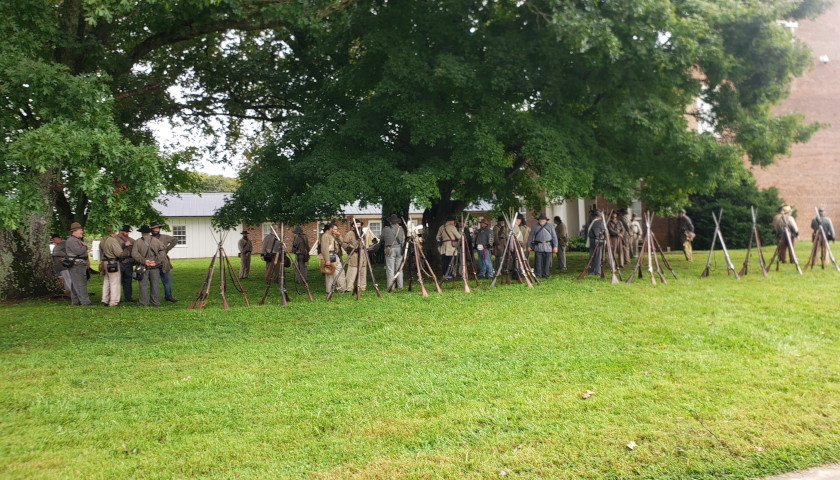
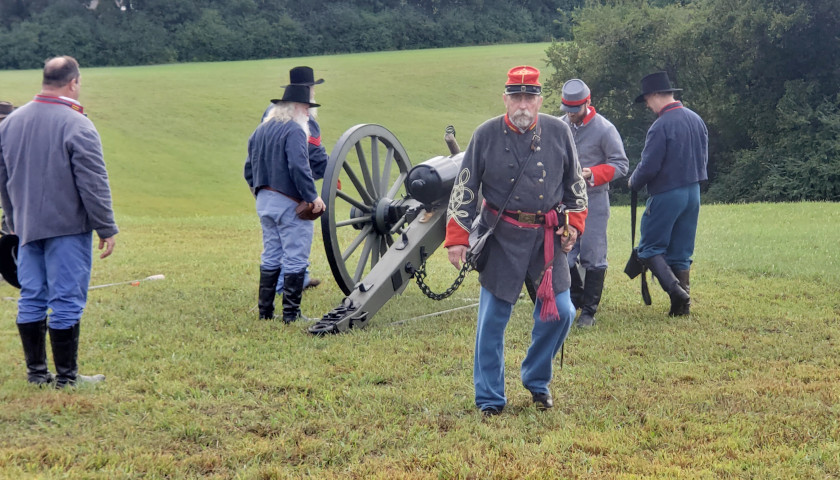
Donald Kimbell and Ken McBride, who represented the 4th Louisiana Field Artillery, told The Tennessee Star that artillery units from all of the 11 states that seceded from the Union were represented.
Kimbell, who serves as Louisiana SCV’s chaplain, said that he decided to forego a vacation cruise in order to attend the interment ceremony.
“I’ve been on a cruise before, but I’ve never buried a Confederate General,” Kimbell told The Star.
As the discussion turned toward recent efforts to erase America’s history, McBride made the point about the interment ceremony for General Forrest, “History is being written right here today.”
The event was held as a funeral, with the caskets carried by nearly a dozen pallbearers each onto the field area between the Elm Springs mansion and the new museum, where the ceremony was held with attendees having set up lawn chairs they were advised to bring.
During the entrance portion of the ceremony, the crowd stood in notably silent and solemn reverence for nearly 10 minutes.
In attendance were several Forrest family members, including two great-great-grandsons and four cousins. Three other great-great-grandsons, while still alive, were not in attendance.
Following the presentation of colors and the invocation, opening remarks were given by the SCV Commander-in-Chief Larry McCluney, Jr.
McCluney noted the earlier heavy rain, but said, “I’ve never done a Confederate funeral, Confederate memorial service when God didn’t bless us with a break in the rain. It’s always rained before. It’s always rained after, but it always sun shine on such a momentous occasion.”
Indeed, the sun did come out from behind the clouds, making it quite warm during the more than hour-long ceremony.
The remains of Forrest and his wife were buried under a statue of the general in 1904, after being moved from their original resting place in a Memphis cemetery.
In the late-night hours of December 20, 2017, the city of Memphis arranged to have the statue taken down, circumventing state law that prohibits the removal of historic monuments from public property, by selling the public park to a non-profit.
The family then had to pursue legal action in order to gain approval to, once again, remove the remains, which the SCV agreed to oversee.
McCluney seemed mindful of the controversy without directly speaking about it when he addressed the family.
“I want to thank the family for allowing us to have the honor to carry on with these proceedings and to entrust us with the remains of their ancestors, who will finally be put to rest here at Elm Springs for eternity,” he said.
McCluney said the last phase of the long journey would be the relocation of the large monument depicting Forrest on a horse that was removed from the Memphis park and is currently being stored in an undisclosed location.
Brief comments were made by officials of SCV affiliated lineage societies, Mike Moore, adjutant general of the Military Order of the Stars and Bars and Dottie Meadows, president of the Tennessee Society Order of Confederate Rose.
Forrest’s farewell address to his men was read by SCV Past Commander-In-Chief Paul Gramling, Jr.
The eulogy was delivered by H. Edward Phillips, III, who is not just a cousin of Forrest, but also leader of the Forrest family legal team.
McCluney, who is an educator, used a referenced to the three R’s, but with a different meaning that was reflected in the day’s event: Remembrance, Respect and Reverence.
“That’s what today is about,” said McCluney. “We’re here to remember a hero, not just of the south, but an American warrior.”
Following the formal remarks, wreaths of magnolia leaves, a garland of which also adorned the stage, were placed beside the grave sites into which the remains will be placed at a later time due to the impending rain.
The infantry and artillery units then honored Forrest with a rifle volley and cannon salute.
Visitation was held on September 17, from 9 a.m. to 5 p.m. at the Sons of Confederate Veterans National Headquarters and Museum and Historic Elm Springs in Columbia, Tennessee.
– – –
Laura Baigert is a senior reporter with The Star News Network, where she covers stories for The Tennessee Star and The Georgia Star News.






.JPG)


.JPG)


.jpg)
_-_panoramio.jpg)


.jpg)


,_Baujahr_1944_c.JPG)


.jpg)