Marines zig-zagged across the valley, dodging bullets and explosions in a sea of utter chaos. Men lunged towards any cover they could find and crouched, frozen. Others lay motionless, dead, their lifeblood draining in that godforsaken hellhole. The sounds of exploding shells and cries of imminent death were deafening.
Marine sniper, Daniel W. Cass, and his spotter, Corporal Clarence Carter, along with their unit, were assigned to rescue marines pinned down in the Wana Gorge Valley by Japanese machine guns. Cass was a nineteen-year-old grunt then, Carter just two years older. It would be their first run as snipers.
As they peered over a ridge overlooking the valley, 1,200 yards separated Cass and Carter from enemy nests below a coral ledge. It would be a long shot, with wind, heat waves and fog distorting the scope’s visibility. No time to look for a better position. Marines below were being ripped to shreds.
Using his rifle scope, Cass surveyed the area, scanning for movement or smoke. Looking through his spotter scope, Carter suddenly said, “I found them.” Cass followed his spotter’s point and saw the distinct muzzle flame flickering through the fog. He dropped his scope elevation until his crosshairs were directly on a speck of gray uniform.
Deep breath. Let half out. Hold. Crosshair, crosshair, squeeze.
The bullet hit the enemy’s nest. “I fired and worked the bolt, fired and worked the bolt, pouring accurate fire into Japanese defenses.” At some point, the machine gun fire stopped. The Japanese retreated. Slowly, the marines rose cautiously to their feet and trudged forward. One turned and waved thanks. [1]
___________________
Such are the experiences of military snipers. Though the historic settings and missions have differed, the courage, sense of duty, the infallible bond with his comrades in arms remain the raison d’être for soldiers in the pits of hell. The psychology of combatants’ willingness to kill has filled volumes and is too complex to cover in brief, but Lt. Col. Dave Grossman, in his seminal work, On Killing: The Psychological Cost of Learning to Kill in War and Society, states, “A tremendous volume of research indicates that the primary factor that motivates a soldier to do the things that no man wants to do in combat is not the force of self-preservation but a powerful sense of accountability to his comrades on the battlefield.” [2]
Armed with weapons designed for accuracy and long-range targets, snipers are highly trained in precision shooting. But marksmanship is only part of a sniper’s skill set. They are masters of camouflage, concealment, infiltration, reconnaissance, navigation, and survival, making the task of locating them a daunting and frustrating ordeal for the enemy. A sniper is capable of inflicting heavy losses on opposing forces, and in many cases, an entire unit can be brought to a halt by the presence of a single sniper.
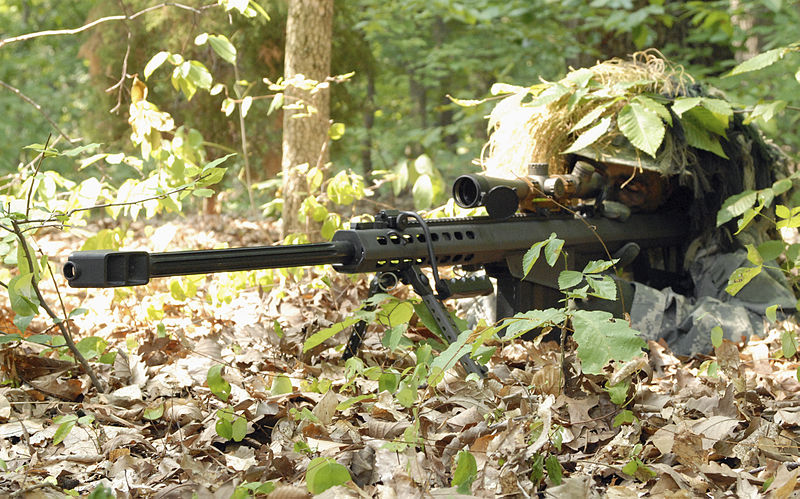
While it is not unheard of for snipers to operate alone, they generally work in two- to four-man teams for greater efficiency: one man focuses solely on shooting, the other assists in observing the area and spotting other targets. The spotter is also tasked with maintaining communication with other units, observing the atmospheric conditions, providing security, and coordinating artillery and air support. Sniper teams typically operate independently but never far forward from their main units. [3]
“One man, one kill.”
Snipers are trained to observe. Concealed in their surroundings, they maintain visual contact with their targets to gather as much intelligence as possible while eluding the enemy’s detection. They may spend hours or even days, frozen in position, observing the area or stalking the enemy. Heat, vermin, snakes, nature’s call are challenges that often need to be ignored. A great deal of time is dedicated to reconnaissance before a sniper engages his target, and with the sensitive political nature of today’s urban conflicts, a sniper must always consider the potential of collateral damage.
All military branches train and utilize snipers, with service-specific training programs lasting five to twelve weeks. Sniper candidates volunteer for consideration and must be recommended by their unit commanders. They must meet criteria in the areas of marksmanship, physical condition including visual acuity, mental and emotional balance, ability to learn intelligence equipment and reports, and familiarity with the natural environment.
The term “sniper” originated in British India in the 1770s, where British officers practiced their sharpshooting skills by targeting a highly elusive bird called a snipe. The earliest documented use of the word is found in a 1782 letter from George Selwyn to Lord Carlisle, in which he wrote, “Now people have been shot by platoons and in corps, the individual will be popped at or sniped, as they call it, from time to time…” [4]
In the United States, the art of sniping was first developed during the American Revolutionary War by Patriots fighting for independence from Great Britain. American colonists who displayed an aptitude for sharpshooting had typically spent years developing and honing their marksmanship skills through hunting in the rugged wilderness of the continent. Utilized as snipers, these men would first take out British field officers, thereby eliminating the enemy’s leadership. This tactic was extremely controversial because it went against the conventional doctrine of warfare at the time. The British considered it uncivilized and dishonorable, but it proved highly effective on the battlefield. While the weapons and tactics used since then have evolved, the concept behind a sniper’s mission remains the same. [5]

Riveting accounts of the longest shots and the deadliest ambushes have taken us to battlefields from the American Revolution to current combat zones. In the long history of the United States, there have been several warriors whose skills and notable feats have played a major role in the conflicts they fought. Click “Related Articles” below to learn of their incredible stories and how their actions made a major impact on the battlefields.
As always, the objective must be not to judge, but simply to understand. ~Lt. Col. Dave Grossman

.gif)
.gif)
.gif)
.gif)

President Carter was fishing in his hometown of Plains, Georgia, on April 20, 1979, alone in a flat-bottomed boat while staff were on land nearby. Carter said a rabbit being chased by hounds “jumped in the water and swam toward my boat. When he got almost there, I splashed some water with a paddle.”[1]
When Carter returned to his office, his staff did not believe his story, saying rabbits could not swim or that one would never approach a person threateningly.[2] However, a White House photographer had taken a picture of the incident, which was released by a later administration
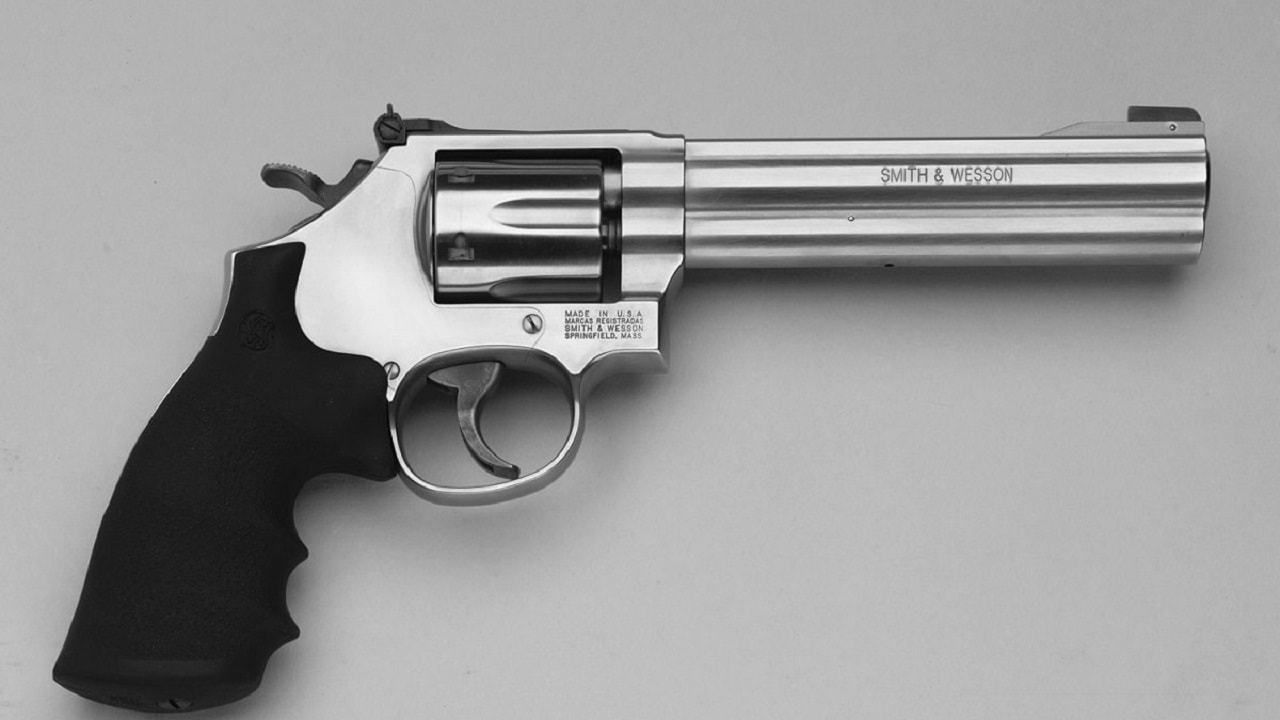
Smith & Wesson Revolvers: A Classic or Overrated? It’s difficult to beat a revolver for reliability. They usually don’t malfunction or jam because they have fewer moving parts compared to semi-automatics. They are effective in home defense situations. Many are chambered in many different calibers including beefy .44 or .357 Magnum for heavy-duty stopping power. They are easy to maintain – just use a bore brush for the barrel and cylinders and then wipe down the piece. But revolvers tend to be heavier and slower to load if you are not used to them.
Is Smith & Wesson Keeping Up With the Competition?
You can’t discuss revolvers without mentioning the Smith & Wesson brand. Since Horace Smith and Daniel Baird Wesson made their first repeating pistol in 1852, Smith & Wesson have been perfecting their firearms. But is S&W resting on its laurels and letting the competition eclipse them? Colt and Ruger make commendable revolvers too.
History of Smith & Wesson Revolvers
Sam Colt invented the revolver in 1836, so Colt has played the revolver game longer than Smith & Wesson. The Ruger Blackhawk gave the late 19th century legendary Colt Peacemaker a run for its money.
For Smith & Wesson, it was the Model 3 American that put them on the map in 1869. This gun, like the Peacemaker, proliferated around the Old West and was especially prized during the Civil War. The gun maker is also widely known for its Model 10 .38 caliber Military and Police revolver. By 1935, Smith & Wesson had a .357 Magnum version. In 1956, S&W pioneered the Model 29 .44 caliber made famous in popular culture by Clint Eastwood in the Dirty Harry movies. Then in 1966, S&W unveiled the first stainless steel revolver. In the 1980s profits went down because police departments in the United States were switching to lighter semi-automatics made by Glock and SIG Sauer.
Uh Oh, Quality May Be Taking a Hit
But lately, according to some reviewers, the Smith & Wesson brand has taken a dive. Gun blogger Chuck Hawks gives examples of why the S&W revolvers are having trouble accomplishing their basic mission.
First, two .22 Masterpiece target revolvers he inspected for a sporting goods store were so out of the ordinary that the cylinders could not be rotated fully. Upon another inspection for a gun shop, Hawks found the “cylinder ratchet notches were so poorly machined that no two were identical.” After a day at the range with a new Chief’s Special .38 Special revolver, he noticed that all the chambers on the cylinder had a small bulge.
These types of issues are likely the cause of poor quality control at the manufacturer. Hawks thinks the revolvers are not being tested correctly.
“Such examples are far too numerous and widespread. Design, quality, and quality control problems have been endemic to Smith & Wesson firearms for decades,” he wrote.
Some Reviewers Still Sing Praises for the S&W Revolver
S&W revolvers are still popular with other reviewers. Some like the heavy trigger pull that will keep the gun from firing unexpectedly. There are numerous types of holsters that offer ample concealment. You can usually find quality ammunition for the pistol.
The Model 500 Is One of the Most Powerful S&W Revolvers
The S&W Model 500 gets good reviews. You can mount optics on the Model 500. The front sight is interchangeable, and the rear sight is adjustable. 1945’s own Richard Douglas sings its praises.
“For one, Smith & Wesson recently developed the innovative ‘x-frame’ to give you a better grip and help to handle the recoil that comes along with the immense power of this handgun. This makes the 500 very comfortable to handle, and even features a recoil-absorbing rubberized grip complete with finger grooves to let you hold the gun at an angle that allows for optimal control and accuracy,” according to Douglas.
Smith & Wesson: Enviable Sales and Profits
Smith & Wesson has a legion of fans. You can tell from their record sales and profits. Sales went up 100 percent year over year in July 2021. The Springfield, Massachusetts company made over $250 million in profit during that period. S&W paid off its corporate debt and even gave full-time workers $1,200 bonuses.
All told Smith & Wesson revolvers get mixed reviews. It seems there are problems when models are produced in high numbers. Like all new guns, keep a close eye on your pistol when it comes out of the box and inspect it carefully after your first day on the range.
If there are problems with your Smith & Wesson revolver, the company has a limited one-year warranty. When you find a defect, put it in writing and the company promises that it will fix the problem free of charge.

.gif)
.gif)
.gif)
.gif)
.gif)
.gif)
.gif)
.gif)