


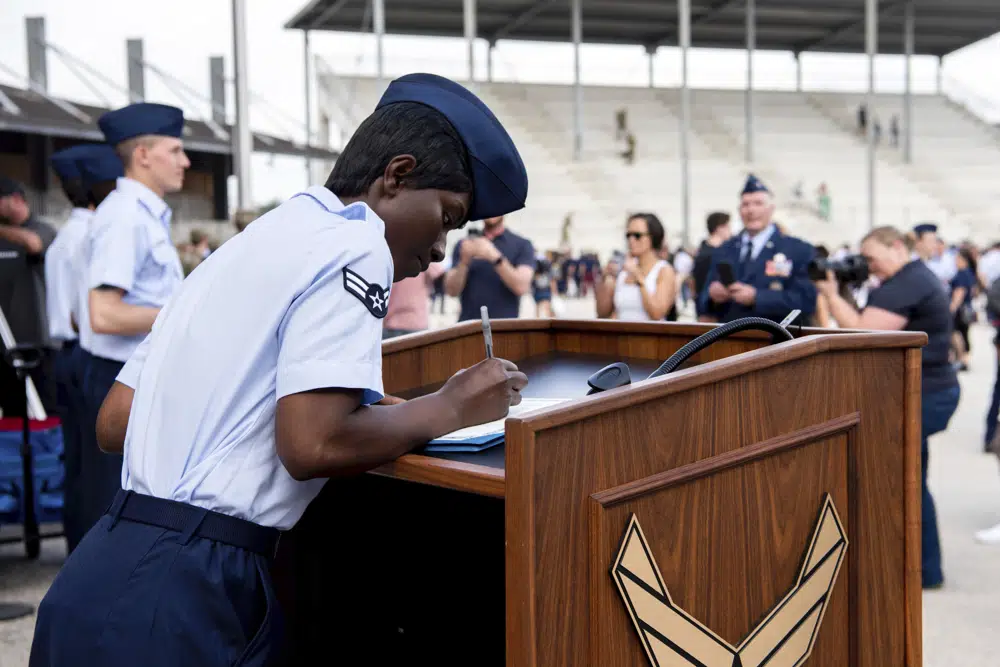
WASHINGTON (AP) — When Esmita Spudes Bidari was a young girl in Nepal, she dreamed of being in the military, but that wasn’t a real option in her country.
Last week, she raised her right hand and took the oath to join the U.S. Army Reserves, thanks in part to a recruiter in Dallas who also is Nepalese and reached out to her through an online group.
Bidari, who heads to basic training in August, is just the latest in a growing number of legal migrants enlisting in the U.S. military as it more aggressively seeks out immigrants, offering a fast track to citizenship to those who sign up.
Struggling to overcome recruiting shortfalls, the Army and the Air Force have bolstered their marketing to entice legal residents to enlist, putting out pamphlets, working social media and broadening their outreach, particularly in inner cities. One key element is the use of recruiters with similar backgrounds to these potential recruits.
“It is one thing to hear about the military from locals here, but it is something else when it’s from your fellow brother, from the country you’re from,” said Bidari, who was contacted by Army Staff Sgt. Kalden Lama, the Dallas recruiter, on a Facebook group that helps Nepalese people in America connect with one another. “That brother was in the group and he was recruiting and he told me about the military.”
The military has had success in recruiting legal immigrants, particularly among those seeking a job, education benefits and training as well as a quick route to becoming an American citizen. But they also require additional security screening and more help filling out forms, particularly those who are less proficient in English.
Both the Army and the Air Force say they will not meet their recruiting goals this year, and the Navy also expects to fall short. Pulling more from the legal immigrant population may not provide large numbers, but any small boosts will help. The Marine Corp is the only service on pace to meet its goal.
The shortfalls have led to a wide range of new recruiting programs, ad campaigns and other incentives to help the services compete with often higher-paying, less risky jobs in the private sector. Defense leaders say young people are less familiar with the military, are drawn more to corporate jobs that provide similar education and other benefits, and want to avoid the risk of injury and death that service in defense of the United States could bring. In addition, they say that little more than 20% meet the physical, mental and character requirements to join.
“We have large populations of legal U.S. residents who are exceptionally patriotic, they’re exceptionally grateful for the opportunities that this country has provided,” said Air Force Maj. Gen. Ed Thomas, head of the service’s recruiting command.
The biggest challenges have been identifying geographic pockets of immigrant populations, finding ways to reach them and helping any of those interested navigate the complex military recruiting applications and procedures.
Last October, the Army reestablished a program for legal permanent residents to apply for accelerated naturalization once they get to basic training. Recruiters began to reach out on social media, using short videos in various languages to target the top 10 countries that recruits had come from during the previous year.
The Air Force effort began this year, and the first group of 14 graduated from basic training and were sworn in as new citizens in April. They included recruits from Cameroon, Jamaica, Kenya, the Philippines, Russia and South Africa. As of mid-May there were about 100 in basic training who had begun the citizenship process and about 40 who had completed it.
Thomas said the program required changes to Air Force policy, coordination with U.S. Citizenship and Immigration Services and a careful screening process to ensure there are no security risks.
“We have to take exceptional measures to be able to thoroughly vet and go through the security clearance investigation,” he said, adding that in many cases the immigrants are not immediately put in jobs that require top secret clearance.
Under the new program, recruits are quickly enrolled in the citizenship system and when they start basic training, an expedited process kicks off, including all required paperwork and testing. By the time Air Force recruits finish their seven weeks of training, the process is complete and they are sworn in as American citizens.
The first group of 14 included several who are seeking various medical jobs, while another wants to be an air transportation specialist. Thomas said Airman 1st Class Natalia Laziuk, 31, emigrated from Russia nine years ago, has dreamed of being a U.S. citizen since she was 11, and learned about the military by watching American movies and television.
“Talking to this young airman, she essentially said, ‘I just wanted to be useful to my country,’” he said. “And that’s a story that we see played over and over and over again. I’ve talked to a number of these folks around the country. They’re hungry to serve.”
For Bidari, who arrived in the U.S. in 2016 to attend college, the fast track to citizenship was important because it will make it easier for her to travel and bring her parents to the United States to visit. Speaking in a call from Chicago just a day after she was sworn in, she said she enlisted for six years and hopes that her future citizenship will help her become an officer.
In Chicago earlier this year, Army Secretary Christine Wormuth heard from a number of recruiters about the increased outreach to immigrant communities and how it helped them meet their numbers. In the 2022 budget year, they said, the Chicago recruiting battalion enlisted 70 legal permanent residents and already this year they have enlisted 62.
More broadly across the Army, close to 2,900 enlisted during the first half of this budget year, compared with about 2,200 during the same period the previous year. The largest numbers are from Jamaica, with 384, followed by Mexico, the Philippines and Haiti, but many are from Nepal, Nigeria, Ghana, Cameroon, Colombia and the Dominican Republic.
“As a little girl, looking at the soldiers, I always had admiration for them,” said Bidari, recalling British troops in Nepal. “Yesterday, when I was able to take that oath … I don’t think I have words to really explain how I was feeling. When they said, ‘Welcome future soldier,’ I was like, ‘Oh my goodness, this is happening.’”
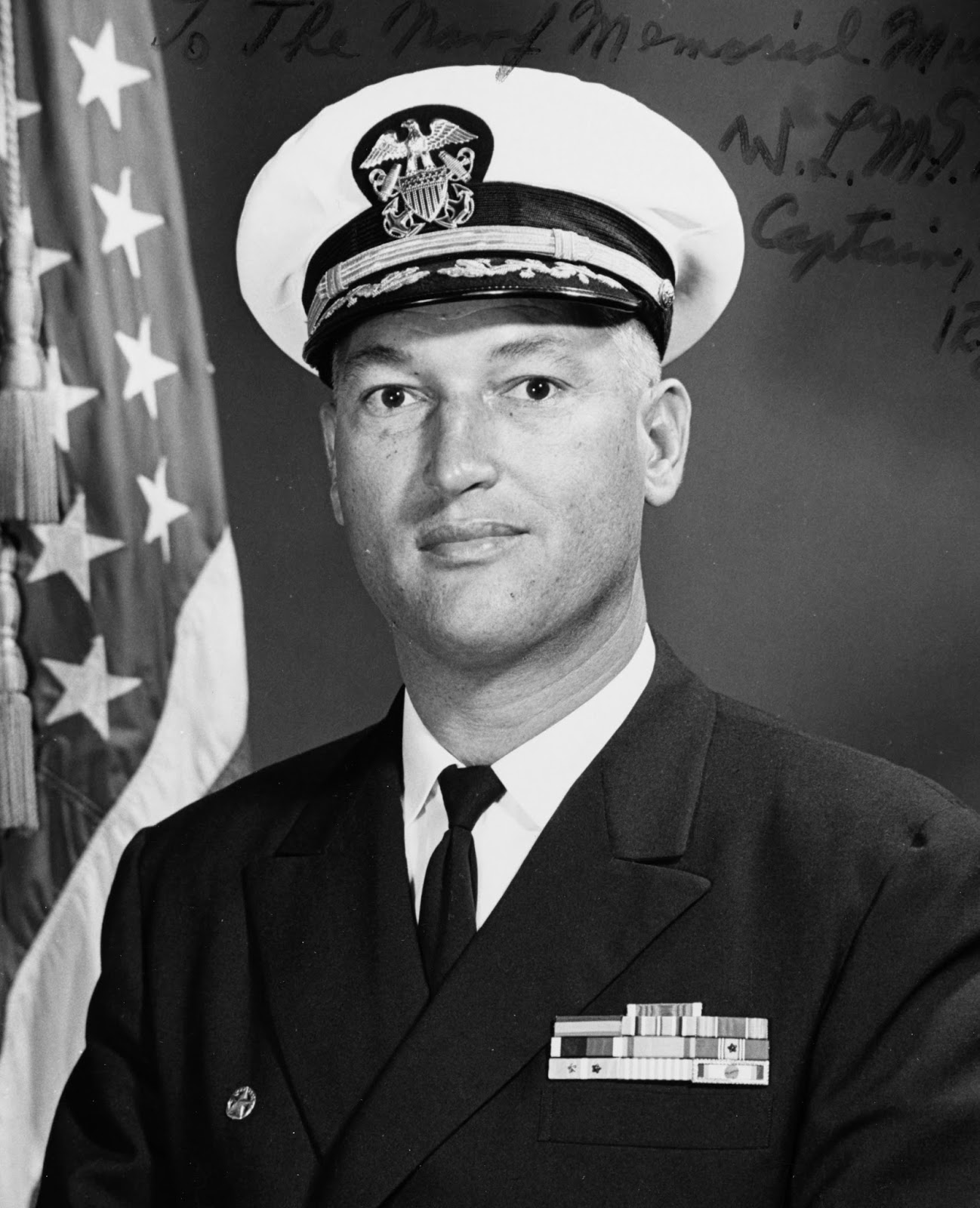 |
| William L.McGonagle (Naval History and Heritage Command photograph) |
On June 11, 1968, in Leutze Park at the Washington Navy Yard, Secretary of the Navy Paul R. Ignatius and Admiral Thomas H. Moorer, chief of naval operations, awarded the Congressional Medal of Honor to Captain William L. McGonagle, commanding officer of USS Liberty (AGTR 5), for performance above and beyond the call of duty on June 8, 1967, when that ill-fated ship was attacked without warning by air and surface craft of the Israel Defense Forces.(1) The travail of that ship and her crew resulted from actions that have never, in the view of many of those who were on board, been truthfully explained by the attackers. However, the medal and many others earned as the result of that confrontation on the high seas are talismans of brave and selfless acts by a host of officers and enlisted personnel of the U.S. Navy.
The Humble Origins of a Spy Ship
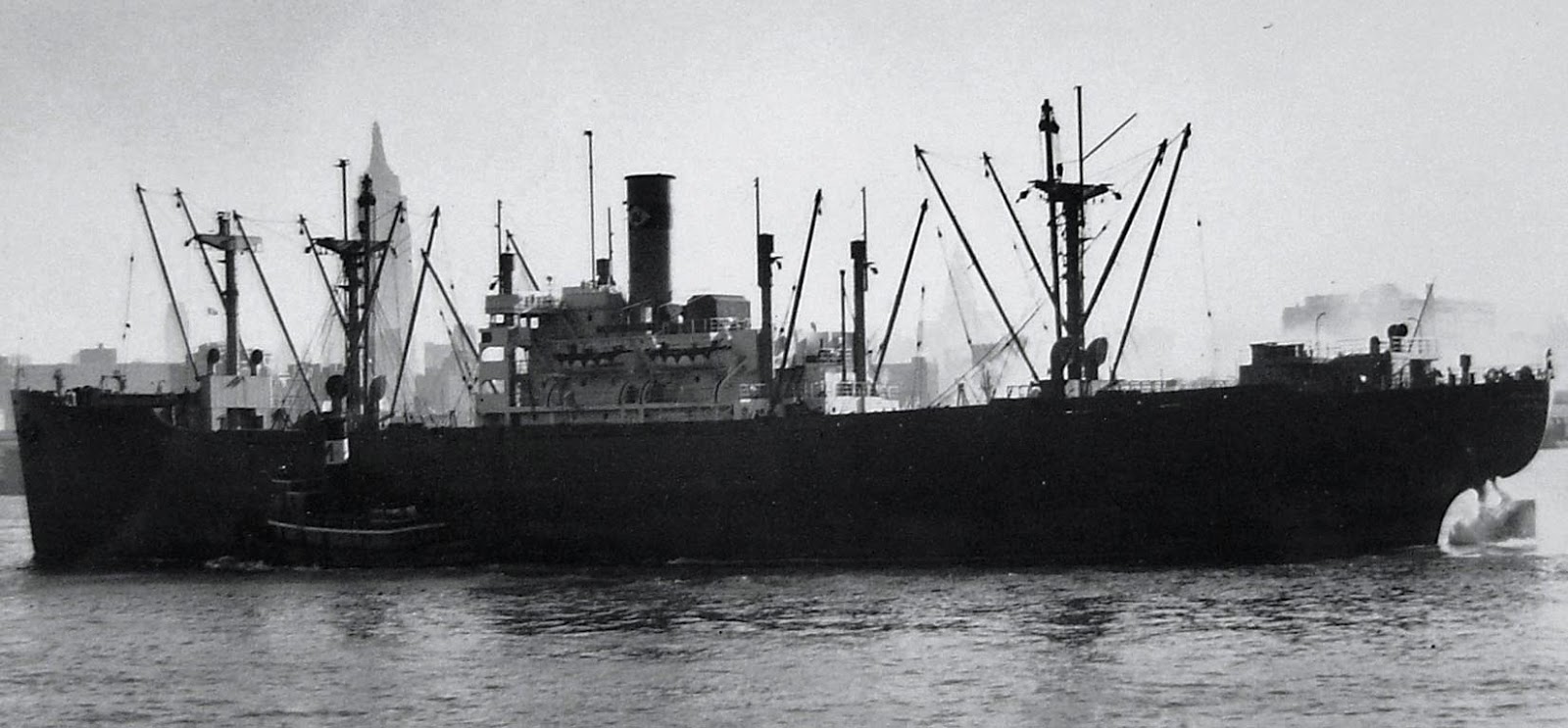 |
| SS Simmons Victory in New York, 1947. (World Ship Society via navsource.org) |
Liberty began her life as SS Simmons Victory, a Victory-class cargo ship built during the Second World War by the Oregon Shipbuilding Company of Portland, Oregon and named for Simmons College in Boston, Massachusetts. Completed about two months after being laid down, she was delivered to the War Shipping Administration on May 4th, 1945, and performed strategic lift operations under charter to the Pacific Far East Line, to include delivering ammunition from Port Chicago, California to Leyte for the impending invasion of Japan. Japan’s surrender in August obviated the necessity for this operation, and she returned the ammunition to Port Chicago. During the Korean War, she carried out similar duties. Simmons Victory was withdrawn from service in 1958 and placed in the National Defense Reserve Fleet in Olympia, Washington.
Acquired by the Navy in February 1963, Simmons Valley was converted to a “miscellaneous auxiliary ship,” and commissioned as USS Liberty on December 30, 1964, at the Puget Sound Naval Shipyard. She steamed to Norfolk in early 1965 for installation of equipment that would enable her crew to conduct communications surveillance and processing operations for the National Security Agency. Liberty was assigned to Service Squadron Eight, and following shakedown at Naval Base Guantanamo Bay began deployment to the west coast of Africa to participate in the Navy’s program of research and development in communications.
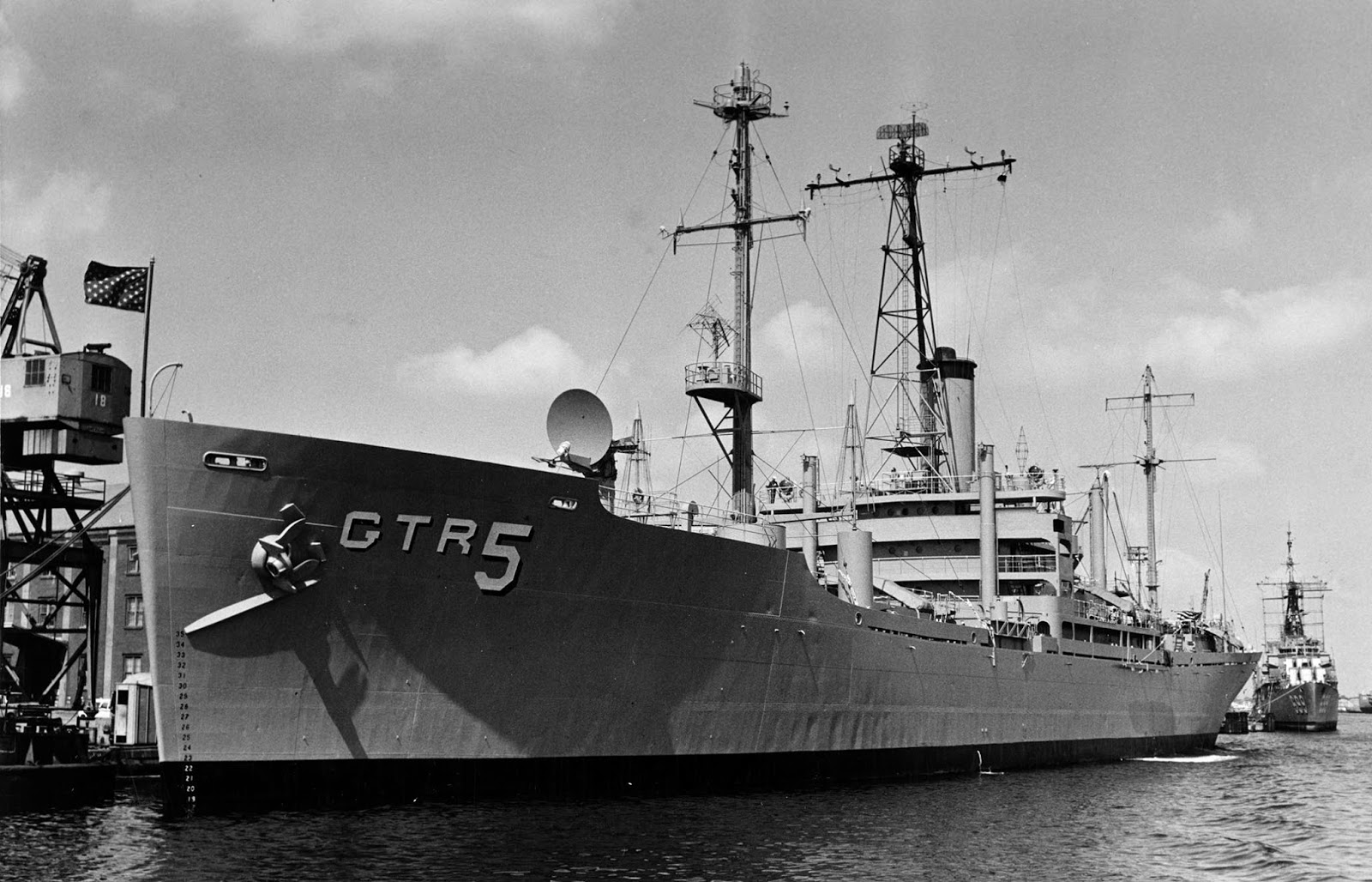 |
| USS Liberty (AGTR 5) at the Norfolk Naval Shipyard, Portsmouth, Virginia, in October 1966. USS Waldron (DD 699) is tied up astern of Liberty. (Courtesy of the Mariners’ Museum, Newport News, Virginia. Ted Stone Collection. Naval History and Heritage Command photograph) |
Liberty’s operations, and those of other technical research ships such as USS Banner (AGER 1), USS Pueblo (AGER 2), and USS Palm Beach (AGER 3), have retained a somewhat murky, mysterious character, though the role of the National Security Agency as an eavesdropping organization has more recently become publically known. The ships chosen for these missions were older, nondescript cargo vessels of uncertain pedigree that could be easily converted and equipped with costly electronic communications surveillance equipment. Publicly available information shows that, prior to her fateful voyage to the vicinity of the Sinai Peninsula, Liberty made three deployments to the West Coast of Africa between the Canary Islands and the Cape of Good Hope as “a floating research and development ship.”(2)
Into Harm’s Way
Liberty’s third deployment was interrupted by orders received during the morning watch on May 24th, 1967 at Abidjan, Ivory Coast, where the ship’s crew was enjoying a liberty port. The ship was ordered to proceed over 3,000 miles at best speed to Rota, Spain. There, she was to take on additional personnel and equipment for sensitive assignments in connection with worsening tensions between the United Arab Republic (present-day Egypt) and the State of Israel. Following an eight-day voyage, Liberty entered Rota, took on stores, equipment, additional linguists and technical personnel, and departed for the Eastern Mediterranean on June 2, 1967.
Officers and enlisted personnel on board the ship and those in supervisory positions expressed misgivings about the impending mission. Perhaps it was best expressed by Chief Petty Officer Raymond Linn, who was to retire at the end of June after 30 years’ service. He opined that it was foolhardy to send an unarmed ship, a spy ship, into such a potential maelstrom. Chief Linn proved all too prescient, as he would become one of 34 crewmen who would die in the attack. Others at higher levels expressed uncertainty, and Cdr. McGonagle made a request for a destroyer type escort. The request was denied for, among other reasons, the ship had every right to be where she was and was clearly identifiable as a United States Ship. Finally, it was assumed that the ship could withdraw from danger if need be.
The intensity of hostilities during what would become known the Six Day War was such that those higher up in the chain of command modified operational orders, not simply for USS Liberty, but for all Sixth Fleet ships. In summary, new orders stipulated that areas might be modified based on “the local situation” and that the Sixth Fleet Commander was to be advised by flash message of “any threatening actions to you or diversions from schedule necessitated by external threat.” These messages, and those restricting a closest point of approach to 20 (and later, 100) miles from the hostile coast, did not reach Liberty.
Prior to reaching the operating area, Cdr. McGonagle had met with Lt. Cmdr. Dave Lewis, Liberty’s Research Department director, to confirm that it was absolutely necessary to be as close to the Gaza Strip as set forward in orders to execute the mission. McGonagle had also instituted a “modified” weapons condition three steaming watch that placed ammunition and extra personnel at the forward .50 caliber gun mounts.
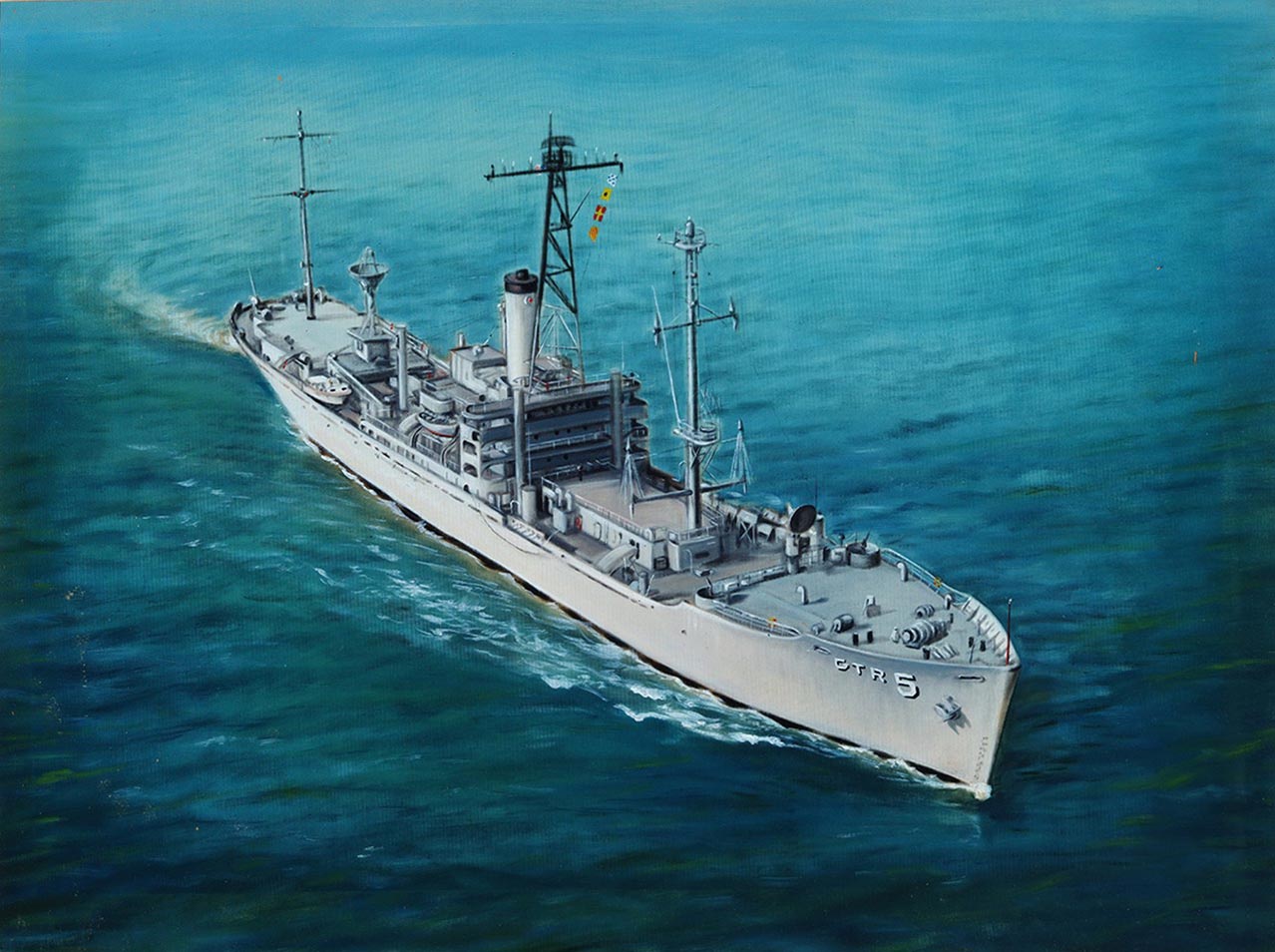 |
| A painting of USS Liberty, Oil on Silk; Artist Unknown; C. 1967. (Gift of Ms. Cindy McGonagle, Naval History and Heritage Command image) |
Liberty arrived off the city of El Arish, about 30 miles west of the Gaza Strip on the northern coast of the Sinai Peninsula, just after midnight on June 8th, 1967. There, a tale of bravery, perseverance and sacrifice, unique in the annals of the U.S. Navy, would play out. By late morning she had been overflown by multiple aircraft, both ungainly “flying boxcar” Noratlas 2501 types, and fighter bombers. One of the boxcars reportedly had Star of David markings. It was, in the words of one of the officers of the deck, Ens. John Scott, a beautiful day, and the American flag was clearly visible. All crewmembers later queried agreed that the flag was clearly visible prior to and during the attack. Some members of the crew even sunbathed on deck before a General Quarters drill was held at 1300 that afternoon.
About one hour later, a savage air attack began and in the words of then-Lieutenant George Golden, Liberty’s chief engineer, “all hell broke loose.” Repeated strafing by Mirage III fighters and Mystere fighter-bombers left the bridge in shambles, with the navigator dead, the executive officer mortally wounded, and the officer of the deck and the commanding officer severely wounded. The ship’s bridge area was in flames from burning napalm, and the superstructure was repeatedly penetrated by rocket fire. Years later, Golden recounted that three flags, including a large “holiday ensign,” were raised and shot away.(3) A shipyard survey later tabulated 821 holes made in Liberty’s hull, deck, and superstructure.
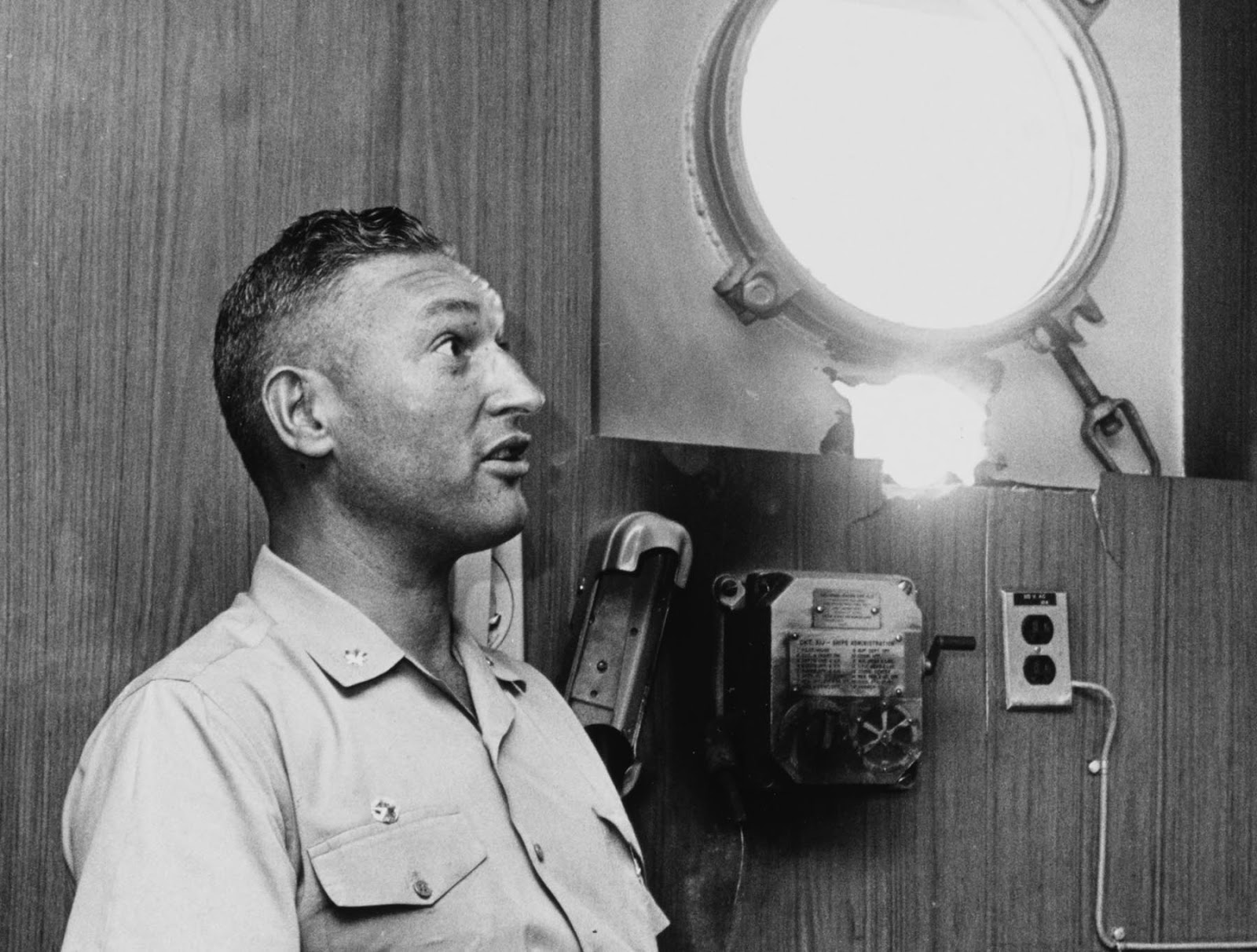 |
| Cdr. William McGonagle is seen here in his cabin aboard USS Liberty on June 11, 1967, three days after an Israeli attack crippled his ship. A hole from one of the hundreds of rounds that penetrated the ship can be seen just to McGonagle’s left. (Naval History and Heritage Command photograph) |
During the initial attack, the forward .50 caliber machine gun positions were destroyed and the crews killed. Communications antennae were destroyed, and the ship was quickly rendered defenseless and mute. The air assault was followed by a surface engagement in which three Israeli torpedo boats rapidly closed in and launched torpedoes, one of which made a 40-foot gash, starboard side amidships, flooding the Research Department spaces and killing all inside.
Amid the massive, sudden destruction, the well-trained crew responded with instinctive professionalism and consummate bravery. Lt. Richard Kiepfer, the ship’s doctor, rescued those wounded from exposed decks at great risk to himself. Helmsman Francis Brown remained at his post, despite heavy shelling, until he was killed by a projectile that struck him from behind. Executive Officer (XO) Phillip Armstrong was fatally injured by strafing as he jettisoned 50-gallon gasoline drums from the bridge. Everywhere crewmen performed gallantly, to include those initially temporarily overcome by fear. Dr. Kiepfer, though wounded himself, operated in a vain attempt to save Gary Blanchard, a young seaman from Kansas.
During the initial attack, radiomen were able to send a distress message which was received on board the carrier Saratoga (CVA 60) using jury rigged equipment, but the signal was jammed intermittently. Rescue ships and aircraft did not reach the ship during the long and perilous night. Cdr. McGonagle, fortified by black coffee and assisted by relays of underway officers of the deck, remained on the bridge guiding the ship at night by observing Polaris, for the gyrocompass had been rendered useless. Ens. John Scott, Damage Control Assistant, personally surveyed the ship, monitored damage reports from his subordinates and supervised shoring of the bulkheads of the research space to prevent its collapse.
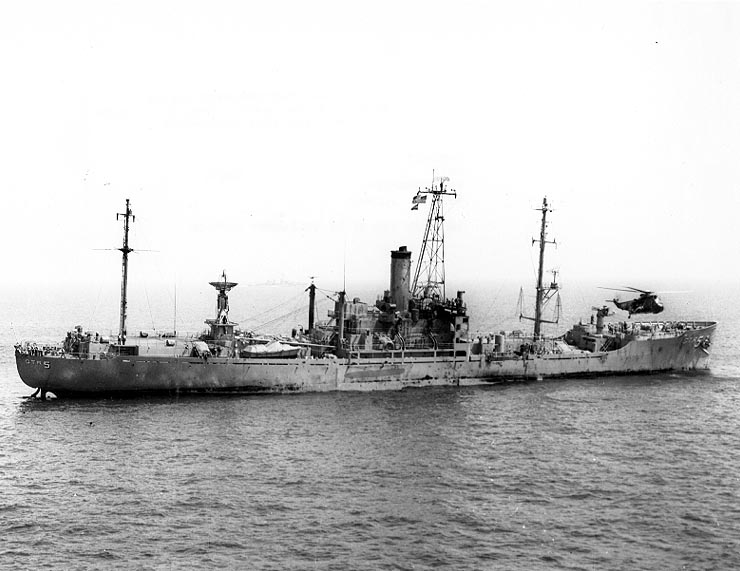 |
| USS Liberty (AGTR 5) receives assistance from units for the Sixth Fleet after she was attacked by Israeli forces off the Sinai Peninsula on June 8, 1967. An Sh-3 helicopter hovers near her bow. (U.S. Navy photograph via Wikimedia Commons) |
USS Davis (DD 937), flagship for Commander, Destroyer Squadron Twelve (COMDESRONTWELVE), received message traffic suggesting that the Liberty had been attacked, and the ship responded to emergency orders of Commander Sixth Fleet that she proceeded at top speed, in company with USS Massey (DD 778), to the stricken ship some 500 miles away. At first light on June 9, the destroyers found, according to Lt. (later Rear Admiral) Paul Tobin, a powerless ship covered with marks of battle damage, scorch marks, and a ten degree starboard list. “The reality of the situation struck home as we climbed aboard and looked at the faces of the men,” wrote Lt. Hubert Strachwitz of the Davis in a letter to his wife. “No Hollywood makeup man nor actor could ever produce those faces,” he went on. “There were sunken eyes, bristly, dirty faces dark bloodstains, ripped clothes covered with oil and charcoal. There were no hysterics, no crying, no cursing—just tired bodies trying to do necessary jobs.”(4)
The major evolutions required were providing medical care for the wounded, removing the dead, restoring power and stability to the ship, so that the ship could reach a safe port. Capt. Harold Leahy, COMDESRON TWELVE, came aboard and climbed to the shattered bridge where the commodore gently offered to take command of the Liberty. After consulting with Dr. Kiepfer and Dr. Peter Flynn, a general surgeon airlifted to Massey from USS America (CVA 66), he chose not to with the understanding that the captain lay below to rest. Kiepfer opined then as he did later to the board of inquiry, that Capt. McGonagle was a key ingredient—a rock upon which the rest of the men supported themselves—in the survival of the Liberty. In so doing, he had earned the right to bring her safely into port. Lt. Tobin and Lt. Cmdr. William Pettyjohn, COMDESRONTWELVE chief of staff, came on board to give temporary assistance to the engineering force and assume the duties of executive officer.
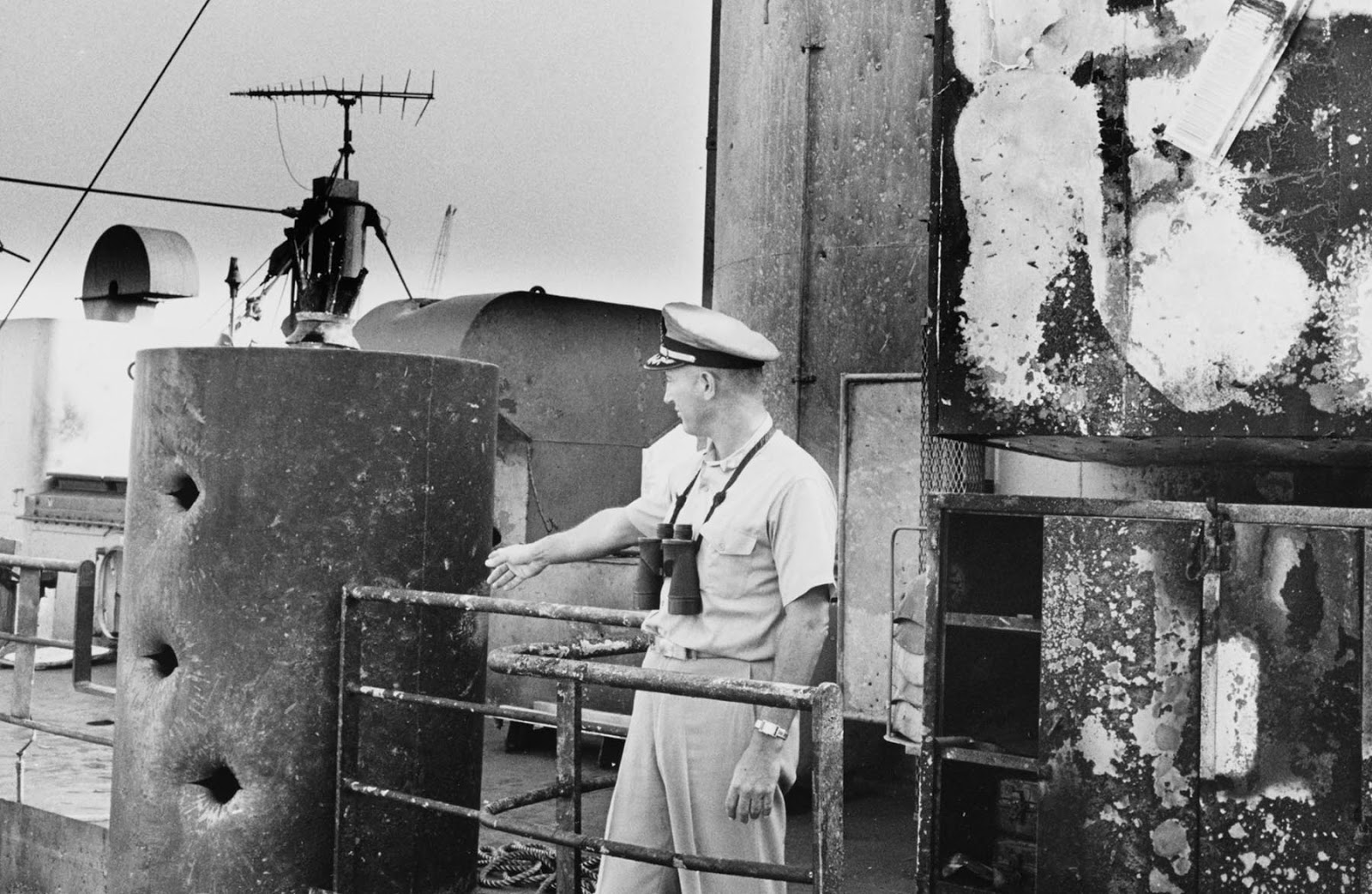 |
| Cdr. McGonagle points out damage inflicted on Liberty‘s superstructure during the Israeli attack off the Sinai Peninsula on June 8, 1967. The photograph was taken on June 16, two days after arriving at Valletta, Malta, for repairs. (Naval History and Heritage Command photograph) |
The next pressing task was to restore power and stability to the ship. Lt. Tobin and Lt. Cmdr. Pettyjohn, together with the Liberty’s crew, augmented by engineering and damage control rates, began the daunting task. Later, Tobin observed that it was good to work with the crew, for they had detailed knowledge of the layout of the darkened ship and its equipment. He also recalled that they were infused with new energy by their newly arrived comrades.(5)
By careful study of data at hand, such as the liquid loading diagram, it was determined that the list could be corrected, and the transfer of remaining fuel to port tanks was successful. Concurrently, the propulsion plant was surveyed and electric power was gradually restored after a diesel generator was started and wiring repaired. The ship was determined to be as seaworthy as possible and it was shown that, although there was much freestanding water throughout the ship, there was sufficient righting arm to enable it to recover from rolls in heavy weather. It was thought that the keel was intact.(6)
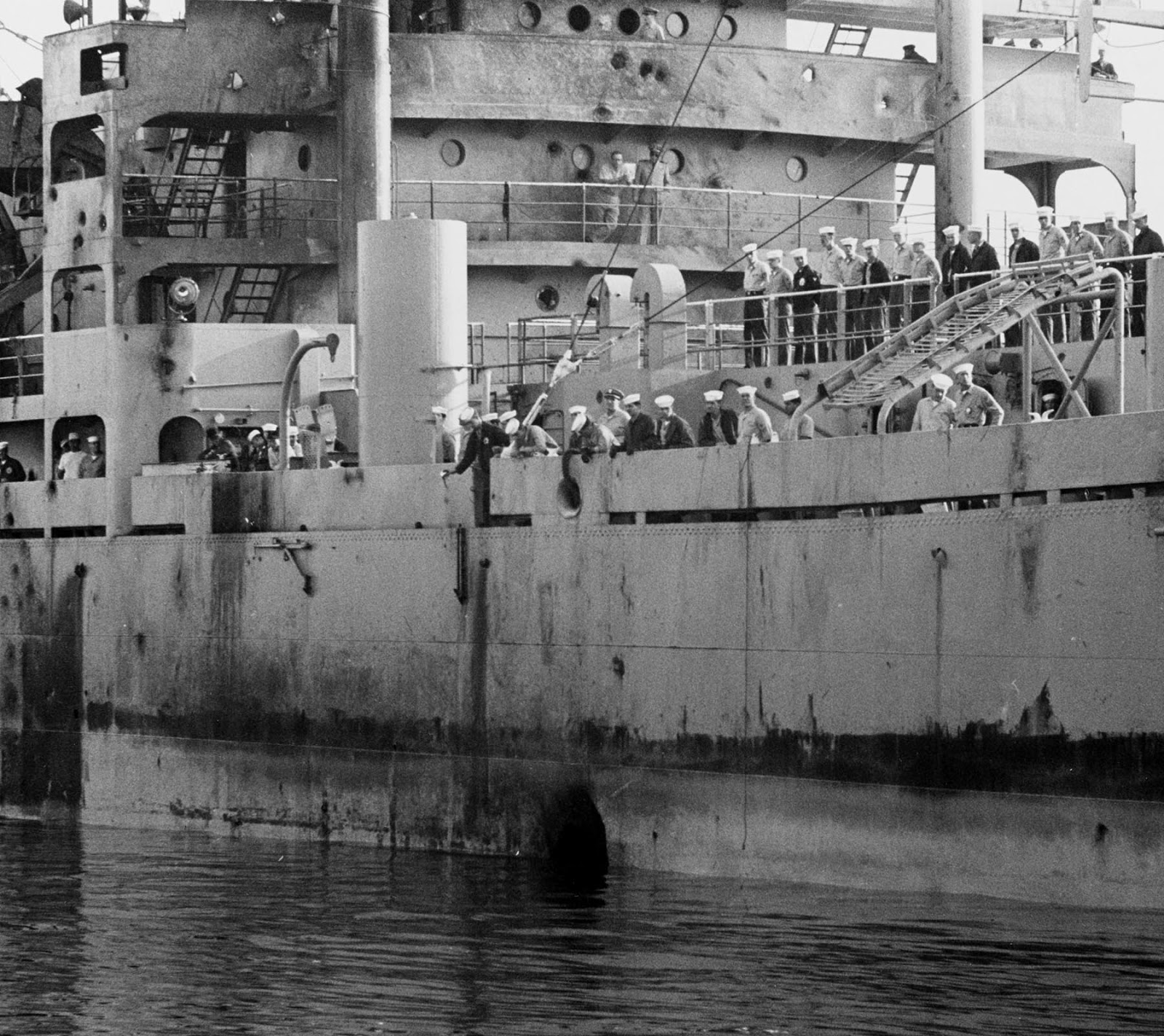 |
| At Valletta, Malta, after arriving there for repair of damages received when she was attacked by Israeli forces off the Sinai Peninsula on June 8, 1967. She arrived at Malta on June 14, 1967. Note torpedo hole in her side, forward of the superstructure. Photographed by Photographer’s Mate1st Class J.J. Kelly, USN. (Naval History and Heritage Command photograph) |
After critical systems were restored and Liberty no longer seemed in danger of sinking, the decision was made to raise steam and make the transit to Malta, 1,000 miles away. Lt. Cmdr. Pettyjohn, acting as temporary XO, established regular steaming watches and a regular underway routine. As time elapsed, the ship’s operating systems, such as her gyroscopic compass and fire and flushing water, were restored. The restoration of lighting and ventilation had earlier brought about an improvement in morale and wellbeing. Liberty was accompanied by the ocean going tug USS Papago (ATF 160) whose crew recovered bodies that had drifted though the torpedo hole as well as classified materials. Except for one unnerving night, when the ship encountered heavy weather 150 miles from Malta, the transit was uneventful. Forward bulkheads in the vicinity of the flooded spaces warped and panted. The contents of the adjacent compartments were removed and jettisoned and additional shoring placed. The weather moderated, and on June 14, with Cdr. McGonagle on the bridge at the conn, the ship entered Grand Harbor, Valetta, Malta, with Fort Ricasoli on the port beam.
 |
| USS Liberty arrives at Valletta, Malta, after arriving on June 14, 1967, for repair of damages received when she was attacked by Israeli forces off the Sinai Peninsula six days before. Photographed by Photographer’s Mate1st Class J.J. Kelly, USN. (Naval History and Heritage Command photograph) |
Liberty spent the mid-summer of 1967 dry docked in Malta, where the remains of those who died in the Research Department spaces were removed, and a board of inquiry under Rear Admiral Isaac S. Kidd, Jr., was convened. A new permanent XO, Lt. Cmdr. Donald L. Burson, formerly the operations officer in USS Aucilla (AO 56), a Norfolk-based fleet oiler, arrived to replace Lt. Cmdr. Philip Armstrong, who had been killed in the attack.(7) It was a period for recollection of the ordeal, decompression and relaxation, as well as poignant tasks such as writing to the survivors of those lost, undertaken in an instinctively kind, gentle way by the skipper, assisted by Ens. Patrick O’Malley. The chief engineer, Lt. George Golden, remembered that when he and the skipper went to a party, the captain expressed some reluctance to leave, and when he did return to his room, “wept.”(8) Liberty left Valetta in company with Papago and arrived at Naval Amphibious Base Little Creek on July 29, 1967.
William McGonagle, as noted, was awarded the Congressional Medal of Honor on June 11, 1968, after his promotion to captain. The newspaper account of the ceremony noted that after Navy Secretary Ignatius placed the award around his neck, McGonagle “wept.”(9) Three days later, he travelled to Norfolk Naval Shipyard, where Liberty was moored, pending a decision about her future. He conferred various awards, such as silver stars and the bronze star, to surviving crew members for heroism under fire. Others had already left the command. The magnitude of the crew’s bravery is evinced by the sheer number of personal awards given after Liberty’s return: one medal of honor, two navy crosses, 11 silver stars, nine navy commendation medals, and 204 purple hearts among a crew of 294.(10)
Liberty’s final act occurred on June 28, 1968, when she was decommissioned. Under clear skies, Lt. Cmdr. Burson, who had relieved Capt. McGonagle, gave brief remarks and Capt. Charles J. Beers, commander of the Inactive Ships Maintenance Facility, read the inactivation orders, the colors were lowered, and the 83 remaining crew members left the ship. (11)
Demise of Surface Intelligence Collection
The decommissioning occurred about five months after the capture of the USS Pueblo (AGER 2) while conducting a similar intelligence gathering mission off the North Korean coast. The crew was interned under brutal conditions for nearly a year. Two such episodes so close together impaired the prestige and standing of the United States and exposed brave crews to death and extended torture. The court of inquiry on the Pueblo incident, in contrast to the Liberty board of inquiry conducted by Rear Adm. Kidd, conducted lengthy deliberations and uncovered defects in program execution, such as lack of a plan to assist the ship in the case of unanticipated emergency. The most telling flaw was the assumption that ships engaged in such sensitive operations in international waters were immune from interference. The abrupt collapse of that assumption led Navy Secretary John Chafee to set aside the recommended court martial for the Pueblo’s commanding officer and punishments for those higher in the chain of command. The AGTR and AGER programs were eliminated, and Lt. Cmdr. Burson went from being the last commanding officer of USS Liberty to also being the last commanding officer of USS Palm Beach (AGER 3), which was stricken from the Navy Register on December 1, 1969
For Many, a Catastrophe without Closure
The end of the Liberty’s short career as a “spy ship” and the denouement of much of the Navy’s surface intelligence gathering activities came about two years after the attack. In its wake, uncertainty and residual bitterness remained among former Liberty crewmembers, including Capt. McGonagle, those who conducted the investigation, and former high-ranking government officials such as Secretary of State Dean Rusk. The attack was savage and repeated against key defensive and ship control/communications spaces and facilities. Liberty was much larger than the SS Quseir, the Egyptian livestock carrier for which the Israeli government concluded she had been mistaken. The question remains, why would such assets have been used against a livestock ship? The best summation of the attack was perhaps made by retired Rear Adm. Paul Tobin, who played a key role in steaming the ship to Malta. He pointed out that the Israeli attack was made against a ship that was in international waters, was freshly painted, had large, clearly painted hull beading and was adorned with sophisticated antennae. To Tobin, it was unbelievable that unsupervised pilots made repeated attacks on a defenseless ship.(12) It must be the governing evaluation until and unless the government of the State of Israel makes a truthful disclosure of the facts, as Capt. McGonagle requested in an excellent oral history conducted by former Naval History and Heritage Command historian Tim Frank, two years before McGonagle’s death in 1999.
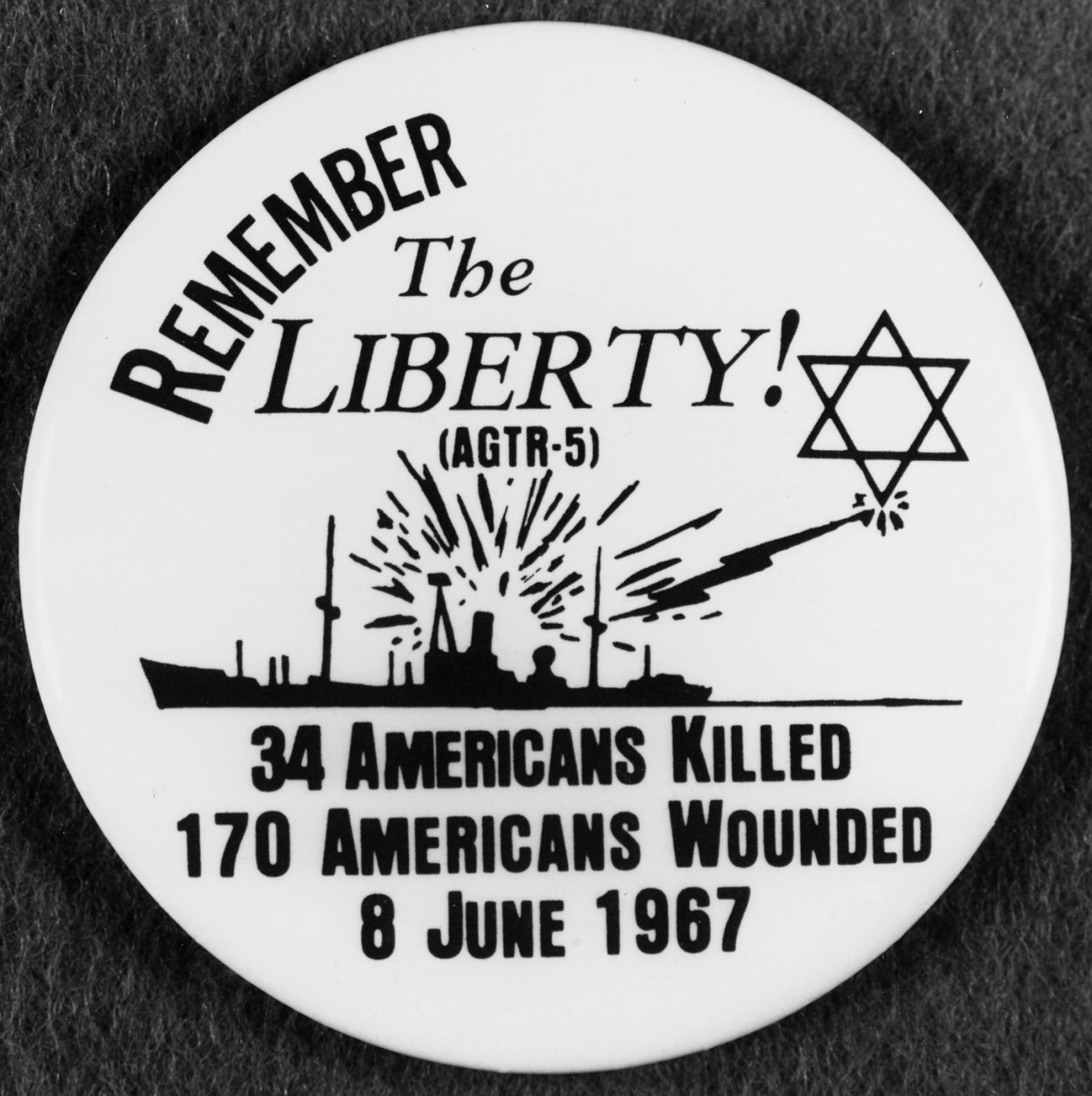 |
| A privately-produced button in the collection of the Naval History and Heritage Command. (Courtesy of Richard K. Smith, 1978) |
The attack on the ship and her brave crew and its residuals may have one overriding meaning. It is, as a Norfolk Virginian-Pilot editorial page writer opined in July, 1967, that “the arrival here today of the USS Liberty is a sobering reminder to this Navy community that no ship that clears this port is assured of returning with her hull intact and all her crewmen alive and uninjured….”(13)
Notes:
About the author: Captain Alexander “Sandy” Monroe, a retired surface warfare officer, is the author of official histories on U.S. Atlantic Command counternarcotic operational assistance to civilian law enforcement agencies and the treatment of Haitian asylum seekers at Naval Station Guantanamo Bay, Cuba. He was also dispatched to the Arabian Gulf on assignment for the director of naval history during Operation Earnest Will.


 Hell I found out that Disneyland in Anaheim has a real jail for some reasons. Seems somebody went skinny dipping in the submarine pool & freaked out some folks by tapping on the portholes of the sub. I think that some liquor was involved. Grumpy, Class of 1977 Arcadia HS. (Think AHS = All Horse Sh*t)
Part I of this post briefly describes Some of the firearms advances before 1791. Part II describes the federal industrial policy for advancing firearms technology.
This post is based on my article The History of Bans on Types of Arms Before 1900. It is forthcoming in Notre Dame’s Journal of Legislation, vol. 50, no. 2, in 2024. The Post also draws on chapter 23 of my coauthored textbook Firearms Law and the Second Amendment: Regulations, Rights, and Policy (Aspen Pub., 3d ed. 2022).
I. Firearms improvements before 1791
While the Founders could not foresee all the specific advances that would take place in the nineteenth century, the Founders were well aware that firearms were getting better and better.
Tremendous improvements in firearms had always been part of the American experience. The first European settlers in America had mainly owned matchlocks. When the trigger is pressed, a smoldering hemp cord is lowered to the firing pan; the powder in the pan then ignites the main gunpowder charge in the barrel.
The first firearm more reliable than the matchlock was the wheel lock, invented by Leonardo da Vinci. In a wheel lock, the powder in the firing pan is ignited when a serrated wheel strikes a piece of iron pyrite. The wheel lock was the first firearm that could be kept loaded and ready for use in a sudden emergency. Although matchlock pistols had existed, the wheel lock made pistols far more practical and common. Paul Lockhart, Firepower: How Weapons Shaped Warfare 80 (2021).
The wheel lock was the “preferred firearm for cavalry” in the sixteenth and seventeenth centuries. Id. The proliferation of wheel locks in Europe in the sixteenth century coincided with the homicide rate falling by half. See Carlisle E. Moody, Firearms and the Decline of Violence in Europe: 1200-2010, 9 Rev. Eur. Stud. 53 (2017)
However, wheel locks cost about four times as much as matchlock. Moreover, their moving parts were far more complicated than the matchlocks’. Under conditions of hard use in North America, wheel locks were too delicate and too difficult to repair. The path of technological advancement often involves expensive inventions eventually leading to products that are affordable to average consumers and are even better than the original invention. That has been the story of firearms in America.
Flintlocks quintuple the rate of fire
The gun that was even better than the wheel lock, but simpler and less expensive, was the flintlock. The earliest versions of flintlocks had appeared in the mid-sixteenth century. But not until the end of the seventeenth century did most European armies replace their matchlocks with flintlocks. Americans, individually, made the transition much sooner. Lockhart at 106.
Indian warfare in the thick woods of the Atlantic seaboard was based on ambush, quick raids, and fast individual decision-making in combat—the opposite of the more orderly battles and sieges of European warfare. In America, the flintlock became a necessity.
Unlike matchlocks, flintlocks can be kept always ready. Because blackpowder is hygroscopic, and could be ruined by much water, it was common to store a firearm on the mantel above the fireplace. Another advantage, which mattered greatly in America but was mostly irrelevant for European warfare, is that a flintlock, unlike a matchlock, has s no smoldering hemp cord to give away the location of the user. Flintlocks are more reliable than matchlocks—all the more so in adverse weather, although still far from impervious to rain and moisture. Significantly, Flintlocks are much simpler and faster to reload than matchlocks. See, e.g., W.W. Greener, The Gun and Its Development 66-67 (9th ed. 1910); Charles C. Carlton, This Seat of Mars: War and the British Isles 1585-1746, at 171-73 (2011).
Initially, the flintlock could not shoot further or more accurately than a matchlock. Lockhart at 105. But it could shoot much more rapidly. A matchlock takes more than a minute to reload once. Id. at 107. In experienced hands, a flintlock could be fired and reloaded five times in a minute, although under the stress of combat, three times a minute was a more typical rate. Id. at 107-08. Compared to a matchlock, a flintlock was more likely to ignite the gunpowder charge instantaneously, rather than with a delay of some seconds. Id. at 104. “The flintlock gave infantry the ability to generate an overwhelmingly higher level of firepower.” Id. at 107.
The Theoretical Lethality Index (TLI) is a measure of a weapon’s effectiveness in military combat. The TLI of a seventeenth century musket is 19 and the TLI of an eighteenth century flintlock is 43. Trevor Dupuy, The Evolution of Weapons and Warfare 92 (1984). So the transition of firearm type in the American colonies more than doubled the TLI. There is no reason to believe that the American Founders were ignorant of how much better their own firearms were compared to those of the early colonists.
Joseph Belton’s 16-shot model
In 1777 in Philadelphia, inventor Joseph Belton demonstrated a firearm that could fire 16 shots all at once. The committee watching the demonstration included General Horatio Gates, General Benedict Arnold, and scientist David Rittenhouse. They wrote to the Continental Congress and urged the adoption of Belton guns for the Continental Army. Congress voted to order a hundred–while requesting that they be produced as 8-shot models, since gunpowder was scarce. However, the deal fell through because Congress could not afford the high price that Belton demanded. Repeating arms were expensive, because their small internal components require especially complex and precise fitting.
Hence, the Founders who served in the Second Continental Congress were well aware that a 16-shot gun had been produced, and was possible to produce in quantity, for a high price. Delegates to the 1777 Continental Congress included future Supreme Court Chief Justice Samuel Chase, John Adams, Samuel Adams, Francis Dana, Elbridge Gerry, John Hancock, the two Charles Carrolls from Maryland, John Witherspoon (President of Princeton, the great American college for free thought), Benjamin Harrison (father and grandfather of two Presidents), Francis Lightfoot Lee, and Richard Henry Lee .
The Girardoni rifle
Likewise, the 22-shot Girardoni rifle famously carried by the Lewis & Clark expedition starting in 1803 was no secret, as it had been invented in 1779. It was used by the Austrian army as a sniper rifle. Powered by compressed air, its bullet his as hard as the modern Colt .45ACP cartridge. John Paul Jarvis, The Girandoni Air Rifle: Deadly Under Pressure, Guns.com, Mar. 15, 2011.
The Girardoni had a 21 or 22 round caliber tubular magazine, and could be quickly reloaded with 20 more rounds, using speedloading tubes that came with the gun. After about 40 shots, the air reservoir could be exhausted, and would need to be pumped up again.
Repeaters in ordinary commerce
As of 1785, South Carolina gunsmith James Ransier of Charleston, South Carolina, was advertising four-shot repeaters for sale. Columbian Herald (Charleston), Oct. 26, 1785.
The American Rifle
The founding generation was especially aware of one of the most common firearms of their time, the Pennsylvania-Kentucky rifle, which is also called “The American Rifle.” The rifle was invented by German and Swiss gunsmith immigrants in the early eighteenth century. When they came to Pennsylvania for religious freedom, they were familiar with the heavy Jaeger rifles of Central Europe.
The American Rifle was created initially for the needs of frontiersmen who might spend months on a hunting expedition in the dense American woods. “What Americans demanded of their gunsmiths seemed impossible”: a rifle that weighed ten pounds or less, for which a month of ammunition would weigh one to three pounds, “with proportionately small quantities of powder, be easy to load,” and “with such velocity and flat trajectories that one fixed rear sight would serve as well at fifty yards as at three hundred, the necessary but slight difference in elevation being supplied by the user’s experience.” Robert Held, The Age of Firearms: A Pictorial History 142 (1956). “By about 1735 the impossible had taken shape” with the creation of the iconic American Rifle. Id.
As for the most common American firearm, the smoothbore (nonrifled) flintlock musket, there had also been great advances. To a casual observer, a basic flintlock musket of 1790 looks very similar to flintlock musket of 1690. However, improvements in small parts, some of them internal, had made the best flintlocks far superior to their ancestors. For example, thanks to English gunsmith Henry Nock’s 1787 patented flintlock breech, “the gun shot so hard and so fast that the very possibility of such performance had hitherto not even been imaginable.” Id. at 137.
The Founders were well aware that what had been impossible or unimaginable to one generation could become commonplace in the next. With the federal armories advanced research and development program that began in the Madison administration, the U.S. government did its best to make the impossible possible.
II. James Madison and James Monroe, the founding fathers of modern firearms
U.S. Representative James Madison is well-known as the author of the Second Amendment and the rest of the Bill of Rights. What is not well-known is how his presidency put the United States on the path to mass production of high-quality affordable firearms.
Because of weapons procurement problems during the War of 1812, President Madison’s Secretary of War James Monroe, who would succeed Madison as President, proposed a program for advanced weapons research and production at the federal armories, which were located in Springfield, Massachusetts, and Harpers Ferry, Virginia. The Madison-Monroe program was to subsidize technological innovation. Ross Thomson, Structures of Change in the Mechanical Age: Technological Innovation in the United States 1790-1865, at 54-59 (2009). It was enthusiastically adopted with the support of both the major parties in Congress: the Madison-Monroe Democratic-Republicans, and the opposition Federalists. 8 Stat. 204 (1815); Johnson, Kopel, Mocsary, Wallace & Kilmer, Firearms Law and the Second Amendment: Regulation, Rights, and Policy 2209 (3d ed. 2022) (online chapter 23).
While serving as ambassador to France, Thomas Jefferson had observed the progress that the French were making in producing firearms with interchangeable parts. He enthusiastically recommended that the United States do the same. See Letter from Thomas Jefferson to John Jay (Secretary of Foreign Affairs under the Confederation government), Aug. 30, 1785, in 1 Memoirs, Correspondence, and Private Papers, of Thomas Jefferson 299 (Thomas Jefferson Randolph ed., 1829). In 1801, President Jefferson recounted his French observations to Virginia Governor James Monroe and expressed hope for Eli Whitney’s plan for interchangeable gun parts. Letter from Thomas Jefferson to James Monroe, Nov. 14, 1801, in 35 The Papers Of Thomas Jefferson 662 (Barbara B. Oberg ed., 2008).
Under the bipartisan Madison-Monroe program, generous federal arms procurement contracts had long lead times and made much of the payment up-front, so that manufacturers could spend several years setting up and perfecting their factories. The program succeeded beyond expectations, and helped to create the American industrial revolution.
The initial objective was interchangeability, so that firearms parts damaged in combat could be replaced by functional spare parts. After that would come higher rates of factory production. And after that, it was hoped, production at lower cost than artisanal production. Achieving these objectives for the more intricate and closer-fitting parts of repeating firearms would be even more difficult.
To carry out the federal program, the inventors associated with the federal armories first had to invent machine tools. Consider for example, the wooden stock of a long gun. The back of the stock is held against the user’s shoulder. The middle of the stock is where the action is attached. (The action is the part of the gun containing the moving parts that fire the ammunition; the Founding generation called it “the lock.”) For many guns, the forward part of the stock would contain a groove to hold the barrel.
Making a stock requires many different cuts of wood, few of them straight. The
artisanal gunmaker would cut with hand tools such as saws and chisels. Necessarily, one artisanal stock would not be precisely the same size as another.
To make stocks faster and more uniformly, Thomas Blanchard invented fourteen different machine tools. Each machine would be set up for one particular cut. As the stock was cut, it would be moved from machine to machine. By mounting the stock to the machine tools with jigs and fixtures, a manufacturer could ensure that each stock would be placed in precisely the same position in the machine as the previous stock. The mounting was in relation to a bearing — a particular place on the stock that was used as a reference point. To check that the various parts of the firearm, and the machine tools themselves, were consistent, many new gauges were invented. Felicia Johnson Deyrup, Arms Makers of the Connecticut Valley: A Regional Study of the Economic Development of the Small Arms Industry, 1798-1870, at 97-98 (1948); Thomson at 56–57.
What Blanchard did for stocks, John H. Hall, of the Harpers Ferry Armory, did for
other firearms parts. Hall shipped some of his machine tools to Simeon North, in Connecticut. In 1834, Hall and North made interchangeable firearms. This was the first time that geographically separate factories had made interchangeable parts. Id. at 58; Merritt Roe Smith, Harpers Ferry Armory and the New Technology: The Challenge of Change 212 (1977).
Because Hall “established the efficacy” of machine tools, he “bolstered the confidence among arms makers that one day they would achieve in a larger, more efficient manner, what he had done on a limited scale. In this sense, Hall’s work represented an important extension of the industrial revolution in America, a mechanical synthesis so different in degree as to constitute a difference in kind.” Id. at 249.
The technological advances from the federal armories were widely shared among American manufacturers. The Springfield Armory built up a large network of cooperating private entrepreneurs and insisted that advances in manufacturing techniques be widely shared. By mid-century, what had begun as the mass production of firearms from interchangeable parts had become globally known as “the American system of manufacture”—a system that encompassed sewing machines, and, eventually typewriters, bicycles, and automobiles. See, e.g., David R. Meyer, Networked Machinists: High-Technology Industries In Antebellum America 81-84, 252-62, 279-80 (2006).
Springfield, in western Massachusetts on the Connecticut River, had been chosen for the federal armory in part because of its abundance of waterpower and for the nearby iron ore mines. Many private entrepreneurs, including Colt and Smith & Wesson, made the same choice. The Connecticut River Valley became known as the Gun Valley. It was the Silicon Valley of its times, the center of industrial revolution. Id. at 73–103, 229–80.
In short, the Founding generation was familiar with tremendous advances in firearms technology. In the American colonial experience, the rate of fire for an ordinary firearm had quintupled. As of 1791, repeating firearms capable of firing 16 or 22 shots had been demonstrated, but they were much too expensive for ordinary citizens. The Madison-Monroe administration’s wise industrial policy, continued under future administrations, led the way towards the mass production of high quality firearms at low prices. No one in 1791 or 1815 could have foreseen all the firearms innovations in the 19th century. We do know that the American federal government did all it could to make those innovations possible.


