Attachments area
Category: Uncategorized


Categories
Campfire desserts
| June 2, 2016
Cooking, Food & Drink, Manly Skills, Outdoors, Travel & Leisure

As someone who loves camping, but has a busy schedule, I can usually only get away for a day or two at a time, and am thus always looking for ways to streamline my tripsin order to make them more frequent and turnkey. Part of that is simplifying my grub; instead of having to haul pots and pans into the wild, and clean them after each meal, I cook my meals in foil packets or on a stick; no muss, no fuss, no clean up.
That works well for entrees, but what about the crown of the meal — the dessert? S’mores are an obvious and delicious choice, but lately I’ve found myself wanting to branch out more.
So we recently field-tested a bunch of easy, make-ahead campfire desserts, and found six absolute winners. These tasty treats require no pots, pans, or clean-up. Just put ’em in the fire, and enjoy.
If you’re ready to add some variety to your s’mores routine, give these recipes a try on your next trip into the woods.
Notes on Preparation & Cooking
- All of these recipes can be made ahead of time at home and brought with you to your destination.
- The ideal place to cook nearly all campfire grub is not directly in the flames, but on a nice bed of coals (shoot for at least 2 inches of them).
- When making something in a foil packet, always spray the surface on which you’re going to place your food with cooking spray, so that the food doesn’t stick once it’s cooked.
- Use heavy-duty foil to avoid puncturing. I recommend using two sheets to be on the safe side, and because it seems to cut down on charring.
- Measurements of ingredients are kept intentionally vague on most of these. I don’t exactly measure the ingredients when making campfire grub. A little bit of this, and a little bit of that, and you’re gold. Measure and season to taste.
- Cook times are approximate as well; they can vary depending on how hot your coals are. Check on your food periodically to see how it’s doing; if it’s not done, crimp the foil back together and return the food to the coals. The packets will be hot, so use an oven mitt, gloves, and/or tongs, and look out for steam.
Finally, know that while none of these campfire desserts are going to win any beauty contests (campfire cooking rarely will), they’re all, appearances aside, certified delicious.
Pineapple Upside-Down Donut
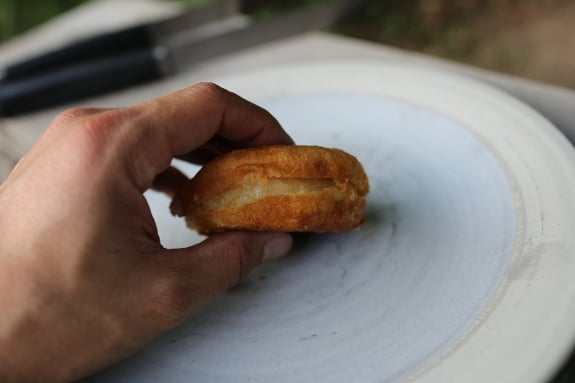
If you’re a fan of pineapple upside-cake, you’ll love this easy campfire homage to that dessert.
Ingredients:
- Plain cake donut
- Canned rings of pineapple
- Brown sugar
- Squeeze “butter”
Instructions:
Slice a donut in half (through the ring, so you’re creating 2 O’s, not 4 C’s). Lay a pineapple ring on the bottom of one half of the donut. Spoon on some brown sugar. Squeeze a line of butter around the ring. Place the other half of the donut on top; you now have a pineapple donut “sandwich.” Place the donut on a sheet of foil. Bring the long sides of the foil to the center and crease them together until the foil is flat next to the donut; then tightly roll up the shorter sides.
Place in campfire coals and cook for 5-8 minutes until the donut and pineapple are heated through. Be sure to flip it over halfway through, or the bottom will burn.
Campfire Apple Crisp
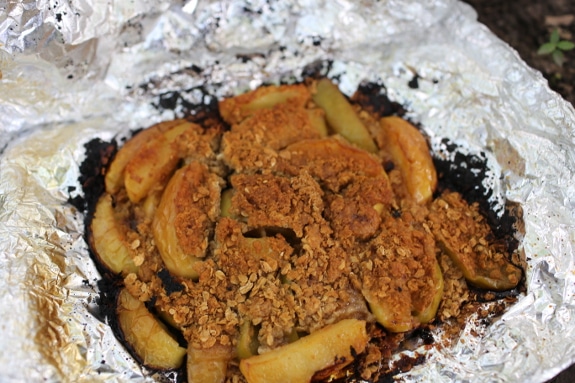
This traditionally oven-baked dessert can be enjoyed in the great outdoors. I got the recipe for this one from Cooking With Jax. It serves 2-3 people.
Ingredients:
- ½ cup old-fashioned oats
- 6 tbsp flour
- 3 tbsp packed brown sugar
- ¼ cup granulated sugar
- ¼ tsp cinnamon
- dash of nutmeg
- 3 apples
- 2 tbsp butter
- squeeze of lemon juice (you can sprinkle this on the apple slices, but we left it out just to have one less thing to worry about)
Instructions:
Mix together the oats, flour, sugar, and spices. Cut in the butter until the mixture is crumbly. Cut the apples into slices and place the slices on a double-layered, cooking oil-sprayed sheet of foil. Cover with the oat mixture. Take another piece of foil the same size as the bottom one, spray one side of it with cooking oil, and place it spray-side down on top of the apples/oats. Crimp/crease the sides of the bottom and top sheets of foil together, all along the perimeter of the foil rectangle.
Cook in the coals for 20-30 minutes.
Cobbler-in-a-Can
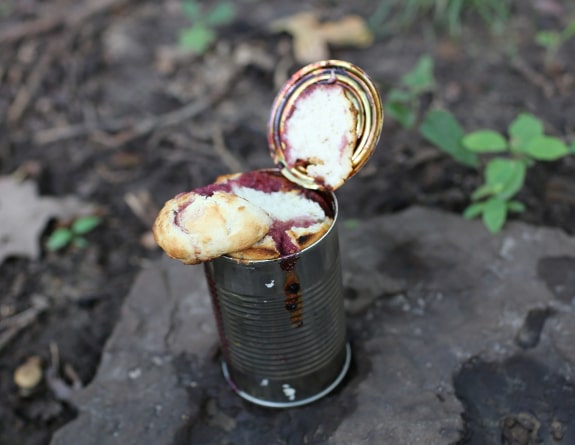
Cobbler made in a Dutch oven is a perennial campfire favorite. But if you don’t have a Dutch oven, or don’t want to bring it along on a quick trip, you can actually make cobbler right in a can of fruit or pie filling. I imagine some may be aghast at this idea, as most cans are lined with BPA (the toxicology of which is debatable). It’s hard to imagine that a perhaps once-a-year ingestion of such a campfire dessert will do you in, but if you’re worried about it, then skip this one, and the Puppy Chow dessert as well. Or search out a BPA-free can.
Ingredients:
- Pie filling or fruit in heavy syrup (we used dark sweet cherries in heavy syrup)
- Bisquick
Mix 1¼ cups Bisquick with ½ cup milk. This will make enough batter to place one big “biscuit” in 2 smaller cans, or if you have a larger can, you can put all the batter into it. Open can of fruit/filling and drain off excess syrup. Place biscuit batter on top of fruit. Replace lid.
Cook on hot coals until batter turns into hard dumplings.
Banana Boats
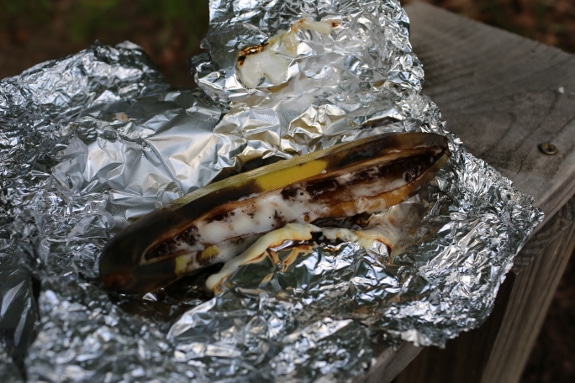
This is an old campfire favorite that’s especially enjoyed by kids.
Ingredients:
- Bananas
- Mini marshmallows
- Chocolate chips
Marshmallows and chocolate chips are the basic, traditional stuffings for banana boats, but there are numerous variations. Try golden grahams, crumbled up graham crackers, peanut butter chips, nuts, and so on.
Instructions:
Slice the banana lengthwise through the skin on its flat, concave side. Allow the knife to penetrate the fruit, but don’t slice through the skin on the other side. Stuff the pocket/crevasse with marshmallows, chocolate chips, or whatever else you have in mind. Wrap and crimp foil around the banana to make a “boat.”
Cook on coals for 5-8 minutes until the marshmallows and chips melt. Unwrap and scoop out the banana/toppings with a spoon.
Puppy Chow
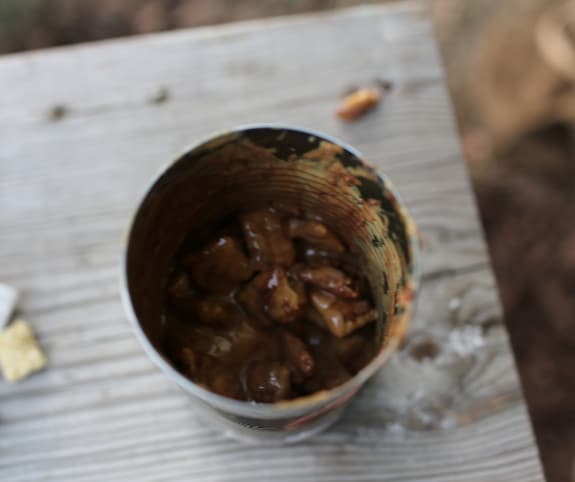
Puppy chow is a version of Chex snack mix; here, sans powdered sugar, it’s used as inspiration for a campfire treat.
Ingredients:
- Peanut butter, or peanut butter chips
- Chocolate chips
- Chex cereal
Instructions:
Take an empty, clean aluminum can and fill it with peanut butter and chocolate chips. Place on coals and allow ingredients to melt. Once the PB and chips are melted, stir in some Chex cereal. You can also use it as a dip for graham crackers.
Orange Peel Cupcakes
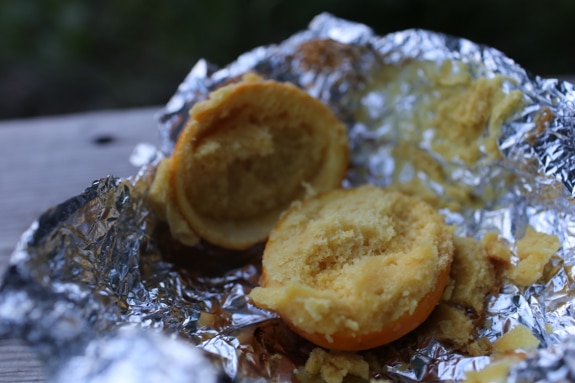
Cupcakes around the campfire — no muffin tins or oven required. Making cupcakes inside of an orange is not only fun, but delicious — these ended up at the top of everyone’s list. The orange peel imparts a subtle orange flavor to what you cook inside of it, and you can also use the same method to make muffins, brownies, and even cinnamon rolls.
Ingredients:
- Oranges
- Cupcake/cake mix
Instructions:
Prepare cake batter according to the package instructions. Slice an orange through about ¾ of the way up. Scoop out the pulp so that you’re left with a hollow “bowl.” (You can eat the pulp later, or use it to make OJ.) Spoon in the cake batter and fill up the hollowed-out orange, stopping a little short of the lip. Put the top back on and wrap the whole orange tightly with foil.
Cook in the coals for 20-25 minutes until the batter is baked through. Rotate the orange’s position several times as it cooks to ensure even baking.

Categories
Reising M55 Submachine Gun
Now this is one of those guns that almost made it big. But fell short in the end. The Marines tried them out in their early Fights in the Pacific.

But due to a bunch of problems that the gun had due to its design. Like way too many small parts, finicky about ammo and no toleration for dirt.
It was soon ditched and slowly faded to black.
But you can still see them from time to time at certain Machine Gun Shoots.


Here is some more information about this weapon:
Attachments area

| Model 50 Reising | |
|---|---|

The Reising Model 50 submachine gun
|
|
| Type | Submachine gun |
| Place of origin | United States |
| Service history | |
| In service | 1941–1953 |
| Used by | See Users |
| Wars | World War II Hukbalahap Rebellion Malaysian Emergency[1] Costa Rican Civil War[1] |
| Production history | |
| Designer | Eugene Reising |
| Designed | 1940 |
| Manufacturer | Harrington & Richardson |
| Produced | 1941–1945 |
| Variants | M55, M60, M65 |
| Specifications | |
| Weight | 3.1 kg (6.83 lb) (M50) 2.8 kg (6.2 lb) (M55) |
| Length | 959 mm (37.8 in) 787 mm (31.0 in) stock retracted (M55) |
| Barrel length | 279 mm (11.0 in) (M50) |
|
|
|
| Cartridge | .45 ACP (M50 and M55)[2] .45 ACP (M60) .22 LR (M65) |
| Action | Delayed blowback, closed bolt |
| Rate of fire | 550 rounds/min (M50) 500 rounds/min (M55) |
| Muzzle velocity | 280 m/s (919 ft/s) |
| Maximum firing range | 300 yards |
| Feed system | 12- or 20-round detachable box magazine |
| Sights | Front blade, rear notch |
The .45 Reising submachine gun was manufactured by Harrington & Richardson (H&R) Arms Company in Worcester, Massachusetts, and was designed and patented by Eugene Reising in 1940. The three versions of the weapon were the Model 50, the folding stock Model 55, and the semiautomatic Model 60 rifle.[3] Over 100,000 Reisings were ordered during World War II, and were initially used by the United States Navy, Marine Corps, and the United States Coast Guard, though some were shipped to Canadian, Soviet, and other allied forces to fight the Axis powers.[4]
Contents
[hide]
History[edit]

A U.S. Coast Guard sailor on shore patrol with working dog and a Reising Model 50 with 12-round magazine.
The Reising submachine gun was a very innovative weapon for its time featuring firepower, accuracy, excellent balance, light weight and ease of manufacture compared to the Thompson Model 1928 submachine gun, the leading American competitor of the time. But poor combat performance of the Reising contrasted with favorable combat and law enforcement use of the Thompson forever mired the weapon in controversy.[3]
Eugene Reising was an excellent marksman and ordnance engineer who believed engineering principles must match actual field needs. Reising practiced his creed by being an avid shooter, and by serving in the early 1900s as an assistant to firearm inventor John M. Browning. In doing so, Reising contributed to the final design of the US .45 Colt M1911 pistol, one of the most reliable pistols in history. Reising then designed a number of commercial rifles and pistols on his own, when in 1938, he turned his attention to designing a submachine gun as threats of war rapidly grew in Europe.[3]
Two years later he submitted his completed design to the Harrington & Richardson Arms Company (H&R) in Worcester, Massachusetts. It was accepted, and in March 1941, H&R started manufacturing the Model 50 full stocked submachine gun. Months later, production began on the Model 55 (identical to the Model 50 other than having a folding wire buttstock, no compensator, and a barrel half an inch shorter); and the Model 60 full stocked semiautomatic rifle that also resembled a Model 50, but had a 7.75 inch longer barrel without cooling fins or compensator.[3]
H&R promoted the submachine guns for police and military use, and the Model 60 for security guards. After the Japanese attack on Pearl Harbor in December 1941 the US was suddenly in desperate need of thousands of modern automatic weapons. Since the Reising’s only competitor was the venerable .45 ACP Thompson Model 1928A1 submachine gun, a weapon that epitomized reliability and exquisite machining, the more easily manufactured Reising was quickly adopted by the US Navy and Marines as a limited-standard weapon.[3]
The US Army first tested the Reising in November 1941 at Fort Benning, Georgia, and found several parts failed due to poor construction. Once corrected a second test was made in 1942 at Aberdeen Proving Ground, Maryland. In that test 3,500 rounds were fired resulting in two malfunctions: one from the ammunition, the other from a bolt malfunction. As a result, the Army didn’t adopt the Reising, but the Navy and Marines did, faced with insufficient supply of Thompsons.[3]
The Navy and Marines also noticed that the Reising had certain advantages over the Thompson. It was less costly, costing $62 compared to the $200 for the Thompson. It was much lighter (seven vs. eleven pounds). And, the Model 55 was much more compact (about twenty-two vs. thirty-three inches in length)–the most compact, accurate, and lightest submachine gun in the world at the time.[3]
The Reising cost and weighed less than the Thompson because its metal components were mostly stampings instead of machined parts. Its low weight was due to its delayed blowback design, whereas most WWII-era submachine guns utilized the simple blowback principle. Simple blowback relies largely on the mass (weight) of the bolt to secure the cartridge when firing, and therefore requires this component to be particularly heavy. (The 1928A1 Thompson had a more involved Blish lock system, but this was similarly dependent on high bolt mass.) It was more balanced because the barrel-and-receiver-group rested concentrically within the stock. It had smoother lines because the stock was of conventional shape, and the cocking handle (action bar) was placed inside the forearm. In addition, it was more accurate because the closed-bolt only shifted the hammer and firing pin on firing, whereas the Thompson slammed home a heavy bolt and actuator.[3]
Design[edit]
Though described as a submachine gun, the Reising was designed as a compact lightweight semi-automatic delayed blowback carbine, firing from a closed bolt for accuracy. The Reising was made in selective fire versions that could be switched between semi-automatic or full-automatic fire as needed and in semi-auto only versions to be used for marksmanship training and police and guard use. The Reising had a designed full-auto cyclic rate of 450–600 rounds per minute but it was reported that the true full-auto rate was closer to 750–850 rounds per minute. At those rates, the twenty round magazine could be emptied in less than two seconds. In 1941, the Reising was priced at approximately $50 per weapon as opposed to $225 for the standard military issue Thompson submachine gun.[5]
Variants[edit]

Reising Model 65 training rifle
There were four versions of the Reising, two selective fire models: the M50 and M55, and two semi-automatic only variants—the M60 a .45 ACP light rifle variant[6] and the M65 chambered for the .22 Long Rifle rimfire cartridge designed for training purposes.

Reising Model 55 with wire stock folded
There were two differences between the M50 and the M55, those being the elimination of the compensator and the addition of a folding wire buttstock making the M55 lighter and shorter. M55 was originally issued to Marine parachute infantry and armored vehicle crews.
The M60 was a long-barreled, semi-automatic carbine model designed primarily for military training and police use. However, few of these were ever sold. The Marines used M60s for training, guard duty, and other non-combat roles. Some M60s were believed to have been issued to Marine officers at Guadalcanal.[7] The remaining guns were passed on to State Guards and civilian law enforcement agencies.
USMC Deployment[edit]

USMC Reising Model 60 carbine
The Reising entered military service primarily because of uncertainty of supply of sufficient quantities of the Thompson submachine gun. In the testing stage, it won out over some other competing designs. It was very light and quite accurate in aimed fire, and “capable of intensive fire against personnel within a range of 300 yards.”[8] This was attributed to its better stock fit and intricate closed bolt, delayed blowback design, though its firepower was somewhat limited due to the 20-round capacity of its largest magazine.[9][10] Most submachine guns fire from the open bolt position, meaning the full weight of the bolt slams forward when the trigger is pulled; with the Reising, only a lightweight firing pin striker moves when the trigger is pulled.[3]
The U.S. Marines adopted the Reising in 1941 with 4,200 authorized per division with approximately 500 authorized per each infantry regiment.[11][12] Most Reisings were originally issued to Marine officers and NCOs in lieu of a compact and light carbine, since the newly introduced M1 carbine was not yet being issued to the Marines. Although the Thompson submachine gun was available, this weapon frequently proved too heavy and bulky for jungle patrols, and initially it too was in short supply.[9]
During World War II, the Reising first saw action on August 7, 1942, exactly eight months to the day after Pearl Harbor, when 11,000 men from the 1st Marine Division stormed the beaches of Guadalcanal, in the Solomon Islands. This sweltering ninety-mile long mountainous island was covered with dense jungle and swamps, and was defended by Japanese troops. Since Guadalcanal had an airfield, the island had to be taken as Japanese aircraft from there could isolate Australia and New Zealand from America. To the Marines’ surprise, as they stepped off their landing craft and their naval fire crept forward, they were met not by the Japanese, but by silence and shattered coconut groves that fringed the beach. Advancing cautiously into the dark, musky jungle, they pushed forward and took the airfield the following day. But Japanese warships and reinforcements were en route. That night, powerful shell fire swept the Marines as they were suddenly cut off from sea; to be locked in mortal ground combat with the Japanese 35th Infantry Brigade, and 2nd and 28th Infantry Divisions.[3]
On the same date of Guadalcanal’s invasion, the Model 50 and 55 saw action by fast-striking, camouflage-dressed, 1st Marine Raiders on the small outlying islands of Tulagi and Tanambogo to the north. Two companies of Marine paratroopers, “The Devil Dogs,” dressed in olive drab jump smocks also used Model 55s to attack the island of Gavutu, between Tulagi and Tanambogo. Although Tulagi and Tanambogo were each secured in a day, the fighting was fierce. Japanese firing from caves and beach dugouts destroyed many of the raiders’ assault craft before touching shore. At day’s end, the raiders suffered 234 casualties from a 750-man force. The paratroopers fared worse. Of the 377 men who assaulted Gavutu, 212, roughly two-thirds were killed or seriously wounded, many because escorting warships couldn’t provide close fire support in the uncharted waters, and bombers sent to assist the paratroopers dropped their ordnance short killing their own men. Following six months of intense fighting, Guadalcanal fell to the Marines on February 7, 1943, at a cost of 6,000 wounded and killed Americans as well as 20,000 dead Japanese. Guadalcanal’s capture marked the beginning of the end of the Japanese Empire; other than minor advances in Burma and China, the Japanese were continuously pushed back to their homeland.[3]
Although Paramarines and armored crewmen had been issued the folding stock M55, the weapon’s poorly designed wire-framed stock tended to fold while firing and soon earned the M55 a poor reputation.[4] Moreover, the Reising was designed as a civilian police weapon and was not suited to the stresses of harsh battle conditions encountered in the Solomon Islands—namely, sand, saltwater and the difficulty in keeping the weapon clean enough to function properly. Tests at Aberdeen Proving Ground and Fort Benning Georgia had found difficulties in blindfold reassembly of the Reising, indicating the design was complicated and difficult to maintain. Many of the parts were hand fitted at the factory; this lack of parts interchangeability was not a problem for a civilian security or police firearm, but it was very problematic when Reisings were maintained in the field under combat conditions.[13]
While more accurate than the Thompson, particularly in semi-automatic mode, the Reising had a tendency to jam.[9] This was in part due to its overly complex delayed-blowback design.[13] This design used a system of levers within the receiver to release a fragile firing pin that could break, rust, or freeze in the humid jungle climate. This problem was exacerbated by the bolt delay recess in the receiver that accumulated dirt or fouling, preventing the bolt from seating properly; if not seated in its recess, the trigger disconnector prevented firing. In addition, the magazine was a staggered-column, single-cartridge feed design, and slight damage to the feed lips or debris in the magazine would render the magazine unusable. A partial solution to the magazine problem was the later introduction of a single-column magazine that reduced the capacity from 20 to 12 rounds.[3]
The Reising earned a dismal reputation for reliability in the combat conditions of Guadalcanal.[14] Fortunately, the M1 carbine eventually became available and was often chosen over both the Reising and the Thompson in the wet tropical conditions, as the M1928 Thompson’s built-in oiling pads in the receiver were a liability.[15]
Withdrawal from the Fleet Marine Force[edit]
In late 1943 following numerous complaints, the Reising was withdrawn from Fleet Marine Force (FMF) units and assigned to Stateside guard detachments and ship detachments.[16] After the Marines proved reluctant to accept more Reisings, and with the increased issue of the .30-caliber M1 carbine, the U.S. government passed some Reising submachine guns to the OSS and to various foreign governments (as Lend-Lease aid). Canada purchased some Model 50 SMGs and these were issued to 2nd Battalions in Canada where the 1st Battalions of regiments were serving overseas. They were issued along with .30-06 M1917 Enfields and .30-06 Lewis machine guns. One such unit to receive them was the 2nd Bn Seaforth Highlanders of Canada. The Veteran’s Guard of Canada were issued the weapon to guard German Prisoners of War.[17] Others were given to various anti-Axis resistance forces operating around the world.
Many Reisings (particularly the semiautomatic M60 rifle) were issued to State Guards for guarding war plants, bridges, and other strategic resources. And after the war thousands of Reising Model 50 submachine guns were acquired by state, county, and local U.S. law enforcement agencies. In this role the weapon proved much more successful, and by doing so, forever mired the weapon in controversy.[3]
Issues of reliability[edit]
H&R was justifiably proud of the Reising’s superior accuracy and balance, lighter weight, and ease of manufacturing when compared to the Thompson. However, the Reising’s close tolerance and delicate magazine proved unreliable in the sand and mud of the Solomons—unless kept scrupulously clean. The gun quickly became despised by front-line Marines, and Lieutenant Colonel Merritt A. Edson, Commander, 1st Marine Raider Battalion, ordered that Reisings be flung into Guadalcanal’s crocodile infested Lunga River, as his troops resorted to reliable bolt-action Springfield rifles.[3]
This failure made a mockery of H&R’s company slogan, “Six-and-one-half pounds of controlled dynamite. The H&R Reising will get a bullet there when you need it!”[3]
There are other reasons for its failure. Foremost was the Reising’s complex design of many small pins, plungers, springs and levers. Disassembly and assembly was difficult even under normal conditions. Simple maintenance was problematic as there was no bolt hold-open device. Chambering a cartridge was awkward as the action bar was hard to grasp in the forearm and could be obstructed by the sling. Worse, the safety/selector switch couldn’t be sensed by feel at night if it was in the safe, semi, or automatic position.[3]
“Filing-to-fit” of certain parts during production limited interchangeability. The exposed rear sight had no protective ears and was vulnerable to breakage. The adjustable front sight could be lost if the retaining screw wasn’t tightly secured. The weapon was susceptible to jamming if grime clogged the bolt’s locking recess in the receiver. The two small magazine guide retaining pins and corresponding receiver stud holes were tapered allowing disassembly and assembly only from one direction—right to left for disassembly, and left to right for assembly; adding unacceptable levels of complexity in a combat environment. The retaining pins had to be delicately pounded out whenever the bolt needed to be removed for cleaning. During the reassembly process, if the retaining pins were inserted too much or too little when reassembling, the receiver might not fit back into the tight confines of the stock.[3]
Model confusion[edit]
What constitutes a “commercial” and “military” Model 50 is amorphous. First, H&R never made a distinction; the distinction is made by collectors. This confusion stems from a period in production where early Model 50s were manufactured with commercial characteristics and H&R’s wartime practice of randomly installing old parts in stock throughout production.[3]
While there is not one factor that distinguishes the so-called commercial from the military model, the commercial model is usually blued. It commonly has a fixed front sight and a rear sight with no retaining screw. It often has 28 fins on the barrel, a one piece magazine release, no outward flanges on the safety/selector switch, and no sling swivels. Lastly, the commercial model commonly has a smooth take-down screw, a two-hole trigger guard, and serial numbers ranging from one to 20,000.[3]
Military Reisings are usually parkerized. They often have an adjustable front sight with an Allen screw and a rear sight with a retaining screw. They routinely have 14 fins on the barrel, a two piece magazine release, outward flanges on the safety/selector switch, sling swivels, stock ties (crossbolts through the forearm), and a knurled take-down screw. Finally, the military model commonly has a three-hole trigger guard, proofmarks like “PH” or “Pm2” above the chamber, and serial numbers ranging from 20,000 to 120,000.[3]
There are three types of H&R magazines. The first and second models are both smooth body, are blued, and are twenty-shot double column. The first model is distinguished by five cartridge peep holes on the left side, a feature eliminated on the second model to prevent mud and sand from entering. In contrast, the third model is parkerized, has two long indentations on the sides to reduce its capacity to a twelve-shot single column magazine because of feeding problems experienced with former models.[3]
Post World War II[edit]

Deputy sheriff with Reising M50
Production of the Model 50 and 55 submachine guns ceased in 1945 at the end of World War II. Nearly 120,000 submachine guns were made of which two thirds went to the Marines. H&R continued production of the Model 60 semiautomatic rifle in hopes of domestic sales, but with little demand, production of the Model 60 stopped in 1949 with over 3,000 manufactured. H&R sold their remaining inventory of submachine guns to police and correctional agencies across America who were interested in the Reising’s selective-fire capability, semi-auto accuracy, and low cost relative to a Thompson. Then faced with continued demand, H&R resumed production of the Model 50 in 1950 which sputtered to a halt in 1957 with nearly 5,500 additional submachine guns manufactured. But just when the Reising story seemed to end, a foreign order was received in the 1960s for nearly 2,000 more Model 60s, but that order was finally the end.[3]
Decades later, in 1986, H&R closed their doors and the Numrich Arms (aka Gun Parts Corporation) purchased their entire inventory. Acquiring a number of Model 50 receivers, Numrich assembled them with parts. These weapons all have an “S” preceding the serial number and were sold domestically in the early 1990s after reparkerization and fitting with newly manufactured walnut stocks. These stocks are distinguished from originals by their wider than normal sling swivels and buttstocks, by the fact they have no stock ties, and have H&R marked plastic buttplates (originals were unmarked metal).[3]
Machine gun murders[edit]
In New Zealand in December 1963, two men thought to have been operating an illegal beerhouse business were murdered execution-style with a Reising machine gun. Machine guns were a type of weapon thought not to exist in the country at the time.[18]
Users[edit]
 Argentina[1]
 Australia[1]
 Brazil[1]
 Canada[1]
 Costa Rica[1]
 French Indochina: 4,000 ordered, delivery and issue not confirmed.[1]
 Finland: Captured from the Red Army.[1]
 Mexico[1]
 Nazi Germany: Captured from the Red Army.[1]
 New Zealand[1]
 Soviet Union: Received in the form of Lend-Lease aid.[1]
 Philippines: Used by the Philippine Army and Philippine Constabulary during World War II and into the 1960s.
 United States[1]
 United Kingdom[1]
 Uruguay[1]
 Venezuela[1]
M50 Reising
| Model 50 Reising | |
|---|---|
|
The Reising Model 50 submachine gun
|
|
| Type | Submachine gun |
| Place of origin | United States |
| Service history | |
| In service | 1941–1953 |
| Used by | See Users |
| Wars | World War II Hukbalahap Rebellion Malaysian Emergency[1] Costa Rican Civil War[1] |
| Production history | |
| Designer | Eugene Reising |
| Designed | 1940 |
| Manufacturer | Harrington & Richardson |
| Produced | 1941–1945 |
| Variants | M55, M60, M65 |
| Specifications | |
| Weight | 3.1 kg (6.83 lb) (M50) 2.8 kg (6.2 lb) (M55) |
| Length | 959 mm (37.8 in) 787 mm (31.0 in) stock retracted (M55) |
| Barrel length | 279 mm (11.0 in) (M50) |
|
|
|
| Cartridge | .45 ACP (M50 and M55)[2] .45 ACP (M60) .22 LR (M65) |
| Action | Delayed blowback, closed bolt |
| Rate of fire | 550 rounds/min (M50) 500 rounds/min (M55) |
| Muzzle velocity | 280 m/s (919 ft/s) |
| Maximum firing range | 300 yards |
| Feed system | 12- or 20-round detachable box magazine |
| Sights | Front blade, rear notch |
The .45 Reising submachine gun was manufactured by Harrington & Richardson (H&R) Arms Company in Worcester, Massachusetts, and was designed and patented by Eugene Reising in 1940. The three versions of the weapon were the Model 50, the folding stock Model 55, and the semiautomatic Model 60 rifle.[3] Over 100,000 Reisings were ordered during World War II, and were initially used by the United States Navy, Marine Corps, and the United States Coast Guard, though some were shipped to Canadian, Soviet, and other allied forces to fight the Axis powers.[4]
Contents
[hide]
History[edit]
A U.S. Coast Guard sailor on shore patrol with working dog and a Reising Model 50 with 12-round magazine.
The Reising submachine gun was a very innovative weapon for its time featuring firepower, accuracy, excellent balance, light weight and ease of manufacture compared to the Thompson Model 1928 submachine gun, the leading American competitor of the time. But poor combat performance of the Reising contrasted with favorable combat and law enforcement use of the Thompson forever mired the weapon in controversy.[3]
Eugene Reising was an excellent marksman and ordnance engineer who believed engineering principles must match actual field needs. Reising practiced his creed by being an avid shooter, and by serving in the early 1900s as an assistant to firearm inventor John M. Browning. In doing so, Reising contributed to the final design of the US .45 Colt M1911 pistol, one of the most reliable pistols in history. Reising then designed a number of commercial rifles and pistols on his own, when in 1938, he turned his attention to designing a submachine gun as threats of war rapidly grew in Europe.[3]
Two years later he submitted his completed design to the Harrington & Richardson Arms Company (H&R) in Worcester, Massachusetts. It was accepted, and in March 1941, H&R started manufacturing the Model 50 full stocked submachine gun. Months later, production began on the Model 55 (identical to the Model 50 other than having a folding wire buttstock, no compensator, and a barrel half an inch shorter); and the Model 60 full stocked semiautomatic rifle that also resembled a Model 50, but had a 7.75 inch longer barrel without cooling fins or compensator.[3]
H&R promoted the submachine guns for police and military use, and the Model 60 for security guards. After the Japanese attack on Pearl Harbor in December 1941 the US was suddenly in desperate need of thousands of modern automatic weapons. Since the Reising’s only competitor was the venerable .45 ACP Thompson Model 1928A1 submachine gun, a weapon that epitomized reliability and exquisite machining, the more easily manufactured Reising was quickly adopted by the US Navy and Marines as a limited-standard weapon.[3]
The US Army first tested the Reising in November 1941 at Fort Benning, Georgia, and found several parts failed due to poor construction. Once corrected a second test was made in 1942 at Aberdeen Proving Ground, Maryland. In that test 3,500 rounds were fired resulting in two malfunctions: one from the ammunition, the other from a bolt malfunction. As a result, the Army didn’t adopt the Reising, but the Navy and Marines did, faced with insufficient supply of Thompsons.[3]
The Navy and Marines also noticed that the Reising had certain advantages over the Thompson. It was less costly, costing $62 compared to the $200 for the Thompson. It was much lighter (seven vs. eleven pounds). And, the Model 55 was much more compact (about twenty-two vs. thirty-three inches in length)–the most compact, accurate, and lightest submachine gun in the world at the time.[3]
The Reising cost and weighed less than the Thompson because its metal components were mostly stampings instead of machined parts. Its low weight was due to its delayed blowback design, whereas most WWII-era submachine guns utilized the simple blowback principle. Simple blowback relies largely on the mass (weight) of the bolt to secure the cartridge when firing, and therefore requires this component to be particularly heavy. (The 1928A1 Thompson had a more involved Blish lock system, but this was similarly dependent on high bolt mass.) It was more balanced because the barrel-and-receiver-group rested concentrically within the stock. It had smoother lines because the stock was of conventional shape, and the cocking handle (action bar) was placed inside the forearm. In addition, it was more accurate because the closed-bolt only shifted the hammer and firing pin on firing, whereas the Thompson slammed home a heavy bolt and actuator.[3]
Design[edit]
Though described as a submachine gun, the Reising was designed as a compact lightweight semi-automatic delayed blowback carbine, firing from a closed bolt for accuracy. The Reising was made in selective fire versions that could be switched between semi-automatic or full-automatic fire as needed and in semi-auto only versions to be used for marksmanship training and police and guard use. The Reising had a designed full-auto cyclic rate of 450–600 rounds per minute but it was reported that the true full-auto rate was closer to 750–850 rounds per minute. At those rates, the twenty round magazine could be emptied in less than two seconds. In 1941, the Reising was priced at approximately $50 per weapon as opposed to $225 for the standard military issue Thompson submachine gun.[5]
Variants[edit]
Reising Model 65 training rifle
There were four versions of the Reising, two selective fire models: the M50 and M55, and two semi-automatic only variants—the M60 a .45 ACP light rifle variant[6] and the M65 chambered for the .22 Long Rifle rimfire cartridge designed for training purposes.
Reising Model 55 with wire stock folded
There were two differences between the M50 and the M55, those being the elimination of the compensator and the addition of a folding wire buttstock making the M55 lighter and shorter. M55 was originally issued to Marine parachute infantry and armored vehicle crews.
The M60 was a long-barreled, semi-automatic carbine model designed primarily for military training and police use. However, few of these were ever sold. The Marines used M60s for training, guard duty, and other non-combat roles. Some M60s were believed to have been issued to Marine officers at Guadalcanal.[7] The remaining guns were passed on to State Guards and civilian law enforcement agencies.
USMC Deployment[edit]
USMC Reising Model 60 carbine
The Reising entered military service primarily because of uncertainty of supply of sufficient quantities of the Thompson submachine gun. In the testing stage, it won out over some other competing designs. It was very light and quite accurate in aimed fire, and “capable of intensive fire against personnel within a range of 300 yards.”[8] This was attributed to its better stock fit and intricate closed bolt, delayed blowback design, though its firepower was somewhat limited due to the 20-round capacity of its largest magazine.[9][10] Most submachine guns fire from the open bolt position, meaning the full weight of the bolt slams forward when the trigger is pulled; with the Reising, only a lightweight firing pin striker moves when the trigger is pulled.[3]
The U.S. Marines adopted the Reising in 1941 with 4,200 authorized per division with approximately 500 authorized per each infantry regiment.[11][12] Most Reisings were originally issued to Marine officers and NCOs in lieu of a compact and light carbine, since the newly introduced M1 carbine was not yet being issued to the Marines. Although the Thompson submachine gun was available, this weapon frequently proved too heavy and bulky for jungle patrols, and initially it too was in short supply.[9]
During World War II, the Reising first saw action on August 7, 1942, exactly eight months to the day after Pearl Harbor, when 11,000 men from the 1st Marine Division stormed the beaches of Guadalcanal, in the Solomon Islands. This sweltering ninety-mile long mountainous island was covered with dense jungle and swamps, and was defended by Japanese troops. Since Guadalcanal had an airfield, the island had to be taken as Japanese aircraft from there could isolate Australia and New Zealand from America. To the Marines’ surprise, as they stepped off their landing craft and their naval fire crept forward, they were met not by the Japanese, but by silence and shattered coconut groves that fringed the beach. Advancing cautiously into the dark, musky jungle, they pushed forward and took the airfield the following day. But Japanese warships and reinforcements were en route. That night, powerful shell fire swept the Marines as they were suddenly cut off from sea; to be locked in mortal ground combat with the Japanese 35th Infantry Brigade, and 2nd and 28th Infantry Divisions.[3]
On the same date of Guadalcanal’s invasion, the Model 50 and 55 saw action by fast-striking, camouflage-dressed, 1st Marine Raiders on the small outlying islands of Tulagi and Tanambogo to the north. Two companies of Marine paratroopers, “The Devil Dogs,” dressed in olive drab jump smocks also used Model 55s to attack the island of Gavutu, between Tulagi and Tanambogo. Although Tulagi and Tanambogo were each secured in a day, the fighting was fierce. Japanese firing from caves and beach dugouts destroyed many of the raiders’ assault craft before touching shore. At day’s end, the raiders suffered 234 casualties from a 750-man force. The paratroopers fared worse. Of the 377 men who assaulted Gavutu, 212, roughly two-thirds were killed or seriously wounded, many because escorting warships couldn’t provide close fire support in the uncharted waters, and bombers sent to assist the paratroopers dropped their ordnance short killing their own men. Following six months of intense fighting, Guadalcanal fell to the Marines on February 7, 1943, at a cost of 6,000 wounded and killed Americans as well as 20,000 dead Japanese. Guadalcanal’s capture marked the beginning of the end of the Japanese Empire; other than minor advances in Burma and China, the Japanese were continuously pushed back to their homeland.[3]
Although Paramarines and armored crewmen had been issued the folding stock M55, the weapon’s poorly designed wire-framed stock tended to fold while firing and soon earned the M55 a poor reputation.[4] Moreover, the Reising was designed as a civilian police weapon and was not suited to the stresses of harsh battle conditions encountered in the Solomon Islands—namely, sand, saltwater and the difficulty in keeping the weapon clean enough to function properly. Tests at Aberdeen Proving Ground and Fort Benning Georgia had found difficulties in blindfold reassembly of the Reising, indicating the design was complicated and difficult to maintain. Many of the parts were hand fitted at the factory; this lack of parts interchangeability was not a problem for a civilian security or police firearm, but it was very problematic when Reisings were maintained in the field under combat conditions.[13]
While more accurate than the Thompson, particularly in semi-automatic mode, the Reising had a tendency to jam.[9] This was in part due to its overly complex delayed-blowback design.[13] This design used a system of levers within the receiver to release a fragile firing pin that could break, rust, or freeze in the humid jungle climate. This problem was exacerbated by the bolt delay recess in the receiver that accumulated dirt or fouling, preventing the bolt from seating properly; if not seated in its recess, the trigger disconnector prevented firing. In addition, the magazine was a staggered-column, single-cartridge feed design, and slight damage to the feed lips or debris in the magazine would render the magazine unusable. A partial solution to the magazine problem was the later introduction of a single-column magazine that reduced the capacity from 20 to 12 rounds.[3]
The Reising earned a dismal reputation for reliability in the combat conditions of Guadalcanal.[14] Fortunately, the M1 carbine eventually became available and was often chosen over both the Reising and the Thompson in the wet tropical conditions, as the M1928 Thompson’s built-in oiling pads in the receiver were a liability.[15]
Withdrawal from the Fleet Marine Force[edit]
In late 1943 following numerous complaints, the Reising was withdrawn from Fleet Marine Force (FMF) units and assigned to Stateside guard detachments and ship detachments.[16] After the Marines proved reluctant to accept more Reisings, and with the increased issue of the .30-caliber M1 carbine, the U.S. government passed some Reising submachine guns to the OSS and to various foreign governments (as Lend-Lease aid). Canada purchased some Model 50 SMGs and these were issued to 2nd Battalions in Canada where the 1st Battalions of regiments were serving overseas. They were issued along with .30-06 M1917 Enfields and .30-06 Lewis machine guns. One such unit to receive them was the 2nd Bn Seaforth Highlanders of Canada. The Veteran’s Guard of Canada were issued the weapon to guard German Prisoners of War.[17] Others were given to various anti-Axis resistance forces operating around the world.
Many Reisings (particularly the semiautomatic M60 rifle) were issued to State Guards for guarding war plants, bridges, and other strategic resources. And after the war thousands of Reising Model 50 submachine guns were acquired by state, county, and local U.S. law enforcement agencies. In this role the weapon proved much more successful, and by doing so, forever mired the weapon in controversy.[3]
Issues of reliability[edit]
H&R was justifiably proud of the Reising’s superior accuracy and balance, lighter weight, and ease of manufacturing when compared to the Thompson. However, the Reising’s close tolerance and delicate magazine proved unreliable in the sand and mud of the Solomons—unless kept scrupulously clean. The gun quickly became despised by front-line Marines, and Lieutenant Colonel Merritt A. Edson, Commander, 1st Marine Raider Battalion, ordered that Reisings be flung into Guadalcanal’s crocodile infested Lunga River, as his troops resorted to reliable bolt-action Springfield rifles.[3]
This failure made a mockery of H&R’s company slogan, “Six-and-one-half pounds of controlled dynamite. The H&R Reising will get a bullet there when you need it!”[3]
There are other reasons for its failure. Foremost was the Reising’s complex design of many small pins, plungers, springs and levers. Disassembly and assembly was difficult even under normal conditions. Simple maintenance was problematic as there was no bolt hold-open device. Chambering a cartridge was awkward as the action bar was hard to grasp in the forearm and could be obstructed by the sling. Worse, the safety/selector switch couldn’t be sensed by feel at night if it was in the safe, semi, or automatic position.[3]
“Filing-to-fit” of certain parts during production limited interchangeability. The exposed rear sight had no protective ears and was vulnerable to breakage. The adjustable front sight could be lost if the retaining screw wasn’t tightly secured. The weapon was susceptible to jamming if grime clogged the bolt’s locking recess in the receiver. The two small magazine guide retaining pins and corresponding receiver stud holes were tapered allowing disassembly and assembly only from one direction—right to left for disassembly, and left to right for assembly; adding unacceptable levels of complexity in a combat environment. The retaining pins had to be delicately pounded out whenever the bolt needed to be removed for cleaning. During the reassembly process, if the retaining pins were inserted too much or too little when reassembling, the receiver might not fit back into the tight confines of the stock.[3]
Model confusion[edit]
What constitutes a “commercial” and “military” Model 50 is amorphous. First, H&R never made a distinction; the distinction is made by collectors. This confusion stems from a period in production where early Model 50s were manufactured with commercial characteristics and H&R’s wartime practice of randomly installing old parts in stock throughout production.[3]
While there is not one factor that distinguishes the so-called commercial from the military model, the commercial model is usually blued. It commonly has a fixed front sight and a rear sight with no retaining screw. It often has 28 fins on the barrel, a one piece magazine release, no outward flanges on the safety/selector switch, and no sling swivels. Lastly, the commercial model commonly has a smooth take-down screw, a two-hole trigger guard, and serial numbers ranging from one to 20,000.[3]
Military Reisings are usually parkerized. They often have an adjustable front sight with an Allen screw and a rear sight with a retaining screw. They routinely have 14 fins on the barrel, a two piece magazine release, outward flanges on the safety/selector switch, sling swivels, stock ties (crossbolts through the forearm), and a knurled take-down screw. Finally, the military model commonly has a three-hole trigger guard, proofmarks like “PH” or “Pm2” above the chamber, and serial numbers ranging from 20,000 to 120,000.[3]
There are three types of H&R magazines. The first and second models are both smooth body, are blued, and are twenty-shot double column. The first model is distinguished by five cartridge peep holes on the left side, a feature eliminated on the second model to prevent mud and sand from entering. In contrast, the third model is parkerized, has two long indentations on the sides to reduce its capacity to a twelve-shot single column magazine because of feeding problems experienced with former models.[3]
Post World War II[edit]
Deputy sheriff with Reising M50
Production of the Model 50 and 55 submachine guns ceased in 1945 at the end of World War II. Nearly 120,000 submachine guns were made of which two thirds went to the Marines. H&R continued production of the Model 60 semiautomatic rifle in hopes of domestic sales, but with little demand, production of the Model 60 stopped in 1949 with over 3,000 manufactured. H&R sold their remaining inventory of submachine guns to police and correctional agencies across America who were interested in the Reising’s selective-fire capability, semi-auto accuracy, and low cost relative to a Thompson. Then faced with continued demand, H&R resumed production of the Model 50 in 1950 which sputtered to a halt in 1957 with nearly 5,500 additional submachine guns manufactured. But just when the Reising story seemed to end, a foreign order was received in the 1960s for nearly 2,000 more Model 60s, but that order was finally the end.[3]
Decades later, in 1986, H&R closed their doors and the Numrich Arms (aka Gun Parts Corporation) purchased their entire inventory. Acquiring a number of Model 50 receivers, Numrich assembled them with parts. These weapons all have an “S” preceding the serial number and were sold domestically in the early 1990s after reparkerization and fitting with newly manufactured walnut stocks. These stocks are distinguished from originals by their wider than normal sling swivels and buttstocks, by the fact they have no stock ties, and have H&R marked plastic buttplates (originals were unmarked metal).[3]
Machine gun murders[edit]
In New Zealand in December 1963, two men thought to have been operating an illegal beerhouse business were murdered execution-style with a Reising machine gun. Machine guns were a type of weapon thought not to exist in the country at the time.[18]
Users[edit]
- Argentina[1]
- Australia[1]
- Brazil[1]
- Canada[1]
- Costa Rica[1]
- French Indochina: 4,000 ordered, delivery and issue not confirmed.[1]
- Finland: Captured from the Red Army.[1]
- Mexico[1]
- Nazi Germany: Captured from the Red Army.[1]
- New Zealand[1]
- Soviet Union: Received in the form of Lend-Lease aid.[1]
- Philippines: Used by the Philippine Army and Philippine Constabulary during World War II and into the 1960s.
- United States[1]
- United Kingdom[1]
- Uruguay[1]
- Venezuela[1]
Categories
Elmer Keith
When I was lot younger and a lot skinnier.
I briefly saw the old boy in the flesh. From what I saw & heard was this was one hard man. Who did not suffer fools at all.
Later on I bought one of his books. (Hell I was there!) 
So I think that I was right the first time about this hard case of a man.

Elmer Keith shooting two revolvers at the same time.
|
|
| Born | March 8, 1899 |
|---|---|
| Died | February 14, 1984 (aged 84) |
| Nationality | United States |
| Occupation | Rancher, author, Firearmsenthusiast |
| Known for | Creation of the .357 Magnum, .44 Magnum, and .41 Magnumcartridges |
| Home town | Salmon, Idaho |
| Spouse(s) | Loraine Randall |
Elmer Merrifield Keith (March 8, 1899 – February 14, 1984[1]) was an Idaho rancher, firearms enthusiast, and author. Keith was instrumental in the development of the first magnum revolver cartridge, the .357 Magnum, as well as the later .44 Magnum and .41 Magnum cartridges.
Contents
[hide]
Personality and life[edit]
Keith’s trademarks were his cigars, his ten-gallon Stetson, and his outspoken opinions. Keith was an avid handgun hunter in the earliest days of the sport, and often hunted medium game with a double action Smith & Wesson revolver.
In the days when handgun cartridges tended to fire large, slow bullets like the popular .45 Colt, or light, fast bullets like the .30 Mauser, Keith was pushing the limits of existing cartridges, driving large bullets at high velocities.
He was married to Loraine Randall. Elmer Keith was born in Missouri but was raised in Montana, Idaho, and eastern Oregon.
In the 1930s and early 1940s, he had a ranch on the North Fork of the Salmon River near Salmon, Idaho. In the late 1940s, Elmer and Loraine left the ranch and moved into the town of Salmon. [The ranch is still owned by the Keith family.]
During World War II, Keith served as an inspector at the Ogden, Utah Arsenal. The rifles that he inspected were cartouchestamped with the initials “OGEK” in a rectangular box, on the buttstock.
Rifles stamped OGEK without a rectangular box were inspected by Ed Klouser at the same Ogden Arsenal.[2]
In The Phantom Of Phu Bai, a biography of USMC Scout Sniper Eric England written by Dr. Joseph B. Turner, one chapter is about Elmer Keith and his influence on the shooting community.
Magnum revolvers[edit]
Keith’s first major contribution, the .357 Magnum, was the result of handloading the .38 Special cartridge far beyond normally accepted limits, taking full advantage of the greater strength of the revolvers available in the 1920s compared to those of the late 19th century.
The .357 Magnum first became available in 1935 and quickly became a favorite among law enforcement and civilian users. The .357 Magnum had a slightly longer case than the .38 Special, but was otherwise identical, so .357 Magnum revolvers could shoot .38 Special or .357 Magnum ammunition, but .38 Special revolvers (most of which are not safe for the pressures generated by the Magnum round) could not chamber .357 Magnum ammunition.
Buying a .357 Magnum revolver gave the shooter all the abilities of the well-established .38 Special, with the ability to double the available power by using the Magnum cartridge.
Keith’s contributions to the commercial development of the .357 Magnum have been questioned by some writers, and Keith subsequently denigrated the .357 Magnum as he had the .38 Special.
The .44 Magnum was developed in much the same way, and was released commercially in 1956. Keith had earlier determined that the thinner chamber walls of the .45 Colt would not comfortably withstand the pressures generated by his own heavy loads.
He therefore started experimenting with the .44 Special revolver, and used the same formula of pushing heavy bullets at high velocities that he had used for the .357 Magnum.
The resulting “.44 Special Magnum” was a formidable cartridge for handgun hunting, firing a 250 grain bullet at 1,200 ft/s (370 m/s).
Keith encouraged Smith & Wesson and Remington to produce a commercial version of this new high pressure loading, and revolvers chambered for it.
While S&W produced the first prototype revolver chambered in .44 Magnum, the famous Model 29, Sturm, Ruger actually beat S&W to market by several months in 1956 with a .44 Magnum version of the single action Blackhawk revolver.
In fact Remington delivered a more powerful cartridge than Keith asked for, firing a 240 grain bullet at 1,500 ft/s (460 m/s), and it remained the most powerful production handgun cartridge until the commercial introduction of the .454 Casull (based on the .45 Colt).
The .44 Magnum is still far more popular, as the recoil of .454 Casull rounds is considered excessive by most shooters, and revolvers in .454 Casull were rare and expensive until the introduction of .454 Casull models by Sturm, Ruger and Taurus in the late 1990s.
The .41 Magnum, released in 1963, was an attempt to reach a middle ground between the .357 and .44 magnums. The .357 Magnum was adequate for hunting deer-sized game, but the limited power meant it needed to be used by a skilled marksman.
The .44 Magnum provided far more power, easily taking deer sized game, but recoil and muzzle blast are substantial, at least in the earliest commercial loadings.
The .41 Magnum, inspired by the older, obsolete .41 Long Coltcartridge, was intended to provide more power than the .357 Magnum with less recoil and muzzle blast than the .44 Magnum. The .41 Magnum used a completely new case (unlike the .357 Magnum and .44 Magnum which were based on existing cases), and used a .410″ bullet instead of the earlier .41 Colt and .38-40‘s roughly .400″ diameter bullet, while pushing the new .410″ bullet to similar velocities as achieved by the .357 and .44 Magnum bullets.
However, while there was (and still is) a small community of shooters preferring the .41 Magnum, the round failed to achieve a similar high degree of popularity. Some police, to whom the .41 Magnum was initially marketed, were happy with the .38 Special or .357 Magnum, and many officers had no interest in anything more powerful, and which also delivered greater blast and recoil that could place the shooter at a disadvantage in a gunfight requiring fast follow-up shots.
However, some police departments adopted the 41 Mag with the reduced load designed for police use, and were quite happy the added power required only one hit to put an opponent down.
Thus the 41 Magnum saved many officer’s lives who were lucky enough to use them[citation needed]. Hunters likewise stayed with the more commonly available .44 Magnum, which could be used with full power factory loads, less powerful handloads, or commercial .44 Special ammunition as needed.
Keith regarded the handgun as a weapon of opportunity. He had plenty of opportunities to use his sixgun on game during his life. He was incredibly skilled with handguns.
He shot at a rifle-wounded deer and hit it several times at a range of 600 yards using his 6½ inch S&W Model 29.[3] It is currently part of the Keith collection with the factory standard 4-inch (100 mm) barrel length that he more commonly carried.
The Keith firearm collection has been dispersed, having been sold individually at auction by James D. Julia in March 2015. (http://jamesdjulia.com/373_shs/)
Keith is also famous for designing and commissioning his No. 5 revolver, fashioned by R.F. Sedgeley, in 1928.
Keith-style bullets[edit]
Keith was also responsible for a number of bullet designs still popular today, and collectively called “Keith style” bullets.
These bullets were based on the semiwadcutter design, but using a wider than normal front surface, and convex sides.
These changes increased the volume of the bullet outside the case, thus allowing more room inside the case, needed for large loads of slower burning powders (see internal ballistics).
These bullets remain popular for both target shooting and hunting. When shooting paper targets, they cut a relatively clean hole in the target, yet provide more case volume and a better ballistic coefficient than a flat front wadcutter.
When used for hunting, the heavy bullets provide excellent penetration; they are often used on dangerous game, for which more reliable penetration is required than is possible with expanding hollow point or soft point bullets.

Keith-Style SWC
Originally Keith specified a meplat that was 65% of the bullet caliber, but later increased it to a 70% meplat.
The other distinguishing characteristics of a “Keith-style” SWC are a double radius ogive, beveled crimp groove, three equal width driving bands, wide square bottomed grease groove, and a plain base with sharp corners.
The wide forward driving band helps keep the bullet aligned as it jumps across the cylinder gap. Because of the three wide equal width driving bands, the total bearing surface is half the length of the bullet.
The relatively large bearing surface helps the Keith-style SWC to be an inherently accurate bullet, and minimizes leading from gas blow-by. The wide square bottom grease groove holds ample lubricant.[4]
Work with rifles
Keith was instrumental in the development of various wildcat cartridges, a few of which were later adopted as factory rounds.
The .333 OKH (“O’Neil-Keith-Hopkins”), developed in conjunction with Charlie O’Neil and Don Hopkins, was made from .30-06 Springfield brass necked up to take the .333″ 250 and 300-grain bullets of the .333 Jeffery.
There was also a .334 OKH,[5] based on the shortened .300 H&H Magnum case.
The .333 OKH, necked up slightly to take the more common .338″ sized bullets of the older .33 Winchester, led to the creation of the popular Wildcat cartridge the .338-06, also known as the 338 OKH, and was the inspiration for the 1958 commercial introduction of the .338 Winchester Magnum based on the larger belted .458 Winchester Magnum case.
The .334 OKH, likewise necked up to accept .338″ bullets and given the distinctive Weatherby “double-radius” shoulder, was introduced by Weatherby in 1963 as the .340 Weatherby Magnum. The .338-378 Weatherby Magnum.
Introduced in 1998, was developed based on another one of Keith’s wildcats, the .338-378 KT(Keith-Thomson), which he developed in the 1960s with Bob Thomson.
An admirer of the old British double rifles, Keith had numerous examples in his collection.
He used two of these doubles, a .476 Westley Richards and a .500 Nitro Express, to take dangerous game in Africa on two different safaris. Keith documented the first of these hunts in his 1968 tome, Safari.
Published works
Keith was a prolific writer, writing both books and magazine columns.
During the 1950s and 1960s, he was especially well known for his regular monthly columns he wrote for Guns & Ammo magazine and American Rifleman.
Typically exploring the performance of the latest new gun offerings. Especially those firing large, heavy bullets pushed to high velocities.
He has influenced modern gun writers such as Mike Venturino and John Taffin.[6]
- Sixgun Cartridges and Loads. Onslow County, N.C., Small Arms Technical Publishing Co, 1936. [Riling 2200]
- Big Game Rifles and Cartridges. Onslow County, N.C., Small Arms Technical Publishing Co, 1936. [Riling 2199]
- Keith’s Rifles for Larger Game Huntington, WV: Standard Publications, 1946. [Riling 2551]
- Elmer Keith’s Big Game Hunting. Boston: Little, Brown, 1948. [Riling 2648]
- Shotguns. Harrisburg, Pennsylvania: Stackpole & Heck, 1950. [Riling 2726]
- Sixguns. Harrisburg, Pennsylvania: Stackpole & Heck, 1955.
- Guns and Ammo for Hunting Big Game, with John Lachuk. Los Angeles, Calif. : Petersen Publishing Co.,1965.
- Safari. La Jolla, Calif: Safari Publications, 1968.
- Keith, An Autobiography, Winchester Press, 1974[7]
- Hell, I Was There (autobiography). Los Angeles, Calif.: Petersen Publishing Co., 1979.
References are to Ray Riling, Guns and Shooting, a Bibliography, New York: Greenberg, 1951.
References
- Jump up^ Elmer Merrifield Keith at Find a Grave
- Jump up^ “Inspectors Stamps”. m1903.com. Retrieved 24 July 2011.
- Jump up^ Elmer Keith’s 600 yard shot
- Jump up^ From Ingot to Target: A Cast Bullet Guide for Handgunners© Chapter 12: The Keith Semiwadcutter (SWC)
- Jump up^ Frank C. Barnes, Holt Bodinson, Cartridges of the World: A Complete and Illustrated Reference for Over 1500 Cartridges Cartridges of the World, ISBN 978-0-89689-936-0, S. 198,66
- Jump up^ Taffin, John (1997). Big Bore Sixguns. Krause. p. 7. ISBN 978-0-87341-502-6.
- Jump up^ Library of Congress Catalog Card Number: 73-78837, ISBN 0-87691-137-8
John Peter Gabriel – Lawman & Gunfighter
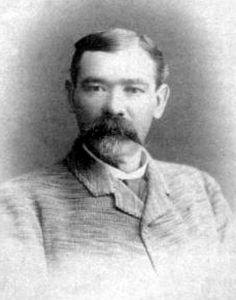
John Peter Gabriel
John Peter Gabriel (1838-1898) – A prominent lawman in Pinal County, Arizona in the 1880s, Gabriel pursued the Red Jack Gang and numerous other bandits. In 1888, he barely survived the Florence, Arizona Gunfight with Joe Phy.
Gabriel was born on November 17, 1838 in Kruft, Germany, the fourth of six children to John and Anna Schlauss Gabriel. When he was just nine years-old, he immigrated with his parents to the United States, where the family settled in Grant County, Wisconsin. Two years later, his father died and when his mother was unable to support the family 12-year-old Pete was taken in by a prominent lawyer named Ninian Whiteside, who soon joined the gold rush for California, moving his family and young Gabriel with him. When John grew up he worked in various professions before eventually making his way to Arizona, where he often worked in mining and at other times, as a lawman.
In 1877 , he was running a hotel at Silver King in Pinal County, when Sheriff Peter R. Brady appointed him a resident deputy. Gabriel’s popularity with local Democrats prompted him to run for sheriff against his boss the following year, he defeated Brady at took office in January, 1879.
He quickly established himself as one of Arizona’s finest and most-dedicated sheriffs, fighting lynch mobs and tracking down stage robbers, murderers, horse thieves and cattle rustlers. His skills with a gun were also well known, prompting one observer to say: “Gabriel was the finest pistol shot I have ever known, equaling, I am sure, the best the West ever produced.”
Somewhere along the line, he hired a man named Joseph Phy, an experienced law officer, to become his deputy. The pair who had previously known each other in the law enforcement capacity were friends. However, in 1883 he fired Phy for disorderly and drunken conduct and later arrested him in Case Grande, Arizona for assault.
Gabriel left the office of sheriff at the end of his term in 1886. He spent much of his time at his mine in the Dripping Springs Mountains, only occasionally coming to town to buy supplies and conduct business. That same year, Phy decided to run for sheriff and despite their past differences, Gabriel initially supported him for the job. However, at some point he withdrew his support and the two former friends soon became bitter enemies.
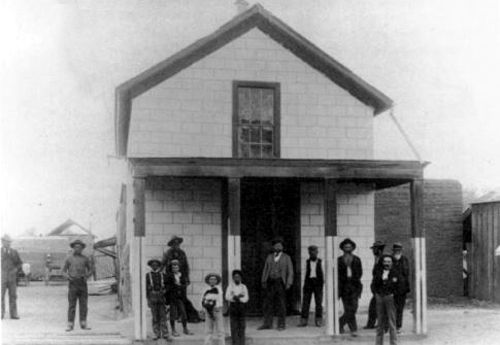
Tunnel Saloon, Florence, Arizona
After two years of simmering anger, both men were in Jack Keating’s Tunnel Saloon in Florence, Arizona on May 3, 1888. Before long an argument erupted that quickly escalated to the point that Phy went out on the street, calling Gabriel out. Both men went for their guns and a blazing gunfight occurred. After eleven shots had been fired, Gabriel was wounded in the groin and in the chest and staggered to a nearby stable where he collapsed. Miraculously, he would survive. Phy; however, was not so lucky. Also seriously wounded, he lived but four hours. Gabriel stood trial for the killing but was exonerated on the grounds of self-defense.
Peter Gabriel spent the next decade prospecting in Arizona and northern Mexico before returning to work his old claim – the Monitor Mine on Mineral Creek. At the age of 59, he drank some poisonous water, probably laced by arsenic used in mining, and for a week, he lay alone and deathly ill in his cabin. Finally, his mining partner found him there on July 28, 1898. Gabriel died the next day and was buried near the mine.
In reporting his death, the Phoenix Herald said, “He was a bold and fearless man, a good officer … Pete Gabriel probably carried more scars at the hands of the lawless element than any other man in the southwest.”
By Kathy Weiser-Alexander, September, 2017.
Sources:
Auer, L.C.; Gun Grudge in Florence
Boessenecker, John; Pete Gabriel: Gunfighting Lawman of the Southwestern Frontier; The Journal of Arizona History; Arizona Historical Society, Spring, 2012.
Find a Grave
True West Magazine
Also See:
Lawmen of the Old West
Old West Gunfights
Arizona (main page)
Categories
"What's in a Name"


Or Maybe just maybe gasp, some Personal Responsibility!
FBI: Over Four Times More People Stabbed to Death Than Killed with Rifles of Any Kind

JUSTIN TALLIS/AFP/Getty Images
The FBI Uniform Crime Report (UCR) for 2016 shows more than four times as many people were stabbed to death than were killed with rifles of any kind.
And because the category of rifles covers every type of rifle, this means there would be an even greater divide between the number of people stabbed to death versus those shot to death with an AR-15 or similar rifle.
According to FBI: UCR Table 12, there were approximately 374 people shot and killed with rifles of any kind. There were 1,604 people killed with “knives or cutting instruments.”
Table 12 also shows that more people were killed via the use of “hands, fists, feet, etc.,” than were killed by rifles of any kind. In fact, the tally shows that the death numbers were not even close. While approximately 374 people were shot and killed with rifles, roughly 656 people were beaten to death with “hands, fists, feet, etc.”
On September 26, 2016, Breitbart News reported similar gaps between rifle/shotgun homicides and stabbing homicides. UCR figures showed the number of people killed with rifles and shotguns combined in 2015 was approximately 548. Nearly three times that many — approximately 1,573 people — were stabbed or hacked to death.
This is not to diminish the deaths of those who did die via a rifle. But it does show that the Democrats’ relentless focus on banning “assault weapons” is a focus on something that is not used for homicide with anywhere near the frequency of knives and/or fists and feet.
AWR Hawkins is the Second Amendment columnist for Breitbart News and host of Bullets with AWR Hawkins, a Breitbart News podcast. He is also the political analyst for Armed American Radio. Follow him on Twitter: @AWRHawkins. Reach him directly at awrhawkins@breitbart.com.