Category: Uncategorized

As a U.S. territory, the U.S. Virgin Islands falls under the Second Amendment, with lawful citizens there protected from infringement of their right to keep and bear arms. However, many in government don’t see it that way.
We reported last December that the U.S. Department of Justice (DOJ) filed a complaint against the Virgin Islands Police Department (VIPD) alleging that the territory’s unreasonable delays and conditions on lawful gun owners’ rights create an unconstitutional permitting process in violation of the Second Amendment.
At the time, the DOJ said numerous applicants have complained that VIPD is unreasonably delaying their gun permit application decisions and adding unreasonable conditions, including bolted-in gun safes, prior to issuing gun licenses.
Additionally, VIPD continues to enforce a proper cause regulation nearly identical to the law that the U.S. Supreme Court previously struck down in the 2022 Bruen ruling.
Now, Gov. Albert Bryan Jr. has signed an executive order banning carry in government buildings. Under the order, officers and employees of the government of the Virgin Islands, contractors, visitors and members of the public may not carry, possess or have a firearm or ammunition in any government building or interior office, including adjacent secured areas used for official proceedings.
The restriction applies regardless of whether an individual has an active concealed carry license or any other firearm license.
Interestingly, carrying firearms in those places had not caused any problems in the past. The governor signed the order as a preemptive measure—basically, a solution in search of a problem.
“Government has a responsibility to look ahead, identify gaps, and act before those gaps become problems,” Gov. Bryan said in a news release announcing the action.
“This executive order is a practical, commonsense step to make sure our employees, residents and visitors know what to expect when they enter a government facility. These are places where the public’s business is conducted, and clear safety standards matter.”
Gov. Bryan somehow seems to think that his order doesn’t infringe on the right to bear arms, even though it completely bans the bearing of arms in many buildings and other areas.
“This policy respects the difference between responsible firearm ownership and the need to maintain safe, orderly public facilities,” the governor said. “It does not take away anyone’s rights. It simply makes clear that government buildings are not ordinary spaces. They are workplaces, service centers, hearing rooms, offices and places where sensitive public matters are handled every day.”
Obviously, that statement is a load of anti-gun B.S., much like we commonly hear from anti-gun governors in the continental United States. The assertion that responsible firearm ownership and having safe, orderly public facilities are not compatible in any way is a slap in the face to all gun owners in the Virgin Islands and throughout the nation.
Ultimately, we can only hope that the DOJ, which is already of some of the Virgin Islands’ other 2A infringements, will target this new executive order in the courtroom along with the unconstitutional permitting delays already being questioned.
===============================================
By the way according to my computer is this little nugget of information that is not mentioned. Take it for whatever its worth. Grumpy
The U.S. Virgin Islands (USVI) face high rates of violent crime, particularly gun violence, with homicide rates among the highest in the world.
While tourists are rarely targets of violent crime, they may encounter petty theft, such as pickpocketing. Crime is often concentrated in specific neighborhoods, and many incidents involve personal or gang-related disputes.
Key Crime Trends and Safety Information
-
- Homicides: The territory has a high homicide rate, often exceeding 50 per 100,000 people, which is on par with some of the most violent areas in the world. As of late 2024, St. Thomas had reported 29 murders.
- Gun Violence: Illegal firearm trafficking is a major concern, with roughly 93% of guns used in crimes trafficked into the territory.
- Safety for Tourists: Tourists are not typically targeted, but they should exercise caution, particularly in areas like St. Thomas, where violent crime has been more prevalent.
- Common Crimes: Petty crime, including pickpocketing and purse snatching, is a risk, particularly in crowded areas.
- Geographical Variations: St. Thomas has seen higher violent crime rates recently compared to other islands, but crime is present throughout the territory





Categories
Me264 “Uberfortress”
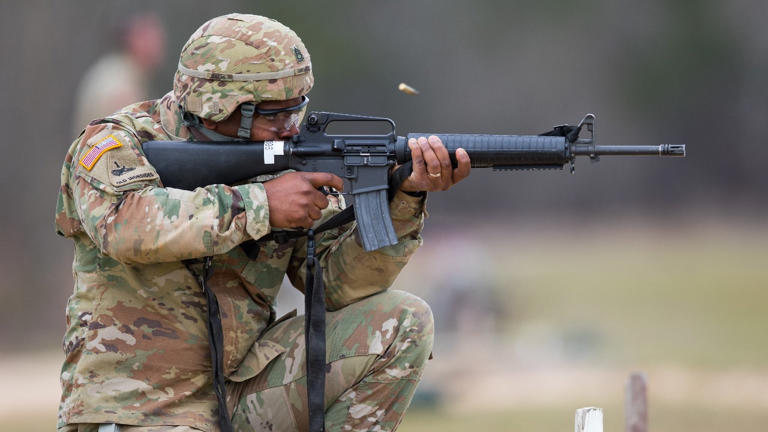
U.S. Army Reserve Sgt. 1st Class Harrison Brewer, G4 Chief Movements Supervisor for the 335th Signal Command (Theater), fires an M16 rifle on a range at Fort Gordon, Georgia, March 8, 2019.
Soldiers from the 335th Signal Command (Theater) headquarters completed warrior tasks and battle drills to include weapons qualification, grenade practice and roll over training during a four-day training designed to increase their warfighting abilities. (U.S. Army Reserve photo by Staff Sgt. Leron Richards)© Provided by 1945
Firearms design isn’t easy, and even trained engineers have had trouble turning a concept into a reliable weapon.
And while countless small arms used by the United States Army became the stuff of legend, for every success like the Thompson submachine gun or M1 Garand there are those guns that are best forgotten.
While we won’t claim this is comprehensive, here are our top picks of some of the worst U.S. Army guns ever. Thankfully, most never saw wide service on the battlefield, or none at all.
THOMPSON AUTO RIFLE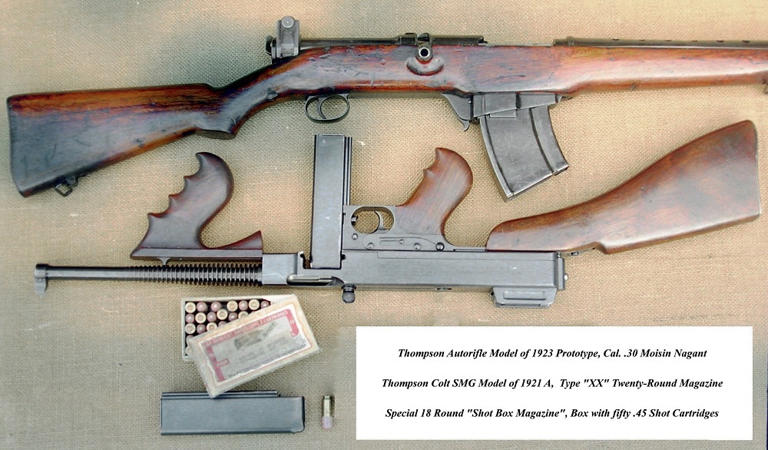
Forgotten Firearms: 5 Guns the U.S. Army Passed On© Provided by 1945
Thompson Autorifle Model 1923 (top) and SMG Model 1921.
The Thompson submachine gun or “Tommy Gun” has become one of the most iconic firearms of the 20th century and certainly one of the most successful submachine gun designs. It is perhaps even as famous as the AK-47, and the Thompson is clearly the forerunner of the modern “black gun.”
Yet, the Thompson wasn’t an instant hit, and the role that John T. Thompson actually played in the design and development of the weapon bearing his name has remained a matter of conjecture.
What is known is that his follow-up, the Thompson Autorifle Model 1928, developed for the U.S. military’s semi-automatic rifle trials, didn’t do much to impress anyone. Chambered in .30-06, it utilized a delayed blowback operation rather than the more complex gas-operated action, which is used in innumerable other self-loading/semi-automatic rifles. Thompson’s design required lubricated ammunition and it reportedly ejected spent casings in such a violent manner that it was reportedly hazardous to those around the shooter.
M50 REISING
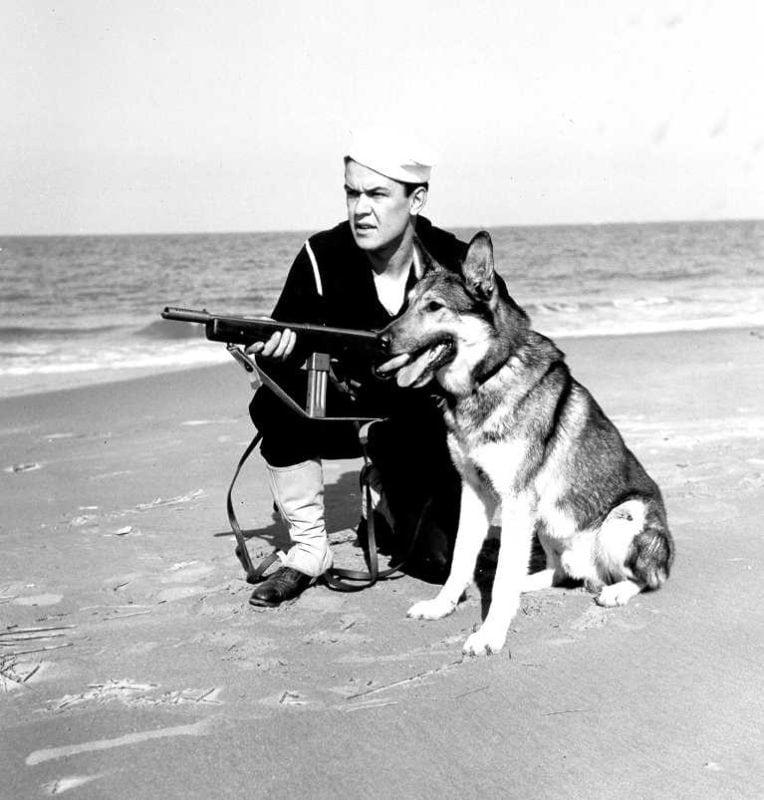
As some 100,000 were actually ordered during the Second World War, the M50 Reising may not have truly been rejected – but perhaps it should have been. Developed by Eugene Reising, the compact submachine gun promised to be a “poor man’s Thompson” as it was cheaper to produce, more compact, and lighter. It fired from a closed bolt, which allowed for greater control even in full-automatic mode.
 Forgotten Firearms: 5 Guns the U.S. Army Passed On© Provided by 1945
A United States Coast Guardsman with working dog and Reising SMG during WWII.
It seemed to have everything going for it – but its 20-round magazine was just the first of the problems. Moreover, while the weapon was reliable in ideal conditions, the jungles of the Pacific with sand, humidity and saltwater meant the complex delayed-blowback operation would jam frequently. It was difficult to maintain, made worse by the fact that many parts were hand fitted at the factory. By the end of the war, the Reising was relegated to the guards at war plants. While its reputation improved after the war when it was used by U.S. law enforcement, its wartime role sealed its fate.
THE MODEL 45A
A mystery design from the war was the little-remembered Model 45A, a weapon that was developed at the end of the war and which seems as revolutionary now as it must have been then.
 Forgotten Firearms: 5 Guns the U.S. Army Passed On© Provided by 1945
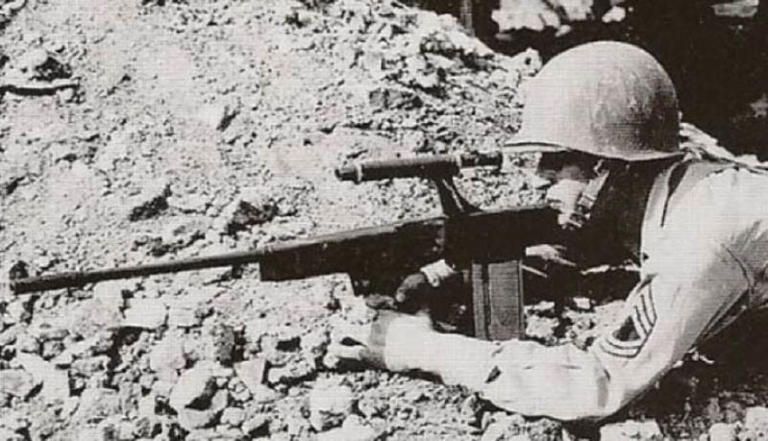
Model 45A. Image: Creative Commons.
The Model 45A was a .30 caliber bullpup designed to be a hybrid battle rifle/light machine gun. Developed by the Army in 1945 in the Philippines, it utilized a Browning Automatic Rifle magazine and featured an integral scope/carrying handle – thus making it look similar in profile to the Austrian Steyr AUG. Why it was developed has remained a mystery, as there no known surviving prototypes and apart from some U.S. Army Signal Corps photos, little evidence survives to show this gun even existed.
ARMALITE AR10
Before Eugene Stoner developed what would become the AR15/M16, there was the AR10. Developed in the 1950s, the AR10 clearly shows what Stoner had in mind – and this is a case where it took one failure to get the weapon refined according to standards. Chambered in 7.62x51mm NATO or .308 Winchester, the AR10 featured an innovative straight-line barrel/stock design and made use of phenolic composites and forged alloy parts, which made it lighter than contemporary weapons.
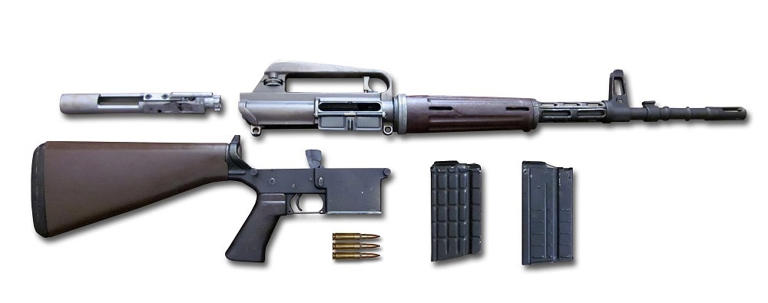
U.S. Army Guns© Provided by 1945
Stripped AR-10. Image: Creative Commons.
However, when one of the prototypes failed in early testing, the damage was done. The weapon seemed too revolutionary for military thinkers who sought to go with an improved version of the M1 Garand, which resulted in the adoption of the M14.
Eventually, the design was refined and could go on to be the AR-15. Yet, had the modern ArmaLite Inc. not released a commercial AR10, it might have been simply a largely forgotten part of the AR15 story.
STONER 63
After Stoner made his mark with the AR-15/M-16 design, he set about developing a modular firearm that was simply too innovative for its time. The Stoner 63 could transform from rifle to carbine to machine gun by swapping out parts.
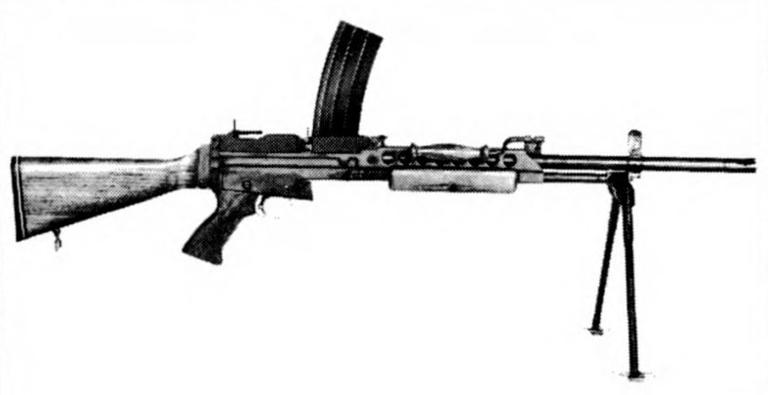 U.S. Army Guns© Provided by 1945
Stoner 63. Image: Creative Commons.
It could fire from a rear-loading magazine as a rifle/carbine or light machine gun with top loading magazine or even via a belt as a squad automatic weapon. In total, some 4,000 of the two main versions were produced and the Stoner 63 even saw some field testing in Vietnam as well as in the invasion of Grenada in 1983. Yet, despite the fact that it was well-liked by the SEALs and other units it was never widely adopted by the U.S. military.