Green Berets rely on their problem-solving abilities to survive in combat. Much of SF selection seeks to assess this talent and the Special Forces qualification course develops and improves creativity. Many times, military problems must be solved with the application of force. Green Berets are not afraid to get their hands dirty, but they understand the power of working with and through others. A friend of mine, George, a Green Beret and a Ranger, told me this story. I don’t think it’s true, but it does explain the Green Beret and the rangers.
The story goes like this.
The new secretary of defense had been confirmed and was touring the Pentagon, taking briefings on the capabilities of his forces. He had a well-deserved reputation as a no-nonsense guy. After a briefing on Special Operations Forces, he was escorted to lunch by a Green Beret officer.
The secretary’s confused look did not bode well as they walked through the E ring. “I understand how SOF is different from conventional forces, but the Rangers and Green Berets seem just alike to me. You have a Special Forces Tab and a Ranger Tab. What’s the difference?”
“The units are very different, sir. While both units are composed of very capable soldiers, selected for intelligence and fitness, Rangers attack the enemy directly, while Special Forces work by, with, and through indigenous forces to accomplish tasks far beyond their numbers.” The Green Beret secretly hoped he would not be pulled into the eternal Ranger versus SF discussion for the 10,000th time. He prided himself on his teaching abilities, but this guy was being obtuse.
“They dress just alike, they are both ARSOF units, and they both have direct-action capabilities. How are they so different?” It seemed the secretary was going to force this. The next four years of Special Forces missions hinged on the new secretary’s understanding. As they walked through an area of temporary construction, the Green Beret had a flash of inspiration.
“Sir, humor me here; let’s do a little demonstration. Rangers are highly aggressive. They pride themselves on their toughness and discipline. They follow orders without question. You see that huge soldier with a tan beret? He is a Ranger.”
As the Ranger approached, the Green Beret called out, “Hey, Ranger! Come here.”
The Ranger moved toward them, sprang to attention and saluted. “Rangers lead the way, sir. How may I be of assistance?”
“Can you help us here for a moment? This is the new Secretary of Defense. He wants to know more about the Rangers. Will you help me educate him?”
Pointing to a new section of hallway, the Green Beret officer said, “Ranger, I need you to break through that wall.”
“Hooah, sir. Would you like a breach, or complete destruction?”
“A man-sized breach will be fine.”
With that, the Ranger removed his beret and assumed three-point stance six feet from the wall. With a grunt, he launched himself into the wall, punching his head and shoulders right through the drywall. Hitting a 2×4 on the way through, he was a little stunned, but he continued to work, smashing a hole wide enough for a fully kitted Ranger to pass through. Staggering to his feet with a trickle of blood running down his face, he appeared a little disoriented.
“Thank you, Ranger. Great job. You are a credit to the Regiment. You need to go the aid station and get someone to look at that cut.”
The secretary was incredulous. He had never seen such a display of pure discipline and strength. “That was astounding. What could Special Forces possibly do to match that?”
The Green Beret was also impressed but not surprised. “The Rangers are highly disciplined sir, but Special Forces selection and training also produces strong, disciplined soldiers. We deploy older, more mature soldiers in very small numbers. They understand that they are a valuable strategic resource and are selected for their advanced problem-solving abilities.”
The secretary seemed displeased. “Frankly, that sounds pretty bogus. It seems that these Rangers are the finest soldiers in the Army. What could Special Forces do that the Rangers cannot?”
As he spoke, a Green Beret staff sergeant walked by. Not as young or lean as the Ranger, he had a commanding presence, and a serious look filled with confidence. The Green Beret officer called him over.
“Hey Mike, can you help us here for a moment? This is the new Secretary of Defense. He wants to know more about the Special Forces; will you help me educate him?”
The staff sergeant shook the secretary’s hand and introduced himself. “How can I help you, sir?”
Pointing to an undamaged section of hallway, the Green Beret officer said, “Mike, I need you to break through that wall.”
“No problem. Would you like a breach, or complete destruction?”
“A man-sized breach will be fine.”
The staff sergeant removed his beret and stood for a moment in silence, six feet from the wall. He scanned the area and smiled broadly as he found the perfect tool for the job. “Hey Ranger,” he said, “Come here.”
Know your abilities, learn about your environment, and use your resources deliberately. Green Berets know that finding just the right tool can be the most important part of the job. The Ranger in the story can take down a wall.
The Green Beret can take out walls until he runs out of Rangers, and then one more. As a force multiplier in the real world, the Green Berets can enlist large units with local knowledge to fight beside them. A single 12-man A-Team can train and employ a 500-man infantry battalion. That is a significant return on investment for the taxpayer.
Value yourself and use your rapport skills to build partnerships. Many hands make light work; don’t do everything yourself. Green Berets know that there is no limit to what you can do if other people are doing the work.
After the ‘shot heard round the world,’ as Redcoats retreated to Boston, Patriots sprang an ambush at a bend in the road known since as the Bloody Angle
British regulars under Lt. Col. Francis Smith continue their orderly withdrawal to Boston from Lexington and Concord, Mass., under devastating fire from concealed Patriot sharpshooters. (Don Troiani (Bridgeman Images))
Unveiled in Lexington, Mass., in 1900, the “Lexington Minuteman,” by Henry Hudson Kitson, honors all the militiamen who fired the “shots heard round the world.” (Daderot)
The relationship between Great Britain and the American province of Massachusetts Bay deteriorated rapidly during the late winter and spring of 1775. On April 14 Lt. Gen. Thomas Gage, the commander of British forces in North America, received orders from London to disarm colonial militias and arrest rebel leaders. British intelligence had learned the Massachusetts militia was stockpiling weapons and supplies in Concord, 16 miles west of Boston. On April 18 Gage ordered a task force to march on Concord “with the utmost expedition and secrecy” to capture and destroy the military stores.
Gage entrusted the Concord mission to Lt. Col. Francis Smith, commander of the 10th Regiment of Foot. Instead of assigning the mission to complete regiments, Gage created a task force, selecting light infantry and grenadier companies from the regiments under his command and the 1st Battalion of Royal Marines. The 21 companies totaled more than 700 men. Major John Pitcairn of the Royal Marines was Smith’s second-in-command. There was no intermediate level of command between them and the 21 companies. Gage’s use of only elite troops in the unorthodox task force was an indication of the mission’s importance.
Francis Smith led the British regulars to and from Lexington and Concord. (National Army Museum, U.K.)
In 1775 a British infantry regiment comprised one company of grenadiers, one company of light infantry and eight battalion companies. The grenadiers and light infantry were the elite troops. The period London Encyclopedia called the grenadiers “the tallest and stoutest men, consequently the first upon all attacks.” These shock troops were used for breaching obstacles and other heavy work. In combat grenadiers operated on the regiment’s right. Light infantrymen acted as flankers and protected the left of the formation.
British troops in colonial North America carried the Model 1756 long land pattern “Brown Bess” musket. The .75-caliber smoothbore fired a .69-caliber ball with a maximum effective range of about 100 yards. In Boston, the Redcoats bound for Concord received 36 rounds of ammunition—then the basic load for a British infantryman. They would receive no resupply on the march. The Redcoats also carried bayonets, giving them a huge advantage over the Patriot militia in close-quarters fighting.
Massachusetts law required all able-bodied men aged 16 to 60 to join their local militias. Many of their officers were veterans of British campaigns against the French and Indians. The colonial government also urged each town to organize a third of its militia into companies of “minutemen,” composed primarily of younger men, who received extra training and committed to turn out immediately in an emergency. That said, most of the Patriots who would confront the British during their retreat from Concord were regular militiamen. Furthermore, though towns purchased weapons and ammunition, most militiamen fought with their personal muskets, shot and powder. Few owned bayonets.
Militia weapons included a range of locally crafted hunting and military designs, commercial arms contracted from private makers, firearms drawn from provincial arsenals, confiscated Loyalist arms, state purchases of spare guns from civilians, surplus arms from European dealers and muskets issued in North America by the British during earlier conflicts.
Captain John Parker’s 77 militiamen were the first to confront the British on April 19, 1775, just after sunrise on Lexington Green. (Don Troiani/U.S. National Guard)
The Patriots learned of Smith’s mission to Concord on April 18 and sent dispatch riders (including the celebrated Paul Revere) to alert area townships the British were coming. Militiamen from across the region began assembling in their home villages, including Concord. The Redcoats began marching west from Cambridge, across the Charles River from Boston proper, at about 2 a.m. on April 19. By 5 a.m. the column had reached Lexington, some 7 miles shy of Concord, where they skirmished with the local militia, spilling the first blood of the American Revolutionary War.
The British arrived in Concord around 7 a.m. When the Redcoats marched into town, the militia retreated to the outskirts. Smith then dispatched detachments of soldiers to seize the cached military stores. He sent one group of soldiers 2 miles north of town to search the farm of Colonel James Barrett, the local militia commander. After searching the village, British soldiers smashed up and torched several cannon carriages. Enraged at the sight of smoke rising from the center of town, militiamen from Concord, Acton, Lincoln, Bedford, Carlisle, Chelmsford, Groton, Littleton, Stow and Westford—some 500 men in all—confronted Redcoats guarding the North Bridge over the Concord River near Barrett’s farm. The British fired a volley as the Patriots approached. The militiamen returned fire, killing several Redcoats and wounding many others, in an action memorialized as the “shot heard round the world.” The bloodied British withdrew to Concord.
At Concord’s North Bridge Capt. Isaac Davis’ company of militiamen from Acton skirmish with troops of the 4th (King’s Own) Foot, in the action famed for the “shot heard round the world.” (Domenick D’Andrea/U.S. National Guard)
After the fight at North Bridge the Redcoats tarried in Concord several more hours. They destroyed a cache of confiscated military supplies, consolidated their scattered forces and organized transportation for their wounded. Smith showed no sense of urgency. That would prove a mistake, for while the British lingered, militiamen spread word and converged on Concord.
Finally, around noon, after having dallied five hours in Concord, the British force began its return trek to Boston. At the outset of the march Smith took the precaution of deploying 80 to 100 flankers on a ridge to the left, or north, side of Bay Road, the outbound route. The main column marched unmolested for about a mile to a junction known locally as Meriam’s Corner. At that point Bedford Road came down from the north to join Bay Road. Just past the intersection Bay Road crossed Mill Brook. Although only a trickle today, in 1775 it was a flowing stream that required a bridge to traverse. The ridge ended just shy of Bedford Road, so as the Redcoats approached the bridge, Smith ordered the flankers to rejoin the main body to cross Mill Brook.
Smith showed no sense of urgency. That would prove a mistake, for while the British lingered, militiamen spread word and converged on Concord
About the time the British started across the bridge, Patriot militia began converging at Meriam’s Corner. From the north fresh companies arrived from Reading, Billerica and Bedford. The militiamen who had fought at North Bridge marched across open pasture known as the Great Meadow, north of Concord.
As Smith’s flankers rejoined the main column, Patriots took up positions around the home and outbuildings of Nathan Meriam, within 100 yards of Bay Road. Six small militia companies from Sudbury watched the British from a respectful distance across open fields south of the road.
As the last of the British forces crossed Mill Brook, the rear guard turned and fired a wild volley to drive off approaching militia. That was all the excuse the Patriots needed. From either side of Bay Road they unleashed a volley at the retreating Redcoats. When the smoke cleared, two British soldiers lay dead and several others were injured. “Up to this moment the remainder of the day might have passed without further incident,” a history of that fateful day noted. “The few minutes of action at Lexington Green and Concord Bridge might even have been written off as part of a chronicle without any fulfillment or far-reaching end. Such however, was not destined to be the case.…From this volley there was to be no point of return.”
As the British force continued to retreat east on Bay Road, militiamen shadowed their march and sniped at the Redcoats from both sides of the thoroughfare. Once over Mill Brook, Smith redeployed his flankers—which helped keep the Patriots from approaching too closely—and inflicted casualties among the militia. Less than a mile past Meriam’s Corner the British column reached Brooks Hill (aka Hardy’s Hill), where waiting militiamen had flanked the road. Wooded terrain and buildings on the Brooks farm and at Brooks Tavern offered concealed positions, allowing the Patriots to lay down accurate fire on the Redcoats from close range. Although the British quickly pushed through the hail of musket fire with their flankers’ help, the worst was yet to come.
In a contemporary illustration Patriot militiamen engage British troops retreating east from Concord toward the Bloody Curve. (Sarin Images/Granger)
The village of Woburn lies some 4 miles northeast of Lexington. At about 1 a.m. on April 19 a lone horseman had ridden through to alert officials the British were marching out from Boston, and the Woburn Militia immediately began assembling. “The town turned out extraordinary,” recalled Maj. Loammi Baldwin, the local commander, “and proceeded toward Lexington.” Down dirt roads and across country Baldwin and three companies of Woburn Militia, totaling some 250 men, made their way south. Although they heard “a great firing” from the direction of Lexington, the Woburn men were too late to make a stand with their neighbors on the green. When they did arrive, they were infuriated to find “eight or 10 dead.”
Baldwin ordered his men to trail the British to Concord. Some 4 miles west of Lexington they reached Tanner’s Brook, a stream cutting across Bay Road, where the men refreshed themselves. Before moving on, they heard the fighting on Brooks Hill and soon spotted approaching Redcoats. The Woburn Militia, in Baldwin’s recollection, “then concluded to scatter and make use of the trees and walls for to defend us and attack them.” Dashing uphill to a sharp northeastward bend in Bay Road, they took up positions in an apple orchard overlooking the road.
The half-mile of Bay Road between the two bends—the Bloody Angle—offered ideal cover and concealment for an ambush
From Brooks Hill the British line of march dipped into the narrow ravine drained by Tanner’s Brook. From there the road climbed some 100 yards before reaching a bend to the left, or northeast—the first of two turns. Beyond the first bend the road climbed sharply and then leveled off as it approached the second bend. To the left, or west, side of the road was open pasture dotted with large trees. The apple orchard stood to the right of the first bend, while a woodlot filled with younger trees flanked the second. The half-mile of Bay Road between the two bends—the Bloody Angle—offered ideal cover and concealment for an ambush.
Exploiting their familiarity with the terrain and local roads, the Patriots converged on the stretch of Bay Road between the bends ahead of the Redcoats. Before reaching the Bloody Angle, the British had the advantage of interior lines, forcing the Patriots to move farther and faster to maintain contact with the Redcoat column. After the skirmish at Brooks Hill, however, some militiamen cut cross-country to Bay Road beyond the first bend, allowing them to reach the wooded pasture ahead of the Redcoats—a classic example of the use of interior lines. Other militiamen who had fought at Meriam’s Corner marched cross-country through an open area known as the Great Fields before scaling a wooded height to reach Bay Road and take up firing positions in the wooded pasture near the second bend. A third group of Patriots dogged the Redcoats from the rear. Though popular lore avows each man fought on his own, in reality the militia moved as companies, each under its commander’s control. “Far from being a disorganized rabble,” historian Walter Borneman wrote, “the rebels were working together with deadly efficiency.” The British were about to march into a half-mile-long gauntlet of fire.
The British mission called for 700 British regulars to march from Boston (at bottom center) 16 miles west to Lexington and Concord in search of Patriot military stockpiles. (Library of Congress)
After passing the ambush on Brooks Hill, the Redcoats marched quickly down the east face of the rise to escape. It was 1:30 p.m.
Militiamen from Westford, Stow and Groton, who had just arrived from their homes west of Concord, harassed the rear of the column. At the bottom of the hill Lincoln Bridge spanned Tanner’s Brook, where the restrictive terrain again forced Smith to recall his flankers to cross the stream.
Once past Lincoln Bridge the weary Redcoats trudged uphill some 100 yards to the first bend. Capt. Lawrence Parsons’ light company of the 10th Foot was in the lead. Parsons was the only officer in his company who remained uninjured. As they rounded the bend, the British met a blast of musket fire from Woburn militiamen concealed in the apple orchard and behind stone walls. After firing, the Woburn men raced into the adjacent woodlot to keep the British column under constant fire.
After the Woburn Militia opened up on the right flank of the British column, Patriots across the road took their turn. There, concealed behind large trees in the wooded pasture, militiamen from Reading, Redford, Chelmsford, Billerica and others who had engaged the enemy at Brooks Hill fired on the exhausted Redcoats. Smith detached flankers to drive back the Patriots, but they were not as effective at engaging militiamen hiding behind large trees as they had been in the more open landscape closer to Concord. The trees provided good cover, and the flankers merely became better targets the closer they came to the concealed militiamen.
The Redcoats had entered Bloody Angle as an organized military formation and emerged a bloodied mob. It is a testament to the British leaders and soldiers’ resolve and professionalism that they survived at all
The Redcoats fighting at the Bloody Angle faced several disadvantages. Perhaps foremost, the Patriots outnumbered them more than 2-to-1. The British decision to supply each man the basic load of 36 rounds of shot and not plan for resupply also began to tell as they ran short of ammunition. If Smith allowed the column to stop and engage the militia, his force would be overwhelmed by the Patriots. There wasn’t even time for the British to tend to casualties, so they left wounded comrades to their fate along the road. Most officers were dead or wounded, so the redoubtable British sergeants took over and kept the column moving forward. Their situation was becoming critical. At that point, midway between the two bends, the British began to break.
The Redcoats double-timed it uphill toward the second bend, where militiamen from Concord and other towns were waiting for them. As the British approached the bend on the run, the Patriots unleashed a volley. The Woburn Militia also continued firing on them from the woodlot across the road. Although staggered by these vicious attacks, the column kept moving. Then the Redcoats caught a break.
The terrain, which had plagued the British all day, suddenly became their ally. One hundred yards past the second bend Bay Road crested a hill and began a gentle descent for a half mile. To the weary Redcoats, running downhill must have seemed a godsend. Also in their favor was the roadside terrain, which past the second bend became overgrown and swampy, slowing Patriot pursuit. Although exhausting for the British, running had saved their lives. Though far from out of danger, they had survived the Bloody Angle and had a few minutes to regroup until the Patriots reorganized and resumed their attacks.
The peaceful surroundings at present-day Bloody Curve belie the bloody fight that happened along this roadside in April 1775. (National Park Service)
The Redcoats had entered Bloody Angle as an organized military formation and emerged a bloodied mob. It is a testament to the British leaders and soldiers’ resolve and professionalism that they survived at all. Had they been less resolute, the whole column could have been annihilated or captured. Eight Redcoats died outright during the fighting at Bloody Angle, 30 more received wounds of varying severity and an unknown number went missing or were captured. The figures represent nearly 15 percent of all British casualties during the retreat from Concord to Boston. The day after the battle locals buried five of the Redcoats killed at Bloody Angle in a little cemetery in Lincoln. Other British dead still lie where they fell along Bay Road.
The Patriots did not escape unscathed. Several Massachusetts militiamen were wounded at the Bloody Angle, and three were killed—Jonathan Wilson of Bedford, Nathaniel Wyman of Billerica and Daniel Thompson of Woburn. Redcoat flankers inflicted most of the Patriot casualties. Compared to the losses of their adversaries, however, militia casualties were surprisingly light.
The British survivors of the Bloody Angle weren’t out of the woods, as the Patriot militias quickly regrouped and resumed their attacks on the beleaguered column. Had Smith’s command not received reinforcements at Lexington in the form of 1,000 men and two cannons under the command of Brig. Gen. Hugh Percy, they would never have made it back to Boston. As it was, militiamen from all over eastern Massachusetts gathered along the British escape route and turned their retreat into one long, bloody running fight. The British eventually reached Boston, but not before feeling the full wrath of the Massachusetts militia at the Bloody Angle. MH
Historian and retired Army officer Douglas L. Gifford specializes in American military history.
“I sure wish we would have to mix with some of the [Warlord] armies over here as I would like to see if they are good in a scrap” – Pvt John Black, 3rd Brigade USMC, Tientsin, 15 Dec 1927
Until February of 1938 the Marines did not maintain a permanent presence in Tientsin. The city on the Pei ho River (Hai River) with both road and rail access served as a natural gateway to Peking. In 1900, during the Boxer troubles the Marines did fight here and earned the respect of a number of their allies for their courage under fire.
Furthermore, until shortly after WWI they routinely used the city as a logistics center for gathering supplies off loaded at the shallow water ports of Taku and Tangku. In the 1920’s they occasionally occupied the city when fighting between local warlords threatened to cut off Peking from the outside world. But apart from Smedley Butler’s 1927-28 expeditionary force, they rarely stayed beyond a few weeks. Bulter redeployed his force from Shanghai and brought them to Tientsin because he feared the fighting between the Nationalist forces and the warlord armies might cut off Peking from the outside world.
Pvt Black summed up Butler’s mission in much simpler and cruder terms: “I think I will have to go to Peking again soon as there is quite some fighting there and I am one of many that is here to see that when these Chinks fight that they don’t mix with anybody that is white.” Black never had to fight his way to Peking and by January 1929 Butler’s Marines returned stateside, leaving on rather good terms with the Chinese. Follow this link to pictures of Butler’s activities in Tientsin.
10 Novemebr 1928, Gen Butler and American Minister to China John Van Antwerten MacMurray along with Chinese officals at a dedication to a Sino-American cooperation and friendship project to honor of the opening of a highway between Tientsin and Peking.
10th Artillery park outside Tientsin
A company on paradeInstead, Tientsin was an Army town, as elements of the 15th US Infantry garrisoned Tientsin from January 1912 until they were withdrawn in March 1938. At that time the Marines took over the 15th old post,remaining until forced to surrender to the Japanese on 8 Dec 1941.
A common misnomer is the Tientsin compound was originally German barracks vacated during WWI. Although the buildings the 15th and the Marines used were inside the old German concession, the buildings were originally built as a residential apartment complex. Associated with Tientsin was the deep water port city of Chinwangtao. Since Tientsin was a shallow draft port, larger ocean vessels such as US Navy transports had to dock at Chinwangtao.
Chinwangato became after WWI, the primary entry point for Marines coming to north China. In addition, the 15th Infantry maintained a training camp with artillery range at Chinwangtao.
When the Marines took over Tientsin in 1938, they also assumed control of this camp which they renamed Camp Holcomb. Since Camp Holcomb was close to Chinwangtao, Marines were immediately dispatched to covertly record Japanese movements in and out of the port following the outbreak of hostilities between the Chinese and Japanese during the summer of 1937. Like the Peiping Marines, the Tientsin-Chinwangtao Marines were surrendered at the start of WWII.
Following WWII the 1st Marine Division was based at Tientsin from 30 September 1945 until their September 1947 withdrawal. The 1st along with the 6th Marine Division at Tsingtao were tasked with disarming and removing Japanese forces from North China as well as protecting the approaches to Peking. For some brief excerpts and images of post WWII duty around Tientsin and Tsingtao click here.
Gordon Hall during the Great Flood of 1938. Photo courtesy of the Tim Brig Collection
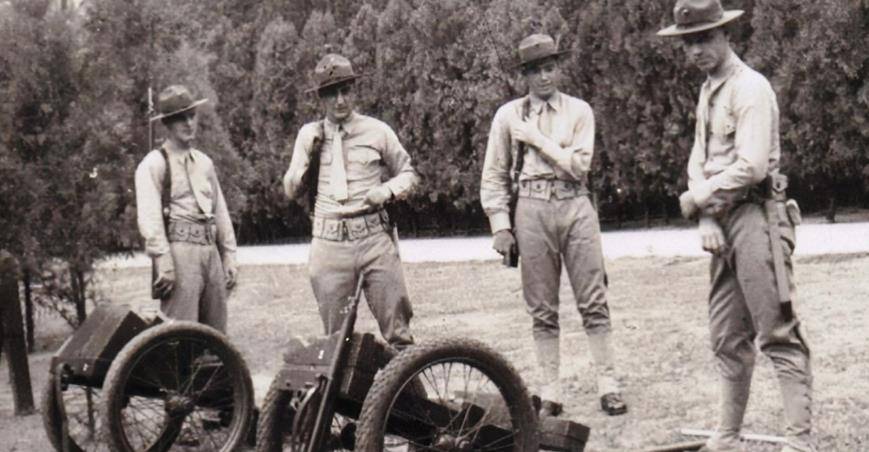
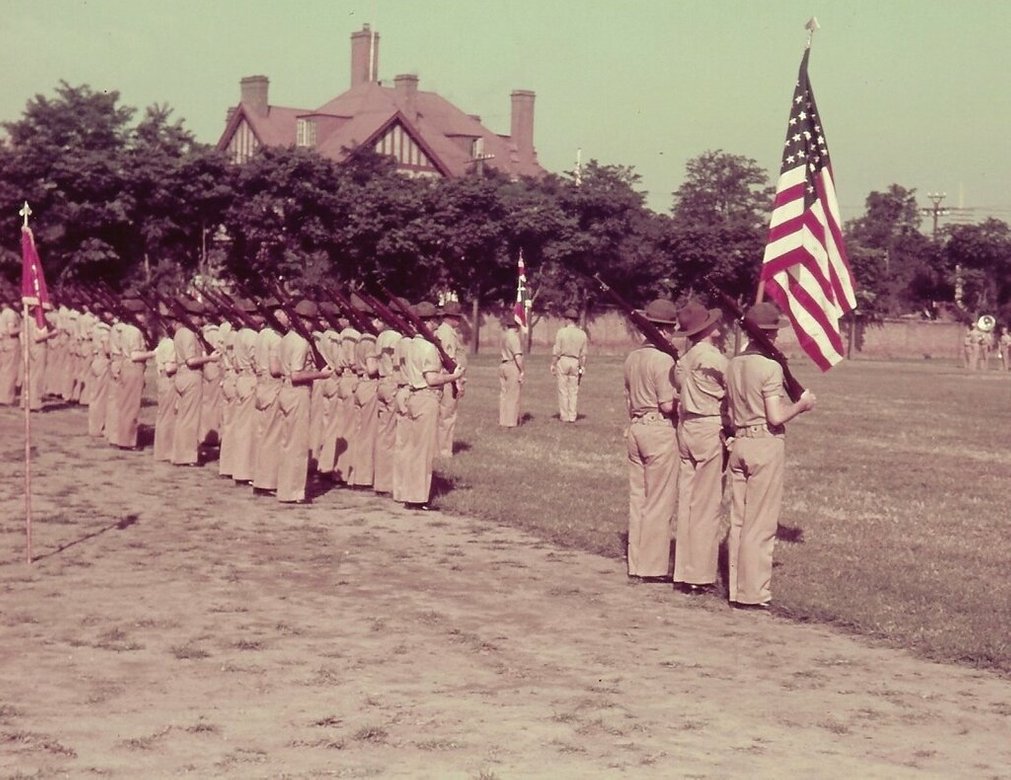
Training on the parade ground. Photo courtesy of the Tim Brig Collection
Marines with their Cole Carts. Photo courtesy of the Tim Brig Collection
Rare pre-WWII color images of the Tientsin Marines drilling on their parade field
 Green Berets rely on their problem-solving abilities to survive in combat. Much of SF selection seeks to assess this talent and the Special Forces qualification course develops and improves creativity. Many times, military problems must be solved with the application of force. Green Berets are not afraid to get their hands dirty, but they understand the power of working with and through others. A friend of mine, George, a Green Beret and a Ranger, told me this story. I don’t think it’s true, but it does explain the Green Beret and the rangers.
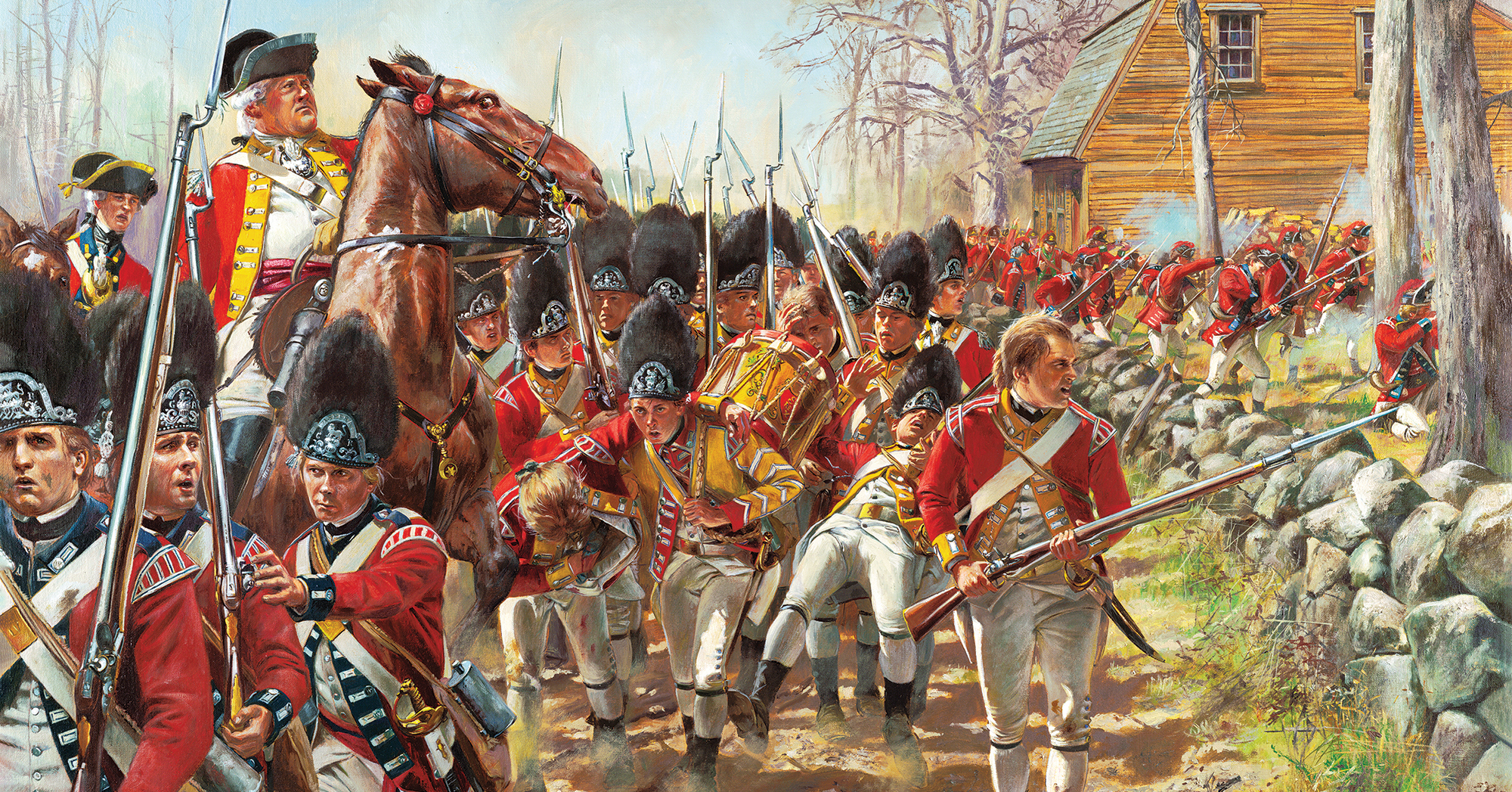 After the ‘shot heard round the world,’ as Redcoats retreated to Boston, Patriots sprang an ambush at a bend in the road known since as the Bloody Angle
 Unveiled in Lexington, Mass., in 1900, the “Lexington Minuteman,” by Henry Hudson Kitson, honors all the militiamen who fired the “shots heard round the world.” (Daderot)
 Francis Smith led the British regulars to and from Lexington and Concord. (National Army Museum, U.K.)
 Captain John Parker’s 77 militiamen were the first to confront the British on April 19, 1775, just after sunrise on Lexington Green. (Don Troiani/U.S. National Guard)
 At Concord’s North Bridge Capt. Isaac Davis’ company of militiamen from Acton skirmish with troops of the 4th (King’s Own) Foot, in the action famed for the “shot heard round the world.” (Domenick D’Andrea/U.S. National Guard)
 In a contemporary illustration Patriot militiamen engage British troops retreating east from Concord toward the Bloody Curve. (Sarin Images/Granger)
 The British mission called for 700 British regulars to march from Boston (at bottom center) 16 miles west to Lexington and Concord in search of Patriot military stockpiles. (Library of Congress)
 The peaceful surroundings at present-day Bloody Curve belie the bloody fight that happened along this roadside in April 1775. (National Park Service)