Category: This great Nation & Its People
Much has been written about the M14, most of it about the rifle’s development and surprisingly little about its use in combat. The select-fire M14’s time in action was relatively short, but those who fired it in anger during the Vietnam War will never forget the last American military rifle constructed of walnut and steel.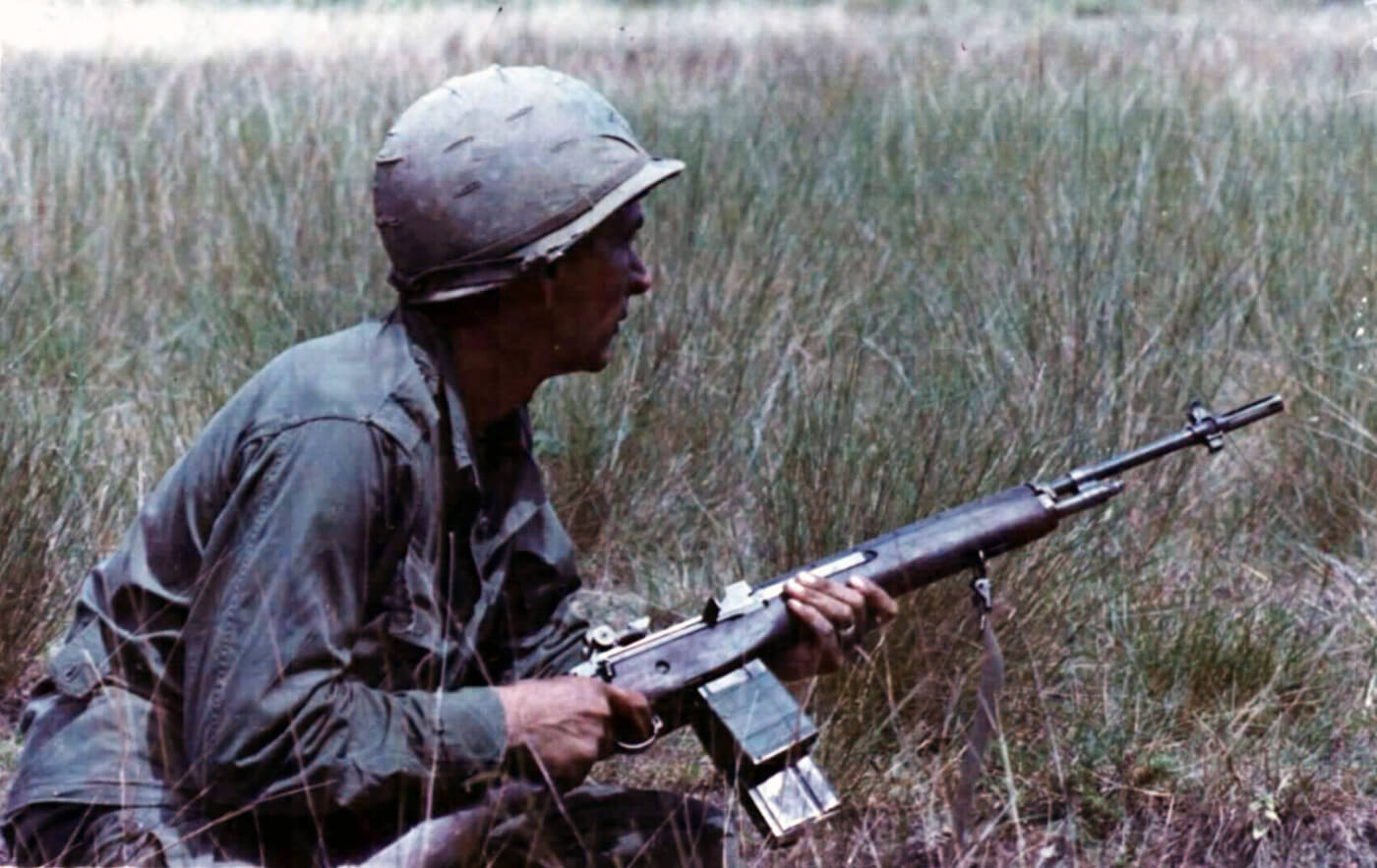
The M14 Concept
At the end of World War II, the U.S. Military had an unusually high number of small arms types, using a wide range of ammunition: the M1911 pistol (.45 ACP), the Thompson and M3A1 submachine guns (.45 ACP), the M1 Carbine (.30 Carbine), the M1903 Springfield and M1 Garand rifles (.30-06), the Browning Automatic Rifle (.30-06), and the Browning M1917 (water-cooled) and M1919 (air-cooled) machine guns (.30-06). All of these were fine weapons, but U.S. small arms logistics had become unduly complex.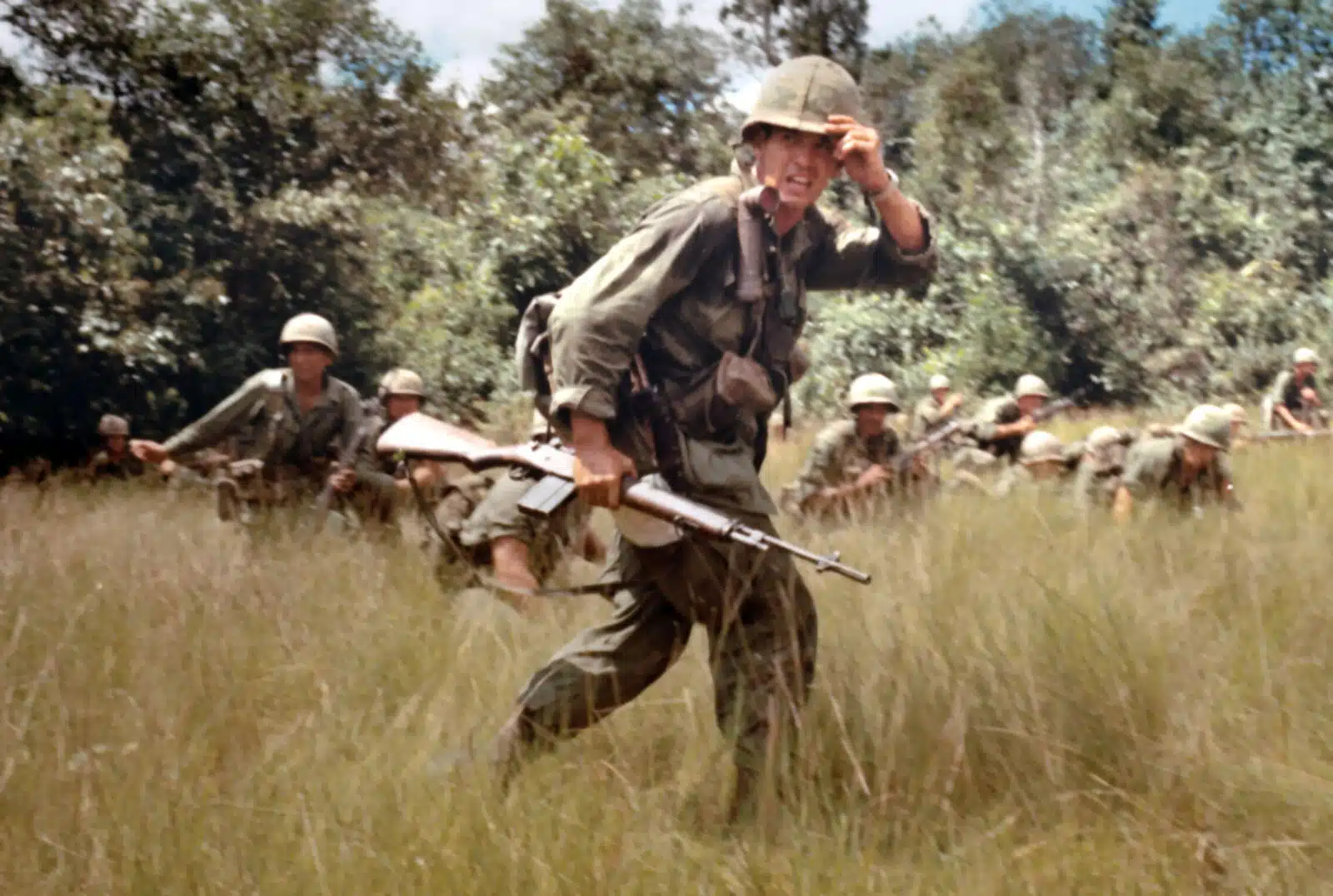
During 1944, U.S. Ordnance began development of a new cartridge—the 7.62mm T65. This would later be slightly modified (during 1954) to become the standard 7.62×51 NATO round. To fire it, a new M14 rifle would update the proven M1 rifle, leveraging the new NATO round to specifically replace the Garand and the squad-automatic BAR—while it was also believed that the selective-fire M14 eliminated the need for submachine guns.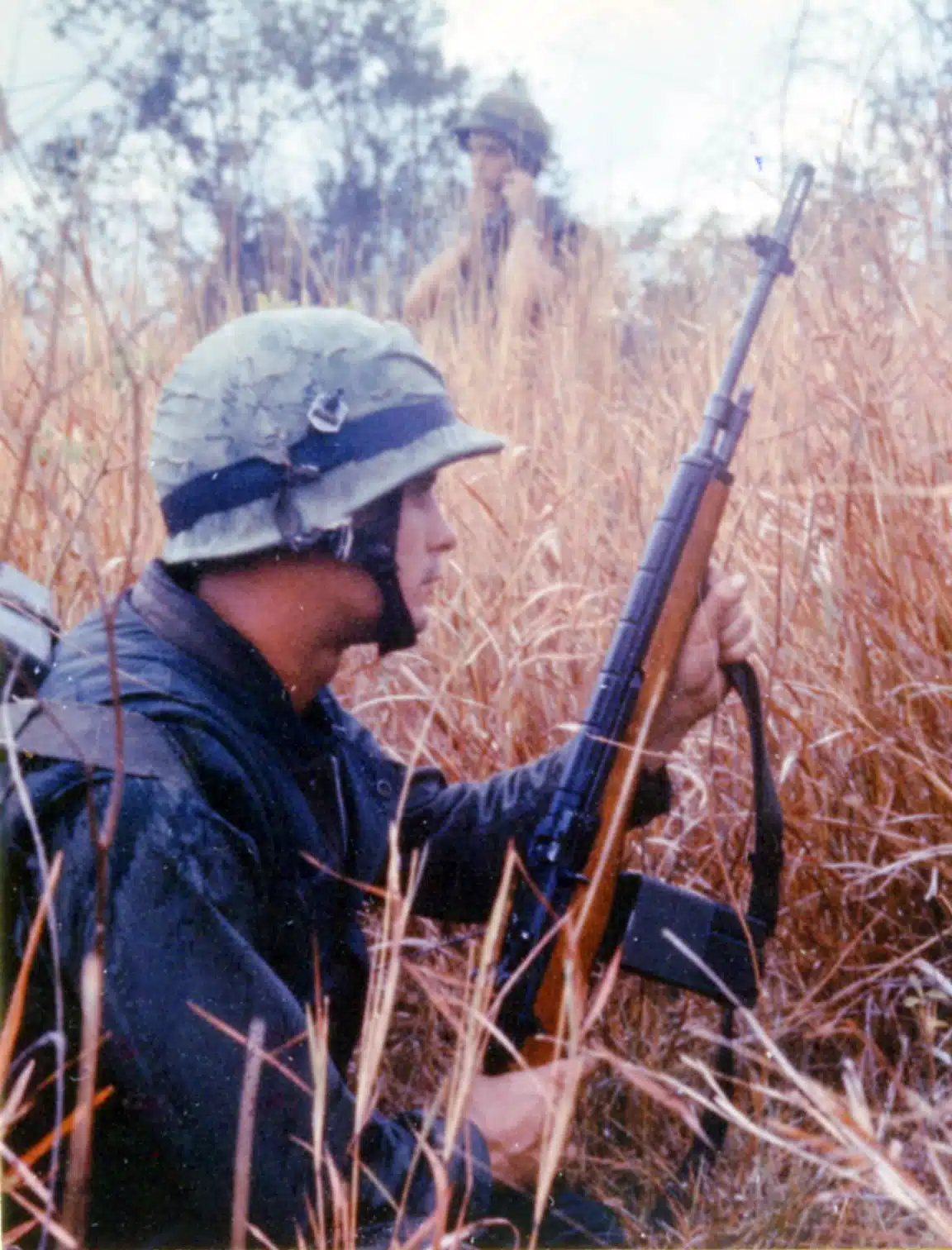
The M14 concept represented practical thinking: a single rifle filling multiple roles while using the same ammunition. From a logistical standpoint, it all makes sense. However, in actual practice no military has ever been able to make it work across the board. Specialized troops with special weapons exist for a reason. But, on its own, the M14 and its powerful cartridge had much to offer.
Changing Times, Evolving Enemies
Behind the Iron Curtain in the 1950s, the Soviets slowly developed the SKS rifle and AK-47 rifle (both chambered in 7.62x39mm). When the AK-47 finally entered service in 1956, U.S. Ordnance described the new weapon as a “submachine gun”, and the Kalashnikov design was not given much credence—U.S. Ordnance particularly disdained the Soviet intermediate cartridge. Meanwhile, the M14 was adopted as the U.S. Military’s standard rifle in 1957.
By the early 1960s, the U.S. mindset about battle rifles was challenged by a growing number of insurgent actions around the world. The light weight and high firepower of the communist AK-47 made guerrilla forces more competitive on the battlefield than ever before.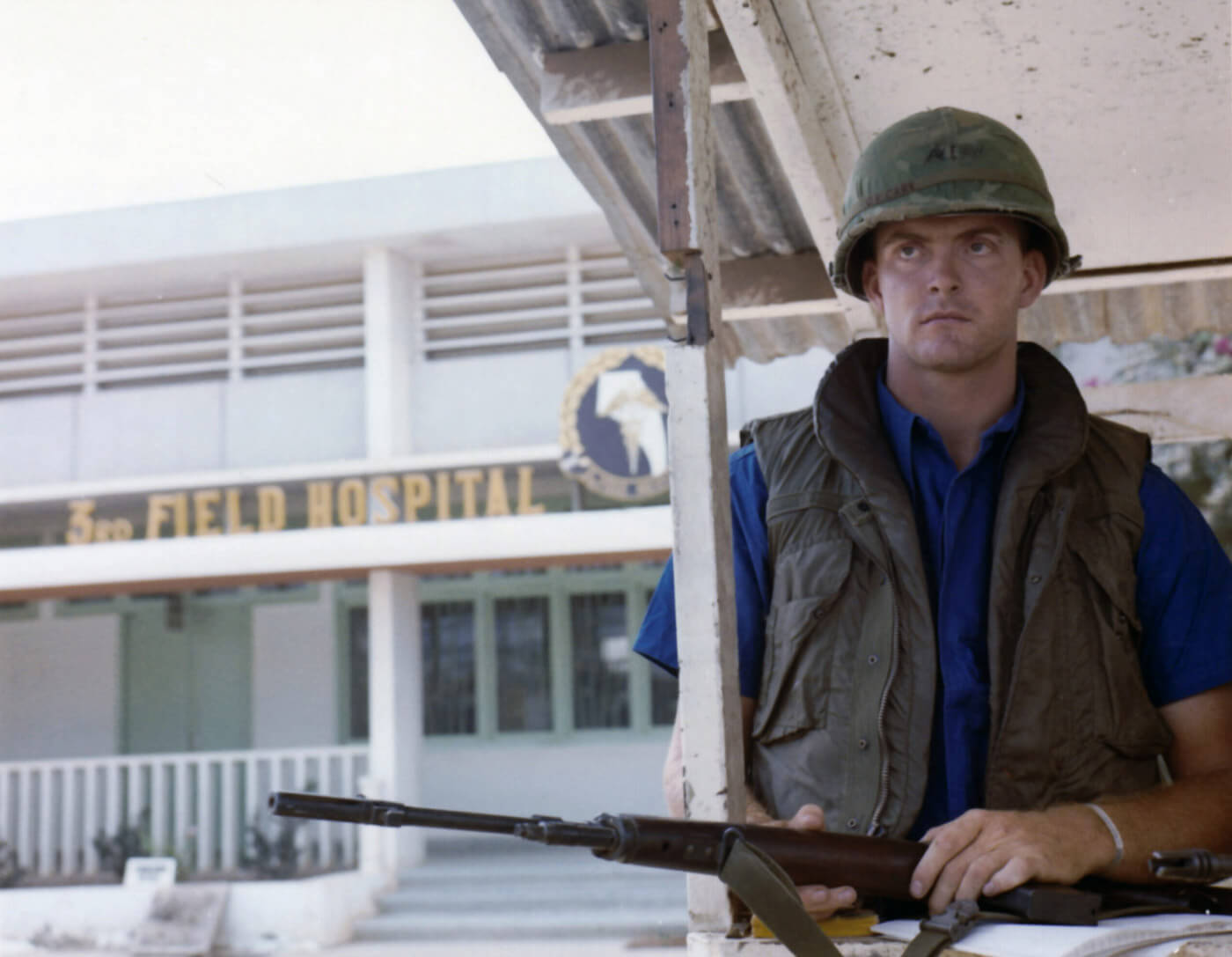
In response, U.S. Ordnance quickly placed its focus on the AR-15 rifle, and by 1963 more than a thousand of the 5.56mm rifles had been tested in Vietnam. U.S. Special Forces adopted the AR-15 during 1963, and with favorable reports on the new rifle and its ammunition coming from Southeast Asia, momentum was quickly building for a change in battle rifles. In March 1964, the M16 rifle entered large-scale production, and by 1969 it had become the U.S. Military’s standard service rifle.
The M14 in Vietnam
Modern evaluations of the M14’s combat performance seem to quickly devolve into shouting matches between fans of the M14 and the M16. Suffice it to say that they are both excellent rifles, and no shooter is “wrong” if they have a preference. Also, it is important to remember that given a choice, an infantryman will choose everything. He wants light weight coupled with great firepower. He wants reliability and accuracy. He wants tremendous shoot-through-coverand man-stopping knock-down power. Coupled with that he wants all the magazine capacity he can get.
And while no one begrudges the infantryman his many wants in a battle rifle, there has never been a firearm that gives him everything he desires in just one gun. Ultimately, the American fighting man uses what he is issued, and he has an irrefutable history of using his service arms well.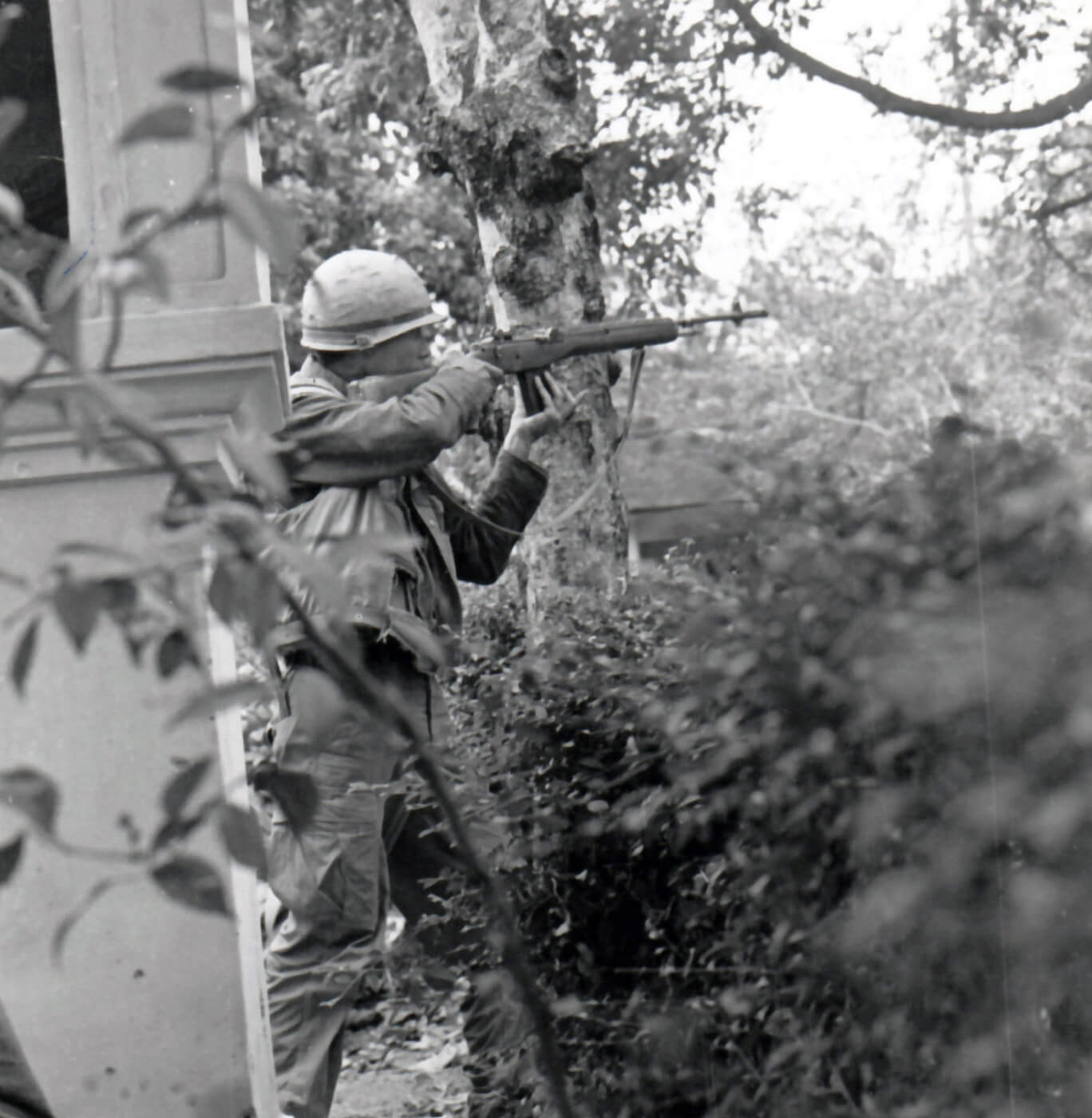
Could the U.S. Military have performed just as well on the battlefields of Vietnam if the M16 had not replaced the M14 as the primary rifle? I believe the battlefield results would have been similar, as the combat qualities of the American rifleman have always been paramount. Advanced training in marksmanship and fire control could overcome the M14’s less-than manageable qualities when used as a full-auto weapon, and it was also more than capable in semi-auto mode.
Modifications to the M14 were certainly necessary, beginning with a fiberglass stock to replace the original walnut and birch types that tended to swell in the jungle environment. Meanwhile, every infantryman tends to find his rifle to be too heavy at some point. At 10.5 lbs. loaded, the M14 was about 2 lbs. heavier than the AK-47 or the M16, and comments from the troops often reflect this. U.S. troops in WWII complained that the M1 rifle was too heavy as well—but the large amount of deceased Axis troops suggest that the Garand rifle’s performance was just fine.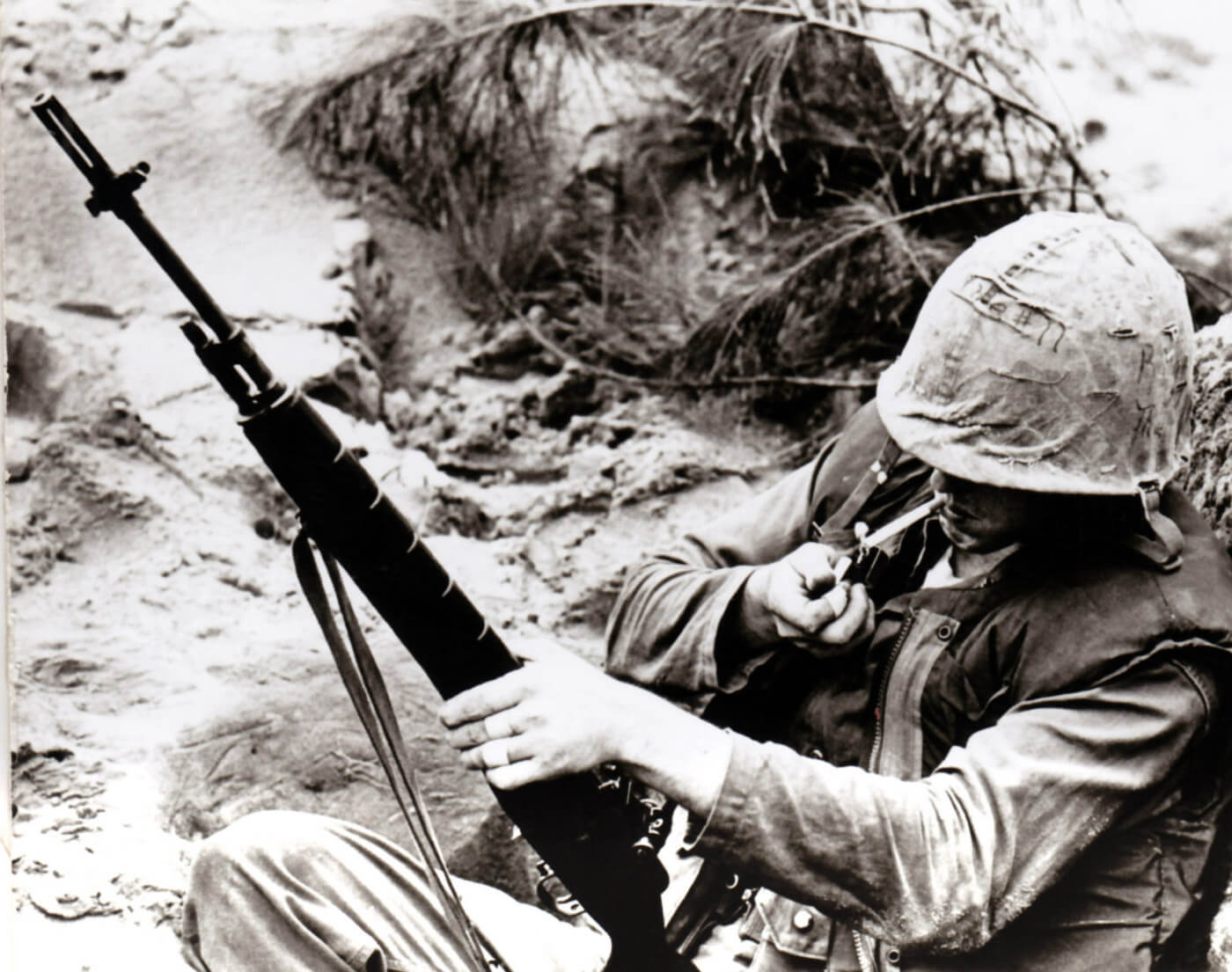
As a counterpoint to the weight issue, the M14’s 7.62x51mm cartridge was powerful enough to muscle through jungle foliage. Marines describe that, in the absence of an M60 machine gun, the M14 offered the next strongest alternative. In Vietnam, the tactical conditions could vary greatly between one firefight and the next, and the M14 rifle could deliver a high level of firepower, with good accuracy at longer range, whenever called upon. And it certainly earned a legion of fans in the jungles of Vietnam.
From the Source
I recently spoke to an old friend who had considerable experience “in country,” and with a wide variety of U.S. infantry weapons. Captain Dale Dye enlisted in the U.S. Marine Corps in January 1964. He served in Vietnam in 1965 and 1967 through 1970, surviving 31 major combat operations. He emerged from Southeast Asia with numerous decorations, including a Bronze Star for valor and three Purple Heart medals for wounds suffered in combat.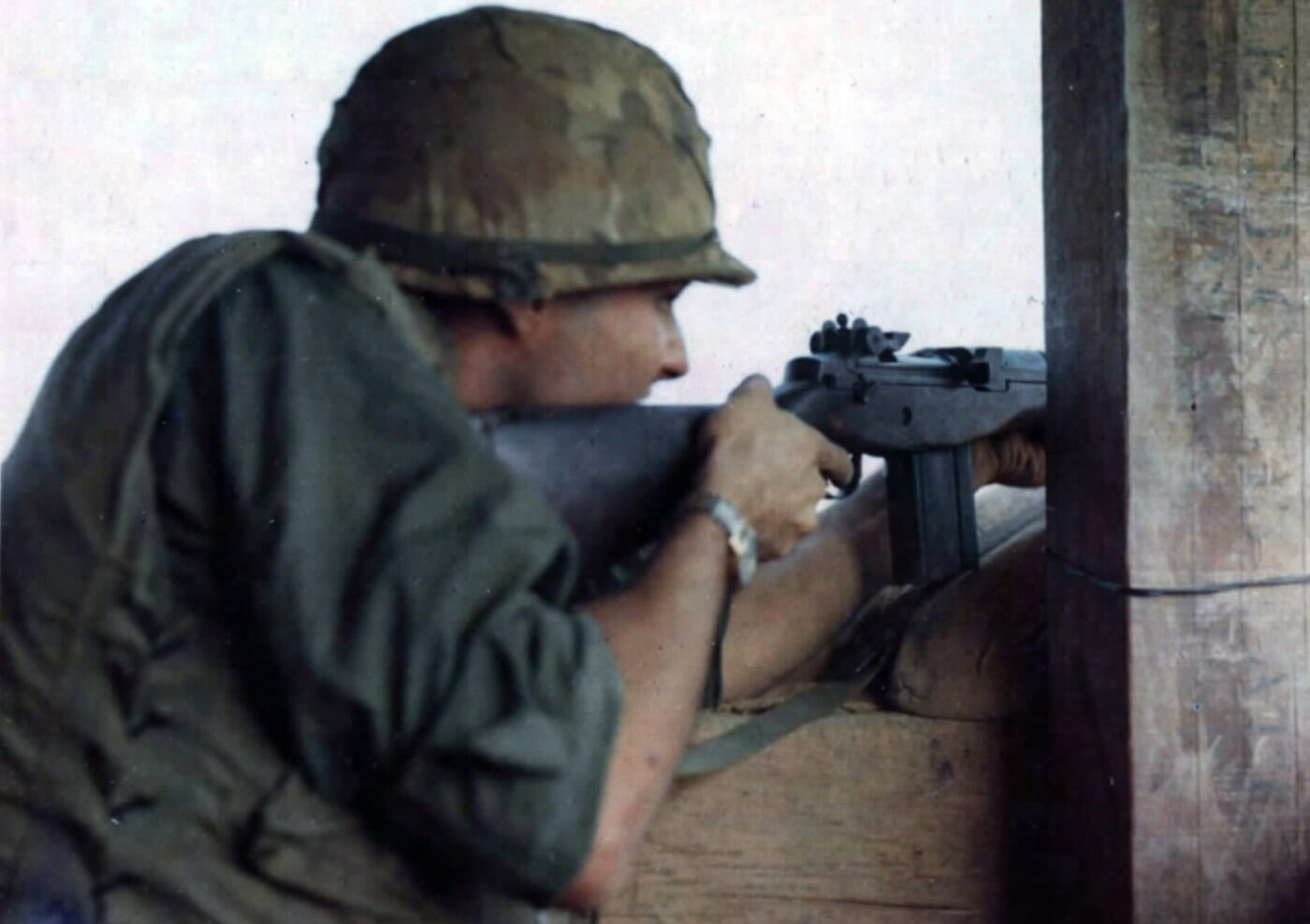
He spent 13 years as an enlisted Marine, rising to the rank of master sergeant. He was chosen to attend officer candidate school and was appointed a warrant officer in 1976. He later converted his commission and was a captain when he was sent to Beirut with the multinational peacekeeping force in 1982-83.
When I asked him about the M14, Captain Dye commented: “The M14 was a rifleman’s rifle and most Marines carried it with enthusiasm early in the Vietnam War. I can distinctly remember guys trying to hide their favorite M14 when the word came down that we were going to be issued the M16.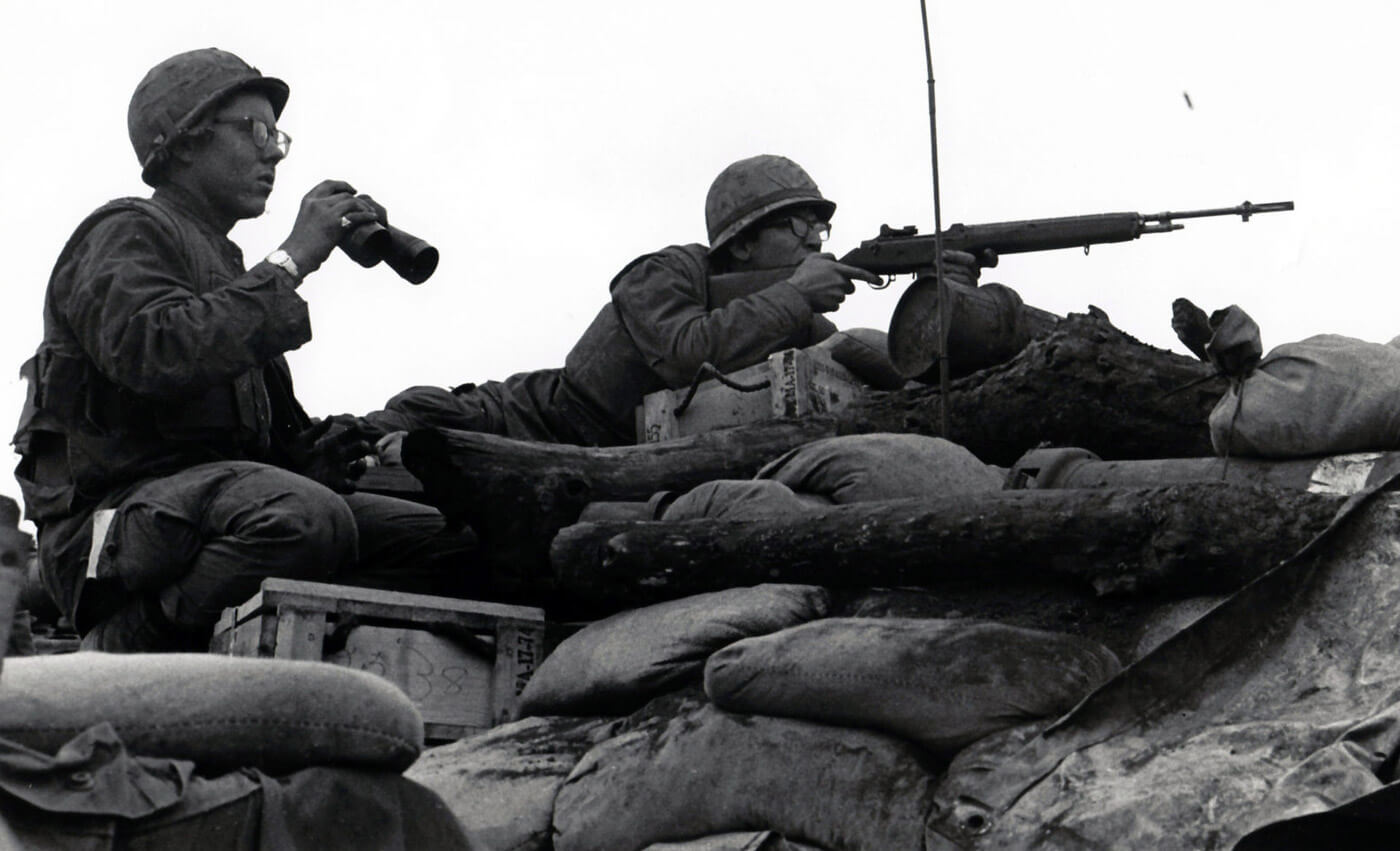
Despite the best efforts by some commands, many Marines continued to carry an M14 for quite some time after the switch-over was ordered. There was just a certain factor of trust in that rifle. Or maybe it was some kind of Marine Corps ‘mojo’ but it seemed reassuring to carry a weapon that looked, felt and shot like a ‘real’ rifle.”
It’s All Relative
Taste, and trust in rifles is clearly a generational issue. My father was an infantry sergeant in World War II. When he looked at an M16, he thought they were not “proper” rifles. My grandfather, a World War I infantryman, would likely have looked at the M1 Garand with suspicion, considering it inelegant and brutish compared to his M1903 Springfield rifle. My brothers and I considered rifles like the M16 to be completely normal, and truly appreciate the semi-auto AR-15 variants designed for the civilian market.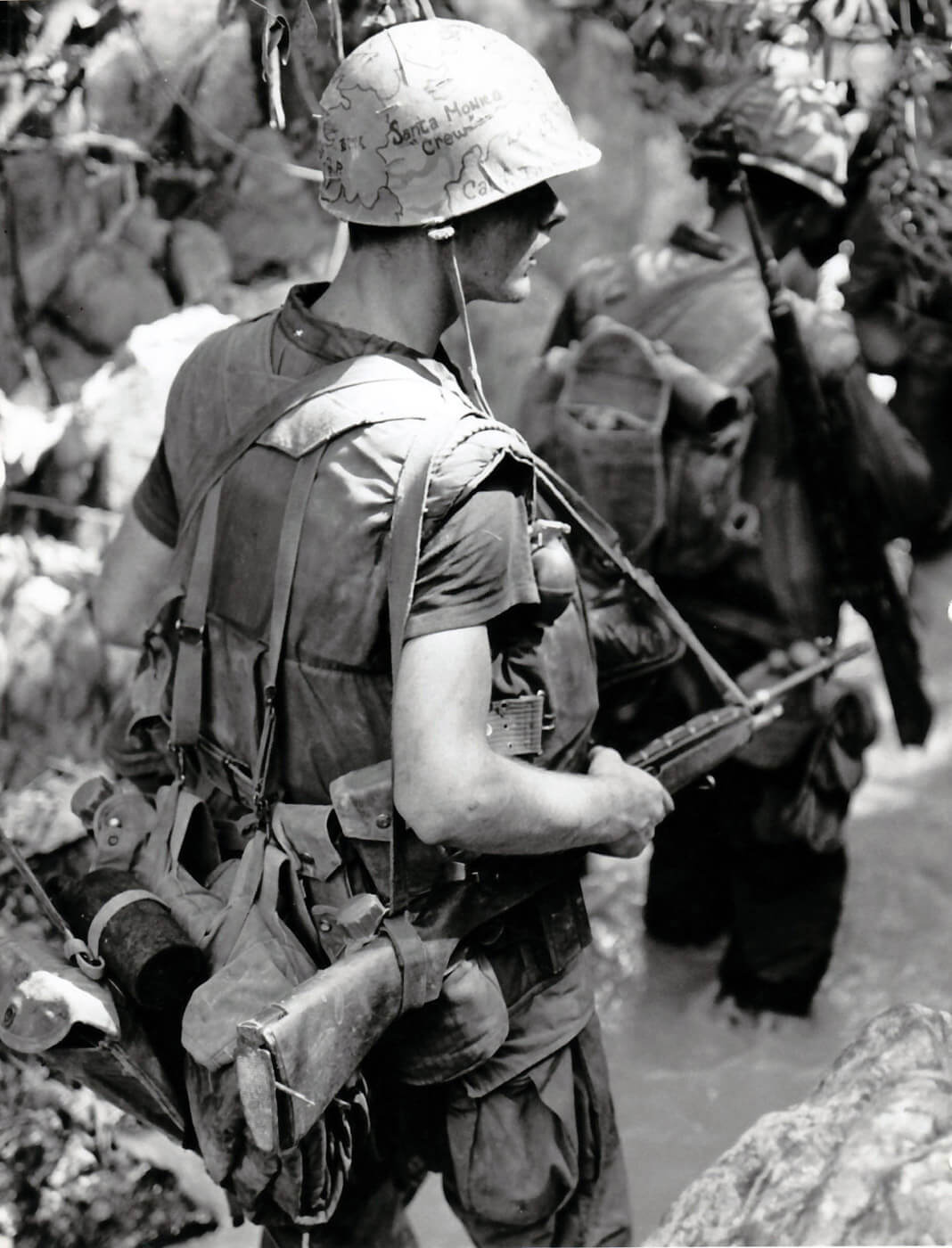
Combat seems to have an “evening-out effect” about the opinions of small arms. In that light, many of the combat lessons learned in Vietnam about the capabilities of the M14 were overlooked. Since the turn of the millennium, our military has been “rediscovering” the rugged M14’s powerful capability, much to the dismay of America’s enemies.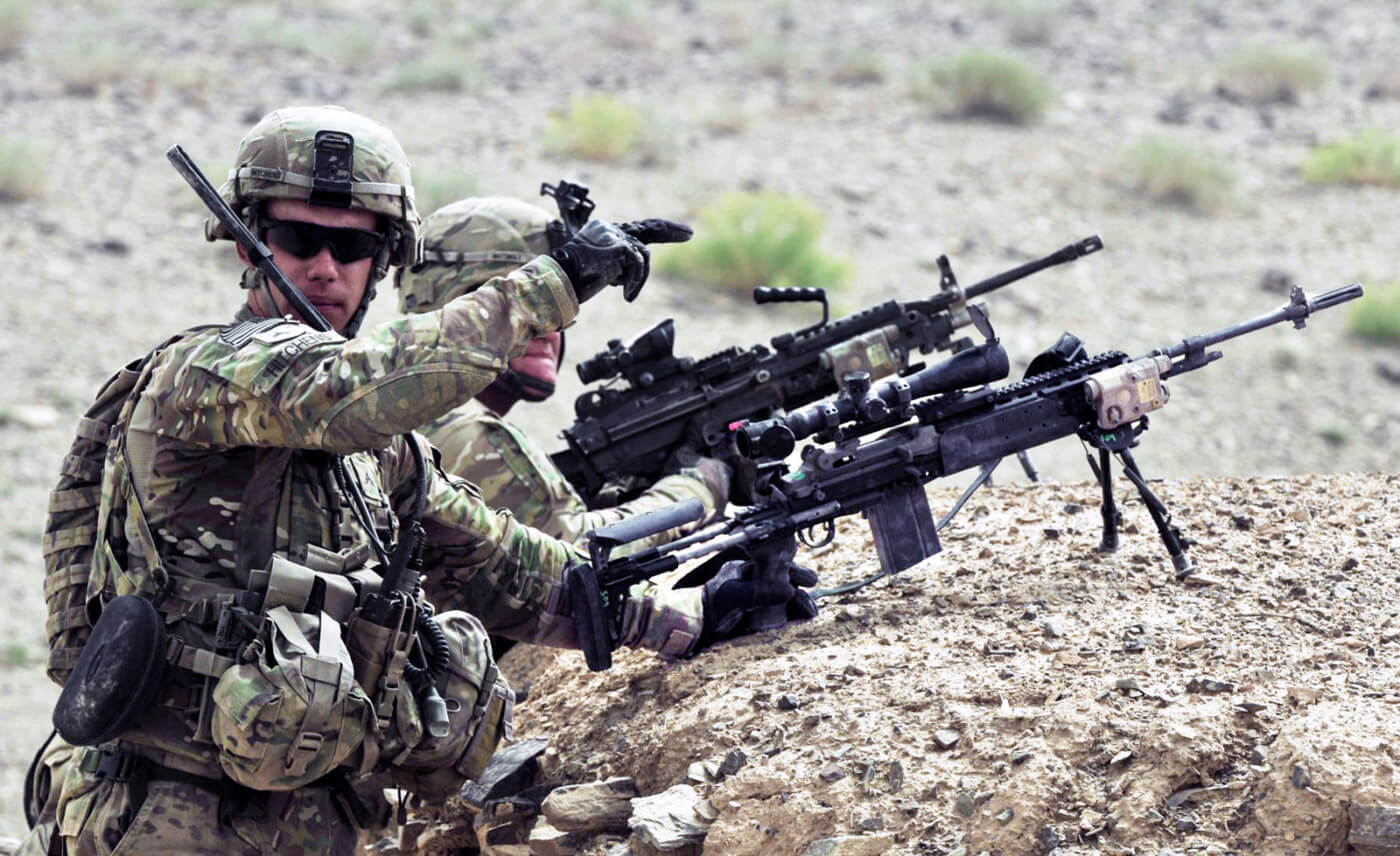
Alongside the select-fire M4 Carbines and M16 rifles serving on the battlefield, the U.S. Military M14 also serves. Elements of the U.S. Special Operations Command use the Mk14 Enhanced Battle Rifle (the EBR) as a designated marksman rifle, and in Afghanistan the U.S. Army assigns two M14 EBR-RI rifles per infantry platoon.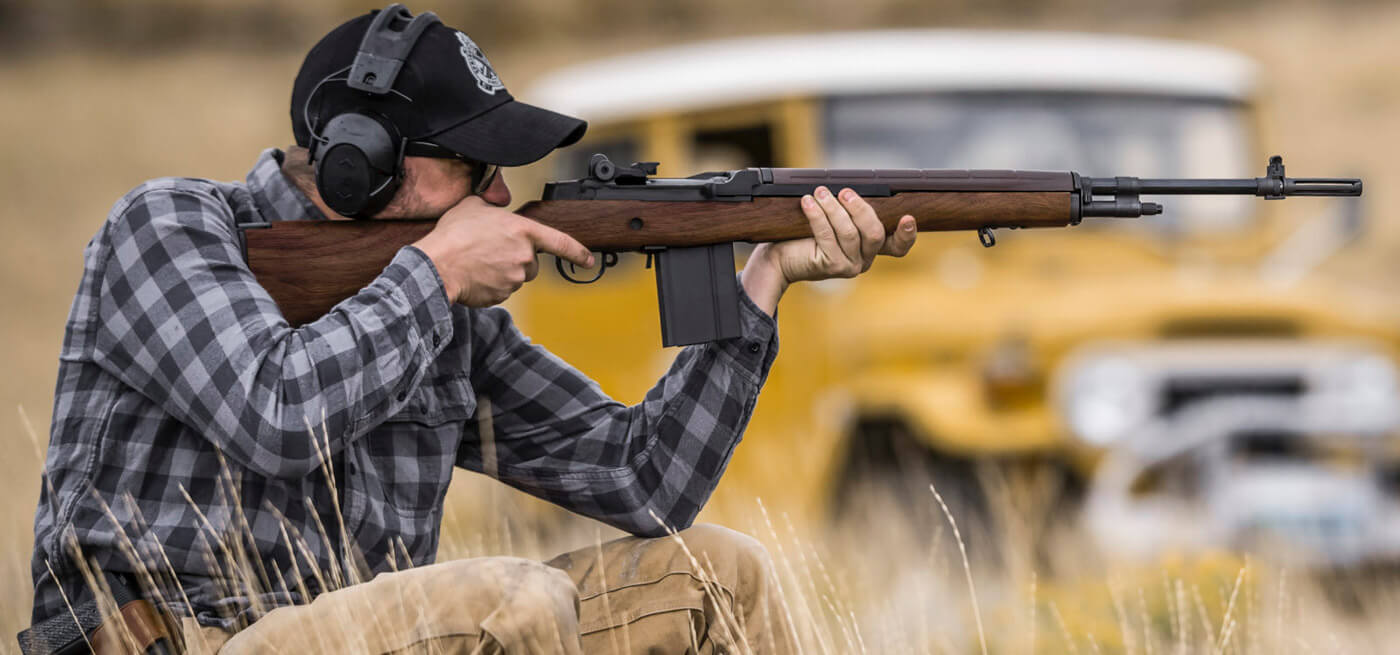
Civilian-Legal Sibling
While the M14 is still serving as a U.S. Military rifle, civilian shooters can thank Springfield Armory of Geneseo, Illinois, for offering a semi-automatic, civilian-legal version of this rifle in its M1A. Proven on the competition fields and exhibiting the timeless beauty of wood and steel (although you can get it with a black composite stock if you so desire), the M1A is a wonderful opportunity to own the civilian sibling of a proven American service rifle.
Categories
Mike Day
:quality(70)/cloudfront-us-east-1.images.arcpublishing.com/archetype/ADFHBWFMDVHMJCAOQCJE7ETHEA.jpg) In 2007, US Navy SEAL Mike Day incredibly survived being shot 27 times by al-Qaeda militants in various parts of his body and was also hit by a grenade.
In 2007, US Navy SEAL Mike Day incredibly survived being shot 27 times by al-Qaeda militants in various parts of his body and was also hit by a grenade.
Despite these severe injuries, he was able to defeat all four attackers and walked away without help after waking up. For this he got a Silver Star & Purple Heart.
After serving in the Navy for 21 years, Day retired in 2010. He dedicated his post-service life to supporting veterans through his work with Wounded Warriors. Mike Day passed away in March 2023.
American self-propelled artillery in World War II transformed how the United States Army delivered firepower on the battlefield. These tracked vehicles combined mobility with devastating howitzers and guns, keeping pace with advancing armor divisions in ways towed artillery never could. From the M7 Priest’s 105mm howitzer to the massive M43’s 8-inch gun, these weapons shaped combat operations across North Africa, Europe, and the Pacific.

The story starts with improvisation. When Germany blitzed through France in 1940, American planners saw they needed artillery that could move fast and hit hard. Self-propelled guns became essential for supporting mobile warfare. The U.S. entered the war in late 1941 with almost nothing in this category, forcing engineers to mount existing artillery pieces on whatever chassis they had available.
T19 Howitzer Motor Carriage
The T19 Howitzer Motor Carriage represents the first American attempt at fielding self-propelled artillery during the Second World War. Engineers adapted the 75mm M2A1 gun and mounted it on the M3 halftrack chassis. This quick solution entered service in 1941, but the vehicle soon showed its limitations.

The weapon system featured an open-topped fighting compartment with limited armor protection, and the crew operated the howitzer from the vehicle’s rear platform. Development began in 1941, and the vehicle entered production in 1942, representing one of the early American attempts to create mobile artillery support for its increasingly mechanized forces.
In combat, the T19 saw limited use by U.S. forces during World War II. While approximately 300 units were produced, the design had significant limitations that reduced its battlefield effectiveness. The half-track chassis provided insufficient stability for the powerful 105mm howitzer, leading to accuracy issues during firing, and the open-top design left the crew vulnerable to enemy fire and artillery fragments. The vehicle’s armor protection was minimal, suitable only for deflecting small arms fire and shrapnel. These drawbacks led to the T19 being gradually superseded by more capable self-propelled artillery designs.
The M7 Priest: Backbone of American Mobile Artillery
The 105mm Howitzer Motor Carriage M7 changed everything. Known as the Priest due to its pulpit-like machine gun ring, this vehicle became the most numerous and important self-propelled artillery platform in U.S. Army service during the war.

Development began in June 1941, six months before Pearl Harbor. Army observers in Europe recognized that self-propelled artillery needed proper armor and full tracks, not the halftrack compromises. They selected the M3 Lee tank chassis as the foundation. The M3’s proven drivetrain, when combined with the reliable 105mm M2A1 howitzer, created a vehicle that could survive combat while delivering accurate fire.
The M7 entered combat with the British in mid-1942. The British and Canadians eventually developed their own Sexton self-propelled gun, using the 25-pounder on an M4 chassis to address ammunition compatibility issues.

Americans used them in combat first during Operation Torch, and then through the rest of the war on every front. A B1 variant used the M4 Sherman chassis instead of the M3 Lee, as the Sherman became the standard American tank. Crews loved the M7 in all varieties. The vehicle had good mobility and an effective gun that put rounds on targets up to seven miles away. It could also defend itself against tanks, earning the nickname “tank killer” in some popular press.
The Army deployed four self-propelled Priests per battery, with three firing batteries per battalion when assigned to infantry. When assigned to armored units, each battery was assigned six Priests.

The M7’s open crew compartment was both an advantage and a vulnerability. It enabled better observation and faster loading because crews weren’t confined to a cramped turret. But it left them exposed to snipers and artillery airbursts. The vehicle carried a .50 caliber Browning M2HB machine gun on that distinctive pulpit mount for anti-aircraft defense.
The weapons system continued to see action in the Korean War, where it proved just as valuable supporting mobile operations against North Korean and Chinese forces. Several Allied countries received M7s postwar, with the West German Bundeswehr using them into the early 1960s.
M8 Howitzer Motor Carriage
The 75mm Howitzer Motor Carriage M8 filled a different tactical niche. With a crew of four, it mounted a 75mm M2/M3 howitzer on an M5 light tank chassis. Adopted in 1942, it provided fire support specifically for armored cavalry reconnaissance squadrons that needed lighter, faster artillery support.

The M8 featured an open-top turret that gave the crew better situational awareness during fast-moving reconnaissance missions. A .50 caliber machine gun mounted at the rear provided secondary armament for close defense.
What made the M8 different was its role. It accompanied reconnaissance units, providing on-call fire support when cavalry scouts ran into trouble. Often, it was used for direct fire support against strongpoints and pillboxes. The M5 light tank chassis kept weight down and speed up, essential for keeping pace with fast-moving reconnaissance operations.

Production totaled 1,778 vehicles by war’s end. It wasn’t glamorous and didn’t pack the punch of heavier self-propelled artillery, but it did exactly what cavalry commanders needed — reliable, mobile fire support that could go where the action was.
M12 Gun Motor Carriage
The M12 Gun Motor Carriage has one of the stranger stories in American self-propelled artillery. It adapted the French 155mm GPF gun to motorized use, mounting it on an M3 medium tank chassis. Engineers moved the engine forward and fitted the powerful gun to the rear. A spade like a bulldozer blade at the rear sank into the ground for stability while firing.

An even 100 were completed by early 1943. Then they sat in storage, seemingly waiting for the European Campaign that would not kick off until June, 1944. Seventy-four M12s were dug out of storage and shipped to units preparing for D-Day. They proved valuable as medium artillery support for fast-moving armor during the breakout from Normandy and the drive across France.
The M12 had a maximum range of 21,982 yards with a crew of six. It fired the same 155mm ammunition as towed guns, making supply easier. The vehicle was accompanied by an M30 cargo carrier converted from an M12 chassis that hauled ammunition and supplies. This two-vehicle team could operate semi-independently, carrying enough ammunition for extended fire missions.

The 155mm gun gave the M12 serious reach. It could engage targets that towed guns couldn’t touch quickly enough, especially during fluid mobile operations. When American armor punched through German lines, the M12s could keep up and provide fire support without the delays of limbering and moving towed artillery.
Late-War Heavy Artillery: M40, M41, and M43
As the war progressed, the Army developed even heavier self-propelled artillery pieces. These vehicles came too late to see significant World War II service but established designs that proved valuable in Korea.
The 155mm Gun Motor Carriage M40 was adopted in February 1945. It mounted either a 155mm Gun M1A1 or M2 on the rear deck of a modified M4 medium tank chassis. With a crew of eight, it achieved an impressive range of 25,722 yards, firing 95-pound projectiles. The M40 used a different mounting than the M12, incorporating lessons learned from combat experience.
It is believed that a single M40 was used in the European Theater prior to the war’s end. More would see use during the Korean War.
The M41 Howitzer Motor Carriage came in June 1945. It mounted the 155mm Howitzer M1 on the rear of an open M24 Chaffee light tank chassis. This was a howitzer rather than a gun, meaning a shorter barrel, lower muzzle velocity, and a higher trajectory. Maximum range reached 16,360 yards. Only 85 were accepted by the Army before production ended. The gun is not believed to have entered any theater of combat in World War II, though it did see action in the Korean War.

The 8-inch Howitzer Motor Carriage M43 represented the heaviest American self-propelled artillery. Adopted in June 1945 with limited production of just 48 vehicles, it incorporated an 8-inch Howitzer M1 or M2 barrel with a maximum range of 18,515 yards, firing 200-pound shells. This was serious firepower.
The M43 was mounted on an M4 medium tank chassis with a crew of eight. The 8-inch howitzer had been a standard heavy artillery piece in towed form, and putting it on tracks gave the Army mobile heavy fire support capability. A single M43 entered combat in World War II. More would serve in the Korean War.
These late-war vehicles — the M40, M41, and M43 — saw limited World War II service simply because they arrived so late. But they proved their worth in Korea, where mobile artillery supporting rapid advances and withdrawals was essential.
Legacy of American SPA
Many American self-propelled artillery pieces continued service well beyond World War II. The Korean War saw extensive use of M7 Priests, M40s, and M43s. These vehicles proved just as valuable supporting mobile operations on the Korean peninsula as they had in Europe. The ability to keep pace with advancing or retreating forces remained essential.
The lessons learned from World War II self-propelled artillery shaped Cold War doctrine. The emphasis on mobility, the use of proven chassis for rapid development, and the understanding that numerical superiority could compensate for individual technical shortcomings.
American self-propelled artillery in World War II represented a pragmatic response to the tactical challenges of mechanized warfare. These vehicles weren’t perfect. They used open turrets, leaving crews exposed. Early designs like the M3 were basically compromises. But they got the job done. They kept pace with advancing armor, delivered devastating firepower, and helped American forces win the war.
Categories
“Counting the Cost”
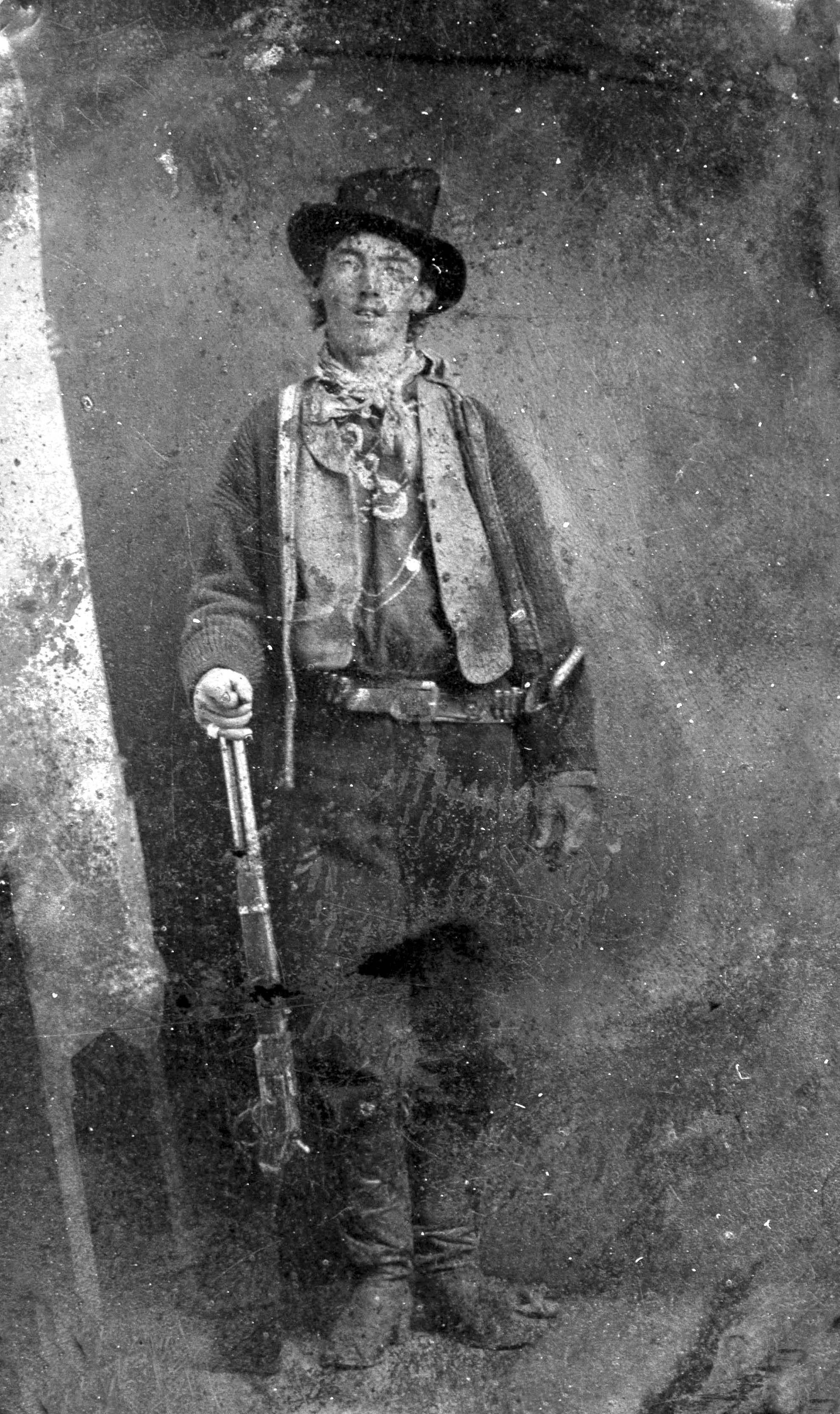
The Lincoln County War wasn’t a war in any traditional sense. It was a vicious, drawn-out power struggle in southeastern New Mexico Territory that ran from 1878 to 1881, driven by greed, political corruption, and personal vendettas. It turned ranchers into gunmen, merchants into targets, and a teenage drifter named Henry McCarty into the legend we know as Billy the Kid.
More people have heard of Billy than have heard of the actual causes of the conflict, which is a shame. The Lincoln County War is one of the best examples of how the Old West actually worked — and how it fell apart. The firearms these men carried shaped every ambush, every last stand, and every street fight from Lincoln to Blazer’s Mills.
The House: Murphy, Dolan, and the Root Cause
To understand the Lincoln County War, you have to understand The House. Lawrence G. Murphy and James J. Dolan, both Irish immigrants, operated a general store in Lincoln known locally as “The House.” It wasn’t just a store — it was the economic and political engine of Lincoln County.
Murphy and Dolan controlled the lucrative government beef contracts that supplied Fort Stanton and the Mescalero Apache reservation. They extended credit to local ranchers at punishing terms. They had the county sheriff, William Brady, firmly in their pocket. As a result, if you wanted to do business in Lincoln County, you went through The House, or you didn’t do business at all.
Murphy was the senior partner, but by the mid-1870s his health was failing — he was drinking heavily and suffering from what was likely cancer. Dolan, younger and more aggressive, was increasingly running the operation. Their methods were simple: political patronage, economic coercion, and when necessary, violence. It was a system that worked as long as nobody challenged it.
The Challengers: Tunstall, McSween, and Chisum
The challenge came from three very different men. John Henry Tunstall was a 24-year-old Englishman from London who’d come to New Mexico Territory with his family’s money and ambitions of building a cattle empire. Alexander McSween was a Canadian-born lawyer who’d initially done legal work for The House but had broken with Murphy and Dolan over a financial dispute. Meanwhile, John Chisum was the biggest cattle rancher in the region, running tens of thousands of head across a territory the size of some eastern states.
In 1877, Tunstall opened a competing general store in Lincoln and, together with McSween, established a bank. This was a direct challenge to The House’s monopoly. Dolan and Murphy responded with legal harassment, filing lawsuits and getting court orders to seize Tunstall’s property.
Tunstall, for his part, wasn’t particularly diplomatic about the situation. He openly announced his intention to break The House’s grip on Lincoln County commerce. Poking that particular bear was going to have consequences.
The Murder That Started It All
On February 18, 1878, a posse led by William Morton — operating under a court order to seize Tunstall’s cattle and horses — caught up with Tunstall on the road to Lincoln. Tunstall was riding with several of his ranch hands, including Billy the Kid, Dick Brewer, John Middleton, and Fred Waite. As the posse approached, the ranch hands scattered into the hills. Tunstall, apparently believing he could resolve the situation peacefully, stayed on the road.
He was wrong. Members of the posse — including Morton, Jesse Evans, and Tom Hill — shot Tunstall dead. He was struck by two rifle bullets, one in the chest and one in the head. The posse then shot Tunstall’s horse and placed the dead man’s hat under the horse’s head, apparently as a gesture of contempt. A federal investigator, Frank Warner Angel, later determined that Tunstall had been murdered in cold blood.
Tunstall’s murder lit the fuse. His cowhands and supporters, including Billy the Kid, formed a vigilante group called the Regulators, with Dick Brewer as their leader. They obtained deputizations from a sympathetic justice of the peace and set out to arrest Tunstall’s killers — though “arrest” was an optimistic term for what they had in mind.
The Regulators Strike Back
On March 6, 1878, the Regulators captured William Morton and Frank Baker, two men identified as participants in Tunstall’s murder. Both prisoners were killed while allegedly “attempting to escape” on March 9. Additionally, a Regulator named William McCloskey, suspected of being a Dolan spy, was also killed during the incident.
On April 1, 1878, the Regulators ambushed Sheriff William Brady and his deputies on the main street of Lincoln, firing from behind an adobe wall next to Tunstall’s store. Brady was hit by at least a dozen rounds and died in the street. Deputy George Hindman was also mortally wounded. Billy the Kid was later charged with Brady’s murder — one of the few legal consequences anyone faced during the entire Lincoln County War.
Three days later, on April 4, the Regulators killed Andrew “Buckshot” Roberts at Blazer’s Mills in a close-range gunfight that also cost Dick Brewer his life. Roberts, despite being gut-shot in the opening volley, barricaded himself in a building and fought for hours with a Springfield rifle, killing Brewer with a shot to the head. It was one of the most remarkable last stands in frontier history — a dying man who refused to quit.
Washington Intervenes
The bloodshed in Lincoln County eventually got Washington’s attention. The British government filed a formal complaint over Tunstall’s murder — he was, after all, a British subject killed under questionable legal authority. In response, President Rutherford B. Hayes dispatched a special investigator, Frank Warner Angel, whose report documented a pattern of corruption, murder, and abuse of legal process by the Dolan-Murphy faction.
In September 1878, territorial governor Samuel Axtell was replaced by Lew Wallace — yes, the same Lew Wallace who wrote Ben-Hur. Wallace arrived with instructions to restore order. He issued an amnesty proclamation and even met secretly with Billy the Kid in March 1879, reportedly offering the Kid a pardon in exchange for testimony against Dolan’s allies in the murder of Huston Chapman, a one-armed lawyer who’d been gunned down on the streets of Lincoln.
Billy held up his end and testified before a grand jury, but the pardon never materialized. Wallace had a novel to finish and a territory to govern, and keeping promises to a teenage outlaw apparently ranked low on his list.
The Five-Day Battle of Lincoln
The Lincoln County War reached its climax in the Five-Day Battle of Lincoln, fought from July 15 to July 19, 1878. Alexander McSween returned to Lincoln with approximately 41 supporters. He positioned about ten men in his own home and distributed the rest throughout the town, including at the Ellis store. Opposing them were Dolan’s forces, reinforced by a contingent of Seven Rivers cowboys and backed by Sheriff George Peppin.
For four days, the two sides exchanged fire across the town of Lincoln. Neither side could dislodge the other. Then, on the night of July 18-19, Dolan’s men set the McSween house on fire. As the flames spread room by room, the trapped Regulators had no choice but to attempt a breakout.
McSween tried to surrender. He was shot nine times and killed. At least four other Regulators died in the escape attempt. Bob Beckwith, a Dolan supporter, was also killed in the chaos — reportedly hit by friendly fire, though accounts vary. However, Billy the Kid and several other Regulators managed to slip through the Dolan lines in the darkness and escape into the hills.
The Five-Day Battle effectively ended the organized phase of the Lincoln County War, though the violence continued to sputter for years afterward. Billy the Kid continued his career of cattle rustling and gunfighting until Pat Garrett shot him dead at Fort Sumner on July 14, 1881. Lawrence Murphy died of cancer on October 20, 1878, just months after the battle. James Dolan was eventually indicted for Tunstall’s murder but acquitted; he later acquired Tunstall’s property and died on his ranch in 1898.
The Guns of the Lincoln County War
The firearms carried during the Lincoln County War were the standard arms of the late 1870s frontier. Understanding what these men carried helps explain how the fighting unfolded — and why certain engagements played out the way they did.
Colt Single Action Army
The Colt Single Action Army — introduced in 1873 and chambered most commonly in .45 Colt — was the dominant revolver on the New Mexico frontier. By 1878, the Peacemaker (as it came to be known) was available from Colt in multiple barrel lengths, from the short-barreled “Sheriff’s Model” to the standard 7.5-inch cavalry length.
In 1878, Colt began offering the Single Action Army in .44-40 Winchester as the “Frontier Six-Shooter,” which allowed a man to carry one caliber of ammunition for both his revolver and his rifle. On a frontier where resupply was uncertain, that mattered enormously.
Winchester Model 1873
The Winchester Model 1873 was the lever-action rifle of the era. Chambered in .44-40 Winchester (and later .38-40 and .32-20), it was a fast-handling repeater that could be fed through a loading gate on the right side of the receiver. It held up to 15 rounds in its tubular magazine in the full-length rifle configuration. For more on Winchester’s history and how they dominated the frontier market, see our detailed company profile.
For men fighting at the ranges typical of Lincoln County — across a street, across a corral, from behind an adobe wall — the Winchester ’73 was an ideal weapon. It wasn’t a long-range precision arm, but in a close-quarters gunfight in a frontier town, rate of fire mattered more than ballistic performance at distance. Compare that to the broader role lever-action rifles played across the entire American West.
Colt Model 1877 “Thunderer” — Billy the Kid’s Sidearm
The Colt Model 1877 “Thunderer” deserves special mention because it was Billy the Kid’s known sidearm. The 1877 was Colt’s first double-action revolver. The “Thunderer” variant was chambered in .41 Long Colt, while the “Lightning” was in .38 Long Colt.
When Pat Garrett killed Billy the Kid at Fort Sumner in 1881, the outlaw’s pistol was examined and described as “a self-cocker, calibre .41” with “five cartridges and one shell in the chambers.” That’s a Thunderer with five live rounds and one spent case — a gun that had recently been fired, or at least loaded on an empty chamber for safety.
Springfield Model 1873 “Trapdoor”
The Springfield Model 1873 “Trapdoor“ also saw use in the Lincoln County War, particularly among participants with military connections. The single-shot .45-70 Government was the standard U.S. Army longarm of the period, and surplus or stolen examples were common on the frontier. At the fight at Blazer’s Mills, Buckshot Roberts used a Springfield rifle to devastating effect from a barricaded position.
Sharps Carbines and Frontier Logistics
Sharps carbines were also present in Lincoln County, though less common than the Winchester repeaters. The Sharps was a single-shot breechloader built for accuracy and power at longer range — a fundamentally different tool than the fast-cycling Winchester. Some participants carried Sharps .50-caliber carbines, surplus from the buffalo hunting trade and Indian Wars. For context on how Sharps rifles shaped other frontier battles, see our coverage of Billy Dixon’s legendary shot at Adobe Walls.
But the real story with firearms on the New Mexico frontier wasn’t which guns men carried — it was keeping them fed. Lincoln County in 1878 had no railroad and limited general stores. Ammunition had to be freighted in by wagon from Las Vegas, Santa Fe, or further.
A man carrying a Winchester in .44-40, a Colt in .45, and a Springfield in .45-70 needed three different cartridges, and running dry on any one of them turned an expensive weapon into a club. That logistical reality is a big part of why the .44-40 “Frontier Six-Shooter” pairing was so popular — cutting your ammunition needs from three calibers to two was a genuine tactical advantage when the nearest resupply point was a three-day ride.
Shotguns on the Frontier
Shotguns were present as well. Double-barreled shotguns loaded with buckshot were common frontier weapons, particularly useful for close-range fighting in and around buildings. During the Five-Day Battle, with men shooting from houses and stores at targets across narrow streets, a shotgun loaded with buckshot was arguably more practical than a rifle.
What It Actually Meant
The Lincoln County War wasn’t a simple tale of good guys and bad guys, though Hollywood has tried to make it one for over a century. Tunstall and McSween were challenging a corrupt monopoly, but their own methods weren’t always noble. The Regulators committed murders that were justified as law enforcement but looked a lot like revenge killings. Dolan’s faction was corrupt and violent, but they operated with the cover of legal authority for most of the conflict.
What the Lincoln County War really illustrated was the fragility of law and order in a territory where political power, economic control, and legal authority were all concentrated in the same hands. When that system was challenged, there was no neutral institution capable of resolving the dispute peacefully. The result was three years of bloodshed in a county that had maybe 2,000 residents.
That’s what happens when the law and the monopoly are the same thing. Today, Lincoln, New Mexico, still stands as a State Historic Site where you can walk the same streets and see the firing positions for yourself.
Further Reading
If the Lincoln County War grabbed your attention, these books go deeper than any article can. Robert Utley’s High Noon in Lincoln is the definitive academic history of the conflict — meticulously sourced and fair to all sides. His Billy the Kid: A Short and Violent Life is the best biography of McCarty/Bonney, cutting through a century of myth to get at the documented record.
Frederick Nolan’s The Lincoln County War: A Documentary History compiles primary sources — letters, court documents, depositions — that let you read what actually happened in the participants’ own words. His The West of Billy the Kid is a photographic companion piece with over 250 images, many published for the first time, that puts faces and places to the names in the story.
For a more narrative approach, Mark Lee Gardner’s To Hell on a Fast Horse reads like a thriller while sticking to the historical record — it’s the first dual biography of Billy the Kid and Pat Garrett, and Robert Utley himself called it “superb narrative history.” Michael Wallis’s Billy the Kid: The Endless Ride takes a revisionist angle, exploring why the Kid became one of America’s most enduring folk figures.
For broader context on the firearms and conflicts of the American frontier, our articles on Jesse James’s weapons, Annie Oakley, and Sam Bass cover other key figures of the same era and the guns they relied on.