Category: This great Nation & Its People
In my humble opinion Forrest was probably one of thee best Cavalry Commanders this nation ever produced. Yeah I know, he made his vast fortune off of slavery. But he was & still is the wizard of the saddle in my book. Grumpy
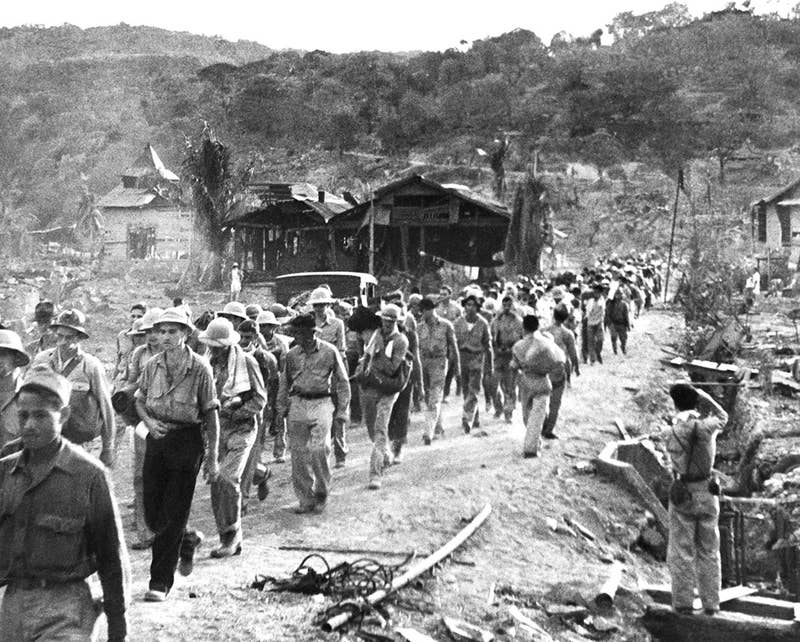
Eighty four years ago, The Japs defeated the US Filipino Army at the Bataan Peninsula & were shocked at the number of POW’s captured. They were not prepared for this and they also held that anyone who surrendered were lower than Whale shit.
So they marched these exhausted, starving, sick men 65 miles to some hell holes called “prison camps”. During this hike that the survivors called it. Anyone falling out was bayoneted by the Japs or if the guard just did not like you. Also any rings like West Point, College Rings & other jewelry were stolen by them.
The Japs also would shoot at Civilians who tried to give food or water to the marching prisoners. So it really was a time of Hell on Earth.
What really got me was the fact. That almost none of the surviving guards except for General Homa were punished for this. Thanks to General MacArthur basically giving amnesty to the Japs after we defeated them.

Citation:
The President of the United States of America, authorized by Act of Congress July 9, 1918 (amended by an act of July 25, 1963), takes pleasure in presenting the Silver Star to Sergeant Leigh Ann Hester, United States Army, for exceptionally valorous achievement during combat operations in support of Operation IRAQI FREEDOM, on 20 March 2005, in Iraq. Sergeant Hester’s heroic actions in Iraq contributed to the overwhelming success of the Multi-National Corps-Iraq mission.
While serving as the Team Leader for RAVEN 42B in the 617th Military Police Company, 503d Military Police Battalion (Airborne), 18th Military Police Brigade, Sergeant Hester led her soldiers on a counterattack of anti-Iraqi Forces (AIF) who were ambushing a convoy with heavy AK-47 assault rifle fire, PRK machine gun fire, and rocket propelled grenades.
Sergeant Hester maneuvered her team through the kill zone into a flanking position where she assaulted a trench line with grenades and M-203 rounds. She then cleared two trenches with her Squad Leader where she engaged and eliminated 3 AIF with her M-4 rifle.
Her actions saved the lives of numerous convoy members. Sergeant Hester’s bravery is in keeping with the finest traditions of military heroism and reflects distinct credit upon herself, the 503d Military Police Battalion (Airborne), the 18th Military Police Brigade, and the United States Army.
NARRATIVE TO ACCOMPANY AWARD: Sergeant Leigh A. Hester is cited for conspicuous gallantry in action against an armed enemy of the United States while engaged in military operations involving conflict with anti Iraq forces (AIF) as a team leader for Raven 42B, 617th Military Police Company, 503d Military Police Battalion (Airborne) stationed at Camp Liberty, Iraq on 20 March 2005, in support of Operation IRAQI FREEDOM.
The team’s mission was to assist Raven 42 in searching the Eastern Convoy Route for improvised explosive devices (IEDs) and provide additional security to sustainment convoys traveling through their area of responsibility. While patrolling Alternate Supply Route (ASR) Detroit, Raven 42B was shadowing a sustainment convoy consisting of 30 third country national (TCN) semi-tractor trailers with a three vehicle squad size escort, call sign Stallion 33, traveling from LSA (logistics support area) Anaconda to CSC (convoy support center) Scania.
The weather for this ASR patrol was 75 degrees and sunny with a 10 knot breeze from the southwest. While traveling on ASR Detroit approximately 50 AIF ambushed the convoy with heavy AK47 fire, RPK heavy machine gun fire, and rocket propelled grenades (RPGs) from the southwest side of the road at 1140 hours. The AIF were utilizing irrigation ditches and an orchard for the well planned complex attack.
The AIF had cars combat parked along a road perpendicular to the ASR with all doors and trunks open. The AIF intent was to destroy the convoy, to inflict numerous casualties, and to kidnap several TCN drivers or U.S. Soldiers.
The initial ambush disabled and set on fire the lead TCN vehicle, which effectively blocked the southbound lanes of ASR Detroit, stopping the convoy in the kill zone. The squad leader, Staff Sergeant Timothy Nein, directed the squad to move forward, traveling on the right shoulder and passing through the engagement area between the enemy and the convoy.
Sergeant Hester directed her gunner to provide heavy volumes of MK 19 and M240B fires into the field where an overwhelming number of insurgents were executing a well coordinated ambush on the convoy. Raven 42 elements were outnumbered five to one. Staff Sergeant Nein ordered the squad to flank the insurgents on their right side.
The squad continued to come under heavy machine gun fire and rocket propelled grenade fire when Sergeant Hester stopped her vehicle, the middle vehicle, at a flanking position enfilading the trench line and the orchard field where over a dozen insurgents were engaging the squad and convoy.
She then directed her gunner to focus fires in the trench line and the orchard field. Sergeant Hester dismounted and moved to what was thought to be the non-contact side of the vehicle. She ordered her gunner to continue to fire on the orchard field as she and her driver engaged insurgents in the orchard field with small arms.
Sergeant Hester began engaging the insurgents with her M203 in order to suppress the heavy AIF fire. Sergeant Hester followed Staff Sergeant Nein to the right side berm and threw two well placed fragmentation grenades into the trench eliminating the AIF threat. Sergeant Hester and Staff Sergeant Nein went over the berm into the trench and began clearing the trench with their M4s. Sergeant Hester engaged and eliminated three AIF to her front with her M4.
They then made their way to the front trench and cleared that as well. After clearing the front trench cease fire was called and she began securing the ambush site. The final result of the ambush was 27 AIF KIA (killed in action), 6 AIF WIA (wounded in action), and one AIF captured

This is from the California Post – The US rescued a missing F-15E airman deep inside Iran with an incredibly complex and daring mission that involved SEAL Team 6, a CIA ruse, a hastily constructed forward air strip in hostile territory, and patrols of friendly aircraft that gave the Air Force colonel cover.
A life-or-death race between US and Iranian forces to find the “seriously injured” weapons officer outside Isfahan over two days culminated in the crew member’s extraction by America’s most elite commandos and a firefight with local militias that were hunting for him.
The unnamed officer, who was shot down on Good Friday in southwestern Iran, hid out in the Zagros Mountains and managed to climb a 7,000-foot ridge to evade capture for 36 hours with just a handgun for defense while American MQ-9 Reaper drones pounded nearby Iranian forces with missiles if they got close to his position.
A US Air Force landing strip was set up close to the city, which houses many of Iran’s missile and army bases, nuclear facilities, and the last of its fleet of F-14 fighter jets.
Two of the aircraft — believed to be MC-130J Commando IIs, specialized, high-tech transport planes — became stuck at the forward airfield in Iran, and three more aircraft were dispatched to pick up the US forces left stranded there, according to the Times.
The two MC-130Js — each worth around $100 million — were demolished in place so as not to fall into enemy hands.
A construction worker making preparations for the removal of the original Statue of Liberty torch in 1985. The old torch went on a tour of the US before it was moved to the Statue of Liberty Museum.
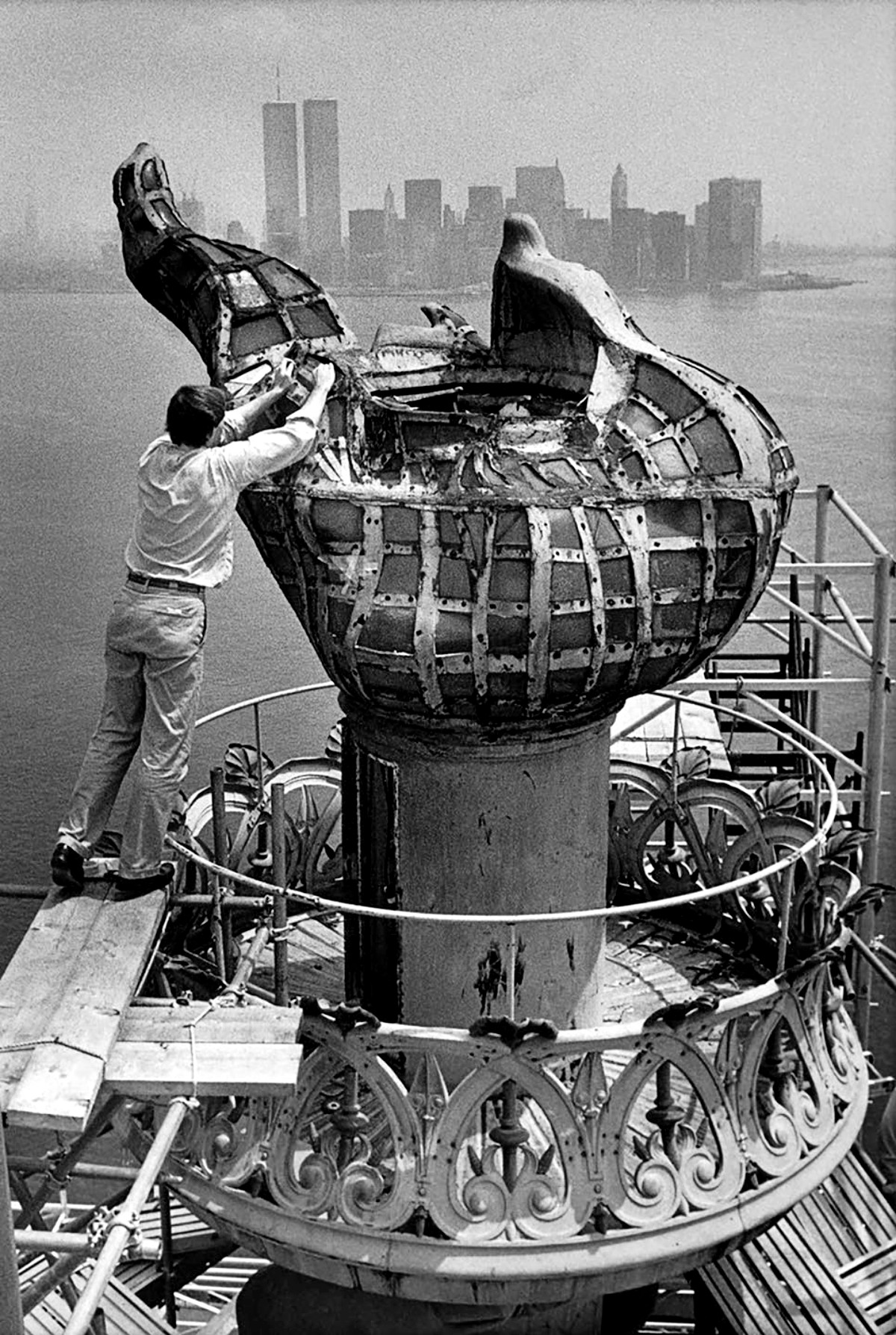
In 1985, a significant event occurred involving one of America’s most iconic symbols: the Statue of Liberty. The original torch, which had stood atop Lady Liberty since the statue’s dedication in 1886, was removed for restoration. Over the years, the copper and glass torch had become worn and damaged due to exposure to the elements, so it was carefully replaced with a replica to ensure the statue’s preservation for future generations. This monumental task was part of a larger restoration project in preparation for the Statue of Liberty’s centennial celebration in 1986.
After the torch was removed, it embarked on a nationwide tour, allowing Americans from coast to coast to see this historic artifact up close. The tour was not only a symbol of national pride but also a reminder of the enduring importance of the Statue of Liberty as a beacon of freedom and democracy. The original torch was eventually relocated to the newly established Statue of Liberty Museum on Liberty Island in 2019, where it continues to serve as a symbol of the nation’s ideals. Its journey from its removal in 1985 to its permanent display highlights the significance of preserving history while making it accessible to the public.


