Category: This great Nation & Its People
Editor’s Note: Today’s article is about Sgt. Darrell Powers, a World War II hero who served with the 101st Airborne Division. Nicknamed “Shifty”, Powers saw action in the American airborne landings in Normandy, Operation Market Garden and the Battle of the Bulge. Powers was more than “just” a soldier — he was also a gun guy. Ayoob shares the full story here.
Stephen Ambrose’s 1992 book “Band of Brothers” was said to have done as much as Tom Hanks’ 1998 movie “Saving Private Ryan” to remind later American generations of the heroism of our servicemen’s sacrifices for freedom in World War II.

The book was based on the recollections of individual paratroopers of the 101st Airborne Division of the U.S. Army, known as the “Screaming Eagles,” and particularly Easy Company. Tom Hanks and Steven Spielberg made it into a compelling HBO TV series that debuted in 2001. America felt it got to know those brave soldiers.
One of them was Sergeant Darrell “Shifty” Powers. His nickname didn’t carry the word’s usual meaning: he earned it in high school for his fast moves on the basketball court. Tall and athletic, he was also one of us: a “gun guy.” He was a hunter, a marksman and, in later life, an outspoken Second Amendment advocate and a daily concealed carrier for whom shooting was a beloved hobby until his passing at age 86.
A Hunter’s Eye
Powers was born and grew up in the hollows of rural Virginia, spending as much time as he could hunting on a mountain on his family’s property. He shot his first squirrel when he was a little boy. His father taught him to be alert to his surroundings in all ways: a subtle sound, an unexpected silence, and more. It was a skill that would save his life and other lives in combat.

In “Band of Brothers” Ambrose wrote of the day, December 29, 1944, when Easy Company was fighting its way out of the Battle of the Bulge, and Shifty noticed a distant tree that hadn’t been there the day before. Based on his observation, the Americans recognized a newly installed and camouflaged German artillery battery and called in American artillery on it, eliminating the threat.
The Guns of Shifty Powers
In his authorized biography by Marcus Brotherton, “Shifty’s War”, Powers mentioned that as a paratrooper he was issued a 1911 .45 auto with a shoulder holster and wore ten eight-round en-bloc clips of .30-06 on his belt to feed his M1 Garand. Shifty said, “Lot of guys used the carbine, you know, and some guys used Thompsons, but I always liked the M1 Garand best.”
It was a preference that remained throughout his life, even into his eighties when he was suffering macular degeneration and being treated for cancer. He told Brotherton, “Those treatments made me real weak. I liked to get out on the deck and shoot my rifle, you know. Nobody lived very close around our house, so it was okay. I couldn’t see to hit a target very well anymore, but I knew where they were. I didn’t hit them all the time, but I’d fire the gun and smell the smoke, so I’d enjoy that.”

“My M1 was my favorite rifle, but it got hard to lift, you know, and I told (my wife) Dorothy, ‘You know, that doggone rifle has gotten fatter since the war.’ Ammunition for M1’s was hard to come by, but my friends would bring me clips. I had a .22 with a scope, which helped me see the targets, so I’d shoot that every so often. Then I had a Lugar (sic) that I’d shoot, and a .22 pistol that I’d like to shoot. As a last resort I had a BB gun, and I’d take that out on the deck.”
The M1 he used in combat was not entirely stock. Shifty had filed the sear to achieve what he called a hair trigger. It was the rifle he used for his most famous shot of the war. Alas, it didn’t follow him all the way through the war. Stephen Ambrose explains in “Band of Brothers,” “Shifty Powers got a new M1. That was a mixed blessing. He had been using one issued to him in the States. He loved that old rifle. ‘It seemed like I could just point it, and it would hit what I’d pointed it at. The best shooting rifle I ever owned. But every time we’d have an inspection, I’d get gigged because it had a pit in it, in the barrel. You can’t get those pits out of those barrels, you know…’ He got tired of being gigged, turned it in and got a new M1. ‘And I declare, I couldn’t hit a barn with that rifle. Awful’est shooting thing there ever was.’”
“Shifty’s Shot”
That famous shot happened in January of 1945. Fighting their way out of the Battle of the Bulge, Shifty’s unit found themselves in the strategically placed town of Foy in Belgium. (Factoid: while Yanks pronounce that town’s name like it sounds, rhyming with “toy,” those who live there reportedly pronounce it “Fwah.”)
A fellow member of the Band of Brothers, Carwood Lipton, told the story this way: “One of the men in the 3rd platoon of E Company, 506th had excellent eyesight, and he was also an outstanding marksman with a rifle. He was Darrell C. ‘Shifty’ Powers, a tall part-Indian, from Clinchco, Virginia.”
“Shifty’s marksmanship paid off for us on January 13 when E company received orders to attack and clear the town of Foy. We moved around to the south of the town and attacked to the north into it. The Germans defended it strongly, and we had a number of men hit. At one point, several of us, including Shifty, Popeye Wynn (Shifty’s closest buddy), Bob Mann, R.B. Smith, and I were pinned down by a sniper that we just couldn’t locate. R. B. Smith caught a bullet in the leg. Then Shifty yelled, ‘I see ‘im.’ And there was a rifle shot. We weren’t pinned down any more so we continued the attack.”
“When things had cleared up later that day I went back to see where that sniper had been. When I found him, Popeye had already found him. We stood there looking down at the dead German and at the bullet hole centered in the middle of his forehead. Popeye looked over at me and said, ‘You know, it just doesn’t pay to be shootin’ at Shifty when he’s got a rifle.’”
The buildings the German and Shifty each fired from still stand. One researcher later determined the distance to be 66 meters.

Powers’ own memory of shooting a sniper in Foy differs somewhat. From the “Shifty’s War” book:
“More shots rang out. I glanced up then down again. The other man along the side of the building froze. The sniper kept firing. Our other guy didn’t stand a chance unless we could get that sniper. I ducked up again to get a bead on where the sniper fired from. He was about sixty feet away, shooting from around the corner of a brick building. I ducked down again and propped my M1 up on the window ledge. Seven rounds were left in my clip. I didn’t have time to properly aim. I fired from instinct, seeing in my mind the corner of that building where I guessed the German’s head to be. Blam. Blam. Blam. Blam. The dust flew off the brick at the corner of the building. I fired all seven rounds. No sound came from where the German sniper was. Our man found his feet again and checked the other man on the ground. The first man was dead. But the other was just fine. ‘Okay,’ I said with a nod. I thought maybe I saved that man’s life. It felt good.”
In the heat of infantry combat, when a soldier fires at an enemy and sees him go down, he will often never know whether his target was killed, wounded, or merely ducked. In his later years, writes Brotherton, “Shifty told his son-in-law, Seldon Johnson, that he had killed the specific number of eight men during the war. The specific line Seldon remembers was, ‘I know I killed eight men. It could have been more, but I don’t know for sure. People think they know what killing’s like, but they don’t.’”
Ironic Injury
Powers’ keen observation skills and superb marksmanship helped to make him one of the few men in the unit to get from D-Day almost all the way through the campaign without sustaining a single wound. The day came when he won a lottery to be sent home, and missing his family greatly, he used his prize.

He was in a truck taking him and other soldiers back from the front lines when a drunk driver crashed into the vehicle, killing one trooper and sidelining Shifty with a smashed pelvis and other severe injuries that left him hospitalized for almost a year.
A Vet of the Greatest Generation on 2A
Like many WWII vets, Darrell Powers returned home a staunch advocate of the right to keep and bear arms. While stationed in England prior to the D-Day invasion he had been horrified to see Brits drilling with picks and shovels to fight heavily armed German infantry should they invade, because so few of them privately owned firearms. (Indeed, Americans donated many of their personal guns for use by the British home guard.)
Says his biographer Marcus Brotherton, “Shifty recounted orally on several occasions his memory of seeing the people in Aldbourne practice defending themselves with only garden implements. During some of his public talks after the war, he made a strong case for maintaining the legality of privatized gun ownership in the United States. This issue was about the only time he ever made a public political statement. Shifty believed that citizens had a right to own guns to defend themselves … .”
The battle-hardened vet practiced what he preached when he came home, not only keeping but bearing arms. Shifty told Brotherton that he always carried a .25 auto on his ankle, just in case.
Cancer did what the Nazis could not and took Sergeant Darrell Powers in 2009 at the age of 86. Like so many of The Greatest Generation, this American hero left a legacy of the value of skill at arms and the importance of fighting for freedom.
The U.S. Army has never been a particularly agile beast when it came to bold new technologies. Horse cavalrymen were dragged kicking and screaming into tanks during World War II, and the grunts and tankers of the ’50s viewed the helicopter with a tolerant skepticism at best. In 1963 the 11th Air Assault Division was testing the practical aspects of air mobility at Fort Benning, Georgia. Two years later the 1st Cavalry Division (Airmobile) went to war.

This WW2-era Smith and Wesson Victory .38 revolver is typical of the sorts of double action .38 revolvers issued to Army aircrews in Vietnam. Simple and stupid-proof, this basic wheelgun is easily operated one-handed.
The war in Vietnam saw the introduction of a wide array of new technologies. From smart bombs to night vision and lightweight assault rifles, Vietnam was a proving ground for countless new weapons and the tactics that drove their employment. As a result, flight crews operating Army rotary-wing combat aircraft frequently made up the rules as they went along.
There really was no precedent for what those guys were doing. UH1 Hueys and CH47 Chinooks carried troops, ammunition, equipment, and supplies into places that would have otherwise been inaccessible. The use of massed helicopter assets allowed Army commanders unparalleled mobility around and above a non-linear battlefield. Light and agile aeroscout aircraft like the OH6 provided responsive intelligence gathering. Armed versions of the UH1 and later dedicated AH1 Cobra gunships offered responsive and overwhelming aerial fire support. Throughout it, all Army flight crews operated in the treetops engaging the enemy face to face in a pitiless close range fight to the death.

The OH6A Loach (a colloquialism for Light Observation Helicopter) flew down in the treetops gathering intelligence and rooting out the enemy.
The Whirlybird Becomes a Warplane

The M3A1 Grease Gun was in common use by the Army of the Republic of South Vietnam. The gun was therefore available for barter among US forces in Vietnam.
For better or for worse the M60 was our standard belt-fed light machine gun at the time. This basic gun saw action in the D-model configuration with spade grips on a pintle mount in the doors of Hueys and Chinooks. As a flexible weapon crew chiefs frequently simply suspended their standard ground guns on bungee cords for maximum maneuverability. Solenoid-fired versions in pivoting mechanical mounts armed the first Huey gunships.
The M134 minigun saw its baptism by fire in Vietnam as well. While a few of these electric-powered Gatling guns were mounted as door guns, most saw action in the chin turrets of AH1G Cobra gunships. In this configuration, the M134 alongside the M129 automatic grenade launcher reaped a bloody harvest from the Viet Cong and NVA.
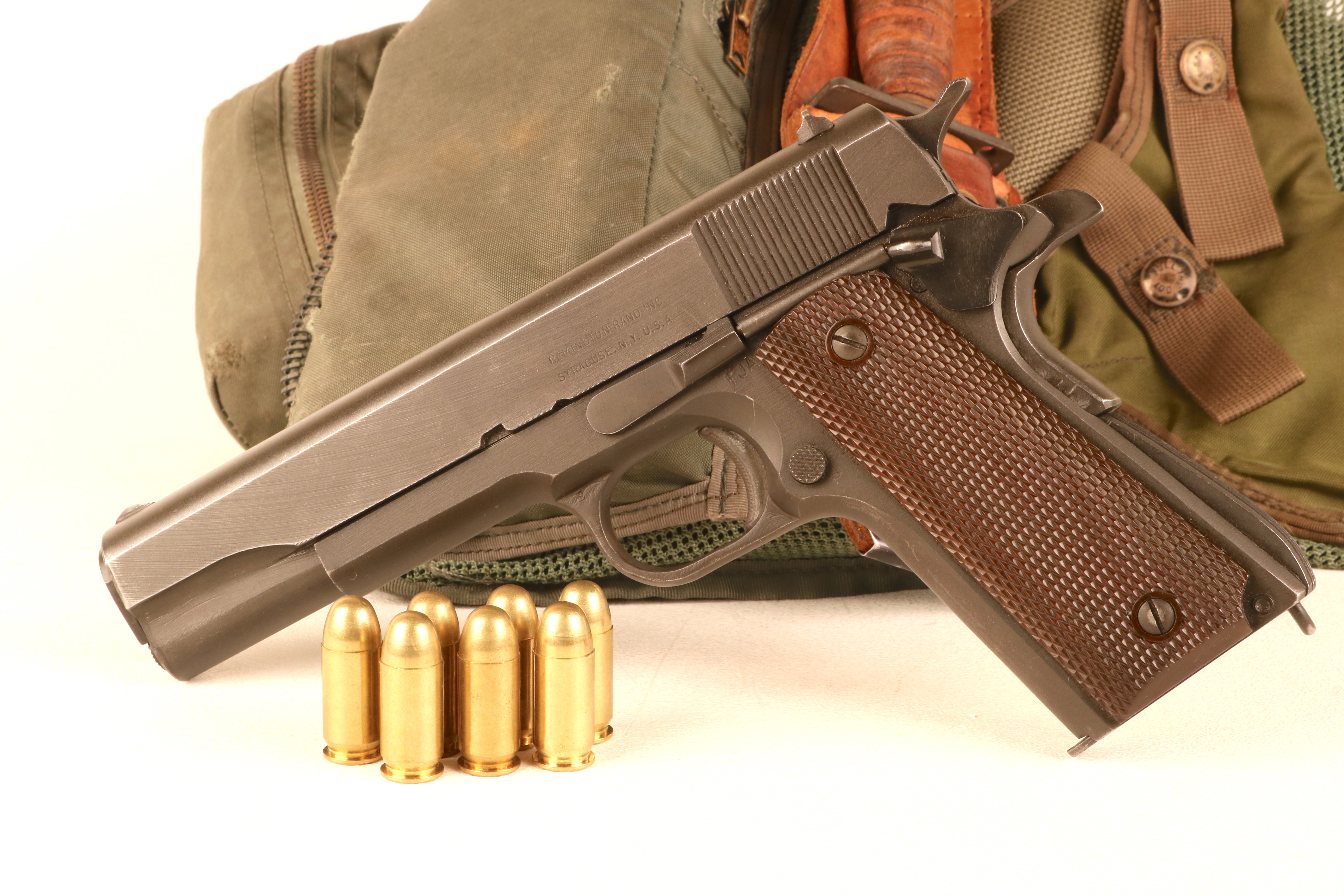
The 1911A1 pistol carried generations of GIs through several major wars. Its single-action trigger meant that the 1911A1 was not typically an issue aircrew weapon, but many were utilized for this purpose nonetheless.
One aspect of the helicopter’s low and slow operational environment was that these early aircraft were mightily vulnerable to ground fire. Heavy machineguns like the DSHk were murder on low-flying helicopters while shoulder-fired small arms were also quite effective at the sorts of ranges these engagements demanded. As a result, the Vietnam War saw an unprecedented number of survivable aircraft crashes. When faced with the prospect of personal defense while awaiting air support and extraction many of these early Army aviators acquired some unusual small arms.

The UH1 was the archetypal utility helicopter used in Vietnam. Employed as troop transports, Medevac aircraft, and gunships, the Huey transformed the battlefield in Southeast Asia.
GI-Issue Personal Defense Weapons
There is an adage in Army Aviation that you will leave a burning helicopter equipped solely with what is affixed to your body. Throughout most of the Vietnam War the standard issue handgun for Army aircrews was the double action .38 revolver. In the event of a crash pilots and aircrewmen needed to be able to operate their handguns one-handed if they were injured. As Condition 1 carry was not authorized for troops armed with the 1911, the double action .38 offered easy one-handed operation and foolproof reliability. Countless Army aviators nonetheless acquired 1911 pistols through means both official and otherwise.
Helicopter cockpits were cramped so small lightweight rifles that were easy to stash behind seat armor became a great boon. The M16 found its way into Aviation units as it was issued to other branches. Despite the relatively small size of those early M16’s, they still did not ride well in the front end of a helicopter. The solution was something somewhat stubbier.
In 1967 Colt developed a shortened version of the M16 called the XM177. There had been several lesser efforts previously, but the XM177 was the first Carbine version of the M16 to see large-scale production. Early versions sported a 10-inch barrel tipped with a sound moderator. Later versions extended the barrel to 11.5 inches for greater reliability as well as diminished muzzle flash and noise. These guns were universally referred to in theater as CAR-15’s.
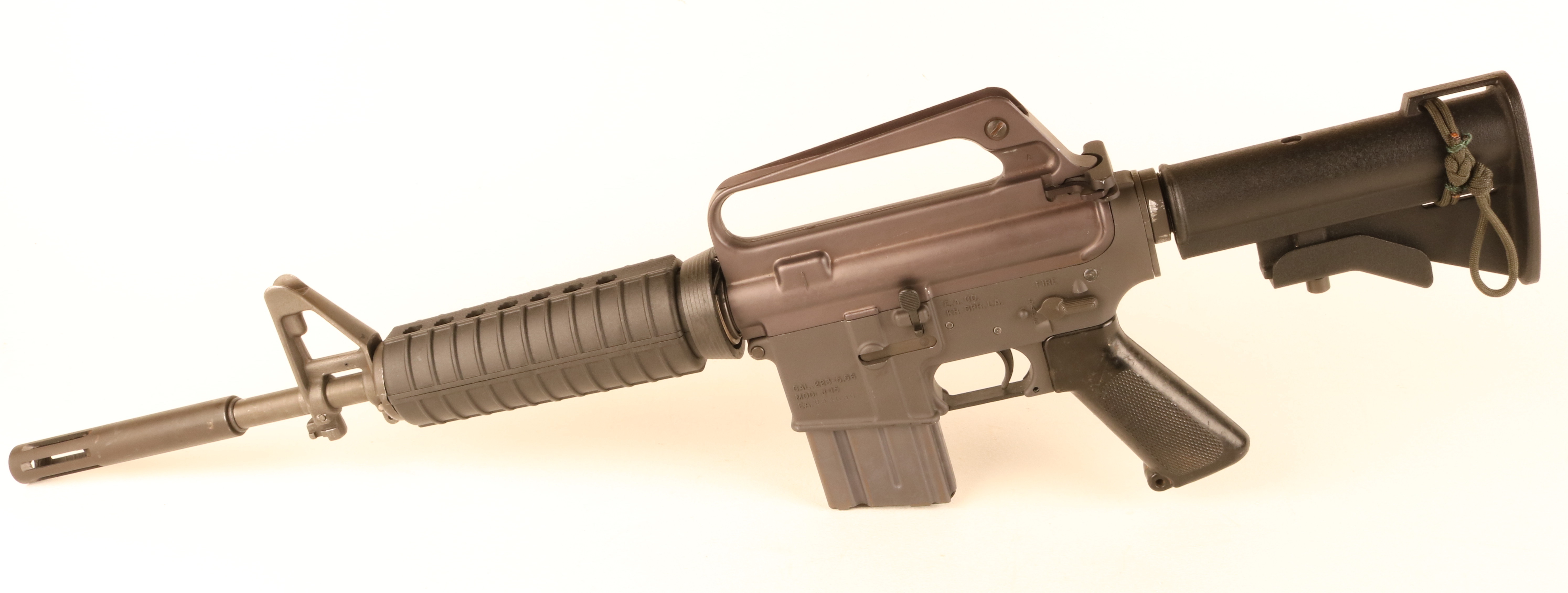
While technically this little chopped-down M16 was designated the XM177E2; the troops who used it called it the CAR15. Sporting either a 10 or 11.5-inch barrel and a sound moderator, the CAR15 was the submachine gun version of the M16 and a popular aircrew weapon.
The CAR-15 weighed 5.35 pounds and was 29.8 inches long with its stock collapsed. These little rifles could subsequently fit inside the cramped cockpits of Cobra Attack and Loach Observation helicopters. While problems with range, poor accuracy, excessive fouling, and erratic performance with tracer rounds plagued the guns, they saw widespread service with Army aviators.

The M134 Minigun had its baptism by fire in Vietnam. While these electrically powered Gatling guns were occasionally used as helicopter door guns, they were most commonly encountered in the chin turrets of AH-1G Cobra gunships.
Necessity is the Mother of Invention
A protracted war such as the one in Vietnam saw the proliferation of small arms from a variety of nations and eras. Friends who served in theater have related stories of obtaining everything from World War II-era submachine guns to civilian shotguns to captured Combloc weapons by barter, purchase, or theft. As a result, in these heady days before so much standardization, Army aircrews frequently flew with an amazing amalgam of defensive small arms.
The M1A1 Thompson and M3A1 Grease Gun were readily available as they were in widespread issue with South Vietnamese forces. These guns both launched heavy .45ACP rounds and had the added benefit of sex appeal to young soldiers who grew up on gangster movies. However, the Thompson, in particular, was brutally heavy. Many sky soldiers who acquired Thompsons soon grew weary of them after packing them for a time.
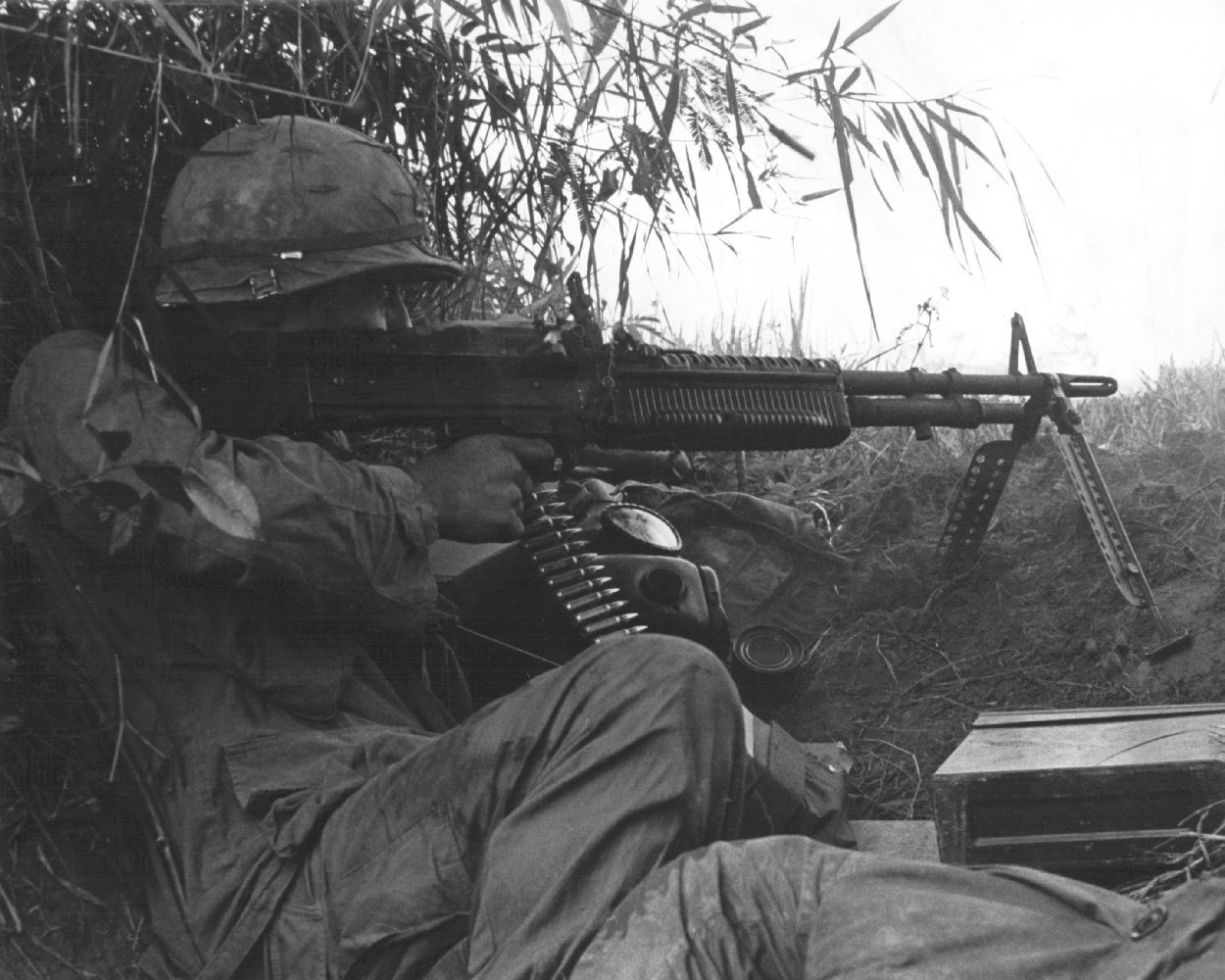
The M60 belt-fed machinegun was the standard light machine gun for US forces in Vietnam. As aircrew weapons, they were suspended on bungee cords, fitted with spade grips and mounted on a pedestal, or fired from mechanical mounts via solenoid.
Captured Iron

Fixed stock Kalashnikovs are compact and powerful making them suitable defensive tools in close quarters. This is a new stamped receiver PSAK47 from Palmetto State Armory.
The argument has frequently been made that the enemy’s AK47 was a better Infantry weapon than our M16. The Russian AK47 and its Chinese counterpart the Chicom Type 56 were robust, reliable, hard-hitting rifles. When they could be obtained AK47’s, particularly the compact folding-stocked versions, were popular aircrew guns. AKs fed from reliable 30-round magazines and carried the extra benefit of producing a common muzzle report with the enemy’s weapons. When down and evading in hostile territory it is not good to sound strange, distinctive, or foreign.
The Combloc RPD was also a superlative weapon for its time. Firing the same M43 7.62x39mm round the AK ran from non-disintegrating 100-round belts, the RPD was remarkably lightweight and effective. Though it suffered from the lack of a quick-change barrel and a tedious reloading protocol, the RPD offered a great deal of firepower for its 16-pound weight. By contrast, our M60 weighed 23 pounds. The RPD carried its onboard ammunition in a pair of connected 50-round belts connected and wound into a pressed steel drum.

The belt-fed RPD was prized for its large volume of onboard firepower. While the RPD would not fit in the most spacious helicopter cockpit, they were used on occasion by crew chiefs as survival weapons.
Practical Tactical

The CH47 Chinook provided heavy lift support to troops on the ground and could carry outsized cargo as a sling load.
The Smith and Wesson Victory Model .38-caliber revolver is indeed stupid-proof. Reliable and soft shooting, the .38 Special caliber has proven itself in countless police shootings over the decades. However, reloading is tedious and carrying spare ammunition loose in a survival vest is a suboptimal solution.
The 1911A1 hits like a freight train downrange, and its single action trigger is the standard by which all others are judged. A friend who carried a 1911 for two years as an Infantryman in World War II told me he carried his pistol with a round in the chamber, the hammer at half cock, and the safety on. With practice he could get his weapon into action both quickly and one-handed. The GI-issue 1911’s that I used operationally back in the day were all fairly long in the tooth. The loose tolerances that kept these guns in action in the face of dirt and grime typically came at the cost of accuracy.
The many-splendored ills of the M16 have been thoroughly explored in other venues, and most of the same problems apply equally or worse to the CAR15. However, aircrews typically had the luxury of keeping their weapons clean and in good repair. In my prime, I could consistently hit a man-sized target out to 400 meters with an M16A1. Having run a lot of rounds through the CAR15 over the years I would not trust it much past a football field.

Folding stock AKs were relatively unusual but popular among aircrews when they could be scrounged. This is a stamped receiver Chicom Type 56-1. Almost all AKs encountered in Vietnam had forged receivers.
The 5.56mm round relies upon velocity for effectiveness. As the CAR15 barrel in its earliest iterations was exactly half as long as that of the M16 the CAR15 offers questionable wound ballistics at long ranges anyway. Spare 20-round magazines typically rode in bandoleers draped over the seat armor.

The AH1G Cobra gunship was fast, sleek, and lethal. Cobras operated in concert with OH6 Loaches to form what was called a Pink Team. This combination of gunship and observation helicopter found, fixed, and destroyed enemy troops and equipment.
The M60 is a monster of a gun that is pure torture on a long forced march. When kept clean and run from fixed mounts the M60 was relatively reliable in my experience, but I never had one run really well in the dirt. Personally, I would leave the Pig, the affectionate term all soldiers used for this beast of a gun, in the aircraft. I’d grab something lighter with which to escape and evade.
The AK, particularly in its folding stock guise, is a superb aircrew weapon. The steel struts on the underfolding stock are uncomfortable, but they remain fully serviceable. You can wrap the stock struts in 550 cord to improve your cheek weld. The AK jumps around a bit on full auto, but its heavy 123-grain bullet carries energy well out to 300 meters or so. The sliding tangent sights are yesterday’s news but remain thoroughly effective.
The RPD would never ride in the cockpit of a Cobra or Loach but would easily tuck behind the sling seat in the crew compartment of a Huey or Chinook. The RPD offers massive short-term suppressive firepower during an extraction, though reloading is a pain. Additionally, any full auto belt fed gun runs through ammunition at a frightful rate.
Ruminations
When I flew for Uncle Sam we packed M9 Beretta pistols that offered both high capacity semiautomatic firepower along with one-handed double-action operation. A colleague indeed scrounged an M3A1 Grease Gun and flew with it during the First Gulf War. However, for the most part, Aviators of my era were expected to make do with a handgun. Much of my career was spent flying CH47D Chinooks so we had plenty of space. Nowadays the widespread issue of the M4 Carbine allows most Aviators to pack the same weapon used by his or her ground-pounding brethren.

Dedicated Huey gunships mounted a variety of machineguns, automatic grenade launchers, and unguided rockets for their aerial fire support role.
On the modern battlefield, a soldier’s personal weapon is but the smallest part of the overall tactical equation. However, for a downed aviator that handgun or rifle become his entire world. A friend who was shot down in Mogadishu actually had to rely on his handgun for real. While it was not a decisive tool, it did buy him some time. When he got home he made a point to impart to those with whom he served the importance of range time with your assigned defensive weapon.
As of 2013 a CH47F helicopter cost $38.55 million. The investment required in training up the pilots and flight crewmembers to operate these complex aircraft is comparably substantial. However, when evading in hostile territory everything comes down to a basic rifle or handgun. Starting back in the 1960’s Army Aviators have carried a wide variety of personal defense weapons. In today’s non-linear battlefields these lessons learned still carry exceptional gravitas.
The USS Saratoga (CV-3) was one of just three United States Navy aircraft carriers — along with USS Ranger (CV-4) and USS Enterprise (CV-6) — to survive the entirety of the Second World War.
Although outdated by 1943, as the newer and more capable Essex-class entered service, CV-3 was one of the American flattops that fought for time in the early stages of the conflict, and continued to find a role until victory was finally achieved.

After the war ended, USS Saratoga was among the warships that helped return United States military personnel from distant posts in the Pacific, and met her end as a target for nuclear weapon tests during Operation Crossroads.
An Important Name
USS Saratoga is fittingly remembered for her role during the Second World War, yet she has historic ties to the founding of the nation. In addition, she was ordered as the United States sought to avoid entry into the First World War, and was originally authorized as a Lexington-class battlecruiser.

The famed American flattop was also the fifth of six U.S. Navy warships named for the Revolutionary War’s Battle of Saratoga, which actually consisted of two battles fought in September and October 1777. The second was a decisive American victory, which persuaded France to enter the conflict as an American ally.

The World War II carrier was preceded by an 18-gun sloop-of-war lost in a gale during the Revolution and was itself followed by a 26-gun corvette that saw service during the War of 1812 on Lake Champlain. The third USS Saratoga was a 22-gun sloop-of-war that served with the U.S. Navy for more than 40 years. The fourth USS Saratoga (ACR-2) was the former armored cruiser USS New York, which also ended her service with the name USS Rochester.
The most recent and final to date USS Saratoga (CV-60) was a Forrestal-class supercarrier that saw service during the Cold War.
From Battlecruiser to Carrier
As noted, the Lexington-class was originally to have consisted of six battlecruisers. Construction of what was to become CV-3 was put on hold during the First World War because there was a greater need for anti-submarine vessels to counter Germany’s U-boat campaign, which led to America’s entry into the conflict. That was almost certainly for the best, as it allowed the design to be improved, including increased armor protection based on experience gained by the UK’s Royal Navy during the conflict. That likely contributed to her survival during the Second World War.

When she was finally laid down at the New York Shipbuilding Corporation at Camden, New Jersey, in 1920, the warship received the hull number CC-3. USS Saratoga was on track to be the second of the six Lexington-class battlecruisers.
However, the Washington Naval Conference resulted in the construction of USS Saratoga being suspended when she was around 28 percent completed. Work was also halted on USS Lexington, and rather than scrap the vessel, it was converted into a carrier. CC-3 was subsequently given the hull number CV-3 on July 1, 1922.

Following the conversion, the USS Lexington (CV-2) and CV-3 were the largest aircraft carriers in the world, with flight decks 901 feet long and 100 feet wide. Each was fitted with lowerable crash barriers, a simple yet innovative feature that enabled the two American flattops to quadruple the landing rate of aircraft. That allowed USS Lexington and USS Saratoga to operate with 86 planes, double the number of the Royal Navy’s HMS Courageous.

Powered by diesel-fueled turbines with electric motors, the U.S. carriers could reach speeds of 34 knots. As naval aviation was still considered experimental in nature, the warships, which displaced 36,000 tons, were armed with four twin 8-inch (203mm) guns.
Readying for War
CV-3 was commissioned on November 16, 1927, nearly a month ahead of USS Lexington, giving USS Saratoga the distinction of being the first “fast carrier” to enter service. She sailed from Philadelphia in early January 1928 for a shakedown cruise, and it was on January 11 that Marc Andrew “Pete” Mitscher, the ship’s air officer, made the first landing on the flight deck. Mitscher, a pioneer in naval aviation, would go on to become an admiral in the United States Navy, leading a Fast Carrier Task Force in the Pacific War.

On January 27, 1928, USS Saratoga carried out a unique experiment with the rigid airship USS Los Angeles (ZR-3), which moored to the flattop’s stern to take on fuel and stores.
Two years later, CV-3 took part in Fleet Problem IX, her first fleet exercise. The drills included a simulated attack on the Panama Canal, during which USS Saratoga launched a strike that could have destroyed the locks. However, as the carrier had been spotted by defending vessels, she was also “sunk” by aircraft from USS Lexington. Those drills served as an augury to the future conflict in which both carriers would fight, and sadly, the Lexington wouldn’t survive.
Over the next decade, the United States Navy continued to develop its carrier tactics. During the subsequent Fleet Problem X in the Caribbean in 1930, CV-3 was again sunk, along with USS Langley (CV-1), in a surprise attack carried out by CV-2. USS Saratoga managed to gain the upper hand in the following Fleet Problem XI, where CV-3 came out on top.
Fleet Problem XIX in 1938 may have been the most significant of the exercises, as CV-3’s new squadron of Douglas TBD Devastators, the first torpedo bombers to serve on a flattop, was used in a “sneak attack” on Pearl Harbor, catching the base largely off-guard!
At that point, Japanese and American tactics were mainly the same: to provide an air umbrella for a strike force of battleships. That exercise clearly demonstrated a more effective use of aircraft carriers, where air power could strike far deeper and harder into enemy territory than any warship.

Japan soon began building two 30,000-ton carriers, along with aircraft ideally suited for such operations. Then, three years after the Fleet Problem XIX, the Imperial Japanese Navy (IJN) attacked Pearl Harbor for real. At that point, the IJN operated 10 carriers to the United States Navy’s eight, of which only three were in the Pacific.
USS Saratoga in December 1941
CV-3 wasn’t at sea when the IJN attack on Pearl Harbor occurred, as the carrier had only recently completed a modernization at Bremerton Navy Yard, Washington, which saw the widening of the flight deck at the bow, and additional aircraft guns installed.

Work was only completed in late November 1941, and on December 7, the USS Saratoga arrived in San Diego to embark her air group. Just a day later, the warship was dispatched to carry United States Marine aircraft to reinforce the garrison at Wake Island.
She arrived at Pearl Harbor on December 15, quickly refueled, and then rendezvoused with the cargo ship USS Tangier (AV-8), which carried relief troops and supplies. USS Lexington (CV-2) and USS Enterprise (CV-6) provide distant cover, but when reports came that Wake Island was under attack, the relief force was recalled. Wake Island, the “Alamo of the Pacific,” fell to Japanese forces on December 23. Military historians have debated whether the right call was made to pull back the American carriers, but the U.S. was still fighting for time at that point.
USS Saratoga carried out operations near the Hawaiian Islands as the year ended.

Just days into 1942, south of Oahu, CV-3 was hit by a deep-running torpedo fired by the IJN submarine I-16. It could have been a disaster for the United States Navy to lose a carrier, but the added armor likely helped save the ship. Six crew members were killed and three firerooms were flooded, yet the aircraft carrier limped back to Pearl Harbor under her own power. Temporary repairs were made, and the ship then headed back to Bremerton Navy Yard for permanent repairs and upgrades to her anti-aircraft batteries.
Returned to Service
USS Saratoga was sidelined until May, undergoing repairs. After then traveling again to San Diego, CV-3 conducted intensive training with her air group before heading back into action. Although the United States Navy expected a major assault on Midway in early June 1942, the carrier first needed to load aircraft, stores, and rendezvous with escorts.

She only arrived at Pearl Harbor on June 6, missing the showdown at the Battle of Midway.
Joined by USS Enterprise and USS Hornet (CV-8), the carrier was deployed to the Aleutian Islands, where the Japanese had landed its forces. However, the operation was canceled due to the slow speed of the fleet, and just a month later, CV-3 was steaming again to the South Pacific.
USS Saratoga served as the flagship for Rear Admiral Frank J. Fletcher during the landings on Guadalcanal, and the flattop had completed training flights at the Fiji Islands just weeks earlier. For two days, aircraft from the carrier provided cover, and afterwards, CV-3 continued to operate east of the Solomons to protect the sea lanes.

Finally, on August 24, contact was made, and USS Saratoga saw her first major combat operations, launching her aircraft at the IJN’s light carrier Ryūjō. Commander H. D. “Don” Felt led the Air Group 3 (AG-3), equipped with the Grumman TBF Avenger torpedo bomber, in the attack. A 1,000-pound armor-piercing bomb dropped by Felt’s aircraft struck the flight deck of the IJN’s light carrier, setting it afire.
Three more bombs found their target, and five torpedo-armed Avengers also targeted the Ryūjō at the starboard bow, with one torpedo striking the carrier. Ryūjō listed to the starboard, dead in the water. By that evening, she was at the bottom of the Pacific. Aviators from USS Saratoga had scored their first significant victory of the war.
Then just a week later, another Japanese torpedo, fired by the IJN submarine I-26, struck CV-3. Although no one was killed, a dozen sailors were wounded, and an engine room was flooded. She was temporarily dead in the water, but the New Orleans-class heavy cruiser USS Minneapolis (CA-36) was able to tow the carrier back to Tongatabu for temporary repairs. USS Saratoga arrived at Pearl Harbor on September 21.

Repairs were completed by early November 1942, and she was deployed back to the Eastern Solomons. She spent a year providing air cover for some minor Allied operations, and it wasn’t until a year later, in November 1943, that she took part in any significant combat, when the carrier helped neutralize the Japanese airfields on Buka.
On November 5, 1943, aircraft from USS Saratoga and the Independence-class light aircraft carrier USS Princeton (CV/CVL-23) conducted a raid on the occupied port of Rabaul to destroy the IJN fleet. The port was one of the most heavily defended Japanese bases in the Pacific, with anti-aircraft guns ringing the harbor, as well as six airfields from which fighter aircraft could launch.
The Japanese assumed the defensive shield couldn’t be penetrated, but they were wrong.
CV-3’s aircraft were able to break through the heavily defended port and damage multiple Japanese heavy cruisers, including the Atago, Chikuma, Maya, Mogami, and Takao, as well as the light cruiser Agano. The Avengers succeeded in torpedoing the light cruiser Noshiro and the destroyer Fujinami. The carrier-based assault was followed by 27 Consolidated B-24 Liberators, but the American bombers — which sought to target Japanese aircraft on the ground — found no targets of opportunity and hit the shore installations instead.

The strike, although costly with every carrier-based plane taking some damage, crippled operations at Rabaul and stopped a major Japanese naval offensive. Having spent a year at sea, USS Saratoga was overdue for repairs and returned to the United States.
From the Marshall Islands to Iwo Jima
In January 1944, USS Saratoga once again returned to Pearl Harbor, joined by USS Langley (CVL-27) and USS Princeton, as the warships were deployed to support the U.S. Navy’s Gilbert and Marshall Islands Campaign. Aircraft from CV-3 took part in attacks on Japanese-held Wotje and Taroa, then on the Engebi and Eniwetok atolls, and provided air cover for American ground forces during the landings.
Following the campaign, in March 1944, USS Saratoga was dispatched to the Indian Ocean, where she trained with the Royal Navy carrier HMS Illustrious, and then took part in Operation Cockpit, the raids on Japanese-occupied Java and Sumatra. The operation was notable as the Allied force included the Free French battleship Richelieu, the Dutch cruiser HNLMS Tromp, the New Zealand cruiser HMNZS Gambia, and four Australian destroyers.

The air wing of the British flattop included Vought F4U Corsairs and Fairey Barracuda torpedo/dive bombers, while the air group of CV-3 consisted of Grumman F6F Hellcats, Douglas SBD Dauntless dive bombers, and Grumman TBF Avenger torpedo bombers. The engagement was largely inconclusive, but it provided the Royal Navy with much-needed insight into carrier operations. Following the brief battle in the Indian Ocean, USS Saratoga was recalled to the United States for another refit. However, on the return journey, most of the Allied force also took part in Operation Transom, against the occupied city of Surabaya on Java, another raid that has been deemed inconclusive.
USS Saratoga completed her refit and spent the remainder of 1944 carrying out training for night fighter squadrons. Then, in January 1945, she was ordered to rejoin the fleet at Iwo Jima. As the carrier arrived in the area of operations, she came under a Japanese kamikaze attack.
Three bombs and two kamikaze aircraft struck the aging flattop. She was struck again as night fell. The carrier’s forward flight deck was destroyed, there were holes on her starboard side, and a large fire broke out on the hangar deck. The attack killed 123 men and also destroyed 36 planes.
Miraculously, USS Saratoga survived.

She didn’t meet the same fate as USS Lexington, which had been lost following the Battle of Coral Sea in May 1942. By evening, the fires on USS Saratoga were under control, and she was even able to recover aircraft. She was again forced to return to Bremerton for repairs. CV-3 then spent the final months of the war as a training platform at Pearl Harbor.
When the war ended with Japan’s surrender, USS Saratoga was among the many warships assigned to “Magic Carpet” duty. She helped bring home more than 29,000 Pacific War veterans, more than any other vessel. For her actions in the Second World War, she received four campaign decorations, eight battle stars, the American Campaign Medal, the Asiatic-Pacific Campaign Medal, the American Defense Service Medal, and the World War II Victory Medal.
Impressively, USS Saratoga recorded a lifetime total of 98,549 landings during her 17 years in service.
Operations Crossroads
USS Saratoga wasn’t just one of the three United States Navy carriers in service before the war to survive until victory was achieved; she was also the oldest. It was already evident there would be no place for the flattop in the post-war world.

Sadly, no consideration was given to preserving the vessel as a floating museum. Instead, the decision was made to employ the carrier in the Operation Crossroads atomic bomb tests on naval vessels at Bikini Atoll. USS Saratoga proved as tough and determined against an atomic bomb as she did against the torpedoes and kamikazes.

She survived the initial bomb, Test Able, which was an air burst over the site. However, she was fatally damaged during the subsequent Test Baker, an underwater detonation carried out on July 25, 1946. USS Saratoga sank approximately eight hours after the underwater blast. She was struck from the U.S. Navy list on August 15, 1946, marking the official end of her service.