Category: This great Nation & Its People
Being on the back half of my seventh decade, there are a lot of things about contemporary society that I find perplexing. For example, service dogs are now almost ubiquitous. Not the kind of “service dog” that alerts of an onset seizure, helps the physically or visually disabled, sniffs out explosives and runs down escaping perpetrators, they are true gifts of God. As are the “service dogs” that point quail and retrieve ducks. The ones that perplex me are the little “Fluffies” whose supposed “gift” is that they calm the frayed nerves triggered by the perceived anxiety of a “victim” of some trendy contemporary angst.
These dogs are allowed by bureaucratic fiat to chaperone their convalescing victim on planes, in church, even at the SHOT Show. Other delusions of oppression like global warming and PTSD caused by non-combat events are difficult for my limited mind to wrap itself around. Everyone is a victim of someone or thing.
No disorder however is more perplexing than the nouveau defect of “Toxic Masculinity.” Apparently the entire 50’s, 60’s and 70’s were a petri-dish of perversion for those of us who identify as male. Attempting to find an objective definition of toxic masculinity is difficult; they all read like an Alexandria Ocasio-Cortez CNN interview, untethered and well…..sorta crazy.
Suffice it to say that if you like guns, shooting and are reading these words, you probably are a carrier. For sure the sport of “practical” shooting was initiated, administered and dominated by men that would be considered “exhibit A” of toxic masculinity by today’s emotive reformers. Most of the early pillars upon whom we’ve built are well known. One of the lesser known pioneers to whom we can proudly trace our lineage of toxic masculinity is Lt. Col. Bill McMillan.
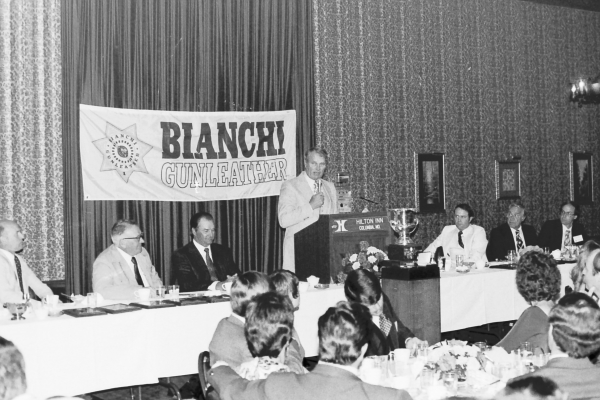
Lt. Col. Bill McMillan guest speaker addresses the competitors at the 1st Bianchi Cup banquet in 1979.
Bill McMillan retired from the Marine Corps the same year that I joined, 1974. As a 6 time Olympian and Gold Medal winner in 1960 in the 25 meter rapid fire pistol event, he was and is a true icon of the Corps. In those days, McMillan stories ran rampant at Corps shooting events and Bill would occasionally attend and put on demos for aspiring competitive shooters. At one of the Western Division matches, he conducted a demo on trigger control using a Thompson submachine gun.
Taping a clay pigeon onto one of the green silhouette target backers, he backed off a number of paces (the distance is irrelevant to the story). Bill then emphasized that a shooter had to be able to feel and control the trigger of whatever firearm that they were shooting, even a fully automatic one. “For example, here’s a one shot burst, he said.” Bang. The clay pigeon shattered. “Here’s a two shot burst.” Bang, Bang. “Here’s three shots.” Bang, Bang, Bang. “Four shots.” Bang, Bang, Bang, Bang. You get the idea.
He kept going until the number of the shots could no longer be audibly distinguished. He then went down to the target with another clay pigeon and taped it on the backer; it covered every hole that he had shot during the demo!
An often told McMillan story relates an example of coaching that he performed in the mid-60’s for the 3rd Tank Battalion. After conducting a shooting demo he asked if any of the assembled Marines were unqualified with their standard-issued 1911A1. One reluctant Marine came forward. Bill loaded a magazine with 5 rounds and had the Marine shoot at a silhouette backer with a regulation bullseye target taped to it; the Marine missed the entire silhouette with all 5 rounds. Bill took him aside and spoke to him for just a few seconds, reloaded the pistol and had him repeat this exercise with the Marine hitting the target with all 5 rounds and putting 4 in the black!
In 1964 he was made an honorary Deputy Sheriff with the San Diego County Sheriff’s Department during a ceremony and shooting exhibition conducted by Ray Chapman and Eldon Carl who worked for the Dept. After retiring from the Marine Corps in 1974, McMillan went to work for the Sheriff’s Department as the Weapons Training Coordinator.
In 1978 during the first class that Ray ever held at the new Chapman Academy, his curriculum included a segment on both strong and weak one-hand shooting. Ray taught a 5 o’clock hold with the right hand and a 7 o’clock hold with the left with the gun “tilted” in board. This was the first time that I was exposed to the 30 degree tilt which allowed for a more natural and strong hold on the handgun. The technique has become almost universally accepted in the “practical” shooting arena and has been taught by most of the famous practitioners of self-defense training.
Only recently have a few trainers like Dave Spaulding gotten away from the practice. Chapman credited McMillan with teaching him the technique which Bill said he originally saw being executed by a Russian bullseye shooter at one of the International games. The technique eventually became known as the “McMillan tilt” in bullseye circles.
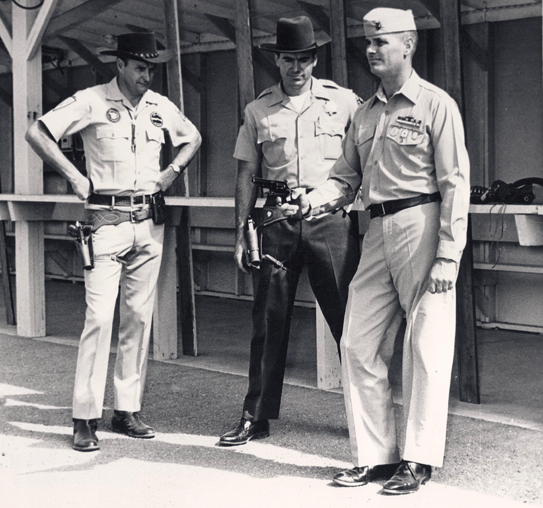
Ray Chapman and Eldon Carl observing Bill McMillan in 1964.
At the inaugural Bianchi Cup in 1979, Chapman and John Bianchi asked McMillan to be the guest of honor and speaker at the banquet. It was in keeping with the dignity of the event to have McMillan speak.
Almost exactly one year later, disaster struck. On May 21, 1980, Bill was supervising a “shoot/don’t shoot” exercise using duel-a-tron pivoting targets which he operated from behind a control panel. As a deputy worked his way thru a mock store set-up, McMillan activated two targets, one a “shoot,” one a “no-shoot.” The deputy correctly engaged the “shoot” target but out of the corner of his eye saw another “shoot” target against the wall behind the door thru which he had just exited. Turning, the officer fired two rounds back up-range into the target. The two rounds passed thru the target, wall, a glass window surrounding the control panel and struck McMillan in the upper chest. EMT’s arrived on the range within 4 minutes and found McMillan to have neither measurable blood pressure nor a pulse.
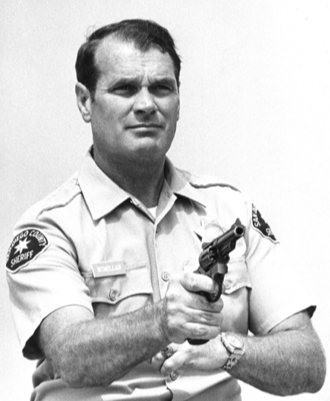
Publicity shot of Deputy Sheriff Bill McMillan.
|
They somehow managed to resuscitate Bill and transport him to the Emergency room where he endured 5 hours on the operating table and lost 11 pints of blood. Bill remained unconscious for 2 weeks while he endured multiple surgeries complicated by a blood clotting disorder. One slug was removed 5 days after the shooting and the second slug was removed almost a year later. Bill’s injuries left him very much like a stroke victim. He initially lost the use of his right arm and leg and had no feeling in his mouth. He had to relearn to walk and talk. He also suffered double vision which was helped by prescription bi-focals.
It’s difficult to imagine the impact that such a loss of bodily control would have on an Olympic shooter, Korea and Viet Nam combat veteran and law enforcement officer. Intestinal fortitude, stubbornness, character, determination or some combination of traits saw McMillan driving a vehicle and helping the San Diego Sheriff’s Range Master test ammunition and working with the Sheriff’s SWAT team within a year!
Refusing to buy into a victim mentality, McMillan commented that if this accident had to happen, he was glad that it happened on the downside of his career.
Col. McMillan passed away from congestive heart failure on June 10, 2000.
Every time I shoot one handed and tilt my handgun inboard, I think of Col. McMillan and thank God that men like him have enriched my life in some way. If that’s a nod to “toxic masculinity,” so be it.
– – Greg Moats
Greg Moats was one of the original IPSC Section Coordinators appointed by Jeff Cooper shortly after its inception at the Columbia Conference. In the early 1980’s, he worked briefly for Bianchi Gunleather and wrote for American Handgunner and Guns. He served as a reserve police officer in a firearms training role and was a Marine Corps Infantry Officer in the mid-1970’s. He claims neither snake-eater nor Serpico status but is a self-proclaimed “training junkie.”

The crew of B-29 Superfortress 42-24598 “Waddy’s Wagon”, 20th Air Force, 73rd Bomb Wing, 497th Bomb Group, 869th Bomb Squadron, the fifth B-29 to take off on the first Tokyo mission from Saipan on November 24, 1944, and first to land back at Isley Field after bombing the target.
Crew members posing here to duplicate their caricatures on the plane. Light-hearted humor in the face of death and destruction. That generation were some incredibly brave guys…
Shooting Times Magazine
June 1980
General Delivery
Horsethief, NM
(Sunday Night)
Alex Bartimo, Editor
Shooting Times
Box 1790
Peoria IL 61656
Dear Bart:
This isn’t actually from Horsethief. I’m camped in the big timber about halfway up the side of San Miguel mountain. Saint Mike, we call it. You may not be able to read my poor handwriting because of the the watermarks on the paper. I know I should be weeping about missing the deadline on this month’s gun review, but I’m sorry to say these splotches weren’t made by tears.
Rain and snow did that.
I’m trapped here, and it’s my own fault. Down at the house in Horsethief, I contracted cabin fever. No pals had visited in more than a month. I don’t take a newspaper (you can get bad news anywhere). I’d read every book on the place at least twice, and Horsethief has no library or newsstand. We get one television station from Albuquerque via a repeater in the mountains, and it runs Bozo the Clown, As The World Flips, intriguing situation comedies about the family problems of New York taxi drivers, and wilderness stories about mountain men who feed themselves and their pet mountain lions with mushrooms and rosehips gathered in the dew.
My set is still like new-it never gets turned on.
The fact of the matter is, I was bored stiff when I got this foreign .380 you wanted shot and decided to make it my excuse to come up to this big stretch of forest belonging to a friend of mine. I was going to stay a couple of days, shoot, and drowse in the sunshine.
Didn’t work out that way.
I like to carry extras, so I packed my old pickup with sleeping bag and big tarp, groceries for two or three days-including canned corned beef hash, chili con carne, coffee, bacon, eggs, and a sack of fresh biscuits. And one jug of Henry McKenna redeye to ward off the weeps around the evening fire. Luckily, I also brought a Coleman camp stove and lantern because I planned on cooking on an open fire.
I stowed the camera equipment, figuring on getting pictures of .380 on tree stump and (using a selftimer) heroic poses of my classic profile looking off into the horizon.
The trip up was nice. Plenty of sunshine. Few melting snowbanks left from winter. Jeep road a little tough on pickup, but made it to campsite okay. Strung lariat rope between two trees and wired end of tarp to it. Made lean-to. Took rocks from clear, cold stream and built fireplace. Gathered enough dead wood to last two days. Unrolled sleeping bag, laid holstered Ruger .44 beside it. Was home.
Built fire, had hash and biscuits, raunchy coffee. Took tot of McKenna while looking at stars. Wondered what city folks were doing. Turned in early.
Up before first light. Drizzling rain. Get GI poncho from truck’s toolbox. Trouble getting fire going with wet wood. Pour on Coleman fuel. Burn fingers…..Biscuits, bacon and coffee.
Sitting in lean-to, I examine new .380. Most unusual. Called the Mama Mia. Made in Costa Rica by Hijos de Basura, S.A. and imported by Larson E. Rippoff Inc. Homossa Springs, Florida. Price: $469.98. About five inches long. Ten-shot staggered magazine extends one-half inch below butt. Double action with pull of approximately 20 pounds; single-action pull about 25 pounds.
Shiny plastic grips. Shiny plastic trigger guard (combat style). Shiny plastic sight rib and sights. Rear sight adjustable for windage. One click equals 12 inches at 25 yards.
Extra 48-shot magazine is curved. Might not do much for feeding but looks jazzy, making pistol five inches long and 1 ¼ feet deep. Optional flash hider and grenade launcher supplied with my review gun. Extras cost only $189.98.
Many cast parts in pistol. Nothing wrong with well-cast parts, but these of somewhat lesser quality than lead soldiers I made as a boy.
Can’t shoot, must wait out rain. Wait all day. Except for small supply under tarp, wood is soaked. Crank up Coleman stove. Chili and biscuits. Wish had brought tortillas and refried beans. Hit sack early. Sleeping bag feels damp.
Third day now. Raining harder. Decide to go home. Dismantle camp, pack truck. Trouble starting engine. Drive 10 feet from camp on muddy trail, skid, nose into boulder. Rear wheels spin. No four-wheel drive. No tire chains. Stuck. Rebuild camp. All wood wet. Hunker around Coleman stove. Things have to get better. Feast on bacon, eggs, soggy biscuits. Long pull at Henry McKenna, then dream in wet sleeping bag. Fourth day. Bear sign around truck. Glad I hadn’t woke up. Might have made mistake and shot bear with .380. Wish I was in Horsethief, watching taxi driver program. Still no interest in mountain man and lion.
Go to stream for coffee water and wash. Bank full, running fast, water chocolate brown. Wash in muddy water and get gallon jug of emergency water from truck. Use sparingly. Going nuts.
Sun peeps through in afternoon. Rain stops, but pickup still stuck. Grab opportunity to shoot the Mama Mia. Staple dry targets from toolbox to big conifer pine. Have W.W. R-P, and Federal factory loads. Load 10 round magazine. Brace against tree now. Squeeze off first round at target. Low/left in 7 ring. Empty case smokestacks. Feed next round into chamber manually. Not on paper. Now shooting low/right 6s. Go through 20 shots, all hand operated. Group is high, right, low, left, 16 inches (diameter of tree).
Forty-eight-round magazine loaded and put in place. Will not feed first round. Note for first time that loading ramp is very steep-about 45 degree-and narrow. Get screwdriver kit from toolbox and dismantle pistol.
Many tool marks inside shiny exterior. Horseshoe rasp, maybe. Springs all piano wire type. Apparently from very small piano. After some difficulty, reassemble and try 48-round magazine again. No dice. Big magazine apparently meant to be handy place to carry ammunition.
Shoot single shot for a while. Groups don’t improve. Curious square holes cut by bullets. Perhaps due to quadrangular rifling in bore. Try all brands of ammunition. Results the same.
See squirrel munching acorn in nearby tree. Very fat. Squirrel out of season, but I get an evil idea. Rations low. Squirrel rolled in biscuit crumbs and fried in bacon drippings would be great morale builder.
Sight seven inches high and left on squirrel with Mama Mia. And miss. Squirrel munches acorn. Hold upper right quadrant or rodent. Does not disturb dining squirrel. Working slide by hand, fire five quick shots. Squirrel looks on with interest. Think of going for .44 Magnum, but don’t believe squirrel tail and ears would make good supper.
Fifth day. Grub low. Biscuits turning green. Hunting squirrels, porcupines, and even bears with .44 Magnum. Mighty hunter in magazine articles; dripping dud in wet forest.
Sixth day. Definitely in deep trouble. Old bones won’t stand up to 40-mile walkout. Wife home from Flower Arrangers Convention in Santa Fe by now. Will find me gone and cats unfed. Will be mildly irritated. Probably throw things. But she will call friends in State Police and Forest Service. They will check out jails, hospitals, then Kelly Canyon, Desert Saloon, El Paso. Then they will settle down to look for me. Shouldn’t be longer than one more day….
Down to dregs of coffee by seventh morning. Broken clouds. Mama Mia WD-fortied and put away. Reading labels on empty hash cans. Stomach growling.
Suddenly hear chopper working way up canyon. Use Coleman fuel. Make smoky fire. Helicopter hovers, lands in mud near pickup. Pilot is Dick Shaw, a State Police friend.
Embarrassing situation. Shaw disgusted. Dismounts from machine, walks toward pot of weak coffee, gets dirty cup, and drinks. Sees I’m cold, wet. Gives me a cigarette.
“How’d you get yourself in this fix, Skeeter?”
Mutter something about big job I had to do-caught by weather. Shaw not at all sympathetic. Says he will radio for four-wheeler with chains and winch to come get me. Will probably cost at least $100. I say okay.
Shaw blasts off. I start breaking camp again. Must go home and face music. Will mail this letter tomorrow.
Might be just as well if this was one gun review that didn’t get printed.
Su amigo,
Skeeter
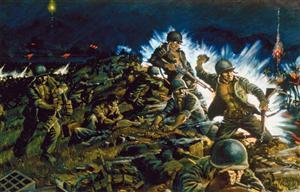
Captain Dickson, adjutant of the 5th Marines at Guadalcanal, painted this scene of night combat along Bloody Ridge in September 1942. More hard fighting was to come.
U.S. MARINE CORPS COMBAT ART COLLECTION
A perceived lack of Navy support for Marines on Guadalcanal led one Marine officer to have an irreverent medal cast in commemoration of the event. But did the Navy really abandon the Marines?
By late November 1942, the tide had turned for American forces on Guadalcanal. If Marine and Navy aircraft were not exerting air superiority, they at least had air parity. Navy ships were interrupting Japanese attempts to land additional forces ashore, and Soldiers and Leathernecks had begun arriving to reinforce the gaunt malaria-ridden Marines already there.
Lieutenant Colonel Merrill B. Twining, the operations officer of the 1st Marine Division, resolved to commemorate the Leathernecks’ participation in the ill-conceived and poorly supported naval campaign. He thought an appropriate medal was required and turned to Captain Donald L. Dickson, a talented artist serving as the adjutant of the 5th Marines.
Who above Twining in the chain of command approved the medal, and its obvious criticism of the senior Navy officers involved in Operation Watchtower, is unknown. But when the division redeployed to Australia in early 1943, a local metal craftsman was hired to cast it.
The image on the front shows a hand and the sleeve of an admiral—obviously Vice Admiral Robert J. Ghormley, Commander, South Pacific, or Vice Admiral Frank Jack Fletcher, commander of the invasion force—dropping a hot potato into the arms of a Marine. The inscription on the front reads simply Faciat Georgius (Let George Do It).
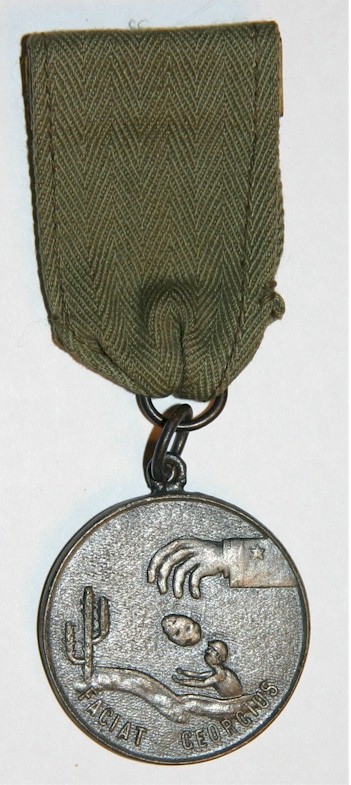

The reverse of the medal shows a Japanese soldier with his breeches pulled down and the inscription “In fond memories of the happy days spent from Aug. 7th 1942 to Jan. 5th 1943. U.S.M.C.” Ribbons for the medal were fashioned from the herringbone twill of Marine field uniforms, supposedly washed in the fetid waters of the Lunga River on Guadalcanal.
The appearance of the medal illustrated the frustration Marines felt for what they saw as a lack of Navy support in the Guadalcanal campaign.
With the fresh taste of victory in earlier encounters at the Coral Sea and Midway, naval leaders pressed to continue the initiative in the Pacific. Vice Admiral Chester A. Nimitz, Commander, Pacific Fleet, proposed sending a Marine Raider battalion to destroy a Japanese seaplane base located on Tulagi in the Solomon Islands. But in Washington, Chief of Naval Operations Admiral Ernest J. King proposed a much larger operation, arguing successfully with the other members of the Joint Chiefs of Staff and then the President, to maintain momentum in the Pacific.
Intelligence reports of an enemy airstrip under construction on Guadalcanal reinforced King’s argument that further Japanese threats in the region be stymied. Thus, Operation Watchtower came into being.
The 1st Marine Division began to arrive in New Zealand in June 1942. Its commander, Major General Archer A. Vandegrift, had been told by Commandant of the Marine Corps Lieutenant General Thomas Holcomb not to anticipate any combat operations before 1943. In his first conference with Ghormley on 26 June, a dismayed Vandegrift learned of Operation Watchtower with a proposed D-day of 1 August. He reminded Ghormley that his division was grossly understrength. Undeterred, Ghormley ordered it reinforced with the 2d Marines, 1st Raider Battalion, 1st Parachute Battalion, and the 3d Defense Battalion, which increased Vandegrift’s strength to approximately 19,000 men. The Joint Chiefs approved changing D-day to 7 August; reports of the airfield on Guadalcanal prevented further delay of the invasion.
Because Ghormley’s headquarters were in Noumea, on New Caledonia, some distance from the Solomons, he invested command of the expeditionary force with Fletcher. It consisted of the carrier force (3 carriers, 1 battleship, 6 cruisers, 16 destroyers, and 3 oilers) and Rear Admiral Richmond Kelly Turner’s amphibious force, supported by 5 cruisers and 9 destroyers. Accurate maps of the amphibious objective area (AOA) never appeared, even long after the invasion began, and estimates of Japanese ground forces on Guadalcanal and nearby Tulagi remained uncertain. Later, it was determined that no more than 3,457 were stationed in the Guadalcanal-Tulagi area. Aerial photographs revealed the construction of the airfield and no extensive defenses on Guadalcanal’s north shore.
To the Solomons
The forces rendezvoused in the Fijis on 26 July, conducted a disappointing rehearsal, and steamed toward the Solomons three days later. B-17 bombers flying from the New Hebrides began striking targets on Guadalcanal and Tulagi on the last day of July. Reflecting on the exigency precipitating the operation, King provided a droll comment that proved to be the understatement of the entire operation: “Because of the urgency of seizing and occupying Guadalcanal, planning was not up to its usual thorough standard.”
Few of the Navy commanders gave serious thought to the resupply and support for the Marines about to be dumped onto a hostile shore. Most disconcerting was Fletcher’s decision to depart the amphibious objective area after just 48 hours; reluctantly, he agreed to keep his precious carriers in the AOA for a third day, but Vandegrift argued for at least four days.
The commander of the invasion force had grown fearful of exposure to enemy bombers. Without the support of Fletcher’s aircraft, Turner decided to withdraw the ships of the amphibious force whether unloaded or not. When Fletcher left the AOA, Turner followed with ships still half full; they hauled away part of one infantry regiment along with most of the supplies and equipment necessary to sustain the division in combat ashore for a minimum of 30 days.
Meanwhile, senior Japanese officers in Rabaul and as far away as Imperial General Headquarters in Tokyo remained convinced that the amphibious invasion consisted of nothing more than a reconnaissance in force. By nightfall on D-Day, Vandegrift had more than 11,000 troops ashore. By then, the Marines had overrun the Japanese airfield and advanced to the banks of the Lunga River. The unit of the Special Landing Force, an estimated 430 Japanese Marines, had fled inland with 1,000 Korean laborers when the preassault bombardment began.
But on nearby Tulagi, the Leathernecks found that the Japanese Marines intended to fight a vicious, no-surrender battle. After two days of ferocious combat, the 1st Raider Battalion and 2/5 had maneuvered to outflank and overrun pockets of die-hard defenders. Earlier, strikes by carrier-based aircraft destroyed the seaplane base that had provided the stimulus for the operation.
In response to the audacious incursion, Japanese headquarters in Rabaul opted for the quick fix of air power. On the morning of D-day, an Australian coastwatcher reported a sizeable formation of enemy bombers. Flying from Fletcher’s carriers, positioned 100 miles south of Guadalcanal, fighters destroyed or chased away the Japanese planes before any of them could disrupt the landing. Inexplicably, enemy pilots focused on the amphibious ships and ignored the beaches crammed with troops and supplies. But on the evening of 8 August, an enemy naval force responded to the American invasion with a stinging response.
In the Battle of Savo Island, the Japanese shattered the covering force with no casualties to themselves; four cruisers went to the bottom, and another lost her bow. Fortunately for the Marines ashore, the Japanese naval force departed without attempting to disrupt the landing further. Nonetheless, the victory caused celebrating superiors in Tokyo to allow the event to overshadow the importance of the amphibious operation. A Japanese journalist proclaimed euphemistically that “the Marines in the Solomons were like summer insects which have dropped into the fire by themselves.”
The Ichiki Detachment Lands
Senior officers in Rabaul and Tokyo concluded that the Japanese Army should drive the Marines from Guadalcanal and ordered the 17th Army to undertake the mission. For this assault force, its commander chose a crack regiment commanded by a notorious firebrand. Colonel Ichiki Kiyonao had once scoffed that it only required swords and sabers to defeat the Americans. On the evening of 18 August 1942, the Ichiki Detachment landed at Taivu Point just 22 miles east of the Marine perimeter; the remainder of the 35th Infantry Brigade followed. The Japanese force deployed ashore with characteristic smugness for the fighting ability of their occidental foe: “Westerners—being very haughty, effeminate, and cowardly—intensely dislike fighting in the rain or mist or in the dark,” snarled one strategist.
Ghormley had warned both Nimitz and King that the Japanese might recapture Guadalcanal unless more carrier support and troop reinforcements were forthcoming. Apparently, his pessimism failed to reach the Oval Office. On 19 August, President Franklin D. Roosevelt informed Soviet leader Josef Stalin that, “We have gained, I believe, a toe-hold in the Southwest Pacific from where the Japanese will find it very difficult to dislodge us.” Closer to the scene, senior officers remained less sanguine. After returning from the South Pacific, an Army Air Forces officer advised Lieutenant General Henry H. “Hap” Arnold that “there’s another Bataan coming and so you’d better get ready for it.”
Meanwhile, on 20 August Vandegrift greeted the arrival of Marine Air Group 23’s two squadrons at Henderson Field: 19 Grumman F4F-4 Wildcat fighters and 12 Douglas SBD-3 Dauntless dive-bombers. Two days later, five Army Bell P-400 Airacobras flew in to add to the lethality of air assets positioned on Guadalcanal. One grizzled observer was overheard to mutter, “Now let the bastards come!” And they did, with a vengeance.
During the night of 20-21 August, Ichiki’s troops stormed the Marines’ lines in a screaming, frenzied display of the “spiritual strength” that they had been assured would sweep aside their occidental enemy. As the Japanese charged across a sand bar astride the Ilu, the Leathernecks cut them down. Trapped between two Marine battalions and the sea, Ichiki burned the regimental colors after soaking them in his blood and then committed sepuku. Tanks rolled over the bodies, grinding them into their treads; Crocodiles fed on the dead that clogged the river.
Reflecting on the defeat, a senior Japanese officer concluded that the attack was shear folly. “This tragedy should have taught us the hopelessness of bamboo spear tactics,” he remarked to a confidant. More than 800 Sons of Nippon died in the abortive attempt to breach the Marines’ lines, while the defenders suffered only 44 killed and another 71 wounded. Undeterred, the 17th Army headquarters in Rabaul planned another ground assault.
Meanwhile, the remainder of Major General Kawaguchi Kiyotake’s 35th Infantry Brigade had landed. Incredibly, the Japanese continued to believe that no more than 2,000 Marines were ashore with significant air assets supporting them. As plans for an assault on 13 September unfolded, Kawaguchi voiced his misgivings: “Wouldn’t you think that the destruction of the Ichiki Detachment would be a lesson to us? [Imperial General Headquarters] belittles the enemy on gadarukanaru [starvation island, or Guadalcanal] and declares that once we land successfully, the Marines will surrender.”
Edson Holds
A captured map revealed that the Japanese intended to attack across the ridge separating the jungle from the airstrip and then burst onto the Lunga Plain only a mile from Henderson Field. Vandegrift predicted the main point of attack and positioned a combined force of raiders and paratroopers commanded by Colonel Merritt A. “Red Mike” Edson to block it.
Enemy bombers and artillery pummeled the ridge as a prelude to the ground assault. Enemy ships fired flares over the area, and naval gunfire added to the cacophony. The first blow came during the night of 12-13 September. In desperate hand-to-hand combat, Edson’s force held the ridge as the Japanese made two more attempts to overrun it.
The next night, two of Kawaguchi’s battalions, led by sword-wielding officers shouting “Totsugeki [Charge]” attempted to breach the Leatherneck lines in 12 separate attacks. At first light, the defenders—a total of 840 Marines—counted more than 600 Japanese bodies strewn across the landscape. The survivors of Kawaguchi’s force retreated to the west, dropping the most seriously wounded of their comrades to die along the jungle trails.
Meanwhile, Japanese ships began disgorging the Sendai Division on 7 October without hindrance from Navy ships. On 13-14 October, bomber strikes preceded an intense artillery and naval gunfire bombardment of Henderson Field; the shelling left the vital airstrip in shambles and destroyed most of the facility’s aviation fuel. Vandegrift described his predicament in sober terms to Ghormley and Turner: While his force exceeded that of the enemy, intelligence estimates indicated more than 15,000 Japanese troops assembling in the hills.
In Need of Navy Support
More than half of Vandegrift’s men were in no condition to undertake a protracted land campaign because of malaria. He repeated the requirement for the Navy to control the sea lanes offshore to prevent further Japanese reinforcement and naval gunfire bombardment. He also stressed the need for an increase in his troop strength with the addition of the remainder of the Americal Division from New Caledonia, along with the 2d Marines and 8th Marines from the 2d Marine Division.
As news of the thousands of Japanese pouring ashore spread, a senior Marine officer noted that “the Japs had the run of the waters” and added scornfully, “Where is the Navy, everyone wants to know?” Another disappointed observer noted that “they are landing faster than we can kill ’em.”
After the Sendai Division had massed in the hills east of the ridge bordering the Marine lines, it began to deploy toward Henderson Field. The dense jungle foliage over the 15-mile trek concealed the force, which was buoyed with its commander’s exhortation: “The forthcoming attack on Guadalcanal, which is under the focus of the entire world, is the decisive campaign on which the fate of the Japanese Empire depends.”
Meanwhile, Nimitz had replaced the overcautious Ghormley with the determined and aggressive Vice Admiral William F. Halsey. During the previous ten weeks of the campaign, neither Ghormley nor his chief of staff had bothered to even visit Guadalcanal; Halsey flew there just four days after assuming command. Vandegrift told Halsey that he had no intention of evacuating Guadalcanal but required more active support; Halsey promised Vandegrift “everything I’ve got.”
In Washington, optimism in the South Pacific was matched with guarded pessimism. When a journalist asked Secretary of the Navy Frank Knox, “Do you think we can hold Guadalcanal?” he received a waffling response that could hardly encourage any Marine there: “I will not make any prediction, but every man will give a good accounting of himself. There is a good, stiff fight going on—everybody hopes we can hold out.”
In late October, the Sendai Division attempted to overrun Leatherneck positions but failed. Correctly predicting that the Japanese would again attempt to take what had become “Bloody Ridge,” Vandegrift positioned the 7th Marines and the 164th Infantry to hold the vital terrain. The defenders blunted the enemy attack, and the remnants of the Sendai Division fled into the jungle; another 3,500 enemy troops were killed.
Unknown to the Japanese, Vandegrift’s situation had improved considerably by then. An additional airstrip, “Fighter One,” had been completed by the 6th SeaBee Battalion; the 7th Marines had redeployed from Samoa, and the 2d and 8th Marines from the 2d Marine Division were ashore; the first elements of the Americal Division had redeployed from New Caledonia; and both fighters and torpedo aircraft from carriers had begun to reinforce Leatherneck aviation units at Henderson Field.
Once again, Turner took his “field marshal’s baton” out of his briefcase. The amphibious task force commander opined that the 7th Marines should be positioned in little groups all over Guadalcanal’s coast. Vandegrift simply waived that preposterous notion aside, but then Turner suggested that additional raider battalions could be formed out of the 7th and 8th Marines, along with any “spare” Marines.
Fortunately, Nimitz visited Guadalcanal at about that time and, after Vandegrift spoke to him, put Turner on a short leash. By then, Vandegrift and his staff had grown increasingly impatient. His operations officer even interrupted a visiting admiral who started to say, “What you need . . .” by exclaiming, “What we need is an end to arbitrary decisions by people who don’t know what they’re doing!”
In Hawaii and Washington, the war in the Solomons grew increasingly worrisome. A sharp increase in Navy losses fueled the trepidation; severe damage to a carrier and a battleship left only one carrier and a single battleship on station to support the Marines on Guadalcanal. On 9 November, the first elements of the 38th (Hiroshima) Division landed to reinforce the dwindling number of Japanese on the island.
When its remaining 12,000 men and ten tons of supplies sailed from Shortland Island (just south of Bougainville in the Solomons), the U.S. Navy’s surface forces rose up to smash the reinforcement effort. On 13 and 13-14 November, Navy vessels turned back efforts by Japanese warships to bombard Guadalcanal prior to landing the Hiroshima Division. On the 14th, Navy and Marine aircraft sank seven transports packed with division troops. Only four transports managed to offload.
Happy Thanksgiving
By late November, enemy forces in the region had been defeated or isolated. Halsey brought welcome gifts to the haggard, malaria-ridden, and exhausted Marines on Thanksgiving Day: a turkey dinner with cranberry sauce, and orders to redeploy from Guadalcanal to Australia. As the battle-weary Leathernecks ate their holiday meal, few if any knew or even cared that more than 100 Japanese soldiers died of starvation each day in the jungles of Guadalcanal.
In late December, Imperial General Headquarters concluded that the cost to re-take Guadalcanal had become too great. By that time, all of the elements of the Americal Division were ashore. The 25th Infantry Division and the headquarters of the 2d Marine Division had arrived along with the 6th Marines to constitute XIV Corps.
More than 23,000 Japanese died attempting to eject the Marines from the southern Solomons. Each side lost 24 ships. Leatherneck casualties numbered 1,052 killed, 2,799 wounded, and 8,580 cases of malaria. In more than six months of aerial combat, 94 Marine pilots lost their lives, but they earned an impressive kill ratio of 3:1 against the Japanese pilots.
The Marines at Guadalcanal destroyed the myth of the Japanese as infallible jungle fighters. Emperor Hirohito’s royal decree of 31 December 1943, ordering no further attempts to retake Guadalcanal, foreshadowed the end of the war in the Pacific with an American victory. Japan had entered a war of attrition on Guadalcanal that it could not win.
By the time Imperial General Headquarters concluded that its military and naval forces could not eject the Americans from Guadalcanal, their fruitless efforts had sufficiently eroded Japanese strengths such that General Douglas MacArthur’s campaign to recapture the Philippines and Nimitz’ drive through the Central Pacific could not be stopped.
As one distinguished historian of the Japanese Navy, Paul S. Dull, noted, “At first by accident, later by pride, and then finally in desperation, Guadalcanal became the place the Japanese wanted at all costs to hold.” A Japanese admiral who commanded a surface force in the Solomons reflected, “There is no doubt that Japan’s doom [in the Pacific War] was Guadalcanal.”
The Leathernecks succeeded in spite of lackluster support from Washington and senior Navy commanders on the scene. Years later, the reflections of Merrill Twining (the brains behind the George Medal) placed the epic confrontation in perspective: “You just can’t conceive of the conditions under which that operation came off—the greatest luck, the unbelievable ineptness of the Japanese, everything in the world conspired to make it succeed at all.
All Available Resources
For a generation, Marine veterans of the campaign to seize Guadalcanal-Tulagi remained embittered by the seeming lack of Navy support. Hence the inspiration behind the irreverent commemorative medal. A balanced assessment of the Navy’s support for Operation Watchtower, however, suggests that it deployed all available resources. After the battles of the Coral Sea and Midway, the Navy could not afford the loss of another aircraft carrier. The disaster at Pearl Harbor left few ships available to control the waters off Guadalcanal. In any event, the Navy was fighting a two-ocean war. Planners in Washington demanded more from the Bluejackets and Leathernecks in Operation Watchtower than could be supported with the meager assets available.
Lieutenant Colonel Bartlett is a frequent contributor to Naval Institute publications. He is coauthor with Jack Sweetman of the new edition of the upcoming Naval Institute Press book, Leathernecks: An Illustrated History of the U.S. Marine Corps.