Categories
Soldiering This great Nation & Its People War

Alexander Gardner: The American who fought for the Sikh Empire

Categories
This great Nation & Its People

IN SELF-DEFENSE ARMED CITIZENS ARE FIGHTING BACK WRITTEN BY DAVE WORKMAN

2

Increasing numbers of citizens are buying and carrying defensive sidearms.
Dave says “practice” and that’s what he’s doing, prepping for the day
we all hope never comes.


There are now 25 states with so-called “Constitutional carry” and Florida appears to be approaching permitless carry, which translates to more citizens soon being able to carry defensive firearms without having to jump through the hoops of a licensing process.

There is another translation: Criminals, be careful … be very careful. In fact, now might be a good time to reconsider your career choices and see if the hardware store is hiring.

I routinely report on the number of active concealed pistol licenses in my home state of Washington, and following a slight end-of-year dip reported Jan. 3, the number has been steadily climbing. Last month, a whopping 698,186 active CPLs were reported by the state Department of Licensing.

Each state has its own laws regarding the use of lethal force, and in Washington, the statute is RCW 9A.16.050. Here’s what it says:

“Homicide is also justifiable when committed either:
(1) In the lawful defense of the slayer, or his or her husband, wife, parent, child, brother, or sister, or of any other person in his or her presence or company, when there is reasonable ground to apprehend a design on the part of the person slain to commit a felony or to do some great personal injury to the slayer or to any such person, and there is imminent danger of such design being accomplished; or
(2) In the actual resistance of an attempt to commit a felony upon the slayer, in his or her presence, or upon or in a dwelling, or other place of abode, in which he or she is.”

Collaborating with Alan Gottlieb, best known as the founder and chief executive officer of the Second Amendment Foundation, I’ve done a couple of books over the years dealing with firearms and self-defense incidents. Anecdotal information contained in those books has been appreciated by some while making others uncomfortable and a few upset because the stories reinforced the notion of armed self-defense being a good thing.

One cannot pick up a newspaper or read an online news publication without finding stories with such headlines as “Robbery suspect shot,” or “Clerk kills armed robber,” or “Homeowner kills burglar.” The first Workman-Gottlieb collaboration — titled “America Fights Back – Armed Self-Defense in a Violent Age” — is still found on Amazon and other places.


The goal is not winning a gunfight, but surviving. Some armed citizens get hurt while defending themselves.

Never Ends Well


There’s an interesting line of dialogue in an old Patrick Swayze film titled “Road House” in which he plays a famous bouncer. While he’s in the ER being treated for a knife wound, the attending doctor asks him, “Do you ever win a fight?”

His reply is sobering. “Nobody ever wins a fight.”

Fox News recently reported an incident that didn’t end well, especially for the alleged bad guy, but it wasn’t a pleasant experience for the good guy, either. In East Hartford, Connecticut, two men wearing ski masks entered a clothing store, and for one of them, it was the last thing he did besides expire.

The report said the robbers shot the merchant in the back, but bad news for them, he had two legally owned firearms, and he fought back. Fatally-wounded in the encounter was a suspect identified as Jashar Haslam of Hartford. He was only 26 years old. The unidentified wounded store owner suffered non-life threatening injuries, and he survived a terrible experience.

When WVIT News reported on the gun battle, it noted the other suspect fled and, at the time, was still at large. Not much friendship among criminals when the shooting starts and bullets start punching holes.


Mother Knows Best


Check your favorite Internet search engine with these words: “Woman kills home invader.” You will find lots of incidents.

One, which recently got my attention, was a CBS News report about a Louisiana mom who “allegedly” brought a sudden end to a strange incident involving a fellow identified as 51-year-old Robert Rheams. This guy had been paroled from a 20-year-stretch for armed robbery, and it evidently didn’t take long for him to find trouble.

The report said he was apparently involved in an alleged carjacking hours before he showed up at the home of the woman, who lived in Hammond, Tangipahoa Parish. He was reportedly armed with a shovel and lug wrench. Never take those tools to a gunfight.

Sheriff’s Office Chief Jimmy Travis was matter-of-factly quoted in the CBS story, observing how this fatal confrontation was a case of a “homeowner exercising Second Amendment rights to protect herself and her children from a violent home invasion.”

The case was forwarded to the local district attorney’s office for “further review,” the report noted.


Call police if you have time, but growing numbers of homeowners
are buying guns and practicing in case they don’t have the time.

Heaven? No, It’s Iowa


A 30-year-old home invasion suspect in Monticello, Iowa was shot and killed in a January confrontation involving a homeowner and his 10-year-old son, both of whom were unharmed, according to KWWL News.

This was an early-afternoon incident on a Wednesday, which was unusual when it comes to this sort of crime. The 44-year-old homeowner armed himself after calling Monticello police with a report of an “in-progress” break-in, but by the time cops arrived, Pattrick Michael O’Brine was down for the count.

The incident underscores the wisdom of an oft-repeated observation in the self-defense community: “When seconds count, police are minutes away.” Nothing is closer to the truth than this seven-word principle. While police would be delighted to always arrive in the nick of time to catch the bad guys and save the good folks, rarely does that happen.

It may be one reason why the past couple of years have seen a lot of first-time gun-buyers in shops from Tampa to Tacoma. Toss in longer response times in communities where police ranks have been shrinking thanks to “defund the police” efforts, and nightly news broadcasts that frequently lead with a violent crime report, and it doesn’t take much to figure out why people are buying guns. That good old Second Amendment is the ultimate fall back when everything else goes haywire.


Fort Smith Fatal Encounter


According to a story on “Today In Fort Smith,” an Arkansas man identified as 29-year-old Jacob Andrew Webb had a background that included previous drug-related arrests “for which he received suspended imposition of sentences.”

Early last month, Webb reportedly entered the residence of an unidentified 58-year-old homeowner, armed with a knife. He never left.

There was some sort of confrontation, during which the homeowner was injured and Webb was shot in the midsection. After police arrived, the homeowner was taken to a local hospital for non-life-threatening injuries, according to KHBS 4029 News. Such injuries are still painful.

At the time he died, Webb was reportedly on “extended probation out of Logan County on two separate drug-related arrests in 2020 and 2021.”


Wisconsin Strong


There’s a 79-year-old man in Marathon County, Wisconsin who recently proved age doesn’t necessarily translate to vulnerability.

According to WSAW/Gray News, the septuagenarian was apparently followed home by a 22-year-old man in the early morning hours. The suspect attacked and stabbed the older gent as he was exiting his car, which had been parked in the garage.

This was another example of making a fatal error in the victim selection process. The older man drew a gun and fired one round. The bullet struck the younger man in the chest, and he reportedly expired while trying to flee.

The story made it all the way to Texas, where it was reported by the Fort Worth Star-Telegram, probably because it was a tale in which an older would-be victim prevailed.


The Moral?


Perhaps the moral of this stroll into the realm of violent crime and self-defense is that all the gun control laws on the books, and the ones still waiting to be written, will not deter violent criminals.

Gun prohibitionists think they can penalize law-abiding citizens and somehow get outlaws to change their ways. History tells us differently — after all, Jesse James, Cole Younger, the Daltons, Bonnie and Clyde, John Dillinger and a host of other societal losers provided ample proof — and history is unforgiving, no matter how many times some people try rewriting it.

If you’re one of the millions of armed private citizens responding to a changing world in which the nearest police officer or sheriff’s deputy is minutes away or maybe much longer, find out about your state’s self-defense laws. Today is a good time, yesterday


Nice gun, a 5-shot .41 Magnum; what if it were stolen? You want to report that theft immediately to the police.

Lots of ‘Crime Guns’


Here’s something we know about crime: When bad guys are packing iron, much of it is hot.

The New York Times last month confirmed that between 2017 and 2021, law enforcement recovered “about two million guns linked to crimes.” The newspaper said the information came from the most comprehensive national accounting of crime guns in decades. The times was referring to the “National Firearms Commerce and Trafficking Assessment (NFCTA): Crime Guns – Volume Two” published by the federal Bureau of Alcohol, Tobacco, Firearms and Explosives.

When a gun is stolen, it is technically “involved in a crime.” When a gun is recovered from a burglary investigation, or seized from a criminal during an arrest, it is “involved in a crime.” The term “crime gun” can be applied, even if the gun wasn’t fired.

“While more than 95% of stolen guns originate via thefts from private citizens (see Figure BRL-01 below), FFL and commercial shipping thefts are nevertheless a direct source of crime guns,” the report says. “As of 2022, only fifteen states — California, Colorado, Connecticut, Delaware, Hawaii, Illinois, Maryland, Massachusetts, Michigan, New Jersey, New York, Ohio, Oregon, Rhode Island, and Virginia — require private citizens to report when a firearm is stolen. As a result, while the reported number of firearms stolen annually from individuals is substantial, there is significant underreporting; a 2016 survey by the U.S. Bureau of Justice Statistics indicated that only about 75% of private gun thefts are reported to law enforcement.”

There are lots of videos of middle-of-the-night smash-and-grab gun store thefts. That’s one way to arm a community of thugs.

If you don’t own one, buy a gun safe. Your firearms are valuable, along with your right to have them. Record the serial numbers of your guns and keep that log someplace safe.

If your gun is stolen, report it immediately. There’s a possibility you might get that gun back if it is recovered, and you certainly don’t want to be linked to any crime that gun might later be part of. Thefts from private citizens account for almost 96% of stolen guns during the 2017-2021 time period. During those years, the report notes there were 3,100 theft incidents involving 21,585 guns. Any way one looks at this, it’s a lot of hot hardware.

Categories
This great Nation & Its People War Well I thought it was funny!

You do know that old Zach will NEVER live this one down, right?

r/NoSillySuffix - [Military] US soldiers take defensive positions after taking fire from Taliban in Korengal Valley. Spc. Zachary Boyd was still in his pink “I love NY” boxers as he rushed from his sleeping quarters to join his fellow platoon members. [3888×2592]

US soldiers take defensive positions after taking fire from Taliban in Korengal Valley. Spc. Zachary Boyd was still in his pink “I love NY” boxers as he rushed from his sleeping quarters to join his fellow platoon members.

Categories
A Victory! The Green Machine This great Nation & Its People War You have to be kidding, right!?!

Hard to believe but this is not Italy. Istead this is Alaska and the 7th InFantry Dision is chearing out the Jap Army

Haversack ou Backpack ?

Categories
A Victory! All About Guns Hard Nosed Folks Both Good & Bad Our Great Kids This great Nation & Its People

History In A Handgun: William W. McMillan’s Colt .45 by Doug Wicklund, NRA Museums Senior Curator

LtCol William W. McMillan, Jr. USMC (Ret'd)

Many times, the person behind a given firearm can easily overshadow it. In the case of the story of the multi-talented William W. McMillan Jr., it is especially difficult to choose a starting point.

Does one consider just his military competitive shooting, or look to only his Olympic shooting years? It’s safe to say that Bill McMillan fulfilled a litany of incredible accomplishments over his 71 years in both military and civilian roles.

McMillan was never far from the firing line, representing America in six Olympic Games. While he owned many firearms, one unique Colt pistol that brought him special recognition is on display today in the NRA National Firearms Museum in Fairfax, Virginia.

McMillan was born in Frostburg, Maryland in 1929, and went to high school in Turtle Creek, Pennsylvania. Immediately after graduating in 1948, he joined the United States Marine Corps. His competitive shooting began early with a series of matches in the military in 1949 that led to McMillan, quickly recognized as a “natural,” receiving the Distinguished Pistol Shot Badge in 1950.

Possibly part of his personal incentive for doing well with a service pistol was the fact that McMillan had been the only Marine in the barracks not qualified with a pistol at the Brooklyn Navy Yard, and as a result had to walk the only rifle sentry post – a very cold and windy pier.


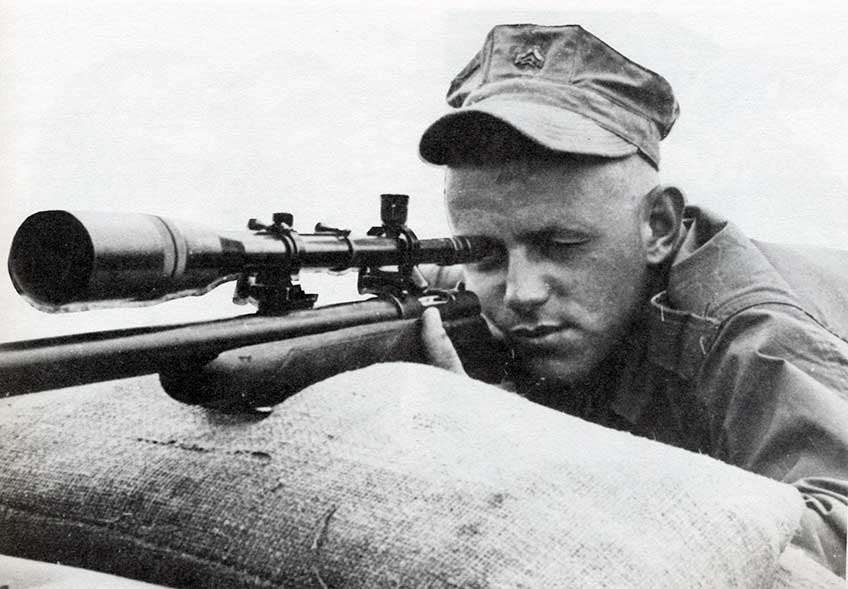
McMillan (right) as a U.S. Marine Corps first lieutenant, inspecting a rifle with Capt. John Jagoda (left). (Photo courtesy/WWMcmillan.info)

Just nine days after the gold Distinguished Pistol Shot Badge was pinned on McMillan’s uniform, the Korean War began. In 1953, McMillan received his commission as a second lieutenant in the infantry, after shooting slightly bigger guns in Korea – 75-millimeter recoilless rifles — as part of the 7th Marines.

One short year later, McMillan earned the Distinguished Marksman Badge. He was now “double distinguished,” a competitive shooting level of skill with both rifle and pistol that few ever attained. Honing his skill annually wasn’t easy, but he was able to score an unprecedented five Lauchheimer awards for being the combined champion for rifle and pistol shooting for the Marine Corps.

That wasn’t at all the end of his Distinguished Badge quest. In May of 1963, McMillan received Distinguished International Shooter Badge #14. This “triple distinguished” recognition came after McMillan’s achievements at the 1962 International Shooting Union matches in Cairo, Egypt.

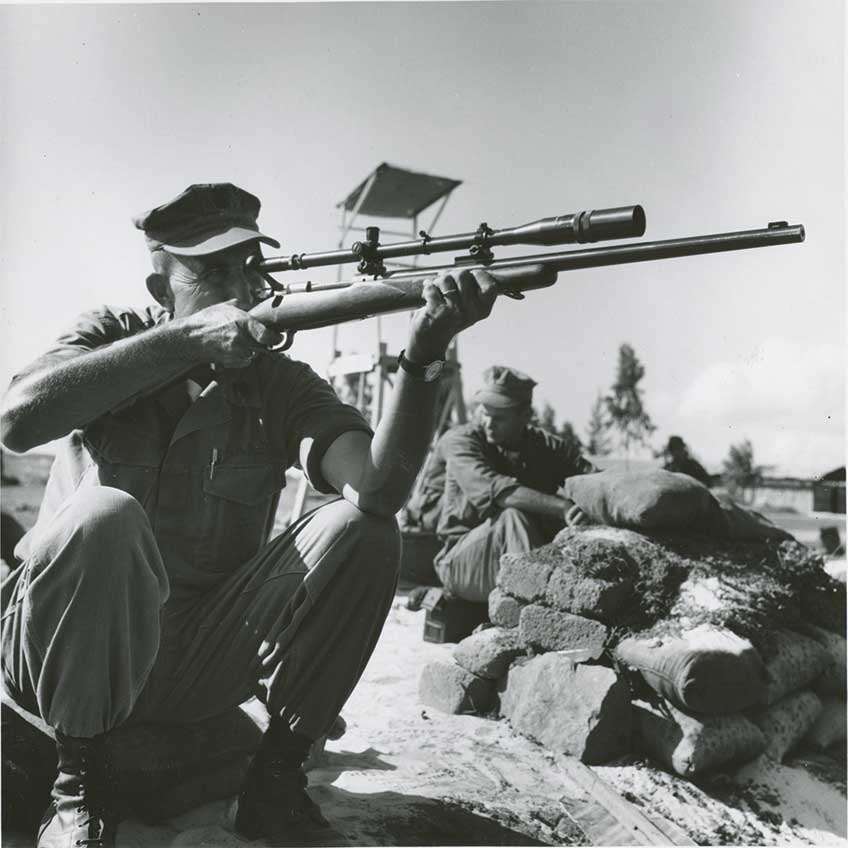
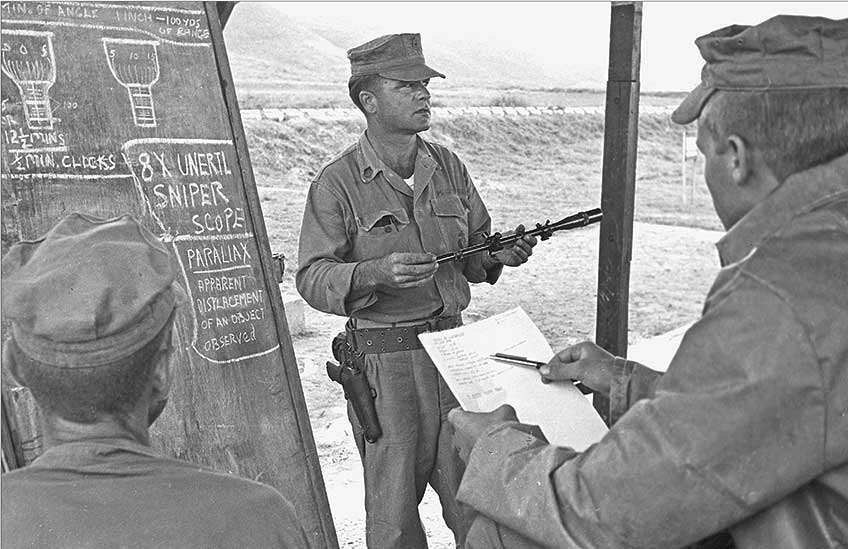
McMillan returned to war in Vietnam, finding himself in the thick of the campaign overseas. As an ordnance officer, he received the Bronze Star and spent a year on Okinawa, responsible for the known-distance ranges for Marine qualifications. He retired from active military service as a lieutenant colonel in 1974 and went into law enforcement training work in California and with the Federal Bureau of Investigation.

McMillan’s military service regularly intersected with his extensive international competition. He competed in his first Olympic Games in 1952 and placed seventh in Helsinki, Finland, as one of the six shooters on the American team. In 1956, problems with a jamming gun in the tryouts cost him the chance to rejoin the American team in Melbourne, Australia.

But it was in 1960 in Rome where McMillan really shone. Using a High Standard .22 pistol that is today on exhibit with his Olympic gold medal at the NRA National Sporting Arms Museum in Springfield, Missouri, McMillan posted an eight-point win in a fiercely competitive rapid-fire pistol struggle against Soviet and Finnish rivals. This was one of the two shooting medals the Americans brought home from the Italian Olympics. Notably, McMillan actually took a nap in the middle of the shooting competition while other competitors shot, then calmly went to the firing line and produced the top score against some probably unnerved opponents.

In the 1964 Tokyo Olympics, McMillan’s high score, just one point behind his 1960 win, was only good enough to bring him 12th place. In Mexico in 1968, 17th place was McMillan’s best result, in an Olympics increasingly dominated by foreign shooters.   In Munich in 1972 and at Montreal in 1976, McMillan’s scores, while very respectable compared to his showing in the 1960 Games, left him far from the winner’s podium. The 1980 Games would have been McMillan’s seventh Olympic appearance, but the U.S. boycott of the Games ended that string.

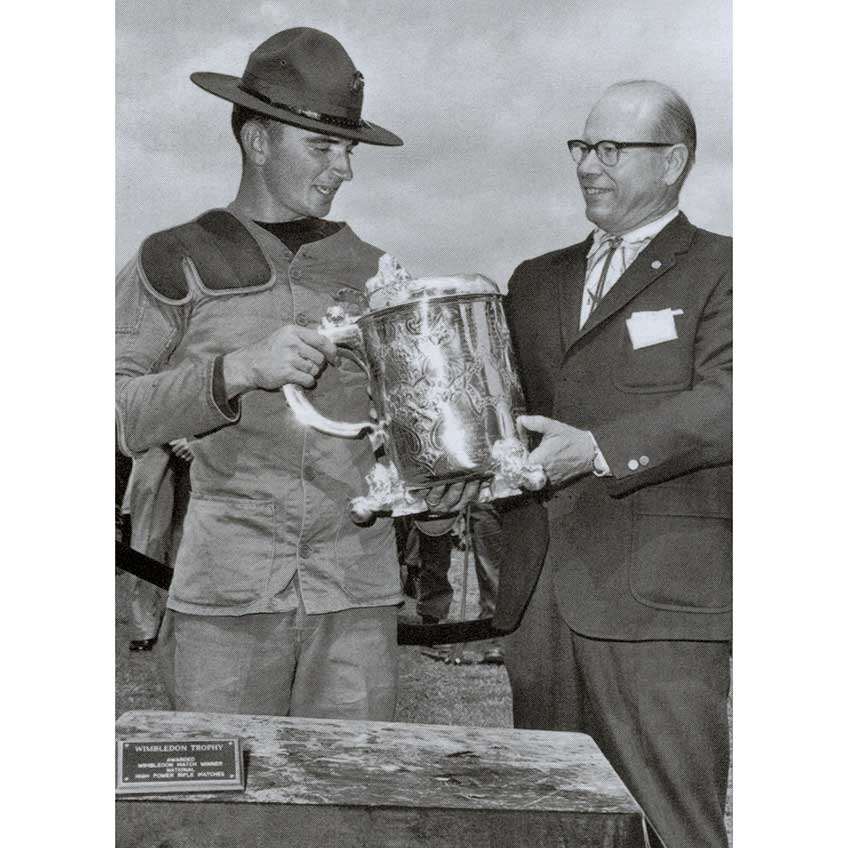
While McMillan’s wins overseas in the later Olympics were denied, he was still going very strong in domestic competition. His Colt National Match .45 was the handgun he used to take the National Trophy for Individual Pistol in 1963. Fitted with a set of gold and silver grips from Mexico, these exotic grips are not what one would normally see on a competition pistol.

However, McMillian used the gun regularly in practice as part of the NRA 2600 Club. He was also recognized as a Lifetime Master in Pistol and Outdoor Pistol. In 1979 and 1980, he received honors as part of the NRA National Training Team.

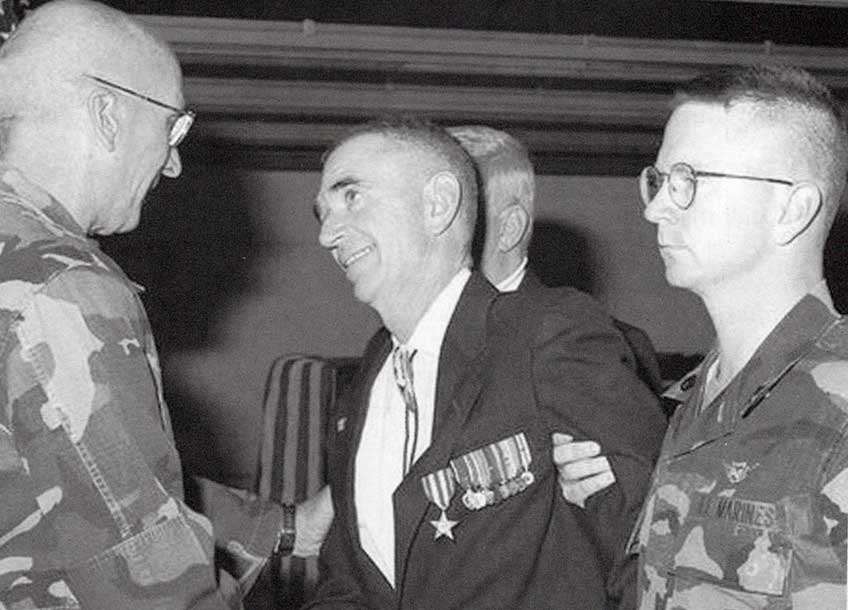
McMillan’s Colt pistol was one of two handguns donated by his son to the NRA, and one that is seen by thousands in the Fairfax galleries annually. Alongside the pistol in the case are his three Distinguished Badges, mounted together as a combined award that celebrates just a fraction of the accomplishments of a most multi-talented shooter, Marine and Olympian, William W. McMillan Jr.

To see McMillan’s Colt National Match .45 and thousands of other unique, historic and significant firearms from across the world and throughout history, visit the NRA National Firearms Museum in person or online!

Categories
Some Red Hot Gospel there! This great Nation & Its People

Damn right Mr. President!

Categories
Our Great Kids Soldiering This great Nation & Its People War

Vietnam war – Harry Thompson’s memories of the battle at Lo Giang as the company clerk.

Categories
All About Guns This great Nation & Its People War

Battleship 40mm Gunner Describes Fighting Off Kamikazes

Categories
This great Nation & Its People War

Confederate War Graves in NORMANDY???

Categories
Soldiering This great Nation & Its People War

SSG Alan Magee: The Luckiest Man in the World by WILL DABBS

In a bygone era, sneezing was understood to be the body’s involuntary effort at expelling evil spirits. Thus the admonition of “Bless you” with each iteration.

Luck. Now that’s a difficult concept to get your head around. Even this deep into the Information Age when most modern folks worship at the exalted altar of science, you can still find people who refuse to walk under a ladder, won’t open an umbrella indoors, or say “Bless you” when someone nearby sneezes. We humans are pretty darn strange.

This was an epic read.

However, what do you expect? Random chance is indeed a fickle mistress. In the superb book Bravo Two Zero by Andy McNab, two SAS operators are sitting side by side in a stolen car stopped at a roadblock on a black rainy night in the Iraqi desert during the First Gulf War. The two men are oriented shoulder-to-shoulder, and the car is stopped in a long line of vehicles rendered immobile by an Iraqi checkpoint.

In combat little things can become big things. Folks often live or die based upon the vagaries of fate.

When discovery was inevitable the two men bailed out of the car, one on the left and the other on the right. One man escaped to freedom, while the other was killed. They began in the same spot, yet each man’s ultimate fate was driven by the side of the car he exited. It’s hard not to get a little weirded out over stuff like that.

I’ve been through too much myself to put a great deal of credence in blind chance. In the dark places Jesus has always worked for me.

Personally, I attribute such stuff to Divine Providence. My faith that an all-powerful God loves and watches over me is a source of great comfort when life is going pear-shaped. God and I have gotten through some remarkable scrapes together. However, in the case of SSG Alan Magee, we find a tale that strains credulity. His story would be impossible to believe had it not been reliably verified.

The Man

The B17 Flying Fortress was one exceptionally pretty warplane. I’d likely feel differently were it dropping bombs on me.
While the B17 got most of the press, there were half again more Liberators in service. The B24 was the most-produced bomber aircraft in history.

Alan Eugene Magee was born on January 13, 1919, the youngest of six children. He grew up in Plainfield, New Jersey. When the war broke out Magee enlisted in the US Army Air Corps and trained to be a gunner on a heavy bomber. The heavies—the B17 Flying Fortress and the B24 Liberator—promised to revolutionize warfare. Through these expensive strategic assets, the Allies hoped to break the will of the German people to fight. Victory, however, would come at a terrible cost.

1LT Jacob Fredericks named this particular B17. 1LT Fredericks had been an engineer at Kellogg’s making Rice Krispies before the war. He originally picked the plane up at Kellogg Field in Battle Creek, MI, where both the cereal and the plane were made. Naming the machine after a breakfast cereal was a no-brainer.

SSG Magee’s mount, a B17F christened “Snap! Crackle Pop!,” carried a crew of ten. WW2-era fliers had a good deal more latitude to personalize their aircraft than we did when I flew for Uncle Sam. Part of that was because so many of these old planes were destroyed so quickly. Tactical aircraft fighting in WW2 frequently did not survive very long in combat. By contrast, our mounts operating without anybody actively shooting at us were expected to last essentially indefinitely.

I got to fly these things, but they were not my airplanes. The flight engineers and crew dogs owned the aircraft. We pilots just drove them from time to time.

For a time I flew an entirely different Boeing product. In my day the flight engineer and crew chief owned the airplane. It was their names that rightfully got stenciled on the sides. The pilots just borrowed them from time to time. We typically drew specific tail numbers for specific missions at the whim of the maintenance officers. When we deployed to some austere spaces we’d typically personalize our aircraft with chalk intending to wash it off when we got home.

You have to be careful what you scribble on the outside of a military aircraft. Sometimes sensitive eyes can see that stuff once you get back to the World.

One of my flight engineers returned from a desert deployment with something quite risqué scrawled on the belly of his aircraft. I never crawled underneath them, so I had no idea it was there. Apparently his pornographic expression was intended to entertain the infantry guys with whom we operated. That was all fine until we got back to home station and did a demo for the local press. The belly of his airplane replete with graphic anatomical references made the front page of the local newspaper. Steve, I bet you thought I had forgotten that. Those were some epically great times.

The Plane

The G-Model B17 Flying Fortress can be differentiated at a glance by the two-gun powered chin turret in the nose.

The B17G was the definitive late-war Fortress. The G-model included such upgrades as a motorized chin turret up front to help dissuade attacking enemy fighters from trying nose-on attacks. SSG Magee’s B17F lacked this particular system in favor of a brace of free fifties in ball mounts in the front Plexiglas.

A modified version of the Wright Cyclone radial engine that powered the B17 actually drove certain models of the M4 Sherman tank as well.

“Snap! Crackle! Pop!” was one of 12,726 of the heavy bombers that rolled out of two plants during World War 2. These planes were powered by four Wright R-1820-97 Cyclone supercharged radial engines each producing 1,200 horsepower. The Wright Cyclone was an iconic design also used in the P36 Hawk, the Douglas DC-3, the SBD Dauntless dive bomber, the Sikorsky H34 helicopter, and, in slightly modified form, certain variants of the M4 Sherman tank.

While obliterating strategic enemy targets was the stated mission of the B17 and B24 heavy bombers, attritting German fighter stocks was also an implicit goal.

The B17’s bomb load ranged from 4,500 to 8,000 pounds depending upon the required range and environmental conditions. The maximum takeoff weight was a whopping 65,500 pounds, and the plane cruised at 158 knots or 182 miles per hour. The B17’s service ceiling was 35,600 feet.

The B17 veritably bristled with AN/M2 .50-caliber machine-guns.

SSG Magee’s B17F packed eleven AN/M2 .50-caliber machineguns in a variety of handheld and powered mountings. These weapons and mounts were meticulously designed to provide optimal coverage all around the plane, particularly when flown as part of an extensive and coordinated formation with multiple aircraft. SSG Magee was a relatively short man, so he got tagged for the ball turret.

The Sperry Ball Turret

Though undeniably weird, the Sperry ball turret was an effective, combat-proven design.

Sperry and Emerson Electric both developed examples of powered ball turrets for use in ventral mounts on combat aircraft during World War 2. The Sperry design was deemed superior and placed into mass production. While the mounts were radically different, both the B17 and the B24 used the same gun turret.

Everything about the ball turret was cramped.

The tricycle landing gear design of the B24 necessitated a retractable mount for the ball turret. Were it not for the retractable mount the turret would strike the ground when the pilot rotated the aircraft for takeoff. By contrast, the conventional landing gear layout of the B17 allowed the ball turret to remain in place through all modes of flight.

You more wore the ball turret than crewed it. It would have been an awfully lonely place in combat.

The ball turret was unimaginably cramped. As a result, this position was typically relegated to the smallest member of the crew. To enter the turret the guns were swiveled straight down, and the gunner entered through a small metal hatch in the back. Once in place, the gunner sat in the fetal position flanked on each side by the ample breaches of his twin Browning fifty-caliber machineguns. There was an electronic reflex sight mounted between the gunner’s feet. Charging these weapons and clearing stoppages were incredible chores within the cramped confines of the ball turret. Ammunition fed from the belly of the plane through a pair of articulated feed chutes.

There wasn’t room in the ball turret for a parachute.

Because of the dearth of usable space, ball turret gunners flew without parachutes. Their chutes were stowed in the crew compartment nearby. However, to bail out, the ball turret gunner had to swivel the guns straight down, unlock and open the access panel, crawl backward out of the turret, attach the parachute, and exit the aircraft. As you might imagine, in a plane that might be gyrating wildly or on fire this could be quite the impressive feat.

The Event

Like many warplanes of its era, “Snap! Crackle! Pop!” didn’t last long in combat.

On January 3, 1943, SSG Magee strapped into “Snap! Crackle! Pop!” for his seventh combat mission while assigned to the 350th Bomb Squadron of the 303d Bomb Group. Their objective this fateful day was a daylight run over Saint-Nazaire, France. The submarines that sortied out of Saint-Nazaire caused no end of frustration to trans-Atlantic convoys. As a result, Allied planners invested tremendous effort in trying to take out the sub pens that housed and serviced them.

Flak is an abbreviation of the German word Flugabwehrkanone which means “Air Defense Cannon.”

Once near the target, SSG Magee’s aircraft encountered murderously thick flak. A nearby shell burst from a high-velocity 88mm flak gun disabled his ball turret and liberally ventilated both the fuselage of the airplane as well as SSG Magee. SSG Magee clambered out of the turret with difficulty only to find that his parachute had been shredded by the flak hit. As he tried to get his head around that revelation a second shell tore off part of the right-wing. Now uncontrollable, “Snap! Crackle! Pop!” entered a vicious spin.

SSG Magee’s B17 disintegrated in mid-air.

SSG Magee’s plane was at cruising altitude, and his quick egress from the ball turret left him without access to the plane’s oxygen supply. He somehow made it to the radio compartment before losing consciousness due to hypoxia. Soon thereafter his B17 disintegrated.

That SSG Alan Magee survived being thrown clear of his disabled B17 at more than 20,000 feet without a parachute was a legitimate miracle.

SSG Magee was miraculously thrown free of the crippled airplane and fell some four miles toward the French ground below. He ultimately ended up crashing through the glass roof of the Saint-Nazaire train station. Passersby found him unconscious but alive on the floor of the terminal.

Both SSG Magee and his aircraft were well and truly mangled.

SSG Magee had 28 different shrapnel wounds from the original flak attack. In addition, he suffered multiple broken bones, severe facial trauma, and damage to both his lungs and kidneys. His right arm was also nearly severed from tearing through the glass of the train station. However, he was inexplicably still alive.

The Rest of the Story

I’ve done this before. Trust me, you come screaming out of the sky at an impressive clip. I can’t imagine surviving such an event without a parachute.

Terminal velocity for a limp human is about 120 miles per hour. Nothing about SSG Magee’s ordeal should have been survivable. However, he was taken prisoner by the Germans and eventually recovered after some decent medical care. He spent more than two years in a German POW camp before being liberated in May of 1945. Once he was repatriated he was awarded the Air Medal along with a well-deserved Purple Heart.

SSG Alan Magee went on to enjoy a long full life. Here he is seen at a memorial for his downed B17 in Europe.

After the war, Alan Magee earned his pilot’s license and worked in the airline industry. He retired in 1979 and moved to New Mexico. SSG Magee died in January of 2003 of a stroke and kidney failure at the ripe age of 84, arguably the luckiest man alive.