Categories
Category: The Green Machine
Categories

It was 1861 when Michigan’s legislature dismissed the idea of George Copway — a popular Methodist minister and Chippewa — to recruit a regiment of Great Lakes Native Americans who he claimed were “inured to hardships, fleet as deer, shrewd, and cautious.” However, much had changed in the span of two years, including the imposition of a federally imposed draft, quotas to be filled by each state, and the already-spilt blood of thousands of Michiganders. As such, Michigan began to seek out Native American soldiers to support the Union war efforts.
Col. Charles V. DeLand, a veteran of the 9th Michigan Infantry, and a troop of eager recruiters were particularly interested in finding stealthy men with acute marksmanship to join a regiment of sharpshooters — particularly, in Company K of the 1st Michigan Sharpshooters. But these recruits needed an incentive, like the promise of payment, meals, and the possibility of negotiating the protection of their traditional homelands from outsider incursion.
In a time when Native Americans feared losing their homes, military service spurred a glimmer of hope. Saginaw Chippewa Chief Nockkechickfawme gave the young men of his tribe even more motivation when he sharply warned of a Confederate overtaking where “there will be no protection for us; we shall be driven from our homes, our lands, and the graves of our friends.” Ottawa Chief Pawbawme drew from his fellow chief’s influence, sparking the enlistment of approximately two dozen more men with his fiery oration.
Upon their departure by steamer, the Ottawa-Ojibwa men were seen off by a great majority of their community. Among these departing warriors was Antoine Scott, who would later be recommended twice for the Medal of Honor but would never be awarded the great recognition.
Another was Thomas Kechittigo — known to many as “Big Tom” — who had originally been refused enlistment in 1861 but would climb the ranks to become a sergeant in Company K. Recruits came from Oceana County, Bear River, Little Traverse, Charlevoix, La Croix and near Saginaw.
Of those who drove enlistments, a shining star was Second Lieut. Garrett A. Graveraet. A young man of only 23, the multi-talented Graveraet became an officer and led an impressive recruitment drive to strengthen the ranks of Company K. He even signed up his own father, the 55-year-old Henry Graveraet, who shaved off 10 years from his true age during enlistment and was the company’s only non-native soldier.
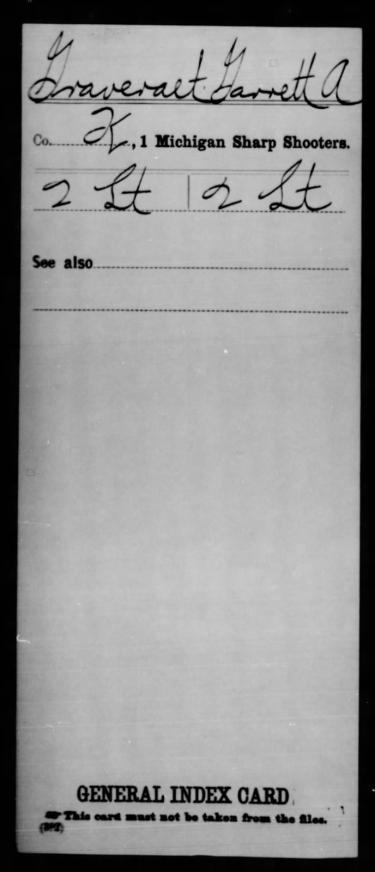
Following recruitment, the men of Company K were met with vigorous training. So, while veteran Colonel DeLand and part of the Michigan regiment sought out the Confederate raider John Hunt Morgan in Indiana, Graveraet — along with Capt. Edwin V. Andress and First Lieut. William Driggs — drilled the recruits of the new company into shape.
They were so effective that upon DeLand’s return, mustering officer Lieut. Col. John R. Smith noted that the recruits were “the stuff, no doubt, of which good sharpshooters can easily be made.” And these native troops were promised the same benefits as white soldiers, such as $13 pay a month — outweighing the $10 monthly pay that U.S. Colored Troops (USCTs) received until equal pay was mandated.
Despite that difference, those in Company K began their wartime service by defending military storehouses and guarding Confederate prisoners — a path reflective of many USCTs’ entry into military service.
Ordered to guard prisoners of war at Camp Douglas outside Chicago, the company experienced the bitter taste of camp life, as they faced not only boredom but also disease and desertion. Additionally, fellow soldiers and Chicago civilians were fascinated by the culture that accompanied Company K.
It wasn’t until March 8, 1864, that orders came in, directing the 1st Michigan Sharpshooters to Annapolis, Maryland, where they would rendezvous with Maj. Gen. Ambrose Burnside’s IX Corps of the Army of the Potomac. Arriving as Lieut. Gen. U.S. Grant started upon the Overland Campaign, the sturdy soldiers of Company K were inserted into the whirlwind of battle.
Their first foray into combat came with the Battle of the Wilderness on May 6, 1864, when the native soldiers engaged with Confederate forces south of Saunders’ Field. They used the brush and mud of their surroundings to camouflage their uniforms and, with an acute aptitude for sharpshooting and skirmishing, dove into battle with great determination. Mortally wounded in the fighting, Sergeant Charles Allen was the first casualty of war to come out of Company K.
However, the dark side of war only intensified for Company K, as days later — on May 12, 1864 — they were attacked by North Carolinians under Brig. Gen. James H. Lane during the Battle of Spotsylvania Court House. Ten more of the company’s men were lost as a result of the fighting.
By June 17, 1864, the Army of the Potomac had moved south of the James River and Company K was again swept into combat when the 1st Michigan were included in Brig. Gen. Orlando Willcox’s poorly executed attack on a Confederate salient around Petersburg, Virginia.
While the sharpshooters obtained possession of Confederate breastworks, they were also isolated and soon-to-be surrounded by enemy forces under Brig. Gen. Matthew Ransom. The already dissipated native soldiers battled on, engaging in hand-to-hand combat that covered the retreat of their fellow soldiers, but were ultimately overwhelmed by the Confederates.
Company K suffered two casualties from the incident, including Oliver Arpetargezhik and the young, bright Lieutenant Graveraet. The young Graveraet fell only days after the combat death of the elder Graveraet.
However, the impact of the June 17 fighting brought about a fate worse than death for more than 80 soldiers from the 1st Michigan, including 14 men from Company K, who were captured by the enemy. Prisoners of war, these soldiers were sent to the notorious Andersonville Prison, where about 50% of these men didn’t make it out alive.
For those who avoided Andersonville, the following month was full of picketing, sniping, and digging, and overall unsavory conditions around Petersburg. But despite the monotony, the native sharpshooters didn’t fail to impress their fellow soldiers. There was a certain instance in which Lieut. Freeman S. Bowley witnessed the sharpshooters intently watch a mile-far chimney for hours, waiting for the enemy force to show themselves. When it seemed like no development was in sight, a sudden shot was fired and a Confederate was seen falling from the chimney, after exposing a portion of his body.
By the end of July 1864, the Union Army was hell-bent on breaking the stalemate in Petersburg and devised a plan to dig a lengthy tunnel under the Confederate defenses, and then fill this space with explosives. On July 30, the Federals detonated the mine, blowing a gap in the Confederate defenses. The 2nd Brigade from Brigadier General Willcox’s division, which included the 1st Michigan, was the third unit to charge into the crater. There, they encountered masses of dazed and confused Federals, many of whom failed to reach enemy lines. They also came across Confederates who, after regrouping, fought back.
On the far left of the Federal charge, the native sharpshooters had gained a foothold on the Confederate defenses, but the circumstances prevented them from overcoming enemy forces. As those opposing soldiers rained fire into the crater, the Native American forces remained composed and determined amidst an impossible situation.
Accounts of the 1st Michigan’s actions at the Battle of the Crater are far and few between, but the regiment’s current-day historian successfully put the puzzle pieces together to understand its final actions at the fateful site. As Federal forces attempted to retreat, sharpshooters — including Sidney Haight, Charles Thatcher, and Company K’s Pvt. Antoine Scott — covered their comrades. Scott was among the last to remove himself from the chaos and was recommended twice for the Medal of Honor for his astounding bravery, but the Chippewa soldier passed in 1878 and never received recognition. At the Crater, it is estimated that Company K lost three men in battle, plus one wounded and six captured. In total, the 1st Michigan lost approximately 45 soldiers in the assault.
Following the immense devastation of the Crater, Company K’s native sharpshooters were present at the battles of Reams Station, Peebles’ Farm and — in the final year of the Civil War — Hatcher’s Run and final operations around Petersburg. Throughout the course of the conflict, about 150 native soldiers served in Company K.
The righteousness of war turns wholly upon one’s perspective. One man’s freedom fighter is another man’s terrorist. This timeless axiom is as old as mankind. The line between reviled bloodthirsty animal and celebrated warrior can at times be undeniably fine.

There is little I enjoy more than dissecting some rarefied military operation. This venue is dirty with my efforts to explore and explain the tales of heroism and refined military acumen that we as a patriotic people do so righteously venerate. However, what if the point of view is reversed? What if, instead of flint-eyed Navy SEALs infiltrating the hideout of some evil terrorist mastermind to dispense a little frontier justice, the operators are actually the terrorists, and the targets are good red-blooded Americans? I admit that this simple adjustment of source material does change everything about the narrative.

In today’s story, the Good Guys do not win. The Bad Guys perished in the effort, but, per their weird twisted moral calculus, that was likely their goal from the outset. Embedded within this narrative, however, is both a compelling story and some valuable lessons learned. That the aftermath, horrifically tragic though it was, did not turn out to be hugely worse speaks to the heroism and professionalism of the US Marines and Allied forces involved.
The Challenge

Establishing and maintaining all-around security for an aviation unit in a hostile area is a Gordian chore. It is one thing if you are a small SAS contingent tasked with occupying a modest wooded hilltop. It is yet another entirely when you must secure a sprawling airbase established in the middle of hostile territory.

Why would they put an airfield in such a place anyway? Airplanes and helicopters are fast. That’s the point. They can move troops and ordnance over long distances quickly. In this case, however, the tactical exigencies were driven by the short legs of the machines in question and the desire for rapid response times. Positioning strike aircraft as close as possible to the battle zone maximized both loiter time on station and the availability of combat assets. It also put these valuable aircraft within easy striking distance of the Taliban.

It really all comes down to geometry. Despite some simply incredible advances in military mobility, we yet remain fairly 2-dimensional creatures. We walk, run, or creep along the ground in such a way that a secure perimeter will usually grant us a proper sense of peace and security. When that perimeter grows to ungainly dimensions is when mischief ensues.
The Setting

Camp Bastion was a sprawling former British Army airbase situated in a remote portion of Afghanistan’s Helmand Province. The Brits later christened it Camp Shorabak. The facility was originally just a tactical landing zone established in 2005 by an RAF Tactical Air Traffic Control Unit. What began as a handful of tents eventually evolved into a bustling military airfield some four miles long by two miles wide. Camp Bastion was the largest British overseas military camp built since World War 2. At its apogee, Camp Bastion was home to 32,000 Allied troops from the US, the UK, and Denmark. It also played host to a substantial ANA (Afghan National Army) contingent as well as the US Marine Camp Leatherneck.

In 2012 Camp Bastion was equipped with a large number of AV-8B Harriers, AH-1W Cobra attack helicopters, UH-1Y Venom Marine utility helicopters, British AH-64 Apaches, and sundry other Allied aircraft up to and including USAF C-130 cargo planes. In support of these variegated fighting machines was a substantial runway and extensive maintenance facilities. Security for all this stuff fell to a joint UK/US force comprised of RAF personnel, Commonwealth troops, and US Marines. At the time of the attack, Prince Harry was flying combat operations out of Camp Bastion as a British Army AH-64 Apache pilot.

Maintaining security is one of the most odious aspects of the military experience. Defensive anything puts the defenders at a natural disadvantage. An attacker chooses the time and place of an engagement. To counter successfully the defenders have to remain ever-vigilant. Keeping that edge amidst long periods of tedium demands dedication, discipline, and deft inspirational leadership.

Things at Camp Bastion had fallen into a routine. We had been involved in Afghanistan for more than a decade, and the optempo of tactical aircraft in and out of the place remained monotonously steady. Roughly one month prior to the attack US Marine MG Charles Gurganus, the base commander, had reduced the number of Marines patrolling the base perimeter from 325 to 100. This turned out to be a fairly momentous decision.
The Enemy

Considering they are little more than souped-up cavemen with Kalashnikovs, the Taliban made for some formidable military opponents. Their dark religious ethos is difficult to comprehend for Western folk. Political capitulation rather than military defeat granted them ultimate victory in Afghanistan in the summer of 2021. What they have unleashed upon their country subsequent to that debacle was lamentably predictable.

A point of personal privilege–of all the twisted things the Taliban has inflicted upon their people in the name of their dark Satanic god, I think it is the plight of Afghan women that troubles me most. At a time when Americans wax apoplectic over pronoun usage, Afghan girls are prevented from advancing beyond grade school by the threat of violence. The Taliban overlords mandate that their women be treated solely by female physicians. They then ensure that there is no pipeline to replace the current profoundly limited crop of female doctors. Hijab laws are such that an Afghan woman now might live out her entire life never having felt the sun on her skin. Of all the world’s manifest injustice I fear this might be about the worst.
The Attack

The Taliban executed this attack with a team of fifteen jihadists all wearing pilfered American ACU uniforms replete with patches and name tags. They carried a variety of small arms including RPG antitank weapons as well as copious Soviet-era F-1 grenades. They later claimed that the impetus behind the assault was two-fold. The film the Innocence of Muslims had recently debuted, and they hoped to somehow kill or capture Prince Harry as well. Radical Muslims found this movie deeply offensive. Here’s a link to the film. I made it through about four minutes. It is epically bad.

The Taliban assault force penetrated the base perimeter on September 14, 2012, at around 2200 hours local time at a point guarded by Tongan and UK troops. The breach point was near the Marine aircraft hangars. They then split into three 5-man elements.

One team engaged a group of Marine aviation maintenance troops from VMM-161 before moving to attack the camp refueling stations. The second team focused on the parked aircraft. The third assaulted the post-cryogenics compound. As near as I could tell this facility managed low-temperature gases used for sighting systems and aviation support.

RAF security troops were onsite twelve minutes after the first shots were fired. The firefight went on for four hours. The second Taliban team detonated grenades in and on several Allied aircraft and engaged others with RPG fire. During the attack, aircrews scrambled UK Apaches as well as US Cobras and Venoms to lend close support. The Venom aircraft orbited the area supporting friendly troops with their door guns.

The pilots and aviation maintainers from Marine Attack Squadron VMA-211 took up their individual weapons and fought effectively as infantry in the close fight. This was the first time since the Battle of Wake Island during WW2 that US Marine aviation personnel had been called upon to do so. As the first five-man Taliban team moved down the flight line, Marines from VMM-161 cut them down, killing four and severely wounding the fifth, a 24-year-old fighter named Mohammed Nazeer.

One of the other Taliban units was eventually flushed out of hiding by a joint RAF/USMC security element and killed with small arms fire. The final group of insurgents was eventually cut down by gunfire from orbiting helicopters after being fixed in place by the RAF Quick Reaction Force. However, all this was not without cost.

The VMA-211 squadron commander, USMC LTC Chris Raible, had been in his office at the time of the attack. Running toward the sounds of battle armed with nothing but a 9mm pistol, LTC Raible was standing near their medical section when an RPG round with an antipersonnel warhead impacted a nearby wall. A piece of shrapnel struck the Marine officer in the neck, and he bled out.

USMC Sergeant Bradley Atwell was staging nearby preparing to join the base defense efforts. Frags from an RPG round killed him as well. LTC Raible was 40, and SGT Atwell was 27.
The Aftermath

Mohammed Nazeer survived, while the rest of the Taliban attackers perished. Six Harriers were destroyed and another two were damaged. These losses constituted six percent of the Marines’ active Harrier force. However, the Marines had another fourteen Harriers onsite 36 hours after the raid. The Taliban force destroyed a USAF C-130 on the ground as well.

In addition to LTC Raible and SGT Atwell, the Taliban wounded seventeen US and UK troops. Three refueling stations were destroyed, and six soft-skinned maintenance facilities were damaged. Allied losses ultimately totaled some $200 million.

At the time of the attack MG Gurganis was on the promotion list for Lieutenant General. After an investigation found that he was responsible for the degradation of base security he was quietly retired. MG Gregg Sturdivant was in command of USMC aviation assets in the area, and he got a similar treatment. Subsequent interviews with USMC personnel revealed that they had caught Tongan troops asleep on guard duty near where the Taliban breached the wire on several occasions. The British High Commissioner to Tonga vigorously disputed this allegation. The attack was the single greatest loss of US airpower since the Vietnam War.
:quality(70)/cloudfront-us-east-1.images.arcpublishing.com/archetype/ACV3JOBXXBBODC52GWJMLFKF6I.jpg)
A photo illustration showing a gun tied to four shootings in Albany, New York, an investigative document and surveillance video of one shooting. (AP Illustration)
Pulling a pistol from his waistband, the young man spun his human shield toward police.
“Don’t do it!” a pursuing officer pleaded. The young man complied, releasing the bystander and tossing the gun, which skittered across the city street and then into the hands of police.
They soon learned that the 9mm Beretta had a rap sheet. Bullet casings linked it to four shootings, all of them in Albany, New York.
And there was something else. The pistol was U.S. Army property, a weapon intended for use against America’s enemies, not on its streets.
The Army couldn’t say how its Beretta M9 got to New York’s capital. Until the June 2018 police foot chase, the Army didn’t even realize someone had stolen the gun. Inventory records checked by investigators said the M9 was 600 miles away — safe inside Fort Bragg, North Carolina.
“It’s incredibly alarming,” said Albany County District Attorney David Soares. “It raises the other question as to what else is seeping into a community that could pose a clear and present danger.”
The armed services and the Pentagon are not eager for the public to know the answer.
In the first public accounting of its kind in decades, an Associated Press investigation has found that at least 1,900 U.S. military firearms were lost or stolen during the 2010s, with some resurfacing in violent crimes. Because some armed services have suppressed the release of basic information, AP’s total is a certain undercount.
Government records covering the Army, Marine Corps, Navy and Air Force show pistols, machine guns, shotguns and automatic assault rifles have vanished from armories, supply warehouses, Navy warships, firing ranges and other places where they were used, stored or transported. These weapons of war disappeared because of unlocked doors, sleeping troops, a surveillance system that didn’t record, break-ins and other security lapses that, until now, have not been publicly reported.
While AP’s focus was firearms, military explosives also were lost or stolen, including armor-piercing grenades that ended up in an Atlanta backyard.
:quality(70)/cloudfront-us-east-1.images.arcpublishing.com/archetype/ANTDAVSMBNHOXMGV6GCJLBYWEM.jpg)
Weapon theft or loss spanned the military’s global footprint, touching installations from coast to coast, as well as overseas. In Afghanistan, someone cut the padlock on an Army container and stole 65 Beretta M9s — the same type of gun recovered in Albany. The theft went undetected for at least two weeks, when empty pistol boxes were discovered in the compound. The weapons were not recovered.
Even elite units are not immune. A former member of a Marines special operations unit was busted with two stolen guns. A Navy SEAL lost his pistol during a fight in a restaurant in Lebanon.
The Pentagon used to share annual updates about stolen weapons with Congress, but the requirement to do so ended years ago and public accountability has slipped. The Army and Air Force, for example, couldn’t readily tell AP how many weapons were lost or stolen from 2010 through 2019. So the AP built its own database, using extensive federal Freedom of Information Act requests to review hundreds of military criminal case files or property loss reports, as well as internal military analysis and data from registries of small arms.
Sometimes, weapons disappear without a paper trail. Military investigators regularly close cases without finding the firearms or person responsible because shoddy records lead to dead ends.
:quality(70)/cloudfront-us-east-1.images.arcpublishing.com/archetype/KDMCCEREMRBYFJN6KD72C2YS4Y.jpg)
The military’s weapons are especially vulnerable to corrupt insiders responsible for securing them. They know how to exploit weak points within armories or the military’s enormous supply chains. Often from lower ranks, they may see a chance to make a buck from a military that can afford it.
“It’s about the money, right?” said Brig. Gen. Duane Miller, who as deputy provost marshal general is the Army’s No. 2 law enforcement official.
Theft or loss happens more than the Army has publicly acknowledged. During an initial interview, Miller significantly understated the extent to which weapons disappear, citing records that report only a few hundred missing rifles and handguns. But an internal analysis AP obtained, done by the Army’s Office of the Provost Marshal General, tallied 1,303 firearms.
In a second interview, Miller said he wasn’t aware of the memos, which had been distributed throughout the Army, until AP pointed them out following the first interview. “If I had the information in front of me,” Miller said, “I would share it with you.” Other Army officials said the internal analysis might overstate some losses.
The AP’s investigation began a decade ago. From the start, the Army has given conflicting information on a subject with the potential to embarrass — and that’s when it has provided information at all. A former insider described how Army officials resisted releasing details of missing guns when AP first inquired, and indeed that information was never provided.
Top officials within the Army, Marines and Secretary of Defense’s office said that weapon accountability is a high priority, and when the military knows a weapon is missing it does trigger a concerted response to recover it. The officials also said missing weapons are not a widespread problem and noted that the number is a tiny fraction of the military’s stockpile.
“We have a very large inventory of several million of these weapons,” Pentagon spokesman John Kirby said in an interview. “We take this very seriously and we think we do a very good job. That doesn’t mean that there aren’t losses. It doesn’t mean that there aren’t mistakes made.”
Kirby said those mistakes are few, though, and last year the military could account for 99.999% of its firearms. “Though the numbers are small, one is too many,” he said.
In the absence of a regular reporting requirement, the Pentagon is responsible for informing Congress of any “significant” incidents of missing weapons. That hasn’t happened since at least 2017. While a missing portable missile such as a Stinger would qualify for notifying lawmakers, a stolen machine gun would not, according to a senior Department of Defense official whom the Pentagon provided for an interview on condition the official not be named.
While AP’s analysis covered the 2010s, incidents persist.
In May, an Army trainee who fled Fort Jackson in South Carolina with an M4 rifle hijacked a school bus full of children, pointing his unloaded assault weapon at the driver before eventually letting everyone go.
Last October, police in San Diego were startled to find a military grenade launcher on the front seat of a car they pulled over for expired license plates. The driver and his passenger were middle-aged men with criminal records.
After publicizing the arrest, police got a call from a Marine Corps base up the Pacific coast. The Marines wanted to know if the grenade launcher was one they needed to find. They read off a serial number.
It wasn’t a match.
CRIME GUNS
Stolen military guns have been sold to street gang members, recovered on felons and used in violent crimes.
The AP identified eight instances in which five different stolen military firearms were used in a civilian shooting or other violent crime, and others in which felons were caught possessing weapons. To find these cases, AP combed investigative and court records, as well as published reports. Federal restrictions on sharing firearms information publicly mean the case total is certainly an undercount.
The military requires itself to inform civilian law enforcement when a gun is lost or stolen, and the services help in subsequent investigations. The Pentagon does not track crime guns, and spokesman Kirby said his office was unaware of any stolen firearms used in civilian crimes.
The closest AP could find to an independent tally was done by the FBI’s Criminal Justice Information Services. It said 22 guns issued by the U.S. military were used in a felony during the 2010s. That total could include surplus weapons the military sells to the public or loans to civilian law enforcement.
Those FBI records also appear to be undercount. They say that no military-issue gun was used in a felony in 2018, but at least one was.
:quality(70)/cloudfront-us-east-1.images.arcpublishing.com/archetype/6NOBD4L22ZF45JFUKS7R2TNAFA.jpg)
Back in June 2018, Albany police were searching for 21-year-old Alvin Damon. They’d placed him at a shooting which involved the Beretta M9, a workhorse weapon for the military that is similar to a model Beretta produces for the civilian market.
Surveillance video obtained by AP shows another man firing the gun four times at a group of people off camera, taking cover behind a building between shots. Two men walking with him scattered, one dropping his hat in the street. No one was injured.
Two months later, Detective Daniel Seeber spotted Damon on a stoop near the Prince Deli corner store. Damon took off running and, not far into the chase, grabbed a bystander who had just emerged from the deli with juice and a bag of chips.
After Detective Seeber defused the standoff, officers collected the pistol. A check by New York State Police returned leads to four Albany shootings, including one just the day before in which a bullet lodged in a living room wall. In another, someone was shot in the ankle.
At the request of Albany police, the U.S. Bureau of Alcohol, Tobacco, Firearms and Explosives traced the gun’s story. The ATF contacted Army’s Criminal Investigation Command, and a review of Army inventory systems showed the M9 had been listed as “in-transit” between two Fort Bragg units for two years before police recovered it.
And the Army still doesn’t know who stole the gun, or when.
The case wasn’t the first in which police recovered a stolen service pistol before troops at Fort Bragg realized it was missing. AP found a second instance, involving a pistol that was among 21 M9s stolen from an arms room.
Military police learned of the theft in 2010. By then, one of the M9s was sitting in an evidence room in the Hoke County Sheriff’s Department, picked up in a North Carolina backyard not far from Bragg. Another M9 was later seized in Durham after it was used in a parking lot shooting.
Another steady North Carolina source of weapons has been Marine Corps Base Camp Lejeune, where authorities often have an open missing weapons investigation. Detectives in Baltimore found a Beretta M9 stolen from a Lejeune armory during a cocaine bust. The Naval Criminal Investigative Service found in the 2011 case that inventory and security procedures were rarely followed. Three guns were stolen; no one was charged.
Deputies in South Carolina were called in 2017 after a man started wildly shooting an M9 pistol into the air during an argument with his girlfriend. The boyfriend, a convicted felon, then started shooting toward a neighbor’s house. The pistol came from a National Guard armory that a thief entered through an unlocked door, hauling off six automatic weapons, a grenade launcher and five M9s.
Meanwhile, authorities in central California are still finding AK-74 assault rifles that were among 26 stolen from Fort Irwin a decade ago. Military police officers stole the guns from the Army base, selling some to the Fresno Bulldogs street gang.
At least nine of the AKs have not been recovered.
INSIDER THREAT
The people with easiest access to military firearms are those who handle and secure them.
In the Army, they are often junior soldiers assigned to armories or arms rooms, according to Col. Kenneth Williams, director of supply under the Army’s G-4 Logistics branch.
“This is a young guy or gal,” Williams said. “This is a person normally on their first tour of duty. So you can see that we put great responsibility on our soldiers immediately when they come in.”
Armorers have access both to firearms and the spare parts kept for repairs. These upper receivers, lower receivers and trigger assemblies can be used to make new guns or enhance existing ones.
“We’ve seen issues like that in the past where an armorer might build an M16” automatic assault rifle from military parts, said Mark Ridley, a former deputy director of the Naval Criminal Investigative Service. “You have to be really concerned with certain armorers and how they build small arms and small weapons.”
In 2014, NCIS began investigating the theft of weapons parts from Special Boat Team Twelve, a Navy unit based in Coronado, California. Four M4 trigger assemblies that could make a civilian AR-15 fully automatic were missing. Investigators found an armory inventory manager was manipulating electronic records by moving items or claiming they had been transferred. The parts were never recovered and the case was closed after federal prosecutors declined to file charges.
Weapons accountability is part of military routine. Armorers are supposed to check weapons when they open each day. Sight counts, a visual total of weapons on hand, are drilled into troops whether they are in the field, on patrol or in the arms room. But as long as there have been armories, people have been stealing from them.
:quality(70)/cloudfront-us-east-1.images.arcpublishing.com/archetype/OUECDQCYPJFVHJZLQZTKFZNXA4.jpg)
Weapons enter the public three main ways: direct sales from thieves to buyers, through pawn shops and surplus stores, and online.
Investigators have found sensitive and restricted parts for military weapons on sites including eBay, which said in a statement it has “zero tolerance” for stolen military gear on its site.
At Fort Campbell, Kentucky, soldiers stole machine gun parts and other items that ended up with online buyers in Russia, China, Mexico and elsewhere. The civilian ringleader, who was found with a warehouse of items, was convicted. Authorities said he made hundreds of thousands of dollars.
Often though, recovering a weapon can prove hard.
:quality(70)/cloudfront-us-east-1.images.arcpublishing.com/archetype/VC5AKAPMVJBIRHG5VFAVFK6XHE.jpg)
When an M203 grenade launcher couldn’t be found during a 2019 inventory at a Marine Corps supply base in Albany, Georgia, investigators sought surveillance camera footage. It didn’t exist. The warehouse manager said the system couldn’t be played back at the time.
An analysis of 45 firearms-only investigations in the Navy and Marines found that in 55% of cases, no suspect could be found and weapons remained missing. In those unresolved cases, investigators found records were destroyed or falsified, armories lacked basic security and inventories weren’t completed for weeks or months.
“Gun-decking” is Navy slang for faking work. In the case of the USS Comstock, gun-decking led to the disappearance of three pistols.
Investigators found numerous security lapses in the 2012 case, including one sailor asleep in the armory. The missing pistols weren’t properly logged in the ship’s inventory when they were received several days before. Investigators couldn’t pinpoint what day they disappeared because sailors gun-decked inventory reports by not doing actual counts.
ROOM FOR DISCREPANCY
Military officials shied from discussing how many guns they have, much less how many are missing.
AP learned that the Army, the largest of the armed services, is responsible for about 3.1 million small arms. Across all four branches, the U.S. military has an estimated 4.5 million firearms, according to the nonprofit organization Small Arms Survey.
In its accounting, whenever possible AP eliminated cases in which firearms were lost in combat, during accidents such as aircraft crashes and similar incidents where a weapon’s fate was known.
Unlike the Army and Air Force, which could not answer basic questions about missing weapons, the Marines and Navy were able to produce data covering the 2010s.
The Navy data showed that 211 firearms were reported lost or stolen. In addition, 63 firearms previously considered missing were recovered.
According to AP’s analysis of data from the Marines, 204 firearms were lost or stolen, with 14 later recovered.
To account for missing weapons, the Pentagon relies on incident reports from the services, which it keeps for only three years.
:quality(70)/cloudfront-us-east-1.images.arcpublishing.com/archetype/5RNHGIURC5HDLDQJ453SRTGE4U.jpg)
Pentagon officials said that approximately 100 firearms were unaccounted for in both 2019 and 2018. A majority of those were attributable to accidents or combat losses, they said. Even though AP’s total excluded accidents and combat losses whenever known, it was higher than what the services reported to the Pentagon.
The officials said they could only discuss how many weapons were missing dating to 2018. The reason: They aren’t required to keep earlier records. Without providing documentation, the Pentagon said the number of missing weapons was down significantly in 2020, when the pandemic curtailed many military operations.
The Air Force was the only service branch not to release data. It first responded to several Freedom of Information Act requests by saying no records existed. Air Force representatives then said they would not provide details until yet another FOIA request, filed 1.5 years ago, was fully processed.
The Army sought to suppress information on missing weapons and gave misleading numbers that contradict internal memos.
The AP began asking the Army for details on missing weapons in 2011 and filed a formal request a year later for records of guns listed as missing, lost, stolen or recovered in the Department of Defense Small Arms and Light Weapons Registry. Charles Royal, the former Army civilian employee who was in charge of the registry, said that he prepared records for release that higher ups eventually blocked in 2013.
“You’re dealing with millions of weapons,” Royal said in a recent interview. “But we’re supposed to have 100% recon, right. OK, we’re not allowed a discrepancy on that. But there’s so much room for discrepancy.”
Army spokesman Lt. Col. Brandon Kelley said the service’s property inventory systems don’t readily track how many weapons have been lost or stolen. Army officials said the most accurate count could be found in criminal investigative summaries released under yet another federal records request.
AP’s reading of these investigative records showed 230 lost or stolen rifles or handguns between 2010 and 2019 — a clear undercount. Internal documents show just how much Army officials were downplaying the problem.
The AP obtained two memos covering 2013 through 2019 in which the Army tallied 1,303 stolen or lost rifles and handguns, with theft the primary reason for losses. That number, which Army officials said is imperfect because it includes some combat losses and recoveries, and may include some duplications, was based on criminal investigations and incident reports.
The internal memos are not “an authoritative document,” Kelley said, and were not closely checked with public release in mind. As such, he said, the 1,303 total could be inaccurate.
The investigative records Kelley cited show 62 lost or stolen rifles or handguns from 2013 through 2019. Some of those, like the Beretta M9 used in four shootings in Albany, New York, were recovered.
“One gun creates a ton of devastation,” Albany County District Attorney Soares said. “And then it puts it on local officials, local law enforcement, to have to work extra hard to try to remove those guns from the community.”
Hall reported from Nashville, Tennessee; LaPorta reported from Boca Raton, Florida; Pritchard reported from Los Angeles; Myers reported from Chicago. Also contributing were Jeannie Ohm in Arlington, Virginia; Brian Barrett, Randy Herschaft and Jennifer Farrar in New York; Michael Hill in Albany, New York; and Pia Deshpande in Chicago.
Categories
Juts reach out & f*ck somebody!
