As America geared up for war, the economy of building a wartime army was overwhelming. Tanks, aircraft, soldiers and weapons—all would consume huge resources, and manufacturers were challenged to reduce costs wherever they could. The arms industry was one area where the designers showed great creativity and were able to place function over form to accomplish their mission.
One of the more expensive (and iconic) weapons at the start of the war, the Thompson submachine gun, became a prime target for cost savings. In 1939, the M-1928 A1 Thompson cost the government more than $200 each—more than four times the monthly wages paid to a typical soldier. By 1942, design and production changes had brought the Army’s price down to around $75, and the final M1A1 variant hit a low price of $45 per copy by 1944.
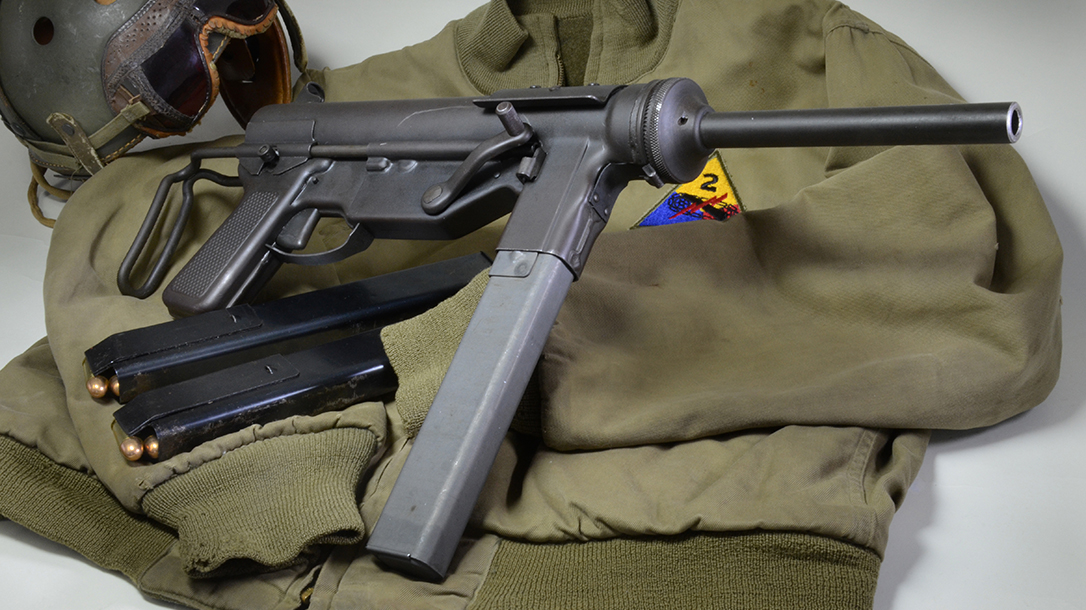
Even so, in 1941 this was excessively expensive for a single weapon, so the War Department sought out a cheaper solution. That solution, the M-3 “Grease Gun,” came in at around $18.50 each, a savings of 90 percent.
As the war came closer to American shores, the U.S. Army Ordnance Board considered what was happening in Europe on the weapons front, including the German MP40 Schmeisser and the British Sten gun, and initiated a study to develop its own easy-to-make submachine gun. Early in 1942, the Army submitted a list of requirements for the new weapon, and Ordnance solicited a list of requirements from both the infantry and cavalry branches for a shoulder-fired weapon with full- or semi-automatic fire capability, in caliber .45 ACP.
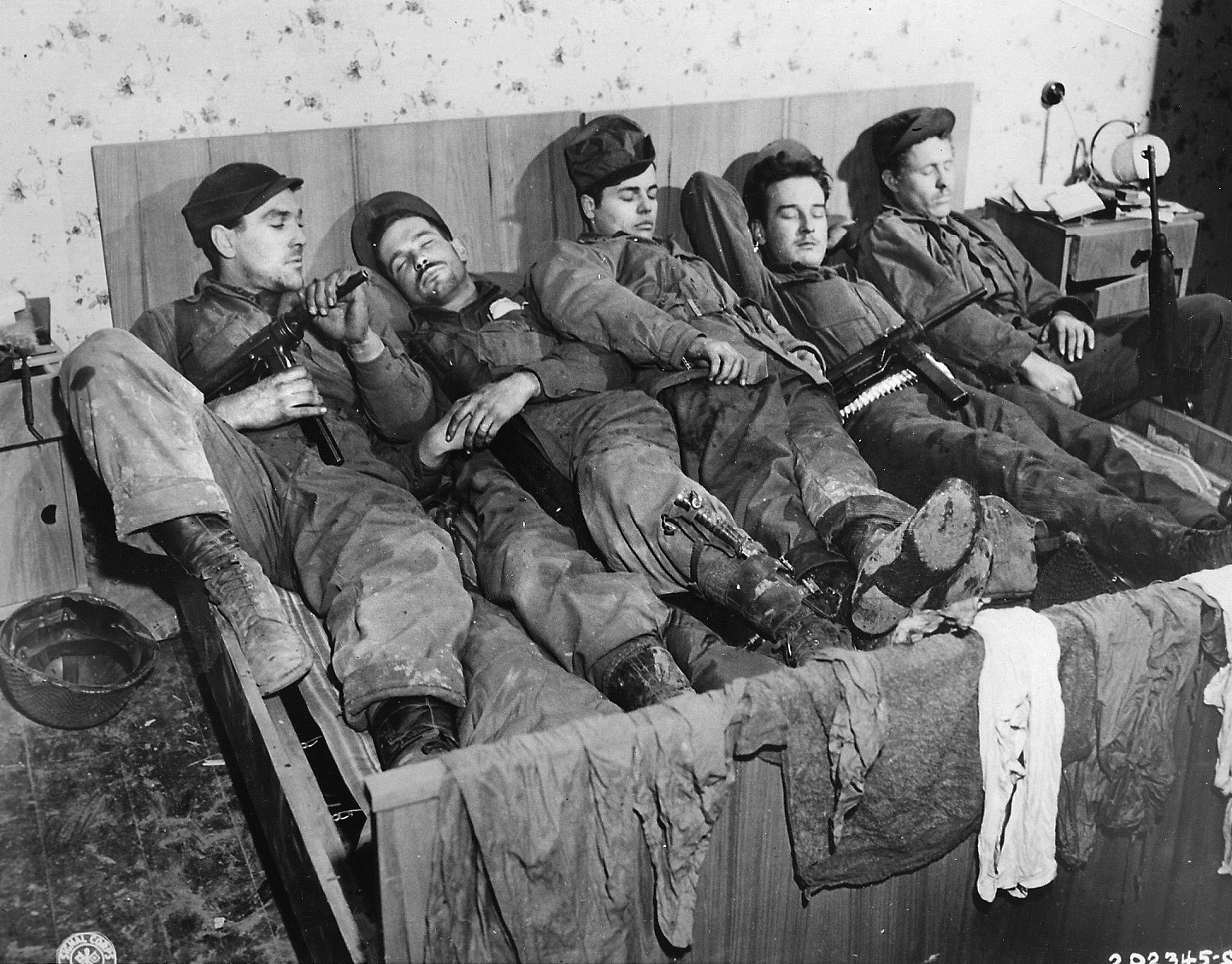 Resting in a German house after a patrol, GIs keep their weapons, including two M-3 “Grease Gun” submachine guns, close at hand.
The list of requirements from each branch were then reviewed and modified at Aberdeen Proving Ground, and a tentative specification released to bidders. The initial T-15 specification of 1942 was for an all-metal weapon of stamped sheet-metal construction to fire the Army’s standard pistol cartridge (.45 ACP); to be designed for inexpensive production with a minimum of machining; and featuring both semi-automatic and fully automatic fire ability; a cyclic rate under 500 rounds per minute; and the ability to place 90 percent of all shots fired (from the standing position in full-automatic mode) on a 6×6-foot target at the combat range of 50 yards. The standard to which the new weapon’s performance was to be compared was the M-1928A1 Thompson, the “Tommy Gun.”
General Motor’s Inland Manufacturing Division in Dayton, Ohio, was just one of several companies that took on the challenge of developing this new weapon. Inland’s design team was already involved in the production of the M-1 carbine, so the chief engineer made this a personal project to plan for tooling and production.
The original War Department specs were simplified in late 1942 to remove the semi-automatic fire capability, and to propose an option to convert the weapon’s original caliber to the commonly available 9mmx19 pistol round that was used by both the Axis and Allied forces. The new specification for this dual caliber weapon was numbered T-20.
Five prototype models of the .45 T-20 and five 9mm conversion kits were built by GM’s Inland Manufacturing prototype shop and submitted for testing in November. At the Ordnance Department trials, the GM submission completed the endurance test with only two failures to feed in over 5,000 rounds fired. In the accuracy portion of the tests, the GM design scored an admirable 97 out of 100 possible hits on the 6 x 6-foot target. Then the real trials began.
Airborne Command, the Amphibious Warfare Board, the Infantry Board, and the Armored Forces Board were all encouraged to look at the best of the new designs. Each branch was told to independently test the T-20 prototype weapons, to see if this new, inexpensive weapon would meet their needs. All four review boards rated the basic GM design as “acceptable,” with similar suggestions and concerns.
All liked the short, handy size and reduced overall length, but all found fault with the GM-designed magazine and feed system, apparently due to the short, wide follower in the magazine that tended to tip or jam under hard use. The cocking handle was deemed too fragile, and the magazine could be difficult to fully load.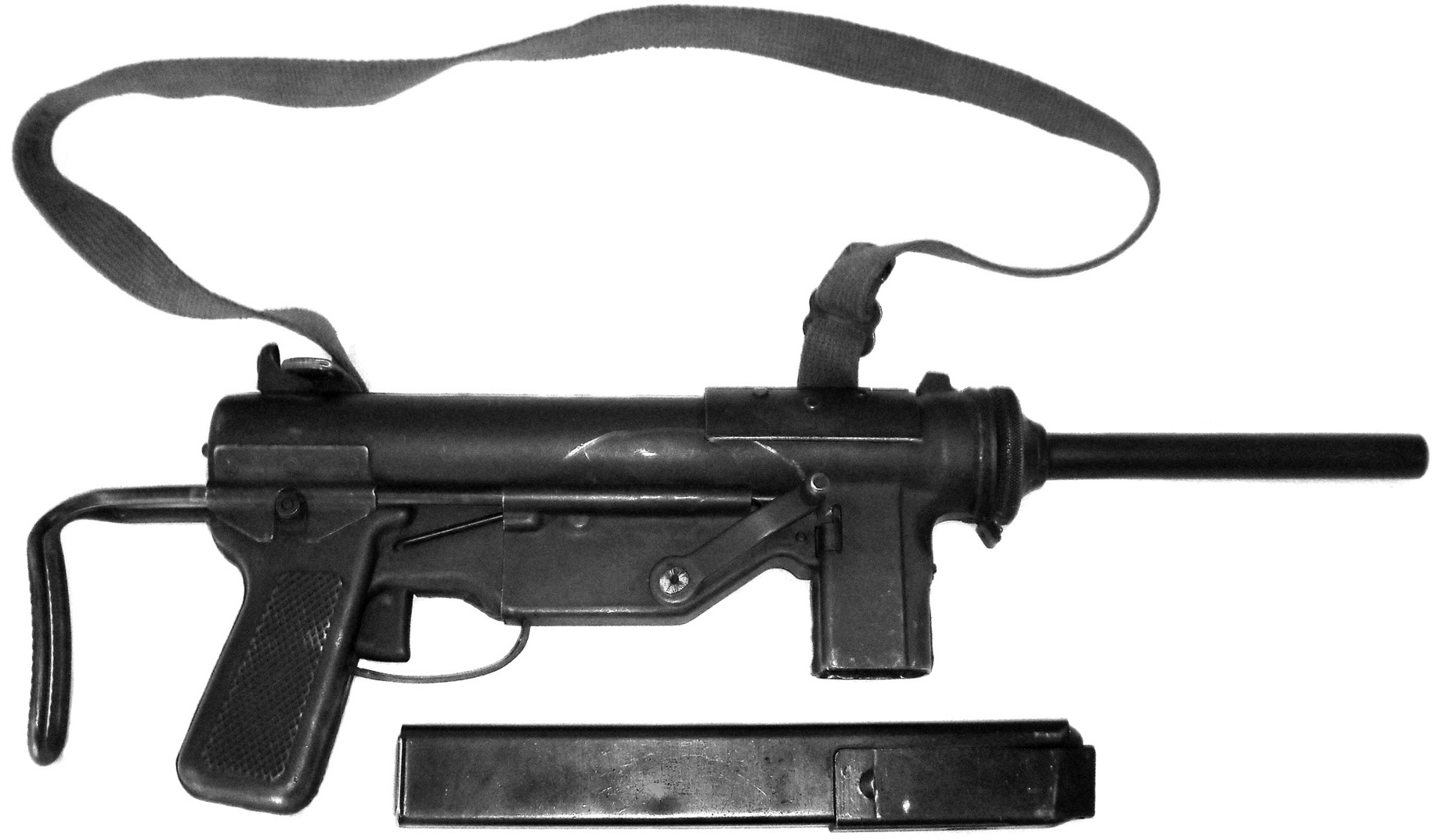
In spite of these faults, the T-20 was formally approved by the Ordnance Department for production in December 1942 as the “U.S. Submachine Gun, Caliber .45, M-3.”
The contract to build this new weapon was issued to the parent organization (GM), which proposed that the Guide Lamp plant in Anderson, Indiana, be the fabrication location, as they were familiar with metal stamping and welding operations and were not working at capacity (according to WPB inspectors). In 1942 this factory was producing blackout lights for Army trucks, M-2 HMG barrels, and parts for the P-39 Airacobra aircraft. With this contract, the Guide Lamp plant was at full capacity, with only 16 percent of the plant capacity dedicated to M-3 production.
When the exclusive contract was given, Guide Lamp produced a total of 606,694 of the M-3 variant sub-machine gun in 1943 and 1944. With no significant changes, the T-20/M-3 was produced as submitted. Even the balky 30-round magazine was put into production as submitted in the interest of expediency. Because of the prework done by the team at Inland, the first guns were able to be submitted for inspector approval within 45 days of the contract.
It was planned that the “Grease Gun” (so called because of its resemblance to the type of tool used by mechanics to lubricate a vehicle’s chassis and axles) or “Buck Rogers Gun” as it was nicknamed by the soldiers, would be produced in numbers sufficient to cancel orders for the more expensive Thompson submachine gun and to allow the Army to remove the Thompson from frontline service.
Due to production delays, design changes, and tooling problems, however, the M-3 never achieved its full potential during World War II, and purchases of the Thompson continued until February 1944. Considering the much longer service life, it is no surprise that the Allies put more than 1.5 million Thompsons into wartime service, outnumbering the M-3 by nearly three to one.
What did the Army get?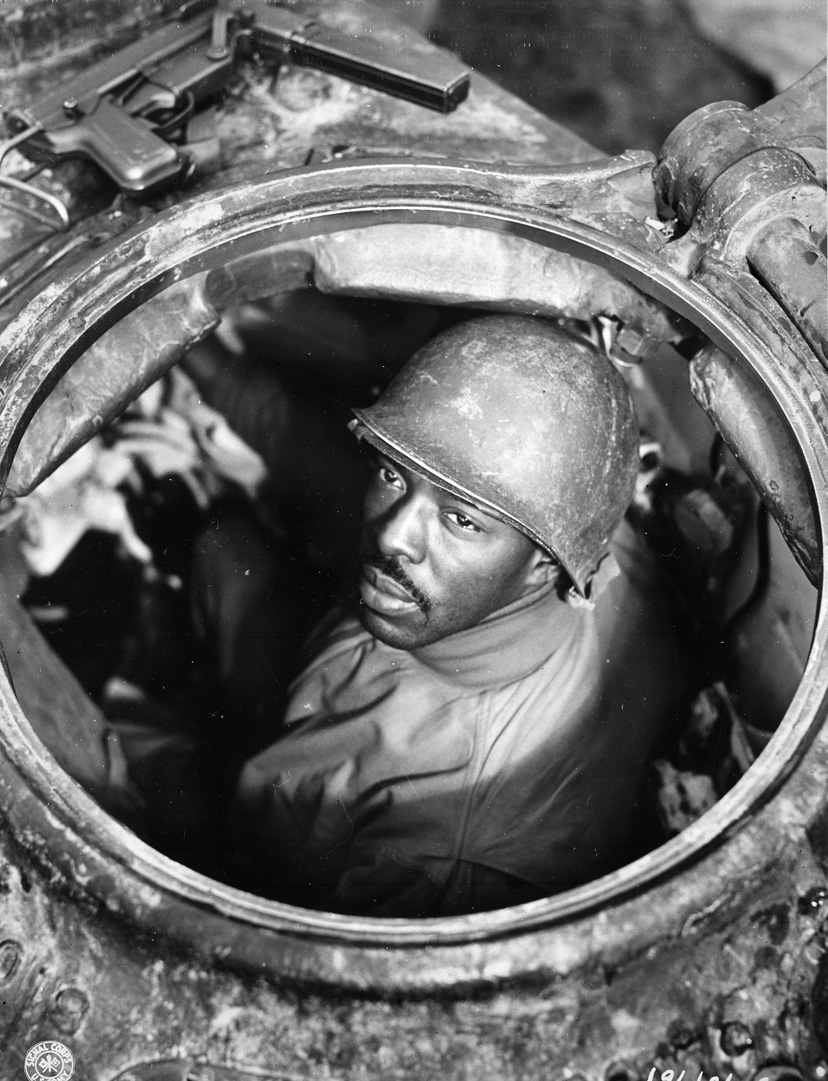
This new and inexpensive M-3 SMG used many automotive production-line processes to keep costs under control. Like the German MP40, the receiver was made of two deep sheet-metal stampings welded together to form the tube for the bolt. The small parts of the firing mechanism were steel stampings, castings, and pressings, with only three machined parts in the whole weapon. The barrel had to be rifled from formed steel tubing, the face of the bolt had to be precision ground, and the threads to retain the barrel were ground, but the balance of the gun was stamped, pressed, and welded.
The magazine was formed from sheet stock, and even the sights were stampings. (A creative note: The sights on the M3 were finished in the test-firing stage when a special drill bored the peep sight hole to align with where the gun put the bullets—not trying to move the sights to meet the point of impact after the fact.)
In the field, the weapon could be disassembled without tools for cleaning or conversion to 9mm. It was simple to work on, reliable, and cheap to build and feed. The firing rate was about half that of the Thompson, firing 300 to 400 rounds per minute, which allowed the individual soldier to stay “in action” longer.
Combined with the lighter weight of the weapon (eight pounds as compared to the Thompson’s 13+ pounds), the GI armed with an M-3 Grease Gun could carry more ammo and stay in the fight longer that one carrying the venerable M-1928 A1.
In combat, the GIs laughed at the ugly duckling. It lacked the fit and finish of the Tommy Gun, and had none of the “image” that came with the Thompson (which had been used by both gangsters and the FBI in the 1920s and 30s). But when the chips were down, the “Greaser” did its job. Dirt didn’t bother it (except that pesky magazine), it was short and handy, and threw enough of the man-stopping .45 ACP rounds that it could help decide a fire fight.
As one GI said, “I hated that gun when they gave it to me. It wasn’t as sharp looking as my Thompson, and looked like a leftover from the parts locker. But when I needed it, that gun never let me down. I didn’t clean it in combat—I just loaded it and drug it through the mud … and it kept shooting.”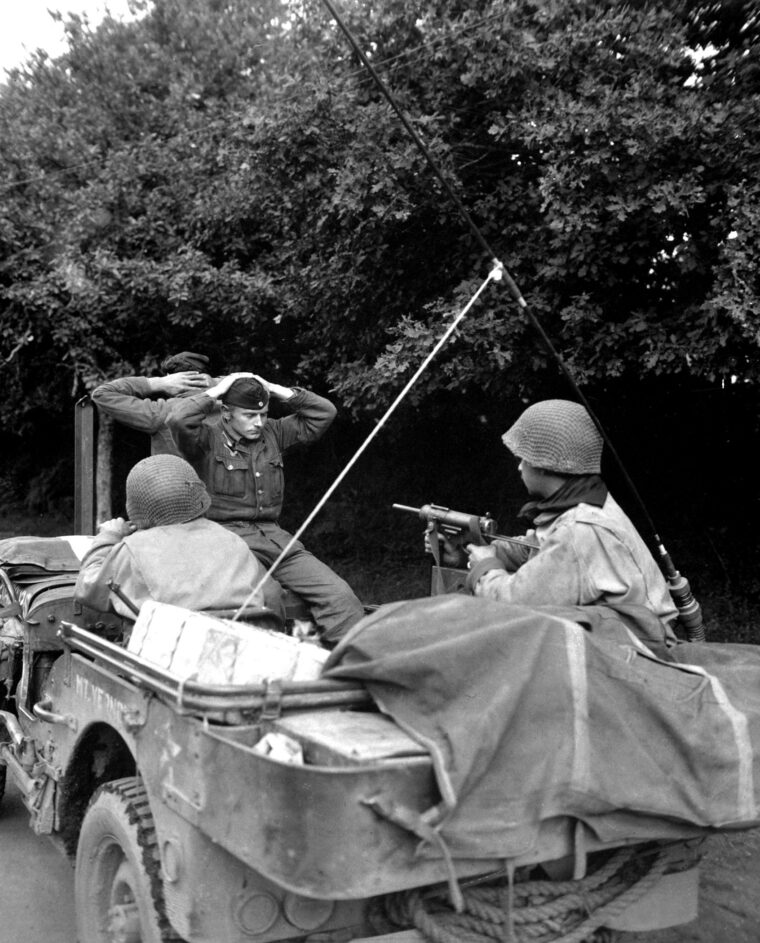
In 1945, the Guide Lamp factory manufactured a simplified M-3 A1 sub-machine gun before production contracts were canceled with the end of the war. A total of 15,000+ were produced, but few saw combat in World War II. During the Korean conflict, the Ithaca Gun Company in Ithaca, New York, produced another 33,000 complete M-3 A1 guns, as well as manufactured thousands of parts for the repair and rebuilding of existing M-3 and M-3 A1 weapons.
The Army originally intended this weapon to be a disposable one—repair parts were not initially ordered or even in the supply system until the end of World War II. The plan, if it broke, was simple: drop it and pick up another. The majority of the failures in combat with this simple gun were related to the magazine, which remained an issue for its entire military career.
The 9mm conversion kit was not widely used, and it is estimated that approximately 1,000 kits were produced by the Rock Island Arsenal and by Buffalo Arms, as well as another 1,000 completed weapons produced by Guide Lamp. The kit consisted of a 9mm barrel, a revised bolt, and a magazine adapter that would permit the use of Commonwealth Stenmagazines. Another variant was produced upon request for OSS use that fitted a silencer to the original barrel. These weapons were built with sound suppressor components produced by High Standard on a Bell Labs design.
However, like many weapons of this era, the M-3 lasted longer in service than anyone thought it would. The Russian Army was provided with a large quantity as part of the U.S. Lend-Lease aid program, but the lack of ammunition left most of them in storage for most of their life. A copy (in 9mm) was produced for the Argentine Army through the 1970s, and was in service long after that time. Several units in the first Gulf War reported for duty with the M-3 or M-3 A1 “Greaser” as an individual-protection weapon for tank-recovery vehicle crews.
A DoD inventory in 1996 showed that more than 1,000 still remained in the depots. Unfortunately for the historical community, few of these have seen the light of day, and examples of the M-3 are seldom seen outside of museums.
The M-3 Grease Gun filled its intended role as an inexpensive, reliable weapon in a wartime economy. It used existing technologies and production methods in new ways to solve a problem and fill a need. While never as popular with the troops as its predecessor, it served the American GI and others around the world for 50 years, and serves as an example of what can be done when there is a need.