Although the scientist who requested the air strike thought it was a success, others weren’t so sure.
One of the U.S. Air Force’s oddest missions was against perhaps its most formidable adversary ever: Mother Nature.
In 1935, lava from the Mauna Loa volcano threatened the nearby seaside town of Hilo, Hawaii. So U.S. bombers, commanded by none other than future Gen. George S. Patton, bombed the lava flow in an attempt to save the town.
Experts were divided on how useful the air strikes ultimately were, but the bombs weren’t the last ones dropped to prevent natural disasters.
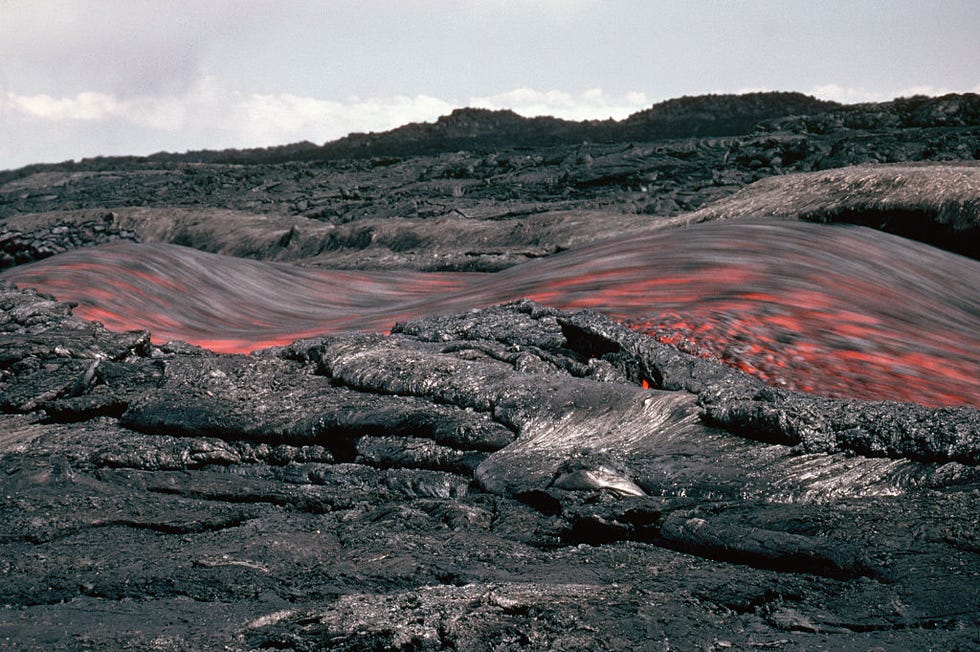
A channel of fast-flowing lava moves through a cooled section of a lava flow. Hawaii, 1984.
Historical//Getty Images
The Hawaiian islands are well known for volcanic activity; the islands themselves were formed by volcanic action over the course of millions of years. The “Big Island” of Hawaii is the home of Mauna Loa, one of the most active volcanoes in the world. It has erupted 33 times since 1843, often adding new territory to America’s 50th state. Indeed, Hawaii is probably the only state in the union that is continuously growing, thanks to volcanoes.
Mauna Loa’s lava flows are closely monitored, but typically harmless. One exception, however, was the 1935 eruption, which unexpectedly flowed north. The eruption started on November 21 and oozed at a rate of a mile a day toward the headwaters of the Wailuku River—the water supply for the town of Hilo. If the volcano cut the supply of fresh water to the town of approximately 20,000 people, the result could be catastrophic.
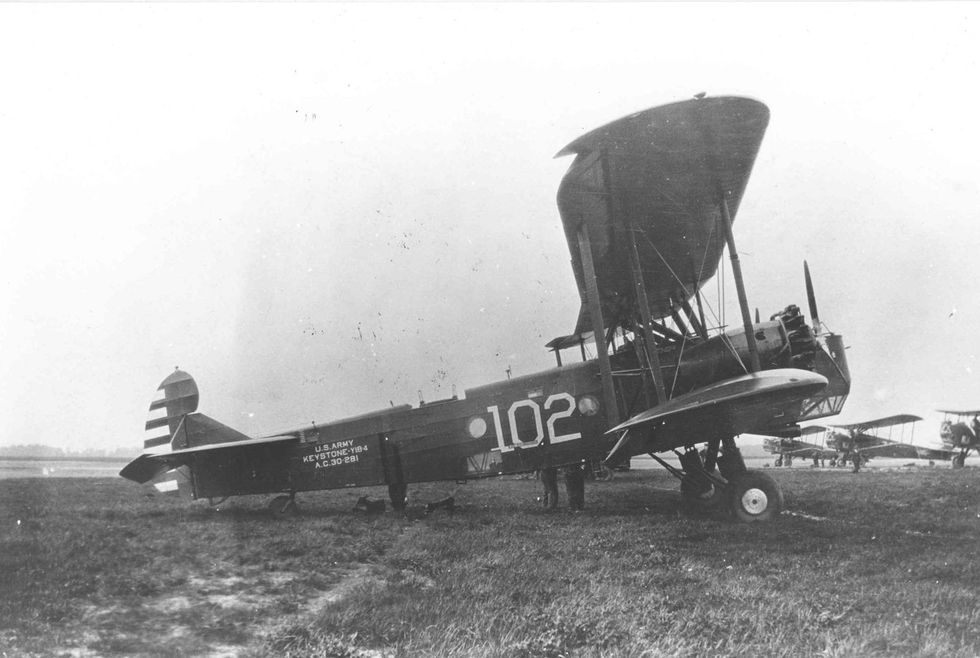
Keystone Y1B-4 bomber.
Wikimedia Commons
Thomas Jagger, the founder of the Hawaiian Volcano Observatory, appealed to the U.S. Army for help. Jagger wanted the Army Air Service, forerunner of the wartime Army Air Corps and later the U.S. Air Force, to bomb the lava tubes and channels that fed lava in the direction of the river. Nobody thought American bombers could destroy the lava, but they hoped the bombing would divert the flow to another, non-threatening direction.
The mission was assigned to Army Air Service planes based on the island of Oahu and planned by Patton. The commander of the First Provisional Tank Brigade in World War I would of course later go on to command the Third Army in Europe during World War II.
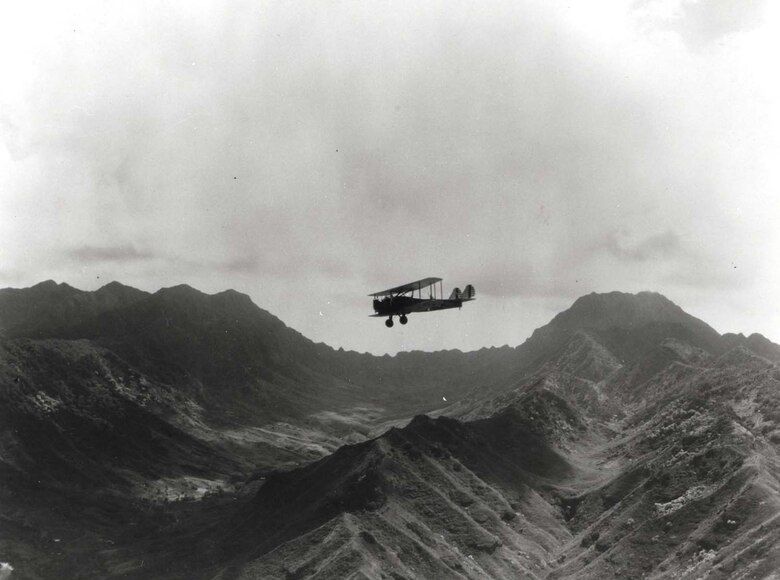
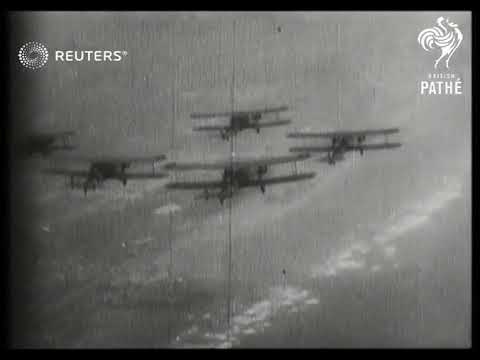
On December 27, 1935, ten Keystone B-3 and B-4 bombers from Luke Field on Ford Island in the middle of Pearl Harbor flew the 200-odd miles to bomb the Humu‘ula lava flow. The bombers dropped 40 bombs, half were high explosive and the rest were WP smoke bombs to mark the impact points. Of the twenty high explosive bombs dropped, sixteen hit the target area and twelve hit the lava tunnel in question.
Here’s video of the planes involved in the air strike:
Jagger observed the air strike from a telescope at the base of Hawaii’s other volcano, Mauna Kea. “The experiment could not have been more successful; the results were exactly as anticipated,” he later told the New York Times. The lava slowed from covering more than 5,000 feet a day to 1,000 feet after the bombing, and the flow stopped entirely on January 2, 1936.
Not everyone shared Jagger’s optimism. Harold Stearns, a U.S. Geologic Survey who flew on the mission, believed the slowing and stopping of the flow was a coincidence. Jagger’s boss, the head of Hawaii National Park, told the Army the day after the attack, “Though we are as yet unable to determine what effect the airplane bombardment achieved … I feel very doubtful that it will succeed in diverting the flow.”
The U.S. Geologic Survey, writing about the incident more than 80 years later, says, “Modern thinking mostly supports Stearns’ conclusion.”
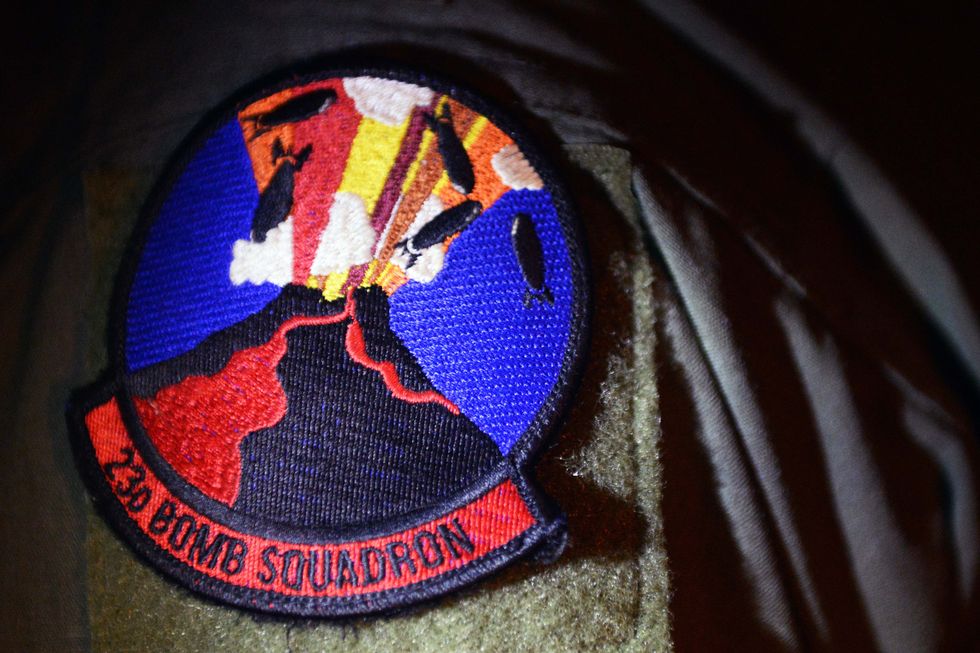
In 2015, the 23rd Bomb Squadron, the unit that flew the mission against Mauna Loa’s lava flow, returned to Hawaii to commemorate the 80th anniversary of the mission. A B-52 bomber assigned to the 23rd Expeditionary Bomb Squadron flew from its temporary base on the island of Guam to Hawaii, a 12-hour mission. The squadron insignia, this Air Force Global Strike Command article notes, still depicts bombs tumbling down onto a volcano.
23rd Bomb Squadron shoulder patch, 2015.
36TH WING PUBLIC AFFAIRS
The 1935 volcano air strike wasn’t the last time mankind trained its weapons of war on nature. Today, Russia and China occasionally send their air forces to bomb frozen rivers, typically to remove dangerously high levels of ice buildup or to allow nearby communities to reconnect with the outside world. And in July 2018, the Swedish Air Force bombed a wildfire on a military training ground, snuffing it out and preventing it from detonating unexploded munitions.
———————————————————————————– I for one did not know this. That and the man did get around did’nt he? All in all I have to say that the US Taxpayer got themselves a real bargain when they commissioned him into the Army.
Particularly in a military environment, the shower is for getting clean,
not socializing. Unsplash photo—photographer One Beauty.
Private Daniels was just not cut out to be a soldier. A wheeled vehicle mechanic, she was forever in trouble. She stole money from her roommate and then attacked the young lady with a shoe brush for reporting her. At the time of this incident she was already being put out of the Army for writing bad checks.
Private Daniels’ boyfriend was a local civilian whom she had met in a bar. I have no idea what he did or where he came from. She had invited him up to her room in the barracks, and he was stupid enough to accept.
CW2 Johansen was one of my Warrant Officers. A former NCO before attending the Warrant Officer course and flight training, Bill was an old school soldier. This fateful evening he was the Battalion Staff Duty Officer. Part of his responsibility involved circling through the barracks, the hangars and the motor pools to ensure everything was quiet and secure. Most officers, myself included, did a fairly cursory job of this. We weren’t at war, and the possibility that the Russians might try to infiltrate our truck park seemed low. Not so Bill Johansen. He checked everything quite thoroughly.
It was wintertime and well below freezing. Bill linked up with the CQ (Charge of Quarters) of the female barracks for a quick walk-through. (Barracks were segregated by gender back then.) The CQ was a junior enlisted soldier whose duty it was to mind the front desk to the barracks all night. As it was a female-only facility, the CQ served as Bill’s escort as he did his walk-through. On the second floor, as they strolled past the communal latrine, they heard jungle noises.
Bill dispatched the CQ to investigate. The CQ duly reported that Private Daniels and her boyfriend were enjoying a cozy shower together. Bill Johansen was having none of that.
Bill was a pretty intimidating guy. He snatched up Private Daniels’ terrified boyfriend and frog marched him, dripping and naked, down to the CQ desk. The poor kid asked if he could go back to Private Daniels’ room to retrieve his clothes, but Bill refused. He felt this to be a teachable moment.
It’s all fun and games until you’re running wet and naked through the snow.
Unsplash photo—photographer Abdullah Ali.
The boyfriend was soaking wet. Bill had the CQ fetch whatever clothing was available in the latrine for the guy to use to cover himself. The CQ returned with Private Daniels’ see-through pink negligee.
Imagine if you will a 19-year-old wet, terrified man shivering in an office wearing nothing but a woman’s sexy transparent nightgown. With this as a foundation, Bill went to work. He started the conversation by postulating how long he thought the kid would go to jail for molesting government property.
Bill explained that Private Daniels belonged to the government, and that the penalties for illicit showering with GIs were severe. By the time he got done the unfortunate young man was expecting fifteen to twenty years hard labor at Fort Leavenworth. At that critical moment Bill placed a phone call. When he returned to the holding area the damp naked man was nowhere to be found.
The kid had crawled out the window. It was 26 degrees out, and Private Daniels’ date was both soaked and barefoot. Additionally, ours was an absolutely enormous Army post. It was literally miles to the nearest gate. Bill sighed and rang up the MPs. He asked them to be on the lookout for a desperate, shivering, wet naked man trying to escape and evade off post. They dispatched a squad car and found the poor miserable guy in short order.
The MPs gave the kid a ride to his apartment off post and donated an Army blanket to the cause. Though I can’t be sure, I rather suspect the sordid events of the evening put a damper on the blossoming relationship between Private Daniels and her now exceptionally clean boyfriend.
Bill briefed me up on the situation the following day. I didn’t have the heart to castigate Private Daniels. She was already well on her way to becoming a civilian. Sharing a communal shower with a civilian in the female barracks wasn’t going to substantially accelerate that process.
I don’t know exactly what I expected work to be like when I chose to become an Army officer. I hoped for travel and adventure, to be sure, but I never expected stuff like that. As for Bill Johansen, he felt good about himself. He could rest easy in the knowledge that absolutely all of the Battalion property was indeed secure.
In June 1859, while attempting to climb a sloping bare rock in southwest Texas, one of the Army’s camels lost its footing and fell, smashing one of the precious water barrels it was carrying. An officer accompanying the expedition quickly cut the lines ensnaring the camel, preventing a bad situation from becoming worse. (Camels in Texas, by Thomas Lovell, courtesy of the Abell-Hanger Foundation and the Permian Basin Petroleum Museum, Library and Hall of Fame of Midland, Texas, where the painting is on permanent display.)
In the 1830s America’s westward expansion was being severely curtailed by the inhospitable terrain and climate faced by pioneers and settlers. This was particularly the case in the southwest, where arid deserts, mountain peaks and impassable rivers were proving to be an almost insurmountable obstacle to men and animals alike. In 1836, U.S. Army LT George H. Crosman hit upon an unusual idea to deal with the situation. With the able assistance of a friend, E. H. Miller, Crosman made a study of the problem and sent a report on their findings to Washington suggesting that:
“For strength in carrying burdens, for patient endurance of labor, and privation of food, water & rest, and in some respects speed also, the camel and dromedary (as the Arabian camel is called) are unrivaled among animals. The ordinary loads for camels are from seven to nine hundred pounds each, and with these they can travel from thirty to forty miles a day, for many days in succession. They will go without water, and with but little food, for six or eight days, or it is said even longer. Their feet are alike well suited for traversing grassy or sandy plains, or rough, rocky hills and paths, and they require no shoeing… “
Their report was disregarded by the War Department. It was with this rather simple suggestion, however, that Crosman first introduced the concept for what would later become the most unique experiment in U.S. Army history.
MAJ Henry C. Wayne, an officer in the Quartermaster Department, was one of the early advocates for the Army’s use of camels. He resigned from the Army on 31 December 1860 and was later commissioned a brigadier general in the Confederate Army. (Library of Congress)
The idea lay dormant for several years until 1847 when Crosman, now a major, met MAJ Henry C. Wayne of the Quartermaster Department, another camel enthusiast, who would take up the idea. MAJ Wayne submitted a report to the War Department and Congress recommending the U.S. government’s importation of camels. In so doing, he caught the attention of Senator Jefferson Davis of Mississippi, who thought Wayne’s suggestions both practical and worthy of attention. Davis, as chairman of the Senate Committee on Military Affairs, tried for several years to acquire approval and funding for the project, but to no avail. It was not until 1853, when Davis was appointed Secretary of War, that he was able to present the idea of importing camels to both President Franklin Pierce and a still skeptical Congress.
In his annual report in 1854, Davis informed Congress that, in the “…. Department of the Pacific the means of transportation have, in some instances, been improved, and it is hoped further developments and improvements will still diminish this large item of our army expenditure. In this connexion, … I again invite attention to the advantages to be anticipated from the use of camels and dromedaries for military and other purposes, and for reasons set forth in my last annual report, recommend that an appropriation be made to introduce a small number of the several varieties of this animal, to test their adaptation to our country…”
On 3 March 1855, Congress agreed and passed the Shield amendment to the appropriation bill, resolving: “And be it further enacted, that the sum of $30,000 be, and the same is hereby appropriated under the direction of the War Department in the purchase and importation of camels and dromedaries to be employed for military purposes.” Secretary Davis would finally get his camels.
Davis lost no time in getting the experiment underway. In May 1855, he appointed Wayne to head the expedition to acquire the camels. The Navy store ship USS Supply, was provided by the Navy to transport the camels to the United States. The Supply was under the command of LT David Dixon Porter, who, on being informed of the mission and its cargo, saw to it that she was outfitted with special hatches, stable areas, a “camel car,” and hoists and slings to load and transport the animals in relative comfort and safety during their long voyage.
Sailors and an Arab camel herder load a Bactrian camel aboard the USS Supply during one of the two expeditions to procure camels. (National Archives)
When Wayne inspected the Supply, he was both amazed and greatly impressed with Porter’s meticulous and thorough preparations. It was decided that while Wayne went to London and Paris to visit the zoos and interview military men and scientists with first-hand knowledge and experience in camel handling, Porter would sail the Supply to the Mediterranean and deliver supplies to the U.S. naval squadron based there. On 24 July, Wayne joined Porter in Spezzia (La Spezia), Italy and from there they sailed to the Levant, arriving at Goletta (La Goulette) in the Gulf of Tunis on 4 August.
In Goletta, the expedition purchased their first three camels, two of which they later discovered were infected with the “itch,” a form of mange. Arriving in Tunis they were joined by Mr. Gwynne Harris Heap, a brother-in-law of Porter’s, whose father had been U.S. Consul at Tunis. Heap was familiar with eastern languages and customs and his extensive knowledge of camels proved an invaluable asset to the expedition. During the next five months the expedition sailed across the Mediterranean, stopping at Malta, Greece, Turkey, and Egypt. Wayne, Porter, and Heap also made a separate voyage on their own to the Crimea to speak with British officers about their use of camels during the Crimean War. A similar side trip was made to Cairo while the Supply was docked at Alexandria.
Jefferson Davis first encouraged the Army’s use of camels while serving in the U.S. Senate. In 1855, Secretary of War Davis persuaded a skeptical Congress to appropriate $30,000 for the purchase and importation of camels for the Army. (Jefferson Davis, by Daniel Huntington, Army Art Collection)
After numerous difficulties involving a lack of suitable animals and obtaining export permits, the expedition finally acquired through purchase and as gifts a sufficient number of camels. In all, they obtained thirty-three animals: nineteen females and fourteen males. The thirty-three specimens included two Bactrian (two-humped), nineteen dromedaries (one-humped), nineteen Arabian, one Tunis burden, one Arabian calf, and one Tuili or booghdee camels. The Arabian dromedaries are renowned for their swiftness and the Bactrians for their strength and burden carrying abilities. Thanks to Heap’s knowledge of camels and his negotiating skills, the cost averaged around $250 per animal, and most were in good condition. The expedition also hired five natives–Arabs and Turks–to help care for the animals during the voyage and act as drovers when they reached America. On 15 February 1856, with the animals safely loaded aboard, the expedition began its voyage home.
The expedition, slowed by storms and heavy gales, lasted nearly three months. It was Porter’s foresight and diligence in caring for the animals that enabled them to survive the horrendous weather conditions. The Supply finally unloaded its cargo on 14 May at Indianola, Texas. During the voyage one male camel had died, but six calves were born, of which two had survived the trip. The expedition therefore landed with a total of thirty-four camels, all of whom were in better health than when they left their native soil.
On 4 June, after allowing the camels some needed rest and a chance to acclimatize themselves, Wayne marched the herd 120 miles to San Antonio, arriving on 18 June. Wayne planned to establish a ranch and provide facilities for breeding the camels, but Secretary Davis had other ideas, stating, “the establishment of a breeding farm did not enter into the plans of the department. The object at present is to ascertain whether the animal is adapted to military service, and can be economically and usefully employed therein.” Despite his objections, Davis did see the advantages in sending Porter on a second trip to secure more camels. There was over half of the appropriation money remaining and the Supply was still on loan from the Navy. On Davis’ instructions, Porter once again left for Egypt. On 26-27 August, Wayne moved the herd some sixty miles northwest to Camp Verde, a more suitable location for his caravansary. He constructed a camel corral (khan) exactly like those found in Egypt and Turkey. Camp Verde would be the “corps” home for many years.
To satisfy Davis’ concerns about the military usefulness of the camels, Wayne devised a small field test. He sent three wagons, each with a six-mule team, and six camels to San Antonio for a supply of oats. The mule drawn wagons, each carrying 1,800 pounds of oats, took nearly five days to make the return trip to camp. The six camels carried 3,648 pounds of oats and made the trip in two days, clearly demonstrating both their carrying ability and their speed. Several other tests served to confirm the transporting abilities of the camels and their superiority over horses and mules. Davis was much pleased with the results and stated in his annual report for 1857, “These tests fully realize the anticipation entertained of their usefulness in the transportation of military supplies…. Thus far the result is as favorable as the most sanguine could have hoped.”
During surveying expeditions of the late 1850s that took place in the harsh climate of the Southwest, camels proved their worth by carrying large amounts of cargo and requiring little water in comparison to horses and mules. (The Search for Water, by Ernest Etienne de Franchville Narjot, The Stephen Decatur House Museum)
Over the next several months, Wayne worked with the civilian drovers and soldiers to accustom them to the camels and vice versa. They learned how to care for and feed the animals, manage the cumbersome camel saddles, properly pack the animals and, most importantly, how to deal with the camel’s mannerisms and temperament. By nature the camel is a docile animal, but can demonstrate a violent, aggressive temper when abused or mistreated, literally kicking, biting or stomping an antagonist to death. Camels, like cows, chew a type of cud and when annoyed would often spit a large, gelatinous, foul smelling mass of cud at its detractor. The most difficult aspect for the men to get used to was the camel’s somewhat pungent smell. Although camels really do not smell any worse than horses, mules or unwashed men, their smell was different and had a tendency to frighten horses unfamiliar with the odor.
On 30 January 1857, Porter returned to the U.S. with an additional forty-one camels. Since by this time five of the original heard had died from disease, the new arrivals brought the total number of camels to seventy. The animals were landed at Indianola on 10 February and then moved to Camp Verde.
In March 1857, James Buchanan became president and several changes were made which directly affected the camel experiment. John B. Floyd replaced Davis as Secretary of War and MAJ Wayne was transferred back to the Quartermaster Department in Washington, DC, thus removing in one blow two of the camel experiment’s main supporters. Nevertheless, Secretary Floyd decided to continue his predecessor’s experiment.
In response to a petition made by some 60,000 citizens for a permanent roadway which would help link the eastern territories with those of the far west, Congress authorized a contract to survey and build a wagon road along the thirty-fifth parallel from Fort Defiance, New Mexico Territory, to the Colorado River on the California/Arizona border. The contract was won by Mr. Edward Fitzgerald Beale, a former Superintendent of Indian Affairs for California and Nevada who held the rank of brigadier general in the California militia. Beale was a good choice for the survey, having traveled parts of this region during the Mexican War and while surveying a route for a transcontinental railway.
It was only after Beale accepted the contract that he learned of the Secretary of War’s special conditions. Floyd ordered Beale to take twenty-five of the camels with him on the surveying expedition. Beale protested vehemently at being encumbered with the camels, but Floyd was adamant. Since Wayne had left Camp Verde, the camels had been unused. The government had gone to some time and expense to test the camels in just this kind of situation and Floyd was determined to see if they would justify the money being spent on them. Although strongly opposed to the idea, Beale finally consented.
On 25 June 1857, the surveying expedition departed for Fort Defiance. The party consisted of twenty-five camels, two drovers, forty-four soldiers, twelve wagons, and some ninety-five dogs, horses and mules. At first, the performance of the camels convinced Beale that his original protests were well founded, as the animals moved slower than the horses and mules and were usually hours late reaching camp. On the second week of the journey, however, Beale changed his tune and noted that the camels were “walking up better.” He later attributed the camel’s slow start to their months of idleness and ease at Camp Verde. It was not long after that the camel’s settled to their task and began outdistancing both horses and mules, packing a 700 pound load at a steady speed and traversing ground that caused the other animals to balk. By the time the expedition arrive at Fort Defiance in early August, Beale was convinced of the camel’s abilities. On 24 July he wrote to Floyd, “It gives me great pleasure to report the entire success of the expedition with the camels so far as I have tried it. Laboring under all the disadvantages ….we have arrived here without an accident and although we have used the camels every day with heavy packs, have fewer sore backs and disabled ones by far than would have been the case travelling with pack mules. On starting I packed nearly seven hundred pounds on each camel, which I fear was too heavy a burden for the commencement of so long a journey; they, however, packed it daily until that weight was reduced by our diurnal use of it as forage for our mules.”
Upon finding water, horses on a surveying expedition eagerly quench their thirst while the accompanying camels show little interest. The Army’s camels proved they could withstand the oppressive climate of the American Southwest and other hardships that could send horses and mules into a panic. (Horses Quenching Their Thirst, Camels Disdaining, by Ernest Etienne de Franchville Narjot, The Stephen Decatur House Museum)
At the end of August the expedition left the fort on their survey. Beale was concerned about the dangers inherent in such a journey over such treacherous terrain, but these concerns proved unfounded in regard to the camels. “Sometimes we forget they are with us. Certainly there never was anything so patient or enduring and so little troublesome as this noble animal. They pack their heavy load of corn, of which they never taste a grain; put up with any food offered them without complaint, and are always up with the wagons, and, withal, so perfectly docile and quiet that they are the admiration of the whole camp. ….(A)t this time there is not a man in camp who is not delighted with them. They are better today than when we left Camp Verde with them; especially since our men have learned, by experience, the best mode of packing them.”
The camels ate little of the forage, content instead to eat the scrub and prickly plants found along the trail. They could travel thirty to forty miles a day, go for eight to ten days without water and seemed not the slightest bit bothered by the oppressive climate. At one point the expedition became lost and was mistakenly led into an impassable canyon. The ensuing lack of grass and water for over thirty-six hours made the mules frantic. A small scouting party mounted on camels was sent out to find a trail. They found a river some twenty miles distant and led the expedition to it, literally saving the lives of both men and beasts. From then on, the camels were used to find all watering holes.
The expedition reached the Colorado River on 17 October, the last obstacle in their journey. While preparing to cross the river, Beale wrote to Floyd on the 18 October, “An important part of all of our operations has been acted by the camels. Without the aid of this noble and useful brute, many hardships which we have been spared would have fallen to our lot; and our admiration for them has increased day by day, as some new hardship, endured patiently, more fully developed their entire adaptation and usefulness in the exploration of the wilderness. At times I have thought it impossible they could stand the test to which they have been put, but they seem to have risen equal to every trial and to have come off of every exploration with as much strength as before starting…. I have subjected them to trials which no other animal could possibly have endured; and yet I have arrived here not only without the loss of a camel, but they are admitted by those who saw them in Texas to be in as good a condition as when we left San Antonio…. I believe at this time I may speak for every man in our party, when I say that there is not one of them who would not prefer the most indifferent of our camels to four of our best mules.”
On 19 October, as the expedition began to cross the Colorado, Beale was concerned about the camels getting across as he had been told they couldn’t swim. He was pleasantly surprised when the largest camel was led to the river, plunged right in fully loaded and swam across with no difficulty. The remaining camels also crossed without incident, but two horses and ten mules drowned in the attempt. Their surveying mission completed, Beale led the expedition to Fort Tejon, about 100 miles north of Los Angeles, to rest and re-provision. The expedition had lasted nearly four months and covered over twelve hundred miles.
Floyd was extremely pleased with the results. He ordered Beale to bring the camels back to Camp Verde, but Beale demurred, giving the excuse that if the troops in California became involved in the “Mormon War,” the camels would prove invaluable carrying supplies. Instead, Beale moved the camels to the ranch of his business partner, Samuel A. Bishop, in the lower San Joaquin Valley. Bishop used the camels in his personal business, hauling freight to his ranch and the new town arising near Fort Tejon. During one such venture, Bishop and his men were threatened with attack by a large band of Mohave Indians. Bishop mounted his men on the camels and charged, routing the Indians. It was the only combat action using the camels and it was performed not by the U.S. Army, but by civilians.
In April 1858, Beale was ordered to survey a second route along the thirty-fifth parallel from Fort Smith, Arkansas to the Colorado River for use as a wagon road and stage line He was given the use of another twenty-five camels from Camp Verde for this expedition. It took Beale nearly a year to complete this mission and his report to Floyd again extolled the exemplary performance of the camels.
In his annual report to Congress in December 1858, Floyd enthusiastically stated, “The entire adaptation of camels to military operations on the plains may now be taken as demonstrated.” He further declared that the camel had proven its “great usefulness and superiority over the horse for all movements upon the plains or deserts” and recommended that Congress “authorize the purchase of 1,000 camels.” Congress, however, was not convinced and authorized no further funding. Undeterred, Floyd pleaded his case again in his annual report in 1859, “The experiments thus far made – and they are pretty full – demonstrate that camels constitute a most useful and economic means of transportation for men and supplies through the great desert and barren portions of our interior… An abundant supply of these animals would enable our Army to give greater and prompter protection to our frontiers and to all our interoceanic routes than three times their cost expended in another way. As a measure of economy I can not too strongly recommend the purchase of a full supply to the consideration of Congress.” Despite the abundant evidence and sound arguments Congress wouldn’t budge. Floyd tried again in 1860, but by then the clouds of civil war had Congress’ undivided attention and the idea of purchasing camels was far from their minds.
In November 1859, the Army took charge of the twenty-eight camels on Bishop’s farm and moved them to Fort Tejon. Although the animals were in rather poor physical shape, there were now three more than Beale had originally left on the ranch, demonstrating MAJ Wayne’s theory that the camels – if given the opportunity – could breed on their own. This herd remained at Fort Tejon until March 1860, when they were relocated to a rented grazing area some twelve miles from the fort. In September several camels were sent to Los Angeles to take part in the Army’s first official test of camels in California.
The test, under the command of the Assistant Quartermaster, CPT Winfield Scott Hancock, was to see if the camels could effectively be used as an express service. The camels were tested against the existing service, a two-mule buckboard, in carrying messages some three hundred miles from Camp Fitzgerald to Camp Mohave on the Colorado River. Two test runs were made and, in both, the camels died from exhaustion, leading the Army to realize what other tests had already shown, that camels were not bred for speed but for transport. Although the test proved that the “camel express” was significantly cheaper, it was no faster than the mule and buckboard service and was much harder on the camels. This was the only test they had ever failed.
A second Army experiment was run in early 1861 when four camels were assigned to accompany the Boundary Commission on their surveying expedition of the California-Nevada boundary. The expedition, hopelessly disorganized from the start, was a complete failure and nearly ended in disaster. The expedition got lost and wandered into the merciless Mojave Desert. After losing several mules and abandoning most of their equipment, it was the steadfast camels that saved the day and led the survivors to safety.
The advent of the Civil War effectively halted the camel experiment. Rebel troops occupied Camp Verde on 28 February 1861 and captured several of the remaining camels, using them to transport salt and carry mail around San Antonio. The camels suffered greatly at the hands of their captors, who had an intense dislike for the animals. They were badly mistreated, abused and a few of them were deliberately killed.
The herd near Fort Tejon, numbering thirty-one camels, was transferred to the Los Angeles Quartermaster Depot on 17 June 1861. During the next three years the camels were kept well fed and continued to breed, frequently being transferred from post to post as no one knew what else to do with them. Several recommendations to use them for mail service were proposed, but never adopted. The expense of feeding and caring for the unused animals finally became too much and, on the recommendation of the Department of the Pacific, Secretary of War Edwin M. Stanton ordered them to be sold at public auction. Apparently unaware of the numerous successful tests performed with the camels, Stanton stated, “I cannot ascertain that these have ever been so employed as to be of any advantage to the Military Service, and I do not think that it will be practical to make them useful.”
On 26 February 1864, the thirty-seven camels from California were sold for $1,945, or $52.56 per camel. The surviving forty-four camels from Camp Verde were finally recovered at the end of the war. On 6 March 1866, they too were put on the auction block, bringing $1,364, or $31 per camel. The Army’s Quartermaster-General, MG Montgomery Meigs, approved the sale, stating his hopes that civilian enterprises might more successfully develop use of the camel and expressing his sincere regrets that the experiment had ended in failure.
The camels ended up in circuses, giving rides to children, running in “camel races,” living on private ranches, or working as pack animals for miners and prospectors. They became a familiar sight in California, the Southwest, Northwest, and even as far away as British Columbia, their strange appearance often drawing crowds of curious people. In 1885, as a young boy of five living at Fort Seldon, New Mexico, GEN Douglas MacArthur recalled seeing a camel: “One day a curious and frightening animal with a blobbish head, long and curving neck, and shambling legs, moseyed around the garrison…. the animal was one of the old army camels.”
Eventually, when the curiosity wore off or their new owners simply did not want or need them anymore, many of the camels were turned loose in the wild to fend for themselves. They were seen for many years afterward, wandering the deserts and plains of the Southwest. The last of the original Army camels, Topsy, was reported to have died in April 1934, at Griffith Park, Los Angeles, at the age of eighty, but accounts of camel sightings continued for decades. Although never officially designated, “U.S. Army Camel Corps,” this is how the Army’s camel experiment has been remembered. Ignored and abandoned, it was an ignominious and unfortunate end for these noble “ships of the desert.”
Sioux and Cheyenne warriors who gathered west of Fort Phil Kearny on the morning of Aug. 2, 1867, had several reasons to feel confident as they prepared to attack civilian woodcutters and the U.S. Army troops assigned to protect them.
Nine months earlier, Lakota, Cheyenne and Arapaho warriors had attacked troops along the Bozeman Trail about four miles north of the fort, which is located near present-day Story, Wyo, on the east flank of the Bighorn Mountains halfway between the present towns of Buffalo and Sheridan. Tribal leaders sent out a small band of decoys that managed to lure Capt. William J. Fetterman into an area where he and all 80 of his men were ambushed and killed. At the time, it was the worst military defeat ever suffered by the Army on the Great Plains.
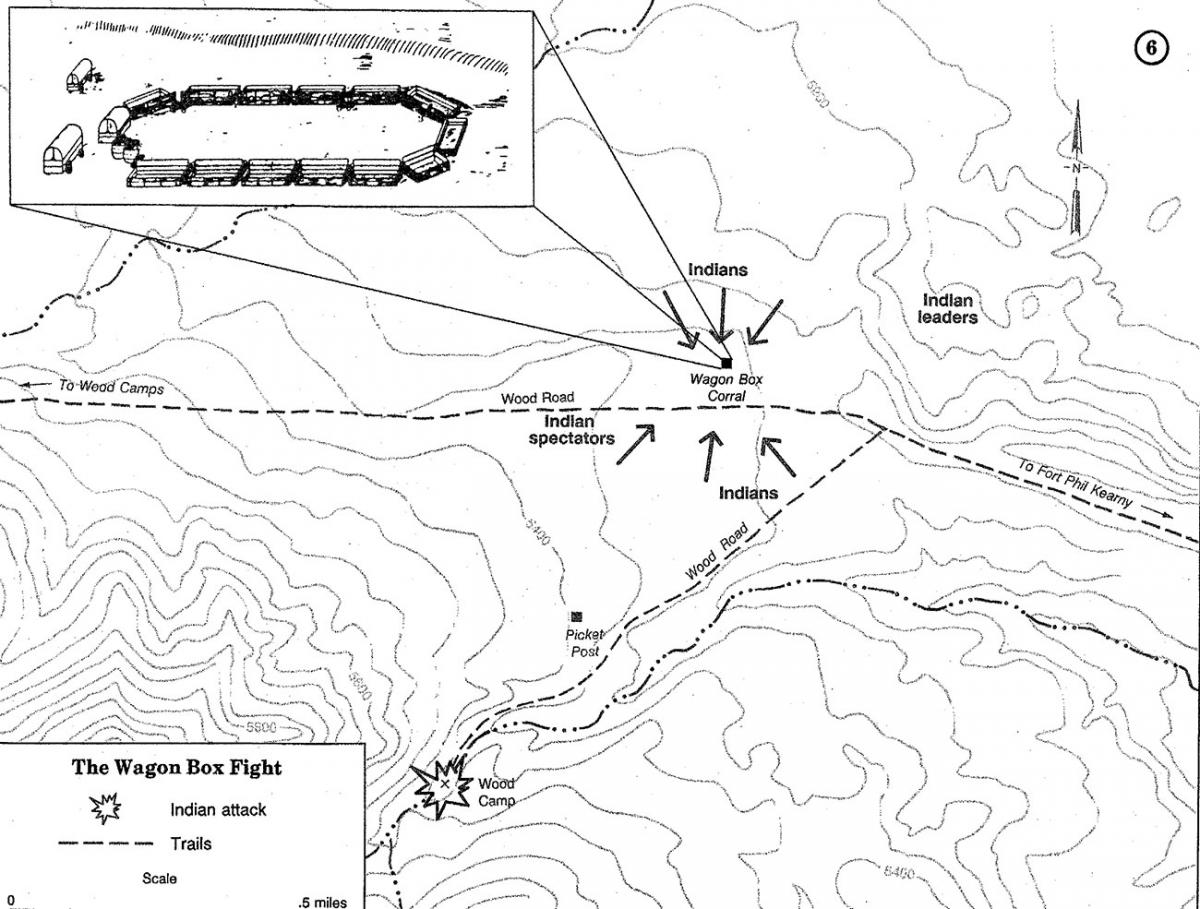
On Aug. 2, 1867, Oglala Sioux warriors attacked troops and civilian woodcutters replenishing Fort Phil Kearny’s wood supply several miles northwest of the fort. Wikipedia.
Red Cloud’s War
In the summer of 1867, looking to repeat their success, Indians—furious that white men the year before had built three forts along the new Bozeman Trail across their land in the Powder River Basin—planned attacks on two of the forts. The federal government contended the forts and defense of the trail were necessary because the route offered the quickest path to gold mine discoveries in Montana. The conflict became known as Red Cloud’s War.
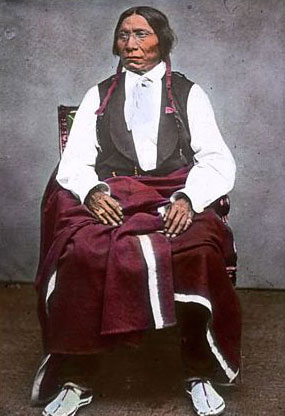
Oglala Sioux Chief Red Cloud led the tribe’s resistance to the U.S. Army’s incursion into the Powder River Basin in the 1860s. Whether he was at the Wagon Box Fight is unclear. First People.
Sioux Chief Red Cloud had vowed to kill every white man found on the Indians’ land. The Indians harassed troops and white travelers more or less continually. The next large attacks after the Fetterman massacre came in August.
One contingent of warriors battled soldiers and civilians at the Hayfield Fight on Aug. 1, 1867, near Fort C.F. Smith on the Bighorn River in southern Montana Territory. Early the next morning, Red Cloud and more than 1,000 warriors gathered and attacked woodcutters and soldiers near a spot about six miles northwest of Fort Phil Kearny.
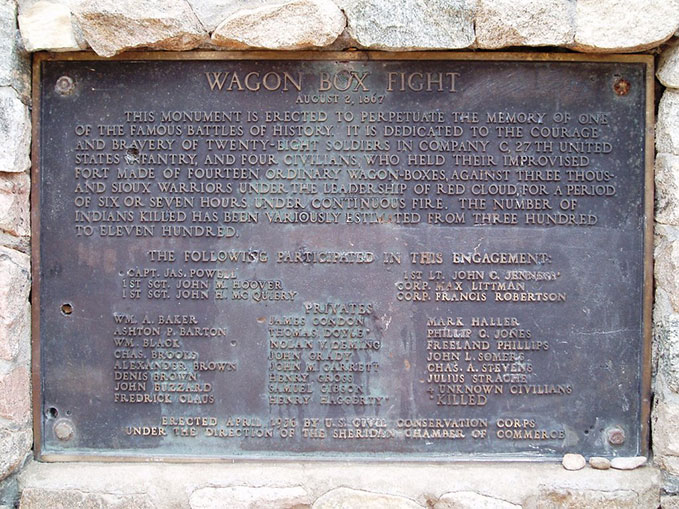
What happened over the course of six hours on August 2 became known as the Wagon Box Fight, a relatively small battle that became well known for several disparate reasons. It was the Army’s first chance to claim victory after the Fetterman disaster, though in retrospect the fight seems more like a draw. At the time and since, there were widely conflicting reports on the number of Indian casualties, and for this reason too the fight continues to draw the interest of students of the Indian Wars.
Finally, the fight is important in the history of tactics because it was the first time a large force of mounted tribesmen faced sustained fire from relatively rapid-shooting, breech-loading rifles. The warriors’ old tactics of closing fast on horseback for close combat with their enemies no longer worked—and they paid a heavy price.
The wood supply
Hundreds of infantry and cavalry soldiers based at Fort Phil Kearny needed a steady supply of wood from forests on the slopes of the Bighorn Mountains for construction at the fort, as well as a constant supply for fuel for cooking and for the next winter’s heating.
Protecting the contracted civilian woodcutters was thus one of the Army’s most important jobs if the troops were to survive in hostile country. The wood line where the prairie met the mountain forest was about six miles from the fort. Wagon trains of woodcutters and their soldier guards suffered constant small attacks during the entire two years Fort Phil Kearny was in existence.
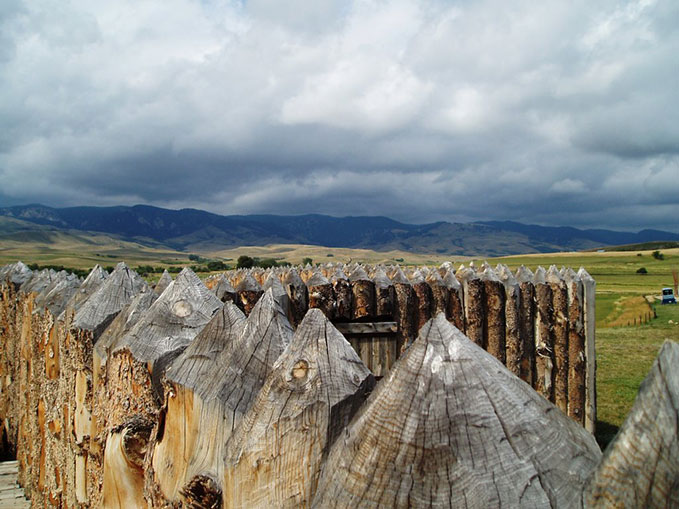
View toward the Bighorn Mountains and the site of the Wagon Box Fight, from the reconstructed stockade of Fort Phil Kearny. Vasily Vlasov, Panoramio.
On August 2, the tribes tried something much larger. The Indians held a distinct advantage because their foes had split into two groups. Civilian woodcutters decided to stay at a camp near the wood line, about a mile from a makeshift stock corral the soldiers had fashioned from14 wagon boxes, removed from their running gear and set on the ground. Logs were transported from the woodcutting camp to the fort resting directly on the running gear.
A wagon-box corral
The wagon boxes were 10 feet long, two and a half feet high and four and a half feet wide. The wood was only about an inch thick, with no lining. The boxes eventually served as the main line of defense against a massed Indian force determined to overrun the corral and the 32 men using it as cover.
Capt. James W. Powell was in command of C Company, 26th Infantry, which at the end of July had relieved the company previously guarding the woodcutters, and so his troops were new to the job. He set up operations at the corral.
Early on August 2, Powell sent 13 men out from the corral to guard the woodcutters’ camp and another 14 to escort wagons carrying wood to and from the fort. That left the captain and Lt. John C. Jenness at the corral with 26 enlisted men.
The soldiers at the corral were joined by two civilian teamsters who had left the fort that morning to hunt deer. The pair saw Indian smoke signals and tried to get back to the fort, but wound up at the corral instead.
The first attack
The Indians set their sights on the camp’s mule herd, with 200 warriors on foot trying to scatter the animals, but the mule herders kept the attackers at bay until a new wave of Indians managed to drive off the herd and set fire to the woodcutters’ camp. Simultaneously, about 500 Indians attacked the woodcutters. Then the woodcutters and their soldier guards tried to move toward the fort, bypassing the corral.
Three soldiers and four civilian contractors were killed, but Powell managed to divert the Indians’ attention by mounting an attack on the rear of the Indian force from the corral, which allowed the rest of the woodcutting camp’s occupants to hide in the timber or get to the fort. Within 15 minutes, an estimated 800 Indians on horseback surrounded Powell and his men at the makeshift corral.
Using field glasses to scan the area, Lt. Jenness reportedly told the men he spotted Red Cloud at the top of a hill with other Indian leaders. It has never been verified that Red Cloud was at the scene, and because the lieutenant didn’t know what the man looked like, Jenness may have misidentified another chief.
Trapdoor Springfields
Unlike Fetterman’s troops, who carried muzzle-loaders that could only fire three rounds a minute at most, the men at the wagon boxes were equipped with new breech-loading Springfield trapdoor rifles. Seven hundred of these weapons were brought to the fort a short time before by wood contractor J.R. Porter of the Gilmore & Proctor firm. They could fire 15 to 20 rounds per minute. Unfortunately, there hadn’t been any time for target shooting, and Army weapons training was known to be dubious at best. Still, most of the men managed to at least become familiar with the new rifles in the weeks since the weapons had arrived.
New, breech-loading Springfield Model 1866
The soldiers punched two-inch holes into the wooden wagon boxes so they could fire through them. Yokes, bags of grain, kegs and other equipment were stacked between wagons for protection. Some men fired over the tops of the boxes, and blankets covered the tops to hide the men’s positions and provide limited protection from the arrows raining down on them.
The Indians were primarily armed with bows and arrows, lances and war clubs, though some had firearms captured months earlier during the Fetterman attack. They didn’t have much ammunition, however. The soldiers at the Wagon Box Fight began the battle with 7,000 rounds on hand—and this large supply saved their lives.
Once the attack began, most of Powell’s men kept their ammunition in their hats. Although this was convenient, it left their heads exposed to the sun and its sweltering heat. In addition, the troops had to deal with the stench: Indians coated their arrows with burning pitch that set fire to hay and mule and horse dung.
The soldiers’ superior firepower drove back the initial wave of Indians and they retreated to about 600 yards from the corral and spent the next few hours making separate attacks on foot.
A long fight
Powell was at one end of the corral, with Jenness stationed at the other. Participants later reported that a few Indians managed to get within 5 feet of the corral, but none penetrated the barrier.
Jenness was shot in the head and killed, as were two privates, Henry Haggerty and Thomas Boyle. Two other privates were wounded in the fight.
A teamster, R.J. Smyth, later recalled the lieutenant’s bravery during the battle. “Lt. Jenness had just cautioned me not to expose my person, and to hold my fire until I was sure of getting an Indian at each shot,” Smyth said. “He had moved a few feet from my box when he was shot through the head, I think he died instantly. He was a grand, good man, and a fearless officer. I told him to keep under cover. He stated he was compelled to expose himself in order to look after his men.”
Several soldiers wrote firsthand accounts of the ordeal. Sgt. Samuel S. Gibson, who at 18 was the youngest soldier at the corral, recorded the most detailed and dramatic version of the event. He had been dispatched to guard duty at the woodcutters’ camp and had a skirmish with several Indians before he and another soldier made it safely to the corral.
“The whole plain was alive with Indians shooting at us, and the tops of the boxes were ripped and literally torn to slivers by their bullets,” he wrote. “How we ever escaped with such slight loss I have never been able to understand, but we made every shot tell in return, and soon the whole plain in front of us was strewn with dead and dying Indians and ponies. It was a horrible sight!”
Gibson added, “The Indians were amazed at the rapidity and continuity of our fire. They did not know we had been equipped with breech-loaders and supposed that after firing the first shot they could ride us down before we could reload.”
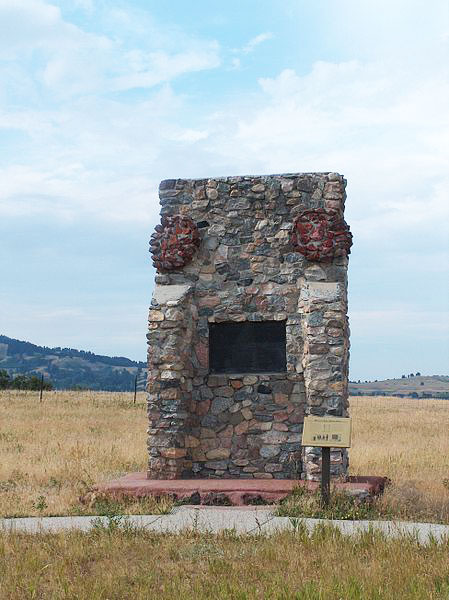
The monument at the site of the Wagon Box Fight was built by the Civilian Conservation Corps in 1936. Wikipedia.
Sometime between noon and 1 p.m., hundreds of warriors led by Red Cloud’s nephew charged the corral on horseback, hurtling toward the wagons in a V-shaped wedge. Powell later recalled that things looked very bleak at that moment, especially because ammunition was running low and his men were exhausted from holding off the Indians for so long.
After Indians on horseback were initially forced to retreat from the corral area, they tried to attack on foot over the next three hours. On Sullivant’s Ridge, a hill to the east, were several hundred Indians out of range who had been watching the battle “like spectators,” but it appeared to Powell that they would enter the fray.
A howitzer rescue
Just at that moment, though, Powell said he heard the sound of a howitzer shell hit and saw a rescue party led by Maj. Benjamin F. Smith, who had 100 men with him.
“The shell fired was in the direction of the Indians [on the hill], but fell short, as I anticipated,” Smith noted in his report, “but [it] seemed to disconcert them as a number of mounted Indians who were riding rapidly toward my command turned and fled.”
The Indians who had been attacking the corral as well as the ones watching the action all retreated.
Smith, arriving at the corral, was shocked to find that most of the men had survived the intense encounter. He had expected them all to be dead. “It was a hard lot to look at. The day was hot and the sun was beating down on them in the wagon beds,” he wrote. “The smoke from their guns had colored their faces and they looked as though they had used burnt cork on their faces.”
Each survivor received a big drink of whiskey from a keg brought along on the rescue mission by the post surgeon, Dr. Samuel M. Horton.
Indian casualties
Text on the 1936 monument overstates the number of Indian warriors and casualties. Vasily Vlasov, Panoramio.
Estimates of Indian casualties in the Wagon Box Fight, though, vary enormously; they range from two dead to 1,500. To date no one has come up with a definitive answer about why there is no agreement on the numbers.
“No [other] event has had more wild, inaccurate tales written concerning it,” writer Vie Willits Garber noted in a 1964 Annals of Wyoming article.
Two respected historians–Stanley Vestal and George Hyde–as well as several Sioux leaders said only six warriors were killed and six more wounded.
But there are accounts of people who later talked about the battle with Red Cloud. They said the chief told them that the count was much higher. Gen. Grenville M. Dodge interviewed Red Cloud in 1885, and he told him more than 1,100 Sioux, Cheyenne and Arapahos were killed or wounded at the fight. A Sioux medicine man, whose name was not recorded, visited the post of Col. Richard I. Dodge at North Platte in the fall of 1867. He told the colonel that the total of dead and injured was 1,137, and that figure was widely reported the same year as the battle.
Hyde’s book, Red Cloud’s Folk was published in 1937, based on interviews Hyde had conducted decades earlier. Hyde said that late in his life Red Cloud, who died in 1909, claimed not to remember the Wagon Box Fight at all. The historian said that was unlikely, given the large number of warriors in the battle and the fact that it marked the chief’s last major fight.
In his official report, Powell estimated 60 Indians killed and 120 wounded–figures held up to ridicule by some historians as “wildly exaggerated,” while his Army superiors believed he was being incredibly modest about the body count. Enlisted men at the scene supported much larger claims, with various shooters putting the number of dead between 300 and 800.
The account of at least one Indian warrior, an Oglala Sioux named Fire Thunder, supports the claim of heavy Indian losses. He described “dead warriors and horses piled all around the [wagon] boxes and scattered over the plain.”
In 1969, at a reenactment of the Wagon Box Fight near Sheridan, Wyo., some Indian descendants of the participants claimed Indian casualties were between 1,200 and 1,500.
Hyde said while he knew of no written accounts of the battle by Indians, they did not regard the fight as a defeat. If the reports of six dead and six wounded Indians were accurate, as Hyde believed them to be, he said they inflicted more damage to the white men at the camp and the corral because they killed a total of six soldiers and four civilians, plus capturing a large number of horses and mules.
Aftermath
In the Treaty of Fort Laramie in 1868, with the transcontinental railroad nearing completion and opening up a new, shorter route to the Montana gold fields, the government agreed to abandon the forts on the Bozeman Trail, to make the western half of Dakota Territory a large reservation for the Sioux and to allow the tribes to hunt buffalo in the Powder River Basin of what are now Wyoming and Montana. The tribes burned the abandoned forts shortly after the Army left.
The Wagon Box Fight was the last major battle of Red Cloud’s war against the white men he felt had invaded the land they had promised to his people. Some historians credit the battle with teaching both sides valuable tactical lessons. To the Army, it was now clear that Red Cloud commanded thousands of hostile warriors, not just a small number of malcontents.
The tribes, meanwhile, became convinced that they did not have a chance against large numbers of troops unless they could secure similar firepower, which they did by the time of the Battle of the Little Bighorn in 1876.
Garber, Vie Willits. “The Wagon Box Fight.” Annals of Wyoming 36, no. 1 (April 1964): 61-63.
Hyde, George E. Red Cloud’s Folk: A History of the Oglala Sioux Indians. Vol. 15, The Civilization of the American Indian. Norman: University of Oklahoma Press, 1975, 159-160.
Keenan, Jerry. The Wagon Box Fight: An Episode of Red Cloud’s War. Conshohocken, Pa.: Savas Publishing Co., 2000.
“The Wagon Box Fight.” Annals of Wyoming 7, no. 2 (Oct. 1930): 394-401.
Illustrations
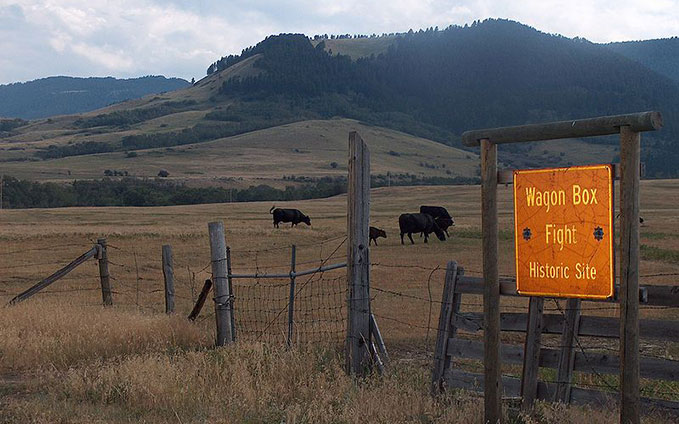
The image of the model 1866 trapdoor Springfield rifle is from Wikipedia. Used with thanks. The photos of the monument and the main sign at the Wagon Box Fight site are also from Wikipedia. Used with thanks.
The map of the battle site is from FortWiki.com. Used with thanks.
The photo of the monument plaque and the view toward the mountains from the reconstructed Fort Phil Kearny stockade are by Vasily Vlasov, from Panoramio. Used with thanks.
The photo of Red Cloud is from First People, a child-friendly site about Native Americans and members of the First Nations, with more than 1400 legends, 400 agreements and treaties, 10,000 pictures, clipart, Native American books, posters, seed bead earrings, Native American jewelry, possible bags and more. Used with thanks.
“Leadership is the art of accomplishing more than the science of management says is possible.”
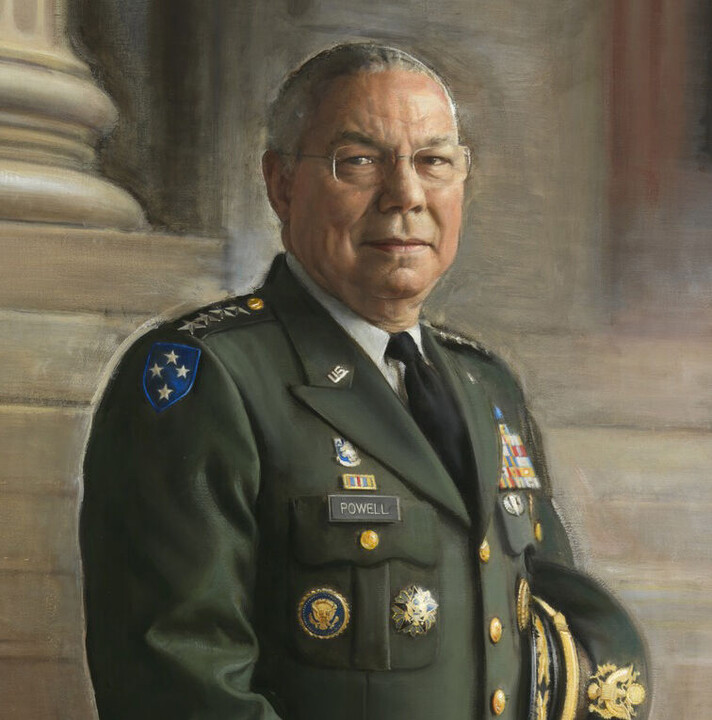
This is one of many quotes attributed to legendary public statesman and former Secretary of State Colin Powell.
Since his retirement from public office in 2004, Powell has spent much of his time sharing his leadership knowledge with the business community. In his 2012 book, It Worked For Me, Powell attributes his success to hard work, straight talk, respect for others, and thoughtful analysis.
At the heart of the book are Powell’s “13 Rules” — ideas that he gathered over the years that formed the basis of his leadership principals.
Powell’s 13 Rules are listed below. They are full of emotional intelligence and wisdom for any leader.
1. It Ain’t as Bad as You Think! It Will Look Better in the Morning. Leaving the office at night with a winning attitude affects more than you alone; it conveys that attitude to your followers.
2. Get Mad Then Get Over It. Instead of letting anger destroy you, use it to make constructive change.
3. Avoid Having Your Ego so Close to your Position that When Your Position Falls, Your Ego Goes With It. Keep your ego in check, and know that you can lead from wherever you are.
4. It Can be Done. Leaders make things happen. If one approach doesn’t work, find another.
5. Be Careful What You Choose. You May Get It. Your team will have to live with your choices, so don’t rush.
6. Don’t Let Adverse Facts Stand in the Way of a Good Decision. Superb leadership is often a matter of superb instinct. When faced with a tough decision, use the time available to gather information that will inform your instinct.
7. You Can’t Make Someone Else’s Choices. You Shouldn’t Let Someone Else Make Yours. While good leaders listen and consider all perspectives, they ultimately make their own decisions. Accept your good decisions. Learn from your mistakes.
8. Check Small Things. Followers live in the world of small things. Find ways to get visibility into that world.
9. Share Credit. People need recognition and a sense of worth as much as they need food and water.
10. Remain calm. Be kind. Few people make sound or sustainable decisions in an atmosphere of chaos. Establish a calm zone while maintaining a sense of urgency.
11. Have a Vision. Be Demanding. Followers need to know where their leaders are taking them and for what purpose. To achieve the purpose, set demanding standards and make sure they are met.
12. Don’t take counsel of your fears or naysayers. Successful organizations are not built by cowards or cynics.
13. Perpetual optimism is a force multiplier. If you believe and have prepared your followers, your followers will believe.
Colin Powell’s rules are short but powerful. Use them as a reminder to manage your emotions, model the behavior you want from others, and lead your team through adversity.
Rest in Eternal Peace, General!
Thank you for your service to the United States, the world, and Mankind.
The world is a better place for you having been in it for 84 years.
I don’t think the claim was that it had no recoil; rather, I believe it was designed to fire bursts so fast that it could send three rounds downrange before the operator perceived the recoil, thus improving accuracy.
Beyond that: I don’t really know. If I had to guess, I’d say the G11 is an example of one of those guns that comes along once in awhile that’s basically the solution to problems nobody really has. The idea of a rifle that can easily carry 50 rounds, and is immune to the sorts of malfunctions/stoppages that can be associated with metal casings, is intriguing…but not really the answer to anyone’s prayers.
Moreover: forward leaps in technology with no proven track record can be scary and intimidating to organizations in any context, especially when the industry is one in which reliable and effective performance is literally the difference between “life” and “death.” It may seem funny now, but when the first M16 rifles made it to line troops during the Vietnam War, one of the reasons why it was initially regarded with distrust was that troops accustomed to large-bore weapons of forged iron/steel and wood felt that the new space-age weapon made of lightweight composite alloys and polymers was flimsy and toy-like (“the Mattel plastic gun”) and assumed it’s small, high-velocity bullet wouldn’t inflict much injury.
H&K’s M8 rifle, which in my opinion incorporated a lot of great features— particularly it’s highly-modular nature— has nonetheless failed to get much traction (or buyers) despite getting serious consideration in military trials by a number of countries, including the US.
Other typical reasons for certain weapons not getting wide acceptance: politics, military bureaucracy, cost of purchase/integration of new weapons systems.
There are some rumblings that I expect to get louder now that our elite is realizing that they have totally alienated the traditional Americans who traditionally make up our Armed Forces, and that they are thinking about the necessity of a draft. The Army War College, of which I am an alum, recently published an article that talks about the casualties you can expect in high intensity warfare – several thousand a week.
So, in a few weeks, you’ve got more dead than you had in Afghanistan and Iraq combined over 20 years. Our military, which has shrunk dramatically over the last three decades, simply cannot accept that rate of casualties, especially when it can’t fill its ranks with volunteers anymore. So, the answer is apparently to not rely on volunteers.
Advertisement
Don’t count out establishment pressure for a new draft. After all, it’s not a meat grinder without meat. The bodies have to come from somewhere. There’s no calling guys back to active duty. At the height of the global war on terror about 20 years ago, we had a lot of dudes signing up because they were excited and patriotic and wanted to avenge 9/11.
Well, they learned, the hard way that this establishment is not only grossly incompetent but cares nothing for them. When you treat troops like garbage, they know it. And it’s not like you can call them back. Their service obligations are up. Most of them are pushing 40 at the low end. Do you know what you call a 40 year-old infantryman? Sergeant major or colonel. And we’ve got plenty of those. In fact, we have too many.
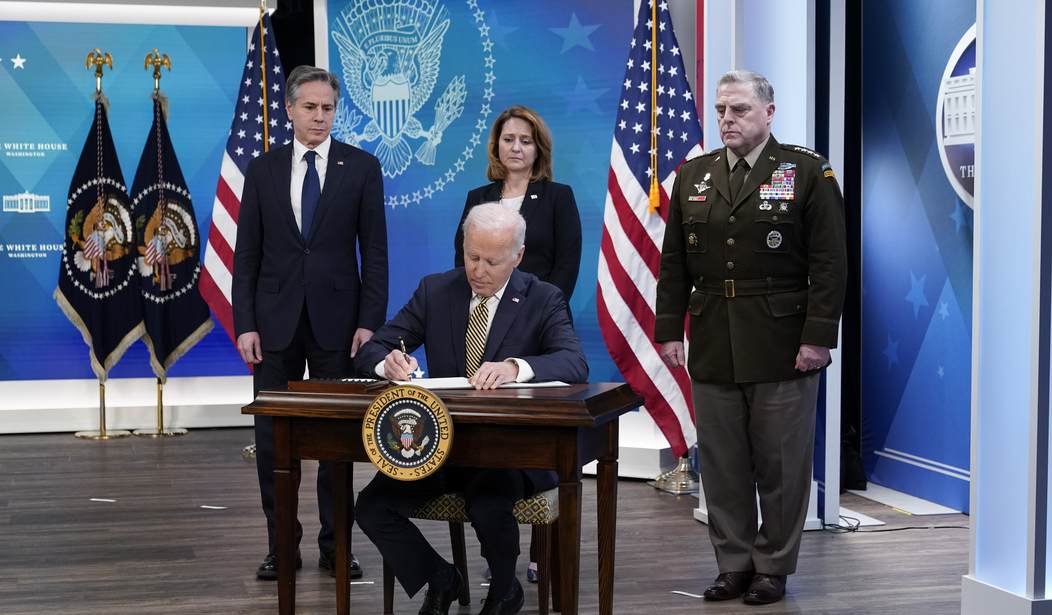
The ridiculous Mark Milley, basically Alexander von Sausage Vindman with more stars, waddled his way up to a podium to retire the other day. He’s a freaking disgrace to the uniform. This is the guy who wanted to know what “white rage” was in front of one audience, but in front of another denied that he knew what woke is. I wonder if they really think their soldiers are stupid enough not to know when they’re being lied to. Well, our troops are not that dumb. And they certainly know when their lives are being squandered, as 13 of them were in Kabul.
It’s not a question of patriotism. Our guys are loyal to our country. But our senior leaders, from our Commander-In-Crusty to the newest woke major at Fort Saul Alinsky, are loyal to social justice ideology.
They pretend the organization that used to be the most respected institution in American society is still the institution that America once respected. But it isn’t. And they will not guilt us into unseeing that reality. Who wants to serve in the Great Pronoun War of 2023? Who wants to be forced into taking vaccines that don’t vaccinate? Who wants their commander to have breasts and a penis?
Not anyone normal. They will try to play the service card. That might work better if that service would be protecting our borders instead of Ukraine’s. When one of these hacks asks you to go serve your country, your proper response should be to ask what is the name of the general fired for what happened in Afghanistan. The fact that they can’t answer that question is all the answer you need.
But they need troops – it’s no fun being a general without any. Who would a draft be targeted at? Traditional, conservative Americans, from mostly the rural South and Midwest, the traditional recruiting grounds for a substantial percentage of our troops.
And those are, not coincidentally, the very people that the folks in charge hate the most. Our soldiers understand that and our soldiers are leaving in droves while young people are foregoing the military. Much of that is because vets are telling them not to join.
Let’s be really clear about what’s going on in the veteran community, because what you hear in the media is a lie. There is almost no one out there who is a veteran who is excited about having his or her kids serve.
It is not that we are not supportive of the troops – if they serve, we back them 100%. But we’re not recommending that they do. The fact is that the leadership of this country is unworthy of our troops, and our potential troops are refusing to volunteer. It’s only going to get worse as the military gets woker and the establishment gets more warmongery.
So, of course, the establishment’s answer to young people’s failure to volunteer is to volunteer them. But we all know who’s going to get volunteered. It’s not going to be Kayden and Ashley from Santa Monica.
It’s going to be your kids. Right now, 70% of kids cannot join the military because of various physical mental and other qualifications. When there is a draft, they may try and be clever and not have the kind of student deferments that made sure that college kids like Joe Biden never saw action, except in mortal combat with Corn Pop.
The way the rich kids will get out of it is to have some psychiatrist talk about their PTSD from being exposed to non-gluten-free noodles or the like. The rich kids are going to get out of it again, or they’re going to get some baloney “alternative” service reading stories to gang members. Your kids won’t get that option. Your kids will get sent to some foreign hellhole for some purpose that our glorious establishment doesn’t feel it needs to explain to you, and they’ll get killed.
But I’m not sure we’re going to see passive compliance here. In Vietnam, few people know that most of the folks who fought were actually volunteers. Yeah, a lot of the rich college kids weaseled out of their duty, but a lot of others signed up voluntarily.
They did it because their dads did it and their dad’s dad did it. But right now, all the dads are saying “Hell no, you won’t go,” not because they hate the red, white, and blue, but because they hate the desiccated old pervert in the White House masquerading as our commander-in-chief, and his coterie of morons that has failed every national security challenge in the last 30 years.
If you start trying to make normal Americans send their kids off to yet another stupid war, that may be the line in the sand where things get ugly. After all, you saw what the moms did over drag queen story hour. What happens when the moms see their sons being sent off to get killed so Lindsey Graham can be the toast of Kyiv? It’s not going to be pretty.
And do not think boots on the ground in Ukraine can’t happen. That big offensive we’ve been hearing about has gone almost nowhere. It has stalled. And the Russians are going to build up their forces, like they have through history, and they’re going to counterattack, and there is a significant chance the Ukrainian army – despite gallant resistance – is going to collapse.
This doesn’t make me happy, because I like Ukrainians – I helped train them. But the facts are the facts. At some point, to save Ukraine, or some piece of it, somebody’s going to get the bright idea to send American bodies in and we’re going to realize what high intensity combat against a peer competitor looks like.
And it looks a lot different than chasing a bunch of goat herders around the Hindu Kush. We’re going to see young Americans get killed in numbers that we can’t even conceive of today. And heaven forefend that it goes off with China, because you can double that figure. If you tell America we can’t lose 5,000 souls on an aircraft carrier pulverized by hypersonic missiles, then you are either lying to us or lying to yourself.
To fight a modern war, they are going to need bodies in numbers not needed for generations. They’re not going to fill the ranks with volunteers. They will have to draft them. That kind of move could re-define American politics because you’re going to get a lot of people elected on an isolationist platform at the next election, assuming there is one.
I am not an isolationist. I’m a Jacksonian. I believe in fighting when you have to, and then you kill the SOBs. But our foreign policy establishment doesn’t believe that. It considers itself smarter than the teachings of 5000 years of military history. And it doesn’t care about our young people.
That seems pretty harsh, but let them try to tell us it’s not true. Let them make the case that our foreign policy establishment believes it has some obligation not to squander the lives of our young people on poorly conceived, planned, and executed overseas military misadventures. They can’t. Their whole response would be “You love Putin,” or something along those lines. But the truth is undeniable. To them, our sons and daughters are nothing more than cannon fodder.


 In June 1859, while attempting to climb a sloping bare rock in southwest Texas, one of the Army’s camels lost its footing and fell, smashing one of the precious water barrels it was carrying. An officer accompanying the expedition quickly cut the lines ensnaring the camel, preventing a bad situation from becoming worse. (Camels in Texas, by Thomas Lovell, courtesy of the Abell-Hanger Foundation and the Permian Basin Petroleum Museum, Library and Hall of Fame of Midland, Texas, where the painting is on permanent display.)
 MAJ Henry C. Wayne, an officer in the Quartermaster Department, was one of the early advocates for the Army’s use of camels. He resigned from the Army on 31 December 1860 and was later commissioned a brigadier general in the Confederate Army. (Library of Congress)
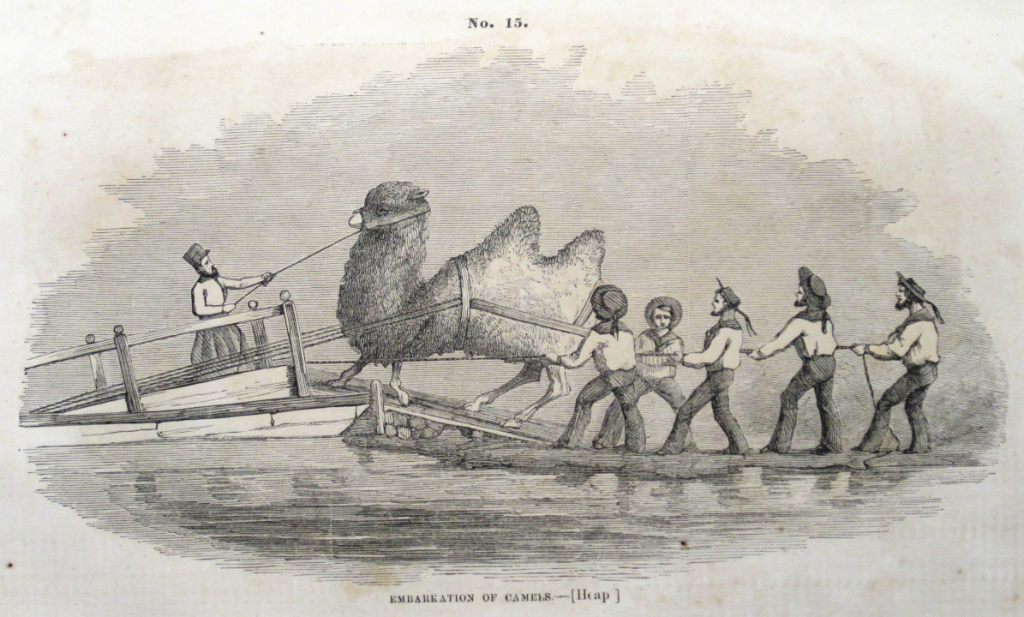 Sailors and an Arab camel herder load a Bactrian camel aboard the USS Supply during one of the two expeditions to procure camels. (National Archives)
 Jefferson Davis first encouraged the Army’s use of camels while serving in the U.S. Senate. In 1855, Secretary of War Davis persuaded a skeptical Congress to appropriate $30,000 for the purchase and importation of camels for the Army. (Jefferson Davis, by Daniel Huntington, Army Art Collection)
 During surveying expeditions of the late 1850s that took place in the harsh climate of the Southwest, camels proved their worth by carrying large amounts of cargo and requiring little water in comparison to horses and mules. (The Search for Water, by Ernest Etienne de Franchville Narjot, The Stephen Decatur House Museum)
 Upon finding water, horses on a surveying expedition eagerly quench their thirst while the accompanying camels show little interest. The Army’s camels proved they could withstand the oppressive climate of the American Southwest and other hardships that could send horses and mules into a panic. (Horses Quenching Their Thirst, Camels Disdaining, by Ernest Etienne de Franchville Narjot, The Stephen Decatur House Museum)