Category: The Green Machine
|
|

|
|

|
|

|
|

|
|

|
|

|
|

|
|

|
|

|
|

|
|

|
|

|
|

|
|

|
|

|
|

|
|

|
|

|
|

|
|

|
|

|
|

|
“The 517th PRCT is one of the greatest fighting machines that America has ever fielded.”
— William B. Breuer, author and historian
This short history was printed as a feature article in Airborne Quarterly magazine in the winter of 1998.
Winter ’98 -The Airborne Quarterly
William E. Weber – Editor
Col. USA-Retired
President/Executive Editor
(Ed. Forenote: The series of articles and other material that follows is compiled from a variety of sources, most notably from members of the 517th PRCT and its fraternal organization. Though some has been published before in other media and forms, what follows is the first time it has been collected as a series.
The purpose is to present as complete a story as possible, so as to enable those who are of a mind an opportunity to get the whole story in one publication. To this must be added the remembrances of individuals before it is too late, for their perspective is every bit as valuable.
They are urged to submit their experiences with the 517th to: U.S. Army Military History Institute, Carlisle Barracks, PA 17013-5008. To Dr. Charles E. Pugh, Clark Archer, Bill Lewis, Disk Seitz, Bob Dalrymple, J. K. Horne Jr., “Prez” and “517teeners”, et al, my thanks for making this Feature Story possible! The following is condensed from Paratroopers’ Odyssey: A History of the 517th Parachute Combat Team (1985, Military Narrative by LTC Charles E. LaChaussee, AUS Ret.) and Chronicle of the 517th PRCT (1985, Compiled by Clark Archer)
ACTIVATION AND TRAINING
The story of the 517th Parachute Regimental Combat Team begins with the activation of the 17th Airborne Division on March 15, 1943. The Division’s parachute units were the 517th Parachute Infantry Regiment, the 460th Parachute Field Artillery Battalion and Company C, 139th Airborne Engineer Battalion. The 517th was at Camp Toccoa, Georgia; the 460th and C/139 were at Camp Mackall, North Carolina.
For the next several months, all men volunteering for parachute duty at induction stations throughout the United States were sent to Camp Toccoa. The 517th was charged with screening the volunteers and assigning those qualified to either infantry, artillery or engineers. Officers of the 460th and C/139 were placed on temporary duty at Toccoa to help with the screening, and men assigned to those units were sent to Camp Mackall.
As units filled up, they were to be given basic training at their home stations and then sent for parachute qualification to Fort Benning, Georgia. After jump training, all units, including the 517th would join the 17th Airborne at Camp Mackall.
Receiving and screening one to two hundred men a day was a pretty big order for the 517th. On activation, the regiment had a total strength of nine officers, headed by newly appointed commanding officer Lt. Col. Louis A. Walsh, Jr. They were joined three days later by the “cadre” under command of Major William J. Boyle, bringing the regiment’s strength to about 250.
Through the spring of 1943 trains arrived at Toccoa daily with contingents of 50 to 150 men; each group was met at the station and trucked to the parade ground where a 34-foot-tall parachute “mock tower” had been erected. Lieutenant John Alicki, favored by fortune with a rugged appearance, greeted them with a blood-and-guts speech intended to scare off the timorous.
“In” and “Out” platoons were formed, those who survived the mock tower went to the “In” platoon for further screening. This consisted of a medical examination by Regimental Surgeon Paul Vella and his staff, followed by an interrogation by their potential officers as to why they has applied for parachute duty. Many answers were interesting and some hilarious.
A few had been advised by doctors to take up parachuting to help overcome their fear of heights. Some with criminal records had been told their slates would be wiped clean. Those failing the screening process were sent to the “Out” platoon and the balance assigned to units. As men assigned to the artillery and engineers moved to Camp Mackall the infantry began basic training.
Military organizations are strongly influenced by the character of their commanders. Because of its isolation and greenness, this was particularly true of the 517th. At age 32, Louis Walsh was young, cocky and aggressive. He had been with the Airborne since its earliest days and had spent three months as an observer with U.S. forces in the Southwest Pacific. Having seen combat in its most primitive form under atrocious conditions, he was determined to prepare the 517th to survive, fight and win under any circumstances. To reach this goal Colonel Walsh set extremely high standards. Physical conditioning was paramount.
Each trooper was required to qualify as “expert” with his individual weapon, “sharpshooter” with another and “marksman” with all crew-served weapons in his platoon.
It had been planned to fill the battalions in numerical sequence. By the end of April, Major Boyle’s lst Battalion was almost complete. At the end of the following month Major Seitz’ 2nd Battalion was pretty well on its way. By late June or early July, while Major Zais’ 3rd Battalion was still waiting for its first recruit, the flow of volunteers to Toccoa was suddenly turned off. It was announced that the 3rd Battalion would be filled with Parachute School graduates who had already completed basic.
In late summer an advance detail staked out a claim at Camp Mackall and the regiment moved to Fort Benning for parachute training. The 517th breezed through jump school with no washouts, setting a record that has endured to this day. School Commandant General Ridgely said that the 517th’s Battalions were without equal in discipline and effectiveness – which says a great deal for Colonel Walsh’s selection and training methods. The 517th troopers were the first to wear the steel helmet in jump training; until then a modified football helmet had been used. On completion of jump training the lst and 2nd Battalions moved on to Mackall while the 3rd remained at Benning to complete fill-up.
Camp Mackall was not much different from Toccoa, but bigger on level ground. Everyone was quartered in the same one-story, uninsulated “hutments” heated with coal stoves. The 17th Airborne was big on athletics, and the 517th shook it up a little by fielding football and boxing teams that won Division Championships.
One day an inspection team from Headquarters Army Ground Forces arrived at Camp Mackall to test the regiment’s physical fitness. Using more-or-less scientific statistical sampling methods, men and units were selected and put through their paces. Individuals took the Physical Fitness Test consisting of pull-ups, push-ups, and other weird calisthenics done against time. Platoons and companies were chosen to run and march, with and without equipment, for various distances. When all was done, the results were analyzed and announced. The 517th had taken first, second and third place in all tests and events, scoring higher than any unit tested before or since.
Through the fall the regiment conducted unit training — tactical exercises for the squad, platoon, company and battalion. Effort was made to conclude each phase of training with a parachute jump. Sometimes jumps had to be cancelled because of weather or lack of airplanes, but men and units averaged one per month.
In February, the regiment moved to Tennessee to take part in maneuvers being conducted by Headquarters Second Army. The “Tennessee Maneuvers” were a sort of little practice war that went on year-round. Participation in the Tennessee Maneuvers was supposed to be the final test before a unit could be pronounced combat-ready.
One cold day in March when all were shivering and knee-deep in mud, it was announced that the parachute elements of the 17th Airborne Division were being pulled out for overseas shipment as the 517th Regimental Combat Team. So, from the mud of Tennessee, the 517th PRCT emerged. The parachute units were hastily shipped back to Camp Mackall to prepare for overseas movement.
The 460th Parachute Field Artillery Battalion, with an authorized strength of 39 officers and 534 enlisted men, consisted of a headquarters and four firing batteries, each with four 75mm pack howitzers. The 75 threw a 13.9-pound shell for a maximum range of 9,650 yards. The 75 broke down in to seven pieces for parachute drop.
Company C, 139th Airborne Engineer Battalion, was redesignated the 596th Airborne (Parachute) Engineer Company. The 596th had a company headquarters and three platoons with an authorized strength of eight officers and 137 enlisted men. The engineers were lightly armed and equipped, but highly trained in their missions of construction and destruction.
The 517th RCT received no special augmentation to allow it to function as a separate unit. It was expected to operate as a small division.
On return to Camp Mackall, all efforts were concentrated on preparation for overseas movement. In the midst of this activity, the word spread one day that Colonel Walsh had been relieved. It was a real shock to 517th troopers. But in the Army, as elsewhere, life must go on. Colonel Walsh’s successor was Lt. Col. Rupert D. Graves, USMA ’24, who came from command of the 551st Parachute Infantry Battalion.
In early May, the RCT components staged through Camp Patrick Henry near Newport News, Virginia. On May 17th the troopers climbed the gangplanks for their great adventure. The 517th boarded the former Grace liner Santa Rosa, while the 460th and 596th loaded onto the Panama Canal ship Cristobal.
ITALY
One dark night the ships slipped through the Straits of Gibraltar and it became obvious that the destination was Italy. This idyll came to an end when the Santa Rosa and Cristobal docked at Naples on May 31st. The troopers filed down gangplanks into waiting railroad cars and were carried to a staging area in the Neapolitan suburb of Bagnoli. En route, Colonel Graves was handed an order directing the RCT to take part in the attack from Valmontone to Rome the next day. The 517th was ready to go, but since crew-served weapons, artillery and vehicles had been loaded separately it would have to be with only rifles. After this was pointed out, the order was cancelled and the RCT moved on to “The Crater.”
Gradually weapons and vehicles arrived. On June 14th the outfit struck tents, stowed away extra gear and moved to a beach to wait for LSTs to carry it to Anzio. The troopers filed aboard, were handed C-rations, and told to make themselves comfortable anywhere they could find space on the crowded decks. In the evening, the ships raised ramps, backed out into the channel and headed north. During the night the RCT’s destination was changed. At midday the LSTs put in at bomb-wracked Civittavecchia, dropped ramps and the troops marched off to bivouac several miles inland.
The RCT was attached to Major General Fred L. Walker’s 36th Infantry Division, which under IV Corps was operating on the left of Fifth Army. A long truck ride and a short foot march on the 17th of June brought the units south of Grosseto. Colonel Graves was handed an overlay marked with zones, Objectives and phase lines. The regiment was to join the division’s advance north from Grosseto the next day.
At daylight on June 18th, the rifle battalions filed through Grosseto heading north-east on Highway 223. Mechanized cavalry had reportedly been through the area and found it clear, but the leading company of Major Boyle’s 1st Battalion ran into a storm of machine gun fire as it entered the Moscona Hills. The troopers fanned out, took cover and returned fire. The Germans held a group of farm buildings in a small valley. With a platoon of B Company attached, C Company moved to the ridge overlooking the farm and opened fire. Enemy machine gun fire clipped leaves from a hedgerow; within a few minutes 10 C Company men were hit.
Colonel Graves had received no word from the 1st Battalion, but its predicament was obvious. He committed Lt. Col. Dick Seitz’ 2nd Battalion to envelop the enemy from the right and sent I Company from the 3rd Battalion to protect the western flank. Battalion 81mm mortars and 460th guns opened up. Under this fire and with pressure on their front and flank, the Germans pulled out.
In the early afternoon the advance was resumed. At twilight the battalions took up rough perimeters and halted for the night. On the east I Company had become trapped in a minefield under machine gun fire. It was extricated after dark.
In its all-important first day of combat, the regiment suffered 40 to 50 casualties but inflicted several times that number upon the enemy. The next seven days were spent in almost continuous movement. The Germans tried to make an orderly withdrawal while the Americans pressed them hard. For the 460th the period was a continuous, 24-hour-a-day operation. Gun batteries continually leap-frogged each other; usually two batteries were in position while the other two were moving forward. The principle chore of the 596th Engineers was road reconnaissance and mine-sweeping.
On June 19th the 2nd Battalion captured the hilltop village of Montesario. On the left the 3rd Battalion moved through Montepescali against light resistance, going on to take Sticciano with 14 prisoners. The RCT bivouacked overnight June 22-23 on a ridgeline south of Gavarrano. Next morning the RCT moved across the Piombino Valley and closed into all assembly area behind the 142nd Infantry. On June 24th the 2nd Battalion entered the eastern outskirts of Follonica under heavy artillery and Nebelwerfer fire.
During the night of June 24-25 the 3rd Battalion made a long infiltration, emerging next morning on high ground over-looking the dry stream bed of the Cornia River. At 0800 the 1st Battalion passed through the 3rd to seize Monte Peloso, dominating a broad valley with the town of Suvereto about a mile north on the far side. The attack was preceded by a heavy artillery barrage fired by 36th Division Artillery under 460th direction.
Moving in column along the dry stream bed, 1st Battalion met minor delays as skirmishers with “burp guns” fought to slow the advance. Under cover of a smoke screen laid down by 1st Battalion’s 81mm Mortar Platoon, one company moved west in a shallow envelopment to the left. PFC Carl Salmon silenced a machine gun with rifle fire, and troopers rushed the hill. The enemy force had been a detachment of the 29th SS Panzer Grenadier Division. The remainder of the battalion came forward and the position was consolidated.
Enemy artillery fire continued heavy on Monte Peloso through the night. A haystack on the crest had caught fire during the afternoon. After dark it became an aiming point for the German artillery. While the 1st Battalion had been taking Monte Peloso, Colonel Graves had been studying the terrain to the north. It was ideal for defense, with steep hills over-looking broad open fields. In the distance he saw Tiger tanks moving around. Graves estimated that there would also be minefields with which to contend. The colonel was planning a night attack to Suvereto. However, the 517th went into IV Corps reserve and remained in that status until early July.
The 517th had been sent to Italy in response to a Seventh Army request for airborne troops for ANVIL, the invasion of Southern France. Troops had been withdrawn from the line (including 517th’s) and air and naval forces were assembling.
On July 2nd the Combined Chiefs of Staff issued a directive to the CINC Mediterranean to go ahead with ANVIL (renamed DRAGOON) on 15 August. As a by-product of this directive the 517th RCT was released from IV Corps and moved to join the First Airborne Task Force in the Rome area.
| 1st Airborne Task Force Insignia |
The German Nineteenth Army was along the Mediterranean coast. Four divisions and a corps headquarters were west of the Rhone. East of the Rhone the LXII Corps at Draguignan had a division each at Marseilles and Toulon and one south-west of Cannes. There were an estimated 30,000 enemy troops in the assault area and another 200,000 within a few days march.
The planners decided early that an airborne force of division size would be needed. Since there was none in the Mediterranean, a force of comparable size would have to be improvised. In response, the 517th RCT, 509th and 551st Parachute Battalions and the 550th Airborne Battalion were provided. Other units in Italy were designated “gliderborne” to be trained by the 550th and the Airborne Training Center. By early July the concentration of airborne forces in the Rome area was almost complete. Two additional troop carrier wings totaling 413 aircraft were enroute from England.
H-Hour and D-Day were tentatively set for 0800, 15 August. The 517th RCT had been allocated 180 C-47 aircraft in four serials. The Combat Team was sealed off on August l0th. Maps, “escape kits” and invasion scripts were issued. During the last hours of daylight on the 14th, equipment bundles were packed, rigged and dropped off beside each plane. Around midnight the paratroopers formed by sticks and marched to their planes. After slinging the pararack bundles they fitted parachutes, adjusted weapons and equipment and climbed aboard. At 0100 on August 15th, 396 C-47 aircraft began turning over their engines. At 10-second intervals, planes taxied down dirt runways, lifted off and circled into formation.
DRAGOON – THE INVASION OF SOUTHERN FRANCE THROUGH D+4
Radio beacons would guide the serials from Elba to the northern tip of Corsica. From there, radar and Navy beacon ships would lead them to Agay, where each serial should descend to 1,500 feet, slow to 125 miles per hour, and home-in on its drop zone by beacons and lights to be put out by pathfinder teams. Each plane carried six equipment bundles in pararacks beneath its belly.
Most of the pathfinders missed their drop zones. The 517th team dropped early at 0328. North of La Ciotat the aircrews dropped 300 parachute dummies and a large quantity of “rifle simulators” which went off in firecracker-like explosions as they hit the ground.
The four serials bearing the517th RCT began drops at 0430. First to arrive was Lt. Col. Dick Seitz’ 2nd Battalion in Serial 6 flown by the 440th Group from Ombrone. Lt. Col. Mel Zais’ 3rd Battalion was due next in the 439th Group’s Serial 7 from Orbetello. The 460th Field Artillery (less Battery C) in Serial 8 with the 437th Group from Montalto fared better than the 3rd Battalion but not as well as the 2nd.
Twenty plane loads jumped early and were spread from Frejus to the west. Last in was Serial 9 at 0453, flown by the 435th Group from Canino with Major Boyle’s 1st Battalion and Battery C of the 460th. One platoon of the 596th had dropped with the 509th. One platoon had dropped with the 2nd Battalion and one with the 3rd Battalion.
All told, only about 20 percent of the 517th RCT landed within two miles of the DZ. Regardless of where they landed the 517th troopers went to work with the tenacity and aggressiveness that characterized parachute outfits. The Germans were not anxious to tangle with the Allied paratroopers but nevertheless put up a stiff fight.
Actions throughout the next three days threw the Germans into a state of chaos. Enemy convoys were attacked, communication lines severed and German reinforcements were denied access to the beach landing areas. Towns and villages were occupied as troopers fought toward their objectives. Le Muy, Les Arcs, La Motte and Draguignan became names to remember.
Part of the 3rd Battalion had proceeded toward Fayence shattering enemy lines and installations as they moved. Remaining troops of the 3rd Battalion assembled from Seillans, Tourettes and Callian. Those troops landing to the east of Tourettes were joined by troops of the British 2nd Independent Parachute Brigade. ‘The combined force annihilated a large German convoy speeding reinforcements to defensive positions near the beach.
Lt. Col. Boyle and a handful of 1st Battalion men made a gallant stand at Les Arcs. Remaining elements of the 1st Battalion captured assigned objectives.
The 460th Field Artillery, under Lt. Col. Ray Cato, had a bulk of its guns deployed and ready to fire by 1100.
The 2nd Battalion pushed through to join with the 1st Battalion as Germans began massing their forces on the outskirts of Les Arcs for an all-out counterattack. The 3rd Battalion completed a 40km forced march as the RCT consolidated. The team attacked all assigned German positions clearing the way for Allied beach forces to push toward the north.
The 1st Platoon of Capt. Bob Dalrymple’s 596th engineers had joined assault operations with elements of the 509th Parachute Battalion near Le Muy. The 2nd Platoon conducted operation south of Les Arcs. The 3rd Platoon had joined attack operations with 3rd Battalion.
By D+3, German opposition within the airhead had ceased. The 517th RCT was given a new mission.
| “There was no development of that period which added more decisively to our advantages or aided us more in accomplishing the final and complete defeat of German forces than did this attack coming up the Rhone Valley from the Riviera.”
General of the Army |
The Airborne operation was a remarkable performance, considered by many military historians the most successful of the war. Within 18 hours 9,099 troops, 213 artillery pieces and anti-tank guns and 221 vehicles had been flown over 200 miles across the Mediterranean and landed by parachute and glider in enemy-held territory. Despite widely-scattered landings, all missions assigned had been accomplished within 48 hours. Airborne task force losses included 560 killed, wounded and missing, and 283 jump and glider casualties. 517th PIR losses included 19 killed, 126 wounded and 137 injured through D+3.
THE CAMPAIGN IN SOUTHERN FRANCE
As VI Corps moved west, the Airborne Task Force reverted to Seventh Army control and was assigned to protect the Army’s eastern flank, while the main forces moved up the Rhone Valley. The British 2nd Parachute Brigade returned to Italy and was replaced by the First Special Force. Protection of the Army’s eastern flank meant moving as far east as practicable and then protecting the best ground available. The initial Task Force objective was the line Fayence-La Napoule. The 517th RCT was assigned the left, the Special Service Force the center and the 509th/551st the right in a narrow strip along the coast.
The 2nd and 3rd Battalions were charged with the capture of Fayence and Callian. This was accomplished by August 21st. Saint Cezaire fell to Companies G and Ion the 22nd. During the attack, Company G had been pinned down. Company I surged through heavy fire up the mountainous slope to take the objective. For this action, it earned a commendation from Task Force Commander Maj. Gen. Robert T. Frederick.
Saint Vallier, Grasse, Bouyon and La Roquette fell in quick succession. In the attack on La Roquette, Company E distinguished itself and received a commendation from General Frederick.
The RCT’s momentum was slowed by a line of enemy fortifications extending from the Maritime Alps to the sea. The Germans attempted to hold a series of forts at all costs. On September 5th, Company D succeeded in taking some high ground near Col de Braus. Heavy fighting ensued. Companies G and H were successful in capturing Col de Braus. A step closer to the heavily defended Sospel Valley.
The 1st Battalion, supported by 460th fire, pressed into Peira Cava. A red-letter day of the campaign occurred when Ventebren and Tete de Lavina were captured by the 2nd and 3rd Battalions.
The remainder of September was spent digging defensive positions in and around Peira Cava. The 517th RCT now held a thinly manned 15-mile front, using mines and booby-traps to take the place of troopers. Attacks on Hill 1098 ended the month with the roar of artillery duels echoing through the Maritime Alps.
Despite heavy artillery fire, a patrol from Company F pushed into Sospel on September 29th. The Germans withdrew as Company B moved up to occupy Mount Agaisen. The siege of Sospel was over after 51 days of continuous fighting. Troopers fanned out in pursuit of the enemy. 517th involvement with the campaign was terminated on November 17, 1944. The RCT marched 48km to La Colle. On December 6th the RCT moved from La Colle to entrain at Antibes for movement to Soissons and assignment to XVIII Airborne Corps.
The 517th PRCT suffered over 500 casualties and had 102 men killed in action. On July 15, 1946, the President of the Provisional Government of the French Republic issued Decision Number 247 awarding the French Croix de Guerre to the RCT .
ARDENNES-ALSACE
All elements of the RCT were quartered in Soissons by December l0th. Every American airborne unit in Europe was now part of General Matthew B. Ridgway’s XVIII Airborne Corps. This included the 82nd and 101st Airborne Divisions just back from Holland and the 517th and other separate units up from the Mediterranean. Additionally, the 17th Airborne Division was now in England and was scheduled to come across to France in the near future.
During the night of December 15-16 the German army launched its last great offensive of World War II, striking with three armies against weak American positions in the Ardennes region of Belgium and Luxembourg. The Allies were taken totally by surprise. The Germans made their main effort with the Sixth SS and Fifth Panzer armies, while their Seventh army on the left made a limited holding attack.
| (Insert picture)1st Sec Mortar Platoon, 1/517th |
Movement orders came for the 517th and 1100, December 21st. One Battery of the 460th and a platoon of the 596th were attached to each rifle battalion for movement.
Orders were received through XVIII Airborne Corps which directed the 1st Battalion to the 3rd Armored Division sector near Soy, Belgium. Pressure from German armor had made the situation so fluid that it was impossible to tell exactly where the front began. Company D was immediately attached to the 3rd Armored’s Task Force Kane. This unit held the key point on which the front hinged. Companies A and B detrucked northeast of Soy and was ordered to attack along the highway leading from Soy to Hotton.
The mission of the 1st Battalion was to take the commanding ground around Haid-Hits, then remove the enemy from the high ground at Sur-Les-Hys. The object was to facilitate a breakthrough and free surrounded elements of the 3rd Armored in Hotton.
Company B led the attack until forced to hold a line due to heavy tank and automatic weapons fire. It became necessary for Company A to bypass the planned route to Hotton. While this maneuver saved casualties, it was necessary to fight for every foot of ground along the entire route. Fighting on the return trip from Hotton to Soy was as heated as on the trip in. The Soy-Hotton mission was so well executed despite fanatic resistance that the 1st Battalion was awarded the Presidential Distinguished Unit Citation. The cost: 150 wounded and 11 men killed.
While the 1st Battalion was attached to the 3rd Armored, the balance of the RCT was kept busy. The morning after arrival in Belgium, Company G was detailed as a security force for the XVIII Airborne Corps CP. The RCT (less 1st Battalion and Company G) was attached to the 30th Infantry Division near Malmedy. The RCT Headquarters opened at 1000, December 23rd, at Xhoffraix. On Christmas Day the RCT was released from attachment to the 30th and returned to XVIII Corps control.
When the RCT was attached to the 30th Division, the 460th tied in with 30th Division Artillery and fired 400 rounds in missions south and east of Malmedy. During the nine days in December, the 460th fired more than 30 TOTs.
The fall of Manhay to the 2nd SS Panzer Division on Christmas Day sent shock waves throughout the Allied Command. From Manhay the Germans could continue north toward Liege or turn against the flank of the 3rd Armored and the 82nd Airborne. Urgent directives descended upon General Ridgway demanding that Manhay be retaken at all costs.
The directive to recapture Manhay arrived in RCT Headquarters at 1400 on December 26th. The 517th was to attach one battalion to the 7th Armored Division for the mission.
The 3rd Battalion (less Company G) under Lt. Col. Forest S. Paxton was given the assignment. One platoon of the 596th Engineers and a section of the Regimental demolitions platoons was attached. The battalion would have to cross two miles of terrain covered with snow and underbrush, in darkness, before reaching the line of departure. The attack would jump off at 0215 after a 10-minute TOT by eight battalions of artillery.
The attack proceeded as planned after 5,000 rounds were fired in four concentrations. By 0330 the last pocket of resistance was eliminated. A counterattack at 0400 was driven off. The 3rd Battalion suffered 36 casualties, including 16 killed.
Early on New Year’s Day, the RCT was attached to the 82nd Airborne and alerted to go on the attack. On January 3rd, the RCT, acting as the left flank of the 82nd, attacked south along the Salm River. The 551st Parachute Infantry, as an attached unit, fought through Basse Bodeux, while the 2nd Battalion captured Trois Ponts. The southerly attack continued to Monte Fosse where advance elements were subjected to intense shelling.
The 1st Battalion moved through ground already taken to seize Saint Jacques and Bergeval. The 3rd Battalion continued its attack across the Salm River and moved to the east. On January 9th, they circled around the 551st and closed on the bank of the Salm at Petit-Halleux. That night, advance details of the 75th Infantry Division arrived to make arrangements for relieving the 82nd in the area. To get them off to a good start, 3/517 under direction of the 504th crossed the Salm and seized Grand Halleux.
Colonel Graves received orders on January 11th that the RCT (less 2nd Battalion, attached to the 7th Armored Division) was attached to the 106th Infantry Division. The immediate job was to relieve the 112th Infantry at Stavelot and along the northern bank of the Ambleve. This was accomplished by the 1st Battalion on January 12th.
A new attack was launched at 0800 on January 13th, to seize a line running from Spineux, north of Grand Halleux, to Poteaux, eight miles south of Malmedy. The 1st and 2nd Battalions moved to the south capturing Butay, Lusnie, Henumont, Coulee, Logbierme and established blocks at Petit Thier and Poteaux. The RCT had now reached the limits of the prescribed advance.
| (Insert picture)German POWs captured by 517th during Battle of the Bulge |
While most of the RCT had been involved with the 106th and 30th Infantry Division, the 2nd Battalion moved from Goronne to Neuville for assignment to the 7th Armored Division. Colonel Seitz and his men were assigned to Combat Command A at Polleux. On January 20th, Task Force Seitz attacked south from an assembly area near Am Kreuz to capture Auf der Hardt woods and formed defensive positions on the southern edge. On reaching the objective, a patrol was sent to the village of Hochkreuz.
At 1500 Company F was detailed to join a tank company for an attack on Born.
On January 22nd, the task force led CCA through In Der Eidt Woods and closed in attack positions a mile north-west of Hunnange. At 1700 TOT concentrations were fired on Hunnange and the attack moved out. By dark Task Force Seitz had overrun Neider Emmels and Hunnange and was in contact with other 7th Armored Division forces.
Defensive positions were taken facing south and southwest. A road block was established at Lorentswaldchen and patrols were sent to the outskirts of Saint Vith. At 1400 on January 23rd, Combat Command B passed through Task Force Seitz and completed the capture of Saint Vith.
On January 24th orders were given to clear the Saint Vith-Ambleve road that remained in enemy hands. At 0600 on January 25th, the Battalion moved out for its attack position. By 1400 the objectives were secured.
On February 1st the 517th PRCT joined the 82nd near Honsfeld. Next day the 1st Battalion took up a blocking position to protect the northern flank of the 325th Glider Infantry while the 3rd Battalion moved into position to support if required. All objectives of the attack plan were met, and on February 3rd, the RCT received orders attaching it to the 78th Infantry Division at Simmerath.
| The Schmidt Minefield
During the night of 5 Feb 45, A and B Companies of the 517th attempted to cross the Kall River to secure a high observation point. To do this they were forced to move through minefields in view of the enemy. These fields were determined to have been the most extensively mined are encountered by the Allies during WWII. The 596th Parachute Combat Engineer Company was called forward to breach the minefield while under intensive enemy small arms and automatic weapons fire. By their daring and valor, the engineers cleared a breach, enabling the infantry to pass through US Army History – Ardennes |
The 78th was to attack east on February 6th to seize Schmidt and the Schwammenauel Dam. The 517th RCT was to move north to the Kleinhau-Bergstein area, relieve elements of the 8th Infantry and attack south from Bergstein during darkness on February 5th to seize the Schmidt-Nideggen Ridge. The Germans had prepared the strongest defenses of the western front in this area.
By 0600 on the morning of February 5th, all units had closed at Kleinhau. The German line ran from Zerkall west and South of Hill 400 to the Kall River. After dark the 2nd and 3rd Battalions moved into attack positions. Five to six hundred yards below Bergstein, both battalions hit minefields and concertina wire. The troopers attempted to move forward by crawling and probing, but all efforts proved futile. Men were blown up by Schu mines, Tellermines and “Bouncing Bettys.” In Bergstein the troopers found some protection from small-arms fire but little else.
In mid-morning the 596th Engineers began working in relays to clear a lane through the largest minefield encountered by the Allies in World War II while under direct enemy observation and fire. For 36 hours the 596th continued this genuinely heroic effort. In the 1st Battalion area, Company A sent a patrol from Hill 400 to Zerkall.
In the early afternoon of February 7th, Colonel Graves was informed that the 517th was released from the 78th Division and attached to the 82nd Airborne in place. Task Force A had been formed, consisting of the 517th and the 505th Parachute Infantry. The 517th was to continue its planned attack.
During darkness on February 7th, the 1st and 2nd Battalions prepared to go on the attack. At 2145 the 2nd Battalion moved down the lane through the minefields. By 0100 Company E and the remains of Company F were at the edge of the Kall Ravine. At 0145 the 1st Battalion was 400 yards southeast of Hill 400. North of the Kall, the 2nd Battalion troopers came under savage machine gun and mortar fire. The 1st Battalion rearranged to Hill 400. At noon a 3rd Battalion patrol was sent west to contact the 505th at the predesignated point on the Kall. Three efforts to reach the point were turned back by machine gun fire.
The rifle strengths of the 517th Battalions, now reduced to company size, would be relieved by the 508th Parachute Infantry that night.
December and January casualties were 653: 565 wounded and 78 killed. February casualties in Germany were 287: 235 wounded and 52 killed. These numbers, do not include evacuations attributable to disease and frozen extremities.
EPILOGUE
The 517th Parachute Regimental Combat Team accumulated over 150 combat days during five campaigns on battlefields in Italy, France, Belgium and Germany.
The battalion casualty rate was 81.9 percent. The Team suffered 1,576 casualties and had 247 men killed in action.
PFC Melvin E. Biddle B/1/517th PIR was awarded the Congressional Medal of Honor for heroic actions during the Soy-Hotton engagement.
On February 15, 1945, elements of the RCT were assigned to the 13th Airborne Division. The 13th was deactivated in February of 1946.
In addition to the one Medal of Honor, troopers of the 517th PRCT earned 131 Silver Stars, 631 Bronze Stars, 1,576 Purple Hearts, 6 Distinguished Service Crosses, 5 Legion of Merits, 4 Soldier Medals, 2 Air Medals and 17 French Croix de Guerres.
Categories
Enjoy the Decline!
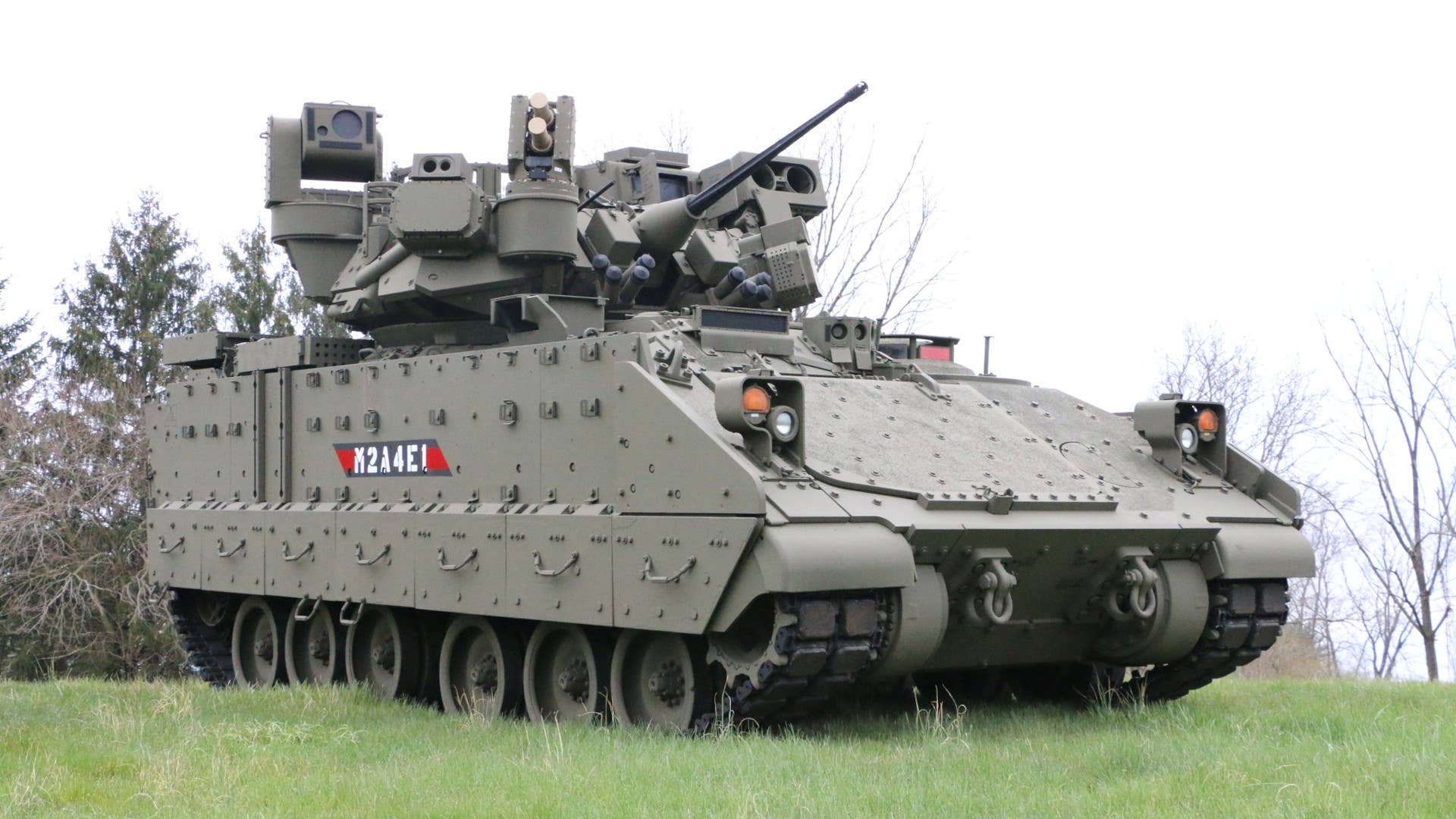
Hard-kill active protection systems offer valuable additional defense against missiles and rockets, and could be used to swat down drones.
The U.S. Army recently unveiled a new upgraded variant of the Bradley Fighting Vehicle. The M2A4E1 version most notably features the Israeli Iron Fist Light, a hard-kill active protection system designed primarily to physically destroy or at least disrupt incoming anti-tank guided missiles and other infantry anti-armor weapons like rocket-propelled grenades. This system could potentially also help defend against the growing threat posed by drones, as The War Zone has previously explored in detail.
The Army rolled out the M2A4E1 last week, according to recent social media posts from the service’s Program Executive Office for Ground Combat Systems (PEO GCS). Army Maj. Gen. Glenn Dean, head of PEO GCS, had confirmed the service was starting to buy at least a limited number of Iron Fist systems from integration on Bradleys in an interview with Breaking Defense in March.
An M2A4E1 Bradley with the Iron Fist active protection system and other upgrades seen at a recent rollout ceremony. US Army
“The M2A4E1 is the most modern and survivable version of the Bradley as a result of integrating an Iron Fist Active Protection System,” according to a post on PEO GCS’s official Facebook page. The new variant also has and “improved High Definition Forward Looking Infrared Gunner’s Sight and an Environmental Control Unit to prevent heat stress for dismounts.”
As installed on the M2A4E1, Iron Fist Light consists of two countermeasures launchers and four sensor arrays positioned around the vehicle’s turret. The sensors, which are small form factor active electronically-scanned array (AESA) radars paired with infrared cameras, are used to detect and cue the launchers, which are turreted themselves. A small interceptor with a high-explosive fragmentation warhead is then fired at the incoming missile or rocket. Israel’s Elbit Systems is the manufacturer of Iron Fist and U.S.-based General Dynamics Ordnance and Tactical Systems has been serving as the lead integrator of the system onto the Bradley.
The Army has been interested in adding an active protection system to the Bradley for years and has been looking closely at Iron Fist, specifically, for some time. A major hurdle in the past was the lack of necessary electrical power on earlier A3 variants to support the system. The M2A4 version, which the Army began fielding in 2022, features a new auxiliary power unit (APU) that has helped make the Iron Fist integration a reality.

An M2A4 Bradley. US Army
The Iron Fist configuration on the M2A4E1 is also reportedly significantly different from previous iterations the Army has tested, but the specifics are unclear. A picture the Army previously released of a Bradley equipped with an Iron Fist did show a version of the system with a different type of radar.


A rendering of a Bradley with an Iron Fist installation also showing a different kind of radar from what is seen now on the M2A4E1. DOD
PEO GCS has also said that funding to help replace dozens of older Bradleys transferred to Ukraine is aiding in the acquisition of M2A4E1 variants. It is unclear how many M2A4E1s the Army currently plans to acquire and how many of them will be converted from existing models.
The Army has been looking to add hard-kill active protection systems to other armored vehicles in inventory, as well. The service has been adding Trophy systems to its M1 Abrams tanks in recent years.
An M1 Abrams tank equipped with the Trophy active protection system. US Army via Leonardo
Trophy is another Israeli-made system from Rafael, which has been combat-proven in service with the Israel Defense Forces and that you can read more about in detail here. Companies in Israel have been and continue to be pioneers in the development of active protection systems.
The development and fielding of increasingly more capable anti-tank guided missiles and other infantry anti-armor weapons, including by near-peer competitors like China and Russia, has long been a driver for the adoption of active protection systems on armored vehicles by armed forces around the world. Those same kinds of anti-armor capabilities have also been increasingly proliferating among smaller countries and even non-state actors. The war in Ukraine, where U.S.-supplied Javelin anti-tank missiles and similar weapons have been a major factor in the fighting on both sides, has helped drive these concerns home.
Hard-kill active protection system may now offer a readily available way to give tanks and other armored vehicles extra protection against drones, something you can read about more in-depth in this past War Zone feature. The threats posed by uncrewed aerial systems, including highly maneuverable first-person view kamikaze types and other weaponized commercial designs, is not new. However, the conflict in Ukraine has again helped drive it into the mainstream consciousness.
https://video.twimg.com/amplify_video/1691084759101734913/vid/640×360/LleyZT3GmJ5NT8vt.mp4?tag=14
The still-growing dangers that drones and anti-tank missiles, among other things, present to armored vehicles, in particular, have prompted experts working for the Army to question whether designs like the Abrams and the Bradley will still be dominant factors on high-end battlefields by 2040. The service is already looking at a future that features new lighter-weight crewed tanks and other armored vehicles, as well as multiple tiers of uncrewed ground combat vehicles.

In the meantime, adding active protection systems to platforms like the Bradley will be one of the ways to help ensure heavy armored vehicles remain relevant on future battlefields, at least under certain circumstances.
============================================ Now a long time ago I was in an ACR. So while looking at this “new” idea for the Bradley. Here are some questions about it.
Like what happens when a very tired crew hits a good size tree branch ? Can the stuff outside the turret take a really good smack & still work?
Or how about a couple of good men with a heavy machine gun shooting AP ammo ? Will it take a beating & keep on ticking?
This also comes to mind. What if the kids drive into a house or a building to hide from the bad guys? Still good to go?
The last thing that comes to mind is this. What if the bad guys start sending out some really nasty airbursts. Will this stuff still be mission ready?
As inquiring minds would like to know, General?