Typical US Army propaganda! Also what in the Hell is with the crappy computer voice too! But let us move on.
For example -Like the Army is really going let some Trooper (E-1 thru E-4) sound off about this gun. Even if its the best handgun ever made. You will be told in no uncertain terms on what to say about it.
Because nobody in their right mind, Is going to play the game of “Telling the Truth to Power” in the US or any other Army out there for that matter.
Especially when some of the really scary Folks in charge of you are involved.
For example. I had a Squadron Command Sgt Major. Who had gone to the Vietnam War several times. But was finally told that he could not go again. Because he was “enjoying” it too much!
Another time I looked at his fruit salad, when he wasn’t looking.
It was the first time I had ever seen somebody with a Combat Infantry badge, D.S.C., Silver Star, Bronze Star with V for valor, a Purple Heart with a mess of palms & stars and a bunch of Foreign Decorations that I couldn’t ID. Even the Squadron Commander was slightly scared of him.
Bottom line – Folks you will have to trust me on this one. As I have met & worked with some really tough & scary Folks while I was in the Army.
But if you really want to find out about anything in the Army. Then go to the Officers Club at the end of of a hard day. Or the NCO Club and stand for a couple of rounds. Then you will get the truth about any almost any subject.
Another day of Doctors sawing bones ,and leech treatments today. But thankfully Mack, has written a guest post for today on his idea on US service rifles. Some of you will recognize Mack as he was a regular commentor at weapons man and here. I have invited him to be a regular guest for our site and therefore giving me more chance to be lazy.
The A-7F Strike Fighter II was a multi role carrier capable high sub-sonic war plane that was relatively cheap that worked and was flown in some variant by the Air Force, Navy, and Marine Corps. After the First Gulf War, it was ingloriously sent to the bone yard in Arizona.
The A-7F was everything the F-35 wants to be but better and cheaper. The F-35 project is about like the damn M-17/ P320. This is what I am afraid will happen with the Army trying to adopt a new 7.62 platform.
First off, all the Camp Perry and M-14 fanboys can chill in that the solicitation as currently available to the public is for new DMR platforms only.
So no, Cletus, the Army is not giving every soldier a 7.62 battle rifle. Sorry about it, go put another coat of varnish on your M1A.
I will not dispute issues of lethality with the M-4/ 5.56; however, I will proudly stand by the rifle and the round when used with effective ammunition at realistic ranges.
Whatever genius in the ordnance corps thought the M855 was a good man stopper out of a carbine, is probably the grandson of the fella that thought the AEF shouldn’t use a Lewis gun.
Iraq for the most part was an urban war. Afghanistan was fought in the valleys and the mountains. For the most part, the M-4 did okay in both of these.
However, a good case can be made in Afghanistan particularly, that the American soldier or Marine could have been better served by more 7.62 rifle, key word rifle, platforms.
However, this in my opinion, is specific to the war in Afghanistan. Begrudgingly, I will admit, the Marine Corp seems to be on the right track with the M-27.
That gives more fire power and accuracy to the individual fire team. I believe something like the Navy’s Mk 13 issued to the fire team level is what the Army should go with. However, since it is both a Navy specific platform and not new, I highly doubt the Department of the Army will go with it because it makes too much sense.
There are undoubtedly times when a 7.62 is needed, but with apologies to MG Scales, the United States Army is not being out ranged in Afghanistan by illiterate goat farmers with Mosin Nagants.
For whatever reason, the US Army is infatuated with the myth of SGT York stopping the Germans with accurate rifle fire at 1000 yards. That is all well and good, but the damn training doesn’t even live up to that myth, much less the equipment.
The US Army would be better served to half the amount of don’t drive drunk and don’t sexually harass power points in favor of more realistic range time that isn’t done on a square range shooting at paper targets.
And of course, after great fan fare, the request for a new 7.62mm platform was quietly dropped. And now the Army is looking for a new sub gun. Which makes sense to an extent. But not really.
If I were allowed to select the Army’s new crop of personal weapons, we would see a Glock 19 as a sidearm. And multiple uppers for the M-4. A .300 BLK for PDW/suppressed awesome, the standard M-4 style 5.56mm upper, and a heavy barreled SDM platform. Modularity for days.
If the U.S. military could supply six calibers to far flung fronts across the world in World War II, they can certainly bear the burden of supplying .300 BLACK OUT to the guys in the Sandbox.
The SIG M-17 pistol is serving in combat with the US Army. The story has a happy ending, but it took years and millions of rounds to get there.
The competition for the Army’s Modular Handgun System (MHS) contract was one of the most rigorous and highly competitive review processes in the history of military firearms. It was scrutinized and contested and endlessly questioned.
SIG submitted a P320-based platform. The only true modular candidate, SIG’s XM-17 performed well during the selection under all conditions the Army could dream up. After over two million rounds of testing, the XM-17 became the M-17 and a new icon was born.
The service handguns chosen by the Army have always become essential weapons; the Remington New Army, the Colt Single Action Army, Browning’s M-1911 and the M-9 Beretta are all classics. Now you can get the latest chapter in this historic line.
Other manufacturers have been selling their versions of the MHS while SIG has been busy making guns for the Army.
Every branch of the military has adopted the M-17 and the smaller version, the M-18. At last, Sig has sent the military enough guns that they can make some M-17s for the rest of us. There are two civilian versions, The M17 Commemorative and the P320-M17 and they are on their way to an FFL near you.
P320-M17
The P320-M17 closely follows the specifications of the U.S. Army’s M17. The P320-M17 features a coyote-tan carry-length grip module available in three sizes and comes standard with a manual safety. Non-manual safety P320-M17 pistols will be shipped at a later date. There is a coyote-tan PVD coated stainless steel slide and black controls just like the pistols currently being shipped to the U.S. Army. The sights are a SIGLITE front night sight and removable Night Sight rear plate.
Many internet experts, who have never touched an M-17, believe that the small arms professionals in the Army, the Navy, the Marines, the Air Force, and the Coast Guard have gone through millions of rounds of extensive testing and picked the wrong gun.
After my own limited test firing, just over three thousand rounds through the M-17 and the 320-M17, the M-17 is my choice too and I believe that the army chose the best gun for the job.
The P320-M17 easily clangs the CTS steel targets at 50 yards. At the Academy we shot steel out to 75 yards.
The P320-M17 Specs:
Total length: 8″
Barrel length: 4.7″
Weight (incl. magazine): 29.6 oz.
Height: 5.5″
Width: 1.3″
Sight radius: 6.6″
MSRP: $768.00
I got a 320-M17 a month ago. I have taken it to classes as a student and an instructor. I have shot thousands of rounds of ball and hollow points with no issues and no cleaning. I have lubricated it and I will probably clean it when it gets dirty. This is not a torture test; the gun just isn’t dirty enough to require cleaning yet.
The P320-M17 comes with two 17 round magazines
I had the opportunity to travel to New Hampshire to visit the SIG SAUER factory. The technology is highly automated with multiple quality checks. I got to walk the production floor and see every step of the process from machining to assembly. Trained professionals assemble guns and reject any component which isn’t perfect, but that is only half the story.
There is a quality plan for each part which dictates how many parts from each lot are checked at special robot laser verification stations which check every angle of a part. These check stations are connected to each of the automated CMC machines and automatically update the instructions to the machines, in real time.
Problems are anticipated and avoided. This reduces bad parts, keeps them out of the supply chain and cuts costs so SIG can make better and less expensive guns. They test fire every gun and I got to witness the process while I was there.
I also got to go to the SIG Academy and shoot the 320-M17 for a day under strict the tutelage of a couple of former Special Forces operators (one who is still active) on their staff. I shot 400+ rounds of SIG FMJ ammunition at paper and steel targets.
We ran the guns hard and shot them hot. We worked up to multiple target drills and shooting a scenario in and around cars and barricades. The guns got hot and dirty and they all ran.
The M17 has a great trigger and good sights; I can’t tell a difference in performance or feel between the M-17 and the P320-M17. The contract specification for the M-17 was shooting a ten round four-inch group at 35 yards with crappy ball ammo which it will do all day.
The civilian versions of the M-17 are just as accurate and fun to shoot. I have used a variety of heavy and light bullets in full metal jacket and hollow points. The 320-M17 fed them all.
The P320-M17 was reliable and accurate with ball ammo
The feel and the grip angle are like the rest of the P-320 family. The manual safety is ambidextrous and placed so that the thumb rides on it naturally when you assume a firing grip. The ambidextrous slide lock sits right in front of the safety. It takes a little getting used to, but it is ergonomic and easy to use.
There is some debate about external safeties. The MHS requirements specified a safety and the M-17 delivered. The M-1911 had a well-placed safety, the M-17 is better, inspired by competition modified civilian 1911s.
There are a lot of things soldiers do, like individual movement techniques (Google it), which are fundamentally different than police or civilian applications. Military guns get banged and dropped and abused. Some soldiers jump out of airplanes wearing them.
With training, a manual safety is no slower and provides an extra layer of protection. Nobody wants to get shot doing a PLF (Parachute Landing Fall).
Speed drills at 15 yards were no problem for the P320-M17
The P320-M17 groups well at 15 and 25 yards.
The P320-M17 comes apart like any other SIG P-320. The original specifications for the XM-17 required a special tool to remove the takedown lever. This requirement was changed and now both the Army M-17s and the civilian variants have the same removable takedown lever as the P-320. The military M-17 and the Commemorative require a special tool to disassemble the slide. The trigger modules have the serial number and are completely removable.
The P320-M17 slide markings
The Commemorative
The M17 Commemorative pistol shares the same components, coatings, and markings as the original pistol that was awarded the U.S. Army contract for the modular handgun system (MHS).
Just like the military M-17, the Commemorative comes with a coyote-tan carry-length grip module and a coyote-tan PVD coated stainless steel slide. The Commemorative has coyote-tan colored controls just like the original pistols shipped to the 101st Airborne.
The Commemorative is an exact replica of the first M17s the military got. SIG has made 5,000 available to the public. It even ships in the same cardboard box that the military gets it in.
As a side note, SIG is no longer offering the coyote-tan colored controls, even for the military. So the civilian version of the M17 looks just like what the military is currently getting.
The pistol features a SIGLITE front night sight and removable Night Sight rear plate with the same optic cut as specified by the MHS contract. It comes with two 21-round magazines, one 17-round magazine and a manual safety.
Only 5,000 M17-Commemorative Edition pistols have been produced. Each one carries a unique identifier (UID) just like the Army guns. From the pistol to the same cardboard packaging as delivered to the U.S. Army, the M17-Commemorative Edition is identical to the U.S. Army’s official M-17 service pistol.
Register your M17-Commemorative and you get an official certificate of authenticity and a commemorative challenge coin, both with serial numbers matching your M17-Commemorative pistol.
To complement these guns, an M17 Collector’s Case is available separately at sigsauer.com/store. The case is a solid cherry box, with dark mahogany stain, a tempered glass top, a brushed nickel latch and a keyhole back for optional wall-hanging.
The M17 Collector’s Case features a slate-grey flocked foam insert with an affixed U.S. Army logo, and precision laser placement cuts for the pistol, certificate and Official Challenge Coin.
M17 Commemorative pistol in optional M17 Collector’s Case
M17 Collectors Case MSRP: $199.99 (sold separately at sigsauer.com/store)
For more information on the SIG M17 visit SIG by clicking Here.
____________________________
My own uninformed opinion about this pistol. Is that it does not have an exposed hammer. Which could tell somebody if the weapon could be cocked and ready to go or not.
Since anybody who has been around guns and human beings knows from experience. There are going to be some idiot who is going to have the gun loaded and ready to go. just like on the TV or cell Phone now.
Which will lead to an “accidental” discharge & hopefully nobody getting hurt. But we know that in the real world somebody is going to get hurt.
Just saying!- Grumpy
It was Ben Franklin who wrote, “He who neglects his hair neglects his country.”
Well, all right, he never did say that but he would’ve had he thought of it, because Ben understood the importance of a well put together coiffe of hair.
The military has undergone some variations on its way of thinking about hair for men. Back in the early days, it was cool to have long hair. Hell, if you didn’t want to have long hair you’d have to get a wig!
And for those who couldn’t afford the fancy up-dos, there was always the fallback of bear grease and flour to rub through your locks. Might not smell the best – and it would attract flies – but damn if you didn’t look dashing.
Dope hair makes dragoons cry. Fact.
Then came the 1800s and the glorious manes disappeared, replaced by as many sideburns as you could pack on your face without allowing them to develop into actual facial hair. It was a pretty good time as men’s hair goes – lots of flow.
“Check out this chill ass map, brah”
Except for maybe young U.S. Grant and his…whatever it is that he had going on there.
Is this a..half mullet? A hullet?
By the time the Civil War hit, however, it was all beards, all the time. The more beards, the better. Stack beards on beards, the masses said, and the generals on both sides obliged.
Ambrose Burnside went one better and connected his whole face with sideburns, a look that left little in the way of confidence in his abilities.
The man appeared to have gone into hiding and was peering out behind the bushes, which is perhaps why he failed so miserably at Fredericksburg: he simply couldn’t see what was going on.
Never go full sideburn defilade.
Alpheus William’s mustache was always trying to get away, so he nailed it down so as to have it with him always.
“Quick, boys, seize the shoulders!”
Most didn’t seem to care too much what was going on up top – both in the hair situation and the brain department, as it would turn out.
By the time we get to 1898 and the Army’s foray into making war in places where the climate will kill you faster than the natives, most of the beards have vanished. A few holdovers can be seen, all exclusively sported by Civil War veterans who refused to realize that 50 years of military service doesn’t mean you’re a genius – it means you’re ancient as hell and need to retire.
The de rigueur hair style at this point becomes the mustache. It was as if President McKinley had called for a wall of mustaches to face off against the Spanish, for they sprouted from every field grade and general officer’s face faster than disease spread through the troops stationed in Cuba.
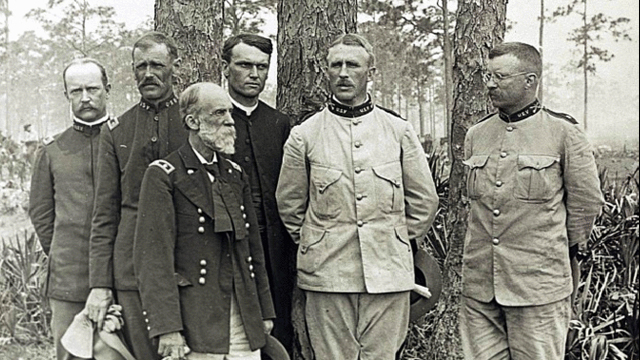
Mustaches for dayssssss…except for General Beardy McBeardface Wheeler.
World War I saw the complete and final death of the beard for the majority of all troops, for the simple reason that if you had a beard – well, you were gonna die because your gas mask wouldn’t seal. That said, the ‘stache refused to go away and reigned supreme on the Western Front. It was paired with a short, cropped haircut.
Why? Because while the ladies love glorious flowing locks, so do lice. And the ratio of lice to available women in the trenches was pretty much 1 billion to one, so off the hair went.
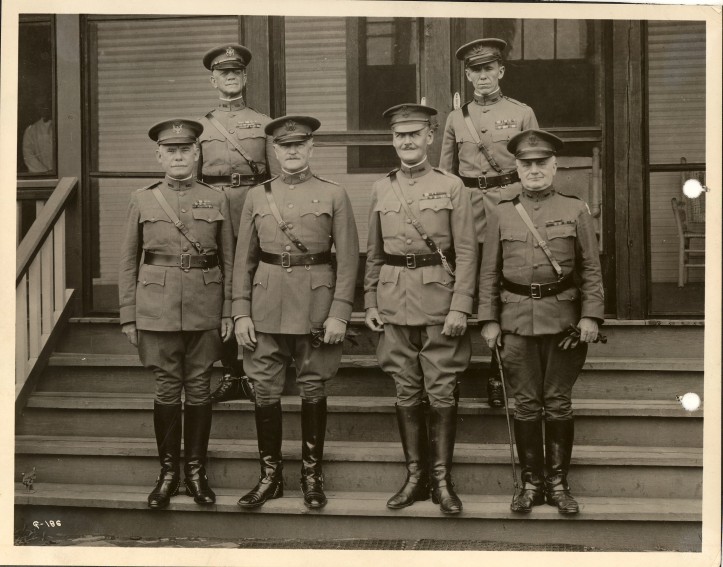
Clean cut, mustached, with nice high collars that made it difficult to look from side to side, the officers of 1918 cut a dashing figure. Well, you know, the ones that weren’t covered in mud.
Unless you were at GHQ, in which case, no mud for you.
By World War II, Army officers had caved to the popular pressure of what a soldier should apparently look like: shaven, with a cropped haircut that was usually some variation of a fade or cropped top.
Boring ol’ hairstyles, and yet the owners did some damn fine work. Of course, in the frost of the Ardennes or the humid jungles of New Guinea, the niceties of grooming faded into the background. And in sustained combat, the beards came back – although never officially.
And some people decided to go for Mohawks. There’s always one.
Following World War II, Army hair got all regulated and whatnot. The current regulation, AR 670-1, is pretty vague about the limitations on male haircuts, as long as they are well-groomed and present a neat and orderly appearance.
Naturally, there’s all sorts of disparities when it comes to officers of today and their hair style of choice.
You’ve got the highly motivated ones with high and tights, who you look askance at and ask them why they didn’t go join the Marine Corps and get it over with.
Then there’s the “my entire personality is the Army which is why my haircut is so bland and buzzed” type. Of course aviators have the “I woke up like this” hair, which takes the meaning of good order and discipline to the limit.
And then you’ve got the younger generation of officers – myself included – who believe that “Yes, Virginia, you can be an Army officer and have good hair.” With trimmed sides and a comb-able top that falls within Army regs – yet still causes sergeants major to go into fits – we are reclaiming the heritage of Army hair.
Clay’s Guide to Urban Defense: Ep. 4 Hardening the Home
byCLAY MARTIN
In our last episodes we covered the fun part: guns and how much ammo to feed ’em. I’m as guilty as anyone when it comes to chewing the fat on this topic; I’ve spent hours in the forums talking about caliber preference, weight vs. power, and all the like.
But now we have to get into the not so fun part, the part that resembles work. If guns are the equivalent of showing off your abs, the hardening the home part of this series is how you got those abs. It isn’t sexy, but it is important.
I’m going to start here with some general experience, and why I’m qualified to speak on the matter of defending an urban location. First and foremost, I did some tours in Iraq, which offers some unique insights.
Despite what the public generally thinks about U.S. Military bases and the lines of trailers many troops used, it wasn’t always like that. Especially in the early days, we took over former regime buildings and lived and worked in them.
It is pretty funny to see a bunch of grunts living in a palace with gold toilets, but it’s how it went. The bad guys weren’t shy about still trying to kill us in those structures, so we learned a lot about hardening them from both rifle fire and mortar attacks.
With the caveat that we usually had Uncle Sugar’s logistics train to help us, which provided very expensive and unwieldy things. Like Kevlar blast blankets and Hesco bastions as time went on. Blast blankets start at about $1,500 apiece, so I think we can leave those off the shopping list.
Second, Iraq had a very weird infrastructure. In certain spots at least, I remember being amazed by how similar it was to a U.S. city. Like the interstate highway system around Baghdad had green and white signs exactly like ours (only they were in English and Arabic), letting you know what exit was coming up.
This applied somewhat to buildings as well. In the cities, most structures were concrete and bore at least a passing resemblance to ours. Minus all the OSHA standards and safety features.
Third, not only did we harden buildings, so did the bad guys. It was not uncommon at all to have to fight through barricades and the like, especially if a certain neighborhood was in open revolt at the time.
That, combined with some very odd design choices, gives a man insight into how to set up a defense.
And fourth, my last job helps a lot as well. As a CQB instructor, part of the task was teaching new guys how to deal with obstacles similar to what they were likely to encounter.
But being on a timeline and a budget, the idea was to build those obstacles cheap and easy. But also in a manner that would require a lot of effort from the student to overcome or work around or breakthrough.
Suburban Defense
Much like the first article on rifles, where we divided the world into free and non-free cities, we need to divide again. The first part of this will focus on the suburbs, for a normal American house built of 2x4s and drywall.
The second will focus on the concrete and stone structures we introduced in episode one. There is obviously some overlap of what can be done, and those things I will put in the second part.
Having traveled the world, I can generally break all construction into two categories. American, and everyone else. For cities this is definitely true, Prague looks like Okinawa, looks like Cairo, in terms of things built in the last 50 years.
Maybe I lack the artist’s eye, but it’s how I see it. No one on earth has American-like home ownership, owed at least partially to our ability to build them relatively cheap but also structurally sound.
And while American homes have proven capable of lasting against the elements for 100 plus years, they do have a weakness. They don’t stop bullets worth a damn! Maybe that is also because we always play away games.
Unless you have something a little different, like a log cabin with foot-thick walls, your house is largely indefensible against rifles. It is even worse against fire, which is a concern I often see ignored in preppier circles. Your back fence will burn, your shingles will burn, and the outside of your house will burn with very little effort.
We have largely mitigated this problem in civilized society by having good fire departments and enforcing suburban burn bans, but it is a different animal when Mad Max rules are in play. In short, I would not want to ever try and defend my house from teeming hordes equipped with Molotov cocktails and long guns.
Sandbags And Fighting Positions
But you might not have a choice. So you can still do some things to tilt the odds in your favor. A lot of this is construction specific, which also varies from region to region. One thing that has been brought up in the comments section is sandbags.
Plausible option and it would help stop bullets at least. The downside here is the number of sandbags you would need to secure a perimeter around your home, and the labor required to fill them. Having done some sandbag filling, it is not a fun chore.
Some suggested sandbags in the context of hardening only one room, but that has downsides too. Even to protect an interior room is going to require a lot. And if you can only defend that room, you are ceding enough ground to attacking forces to get within 4 feet of you before you have a clear shot.
If you are built on a concrete foundation, you can actually take a shortcut. It’s extreme, but we are talking about extreme circumstances. If you cut holes in your floor for fighting positions, you would lower your needed sandbag count by a lot.
Because you have walls to hold the dirt up, you could actually get by without any sandbags at all. You will still want a wheelbarrow, but you could actually build “range berms” three feet high the entire way around your house. Inside or outside, depending on the direness of the situation.
I have a full basement, so my options are more complex. The smartest thing I could do is build parapets to my needed perimeter positions, and then cut firing ports in the walls to the outside. That cedes my entire first floor, but the surprise would be nasty. Imagine running up the driveway for an easy score, then taking rifle fire at knee height. Ouch!
While we are talking about the typical neighborhood set up, the direness of the situation directly influences the level of heavy-handed response from you. For instance, have you thought about fields of fire?
Most of the places I have lived, my best course of action would be extreme. I would have to huddle the neighbors in my own home, while I burned theirs to the ground.
Otherwise, the avenues of approach would be many. You can stop saboteurs at 50 meters. At five meters, they are likely to win or at least complete their task.
Plywood
What else is a high priority? The next step we can take directly from our friends in hurricane country. While plywood window coverings won’t stop bullets, they do stop bricks and Antifa goblins (FYI: half-inch plywood won’t even stop handgun rounds, much less rifle fire).
I suggest a slight variation from the full coverage of windows, leaving an 8-inch gap at the bottom. This prevents your house from being totally dark while also creating airflow. Since you bought a pile of guns from episode 1, it also gives you space to see and shoot back.
Won’t the gap make the window coverings easier to rip off? That is a valid criticism, and yes, a little. But two things. One, as they said in Rhodesia, “An obstacle is only an obstacle if it’s covered by fire.”
If someone is sticking a crowbar in your barricades, you should be sticking bullets in them. And two, trying to remove a sheet of plywood held in by a dozen three-inch deck screws is no easy feat. With your F-250 maybe but not with just your hands or hand tools.
Won’t the gap allow snipers to shoot into your house? Possibly. Walking in front of a lit window does create a signature that could get you shot. But it is also kind of the point of the gap. That ribbon of light should serve as a reminder not to walk in front of it. Because in terms of rifle fire, your house might as well be made of paper mache.
Doesn’t the plywood create a fire risk all its own? Yes, it will burn, no question. But if it keeps a Molotov from landing in your living room/inside perimeter, it has still done its job. Which brings up the next subject.
Fire Extinguishers And Screws!
Aside from all the standard prepper food and water, you are going to need some other things for home defense. Right up there with bullets should be fire extinguishers. A million dollars in guns and ammo is worthless to you if it burns up. When you calculate the spots in your home that need to be covered by a sentry, calculate 2x fire extinguishers for each as well.
Next, you need at minimum a full contractor box of either nails or deck screws. I prefer deck screws, but only if I have a cordless drill. Nails are easier to install with manual labor but are also easier to pull out. You can make some creative barricades with just that and materials laying around your garage or basement. In the absence of plywood, I could barricade all my windows with fence planks.
For our suburban neighborhood defense, I will close with this. You are going to have to think outside the box. One of the other specific suggestions I have is to plant a large bush or bamboo in a spot you have no windows, 3-4 feet off the wall. The thicker the better. If I was planning to siege a suburban house, and I had numbers on my side, what would my plan be? The same as any Old West movie. Cover the doors and windows with guns, and set it on fire. Shoot anyone that comes out. It is a mistake to assume goblins have never watched an old Western or can’t fathom that simplistic line of reasoning. If you find yourself in that spot, the weakness of sheetrock walls can work to your advantage for once. The bushes are to cover your emergency escape hatch, that you are cutting on the inside from day one of the crisis. If you ever need it, cut the last bit of exterior wall you have left in place, and the ground cover buys you precious seconds of surprise. It’s little things that often give you a tactical advantage, and you have to shift your thinking.
Tune in next week, when we cover the specific defense of concrete buildings for our brethren stuck at the city center.
Defense Specialist Allison Barrie on how the United States’ elite Special Operations warriors are set to become even more deadly when upgraded cutting-edge suppressor become a new addition to their arsenal.
U.S. Special Operations are a remarkable, formidable fighting force who are admired and feared throughout the world. Now, the military’s elite warriors are set to become even more deadly with a new addition to their arsenal.
About $48 million-worth of new, cutting-edge suppressors will be in the hands of America’s top military personnel, enhancing their capabilities on the battlefield.
For several years, Special Operations Command has been hunting for the best suppressed upper receivers for their M4A1 carbines.
They’ve chosen the Sig Sauer MCX SURG System to upgrade these weapons. The new Sig suppressor will deliver accuracy, speed and reliability.
And of course, it will deliver outstanding sound reduction. The new suppressors are made of ultra-advanced materials. ARMY TAKES AIM WITH MORE M4 WEAPONS
Sig Sauer has a distinctive looking, revolutionary approach to suppressors. They look nothing like the suppressors you see in movies and TV shows – these rifle suppressors are tubeless. They’ve eliminated the outer tube typically seen with suppressors.
File photo (U.S. Army)
In addition to reducing weight, this tubeless design increases volume, lowering pressure and temperature for greater durability and leading signature reduction.
One of the keys to this feat is the special “baffle” design. TheM4A1 Weapon
M4A1s tend to be used by military special operations. The M4 Carbine entered service in 1994 to replace the M16 for some roles. The M4 provided a shorter and lighter variant. The M4A1 is a fully automatic version of this weapon.
Made by FN, the M4A1 weighs about 6.36 pounds with a 14.5-inch long barrel. The overall length is anywhere between 29.75 inches to 33. Cartridges are the 5.56x45mm (.223) NATO cartridge that is magazine fed with a mag capacity of 30 rounds. NEW LASER-EQUIPPED DRONES WILL TAKE OUT MISSILE THREATS AGAINST THE US
The M4A1 trigger group settings are: safe, semi-automatic, or fully automatic. The trigger pull is 5.5 to 9.5 rounds and it has a 700-900 RPM rate of fire.
File photo (U.S. Marine Corps)
This weapon fires using a direct impingement gas operating system and has an effective range of about 500 to 600 meters (1,640 to 1,969 feet). PODCAST: GET SOME TOP TIPS FROM THIS GREEN BERET MARKSMAN, NOW SIG SAUER SHOOTING EXPERT INSTRUCTOR What impact does a suppressor have?
Suppressors are often referred to as “silencers.” The goal is to make a weapon as silent as possible. But it is not just about sound, it is also about other “signatures” that could reveal your location to an enemy. Another key tell is visual – the flash. Adding a good suppressor to your weapon will also reduce, if not contain, this visual cue.
One of the reasons they are referred to as suppressors – and not silencers – by the military and law enforcement is because the vast majority on the public market don’t achieve anything near silence.
Reducing the noise is not just about exposing your location and actions to the enemy, it can also make it easier for special operations teams to communicate with each other on the battlefield. For these warriors, their ears are continuously exposed to gunfire year-round because they are either training or deployed. An excellent suppressor is key to better protection for their hearing. ‘GIRAFFES’ JOIN THE NAVY AND HUNT ENEMY THREATS
A common misconception is that suppressors reduce capability in lots of ways, such as reducing range and lethality.
Sig Sauer SBR with silencer (Sig Sauer)
These new Sig Sauer suppressors are an excellent DoD investment. They will most definitely increase the lethality of our elite forces and make them harder to kill. Rigorous Testing
To achieve selection, all the suppressors under consideration were challenged to meet hard core requirements. The testing was rigorous, comprehensive and exhaustive.
The MCX SURG also had to meet the extremely high standards for sound reduction. It also went up against firing specifications – a suppressor must enhance effectiveness in combat and absolutely not incur any trade off on lethality. Accuracy, speed and reliability are vital.
There were also very demanding standards for temperature and vibration – standards that both enhance effectiveness and the safety of users. PODCAST: WHAT’S IT LIKE TO BE A NAVY SEAL IN A HELICOPTER 2 MINUTES OUT FROM A TARGET? FIND OUT FIRSTHAND FROM THIS AMERICAN HERO SURG
The Department of Defense revived the Suppressed Upper Receiver Groups (SURG) in 2017. This program aims to upgrade, and optimize military weapons for continuous, suppressed use on the battlefield. ‘FORCE FIELD’ TECHNOLOGY COULD MAKE US TANKS UNSTOPPABLE
After years searching for the best solution, it was decided that the Sig Sauer MCX suppressor outperformed the competition and the award was recently issued.
FN M4A1 rifle (FN)
What’s next?
This is the second M4 conversion Sig Sauer is helping U.S. Special Operations Forces with this year.
Earlier this year, Special Operations Command (SOCOM) bought some Sig Sauer MCX Rattlers. Rattlers are personal defense weapons available on the open market and chamber standard 5.56mm rounds and .300 Blackout. For operators, these could be very handy for CQB (close-quarter battle). These are built with the M4A1 lower receiver.
The new MCX SURG suppressors will be rolled out to Special Operations Forces over the next five years.
Allison Barrie is a defense specialist with experience in more than 70 countries who consults at the highest levels of defense and national security, a lawyer with four postgraduate degrees, and author of the definitive guide, Future Weapons: Access Granted, on sale in 30 countries. Barrie hosts the new hit podcast “Tactical Talk” where she gives listeners direct access to the most fascinating Special Operations warriors each week and to find out more about the FOX Firepower host and columnist you can click here or follow her on Twitter @allison_barrie and Instagram @allisonbarriehq.
By Ray Starmann
Remember, the old expression, ‘the Army will make a man out of you.’ Or, the Marines great recruiting tagline, “Looking for a few good men.” How about the Navy’s action-packed 1980’s commercials with F-14’s blasting off into the wild blue yonder under the cover of smoke and exhaust fumes as a gravelly voice told a nation of young men that to join the Navy wasn’t just a job, but an adventure.
From the birth of this nation, the military was seen as a male rite of passage, something one joined, not only out of patriotism, but to prove something to oneself; perhaps, like Phil Caputo, to avoid the complete drudgery of civilian life, and to find oneself in that ultimate crucible of manhood – war.
Young males always admired the generations of men who went before them and who had served honorably and survived to ‘stand a tip-toe’ for the rest of their days.
But, since, Tailhook in Sept of 1991, in what I believe was the launching point for the PC destruction of the US military, our armed forces have been on a downward spiral into an abyss of diversity, feminism, political correctness and cowardly leadership.
And, now, literally every week there are one or two or three stories detailing just how deep in the PC abyss the military has sunk.
Today, the Army Times, aka the Diversity Times, shouted out with glee the joyous fact that Staff Sgt. Amanda Kelley, 29, is the first enlisted woman to earn a Ranger tab.
1st Armored Division spokeswoman Lt. Col. Crystal Boring, could barely keep herself from busting out of her maternity army combat uniform when she updated Old Ironside’s Twitter Page with this announcement – HISTORIC MOMENT!
Congratulations to @USArmy Staff Sgt. Amanda F. Kelley for being the first enlisted woman to graduate Ranger School, and earn the coveted Ranger tab today at Fort Benning, Ga. She is the true definition of an #IronSoldier!
Oh rejoice! Diversity!
Who cares if we get our asses handed to us against the ChiComs? The important thing is to keep the lie going, national security be damned!
Kelley is a military intelligence electronic warfare specialist, serving in a combat aviation brigade.
One might begin to ask oneself why in the name of God this soldier was sent to Ranger School, wasting tax payer money and taking a slot that some young stud in an Infantry Battalion could have filled.
Kelley’s attendance at Camp Diversity, aka Make-Believe Land, aka Fantasy Island, aka Ranger School and her ‘graduation’, served no other purpose than to shove another female through the course so Kirsten Gillibrand can get a tingle down her leg.
Ranger School used to be one of the toughest military schools in the world. For decades, men trained hard with the hope that they could earn a Ranger tab, maybe even serve in a Ranger battalion, maybe follow in the footsteps of the Boys of Pointe du Hoc and Merrill’s Marauders.
Why even go to Ranger School now? They’re graduating mommies, the cheerleader you wanted to date in high school and the butch dyke down the block.
Not exactly a male rite of passage, anymore is it? More like an episode of Big Brother – Blanks and Boots.
And, mark my words, you heard it here first, there will be some bimbo in the coming months sporting a Green Beret and the liberal world will shout loud and high about the joys of diversity and how men and women are physically equal, when every Swingin’ Richard on Smoke and Mirrors Hill at Bragg, knows damned well that the standards have been lowered so much at the SFQC that Granny Clampett could be your next A Team light weapons sergeant.
While the PC warriors celebrate diversity, our enemies are licking their chops like Wiley Coyote at an all you can eat ACME buffet. And, this time Wiley is going to kick some butt.
Our enemies are dying with laughter every day now. They don’t even have to squeeze off a round or drop a mortar in a tube. We’re doing all the work for them as we destroy ourselves in the name of feminism and political correctness.
What red blooded American male would want to serve in a US military of drag queens, cadets in red high heels, Mommy Rangers, lactating chicks in the field and waddling battalion commanders?
There’s a known fact that the feminist crowd would like to keep buried, like those Green Cards for those Ranger tabbed ladies that Benning hides so well – any industry women take over, men leave… in droves.
The future of the US military is a largely female force (there are currently 170,000 serving in the US Army) with a smattering of gay men, men who think they’re women, liberals in skinny fatigues and aggrieved soy boys.
The future of the US military is a broken force, a devastated force, if anything is left at all on some distant battlefield.
A perfect storm is brewing in the US military now.
It’s a combination of a worthless Secretary of Defense who is probably the biggest disappointment since Evil Knievel’s failed Snake River Canyon jump, a Congress with few veterans and those who are, are mostly female, cowardly generals and admirals, liberal generals and admirals, a vocal LGBT mafia in the Beltway, candy ass Millennial recruits and the feminist lobby which believes combat power equals the number of pregnant women a division has in its TO&E.
Nope, the US military just isn’t macho anymore.
And, that’s a big, big problem.
______________________________
I beg to differ a bit on this one. As the US Army will survive. But its survival will cost a lot of Lives, Treasury & National Pride.
Because I am willing to bet on this. That a lot of “questionable” Folks, are going to be shot. That and the entrance hole on the “Brave” veteran.
Will not be a 5.56 mm one or that certain fragments of steel will be American made.
Also why does the Army not set up a Special Training School for Women only. One that takes into consideration the following. Like the Female Troopers strengths & Dimensions of soldiery?
Grumpy
I got this from “Angry Staff Officer.
I know that other services handled defeat like the Germans did from WWI, it still gave them national pride, but the German defeat from WWII was total.
The national identity was totally decimated from the war and the Germans were a people with out morals or anything, it was like they had to atone for the sins of their past and nothing was off limits.
When Germany became its own nation in 1949 they started to form their own identity and move beyond the horrors and deprivation of the war.
I am not sure what we would do if we lost an entire field Army, if half of the population would rejoice in the loss because they hate what the United States is and want to see us lessened. It is interesting although distasteful exercise.
Training for Defeat
In the U.S. Army we have a long tradition of victory – or so we tell ourselves. We proudly carry the campaign streamers from past conflicts on our unit colors and enjoy hearing about the exploits of past heroes. Victory is our expectation.
But what if that isn’t what happens?
Now, I’m not talking about the nebulous idea of strategic victory in places like Vietnam, Iraq, or Afghanistan; I’m talking about the sharp and nasty feeling of operational and tactical defeat. Retreat. Withdrawal. Being overrun. Loss of soldiers. Loss of entire units. Disaster.
A sight we are not used to: U.S. soldiers surrendering to the Germans after their unit was overrun during the Battle of the Bulge in World War II.
We’re far more comfortable talking about potential victory than we are discussing the possibility and – let’s be honest – very strong likelihood of loss.
And even when we are discussing loss, we spend more time talking about mitigating risks than we do how to react should the adverse occur.
This means that we have a generation of young leaders who learn about loss only when it actually happens. This is decisively the opposite of how we treat everything else in the Army as regards training.
We don’t send soldiers into battle without ever having fired their weapon; why should we send commanders to war without at least having some training on how to deal with loss and defeat?
And yes, we do train for some loss: vehicle recovery, casualty evacuation, and breaking contact come to mind. But how well do those test a unit for a full and total breakdown?
Or is it perhaps better to not even put that idea into soldiers’ heads? These are the questions we should at least be asking, as leaders.
Fortunately – or rather unfortunately – we have no end of historical examples of loss and defeat in the U.S. Army to use as case studies – even if we are loathe to study them or admit that they exist.
The first thing to remember is that there are varying levels of loss. The first is the most desirable, if we can call loss desirable: loss with preservation.
The ideal example of this is George Washington’s campaigns through New York and New Jersey from 1776 through 1777. In the fall of 1776, Washington’s force of 19,000 militia and Continentals was slowly driven out of New York City.
It was not Washington’s finest hour; he lost 3,000 men who were captured because of lack of communications. He was driven from Manhattan, then Harlem, then White Plains, and then withdrew under heavy pressure into New Jersey – that’s how you know it was bad. No one goes to New Jersey voluntarily. By the end of the campaign he had barely 5,000 troops left.
The Battle of Long Island – incredibly stylized, since no one had uniforms this clean and, well, uniform. (National Guard Heritage Series Print)
To many, this would appear to be a complete defeat; Washington had lost more than two thirds of his force to battle and attrition, as well as losing the largest city on the eastern seaboard. And he was now in full retreat. To the British, it was a decisive victory for those very reasons.
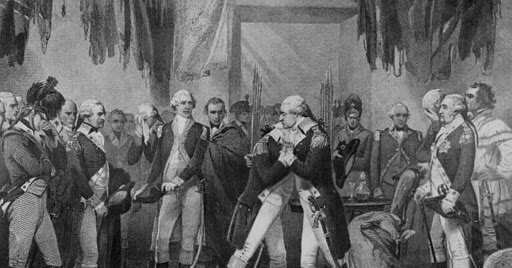
But Washington did not see the war in those terms; for him, the survival of the Continental Army was the most important factor of the war. The loss of New York taught him that population centers mattered little as long as he could field a force.
And even with his small army, Washington was able to make life difficult for the British through constant raids and local attacks. In December, he made a large raid at Trenton which caused 1,000 Hessian casualties and drew British General Howe out of his fortifications into New Jersey.
This led to a local British defeat at Princeton which raised Continental morale and caused Howe to withdraw from New Jersey.
Washington spent the remainder of 1777 successfully not losing, for lack of a better term. He played a masterful ballet with the British, skillfully avoiding a decisive battle where he might have been wiped out.
While Washington eventually lost Philadelphia, the British would learn a lesson that Napoleon would learn in Moscow: it is relatively easy to secure a hostile city deep in enemy territory; it is far harder to hold it.
And they learned what all the rest of us already know: Philly is not a city worth staying in longer than a few days (Kidding, I love all you Philadelphians).
By not risking his army in general battle, Washington set the conditions for successful operations elsewhere – namely, Saratoga – which would bring in foreign aid.
This proved indispensable in winning the war for the Continental Army.
Loss with preservation means that you know what to do when you retreat; that there is a plan for a withdrawal; that the force is made to realize that although you may be retreating, you are not doing so out of defeat.
It means that the loss can be followed up by a counterattack. It is what the idea of defense in depth is based on: temporary loss of forward positions in order to overextend the enemy and make them vulnerable to a counterattack.
It is an incredibly difficult thing to do and must be trained on. A withdrawal can turn into a retreat which can turn into a panic very quickly, unless troops are disciplined and well-led.
Tactical withdrawals and disengagements may often be necessary in future conflict, which is why they need to be part of training now.
The next level of loss is a full on retreat. This is best typified by the U.S. Army loss at the First Battle of Bull Run in 1861. Both the U.S. Army and the Confederate armies were amateurs at war and fairly evenly matched.
The U.S. Army under Irvin McDowell gained an initial advantage in the attack but overextended and exhausted itself just as the Confederates received reinforcements.
Because of the poor or even non-existent training in the U.S. Army which largely consisted of volunteer units made up of 90-day troops, the retreat of some units caused an overall panic that infected nearly every unit on the battlefield.
Fortunately, a small rear guard was able to cover the route which staved off total destruction of the army.
The Confederates were so exhausted and disorganized from the battle that they were not able to pursue. Whole U.S. units abandoned their position and equipment without even firing a shot.
Rickett’s U.S. Battery being overrun on Henry House Hill. Note the caissons and limbers being withdrawn in confusion – these would have been needed to save the guns. Instead they only added to the packed and chaotic roads leading back to Washington D.C.
This defeat almost ruined U.S. chances for a victory in the east, but for the sad condition of the Confederate forces. Their victory left their army in such a disarray that the U.S. was able to reform and put a force in the field in a short time.
However, this defeat and the cultural sting of it would haunt the Army of the Potomac (the main U.S. Army in the east) for several years.
It would take until the summer of 1863 for that army to shake off the sting of Bull Run, despite performing very well in multiple campaigns. Victory, they say, can be contagious. Defeat can be as well.
The worst thing that can befall an army or a unit is full-on destruction. Units are sometimes destroyed for a greater cause: to delay oncoming enemy forces or to seize a vital piece of terrain.
Even the dismal performance of the US II Corps at Kasserine Pass in 1943 – a defeat if ever there was one – at least served to delay the Axis advance and buy time for an Allied counterattack.
Similarly, the U.S. forces in the Philippines in 1942 fought a sustained action under incredible duress to buy time for the U.S. Navy to recover from Pearl Harbor and return to the Pacific in force.
But the destruction of an entire army or large body of troops is far more difficult to justify or recover from. For example, the destruction of Task Force Smith in Korea contributed nothing to the overall situation on the peninsula beyond serving as a wake-up call to the low levels of readiness in the U.S. Army in 1950.
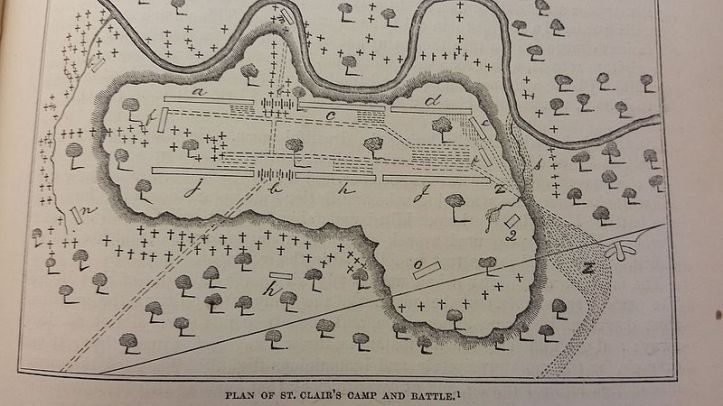
Similarly, the 1791 destruction of General Arthur St. Clair’s Army along the Wabash River in western Ohio was an unmitigated disaster.
A previous force of 400 militia and regulars had been soundly defeated near present-day Fort Wayne, Indiana, so St. Clair had been sent on a punitive expedition.
St. Clair went into the campaign with little intelligence of his enemy – a loose confederacy of western Native American nations – and an insufficient force to wage backcountry warfare.
President George Washington urged St. Clair, a veteran of the American Revolution, to move from his base of operations near present-day Cincinnati in the summer months but logistics difficulties and recruitment problems delayed him until the fall.
To Washington, alarm bells should have been ringing that this looked all to familiar to the disastrous Braddock expedition into Pennsylvania in 1755.
The Ohio back country, as it looked in the 1790s.
When St. Clair finally moved his force of about 2,000 regulars, militia, and three-month levies – accompanied by hundreds of camp followers – the going was slow.
Desertions began to take a toll as the force moved up through the Ohio backcountry until by November 3, St. Clair was down to just under 1,000 effective soldiers.
Encamping on a hill, St. Clair’s force neglected to dig any type of protective positions and set up camp as if they were in garrison.
They were therefore unprepared when the enemy under Little Turtle struck. The militia scattered and broke in the face of heavy fire as the regulars formed ranks and fired volleys.
Little Turtle pulled his force back and then began flanking the regulars, who fixed bayonets and charged. While this was considered the most effective tactic of the day, Little Turtle simply allowed the charge to pass through his ranks and then closed in again.
This happened three times before the exhausted regulars fells back. U.S. artillery had been placed away from the infantry and – unsupported – the gunners were shot down early in the fight, denying St. Clair this key advantage.
After three hours of fighting, St. Clair knew that he had to get his force out of there. They attempted one final charge to clear the area to allow for a retreat but as before Little Turtle allowed the troops to pass before returning to strike the flanks and rear.
The retreat turned into a rout as the U.S. soldiers fled back to the relative safety of Fort Jefferson several miles away. Losses had been catastrophic.
Over 800 Americans were dead; nearly all of the remainder wounded. Enlisted men suffered a 94% casualty rate, making it the worst defeat in U.S. Army history. Half the U.S. Army of the time lay dead or wounded.
Response from the government was swift: St. Clair was forced to resign, Congress began the first special investigation into the conduct of a military action, the regular and militia military forces were strengthened and reformed, and money committed for a full campaign in the west.
In other words, much like the defeat of Task Force Smith, it was a wake-up call concerning military readiness. But at a shocking cost of lives lost.
Both actions stand as reminders of the hubris of U.S. military leaders and the folly of attempting to project force on the cheap. Separated as they are by 159 years, they share the same causes and the same lessons learned.
Defeat should not be unexpected, nor unlooked for. Leaders who understand that withdrawal is sometimes necessary can preserve their force to fight another day.
Which is why it is important to think about and train for a day when we are overmatched on the battlefield. History shows us that the U.S. Army goes into every new conflict unprepared for the new challenges it will face; the lessons learned come with the unnecessary expenditure of lives and equipment.
But if we learn to adapt and be accustomed to thinking about loss, we can better preserve the force and situate ourselves for eventual counterattack.
 The SIG M-17 pistol is serving in combat with the US Army. The story has a happy ending, but it took years and millions of rounds to get there.