
Categories


Wife Suzi and I were chatting the other day about someone in the industry who got a new job. She said, “Nah, he won’t make it, he’s not a Gunist.” I paused, thinking, “I don’t think I’ve ever heard that word, but it’s a good one.”
“So,” I said, “what’s a Gunist?” Suzi has been around our industry for quite some time. I was curious to know what insight she had on the matter.
“Oh, you know, someone like you. Somebody who’s lived it, breathed it, grew up with it, reads those boring books you read about old English guns, proof marks, all that reloading stuff, works on guns in the garage for hours at a time, you know — gun stuff. If I need to know something about guns, I ask you and you just about always know at least something about it. He’s not like that and doesn’t understand who we are, or how we think. Just because he can sell refrigerators, doesn’t mean he can work in our industry selling gun stuff.”
And it dawned on me, she was right.
In the “old” days, say, 20 or 30 years ago, the vast majority of executive level types in the biz were gun guys, or as Suzi says, “Gunists.” They had grown up shooting, hunting, collecting and more than likely, working in our industry. They understood their customers — because they were their customers. Fast-forward 20 or 30 years and in today’s “corporatized” companies, there is a tendency to think, “Well, if they can sell widgets, or tractors or used cars, they can sell guns.” But almost always it ends up not to be the case at all. There are exceptions, but not many.
The really bad thing is some of those who get brought into our industry have tended to bounce from company to company, wrecking havoc, getting fired, getting golden handshakes, only to turn up again in some executive position. It’s like, once you get a union card, you can get a job no matter what. “Hey, he was the VP of marketing there, so he could be the VP of marketing here,” sort of thinking. Not.
If you’re a “Gunist” and reading this now, you are probably aware of some pretty silly new products that have been introduced over the past 10 years or so. After a jaunt to SHOT Show, I have often come away thinking, “Did anyone who was an actual shooter even look at that product before they introduced it?” And the scary thing, is sometimes I find out that actually, no … nobody who was an actual shooter had looked at it before the VP of Sales (formerly a VP of sales at Enron or something and a definite non-shooter) simply ordered it launched and their Madison Ave. marketing firm did it. Then we usually witness what we call “the big silence” as people don’t buy whatever “it” is.
Of course, then that VP ends up at some other unsuspecting company and does the same thing. Repeat ad-nauseam. All of which is fine if all I’m going to do is complain about it. So let’s not just complain and wring our hands and repeat woe-is-me chants. What can we do about it?
Actually, it’s easy. Make yourself known. If (fill in the blank here) company announces, introduces or tries to sell you on a product that’s stupid — tell them. Pick up the phone, drop them an e-mail, fill out the survey, whatever it takes. Just say, “Hey, I don’t mean to be ugly, but that new digital/hi-tech/battery-powered/operator-based/polymer/CR123/lavender-laser/Kydex-wrapped widget, is … um … stupid. Don’t waste your money on it, because I won’t waste my money on it either. And besides, you shoulda’ asked a Gunist before you did it in the first place.”
Of course, some of those marketing disasters have served to make our industry interesting at times. I’ve still never actually seen a magazine for a Bren Ten 10mm auto. Can you say “Rogak P-18” auto pistol? Even the term “Short Magnum” may go the way of the Do-Do bird. And just because you can make it out of polymer, doesn’t mean you actually should. Well, at least then it could be recycled into those little booze bottles you get on airplanes.
So let’s cross our Gunist fingers and hope the industry looks harder for executives who know the difference between a .22 Hornet and a .22 LR, have some 1950s Gun Digests laying around that are well-thumbed, and are really sorry they can’t make the meeting on Wednesday because it’s dove season opener. Please?

Monument to the Warsaw Uprising
I stood on a balcony in Warsaw this past week to gaze at the Vistula River. The Vistula runs wide and deep, the guardian of Warsaw from the east. Poland has seen existential threats from all directions. In the 20th century, the danger came from Germany to the west and from Russia to the east. Poland was once an empire, but for much of its recent history, it has been a victim. And the Vistula is where we must remember an episode that may not have resulted in the most Polish deaths but that nonetheless exemplifies the brutality and betrayal that was visited upon the country not so long ago.
In 1945, Germany was collapsing. A quasi-government in Poland called the Lublin Committee was emerging from the ashes, preparing to build a free Polish government and allow Poland to take control of its destiny. The future of Poland had been discussed extensively at the meetings of the big three – Roosevelt, Churchill and Stalin. Roosevelt and Churchill favored the Lublin Committee. Stalin was appalled. For Stalin, a pro-Soviet or at least a Soviet-controlled Poland was essential. Then as today, the Russian objective was strategic depth. Moscow had nearly fallen to the Germans, saved only by winter and distance. Controlling Poland was a simple matter of safety. Moscow therefore wanted the Lublin Committee replaced by a communist government under Russian control.
Roosevelt and Churchill opposed this, but they had a different sense of Stalin and how to handle him. Churchill saw Stalin as the moral and strategic danger to their plan to spread liberal democracy to the east. Roosevelt believed that whatever Stalin might be, he had to be persuaded that the Lublin Committee would not pose a threat to Russia. Roosevelt believed deeply in the power of personal relations to the point that it might overwhelm geopolitical imperatives. I don’t think he was naïve, but he believed Stalin had the upper hand militarily and that the only viable option was trying to convince him that the U.S. and Britain had no bad intentions. What was benign to them was a mortal threat to Stalin. Even so, Stalin indicated vaguely that the Lublin Committee would be respected.
During World War II, as the Russians approached Warsaw from the east, the Polish Home Army, a resistance force inside Warsaw, rose up against the Germans. At this moment, Stalin halted the Russian advance. His explanation was that Russian forces needed to regroup and be resupplied. Warsaw was Stalin’s for the taking. Some reorganization might have been needed, but the Russian army stopped for weeks. The Germans carried out the slaughter they were famous for, decimating the Home Army and allowing Russia to enter Warsaw as the only force capable of governing. The Lublin Committee was brushed aside, and a communist party subservient to Russia was imposed, remaining in power until the Soviet Union fell. In other words, Stalin stopped to give Hitler time to slaughter Stalin’s Polish enemies, and once completed, Stalin advanced into a devastated city.
This is where the Cold War began. Stalin did not trust Churchill or Roosevelt. In his view, Russia paid the price for crushing Hitler – in spite of the fact that he had allied with Hitler to invade and divide Poland in 1939. Roosevelt believed he could forge personal trust with Stalin to avoid conflict, which was perhaps the only course possible since a Western military insertion into Poland was impossible. The deep doubts about Russia were frozen into a long-term distrust and created 46 years of conflict.
When I stepped out on that balcony in Warsaw, a cocktail in hand, I did not know that this was the river behind which Stalin halted, and to my rear was the city where he welcomed Hitler’s slaughter of the Poles. I saw a deep and deceptively calm river but could not see the blood that had been spilled to assure Russia’s strategic depth. The irony was that I was in Warsaw to address the strategic challenge posed in 2022 by Russia in Ukraine, the massive Polish effort to sustain the Ukrainian resistance, and my own country’s presence in Poland, supplying weapons to Ukraine and with the 82nd airborne deployed.
Russia continues to seek strategic depth all these years later, and continues the contest it began on the banks of the Vistula. Russia lost Poland, and now it’s fighting a war to take hold of Ukraine. It no longer has a Germany to do its dirty work. But it is important we remember the manner in which Russia pursues imperatives: What Moscow must have generates its operating principles. It cannot give up the search for strategic depth, nor can it obtain it without the ruthlessness reality demands. But history has a great sense of humor and demands patience. How much patience Ukraine can muster is, of course, unclear. How many times Russia must play the same game is even more so.
“Guns aren’t radically deadlier than they were 50 years ago, but our sick culture is.”
While humanity has been fallen since Eden, the past 50 years have seen countless indicators of exponential cultural decline, not the least of which have been falling marriage rates and skyrocketing numbers of children who are denied the chance to live with both their mother and father.
We’re also seeing a pandemic of mental illness, which the years of mental angst and isolation caused by Covid school closures will certainly only worsen.
Americans are losing interest in the purpose and community that faith and church offer, losing respect for the sanctity of human life, and losing sight of the notion that a higher moral good exists than immediate self-gratification.
Instead, we live under a cultural ethic that idolizes the indulgence of selfish desires even up to the point of taking the life of another.

In a leaky warehouse on the outskirts of the city, Su Jun readied his weapon at the commanding shout. Down the line, more armed men clad in camouflage vests, utility belts and kneepads did the same. Another order came and they opened fire.
Shots popped and echoed beneath the cavernous ceiling. The would-be defenders kept shooting, switching between rifles and pistols leveled at cardboard targets. On a final command, the clamor subsided, leaving plastic pellets scattered across the floor. Su let his BB gun drop.
Su, 39, is not a soldier but a tattoo artist. The only time he held a rifle that fired real bullets was more than a decade ago, during the two years of military service then required of men in Taiwan. But while the guns in his hands were fake — and the drill more paintball target practice than military maneuver — the threat in Su’s mind was viscerally real.
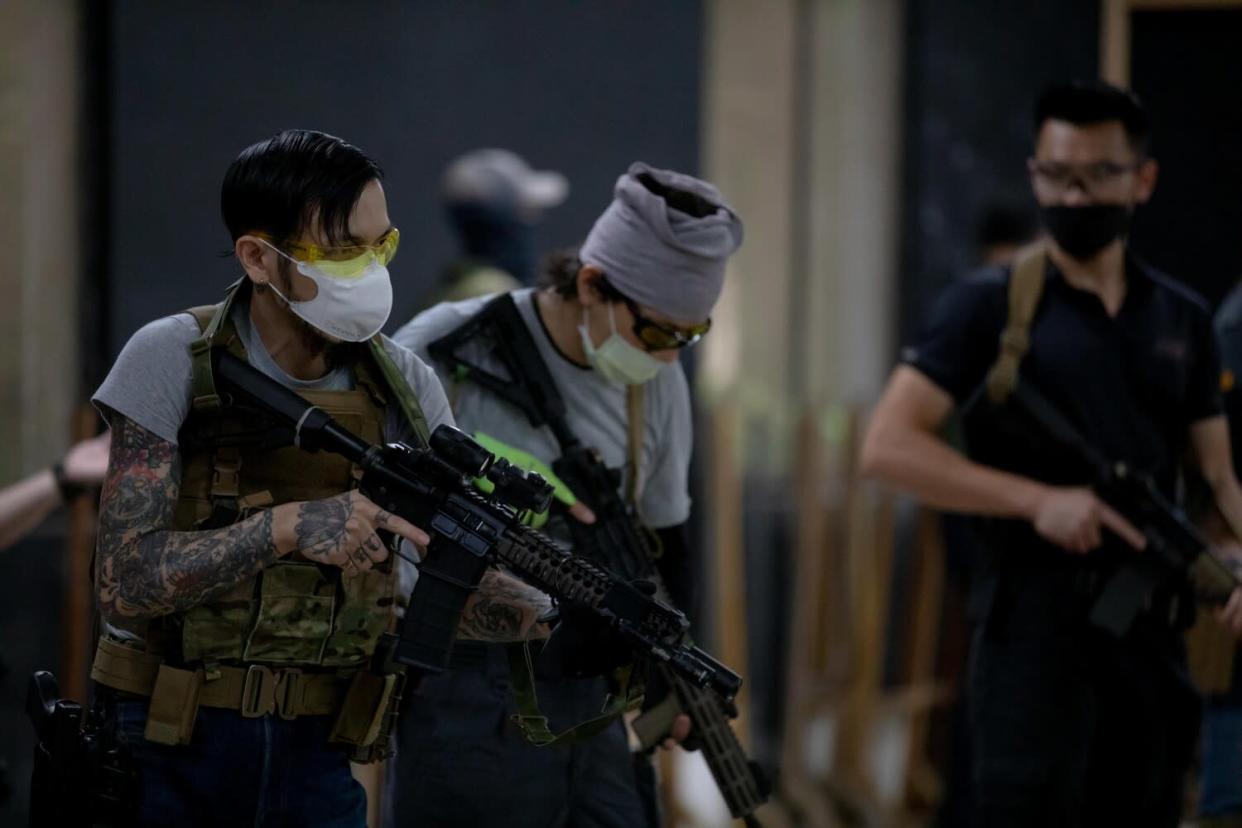
For decades, Taiwan has lived under the specter of military aggression from mainland China, which considers the self-ruled island as part of its territory. But it wasn’t until Russia invaded Ukraine in February that many Taiwanese started wondering what role they might play if a war broke out at home and Chinese soldiers were suddenly on the beaches.
Worried that he might need to take up arms, Su quickly signed up for a beginner’s airsoft gun class and two more after that.
“It just feels like anything is possible,” Su said.
In Ukraine, civilians joined the fight against Moscow with assault rifles and Molotov cocktails. Finnish citizens, also sharing a border with Russia, have rushed to wartime defense courses to learn hand-to-hand combat and how to use weapons. In Taiwan, though, a similar instinct has run up against strict gun control laws and a complicated history between its people and military, dating back to the days of martial law under the Nationalist Party, or Kuomintang.
“Guns were an evil thing. You didn’t want to come into contact with them,” said Max Chiang, chief executive of Polar Light Training, which hosts airsoft training classes including those that Su attended. This year, interest in classes has tripled, he said, with at least half of new participants motivated by the war in Ukraine.

Cross-strait tensions have intensified as Chinese President Xi Jinping’s calls for unification have become more assertive in the face of increasing opposition from Taiwan. Even among the concerned, few Taiwanese believe an invasion is imminent. But watching Russia attack Ukraine has highlighted the worst-case scenario in confronting a hostile, territorial and vastly bigger neighbor.
Those fears have reinvigorated debate over Taiwan’s national defense strategy, and whether it can withstand a similar assault from China. Chinese war planes have buzzed the island in recent years, and Beijing’s naval exercises in the South China Sea have unnerved the region. Taiwanese President Tsai Ing-wen has stepped up defense spending to record levels, while U.S. officials have weighed in on how Taiwan can best deter China’s expanding military.
President Biden said this week at a Tokyo news conference that the U.S. would get involved militarily to defend Taiwan. The comments appeared to have marked a departure from Washington’s longtime “strategic ambiguity,” a policy that left open the question of whether the U.S. would send forces to Taiwan in a war with China. The White House later said the administration’s stance had not changed, but the statements tapped into a sense of growing unease among Taiwanese and the international community.
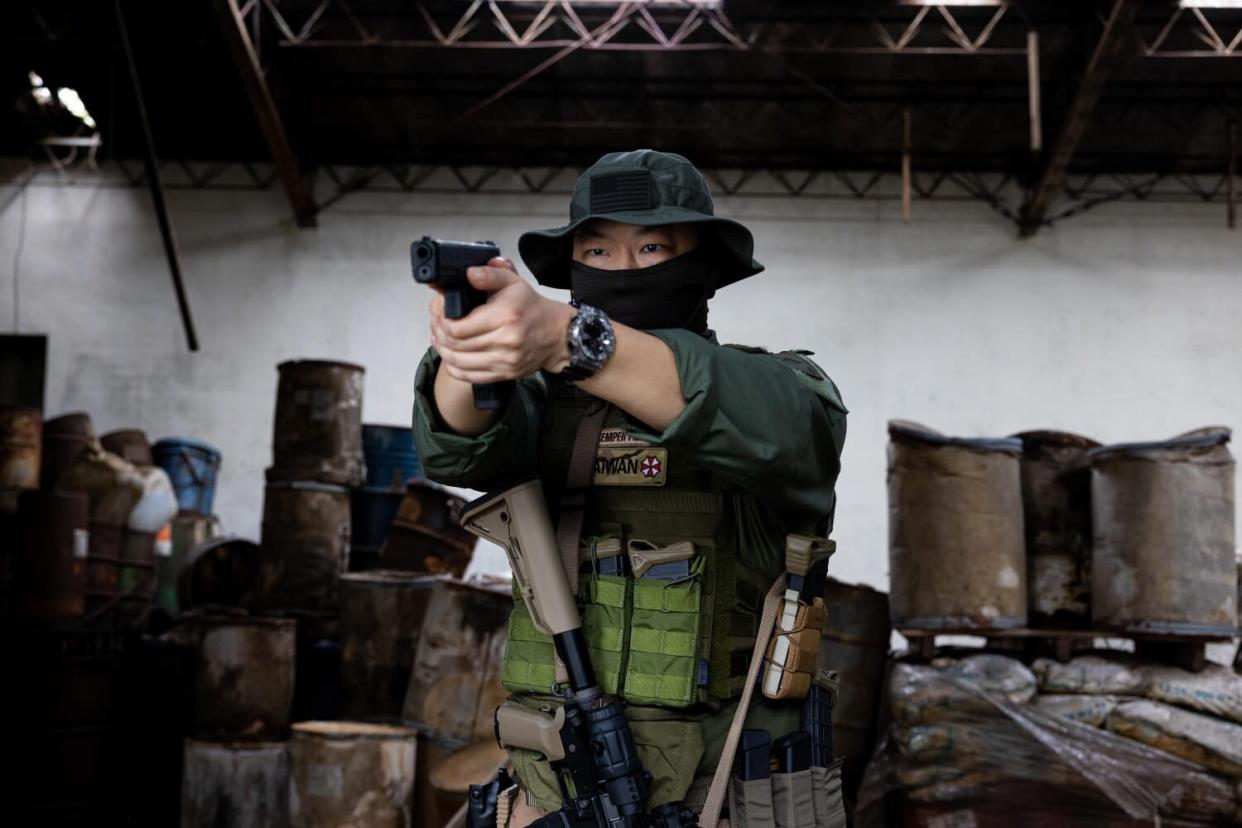
With the U.S. committing weapons but not soldiers to help Ukraine, many wonder whether the same may happen in Taiwan. According to an October poll by the Taiwanese Public Opinion Foundation, 65% of respondents believed the U.S. would dispatch troops to Taiwan. That number had fallen to 36% in April.
Polls in recent months have also shown that a growing majority of the Taiwanese population are willing to fight to defend the island of 23 million from a Chinese invasion. Taiwan has lived with this dilemma since 1949, when Chinese Nationalists fled to Taipei after a civil war with Communist Party forces.
That history became resonant in February when Caren Huang watched on TV as 5,000 miles away Ukrainian civilians took up arms to battle for their home. It was then that she decided she should learn how to shoot a gun.
On a rainy Saturday morning in May, she trekked to Linkou, a district northwest of Taipei whose name means “mouth of the forest.” At the end of a winding mountain road, she was surprised to discover that she wouldn’t be using real firearms. Still, as she held the air pistol in her hand, lighter than she had imagined, it felt sleek, cool and somewhat stress-relieving. In the quiet between shooting rounds, crickets chirped from the thickets of bamboo outside.

For most of her life, the 44-year-old former financial analyst assumed that Taiwan would eventually unite with mainland China. Growing up under martial law, Huang remembers learning about her Chinese identity and the greatness of the Chinese nation in school. At 17, she and her family emigrated to New Zealand, where she gradually realized the cultural and political differences between Taiwan and mainland China.
When she returned to Taiwan after college in 2000, China was on an economic upswing. The country was opening up to the outside world and seemed rife with business opportunities. Huang thought that by working more closely together, both sides of the Taiwan Strait could benefit.
Many of her friends felt the same way. But as China’s meteoric growth tapered and the government tightened its grip on civil society, including its crackdown in Hong Kong, her doubts deepened.
“As long as it’s an authoritarian country, they can regress at any time,” Huang said. “Then whatever rights you have, the government can take it all back. I feel like this is the scariest thing. If their political system doesn’t change, then I think it will be very hard for Taiwan to join with China.”
Even as she began to favor independence, Huang had thought it highly unlikely that China would attack Taiwan. She didn’t rule out minor skirmishes, but the economic and political ramifications of an all-out invasion seemed too high to justify. Seeing Russian President Vladimir Putin launch a war on Ukraine made her feel that nothing was certain.
“If they really need me to pick up a gun and defend the country, or if they need any kind of first aid, or if they want us to do anything else to help, then I’ll do it,” Huang said.

That kind ofresolve is crucial to Taiwan’s ability to repel an invasion, experts said, especially given China’s advantage in numbers. The Chinese People’s Liberation Army totals about 975,000 active-duty personnel, according to U.S. estimates, compared with Taiwan’s 169,000. However, the collective will to fight is difficult to gauge in a society where military service and training are not highly valued and often derided.
“Military men have no social status in Taiwan,” said retired Adm. Lee Hsi-ming, who served as the chief of the general staff of Taiwan’s Armed Forces. “This is the military’s problem, and the whole nation’s problem.”
To engage more citizens, Lee has proposed training civilians in combat to form a volunteer defense force, similar to Ukraine’s Territorial Defense Forces. Two years ago, the idea of sending civilians out to die was met with widespread backlash. There was notably less criticism when Lee raised the prospect again this year. Such an initiative would need government backing to succeed, he said.

The more concerning problem, though, said Lee, is a young generation that is reluctant to enlist in the military even as it becomes increasingly vocal against Beijing.
“If you are very provocative and you don’t have the capability to defend yourself, that kind of provocation will be dangerous,” Lee said. “It’s better for Taiwan if we have a robust, resilient defense capability, but we don’t do any provocative things.”
In preparation for potential conflict, some Taiwanese have sought out disaster response seminars and first-aid classes in recent months. Yet those who envision themselves engaging in war have found BB gun training to be their best bet.
Alan Chen, a journalist who writes about military technology, had essentially considered airsoft guns toys. But the invasion of Ukraine, along with several tactical shooting YouTube videos, persuaded him to try them out in case he was called back to serve.

“If things really go down, I don’t want to be the one that hinders someone else,” the 38-year-old said. After his first few classes, his concerns shifted. “Now, I’m kind of worried that my teammate might shoot me accidentally, because I know that they haven’t gotten that training.”
Taiwan started to transition to an all-volunteer military several years ago, but has had trouble attracting new recruits. Currently, young men are required to complete four months of military service and return periodically for training as reservists.
Chris Chen, a 26-year-old personal trainer in New Taipei City, could envision a life in the military, given the proper training. But he said his four months of conscription had confirmed the rumors: Serving in Taiwan’s army was largely a waste of time.

“I trained like my father did, which is you only shoot in one position, and six shots every time,” Chen said in between drills at Polar Light’s two-day advanced tactical shooting course. “I need to come to these kinds of lessons to actually learn something.”
Chen’s criticisms are common among men who have completed Taiwan’s mandatory military service. Recruits have described the exercises as boring and aimless, largely consisting of chores and paperwork, while practice in firearms is limited.
Still, Chen acknowledges that some might find training with air guns equally futile.
“People are like, ‘Why are you so serious? You’re shooting BB guns,’” he said. His response to them? “You should always be prepared.”
Aware of such critiques, the government has announced intentions for military reform. Lawmakers have extended the training period for some military reservists from several days to two weeks, and are contemplating extending conscription from four months to one year.
“When legislators try to increase the duration to serve in the military, it was a kind of political suicide in the past,” said Democratic Progressive Party legislator Wang Ting-yu, who sits on Taiwan’s Foreign Affairs and National Defense Committee.
Equally important, skeptics said, is whether the additional time would be used effectively. The Ministry of National Defense this year launched a bureau to oversee and improve reservists’ training. Wang said in the scenario of an attack, 200,000 professional military members, along with a first tier of 300,000 reservists, would be organized for duty in the first 24 hours. The remaining 2 million or so reservists would serve as supporting personnel.
Wang added that Ukraine demonstrated the need to rally civilians to mount an effective resistance. But he pointed to potential dangers in arming all of them: “Do we need to make these kinds of civilians capable to defend our country? We are debating about that,” he said.
Su Tzu-yun, an associate research fellow at Institute for National Defense and Security Research, a government-funded think tank, said the recent inspiration to fight among Taiwanese citizens should be utilized.
“I think this is the most important factor in all wars in history: the determination to defend your country,” he said. “Those who want to practice shooting, target practice, right now Taiwan’s system doesn’t allow that. That needs to change, to let those who want to learn how to fight.”
As an island, Taiwan has a less imminent need for foot soldiers than if it shared a land border with China. Taiwan has pursued an “asymmetrical” approach to warfare, prioritizing weapons and materiel purchases to ward off attacks from the air and sea, with ground forces acting as a last line of defense.

If a battle ever reaches that point, many Taiwanese are unsure what will come next.
“Right now Taiwan’s leaders, they need to communicate with society. This will be critical to whether — no matter if it’s territorial defense or volunteer reserves — it works,” Su said.
A civil defense handbook published in April by the Ministry of National Defense was widely panned for its lack of useful information. The book included basic instructions on what residents should do in a war, including QR codes and hotlines to call for help. The ministry is revising it and plans a reissue this year.
Stanley Shen, a 33-year-old engineer, said he found the survival books he purchased himself vastly more helpful than the government-issued one. Until recently, he hadn’t considered how he might respond in the midst of war. But when he saw a YouTuber post about Polar Light on Facebook, he and his girlfriend signed up for the beginner course.
After his first class, Shen said, he planned to buy his own airsoft gun to sharpen his skills.
“No one wants war. But if it really happens, I hope that I can learn enough in this class to improve my ability to keep those I care about and need to protect safe,” Shen said.
This story originally appeared in Los Angeles Times.
———————————————————————————-
Nothing like the threat of getting mugged to change ones mind! Grumpy
CRPA is looking for LA County Residents who are interested in being a Plaintiff in an upcoming case!

Please respond to contact@crpa.org with your Name and City of Residence and you will be contacted by someone on our Team!!


