Coats, Greatcoats, Undercoats.
……….
Waistcoat (Undercoat)
Gilet à manches
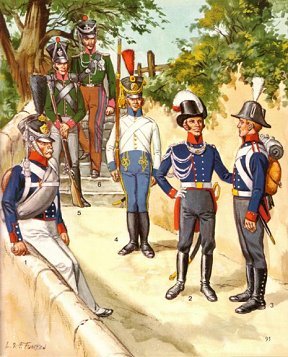
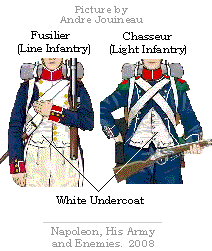 For the French light infantry the undercoat was white linen in summer and blue wool in winter. The white woolen waistcoat was treated with chalk, which was said to have “burned” (brûlé) the cloth. See picture –> For the French light infantry the undercoat was white linen in summer and blue wool in winter. The white woolen waistcoat was treated with chalk, which was said to have “burned” (brûlé) the cloth. See picture –>
 The waistcoat of French chasseurs-a-cheval was sleevless and worn under the uniform. It was white in summer and dark green in winter. Before 1812-1813 there were many unofficial versions of the waistcoat. For example instead of dark green it was red, or red braided with white, or green braided with red or white, etc. Between 1812 and 1815 many horse chasseurs however wore the new and simple uniform, called habit veste or Bardin-uniform. The waistcoat of French chasseurs-a-cheval was sleevless and worn under the uniform. It was white in summer and dark green in winter. Before 1812-1813 there were many unofficial versions of the waistcoat. For example instead of dark green it was red, or red braided with white, or green braided with red or white, etc. Between 1812 and 1815 many horse chasseurs however wore the new and simple uniform, called habit veste or Bardin-uniform.
The waistcoat of French foot gunner was white (according to Knotel and Elting). But the Zimmerman Manuscript shows them in 1807 in blue waistcoats. The same for the Brunswick Manuscript and year of 1805. Berka Manuscript shows them also in blue for 1809 and Martinet gives them blue for 1807-1814. The foot gunners of Old Guard wore white waistcoats for summer (according to Bucquoy). Other sources gives for them blue waistcoats (Berka Manuscript, Malibran, Rousselot and Rigondaud).
If battle was fought on a very hot day some soldiers wore only coats, or only waistcoats. In 1809 at Wagram the gunners of Old Guard went into action on that muggy day stripped to shirts.
Coat (Jacket)
Habit-veste
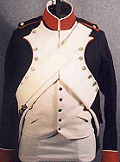 Picture: dark blue coat with dark blue shoulder straps piped red, red collar and cuffs pipped white, white lapels, white undercoat, and white shoulder belt. The French line infantry wore it until 1812-1813. Source: Military Heritage > Picture: dark blue coat with dark blue shoulder straps piped red, red collar and cuffs pipped white, white lapels, white undercoat, and white shoulder belt. The French line infantry wore it until 1812-1813. Source: Military Heritage >
The distinction between various armies normally lay in colours of their coats:
 – red coats for the Danish and British – red coats for the Danish and British
– white or light grey for the Saxon, Spanish, Austrian and royal French
– dark blue for the Poles, Prussians and Napoleonic French
– green for the Russians etc.
Within each army diffent regiments were usually distinguished by “facings” – linings,turnbacks and braiding on coats in colours that were distinctive to one or several regiments. The white coats (or rather light grey) popular amongst many armies soiled easily and had to be pipeclayed to retain any semblence of cleanliness.
Green as worn by jagers and rifle regiments proved particularly prone to fading until suitable chemical dyes were devised in the 1890s. The red were the most expensive of the six basic colors and together with white uniforms made the wearers a better target for enemy.
“White stood out in the field, when one of the functions was to make a good show. In the course of time coats of blue faded badly, those of pike gray turned a dirty ashen color, and those of green assumed a tinge of yellow, while repairs were all too evident on dyed coats of any kind, and added to a general look of shabbiness. Coats of white, on the other hand, could always be worked up with chalk to make them look ‘new and brilliant.” (Duffy – “Instrument of War” Vol I p 130)
The grey uniforms were the cheapest and most practical but were the least attractive. It was not until 20th Century when drab colours were being adopted for active service and ordinary duty wear.
The ‘Napoleonic’ coat was called habit à la française, it was dark blue with white lapels for line infantry. The white lapels were treated with pipe clay, which made them really white. In 1793 the dark blue coats were oficially introduced in the infantry. It had long tail that was shortened before 1806. (The weather ‘softened’ the color of the dark blue and dust, blood and mud made it sometimes unrecognizable.) The dark blue became greyish blue etc.
In 1800-1801 the coat was given shorter tail and was stated that the collar and cuffs are red piped white. The lapels were white piped red although – according to an order of July 13th 1805 – many colonels didn’t obey this order and have abolished the red piping. According to regulations the coat of line infantry suppose to have red cuffs with dark blue cuff flaps but red cuff flaps were more popular. There were few differences between the coat of line and light infantryman. According to Etat-Militaire (1801) the coat tail of light infantryman was shorter than that of the lineman.
The regulations of 1801-1802 prescribed for light infantry blue cuffs pipped white but many soldiers had the unofficial red cuff flaps.
In 1806 as a result of the British naval blockade there was a shortage of indigo used for dyeing cloth and so Napoleon ordered the introduction of a white uniform for his line infantry. According to Decree of April 25th 1806 the following regiments of line infantry were assigned white coats: 3rd, 4th, 8th, 12th, 14th, 15th, 16th, 17th, 18th, 19th, 21st, 22nd, 24th, 25th, 27th, 28th, 32nd, 33rd, 34th and 36th Line. (Journal Militaire Vol I 1806, pp 176-178)
The next decree mentioned all line regiments.
Napoleon expressed his disapproval and only 18 of the 112 regiments were issued with these. This is said that it happened after he saw bloodstained white uniforms at Eylau. But to me this reason sounds a little bit strange. The battle at Eylau was fought on a snowy, winter day and soldier wore the warm long greatcoat. If he was wounded the greatcoat, and not the white jacket, was “marked”. Secondly, white uniforms didn’t bother the Austrians, they wore them all the time. It didn’t bother the Saxon soldiers neither. I guess the white color reminded Napoleon the old regime of previous century and therefore he disapproved it.
In 1807 the importing of indigo resumed and the dark blue coats were reinstated.
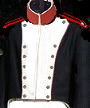 In January 1812 was introduced so-called habit-veste, a coat with even shorter tail (officers’ tails were slightly longer). Its white turnbacks bore a blue crowned “N” for fusiliers, red grenade for grenadiers and yellow horn for voltigeurs. In January 1812 was introduced so-called habit-veste, a coat with even shorter tail (officers’ tails were slightly longer). Its white turnbacks bore a blue crowned “N” for fusiliers, red grenade for grenadiers and yellow horn for voltigeurs.
This coat – in my opinion – is the most beautiful, the most elegant of all infantry uniforms of Napoleonic era. The white (dark blue for light infantry) “plastron” – style lapels were piped red (white for light infantry). The cuffs were red piped white. Major Bardin was responsible for the design of this coat and for this reason this is known under “Bardin uniform” in western literature. Most French infantry units wore it in the battles of Ligny and Waterloo.
Infantry greatcoat (overcoat)
Capote.
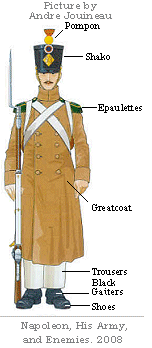 Life during campaign had a variety of conditions and experiences for the cavalrymen. There were great hardships undergone, and the weather had the greatest influence on conditions, varying from heat to extreme cold. The main protection against rain and snow was one’s greatcoat. It was popular and comfortable voluminous wear and could be worn with or without the coat underneath. Many troops wore civilian overcoats, capes and cloaks. Some greatcoats (overcoats) were purchased by individual soldiers, NCOs and officers. One of the innovations introduced in 1792 was sky-blue greatcoat for officers. It was not until 1805 that the were greatcoats issued to the troops. They were purchased not by individuals but from regimental funds. Life during campaign had a variety of conditions and experiences for the cavalrymen. There were great hardships undergone, and the weather had the greatest influence on conditions, varying from heat to extreme cold. The main protection against rain and snow was one’s greatcoat. It was popular and comfortable voluminous wear and could be worn with or without the coat underneath. Many troops wore civilian overcoats, capes and cloaks. Some greatcoats (overcoats) were purchased by individual soldiers, NCOs and officers. One of the innovations introduced in 1792 was sky-blue greatcoat for officers. It was not until 1805 that the were greatcoats issued to the troops. They were purchased not by individuals but from regimental funds.
In April 1806 all soldiers of field battalions (but not the depot, reserve and garrison battalions) received beige, grey, blue and brown greatcoats. There was little standarization but the most common were dull beige and it was the official color. (According to Ordannance du 25 Avril 1806: “La capote ou redingote en drap beige.”)
There were also quite a few captured greatcoats and greatcoats made from requisitioned cloth in occupied countries.
The average French greatcoat was not too long, just below the knee. The Russian greatcoats were longer but climate in Russia was harsher. Usually, French infantry had their greatcoats (introduced officially in late 1806) rolled on the back of their backpacks. They couldn’t wear them rolled over the shoulder as the Russians and Prussians because they were cut differently. For example the Prussian greatcoats were very wide at the bottom. The French ones were narrower and thus, if you rolled them, would have been too short to be carried over the shoulder.
In 1805 after the Battle of Austerlitz the squadron of Napoleon’s escort spent whole night stripping the Russian corpses of their voluminous warm greatcoats with which to cover the wounded.” (Savary – “Memoirs of the Duke of Rovigo” I p 136)
Only in 1812 was made first real attempt to standarize the greatcoats so the troops have more military look than civilian crowd. According to Article 21 of the Bardin regulations issued in 1812 all greatcoats for the line and light infantry were made of “beige serge wool.” There were no distinctions between line and light infantry, and even more, there were no distincions between infantry and artillery. All of them were beige greatcoats.
Carl Vernet in his book about Bardin Regulations gave grey greatcoats for privates and NCOs in infantry and artillery and dark blue for officers. In 1813 all the numerous gunners of four naval artillery regiments were issued dark blue (not beige) greatcoats.
According to Knotel in 1813-1814 campaigns many greatcoats in line and light infantry bore red patches on collars. In the Young Guard the greatcoats were worn over the uniforms. Henri Lachoque writes: “The following order was issued: ‘Coats will be worn under the overcoats. On fine days generals may order the latter rolled over the packs; but in foul or cold weather, or on night marches, soldiers must wear both coats and ocercoats.” (Lachoque – “The Anatomy of Glory” p 304)
The infantry of Old Guard continued with the solemn, dark blue greatcoats. The infantry of Young Guard wore dark-grey greatcoats (some say it was blue-grey, with more grey than blue). In 1815 majority of the Young Guard left on campaign wearing dark grey greatcoats with red or yellow epauletes. Minority wore either beige of line troops or dark-blue of Old Guard.
Cavalry greatcoat. (Cloak)
Manteau-capote.
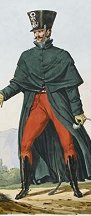 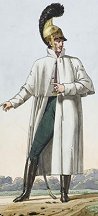 Left: French 9th Hussar Regiment. (Source: Projet de règlement sur l’habillement du mjr Bardin. Paris, Musée de l’Armée.) Left: French 9th Hussar Regiment. (Source: Projet de règlement sur l’habillement du mjr Bardin. Paris, Musée de l’Armée.)
Right: French Chevaulegere Lanciers. (Source: Projet de règlement sur l’habillement du mjr Bardin. Paris, Musée de l’Armée.)
.
.
. The sleeves cloaks looked awesome during charge but not too comfortable when carbines were used. When mounted the greatcoat protected not only the man but also part of the horse, weapons and harness.
In 1812 was ordered to replace them with capotes. The capotes had sleeves, and were made of white wool cloth “with light blue thread” for privates in heavy cavalry, or dark green for privates of light cavalry. The officers wore either dark blue (cuirassiers and carabiniers) or dark green (dragoons, lancers, chasseurs and hussars) capotes.
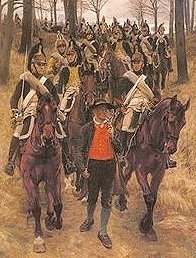
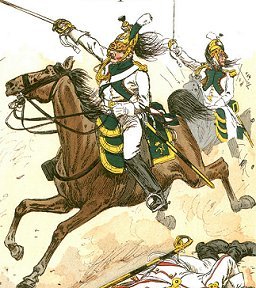
On a warm day before combat the greatcoat (cloak or capote) was rolled over the shoulder and served as a protection against saber blows and lance thrusts. Ernst Maximilian Hermann von Gaffron of the Prussian Silesian Cuirassiers describes combat with French dragoons in 1813 at Liebertwolkwitz: “The horse-tail manes of their helmets … and the rolled greatcoats, which they wore over their shoulders, protected them so well that they were pretty impervious to cuts, and our Silesians were not trained to thrust nor were our broad-bladed swords long enough to reach them.”
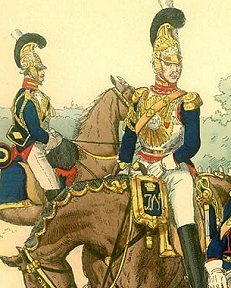
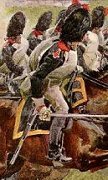  Left: French Horse Grenadiers of Imperial Guard. Left: French Horse Grenadiers of Imperial Guard.
Right: French Dragoons.
|

 1.
1. 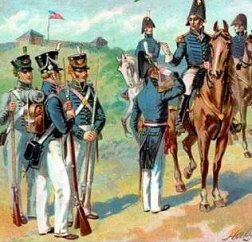 Left: uniforms of soldiers of the US Army in 1812-15.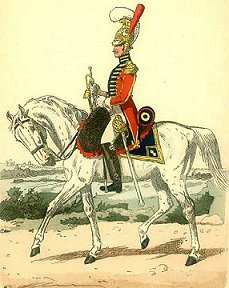
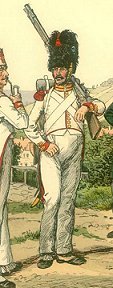
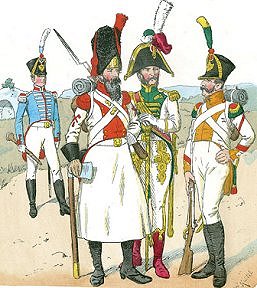
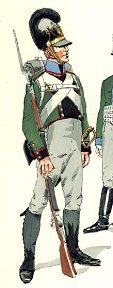
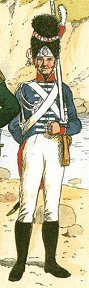
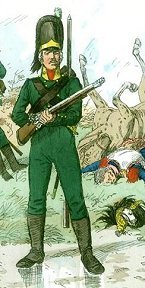
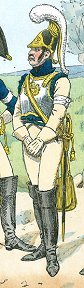
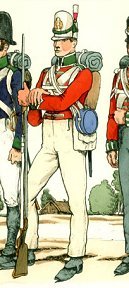
 – infantryman’s outfit cost 200-250 francs
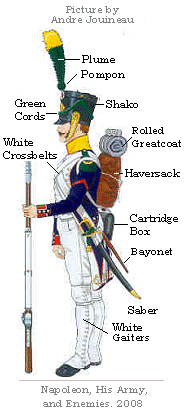 Linen comes in a variety of natural shades that range from light to dark. Linen may be dyed, but the range of colors is much less vivid than for the wool colors.
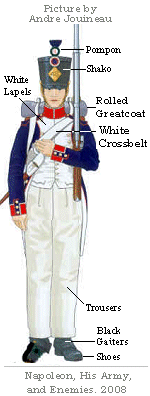 Color of linen can range from bleached snow-white to silver, ecru, brown or beige. Linen can be either soft or heavier and harder. Its greatest feature is that it can absorb moisture more quickly than cotton and move this moisture faster so that the drying time is shorter.
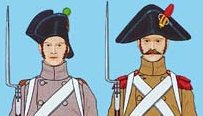 Picture: bicorn hats of French line infantry in 1806.
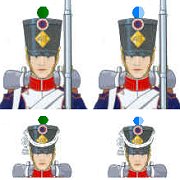 Picture: shakos of French line infantry (fusiliers), by Andre Jouineau.
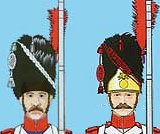 Picture: bearskins of French infantry. Carabinier (left) and grenadier (right).
 This is said that the trumpeters of cavalry regiments wore white bearskins. Rousselot however claimed that during campaign the trumpeters of Guard horse chasseurs (chasseurs-a-cheval de la Garde) and Guard horse grenadiers (grenadiers-a-cheval de la Garde) left their white bearskins in regimental depots.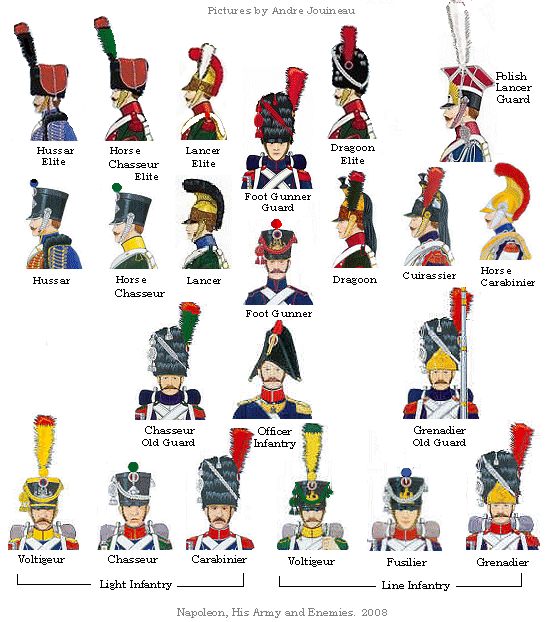
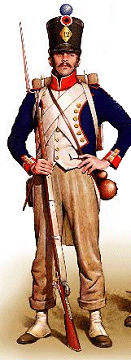 Picture: French fusilier (line infantry) wearing off-white trousers over his white breeches and white gaiters. Picture by Dmitriy Zgonnik of Ukraine for the H.A.T. Company.
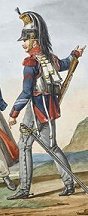 Before campaign every heavy and light cavalryman received white sheepskin to the regulation shabraque (cloth covering the saddle) and grey overalls called pantalons a cheval. The overalls were worn with or without the breeches underneath. Some overalls had cloth covered buttons down the outer seams while other had red laces instead of buttons. The first time the overalls were mentioned in official order was in the year of 1812 although they were used already in the 1790s. The decree of 1812 described the overalls as made of grey linen with cloth covered buttons. Due to its weight and numerous buttons this type of overalls was replaced by lighter overalls, often reinforced on the inside of the legs and around the bottoms with black leather. These lighter overalls might be grey, blue, red or green but during 1812-1815 the grey with orange or red stripe and without buttons were more common.
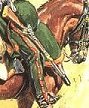 Right:
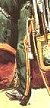 Left:
Left: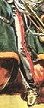 Right:
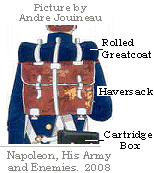 The knapsack was made of cow or goat skin with the hair on the outside. It contained a lot of essential personal items from which the soldier had no desire to be separated. The water bottle hung behind the left hip rather than the right to avoid obstructing the opening of the cartridge box.
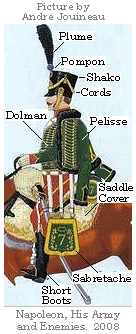 The dolman and fur-edged pelisse were heavily braided parts of hussar’s flamboyant outfit. The pelisse cost a little fortune, 216 Francs !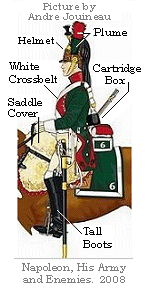
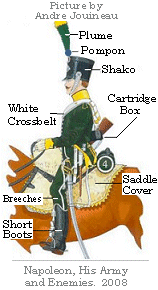 Before campaign the white sheepskin trimed red and grey overalls were issued to every cavalryman. The sheepskins for light cavalry were bigger than for the heavies. They were used by French, Polish and Austrian cavalry (but not by the Russians and Prussians) for comfort, especially during long marches.
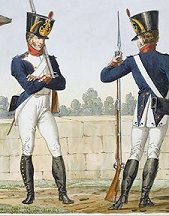 Up to the beginning of XIX Century military fashions remained in many ways indebted to civilian models. It was not until 1812 when Colonel Bardin wrote “It is necessary that the military dress don’t follow the liberties and whims of civilian fashion. Military styles are not the same with women fashion.” Napoleon liked Bardin’s view very much and accepted his ideas at once. As a result new and more modest uniforms were introduced.
 The new uniforms were probably issued in 1812 only to Davout’s I Army Corps before the invasion of Russia. Koen de Smet wrote: “The Bardin uniform was introduced in 1812, and some units (or parts of units) will certainly have received it before the Russian campaign. The majority however will still have started the Russian campaign in their old uniforms.” But this is not certain at all, rather they were not issued in any larger quantity until Spring 1813 and only on the primary theater of war (great battles in Germany: Leipzig, Hanau etc.) French troops on secondary theaters of war, in Italy and Spain, wore the old uniforms.
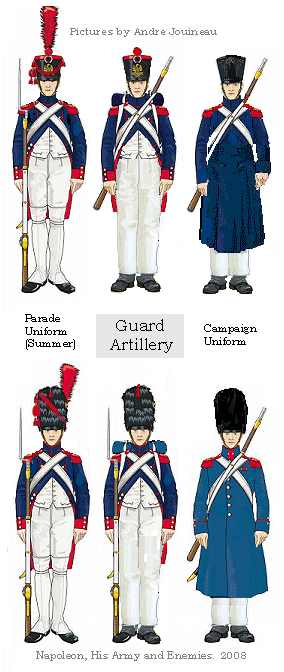 Picture: three types of uniforms, parade uniform, campaign uniform, and uniform worn in battle. Napoleon’s Guard Foot Artillery. Slightly modified uniforms after Andre Jouineau.