


Categories
 William Frederick Harris (March 6, 1918 – December 7, 1950) was a United States Marine Corps (USMC) lieutenant colonel during the Korean War. The son of USMC General Field Harris, he was a prisoner of war during World War II and a recipient of the Navy Cross for extraordinary heroism during the breakout in the Battle of Chosin Reservoir. He was last seen by American forces on December 7, 1950, was listed missing in action and is presumed to have been killed in action. Harris was featured in the book and film Unbroken.[1][2]
William Frederick Harris was born on March 6, 1918, at Good Samaritan Hospital in Lexington, Kentucky, to Field Harris (1895–1967) and Katherine Chinn-Harris (1899–1990).[1]
Harris graduated from the United States Naval Academy, Annapolis, Maryland, in the class of 1939. He was in A Company, 1st Battalion, 4th Marines[3] and was captured by Japanese forces during the Battle of Corregidor in May 1942.
He escaped with Edgar Whitcomb, future governor of Indiana,[4] and on May 22, 1942, swam 8+1⁄2 hours across Manila Bay to Bataan, where he joined Filipino guerrillas fighting Japan just after the Battle of Bataan.[5] In the summer of 1942, Harris and two others left Whitcomb and attempted to sail to China in a motorboat, but the engine failed and the boat drifted for 29 days with little food or water. The monsoon blew them back to an island in the southern part of the Philippines where they split up and he joined another resistance group.[6] Harris headed towards Australia hoping to rejoin American forces he heard were fighting in Guadalcanal, but he was recaptured in June[7] or September 1943[8] by Japan on Morotai island, Indonesia, around 1,000 miles (1,600 km) from Bataan.[9][10]
Harris was taken to Ōfuna POW camp, arriving February 13, 1944[11] and became acquainted with Louis Zamperini. Harris experienced malnutrition and brutal treatment at the hands of his jailers, notably by Sueharu Kitamura (later convicted of war crimes). Due to malnutrition, by mid-1944 the over 6 feet (180 cm) tall Harris weighed only 120 pounds (54 kg) and had beriberi.[12] In September and November 1944, Harris was beaten severely, to the point of unconsciousness, by Kitamura.[13][14] According to fellow captive, Pappy Boyington, Harris was knocked down 20 times with a baseball bat for reading a newspaper stolen from the trash.[15] Harris was near death when he arrived at a POW camp near Ōmori in early 1945. Zamperini provided Harris with additional rations and he recovered.[16] William Harris was chosen to represent prisoners of war during the surrender of Japan, aboard USS Missouri on September 2, 1945.
After World War II, Harris remained in the Marines. He married Jeanne Lejeune Glennon in 1946 and had two daughters.[1]
He was recalled to active duty during the Korean War.[2] He was the commanding officer of Third Battalion, Seventh Marines, First Marine Division (Reinforced) in the Korean War. During the breakout in the Battle of Chosin Reservoir, his unit stayed behind as a rear guard to protect retreating forces. Despite heavy losses, Harris rallied his troops and personally went into harm’s way during the battle. Harris was last seen by American forces on December 7, 1950, walking and carrying two rifles on his shoulders. He was listed as missing in action, but after the war when former POWs had neither seen nor heard of him, Harris was declared to be dead. He was awarded the Navy Cross in 1951 for his actions at Chosin. Because of his penchant for escape and survival exhibited during World War II, his peers and family were reluctant to accept his death. A superior officer held on to his Navy Cross for a number of years, expecting to be able to give it to Harris personally.[17]
Remains thought to be his were eventually recovered. His family doubted the remains were his, and conclusive testing using DNA had not been attempted as of 2014.[1]

For his leadership and heroism on December 7, 1950, Harris was awarded the Navy Cross.
The President of the United States of America takes pride in presenting the Navy Cross (Posthumously) to Lieutenant Colonel William Frederick Harris (MCSN: 0-5917), United States Marine Corps, for extraordinary heroism in connection with military operations against an armed enemy of the United Nations while serving as Commanding Officer of the Third Battalion, Seventh Marines, FIRST Marine Division (Reinforced), in action against enemy aggressor forces in the Republic of Korea the early morning of 7 December 1950. Directing his Battalion in affording flank protection for the regimental vehicle train and the first echelon of the division trains proceeding from Hagaru-ri to Koto-ri, Lieutenant Colonel Harris, despite numerous casualties suffered in the bitterly fought advance, promptly went into action when a vastly outnumbering, deeply entrenched hostile force suddenly attacked at point-blank range from commanding ground during the hours of darkness. With his column disposed on open, frozen terrain and in danger of being cut off from the convoy as the enemy laid down enfilade fire from a strong roadblock, he organized a group of men and personally led them in a bold attack to neutralize the position with heavy losses to the enemy, thereby enabling the convoy to move through the blockade. Consistently exposing himself to devastating hostile grenade, rifle and automatic weapons fire throughout repeated determined attempts by the enemy to break through, Lieutenant Colonel Harris fought gallantly with his men, offering words of encouragement and directing their heroic efforts in driving off the fanatic attackers. Stout-hearted and indomitable despite tremendous losses in dead and wounded, Lieutenant Colonel Harris, by his inspiring leadership, daring combat tactics and valiant devotion to duty, contributed to the successful accomplishment of a vital mission and upheld the highest traditions of the United States Naval Service.
— Board of Awards, Serial 1089, 17 October 1951[18]
Harris also received the Purple Heart, the Prisoner of War Medal, the Combat Action Ribbon, the Korean Service Medal, the United Nations Service Medal, the National Defense Service Medal, the Republic of Korea Presidential Unit Citation, the Korean War Service Medal and the World War II Victory Medal.[19]
  |
||||
 |
 |

|
 |
|
 |
|
.svg) |
 |
|
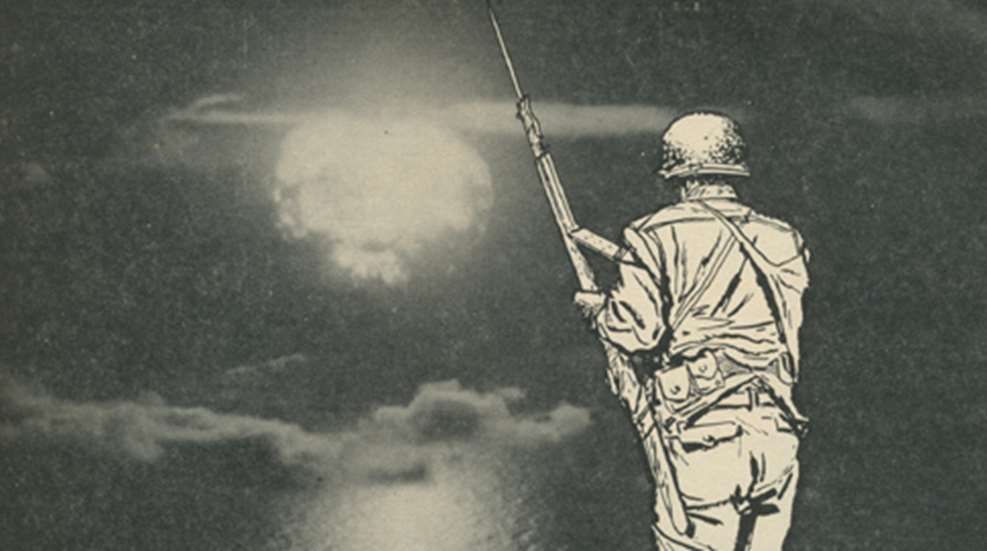
This article appeared originally in the March 1952 issue of American Rifleman.
The other evening I heard General J. Lawton Collins, Army Chief of Staff, say on the radio that atomic weapons for the U.S. Infantry would be ready ‘in the not too distant future.’ A few days earlier in Texas he had told a reporter that these newfangled weapons for the battlefield would be available ‘very soon.’ Gen. Collins
If what General Collins has said is true, what is to happen to the doughboy who lugs his M-1 Garand into battle?
I had first asked the question several years earlier at the Fort Benning, Georgia, Infantry School, at an orientation conference for reporters held by the Defense Department.
All during that day at Fort Benning our ears and eyes had been filled with the thunder and flash of mock battle, of rumbling tanks, of big mortars that made the earth shake, of ear-splitting artillery, of flamethrowers searing ‘enemy’ pill boxes.
In that smoke and dust, the rifleman seemed to have shrunk to an insignificant figure walking behind the thunder with his Garand. Where was the foot-soldier with his rifle?
Sitting in a big classroom later that day, with the Infantry School’s top brass in front of us, we reporters were supposed to ask questions about the day’s demonstrations of infantry weapons and tactics we had witnessed. I asked officers at the Infantry School the following questions:
What good is the rifle in modern warfare?
How many of the enemy does the rifle really kill?
Would it not be cheaper and just as effective to hand our men a lightweight machine gun that makes lots of noise and gives them a psychological lift?
What is the use of wasting money on expensive rifles and ammunition when the stuff is just sprayed around anyway and does not do much harm to the enemy?
I did not get satisfactory answers to these questions. It was apparent that little attention was being paid to the role of the rifle; the emphasis was on noisier weapons.
Upon my return to Washington, still seeking the answers to those questions, I started on a personal hunt in the Pentagon. No one in Army G-3 (Operations) seemed to care to analyze what the rifleman does in combat, what part he plays and whether he is still needed in the Infantry.
I searched through Army publications for articles about the rifle and the rifleman but found little to answer the question: What about the rifleman in the atomic age?
I was beginning to realize that I was looking for the forgotten man in the Army. I decided to see the Army’s top infantryman, General Collins himself.
General Collins is all soldier—erect in bearing; pressed, polished, and neat; remote and businesslike. He likes to get down to business at hand and get it over with in the time allotted on his daily calendar. he is cautious and restrained in his talk.
I started off by telling him of my bewilderment in this talk of fantastic weapons, atomic bombs, hydrogen bombs, guided missiles. I told him that I had read of the clamor for atomic bombs to replace infantrymen, of atomic bombs for the battlefield, of atomic bombs that make wars cheaper. I mentioned the air-power theorists who suggest that future wars can be won without men and their rifles.
“Are the rifleman really foredoomed as a military force?” I asked General Collins.
Grinning broadly at my gloomy forecast, General Collins leaned back in his leather chair thoughtfully.
“I don’t foresee the period where there will be no riflemen,” he said slowly. “It is possible that the need for riflemen may be reduced by new weapons in the dim distant future, but I feel strongly that we will always need men armed with shoulder weapons.”
“It was amply demonstrated in Korea that the basic tools of the infantry—the rifle, machine gun, and mortar—will continue to be necessary for warfare in the foreseeable future,” General Collins said. “You have to have rifleman as an integral part of the armed forces. You can’t stop an enemy by air alone. You can’t replace the rifleman by atomic weapons.”
General Collins conceded that new weapons like guided missiles or atomic bombs may be needed, particularly at the outset of war, to offset the ‘relative inferiority’ in forces in being. He said the chances are that we would be outnumbered in the beginning and we would use any weapon to overcome the enemy’s advantage in troop strength.
But, he emphasized, these new weapons, useful though they may be, cannot do away with the rifle or with the man on the ground. He noted that the history of warfare demonstrates this fact, despite innovations over the centuries. He observed that even an old-fashioned weapon like the bayonet, which appeared headed for a museum, made a dramatic comeback in hand-to-hand fighting in Korea.
General Collins stressed the importance of the rifleman in holding ground and taking ground from the enemy. He said Korea presents a graphic illustration of this classical axiom of warfare. He cited the vital role of the rifleman by recalling that more and more men are involved in warfare over the centuries, despite the development of new weapons and the technology of war. He said there may not be more troops at the front lines than in the past, but the complicated weapons have added more men in the rear to supply the men at the front.
The General broke in here with a little story. He recalled that when he visited the Korean battlefronts in July 1950, he talked with Maj. Gen. William F. Dean, missing commander of the hard-hit 24th Infantry Division, near Taegu. General Dean’s last words to him were, “I need more rifleman.” About a week later, Dean vanished in the fierce fighting at Taejon and just recently turned up as a prisoner of the Chinese communists.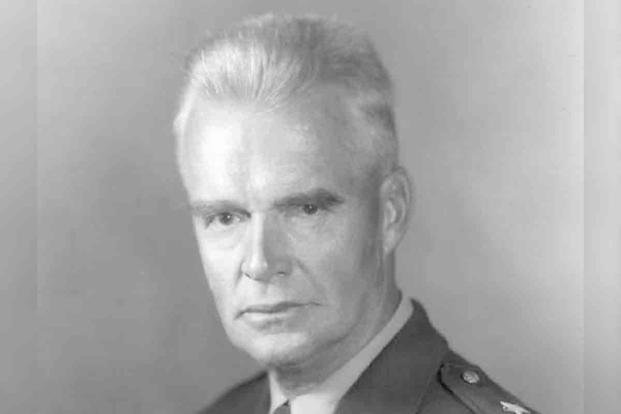 General Dean
By coincidence, the man who followed General Dean as commander of the 24th Infantry Division in Korea was leathery Maj. Gen. John H. Church, now commandant of the Infantry School at Fort Benning. As would be expected of a combat veteran of three wars, General Church is not ready to write off the infantryman or the rifle in favor of atomic weapons.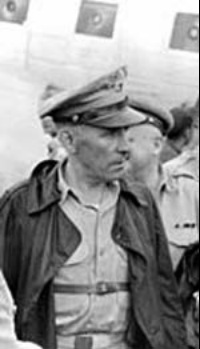 General Church
I had talked with General Church in the Pentagon and I had written him in my search for answers to the questions that had been troubling me. In his first comprehensive policy statement as the new commandant of the Infantry School, General Church emphasized the point that the rifle is not a ‘has-been’ in warfare.
General Church noted that the infantry is a balanced team consisting not only of the rifleman but of mutually supporting elements with tanks, machine guns, mortars, recoilless rifles, as well as supply, signal, engineer, ordnance, medical and other units.
He said that of the 18,804 men in each infantry division, slightly more than 7,000 are armed with rifles. Of these, only 1,944 are rifleman in rifle squads. He emphasized that this ratio of riflemen to the whole division is often used erroneously to support arguments seeking to detract from the importance of the rifleman.
“The incontrovertible fact remains that the rifleman is the heart and soul of the infantry team, and, in fact, of the combined ground arms team,” he said. “All of the other elements have but one mission—to support and assist the rifleman to move forward and seize and hold his assigned objective.
“The very weight of this support serves to emphasize the basic fundamental remains that it is the rifleman who, in the final analysis, carries the fight to the enemy and clinches the decision…None of this in any way minimizes the importance of the rifleman. Those who support him behind the lines and on the battlefield itself help to soften up the enemy, but it still remains for him to deliver the knockout blow.
“Remember, too, that in the fluid type of warfare being fought today there is no fixed front line,” General Church cautioned. “Infiltrating attacks in the rear areas require that cooks, supply and administrative personnel, and command post personnel take precautions for their own security, and they are frequently forced to fight as riflemen for their own defense. Infantrymen who make up the gun screws for mortars and machine guns and recoilless rifles defend themselves and their gun positions as riflemen if an attacking enemy reaches them.”
After all the kudos to the rifleman as the ‘heart and soul’ of the infantry, the question still remains: Is accurately aimed rifle fire and marksmanship training still important in warfare? Perhaps, it might be suggested, the rifleman can be just as effective by shooting helter-skelter with a ‘burp’ gun. Why bother with rifle marksmanship?
Both Generals Church and Collins, who have seen war closeup, are not ready to surrender the traditional American concept of rifle marksmanship.
“It cannot be denied,” said General Church, “that there are those who advocate a de-emphasis on training in rifle marksmanship. It is our unequivocal conviction that such thinking is wrong. The Infantry School, which is responsible for the formulation of Infantry doctrine throughout our Army, has not reduced the time or the emphasis given to this type of training.”
General Collins stressed in his talk with me that he has always been concerned with the waste of ammunition in warfare and in the tremendous cost of moving ammunition supplies to the front. He believes in frugality of ammunition use, of making ammunition count.
That’s why General Collins is adamant in his opposition to what he considers is the European tendency toward automatic weapons to replace the rifle. General Collins said that he favors switching, when conditions permit, to a lightweight version of the Garand rifle, with certain improvements, but his is solidly against suggestions that the Garand be made ‘solely’ a fully automatic rifle.
“My personal view,” General Collins told me, “is that we need a lightweight rifle that can be used for semiautomatic fire or, when required, full automatic fire. I am personally quite skeptical about making all weapons fully automatic. Automatic shoulder weapons waste too much ammunition. Of course, we need a Browning automatic rifle with each squad, but to arm every man with a fully automatic rifle would be foolhardy.
“From my experience in combat and from years as a weapons instructor, I would say that you can get more hits with a semiautomatic rifle than with a full automatic. I am confident that the automatic wastes ammunition. And it’s difficult enough to get ammunition to the front without wasting it.”
General Collins conceded that there is a special need for the ‘burp’ gun but he stressed that every soldier should not be armed with one. He said ‘there’s not use spraying the woods’ when aimed, accurate fire at a clump of bushes concealing the enemy would do the trick.
He said that the soldiers he has talked with in combat areas want the M-1 Garand rifle. They must have more striking power, not less, he said. They would lose hitting capability with an automatic rifle, he added.
The adoption of a rifle that can be fired fully automatically appears to contradict General Collins’ attitude favoring the more accurate fire of the semiautomatic Garand. If the semiautomatic rifle has greater hitting effectiveness and saves ammunition, the question arises, why have it turned into an automatic? It’s obvious that troops with a rifle that can be fired semiautomatically or fully automatically will have a great tendency to switch the selector to full automatic—turning it into a ‘burp’ gun, the very thing General Collins deplores.
From my personal observation in the Pentagon, I have decided that General Collins still objects to an automatic rifle for the foot solider but has been influenced to keep the door open for such a development in the future. It should be evident that if the Army turns to a shoulder weapon which can be fired automatically, accurate marksmanship will have to yield to the natural tendency with such weapons for helter-skelter spraying and a high waste of ammunition.
I also talked with General Collins about the values of civilian marksmanship and the part that could be played by civilian rifle clubs in supplying the Army with ready-trained marksmen. He replied that the Army likes to get well-trained rifle marksmen. He said youths coming from rifle clubs who already know how to shoot accurately could be used more readily as coaches in the Army training system.
“What I am afraid of is that people may get the idea that rifle clubs could be a substitute for universal military training,” General Collins commented when it was suggested that the rifle clubs in the United States could be tied into a system of marksmanship training for youths before they go into the Army, or for reservists on inactive status.
“What we need most is a system of universal military training,” General Collins declared. “When young men pass into UMT, that’s where we will teach them to shoot. We can do that in a relatively short time. The whole method of instruction in marksmanship has been worked out to perfection over a period of years. We can teach marksmanship effectively through UMT.”
General Collins make it clear that rifle marksmanship is merely one of many courses of instruction that the UMT trainee must learn and that marksmanship cannot be emphasized at the sacrifice of other vital training.
“Very frankly,” he said, “we are not going to spent too much money on this one aspect of training. We must weight our expenses carefully. We can’t spend as much as we have in the past.”
General Collins said he favored continuance of the civilian marksmanship program, and that the Army, to a limited extent, help finance this program. He conceded that early training in rifle marksmanship would help youths preparing for the Army. He emphasized, however, that the Army feels it can take a youth who has never fired a rifle before and train him quickly to become an effective rifleman.
He indicated that pre-introductory training in a civilian rifle club for youths entering the Army would not materially reduce the basic training course of the Army, or result in any appreciable saving of money.
General Collins said the Army has little need for rifle specialists ‘who can hit a gnat’s eye’ although he favored competitive shooting both in and out of the Army. Competitions, he said, create a healthy and widespread interest in rifle marksmanship, and frequently produce statistical and technical information of value to the services.
It was clear to me from what General Collins said, and from what he implied, that the Army continues its traditional jealousy of other agencies that might help it get its job done. The Army attitude appears to be that civilian marksmanship training is sort of a luxury which, although worthwhile, cannot do the Army’s job of training soldiers to shoot and handle firearms. But if it is true that the Army still needs rifles and riflemen, it seems to me as a military reporter and plain citizen that the Army should welcome every bit of help it can get.
And there may be some real money in the economy in training young men in civilian rifle clubs—thus saving time and money when they get into the Army. General Collins rejected this idea, saying that the saving would not be ‘appreciable.’ There is some question whether the Army is not taking a partisan view on this point.
In this atomic age, it is evident that the Army will need its riflemen, and perhaps because this is the atomic age the nation will need its civilian riflemen more than ever.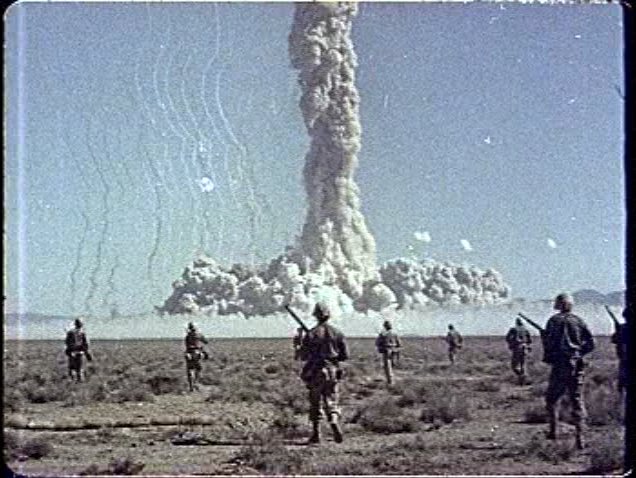
—Lloyd Norman
In the late 1950s, there were basically two camps in the U.S. military on what the next service rifle should be — those who thought a service rifle should be made of wood and blued steel and wanted a modified version of the M1 Garand, and those who thought the future of the modern service rifle was with forged aluminum and polymer furniture.

While the 5.56mm AR-15 today is so common and accepted that it’s viewed as the “standard” in self-loading rifle design, it is easy to forget how revolutionary it was in its day. In the 1950s (and before the AR-15 was introduced), there was the AR-10 battle rifle.
This radical approach to military rifle design used forged aluminum receivers — an upper and a lower — that were mated with a stock made of polymer — essentially plastic. The caliber was 7.62×51 mm NATO, the same as the M14, but it used a gas-operated, straight-line rotating-bolt system, which offered less recoil than the M14. In addition, it employed a direct gas-impingement system. While it might have come from the same era as the M14, it seemed like it was from a different planet in those days. [Read more about the M14 history.]

The military bureaucracy was at a stalemate with its heels dug in. A lot was at stake, especially the lucrative government contract. Adding more drama to an already tense and passionate situation, the U.S. military saw the potential benefits of a high-velocity .22-caliber cartridge rather than the more ponderous — but capable — 7.62x51mm round.
To address this, the AR-10 was scaled down to the .223 cartridge and the AR-15 was born. However, the M14 community was still not budging. The M14 had the benefit of a proven design based on the Garand, as well as truly capable, if somewhat traditional, chambering. Despite the fact that the AR-15 and the 5.56×46 mm NATO cartridge had shown great promise in initial testing, the U.S. military’s choice of the M14 over the AR-10 (as well as the FAL) had solidified the wood and steel rifle in the role of primary service rifle for the United States military — for now.

However, the “aluminum and plastic” upstart would soon gain the upper hand. As is well known, the AR-15 platform eventually prevailed. So, let’s consider that journey.
In hindsight, it was easy to see that the AR-15 would ultimately prevail. Prior to the AR-15 becoming the M16, other factors shaped the evolution of our approach to warfare and the tools used to fight. Let’s take a 10,000-foot view of defense policy in the post-WWII era.
After WWII and the first use of nuclear weapons, the role of the infantry soldier was thought to be played out in a nuclear battlefield. The nuclear arms race post-WWII had both sides rethinking what a post-nuclear war landscape would look like.

Thankfully, the Cold War-era struggle did not take the form of an atomic mushroom cloud. Counterinsurgency was the new strategy in the unique form of warfare that developed with two opponents armed to the teeth with nukes. Since direct combat was not feasible (as it would effectively end our civilizations), proxy warfare became the norm in hotspots worldwide.
America’s approach was to help these countries fight communism by arming, teaching, and supporting our allies in limited wars in their own nations. Hence, rather than atomic stockpiles of weapons, an old-fashioned arsenal of specialized small arms became the focus. Throw in a few advisors for training, and you have a recipe for the Vietnam War.
While the Advanced Research Projects Agency (or “ARPA”), tucked under the broader Defense Department umbrella, was originally organized to research ballistic missiles, in 1961, the Kennedy administration — with an interest in supporting our foreign allies in limited wars to stop communist aggression — approved Project Agile.

Project Agile was designed to help remote areas of the world with counterinsurgency action against communist insurgents. Two areas, both in Indochina, were identified as under threat to Communist aggression. One was in Bangkok, and the other was in Saigon.
The average height of a Vietnamese soldier was five feet, and he weighed about 90 pounds. The ARPA was convinced by the original manufacturer of the AR-15 that the gun had a great deal of potential as a rifle for Vietnamese fighters since it was lightweight, capable and soft recoiling.

ARPA requested AR-15s for this effort, only to be denied because there were plenty of M2 Carbines in storage that could be issued without spending budget on new guns.
The M2 Carbine was also lightweight and ideal for operators with small statures. The ARPA reintroduced its request and suggested that a limited number of AR-15s be used. They settled on asking for 1,000 rifles to only be used in Vietnam (and not Thailand), and the rifles would be tested against the M2 Carbine.
There were many other subprojects under Project Agile, such as ones that dealt with communications and logistics, as well as planning. However, the ARPA report for the AR-15 was titled “Task 13A” and compared the M2 Carbine to the AR-15 “to determine which is more suitable replacement for other shoulder weapons in selected units of the Republic of Vietnam Armed Forces (RVNAF).”
I don’t need to tell you the outcome. You already know the AR-15 performed best with the “small stature of the Vietnamese soldier…”. We all know that the taller U.S. advisors liked how the new rifle performed, too. While the test helped ARPA in one of its many projects assist counterinsurgents by confirming the superiority of the AR-15 to the M2 Carbine, it also proved the readiness of the AR-15.

Analysis of the AR-15 from both U.S. Advisors and Vietnamese commanders reported the AR-15 as “extremely favorable.” The lethality of the .223 round proved to be extraordinary. Users had a high respect for the AR-15 and preferred it to all other firearms available.

The first AR-15s in country did not have a forward assist, which is how the Air Force (the first adopter of the design) wanted the gun. The Army, however, insisted on a forward assist and originally designated the rifle the XM16E1; after the details were worked out, it was designated the M16A1.
The testing under Project Agile was the first time the rifle was used in Vietnam. In 1964, America’s broader involvement in Vietnam was officially begun with Congress passing the Gulf of Tonkin Resolution, which authorized direct U.S. military involvement in the nation. The rest is history.


Ney, The Bravest of Napoleons Marshals


