Category: Real men
“What is the coolest line in history?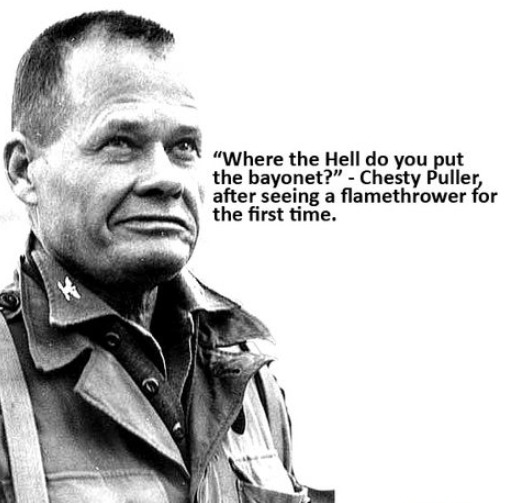
U. S. Marine Lt. Gen. Lewis “Chesty” Puller is arguably the toughest sonuvabitch that ever walked this Earth.
Chesty Puller started at the bottom, as a rank private in the Marine Corps. He climbed the ranks as he fought guerrillas in Nicaragua and Haiti; slogged through many nasty engagements through World War II; and the hell that was the Korean War.
It wasn’t until he suffered a stroke in 1955 and forced retirement that slowed him down. He was admired by the men under his command, and feared by his opponents on the battlefield.
He was also a fount of cool, quotable lines:
- “You don’t hurt ’em if you don’t hit ’em.”
- “Hit hard, hit fast, hit often.”
- “All right. They’re on our left; they’re on our right; they’re in front of us, and they’re behind us. They can’t get away this time.”
- “Son, when the Marine Corps wants you to have a wife, you will be issued one.”

Categories
The British Army at work in Aden

 Situation: The evilest mass murderer on the planet has targeted you. You’ve been furnished security, but you aren’t sure it’s enough.
Lesson: If you can’t take care of yourself, you can’t take care of those who count on you … and the innermost bastion of security is yourself.
The world remembers Sir Winston Churchill as a long-serving British statesman and the Prime Minister who guided an underdog Great Britain successfully through World War II. What few history students learn about him is Churchill was very much a gun guy. He had killed enemy combatants with a pistol, loved to shoot and routinely carried a gun.
Churchill The Gunfighter
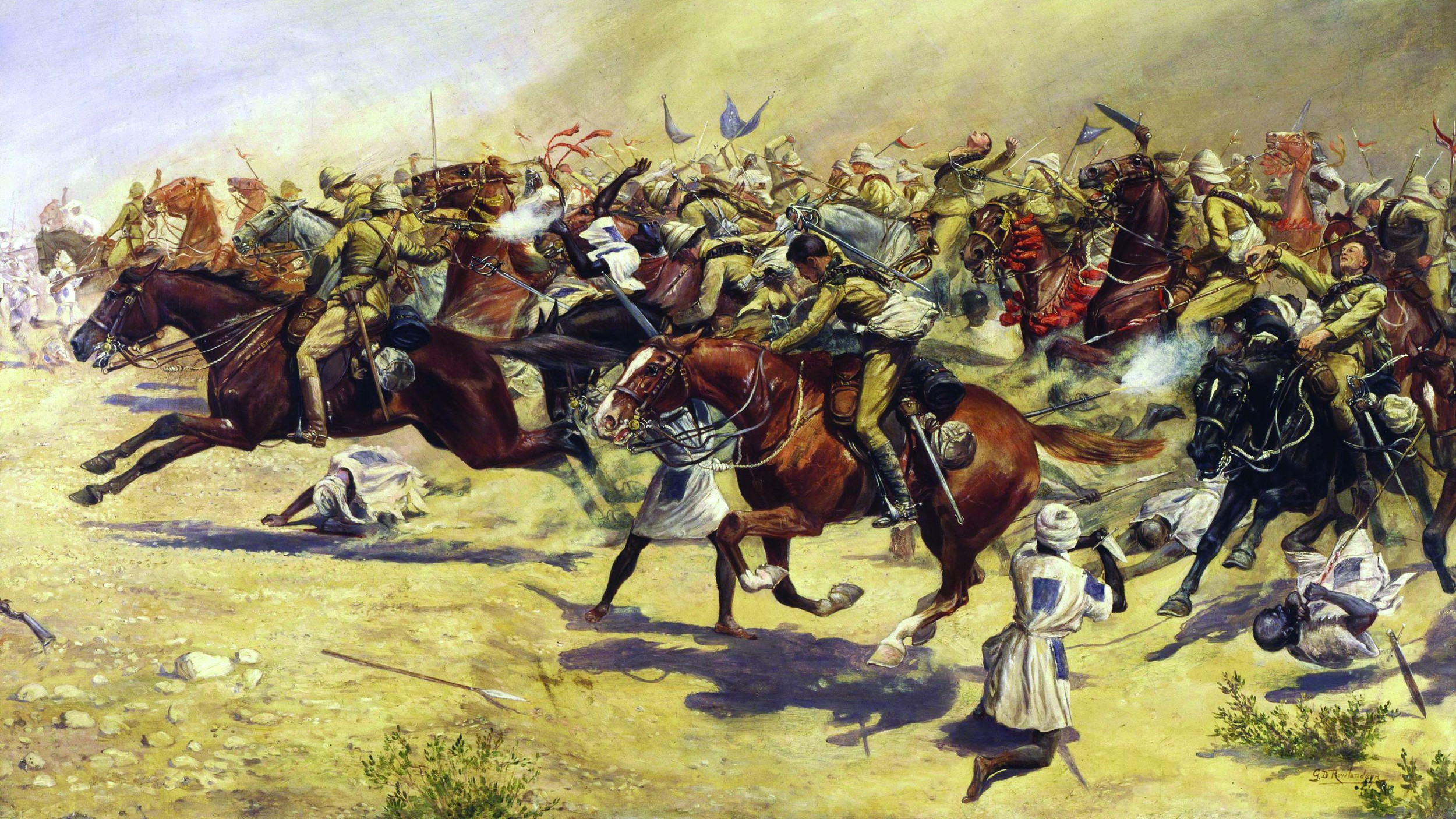
In 1898, at the battle of Omdurman in the Sudan, Churchill was a young cavalry officer. More than half a century later he would tell a biographer, “On account of my shoulder (which had been dislocated in India) I had always decided that if I were involved in hand-to-hand fighting, I must use a pistol and not a sword. I had purchased in London, a Mauser automatic pistol, then the newest and latest design. I had practiced carefully with this during our march and journey up the river.” (1)
Churchill was part of a cavalry charge under way through a gulley when he found he and his comrades were up against a much larger enemy than they had anticipated: an estimated 3,000 fighters who far outnumbered his own contingent. He told one biographer, “I drew my Mauser pistol — a ripper — and cocked it. Then I looked to my front. Instead of the 150 riflemen who were still blazing I saw a line nearly (in the middle) 12 deep of closely jammed spearmen — all in a nullah with steep sloping sides six feet deep and 20 feet broad.” (2)
Churchill was soon amidst a maelstrom of enemy troops, profoundly outnumbered. The great historian William Manchester would later describe what happened to Churchill in those moments, sometimes using Churchill’s own quotes. Churchill saw his men being “dragged from their horses and cut to pieces by the infuriated foe.” Finding himself “surrounded by what seemed to be dozens of men,” he “rode up to individuals firing my pistol in their faces and killing several — three for certain, two doubtful — one very doubtful.”
One was swinging a gleaming, curved sword, trying to hamstring the pony. Another wore a steel helmet and chain-mail hangings. A third came at him “with uplifted sword. I raised my pistol and fired. So close were we that the pistol itself actually struck him.” The dervish mass, he saw, was re-forming. He later recalled, “The whole scene seemed to flicker.” He looked around. His troop was gone. His squadron was gone. He could not see a single British officer or trooper within a hundred yards.
Hunching down over his pommel, he spurred his pony free and found his squadron 200 yards away, faced about and already forming up. His own troop had just finished sorting itself out, but as he joined it a dervish sprang out of a hole in the ground and into the midst of his men, lunging about with a spear. They thrust at him with their lances; he dodged, wheeled and charged Churchill. “I shot him at less than a yard. He fell on the sand and lay there dead. How easy to kill a man! But I did not worry about it. I found I had fired the whole magazine of my Mauser pistol, so I put in a new clip of 10 cartridges before thinking of anything else.”
It occurred to him if he hadn’t injured his shoulder in Bombay, he would have had to defend himself with a sword and might now be dead. Afterward he reflected, “One must never forget when misfortunes come that it is quite possible they are saving one from something much worse.” He wrote his mother Jennie: “The pistol was the best thing in the world.” (3)
Churchill and his biographer were not the only ones to conclude the 10-shot Mauser saved his life, and neither the saber nor a revolver with five or six shots might have sufficed. There had been little time in the melee, needing one hand to control the reins of his horse, to eject spent casings and insert live cartridges into a wheel gun.
Notes another biographer, Martin Gilbert in Churchill: A Life, “The cavalry charge was over, and the troop dispersed. ‘It was, I suppose, the most dangerous two minutes I shall live to see,’ Churchill told Hamilton. Of the 310 officers and men in the charge, one officer and 20 men had been killed, and four officers and 45 men wounded. ‘All this in 120 seconds!’ Churchill commented. He had fired ‘exactly 10 shots’ and had emptied his pistol, ‘but without a hair of my horse or a stitch of my clothing being touched. Very few can say the same.’” (4)
Churchill The Shooter
Winston Churchill owned a substantial collection of fine guns, including magnificent bespoke shotguns from the finest English makers, and loved to hunt.
No one knew his proclivities in firearms better than his long-time bodyguard, Scotland Yard Inspector Walter Henry Thompson. “Churchill offered to pay me five pounds a week as his bodyguard in a purely private capacity. He gave me his Colt automatic to use — and I may say with pride that I am the only man Mr. Churchill has allowed to handle his guns. He is a first-class shot and takes a jealous pride in his personal armory.”
Thompson added, “Although he recognized some measures had to be taken for his security, he was confident in any real pinch he, Winston Churchill, would probably be able to look after himself, personally. When we were at Chequers, the country home of Britain’s prime ministers, he often went to a nearby range and proved himself a first-class shot with his Mannlicher rifle, his .45 Colt automatic and a service .38 Webley. He was particularly deadly with the Colt and there would have been little chance for anyone who came in range of that weapon with unfriendly intent.” (5)
Just what did Thompson mean by “first-class shot”? “We set up an outdoor range at Chequers and to this he would frequently repair and fire a hundred rounds or so with his Mannlicher rifle, 50 rounds from his Colt .45, or an equal number from his .32 Webley Scott. He gets well onto the target with all three, but with the Colt Automatic he is absolutely deadly … A gun is something he understands entirely.”
Adds Thompson, “Near the war’s end, while practicing with me at outdoor targets, with officers of the guard in competition and firing an old Colt .45, only one of Churchill’s bullets was on the fringe of the bullseye, the other nine being dead center. This target was taken down and marked by me and noted by those who were with him then. Later I had it officially entered and dated, and it is now in the Chequers library.” (6)
The Concealed Carrier
Winston Churchill learned early in his adult life the value of a discreetly concealed handgun. In 1899 during the Boer War, he was captured but managed to escape. A sympathizer furnished him with provisions and a concealable revolver before he sneaked onto a train to get farther out of reach of the enemy. He kept the revolver, described as a six-shot pin-fire. A part of his estate, it sold for 32,000 English pounds at auction in 2002.
Richard Law, one of the leading lights fighting for gun owners’ rights in Great Britain, is a prolific writer and skilled researcher. He discovered when he learned Thompson, Churchill’s long-standing bodyguard, carried a .32 caliber mouse gun, Churchill requisitioned a Colt .45 and furnished it to him.
Later, discovering Thompson was still carrying the .32, a disgusted Churchill demanded the .45 back and stuck it in his overcoat pocket to use as his own. Law’s research turned up photos of Churchill in which a remarkably 1911-looking object is printing under his suit coat or his ulster, in the right hip area.
Bodyguard Thompson is our most thorough source of information on the Prime Minister’s concealed carry habits. In Thompson’s autobiography he said of Churchill, “People ask me if Mr. Churchill, in times of danger, was not usually armed, and this is my answer. He was when he remembered to carry his weapon. He was an unusually fine shot, with either rifle or revolver, and later became deadly with some of the most lethal of the automatic weapons that we were to develop, including the Sten.
He loved firearms and I believe loved the sound of them. He practiced target shooting in the basements of his various residences and never refused to ‘have a shoot’ with me when I felt it was time to check his handling of arms.
Being a good shot is like being a good pianist: One cannot grow rusty and return suddenly to dependable controls. One can leave his guns alone for weeks and, by practicing a few hours each day for several days, recover all his skills, but he cannot recover them immediately. So, while it was all right for Mr. Churchill, in periods when he was not a protected public servant in high office, to ignore this somewhat realistic side of survival, I never recommended it, knowing these periods would be brief.”
Throughout his book Thompson constantly describes himself as carrying two handguns, usually two revolvers.
Unfortunately, he seems to have the curious habit of describing all handguns as revolvers. One gets the inference he is often referring to the pistol Scotland Yard issued for such close protection details: the 1914 Webley .32 auto. Heavy-for-caliber at 2.5 lbs. and with the pointing characteristics of a T-square, this rickety-looking pistol had a reputation as a jam-o-matic and remains a contestant for the ugliest handgun of all time. Churchill himself owned one, and perhaps his experiences with it were part of his concern when he tried to switch his bodyguard to a Colt 1911.
Thompson’s remark quoted here earlier indicates the Prime Minister wasn’t strictly consistent with carrying a firearm. “His sense of personal safety had largely left him, to the extent that he would tire of carrying his revolver and forget it. He’d lay it down somewhere and leave it if I didn’t check it each time. Sometimes when I found him unarmed, I’d have to give him one of my own revolvers. I didn’t like to do this and didn’t often have to. I’m very used to the few that I work with, but it was of course essential that he should not be alone at any time — even in the middle of the night in his own bed — without a revolver in reach … He would draw his gun and pop it into sudden view and say roguishly and with delight: ‘You see, Thompson, they will never take me alive. I will get one or two before they take me down.’”
Fortunately, Winston Churchill never got the chance to find out. There were many Nazi assassination plots against him: During the Blitz, bombs fell near his residences, obviously targeted. In at least one case, Nazi agents parachuted into Britain to kill him. None got close. Between Scotland Yard and the military, all were scooped up before they could get in position to take a shot at the great man.
The Heads-Up Gunner
Winston Churchill liked his automatic weapons. In one of his most famous photos, he is wearing a pinstripe suit and chomping on his ever-present cigar as he holds a .45 caliber Thompson submachine gun with drum magazine and pistol grip fore-end. Adolf Hitler, historians say, despised Churchill with a venom exceeded only by the Prime Minister’s hatred of him. Hitler used the photo of Churchill with the “tommy gun” to claim the English leader was merely a clone of a stereotype American gangster.
Churchill was also an aficionado of Britain’s signature SMG, the Sten gun. He had his own Mark III Sten, which had been presented to him personally, as well as a Thompson in his own battery. He reportedly had one or the other in his limousine, depending on his conveyance of the day. And he shared his appreciation for buzz guns with others he knew were at risk of assassination.
In his excellent new book on the time of The Blitz, The Splendid and the Vile, Erik Larson focuses primarily on Churchill and those around him. Larson writes, “The queen began taking lessons in how to shoot a revolver. ‘Yes,’ she said, ‘I shall not go down like the others.’” (7)
Other sources say Churchill arranged for a Thompson — and competent instruction — to be delivered to all the Royal Family. All of them shot it: King George, his consort, and their daughters Elizabeth and Margaret, then 14 and 10 years of age. One source says the Queen Mother liked to shoot rats in the gardens of Buckingham Palace, though presumably not with the tommy gun.
Disproportional Influence
Winston Churchill’s two minutes with a Mauser C96 in his hand during the charge at the Battle of Omdurman had a profound influence that went far beyond his own survival. If you read Churchill, it becomes clear he went to war as a young man seeing combat as a theater for chivalry. The battle of Omdurman changed this for him profoundly. Against a vastly greater force, the English and their allies had decisively prevailed. The enemy had been softened up by massive barrages of British artillery and Maxim machine guns. Winston Churchill rode out of the battle alive only because he had the most modern, high-tech firepower that could be wielded in one hand in the year 1898.
WWI found Churchill as a young member of Parliament, advocating for high-tech warfare. He’s credited with convincing the British government to develop tanks. As Prime Minister in WWII, he consistently funded newer and better airplanes, espionage apparatus and more. The epiphany that brought about those war-winning changes was born in two minutes of shooting the most modern handgun of the day, with his life on the line. And, as we’ve seen, his example of being constantly ready for individual combat against a homicidal foe is an inspiration to every free individual.
Footnotes: (1) Boothroyd, Geoffrey. The Handgun. NYC: Bonanza Books, 1970, p. 397. (2) Manchester, William. The Last Lion: Winston Spencer Churchill Boston: Little, Brown & Co., 1983, pp. 277–279. (3) Manchester, William, Ibid. (4) Gilbert, Martin. Churchill: A Life. NYC: Henry Holt & Co., 1991, p. 96. (5) Thompson, W.H. “I Guarded Winston Churchill,” Maclean’s, 10/15/51, pp. 10–11. (6) Thompson, Walter Henry. Assignment: Churchill. Arcole Publishing 2018 edition, originally published 1955. (7) Larson, Erik. The Splendid and the Vile. Random House, 2020, p. 130.