Category: Real men
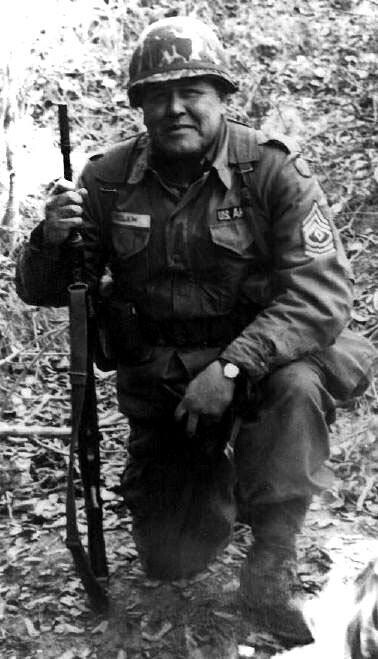
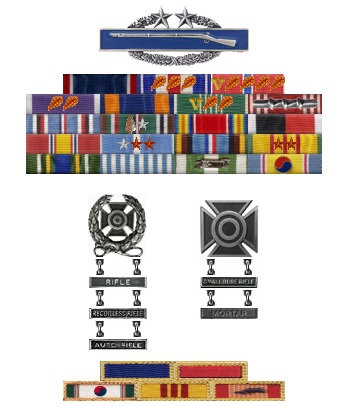
Remembering Pascal Cleatus Poolaw, Sr., the most decorated Native American soldier in U.S. history – 4 Silver Stars, 5 Bronze Stars 3 Purple Hearts. He earned a total of 42 medals and citations.
Born on January 29, 1922, in Apache, Oklahoma, Poolaw, a full-blooded Kiowa, served with the United States Army in World War II, the Korean War, and the Vietnam War.
Poolaw, his father and two brothers joined the Armed forces in 1942 during World War II.
He earned his first Purple Heart when he was wounded in September 1944. While serving with the 8th Infantry Regiment’s M Company near Recogne, Belgium, Poolaw’s unit was engaging fire with the Germans.
He pushed his unit forward under heavy fire and hurled hand grenades at enemy machine guns, causing numerous enemy casualties and as a result of his heroic actions, many of his comrades lives were saved and the company was able to continue the attack and capture strongly defended enemy positions.
Poolaw’s military career did not end in Belgium with fighting Germans. During the Korean War, Poolaw saw combat and was wounded again and awarded the Distinguished Service Cross, a second Purple Heart, and two more Silver Stars.
He returned to the U.S. in 1952 and retired from the Army ten years later. This is not where his military career ends.
During the Vietnam War, all four of the Poolaw’s sons were in the military. In February 1967, his son, Pascal Jr., was injured by a landmine in Vietnam.
This injury resulted in amputation of his right leg below the knee. Poolaw’s youngest son, Lindy, was also drafted. Afraid of what could happen to his sons as the war progressed, Poolaw rejoined the Army at the age of 45. Giving up his rank as a 2nd Lieutenant (a promotion he earned in Korea), with the intentions of serving in direct combat, Poolaw hoped to keep his youngest son away from the front lines by taking his place.
Regulations prohibited two members of the same family from serving in combat at the same time without their consent. Unfortunately, by the time he arrived on the West Coast, Lindy had left for Vietnam the day before.
(Lindy did not make it)
Poolaw was deployed on May 31, 1967 as a first sergeant of the 26th Infantry Regiment’s C Company.
His last Silver Star was for an event that occurred a few months later. On November 7, 1967, Poolaw’s unit were part of a search and destroy mission near the village of Loc Ninh. Poolaw and his unit were ambushed by the Viet Cong force with intensive claymore mine, rocket, small arms, and automatic weapons fire – saving countless lives.
While wounded, he continued moving among his squad making sure everyone was positioned properly while pulling casualties back.
As Poolaw was carrying a wounded soldier to safety, he was struck by a rocket propelled grenade and killed. For his heroic actions Poolaw was awarded a Silver Star and a third Purple Heart posthumously. ” He has followed the trail of the great chiefs,” his wife Irene said at Poolaw’s funeral. His people hold him in honor and highest esteem. He has given his life for the people and the country he loved so much.”
We honor and thank First Sgt. Pascal Poolaw Sr. for his exemplary service and the ultimate sacrifice he made for our country. Rest in peace good warrior. You will never be forgotten!!

Categories
A Victory! COOL!!!!!!!!!!!!!!!!! Hard Nosed Folks Both Good & Bad I am so grateful!! If I was in Charge Interesting stuff Leadership of the highest kind Manly Stuff One Hell of a Good Fight Our Great Kids Paint me surprised by this Real men Soldiering Some Red Hot Gospel there! Stand & Deliver This great Nation & Its People War
Another, this man is one Hell of a stud!! William Frederick Harris
 William Frederick Harris (March 6, 1918 – December 7, 1950) was a United States Marine Corps (USMC) lieutenant colonel during the Korean War. The son of USMC General Field Harris, he was a prisoner of war during World War II and a recipient of the Navy Cross for extraordinary heroism during the breakout in the Battle of Chosin Reservoir. He was last seen by American forces on December 7, 1950, was listed missing in action and is presumed to have been killed in action. Harris was featured in the book and film Unbroken.[1][2]
Biography
William Frederick Harris was born on March 6, 1918, at Good Samaritan Hospital in Lexington, Kentucky, to Field Harris (1895–1967) and Katherine Chinn-Harris (1899–1990).[1]
Harris graduated from the United States Naval Academy, Annapolis, Maryland, in the class of 1939. He was in A Company, 1st Battalion, 4th Marines[3] and was captured by Japanese forces during the Battle of Corregidor in May 1942.
He escaped with Edgar Whitcomb, future governor of Indiana,[4] and on May 22, 1942, swam 8+1⁄2 hours across Manila Bay to Bataan, where he joined Filipino guerrillas fighting Japan just after the Battle of Bataan.[5] In the summer of 1942, Harris and two others left Whitcomb and attempted to sail to China in a motorboat, but the engine failed and the boat drifted for 29 days with little food or water. The monsoon blew them back to an island in the southern part of the Philippines where they split up and he joined another resistance group.[6] Harris headed towards Australia hoping to rejoin American forces he heard were fighting in Guadalcanal, but he was recaptured in June[7] or September 1943[8] by Japan on Morotai island, Indonesia, around 1,000 miles (1,600 km) from Bataan.[9][10]
Harris was taken to Ōfuna POW camp, arriving February 13, 1944[11] and became acquainted with Louis Zamperini. Harris experienced malnutrition and brutal treatment at the hands of his jailers, notably by Sueharu Kitamura (later convicted of war crimes). Due to malnutrition, by mid-1944 the over 6 feet (180 cm) tall Harris weighed only 120 pounds (54 kg) and had beriberi.[12] In September and November 1944, Harris was beaten severely, to the point of unconsciousness, by Kitamura.[13][14] According to fellow captive, Pappy Boyington, Harris was knocked down 20 times with a baseball bat for reading a newspaper stolen from the trash.[15] Harris was near death when he arrived at a POW camp near Ōmori in early 1945. Zamperini provided Harris with additional rations and he recovered.[16] William Harris was chosen to represent prisoners of war during the surrender of Japan, aboard USS Missouri on September 2, 1945.
After World War II, Harris remained in the Marines. He married Jeanne Lejeune Glennon in 1946 and had two daughters.[1]
He was recalled to active duty during the Korean War.[2] He was the commanding officer of Third Battalion, Seventh Marines, First Marine Division (Reinforced) in the Korean War. During the breakout in the Battle of Chosin Reservoir, his unit stayed behind as a rear guard to protect retreating forces. Despite heavy losses, Harris rallied his troops and personally went into harm’s way during the battle. Harris was last seen by American forces on December 7, 1950, walking and carrying two rifles on his shoulders. He was listed as missing in action, but after the war when former POWs had neither seen nor heard of him, Harris was declared to be dead. He was awarded the Navy Cross in 1951 for his actions at Chosin. Because of his penchant for escape and survival exhibited during World War II, his peers and family were reluctant to accept his death. A superior officer held on to his Navy Cross for a number of years, expecting to be able to give it to Harris personally.[17]
Remains thought to be his were eventually recovered. His family doubted the remains were his, and conclusive testing using DNA had not been attempted as of 2014.[1]
Awards

For his leadership and heroism on December 7, 1950, Harris was awarded the Navy Cross.
The President of the United States of America takes pride in presenting the Navy Cross (Posthumously) to Lieutenant Colonel William Frederick Harris (MCSN: 0-5917), United States Marine Corps, for extraordinary heroism in connection with military operations against an armed enemy of the United Nations while serving as Commanding Officer of the Third Battalion, Seventh Marines, FIRST Marine Division (Reinforced), in action against enemy aggressor forces in the Republic of Korea the early morning of 7 December 1950. Directing his Battalion in affording flank protection for the regimental vehicle train and the first echelon of the division trains proceeding from Hagaru-ri to Koto-ri, Lieutenant Colonel Harris, despite numerous casualties suffered in the bitterly fought advance, promptly went into action when a vastly outnumbering, deeply entrenched hostile force suddenly attacked at point-blank range from commanding ground during the hours of darkness. With his column disposed on open, frozen terrain and in danger of being cut off from the convoy as the enemy laid down enfilade fire from a strong roadblock, he organized a group of men and personally led them in a bold attack to neutralize the position with heavy losses to the enemy, thereby enabling the convoy to move through the blockade. Consistently exposing himself to devastating hostile grenade, rifle and automatic weapons fire throughout repeated determined attempts by the enemy to break through, Lieutenant Colonel Harris fought gallantly with his men, offering words of encouragement and directing their heroic efforts in driving off the fanatic attackers. Stout-hearted and indomitable despite tremendous losses in dead and wounded, Lieutenant Colonel Harris, by his inspiring leadership, daring combat tactics and valiant devotion to duty, contributed to the successful accomplishment of a vital mission and upheld the highest traditions of the United States Naval Service.
— Board of Awards, Serial 1089, 17 October 1951[18]
Harris also received the Purple Heart, the Prisoner of War Medal, the Combat Action Ribbon, the Korean Service Medal, the United Nations Service Medal, the National Defense Service Medal, the Republic of Korea Presidential Unit Citation, the Korean War Service Medal and the World War II Victory Medal.[19]
  |
||||
 |
 |

|
 |
|
 |
|
.svg) |
 |
|


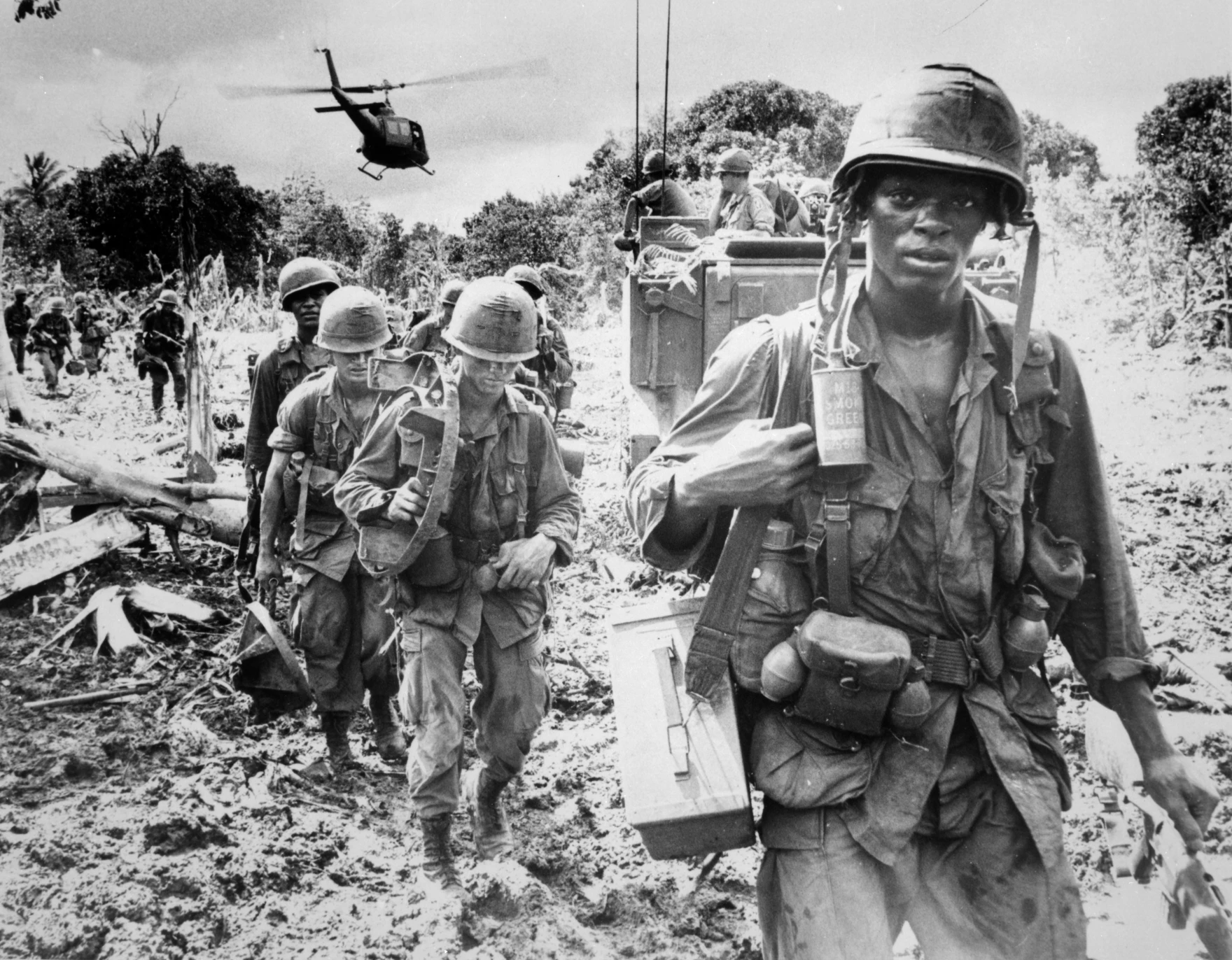
Carlos Hathcock at work in the fields of Vietnam. (Photo: U.S. Marine Corps)
Long before Chris Kyle penned “American Sniper,” Carlos Hathcock was already a legend.
He taught himself to shoot as a boy, just like Alvin York and Audie Murphy before him.
He had dreamed of being a U.S. Marine his whole life and enlisted in 1959 at just 17 years old.
Hathcock was an excellent sharpshooter by then, winning the Wimbledon Cup shooting championship in 1965, the year before he would deploy to Vietnam and change the face of American warfare forever.
He deployed in 1966 as a military policeman, but immediately volunteered for combat and was soon transferred to the 1st Marine Division Sniper Platoon, stationed at Hill 55, South of Da Nang.
This is where Hathcock would earn the nickname “White Feather” — because he always wore a white feather on his bush hat, daring the North Vietnamese to spot him — and where he would achieve his status as the Vietnam War’s deadliest sniper in missions that sound like they were pulled from the pages of Marvel comics.
White Feather vs. The General
Early morning and early evening were Hathcock’s favorite times to strike. This was important when he volunteered for a mission he knew nothing about.
“First light and last light are the best times,” he said. “ In the morning, they’re going out after a good night’s rest, smoking, laughing. When they come back in the evenings, they’re tired, lollygagging, not paying attention to detail.”
He observed this first hand, at arm’s reach, when trying to dispatch a North Vietnamese Army General officer.
For four days and three nights, he low crawled inch by inch, a move he called “worming,” without food or sleep, more than 1500 yards to get close to the general. This was the only time he ever removed the feather from his cap.
“Over a time period like that you could forget the strategy, forget the rules and end up dead,” he said. “I didn’t want anyone dead, so I took the mission myself, figuring I was better than the rest of them, because I was training them.”
Hathcock moved to a treeline near the NVA encampment.
“There were two twin .51s next to me,“ he said. “I started worming on my side to keep my slug trail thin. I could have tripped the patrols that came by.”
The general stepped out onto a porch and yawned. The general’s aide stepped in front of him and by the time he moved away, the general was down, the bullet went through his heart. Hathcock was 700 yards away.
“I had to get away. When I made the shot, everyone ran to the treeline because that’s where the cover was.” The soldiers searched for the sniper for three days as he made his way back. They never even saw him.
“Carlos became part of the environment,” said Edward Land, Hathcock’s commanding officer. “He totally integrated himself into the environment. He had the patience, drive, and courage to do the job. He felt very strongly that he was saving Marine lives.”
With 93 confirmed kills – his longest was at 2,500 yards – and an estimated 300 more, for Hathcock, it really wasn’t about the killing.
“I really didn’t like the killing,” he once told a reporter. “You’d have to be crazy to enjoy running around the woods, killing people. But if I didn’t get the enemy, they were going to kill the kids over there.”
Saving American lives is something Hathcock took to heart.
Carlos Hathcock, in camp (left), and ready to go out on a kill mission (right).
“The Best Shot I Ever Made”
“She was a bad woman,” Carlos Hathcock once said of the woman known as ‘Apache.’
“Normally kill squads would just kill a Marine and take his shoes or whatever, but the Apache was very sadistic. She would do anything to cause pain.”
This was the trademark of the female Viet Cong platoon leader. She captured Americans in the area around Carlos Hathcock’s unit and then tortured them without mercy.
“I was in her backyard, she was in mine. I didn’t like that,” Hathcock said. “It was personal, very personal. She’d been torturing Marines before I got there.”
In November of 1966, she captured a Marine Private and tortured him within earshot of his own unit.
“She tortured him all afternoon, half the next day,” Hathcock recalls. “I was by the wire… He walked out, died right by the wire.”
Apache skinned the private, cut off his eyelids, removed his fingernails, and then castrated him before letting him go. Hathcock attempted to save him, but he was too late.
Carlos Hathcock had had enough. He set out to kill Apache before she could kill any more Marines.
One day, he and his spotter got a chance. They observed an NVA sniper platoon on the move. At 700 yards in, one of them stepped off the trail and Hathcock took what he calls the best shot he ever made.
“We were in the midst of switching rifles. We saw them,” he remembered. “I saw a group coming, five of them. I saw her squat to pee, that’s how I knew it was her. They tried to get her to stop, but she didn’t stop. I stopped her. I put one extra in her for good measure.”
Women were a regular part of the Viet Cong, like the evil torturer “The Apache”
A Five-Day Engagement
One day during a forward observation mission, Hathcock and his spotter encountered a newly minted company of NVA troops. They had new uniforms, but no support and no communications.
“They had the bad luck of coming up against us,” he said. “They came right up the middle of the rice paddy. I dumped the officer in front, my observer dumped the one in the back.”
The last officer started running the opposite direction.
“Running across a rice paddy is not conducive to good health,” Hathcock remarked. “You don’t run across rice paddies very fast.”
NVA and Viet Cong troops in action somewhere in Vietnam.
According to Hathcock, once a Sniper fires three shots, he leaves. With no leaders left, after three shots, the opposing platoon wasn’t moving.
“So there was no reason for us to go either,” said the sniper. “No one in charge, a bunch of Ho Chi Minh’s finest young go-getters, nothing but a bunch of hamburgers out there.”
Hathcock called artillery at all times through the coming night, with flares going on the whole time.
When morning came, the NVA were still there.
“We didn’t withdraw, we just moved,” Hathcock recalled. “They attacked where we were the day before. That didn’t get far either.”
White Feather and The M2
Though the practice had been in use since the Korean War, Carlos Hathcock made the use of the M2 .50 caliber machine gun as a long-range sniper weapon a normal practice. He designed a rifle mount, built by Navy Seabees, which allowed him to easily convert the weapon.
M25 rifle
“I was sent to see if that would work,” he recalled. “We were elevated on a mountain with bad guys all over. I was there three days, observing. On the third day, I zeroed at 1,000 yards, longest 2,500. Here comes the hamburger, came right across the spot where it was zeroed, he bent over to brush his teeth and I let it fly. If he hadn’t stood up, it would have gone over his head. But it didn’t.”
The distance of that shot was 2,460 yards – almost a mile and a half – and it stood as a record until broken in 2002 by Canadian sniper Arron Perry in Afghanistan.
White Feather vs. The Cobra
“If I hadn’t gotten him just then,” Hathcock remembers, “he would have gotten me.”
Many American snipers had a bounty on their heads. These were usually worth one or two thousand dollars. The reward for the sniper with the white feather in his bush cap, however, was worth $30,000.
Like a sequel to Enemy at The Gates, Hathcock became such a thorn in the side of the NVA that they eventually sent their own best sniper to kill him. He was known as the Cobra and would become Hathcock’s most famous encounter in the course of the war.
“He was doing bad things,” Hathcock said. “He was sent to get me, which I didn’t really appreciate. He killed a gunny outside my hooch. I watched him die. I vowed I would get him some way or another.”
That was the plan. The Cobra would kill many Marines around Hill 55 in an attempt to draw Hathcock out of his base.
“I got my partner, we went out we trailed him. He was very cagey, very smart. He was close to being as good as I was… But no way, ain’t no way ain’t nobody that good.”
In an interview filmed in the 1990s, He discussed how close he and his partner came to being a victim of the Cobra.
“I fell over a rotted tree. I made a mistake and he made a shot. He hit my partner’s canteen. We thought he’d been hit because we felt the warmness running over his leg. But he’d just shot his canteen dead.”
Eventually the team of Hathcock and his partner, John Burke, and the Cobra had switched places.
“We worked around to where he was,” Hathcock said. “I took his old spot, he took my old spot, which was bad news for him because he was facing the sun and glinted off the lens of his scope, I saw the glint and shot the glint.” White Feather had shot the Cobra just moments before the Cobra would have taken his own shot.
“I was just quicker on the trigger otherwise he would have killed me,” Hathcock said. “I shot right straight through his scope, didn’t touch the sides.”
With a wry smile, he added: “And it didn’t do his eyesight no good either.“
1969, a vehicle Hathcock was riding in struck a landmine and knocked the Marine unconscious. He came to and pulled seven of his fellow Marines from the burning wreckage. He left Vietnam with burns over 40 percent of his body. He received the Silver Star for this action in 1996.
Lieutenant General P. K. Van Riper, Commanding General Marine Corps Combat Development Command, congratulates Gunnery Sgt. Carlos Hathcock (Ret.) after presenting him the Silver Star during a ceremony at the Weapons Training Battalion. Standing next to Gunnery Sgt. Hathcock is his son, Staff Sgt. Carlos Hathcock, Jr.
After the mine ended his sniping career, he established the Marine Sniper School at Quantico, teaching Marines how to “get into the bubble,” a state of complete concentration. He was in intense pain as he taught at Quantico, suffering from Multiple Sclerosis, the disease that would ultimately kill him — something the NVA could never accomplish.