Categories
All About Guns Anti Civil Rights ideas & "Friends" Paint me surprised by this You have to be kidding, right!?!

Connecticut gun dealers forced to suffer yet another no-sales day Legal action may be necessary, they say. Lee Williams

by Lee Williams

Saturday was supposed to be a big sales day for Lock N’ Load Firearms, which is located in Southington, Connecticut. The gun shop has two major sales each year, and Saturday was its “Customer Appreciation Day.” The store spent a lot on advertising the event and on party goods. Several vendors came out for the sale.

The fun ended around 11:40 a.m., when the state’s computer system went down, and it stayed down throughout most of the day.

Josh, who works at the gun shop, estimates they lost thousands of dollars.

“Guns aren’t $200 or $300 anymore. They cost $600 or $800,” he said. “To set up an event like that, all the advertising, and then to not be able to sell firearms definitely hurt us. But here, it happens all of the time.”

The State of Connecticut does not allow gun dealers to run their own NICS computer checks. It insists on running the checks for them, as well as a half-dozen other state checks.

Josh said the state’s computer shutdowns are becoming far too common.

“I don’t know how to hold the state accountable,” he said. “I hate to think that a lawsuit is the answer, but that’s where we are at. We can’t flip the state reps and senators to get more fair representation at the state capitol.”

Matt, who works at The Gun Store in Waterbury, Connecticut, said the state’s computer shutdowns have become “random but consistent.”

“You can expect to go down every couple of days,” Matt said. “It’s more than I’ve ever experience in the past 20 years. I’m not saying that the State of Connecticut is intentionally doing it, but it’s been consistent enough lately.


If only they used NICS and circumvented all the other six or seven checks they use. The problem is that the state legislature added all these checks. It’s created massive amounts of confusion.”

Common names, he said, like “John Smith” have become a serious issue for the state’s computer systems, which lack the clarity of a NICS Unique Personal Identification Number or UPIN, which gun owners can apply for.

“If they have a NICS UPIN, you find out quickly that it’s not the ‘John Smith’ wanted for murder in Idaho,” he said.

At Central Connecticut Arms in Portland, Connecticut, staffer Ronnie said the shop lost thousands of dollars.

“We couldn’t sell any firearms. It was not a very good day,” he said. “Some customers put their purchases on layaway, which helped.”

The state had another major shutdown just a few weeks ago, Ronnie said.

“We were down for three days. They don’t explain when it’s going to be back up,” he said. “We just sit around here hoping it will be back up soon. It’s a major pain in the ass, man.”

Holly Sullivan

Holly Sullivan is president of the Connecticut Citizens Defense League and serves on the board of the Citizens Committee for the Right to Keep and Bear Arms.

She said there is growing speculation on whether the shutdown was an effort to prevent state residents from purchasing firearms.

“Unlike other states, FFLs are not allowed to use the NICS system themselves. The State of Connecticut acts as a middleman between the FFLs and the NICS system,” she said.


“The state does NICS and state-level checks. Usually, if there’s an IT issue, every FFL gets an email. None were sent on Saturday. This ‘breakdown’ was unusual. Generally, the state will say it’s an IT issue, but they didn’t do that this time.”

Hundreds of Connecticut gun shops were affected, she said.

“This is a symptom of a much larger problem,” she said. “The state wants to control us, but they’re not adequately doing their job. They don’t trust FFLs to do their job. People are denied their Constitutional rights. Let’s say if someone works offshore, it could be months before they get this opportunity again. And besides, Saturday at noon is prime time to buy guns!”

The state has an extreme anti-gun history, Sullivan explained.

“Attorney General William Tong—his hobby is being anti-gun,” she said. “Every legislative session, every anti-gun bill was proposed by Tong. And then he’d bring in his Mom’s Demand action crew. It’s an ongoing problem. Dealers lost a lot of money.”

Neither Connecticut Attorney General Tong nor Connecticut Department of Emergency Services and Public Protection commissioner Ronnell A. Higgins, whose office is responsible for conducting the background checks, returned calls seeking their comments for this story.

The Second Amendment Foundation’s Investigative Journalism Project wouldn’t be possible without you. Click here to make a tax-deductible donation to support pro-gun stories like this.

Categories
All About Guns Fieldcraft Paint me surprised by this Some Scary thoughts that’s too bad”

Ouch & cringing at the same time !

Categories
Born again Cynic! Cops EVIL MF Grumpy's hall of Shame If I was in Charge Paint me surprised by this Some Scary thoughts You have to be kidding, right!?!

‘What about Tate?’ Dave Adamiak, Tate’s father, is nearing his wit’s end. by Lee Williams

by Lee Williams

Dave Adamiak, whose son Patrick “Tate” Adamiak has 17 more years left to serve in federal prison, is confused, perplexed and nearing his wit’s end.

While he appreciates all the support his son’s case has drawn—there are hundreds of videos and stories chronicled on his “Freedom for Tate” website—Tate remains is prison.

To date, there has been no formal move to secure his release—despite the kind words of more than a few elected officials.

Adamiak’s family sent a pardon request to Attorney General Todd Blanche and U.S. Justice Department Pardon Attorney Edward J. Martin Jr., along with nearly 2,000 signatures of supporters, who all believe Tate should never have been charged with a crime.

Tate’s name remains on President Donald Trump’s pardon list, unlike hundreds of others. In addition to 301 pardon denials, the Pardon Attorney has said that 5,908 clemency applications were also rejected.

His 20-year prison sentence, too, has received scorn, even from ATF Director Robert Cekada.

Cekada believes Adamiak was mistreated and massively over-sentenced.

“On the facts of this case, the sentence Mr. Adamiak received is excessive. Mr. Adamiak had no prior criminal history. He dealt with these weapons as curios. We have no evidence that he intended to use the weapons unlawfully or that he was part of a criminal organization. The extremely high sentencing guidelines likely reflect the paradigmatic cases of individuals possessing destructive devices, such as grenade launchers, and normally involve terrorism or organized criminal activity. No such conduct was present here. For me, unlawful possession of National Firearms Act items sentences approximately in the three-to-five-year range are common,” he told me just over a month ago.

Cekada is not alone. Six Republican lawmakers sent their own letter to Blanche and Martin seeking Adamiak’s release.

Congresswoman Jen Kiggans along with Congressmen Eli Crane, Eric Burlison, Paul A. Gosar, D.D.S., Rob Bresnahan, Jr., and Daniel Webster were very clear as to their intent:

“We, the undersigned Members of Congress, respectfully request that you work with President Donald Trump to give fair consideration to a commutation request for Patrick ‘Tate’ Adamiak. We believe that certain inconsistencies in the regulatory framework applied in his case as well as the broader enforcement environment at the time warrant careful review and consideration for executive clemency,” the lawmakers wrote.

The Representatives were extremely clear about Adamiak’s innocence, stating he had “maintained a well‑documented interest in military history and the lawful collection of historic artifacts, replicas, and training devices.”

“The items of concern in his case were inert collector pieces, nonfunctional replicas, and training aids that were incapable of firing,” the letter states.

Patrick “Tate” Adamiak as he was processed into the Western Tidewater Regional Jail on June 16, 2026. (Photo courtesy Western Tidewater Regional Jail).

For reasons that neither he nor his family understand, Adamiak remains housed in the Western Tidewater Regional Jail in Suffolk, Virginia—a county jail and a dangerous hellhole with none of the amenities of a federal prison.

On the day he first arrived at Tidewater, two guards pepper-sprayed an inmate for little or no reason, rammed his head into a metal door, and then dragged him through the jail until his neck and hand were broken. The jail’s medical staff said the inmate was “unlikely to regain limb control.”

The two guards were later fired and charged with malicious wounding; a Class 3 felony in Virginia involving intentional injury with the intent to maim, disfigure, disable, or kill. They each face up to 20 years in prison and $100,000 in fines.

Attempts to contact Adamiak in this facility were unsuccessful.

Case history

Adamiak, who at the time was an active-duty Navy E-6, was arrested and charged by the ATF during the height of the Biden Administration’s war on guns, gun owners, gun rights and the Second Amendment.

Adamiak had been accepted to attend BUD/S (Basic Underwater Demolition/SEAL training). Had the ATF left him alone, he would likely be leading a Navy SEAL platoon.

After ATF agents kicked down his doors, they found nothing illegal or even suspected of being illegal. As a result, the ATF brought in a specialist, ATF Firearm Enforcement Officer Jeffrey R. Bodell, who discombobulated the actual items that the agents had found—all of which are still sold legally online, most do not even require an ID—and turned them into machineguns and destructive devices.

Adamiak was charged with illegally possessing a machinegun for a toy STEN submachinegun found during the search warrant. He paid $75 for the non-firing Spanish replica—or toy—which was made by Denix and is still sold online. Bodell inserted a real STEN barrel and receiver, neither Bodell nor his assistant could make it fire more than one round at a time. Despite their hard work, the toy STEN would not even accept a real magazine. Still, Bodell officially ruled that the toy was a machinegun.

Adamiak was charged with illegally possessing two destructive devices, two inert RPGs that had holes drilled into their receivers and were stripped of internal parts. ATF’s “expert” added parts from real RPGs until they would fire a single subcaliber 7.62x39mm round. As a result, he classified the RPGs as destructive devices. The inert RPGs are still legally sold today without an FFL or any other paperwork.

Takeaways

Adamiak and his father are very concerned about an upcoming hearing, which is scheduled for next month before Arenda L. Wright Allen, the federal judge who oversaw his trial and sentenced Adamiak to serve 20 years in prison.

They both doubt Judge Allen will give Tate a fair hearing. She has already precluded his attorney from rehashing much of anything from the trial. Adamiak could actually receive even more time behind bars.

Every day seems to be a constant battle, Dave Adamiak said. While Tate receives verbal support, nothing official is ever done.

Dozens of politicians have said Adamiak should never have been charged, yet he remains in prison.

“What about Tate?” Dave Adamiak asked. “It appears he’s been swept under the rug after all the traffic about his case. Everyone seems to know about it, but nothing is ever done. He’s still in prison—for nothing illegal. He broke no law. He did nothing wrong.”

Categories
Paint me surprised by this This great Nation & Its People War

News Science Archaeology Shocking new evidence reveals true brutality of American War of Independence The American War of Independence was particularly atrocity-prone because it had a unique combination of features David Keys

A painting by Hugh Charles McBarron, portraying American troops in the American War of Independence

A painting by Hugh Charles McBarron, portraying American troops in the American War of Independence (Wikimedia Commons)

As the world prepares to commemorate this coming Saturday’s 250th anniversary of the American Declaration of Independence, new historical and archaeological evidence and analyses are allowing both academics and the public at large to more fully understand how and why the American War of Independence was even more violent than often popularly believed.

Research over the past few years has shed new light on the massacres, ethnic cleansing and extreme maltreatment of prisoners that occurred during the war.

Although most western European conflicts of the 18th century (such as the Wars of Spanish and Austrian Succession) were on much greater scales, they had much lower atrocity rates.

The American War of Independence was particularly atrocity-prone because it had a unique combination of features: it was an anti-government insurrection, a civil war and an ethnic conflict all combined into one particularly brutal war.

Because it was a rebellion, the British regarded American troops as treason-committing rebels and traitors and treated them with unimaginable cruelty.

Because it was also a civil war (the American population was split between pro-independence and pro-British camps), it was a particularly bitter domestic internecine struggle – and because both sides used Native American tribes as allies, indigenous people were subjected to extraordinarily violent racism expressed through appalling massacres, ethnic cleansing and, in one case, what would today be considered a genocide.

A book published in 2023 (Memory Wars: Settlers and Natives Remember Washington’s Sullivan Expedition of 1779) reveals the ways in which indigenous and European-originating Americans have, over the years, remembered George Washington’s invasion of the Haudenosaunee [Iroquois] Confederacy, a military campaign now regarded by numerous historians and others as an act of genocide.

And last year, another US academic (Professor Joshua Catalano of Clemson University, South Carolina) published a study of the mass execution of dozens of Native American men, women and children by American pro-independence forces in the Gnadenhutten Massacre of 1782. The new research evaluates how myth-making and cover-ups were weaponised to enable frontier land grabs. And, over recent years, archaeological and ethnographic investigations have shed important new light on the 18th-century village where the massacre took place.

Other research (including two books: Relieve Us of This Burthen: American Prisoners of War in the Revolutionary South [2012] and The American Revolution on Long Island [2017]) has investigated disturbing new evidence about Britain’s treatment of American prisoners of war.

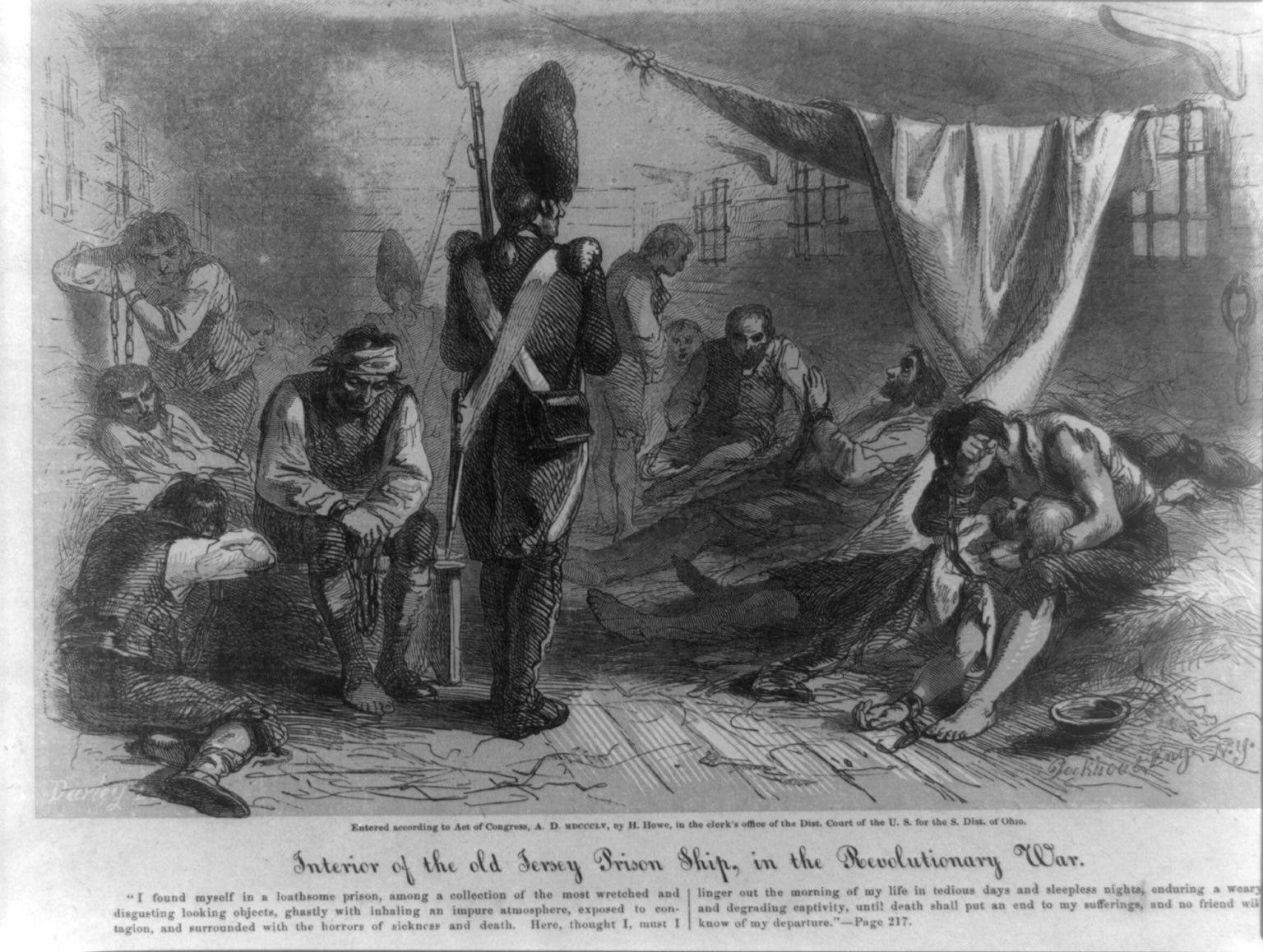
The disease-ridden prison ships in which the British mistreated American prisoners of war and allowed many to starve to death, have been compared to concentration camps by some historians.

Inside a British prison ship. At least 12,000 American prisoners of war died, while incarcerated in such vessels

Inside a British prison ship. At least 12,000 American prisoners of war died, while incarcerated in such vessels (Wikimedia Commons)

Indeed almost twice as many Americans died in those virtual death camps as in battle.

Around 30,000 African-Americans served in the war (on both sides), but research has revealed that, largely due to shocking racially discriminatory practices, their death rate was roughly four times greater than that of white troops.

Very recent research by US scholars (in 2022, 2023 and early 2026) has also shed important new light on how the British military almost certainly used or planned to use germ warfare (smallpox) against pro-independence Americans.

Significantly, over very recent years, several museums have been launched or expanded, providing coverage of the atrocities. The Museum of the American Revolution (in Philadelphia, Pennsylvania), which opened in 2017, includes material on the more appalling aspects of the conflict.

The American Revolution Museum in Yorktown, Virginia reopened in 2016 with equally objective coverage of the brutality of the war.

And throughout the 2000s, the very moving Prison Ships Martyrs Monument in New York was totally restored and modernised with new and detailed explanatory displays.

And, in London, the British Museum is launching an exhibition of three key artefacts linked to Native American peoples involved in the conflict (Declaring Independence: USA 250 will run from 30 June to 29 November in the Museum’s Room 3). The three Native-American-linked exhibits are:

  • The 1777 Washington Peace Medal (presented to a key native American ally of George Washington, but later confiscated by the British)
  • A shell-bead wampum belt used in 18th-century diplomacy between two Native American nations, who then suffered civil war, betrayal and destruction at the hands of both the British and the Americans
  • A ceremonial pipe-tomahawk, given by a British aristocrat to a pro-British Native American leader (Thayandenagaa [Joseph Brant]), who the British Crown had largely betrayed.
One of Britain’s key Native American allies, the war chief of the Mohawks, Thayandenagaa was given a ceremonial pipe-tomahawk, now on display at the British Museum
One of Britain’s key Native American allies, the war chief of the Mohawks, Thayandenagaa was given a ceremonial pipe-tomahawk, now on display at the British Museum (Wikimedia Commons)

And from mid-September, the exhibition will also include the only known ceremonial copy of the Declaration of Independence itself. It is owned by West Sussex Record Office, which will be loaning it to the museum. It will be the first time that the document has ever gone on general public display.

Research by Professor Danielle Allen of Harvard University suggests that it was given as a present by the American revolutionary Thomas Paine to an aristocratic British sympathiser, the Duke of Richmond in late 1787 or early 1788. Professor Allen has just published a book in the US on the subject, entitled Radical Duke (due out in the UK in August).

Significantly, the full-size ceremonial vellum copy of the declaration, due to go on display at the British Museum in mid-September, is actually much better preserved than the original 1776 Declaration in the National Archives Museum in Washington DC. Sadly, the writing on that original is no longer legible – but the one in Britain still is.

(I myself am just shocked by this. Seeing that both sides fought dirty etc. Bottom line – War means fighting and fighting means killing. Seeing that it’s always been that way and sadly it will always be that way! Grumpy)

Categories
All About Guns Paint me surprised by this The Green Machine This great Nation & Its People War

Ichord Report: What If Congress Had Let the M16 Die? By Robert A. Sadowski

“Practically every one of our dead was found with his rifle torn down next to him where he had been trying to fix it.” — Excerpt from a letter written by Marine in 1966 to his family after a firefight in Vietnam.

US soldiers in Vietnam War with early M16 rifles
A U.S. serviceman in Vietnam with an early M16. There were many stories of soldiers and Marines having problems with the earliest models of this rifle in the field. Was it the design’s fault?

Parts of this Marine’s letter was read by Rep. James J. Howard (D-N.J.) to the House. At first, there were reports circulating in the military that the newly developed M16 rifle jammed frequently in combat. We could send astronauts off into space, but our government couldn’t field a reliable service rifle? In May 1967, those reports were made public. It took a Congressional Committee to right the M16 rifle program.

Background

Advisors were initially sent to Vietnam as early as 1955, and then in 1965 the U.S. was all in and officially committed combat troops to Vietnam in 1965. M14 rifles were originally issued to troops bound for Vietnam, but the rifle was deemed too long, heavy, had too much recoil and was uncontrollable if fired in full-auto.

US Marine in prone position firing M14 rifle in Vietnam War
U.S. Marine Lance Cpl. Leroy Duplessis fires his M14 during a firefight with the enemy during Operation Chinook II in 1967. Image: Lance Cpl. E. L. Cole/U.S.M.C.

Conversely, the Viet Cong AK-47 was proving to be highly capable. In the dense jungle environment, a lighter, more maneuverable weapon like it was needed. A new caliber was also being developed that would offer lighter recoil and theoretically equal or greater power than the 7.62 NATO.

US Marine with M16A1 outside of Da Nang Vietnam War
A Leatherneck from I Company, 3d Battalion, 26th Marines cautiously checks an enemy bunker for possible threats during a patrol south of Da Nang. Image: W. R. Shaaf/U.S.M.C.

The result was a high-velocity .22-caliber round that could penetrate a steel helmet at 500 yards, offered less recoil, and allowed soldiers to carry more ammo. The .223 Remington cartridge was the new military round and was officially adopted in 1964 and named “Cartridge, 5.56mm ball, M193”. By 1965, the M16 rifle was being fielded in Vietnam, replacing the much larger M14.

Powder Snafu

The spec for the 5.56 cartridge was for IMR 4475 stick powder, but the producer of the powder could not manufacture it in the quantities requested by the military. A ball powder was the solution, and that seemingly small change was a major factor in M16’s jamming in the jungle. The public was already unhappy with a war in a country most never knew existed before. But I’m getting ahead of the story.

Congress Investigates

The U.S. House of Representatives created a subcommittee in May of 1967 to focus on reports of malfunctions of the M16 experienced by both U.S. Army and Marine Corps personnel. The “Armed Services Special Subcommittee on the M16 Rifle Program” was the official title, and they investigated the controversy with the M16 rifle in Vietnam.

US Capitol building
The U.S. Capitol was where the M16 was critically evaluated by members of the House of Representatives. Image: NARA

Hearings were held between May 15 and August 22 of that year, and a number of field investigations were conducted at military facilities in both the U.S. and in South Vietnam. To quote the Subcommittee findings, management of the Army rifle program was “unbelievable” and should be “thoroughly reviewed.”

What’s In The Report

Richard H. Ichord (D-Mo.) was the chairman of the subcommittee, and the report generated by the three member committee on the failures of M16 is generally known as the Ichord Report. The report noted key issues with the M16:

  • The 5.56mm cartridge used in the M16 was tested and approved with the use of extruded powder, which was switched to ball powder, producing more fouling, which quickly jammed the M16.
  • The lack of a forward assist on the M16 caused the rifle to become inoperable when the bolt failed to go fully forward.
  • The M16 lacked a chrome-plated chamber, which allowed corrosion problems and contributed to case-extraction failures.
  • No cleaning kits, nor instructions on how to clean the M16, were given to troops.
USMC private first class cleaning M16A1 rifle
Pfc. Ricardo King carefully cleans his M16 aboard the helicopter assault ship USS Valley Forge (LPH-8) while part of the Special Landing Force along the coast of Vietnam. Image: Cpl. M. J. Coates/U.S.M.C.

The change in powder, lack of cleaning equipment and training, and the lack of a chrome-plated chamber in the rifle created a perfect storm that led to jamming of the action of the rifle.

Subcommittee members learned that some troops who did have access to cleaning rods taped the rod to their rifle in the event a cartridge case stuck. To clear the jam, the cleaning rod was inserted into the barrel to knock out the spent cartridge case. Other changes were recommended including changing the barrel rifling twist rate and adding of a buffer to slow the rate of fire.

The military published the graphic manual, “The M-16A1 Rifle: Operation and Preventative Maintenance”. These instructions along with cleaning kits were issued to troops as a result of the Ichord Report.

The End Results

The Subcommittee also found conflicts of interest between a commanding general of the Army Weapons Command throughout negotiations for the Army’s procurement of the M16. The general retired and was hired by the original M16 manufacturer, which the Subcommittee called unethical. The change to the new powder “was not supported or justified by test data,” wrote the Subcommittee.

US Marines wade through muddy water in Vietnam while carrying M16A1 rifles
Marines wade through a muddy hole while on a search mission with I Company, 3d Battalion, 5th Marines, 12 miles south-southwest of Da Nang, Vietnam. Image: Sgt. D. E. Kramer/U.S.M.C.

The findings of the report were incorporated into what would become the M16A1, which had significantly fewer reliability problems and led to the respected M16-, M4 Carbine- and AR-15-pattern rifles we know of today. It would appear it took an act of Congress to get the M16 rifle back on track.

Categories
A Victory! All About Guns Cops Good News for a change! Hard Nosed Folks Both Good & Bad I am so grateful!! Manly Stuff One Hell of a Good Fight Our Great Kids Paint me surprised by this Real men Stand & Deliver This great Nation & Its People

The In-N-Out Shooter Met the WRONG Gun Owner

Categories
All About Guns Good News for a change! Manly Stuff One Hell of a Good Fight Our Great Kids Paint me surprised by this Real men Soldiering Some Red Hot Gospel there! Stand & Deliver The Green Machine This great Nation & Its People War

Helicopter Door Gunners Are Insane

Categories
All About Guns Grumpy's hall of Shame Paint me surprised by this Some Sick Puppies! that’s too bad” You have to be kidding, right!?!

The atrocity of the year! A SCCY CPX2 in 9mm

Categories
Paint me surprised by this

Some Red Hot Gospel there!

Categories
Darwin would of approved of this! Grumpy's hall of Shame Paint me surprised by this that’s too bad” Well I thought it was funny!

Florida Man and Yogi

Report on man killed by Glacier National Park grizzly contains disturbing new details

FILE: A grizzly bear in Glacier National Park, Mont.

FILE: A grizzly bear in Glacier National Park, Mont

A surprise night time encounter with a grizzly bear led to the death of Anthony Pollio in Glacier National Park this spring, according to a new report containing previously undisclosed details of the attack

Compiled by the Interagency Grizzly Bear Committee, the board of review report describes how evidence at the scene helped investigators reconstruct what led to the incident on May 3. “The attack was likely brief and intense and not prolonged,” * the report reads.

*(No shit !)
With Lake McDonald 4,300 feet below, trees burned by the 2017 Sprague Fire stand along the steep Mount Brown Lookout Trail in Glacier National Park, Mont., on Sept. 17, 2019.

With Lake McDonald 4,300 feet below, trees burned by the 2017 Sprague Fire stand along the steep Mount Brown Lookout Trail in Glacier National Park, Mont., on Sept. 17, 2019.

Chip Somodevilla/Getty Images

Members of the review board included bear experts from state and federal wildlife agencies, as well as Glacier National Park’s carnivore biologist and chief ranger.* A report is required after any human fatality caused by a grizzly bear.

*(You do have to know that this “report” had to cost us Taxpayers a shit load of money!!)

Pollio, a 33-year-old man from Florida, was hiking the Mount Brown Lookout trail, one of the steepest in the park, alone. According to messages with friends and family sent before the attack, he planned to hike to the lookout and watch the sunset.

(Insert Florida man joke here!)

Investigators believe he was descending the trail, known for its jigsaw of standing and dead trees, in the dark around 9:30 p.m. “Darkness and dead fall on the trail would have prevented the bear and Mr. Pollio from seeing each other until they were very close,” the report reads.

A view of the attack site in Glacier National Park, Mont., from below the trail looking upslope.

A view of the attack site in Glacier National Park, Mont., from below the trail looking upslope.

Interagency Grizzly Bear Committee

It’s unknown if Pollio was making noise* or if he was using his cellphone as a flashlight when the bear, a male grizzly thought to be at least 15 years old, charged.

*(Yeah, I guess that his screaming does not count!)

The report confirmed that Pollio was able to deploy a full can of bear spray.* However, it’s unknown if the spray made contact with the bear. The bear killed Pollio via injuries to his head after a short pursuit. Search and rescue teams found the bear spray in the bushes just off the trail before finding Pollio’s remains.

(I am convinced that some bears like the spray just like my son Willie loves extreme hot sauces on his chow!)

DNA from bear hair and bear scat* collected at the scene matched a grizzly bear with no previous history of human conflict, aggression or capture, described as a “life-long resident of the park.” Investigators found no evidence of predation or caching at the scene, and no bears were found in the area during the search or investigation process.

(A word known as shit or what was left of Poor Pollio’s recycled remains by the rest of us!)

Glacier National Park did not immediately respond to questions regarding whether any management action * was taken, or will be taken, against the bear.

*(Shooting the bear!)

FILE: A road sign warning of dangerous grizzly bears alongside the highway near Glacier National Park, Mont.

FILE: A road sign warning of dangerous grizzly bears alongside the highway near Glacier National Park, Mont.

Buddy Mays/Getty Images

Bear experts made numerous recommendations for future hikers to avoid similar surprise encounters with bears. That includes making noise by talking, clapping or singing, which is “critical when visibility and hearing are limited.” Traveling in a group is always recommended*, as “groups of people are usually noisier and less likely to surprise bears.”

*(That way more large caliber guns can then be carried!)

Experts also suggest not traveling when bears are most active at night, dawn or dusk.

(No scat Kemosabe ! Now I don’t know if a gun would of helped. But I do know that wandering  around alone in the woods is just asking for it! Grumpy)

Now I am sorry if this upsets the family or friends of the dead. But being a weak person, I just could not pass up the poor writing of this incident ! Or the frankly really dumb actions of poor old Pollio in the field! Mea Culpa, Grumpy