Categories
All About Guns Leadership of the highest kind

Something probably we will never see today

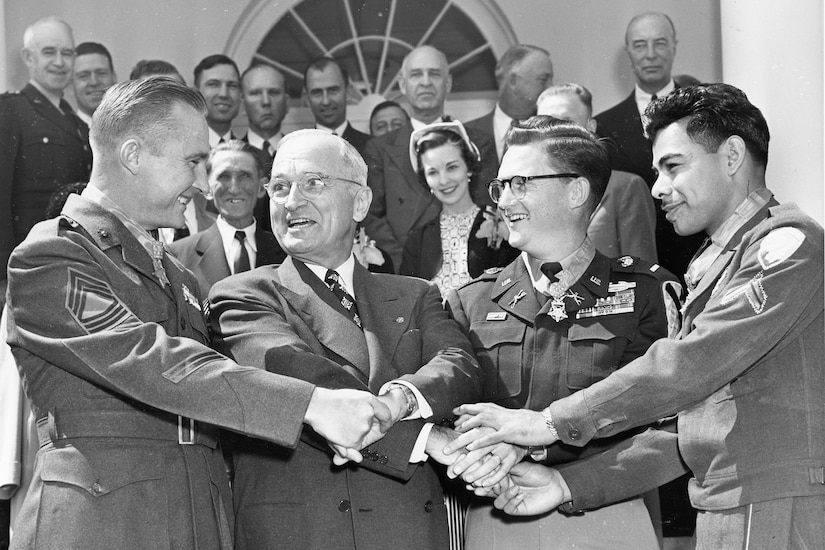
Here we see President Harry S Truman inspecting a Honor Guard Marine Sgt. Rifle. He is even doing it right but then he was a retired Colonel in the Army Reserve. Including his service in France as a cannon cocker.

(I bet that both the Platoon Sgt & The Platoon Leader were shitting bricks during this!! Grumpy)

Categories
Leadership of the highest kind Soldiering The Green Machine This great Nation & Its People War

THE STORY OF THE LEGENDARY GENERAL GEORGE S. PATTON By Will Dabbs, MD

General George S. Patton acknowledges the cheers of the welcoming crowds in Los Angeles, California, during his visit on June 9, 1945. Image: NARA

I met the man in my medical clinic. He was skinny and old. He looked like everybody’s grandfather. His right forearm was a mass of scars. I naturally inquired where he had acquired those.

A lifetime ago this small quiet man was a member of the 5th Ranger Battalion huddled down inside a British-crewed LCA (Landing Craft Assault) boat churning toward Omaha Beach in the first wave. Have you seen Saving Private Ryan? Yeah, he really did that.

The man obviously survived the invasion as well as the hellish slog through the bocage country that followed. He lost two toes at the Battle of the Bulge and fought through the Hurtgen Forest. Along the way, he met General George Patton twice.

Patton spent a year at Virginia Military Institute before transferring to the United States Military Academy (West Point). He had to repeat his freshman year due to poor academic performance.

My friend said that Patton had an odd high-pitched voice that seemed incongruous with his alpha male persona. He told me that the man was as profane and flamboyant in person as the movie made him out to be. At one point my buddy was standing outside of a tent that had recently played host to a command briefing orchestrated by General Eisenhower. All the major players were there, to include Patton, Bradley, and Montgomery. As the meeting concluded, Patton and another General walked past. They were engaged in an animated discussion about what they had just heard, oblivious to their surroundings.

My friend related that he heard Patton say, “Ike doesn’t know how to fight a damn war! We need to hit ‘em in the flanks, and we need to pound them down until they don’t have any fight left in ‘em.”

George Patton was a born soldier and competitor. He competed in the 1912 Olympics in the pentathlon.

Back then, being a general obviously did not require quite as much political sensitivity as might be the case nowadays. Patton would not make it past captain in today’s army. However, my buddy’s first-person observations help put meat on the bones of the historical figure that was arguably America’s most audacious General.

Origin Story

George Smith Patton, Jr. was born in Los Angeles in 1885. He had a younger sister, Nita, who was, for a time, engaged to marry John J. “Blackjack” Pershing. When he was young, Patton had great difficulty learning to read and write. He had to repeat a year at West Point when he was unable to pass mathematics. However, the young officer had other latent skills that made him an exceptionally capable combat leader.

Lt. George S. Patton served as the personal aide to Gen. John J. “Blackjack” Pershing during the Pancho Villa Expedition in Mexico. Image: NARA

In addition to a diagnosable excess of ego, Patton was terrified he might miss out on war. He called in every favor he could find and was eventually assigned as Pershing’s aide during the 1916 Punitive Expedition to fight Pancho Villa. That was where he first saw the elephant.

Like most young men, 2LT Patton was full of fire and vinegar. Once he arrived in theater he found a place filled with danger and intrigue. Mexican bandits were everywhere, and American soldiers had to be forever on their guard. As a result, when the young officer hit a local watering hole with his mates all wearing civilian clothes, he stuffed his M1911 pistol in his belt, just in case.

Patton already exhibited some exceptional skill at arms. He held the title “Master of the Sword” based upon his facility with a cavalry saber and was an Olympian who placed fifth in the 1912 pentathlon. Had he been given credit for two rounds that likely passed through the same hole while firing his .38-caliber Colt target revolver he would have taken gold. However, once he got lubricated at the bar, something untoward occurred and his M1911 accidentally discharged.

Lt. Gen. George S. Patton, Jr. pins the Silver Star on Pvt. Ernest A. Jenkins for his actions in Chateaudun, France on August 16-17, 1944. Patton’s famed revolver is clearly visible. Image: NARA

No one was hurt, but the young man soured on John Browning’s esteemed hogleg. As a result, he sent off for a Single Action Army revolver for which he paid $50. He later had the gun fitted with ivory grips and extensively engraved. He carried the weapon with an empty chamber under the hammer and used it to kill a pair of Mexican bandits. I saw the gun on display in the Patton Museum when I was kid, replete with the appropriate notches in the grips.

Serious War

Patton followed Pershing to Europe for World War I where he developed a keen interest in the burgeoning science of tanks. He toured the French Renault plant where the FT tanks were being produced and received a block of instruction on their operation. When the first 10 tanks were presented to the US Army, Patton personally backed seven of them off the train. He was the only soldier in the US Army with any tank-driving experience.

Lt. Col. George S. Patton, Jr., poses for a photograph in France in 1918 in front of a Renault FT light tank. Patton would help “write the book” on armored warfare. Image: U.S. Army

Patton led the first US armored forces into combat at Saint Mihiel in 1918, often walking in front of the vehicles under fire to guide their drivers. In the heat of battle, he struck an American soldier over the head with a shovel to motivate him to dig and later admitted that he may have killed the man. A gunshot wound to the pelvis took him out of the rest of the war.

The Big Time

World War II was without precedent in human history. In 1939, there were 174,000 troops in the US Army. At its apogee during the height of the war, that number reached 8 million. Such explosive expansion offered unprecedented opportunities for advancement. George Patton rode that wave.

Gen. Bernard Law Montgomery shakes hands with Lt. Gen. George S. Patton, Jr. at the Palermo airport, Sicily, on July 28, 1943. Image: Lt. Brin/NARA

Patton’s military service in WWII has been exhaustively documented elsewhere, but here’s an overview. He served in North Africa and subsequently commanded the Seventh Army during Operation Husky, the Allied invasion of Sicily. The controversy surrounding Patton’s slapping of a soldier suffering from battle fatigue circled the globe. Additionally, Patton was implicated for his part in the infamous Biscari massacre wherein American troops shot Axis prisoners claiming the flamboyant General had directed them to do so during a motivational speech. However, an investigation by the Inspector General of the War Department cleared Patton of any wrongdoing in the matter.

Lt. Gen. George S. Patton, Commanding the U.S. Third Army, prepares to go aloft on August 26, 1944 to inspect the progress of his forces from the air. Image: Van Maanen/NARA

Nevertheless, Patton was placed in command of the “Phantom Army” based in the UK and intended to draw German attention away from the D-Day landings.

Radio commentators chat with Gen. Patton in Hershfeld, Germany on April 19, 1945. The end of the European Theater was less than three weeks away. Image: NARA

Once Patton was unleashed upon the continent, his reputation as a fire-breather veritably exploded. Patton led his Third Army on a hell-for-leather charge across France and then helped break the back of the German assault during the Battle of the Bulge. By the end of the war, Patton was a four-star General and a legend in the eyes of the American people. He famously died in an auto accident at age 60 on 21 December 1945. Controversy orbits around the details to that event to this very day.

Faithful friend to the end, Willie, Gen. Patton’s pet bull terrier mourns the passing of his owner in this January 1946 photograph. Image: NARA

Ruminations

General George Patton was a visionary commander who thrived in the radical space of the war. Audacious, bold, and utterly addicted to war, Patton was a natural combat leader. Though his lack of political sensitivity nearly scuppered his career on numerous occasions, he was nonetheless one of the most effective military officers the United States has ever produced.

Categories
Leadership of the highest kind Manly Stuff Soldiering War

Haile Selassie: Ethiopia’s Wise Wartime Emperor by Will Dabbs

When SCCY Firearms introduced their inexpensive striker-fired handgun, they called it the DVG-1. What not just everybody knew was that DVG stood for “Davis Versus Goliath.” Israel’s King David was one of the most compelling figures in human history.

Ethiopian Emperor Haile Selassie.
This is Ethiopian Emperor Haile Selassie. Once turned out, he was quite the dashing figure. (Photo/Public domain)

Most folks know at least the rudiments of the story. David was just a kid, likely barely even a teenager, when he faced down the nine-foot Philistine giant Goliath. Per the Biblical narrative, David used his shepherd’s sling to brain the guy in the forehead with a rock before decapitating him with his own sword.

David and Goliath
The story of David and Goliath is a timeless tale that transcends both history and faith. (Photo/Public domain)

When David was preparing for this epic battle, he selected five smooth stones from a modest creek near the Valley of Elah, some 15 miles west of Bethlehem. I’ve actually picked up a few similar rocks in that very spot myself. The joke at the time was that the Israeli government likely came out every couple of weeks with a front loader full of gravel just to keep the place stocked up for visitors. Tradition holds that David picked five stones because Goliath had four brothers.

David’s life is a powerful example of redemption. David was a rock star. However, he had an affair with a married woman named Bathsheba, murdered her husband, and subsequently got caught. Their first son perished as a result.

David subsequently repented before the Lord and was forgiven. Despite the grievous nature of his sin, he was nonetheless still described as a man after God’s own heart. I take encouragement from that myself. The David and Bathsheba’s second son was named Solomon. Scripture claims Solomon was the wisest man who ever lived.

painting with The Queen of Sheba
The Queen of Sheba was said to be quite the looker.(Photo/Public domain)

Rulers came from all over the world to sit before Solomon and bask in his knowledge. One of those leaders was the Queen of Sheba. The Land of Sheba included modern-day Somalia, Eritrea, Ethiopia, and Yemen.

One of countless unsubstantiated legends to have spawned from the Biblical narrative holds that Solomon and this visiting queen exchanged more than just pleasantries. The book of I Kings reports that Solomon already had 700 wives and 300 concubines. I simply cannot imagine. Keeping just my one wife happy seems like a full-time job to me. Regardless, this extra-Biblical tale proposes that the queen became pregnant by Solomon and eventually gave birth to a son known as Menelik I. The queen then supposedly raised the boy back home as a pious Jew. Now, hold that thought….

The Man

In the mid-1930s, fascist Italy under Benito Mussolini harbored aspirations to resurrect the greatness of Imperial Rome. Mussolini subsequently had designs on most of the Mediterranean Sea. In 1935, his first major conquest was Ethiopia. Ethiopia was led at the time by Emperor Haile Selassie.

Haile Selassie
Haile Selassie certainly had his fans around the world. (Photo/Public domain)

Born in 1892, Selassie reigned over Ethiopia from 1930 through 1974. History recognizes Selassie as an enlightened reformer. Like all public figures, however, his actual legacy was mixed. While lauded for such stuff as a new freedom-centric Constitution in 1931 and the abolition of slavery eleven years later, he was nonetheless still criticized for the repression of human rights among certain ethnic groups and a failure to modernize quickly enough. Nobody’s perfect, but he was Time Magazine’s Man of the Year in 1935.

Desperation Nation

Ethiopia had beaten Italy during the First Italo-Abyssinian War, which ran from 1895 through 1896. By the mid-1930s, Mussolini remained quite butthurt over that. In October of 1935, the fascist dictator set out to make things right.

At the time, Italy was a world-class military power, while Ethiopia remained fairly primitive. Overall troop strength was about the same, but the Italians had the Ethiopians lyrically outmatched in combat power. Ethiopia fielded four tanks and seven armored cars against some 700 modern Italian armored vehicles. Italy outnumbered Ethiopia ten-to-one in artillery. Ethiopia possessed thirteen military aircraft against 595 Italian combat planes. This was shaping up to be a proper bloodbath.

The Emperor Responds

It is in moments of desperation that the true measure of a man’s character is exposed. When things looked darkest for Volodymyr Zelensky and the Russians were pouring across his national borders, President Biden offered him the use of an American helicopter to whisk him and his family to safety. Zelensky famously responded with, “The fight is here; I need ammunition, not a ride.”

 Haile Selassie's 1935 mobilization order.
This was Haile Selassie’s 1935 mobilization order. It is a study in succinct wartime administration. (Photo/Public domain)

As the Italians mobilized to seize his nation, Ethiopian Emperor Haile Selassie had a similar defining moment. With his military teetering and the option of capitulation on the table, Selassie issued the following proclamation:

“Everyone will now be mobilized…All men and boys able to carry a spear will be sent to Addis Ababa. Married men will take their wives to carry food and cook. Those without wives will take any woman without a husband. Women with small babies need not go. Those blind, those who cannot walk or for any other reason cannot carry a spear are exempted. Anyone found at home after receipt of this order will be hanged.”

That sums things up nicely.

How Goes the War?

The Ethiopians never really had a chance. They nonetheless still fought like lions in the face of crushing opposition. There had been an arms embargo enacted by the major powers, including France and the UK. This disproportionately affected the Ethiopians, given their lack of indigenous manufacturing capability. Despite the relative parity in raw troop numbers, only about one in four Ethiopians had any formal military training. Many were armed with nothing more than a spear or bow. What rifles they did have were often antiquated, as were their few artillery pieces.

italian troops.
Italian troops were both well-trained and well-equipped when compared to their Ethiopian adversaries. (Photo/Public domain)

Selassie’s forces fielded some 1,150 machine guns of various sorts. Curiously, in an effort to influence Anglo-Italian relations and cause a rift between the UK and France, the Germans sent the Ethiopians three combat planes, 10,000 Mauser rifles, and 10 million rounds of ammunition. It was only later that Mussolini and Hitler became BFFs. It was obviously a complicated time.

As is so often the case, a well-funded but overmatched power leaned on mercenaries to flesh out its military machine. The Ethiopian Air Force was commanded by a Frenchman. Professional soldiers from the US, Nazi Germany, Sweden, Russia, Belgium, Czechoslovakia, and Trinidad all came together to advise and command Ethiopian troops. Italian commanders later attributed Ethiopia’s battlefield successes to the influence of these soldiers for hire.

The Conflict Matures

The Italians attacked along several axes and made some modest early gains. Two weeks into the campaign, Italian troops seized Aksum and stole its historical obelisk. This they sent to Rome for display in front of the Ministry for Colonies.

Frustrated by his troops’ slow progress, Mussolini sacked his commander, Marshal Emilio De Bono, and replaced him with General Pietro Badoglio. Badoglio later became Prime Minister of Italy after the fall of the fascists in 1943.

ethiopia's people.
The Ethiopians had no shortage of elan. However, that couldn’t make up for their lack of tanks and combat aircraft.(Photo/Public domain)

Despite the enthusiasm of the Ethiopian forces, the technological superiority of the Italian Army gradually prevailed. In the absence of radios, the Ethiopians relied upon foot messengers for communication. In the face of a modern army, such stuff as this sealed their fate.

The Italians were absolutely barbarous in their prosecution of this war, something that served as a preview for what was to come in World War 2. In response to an assassination attempt against General Rodolfo Graziani, Italian forces massacred as many as 30,000 Ethiopian civilians. The primitive nature of the battlefield made verification of numbers unreliable. The Italians also deployed mustard gas against both military and civilian targets. Hundreds of thousands of Ethiopian civilians perished.

The Christmas Offensive

Around Christmas of 1935, Haile Selassie took personal command of his troops and launched an aggressive counteroffensive against Italian forces ground down by two months of heavy fighting. His objective was to split the Italian army, isolate their Corps commands, and lay a foundation for a follow-on operation to crush the invaders.

a military commander. ethiopia's
Emperor Selassie had a reputation as a competent military commander. (Photo/Public domain)

It was a solid plan deftly executed. However, ground troops simply cannot maneuver in the face of enemy air superiority. Despite the overwhelming technological disparities, the Ethiopians nonetheless still gave a good accounting of themselves.

At one point, an Italian Major named Criniti commanded a squadron of light tanks tasked to block the Ethiopian advance. One valiant Ethiopian soldier charged through withering machinegun fire to mount one of the compact Italian armored vehicles. He then banged on the turret to get the crew’s attention. The two gunners popped their hatches to deal with this unexpected threat. In response, the Ethiopian soldier decapitated them both with his sword.

Emperor Selassie Runs Out of Options

Despite the success of the Christmas Offensive, the Italians’ use of poison gas, to include both mustard and phosgene, ultimately turned the tide of the conflict. Emperor Selassie left Ethiopia to make an impassioned speech for support before the League of Nations in Geneva. World opinion was solidly against the Italians, but the League of Nations had no substantive power. Ethiopia fell, and the emperor spent the rest of the war in exile with his family in the UK.

man and women standing by eachother. ethiopia's
Selassie and his family were forced into exile in Britain following their war with the Italians. (Photo/Public domain)

You recall we began this discussion with King Solomon. Haile Selassie claimed to be the direct descendant of the Solomonic Dynasty. He posited that Menelik I, the purported son of the Queen of Sheba and Solomon, had sired a line of kings that led unbroken right up to his person in the 20th century. Considering this dynasty really gained a foothold in 1270 AD, that’s most likely not true. However, it is thought-provoking to ponder.

A group of Russian-backed Marxists called the Derg eventually removed Haile Selassie in a coup in 1975. Soon afterwards, Derg operatives strangled the deposed emperor to death in his bed. He was 83 years old. The sordid details were not uncovered for another two decades.

painting of a king. ethiopia's
A lot of folks viewed Emperor Haile Selassie as way more than just a regular guy. (Photo/Public domain)

There is much more to this story than we have space to explore. Many followers of the Rastafari movement venerated Haile Selassie as a god. That’s itself a most fascinating tale.

Time Magazine rated Selassie as being among the “Top 25 Political Icons of All Time.” His legacy remains influential in the region to this day. It was a curious end to the line of wise men that just might have descended all the way from the Israelite King Solomon.

Categories
A Victory! COOL!!!!!!!!!!!!!!!!! Hard Nosed Folks Both Good & Bad I am so grateful!! If I was in Charge Interesting stuff Leadership of the highest kind Manly Stuff One Hell of a Good Fight Our Great Kids Paint me surprised by this Real men Soldiering Some Red Hot Gospel there! Stand & Deliver This great Nation & Its People War

Another, this man is one Hell of a stud!! William Frederick Harris

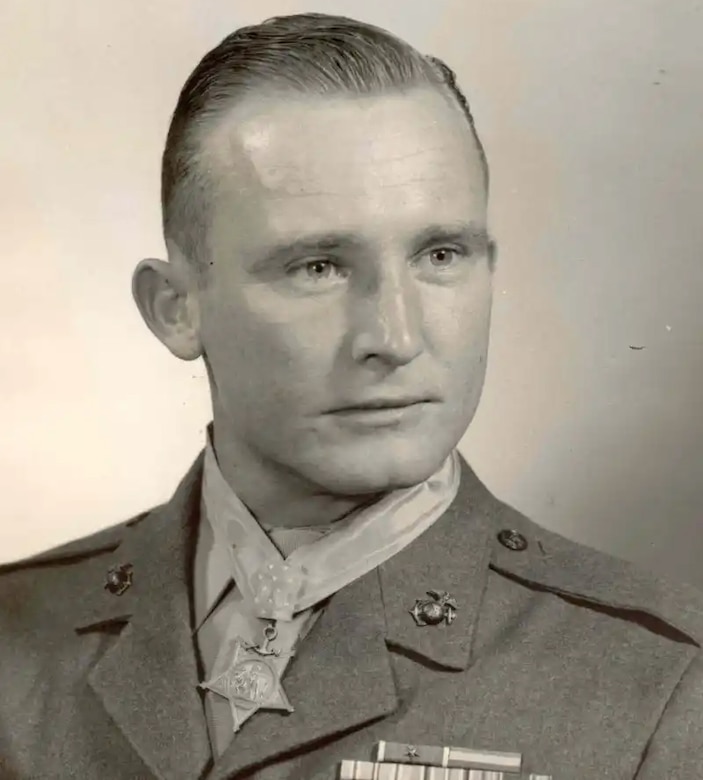
William Frederick Harris (March 6, 1918 – December 7, 1950) was a United States Marine Corps (USMC) lieutenant colonel during the Korean War. The son of USMC General Field Harris, he was a prisoner of war during World War II and a recipient of the Navy Cross for extraordinary heroism during the breakout in the Battle of Chosin Reservoir. He was last seen by American forces on December 7, 1950, was listed missing in action and is presumed to have been killed in action. Harris was featured in the book and film Unbroken.[1][2]

Biography

William Frederick Harris was born on March 6, 1918, at Good Samaritan Hospital in Lexington, Kentucky, to Field Harris (1895–1967) and Katherine Chinn-Harris (1899–1990).[1]

Harris graduated from the United States Naval AcademyAnnapolis, Maryland, in the class of 1939. He was in A Company, 1st Battalion, 4th Marines[3] and was captured by Japanese forces during the Battle of Corregidor in May 1942.

He escaped with Edgar Whitcomb, future governor of Indiana,[4] and on May 22, 1942, swam 8+12 hours across Manila Bay to Bataan, where he joined Filipino guerrillas fighting Japan just after the Battle of Bataan.[5] In the summer of 1942, Harris and two others left Whitcomb and attempted to sail to China in a motorboat, but the engine failed and the boat drifted for 29 days with little food or water. The monsoon blew them back to an island in the southern part of the Philippines where they split up and he joined another resistance group.[6] Harris headed towards Australia hoping to rejoin American forces he heard were fighting in Guadalcanal, but he was recaptured in June[7] or September 1943[8] by Japan on Morotai island, Indonesia, around 1,000 miles (1,600 km) from Bataan.[9][10]

Harris was taken to Ōfuna POW camp, arriving February 13, 1944[11] and became acquainted with Louis Zamperini. Harris experienced malnutrition and brutal treatment at the hands of his jailers, notably by Sueharu Kitamura (later convicted of war crimes). Due to malnutrition, by mid-1944 the over 6 feet (180 cm) tall Harris weighed only 120 pounds (54 kg) and had beriberi.[12] In September and November 1944, Harris was beaten severely, to the point of unconsciousness, by Kitamura.[13][14] According to fellow captive, Pappy Boyington, Harris was knocked down 20 times with a baseball bat for reading a newspaper stolen from the trash.[15] Harris was near death when he arrived at a POW camp near Ōmori in early 1945. Zamperini provided Harris with additional rations and he recovered.[16] William Harris was chosen to represent prisoners of war during the surrender of Japan, aboard USS Missouri on September 2, 1945.

After World War II, Harris remained in the Marines. He married Jeanne Lejeune Glennon in 1946 and had two daughters.[1]

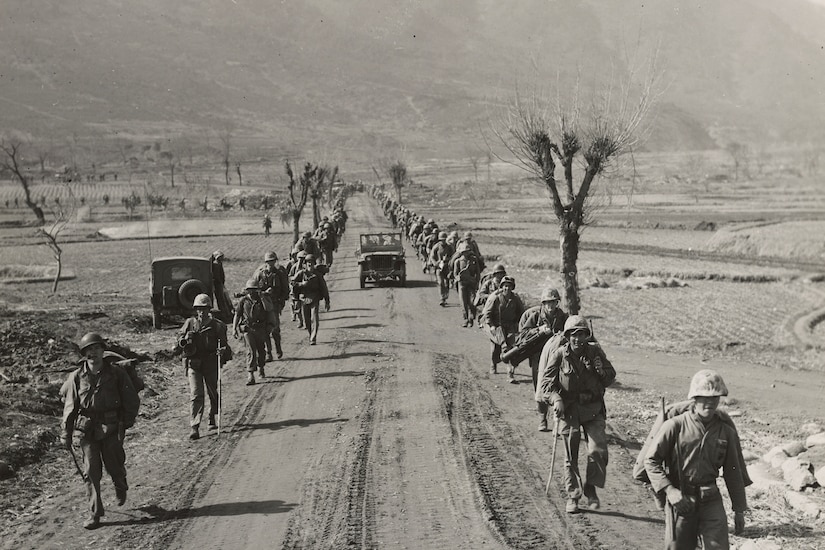
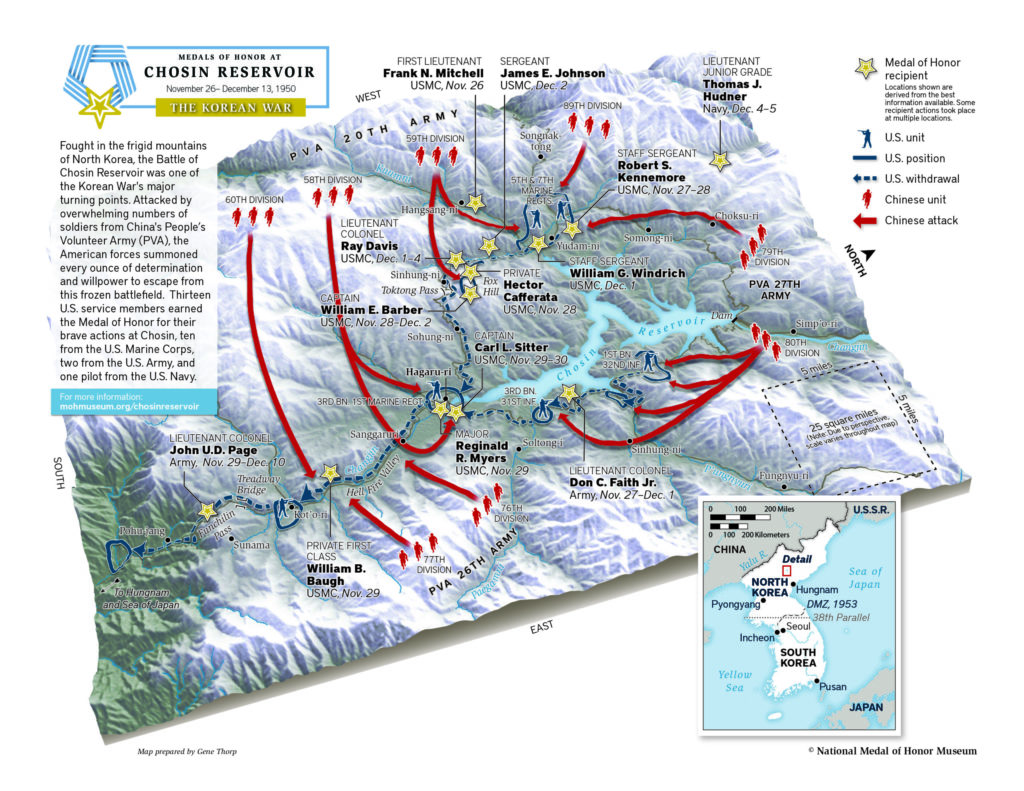
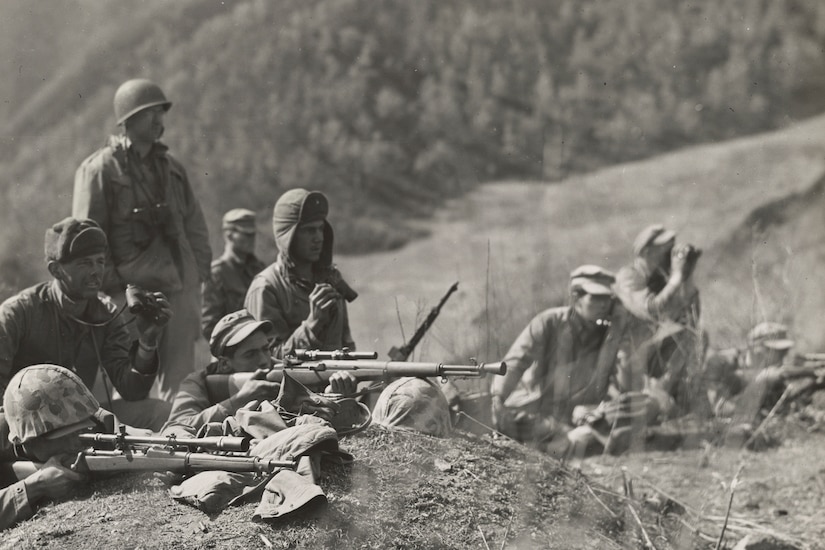
He was recalled to active duty during the Korean War.[2] He was the commanding officer of Third Battalion, Seventh MarinesFirst Marine Division (Reinforced) in the Korean War. During the breakout in the Battle of Chosin Reservoir, his unit stayed behind as a rear guard to protect retreating forces. Despite heavy losses, Harris rallied his troops and personally went into harm’s way during the battle. Harris was last seen by American forces on December 7, 1950, walking and carrying two rifles on his shoulders. He was listed as missing in action, but after the war when former POWs had neither seen nor heard of him, Harris was declared to be dead. He was awarded the Navy Cross in 1951 for his actions at Chosin. Because of his penchant for escape and survival exhibited during World War II, his peers and family were reluctant to accept his death. A superior officer held on to his Navy Cross for a number of years, expecting to be able to give it to Harris personally.[17]

Remains thought to be his were eventually recovered. His family doubted the remains were his, and conclusive testing using DNA had not been attempted as of 2014.[1]

Awards

Navy Cross

For his leadership and heroism on December 7, 1950, Harris was awarded the Navy Cross.

The President of the United States of America takes pride in presenting the Navy Cross (Posthumously) to Lieutenant Colonel William Frederick Harris (MCSN: 0-5917), United States Marine Corps, for extraordinary heroism in connection with military operations against an armed enemy of the United Nations while serving as Commanding Officer of the Third Battalion, Seventh Marines, FIRST Marine Division (Reinforced), in action against enemy aggressor forces in the Republic of Korea the early morning of 7 December 1950. Directing his Battalion in affording flank protection for the regimental vehicle train and the first echelon of the division trains proceeding from Hagaru-ri to Koto-ri, Lieutenant Colonel Harris, despite numerous casualties suffered in the bitterly fought advance, promptly went into action when a vastly outnumbering, deeply entrenched hostile force suddenly attacked at point-blank range from commanding ground during the hours of darkness. With his column disposed on open, frozen terrain and in danger of being cut off from the convoy as the enemy laid down enfilade fire from a strong roadblock, he organized a group of men and personally led them in a bold attack to neutralize the position with heavy losses to the enemy, thereby enabling the convoy to move through the blockade. Consistently exposing himself to devastating hostile grenade, rifle and automatic weapons fire throughout repeated determined attempts by the enemy to break through, Lieutenant Colonel Harris fought gallantly with his men, offering words of encouragement and directing their heroic efforts in driving off the fanatic attackers. Stout-hearted and indomitable despite tremendous losses in dead and wounded, Lieutenant Colonel Harris, by his inspiring leadership, daring combat tactics and valiant devotion to duty, contributed to the successful accomplishment of a vital mission and upheld the highest traditions of the United States Naval Service.

— Board of Awards, Serial 1089, 17 October 1951[18]

Harris also received the Purple Heart, the Prisoner of War Medal, the Combat Action Ribbon, the Korean Service Medal, the United Nations Service Medal, the National Defense Service Medal, the Republic of Korea Presidential Unit Citation, the Korean War Service Medal and the World War II Victory Medal.[19]

 
Bronze star

Bronze star

1st Row Navy Cross Purple Heart
2nd Row Combat Action Ribbon Prisoner of War Medal Asiatic-Pacific Campaign Medal World War II Victory Medal
3rd Row National Defense Service Medal Korean Service Medal Republic of Korea Presidential Unit Citation United Nations Korea Medal
Categories
Leadership of the highest kind This great Nation & Its People

The Greatest Forgotten POTUS in my humble opinion

Categories
Allies Ammo COOL!!!!!!!!!!!!!!!!! Dear Grumpy Advice on Teaching in Today's Classroom Hard Nosed Folks Both Good & Bad I am so grateful!! Leadership of the highest kind Manly Stuff Our Great Kids Real men Soldiering Some Red Hot Gospel there! The Green Machine This great Nation & Its People War

One of my favorite rounds – The 44 Magnum

Categories
All About Guns Allies Leadership of the highest kind Manly Stuff

The Tiny Ship that Drove Japan Insane

Categories
Leadership of the highest kind Manly Stuff Real men Soldiering Some Red Hot Gospel there! Well I thought it was funny!

Old Nosey knew the French well!

Categories
A Victory! COOL!!!!!!!!!!!!!!!!! I am so grateful!! Leadership of the highest kind Manly Stuff One Hell of a Good Fight Our Great Kids Real men Soldiering Stand & Deliver The Green Machine This great Nation & Its People War

82nd All The Way – Alvin York

Categories
COOL!!!!!!!!!!!!!!!!! Good News for a change! Hard Nosed Folks Both Good & Bad I am so grateful!! Leadership of the highest kind Manly Stuff Our Great Kids Real men Soldiering This great Nation & Its People War

Art Imitates Life The Life Of Peter Ortiz By Will Dabbs, MD

Peter Ortiz was a proper war hero long before he went to work in Hollywood. Public domain.

Robert Downey, Jr. is one of the most esteemed actors of his generation. His depiction of Tony Stark as Iron Man across 10 big-budget superhero movies became iconic. I once read a commentary by a British film critic who said that Downey’s English accent in the Sherlock Holmes films was the only example of an American playing a Brit that he felt was in any way believable. What makes that so remarkable is that Downey never took acting lessons. He just got in front of the camera and did his thing. He’s a natural.

There was a time when this was the rule rather than the exception. John Wayne’s natural swagger certainly could not be learned. Back in the Golden Age of Hollywood, actors were not necessarily mushy, fragile prima donnas. They often were drawn from the ranks of truly manly men out in the real world. Principle among them was one Peter Ortiz.

Filmography of a Hero

Peter Ortiz starred in 27 films and two television series. His filmography includes such classics as She Wore a Yellow RibbonRetreat, Hell!The OutcastTwelve O’Clock HighWings of Eagles, and Rio Grande. Ortiz brought a gritty realism to the sundry roles he played on screens both large and small. That’s because he was arguably the baddest man ever to grace the silver screen.

Pierre Julien Ortiz was born in New York in 1913. His mother was of Swiss stock, while his dad was a Spaniard born in France. He was educated at the French University of Grenoble. Ortiz spoke 10 languages. In 193,2 at age 18, he joined the French Foreign Legion.

The Foreign Legion is comprised of some legendarily rough hombres. Peter Ortiz thrived in this space. He earned the Croix de Guerre twice while fighting the Riffian people in Morocco. In 1935, Ortiz turned down a commission as an officer in the Legion to travel to Hollywood and serve as a technical advisor for war films.

Peter Ortiz is shown here second from the left with his team of OSS operators in occupied France during World War 2. Marine Corps photo.

Proper War

We modern Americans often overlook this fact, but World War II burned on for a couple of years before we got involved. As soon as the shooting started, Ortiz left Hollywood and returned to the Legion as a sergeant. He soon earned a battlefield commission and was wounded while destroying a German fuel dump. He was captured soon thereafter but escaped through Portugal, eventually making it back to the United States.

War was a growth industry in the early 1940s, and American citizens with combat experience were invaluable assets. Ortiz enlisted in the U.S. Marine Corps in June of 1942 and earned a commission as a Second Lieutenant 40 days later. He made captain by year’s end and was deployed to Tangier, Morocco, assigned to the Office of Strategic Services. The OSS was the predecessor to the CIA. Captain Peter Ortiz was now officially a spy.

Undercover Ops

Ortiz was wounded badly, recovered, and then parachuted into occupied Europe several times. He repatriated downed Allied flyers and helped organize French Underground units. In August 1944, he was captured by the Germans. He survived torture by the Gestapo and somehow avoided execution. In April 1945, Ortiz’s POW camp was liberated. Now a Lieutenant Colonel, he made his way back to Hollywood to pick up where he left off.

In 1954, Southeast Asia was heating up, so Lt. Ortiz volunteered to return to active duty. However, by then, he was more than 40 years old and sort of famous. The Marines turned him down but promoted him to full Colonel in retirement.

Decorations

We’ve glossed over this guy’s amazing career. He was awarded an Order of the British Empire (OBE) by the government of England. He earned both the Navy Cross and the Purple Heart, each twice. The Navy Cross is our second-highest award for valor, right after the Medal of Honor. Here’s an excerpt from his first Navy Cross citation:

“Operating in civilian clothes and aware that he would be subject to execution in the event of his capture, Major Ortiz parachuted from an airplane with two other officers of an Inter-Allied mission to reorganize existing Maquis groups in the region of Rhone.

By his tact, resourcefulness and leadership, he was largely instrumental in affecting the acceptance of the mission by local resistance leaders, and also in organizing parachute operations for the delivery of arms, ammunition and equipment for use by the Maquis in his region.

Although his identity had become known to the Gestapo with the resultant increase in personal hazard, he voluntarily conducted to the Spanish border four Royal Air Force officers who had been shot down in his region, and later returned to resume his duties. Repeatedly leading successful raids during the period of this assignment, Major Ortiz inflicted heavy casualties on enemy forces greatly superior in number, with small losses to his own forces.”

Ruminations

There were two Hollywood films that were based upon his personal adventures. 13 Rue Madeleine came out in 1947. Operation Secret hit theaters in 1952. Ortiz had one son, Pete Junior, who served as a Marine officer himself, retiring as a Lieutenant Colonel.

Of his dad, the younger Marine said, “My father was an awful actor, but he had great fun appearing in movies.” Colonel Peter Ortiz might not have been the greatest actor of all time, but he was an amazing warrior.

United States

United Kingdom

France

Morocco