By the way my Old Principal Bill Chun stars in this film. He is one of the nicest guys, That and he was one Hell of a Good Boss too! (He is the little Korean Kid in this fine film by the way)
Grumpy
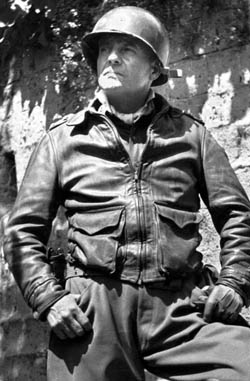
Lucian K. Truscott served in the U.S. Army for 30 years and became one of the outstanding combat commanders of World War II.
By Nathan N. Prefer
In his Maxims of War, Napoleon Bonaparte wrote, “It is exceptional and difficult to find in one man all the qualities necessary for a great general. What is most desirable, and which instantly sets a man apart, is that his intelligence or talent are balanced by his character or courage.” In North Africa, Sicily, Italy, and France, Lucian King Truscott, Jr., proved himself just such a man.
The future general began simply enough when he arrived on January 9, 1895, in Chatfield, Texas. Although the family soon moved to Oklahoma, he would always claim to be a Texan at heart. The grandson of an immigrant from Cornwall, England, he nearly died at a young age when he was playing in his father’s office.
His father, Lucian King Truscott, Sr., was a physician in Chatfield and was busy in another room when his son decided to taste something that looked good in his father’s office. His choice was a poor one, however, and he swallowed some carbolic acid. His father heard his screams and saved his life, but that day he earned one of his trademarks, a raspy, gruff voice that one observer called “a rock-crusher.”
The Truscott family moved to Oklahoma when the land boom began in 1901. Here, young Truscott came into contact with the U.S. Cavalry, an attachment that would last a lifetime.
To help his parents support him and his three sisters, he decided that he and his mother would both attend the Summer Normal School at Norman, Oklahoma. The goal was to acquire a teaching certificate. By age 16, having lied about his age, he was teaching school at Stella, Oklahoma. Later, after another family move, he taught in Onapa, Oklahoma.
Despite his success in achieving a trade, he was restless. This was no doubt what caused him to enlist in the Army Reserves program in which, after two years as a lieutenant, he would become a Regular Army officer.
Lieutenant Truscott’s first assignment was to the 17th Cavalry on the U.S.-Mexican border near Douglas, Arizona. Here he gained on-the-job experience with the vagaries of morning reports, sick reports, duty rosters, and troop administrative requirements.
By the time World War I ended, Lieutenant Truscott was an experienced, if combat-deficient, Army officer. Concerned that he would soon have to return to civilian life, he was relieved to learn that his regiment was being shipped to Hawaii for garrison duties. But before he shipped overseas, Lieutenant Truscott acquired something far more important to his life and career.
General Lucian Truscott proved a capable combat commander in the Mediterranean Theater and rose to command the Allied Fifth Army during World War II.
Sarah Nicholas Randolph was the fourth-generation granddaughter of President Thomas Jefferson and, as such, she had a comfortable life and lofty social standing. Lieutenant Truscott was soon in love, and under the pressure of a move to Hawaii, the two were married on April 5, 1919, in Cochise County, Arizona. With the wedding came a promotion to first lieutenant. In Hawaii he took up polo and became a highly regarded horseman, something he would later have in common with another rising star, George S. Patton.
In a shrinking postwar army, Lieutenant Truscott nevertheless earned a promotion to captain. The interwar years were typical for the Truscotts. After Hawaii came California, then back to Douglas, Arizona. Texas was next, the fourth move in three years. In 1925, Captain Truscott was ordered to attend the Troop Officers’ Course at the Cavalry School in Fort Riley, Kansas where he later served as an instructor.
In 1934, after serving as a troop commander of the 3rd Cavalry Regiment at Fort Myer, Virginia, where he met Majors Dwight D. Eisenhower and George S. Patton and participated in dispersing the “Bonus March” on Washington, he was selected to attend the Command and General Staff School at Fort Leavenworth, Kansas, another prestigious stepping stone to high command. His performance earned him promotion to major, along with an instructorship that lasted until 1940.
In September 1940, the newly promoted Lt. Col. Truscott transferred to the developing armored force. Soon after, Colonel Truscott was off to Fort Lewis, Washington, where he renewed his friendship with Colonel Eisenhower. Together, the two men participated in maneuvers in California. Both would also later participate in the 1941 Louisiana Maneuvers.
After these large-scale maneuvers, Truscott found himself back in Texas, assigned to the 1st Cavalry Division. When word came of the attack on Pearl Harbor, Truscott was promoted to full colonel. While training with his troops Colonel Truscott received an urgent call from General Mark Clark of the War Department who ordered him to report to Washington immediately.
Upon arrival in Washington, Truscott was surprised when General Clark asked if he wanted to become a British commando. These light raiding forces had been developed by the British while they bided their time to rebuild their military strength. General Clark went on to explain that President Franklin D. Roosevelt and British Prime Minister Winston Churchill had agreed to invade Europe in 1943 and, in the meantime, U.S. forces would establish within their organization a group of U.S. commandos.
Truscott was sent to General Eisenhower for details. Eisenhower explained that Army Chief of Staff General George C. Marshall believed that the U.S. Army lacked combat experience throughout its ranks. To achieve this goal, a group of American officers were being sent to England to observe and learn from the experienced British. Colonel Truscott would lead the group that would observe the British Combined Operations Headquarters, the top headquarters for the commandos.
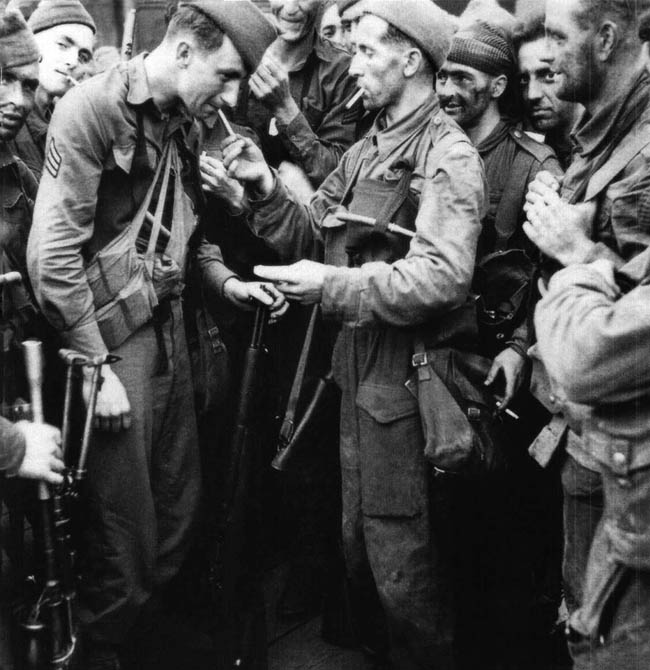
Following the disastrous Dieppe Raid of August 1942, American Rangers and British commandos rest. General Truscott was a major proponent of the Rangers’ formation and was a primary observer during the raid.
After studying every document he could lay his hands on regarding the British situation and listening in on War Department meetings about American plans for the European invasion, Truscott set off for London. As he flew via Canada to England, he received promotion to brigadier general in May 1942. His group began to absorb the organization of the British commando structure from Admiral Lord Louis Mountbatten, and he was invited to sit in on planning conferences for the cross-Channel invasion. He observed commando training and exercises.
The lack of American infantrymen in England at the time and the continuing movement of American units to training bases caused General Truscott to create a unit that could then instruct others rather than pulling men out of existing units. As a result, the 1st Ranger Battalion was created.
In June, General Truscott was advised of a plan to land a large raiding force at the English Channel port of Dieppe in German-occupied France. Since several commando units would be involved in this operation, Truscott had 50 of his newly trained rangers added to the invasion forces. It would result in the first American combat losses in the European Theater. He observed the bitterly opposed landing from offshore.
General Marshall arrived in London in July, and Truscott was summoned to give a detailed report on every aspect of his stay in London to date. Later, he would attend a meeting with Generals Marshall, Eisenhower, and Clark to go over the same information. Using this data, General Marshall had a tentative plan drawn up for the Allied invasion of Europe. Disagreements between the Allies were resolved, albeit temporarily, by a decision to invade French North Africa in 1942. Truscott and his staff became involved in the planning of the new operation and worked with Eisenhower and Patton on the details.
General Patton was pleased to see his old friend. After asking Truscott what he had been doing in London, Patton said, “Dammit, Lucian, you don’t want to stay on any staff job in London with a war going on. Why don’t you come with me? I will give you a command.” Truscott replied that he was eager to get in on the fighting, but he would need Eisenhower to release him. Patton quickly obtained Truscott’s release and placed him on his staff where he became deeply involved in the planning of Operation Torch, the North African invasion.
With the planning completed, Truscott returned to the United States for his new duties. These involved his command of Sub-Task Force Goalpost, a heavily reinforced regiment from the 9th Infantry Division scheduled to land at Port Lyautey in French Morocco. Organizing an efficient task force took all of Truscott’s time, although he did manage to see Sarah and Lucian III, who was now a West Point cadet.
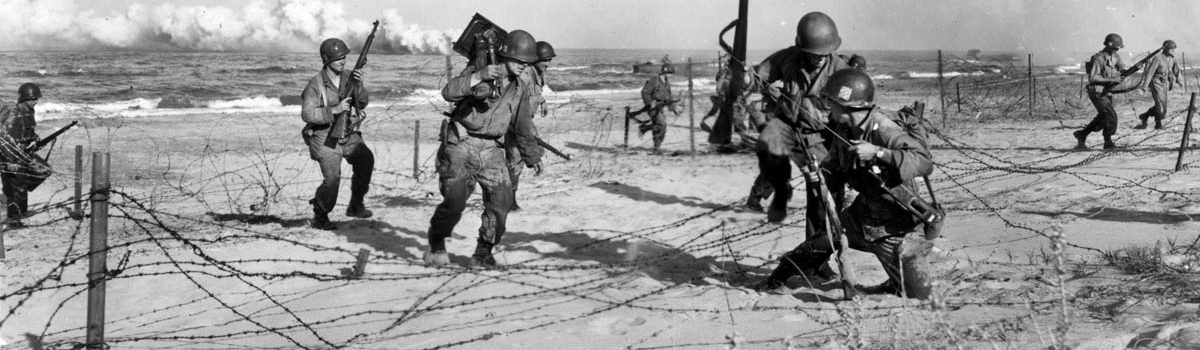
With a force of 9,079 officers and men, Truscott’s Sub-Task Force Goalpost landed against minimal opposition on November 8, 1942, and seized Port Lyautey and its vital airfields. There were problems, of course. During the approach, the task force lost its direction. H-hour had to be delayed while the assault waves reorganized. Heavy seas slowed matters as well. Some boats missed their assigned beaches. At daybreak, French planes strafed the beaches. Overall, though, the invasion succeeded, and the objectives were soon secured. The French surrendered on November 10. This success earned Truscott promotion to major general.
With the invasion complete, Sub-Task Force Goalpost was disbanded. This left Truscott without a command, so he went to Eisenhower in search of a new one. He was told to “wait around for a few days.” Concerned with the slow progress of American forces toward Tunis, Eisenhower made Truscott his deputy chief of staff to control operations with the British First Army. This was a difficult job, requiring the cooperation of the American, British, and French forces involved. This posting would prove an essential part of the eventual Allied victory in North Africa.
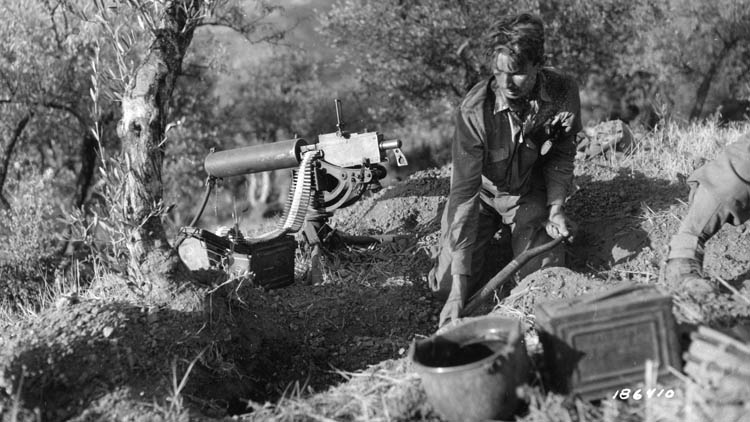
After executing a landing behind German lines at Brolo, Sicily, a soldier of the 3rd Infantry Division digs a foxhole while preparing a machine-gun position.
Once again, Truscott’s outstanding performance earned him a new job, this time commanding the 3rd Infantry Division. The division had an outstanding World War I record and had been stationed at Fort Lewis, Washington, in the interwar years, where both Eisenhower and Truscott had served with it. The division had participated in the North African invasion under Maj. Gen. Jonathan W. Anderson. When the latter was promoted to command of X Corps, Eisenhower gave the division to Truscott in April 1943.
Truscott’s first steps were to improve the training and physical endurance of his new command. As he remembered, “I had long felt that our standards for marching and fighting in the infantry were too low, not up to those of the Roman legions nor countless examples from our own frontier history, not even to those of Stonewall Jackson’s ‘Foot Cavalry’ of Civil War fame,” he wrote. Adopting a tactic of the rangers and commandos, he ordered his men to march at the rate of four miles per hour. Despite initial skepticism, the new rate, soon dubbed “The Truscott Trot,” was achieved by all units of the 3rd Infantry Division and helped make it one of the best combat units of the war.
Alerted for Operation Husky, the coming invasion of Sicily, the division began a new training cycle. The 3rd Infantry Division assaulted Sicily as part of the newly created Seventh Army under Patton. The landings were lightly opposed, and the division quickly moved inland. On the third day of Operation Husky, Truscott was already up front with his leading units, pressing them forward. As he observed one battalion attack an enemy position, his driver advised him that standing in the middle of the road with binoculars was inviting incoming fire. The group retired to a nearby ditch.
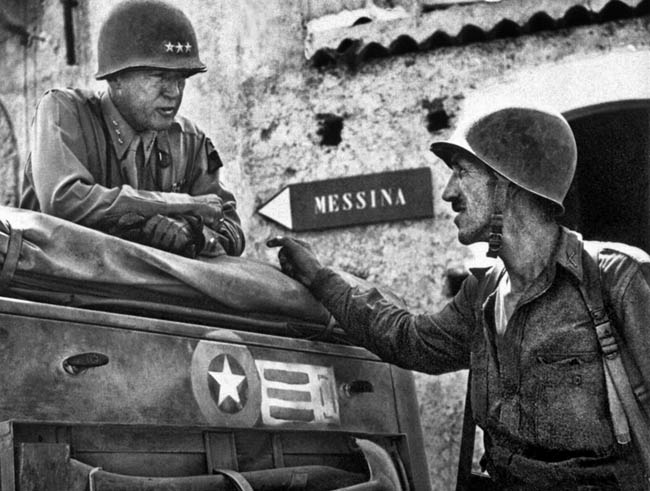
Soon Patton came calling. He was frustrated that his army was under orders to pace the advance of the adjoining British Eighth Army under General Bernard L. Montgomery. The two men talked the situation over and felt that the Seventh Army could easily conquer the western half of Sicily with the prize of its largest city, Palermo, if given permission. Together, the two men decided upon a “reconnaissance-in-force” to the west to, as General Truscott wrote, “clear up the situation.” Thus began the “Race for Palermo.”
Lieutenant Colonel Lyle Bernard, who led the 2nd Battalion, 30th Infantry Regiment during the amphibious assault at Brolo, confers with General George S. Patton, Jr., commander of the U.S. Seventh Army.
A few days after the capture of Palermo, the 3rd Infantry Division was back fighting the Germans in mountainous eastern Sicily. Progress was slow and costly. This time Patton sent his deputy, Maj. Gen. Geoffrey Keyes, to order Truscott to have one of his battalions conduct an amphibious landing behind the German lines. Truscott agreed with the idea, but insisted that it be within supporting distance of the main division force. This soon became a point of disagreement and resulted in a rather famous episode in Truscott’s career.
The first date for the landing was postponed when German aircraft destroyed one of the landing craft. When the next scheduled date was postponed by Truscott because he felt that the bulk of the division was still too far away to support the isolated battalion, Keyes appeared and demanded the landing proceed. He reported to Patton that Truscott did not want to carry out the landing. An hour later, Patton came screaming into the 3rd Infantry Division command post.
Truscott recalled the scene. “He was screamingly angry as only he could be. ‘Goddammit, Lucian, what’s the matter with you? Are you afraid to fight?’ I bristled right back: ‘General, you know that’s ridiculous and insulting. You have ordered the operation, and it is now loading. If you don’t think I can carry out orders, you can give the division to anyone else you please. But I will tell you one thing, you will not find anyone who can carry out orders which they do not approve as well as I can.’” Truscott’s reply calmed Patton immediately, and the two men settled down to discuss how best to relieve the amphibious force.
Lieutenant Colonel Lyle W. Bernard’s 2nd Battalion, 30th Infantry Regiment, itself at two-thirds strength, was reinforced with three batteries from the 58th Field Artillery Battalion, a platoon of the 10th Combat Engineer Battalion, and a platoon of Company C, 753rd Tank Battalion. As Truscott feared, the battalion took severe punishment in its isolated beachhead, and the division, despite its best efforts, took longer than expected. Seven of the eight artillery pieces were lost as were several tanks and other vehicles. But the battalion survived. By August 16, the division was on the hills overlooking Messina. The battle for Sicily was over.
Initially relieved that his division would not be in the assault phase of the invasion of southern Italy, Truscott was soon ordered by his new commander, Maj. Gen. Mark Clark of the Fifth U.S. Army, to be prepared to land farther north once the Allied advance made progress in that direction. But the strong German defense of the Salerno beachhead soon changed such plans. In less than a week, Truscott was ordered to prepare his division to land at Salerno and join the battle there. While his men sailed to Italy, Truscott went to the beachhead to see things for himself and confer with General Clark. Traveling by PT-boat, he visited the beachhead, saw the strong defenses, and received orders to assign his division to the Fifth Army’s VI Corps once ashore.
During the battles along the German Winter Line at Cassino, Truscott learned of an old plan, Operation Shingle, that had been discarded and now suddenly revived. The VI Corps, along with the 3rd Infantry Division and the British 1st Infantry Division, was to land at the town of Anzio, on the coast behind the Winter Line.
The initial landings in January 1944 went surprisingly well and caught the Germans by surprise. But as always, they recovered quickly and soon had the beachhead surrounded. During the early days of the battle, Truscott was wounded in the leg when an enemy shell exploded nearby. Saved from serious injury by his favorite cavalry breeches and boots, he remained on duty after medical treatment.
The attack to break out of the beachhead failed when unexpected German reinforcements stopped the advance. During this attack, General Truscott suffered a personal blow when three ranger battalions assigned to his division for the attack were overwhelmed by the enemy. The Allies went on the defensive. For several weeks, the VI Corps would struggle to save its beachhead from increasingly heavy enemy assaults.
Truscott was asleep in his headquarters on the evening of February 16, 1944, when he was awakened by Colonel Carleton. He had a message from General Clark that relieved Truscott of command of the 3rd Infantry Division and appointed him deputy commander of the VI Corps.
Truscott arrived at the VI Corps headquarters to find Lucas and his staff concerned over the latest German counterattack, which threatened to push the Allies into the sea. He observed that there seemed to be “a feeling of desperation, of hopelessness” prevalent in the headquarters. “My optimistic assurance that nothing ever looked as bad on the ground as it did on a map at headquarters did little to dispel the pall-like gloom.” Truscott contacted the division commanders, learned the situation, and was satisfied that each had done all he could, and that in fact, the situation was not as bad as first feared.
A few days later, Clark visited the beachhead and invited Truscott to accompany him on a tour of the frontline units. During the ride, Clark intimated to Truscott that in a few days Lucas would be relieved of command of VI Corps, and that Truscott would replace him. Truscott recalled, “I replied that I had no desire whatever to relieve Lucas, who was a personal friend, and I had not wanted to leave the 3rd Infantry Division for this assignment. I had done so without protest because I realized that some of the command, especially on the British side, had lost confidence in Lucas.”
In February 1944, General Lucian Truscott replaced General John P. Lucas in command of the U.S. Army’s VI Corps. Three months later, the corps executed a pivotal role in the breakout from the embattled Anzio beachhead.
Continuing as deputy corps commander, Truscott had some ideas to improve the Allied position. He called in the corps artillery officer, Brig. Gen. Carl A. Baehr, and asked how the artillery was employing its guns. Disturbed by what he heard, he called for the 3rd Infantry Division’s artillery operations officer, Major Walter T. (“Dutch”) Kerwin. After Kerwin explained how the division massed its guns against enemy attacks, Truscott ordered him, accompanied by Baehr for authority, to make similar arrangements for all corps and other divisional artillery units.
On February 22, 1944, Clark returned to the beachhead and met with Truscott, ordering him to assume command of VI Corps the next day. Truscott repeated his earlier arguments against relieving Lucas, but was informed that the decision had been made. Later, after Lucas had been informed of his relief by General Clark, Truscott expressed his regrets as to how things turned out. Lucas expressed no hard feeling against Truscott, and the two men remained friends until Lucas’s death.
As corps commander, Truscott had to deal with problems relating to both the American and the British troops under his command. Further, Clark had established an advanced Fifth Army headquarters at the beachhead, and this brought its own problems in assigning space, priorities, and rights of way.
By May, the VI Corps was heavily reinforced and ready to break out of the Anzio beachhead. The original plan had VI Corps striking east to cut the line of retreat of the German Tenth Army. The opening attacks went well, and General Truscott was ecstatic. After viewing the progress of the attacks, he returned to his command post where Clark’s chief of staff, Brig. Gen. Donald W. Brann, was waiting. The new orders required Truscott to turn the bulk of VI Corps north to capture Rome. Only a token force was to be left to try to cut the German escape route.
Truscott “was dumbfounded. I protested that the conditions were not right. This was no time to drive to the northwest where the enemy was still strong; we should pour our maximum power into the Valmontone Gap to ensure the destruction of the retreating German army.” But the orders remained, and Truscott obeyed, participating in one of the war’s most controversial episodes.
With the capture of Rome, the VI Corps stood down for a brief rest. The months of July and August were spent training and planning a new operation, the invasion of southern France. This time Truscott and his VI Corps were under a revived Seventh Army commanded by Lt. Gen. Alexander (“Sandy”) Patch, a veteran of the Pacific War. Allowed to pick his own combat units for the operation, Truscott chose his favorite 3rd Infantry Division and the equally battleworthy 45th Infantry Division, which had fought under his command at Anzio. The third division was the 36th (“Texas”) Infantry Division, which had led the breakout at Anzio.
Truscott planned and executed Operation Anvil-Dragoon, the invasion of southern France, with little difficulty. The landings were lightly opposed, and the drive inland began quickly. The push toward the Belfort Gap went as planned, and the Germans were too busy withdrawing to make much of a defensive stand. Things continued to go well as the VI Corps entered the Vosges Mountains near the German border. As winter slowed operations, Truscott was visited by Eisenhower, who told him, “Lucian, I am going to assign you to organize the Fifteenth Army. You won’t like it, because this Army is not going to be operational. It will be an administrative and training command, and you won’t get into the fighting.”
General Edward H. (“Ted”) Brooks would take over VI Corps while Truscott returned to the United States for a well-earned rest before returning to command the new army. After two years of fighting in North Africa, Sicily, Italy, and southern France, General Truscott was finally going home.
He thoroughly enjoyed his visit. Besides spending time with his wife, he visited West Point to see his son, Lucian III. As he was preparing to return to Europe, he was suddenly called to Washington. While at the War Department, he learned that the unexpected death of a British senior commander had resulted in a series of promotions and moves that would now affect him. One of the unexpected moves was the promotion of General Clark to command the Fifteenth Army Group in Italy. That left a vacancy in command at Fifth Army. General Marshall asked Truscott, “How do you feel about going back to Italy?” Surprised, Truscott replied, “Sir, I will do the best I can wherever you wish to send me.”
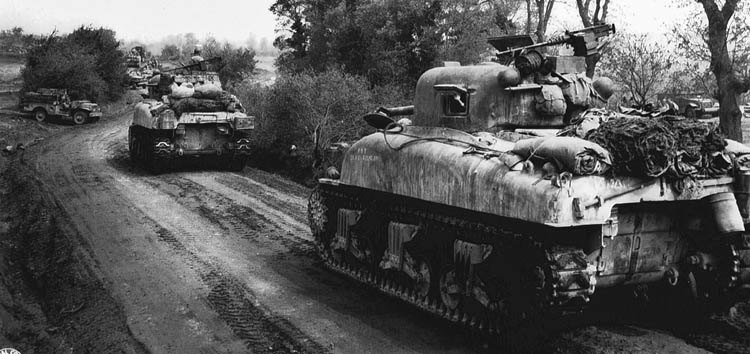
Taking his faithful staff, Truscott assumed command of the Fifth Army in Italy. With 300,000 soldiers under its command, including at various times Britons, South Africans, Polish, New Zealanders, Brazilians, and soldiers of other nationalities, Truscott’s Fifth Army pushed against the new German Winter Line, captured Bologna, broke the back of German resistance at the Gothic Line, and pushed into the Po River Valley, dispersing the German Tenth and Fourteenth Armies. It was a part of the force that accepted the first surrender of a German army group in World War II when Army Group C surrendered to Allied forces in Italy.
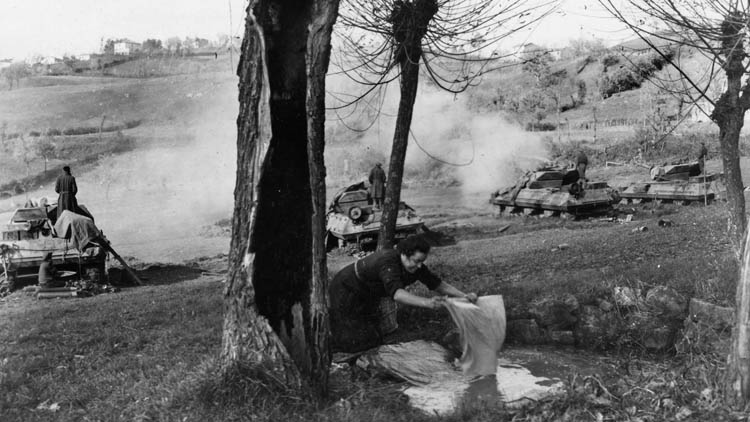
While an Italian woman does her laundry, South African M-10s fire on enemy targets in the city of Bologna. This action took place late in the Italian Campaign as the war in Europe was winding down. Around this time, General Lucian Truscott had returned to Italy to assume command of the Allied Fifth Army.
With the defeat of Germany, Truscott returned to Texas and then volunteered for the war in the Pacific. He was assigned to a group of high-ranking officers who were directed to visit China and prepare to serve there until the defeat of Japan. But even as the group was conducting inspections, Japan surrendered. The war was over. His assignment to command a group of Chinese armies against Japan was moot.
Returning to Italy, Truscott learned that Fifth Army headquarters was to become inoperative. He said goodbye to his faithful staff and decided to visit his friend Patton, then on occupation duty in Germany. Expecting to be sent home to an unknown assignment, Truscott was suddenly caught up in another of Patton’s indiscretions. As he was making the rounds of farewells, Eisenhower’s chief of staff, Maj. Gen. Walter Bedell Smith, caught up with him. Eisenhower wanted to see him immediately. Truscott reported to Eisenhower and learned that he was to replace Patton as commander of the Third Army. For the final time, Truscott protested, but agreed that for the good of the service Patton had to go.
The exchange between two longtime friends went without rancor. When introducing Truscott to the Third Army, Patton said, “A man of General Truscott’s achievements needs no introduction. His deeds speak for themselves.” And so they did.
As the commander of the Third Army on occupation duty, Truscott was faced with new challenges. Tens of thousands of displaced persons needed caring for. He became involved in Cold War politics when, for reasons of their own, some Americans claimed that the Army was abusing or neglecting these unfortunate people. Alerted to the coming storm, Truscott invited newspaper reporters to visit the camps and report accurately on the conditions. Additionally, he was responsible for the trials of Nazi war criminals. He also was responsible for opening a university program for refugees under the auspices of the United Nations. Many who knew him were surprised at his rapid adjustment from combat leader to government administrator.
In early 1946, General Truscott received word that Sarah was seriously ill at Walter Reed Army Hospital. He remained home for 10 days, until he was convinced Sarah was getting well. On the return flight to Germany, he became ill. An electrocardiogram indicated a heart attack, and the doctor ordered several weeks of bed rest. Told that his condition was not improving, Truscott retired on September 30, 1947, after 30 years in the United States Army. He later briefly served as a deputy director of the Central Intelligence Agency. Promoted to the rank of four-star general on the retired list, Lucian King Truscott, Jr., died at the age of 70 on September 12, 1965.
Nathan N. Prefer is the author of several books and articles on World War II. His latest book is titled Leyte 1944, The Soldier’s Battle. He received his Ph.D. in Military History from the City University of New York and is a former Marine Corps Reservist. Dr. Prefer is now retired and resides in Fort Myers, Florida.
George Washington and his soldiers celebrated the signing of the Constitution by racking up a $17,253 tab.
The soldiers were also celebrating Washington being elected as the first president of the newly independent country.
The exact details of the night are hazy but the receipt for the night was saved in the First Troop Cavalry archives.
America was built on alcohol. Many of the founding fathers distilled or brewed their own booze because the ingredients needed to make it flourished perfectly in the soil of the newly formed United States.
Remember, Samuel Adams isn’t just some fictional mascot made up to publicize a brewing company, and Budweiser’s “George Washington recipe” is actually historically accurate.
Also, the terrible road conditions of the time made transporting grains the traditional way, you know, in bread and stuff, a true hardship. It was much easier to just turn whatever you grew into alcohol — which would net an even better profit.
All of this is key to understanding that the founding fathers would more than likely drink any modern military barracks under the table. No single moment best exemplifies this than the time George Washington and his Army buddies celebrated the signing of the Constitution by drinking enough booze to rack up a tab worth roughly $17,253 in today’s currency.
It was the night of September 15, 1787, and George Washington had many reasons to celebrate. A few months earlier, in May, he was elected president at the Constitutional Convention. The United States Constitution had just been finalized and debates were finally settling as the momentous document cruised towards its eventual signing, just two days later. This night was also the farewell dinner for Washington before he set off to do bigger and better things.
Hey when you defeat the British Empire, a man can develop a real thirst!
This is the text of a lecture delivered by the author as part of the Benson Center Lecture Series at the University of Colorado, Boulder, on February 8th, 2021.
I am a black American intellectual living in an age of persistent racial inequality in my country. As a black man I feel compelled to represent the interests of “my people.” (But that reference is not unambiguous!) As an intellectual, I feel that I must seek out the truth and speak such truths as I am given to know. As an American, at this critical moment of “racial reckoning,” I feel that imperative all the more urgently. But, I ask, what are my responsibilities? Do they conflict with one another? I will explore this question tonight.
My conclusion: “My responsibilities as a black man, as an American, and as an intellectual are not in conflict.” I defend this position as best I can in what follows. I also try to illustrate the threat “cancel culture” poses to a rational discourse about racial inequality in America that our country now so desperately requires. Finally, I will try to model how an intellectual who truly loves “his people” should respond. I will do this by enunciating out loud what have increasingly become some unspeakable truths. So, brace yourselves!
I begin with a provocation: Consider this story from my hometown newspaper, the Chicago Sun-Times, that ran on May 31st, 2016. (Things have only gotten worse since.) I ask you to bear with me here because these details matter. We must look them squarely in the face:
Six people were killed, including a 15-year-old girl, and at least 63 others were wounded in shootings across Chicago over Memorial Day weekend.
The total number of people shot during the weekend this year surpassed the 2015 holiday, when 55 people were shot, 12 fatally, over Memorial Day weekend.
The most recent homicide happened late Monday in the Washington Park neighborhood on the South Side.
Officers responding to a call of shots fired about 11pm found James Taylor lying on the ground near his vehicle in the 5100 block of South Calumet, according to Chicago Police and the Cook County medical examiner’s office. Taylor, who lived in the 6500 block of South Ellis, had been shot in the chest and was pronounced dead at the scene, authorities said.
Witnesses at the scene were not cooperating with detectives.
About the same time, a man was shot to death in the West Rogers Park neighborhood on the North Side.
Officers responding to a call of shots fired about 11pm found 39-year-old Johan Jean lying in a gangway in the 6400 block of North Rockwell, authorities said.
Jean, who lived in the 100 block of North Ashland in Evanston, was shot in the neck and taken to Presence Saint Francis Hospital in Evanston, where he was later pronounced dead, authorities said. Police said he was 25 years old.
A source said the shooting stemmed from a dispute between two women. One of them has a child with the man and the other was his girlfriend. Both women were armed, and the man was eventually shot during the argument. No weapons were recovered from the scene.
About 5.20pm Saturday, a man was shot to death in the Fuller Park neighborhood on the South Side.
Garvin Whitmore, 27, was sitting in the driver seat of a vehicle with a passenger, 26-year-old Ashley Harrison, in the 200 block of West Root, when someone walked up to the vehicle and shot him in the head, according to police and the medical examiner’s office.
Whitmore, of the 5800 block of West 63rd Place, was pronounced dead at the scene at 5.29pm, authorities said.
All of the victims were black people. Sixty-three shot, six dead, one weekend, one city. Here’s the thing: reports such as this could be multiplied dozens of times, effortlessly. If a black intellectual truly believes that “Black Lives Matter,” then what is he supposed to say in response to such nauseating reports—that “there is nothing to see here?” I think not.
Violence on such a scale involving blacks as both perpetrators and victims poses a dilemma to someone like myself. On the one hand, as the Harvard legal scholar Randall Kennedy has observed, we elites need to represent the decent law-abiding majority of African Americans cowering fearfully inside their homes in the face of such violence. We must do so not just to enhance our group’s reputation as in the “politics of respectability” but mainly as a precondition for our own dignity and self-respect.
On the other hand, we elites must also counter the demonization of young black men which the larger American culture has for some time now been feverishly engaged in. Even as we condemn murderers, we cannot help but view with sympathy the plight of many poor youngsters who, though not incorrigible, have nevertheless committed crimes. We must wrestle with complex historical and contemporary causes internal and external to the black experience that help to account for this pathology. (There’s no way around it. This is pathology. The behavior in question here is not okay. That one can adduce social-psychological explanations does not resolve all moral questions.)
Where is the self-respecting black intellectual to take his stand? Must he simply act as a mouthpiece for movement propaganda aiming to counteract “white supremacy”? Has he anything to say to his own people about how some of us are living? Is there space in American public discourses for nuanced, subtle, sophisticated moral engagement with these questions? Or are they mere fodder for what amount to tendentious, cynical, and overtly politically partisan arguments on behalf of something called “racial equity”? And what about those so-called “white intellectuals”? Do they have to remain mute? Or, must they limit themselves to incanting anti-racist slogans?
I don’t know all of the answers here, but I know that those victims had names. I know they had families. I know they did not deserve their fate. I know that black intellectuals must bear witness to what actually is taking place in our midst; must wrestle with complex historical and contemporary causes both within and outside the black community that bear on these tragedies; must tell truths about what is happening and must not hide from the truth with platitudes, euphemisms and lies.
I know, despite whatever causal factors may be at play, that we black intellectuals must insist each youngster is capable of choosing a moral way of life. I know that, for the sake of the dignity and self-respect of my people as well as for the future of my country, we American intellectuals of all colors must never lose sight of what a moral way of life consists in. And yet, we are in imminent danger of doing precisely that, I fear. Here’s why.
The first unspeakable truth: Downplaying behavioral disparities by race is actually a “bluff”
Socially mediated behavioral issues lie at the root of today’s racial inequality problem. They are real and must be faced squarely if we are to grasp why racial disparities persist. This is a painful necessity. Activists on the Left of American politics claim that “white supremacy,” “implicit bias,” and old-fashioned “anti-black racism” are sufficient to account for black disadvantage. But this is a bluff that relies on “cancel culture” to be sustained. Those making such arguments are, in effect, daring you to disagree with them. They are threatening to “cancel” you if you do not accept their account: You must be a “racist”; you must believe something is intrinsically wrong with black people if you do not attribute pathological behavior among them to systemic injustice. You must think blacks are inferior, for how else could one explain the disparities? “Blaming the victim” is the offense they will convict you of, if you’re lucky.
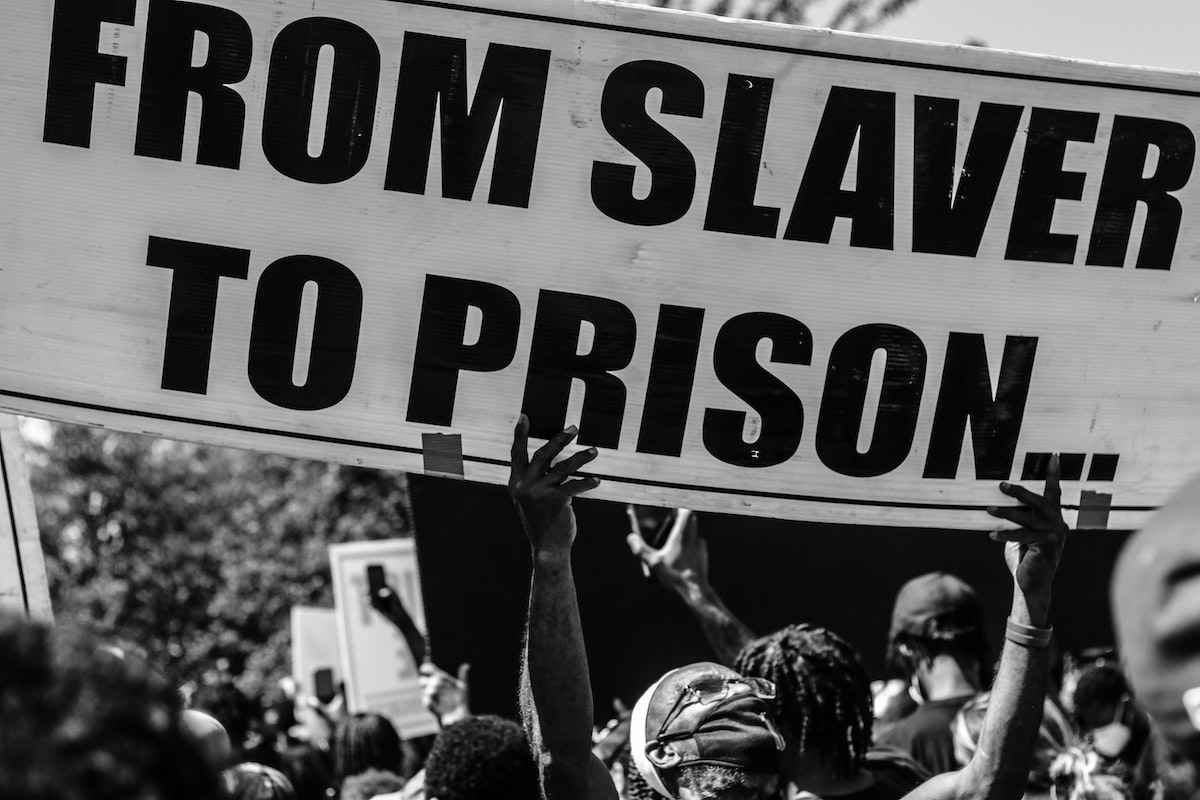
I claim this is a dare; a debater’s trick. Because, at the end of the day, what are those folks saying when they declare that “mass incarceration” is “racism”—that the high number of blacks in jails is, self-evidently, a sign of racial antipathy? To respond, “No. It’s mainly a sign of anti-social behavior by criminals who happen to be black,” one risks being dismissed as a moral reprobate. This is so, even if the speaker is black. Just ask Justice Clarence Thomas. Nobody wants to be cancelled.
But we should all want to stay in touch with reality. Common sense and much evidence suggest that, on the whole, people are not being arrested, convicted, and sentenced because of their race. Those in prison are, in the main, those who have broken the law—who have hurt others, or stolen things, or otherwise violated the basic behavioral norms which make civil society possible. Seeing prisons as a racist conspiracy to confine black people is an absurd proposition. No serious person could believe it. Not really. Indeed, it is self-evident that those taking lives on the streets of St. Louis, Baltimore, Philadelphia, and Chicago are, to a man, behaving despicably. Moreover, those bearing the cost of such pathology, almost exclusively, are other blacks. An ideology that ascribes this violent behavior to racism is laughable. Of course, this is an unspeakable truth—but no writer or social critic, of whatever race, should be cancelled for saying so.
Or, consider the educational achievement gap. Anti-racism advocates, in effect, are daring you to notice that some groups send their children to elite colleges and universities in outsized numbers compared to other groups due to the fact that their academic preparation is magnitudes higher and better and finer. They are daring you to declare such excellence to be an admirable achievement. One isn’t born knowing these things. One acquires such intellectual mastery through effort. Why are some youngsters acquiring these skills and others not? That is a very deep and interesting question, one which I am quite prepared to entertain. But the simple retort, “racism”, is laughable—as if such disparities have nothing to do with behavior, with cultural patterns, with what peer groups value, with how people spend their time, with what they identify as being critical to their own self-respect. Anyone actually believing such nonsense is a fool, I maintain.
Asians are said, sardonically, according to the politically correct script, to be a “model minority.” Well, as a matter of fact, a pretty compelling case can be made that “culture” is critical to their success. Read Jennifer Lee and Min Zhou’s book, The Asian American Achievement Paradox. They have interviewed Asian families in Southern California, trying to learn how these kids get into Dartmouth and Columbia and Cornell with such high rates. They find that these families exhibit cultural patterns, embrace values, adopt practices, engage in behavior, and follow disciplines that orient them in such a way as to facilitate the achievements of their children. It defies common sense, as well as the evidence, to assert that they do not or, conversely, to assert that the paucity of African Americans performing near the top of the intellectual spectrum—I am talking here about academic excellence, and about the low relative numbers of blacks who exhibit it—has nothing to do with the behavior of black people; that this outcome is due to institutional forces alone. That, quite frankly, is an absurdity. No serious person could believe it.
Nor does anybody actually believe that 70 percent of African American babies being born to a woman without a husband is (1) a good thing or (2) due to anti-black racism. People say this, but they don’t believe it. They are bluffing—daring you to observe that the 21st-century failures of African Americans to take full advantage of the opportunities created by the 20th century’s revolution of civil rights are palpable and damning. These failures are being denied at every turn, and these denials are sustained by a threat to “cancel” dissenters for being “racists.” This position is simply not tenable. The end of Jim Crow segregation and the advent of the era of equal rights was transformative for blacks. And now—a half-century down the line—we still have these disparities. This is a shameful blight on our society, I agree. But the plain fact of the matter is that some considerable responsibility for this sorry state of affairs lies with black people ourselves. Dare we Americans acknowledge this?
Leftist critics tout the racial wealth gap. They act as if pointing to the absence of wealth in the African American community is, ipso facto, an indictment of the system—even as black Caribbean and African immigrants are starting businesses, penetrating the professions, presenting themselves at Ivy League institutions in outsize numbers, and so forth. In doing so, they behave like other immigrant groups in our nation’s past. Yes, they are immigrants, not natives. And yes, immigration can be positively selective. I acknowledge that. Still, something is dreadfully wrong when adverse patterns of behavior readily visible in the native-born black American population go without being adequately discussed—to the point that anybody daring to mention them risks being cancelled as a racist. This bluff can’t be sustained indefinitely. Despite the outcome of the recent election, I believe we are already beginning to see the collapse of this house of cards.
A second unspeakable truth: “Structural racism” isn’t an explanation, it’s an empty category
The invocation of “structural racism” in political argument is both a bluff and a bludgeon. It is a bluff in the sense that it offers an “explanation” that is not an explanation at all and, in effect, dares the listener to come back. So, for example, if someone says, “There are too many blacks in prison in the US and that’s due to structural racism,” what you’re being dared to say is, “No. Blacks are so many among criminals, and that’s why there are so many in prison. It’s their fault, not the system’s fault.” And it is a bludgeon in the sense that use of the phrase is mainly a rhetorical move. Users don’t even pretend to offer evidence-based arguments beyond citing the fact of the racial disparity itself. The “structural racism” argument seldom goes into cause and effect. Rather, it asserts shadowy causes that are never fully specified, let alone demonstrated. We are all just supposed to know that it’s the fault of something called “structural racism,” abetted by an environment of “white privilege,” furthered by an ideology of “white supremacy” that purportedly characterizes our society. It explains everything. Confronted with any racial disparity, the cause is, “structural racism.”
History, I would argue, is rather more complicated than such “just so” stories would suggest. These racial disparities have multiple interwoven and interacting causes, from culture to politics to economics, to historical accident to environmental influence and, yes, also to the nefarious doings of particular actors who may or may not be “racists,” as well as systems of law and policy that disadvantage some groups without having been so intended. I want to know what they are talking about when they say “structural racism.” In effect, use of the term expresses a disposition. It calls me to solidarity. It asks for my fealty, for my affirmation of a system of belief. It’s a very mischievous way of talking, especially in a university, although I can certainly understand why it might work well on Twitter.
Another unspeakable truth: We must put the police killings of black Americans into perspective
There are about 1,200 fatal shootings of people by the police in the US each year, according to the carefully documented database kept by the Washington Post which enumerates, as best it can determine, every single instance of a fatal police shooting. Roughly 300 of those killed are African Americans, about one-fourth, while blacks are about 13 percent of the population. So that’s an over-representation, though still far less than a majority of the people who are killed. More whites than blacks are killed by police in the country every year. You wouldn’t know that from the activists’ rhetoric.
Now, 1,200 may be too many. I am prepared to entertain that idea. I’d be happy to discuss the training of police, the recruitment of them, the rules of engagement that they have with citizens, the accountability that they should face in the event they overstep their authority. These are all legitimate questions. And there is a racial disparity although, as I have noted, there is also a disparity in blacks’ rate of participation in criminal activity that must be reckoned with as well. I am making no claims here, one way or the other, about the existence of discrimination against blacks in the police use of force. This is a debate about which evidence could be brought to bear. There may well be some racial discrimination in police use of force, especially non-lethal force.
But, in terms of police killings, we are talking about 300 victims per year who are black. Not all of them are unarmed innocents. Some are engaged in violent conflict with police officers that leads to them being killed. Some are instances like George Floyd—problematic in the extreme, without question—that deserve the scrutiny of concerned persons. Still, we need to bear in mind that this is a country of more than 300 million people with scores of concentrated urban areas where police interact with citizens. Tens of thousands of arrests occur daily in the United States. So, these events—which are extremely regrettable and often do not reflect well on the police—are, nevertheless, quite rare.
To put it in perspective, there are about 17,000 homicides in the United States every year, nearly half of which involve black perpetrators. The vast majority of those have other blacks as victims. For every black killed by the police, more than 25 other black people meet their end because of homicides committed by other blacks. This is not to ignore the significance of holding police accountable for how they exercise their power vis-à-vis citizens. It is merely to notice how very easy it is to overstate the significance and the extent of this phenomenon, precisely as the Black Lives Matter activists have done.
Thus, the narrative that something called “white supremacy” and “systemic racism” have put a metaphorical “knee on the neck” of black America is simply false. The idea that as a black person I dare not step from my door for fear that the police would round me up or gun me down or bludgeon me to death because of my race is simply ridiculous. That is like not going outdoors for fear of being struck by lightning. The tendentious interpretation of every one of these incidents where violent conflict emerges between police and an African American, such that the incident is read as if it were the latter-day instantiation of the lynching of Emmett Till—that posture, I am obliged to report, is simply preposterous. Fear of being “cancelled” is the only thing that keeps many white people outside of the alt-Right from saying so out loud. “White silence” about anti-racism is not “violence.” Nor is it tacit agreement. But it should worry us.
I also want to stress the dangers of seeing police killings primarily through a racial lens. These events are regrettable regardless of the race of the people involved. Invoking race—emphasizing that the officer is white, and the victim is black—tacitly presumes that the reason the officer acted as he did was because the dead young man was black, and we do not necessarily know that. Moreover, once we get into the habit of racializing these events, we may not be able to contain that racialization merely to instances of white police officers killing black citizens. We may find ourselves soon enough in a world where we talk about black criminals who kill unarmed white victims—a world no thoughtful person should welcome, since there are a great many such instances of black criminals harming white people. Framing them in racial terms is obviously counter-productive.
These are criminals harming people, who should be dealt with accordingly. They do not stand in for their race when they act badly. White victims of crimes committed by blacks oughtn’t to see themselves mainly in racial terms if their automobile is stolen, or if someone beats them up and takes their wallet or breaks into their home and abuses them. Such things are happening on a daily basis in this country. We shouldn’t want to live in a world where such events are interpreted primarily through a racial lens. People are playing with fire, I think, when they gratuitously bring that sensibility to police-citizen interaction. That will not be the end of the story.
Yet another unspeakable truth: There is a dark side to the “white fragility” blame game
Likewise, I suspect that what we are hearing from the progressives in the academy and the media is but one side of the “whiteness” card. That is, I wonder if the “white-guilt” and “white-apologia” and “white-privilege” view of the world cannot exist except also to give birth to a “white-pride” backlash, even if the latter is seldom expressed overtly—it being politically incorrect to do so.
Confronted by someone who is constantly bludgeoning me about the evils of colonialism, urging me to tear down the statues of “dead white men,” insisting that I apologize for what my white forebears did to the “peoples of color” in years past, demanding that I settle my historical indebtedness via reparations, and so forth—I well might begin to ask myself, were I one of these “white oppressors,” on exactly what foundations does human civilization in the 21st century stand? I might begin to enumerate the great works of philosophy, mathematics, and science that ushered in the “Age of Enlightenment,” that allowed modern medicine to exist, that gave rise to the core of human knowledge about the origins of the species or of the universe. I might begin to tick-off the great artistic achievements of European culture, the architectural innovations, the paintings, the symphonies, etc. And then, were I in a particularly agitated mood, I might even ask these “people of color,” who think that they can simply bully me into a state of guilt-ridden self-loathing, where is “their” civilization?
Now, everything I just said exemplifies “racist” and “white supremacist” rhetoric. I wish to stipulate that I would never actually say something like that myself. I am not here attempting to justify that position. I am simply noticing that, if I were a white person, it might tempt me, and I cannot help but think that it is tempting a great many white people. We can wag our fingers at them all we want but they are a part of the racism-monger’s package. If one is going to go down this route, one has got to expect this. How can we make “whiteness” into a site of unrelenting moral indictment without also occasioning it to become the basis of pride, of identity and, ultimately, of self-affirmation?
One risks cancellation for saying this, but the right idea is the idea of Gandhi and Martin Luther King: to transcend our racial particularism while stressing the universality of our humanity. That is, the right idea—if only fitfully and by degrees—is to carry on with our march toward the goal of “race-blindness,” to move toward a world where no person’s worth is seen to be contingent upon racial inheritance. This is the only way to address a legacy of historical racism effectively without running into a reactionary chauvinism. Promoting anti-whiteness (and Black Lives Matter often seems to flirt with this) may cause one to reap what one sows in a backlash of pro-whiteness. Here we have yet another unspeakable truth which, as a responsible black intellectual, it is my duty to apprise you of.
On the unspeakable infantilization of “black fragility”
I would add that there is an assumption of “black fragility,” or at least of black lack of resilience lurking behind these anti-racism arguments. Blacks are being treated like infants whom one dares not to touch. One dares not say the wrong word in front of us; to ask any question that might offend us; to demand anything from us, for fear that we will be so adversely impacted by that. The presumption is that black people cannot be disagreed with, criticized, called to account, or asked for anything. No one asks black people, “What do you owe America?” How about not just what does America owe us—reparations for slavery, for example? What do we owe America? How about duty? How about honor?
When you take agency away from people, you remove the possibility of holding them to account and the capacity to maintain judgment and standards so that you can evaluate what they do. If a youngster who happens to be black has no choice about whether or not to join a gang, pick up a gun, and become a criminal, since society has failed him by not providing adequate housing, healthcare, income support, job opportunities, etc., then it becomes impossible to effectively discriminate between the black youngsters who do and do not pick up guns and become members of a gang in those conditions, and to maintain within African American society a judgment of our fellows’ behavior, and to affirm expectations of right-living. Since, don’t you know, we are all the victims of anti-black racism. The end result of all of this is that we are leveled down morally by a presumed lack of control over our lives and lack of accountability for what we do.
What is more, there is a deep irony in first declaring white America to be systemically racist, but then mounting a campaign to demand that whites recognize their own racism and deliver blacks from its consequences. I want to say to such advocates: “If, indeed, you are right that your oppressors are racists, why would you expect them to respond to your moral appeal? You are, in effect, putting yourself on the mercy of the court, while simultaneously decrying that the court is unrelentingly biased.” The logic of such advocacy escapes me.
On achieving “true equality” for black Americans
I am reminded, amidst the contemporary turmoil, of the period after the Emancipation, more than 150 years ago. There was a brief moment of pro-freedmen sentiment during Reconstruction, in the immediate aftermath of the Civil War, but it was washed away and the long, dark night of Jim Crow emerged. Blacks were set back. But, in the wake of this setback emerged some of the greatest achievements of African American history. The freedmen who had been liberated from slavery in 1863 were almost universally illiterate. Within a half-century, their increased literacy rate rivals anything that has been seen, in terms of a mass population acquiring the capacity to read. Now, that was really very significant, for it helped bring them into the modern world.
We now look at the black family lamenting, perhaps, the high rate of births to mothers who are not married and so forth—but that is a modern, post-1960 phenomenon. In fact, the health of the African American social fiber coming out of slavery was remarkable. Books have been written about this. Businesses were built. People acquired land. People educated their children. People acquired skills. They constantly faced opposition at every step along the way, “no blacks need apply,” “white only,” this and that and the other, and nevertheless they built a foundation from which could be launched a Civil Rights Movement in the mid-20th century, that would change the politics of the country. As my friend Robert Woodson is fond of saying, “When whites were at their worst, we blacks were at our best.” Such potentiality seems now to have been, in a way, forgotten as we throw ourselves, as I say, on the mercy of the court. “There’s nothing we can do.” “We’re prostrate here.” “Our kids are not doing as well, our communities are troubled, but here we are, and we demand that you save us.”
This is the very same population about which such a noble history of extraordinary accomplishment under unimaginably adverse conditions can be told. So, pull yourself up by the bootstraps is a kind of cliché, and people will laugh when you say it, and they’ll roll their eyes and whatnot. Take responsibility for your life. No one’s coming to save you. It’s not anybody else’s job to raise your children. It’s not anybody else’s job to pick the trash up from in front of your home, etc. Take responsibility for your life. It’s not fair, and this is another, I think, delusion. People think there is some benevolent being up in the sky who will make sure everything works out fairly, but it is not so. Life is full of tragedy and atrocity and barbarity and so on. This is not fair. It is not right. But such is the way of the world.
Here, then, is my final unspeakable truth, which I utter now in defiance of “cancel culture”: If we blacks want to walk with dignity—if we want to be truly equal—then we must realize that white people cannot give us equality. We actually have to actually earn equal status. Please don’t cancel me just yet, because I am on the side of black people here. But I feel obliged to report that equality of dignity, equality of standing, equality of honor, of security in one’s position in society, equality of being able to command the respect of others—this is not something that can be simply handed over. Rather, it is something that one has to wrest from a cruel and indifferent world with hard work, with our bare hands, inspired by the example of our enslaved and newly freed ancestors. We have to make ourselves equal. No one can do it for us.
Glenn Loury is a professor of economics and faculty fellow at the Watson Institute at Brown University and a senior fellow at the Manhattan Institute. You can follow him on Twitter @GlennLoury.