Category: Hard Nosed Folks Both Good & Bad
 When Bat Masterson and his brother Ed heard of a job building a railroad grade in the summer of 1872, they took it. They had been out on the Kansas plains, skinning buffalo. The hides were pulled off, to be turned into coats, blankets, and most importantly, belts for the factories that were growing in Eastern cities.
The meat was left to rot. The air was full of flies, the stink of rotting carcasses, and the unyielding sun. The air boomed with the sound of rifles. This was the last push before the buffalo were wiped out entirely. A whole economy was built around it.
In a few years the buffalo would be gone, replaced by a sea of bones which in turn were picked up and shipped east to be ground into fertilizer.
Raymond Ritter hired Bat and Ed to build the grade, which was to run from Fort Dodge to Buffalo City. Ritter set the boys to work and left to get the money. He would be back, he said.
He wouldn’t. Empty handed, Bat and Ed, joined by their brother Jim, took another job with a buffalo hunting crew and headed back out onto the plains, this time in winter, to a world of howling blizzards and bitter cold.
In January of 1873, Jim and Ed went back to their folks’ farm in Sedgewick, but Bat hung out. Buffalo City, recently rechristened Dodge City, was a cluster of tents, but he was attracted by the gambling and the nightlife.
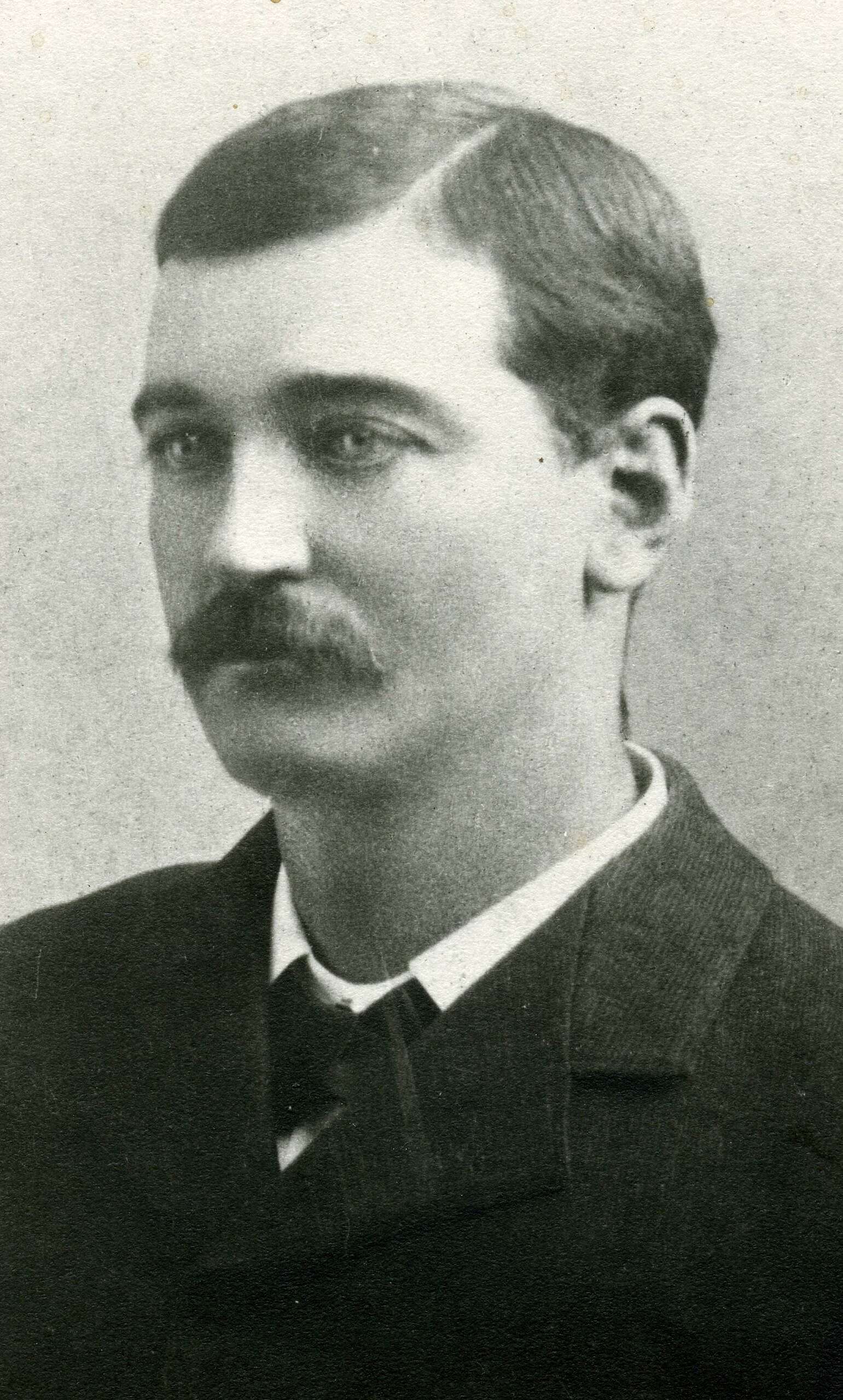
It was at this point that Bat heard from a friend that Raymond Ritter would be coming back through town, eastbound, over the new railroad tracks.
When the train showed up, Bat got on board and walked slowly through each car. Raymond Ritter was shocked to see Bat Masterson, and more shocked still to see the barrel of a revolver pointed at his face. Ritter howled that he was being robbed as Bat hauled him out on the platform, but that didn’t help him any. None of the gathering crowd interfered.
“I’m only collecting what you owe me, and everybody here knows that. You ran out on me and Ed, but now you’re going to pay up.”
He got his money. In true Western fashion, Bat Masterson led everybody to a saloon on Front Street and put up for drinks. He was nineteen years old.
The buffalo gone, the economic focus of the newly named Dodge City would change, in the in the fast-changing resource exploitation economy of the frontier, to cattle. In 1877, Bat was elected Sheriff.
He and his buddy Wyatt Earp practiced a novel form of 19th century policing: buffaloing. Instead of shooting the drunken cowboys who flooded the town in summer, they would knock them in the head with their revolvers and throw them in the clink to dry out. In the context of the time this represented enlightened, community-based policing.
“Bat always had an air about him, a blend of cockiness and charisma that seemed to charm just about everyone he met, and a style that seemed to invite good times,” wrote a historian.
He repeatedly demonstrated utter fearlessness. He had no problem facing down entire mobs by himself. There are numerous accounts of him traveling hundreds of miles to help friends in trouble. But being a sheriff was a form of supplemental income for him. What he really liked was gambling.
Working on the side as security and as a dealer at various saloons and gambling joints, this got him on the wrong side of some community boosters, who considered Bat and his friends an element that had to be eliminated in the name of progress. He lost the next election by a few votes. Bat took the side of the gambling contingent with glee. This led to Bat’s first foray into journalism, his own self-created newspaper, The Vox Populi.
Written solely to influence the outcome of the 1884 elections in Dodge City, The Vox Populi is an entertaining screed of Latinate words and personal insults. “Ford County does not want the scum and filth of other communities for county attorney, such is Burns the Republican candidate.” And, “E. D. Swan would be a nice man to have charge of the poor widows and orphans of Ford County, after turning his aged and decrepit father out on to the streets to die of starvation.”
Bat’s slate of endorsed candidates won, and he folded The Vox Populi after one issue. The Dodge City Globe noted that while “The news and statements it contains seem to be of a somewhat personal nature…. The editor is very promising; if he survives the first week of his literary venture there is no telling what he may accomplish in the journalistic field.” Bat Masterson would not return to journalism for another twenty years, but the seed had been planted.
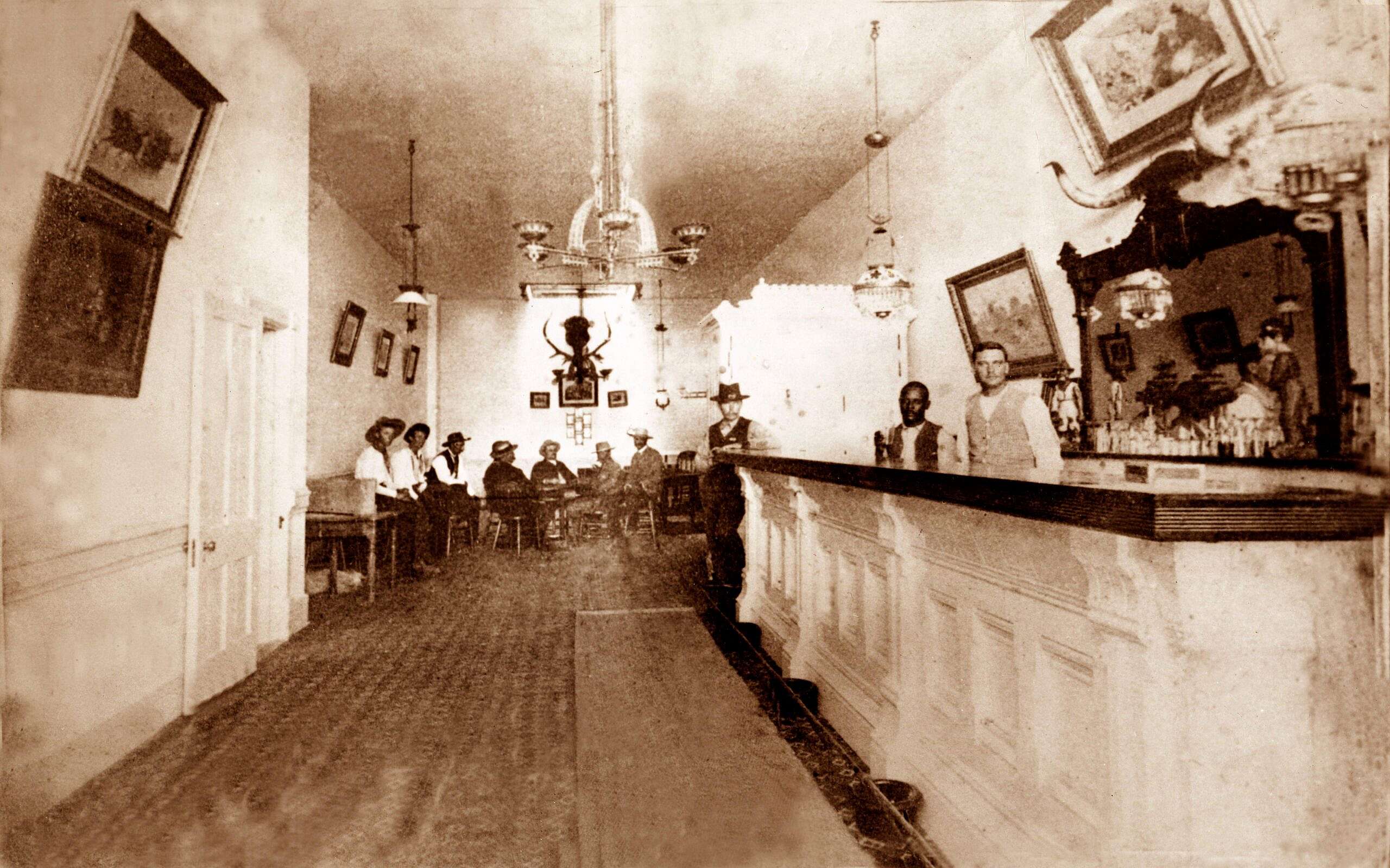
By 1884, Bat had assumed an itinerant life, working a gambling circuit that included, in part: Dodge; Las Vegas, New Mexico; Denver; and Kansas City. He dressed nice. “W. B. Masterson is well-known in this city.
He is a handsome man, and one who pleases the ladies,” wrote one newspaper. Affable and good-humored, in 1885 Bat was voted most popular man in Dodge over the 4th of July and given a gold-headed cane and a watch.
Meanwhile, he dove headfirst into what would be the consuming passion of the rest of his life: boxing. Bat did not like other sports. Baseball, he wrote, was “almost as weird as football.”
He didn’t even seem to have much interest in that most preponderant Western sport, horse racing. He worked as a referee, promoter, and manager, notably wading into the ring in 1893 in Denver and punching the opposing boxer in the face when a melee broke out.
At this time boxing was a barely legal endeavor. Boxers fought dozens of rounds bare-knuckled. Gore was common. Bat, predictably, was in the middle of “The Great Fistic Carnival” of 1896; he was hired by the Pinkertons to provide security.
Scheduled for El Paso, pressure from religious leaders who wanted to ban boxing forced the match out of Texas and across the river into Mexico. No dice. Mexican Rurales lined the south shore of the Rio Grande to make sure this did not happen. New Mexico was out, too; Congress rushed through a measure prohibiting boxing in any U.S. territory.
Bat always seemed to find himself fighting a rearguard action against people who wanted to purify the world. The match ended up being held on an island in the middle of the Rio Grande River, while Texas Rangers and Mexican troops lined the respective shores in order to watch.
When Bat fell out with another boxing promoter over a business deal and Bat resolved the issue by beating the guy with a cane in the middle of a Denver street, it was kind of time to leave. It was at this point he was contacted by the Lewis brothers.
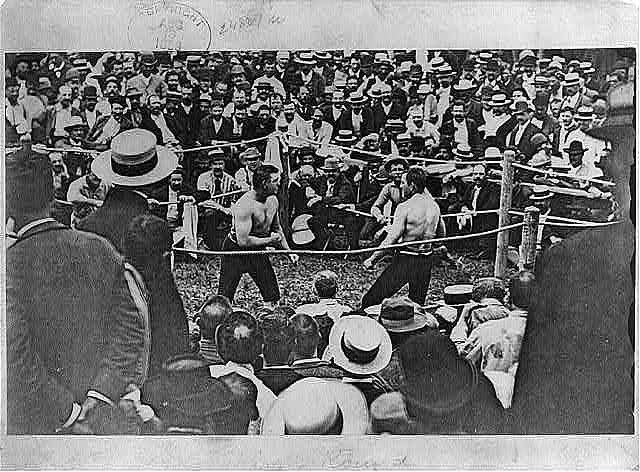
A loyal friend and voluminous correspondent, two of the people Bat had stayed in touch with were journalists Alfred Henry Lewis and his brother William.
They were impressed by Bat’s stories and fearlessness, and when they worked their way up the newspaper ladder from dusty Western towns to New York City, they dropped their friend a line. Why didn’t he just move to New York? They could hook him up with a job.
The man who had lived fifty years of rootless existence was about to find a home. How often does this happen? Are people frequently born into a situation when they would be better off in another? Bat and his wife Emma headed east. Sure, the first day in town he was arrested for carrying a revolver, but that only added to the patina surrounding a genuine denizen of the Wild West.
The Lewis brothers started Bat out on boxing, but they eventually let him write whatever he wanted. The New York Morning Telegraph focused on sports, scandals, and pictures of pretty girls.
They had no political position other than they were against reformers. For Bat Masterson, it was a perfect fit. Bat’s three times a week column was eventually titled, “Masterson’s Views on Timely Topics,” and included commentary on boxing and anything else Bat Masterson wanted to pontificate on.
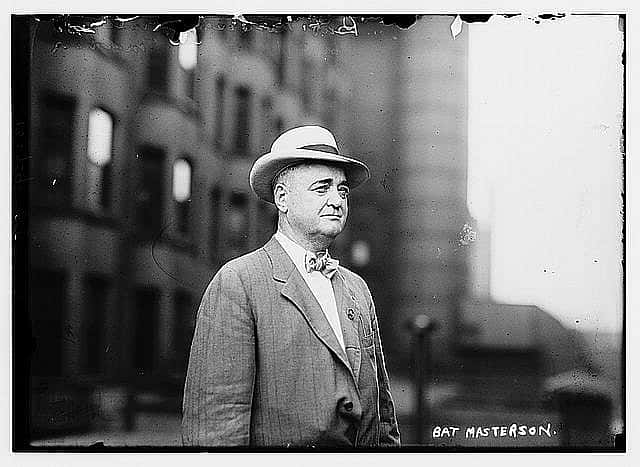
Bat Masterson showed an uncanny ability to adapt. He went from frontiersmen to product and producer of the media age almost seamlessly. A reporter asked Bat if he missed the excitement of the Wild West. Bat said, “I am a Broadway guy now.”
He went from being a rootless Westerner who had no fixed address other than hotels for years to being a provincial New Yorker who didn’t even leave his own neighborhood. He wrote, “Over on the West Side somewhere there is a place called Greenwich Village. I can’t tell where or how it got the name, but it’s there nevertheless.”
“Bat had no literary style but he had plenty of moxie,” said Damon Runyon. He proved a generous mentor to an upcoming generation of prominent journalists, including Runyon, Louella Parsons, Heywood Broun, and Stuart Lake.
Inspired by Bat’s stories, Lake went on to write a signal biography of Wyatt Earp. Runyon went on to greater literary fame when his short story, “The Idyll of Miss Sarah Brown,” was turned into the play Guys and Dolls, which featured a man based on Bat as the main character.
It must have been startling to go from the guerilla warfare, hard labor, heat, and dust of the Kansas plains to eating in fancy restaurants every night.
Bat moved to Times Square during a period of change. Theatres were being built in the neighborhood. Colorful characters and famous people abounded. Bat counted as his companions not just journalists and boxers but celebrities such as songwriter George M. Cohan and John McGraw, manager of the New York baseball Giants.
Actually maybe it wasn’t all that different of a life. Bat had always been surrounded by colorful characters. But now he was doing it in a nicer setting. And the stage from which he held forth was Shanley’s.
The restaurant extended along Broadway from Forty-third to Forty-fourth, right off Times Square. One historian noted that Shanley’s greatest attraction was not its food, but the fact that it was “The favorite loafing place of the celebrated Bat Masterson. Every night the old-time gun fighter, resembling nothing so much as a huge spider, presided over a big steak in a corner of Shanley’s grill, holding a crowd spellbound with tales which were about as wild and wooly as the West he was describing.”
Scrupulously honest, gamblers considered him “square.” In his later life he spent a lot of time, effort, and ink trying to keep boxing honest. When Bat heard a fix was on in one fight, he cornered the boxer in a hotel lobby. How much was he taking to lay down?
“$7,500,” the flustered fighter responded.
That blew that fix. Bat Masterson had a way of making people back down. People frequently commented on his eyes. Wyatt Earp wrote that Bat’s “wide, round eyes expressed the alert pugnaciousness of a blooded bull-terrier…. They were well-nigh unendurable in conflict.”
When Alfred Henry Lewis was doing research on the New York underworld, he got Bat to accompany him into Hell’s Kitchen. Nothing happened. The West Side toughs knew all about Bat Masterson, apparently. They wanted no part of him, even if he looked at that point like a balding, overweight, middle-aged man.
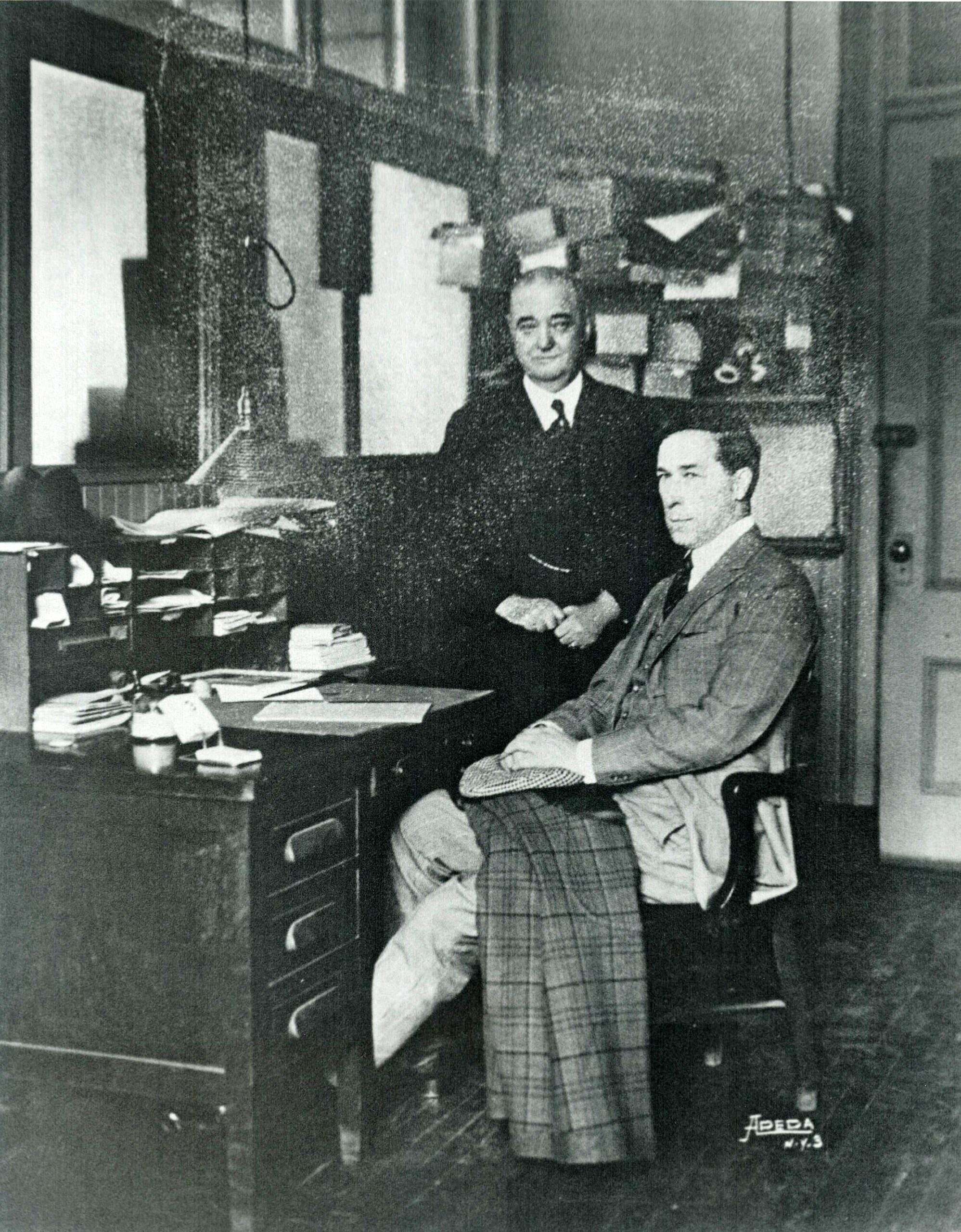
He went out West once again, to a boxing match, and on the way east the train stopped in Dodge. Bat and his friends got out on the platform for a few minutes and ate in a Harvey restaurant, but that was it.
Unlike friends of his such as Earp, who spent the summers in the California desert at a mining claim, Bat was content to eat in restaurants every night. He wrote a series of profiles of Western gunfighters he had known, at William Lewis’ behest, but he would never write about himself.
On a trip to Hot Springs, Arkansas, itself a gambling center, Bat declined the offer of a horseback ride. The man who had once ridden a horse to death in pursuit of outlaws had had quite enough of that.
He showed no interest in the sort of outdoor activities that might appeal to someone who had grown up on the frontier. Bat Masterson had become a man of creature comforts. Bat’s adaptability allowed he and Emma to live comfortably in a five-room apartment.
This was notable. Many of his frontier contemporaries had trouble adapting once their bodies wore out. Wyatt Earp ended his life in near-penury and left his wife with nothing.
Buffalo Bill Cody called his Nebraska ranch “Scout’s Rest.” The idea was that the broken-down Westerners who Cody had spent his youth around would have someplace to go, and not a few of them took him up on his offers of help. Buffalo Bill provided jobs and money for his contemporaries, but Bat Masterson needed no help.
Bat Masterson died at his desk on October 25, 1921. He was 67 years old. He had just completed what would be his last column. A couple weeks before his passing he had been visited by William S. Hart, the great Western movie star of the era. “I play the hero that Bat Masterson inspired,” Hart said. “More than any other man I have ever met I admire and respect him.”

Hint, I would not mind having one for Christmas! Grumpy

Now the real speech below:
Be seated.
Men, all this stuff you hear about America not wanting to fight, wanting to stay out of the war, is a lot of horse dung. Americans love to fight.
All real Americans love the sting and clash of battle. When you were kids, you all admired the champion marble shooter, the fastest runner, the big-league ball players and the toughest boxers. Americans love a winner and will not tolerate a loser. Americans play to win all the time. I wouldn’t give a hoot in hell for a man who lost, and laughed.
That’s why Americans have never lost and will never lose a war. The very thought of losing is hateful to America. Battle is the most significant competition in which a man can indulge. It brings out all that is best and it removes all that is base.
You are not all going to die. Only two percent of you right here today would be killed in a major battle. Every man is scared in his first action. If he says he’s not, he’s a goddamn liar. But the real hero is the man who fights even though he’s scared. Some men will get over their fright in a minute under fire, some take an hour, and for some it takes days. But the real man never lets his fear of death overpower his honor, his sense of duty to his country, and his innate manhood.
All through your army career you men have bitched about what you call ‘this chicken-shit drilling.’ That is all for a purpose—to ensure instant obedience to orders and to create constant alertness. This must be bred into every soldier. I don’t give a fuck for a man who is not always on his toes. But the drilling has made veterans of all you men. You are ready! A man has to be alert all the time if he expects to keep on breathing. If not, some German son-of-a-bitch will sneak up behind him and beat him to death with a sock full of shit.
There are four hundred neatly marked graves in Sicily, all because one man went to sleep on the job—but they are German graves, because we caught the bastard asleep before his officer did.
An army is a team. It lives, eats, sleeps, and fights as a team. This individual hero stuff is bullshit. The bilious bastards who write that stuff for the Saturday Evening Post don’t know any more about real battle than they do about fucking. Now we have the finest food and equipment, the best spirit and the best men in the world. You know, by God, I actually pity these poor bastards we’re going up against, by God I do.
All the real heroes are not storybook combat fighters. Every single man in the army plays a vital role. So don’t ever let up. Don’t ever think that your job is unimportant. What if every truck driver decided that he didn’t like the whine of the shells and turned yellow and jumped headlong into a ditch? That cowardly bastard could say to himself, ‘Hell, they won’t miss me, just one man in thousands.’ What if every man said that? Where in the hell would we be then? No, thank God, Americans don’t say that. Every man does his job. Every man is important.
The ordnance men are needed to supply the guns, the quartermaster is needed to bring up the food and clothes for us because where we are going there isn’t a hell of a lot to steal. Every last damn man in the mess hall, even the one who boils the water to keep us from getting the GI shits, has a job to do.
Each man must think not only of himself, but think of his buddy fighting alongside him. We don’t want yellow cowards in the army. They should be killed off like flies. If not, they will go back home after the war, goddamn cowards, and breed more cowards. The brave men will breed more brave men. Kill off the goddamn cowards and we’ll have a nation of brave men.
One of the bravest men I saw in the African campaign was on a telegraph pole in the midst of furious fire while we were moving toward Tunis. I stopped and asked him what the hell he was doing up there. He answered, ‘Fixing the wire, sir.’ ‘Isn’t it a little unhealthy up there right now?’ I asked. ‘Yes sir, but this goddamn wire has got to be fixed.’ I asked, ‘Don’t those planes strafing the road bother you?’ And he answered, ‘No sir, but you sure as hell do.’
Now, there was a real soldier. A real man. A man who devoted all he had to his duty, no matter how great the odds, no matter how seemingly insignificant his duty appeared at the time.
And you should have seen the trucks on the road to Gabès. Those drivers were magnificent. All day and all night they crawled along those son-of-a-bitch roads, never stopping, never deviating from their course with shells bursting all around them. Many of the men drove over 40 consecutive hours. We got through on good old American guts. These were not combat men. But they were soldiers with a job to do. They were part of a team. Without them the fight would have been lost.
Sure, we all want to go home. We want to get this war over with. But you can’t win a war lying down. The quickest way to get it over with is to get the bastards who started it. We want to get the hell over there and clean the goddamn thing up, and then get at those purple-pissing Japs.[a]
The quicker they are whipped, the quicker we go home. The shortest way home is through Berlin and Tokyo. So keep moving. And when we get to Berlin, I am personally going to shoot that paper-hanging son-of-a-bitch Hitler.
When a man is lying in a shell hole, if he just stays there all day, a Boche will get him eventually. The hell with that. My men don’t dig foxholes. Foxholes only slow up an offensive. Keep moving. We’ll win this war, but we’ll win it only by fighting and showing the Germans that we’ve got more guts than they have or ever will have. We’re not just going to shoot the bastards, we’re going to rip out their living goddamned guts and use them to grease the treads of our tanks. We’re going to murder those lousy Hun cocksuckers by the bushel-fucking-basket.
Some of you men are wondering whether or not you’ll chicken out under fire. Don’t worry about it. I can assure you that you’ll all do your duty. War is a bloody business, a killing business.
The Nazis are the enemy. Wade into them, spill their blood or they will spill yours. Shoot them in the guts. Rip open their belly. When shells are hitting all around you and you wipe the dirt from your face and you realize that it’s not dirt, it’s the blood and guts of what was once your best friend, you’ll know what to do.
I don’t want any messages saying ‘I’m holding my position.’ We’re not holding a goddamned thing. We’re advancing constantly and we’re not interested in holding anything except the enemy’s balls. We’re going to hold him by his balls and we’re going to kick him in the ass; twist his balls and kick the living shit out of him all the time. Our plan of operation is to advance and keep on advancing. We’re going to go through the enemy like shit through a tinhorn.
There will be some complaints that we’re pushing our people too hard. I don’t give a damn about such complaints. I believe that an ounce of sweat will save a gallon of blood. The harder we push, the more Germans we kill. The more Germans we kill, the fewer of our men will be killed. Pushing harder means fewer casualties.
I want you all to remember that. My men don’t surrender. I don’t want to hear of any soldier under my command being captured unless he is hit. Even if you are hit, you can still fight. That’s not just bullshit either. I want men like the lieutenant in Libya who, with a Luger against his chest, swept aside the gun with his hand, jerked his helmet off with the other and busted the hell out of the Boche with the helmet. Then he picked up the gun and he killed another German. All this time the man had a bullet through his lung. That’s a man for you!
Don’t forget, you don’t know I’m here at all. No word of that fact is to be mentioned in any letters. The world is not supposed to know what the hell they did with me. I’m not supposed to be commanding this army. I’m not even supposed to be in England. Let the first bastards to find out be the goddamned Germans. Some day, I want them to rise up on their piss-soaked hind legs and howl ‘Ach! It’s the goddamned Third Army and that son-of-a-bitch Patton again!’
Then there’s one thing you men will be able to say when this war is over and you get back home. Thirty years from now when you’re sitting by your fireside with your grandson on your knee and he asks, ‘What did you do in the great World War Two?’ You won’t have to cough and say, ‘Well, your granddaddy shoveled shit in Louisiana.’ No sir, you can look him straight in the eye and say ‘Son, your granddaddy rode with the great Third Army and a son-of-a-goddamned-bitch named George Patton!’
All right, you sons of bitches. You know how I feel. I’ll be proud to lead you wonderful guys in battle anytime, anywhere. That’s all