Category: Hard Nosed Folks Both Good & Bad
Categories
A Victory! COOL!!!!!!!!!!!!!!!!! Hard Nosed Folks Both Good & Bad I am so grateful!! If I was in Charge Interesting stuff Leadership of the highest kind Manly Stuff One Hell of a Good Fight Our Great Kids Paint me surprised by this Real men Soldiering Some Red Hot Gospel there! Stand & Deliver This great Nation & Its People War
Another, this man is one Hell of a stud!! William Frederick Harris
 William Frederick Harris (March 6, 1918 – December 7, 1950) was a United States Marine Corps (USMC) lieutenant colonel during the Korean War. The son of USMC General Field Harris, he was a prisoner of war during World War II and a recipient of the Navy Cross for extraordinary heroism during the breakout in the Battle of Chosin Reservoir. He was last seen by American forces on December 7, 1950, was listed missing in action and is presumed to have been killed in action. Harris was featured in the book and film Unbroken.[1][2]
Biography
William Frederick Harris was born on March 6, 1918, at Good Samaritan Hospital in Lexington, Kentucky, to Field Harris (1895–1967) and Katherine Chinn-Harris (1899–1990).[1]
Harris graduated from the United States Naval Academy, Annapolis, Maryland, in the class of 1939. He was in A Company, 1st Battalion, 4th Marines[3] and was captured by Japanese forces during the Battle of Corregidor in May 1942.
He escaped with Edgar Whitcomb, future governor of Indiana,[4] and on May 22, 1942, swam 8+1⁄2 hours across Manila Bay to Bataan, where he joined Filipino guerrillas fighting Japan just after the Battle of Bataan.[5] In the summer of 1942, Harris and two others left Whitcomb and attempted to sail to China in a motorboat, but the engine failed and the boat drifted for 29 days with little food or water. The monsoon blew them back to an island in the southern part of the Philippines where they split up and he joined another resistance group.[6] Harris headed towards Australia hoping to rejoin American forces he heard were fighting in Guadalcanal, but he was recaptured in June[7] or September 1943[8] by Japan on Morotai island, Indonesia, around 1,000 miles (1,600 km) from Bataan.[9][10]
Harris was taken to Ōfuna POW camp, arriving February 13, 1944[11] and became acquainted with Louis Zamperini. Harris experienced malnutrition and brutal treatment at the hands of his jailers, notably by Sueharu Kitamura (later convicted of war crimes). Due to malnutrition, by mid-1944 the over 6 feet (180 cm) tall Harris weighed only 120 pounds (54 kg) and had beriberi.[12] In September and November 1944, Harris was beaten severely, to the point of unconsciousness, by Kitamura.[13][14] According to fellow captive, Pappy Boyington, Harris was knocked down 20 times with a baseball bat for reading a newspaper stolen from the trash.[15] Harris was near death when he arrived at a POW camp near Ōmori in early 1945. Zamperini provided Harris with additional rations and he recovered.[16] William Harris was chosen to represent prisoners of war during the surrender of Japan, aboard USS Missouri on September 2, 1945.
After World War II, Harris remained in the Marines. He married Jeanne Lejeune Glennon in 1946 and had two daughters.[1]
He was recalled to active duty during the Korean War.[2] He was the commanding officer of Third Battalion, Seventh Marines, First Marine Division (Reinforced) in the Korean War. During the breakout in the Battle of Chosin Reservoir, his unit stayed behind as a rear guard to protect retreating forces. Despite heavy losses, Harris rallied his troops and personally went into harm’s way during the battle. Harris was last seen by American forces on December 7, 1950, walking and carrying two rifles on his shoulders. He was listed as missing in action, but after the war when former POWs had neither seen nor heard of him, Harris was declared to be dead. He was awarded the Navy Cross in 1951 for his actions at Chosin. Because of his penchant for escape and survival exhibited during World War II, his peers and family were reluctant to accept his death. A superior officer held on to his Navy Cross for a number of years, expecting to be able to give it to Harris personally.[17]
Remains thought to be his were eventually recovered. His family doubted the remains were his, and conclusive testing using DNA had not been attempted as of 2014.[1]
Awards

For his leadership and heroism on December 7, 1950, Harris was awarded the Navy Cross.
The President of the United States of America takes pride in presenting the Navy Cross (Posthumously) to Lieutenant Colonel William Frederick Harris (MCSN: 0-5917), United States Marine Corps, for extraordinary heroism in connection with military operations against an armed enemy of the United Nations while serving as Commanding Officer of the Third Battalion, Seventh Marines, FIRST Marine Division (Reinforced), in action against enemy aggressor forces in the Republic of Korea the early morning of 7 December 1950. Directing his Battalion in affording flank protection for the regimental vehicle train and the first echelon of the division trains proceeding from Hagaru-ri to Koto-ri, Lieutenant Colonel Harris, despite numerous casualties suffered in the bitterly fought advance, promptly went into action when a vastly outnumbering, deeply entrenched hostile force suddenly attacked at point-blank range from commanding ground during the hours of darkness. With his column disposed on open, frozen terrain and in danger of being cut off from the convoy as the enemy laid down enfilade fire from a strong roadblock, he organized a group of men and personally led them in a bold attack to neutralize the position with heavy losses to the enemy, thereby enabling the convoy to move through the blockade. Consistently exposing himself to devastating hostile grenade, rifle and automatic weapons fire throughout repeated determined attempts by the enemy to break through, Lieutenant Colonel Harris fought gallantly with his men, offering words of encouragement and directing their heroic efforts in driving off the fanatic attackers. Stout-hearted and indomitable despite tremendous losses in dead and wounded, Lieutenant Colonel Harris, by his inspiring leadership, daring combat tactics and valiant devotion to duty, contributed to the successful accomplishment of a vital mission and upheld the highest traditions of the United States Naval Service.
— Board of Awards, Serial 1089, 17 October 1951[18]
Harris also received the Purple Heart, the Prisoner of War Medal, the Combat Action Ribbon, the Korean Service Medal, the United Nations Service Medal, the National Defense Service Medal, the Republic of Korea Presidential Unit Citation, the Korean War Service Medal and the World War II Victory Medal.[19]
  |
||||
 |
 |

|
 |
|
 |
|
.svg) |
 |
|


Categories
One of my favorite rounds – The 44 Magnum
 The state of the art in modern special operations, frankly, is remarkable. In 2011, a group of elite Navy SEALs inserted via stealth helicopters deep inside hostile territory to kill the most wanted terrorist on Planet Earth.
They successfully accomplished this daring mission for the loss of a single aircraft. Friendly forces exfilled unharmed, and the world stood amazed. However, that didn’t just happen.

Operation Neptune Spear, the mission to kill Osama bin Laden, was the end result of decades of tactical evolution. The Son Tay Raid in Vietnam, the Israeli raid on Entebbe, and Operation Nimrod, wherein the British SAS took down Prince’s Gate in London — each of these bold missions was more audacious than the last. But where did all that start?
Origins
Modern special operations really had their genesis in World War II. The British 22nd Special Air Service and the American OSS led the charge. For the Axis, however, special operations really orbited around a single man. That pioneering German commando was SS Obersturmbannführer Otto Johann Anton Skorzeny.

Otto Skorzeny was a physically imposing guy. At a time when the average corn-fed American draftee stood five foot eight, Skorzeny was six foot four. He also sported a prominent dueling scar across his left cheek. In 1939, Skorzeny tried to fly combat aircraft for the Luftwaffe but was considered both too big and, at age 31, too old. Instead, he entered the Waffen SS and embarked on a career as a shadow warrior.
Accomplishments
We will have to briefly suspend our justifiable revulsion at the SS and its dark association with genocide to fully appreciate Skorzeny’s contribution to modern spec-ops. Skorzeny fought for what was arguably the most depraved regime of the modern era. However, that does not diminish the man’s martial prowess.

Skorzeny freed the Italian fascist dictator Benito Mussolini from the mountaintop fortress at Gran Sasso in 1943. He kidnapped the son of Miklos Horthy, the Hungarian head of state, from under the noses of his troops. Hitler then used the younger Horthy as leverage to keep Hungary in the war on the Axis side.
Skorzeny also commanded the 150th SS Panzer Brigade, the English-speaking Germans who infiltrated behind American lines to sow chaos during the Battle of the Bulge. He was not captured and executed alongside his men because he was deemed both too large and too distinctive to pass himself off as an American soldier and be a part of that mission. Now, hold that thought…
The Gear
Modern special operators require specialized gear. Weapons employed by special forces are often smaller, lighter, stealthier, and more concealable than those used by their ground-pounding counterparts. A critical part of all that is crafting firearms that don’t make excessive noise.
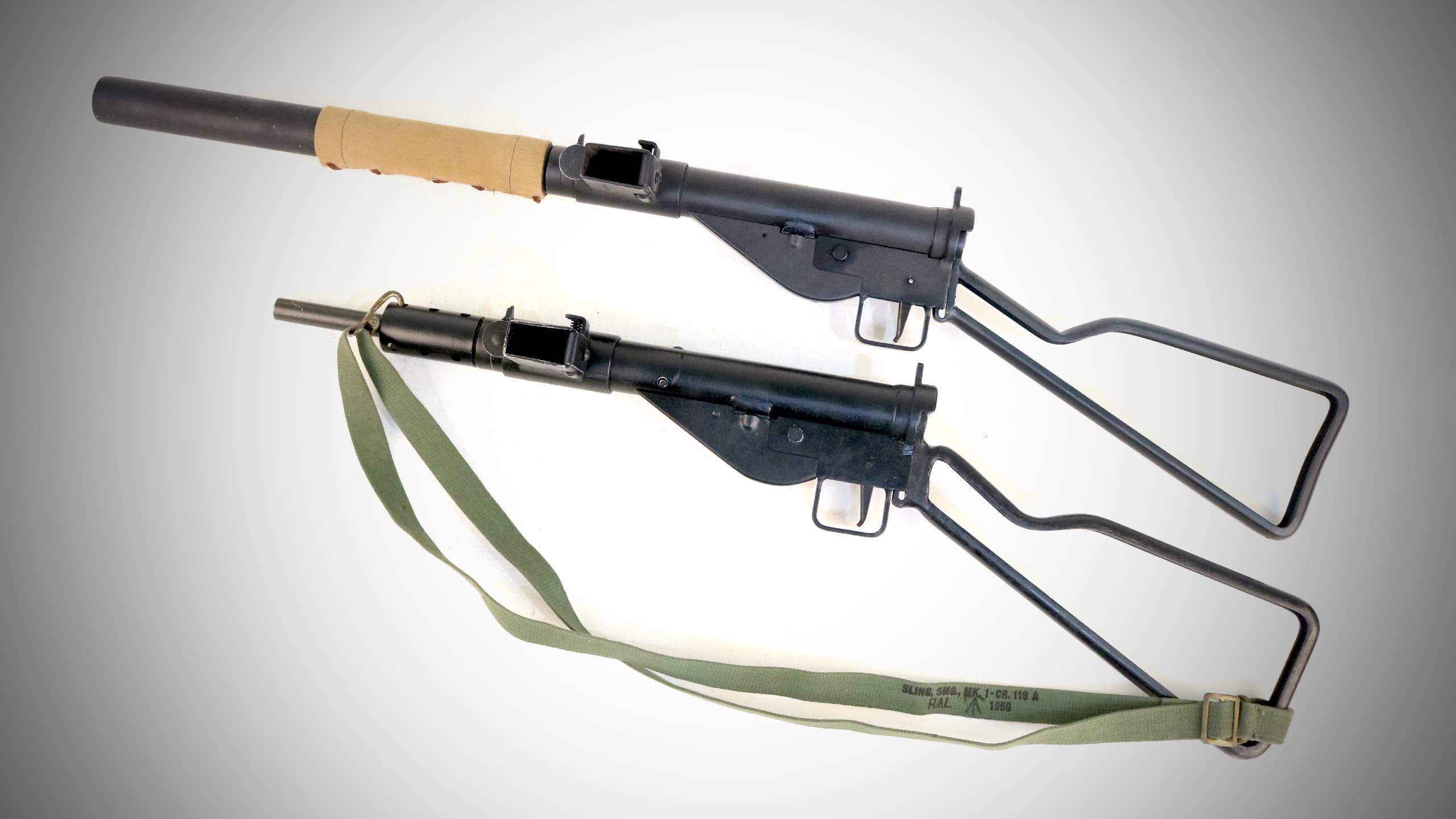
Nowadays, you can’t eat at the cool kids’ table at the local range if you don’t have a sound suppressor threaded onto the snout of your favorite gat. However, back in the 1940s, such tech was in its infancy. The state of the art back then was the British Mk IIS Sten.

Designed by Major Reginald Shepherd and Harold Turpin while working at the Royal Small Arms Factory at Enfield, the name “Sten” is a portmanteau combining letters from each man’s name as well as the Enfield factory. More than four million copies were produced in at least seven different marks. The cheapest version costs $9 apiece. That would be about $150 today. This inexpensive 9mm submachine gun of WWII helped save the British nation during those dark days.
All Sten SMGs fed from the left via an execrable double-column, single-feed 32-round box magazine. The Mk II was the most common version. This variant featured a selective-fire action common to all Stens, as well as a rotating magazine well that could be rotated to seal the action against contaminants.
The Sten Mk II readily broke down into four components for transport or concealment. While the Sten gun was a marvel of modern manufacturing efficiency, the sound-suppressed Mk IIS was legitimately revolutionary.
Mk IIS — The Silent Wonder
9×19 mm Parabellum ammunition is naturally supersonic. A sound-suppressed firearm firing supersonic ammunition is going to make a lot of noise no matter what wondrous things you might do to mitigate its intrinsic racket.
The speed of sound in dry air is 1,125 feet per second. Standard 115-gr. 9mm from a Sten clocks in at around 1,200 fps. The Mk IIS employed a ported barrel that automatically dropped standard service ammunition into the subsonic range. This is not an uncommon solution to the supersonic problem today. It was groundbreaking back in 1943.

Nowadays, we use CNC mills and metal 3D printing to produce complex shapes that maximize the effectiveness of our sound suppressors. During WWII, the designers of the Mk IIS used a series of wire-mesh disks. Think window screen material. This worked shockingly well.
However, the suppressor got hot very quickly and didn’t last terribly long. The Mk IIS came equipped with a canvas cover to help protect the shooter’s hand, and troops were trained to fire the weapon on semi-auto to maximize its efficiency and lifespan.
Back to Otto Skorzeny
Skorzeny coveted a sound-suppressed, pistol-caliber SMG for his special operators in the worst way. There was some tepid research on both 9mm P.08 Luger pistols and 9mm MP40 submachine guns, but nothing of consequence emerged.
The few copies of the suppressed Mk IIS Sten that were captured by the Germans were redesignated the MP 751e. Skorzeny had an example for his personal use.

Otto Skorzeny tried to get Nazi logisticians to allocate precious resources to support his special operations troops. However, nobody would take him seriously when he requested a stealthy 9mm submachine gun. Firearms are noisy. There was clearly little to be done about that.

To prove his point, Skorzeny supposedly tucked his captured Mk IIS Sten gun underneath a long coat while out walking with a German official in downtown Berlin. On a crowded street, Hitler’s favorite commando then stepped behind his counterpart, produced the weapon, and emptied a magazine into the air without alarming either his companion or the other Berliners strolling about around them.
The SS officer made his point. However, by that phase of the conflict, submachine guns were not going to turn the tide. The Nazis were already doomed. Meanwhile, the Mk IIS Sten gun eventually led to the extraordinary sound-suppressed weapons in common use today.
.PNG)
 Lauri Allan Törni (28 May 1919 – 18 October 1965), later known as Larry Alan Thorne, was a Finnish-born soldier who fought under three flags: as a Finnish Army officer in the Winter War and the Continuation War ultimately gaining a rank of captain; as a Waffen-SS captain (under the alias Larry Lane) of the Finnish Volunteer Battalion of the Waffen-SS.
When he fought the Red Army on the Eastern Front in World War II; and as a United States Army Major (under the alias “Larry Thorne”) when he served in the U.S. Army Special Forces in the Vietnam War.
Törni died in a helicopter crash during the Vietnam War and he was promoted to the rank of major posthumously. His remains were located three decades later and then buried in Arlington National Cemetery; he is the only former member of the Waffen-SS known to be interred there.


Peter Ortiz was a proper war hero long before he went to work in Hollywood. Public domain.
Robert Downey, Jr. is one of the most esteemed actors of his generation. His depiction of Tony Stark as Iron Man across 10 big-budget superhero movies became iconic. I once read a commentary by a British film critic who said that Downey’s English accent in the Sherlock Holmes films was the only example of an American playing a Brit that he felt was in any way believable. What makes that so remarkable is that Downey never took acting lessons. He just got in front of the camera and did his thing. He’s a natural.
There was a time when this was the rule rather than the exception. John Wayne’s natural swagger certainly could not be learned. Back in the Golden Age of Hollywood, actors were not necessarily mushy, fragile prima donnas. They often were drawn from the ranks of truly manly men out in the real world. Principle among them was one Peter Ortiz.
Filmography of a Hero
Peter Ortiz starred in 27 films and two television series. His filmography includes such classics as She Wore a Yellow Ribbon, Retreat, Hell!, The Outcast, Twelve O’Clock High, Wings of Eagles, and Rio Grande. Ortiz brought a gritty realism to the sundry roles he played on screens both large and small. That’s because he was arguably the baddest man ever to grace the silver screen.
Pierre Julien Ortiz was born in New York in 1913. His mother was of Swiss stock, while his dad was a Spaniard born in France. He was educated at the French University of Grenoble. Ortiz spoke 10 languages. In 193,2 at age 18, he joined the French Foreign Legion.
The Foreign Legion is comprised of some legendarily rough hombres. Peter Ortiz thrived in this space. He earned the Croix de Guerre twice while fighting the Riffian people in Morocco. In 1935, Ortiz turned down a commission as an officer in the Legion to travel to Hollywood and serve as a technical advisor for war films.

Peter Ortiz is shown here second from the left with his team of OSS operators in occupied France during World War 2. Marine Corps photo.
Proper War
We modern Americans often overlook this fact, but World War II burned on for a couple of years before we got involved. As soon as the shooting started, Ortiz left Hollywood and returned to the Legion as a sergeant. He soon earned a battlefield commission and was wounded while destroying a German fuel dump. He was captured soon thereafter but escaped through Portugal, eventually making it back to the United States.
War was a growth industry in the early 1940s, and American citizens with combat experience were invaluable assets. Ortiz enlisted in the U.S. Marine Corps in June of 1942 and earned a commission as a Second Lieutenant 40 days later. He made captain by year’s end and was deployed to Tangier, Morocco, assigned to the Office of Strategic Services. The OSS was the predecessor to the CIA. Captain Peter Ortiz was now officially a spy.
Undercover Ops
Ortiz was wounded badly, recovered, and then parachuted into occupied Europe several times. He repatriated downed Allied flyers and helped organize French Underground units. In August 1944, he was captured by the Germans. He survived torture by the Gestapo and somehow avoided execution. In April 1945, Ortiz’s POW camp was liberated. Now a Lieutenant Colonel, he made his way back to Hollywood to pick up where he left off.
In 1954, Southeast Asia was heating up, so Lt. Ortiz volunteered to return to active duty. However, by then, he was more than 40 years old and sort of famous. The Marines turned him down but promoted him to full Colonel in retirement.
Decorations
We’ve glossed over this guy’s amazing career. He was awarded an Order of the British Empire (OBE) by the government of England. He earned both the Navy Cross and the Purple Heart, each twice. The Navy Cross is our second-highest award for valor, right after the Medal of Honor. Here’s an excerpt from his first Navy Cross citation:
“Operating in civilian clothes and aware that he would be subject to execution in the event of his capture, Major Ortiz parachuted from an airplane with two other officers of an Inter-Allied mission to reorganize existing Maquis groups in the region of Rhone.
By his tact, resourcefulness and leadership, he was largely instrumental in affecting the acceptance of the mission by local resistance leaders, and also in organizing parachute operations for the delivery of arms, ammunition and equipment for use by the Maquis in his region.
Although his identity had become known to the Gestapo with the resultant increase in personal hazard, he voluntarily conducted to the Spanish border four Royal Air Force officers who had been shot down in his region, and later returned to resume his duties. Repeatedly leading successful raids during the period of this assignment, Major Ortiz inflicted heavy casualties on enemy forces greatly superior in number, with small losses to his own forces.”
Ruminations
There were two Hollywood films that were based upon his personal adventures. 13 Rue Madeleine came out in 1947. Operation Secret hit theaters in 1952. Ortiz had one son, Pete Junior, who served as a Marine officer himself, retiring as a Lieutenant Colonel.
Of his dad, the younger Marine said, “My father was an awful actor, but he had great fun appearing in movies.” Colonel Peter Ortiz might not have been the greatest actor of all time, but he was an amazing warrior.
United States
 Navy Cross with gold star
 Legion of Merit
 Purple Heart with gold star
  American Campaign Medal
 European-African-Middle Eastern Campaign Medal
 World War II Victory Medal
 Marine Corps Reserve Ribbon
 Parachutist Badge


United Kingdom
 Officer of the Order of the British Empire
_Ribbon.png)
France
 Chevalier of the Legion of Honor
 Médaille militaire
 Croix de guerre des théâtres d’opérations extérieures with bronze and silver stars
 Croix de Guerre 1939-1945 with two bronze palms and silver star
 Croix du combattant
 Médaille des Évadés
 Médaille Coloniale with the campaign clasp: “MAROC”
 Médaille des Blesses
 1939–1945 Commemorative war medal (France)


_ribbon.svg)

_ribbon.svg)
_des_Blesses_Militaires_ribbon.svg)

.svg)