Category: Hard Nosed Folks Both Good & Bad

Now the real speech below:
Be seated.
Men, all this stuff you hear about America not wanting to fight, wanting to stay out of the war, is a lot of horse dung. Americans love to fight.
All real Americans love the sting and clash of battle. When you were kids, you all admired the champion marble shooter, the fastest runner, the big-league ball players and the toughest boxers. Americans love a winner and will not tolerate a loser. Americans play to win all the time. I wouldn’t give a hoot in hell for a man who lost, and laughed.
That’s why Americans have never lost and will never lose a war. The very thought of losing is hateful to America. Battle is the most significant competition in which a man can indulge. It brings out all that is best and it removes all that is base.
You are not all going to die. Only two percent of you right here today would be killed in a major battle. Every man is scared in his first action. If he says he’s not, he’s a goddamn liar. But the real hero is the man who fights even though he’s scared. Some men will get over their fright in a minute under fire, some take an hour, and for some it takes days. But the real man never lets his fear of death overpower his honor, his sense of duty to his country, and his innate manhood.
All through your army career you men have bitched about what you call ‘this chicken-shit drilling.’ That is all for a purpose—to ensure instant obedience to orders and to create constant alertness. This must be bred into every soldier. I don’t give a fuck for a man who is not always on his toes. But the drilling has made veterans of all you men. You are ready! A man has to be alert all the time if he expects to keep on breathing. If not, some German son-of-a-bitch will sneak up behind him and beat him to death with a sock full of shit.
There are four hundred neatly marked graves in Sicily, all because one man went to sleep on the job—but they are German graves, because we caught the bastard asleep before his officer did.
An army is a team. It lives, eats, sleeps, and fights as a team. This individual hero stuff is bullshit. The bilious bastards who write that stuff for the Saturday Evening Post don’t know any more about real battle than they do about fucking. Now we have the finest food and equipment, the best spirit and the best men in the world. You know, by God, I actually pity these poor bastards we’re going up against, by God I do.
All the real heroes are not storybook combat fighters. Every single man in the army plays a vital role. So don’t ever let up. Don’t ever think that your job is unimportant. What if every truck driver decided that he didn’t like the whine of the shells and turned yellow and jumped headlong into a ditch? That cowardly bastard could say to himself, ‘Hell, they won’t miss me, just one man in thousands.’ What if every man said that? Where in the hell would we be then? No, thank God, Americans don’t say that. Every man does his job. Every man is important.
The ordnance men are needed to supply the guns, the quartermaster is needed to bring up the food and clothes for us because where we are going there isn’t a hell of a lot to steal. Every last damn man in the mess hall, even the one who boils the water to keep us from getting the GI shits, has a job to do.
Each man must think not only of himself, but think of his buddy fighting alongside him. We don’t want yellow cowards in the army. They should be killed off like flies. If not, they will go back home after the war, goddamn cowards, and breed more cowards. The brave men will breed more brave men. Kill off the goddamn cowards and we’ll have a nation of brave men.
One of the bravest men I saw in the African campaign was on a telegraph pole in the midst of furious fire while we were moving toward Tunis. I stopped and asked him what the hell he was doing up there. He answered, ‘Fixing the wire, sir.’ ‘Isn’t it a little unhealthy up there right now?’ I asked. ‘Yes sir, but this goddamn wire has got to be fixed.’ I asked, ‘Don’t those planes strafing the road bother you?’ And he answered, ‘No sir, but you sure as hell do.’
Now, there was a real soldier. A real man. A man who devoted all he had to his duty, no matter how great the odds, no matter how seemingly insignificant his duty appeared at the time.
And you should have seen the trucks on the road to Gabès. Those drivers were magnificent. All day and all night they crawled along those son-of-a-bitch roads, never stopping, never deviating from their course with shells bursting all around them. Many of the men drove over 40 consecutive hours. We got through on good old American guts. These were not combat men. But they were soldiers with a job to do. They were part of a team. Without them the fight would have been lost.
Sure, we all want to go home. We want to get this war over with. But you can’t win a war lying down. The quickest way to get it over with is to get the bastards who started it. We want to get the hell over there and clean the goddamn thing up, and then get at those purple-pissing Japs.[a]
The quicker they are whipped, the quicker we go home. The shortest way home is through Berlin and Tokyo. So keep moving. And when we get to Berlin, I am personally going to shoot that paper-hanging son-of-a-bitch Hitler.
When a man is lying in a shell hole, if he just stays there all day, a Boche will get him eventually. The hell with that. My men don’t dig foxholes. Foxholes only slow up an offensive. Keep moving. We’ll win this war, but we’ll win it only by fighting and showing the Germans that we’ve got more guts than they have or ever will have. We’re not just going to shoot the bastards, we’re going to rip out their living goddamned guts and use them to grease the treads of our tanks. We’re going to murder those lousy Hun cocksuckers by the bushel-fucking-basket.
Some of you men are wondering whether or not you’ll chicken out under fire. Don’t worry about it. I can assure you that you’ll all do your duty. War is a bloody business, a killing business.
The Nazis are the enemy. Wade into them, spill their blood or they will spill yours. Shoot them in the guts. Rip open their belly. When shells are hitting all around you and you wipe the dirt from your face and you realize that it’s not dirt, it’s the blood and guts of what was once your best friend, you’ll know what to do.
I don’t want any messages saying ‘I’m holding my position.’ We’re not holding a goddamned thing. We’re advancing constantly and we’re not interested in holding anything except the enemy’s balls. We’re going to hold him by his balls and we’re going to kick him in the ass; twist his balls and kick the living shit out of him all the time. Our plan of operation is to advance and keep on advancing. We’re going to go through the enemy like shit through a tinhorn.
There will be some complaints that we’re pushing our people too hard. I don’t give a damn about such complaints. I believe that an ounce of sweat will save a gallon of blood. The harder we push, the more Germans we kill. The more Germans we kill, the fewer of our men will be killed. Pushing harder means fewer casualties.
I want you all to remember that. My men don’t surrender. I don’t want to hear of any soldier under my command being captured unless he is hit. Even if you are hit, you can still fight. That’s not just bullshit either. I want men like the lieutenant in Libya who, with a Luger against his chest, swept aside the gun with his hand, jerked his helmet off with the other and busted the hell out of the Boche with the helmet. Then he picked up the gun and he killed another German. All this time the man had a bullet through his lung. That’s a man for you!
Don’t forget, you don’t know I’m here at all. No word of that fact is to be mentioned in any letters. The world is not supposed to know what the hell they did with me. I’m not supposed to be commanding this army. I’m not even supposed to be in England. Let the first bastards to find out be the goddamned Germans. Some day, I want them to rise up on their piss-soaked hind legs and howl ‘Ach! It’s the goddamned Third Army and that son-of-a-bitch Patton again!’
Then there’s one thing you men will be able to say when this war is over and you get back home. Thirty years from now when you’re sitting by your fireside with your grandson on your knee and he asks, ‘What did you do in the great World War Two?’ You won’t have to cough and say, ‘Well, your granddaddy shoveled shit in Louisiana.’ No sir, you can look him straight in the eye and say ‘Son, your granddaddy rode with the great Third Army and a son-of-a-goddamned-bitch named George Patton!’
All right, you sons of bitches. You know how I feel. I’ll be proud to lead you wonderful guys in battle anytime, anywhere. That’s all
Nicholas II among military representatives of the Allied Powers; from left to right: Baron Rickel (Belgium), General Williams (Great Britain), Colonel Marcingault (Italy), Marquis de Laguiche (France) and Colonel Londkievich (Serbia). Mogilev, Belarus, 8 Sept 1916.
They are all gone now but their actions still effect our world. So I still say that WWI was a disaster of the first magnitude to the ENTIRE Western World. Grumpy
Soon after leaving public office, the 26th President of the United States Theodore Roosevelt (1901-1909) delivered a world-famous speech in France, a part of which later became one of his most often quoted. Referred to as “The Man in the Arena,” it provided insight into the perspective of combatants who perform well under pressure.

“It is not the critic who counts; not the man who points out how the strong man stumbles, or where the doer of deeds could have done them better.
The credit belongs to the man who is actually in the arena, whose face is marred by dust and sweat and blood; who strives valiantly; who errs, who comes up short again and again, because there is no effort without error and shortcoming; but who does actually strive to do the deeds; who knows great enthusiasms, the great devotions; who spends himself in a worthy cause; who at the best knows in the end the triumph of high achievement, and who at the worst, if he fails, at least fails while daring greatly, so that his place shall never be with those cold and timid souls who neither know victory nor defeat.”
What Roosevelt so eloquently shed light upon was the depth of human will, self-determination, and mental fortitude it takes to perform under extreme duress. What was true at the turn of the 20th century and later proven by the belligerents of both world wars, is true to this very day, that only the strong survive.

When Wyatt Earp was asked about winning gunfights, he attributed his success to, “Going into action with the greatest speed which a man’s muscles are capable, but mentally unflustered.” Given the critical importance of staying cool under pressure, it is no secret that the likes of war fighters and law enforcement professionals think clearer and perform better in violent physical altercations.
Back in the day, the term “steely-eyed gunfighter” was attributed to those gunslingers who possessed both the physical skills and mental strength needed to ply their trade. Physical prowess, although certainly a contributing factor, must be preceded by an unyielding and pervasive mental fortitude afforded only to those possessing coolness of mind referred to by legendary gunfighter Wyatt Earp as “mentally unflustered.”

Fast forward to today, what three things can you do to be mentally unflustered should you find yourself needing to win a fight? Let’s begin with competency, consistency, and inoculation.
Competency
Think about going in for critical heart or eye surgery. Odds are that you would want a seasoned doctor that has about a thousand or so of these operations under his belt — preferably performing 20 of these a week for the past 20 years. When it comes to something that serious, you would place your trust in the most experienced physically and mentally competent practitioner. When it comes to surviving extreme physical violence, why wouldn’t you want that same competency to ensure your safety and that of those you care most about?

“Repetition is the mother of all skill” is a quote attributed to the hard skills masters of antiquity, dating back to ancient Rome. In meaningful training, the key to competency is nothing more than a countless number of precisely executed repetitions.
Practice makes permanent. As poor, or shoddy practice can create training scars, so does perfect practice (technique executed correctly) make permanent. The greater your competency the greater your confidence. The greater your confidence the lower your stress.
Consistency
The learning process is nothing more than differentiating “right” from “wrong.” The only way to truly learn is by making mistakes. Only by doing something wrong can you know its opposite — doing something right. For example, there are a hundred things you can do wrong when shooting that cause you to miss a target.
However, there’s only one way not to miss a target and that is to align the muzzle with the target and break the shot without disturbing that alignment. Sounds simple until you try to do it. Apply even the slightest layer of complexity such as speed, distance, movement, cost for failure et al and you introduce factors that directly impact your consistency.

If you’re not making mistakes, then you’re not training for consistency.
Dirty Harry once said, “A man’s got to know his own limitations”. Do you know where is the very edge of your skills envelope? Do you work a specific technique repeatedly pushing the process until your wheels fall off?
How far can you go physically and mentally before you step outside that skills envelope or involuntarily let up on that mental gas pedal? It takes the combination of both physical and mental consistency to perform well under duress. One will not work without the other.
The expert can get it right, but the professional cannot do it wrong.
Building consistency on a solid foundation of competence exponentially increases your confidence, which in turn further attenuates stress.
Inoculation
Place yourself in as close a situation as possible to real world physical violence by avoiding injury in balancing safety and reality of training. Such training methods as “force on force” employed by the military and law enforcement using dye marker cartridges like Simunitions (that can also introduce a pain element feedback to your training), Airsoft or digital electronic/video simulators (like fighter pilots use) that allow you to safely experience conditions similar to what you may experience in reality.

Being mentally inoculated is like hearing the same joke over and over again. The first time you hear a joke it may seem humorous but by the seventh time around it becomes an annoyance. The same applies to your exposure to physical violence via repeatedly placing yourself in similar conditions.

Along with any active threat come three conditions which cause the human mind to become flustered. These are a scenario that is new, unfamiliar and threatening. By the sheer number of repetitions in training and having made more mistakes than not, there’s nothing new. Any such newness is displaced by hard-earned competency. Pushing the edge of your skills envelope creates a new and expanded comfort zone of familiar ground where there is no longer anything unfamiliar. Inoculating your mind against threatening situations attenuates the tendency to become flustered.
Conclusion
Replacing new, unfamiliar, and threatening with competency, consistency, and inoculation are what allow you to go into action with the greatest speed which a man’s muscles are capable, but mentally unflustered.
100-Year-Old Veteran on Live TV: We Fought WW II for Nothing, Britain Less Free Than in 1945
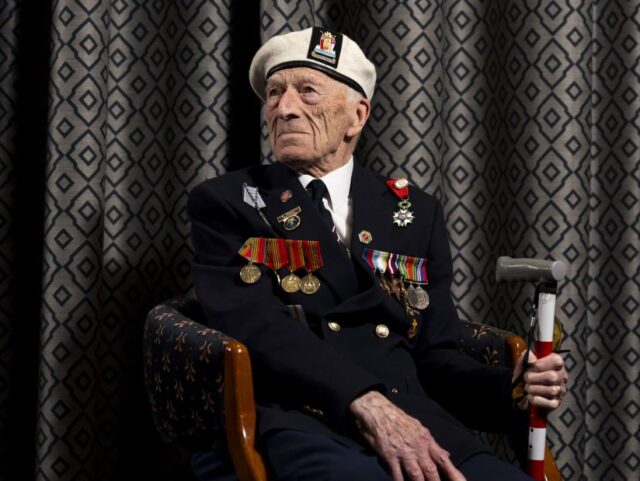
A centenarian Royal Navy veteran took full advantage of an appearance on live television to express his sorrow at the state of modern Britain, saying he and his comrades fought for freedom that has been frittered away, eliciting what critics called a “patronising” response by show hosts.
Royal Navy and Arctic Convoy veteran Alec Penstone told Britain’s ITV breakfast show “the sacrifice wasn’t worth” what the country has since become, mourning the loss of freedom he and his friends fought and died for.
Appearing on Good Morning Britain on Friday for a segment on the upcoming Remembrance Sunday and Armistice Day on November 11th, Penstone was asked what the events commemorating fallen troops from the two World Wars meant, and what his message to the country now is.
Far from the feel-good sentiments the piece had evidently been set up for, 100-year-old Penstone remarked: “I can see in my mind’s eye those rows and rows of white stones.
“All the hundreds of my friends, everybody else, who gave their lives. For what? The country of today. No, I’m sorry, the sacrifice wasn’t worth the result that it is now.”
Comedian Adil Ray, best known for creating Citizen Khan, a BBC comedy about a “British Pakistani” family living in “the capital of British Pakistan” — Birmingham, England — quickly interjected to ask of the veteran: “what do you mean by that, though?”.
Penstone continued: “what we fought for was our freedom. We find that even now, it’s a darn sight worse than what it was when I fought for it”.
Ray’s co-host Kate Garraway, a former journalist and news presenter, placed her hand on Penstone’s shoulder and reassured him that people of her generation did appreciate the sacrifice of the veteran and his friends, before announcing that he was to be presented with a compact-disc of Second World War-era popular music in thanks.
British academic Professor David Betz was among those responding to the turn of events, calling Penstone’s remarks “heartbreaking” and the response from the television hosts “patronising” and “simply infuriating”.
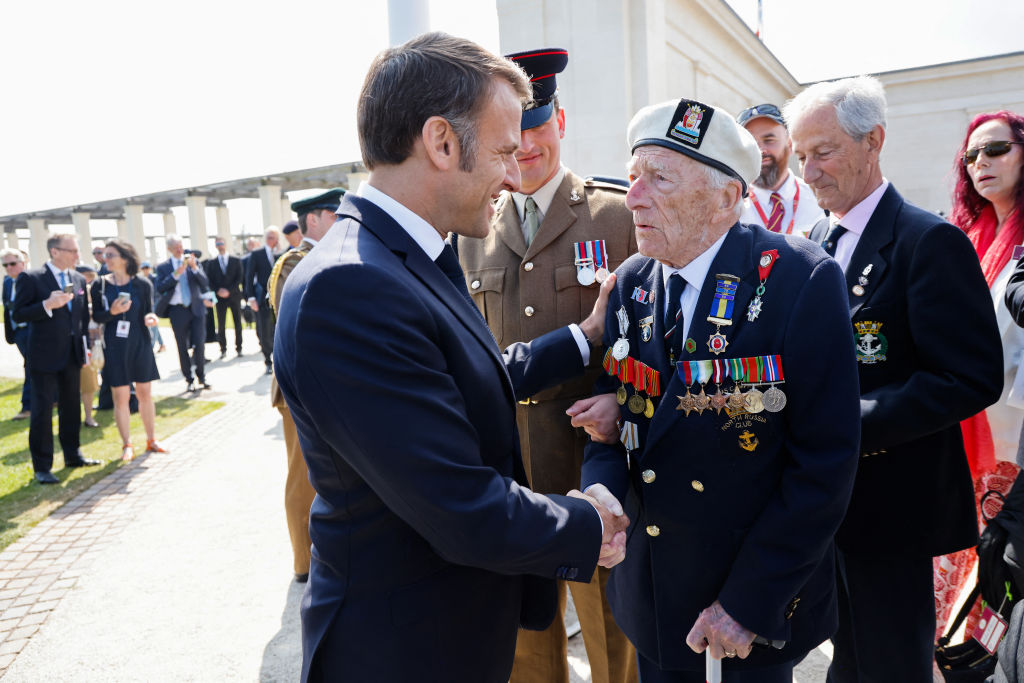
France’s President Emmanuel Macron (L) greets 98-year-old British D-Day veteran Alec Penstone during the UK Ministry of Defence and the Royal British Legion’s commemorative ceremony marking the 80th anniversary of the World War II “D-Day” Allied landings in Normandy France, on June 6, 2024. (Photo by LUDOVIC MARIN/POOL/AFP via Getty Images)
According to a profile by the Royal British Legion, a prominent veterans organisation, Penstone was a young man when the Second World War broke out and initially volunteered as a messenger for the Air Raid Precautions organisation in London during the height of the Blitz.
He said of his time in London during some of the worst bombing of the war: “The moments at 15 years of age, pulling bodies out of bombed buildings you grow up very quickly.”
His father, a veteran of the Great War, made Penstone vow not to serve in an infantry role due to the horrors he’d witnessed in the trenches in the Great War. So he joined the Royal Navy as a submarine-detector, and ended up in one of the most deadly assignments of the Second World War, on the Arctic Convoys. He also served in mine sweeping to clear the sea ready for the D-Day landings, and in the far east, fighting Japan.
The Imperial War Museum states of the Arctic Convoys delivering materiel to the Soviet Union to help them fight Nazi Germany:
Conditions were among the worst faced by any Allied sailors. As well as the Germans, they faced extreme cold, gales and pack ice. The loss rate for ships was higher than any other Allied convoy route.
Over four million tons of supplies were delivered to the Russians. As well as tanks and aircraft, these included less sensational but still vital items like trucks, tractors, telephone wire, railway engines and boots.
While appearing on television today, Mr Penstone was seen wearing the distinctive white beret and badge of the Arctic Convoy Club, a veterans organisation for survivors which disbanded in 2005, given it had so few surviving members.
On his left breast he wore a rack of British medals from his war service including the 1939-45 Star, the Atlantic Star, the Arctic Star, the Pacific Star for service in Burma, and Defence Medal for his service in the ARP.
Separately on a red ribbon, Penstone wore the insignia for a Knight of the Légion d’honneur for role in liberation of France. In 2024, Penstone was personally greeted by French President Emmanuel Macron and thanked for his service.
On his right breast, Penstone wore several Russian Medals including Medal of Ushakov for convoys, and USSR-era convoy medals.
While these are not authorised for wear by Britons in uniform, it is normal practice for British veterans of the Arctic Convoys to wear them on the right breast in this way.
Shooting Times Magazine
In The West Wing of a secluded, tile-roofed Spanish home in San Antonio, Texas is a room that is one of my favorite retreats. It’s a large room, carpeted with the rich hides of Polar and Kodiak bears and tigers. A long setee is draped with zebra hides that prickle your back when you sit down for a drink and some talk with the man of the house. Pairs of elephant tusks stand close to bookcases and a maze of racked rifles and shotguns of every description. The walls are spiked with such a forest of mounted heads and horns that the whole effect becomes blurred, and the guest concentrates on the host, who leans casually behind a big wooden desk.
He is a ruddily healthy man of indeterminate middle age, his compact body kept hard by constant physical activity, his hands those of a working man. He looks at you with a direct blue gaze that would raise your guard if it weren’t with a soft chuckle as he asks about your health, your family, and the advancement of your career. The smile that accompanies the chuckle is partially hidden by a drooping roan moustache, and overshadowed by the belligerent nose of a Roman centurion.
He is Col. Charles Askins, my longtime friend, and one of the most interesting – some say the most controversial – men you are likely to meet anywhere in this last of the 1900s.
Since you are sufficiently bemused by firearms to be now reading the pages of Shooting Times, you know Askins as a prominent writer whose work has appeared in about every gun publication. You might know that he is the son of the late Maj. Charles Askins, the best authority and writer on the subject of shotguns that this country has produced. The salty, knowledgeable, and for the hidebound, often outrageous stories penned by this man of guns are explained and mitigated by a background that would shame the plotting efforts of the most imaginative novelist.
Askins is living proof that the use of guns can be a way of life. Reared by a father whose living came from guns, he worked first as a forest ranger, spent 10 years in the U.S. Border Patrol in rumrunning days when a gunfight a night was the rule of thumb, won the National Pistol Championship, then moved into the U.S. Army for 22 years as an ordinance officer. During those decades of service to his government he managed to allot time for hunting trips on almost every continent in the world and became an internationally recognized big game hunter.
Since his retirement from the army nine years ago, the restless Colonel has continued to combine shooting and writing in an enviable mode of living that has given him material for more than 1000 magazine articles and seven books.
When Askins was born in 1908, his father was a writer and dog trainer. The elder Askins had moved into Ft. Niobrara, a Nebraska military post, to train some bird dogs for a wealthy client and incidentally to brush up on his prairie chicken shooting. Literally cutting his teeth on upland game, the two-year old Charley was packed off to Oklahoma in 1910, and lived near the town of Ames, on the Cimarron River, until 1927.
Ames was also home to a friend of the Askins’ named Charles Cottar, who was doing well as a grain buyer. In 1912 Cottar went to Africa and hunted for nine months. Seeing its potential, he moved his family there in 1913 to spend the rest of his life as a farmer, miner, and professional hunter.
After World War I, Cottar toured the United States showing motion pictures he had made of African game, and doing much to stimulate the interest in African hunting that endures to this day. Encouraging dangerous game to charge him made for better films and Cottar’s foot was crippled by a leopard. A rhino did the same for an arm. Many years later he was killed by an attacking rhino.
When Askins was 15, Cottar invited his father to bring him for a summer’s hunt in Kenya. Feeling that nothing should stand in the way of a good shoot, the Askins team caught a boat and sailed for three weeks to arrive at Nairobi and join their Oklahoma friend.
This was before the days of motorized and refrigerated safaris, and the party left Nairobi afoot, with a Model T Ford pickup carrying their camp outfit. Walking 10 miles a day, the hunters roamed the plains for two months, living off the land. Charley’s dad had fetched along a then-new .35 Newton and a .30-06 Springfield, while Cottar carried a Winchester 95 lever action in .405 caliber.
The teenaged rifleman confined himself to feeding the safari crew with an abundance of the varied antelope, while his dad and Cottar accounted for five lions. On the trip back to the states, the youthful hunter must have reflected that a tedious six weeks on a slow freighter was a small price for such a summer.
At 19 Charley upped stakes and went to the Flathead Forest in Montana, where he hired on as a temporary employee with the U.S. Forest Service during the fire season. He later performed the same work on the Jicarilla Indian reservation in northern New Mexico, interspersing these seasonal chores with hard toil in logging camps.
The year 1929 found him a full-fledged forest ranger, in charge of the Vaqueros Ranger District in the Kit Carson National Forest. This is where Charley began the intensive pistol shooting that was to make him a national champion.
The Vaqueros District was badly overgrazed by a herd of 2600 wild horses that threatened to strip it of vegetation. Game was suffering from lack of forage, and a burgeoning population of mountain lions waxed fat, killing horses and game animals indiscriminately.
Charley coursed the lions with a big pack of dogs. To feed these hounds he killed the scrubs among the wild horse herd, getting lots of practice with the .45 auto he packed in that period, as well as a variety of rifles.
Tiring of what he likens to “a sheepherder’s existence,” Askins succumbed to the siren call of adventure. His old friend George Parker was serving as a border patrolman in El Paso and having a fine time running down the smugglers who were shotgunning Mexican booze into the bone-dry States. Parker’s exciting letters caused Askins to ride down to El Paso, where he joined the Border Patrol in March 1930.
The evening of that first day on the job, the young horseman was dispatched into the Franklin Mountains west of town to bring out the body of a dead smuggler on a pack burro. The contrabandista had elected to shoot it out when challenged by officers, and his earthly remains suggested to Charley that he was in for some busy times. He was.
Several weeks later he and his partners were lying in wait as five smugglers sneaked their contraband up an alley-way leading from the border river. As in most of these encounters, they in darkest part of the night, and were armed and ready to shoot. In his new book, Texans, Guns, and History, Askins describes what happened next.
“When they got to within nine steps of us we challenged. All hell broke loose! The cholo in the lead had a 10-gauge, both hammers back but the gun unfired. After the scrap I gathered up this gun and after carefully lowering the dog-eared hammers, broke the gun open and found it was loaded with Winchester Hi-Speed No. 5 shot. If he could have set off those two charges before he took the double load of my buckshot he’d have evened the odds considerably!”
This was one of many times that Askins had to use his guns in river gunfights during that period when newsmen on the El Paso Times would phone Border Patrol headquarters each morning to inquire, “Who got shot last night?”
Not all of Charley’s gunwork was so grim, and the stories he seems to prefer to tell involve occasions on which he missed his target.
One misty morning near Strauss, N. M., the young Patrol Inspector cut sign on two sets of tracks moving north. The drizzle made seeing difficult, but he stayed on the tracks, sixgun in hand as they led him to a camp where two people lay bedded under a tarp.
Southpaw Charley flipped the tarp off the suspects with his right hand, leveling his revolver with his left. One man sat upright, aiming a carbine at the Askins belly. Startled, Askins fell back, firing as he did. His slug went over the bad guy’s shoulder blasting a big hole in the wet ground and causing immediate capitulation.
It was miss that Charley was dammed about. The two “smugglers” turned out to be a standard American hobo and his wife, on the bum toward California. When for some inexplicable case the “Bo” pointed his weapon at the future pistol champ, he didn’t know how close to death he was. The “carbine” turned to be a hickory pick handle.
After Charley had a couple of months service under his belt, it was decided that tryouts would be held to find the five best pistol shooters in the Border Patrol’s El Paso District. These five would make up a pistol team which would go forth and do battle with civilian competitors and teams from the 7th and 8th Cavalry regiments. No one was surprised when Charley shot number one among the border guards.
In 1932 the 8th Army Corps promoted a pistol tournament in El Paso that was big doings for that Depression year. It attracted top shooters from the entire Corps Area, which included Texas, Louisiana, Arkansas, Oklahoma, and New Mexico.
After two days of shooting, the El Paso Border Patrol team had captured the team championship, Charles Askins had won each individual match, and his pretty wife, Dorothy, had walked away with the trophy in women’s competition.
In that year, Charley’s match guns included a Colt Woodsman .22 with weighted barrel, a heavy Colt shooting Master in .38 Spl., and a commercial M1917 Smith & Wesson revolver in .45 ACP. He was shooting these guns when he lost the 1932 Texas pistol championship to Air Corps Lt. Charley Denford by one point.
In 1933, Askins won the Texas Championship. The next year, 1934, was a hot one for the Los Angeles police, and one of their team took home the Texas cup. For ’35, ’36, ’37, and ’38 the champ of Lone Star State was Charles Askins.
By 1936, Askins had been designated Chief Firearms Instructor for the entire U.S. Border Patrol and moved from his little New Mexico station at Strauss to the district headquarters in El Paso.
Firing a .45 in the National Individual Match at Camp Perry that year, he flubbed his slow-fire string, shooting “a big, fat 80, with a four in the string.”
“This completely relaxed me,” says Askins, “and I knew nothing could win for me then.”
With the pressure off, he went on to shoot a 98 timed and a 98 rapid, winding up with a score of 276. he won the match.
Introduced at Camp Perry in 1937 was the first aggregate match – a combination of the scores of .22, centerfire, and .45 guns, and a much more meaningful test of shooter and guns than had previously been posed. The NRA paid money prizes that year, along with medals and a trophy.
Askins won the aggregate, received $8.56 cash, a medal, and the promise of a trophy which somehow was never delivered. He now wishes the $8.56 had been withheld, too, since it was later ruled that his acceptance of it disqualified him as an amateur, and he was not permitted to try out for the Olympic pistol team.
That year at Perry there was an incident which Askins describes as having “…been played up, discussed, and gotten me criticized ever since it happened. It was during a rapid fire match and I had a misfire.
“The range officer watched as I opened the gun, and there were six cartridges in the cylinder; the rules called for only five. This was a violation of the rules. You couldn’t put six rounds in your gun. I’d done this because on a rapid-fire match if you ever let that hammer slip out from under your thumb the cylinder will roll by and then you won’t get off five shots. So, in violation of the rules as the existed then, I had six cartridges in my gun.”
The NRA range officials did not challenge this action, and allowed him to shoot the string over for record.
In spite of the acceptance of NRA officials of this insignificant overstepping of the rule book, someone complained so vociferously to Askins’ superior officers in the Border Patrol that an investigation was initiated by that service. The upshot was that the 1937 all-around pistol champion was punished by not being allowed to shoot on the Border Patrol team in 1938.
The champion shot at his own expense as an individual in ’38, winning the high aggregate on the All American Team after placing first in .22, third in centerfire, and fifth in .45 events.
Askins was returned to grace in 1939, and reinstated tot the Border Patrol team. He promptly became the center of another controversy. Today’s competition rules provide for three phases of pistol shooting: .22 Long Rifle caliber, any centerfire (.32 caliber or larger), and .45 ACP caliber. Charley Askins is probably personally responsible for their addendum in parenthesis after “centerfire.”
In 1939 the rule was simply “any centerfire” for the second event. Most shooters banged away with .38 Spl. revolvers, a few with .32 S&W Long wheelguns. The .38 Spl. automatics so popular today were unheard of.
Then and now, competition pistol shooters agree that automatics are easier to control in timed and rapid fire than revolvers, and that small calibers are easier than larger ones.
Askins thought so, too, and did something about it.
The almost-extinct 5.5 Velo Dog was an inexpensive, nine-shot French revolver that still occasionally cropped up in Mexico and Latin America in those days. An El Paso hardware dealer showed Charley some of the scarce ammunition that remained after exporting most of his stocks across the Rio Grande. Struck by the dimensional similarity of the tine centerfire cartridge to the .22 Long Rifle shell, Askins formed a beautiful scheme.
First he bought all the 5.5 Velo Dog ammo the dealer had. Then he contacted Frank Kahrs, the shooting promotion director of Remington Arms, who sent the last 2000 rounds of Velo Dog the factory had in stock, and seemed glad to be rid of them. As Askins now gloats, “I had control of the entire remaining supply of Velo Dog ammunition.
J.D. Buchanan was a well-known West Coast pistolsmith, and an Askins friend. Charley shipped him a new Colt Woodsman .22 and a few rounds of Velo Dogs, with instructions to mate the two. In a twinkling, Buchanan altered the Woodsman’s firing pin to a centerfire, changed the extractor to handle the somewhat thicker rim of the French shell, and rechambered the barrel to accommodate the slightly larger diameter and the shortened Velo Dog case. While he was at it he added an adjustable weight and custom sights.
While this was going on, Charley got busy on the ammo. He pulled bullets and dumped the powder charges of the Dogs. He trimmed the cases to .22 LR length and reprimed them. He re-charged with tiny measures of Dupont #5 pistol powder, and seated .22 Long Rifle bullets. Askins was now in the .22 center fire business.
The new Woodsman shot just as well as any .22 rimfire of its day. This gave Charley an advantage of several points over the best centerfire shooters in the country who had to use revolvers.
Word got out about Charley’s scandalous little gun, and he was again under as cloud. Old friends came to advise him that it would be “unethical” to shoot the imaginative .22 against shooters who had only .32 and .38 wheelguns.
The Border Patrol brass got wind of the affair and Charley remembers a letter from them forbidding him to shoot the pistol in the National Matches. Knowing Askins, I would estimate that his neck bowed larger by several sizes.
Range officials examined the offending Woodsman minutely and could find no regulation it abused, until one book man, sharper than the rest, found that the front and rear sights were a hair too far apart to meet maximum sight radius requirements. Askins hastily remedied this by knocking off the Buchanan sight and rather crudely reinstalling it farther forward with solder.
The day came, and Charley obstinately marched to the firing line at Camp Perry. Behind him, “The Border Patrol brass all gathered to bear witness that I had shot the gun against orders,” he smilingly recalls.
The gun shot well and Charley shot well, although not good enough to win the match. At the end of the day he sat down and wrote a letter of resignation to the District Director in El Paso.
“I resigned from the Border Patrol from a feeling that they were going try to dictate how I was to shoot, and I wasn’t going to stand still for it. They had a point and I felt I had a point, too.”
So ended nine years and nine months of service.
By this time, Askins was writing a considerable amount of gun-related material, having published on book, Art of Handgun Shooting, and being employed as firearms editor for Outdoors magazine.
Askins’ father had moved to the Rio Grande Valley at his son’s urging, continuing his studies of firearms and to act as firearms editor of Outdoor Life and later Sports Afield. When asked if his dad had encouraged him to become a writer, Charley shakes his head.
“It was just a good opportunity to trade on his name. If I could get something into print, people might think it was written by the real authority.”
With whatever impetus, after he left the Border Patrol Askins continued to live in the valley above El Paso, “eking out an existence” writing for Outdoor Life, Field and Stream, and The American Rifleman.
He had been a non-commissioned officer in the National Guard since 1930. When the Guard was called to duty in 1941 he contacted his friend and fellow shooting authority, Gen. Julian S. Hatcher, asking for a commission into the regular army.
Maj. Gen. Kenyon Joyce of the 1st Cavalry Division and Col. Caswell gave him their hearty endorsements, and he was give a direct commission as a 1st Lt. Of ordnance in February 1942, reporting for duty at the Aberdeen Proving Grounds.
Ninety days later Lt. Askins left the States with Patton’s 2nd Army Corps, and plunged into the invasion of Africa. There the inexperienced logistics planners found that they could not supply their depots with ordnance as fast as it was being used up.
It was necessary to recover and overhaul equipment abandoned in the field, and Askins was assigned as a battlefield recovery officer in command of provisional company. This company and others like it were eventually found so effective that they were permanently placed in the Table of Organization.
Askins recalls: “We slept all day and worked all night” to avoid enemy fire and ambushes. Under cover of darkness, he and his men reconnoitered, located abandoned vehicles and weapons, and found means of returning them to U.S. lines for repair and reissue.
By the time of the Sicily invasion, Askins had been promoted to executive officer of an ordnance battalion. Asked if he carried any personally owned weapons during his wartime service, Charley reminisced that in Africa and Sicily he had packed a Buchanan-accurized .45 auto.
After Sicily he returned to the States for five Months, then shipped out again for the invasion of the Continent. When he did he left his .45 at home and took along the revolver he had carried in the Border Patrol, a Colt New Service .38 Spl. Askins still has this gun, and it is quite beautiful, carrying a red-posted King rib and adjustable rear sight on its four-inch barrel, and carved ivory stocks. The front of the trigger guard has been cut away.
Knowing Charley’s predilection for the auto pistol, I asked why he had changed to the sixgun in the middle of the war. He answered that he doesn’t remember now what the reason was, but that he was fond of the Border Patrol gun.
He was carrying this sixshooter, loaded with high speed, metal-piercing, Winchester ammunition while searching a house in a village on the Rhine plains. He heard someone making a hasty exit, and ran to a side door in time to see a German with a pack on his back making a dash for the next house.
Askins “let drive” with the .38, its bullet passing through the pack and into the German’s chest. After making certain there were no more Heinies in the house, he loaded the wounded Nazi onto the good of his jeep and drove him to an aid station.
In the town of Schmidt, on the Ruhr River, Charley became bored with what he considered his sedentary existence and borrowed an M1 for a bit of sniping.
Local GIs, happy with the unofficial ceasefire they shared with the seemingly acquiescent Krauts across the river, were chagrined when Askins moved into a second-story room, stood well back from the shot-out window, and commenced to pick off enemy targets of opportunity.
After three days of this his sport ended when German mortars found his hiding spot and sent him running for more substantial comer. It is doubtful that his comrades were sorry that his idyl had terminated.
At the war’s close, he was discharged as a major, immediately signing on as a field editor of Outdoor Life. After nine months of the traveling and public relations work involved in the new job he tired of it, and accepted a regular commission in the army. In July, 1946, Maj. Askins reported for duty with the 1st Army and was sent immediately for training with the 82nd Airborne Division at Ft. Monroe, Va.
While conditioning to the tough life of a paratrooper, Askins renewed his interest in pistol shooting after a separation of eight years. He believed that the Army should have one pistol team, as had the Marines and Navy. As of then the Army fielded teams from all its services, such as Cavalry, Infantry, and Engineers, thus spreading the top shooter apart on separate teams.
He was permitted to nominate shooters for tryouts, and got together 10 or 12 of the entire army’s best prospects for training and elimination at Ft. Bragg. A team was selected and sent to the National Midwinter Championships, where Sgt. Joe Benner won the individual championship.
Charley shot on this team. By this time he was 40, and could look back on an average of 34,000 shots per year, by actual records, that he had fired in his pistols between 1930 and 1940, a total of a third of a million rounds. His interest was jaded, and he gave up match shooting.
“I just couldn’t fire myself up to the degree of enthusiasm for the necessary practice. Practice was just a hell of a lot of hard work.”
By this time the ex-National Champion had accumulated 534 medals and 117 trophies in state, regional, and national competition.
The next few years were pleasant for the Askins family. Ordered to Spain in 1950, Charley served in the U.S. embassy as an assistant Army attaché, his arms expertise being well utilized as he made a study of the Spanish military posture, its arsenals and its assets.
He loved the Spanish people and gloried in the fine partridge hunting his tour afforded him. During the war and this postwar Spanish service, he found time to hunt in Portugal, Morocco, Angola, the Sahara desert, Uganda, Kenya, Tanzania, and Botswana.
He topped off his four years in Spain by graduating from the Spanish Army’s parachute school. In passing he also picked up the National Skeet Championship of Spain.
Charley returned in 1954 to the Combat Development Section of the Infantry School at Ft. Benning, moving to the 18th Airborne as an ordnance officer. In 1956 he was assigned to the Vietnamese army as Chief Instructor of Firearms.
In contrast to the hellhole it is today, Nam was pleasant between wars, the French having just been deposed. There was not even any guerrilla activity during Askins’ occupancy, and he traveled the length and breadth of Vietnam, alone in a jeep.
The French army, rulers of the country for 75 years, didn’t believe in marksmanship training, and had erected no ranges. Charley spent a year building range complexes for each of the 10 VN divisions. He also enjoyed some of the finest big-game hunting of his life.
In the jungles of the little Africa, Askins confronted the gaur, a buffalo larger than the African Cape buff, weighing up to 3000 lbs., and the largest of the five varieties of buffalo in the country. He found the gaur to be shy, but dangerous when wounded, needing plenty of lead to stop him.
There was an abundance of elephant, bad tempered because of continual harassment by the natives. There were Bengal tigers and a smaller tiger which was found along the South China Sea. Leopards, wild boar, Asian bear, and seven species of deer roamed this rifleman’s paradise. Charley’s shotguns took a dove that is the image of the U.S. breed, along with the jungle fowl, the progenitor of the domestic chicken.
Anticipating this good game country, Askins carried seven guns and 2600 cartridges to Vietnam. He had one of the first M70 Winchesters in .458 caliber, along with a lever-action M71 Winchester that was made up by an Alaskan gunsmith named Johnson, who rebored it from .348 to .450 caliber. The rest of the Askins battery included a Savage M99 .358, Browning .22 autoloader, Winchester M12 pump 12 gauge, Browning two-shot auto 12 gauge, one of the first S&W .44 Magnums, a Ruger standard .22 auto pistol, and a little Walther .22 PPK.
He was joined for a two week’s hunt by his Arizona friend, George Parker, whom he had known since the 1925 rifle matches at Camp Perry. The preponderance of his hunting was done in the company of a Chinese sportsman, Ngo Van Chi, who arranged for guides and packers from the Moi tribe of highland savages.
Chi’s safaris were outfitted with 20 elephants, each with a mahout and assistant mahout. Each man received a wage of $1 a day. The Moi tribesmen each demanded and were daily paid one liter of rice wine, three ounces of tobacco, and one pipeful of opium. This was the standard arrangement for safari crews in that area, but Askins found the handling of the wine a definite inconvenience. “We had to pack all those damned bottles – 25 liters of wine a day.” In spite of their peculiar wage negotiations, Charley heartily enjoyed the company of the Mois.
He completed his Vietnamese duties by going through VBN parachute school before retuning to an assignment with the 4th Army Headquarters at Ft. Sam Houston, San Antonio, Tex.
While he alludes infrequently to his paratrooper experiences, I have pried from him that he has made 138 jumps. One of these was with an eight-man stick of hardies who were helping him celebrate his promotion to full colonel. Charley banged up his back and foot on this one and as a result occasionally perches on a rubber doughnut while he types. He doesn’t say, but simple arithmetic tells me that he was more than 50 when he took that dive.
Askins retired from the Army in 1963, and continues to shoot, hunt, and write. His name has appeared in many gun and outdoor magazines and is shooting editor of Guns Magazine and Shooting Industry. He has also written a shooting column for Army Times since 1958. Texans, Guns, and History is the latest of his well-received books.
Charley has made 17 hunting trips to Africa, and is planning another for the summer of ’72. He has hunted twice in India, six times in Alaska. He has killed the game of Mexico, and scores all the Africa “Big Five” among his trophies. Along with tiger, gaur, and Sambar, he has bagged five Kodiak and two Polar bear.
Charley has quit bear hunting in the interest of conservation, and entertains no plans to tackle the category of game sheep. While he hasn’t eschewed big-game hunting, Askins favors the shotgun nowadays, knowing that days of hard stalking after a big game animal might offer a single shot, while the bird hunter may shoot 20 or 30 rounds in an afternoon. After a moment’s pondering, he admits that his favorite quarry is the bobwhite quail.
To stay in good form, Askins shoots almost every day. He arises at 5 a.m., cares for his horses, runs his dogs. A bit of riding, a couple of hours of shooting, and he ready to devote the rest of the day to writing and answering correspondence.
Charley regularly practices with an air rifle, preferring the Model 150 Anschutz. Once a week he drives to Ft. Sam Houston for a couple rounds of skeet. His centerfire rifle practice is all offhand – to stay in trim for game shooting. Pistol practice comes only about once a week – enough to keep his hand in and to beat Skelton whenever he feels like it.
He stays in excellent condition by being active in outdoor sports. He has never smoked.
I once asked Askins how he felt about match pistol shooters who took a toddy for their nerves, and he told me of that Texas match in 1934 when the Los Angeles police beat the pants off him.
Between relays, the L.A. cops would retire to the old Cadillac hearse in which they traveled, and draw the curtains. Moments later they would emerge and clobber the next relay. Charley sent out spies and learned the back of the hearse was stacked high with gin. From then forward he attended his matches fortified with the same brand.
Askins is concerned about the future of hunting. He feels that despite the rosy picture painted by some conservationists, the increase of the game population cannot keep pace with the human population explosion. With game under graduating pressure he predicts that game farms will play a major role in U.S. hunting in the coming years. African hunting, he surmises, is doomed unless poaching can be controlled, and domestic animals be substituted as a source of meat for the swelling populace.
On my last visit to Askins’ diggings in San Antonio, I noticed a large sheet of new tin that had been nailed around the bole of a big tree near his kitchen window. I asked my curious question, and the gunfighter and killer of dangerous carnivore explained, “My cats were climbing the tree and catching the baby birds. Had to do something.”
If Charley Askins had been born 100 years earlier he would have been a mountain man, and Indian scout, a buffalo hunter, or a horse soldier. As it is, close now to the end of the 20th century, he has lived the kind of life that boys think they’re going to live and that most old men wish they had.
May his breed continue.


