
Yes I know it is a real shock to some folks like my Old School Teachers that I can read. But nonetheless I do when I find time.
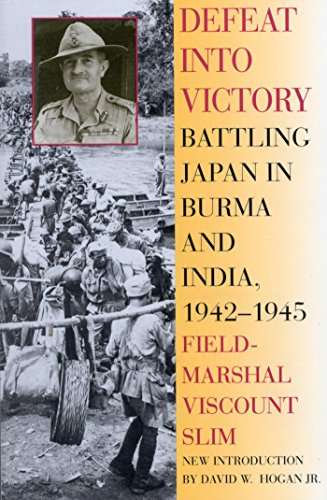
Anyways one of the men that I look up to is a man that most Americans and a lot of Brits don’t know about. Bill Slim, the man who rebuilt a savagely mauled Army that barely escaped the Japs in Burma. Who then took it back and almost completely destroyed the Occupying Jap Army.
This book though does not deal with this subject. Instead it deals with a lot of interesting characters and events in a very humorous manner that happened during his earlier military career.
For example when he was involved in a punitive campaign with the Pathans on the NW Frontier. When on horse back and carrying a flag to signal his beloved Ghurka Troops to withdraw. He had the flag wrap around his head all the while under fire.
Or how he got his butt chewed out for smuggling Australian beer from Haifa to his Troops in Iraq. When his very unofficial & unauthorised Beer Convoy ran his bosses car and him into a ditch.
Anyways if you like a good war story or two. Then you might want to get your hand on a copy of this really amusing book. Oh yeah before I forget his other book Defeat into Victory. Is another great Generals Book to read! Grumpy
Category: Hard Nosed Folks Both Good & Bad
| Elmer Keith | |
|---|---|

Elmer Keith shooting two revolvers at the same time.
|
|
| Born | March 8, 1899 |
| Died | February 14, 1984 (aged 84) |
| Nationality | United States |
| Occupation | Rancher, author, firearmsenthusiast |
| Known for | Creation of the .357 Magnum, .44 Magnum, and .41 Magnumcartridges |
| Home town | Salmon, Idaho |
| Spouse(s) | Loraine Randall |
Elmer Merrifield Keith (March 8, 1899 – February 14, 1984[1]) was an Idaho rancher, firearms enthusiast, and author. Keith was instrumental in the development of the first magnum revolver cartridge, the .357 Magnum, as well as the later .44 Magnumand .41 Magnum cartridges.
Contents
[hide]
Personality and life[edit]
Keith’s trademarks were his cigars, his Stetson, and his outspoken opinions. Keith was an avid handgun hunter in the earliest days of the sport, and often hunted medium game with a double action Smith & Wessonrevolver. In the days when handgun cartridges tended to fire large, slow bullets like the popular .45 Colt, or light, fast bullets like the .30 Mauser, Keith was pushing the limits of existing cartridges, driving large bullets at high velocities.
He was married to Loraine Randall. Elmer Keith was born in Missouri but was raised in Montana, Idaho, and eastern Oregon. In the 1930s and early 1940s, he had a ranch on the North Fork of the Salmon River near Salmon, Idaho. In the late 1940s, Elmer and Loraine left the ranch and moved into the town of Salmon. [The ranch is still owned by the Keith family.]
During World War II, Keith served as an inspector at the Ogden, Utah Arsenal. The rifles that he inspected were cartouche stamped with the initials “OGEK” in a rectangular box, on the buttstock. Rifles stamped OGEK without a rectangular box were inspected by Ed Klouser at the same Ogden Arsenal.[2]
In The Phantom Of Phu Bai, a biography of USMC Scout Sniper Eric England written by Dr. Joseph B. Turner, one chapter is about Elmer Keith and his influence on the shooting community.
Magnum revolvers[edit]
Keith’s first major contribution, the .357 Magnum, was the result of handloading the .38 Special cartridge far beyond normally accepted limits, taking full advantage of the greater strength of the revolvers available in the 1920s compared to those of the late 19th century. The .357 Magnum first became available in 1935 and quickly became a favorite among law enforcement and civilian users. The .357 Magnum had a slightly longer case than the .38 Special, but was otherwise identical, so .357 Magnum revolvers could shoot .38 Special or .357 Magnum ammunition, but .38 Special revolvers (most of which are not safe for the pressures generated by the Magnum round) could not chamber .357 Magnum ammunition. Buying a .357 Magnum revolver gave the shooter all the abilities of the well-established .38 Special, with the ability to double the available power by using the Magnum cartridge. Keith’s contributions to the commercial development of the .357 Magnum have been questioned by some writers, and Keith subsequently denigrated the .357 Magnum as he had the .38 Special.
The .44 Magnum was developed in much the same way, and was released commercially in 1956. Keith had earlier determined that the thinner chamber walls of the .45 Colt would not comfortably withstand the pressures generated by his own heavy loads. He therefore started experimenting with the .44 Special revolver, and used the same formula of pushing heavy bullets at high velocities that he had used for the .357 Magnum. The resulting “.44 Special Magnum” was a formidable cartridge for handgun hunting, firing a 250 grain bullet at 1,200 ft/s (370 m/s).
Keith encouraged Smith & Wesson and Remington to produce a commercial version of this new high pressure loading, and revolvers chambered for it. While S&W produced the first prototype revolver chambered in .44 Magnum, the famous Model 29, Sturm, Ruger actually beat S&W to market by several months in 1956 with a .44 Magnum version of the single action Blackhawk revolver. In fact Remington delivered a more powerful cartridge than Keith asked for, firing a 240 grain bullet at 1,500 ft/s (460 m/s), and it remained the most powerful production handgun cartridge until the commercial introduction of the .454 Casull(based on the .45 Colt). The .44 Magnum is still far more popular, as the recoil of .454 Casull rounds is considered excessive by most shooters, and revolvers in .454 Casull were rare and expensive until the introduction of .454 Casull models by Sturm, Ruger and Taurusin the late 1990s.
The .41 Magnum, released in 1963, was an attempt to reach a middle ground between the .357 and .44 magnums. The .357 Magnum was adequate for hunting deer-sized game, but the limited power meant it needed to be used by a skilled marksman. The .44 Magnum provided far more power, easily taking deer sized game, but recoil and muzzle blast are substantial, at least in the earliest commercial loadings. The .41 Magnum, inspired by the older, obsolete .41 Long Colt cartridge, was intended to provide more power than the .357 Magnum with less recoil and muzzle blast than the .44 Magnum. The .41 Magnum used a completely new case (unlike the .357 Magnum and .44 Magnum which were based on existing cases), and used a .410″ bullet instead of the earlier .41 Colt and .38-40‘s roughly .400″ diameter bullet, while pushing the new .410″ bullet to similar velocities as achieved by the .357 and .44 Magnum bullets. However, while there was (and still is) a small community of shooters preferring the .41 Magnum, the round failed to achieve a similar high degree of popularity. Some police, to whom the .41 Magnum was initially marketed, were happy with the .38 Special or .357 Magnum, and many officers had no interest in anything more powerful, and which also delivered greater blast and recoil that could place the shooter at a disadvantage in a gunfight requiring fast follow-up shots. However, some police departments adopted the 41 Mag with the reduced load designed for police use, and were quite happy the added power required only one hit to put an opponent down. Thus the 41 Magnum saved many officer’s lives who were lucky enough to use them[citation needed]. Hunters likewise stayed with the more commonly available .44 Magnum, which could be used with full power factory loads, less powerful handloads, or commercial .44 Special ammunition as needed.
Keith regarded the handgun as a weapon of opportunity. He had plenty of opportunities to use his sixgun on game during his life. He was incredibly skilled with handguns. He shot at a rifle-wounded deer and hit it several times at a range of 600 yards using his 6½ inch S&W Model 29.[3] It is currently part of the Keith collection with the factory standard 4-inch (100 mm) barrel length that he more commonly carried. The Keith firearm collection has been dispersed, having been sold individually at auction by James D. Julia in March 2015. (http://jamesdjulia.com/373_shs/)
Keith is also famous for designing and commissioning his No. 5 revolver, fashioned by R.F. Sedgeley, in 1928.
Keith-style bullets[edit]
Keith was also responsible for a number of bullet designs still popular today, and collectively called “Keith style” bullets. These bullets were based on the semiwadcutterdesign, but using a wider than normal front surface, and convex sides. These changes increased the volume of the bullet outside the case, thus allowing more room inside the case, needed for large loads of slower burning powders (see internal ballistics). These bullets remain popular for both target shooting and hunting. When shooting paper targets, they cut a relatively clean hole in the target, yet provide more case volume and a better ballistic coefficient than a flat front wadcutter. When used for hunting, the heavy bullets provide excellent penetration; they are often used on dangerous game, for which more reliable penetration is required than is possible with expanding hollow point or soft point bullets.

Keith-Style SWC
Originally Keith specified a meplat that was 65% of the bullet caliber, but later increased it to a 70% meplat. The other distinguishing characteristics of a “Keith-style” SWC are a double radius ogive, beveled crimp groove, three equal width driving bands, wide square bottomed grease groove, and a plain base with sharp corners. The wide forward driving band helps keep the bullet aligned as it jumps across the cylinder gap. Because of the three wide equal width driving bands, the total bearing surface is half the length of the bullet. The relatively large bearing surface helps the Keith-style SWC to be an inherently accurate bullet, and minimizes leading from gas blow-by. The wide square bottom grease groove holds ample lubricant.[4]
Work with rifles[edit]
Keith was instrumental in the development of various wildcat cartridges, a few of which were later adopted as factory rounds. The .333 OKH (“O’Neil-Keith-Hopkins”), developed in conjunction with Charlie O’Neil and Don Hopkins, was made from .30-06 Springfield brass necked up to take the .333″ 250 and 300-grain bullets of the .333 Jeffery. There was also a .334 OKH,[5] based on the shortened .300 H&H Magnum case. The .333 OKH, necked up slightly to take the more common .338″ sized bullets of the older .33 Winchester, led to the creation of the popular Wildcat cartridge the .338-06, also known as the 338 OKH, and was the inspiration for the 1958 commercial introduction of the .338 Winchester Magnum based on the larger belted .458 Winchester Magnum case. The .334 OKH, likewise necked up to accept .338″ bullets and given the distinctive Weatherby “double-radius” shoulder, was introduced by Weatherby in 1963 as the .340 Weatherby Magnum. The .338-378 Weatherby Magnum, introduced in 1998, was developed based on another one of Keith’s wildcats, the .338-378 KT(Keith-Thomson), which he developed in the 1960s with Bob Thomson.
An admirer of the old British double rifles, Keith had numerous examples in his collection. He used two of these doubles, a .476 Westley Richards and a .500 Nitro Express, to take dangerous game in Africa on two different safaris. Keith documented the first of these hunts in his 1968 tome, Safari.
Published works[edit]
Keith was a prolific writer, writing both books and magazine columns. During the 1950s and 1960s, he was especially well known for his regular monthly columns he wrote for Guns & Ammo magazine and American Rifleman typically exploring the performance of the latest new gun offerings, especially those firing large, heavy bullets pushed to high velocities. He has influenced modern gun writers such as Mike Venturino and John Taffin.[6]
- Sixgun Cartridges and Loads. Onslow County, N.C., Small Arms Technical Publishing Co, 1936. [Riling 2200]
- Big Game Rifles and Cartridges. Onslow County, N.C., Small Arms Technical Publishing Co, 1936. [Riling 2199]
- Keith’s Rifles for Larger Game Huntington, WV: Standard Publications, 1946. [Riling 2551]
- Elmer Keith’s Big Game Hunting. Boston: Little, Brown, 1948. [Riling 2648]
- Shotguns. Harrisburg, Pennsylvania: Stackpole & Heck, 1950. [Riling 2726]
- Sixguns. Harrisburg, Pennsylvania: Stackpole & Heck, 1955.
- Guns and Ammo for Hunting Big Game, with John Lachuk. Los Angeles, Calif. : Petersen Publishing Co.,1965.
- Safari. La Jolla, Calif: Safari Publications, 1968.
- Keith, An Autobiography, Winchester Press, 1974[7]
- Hell, I Was There (autobiography). Los Angeles, Calif.: Petersen Publishing Co., 1979.
References are to Ray Riling, Guns and Shooting, a Bibliography, New York: Greenberg, 1951.

I still can not understand this idea of letting woman have a chance to fill a body bag. Can anybody explain this one to me?
Thanks Grumpy
Riveting Twitter Thread on the Infamous ‘Roof Koreans’ of the LA Riots Highlights Importance of the Second Amendment
 April 28, 2019 280 Comments
During the 1992 Rodney King riots in Los Angeles, armed Korean store owners stationed themselves on top of their shops to protect their property from looters and became known as the “Roof Koreans.”
A riveting Twitter thread celebrated these brave heroes as the anniversary of the riots approaches.
From April 29 to May 4 in 1992, rioters burned and looted everything in sight to protest the acquittal of four Los Angeles Police Department officers for excessive force in the beating of King. The riots left over $1 million in property damage. Reginald Denny, a white truck driver who stopped at a traffic light in the middle of the riots, was also pulled from his truck and beat nearly to death by a mob of rioters. His skull was fractured in 91 places.
By the end of the rioting, 53 people were killed, including 35 from gunfire.
While the riots were horrific, the “Roof Koreans” emerged as a testament to the bravery of their community and the importance of the Second Amendment. Their efforts have been described brilliantly by an anonymous Twitter user who posts under the handle “AsianJ86.”
 Sam-flammatory Rhetoric@AsianJ86
Little early but fuck it, we’re close enough.
Thread: Roof Korean Week is here again. After the savage beating of Rodney King at the hands of police officers and their subsequent acquittal, rioters took to the streets in what is known as the “LA Riots.”
Sam-flammatory Rhetoric@AsianJ86Korean citizens and their businesses/homes were intentionally targeted by the rioters. Sure they had nothing to do with King or the police officers who beat him, but “their prices are too high, their attitude is wrong, they have no respect for the community.”
182 people are talking about this
The poster began by describing how Korean citizens were initially being targeted by the rioters.
“Koreans were savagely attacked, while their businesses and homes were looted and burned. They did what good citizens do, they called the police and they waited for help. Unfortunately, police were stretched thin and were also being targeted for violence,” they wrote.
Sam-flammatory Rhetoric@AsianJ86Koreans were savagely attacked, while their businesses and homes were looted and burned.
They did what good citizens do, they called the police and they waited for help. Unfortunately, police were stretched thin and were also being targeted for violence.

Sam-flammatory Rhetoric@AsianJ86So, what do good American citizens do when the police can’t or won’t help them and hordes of armed looters are descending upon them? They become peak American citizens by exercising their God given and constitutionally protected rights.
209 people are talking about this
“So, what do good American citizens do when the police can’t or won’t help them and hordes of armed looters are descending upon them? They become peak American citizens by exercising their God given and constitutionally protected rights,” the thread continued. “Unfortunately for the rioters, most of these fine Americans were legal immigrants from Korea. As such, many of them had fulfilled Korea’s mandatory service obligations prior to earning American citizenship and took to the 2nd amendment like beef to bulgogi.”
Sam-flammatory Rhetoric@AsianJ86Unfortunately for the rioters, most of these fine Americans were legal immigrants from Korea. As such, many of them had fulfilled Korea’s mandatory service obligations prior to earning American citizenship and took to the 2nd amendment like beef to bulgogi.

Sam-flammatory Rhetoric@AsianJ86Outraged at the attack against their prosperous, law abiding community and abandoned by law enforcement (bUt ThE pOlIcE pRoTeCt YoU), they gathered their arms and ammunition. Many were carried to the rooftops by bald eagles (or so the legend goes) and Roof Koreans were born. pic.twitter.com/jDl6Oxsdkf

348 people are talking about this
The thread joked, “many were carried to the rooftops by bald eagles (or so the legend goes) and Roof Koreans were born.”
Sam-flammatory Rhetoric@AsianJ86From the rooftops, these legends protected each other’s property, homes, and lives. But even among a group of legends, bigger-than-fiction heroes can emerge. Enter this handsome devil, David Joo. If you know of Roof Korea, you know David Joo by sight of not by name.

Sam-flammatory Rhetoric@AsianJ86On the second day of the riots, April 30, 1992, David, a humble gun shop owner and his friend Richard Park, a purveyor of fine jewelry who owned a store in the same plaza, came under attack. Not being bloodthirsty savages, they called he police. pic.twitter.com/3WsY8vAstb

142 people are talking about this
Two particular members of the Roof Koreans, David Joo and Richard Park, stood out from the rest.
“David, Richard, and their fellow citizens had to do some on-the-spot soul searching. Yeah they could run for their lives. But what’s life worth if you abandon everything you’ve spent your life toiling for, the existence you’ve sweated and labored for, in the face of danger?” the thread asked.
Sam-flammatory Rhetoric@AsianJ86Four of LA’s finest showed between the waves of attacks. They encouraged the Koreans to flee for their lives and I SHIT YOU NOT promptly FLED as soon as the rioters attacked again and started taking pot shots. YOUR SAFETY IS YOUR RESPONSIBILITY, DO NOT RELY ON POLICE.
Sam-flammatory Rhetoric@AsianJ86David, Richard, and their fellow citizens had to do some on-the-spot soul searching. Yeah they could run for their lives. But what’s life worth if you abandon everything you’ve spent your life toiling for, the existence you’ve sweated and labored for, in the face of danger?
134 people are talking about this
Sam-flammatory Rhetoric@AsianJ86There’s an ancient Korean saying. “Fuck around, find out.” And brotha, let me tell you, rioters found out real quick. David and Richard drew a line in the streets of Los Angeles, got their Leonidas on, and made their stand.


Sam-flammatory Rhetoric@AsianJ86Car loads of armed rioters and gang members made several assaults on the Roof Koreans in an effort to kill them or drive them out of the city but were unable to intimidate or defeat these law abiding civil right exercising champions of the American Dream. pic.twitter.com/LbWuoaT1Vg

372 people are talking about this
“Over 5 days, more than 1000 buildings in the LA area were destroyed, and over a billion dollars worth of damage done. But guess which communities endured the storm with minimal damage and injury? That’s right. The store David and Richard fought from still stands today,” he continued.
Sam-flammatory Rhetoric@AsianJ86Over 5 days, more than 1000 buildings in the LA area were destroyed, and over a billion dollars worth of damage done. But guess which communities endured the storm with minimal damage and injury? That’s right. The store David and Richard fought from still stands today.

Sam-flammatory Rhetoric@AsianJ86Brave Americans refused to surrender their lives and livelihoods to an outraged and murderous horde. They defended themselves exercising the very right a new outrage mob is trying to intimidate, lie, and bully you into surrendering for some illusion of safety. pic.twitter.com/GiR7WwP6dP

253 people are talking about this
Sam-flammatory Rhetoric@AsianJ86They lie to you claiming there’s no need for high capacity magazines or semiautomatic rifles. They want you to rely on the same people who fled, abandoning American citizens to their own defenses as soon as the shit hit the fan.
Sam-flammatory Rhetoric@AsianJ86They stand on the graves of murder victims like a pulpit and they try to blame you and me for the actions of others and use that to try and guilt you into surrendering your constitutionally protected rights. Don’t give them an inch, and don’t let them fool you.
271 people are talking about this
Sam-flammatory Rhetoric@AsianJ86When a mob comes for me and the police run away to save themselves or don’t even show up at all, and I’m looking out at a sea of murderous intent, I have a God given right to protect my life, my familys lives, and our home with whatever weapon I believe best serves that purpose.
Sam-flammatory Rhetoric@AsianJ86So do you.
Don’t let those people cheat, trick, or scare you into surrendering your right to effectively protect yourself, your loved ones, your home, your business, your way of life.
196 people are talking about this
Sam-flammatory Rhetoric@AsianJ86So do you.
Don’t let those people cheat, trick, or scare you into surrendering your right to effectively protect yourself, your loved ones, your home, your business, your way of life.
Sam-flammatory Rhetoric@AsianJ86We aren’t responsible for mass shootings, murder, or suicides. Neither are our weapons. You are your own best defense. Don’t let weak cowards scare you into giving up the best tools for that responsibility.
And if you want to deprive me of my rights, come and take them.
611 people are talking about this
“We aren’t responsible for mass shootings, murder, or suicides. Neither are our weapons. You are your own best defense. Don’t let weak cowards scare you into giving up the best tools for that responsibility. And if you want to deprive me of my rights, come and take them,” the powerful and informative thread concluded.

This is THE HIGH & HOLY DAY for the French Foreign Legion. In which the a small patrol of men of the legion fought to the death to protect the French Army’s Payroll during the Mexican Adventure. They were some mighty stout fighting men!

US WWII Tank Crews must of had solid Brass Balls! 
From the daily Time waster!