Category: Hard Nosed Folks Both Good & Bad

In the late 1880s, the lives of settlers on the Cumberland Plateau of Tennessee had changed little since before the Revolution. Lofty mountains, bridgeless streams, and unpaved roads had isolated the mountain folk from the affairs of the outside world for over a century. Their education and smarts came not from books and “larning,” but from their intimate knowledge of the rugged outdoors. Fiercely independent and self-reliant, they made do with whatever nature and the good Lord provided.
Alvin Cullum York was brought up in these backwoods, where hard work on the homestead made for robust constitutions and where stealth and expert marksmanship in the wilderness were vital for fetching wild game for food sport.
Born on December 13, 1887, Alvin and his ten siblings were raised in a two-room log cabin in Pall Mall, Tennessee, within spitting distance of the Kentucky state line.1 There, in the sun-drenched valley of Three Forks of the Wolf River, the Yorks tended to their seventy-five-acre farm, “part level and part hilly,” where they grew corn and raised chickens, hogs and a few cows for their subsistence.2 To make ends meet, his father, William, worked as a blacksmith, setting up shop in a mountain cave near their home. His mother, Mary, would do chores at neighbor’s homes, sometimes accepting old clothes as payment, which she would mend and alter for the children.3
 York family log cabin. From Cowan, Sergeant York and his People, 33.
 Valley of the Three Forks O’ the Wolf. From Cowan, Sergeant York and his People, 89.
Schools in the remote mountain regions were scarce and poorly funded, not that it mattered much for the older children had to help harvest the crops as a matter of priority. In the winter, keeping school open was impractical as many of the children had to travel long distances and lacked warm clothes and proper shoes. The one-room schoolhouse in Pall Mall was open for only 2 ½ summer months a year; Alvin attended three weeks a year for five years, receiving the equivalent of a second-grade education.4
Alvin picked up hunting skills from his father and his grit from stories of “fightin’ men” like Daniel Boone, Davy Crockett, and Andrew Jackson. For Alvin, hunting was not just a skill but an art. A man had to become intimately acquainted with his rifle’s parts, meticulous with its care, and familiar with its “temperament,” whether its fire would lean left or right or if the sun or the wind, dry or damp days would affect its performance. As an experienced hunter, Alvin could read and interpret signs left by wild animals, blend into the woodlands, and remain motionless while stalking his prey. At local shooting matches, with his old muzzle-loading “hog rifle,” he “could bust a turkey’s head at most any distance” and “knock off a lizard’s or a squirrel’s head from that far off that you could scarcely see it.”5
When his father died in 1911, York went “hog wild,” cussing and gambling and drinking moonshine, the latter often in challenges where the winner was the last man standing. He found himself in trouble with the law on more than one occasion.6 Although he never shunned his responsibilities at home, his sinful ways caused his ma many a sleepless night in prayer. In her quiet manner, she begged her son to change. As a Christian woman, she knew that his sins were wasting his life and destroying his chances for salvation. As a mother, she feared for his personal safety each time he went past the front gate.
Alvin, now twenty-seven years old, began to assess his life and often went into the mountains to pray and ask God to help him fight his demons. He started attending the Wolf River Church where a saddlebag preacher’s sermons further enlightened Alvin to a life of righteousness. His growing fondness for Gracie, a local beauty thirteen years his junior and devout Christian, boosted his motivation to change. 7 On January 1, 1915, York swore off his vices and joined the Church of Christ in Christian Union. A fundamentalist sect, it opposed all forms of violence and advocated a strong pacifist philosophy which York adopted. 8 Now a devout Christian, his new-found beliefs were about to be tested.
Hints of War
On April 6, 1917, the United States of America formally declared war on the German Empire when German U-boats attacked U.S. ships in the Atlantic. Word got around Pall Mall about the escalating war, but little was understood about its causes, our involvement, or its objectives. “I knowed big nations were fighting, but I didn’t know for sure how many and which ones…I had no time nohow to bother much about a lot of foreigners quarreling and killing each other over there in Europe.”9
On May 18, the U.S. government enacted a law requiring that all able-bodied men between the ages of twenty-one to thirty-one register for the draft. York reluctantly registered on June 5 but attempted to gain status as a conscientious objector. Three separate requests for exemption from selective service, including one from his pastor and mentor, Rosier Pile, were summarily denied by the local and district boards. Their reasoning was that the church had “no especial [sic] creed except the Bible, which its members interpret for themselves…”10
 Fentress County recruits, November 15, 1917. Alvin York is fourth from left.
From Hogue, History of Fentress County, xiii.
Throughout his time at Camp Gordon, York was deeply torn between the pacifist teachings of his church and a moral obligation to serve his country. He received counseling from his superiors, Captain Edward Danforth and Major Gonzalo Edward Buxton.11 They managed to convince York to reconsider his role in the Army by referencing chapters from the Bible regarding war and sacrifice. After spending a few days home while on leave, the young private returned to camp, convinced that serving his country was God’s will.12
York was assigned to Company G, 2nd Battalion, 328th Infantry, 82nd “All American” Division on February 1, 1918, and trained at Camp Gordon in Chamblee, Georgia, just northeast of Atlanta. Not surprisingly, he qualified as a sharpshooter when he was able to hit eight out of ten moving targets at 600 yards.13
Over There
The 328th Infantry shipped out from New York and arrived in Liverpool, England, on May 16, 1918, then moved on to Southampton, England, and Le Havre, France, where they landed on May 21, 1918. At Le Havre, their U.S. model of 1917 .30 cal. rifles were exchanged for British Mark III Lee-Enfield rifles, but they were able to keep their 1911 Colt .45 pistols.14 One month later, an assumption that the 82nd Division would be attached to British troops in the region of Picardy was overturned, and the 82nd was instead ordered to Toul. With that, the Lee-Enfield rifles, along with other armaments, were returned to the British and the U.S. model of 1917 Enfield bolt-action rifles were reissued.15
 U.S. rifle cal .30, model of 1917 Enfield most likely used by Alvin York. Manufacturer: Eddystone.
Courtesy Missouri Historical Society.
 British Mark III Lee-Enfield Rifle. Courtesy National Army Museum, London.
By then, the war along the Western Front had become a bloody stalemate with heavy fighting along a series of trenches stretching from the English Channel to the Swiss Alps. Reinforced by the American Expeditionary Forces (AEF), the Allies went on the offensive trying to break through German defenses in northern France.
From Le Havre, the 82nd Division traveled east by train and on foot, past idyllic small towns and serene countrysides, a cruel paradox of what was to come. On June 26 near Rambucourt, York heard the first sounds of gunfire “jes like the thunder in the hills at home.” At Mont Sec, bullets whizzed past “like a lot of mad hornets or bumblebees when you rob their nests.” Here he was placed in charge of an automatic weapons squad and shot French Chauchat machine guns, which he described as being heavy, clumsy, inaccurate, and noisy. “They weren’t near as good as the sawed-off shotguns,” he’d say.16 In September, York was promoted to corporal just before his regiment seized the town of Norroy.17
In the Valley of Death
 1st Division Meuse-Argonne Offensive map compiled by American Battle
Monuments Commission, 1937. Click map to enlarge.
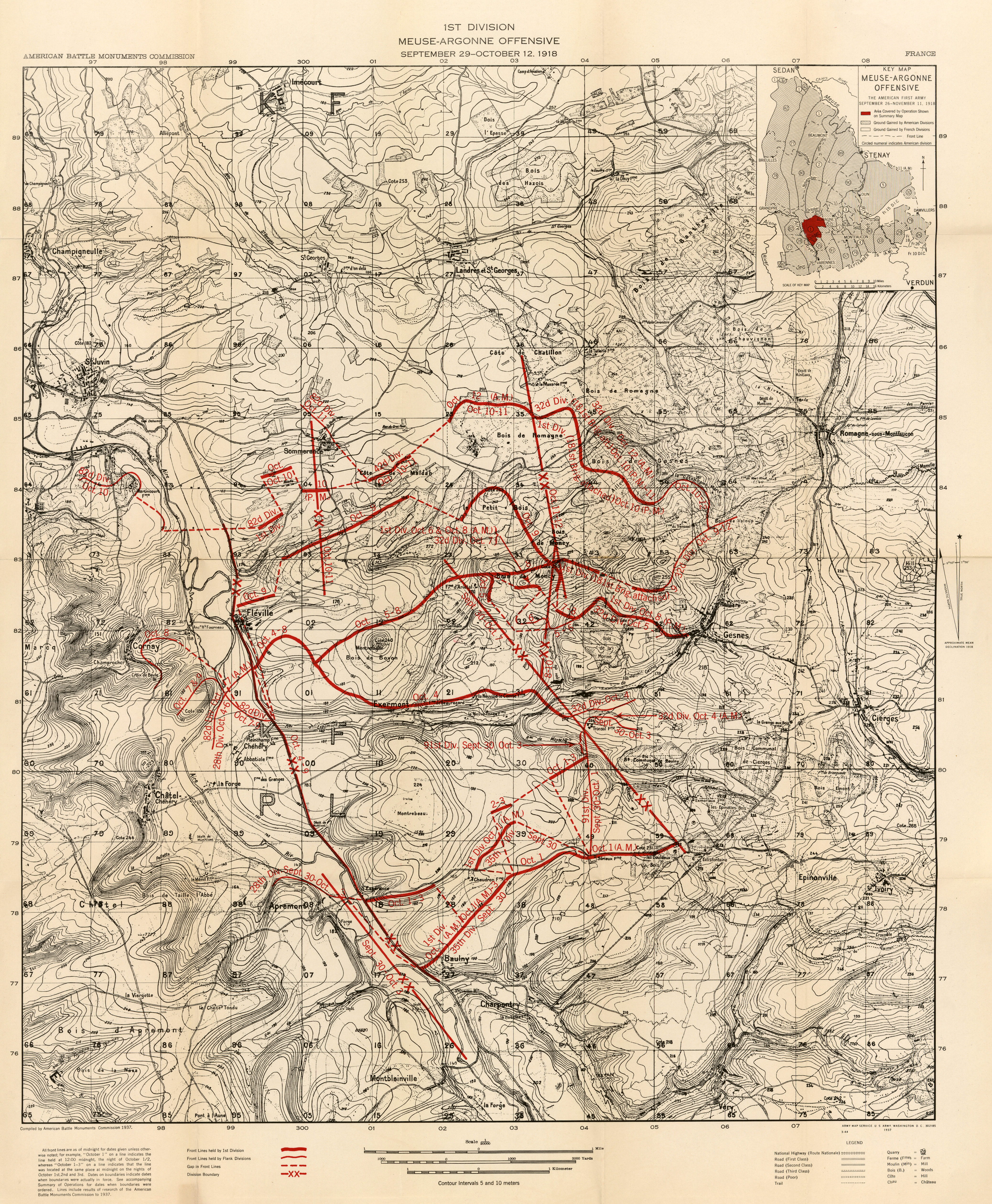
On October 7, 1918, the 1st Battalion, 328th Infantry was ordered to take Hill 223, a strategic position just three kilometers southeast of their main objective: the Decauville rail line. This mission came during a critical phase of the Meuse-Argonne Offensive as American and French troops attempted to achieve the breakthrough that could end the war.18
On the night of October 7, York and the men of the 2nd Battalion watched and waited from the main road between Varennes and Fléville for their turn to continue the assault beyond Hill 223. At 0300 hours, bogged down by heavy rains and mud, fatigued from a sleepless night, hampered by a trek devoid of light except for the glow of gunfire hailing down around them, the troops slogged towards the hill amid utter chaos.
“Lots of men were killed by the artillery fire. And lots were wounded. The woods were all mussed up and looked as if a terrible cyclone done swept through them. But God would never be cruel enough to create a cyclone as terrible as that Argonne battle. Only man would ever think of doing an awful thing like that.”
At 0610 hours, York’s battalion along with three other companies of the 328th Infantry, pushed off Hill 223 with fixed bayonets. The advance was to be preceded by a rolling barrage of artillery fire that never came.19
As the troops raced downhill and charged across the 500-yard valley, now exposed with the light of dawn, an explosion of gunfire erupted from the heights above. “We had to lie down flat on our faces and dig in. And there we were out there in the valley all mussed up and unable to get any further with no barrage to help us, and that-there machine-gun fire and all sorts of big shells and gas cutting us to pieces.”
 Valley just west of hill 223 across which York and the 2nd Battalion attacked on the morning of October 8, 1918.
From Candler, History of Three Hundred Twenty-Eighth Infantry, 60.
The first wave of men had been decimated by the Germans, and now York’s battalion lay pinned down, able to move but a few feet at a time. Something had to be done, but a frontal attack was out of the question.
When platoon sergeant Harry Parsons realized that the thrust of the machine gun fire came from a ridge to the left, he ordered Sergeant Bernard Early to lead Corporals York, Savage, and Cutting and three squads totaling thirteen men, to silence the machine gun nest on the ridge. Seventeen soldiers stealthily climbed up the left flank, concealed by the thick undergrowth, slipped deep into German lines and encircled the enemy gunners from the rear. While chasing the first two enemy soldiers they encountered, the squads stumbled upon a German headquarters with fifteen to twenty unsuspecting soldiers and officers from the 120th Württemberg Landwehr Regiment in conference.20 Caught completely off guard, the Germans surrendered. While the prisoners were being searched, enemy gunners situated on the ridge above the camp turned their machine guns around and swept the open space, instantly killing six American soldiers, including Corporal Savage, and wounding three. Among the wounded were Sergeant Early and Corporal Cutting. Corporal York was now in charge with just seven men under his command.
The onslaught of machine gun fire from above was relentless and destructive. The German prisoners had hit the ground and the Americans had shielded themselves between them, some of the privates managing to get off a shot or two.21 York was caught out in the open about twenty-five yards below the machine gun line near the ridge, his men and the German POWs huddled behind him. Each time a German soldier raised his head, York would “tech him off,” just like he did at the turkey shoots back home.

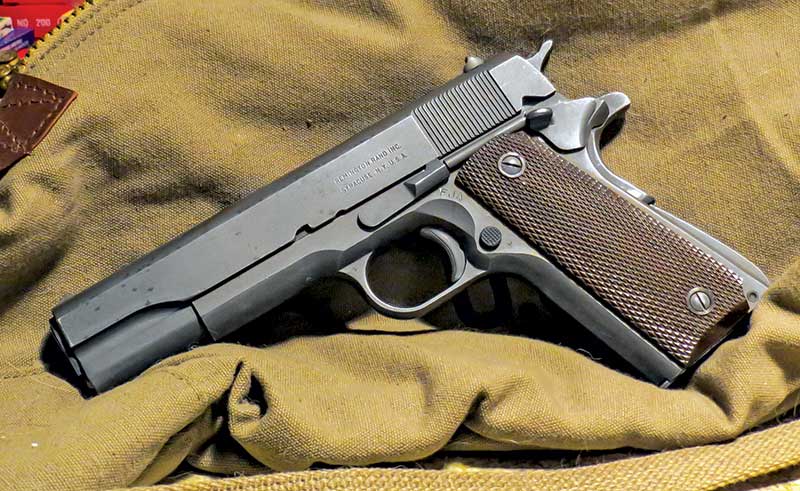
Colt .45 government model of 1911. Garry James, American Rifleman.
At some point, York stood up and began to shoot his rifle offhand. His weapon was getting hot and he was running out of ammunition. So when a German officer led a counter-attack with six of his men charging towards York with fixed bayonets, York drew his Colt .45 automatic and, from back to front, shot each one, a practice he picked up at wild turkey shoots in Pall Mall. The idea was to hit the rear soldiers first so that the remainder would not see their comrade fall and fire at him. “It was either them or me and I’m a-telling you I didn’t and don’t want to die nohow if I can live,” he said.
Falling back on his hunting experience in Tennessee, York continued to methodically pick off German soldiers one by one, each time hollering for them to give up. Alarmed by the number of troops being shot dead and their shattered morale, the German commander, Lieutenant Paul Jürgen Vollmer, shouted out in English offering to surrender his troops.22 As the Germans began to emerge from the upper trenches, one fellow hid a grenade in his raised hand, which he threw at York but missed, hitting another prisoner. York reflexively shot him, and there was no further trouble.
York ordered the eighty to ninety prisoners to form two lines and had them carry Sergeant Early on a stretcher. Using them as cover, York placed Vollmer in front of him with his pistol trained on his back and the other two German officers on either side of him. Seeing that York was considering which way to go, Vollmer suggested to turn down a gully, but York quickly figured it was a trap and decided to go in the opposite direction. Since York and his men had captured the rear German line, they inevitably ran into the first line of enemy trenches. He succinctly told Vollmer to order them to surrender or he would blow the commander’s head off, and they did, joining the lines of POWs headed to the command post.23
York and his men marched the prisoners from one command headquarters to another against his men’s better judgement, until the captives were finally accepted at division headquarters in Varennes, a distance of 10 ½ kilometers. Altogether, York killed 20-25 enemy soldiers, neutralized thirty-five machine guns, and captured 132 German soldiers, though he was quick to reject full credit for the extraordinary success of his mission. “There were others in that fight besides me… I’m a-telling you, they’re entitled to a whole heap of credit. It isn’t for me, of course, to decide how much credit…But jes the same, I’m a-telling you, a heap of those boys were heroes, and America ought to be proud of them.”
His actions enabled the 328th Infantry Regiment to advance across the valley and capture the strategic Decauville Railroad. With their Army on the verge of total collapse and the Central Powers facing defeat on all fronts, Germany agreed to an armistice with the Allies on November 11, 1918, bringing the war to an end.
“I jes want to go home.”
Alvin C. York was promoted to the rank of sergeant on November 1, 1918. He received numerous American and foreign awards, including the highest recognition that could be bestowed upon a U.S. soldier, the Congressional Medal of Honor. French General and Supreme Allied Commander, Ferdinand Foch, commented to York, “What you did was the greatest thing accomplished by any private soldier of all the armies of Europe.”
When York returned to the United States, he found that he had become a national celebrity. It was all so overwhelming for the humble hero, but all he really wanted was to go home. He received offers from Hollywood and Broadway to adapt his life story into a movie and numerous endorsement deals and public appearances worth tens of thousands of dollars. York chose not to capitalize on his newfound fame. He once famously stated “This uniform ain’t for sale.” Instead he dedicated himself to his family and a number of charitable causes. He became a proponent for veterans’ rights, education, and economic development for his impoverished community. Seeking to raise money to help build a bible school, York finally gave his blessing for Hollywood to produce a film based on his life story. In 1941, Sergeant York was released in theaters, starring Gary Cooper in the title role that would earn him an Academy Award. It was the highest grossing film of the year, inspiring young Americans across the country to enlist in the U.S. armed forces during World War II.24
On September 2, 1964, Alvin C. York passed away at a veterans’ hospital in Nashville, Tennessee, at the age of 76. He is currently buried at the Wolf River Cemetery in his hometown of Pall Mall, Tennessee, next to his wife, Gracie, who passed away twenty years later.
Alvin C. York has maintained the status of an American folk hero whose story still resonates with Americans to this day. His heroism in battle, his legendary sharpshooting skills, his underprivileged upbringing, his faith in a higher power, his sense of patriotic duty, and his humble nature all contributed to the legend that is Sergeant York. His story is regarded as one of the most inspirational American success stories, and he has been memorialized as one of the greatest heroes in the long history of the United States Army.
Enfield vs Springfield Rifle Debate
Much discussion has centered around whether York used a 1903 Springfield or a 1917 Enfield rifle during the war. WW I munitions data presented by Assistant Secretary of War, Benedict Crowell, concluded that 12-15% of rifles issued were Springfield guns but the vast majority were 1917 Enfields.25
 U.S. rifle cal .30, model of 1903 Springfield. Twelve to fifteen percent of rifles issued to WW I soldiers were Springfields. Wikimedia
In his diary, York did not specify the type of rifle he used. Per Colonel Buxton, the 82nd Division was issued 1917 Enfields.26 In 2005, writer Garry James documented a conversation he had with York’s son, Andrew, who stated that his father had somehow switched his 1917 Enfield for a 1903 Springfield because the Enfield “had a peep sight with which York had difficulty leading a target.” Another individual commented on a forum that Andrew York told him that when his father’s unit reached the front, they were given a choice of one of the surplus ’03 Springfields, and that York switched, in part, because “the notched rear sight and post or blade front sight” were virtually the same as on his old muzzleloader. On both occasions, Andrew incorrectly stated that his father trained stateside on the ’03 Springfield and that these were replaced with Eddystones at Le Havre (Woodsrunner 38 second entry). A third forum commentator who also met Andrew York questioned Andrew’s knowledge base on the subject. (See Scott in Indiana). Regardless of which rifle he used, Alvin York’s extraordinary feat is well documented and undeniable.
Video
Words spoken by York voiceover actor are directly from his diary. Great short film with some actual war footage.
Sources
[1] Sam K. Cowan, Sergeant York and his People (New York: Grosset & Dunlap, 1922), 147. Alvin York, His Own Life Story and War Diary, Tom Skeyhill, ed. (Garden City, NY: Doubleday, Doran & Co., 1930), 18, 122. Albert Ross Hogue, History of Fentress County, Tennessee: The Old Home of Mark Twain’s Ancestors (Nashville: Williams Printing Co., 1916), ix-xiv. Eventually, William York built an addition to the cabin separated from the main living area by a breezeway described as a “dogtrot;” see “York’s Early Life,” Tennessee Virtual Archive, and John Perry, Sergeant York (Nashville: Thomas Nelson, 2010), 9.
[2] Cowan, Sergeant York, 105-106.
[3] David D. Lee, Sergeant York: An American Hero (Lexington: University Press of Kentucky, 1985), 4. York, His Own Life Story, 125.
[4] Cowan, Sergeant York, 169-170. York, His Own Life Story, 123-124. The one-room schoolhouse held pupils ages six to twenty.
[5] York, His Own Life Story, 133-134.
[6] Ibid., 132.
[7] Ibid., 141-145. Lee, Sergeant York: An American Hero, 8-10. It has been reported that the untimely death of York’s friend, Everett Delk, was one of his prime reasons for changing his life in 1917. However, author Tom Skeyhill, who interviewed York in 1927 for his book, His Own Life Story and War Diary, stated, “…and that was when he [York] learned that I had interviewed Everett Delk, his pal of “hog-wild days” to which Alvin responded, “Everett must’ve told you God plenty.” (York, 33) After he changed his ways and joined the church, York mentions that Everett or Marion would tempt him to join them for parties but he would refuse (York, 146.) On Find a Grave, there is a record of an Elijah Everett Delk from Fentress County, 1894-1928.
[8] Mark Sidwell, “The Churches of Christ in Christian Union: A Fundamentalism File Research Report,” Bob Jones University Mack Library, (Feb. 16, 2004): 1-3.
[9] York, His Own Life Story, 149-150.
[10] Ibid., 156-163.
[11] York erroneously referred to Major Buxton’s first name as George, an understandable assumption since Buxton always used the initial G. See Ned Buxton, “Sergeant York’s Major,” No Greater Calling, July 13, 2006.
[12] “Conscience Plus Red Hair Are Bad for Germans.” Literary Digest 61, no. 11 (June 14, 1919): 46. George Pattullo, “The Second Elder Gives Battle,” Saturday Evening Post 191, no. 43 (April 26, 1919): 3. York, His Own Life Story, 172-176.
[13] Cowan, Sergeant York, 242.
[14] York, His Own Life Story, 194, 230. Official History of 82nd Division of American Expeditionary Forces 1917-1919, G. Edward Buxton, Jr., ed. (Indianapolis: Bobbs-Merrill Co., 1919), 3, 11. Center of Military History, United States Army in the World War 1917-1919: Training and Use of American Units With the British and French Volume 3 (Washington D.C.: Gov’t Printing Office, 1989 Reprint), pg. 51, para 1a,b,e. Leo P. Hirrel, Supporting the Doughboys: U.S. Army Logistics and Personnel During WW I (Fort Leavenworth: Combat Studies Institute Press, 2017), 21. “Weapons of the Western Front: Rifles,” National Army Museum (UK), accessed April 1, 2019. Bruce Canfield, “The U.S. Model of 1917 Rifle, American Rifleman, July 19, 2018. The U.S. was so unprepared for war that drill training at Camp Gordon began with wooden guns (Buxton 3, 226. Hirrel 21).
[15] Buxton, Official History of 82nd Division, 12.
[16] York, His Own Life Story, 201.
[17] Ibid., 209.
[18] Scott Candler, History Three Hundred Twenty-Eighth Infantry, Eighty-Second Division, American Expeditionary Forces, United States Army, (Atlanta: Foote & Davies Co., 1920), 43-65.
[19] Ibid., 217-220. Buxton, Official History of 82nd Division, 51-59.
[20] York, His Own Life Story, 224. Lee, Sergeant York: An American Hero, 31-33.
[21] York, His Own Life Story: 246, 256, 264.
[22] Lee, Sergeant York: An American Hero, 36.
[23] York, His Own Life Story, 229-231.
[24] Michael E. Birdwell, Celluloid Soldiers: The Warner Bros. Campaign Against Nazism 1934-1941 (NY: NYU Press, 1999), 107-110.
[25] Benedict Crowell, America’s Munitions 1917-1918: Report of Benedict Crowell, the Assistant Secretary of War, Director of Munitions (Washington D.C.: Govt. Printing Office, 1919) 183.
[26] Buxton, Official History of 82nd Division, 3.

There are an estimated 120 African hippos loose in Colombia’s labyrinthine waterways today. The name hippopotamus has Greek origins. Literally translated the word means, “river horse.” The animal’s genus is Hippopotamidae.

Hippos are omnivores, meaning they eat most anything they can catch. A fully grown male hippopotamus can weigh upwards of 3,300 pounds. Hippos look sweet and cuddly. They’re not. An adult hippo can run at 30 mph and is legendarily mean-tempered. Hippos are one of the most dangerous animals in Africa, accounting for some 500 dead Africans per annum.

Around the world hippos are considered threatened. However, the hippos in Colombia have no natural predators and are breeding like enormous toothy bunnies. If active culling is not introduced the population should reach 1,400 animals by 2034.

A handful of big males have been castrated and released thus far, but, as one might imagine, this is a fairly onerous chore. It apparently costs around $50,000 to castrate a single hippo. Considering the technical challenges it still seems to me that professional hippo castrators are grossly underpaid.

These 120 animals all descended from a single male and three female specimens purchased in New Orleans in the late 1980s by Pablo Escobar. When he wasn’t collecting exotic animals, Escobar ran the Medellin cartel, the most ruthless and successful of the sundry Colombian drug organizations. How the world rid itself of Pablo is a story most sordid.
The Man

Pablo Escobar was born in December of 1949 in Rionegro, Antioquia, Colombia, the third of seven children. His dad was a farmer and his mom an elementary school teacher. Some people are born with a sweet tooth or a proclivity for sports. Pablo Escobar was born without a conscience.

As a teenager, Escobar would steal gravestones and sand them down flat for resale. He made money in high school by selling counterfeit high school diplomas. Escobar and his buddies stole cars, smuggled cigarettes, and peddled fake lottery tickets. In the early 1970s, Pablo kidnapped a local Medellin executive and returned him in exchange for a $100,000 ransom. This was clearly where the real money was. By his 26th birthday, Pablo Escobar had three million dollars in a local bank.


Seeing the meteoric rise in demand for cocaine in the US, Escobar organized to meet it. By the early 80’s Pablo was seriously rich. He bought 7,000 acres of prime land in Antioquia for $63 million and built Hacienda Napoles, his luxury estate. The facility included a bull ring, an ample lake, a sculpture garden, and a functioning zoo. That’s where the hippos came from.

When he felt threatened Pablo took human life with wanton abandon. In 1985 the Colombian Supreme Court was reconsidering the extradition treaties between Colombia and the United States. Escobar was displeased, so he bankrolled an attack on the court that ultimately killed fully half of the Supreme Court justices.

On the surface Escobar maintained a Robin Hood-style life, giving generously to local charities and infrastructure projects. Such generosity bought him the loyalty of locals that was to be invaluable later while he was on the run. However, along the way, he also murdered some 4,000 people.

Some of his targets were police officials he had terminated via professional sicarios (hitmen). He undertook a sprawling bombing campaign as well. Eventually, Escobar successfully lobbied the Colombian Constituent Assembly to amend the Constitution to prevent extradition to the United States. With this legislative adjustment in the bag, Pablo Escobar surrendered to authorities along with a pledge to desist all criminal activity.

Escobar was remanded to a luxury prison of his own construction called La Catedral. This facility included a football pitch, a bar, a Jacuzzi, a giant dollhouse, and a waterfall. However, it became obvious that Escobar was still running his cartel’s activities while technically incarcerated, so he was ordered moved to a more conventional facility. On July 22, 1992, Escobar escaped during the transfer.
The Hunt

A dedicated unit of Colombian special operators called the Search Bloc was formed for the sole purpose of hunting down Pablo Escobar. The Search Bloc enjoyed the support of the US Joint Special Operations Command. Delta and DevGru instructors trained the Search Bloc in advanced close combat techniques.

In addition to the Search Bloc, Escobar was hounded by a vigilante mob known as Los Pepes. This was short for Los Peseguidos por Pablo Escobar or “People Persecuted by Pablo Escobar.” These guys were flat-out terrifying. Before the dust settled they had murdered some 300 of Pablo’s associates to include his lawyer and a variety of family members. They also destroyed a great deal of the Medellin cartel’s physical property.

By early December 1993, Pablo Escobar had been on the run for sixteen months. Guided by dedicated direction finding assets tracking his radio phone, the Search Bloc closed in on the flat where he was hiding out. Eight Search Bloc operators stormed the apartment with ample backup troops pulling up in support. Escobar and his bodyguard, nicknamed “The Lemon,” piled out a back window and fled across the rooftops. Both men were cut down like dogs. When the Search Bloc shooters got to his body they found Pablo Escobar, the richest most powerful criminal in the world, dead from a gunshot wound to the right ear.
The Guns

This resulted in quite the famous photograph that showed the Search Bloc operators posing around Escobar’s cooling corpse like some recently-bagged whitetail. Studying this photo demonstrates an eclectic array of small arms. As their operations were brief, frenetic, and typically executed in heavily built-up areas, weapon and ammo commonality would not be as important as might be the case in an austere field environment away from resupply.

The rank and file shooters carried license-produced Israeli Galil assault rifles made in Colombia by INDUMIL. First fielded in 1972, the Galil was a hybrid design that incorporated the action of the AKM, the 5.56mm chambering of the M16, and the side-folding buttstock of the FN FAL. The first prototypes were actually built on milled Valmet receivers illicitly smuggled into Israel during the developmental process.

One shooter carries what looks like a Mini-Uzi. Introduced to Israeli Special Forces troops in 1954, the full-sized stamped steel 9mm Uzi submachine gun helped carry the fledgling Jewish state through some of its darkest days immediately after independence. The Mini-Uzi utilizes the same fire controls and magazine but is markedly more compact. It also sports a spunkier 950+ rpm rate of fire as a result.

One Colombian operator carries a Model 653 Colt Commando assault rifle. A precursor to the modern M4, the Model 653 features a thin-profile 14.5-inch barrel and standard round handguards. His 653 sports a pair of magazines taped side by side.

The shooter in the foreground confounded me. At first brush, I thought his rifle was perhaps a chopped FN FAL. The dual magazines appear to be .30-caliber, and the side-folding stock looks about right. However, there appears to be a charging handle of some sort on the right, and the front sight/gas block arrangement doesn’t seem quite right for an FAL. If nothing else the FAL has its charging handle on the left. What do you think? Post your thoughts in the comments section below, and let’s figure this out together.
The Rest of the Story

At the apex of his power, Pablo Escobar’s Medellin drug cartel was bringing in $420 million per week, or around $6 million each day. With a net worth of about $25 billion, Escobar was one of the richest men on the planet. In the late 1980’s he offered to pay off Colombia’s $10 billion national debt in exchange for exemption from any extradition treaties with the US. In 1992 while on the run with his family Pablo actually physically burned $2 million in cash keeping his daughter warm.

Escobar had more cash money than he could ever spend. He stashed it in warehouses and buried it in fields. Around 10% or $2.1 billion was written off annually as misplaced, destroyed by the weather, or eaten by rats.

Escobar built local hospitals, housing projects, and soccer stadiums for the poor of Medellin. He was elected to the Colombian Congress in 1982 but forced out by a justice minister who exposed his illegal dealings. Escobar had the minister killed.

Escobar’s solution to his life’s many challenges was summed up in his motto “Plata o Plumo.” This literally translates to “Silver or Lead.” If he could not bribe his way to a solution then he had those responsible killed. In 1989 his cartel planted a bomb on board an aircraft carrying a suspected informant. 100 people perished in the crash.

Pablo Escobar died the day after his 44th birthday. To this day nobody is really sure who fired the fatal shot. However, his son Juan Pablo reported later that his dad had told him many times that he would never allow himself to be captured alive. Should his arrest be imminent his plan was to shoot himself through his right ear. Escobar’s recently-fired SIG SAUER handgun was indeed found on the roof alongside his body when the Search Bloc reached his corpse.


Talaiasi Labalaba was born on July 13, 1942, in Vatutu Village in Nawaka, Nadi, on the island of Fiji. Fiji is an island country in Melanesia in the South Pacific roughly 1,100 miles northeast of New Zealand. Fiji is actually an archipelago of more than 330 islands, 220 of which are currently uninhabited. Tourism and sugar-cane are the primary industries. As of 1970, Fiji became a fully independent sovereign state within the British Commonwealth of Nations. Beginning in WW2, Fiji’s relationship with the British Empire meant that native Fijians could serve in the British military.

Labalaba spent his childhood on an island and craved adventure. He initially enlisted with the Royal Ulster Rifles and also served with the Royal Irish Rangers. Eventually, Labalaba volunteered for Selection for the 22d Special Air Service.
The Setting

In the summer of 1972 Oman was in chaos. Sharing borders with Saudi Arabia, the UAE, and Yemen, the Omani Sultanate was allied with the British in a fight for its life against Marxist rebels. A small contingent of nine SAS operators was assigned to assist with Omani security as part of the British Army Training Team at Mirbat. Their year-long deployment was part of Operation Jaguar. This nine-man team was short and was soon to rotate home.

Opposing this small contingent was the PFLOAG. This mouthful of word salad stands for the Popular Front for the Liberation of the Occupied Arabian Gulf. Locals just called them the Adoo.

The SAS BATT House stood overlooking the approaches to Jebel Ali, itself a strategically critical piece of dirt leading to the major port of Mirbat. The PFLOAG rebels knew that to take Mirbat they would first have to take Jebel Ali. Before they could get to Jebel Ali they had to neutralize the nine Brits at the SAS BATT House.

The BATT House was itself a fairly impressive fortification. Manning the fort as well as the surrounding encampment were another 25 Omani policemen and some 30 Balochi Askari along with one local firquat irregular. The Balochi Askari were members of the Pakistani diaspora serving in an administrative military capacity. The firqua were members of the Omani loyalist militia.

Arrayed against this Neapolitan band was some 300-400 heavily-armed and dedicated PFLOAG Marxist fighters. At the BATT House, the SAS troops were armed primarily with L1A1 SLR rifles and a single M2 .50-caliber machinegun along with a 60mm mortar. The Adoo packed AK47 rifles, RPG7’s, and mortars along with ample ammunition courtesy of their Soviet and Chinese benefactors.

July 19, 1972, was the day the Brits were to rotate home. At 0600 that morning, CPT Mike Kealy, the 23-year-old commander of the SAS contingent, observed what he thought to be a deployed patrol of loyal Omanis now returning to base. These Omanis had been picketed to warn of approaching Adoo forces. Once he realized how substantial this force was, however, he appreciated that his patrol had surely been killed. He then ordered his men to open fire. The SAS troops did just that but found that the Adoo forces were infiltrating via gullies beyond the effective range and penetration of their SLRs. At that point, the BATT House began receiving accurate and effective mortar and RPG fire. CPT Kealy contacted his higher headquarters in Um al Quarif and requested reinforcements.
The Fight

It soon became obvious that the small SAS force was in grave danger of being overwhelmed. However, located some 800 meters distant at a smaller fortification was a single British 25-pounder artillery piece along with an ample supply of ammunition. SGT Talaiasi Labalaba struck out alone across 800 meters of flat open desert to reach the howitzer. The accumulated Adoo insurgents opened up on him with their AK rifles.

The typical crew for a 25-pounder is six. This multipurpose Quick-Firing gun fired separate ammunition consisting of a projectile loaded first followed by a cartridge case containing between one and three bags of propellant. Running the gun accurately, efficiently, and well is an art that requires extensive cultivated teamwork and training. On this fateful day, SGT Labalaba was managing the big 3,600-pound gun alone.

During the course of several hours, SGT Labalaba poured high explosive rounds into the attacking communist guerrillas, frequently averaging one round per minute. However, the sheer force of numbers was overwhelming him. Eventually, the attacking Adoo troops got an AK round past the splinter shield on the gun and struck SGT Labalaba in the face. Now badly wounded, he radioed back to the BATT House with an update. Despite the horrific nature of his injury SGT Labalaba continued firing the howitzer, sighting directly through the bore at the approaching guerillas. However, he was badly hurt and losing blood. SGT Labalaba was now struggling to operate the heavy gun alone.

CPT Kealy requested a volunteer to assist SGT Labalaba and Trooper Sekonaia Takavesi, a fellow Fijian, answered the call. Under covering fire from the BATT House Takavesi made the long 800-meter run to the artillery emplacement unscathed. Once there he engaged approaching Adoo fighters with his SLR and attempted to address SGT Labalaba’s injury as best he could. Together the two men continued to work the 25-pounder, pouring HE rounds onto the maniacal communist attackers.
The Gun

Developed in 1940, the 25-pounder was an 87.6mm multipurpose artillery piece combining both high-angle and direct-fire capabilities. Ultimately produced in six Marks, the 25-pounder was highly mobile for its day despite its nearly two-ton all-up weight. The gun was used throughout the Commonwealth, and ammunition remains in production at the Pakistani Ordnance Factories today.

The 25-pounder used separate bagged charges that could be cut as necessary to produce an accurate fall of shot at various ranges. A subsequent “Super” charge was also developed that required the addition of a muzzle brake to the gun for safe operation. Most British charges for the gun were cordite-based.


In addition to high explosive, smoke, and chemical shells, the 25-pounder could also fire a curious shaped-charge warhead as well as a 20-pound APBC (Armor Piercing Ballistic Cap) round also designed for antitank use. Antitank rounds were employed in the direct-fire mode using Super charge loads. In addition to these conventional applications, the 25-pounder could also fire foil “window” that mimicked the return of an aircraft on radar as well as shells containing propaganda leaflets. These leaflet shells were employed toward the end of WW2 to convince the Germans to surrender.
The Rest of the Story

Now under dire threat of being overrun, SGT Labalaba retrieved a small Infantry mortar kept at the artillery firing point. This stubby high-angle weapon would be more effective now that the attacking troops were in so close. As he moved to set the mortar up for firing he caught a second round to the neck and bled out.

By now Takavesi had also taken a round through the shoulder and was grazed by another across the back of his head. Despite his injuries, he duly reported the situation back by radio and continued to engage the approaching guerillas with his SLR.

In response, CPT Kealy and another SAS trooper named Thomas Tobin also ran the gauntlet to the artillery firing point. When they arrived they found that Trooper Takavesi had been hit a third time, this time by an AK round through his abdomen. Now having closed to within-hand grenade range, the PFLOAG troops showered the emplacement with grenades, only one of which detonated.

During the fight, Trooper Tobin reached across the body of SGT Labalaba and caught an AK round to the face that blew away much of his jaw, leaving him mortally wounded. Just when the situation seemed darkest, a flight of BAC Strikemaster attack jets from the Omani Air Force arrived on station and opened up on the communist rebels. One of the jets suffered battle damage from ground fire and had to return to base, but rocket and cannon fire from the remaining element ultimately broke the back of the assault.

When Trooper Toobin was hit he reflexively aspirated a chunk of his own splintered tooth. This fragment subsequently set up a lung infection that later killed him in hospital. Sekonaia Takavesi was medically evacuated and recovered. SGT Talaiasi Labalaba received a posthumous Mention in Dispatches. SGT Labalaba is buried at St Martin’s Church at Hereford in England. He was 30 years old when he was killed.

The 25-pounder gun SGT Labalaba used in Oman is currently on display at the Firepower Museum of the Royal Artillery at the former Royal Arsenal at Woolwich in England. The engagement outside Mirbat was intentionally underreported by the Omani and British governments at the time. SAS involvement in Oman was a sensitive issue, and no one wanted undue official attention. SGT Labalaba’s comrades have lobbied ever since that he should posthumously receive the Victoria Cross for his selfless actions in Oman that day.

In October of 2018 Prince Harry formally dedicated a bronze likeness of SGT Labalaba at the Nadi International Airport in Fiji commemorating his exceptional bravery. Another statue occupies a place of honor at SAS HQ as well. Tom Petch, a British filmmaker and himself a former SAS operator is currently producing a feature movie about SGT Labalaba and the Battle of Mirbat.


Here’s Elmer sitting behind his desk. When you pushed a button,
he’d turn around and start talking to you, telling stories.

The famous #5 of which “The Last Word” was written in
Rifleman, April 1929 issue.
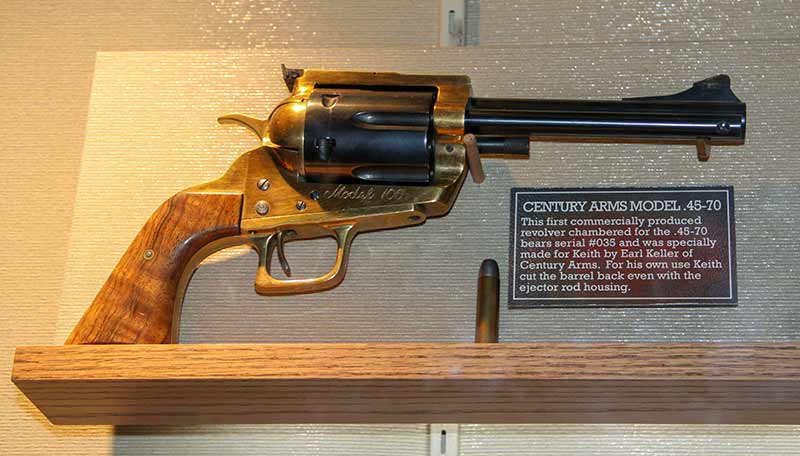
Elmer tested and wrote about all guns. Here’s his Century Arms .45-70 revolver.
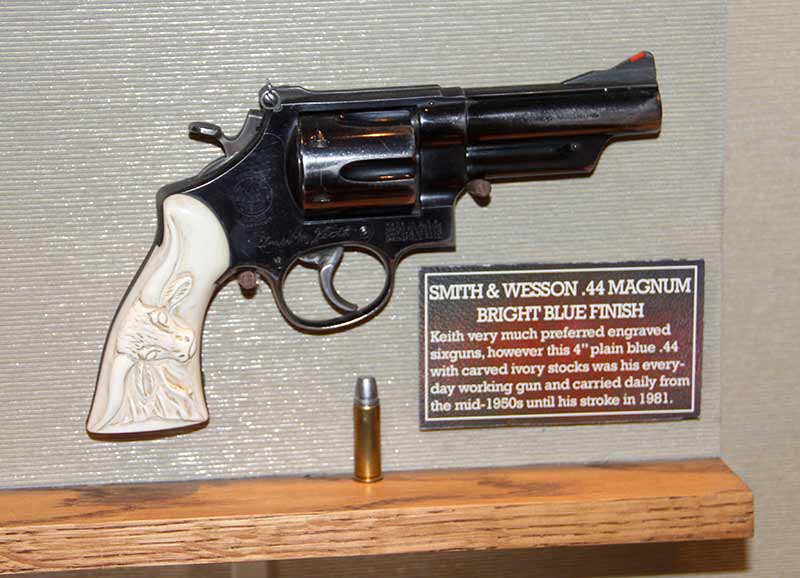
One of many 4″ Model 29s Elmer owned with his trademark steer-head ivory stocks.
Lately, I’ve been getting my Elmer on. Yup! Been reading up and researching the Grand Old Man of Handgunning. Up until seven years ago, there was a place that paid homage to Elmer Keith. For you youngsters never hearing of him, I don’t fault you. You’ve been neglected by your elders, or school system, so I’ll step up and tell you a little about Elmer.
Afterwards, I suggest you hunt up any book, magazine, or computer writing by him and get yourself intimately acquainted with his works, thoughts and readings.
It’s been said Elmer spoke the original thoughts and all others have simply regurgitated his words in one form or another. Thinking about it, it’s not too far from the truth. Elmer had his hand in, or made mention of, just about everything pertaining to the gun world.
With no formal education, Elmer had great instincts and understanding. He didn’t just concentrate on one discipline either, he knew how to shoot, load or discuss anything pertaining to sixguns, autoloaders, black powder rifles, revolvers, shotguns and paper-patched lead bullets for Sharps single-shots rifles. If it went bang, Elmer knew how to shoot and handload for it.
He was a great outdoorsman, outfitter and packer. He guided hunters for years, up until age 50, and knew the life cycle, food habitat and environment of every critter living in his area. He’s responsible, or planted the seed, for such things as the .357, .44 and .41 Magnums, the S&W model 29 and 57, Ruger Flat Top and Super Blackhawk .44 Magnums, the Winchester model 70 rifle, and the .338 Winchester Magnum, to name just a few things.
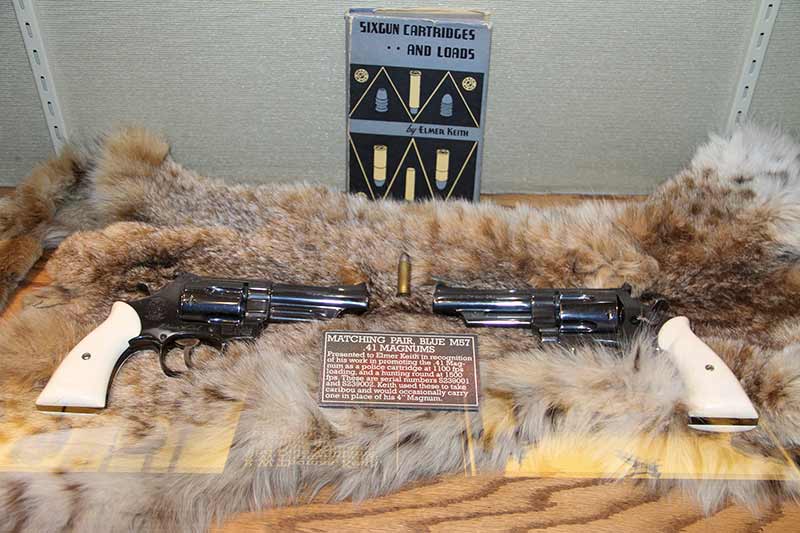
Elmer’s matching pair of S&W Model 57 4″ revolvers.

Here’s Elmer packing out a ram in the rugged country of Idaho. Notice his simple pack-board.
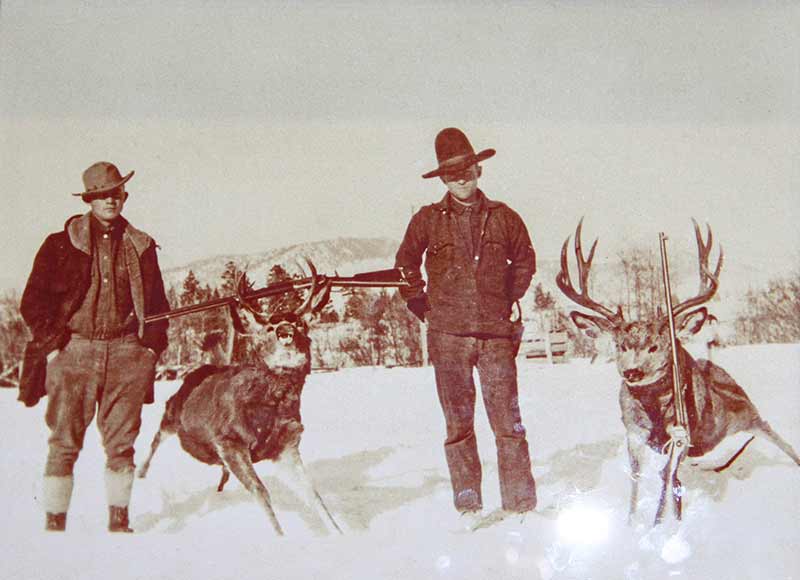
Elmer and his brother Silas with two mule deer. Elmer took his with a Sharps rifle.

The Museum
With much help from our own John Taffin, Cabelas in Boise, Idaho carved a niche in their store to house the Elmer Keith Museum. I knew about it and wanted to go for years. I finally got the opportunity when I went out to visit my buddies Dick Thompson and Steve Call. I was fortunate to make the journey on two occasions.
For those knowing who Elmer was, it was a breathtaking experience to see his pictures, game heads and yes, firearms, of the famous gun writer. As time went on, the family wanted to liquidate the assets, and had everything auctioned off. Sadly, this forced the closure of the museum.
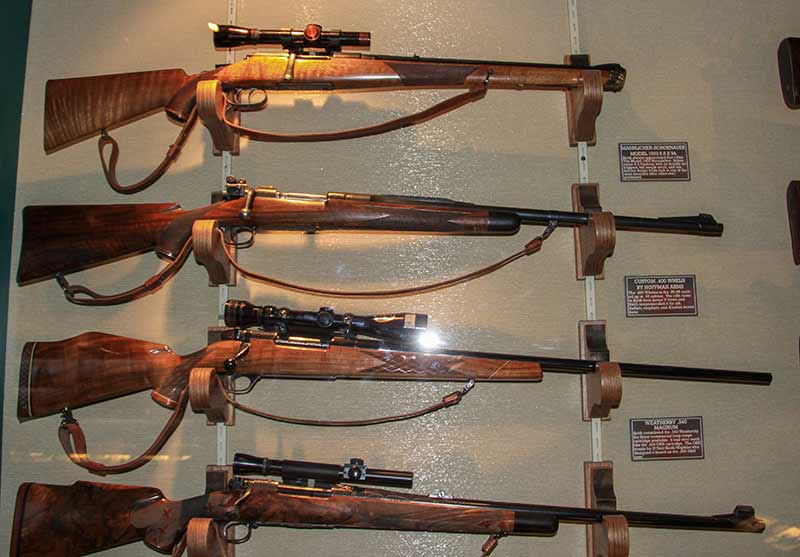
A rack of Elmer’s rifles. Second from top is his famous .400 Whelen, a gift from Jim Howe’ of Griffin & Howe.
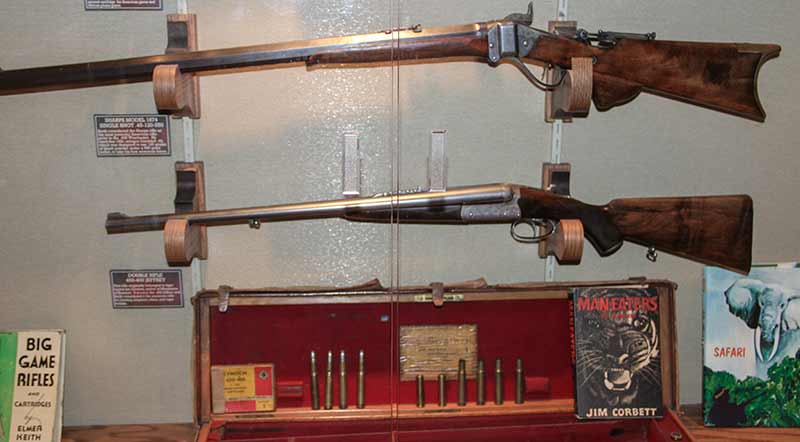
Another rack of rifles. The bottom rifle was Jim Corbett’s .450-400 double rifle,
a major-league cool factor! Below it is the leather case it came with
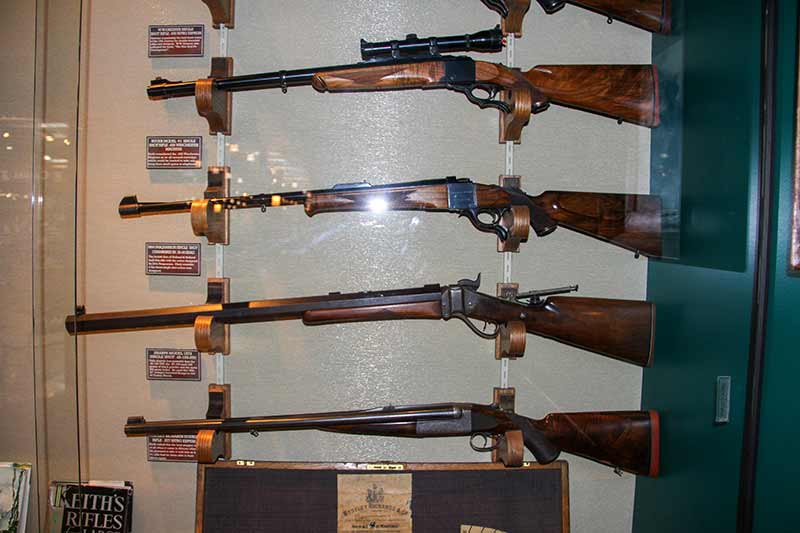
Above the Corbett rifle is Elmer’s Sharps .45-100-550 rifle. Need I say more?

Some of Elmer’s trophies.
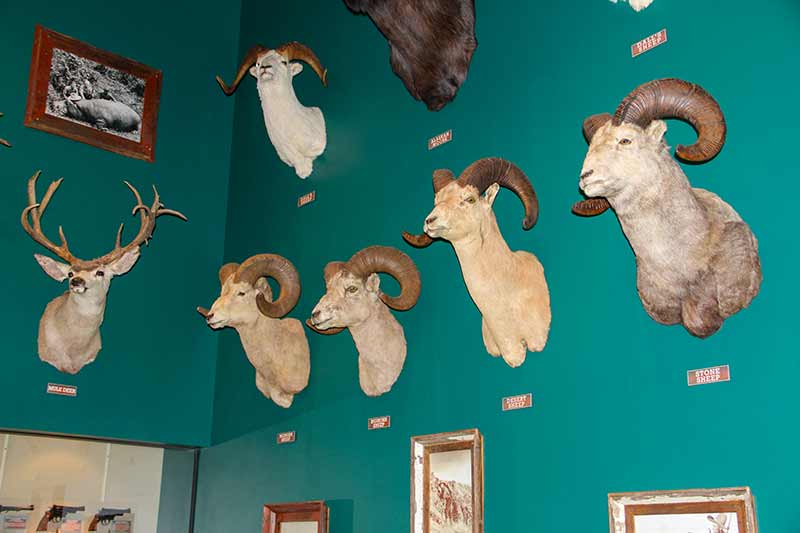
Some fine sheep he took!
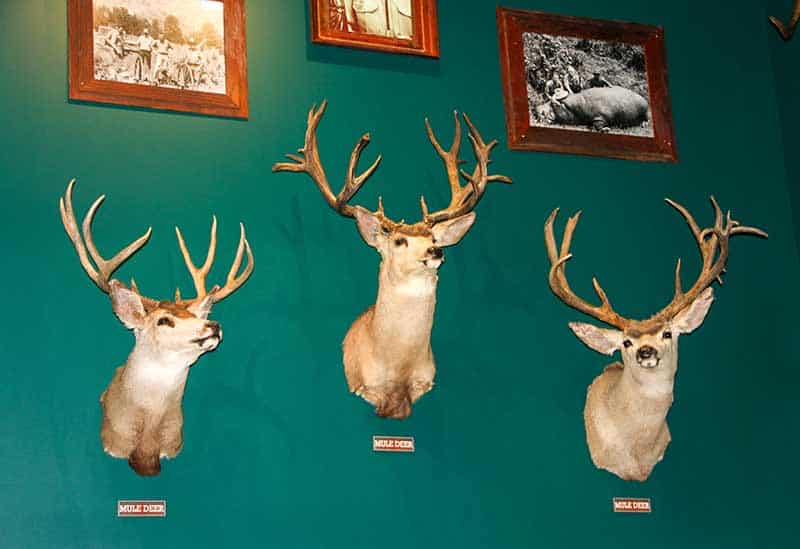
A trio of mulies the master took.
Second Chance
So, for those of you who never had the opportunity, I figured I’d share my pictures with you, to get some insight into one of the pioneers of shooting, hunting and the development of handguns, rifles and cartridges. I hope you enjoy visiting with Elmer. It was something to see in person.
More importantly, I hope I’ve lit a spark for you to continue reading, researching and replicating some of the loads, guns, holsters or hunts Elmer experienced.
It’s fun walking alongside the footprints of our founders, and who knows, you just may learn something along the way.
He’s a senior NCO in the Delta Force. SGM Payne enlisted in 2002, serving as a sniper in the 75th Ranger Regiment until 2007, when he joined the Delta Force.
(SGM Payne in Afghanistan)
In 2015, then-SFC Payne’s unit was deployed to Iraq to help combat ISIS. His unit advised and trained the newly formed Kurdish Counter Terrorist Group. One day, fresh graves are seen outside of a known ISIS prison. The joint team is given the green light.
Payne’s team arrives with the CTG at night time. Upon arrival, they’re hit with volleys of gunfire. The Kurds not having conducted any operations before, are nervous and don’t move forward. The Deltas lead the way, giving their friends courage to press forward. Master Sergeant Joshua Wheeler is killed leading his comrades into battle.
Meanwhile, SFC Payne and his team press into the building. They reach a bolted door that holds in the Iraqi hostages. The team attempts to break it, but there is too much fire coming their way. Payne braves the fire and breaks the bolt. The joint team then starts getting all of the hostages out. As the firefight continues, ISIS terrorists start setting off bomb vests, causing fires which cripple the building’s stability. After securing multiple hostages, they move outside.
(Then-SFC Payne, left or center)
However, plenty of hostages are left. SFC Payne keeps moving back inside to make sure no man is left behind. By doing so, he is risking getting crushed or burnt to death. At one point, a tired hostage believes he is going to die in the fire and can no longer walk to the outside. Payne helps him up and gets him outside.
Overall, due to then-SFC Payne’s actions, over 75 Iraqis are rescued. At first, he is awarded the Distinguished Service Cross, the second highest American military award. However, on September 11, 2020, SGM Payne was awarded the Medal of Honor, the highest military award in the US.
(President Trump awarding SGM Payne the MoH)
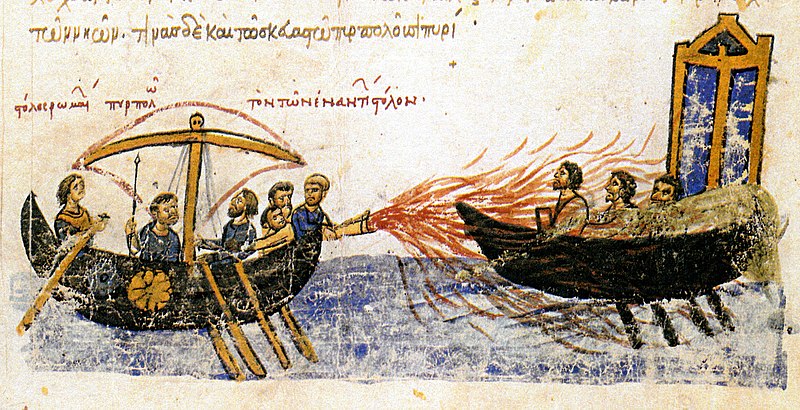
“Greek Fire being deployed against the enemies of Eastern Rome”
Tanks and rifles sure are scary and lethal, so is mustard or chlorine gas. When it comes to creating weapons to annihilate adversaries, we sure can count on how the ancient people effectively forged some of the most formidable and fearsome weapons they had used. Some of them even became the foundation of how our munitions and equipment were developed. With that, here are some of history’s feared and hottest weapons during their time.
Greek Fire

Don’t you just hate it when you accidentally burn yourself by touching hot surfaces? Then you’ll despise the incendiary weapon used by the Eastern Roman Empire in ca. 672. Called the Greek fire, this flame-throwing weapon was what the Byzantine navy typically used during naval battles to burn down enemy ships and effectively provided them with advantages that resulted in military victories. What was truly remarkable about this Greek fire was that it could be ignited even in contact with water, and the victims would continue to burn even while on water.
The Byzantines, later on, developed this weapon by using pressurized nozzles to project the liquid onto the enemy ships, much more like an ancient version of our flamethrower. The formula for this formidable weapon was unsurprisingly a closely guarded state secret, although there were speculations and debate on what it was. The proposal included a mixture of pine resin, naphtha, quicklime, calcium phosphide, sulfur, and or niter.
Greek fire was no doubt a concoction of destruction, but that did not make the Byzantine navy untouchable. Soon, the Muslim navies found ways to defend themselves from it, either by staying out and away from its effective range or by shielding themselves with felt or hides soaked in vinegar.
The Man Catcher

What’s left to do when your castle was in the middle of being besieged by horse-riding enemy forces? For the people of 18th century Europe, they could snare these attackers by catching them like fishes while they were on their horses. The weapon used was the man catcher, also known as catchpole, which consisted of a pole that was mounted with a two-pronged head. The prongs were both semi-circular in shape and had a spring-loaded “door” on the front that allowed the ring to pass around a man-sized cylinder and the victim’s head trapped. And so they would use this man catcher to fish a person from horseback and then drag him to the ground where he could be pinned to either be turned into a prisoner or helplessly killed. On some occasions, it was also used to pin down and contain violent prisoners.
Other countries like Japan also had their own version called sodegarami, tsukubo, and sasumata that were used during law enforcement in Edo-era. The difference was that the sasumata, for instance, had its forked head used to trap down the victim’s neck, legs, arms, or joints.
Morning Star

A popular one, the morning star, was like the more evil brother of the mace. Its design was crude and simple: a stick made of either metal or wood topped with a metal ball laced with spikes and blades. This weapon became popularly used by soldiers in the 14th century, particularly in Germany, where it was popularly called Morgenstern. It was used typically by aiming at the heads and faces of foes, which didn’t sound much, but imagine being hit with a heavy ball of spikes on the nose and on your whole face. It could also be used to take enemies down by aiming it at the legs and knees instead. It is sometimes confused with mace, but the main differentiating factor between the two was that the spikes of the morning star, at most, had flanges or small knobs.
Traditionally, it was used by cavalry and infantry units, with the horsemen being given a version that had a shorter shaft. All in all, there were three types of this weapon that varied in terms of workmanship quality. The first one was well-crafted for military use and was given to professional soldiers. The second was simpler and was hand-cut by peasant militiamen, and the spikes were sometimes made from nails. The third was short shafted and made of metal and ornamented with gold and silver for decorative purposes.
Situation: Famous as a leader in combat, Chesty Puller was a skillful pistol fighter as well.
Lesson: Training, skill and the best equipment are enormously helpful. Perhaps most important, though, is the fighting spirit that made General Puller a legend. And … a pre-war start in guns and hunting can shape a more survivable combatant.
Lewis “Chesty” Puller. In his time, his name was a household word, and if asked “Who was the most famous U.S. Marine?” — many people today would answer, “Chesty Puller.” He first made his mark in “police actions” in places like Haiti, rose to fame in the South Pacific campaign during World War II, and became solidified in legend by leading the Breakout in the Korean conflict.
There are many books about Puller. Most focus on his leadership and courage. One book is even devoted to his famous quotes. But most give short shrift to the general’s formidable pistol fighting skills.
Burke Davis (1913-2006) was the author of many historical non-fiction books, specializing in war and warriors. One of his trademarks was a personal touch, with deep insights into the heroes about whom he wrote. One of Davis’ classics is Marine! The Life of Chesty Puller, subtitled The Only Marine in History to Win Five Navy Crosses.
It is to Burke Davis we are primarily indebted for the following accounts of General Puller’s pistol fights, his training and background with guns and his general attitude toward related matters.
Puller In Combat
Puller’s first deployments were in Haiti and Nicaragua, supporting friendly governments who were fighting anti-American insurgents. In the latter country in 1929, he found himself traveling with a Thompson submachine gun, cased with ample spare ammunition.
Two years later, he found himself fighting for his life with his .45 pistol in Nicaragua. Davis tells us, “They were more than a hundred miles from Jinotega, Company M marching over open country on high ground beside the swift Cua River. Puller and (Col. William) Lee were not far apart when they saw, almost at the same instant, a native dugout canoe speed around a bend to their rear, bearing two men. One of these men fired, wildly. There was also a burst of rifle fire from across the river — another attempt at ambush.
“Puller reacted as usual. He ran at top speed toward the riverbank, straight for the canoe, pulling his pistol as he went. He fired in motion, and one of the canoeists fell across the gunwale. The patrol killed the other Indian, and when men splashed across the river, they found the band had fled.
“Lee thought Puller’s action a climax of the fighting in Nicaragua: ‘It was the greatest field shot I ever saw. He shot that bird from 15 to 25 yards away from that canoe, going at full speed, and the canoe moving, too. He drilled him right in the ear, so perfectly that we looked over the body for several minutes before finding the wound. He had shot him precisely in the opening of the ear. I don’t think such shooting was accidental.’” (1)
Some of the accounts of Puller’s personal engagement in combat are sketchy and short on details. Here is one, from when he was a Colonel on Guadalcanal: “A grenade fell near the Old Man — no more than eight yards away, Captain Zach Cox estimated, but Puller turned when he saw A Company scatter and yelled: ‘Oh, that damned thing ain’t going off.’ It helped steady the men. The grenade was a dud. Cockrell’s B Company was being cut up in the woods by snipers in trees with light machine guns, and fire from Puller’s front became spotty. The fight was now at close quarters: The Colonel had killed three men with his .45 — one of them a Japanese major.” (2)
There were many men in combat along with Puller who were glad they, too, were carrying pistols. One was Captain Regan Fuller, who spoke of an experience he had on Guadalcanal. “It was rough country, up and down everywhere, with plenty of cover. I sent one of my boys, Corporal Turner, up a grassy hill to our right, where we were trying to persuade the Old Man to stop for the night. I walked behind Turner — and we almost stepped on two Japs who were eating rice by a hidden fire at the base of a big tree. They were as astonished as we were, and we all scrambled. I fired three clips from my .45 and killed one of them, but the other ran down the trail toward our main body. Turner’s squad had deployed into line behind us. There was a little shooting, and then quiet …” (3)
The Guns Of Chesty Puller
Most of the time when an enemy was killed by Puller’s own hand, it appears to have been with his service pistol.
While there exists a photo of Puller shooting offhand with a very long barreled, non-issue DA revolver, virtually all the photos of him in the South Pacific and Korea depict him wearing a standard .45 auto. Burke Davis’ anecdotes all refer to him using a .45. I’ve been unable to find if or where Puller’s sidearm still exists today. Most photos of him wearing it are taken from the front, so we can’t see whether it wore a flat (1911) or arched (1911A1) mainspring housing.
There actually exists a chest holster named the Chesty Puller, but it appears to be a modern play on the great Marine’s nickname. In every photo I’ve seen of him in combat theaters, his .45 is in a standard issue flap holster on his right hip, backed up with a web double magazine pouch at the left front of his web belt. While many military officers did carry their .45s in the tanker-style chest holster during WWII, I’ve seen no indication Puller was one of them. He became a Marine early enough he was presumably issued a 1911, since the A1 dates to relatively late in the 1920s. Of course, if he preferred the 1911A1’s features (slightly better sights, longer grip tang to minimize hand bite, shorter trigger, arched housing), he had the “pull” to requisition one once they became available.
In any case, whenever Puller personally fought with a pistol in hand, it was the government-issue pistol known colloquially in his time as simply “the .45 automatic.”
Puller had specific opinions on other small arms. Pictures of him in the field almost invariably show him wearing a pistol and two spare magazines, and he expected fighting men to be constantly armed when in danger zones. Davis writes of one day when Col. Puller was selecting staff members: “When he was choosing his intelligence officers, his exec pointed out a major sent in for the purpose by headquarters. Puller scoffed loudly, ‘Hell, that man hasn’t even got on a weapon. Find me another one.’” (4)
Only The Best For His Men
He also worked hard to make sure his troops had ample ammunition. Again, from Burke Davis: “As the time for a new campaign drew near, Puller drove his staff to complete the last detail in preparation. He warned the regimental supply officer, an Army Quartermaster general, was to check their requisitions. ‘Notify me at once when he arrives,’ Puller said. ‘I want to explain things in person.’
“The Army general arrived when Puller was out, and the lieutenant took the inspector to the supply dump. Puller found them there and overheard their conversation:
“‘Lieutenant, your requisitions are excessive.’
“‘I’m sure Colonel Puller would never have signed for more than we need, sir.’
“‘But he’s asked for 10,000 brass buckshot shells. What the devil does he want with those?’
“‘To kill Japs with, sir.’
“‘Doesn’t Colonel Puller know buckshot is prohibited by the Geneva Convention?’
“‘Sir, Colonel Puller doesn’t give a damn about the Geneva Convention — any more than the Japs did at Pearl Harbor.’” (5)
It should be noted short barrel pump shotguns were indeed used in the Pacific Theater. My late mentor, Bill Jordan, a veteran of that campaign, told me he used a Winchester slide-action trench gun and an S&W 1917 .45 revolver when clearing enemy pillboxes in the island campaign. The brass buckshot shells had been requisitioned because paper shells swelled up in the heat and humidity there, getting stuck in the magazines and chambers.
Puller’s demands for the best equipment for his Marines weren’t limited to guns and ammo. Wrote Davis, “(Puller) spoke to War Production Board officials in Washington: ‘I want to ask you why American troops shouldn’t have the world’s best fighting equipment. On Guadalcanal we saw our trenching shovels break at the first use. All of our men now have Jap shovels because they’re better and more dependable. Jap field glasses are better, too. I have good ones myself, German glasses I’ve carried for 20 years. Why should American glasses be so poor? Not worth a damn in the tropics. They fog up because they are improperly sealed, and once they get damp, they’re done for. I’ve seen hundreds of pairs tossed away in the jungle or the sea, because men know they can see as well with the naked eye. What kind of American ingenuity — or patriotism — produced those?’”
Yet, curiously, Puller wasn’t a fan of the M-1 Garand that George S. Patton had called “the best battle implement ever devised.” Davis reports the following:
“There was a squabble between A Company and some of the 164th Army men, for Regan Fuller’s men had bartered for, or stolen, some new M-1 rifles during the big night’s fighting, and Army officers wanted them returned. The Colonel was amused by the affair. For himself, he favored the old rifle they brought to Guadalcanal: ‘For sheer accuracy, if you want to kill men in battle, there has never been a rifle to equal the Springfield 1903. Others may give us more firepower, but in ability to hit a target, nothing touches the old ’03. In my opinion, nothing ever will. A perfect weapon, if ever there was one.’” (6)
The following seems contradictory to the above, but Davis noted, “… Puller was asked by Marine Corps Headquarters for a full report on his experiences with the Thompson submachine gun under field conditions and sent in an enthusiastic report on the weapon’s value on patrol.” (7)
Puller’s Training & Quals
While based in Hawaii, having shot Expert Rifleman five years running, Puller was affronted when a grizzled sergeant offered to teach him to shoot. When the sarge promised to bring his rifle score up 20 points in two weeks, Puller accepted the challenge. Davis reported, “Puller became the sergeant’s pupil, shooting when targets became vacant during the training, and shot an average of two bandoleers daily. He improved rapidly, and brought his record score from 306 to 326, of a possible 350. During all these years he qualified as expert with both rifle and pistol, and when a rifle team was sent from Pearl Harbor to a competition in San Diego in 1928, Puller was a member.” (8)
Davis adds, “… in the first report period, Puller posted an average score in bayonet drill; a fellow Marine, Lieutenant Gerald Thomas, finished 10 places ahead of him. But in marksmanship, with the automatic pistol, he ranked as expert, with a score of 91.13 out of 100 points. As a rifleman, he fired 335 of a possible 350, and stood 16th in the class of officers. He also ranked as expert with the machine gun, in which he stood high in the top third of the class, with a score of 340.” (9)
The quality of marksmanship training in the United States Marine Corps is, of course, legendary. That said, Puller famously credited his survival and many of his accomplishments in battle to having been a young armed citizen before he enlisted in the Marine Corps.
Born in Virginia, he learned guns and hunting early. He was about 10 years old when cancer took his father, and he supplemented the larder by shooting small game and wild turkeys. He became a trapper, selling muskrat pelts to pay for his ammunition. “Lewis learned both accuracy and frugality, for he bought his own ammunition,” biographer Davis wrote. (10)
Another writer, Michael Martin, wrote, “After his military fighting career was over many years later, Chesty noted he learned more about the art of war by hunting and trapping than he learned from any school. He insisted the skills he learned as a kid, living off the land, saved his life many times in combat.” (11)
Lessons
The constant presence of his sidearm saved Chesty Puller’s life more than once. It is no surprise you see his holstered .45 in almost every photograph taken of him in a combat environment, from his early days in the banana republics to the Pacific Theater to Korea. Note he insisted all his men be within reach of their guns in combat environments, at all times. It saved his life multiple times over … and, doubtless, the lives of many of his troops, including Captain Regan Fuller, as noted above.
Puller was a contemporary and friend of Herman Hanneken in his early combat days. Hanneken was the man who had killed the revolutionary leader Charlemagne Peralte in Haiti in 1919, with a single .45 slug to the heart from Hanneken’s USMC-issue Colt 1911. Puller had doubtless incorporated this knowledge into his trust in the same weapon, which he learned to keep constantly close.
His critics felt too many USMC casualties had accrued from Puller’s aggressive tactics, while his defenders argued those aggressive tactics were what won his major victories. Both sides need to remember Puller was a casualty himself, blown up on Guadalcanal with shrapnel savaging his legs, yet he returned to lead from the front sooner than his doctors wanted. Many who served under him were heard to say they’d follow him into Hell … and that he actually led them there and did his damnedest to get them back out after they’d won.
It is vital to remember this legendary Marine gave credit to his survival and victories to the hunting and shooting skills he learned in boyhood and adolescence. This sort of “pre-service preparation” has served American fighting men since the beginning of our nation. Woods-wise citizen soldiers with their own rifles and muskets won the Revolutionary War. The National Rifle Association was founded in 1871 by Yankee officers who had noted the superior fighting ability of individual Confederate soldiers who had grown up hunting and shooting. Sergeant Alvin York in WWI, WWII’s most decorated soldier Audie Murphy, Carlos Hathcock in Vietnam and Chris Kyle in the most recent conflict all fit the same mold: super-soldiers whose skill at arms had been developed before they joined up. This heritage is one reason why we at the Second Amendment Foundation where I currently serve as interim president have brought lawsuits to allow young Americans ages 18 to 20 to buy their own AR15s and prepare for a career defending their nation with firearms similar to the faster-shooting true assault rifles they’ll be issued when asked to die for their country.
There is much, much more to the history and legacy of Lewis “Chesty” Puller than can be presented in this short space. We conclude with thanks to the late biographer Burke Davis, who gave us so many valuable details from this particular side of the Puller legend. He is the one to thank for what you’ve just read; hell, I merely “wrote the book report.”
For more info: SAF.org. References: 1) Davis, Burke, Marine! The Life of Chesty Puller, P. 56. 2) Ibid., P. 118. 3) Ibid., P. 118. 4) Ibid., P. 181. 5) Ibid., Pp. 169–170. 6) Ibid., P. 148. 7) Ibid., P. 61. 8) Ibid., P. 46. 9) Ibid., P. 61. 10) Ibid., P. 9. 11) Martin, Michael. “Chesty” Puller and the Southern Military Tradition, Abbeville Institute Press, 2018.

“Many GIs in Vietnam thought the night belonged to the enemy, but in the Mekong Delta, darkness belonged to Bert Waldron.” –Major John Plaster

Think back to the last time you felt truly frustrated and helpless. At some point in their lives, everybody finds themselves in circumstances utterly beyond their control. It’s a terrifying sensation.

Perhaps you were the subject of bullying. Maybe you were a little kid and got lost. For the Vietcong in the Mekong Delta in 1969, the engine behind their nightmares was SSG Bert Waldron.

SSG Waldron was a broken man imbued with a dark gift. Born in Syracuse, New York, in 1933, Waldron came of age amidst chaos and despair. The product of a dysfunctional home, young Bert despised his stepfather. This antipathy drove the kid into the nearby forest in search of peace and solitude. There Bert Waldron came to think of the wilderness as home.

Bert Waldron’s life could be a case study of the effects of nature versus nurture. By his 23rd birthday, the man had been married three times. His unique emotional milieu apparently made him all but impossible to live with. Waldron enlisted in the US Navy and served during the Korean War. He left the Navy in 1965 after twelve years to try his hand at civilian life.

With the country embroiled in an increasingly bitter land war in Southeast Asia and life out of uniform not to his liking, Waldron enlisted again, this time in the Army. He completed Basic Training at Fort Benning and five months later was in Vietnam.

Waldron’s prior service in the Navy earned him Staff Sergeant’s stripes, but he still had very little experience with practical soldiering. Once in country, SSG Waldron attended a brief eighteen-day sniper course taught by members of the Army Marksmanship Unit. I don’t know exactly what they taught during those two and one-half weeks, but it took. In short order, SSG Bert Waldron became a holy terror behind a sniper rifle.

SSG Waldron was assigned to the 3d Battalion, 60th Infantry, Regiment, 9th Infantry Division under LTG Julian Ewell. Operating in close conjunction with the Navy’s Mobile Riverine Force, SSG Waldron and his fellow snipers cruised the murky waterways of the Mekong looking for trouble. Waldron’s prior service as a sailor made him a perfect fit for this joint operation with the Brown Water Navy. More often than not Waldron staged onboard ATC’s or Armored Troop Carriers. These heavily armed and armored riverine vessels were called Tango Boats and offered US forces a prickly platform for operations throughout the myriad shallow waterways of the Mekong Delta.

The Mekong was heavily populated and teeming with VC. Charlie typically played to his own strengths, conducting many operations under cover of darkness when American air power and artillery support could not be readily brought to bear. Then Bert Waldrop and his snipers hit the battlefield with high-tech sniper rifles equipped with starlight scopes. The result was unfettered carnage.
War Stories

It takes unimaginable courage to strike out alone into the jungle in the middle of a firefight, but that was exactly Bert Waldron’s forte. In January of 1969, Waldron and his unit came under intense night attack by a force of forty well-armed VC. When his unit found itself in danger of being overrun SSG Waldron pressed out into the jungle alone to hunt. Using his accurized M21 sniper rifle and AN-PVS-2 starlight scope he could spot the enemy maneuvering in the deep foliage and pick them off as opportunity allowed. During the course of the engagement, SSG Waldron savaged the attacking force and broke the back of the assault. This fight earned him a Bronze Star with “V” device.

Three nights later SSG Waldron discovered a large VC force moving tactically. He tracked the enemy unit using his night vision system until he gained an advantageous position to attack. SSG Waldron then sniped and maneuvered, engaging from various angles to convince the VC they were facing a larger, more organized force. Three hours later he had killed eleven of the Cong and forced them to leave the field. This night’s work earned him the Silver Star.

Eight days later SSG Waldron and his spotter were set up near Ben Tre scanning the darkness around their rice paddy with their starlight equipment. They encountered a seventeen-man VC patrol and took out their lead scout as he emerged from the treeline. Calls for artillery support were denied because of a nearby friendly village. At a range of more than 500 meters and under cover of darkness SSG Waldron killed eight VC with eight rounds from his sniper rifle. The surviving members of the VC combat patrol melted back into the jungle to safety.

Four days after that SSG Waldron was deployed in support of an ARVN unit in contact. He discovered a group of six VC attempting to outflank the ARVNs and gain a position of advantage. SSG Waldron then meticulously killed all six of the insurgents, picking them off one by one in the darkness with his sniper rifle and night vision gear.

In one nineteen-day period, SSG Bert Waldron conducted fourteen successful nocturnal sniper operations. For his dedication, valor, and ruthlessness he was awarded his first Distinguished Service Cross. By now the VC were beginning to appreciate that horrible feeling of helplessness. Where previously they could move and operate in the darkness with relative impunity, now SSG Waldron and his snipers brought death from unexpected quarters. Their efforts began to take a toll.

SSG Waldron’s effectiveness as a sniper clearly spawned from some innate skill. He had only had eighteen days’ worth of formal sniper training. During one engagement a VC sniper was peppering a passing Tango Boat from the top of a coconut tree some 900 meters distant. While the boat’s crew struggled to find the hidden sniper with their heavy crew-served weapons, SSG Waldron killed the man with a single round from his M21 rifle…while the boat was in motion. The Physics behind making a one-round kill from a moving boat against a camouflaged adversary nearly a kilometer distant strains credulity. However, the details were verified.

For these and similar actions SSG Waldron was awarded his second Distinguished Service Cross. Waldron’s reputation exploded among both Allied forces and the Cong, earning him the respectful nickname Daniel Boone. After eight months in country, the 9th ID rotated home and SSG Waldron with them. By the time he left Vietnam Bert Waldron had 109 confirmed kills, fully 12% of all the kills logged by all of the division’s snipers. Until Navy SEAL sniper Chris Kyle broke his record in 2006, SSG Bert Waldron was the deadliest American sniper in history.
The Weapon

The Army adopted the M14 rifle as a replacement for the WW2-era M1 Garand in 1959. A gas-operated, magazine-fed design, the M14 really reflected the previous generation’s technology. At 44 inches long the M14 was found to be unduly bulky for the bitter close-range jungle fighting that characterized the war in Vietnam. By the mid-1960’s the M14 was being replaced in SE Asia by the lighter, more maneuverable M16.

The US Army is indeed a majestically cumbersome beast. In 1955 the US Army Marksmanship Training Unit (USAMTU) embarked on a quest to incorporate snipers into the Infantry squad. In the malaise of the early 1960s, this initiative was discontinued. However, the exigencies of combat in Vietnam renewed interest in the art. That exposed the need for a dedicated precision sniper rifle.

While the Marines were using modified bolt-action hunting rifles, the Army contracted with Rock Island Armory to build up 1,435 National Match M14 rifles with Redfield 3-9x Adjustable Ranging Telescope (ART) sights. The ART was the brainchild of 2LT James Leatherwood and included both range finding and bullet drop compensation in its mechanism. This new rifle was formally designated the XM21 and first issued in 1969. An improved version with a fiberglass stock was classified the M21 in 1975 and served until 1988 when it was replaced by the bolt-action M24.

The AN/PVS-2 starlight scope was the first truly successful man-portable passive night vision weapon sight fielded by the US Army. This device amplified ambient starlight to produce a usable image in the absence of an active IR emitter. While such stuff is commonplace today, it was radical indeed in 1967 when it was first deployed to Vietnam. When combined with the early SIONICS suppressors fielded in 1969 the AN/PVS-2 offered American snipers a literally unprecedented capacity to own the night in Vietnam.
The Rest of the Story

Like so many true professional warriors, Bert Waldron found himself ill-suited to peacetime life at home. He served as a senior instructor for the US Army Marksmanship Training Unit (USAMTU) until his discharge in 1970. Along the way he met Mitch WerBell III through the commander of the USAMTU, COL Robert Bayard. and accepted a position as a counter-sniper advisor with Cobray International, WerBell’s weird creepy paramilitary training school in Georgia.

Mitch WerBell dabbled in overthrowing third world governments for a time and made quite a few enemies along the way. In 1975 COL Bayard was found murdered outside an Atlanta shopping mall. His killer was never apprehended. Throughout it all Bert Waldron’s name was a persistent fixture.

For the next two decades, Waldron worked in the shadows, plying the dark skills he mastered in Vietnam into a livelihood. Along the way his final marriage self-destructed and he was investigated by the FBI. In October of 1995, Bert Waldron died of a heart attack at age 62. His ex-wife Betty said this of him, “Bert was a wonderful soldier. He loved his country, he would have died for his country, but he had a lot of problems as a human being.”

Bert Waldron was a “Break Glass in Case of War” type of soldier. America desperately needs such men. It is simply figuring out what to do with them when the bullets aren’t flying that seems to be the perennial challenge.