


The fight to get vital supplies through to Malta would test Britain’s Fleet Air Arm to the limit.

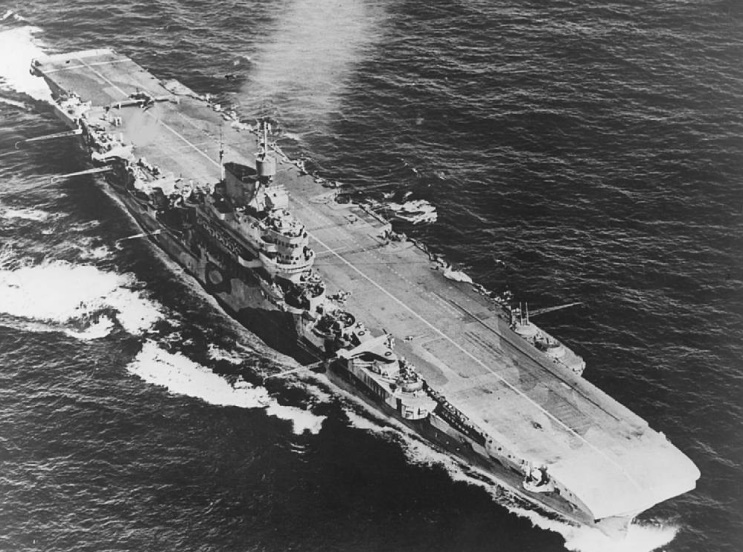
HMS INDOMITABLE from the aircraft carrier VICTORIOUS during the Pedestal Malta convoy.
PRELUDE
HMS Indomitable was deployed on a mission which was to prove the crux of the war in the Mediterranean.
Vital supplies had to be delivered.
Malta simply could not be lost.
Not only was it a vital refuge at the heart of the dangerous Sicilian Narrows, Malta was invaluable as a base of offensive operations against Axis supply lines.
The rocky island would determine the fate of the war in the Mediterranean and beyond. If it fell, not only would Axis forces in North Africa receive their supplies largely unhindered, British supply lines to Egypt, the Middle East and India would be largely severed.
Both sides knew the importance of the island fortress.
It would come down to a test of resolve to see which side was most determined to possess it.
Britain had attempted to run several supply convoys to the beleaguered base in the months leading up to Operation Pedestal.
Operations Harpoon and Vigorous succeeded in getting only four out of 17 cargo ships through to the island.
A lack of sufficient air cover made the convoys extremely vulnerable to air attack, despite the valiant efforts of the anti-aircraft cruisers assigned to their defence.
Fast cruisers and submarines were pressed into service to run the most essential supplies through the Axis gauntlet.
But this was not enough. Malta was being slowly starved of food, munitions and fuel.
Axis air attacks were increasing in intensity. During July, the RAF lost 36 out of 135 Spitfires while attempting to repel repeated attacks. Aviation fuel reserves also were being rapidly depleted.
The Governor of Malta would report:
“…our situation is so grave that it is my duty to restate in the clearest possible terms. The decision materially reduces our chances of survival not because of any failure of morale or fighting efficiency but because it is impossible to carry on without food and ammunition. …”
He predicted Malta had enough supplies to last until September, at which point surrender would be inevitable.
Prime Minister Winston Churchill thought that the loss of Malta
“…would be a disaster of [the] first magnitude to the British Empire”
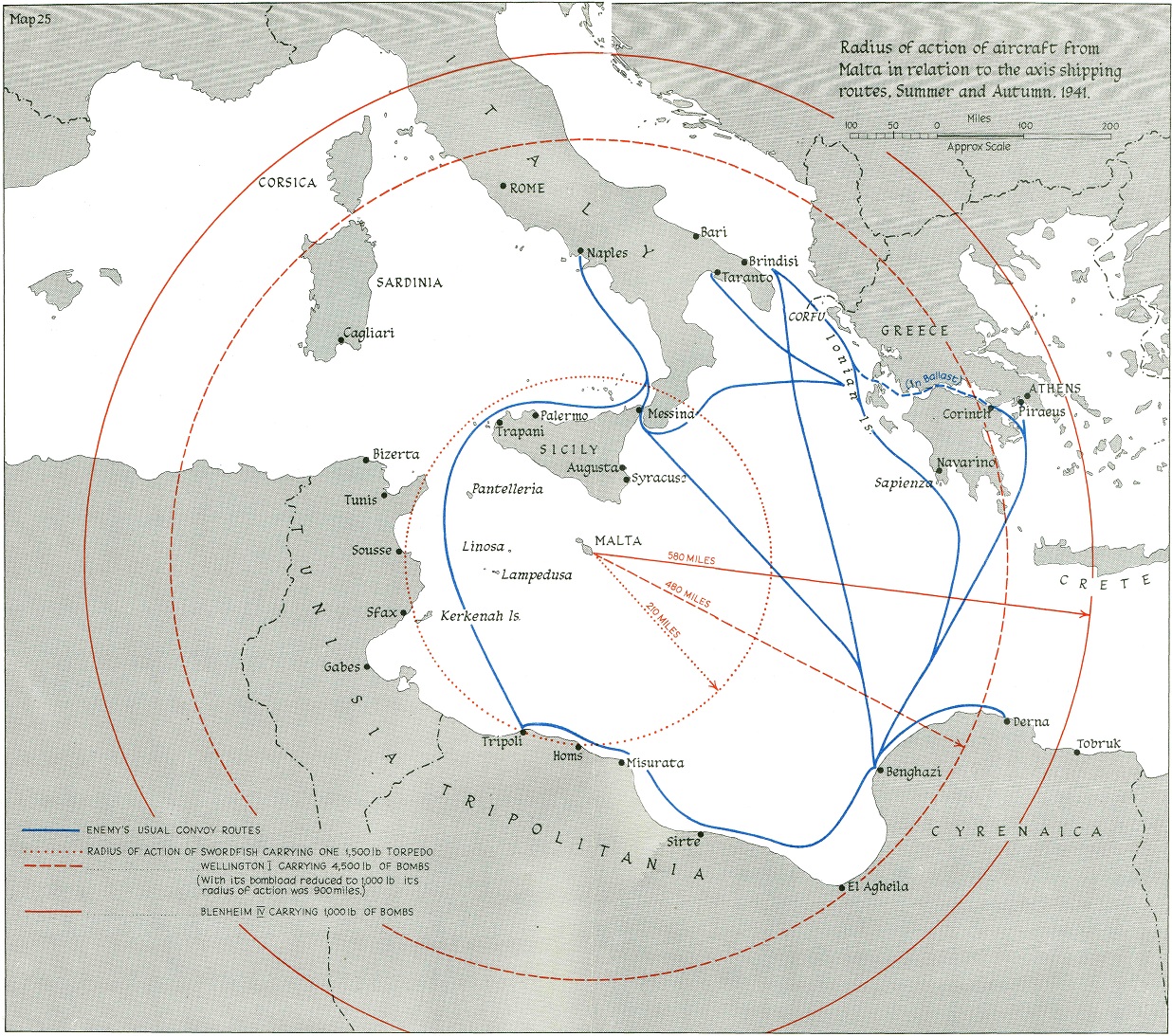
Heart of the matter … The radius of action for aircraft operating from Malta in 1941.

It was resolved that Convoy WS 12S – Operation Pedestal – would be given the strongest possible escort and the fastest and most modern merchant vessels in an all-out effort to break the siege of Malta.
Equally, the Axis wanted it destroyed.
The bombers and submarines based there were wreaking havoc among the supply lines to Africa. Tobruk had fallen and Rommel’s forces needed supplies delivered to El Alamein.
General Rommel knew his position.
“With Malta in our hands, the British would have had little chance of exercising any further control over convoy traffic in the Central Mediterranean. I have personally warned Marshal Kesselring of the tragic consequences for my lines of communication between Italy and Africa if he does not succeed in establishing air superiority over Malta.”
Admiral Doenitz’ outlook was equally grim:
“Even with all the Spanish tonnage and the ships we could seize if we invaded southern France, even by increasing construction tenfold in Italian shipyards, we could not keep up another Rommel campaign. Malta must be destroyed.”
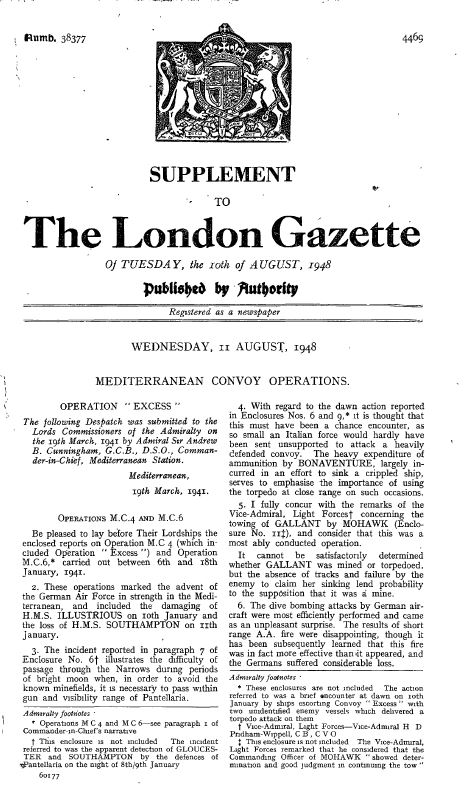
CLICK on the above image to be taken to the original PDF
BRITISH PREPARATIONS
The key to the success of any supply run to Malta would be adequate air protection. To this end three fleet carriers would be allocated to the covering force.
HMS Indomitable was withdrawn from the Eastern Fleet as the Admiralty felt the likelihood of a Japanese foray into the Indian Ocean was highly unlikely after their losses at the Battle of Midway.
The capital ships and carriers of the Home Fleet were also unexpectedly available. The devastation of Convoy PQ17 in July had resulted in the suspension of all relief efforts to Russia. No covering force would be needed in the cold northern waters for the foreseeable future.
This made HMS Victorious available for Operation Pedestal.
Both these modern armoured fleet carriers would join HMS Eagle of Force H in Gibraltar to shepherd the 14 fast merchant ships through to Malta.
Vice Admiral Edward Syfret was assigned to command the combined escort forces of Operation Pedestal, designated Force F. Rear Admiral (Aircraft Carriers) Lyster, of the Home Fleet, would direct the carrier operations. Rear Admiral Burrough of the 10th Cruiser Squadron would lead the close escort through to Malta.

Hawker Sea Hurricanes and Fairey Albacores on the flight deck of HMS INDOMITABLE during a Malta convoy. Note the radio masts in the upright position and the crane on the edge of the deck.
FLEET AIR ARM
Operation Pedestal was to be given the greatest protection possible. Some 70 fighters were assembled on three fleet carriers to counter he German and Italian bombers. A strong force of 30 Albacore Torpedo-Strike-Reconnaissance bombers was to act both as a deterrent to Italian surface ships and as an anti-submarine measure.
The carrier air wing (immediately prior to Operation Berzerk) was as follows:
-
HMS Indomitable: 11 Martlet IIs (806 Squadron), 24 Sea Hurricanes (12 in 800 and 12 in 880 Squadrons), 16 Albacores (in 827 and 831 Squadrons).
-
HMS Victorious: Six Sea Hurricanes on deck park (885 Squadron), 20 Fulmar IIs (14 in 809 and six in 884 Squadrons), 14 Albacores (12 in 832 and 2 in 817 Squadron).
-
HMS Eagle: 16 Sea Hurricanes active (six of which were on outriggers) and an additional four stowed in reserve (12 in 801 Squadron, four in 813 Flight ).
-
HMS Furious: Four Albacores, 40 Spitfires.
Many accounts of Operation Pedestal give differing figures to the above: These are not incorrect. Rather, they list the surviving air group at the time the carriers crossed the Straights of Gibraltar – after the training and patrol attrition leading up to and including Operation Berzerk.
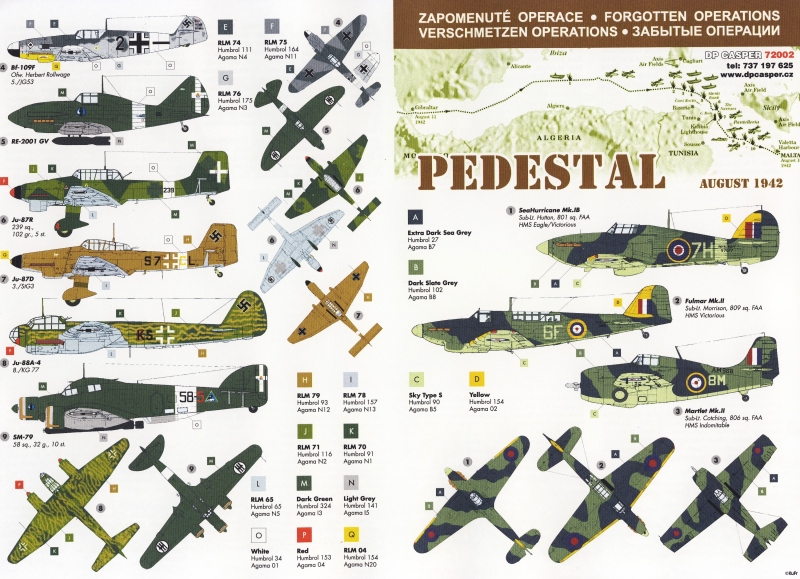
Operation Pedestal was to be the Fairey Fulmar’s last great battle. By now their limitations were well and truly realised. What slim advantage they had held over Italian aircraft in 1940 and 1941 had long since been lost. Now, the Sea Hurricane and Martlet were the FAA’s main fighters.
The Fleet Air Arm knew the aircraft situation was not ideal.
The Sea Hurricane was another stop-gap aircraft, pressed into service by necessity. Grumman had been unable to produce enough Martlets to meet FAA demand. This was both because of the outbreak of war in the Pacific, as well as earlier development difficulties in getting the aircraft’s folding wings to work reliably.
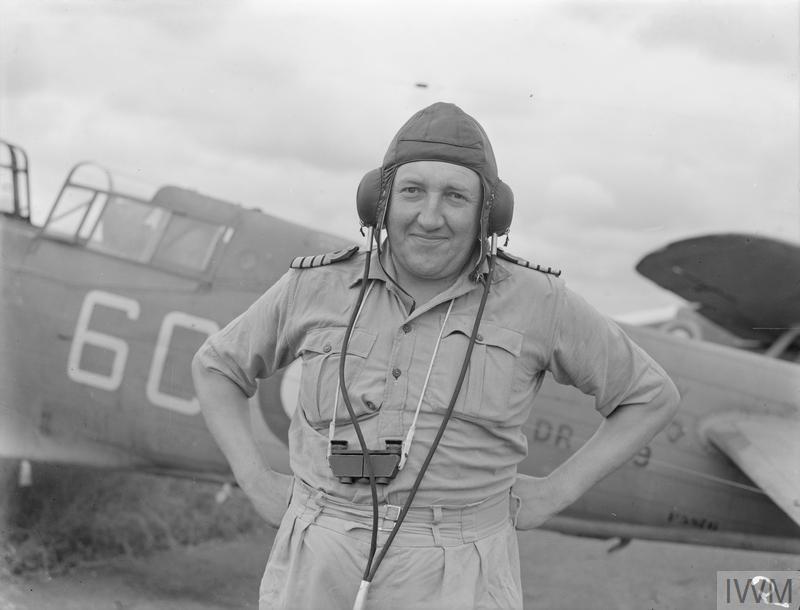
Captain T H Troubridge, Capt of HMS INDOMITABLE.
The Hurricane had an endurance of only 90 minutes (or an hour with combat reserves), making commanders reluctant to include them in air patrols because of the frequency of turning into the wind to land and launch fresh aircraft.
This was particularly apparent in Operation Pedestal: HMS Indomitable had to turn into the wind 37 times in the course of only one day in order to launch and receive 78 sorties.
However, the Sea Hurricane’s value as an interceptor was greatly welcomed: Its climb rate, speed and manoeuvrability – while not a match for the German Me109 – were capabilities without which the convoy could not sail.
Operation Pedestal would be the Sea Hurricane’s most significant battle.
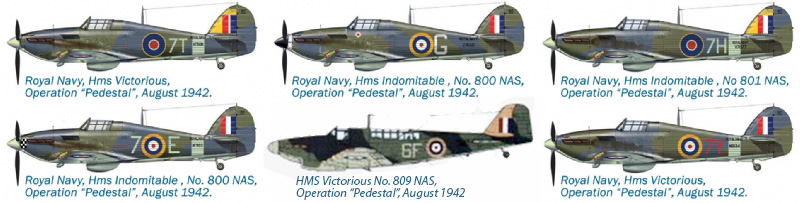
The tubby Grumman Martlet II would also make its mark. It had desirable endurance and a good climb rate, but it was regarded as lacking in manoeuvrability and suffering lower-than-advertised top speeds. The armoured, self-sealing and folding wing version – the only version the FAA regarded as combat capable – was also not available in sufficient numbers to replace the Hurricanes and Fulmars due to demands to equip existing and newly-forming USN squadrons.

Preliminary movements: 3 – 10 August 1942: Photograph taken from the after end of VICTORIOUS’ flight deck showing HMS INDOMITABLE and EAGLE. A Hawker Sea Hurricane and a Fairey Albacore are ranged on VICTORIOUS’ flight deck.
During Pedestal the Fulmars were limited to a patrol height of 10,000ft because of their poor climb rate. As a result, HMS Victorious was allocated the “low cover” role for the fleet. But, together with the Martlets, the Fulmar’s long endurance guaranteed the old fleet fighter a prominent place among the standing air patrols.
With three different types of fighters, Operation Pedestal put each to their best use in the 18-fighter strong “stacked” CAP (optimally divided at six high, six medium and six low).
The Martlets were positioned at medium altitudes as they had the fastest climb rate. The Sea Hurricanes took the high position to dive on their prey. The Fulmars filled the sea-level gap, relying on radar directors to target incoming torpedo bombers.
A further 18 fighters were planned to be maintained “at the ready” on the decks of the three fleet carriers. During times of most extreme danger, a further 12 would hopefully be in a position to be ranged on deck for an emergency launch. The maximum fighter “surge” capability was calculated at 48 machines.
All these fleet fighters were capable of tackling a Ju87 Stuka. But none could easily take on the much faster Ju88. This made the defence of Operation Pedestal a very difficult task for pilots and fighter control officers.
OPERATION BERZERK

The Allied commanders knew nothing on the scale of Operation Pedestal had been attempted before. The challenge was full of unknowns and at great risk of degenerating into chaos. A three-day exercise conducted in the waters west of Gibraltar was hoped to prevent any such confusion.
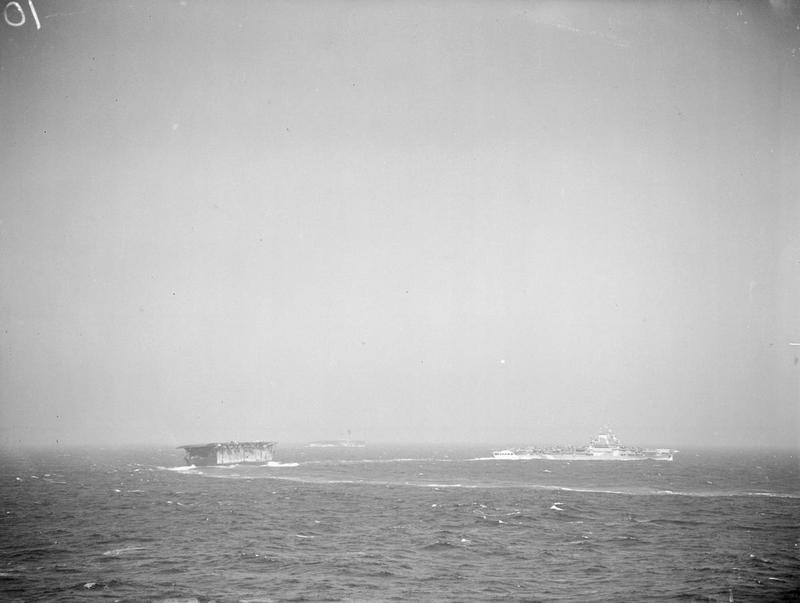
Preliminary movements 3 – 10 August 1942: HMS VICTORIOUS followed by ARGUS, with EAGLE in the distance.
The manoeuvres between the carriers HMS Indomitable, Victorious and Eagle in conjunction with their close escorts HMS Phoebe, Sirius and Charybdis and attendant destroyers was specifically designed to rehearse their fighter recognition, direction and defence procedures.
Also of key importance was practicing at-sea refuelling: A task which was to prove difficult under the rough conditions experienced.
The old aircraft carrier HMS Argus took part in these work-up exercises before returning to Britain.
HMS Furious was late in joining: She had experienced difficulties with her humped flight-deck clipping the propellers of the RAF Spitfires.
Admiral Syfret would remark:
“(This was) the first occasion when five HM aircraft carriers have ever operated in company at sea simultaneously.”

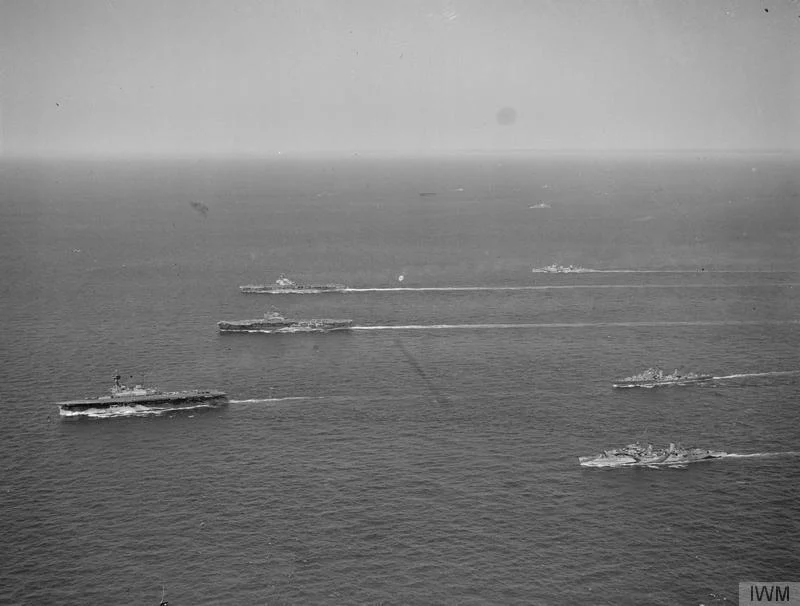
Preliminary movements 3 – 10 August 1942: Aerial view of some of the ships escorting the convoy. Nearest the camera is HMS EAGLE, then HMS INDOMITABLE and HMS VICTORIOUS and in the background are HMS FURIOUS and HMS ARGUS.
The fighter pilots themselves desperately needed the practice. Only 809 and 880 Squadrons had been operating aboard carriers with the aircraft they were flying for more than three months.
As the captain of HMS Indomitable was to point out in his after-action report, several squadrons lacked carrier experience. None of the Sea Hurricane pilots of 800 squadron had ever landed on the deck of a carrier, and only one Martlet pilot from 806 squadron could boast of such an achievement. Both squadrons had only received their new aircraft types in June.
Nevertheless, the squadrons also contained several of the Navy’s most experienced pilots. Lt Cdr “Bill” Bruen was CO of 800 Squadron with Lt W.H. Martyn as his senior pilot. 880 Squadron had Battle of Britain veteran Lt “Dickie” Cork as senior pilot.
The exercise, which included at-sea refueling from a fleet oiler, proved largely successful. But one of Indomitable’s 11 Martlets had been written-off in a landing accident before the exercise, and another rendered unserviceable during “Beserk”. Four Fulmars were also written-off during the exercise.
One of the key components was the assigning of anti-aircraft cruisers as “guard ships” to individual carriers. HMS Indomitable had HMS Phoebe as her attendant. HMS Eagle had Charybdis. HMS Victorious had Sirius.
The fleet’s fighter control teams resolved that interceptions should be conducted by HMS Victorious’ well equipped direction office and more modern Type 281 radar as a result of this intense testing of manoeuvres, tactics and capabilities. The Type 281 would be used to track incoming raids while the Type 277 radars on Sirius and Indomitable would be used for continuous all-round surveillance.
* David Brown in Carrier Fighters states Victorious had a Type 79B radar which proved better at height finding, while Indomitable and Sirius had Type 281 – better at low-altitude detections. I shall attempt to find an accurate primary source.

A Sea Hurricane on an outrigger aboard HMS VICTORIOUS, with HMS SIRIUS, PHOEBE, INDOMITABLE and EAGLE following.
ALLIED ORDER OF BATTLE
British Command: The Flag Officer Commanding was Vice-Admiral E. N. Syfred aboard the battleship HMS Nelson. Rear-Admiral (Aircraft Carriers) Lyster had his flag aboard HMS Victorious.
Merchant ships: Empire Hope, Dorset, Waimarama, Brisbane Star, Port Chalmers, Almeria Lykes, Santa Elisa, Wairangi, Rochester Castle, Ohio, Clan Ferguson, Glenorchy, Melbourne Star and Deucalion
Force X (Close escort to accompany merchants to Malta under the flag of Vice Admiral Burrough aboard Nigeria): Cruisers HMS Nigeria, Kenya, Manchester and Cairo. Destroyers Ashanti, Intrepid, Icarus, Foresight, Fury, Derwent, Bramham, Bicester, Ledbury, Pathfinder and Penn
Force Z (Covering force): Carriers Victorious, Indomitable and Eagle. Battleships Nelson and Rodney. Cruisers Phoebe, Sirius and Charybdis. Destroyers Laforey, Lightning, Lookout, Quentin, Somali, Eskimo, Tartar, Ithuriel, Antelope, Wishart, Vansittart and Wrestler.
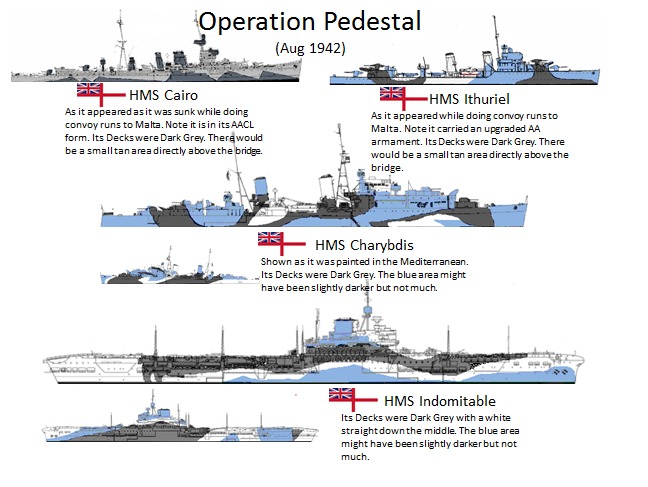
Source: Unknown.
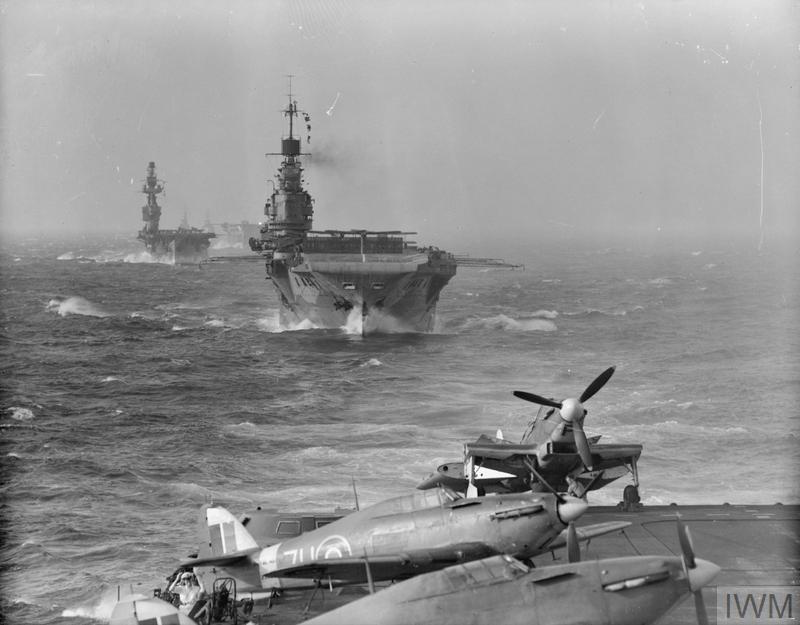
Malta Convoy guardians in line ahead: VICTORIOUS (from which the picture was taken) leading INDOMITABLE and EAGLE.
At dusk on August 10, a diversionary convoy set sail from Haifa and Port Said with an escort of cruisers and destroyers. It was to turn back on August 11.
Intelligence assessments had warned of the likelihood of submarine pickets all along the convoy’s route. There was also a chance the Italian navy may make a foray. Germany was not thought to have any aircraft deployed to Sardinia. Air attacks were not believed likely before August 12, and the first waves of Italian bombers out of Sardinia were not expected to have fighter escort.
While the Italians were expected to have at least seven submarines deployed along the route to Malta, British intelligence did not expect any German U-boats to be operational in the region.
The greatest period of danger was assessed to be the evening of the 12th, once the carriers and battleships of Force Z had turned away from the Sicilian Straits. Pedestal’s air and sea defences would be at its weakest until it passed within Malta’s protective umbrella.
It would be up to the cruisers and destroyers of Force X to see the merchant ships through this vulnerable time. The advanced radars on HMS Nigeria and Cairo were expected to make best use of a long range air patrol of HMS Victorious’ Fulmars. Their fighter-direction abilities would also maximise the protection offered by Malta’s Spitfires and Beafighters
That, at least, was the plan.

AXIS ORDER OF BATTLE
Axis Command: (Italy) Admiral Ricardi of Supamarina and General Rino Corso Fougier of the Superareo. (Germany) Fieldmarshal Albert Kesselring.
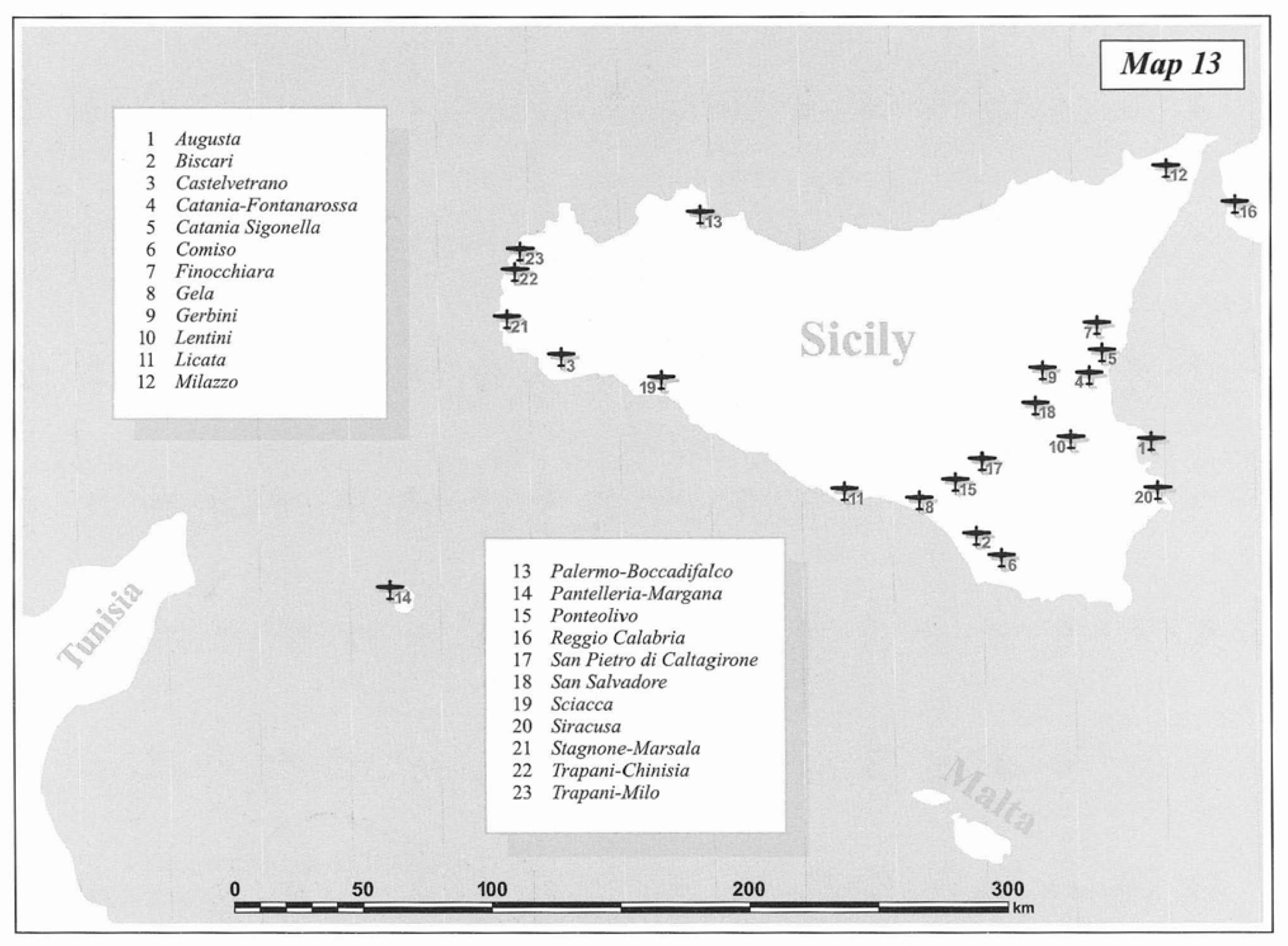
Italian land-based aircraft: (Sicily/Sardinia): 328 aircraft (90 torpedo bombers, 62 bombers, 25 dive-bombers, 151 fighters). In addition, two experimental S79 radio-controlled “flying bombs” were deployed to Villacidro with their Z1007bis “guide”.
German II and X Fliegerkorps: 456 aircraft (328 dive bombers, 32 bombers, 96 fighters)
On August 11, Fieldmarshal Kesselring reported this total of 784 aircraft was ready to engage the British.
Plans were hastily put into action when, on the night of August 9, a large number of ships was reported passing through the Straits of Gibraltar. By 1800 on the 10th, the Italians had assessed that a force of one battleship, two aircraft carriers, four cruisers, 23 escorts and 19 cargo ships were on their way towards Malta. The Supermarina predicted the convoy would pass through the Sicilian Narrows during the evening of August 12.
Fieldmarshal Kesselring ordered II Fliegerkorps to bring its bombers to a high state of readiness, along with the redeployment of aircraft – including fighters – to Sardinia. Italy made a similar redeployment of fighters.
X Fliegerkorps was instructed to conduct comprehensive reconnaissance operations over the eastern Mediterranean.
German intelligence also reported shipping movements – including four cruisers and 10 destroyers – in the western Mediterranean. Heightened activity was also observed in Alexandria.
When this information was passed on to the Italians, fears were raised that the British activity represented an invasion force – not a relief convoy.
Speculation was rampant that Tobruk or Tripoli would be attacked. The German Panzerarmee Afrika was placed on high alert and told to expect a landing at some point along the North African coast between August 13 and 14.
A fighter squadron and several dive-bomber squadrons were ordered to prepare for deployment to Benghazi or Tripoli – depending on where the invasion unfolded. All Axis shipping movements in the North Africa region were halted on August 12.
Most of II Fliegerkorp’s torpedo-bombers had been moved to Norway in June to oppose the Russian convoys.
To make up for this, a Ju88 torpedo-bomber squadron was transferred from Groseto, Tuscany, to Catania, Sicily. About 20 X Fliegerkorps Ju88s based in Crete were also moved to Sicily on August 11. Another eight arrived on August 12.
Fuel shortages prevented their support personnel and weapons also being transferred.
The frantic redeployments to Sardinia had a purpose.
The Germans and Italians intended to surprise and overwhelm the convoy defences with a single strike force of 22 torpedo bombers, 125 dive-bombers and about 40 high-level bombers under a heavy fighter escort.
This would require a high degree of synchronisation, with the Italians forming the main body and the Luftwaffe providing two separate corresponding waves.
The plan was to sink the carriers first. Once the threat of fighter cover was removed, smaller attacks could be launched in conjunction with Italian warships to finish off the merchantmen.

A view of the Pedestal convoy from the air, showing HMS EAGLE hauling out of the formation with cruiser and destroyer support for flying operations, with the merchant ships with either NELSON or RODNEY in the background.

WEDNESDAY, AUGUST 10
In the early hours of August 10, in dense fog, the ships of Pedestal entered the Straits of Gibraltar.
Each merchant skipper opened the sealed envelope which had been given to them by the First Lord. It wished them all “God Speed”.
The convoy formed up into five columns, the central line comprising the battleships and carriers, with the other columns made up of merchantment with a cruiser in the lead. The remaining cruisers brought up the rear.
Surrounding the neat rows were 21 destroyers, each of them prancing about their assigned sector in search of submarines.
Vice Admiral Syfret was confident the ships would pass unnoticed by enemy agents.
His optimism was short lived.
At 0525 four Sea Hurricanes were scrambled to intercept an unknown contact, a “bogey”. It proved to be a Sunderland which opened fire on the approaching FAA fighters.
Another four were launched at 0645. This proved to be a Hudson.
Then the convoy passed through the middle of a Spanish fishing fleet.
About 1700 a French civil flyingboat passed overhead. It was left to go on its way as a civilian non-combatant. But its crew were heard to radio a sighting of the convoy – reporting two battleships, two aircraft carriers, two cruisers, 14 destroyers and 12 transports. These details were immediately forwarded to the Italians by the Vichy authorities.
Two hours later two Martlets were scrambled to identify another bogey. It proved to be a Vichy Bloch 174 reconnaisance aircraft. The FAA did not attack.
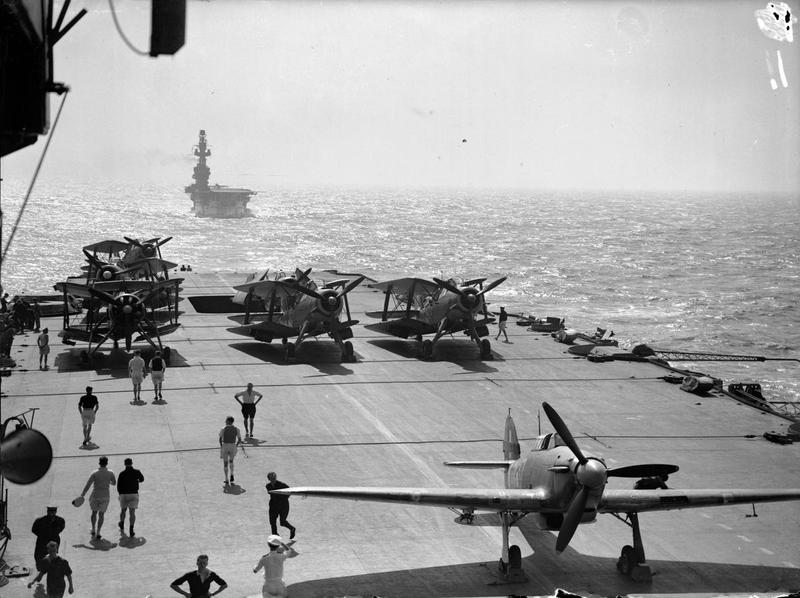
HMS EAGLE seen from the flight deck of HMS INDOMITABLE. Fairey Albacores and Hawker Hurricanes can be seen on the deck of INDOMITABLE, during a Malta convoy.
TUESDAY, AUGUST 11

Six Hawker Sea Hurricanes of 885 Squadron, Fleet Air Arm with their engines running, ranged on the deck of HMS VICTORIOUS. All are ready to take off the moment an enemy aircraft is spotted.
Italian and German submarines were by now full alert due to the French flying boat’s alarm. So, at 0438, the Italian submarine Uarsciek reported firing torpedoes at a carrier. No hit was scored and the convoy noticed no tracks.
At 0620, when Pedestal was south of the Belearic Islands, a U-boat sighted the formation making steady progress eastward. A German Ju88D confirmed the convoy shortly later at 0815, placing it roughly 95 miles north-west of Algiers.
Black Section of 880 Squadron’s Sea Hurricanes was flown off from HMS Indomitable to catch the fast-moving reconnaissance bomber. The Ju88 took up station above the convoy at between 20,000 and 24,000 feet.
Blue Section then took over the pursuit. Blue 1 and 2 spotted the Ju88 at 20,000ft – 2000ft above their own position. After a 10-minute chase, Sub Lt Howarth in Blue 2 opened fire – forcing the Ju88 to turn towards Lt Cork in Blue 1 – his 20mm cannon armed Sea Hurricane. Cork reported seeing the Ju88’s starboard engine’s cowling falling away and a trail of black smoke.
But return fire would take its toll: Several rounds passed through Cork’s Sea Hurricane’s wings and jamming the starboard aileron.
The Ju88 dived – its rear gunner reportedly slumped over his weapon. The bomber pulled away in the dive, and contact was lost at 200ft.
Cork was credited with a “probable” kill – though German records show the aircraft returned to Sardina with one dead and one wounded.
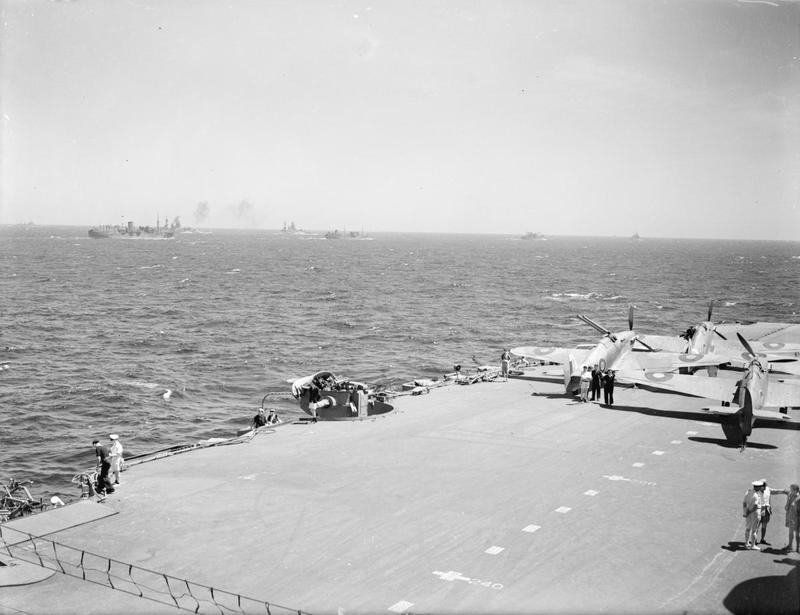
A deck park of Sea Hurricanes protected by the crash-barrier (foreground) aboard HMS INDOMITABLE.
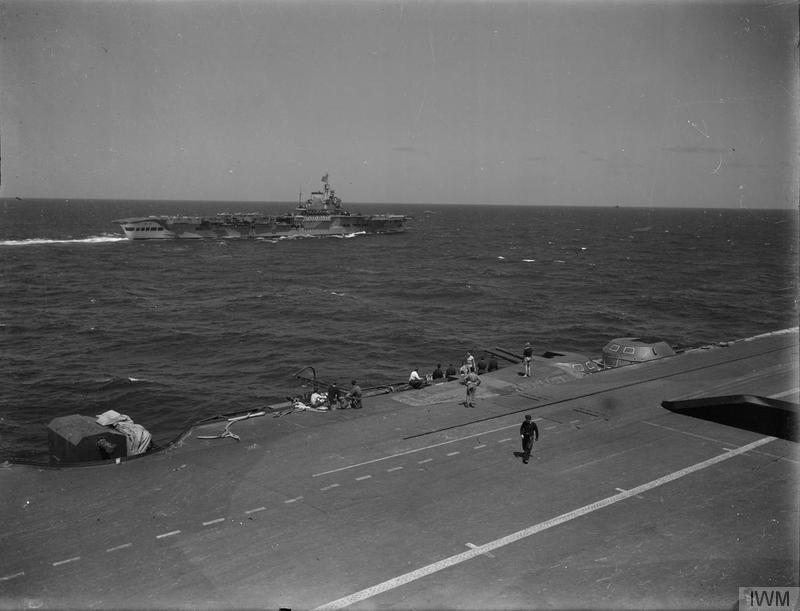
This photo is incorrectly captioned by the IWM. It is of HMS INDOMITABLE, photographed from VICTORIOUS.
Shadowers would stay with the convoy for much of the day.
At 1010, another reconnaissance Ju88 radioed a comprehensive sighting report. A Fulmar launched from Victorious at this time ditched when the port wing suddenly caught fire. Spontaneous combustion of incendiary ammunition was blamed.
Vice Admiral Syfret would observe:
“The continuous snooping throughout the day despite all our fighters could do to prevent it; and the heavy, but fortunately unsuccessful, air attack at dusk. Our fighters competed manfully at great height against the snoopers but the speed and the height of the JU 88s made the fighters’ task a hopeless one. It will be a happy day when the fleet is equipped with modern fighter aircraft.”
By noon the convoy was zig-zagging 75 miles south of Majorca. For much of the day the covering force cruisers and destroyers refuelled from the two Royal Fleet Auxiliary tankers accompanying the convoy.

A Spitfire taking off from HMS FURIOUS during Operation Bellows.

Spitfires moved on to the deck of HMS FURIOUS
OPERATION BELLOWS
HMS Furious pulled out of the convoy and began to fly off her 38 Spitfires after 1129.
Two flights of eight aircraft had departed when, suddenly, an explosion rung out from the direction of the old carrier HMS Eagle.

HMS EAGLE’s flight deck is awash as a merchant ship from the Pedestal convoy presses on.
LOSS OF EAGLE
Sub Lt. Chancey Parker was possibly the first to spot the torpedoes which would so dramatically affect Pedestal’s chances. His Fulmar was in the landing circuit for HMS Victorious:
“I looked over the side and saw three or four torpedo tracks very close together and heading straight for Eagle, so I shouted to my telegraphist Leading Airman Ford to broadcast a warning, but they probably hit as the message was received.”
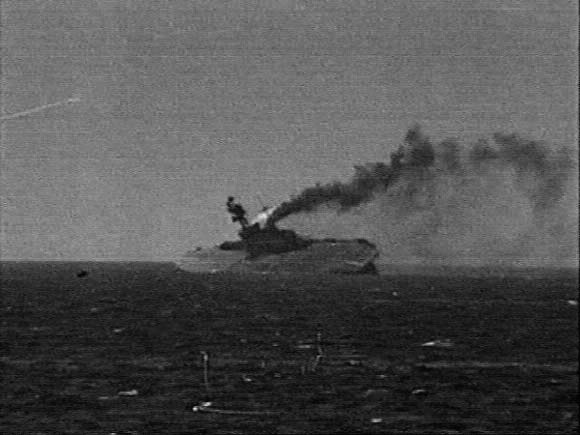
U-73 had penetrated the destroyer screen and closed to within 400 yards of the carrier before putting four torpedoes into her side at 1315. HMS Eagle went down in eight minutes.
A witness described the scene:
“We watched, hypnotised by the speed of events, for her list was rapidly increasing. By the time she had swung ninety degrees to starboard she was right over on her beam-ends, with the port side of her flight deck in the water. Then she disappeared into the cloud of smoke and steam which hung around her.”
HMS Victorious and Illustrious immediately increased to full speed, zig-zagging to evade any further torpedo attack. HMS Charybdis flashed a warning, and Victorious observed a torpedo cross her bows. Another was seen passing to starboard 10 minutes later.
Four of Eagle’s Sea Hurricanes were airborne at the time of her sinking – Red and Yellow Sections of 801 Squadron. One landed on HMS Indomitable and three on Victorious. The remainder was lost with the ship.
Of Eagle’s crew, 929 were rescued out of a crew of 1160. U-73 escaped.
Vice Admiral Syfret realised the significance of this loss:
“The tragic sinking of EAGLE which, quite apart from the loss to the fleet of a well-tried and valuable carrier, at once bereft the force of 25 per cent of its fighter strength.”
About 90 minutes later HMS Furious began flying off her Spitfires again. All but one of the 38 aircraft covered the 650 miles to the island safely. One had reported mechanical issues before making a successful emergency landing aboard HMS Indomitable.
As soon as the last Spitfire flew off towards Malta, Operation Bellows was over and HMS Furious and her escorts hauled out of formation and turned back towards Gibraltar.
At 1420 radar detected an aircraft flying so high it could not be seen. This was most likely a pressurized Ju86P which took photographs of the convoy. A section of Martlets was sent up to investigate, but one was forced to ditch on return to the Fleet after incendiary ammunition had again spontaneously exploded. A Fulmar guided the destroyer Westcott to rescue the pilot.
At 1835 three Sea Hurricanes were launched from Indomitable and vectored towards a Ju88 at 19,000ft. It was seen diving towards the sea after an attack from out of the sun.
A Sea Hurricane had been hit by return fire and was forced to ditch. A Fulmar again directed a destroyer to the rescue.
Pedestal pressed on.
The War at Sea 1939-45:
Freedom’s Battle, Volume 1“The wind was chancy, and we were to be boosted off. I was in position on the catapult, engine running. The flight deck engineer waggled the ailerons to draw my attention to something or other, and I looked out over the port side to see what he wanted. And, as I did so, I stared in shocked surprise beyond him to where Eagle was steaming level with us, half a mile away. For as I turned, smoke and steam suddenly poured from her, and she took on a heavy list to port, and the air shook with a series of muffled explosions.
Over the sound of the engine, I yelled ‘Eagle’s been hit!’
Listing to port, she swing outwards in a slow, agonised circle, and in seven minutes turned abruptly over. For a few seconds longer her bottom remained visible; and then the trapped air in her hull escaped, and with a last gust of steam and bubbles she vanished.
All that remained was the troubled water, a spreading stain of oil, and the clustered black dots of her ship’s company.
There had hardly been time to assimilate the fact that she had been hit before she had capsized and sunk; and when I took off a few minutes later, my mind was still numbed by what I had seen. It had come so completely without warning. It was as if, at any moment, our own ship might stagger and lurch and list, and our aircraft go slithering down the deck into the sea.”

2045 ATTACK 1
Gibraltar had intercepted radio traffic suggesting a dusk attack was being prepared. Pedestal was warned and Indomitable and Victorious launched all their available fighters.
This first air attack was delivered by the Luftwaffe. The move came at twilight when the convoy was 200 miles off Sardinia.
It was detected at a range of 50 miles. It was the first major test of Pedestal’s air defences.
The handful of fighters in the air at the time were quickly reinforced by 15 Sea Hurricanes and four Fulmars.
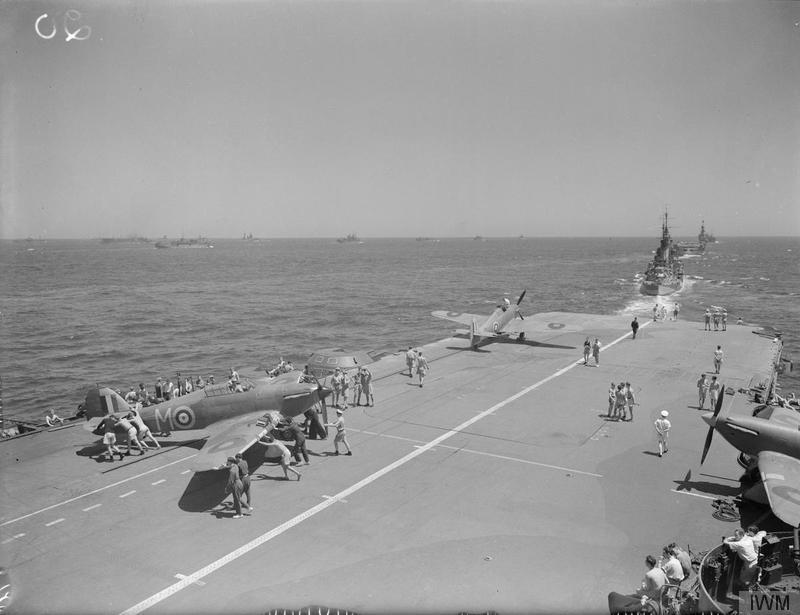
Sea-Hurricanes on the flight deck of HMS INDOMITABLE during Operation Pedestal.
A flight of three or six torpedo-armed He111s made their attack run first, unseen by the high fighters as they skimmed the darkening wave tops. But the fleet’s gun defences were effective and the torpedoes were dropped wild.
But the situation quickly became confused: The fighters could see little in the growing gloom, and the fighter control plots were cluttered by a mass of air contacts – both friendly and hostile.
Some 27 Ju88 low-angle dive bombers converged on the convoy from 8000ft in different directions. Two singled out Victorious. These were engaged by the carrier’s pom-pom and 20mm Oerlikon mounts as they dove towards the carrier from astern.
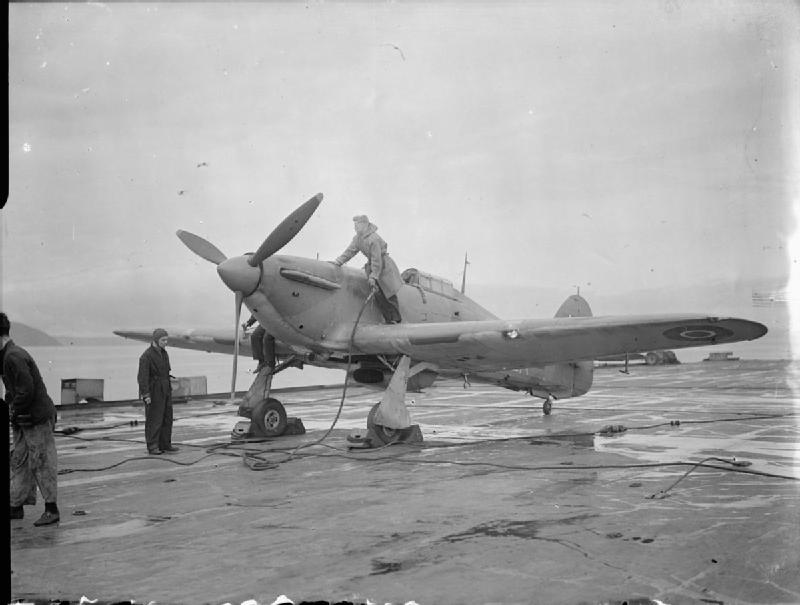
Refuelling a Sea Hurricane
The carrier twisted and turned in evasion to avoid the bombs.
From the ships, the approaching bombers presented a clear silhouette against the twilight sky, making themselves easier targets.
One was claimed shot down by Victorious’ gunners who saw it ditch in a plume of spray. Two bombs fell close, but caused no damage.
The tug Jaunty claimed a second Ju88, reporting seeing it on fire on both wings as it spun into the sea.
HMS Manchester reported splashing a He111 after splinters entered the cruiser’s hangar to damage its Walrus amphibian.
Aboard Nigeria, journalist Anthony Kimmins would report:
“Then suddenly a cheer from a gun crew, and away on the port bow a Ju88 spinning vertically downwards with both wings on fire and looking like a giant Catherine wheel. More cheers over to starboard another Ju88 was diving headlong for the sea, with smoke pouring out behind. At about 500ft the automatic pull-out came into action and she flattened out and crashed on her belly, with a great splash of water. Against the sunset you could see the parachutes of her crew as they drifted slowly downwards”.
German records show two bombers had been lost. They also claimed hits on a carrier, a cruiser and a merchantman. In reality the attack was a failure. No vessel was hit.
DSC RN, Commander R ‘Mike’ Crosley:
They Gave me a Seafire
Towards the end of the first night’s air battle, six Hurricanes of 880 from Indomitable led by Dicky Cork their Senior Pilot, and a couple from Victorious’ 885 Squadron from Buster Hallett’s Squadron, were airborne. The Fleet was under attack, they were short of fuel and it was impossible to find which was their own carrier in the darkness. They were being fired on whenever they came near and it seemed as if they would have to ditch. Indomitable’s Captain, Tommy Troubridge, was, however, giving his fighters all the help he could to find his ship in the darkness, ignoring signals from Nelson that he must tell them to ditch. He took his great ship out of line, steaming her into wind on his own with his masthead and deck landing lights full on. He again ignored Syfret’s order to douse his lights and to “rejoin immediately”, just as Nelson would have done. He said later . “What is the good of a carrier without her fighters?”
The FAA fighters gave chase but were poorly positioned to intercept in the growing darkness. While the fighters claimed only one “probable”, they had succeeded in interupting the bombing and torpedo runs.
Fulmar pilot Sub Lt R. Grose reported:
“I sighted enemy a/c 200ft above on my port bow. I broke away and made a climbing quarter attack firing a 4-second burst at 400 yards closing to 200. He opened up and drew away. I fired another 3-second burst at 450 yards before I lost him. I’m afraid he got home.”
The returning aircraft – many low on fuel – were greeted with gunfire by excited gun crews who found it difficult to make out any recognition features. Visibility was less than 500 yards. Fortunately no friendly aircraft were shot down.
Indomitable’s Captain Tom Troubridge realised the desperate plight of the aircraft struggling against trigger-happy gunners in the convoy and the darkness. He took the initiative – and the risk – of turning his carrier into the wind to allow what he knew were the fleet’s vital defenders to land safely.

Preliminary movements: 3 – 10 August 1942: HMS VICTORIOUS underway with the convoy. The tanker OHIO can be seen off VICTORIOUS’ starboard quarter.
Indomitable would remain out-of-position with lights on at 26kts for more than an hour.
The goal was achieved: Seven of her own Sea Hurricanes returned to their nest, while four 809 Fulmars and one 885 Squadron Sea Hurricane from Victorious came to visit.
Four British fighters would, however, be written-off and another four damaged in deck landing accidents in the dark. A Fulmar had skewed off Indomitable’s deck and into a gun mounting. The Spitfire that had successfully made an emergency landing on Indomitable earlier that day was the victim of another landing accident which spilled over to the deck park. Aboard Victorious, a Hurricane went into the crash barrier and caught fire.
This left 51 fighters operational to face the next days raids.
WEDNESDAY, AUGUST 12
“August 12, 1942, was a significant day in the history of air warfare. The Luftwaffe and Regia Aeronautica delivered three raids, by nearly 200 attack aircraft of all types, escorted by over 100 fighters… At no time did the number of naval fighters airborne exceed twenty-four, six to eight of which were Fulmars.
The events of this day would make Pedestal the most heavily opposed convoy of the Mediterranean war.
Vice Admiral Syfret would later write:
“Throughout the day the force was under continual observation by aircraft which were protected, progressively more strongly, by fighters. During the day the force was subjected to three very heavy air attacks; whilst Force X, after parting company, was attacked at dusk by bombers and torpedo bombers. During daylight hours our fighters, though frequently greatly outnumbered, continued their magnificent work both in reporting approaching raids and in shooting down enemy aircraft. Success also attended our [Anti-Aircraft] guns though more from their deterrent effect than from the accuracy of their fire. ”
The resolve of the Axis was in little doubt.
The Allies had intercepted a message from Reichsmarschal Hermann Goering. In it he stated that X Fliegerkorps and II Fliegerkorps:
“will operate with no other thought in mind than the destruction of the British convoy… The destruction of this convoy is of decisive importance.”
Intelligence intercepts would show the Germans now knew HMS Rodney and Nelson were part of the covering force. However, they had mistaken one of the carriers for a USS Yorktown-class. They listed the standing carrier air-patrol strength as being 10 to 16 aircraft.
Goering would go on to reiterate that the primary targets were to be the carriers and the transports.
The night had been moonless, making air and sea observation of the convoy virtually impossible. By dawn Pedestal was edging within range of fighters based out of Sardinia. The ships closed up at Action Stations at 0520.
German and Italian reconnaissance aircraft swarmed into the air at dawn. A Ju88D made the first contact at 0620 and took up a shadowing position.
The first of the fleet’s fighters – two Sea Hurricanes and two Fulmars – were flown off to intercept as the sun rose at 0630.
Vice-Admiral Syfret would remark:
“There were few moments when neither aircraft, submarines, torpedoes nor asdic contact were being reported.”
At 0710 the first standing patrol of 12 fighters was launched from HMS Indomitable and Victorious. The goal was to keep a dozen interceptors in the air at all times.
Fourteen interceptions were attempted. Only two resulted in engagements. One was successful: Soon after 0700, the Fulmars from 884 Squadron shot a Cant Z1007 down in flames.
Below and on deck, aircraft mechanics worked furiously to repair and prepare their machines for what they knew would be a decisive day.
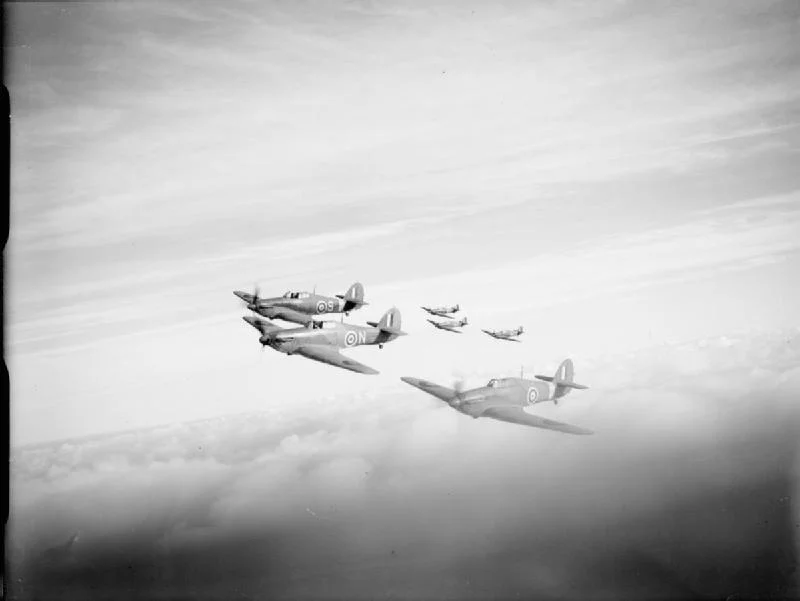
Sea Hurricanes fly in formation.
0915 ATTACK 2
The first full attack was detected about 0907 when a high-level formation of about 19 LG1 Ju88s escorted by 16 1/JG77 Bf109s. The Germans appeared on radar at a distance of 65 miles. Fighter Controllers directed the air patrol to intercept the 24 Ju88 bombers of I and II/LG1 some 25 miles out from the convoy.
White and Red Section Sea Hurricanes from Indomitable’s 800 Squadron were to be the first to intercept at 18,000ft while some 25 miles out from the fleet. Black and Blue Sections of 880 Squadron were to provide back-up. Victorious scrambled three Hurricanes and four Fulmars which got into the air just as the attack developed.
Lt Cdr Bill Bruen of Red Section 800 Squadron claimed one of the LG1 Ju88s – his fifth kill. He would be just the first ace of the day.
Lt William “Moose” Martyn in 800 Squadron’s White One came a close second. He would claim one as a kill and a “share” in another which he had set afire. His wingman finished it off.
Martyn’s own Sea Hurricane was hit by defensive fire and was forced to make an emergency landing aboard Indomitable.
The fighters of 1/JG77 escorting the Ju88 strike came as something of a surprise for the Fleet Air Arm pilots as they had been told not to expect fighters out of Sardinia.
Three Sea Hurricanes of 885 Squadron reported being engaged by fighters. One was damaged before evading. Another pilot was missing, presumed shot down.
A pilot of 800 Squadron who had been plucked from the sea by HMS Pathfinder also said he had been shot down by fighters.
Blue Section 880 Squadron did not report any losses and stated they had not seen any fighters.
Several aircraft were, however, damaged by defensive fire from the bombers.
Red Four lost part of its engine cowling to a Ju88’s defensive fire. It returned safely to its carrier.
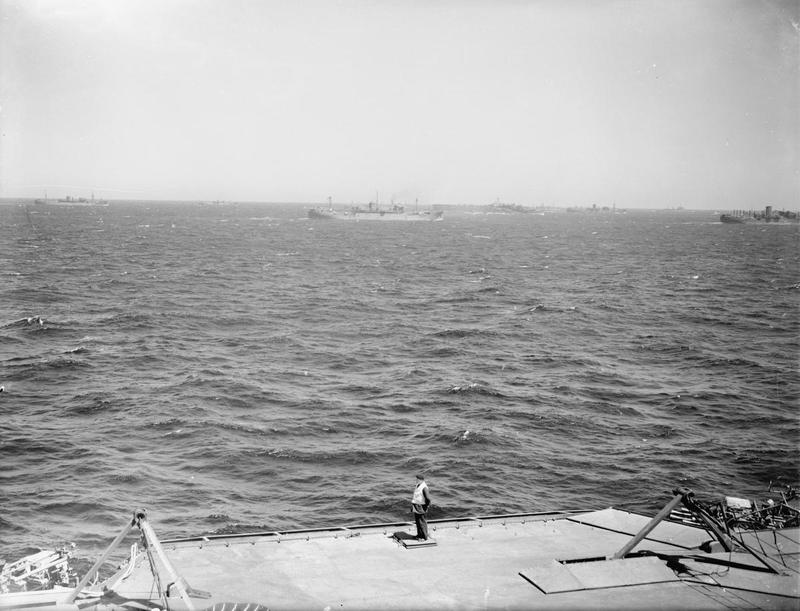
A deck officer observes flight activities with the Pedestal convoy in the background.
Cork, leading a flight of 880 Squadron Hurricanes, later described the engagement:
“The sky at first sight seemed filled with aircraft. The enemy kept in tight formation and our fighters snapped at their heels, forcing them to break in all directions. One Junkers turned away from the main group and I led my section down towards it. I was well ahead and fired when it filled my sights. Smoke poured from its wings and it disappeared below me into the sea. A few minutes later I saw another Ju88 out of the corner of my eye heading along the coast of North Africa, so I set off in pursuit by myself. At 1000ft I came within range and fired. It seemed to stagger in the air, then dropped into the sea with a big splash.”
Eight Ju88s were claimed shot down by fighters and a further two by the destroyer screen.
German records list six as being shot down and a further two lost over Sardinia from ‘friendly fire’. German fighters claimed four Sea Hurricane kills, though the British only record the two losses.
Observers in the air and in the fleet saw many of the Ju88s jettisoning their bombs when under attack. Only four made their way through the fighter screen to bomb the convoy. They scored no hits.
Shortly after this attack, two Fulmars of 884 Squadron – under direction from HMS Victorious’s fighter controllers – surprised a shadowing SM79 and shot it down.
The Germans returned to their bases claiming to have sunk a carrier and two merchant ships. But, as they returned, two were shot down by Italian fighters mistaking them for marauding Beaufighters out of Malta.
Italian submarines had attempted to get into firing position as the bombers had pressed home their attack. The FAA Albacores and Coastal Command Sunderlands along with the Destroyers Laforey , Fury and Foresight forced the boats deep.
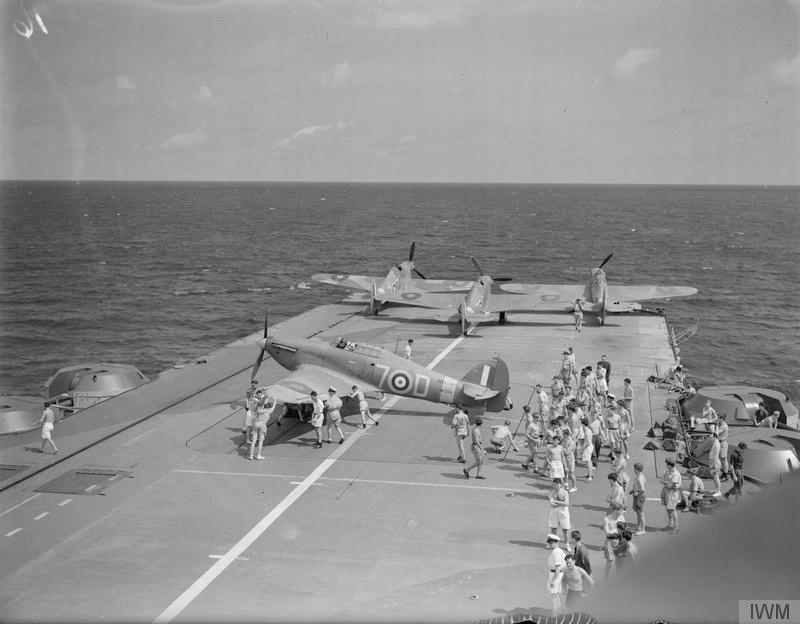
Deck crew position a non-folding Sea Hurricane on HMS INDOMITABLE’s large forward lift. They had to be skewed sideways onto roller-rails to arrange them within the hangar.
1215-13:45 ATTACK 3
Late that morning, Axis forces were issued a new order: Under no circumstances were they to attack damaged or straggling ships. Every effort was to be expended on destroying or crippling those that still had a chance of making it to Malta.
Shortly before midday the air-warning radars of HMS Indomitable, Victorious, Sirius, Nigeria and Cairo began to fill with contacts.
The convoy was just 70 miles south of Sardinia.
More than 70 German and Italian bombers were in the air with a heavy escort of fighters – some accounts state up to 40. Axis attempts to coordinate the strike rapidly fell apart. Because of a variety of communication, mechanical and navigational difficulties, the German and Italian aircraft ended up approaching in four waves spread over a period of 90 minutes.
Pedestal’s standing air patrol consisted of four Sea Hurricanes of Green Section 800 Squadron led by Lt Cdr Rupert Brabner at 20,000ft, 806 Squadron’s Orange Section of four Martlets under the command of Lt “Sloppy” Johnstonand two Fulmars from HMS Victorious’ 884 Squadron under the lead of CO “Buster” Hallet at 10,000ft.
An officer’s account
Send Them VictoriousThe standby squadron was all set on deck, with the aircraft armed, fuelled and wating and the pilots in their cockpits gazing upwards and perhaps munching a biscuit.
Men stood by the lanyards which secured the wingtips of the aircraft – others lay by their chocks and yet more men sat astride their starter motors.
The flight-deck officers fiddled with their flags and Commander Flying nursed his flight deck microphone. There was a tenseness in the air, expectancy and waiting, all waiting for those vital 17 seconds which would follow the Boatswain’s Mate’s call “Fighters stand-to.”
The mad scramble to get the aircraft off and then the eighteenth second should see the ship returning to her station with her fighters safely airborne over the sea.
Lt Cdr Bruen’s Red Section 800 Squadron was scrambled by Indomitable as the attackers were detected by radar. Victorious followed suit, scrambling a further four Fulmars of 809 Squadron and four Sea Hurricanes of 885 Squadron.
HMS Indomitable continued to prepare further fighters – refueling and rearming them on deck – even as the attack unfolded.
At 1211, the outer picket of British destroyers – led by HMS Ashanti – opened fire on the approaching aircraft.
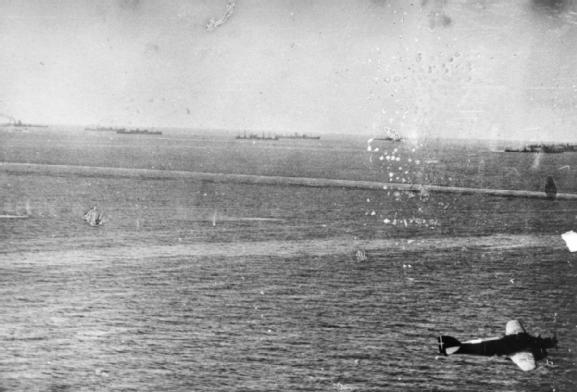
12 August: Air attacks: An Italian photograph of the convoy under attack. An Italian SM.79 torpedo bomber is in the right of the photograph.
The Axis attack plan sounded effective: 10 SM84s would use new circling torpedoes to break up the convoy escort while escorting Italian fighters and figter-bombers would open up a hole in the protective fighter screen. This would allow 43 SM79 and SM84 torpedo bombers to make their approach at low levels while 37 Ju88s would make shallow dives – further confusing the defenders. In the immediate aftermath Re2001 fighter bombers would make a special weapons attack on one of the carriers while a radio-controlled SM79 – packed with explosives – would crash into the other.
The challenge was coordination, and timing.
First Wave: The Italians came first with 10 S84 bombers of 28 Gruppe 32 Stormo and eight Cr42 biplane bombers. Fourteen Mc202s provided escort.
These S84s were carrying a new secret weapon: 350kg, 50cm Motobomba FF electric torpedoes, nicknamed “Mad Bombs”. The 120kg warhead was dropped by parachute and designed to circle in an ever increasing radius at 40kts for between 15 and 20 minutes.
Two CAP Fulmars spotted three large formations approaching the fleet. They engaged head-on as the bombers were seen to drop their “Mad Bombs” by parachute.
The weapon proved unsuccessful.
The British ships, mistaking the new weapon for air-dropped mines, were able to evade them all by making an emergency – but disciplined – 45 degree turn.
The Fulmars would chase these bombers as they turned for home. Three were reported as plunging into the ocean in flames. A fourth was said to have been seen trailing smoke.
The kills were credited to 884s CO “Buster” Hallett–the FAA’s second ace for the day – and Lt Frank Pennington. Pennington was forced to return to Victorious after being damaged by defensive fire.
HMS Rodney claimed to have shot down a bomber at 1217.

Two anti-aircraft cruisers join one of the armoured carriers, probably VICTORIOUS, in laying down a defensive barrage.
Second Wave: Five minutes after the first strike, a larger attack developed. This time some 40 torpedo bombers were to approach simultaneously from two directions. One side was allocated nine S79s and 10 S84s covered by 14 Re2001s. On the other was to be 21 S79s with 12 Re2001s. But this attack also experienced difficulties as both bombers and fighter units were suffering from a shortage of mechanics.
The rushed deployment to Sardinia had taken its toll. The squadrons took off 15 minutes late, leaving behind almost a quarter of their strength.
The fleet fighters tackled elements of the Italian formation well before it reached the convoy, effectively preventing most of the SM84s from carrying out their attacks.
Nevertheless, many torpedo-bombers drove directly for the merchant ships at the heart of the violently manoeuvring convoy and drove headlong into a heavy anti-aircraft barrage – including the 16in guns on HMS Nelson and Rodney. These projectiles were fired at low-trajectories with both proximity and contact fuses. The walls of water these shells threw up was hoped to be a deterrent to torpedo bombers.
Those that got close enough to drop their torpedoes failed to hit anything. Most had shied in the face of the anti-aircraft fire and dropped their weapons outside of effective range.
A few torpedo bombers broke off towards Nelson, but again dropped their loads before the battleship was in sure range.
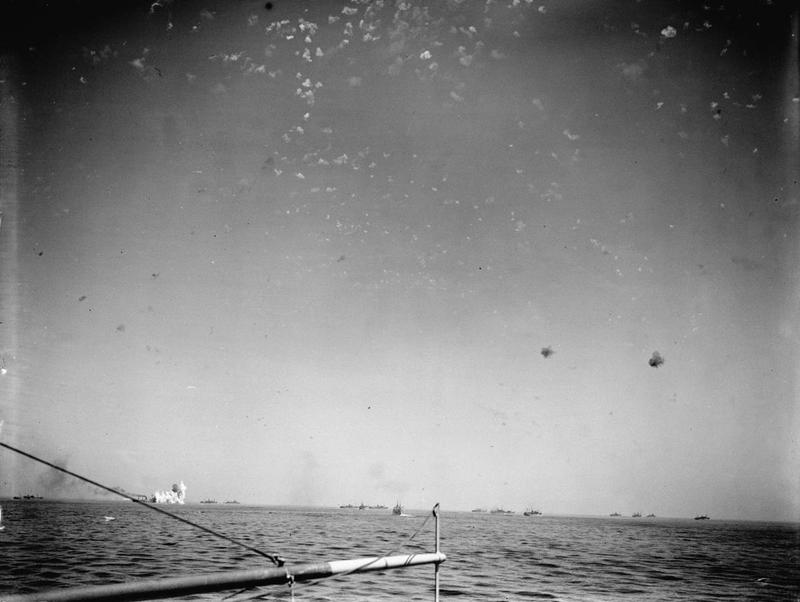
A photo from aboard HMS VICTORIOUS shows a stick of bombs falling near a merchant ship, left, as the sky is filled with flak bursts.
The CAP’s Green Section had engaged a flight of Re2001’s head-on. A Sea Hurricane was shot down in the turning fight that ensued.
One of HMS Eagle’s surviving Sea Hurricane pilots also made Ace. Brabner of 801 Squadron claimed to have downed an SM79 and SM84 in an attack alongside Johnston’s Martlets. Initially listed as probable, they were later upgraded to kills. This confirmed the Member of Parliament’s place in the record books.
Martlet II pilot Sub Lt John Cotching of 806 Squadron claimed to have set an S79 on fire. This was later upgraded to a kill.
Lt Cdr Bruen’s Red Section of 800 Squadron arrived late in the fight, but he managed to claim an SM79 and a share in a SM84.
The final action against this wave was by the Fulmars. One attacked an S79 which it claimed destroyed as it entered the fleet’s AA barrage. Another Fulmar was forced to evade at sea level, with two Italian fighters close on its tail

A Hawker Sea Hurricane of 885 Squadron, Fleet Air Arm flying over the flight deck of HMS VICTORIOUS prior to landing after flying exercises.

Third Wave: The Germans arrived next. It was late.
The German Ju88s of KG54 and KG77 out of Catania and Comiso in Sicily had successfully joined with their Me109 escort. The 37 bombers and 21 fighters rendezvoused over Elmas, Sardinia. But the Germans also had their fair share of problems: Five bombers aborted their mission because of mechanical failures.
Most managed to avoid the Fulmars and Hurricanes hastily re-directed to intercept them. Nevertheless, a handful were forced to jettison their bombs to escape. Flying in small groups at between 10,000ft and 15,000ft, the remaining Ju88s were too high and fast for the FAA fighters striving to regain their patrol heights after engaging the Italians.
Following their orders to go after the merchant ships, the Ju88s managed to damage the Deucaulion at 1318. She was hit by one bomb that failed to explode, and near-missed by two others. The freighter lost electrical power and stopped. She eventually got underway again at 10kts and was ordered to proceed along the North African coast with the destroyer HMS Bramham in support.
HMS Rodney had reported a near-miss about 1230. She was shaken again as Nelson and Cairo were straddled.
Lt R “Sloppy” Johnson, CO of 806 Squadron, was lost during this attack. He reported over wireless that he had attacked a Ju88 and had sent it spinning into the sea.
Johnson reported he been wounded during the engagement. His struggling Martlet made its approach to HMS Indomitable too fast, without flaps. The arrestor hook caught a wire but was torn out of the fuselage. The little fighter tangled on the side of the carrier and Johnson was seen struggling to escape. But the Martlet toppled over and into the sea, taking Johnson with it.

11 August: The loss of HMS EAGLE and the first air attacks: A general view of the convoy under air attack showing the intense anti-aircraft barrage put up by the escorts. The battleship HMS RODNEY is on the left and the cruiser HMS MANCHESTER on the right.
“In the early afternoon, during a lull in the attacks, two fighters came screaming down out of the sun and swooped low over Victorious. We watched them. “Silly twats,” someone remarked, “beating up the fleet at a time like this. Serve ’em right if somebody fired at them.” But nobody did, and fortunately the two smallish bombs they dropped bounced off the armoured flight-deck and exploded harmlessly in the sea. The only casualty was a starter-trolley which got badly bent; but there were some red faces among the guns’ crews and they had to stand a good ribbing for not being able to distinguish a Reggiane from a Hurricane.
Fourth Wave: The third wave of Italians – the fourth faced by the beleaguered British fleet – was a special operations unit. Two modified Re2001s – painted in similar colours to the FAA Sea Hurricanes – joined the holding pattern of fighters preparing to land on their carriers.
These Re2001s were supposed to carry an experimental 630kg low-altitude armour-piercing bomb. However, the weapons had not been prepared quickly enough. The fighters set out on their mission carrying anti-personnel bombs instead. It was hoped they could wreak havoc among the flight deck operations crews.
The plan initially unfolded well. Two Sea Hurricanes had landed on Victorious at 1325. Three more were seen to be in a holding pattern.
Only one was a Sea Hurricane.
Two of the aircraft suddenly turned and dove towards HMS Victorious at 1345.
The approaching fighters leveled off about two miles out from the stern of Victorious and came roaring up towards the flight-deck.
Such was the extent of the surprise achieved that neither would encounter defensive gunfire. Both Re2001s dropped their bombs after achieving “complete surprise”.
Observers aboard HMS Indomitable reported two small bombs “bouncing like cricket balls” along Victorious’ deck before falling over the side.
In actuality one skipped off the flight deck to explode over the sea – showering the gun crews in shrapnel and spray. The other bomb broke up and only partially detonated on the armoured flight deck’s centreline. This attack claimed six lives and wounded others among the deck personnel.
The Italian fighters escaped without a shot being fired at them.
Returning Fulmars attempted to engage, but broke off after the Re2001s yellow markings indicated them to be Sea Hurricanes – also especially painted for the Pedestal convoy with yellow trim for the purpose of identification!
Two modified bombers also took part in an unconventional attack. One, a SM79, was fitted with electronic equipment to allow it to be remote-controlled from a special-ops Cant Z1007.
The plan was to guide the SM79, with a 1000kg bomb, into a carrier’s flight deck. The radio gear malfunctioned and the SM79 flew on mindlessly until it crashed in Algeria.
Douglas Hamby: FAA Naval Air Fitter aboard HMS VIctorious
On 12 August:
The next wave of bombers then came in, led by an experimental radio controlled aircraft loaded with high explosive which was controlled from a mother plane but this lost control of its charge and the un-piloted plane flew on, crashing in Algeria. Two Italian fighter-bombers detached themselves from this attack and approached Victorious. I was on the flight deck at the time watching one of the other attacks develop, only seeing what happened at the last moment. These planes came in as if making a normal landing approach and deceived the lookouts into thinking they were ours, then released their bombs from a height of about 50 feet over the deck – about 250lb bombs I would think. One hit the deck with an almighty clang about 50 feet away from me, broke into pieces and went over the side without exploding. One piece hit a trolley which carried batteries for starting the Hurricane engines, wrecking it. The other bomb went skidding off the deck into the sea also without exploding. . . The next attack from the air was building up and the two carriers put up 24 fighters to meet it, Victorious with some difficulty as our lifts had started giving trouble…. The dive bombers looked as if they intended to concentrate on the two carriers and Victorious and her A.A ship, cruiser Syrius (which had 10 5.25 inch guns for main armament) put up a furious barrage. I was on deck at the time and the result was spectacular, Syrius astern of us was firing all three turrets forward which was great encouragement to us…. For us it had been a very long day, man-handling aircraft in the hangar and on the flight deck, carrying out repairs and checks as soon as our fighters had returned.

This picture is believed to show the experimental low-altitude armour-piercing bomb on a Re2001.
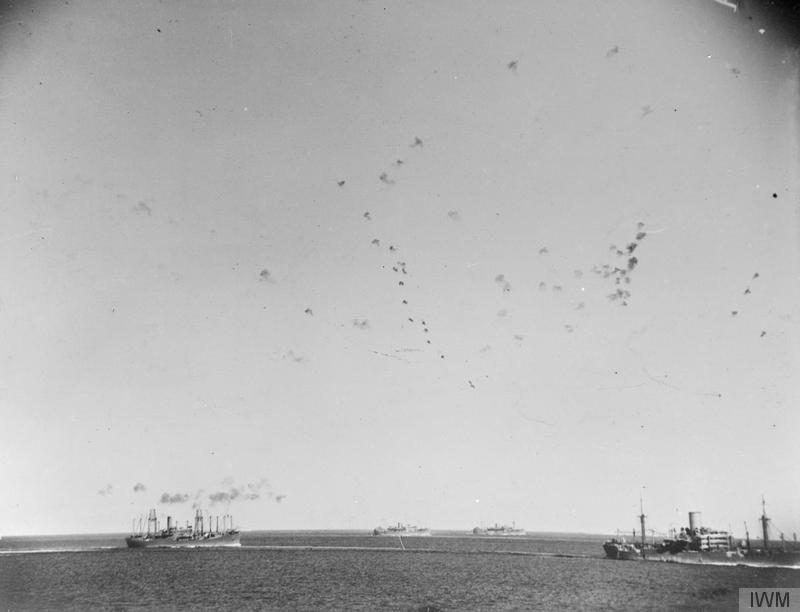
The sky is filled with anti-aircraft shells as the convoy steams on to Malta.
SKIRMISHES (FROM 14:00)
As the noon attack faded away, Admiral Syfret took stock of the situation. His convoy had come through the attack by more than 100 aircraft relatively unscathed.
One merchant ship was damaged and HMS Rodney was slowed to 15 knots due to steering problems. Fortunately, HMS Victorious suffered no lasting effects from the surprise Re2001 raid.
The Italian bombers were refuelled and re-armed at their Sardinian airfields in preparation for another hasty attack.
At 1400 Blue Section and Black Section were directed to a small group of low-flying He111s. These aircraft from 6/KG26 were carrying torpedoes and were flying so low the Sea Hurricanes could only make stern attacks.
Black One had its starboard wing shot away. This was 880 Squadron’s Lt Cdr “Butch” Judd. Senior pilot “Dickie” Cork assumed command.
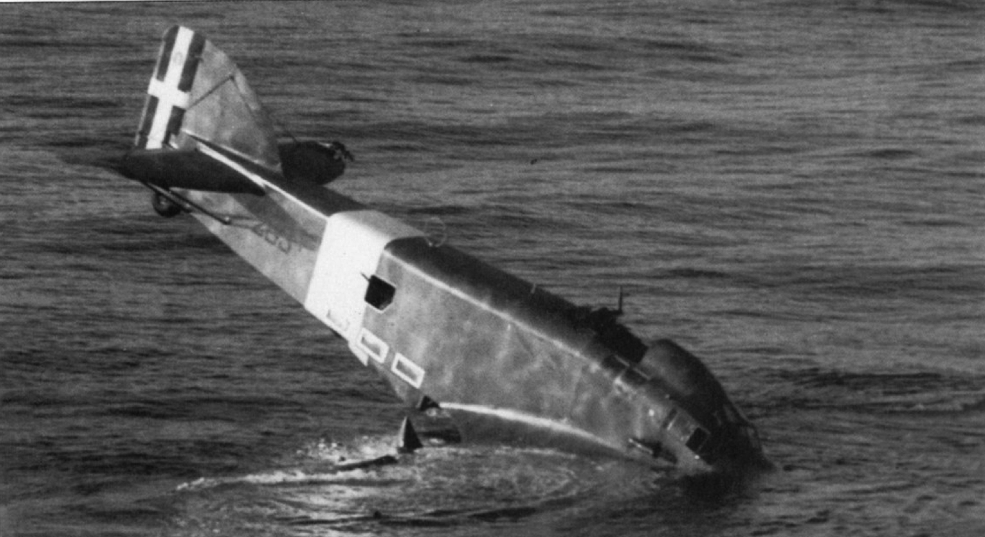
As the He111s flew past the destroyer screen, Blue Section was “bounced” by escorting Me110 fighters. Another Sea Hurricane was sent into the sea. Two more were damaged and forced to return to Indomitable.
Only Blue One, Lt Cork’s cannon-armed Sea Hurricane, remained operational.
“Cork saw one of his companions go down into the sea before a Messerschmitt and, turning quickly, managed to get the German in his sights. Trailing smoke, the Messerschmitt climbed to a thousand feet, when the pilot bailed out and the aircraft crashed into the sea beside Cork’s carrier, whose officers and men cheered as though a goal had been scored in a cup tie.”
Three Fulmars of 884 Sqadron were diverted to intercept a “shadower” at 1410. This Z1007bis was shot down for the loss of one of their own number.
It appears Lt Cork may also have attacked this aircraft and claimed it as a kill. His ‘hybrid’ Sea Hurricane had been damaged by both the Me110 and what he mistook to be an S79. With several large holes in his wings, Cork successfully returned to Indomitable.
Eight Cr42 biplanes configured as dive bombers accompanied by nine Re2001s attempted to locate the convoy in the mid afternoon. One of Indomitable’s Martlet’s shot down a Re2001.
A strike by nine S79s with escorting MC202’s failed to find the convoy.
But Pedestal’s defences were further weakened. Along with the destroyer HMS Bramham, which had been detached with the damaged merchant ship Deucaulion, HMS Ithuriel was no longer available. The destroyer had rammed the Italian submarine Cobalto at 1649, badly damaging her bows. She had her sonar destroyed and her speed reduced to 20 knots.
After the destroyer was attacked again by four Ju88s and Cr42 biplanes, Ithuriel was ordered back to Gibraltar.
Pedestal had only just begun to run the gauntlet. But it was given a crucial three-hour reprieve.

12 August: Air Attacks: HMS NELSON during the air battles on 12 August 1942.
1800-1850 ATTACK 4
As the convoy drew out of range of the Sardinian air bases, few expected the attacks to relent. All knew they were now passing into operational range of the major bases in Sicily.
Radar and reconnaissance aircraft had been reporting Axis aircraft building up in strength since about 1730. As flight after flight joined the formation, it was evident another large attack was about to unfold.
The Italians had managed to maintain contact with the convoy through a shadowing Cant Z1007, but three Fulmars managed to shoot down a reconnaissance S79.
The Regia Aeronautica’s plans involved some 105 aircraft attacking in three waves. A significant part of the anticipated fighter escort – the R2001s which had escorted attacks out of Sardinia – had not finished relocating back to Sicily.

The bomber force also encountered difficulties. Four out of 13 Italian Ju87s of 102 Squadron were “B” models carrying a heavier 2200lb bomb. They were not able to fit the long-range fuel tanks necessary for the required range. Six S84s were unable to mount their new torpedoes.
The Germans again made attempts to coordinate their attack with the Italians. At 1730, 20 German Ju87Ds of II Fliegerkorps escorted by a flight of Me109s took off from their base in Sicily. They were joined by about 20 Ju88s.
The carriers and escorts were as ready as they could be: The formations had been detected and tracked on radar from up to 40 miles away.
In the air against them were three Martlets, 12 Hurricanes and six Fulmars. Both carriers were in the process of launching four more aircraft each. This was all that could be assembled despite the advanced warning. Battle damage, exhaustion and landing accidents had taken a toll on fighter availability.
But the Royal Navy carriers were continuing to prepare fighters: Indomitable had four Sea Hurricanes on deck, while Victorious was readying four Fulmars and two more Hurricanes.
This time the coordination between Italian and German attack forces panned out. The Axis fighter escort also managed to engage most of the fleet defenders before they could tangle with the bombers.
The three waves of Italian torpedo-bombers began making their attack runs at 1200ft from 1800. The Italian MC202 fighters countered the British air patrol directed to intercept.
A Fulmar was seen breaking away from a bomber in flames before crashing into the sea. Its companions took revenge on the offending S79.
Victorious scrambled the four Fulmars of 809 Squadron 1820. These had just enough time to get clear of the fleet before the attack developed.
Indomitable was racing to prepare her four Sea Hurricanes, but these were just starting to launch at 1830 when the attackers appeared on the horizon. The activity on her deck meant Indomitable’s 4.5in HA guns were not able to be brought into action.
All FAA fighters were ordered to clear out from above the convoy as the air began to fill with Axis aircraft. The fleet’s barrage was overwhelmed and unable to effectively identify individual targets. Anything that moved over the convoy was now fair game.
The freshly launched Fulmars were bounced by single-engined fighters, losing one of their number before the remainder could attempt an escape at sea level.
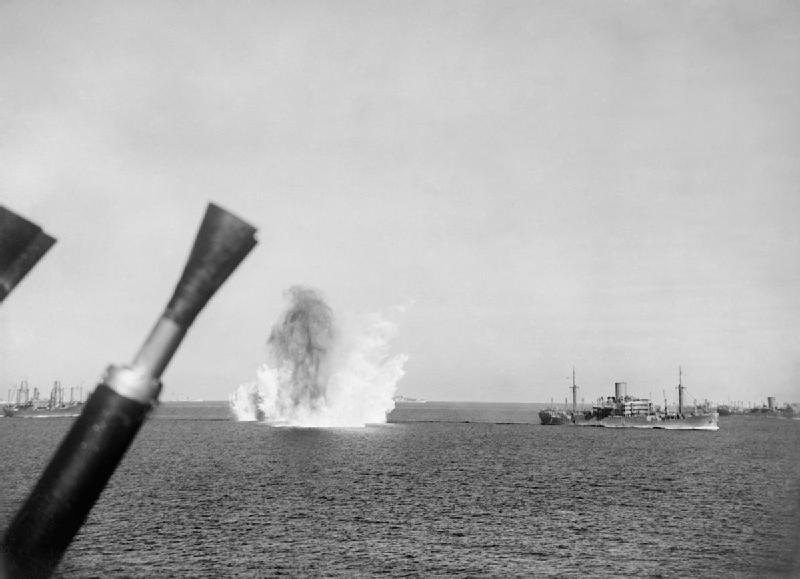
12 August: Evening air and submarine attacks: A bomb falling astern of MS GLENORCHY, which was later sunk by air attack.
Sub Lt Hugh Morrison reported:
“Enemy a/c dived out of sun. I did steep turn and straightened up to meet attacks. Fired short burst at each. Air Gunner observed enemy a/c on fire and hit sea. Other a/c climbed away as soon as they saw this happen.”
The burning aircraft, however, was most likely his fellow Fulmar.
The initial Italian attack was something of a failure. No torpedoes hit, and the Italian Stukas succeeded only in near-missing HMS Rodney. The bomb landed in the sea alongside X turret. The shock and evasive maneuvers caused further problems for the battleship: Her boilers experienced troubles and she was forced to slow once again, this time to 18kts.
One Italian Ju87 was claimed shot down by Sub Lt Thomson of 800 Squadron at 1840. He then claimed to shoot down one of its escorts:
“Me109 with yellow nose and leading edge, and yellow or white band round tail. Under side pale. German markings.”
The Italian torpedo bombers were equally unsuccessful. The S79s had experienced heavy anti-aircraft fire and only 12 had broken through the barrage. These dropped their torpedoes at 3000 yards – too far out for a reliable hit.
HMS Victorious’ Captain Bovell would later note:
“Had the Italian torpedo aircraft shown more initiative, it is thought that protection would have failed…”
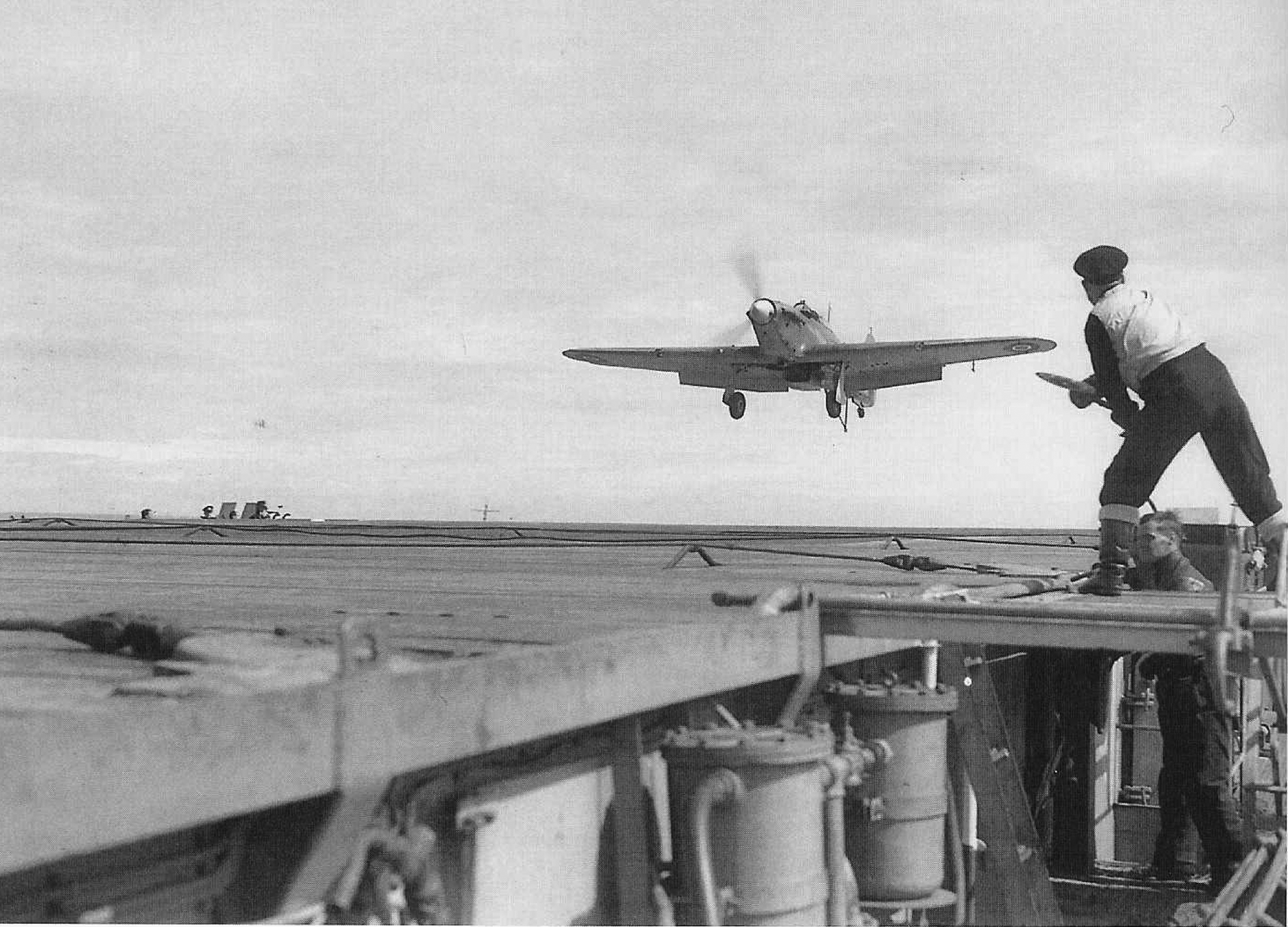
A signalman gives the ‘cut engine’ signal to an approaching Sea Hurricane.
Nevertheless, the destroyer HMS Foresight was struck as she attempted to ‘comb’ the torpedo wakes. The explosion lifted the back of the ship out of the water and blasted off her stern, rudder and propellers. The crippled destroyer was taken in tow for the long trip back to Gibraltar by HMS Tartar, but the battle to save her would eventually be abandoned.
Blue One – Lt Cork – also would have a narrow escape. With is favourite cannon-armed Sea Hurricane undergoing repairs, he was flying a “standard” machine-gun equipped model when he shot down another S79. Having expended all his ammunition, he was bounced by a fighter.
“Attacked by a Reggiane 2001 at 50ft, just as I finished all my ammunition on the 79. Several holes through a/c and radiator, rudder half stripped of fabric, port bottom longeron severed.”
He skimmed the waves in a successful effort to escape and made an emergency landing on the closest carrier – Victorious. His engine seized on final approach as he touched down. The battered Sea Hurricane was dumped over the side.
“The raid had reached its peak when, suddenly, a squadron of twelve Stukas appeared, high in the sky over Indom. Fighters were after them, and a hurricane of flak went up from all sides, as one after another they peeled off at 12,000 feet and dived on to the ship. The 1,000-pounders rained down in a concentrated onslaught, and in a moment she had vanished behind a dense geyser of spray. Two, three, were hit and plunged across the sky into the sea: but Indom was hit too.
At 1830 the German bombers were in a suitable position to attack the convoy as the ships were still evading the Italian torpedo bombers.
Between seven and 12 Ju87Ds of I/StG3 slipped through what they described as light cloud and defensive barrage at 1845 to begin a surprise attack-run out of the sun on HMS Indomitable from astern. One account states the attack consisted of eight Ju87’s and four glide-bombing Ju88s.
Indomitable was in the process of launching the last of the four Sea Hurricanes she had been racing to prepare.
The anti-aircraft cruiser HMS Phoebe was astern Indomitable in her “goalkeeper” position. Her after-action report states she did not notice the developing Stuka attack as she was engaging Italian torpedo bombers off her starboard bow.
HMS Nigeria, however, did: She opened up an “umbrella” barrage over Indomitable – the bursts from her two twin 4in HA mounts creating a curtain of fragments through which the dive bombers had to pass.
From a 70 degree dive that carried it over HMS Phoebe, the first Stuka released its bombs from 1500ft. Observers aboard Indomitable reported the trailing Stukas dropping their bombs at progressively lower heights. All broke-off their dives above the carrier at between 500 and 1000ft.
One of the Sea Hurricanes which had just cleared Indomitable’s deck turned to engage. Sub Lt Blythe Ritchie of 800 Squadron fired on one of the Stukas as it pulled out of its dive. He reported seeing the cockpit canopy detaching and the aircraft plunging into the sea. Five minutes later, he engaged a second:
“I saw one Ju87 at 400ft and chased it for approximately a mile. I did a beam attack at 100 yards and saw part of the cowling fly off, then flew around to its stern and closed to 60 yards, where I saw the gunner double-up. It was now smoking and on fire on the starboard side. The starboard wing dropped and it went into the sea from 200ft.”
Ritchie had chased the Stuka through the fleet’s barrage before sending the bomber into the sea in a ball of fire alongside HMS Victorious. He would later that afternoon claim a third Stuka.
Sub Lt Cotching would tackle the Stuka’s fighter escort in his Martlet II, claiming a Re2001 – his second kill for the day.
“At 1975 I saw the last fighter land on Victorious, then in the faint night sky I saw a group of black dots 1500 ft. overhead. They started to peel off, one after the other, in vertical dives, I realised they were J.U. 87’s (Stukas) and they were diving on the carrier Indomitable. Though Charybdis was too far away from the Indomitable for our close range fire to be effective, I opened fire with the single port Pom Pom, hoping the tracer would warn Indomitable and her closer escorts. Heavy A.A. fire started at once but these Stukas were the Luftwaffe’s special anti-ship dive bombers. Indomitable received three direct hits, and several near misses.
Charydbis steamed over to her at high speed, and as we approached she appeared to be on fire from stem to stern. Smoke was billowing out of her hangar lifts and what I thought was the flight deck, dripping molten metal. (This was actually blazing aviation fuel.) The Indomitable was temporarily out of control, and Charybdis circled her ready to go alongside if need be. It appeared that the Fleet had been caught out by the Stukas attack, but what was really happening was that the enemy was throwing everything they had, and could at the Fleet. Some 145 enemy planes, high level bombers, dive bombers and torpedo planes made low level attacks. There were two more casualties immediately. The destroyer Foresight was torpedoed and sank, and the merchant ship S.S. Deucalion was severely damaged by bombs, lay stopped, and the destroyer Bramham was left to stand by her. Both the Rodney and Nelson had near misses, and the Victorious was hit by an anti personnel bomb on her flight deck. All ships were twisting and turning, whilst Charybdis blasted away at every radar contact approaching the Indomitable.”– Arthur Lawson was a leading telegraphist aboard Indomitable.
“Smoke and steam billowed up above the wall of water; and for a quarter of a minute it seemed as if she could never re-appear except as a smoking hulk. Then, slowly, as the mass of water heaved up by the near-misses subsided, she emerged, listing, on fire fore and aft, nearly stopped, but still afloat.
ABOARD INDOMITABLE
Once the thick cloud of spray and smoke concealing HMS Indomitable had thinned, the following message was flashed:
Indomitable to Senior Officer F Force:
SHIP HIT BY TWO OR THREE BOMBS DAMAGED BY NEAR MISSES STOP PETROL FIRES ON FLIGHT DECK MESSAGE ENDS
Billowing smoke and taking on water, HMS Indomitable turned downwind. Aircraft petrol lines had been severed and set alight in the attack: Rivers of fire flowed across the flight-deck and rained down to the ocean below.

One of Indomitable’s officers recalled the event:

“Looking like beer barrels, the 1100lb bombs seemed to float down towards us as though in some dimly remembered dream. The ship shuddered and the dream expanded into a huge sheet of flame which rose up ahead of the island and engulfed it. There was an enormous explosion ahead of me and then several behind me which seemed to lift the ship several feet. A wall of water rose alongside to some hundred feet then cascaded down on top of me, washing me into the catwalk. For a moment there was a strange silence as flames and smoke billowed near the forward lift and behind the after lift. The ship began listing to port and was moving in a slow circle starboard.”
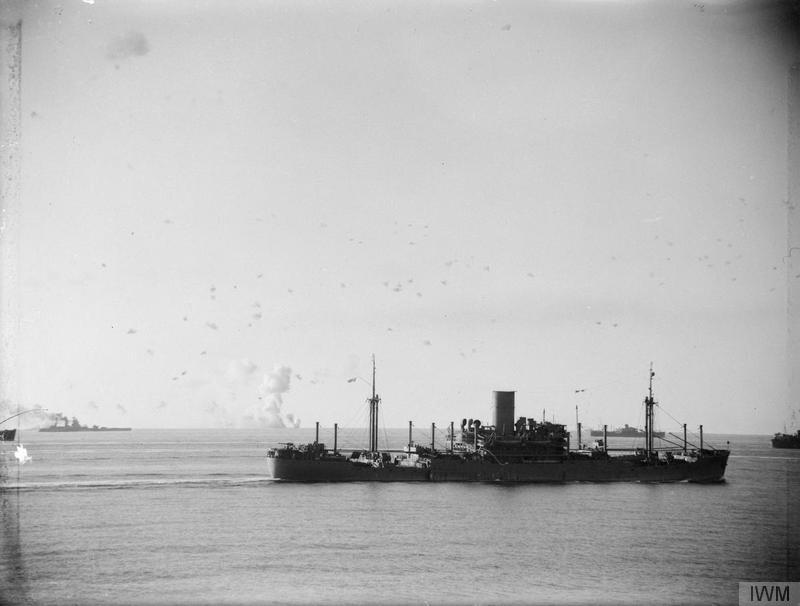
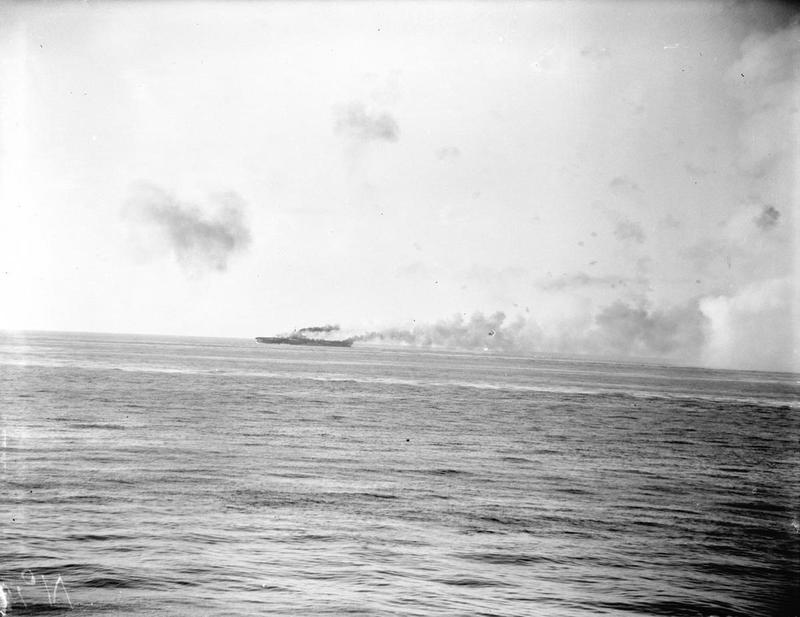
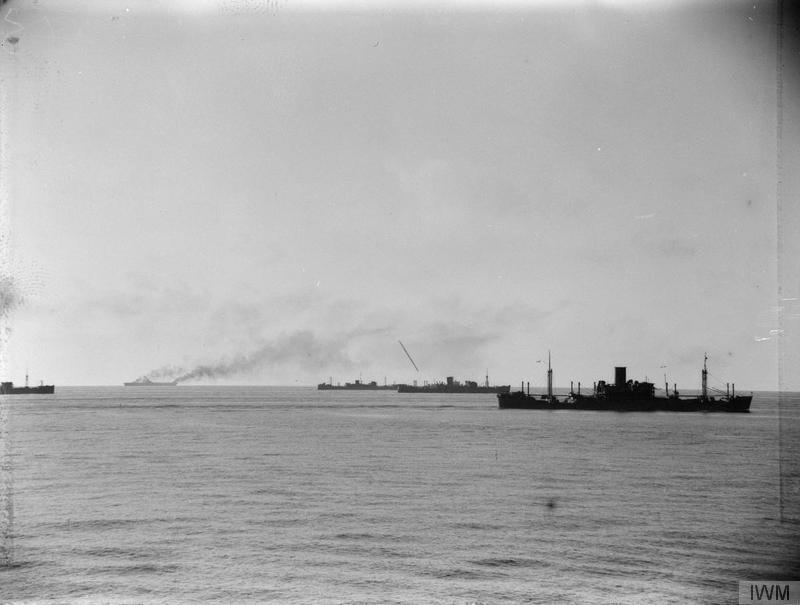
“From every ship men watched her anxiously; isolated from the disaster, yet sharing it, impotent to help yet suffering the wound as if it were to their own ship and their own friends. For twenty minutes she dragged in a slow circle, her deck heeling and the smoke pouring from her. Then she began to right, and the smoke that seemed to issue from her lifts lost its density and thinned to a wisp; a signal lamp blinked: “Situation in hand”, and she steadied on course.
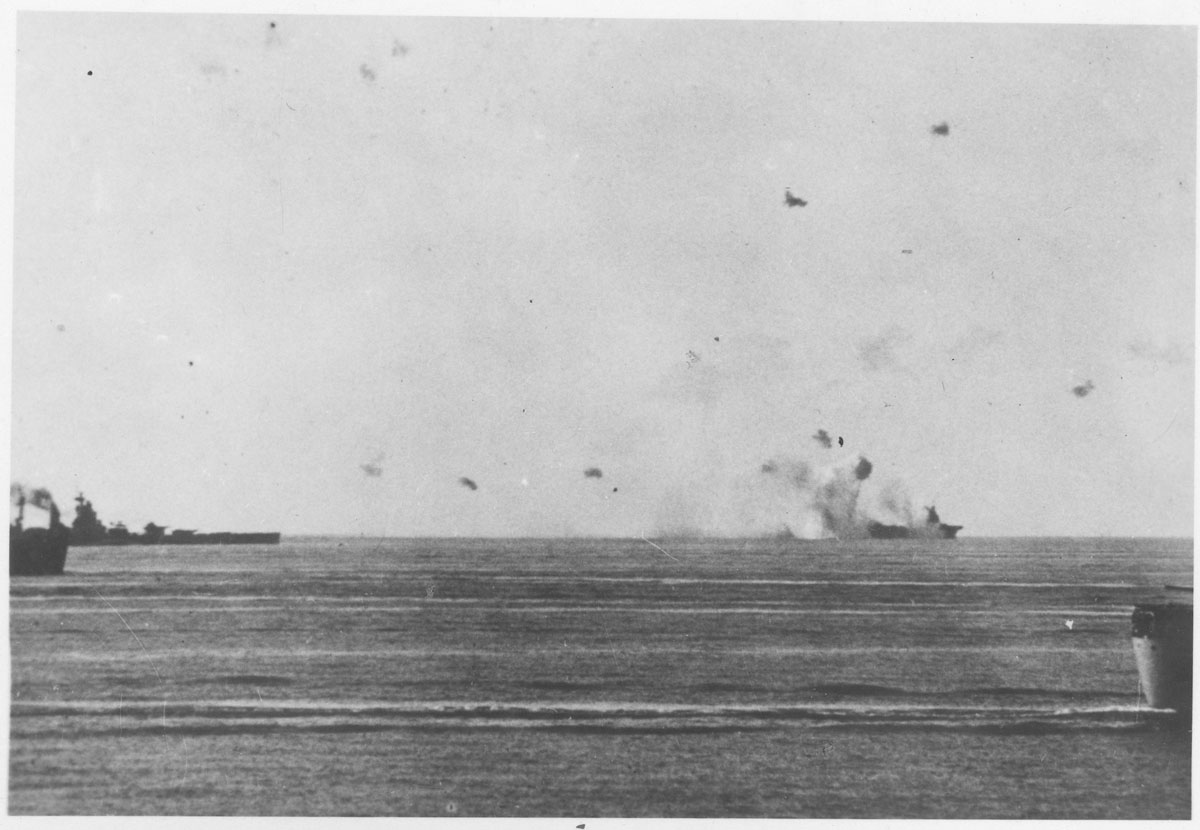
The destroyer HMS Lookout made a close pass to help assess and fight Indomitable’s fires. She reported seeing men running fire hoses on to the burning deck .
Slowing to 12 knots and falling behind the convoy, the burning carrier was unable to land or launch aircraft due to the fires and gaping wounds in its structure.
The anti-aircraft cruisers HMS Charybdis and Phoebe and the destroyers HMS Lookout, Lightning and Somali clustered around the carrier to form a protective screen.
Indomitable’s aircraft were forced to land aboard HMS Victorious. Those that could not be stowed below or in the deck park had to be rolled off the carrier’s stern and into the sea. A patrol of four Fulmars was flown off early to provide deck space. This patrol had been earmarked to help cover the convoy’s passage to Malta later that evening. It would no longer be possible to do so.
Six officers and 44 men had been killed in the attack. The 59 wounded were receiving treatment.
In keeping with orders not to attack damaged ships, the Germans now turned their attention to the battleship HMS Rodney. At 1842 a Ju87D scored a hit on X turret. The bomb glanced off the thick armour to detonate in the sea. The battleship reported shooting down a bomber, observing it crash into the sea off the port bow.
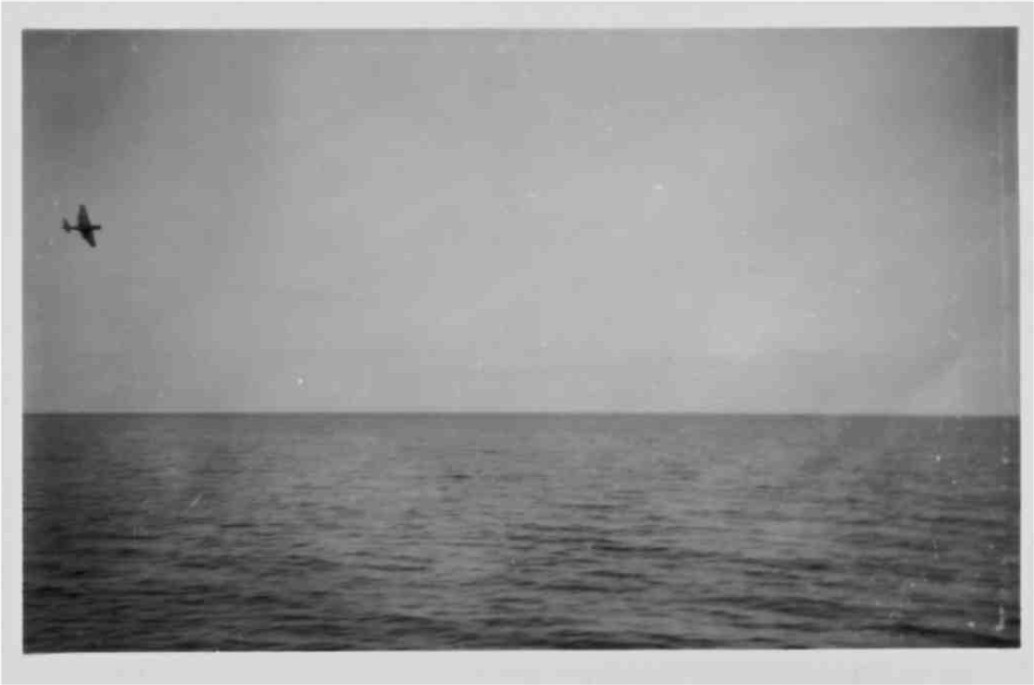
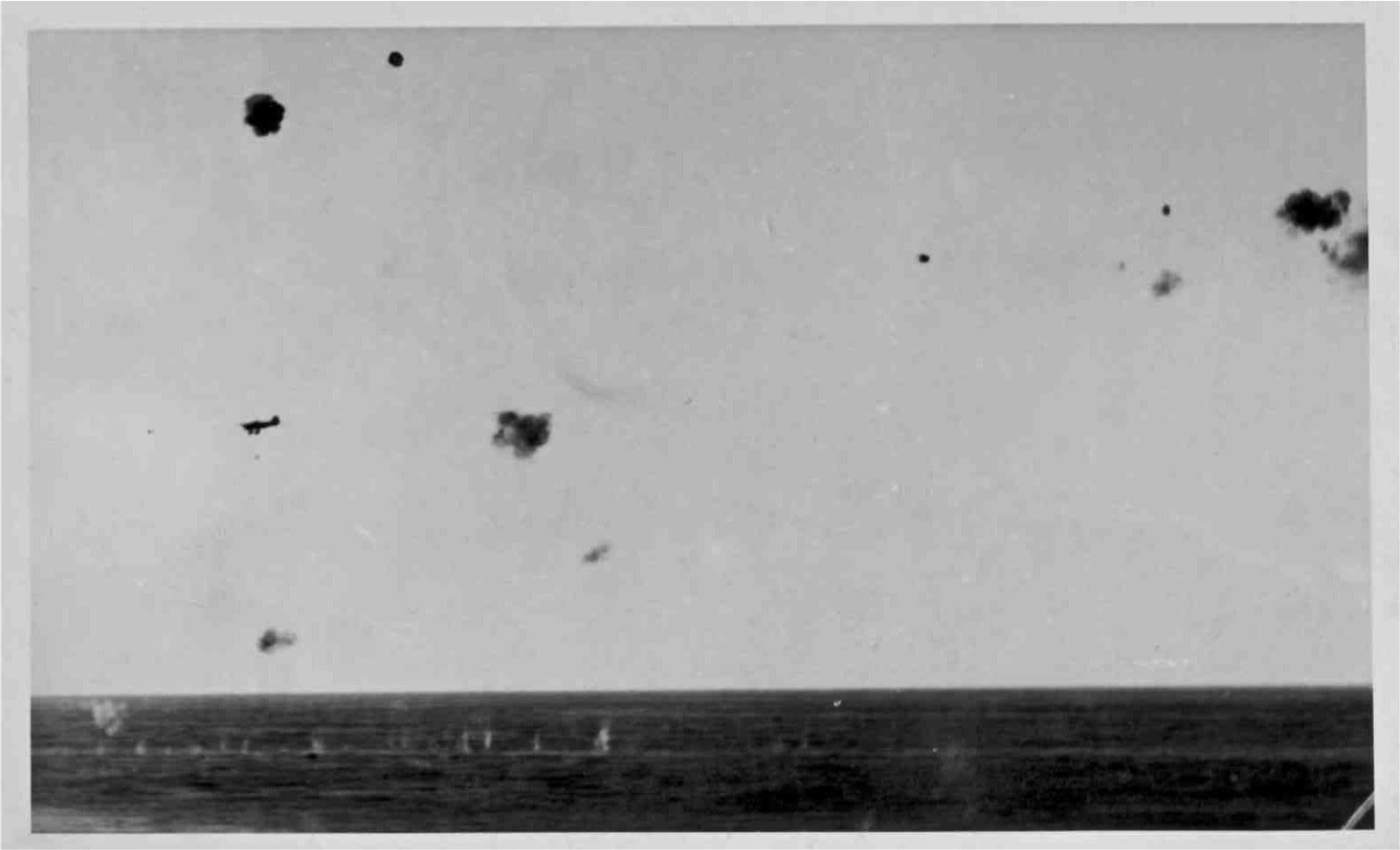
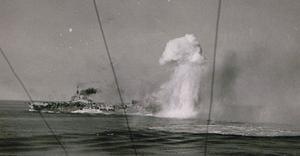
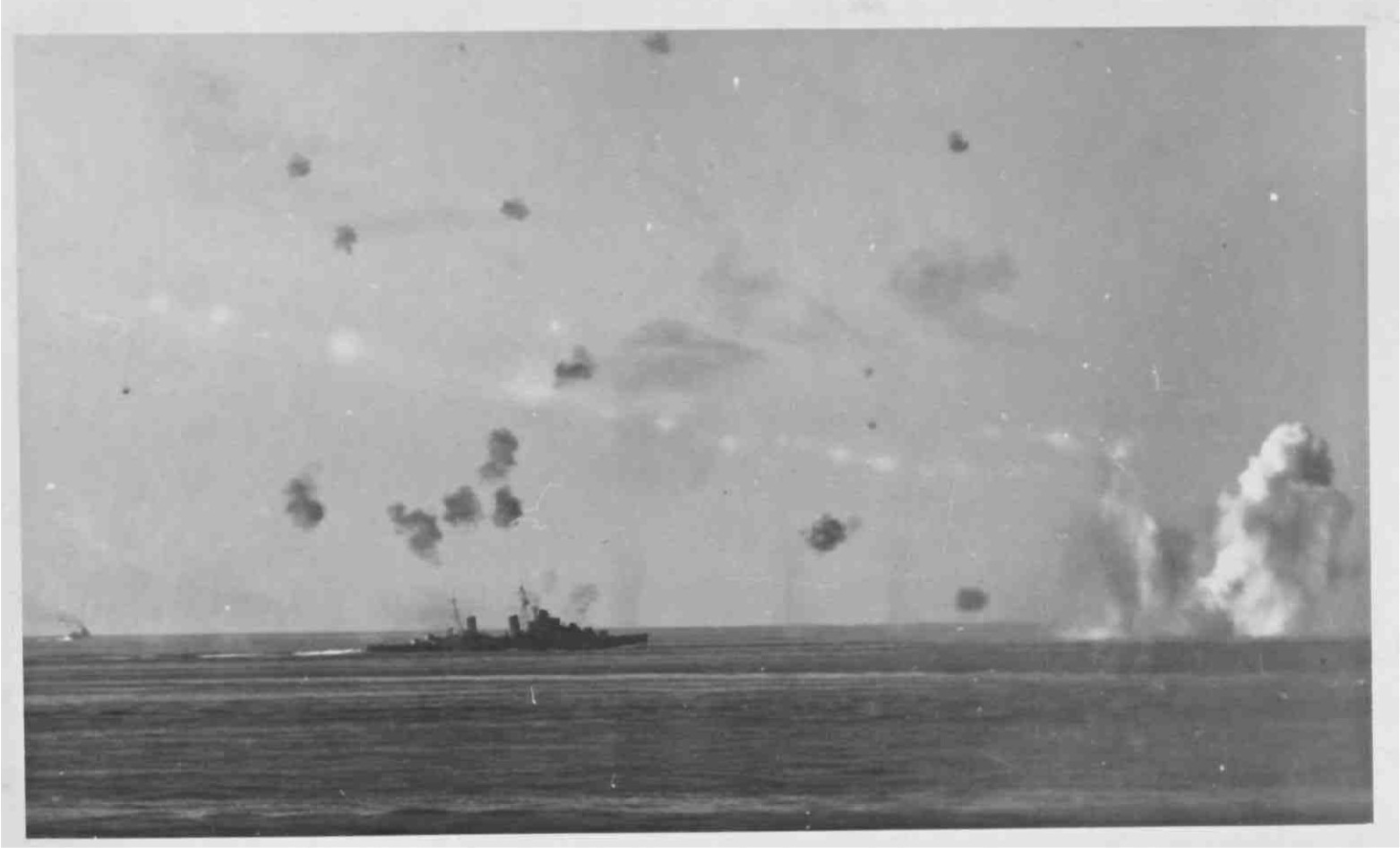
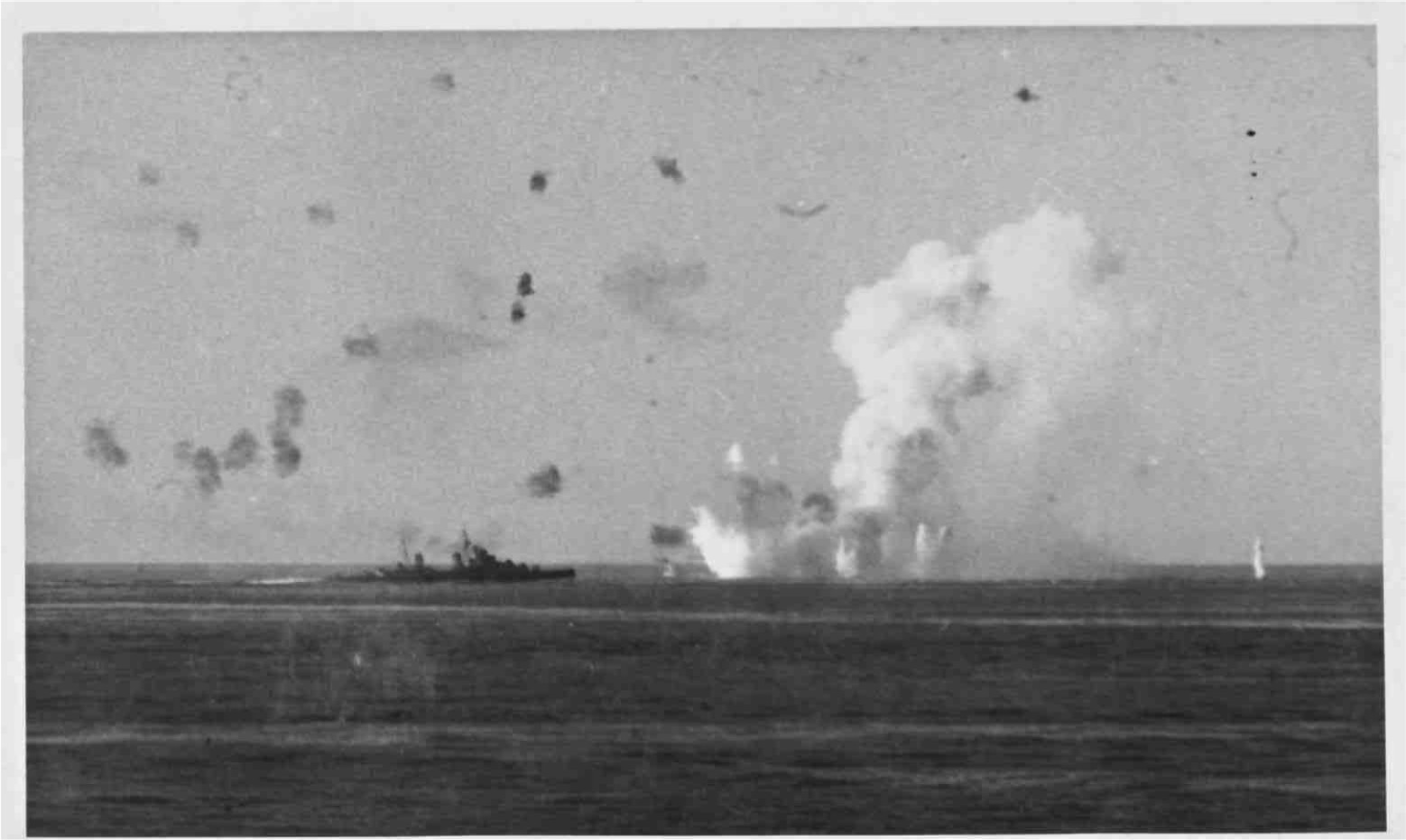
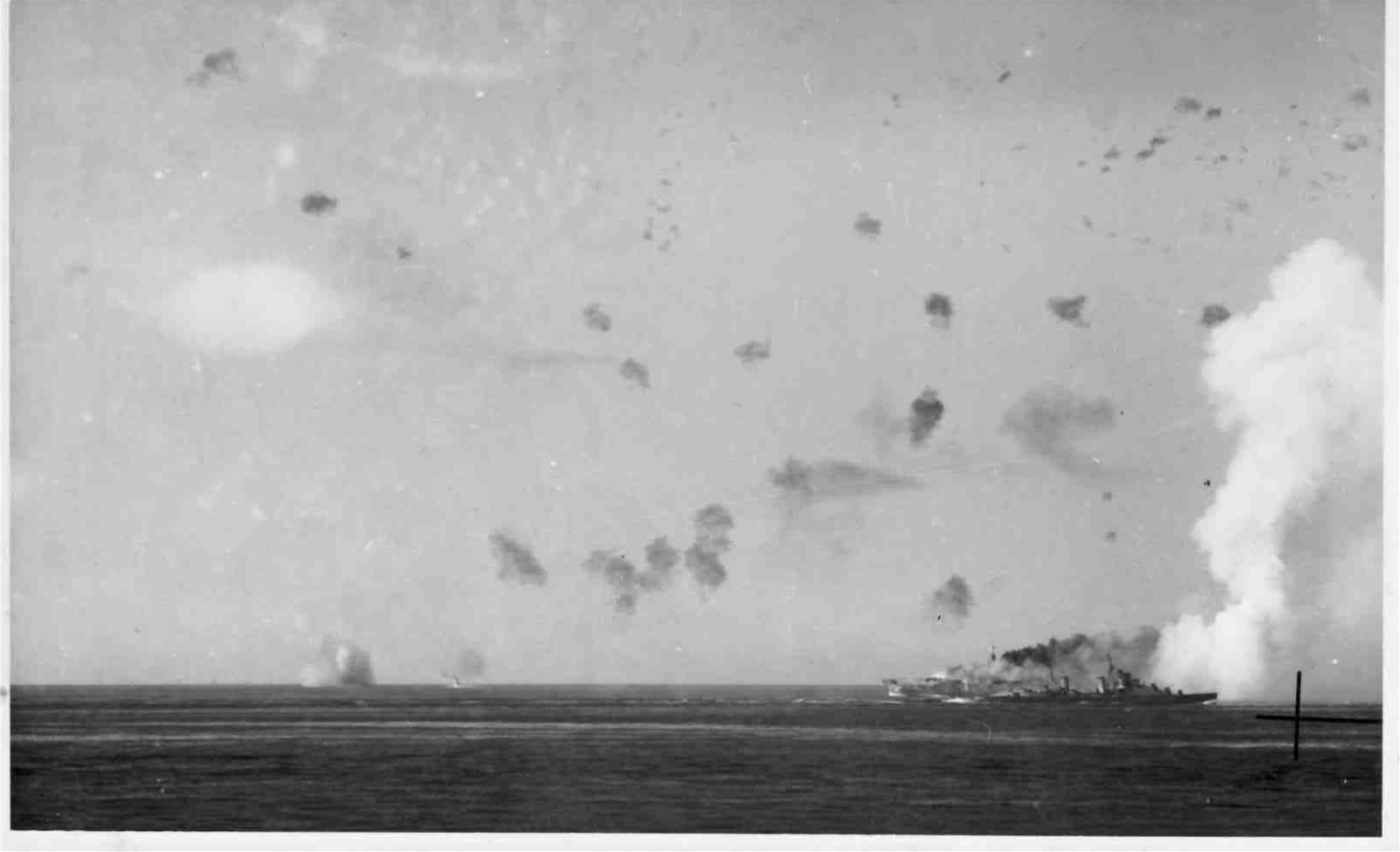
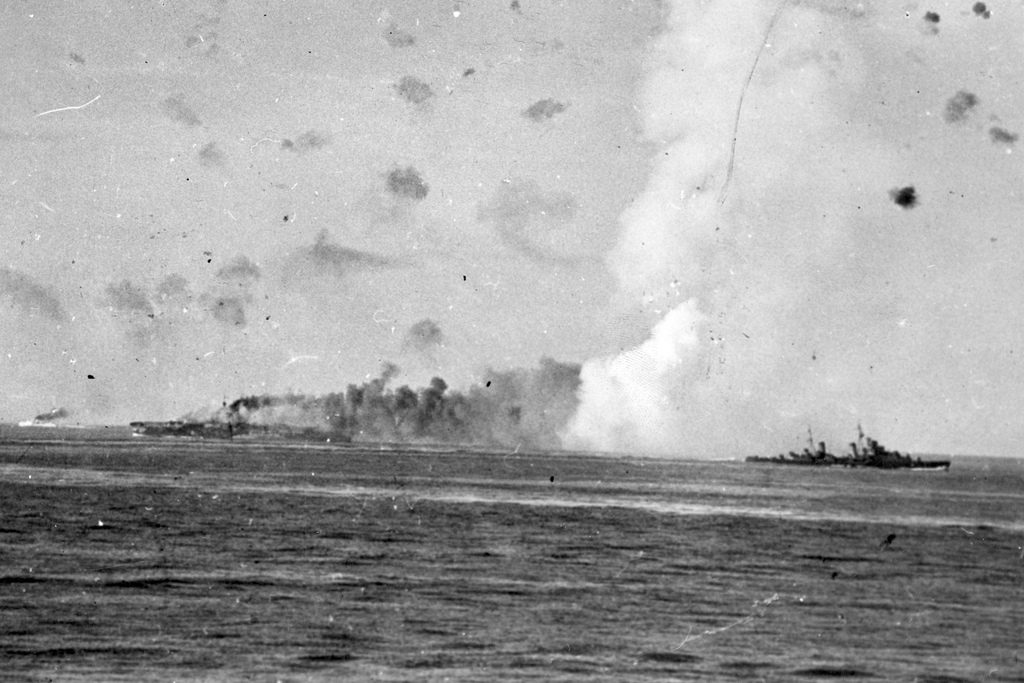
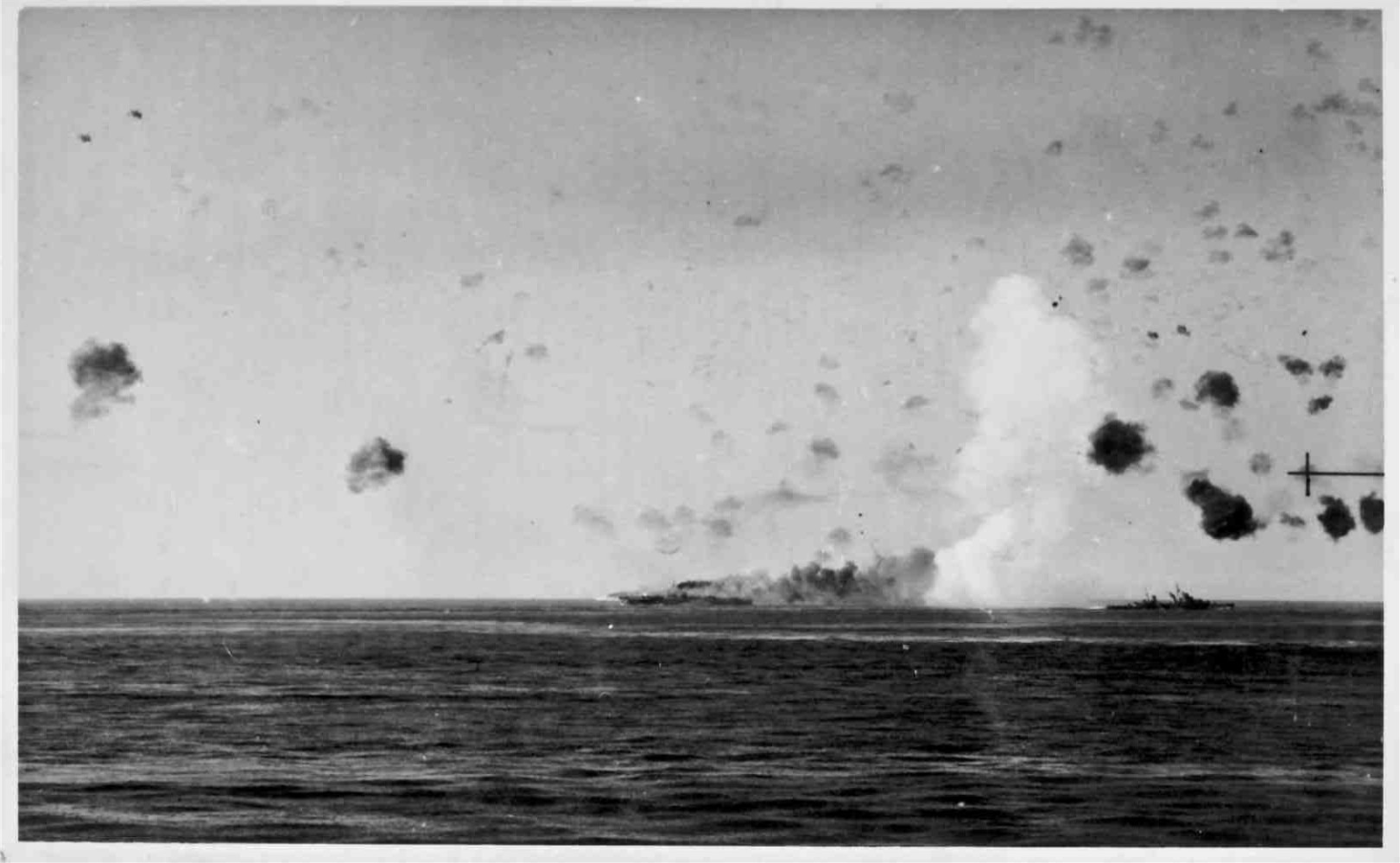
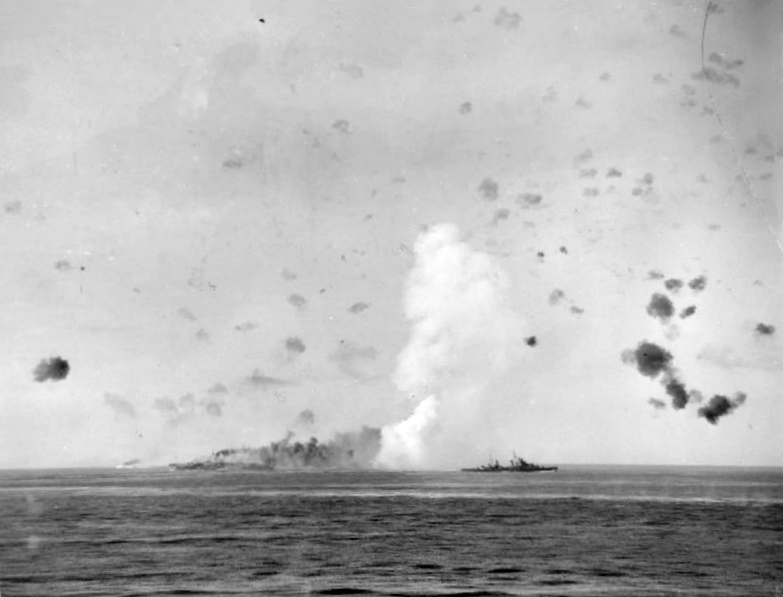
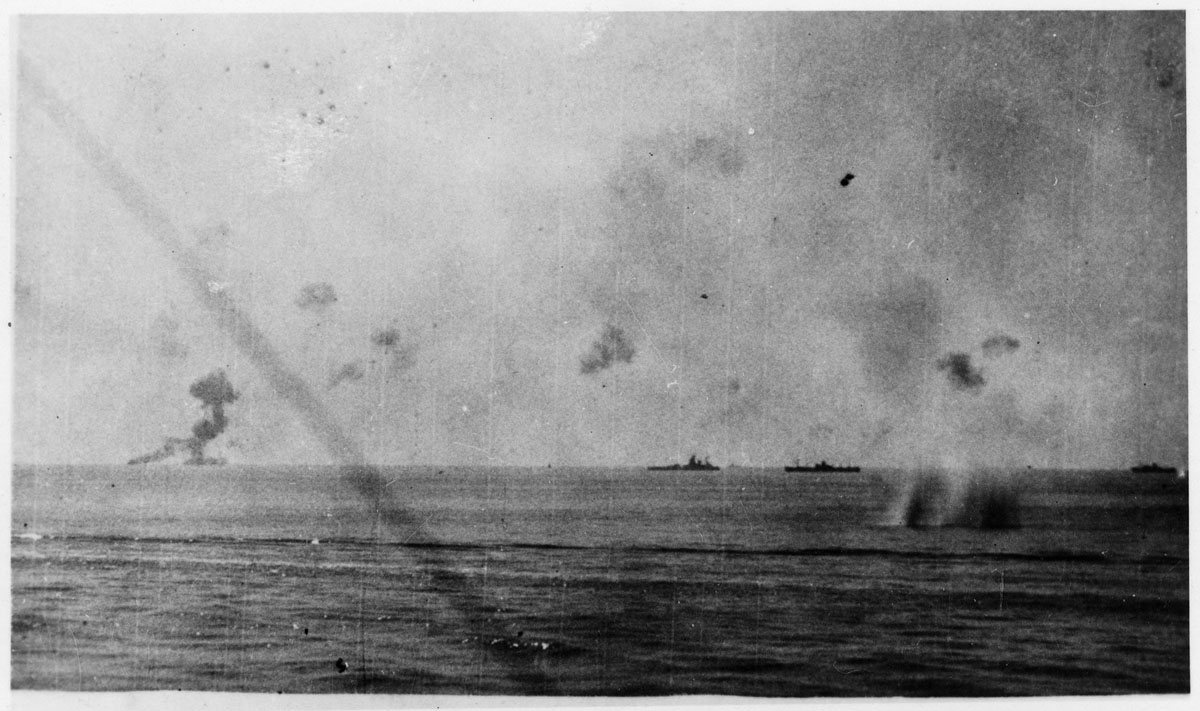
It was to be the raid’s last attack.
Admiral Syfret was faced with a dilemma. He was shortly due to separate Force Z from the convoy, but the fleet had intended to remain close enough to offer a degree of fighter protection as well as offer its deterrent value against any foray by the Italian fleet.
But the force had lost two thirds of its aircraft and the crippled Indomitable needed cover as she slowly limped towards safety.
At 1855, 20 minutes earlier than the scheduled departure time, Admiral Syfret ordered Force Z to turn towards its designated station just out of air attack range of Sardinia. This would help shield the wounded Indomitable long enough to make good her escape.
He was confident the cruisers and destroyers of Admiral Burroughs’ Force X would be sufficient to see the merchantmen through to the safety of Malta’s Spitfire screen.
Arthur Lawson was a leading telegraphist aboard Indomitable:
“Round about 1930 the attacks were being concentrated on the carriers and Indomitable was under continuous bombing, while fighting back tooth-and-nail. Suddenly the ship shuddered from stern to stern and one had the strangest feeling of great resistance being exerted by the whole vessel to stop herself being pressed underwater. A strange hush prevailed immediately following the hits, followed by the bedlam of the damage control parties going about their grisly work. My most vivid memory of that moment was seeing an officer finishing a drink he was having with half his head blown away!”
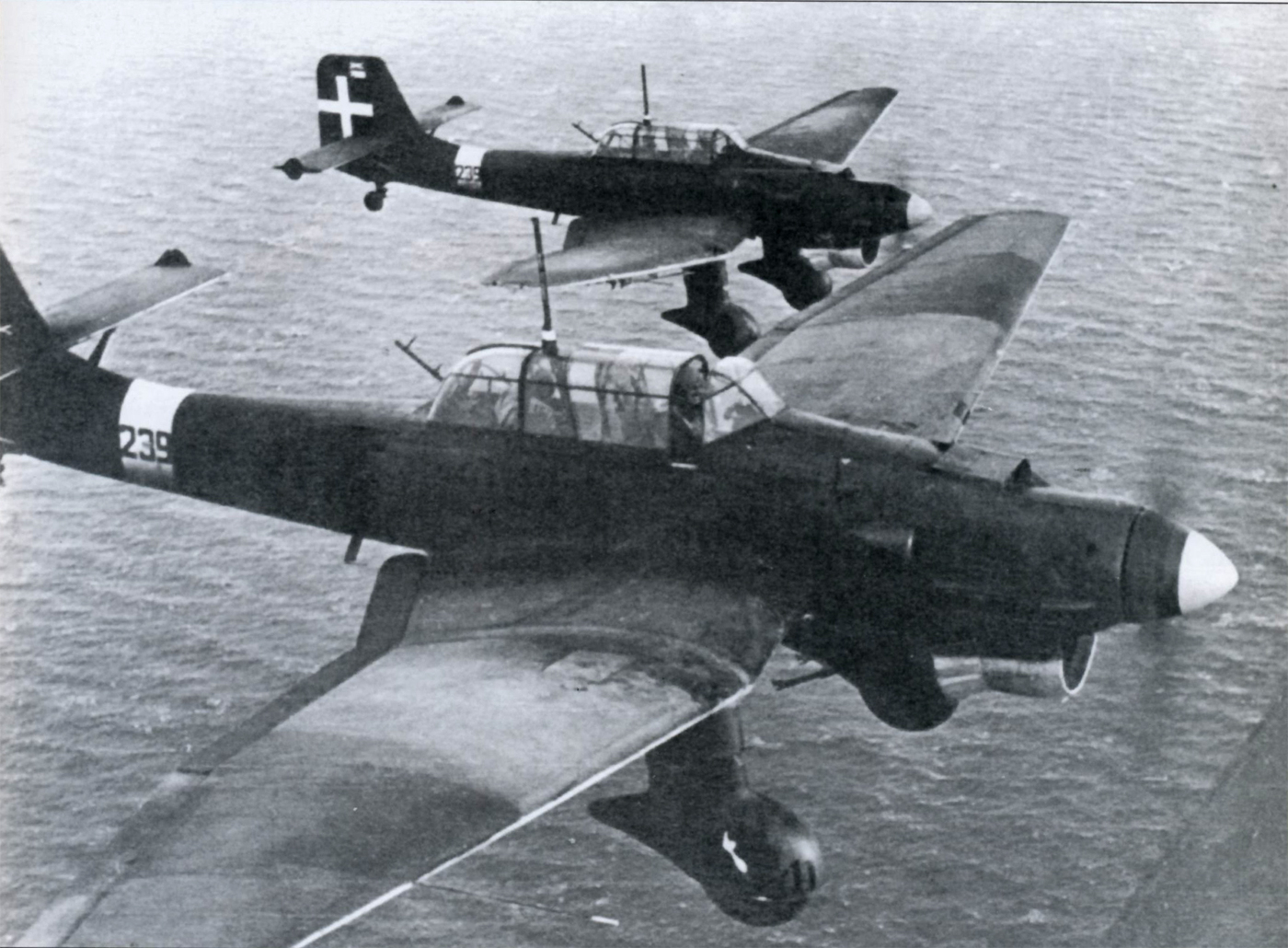
In a letter from Gen Cumbat of 102 Gruppo, based at Pantellelria, to Peter C. Smith, the Italian Stuka pilot tells of his flight of nine engaging HMS Indomitable at 1840, August 12. He had selected as his target ‘an aircraft carrier located forward of the central line of ships in the convoy’:
During my short dive we were surrounded by the outlines of shells from the anti-aircraft guns of all the warships. I dropped my load of bombs and pulled out about 200m from sea level. During that critical phase Cavallo warned me, ‘Fighter on your tail’. I had not yet reached my line of manoeuvre before two cannon blows ripped through both my wings and a machine-gun volley reduced my right fuel tank to the appearance of a soup strainer!
We employed on our Ju87s a private camera operated by the gunners to try to get some pictures during our attacks, but as you can well imagine, the results were very poor and not definite. From this attack I lost both my wing men to the flak and myself did not obtain any witness of my results or documentation. That night, at 0200 on the 3rd, Catania Air Headquarters called me at base asking if I could confirm that my unit had scored hits on an aircraft carrier as the Germans were claiming it for their Stukas. I replied that I could not prove it either way, but should they obtain better information than I then they should award credit to one of my two lost companions who were seen to complete their dives. I never subsequently checked further; all I know is that I lost two very brave and enthusiastic young pilots that day.

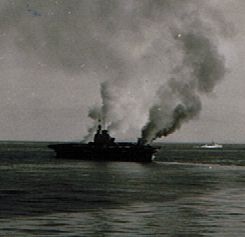
HMS INDOMITABLE comes about to bring the wind over the deck to blow smoke from the fires raging fore and aft away from the ship.
AFTERMATH
Admiral Syfret wrote:
An account from a sailor aboard HMS Eskimo
By about 1800 the sky became thick with aircraft obviously waiting for a co-ordinated attack. There were 42 bombers, mostly JU87 dive-bombers, 40 Savoias and 38 fighters according to one report totalling one hundred and twenty planes. At any rate there were a hell of a lot and these were harried by the carriers’ 22 fighters whose pilots must have been exhausted by this time. Then the enemy attacked and there were planes everywhere and all ships were firing every gun and in the middle of it all it was evident that the aircraft carriers were the main target. Suddenly huge plumes of smoke appeared in the bows and stern of the Indomitable as the Stukas dived down on her and hit her with 2 or 3 bombs. She turned towards us escorted by the anti aircraft cruiser Scylla and as she got close we could see a huge piece of her side plating hanging loose and a plume of black smoke rising near her stern, but she was not put out of action completely.
The German’s assessment of the day’s attacks was surprisingly accurate. They believed they had damaged one “American” aircraft carrier with six bomb hits. They also reported damaging a cruiser and a destroyer, along with one 20,000ton merchant ship.
It is thought that Indomitable’s higher freeboard and lighter paint – used in the Indian Ocean station – had confuse the German pilots into believing she was the USS Wasp.
Now only HMS Victorious’ fighters – with a handful she had recovered from Indomitable – remained to cover Force Z. There were 10 operational Fulmars, eight Sea Hurricanes and three Martlets.
HMS Indomitable had aircraft languishing inside her armoured hangar, waiting as damage control crews frantically worked to clear the tangled mass of steel that was the flight deck.
Two hours after being hit, at 1927, HMS Indomitable signaled she could make 17 knots. An hour later she was making 28.5 knots towards the safety of Gibraltar.
It was HMS Rodney, shocked by at least two near-misses, which slowed Force Z to 18 knots. Her engine room was still having boiler troubles.
Operation Pedestal’s air cover had been dramatically reduced – but it had achieved what had been asked of it. Now Force Z had turned back, the convoy’s merchant vessels were left with only the guns of the close-escort cruisers, destroyers and frigates for protection. Their air defence was in the hands of Malta’s Spitfires and Beaufighters.
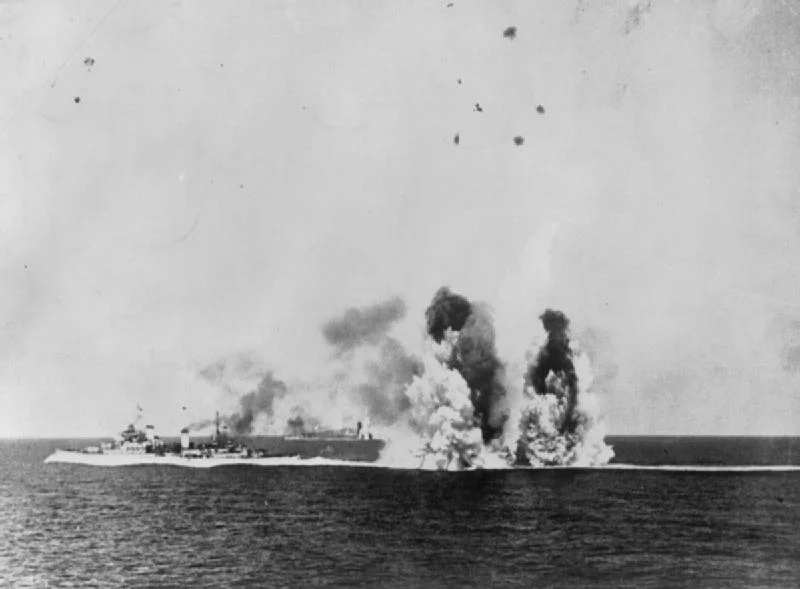
12 August: Evening Air and Submarine attacks: HMS KENYA under air attack on her return voyage to Gibraltar.
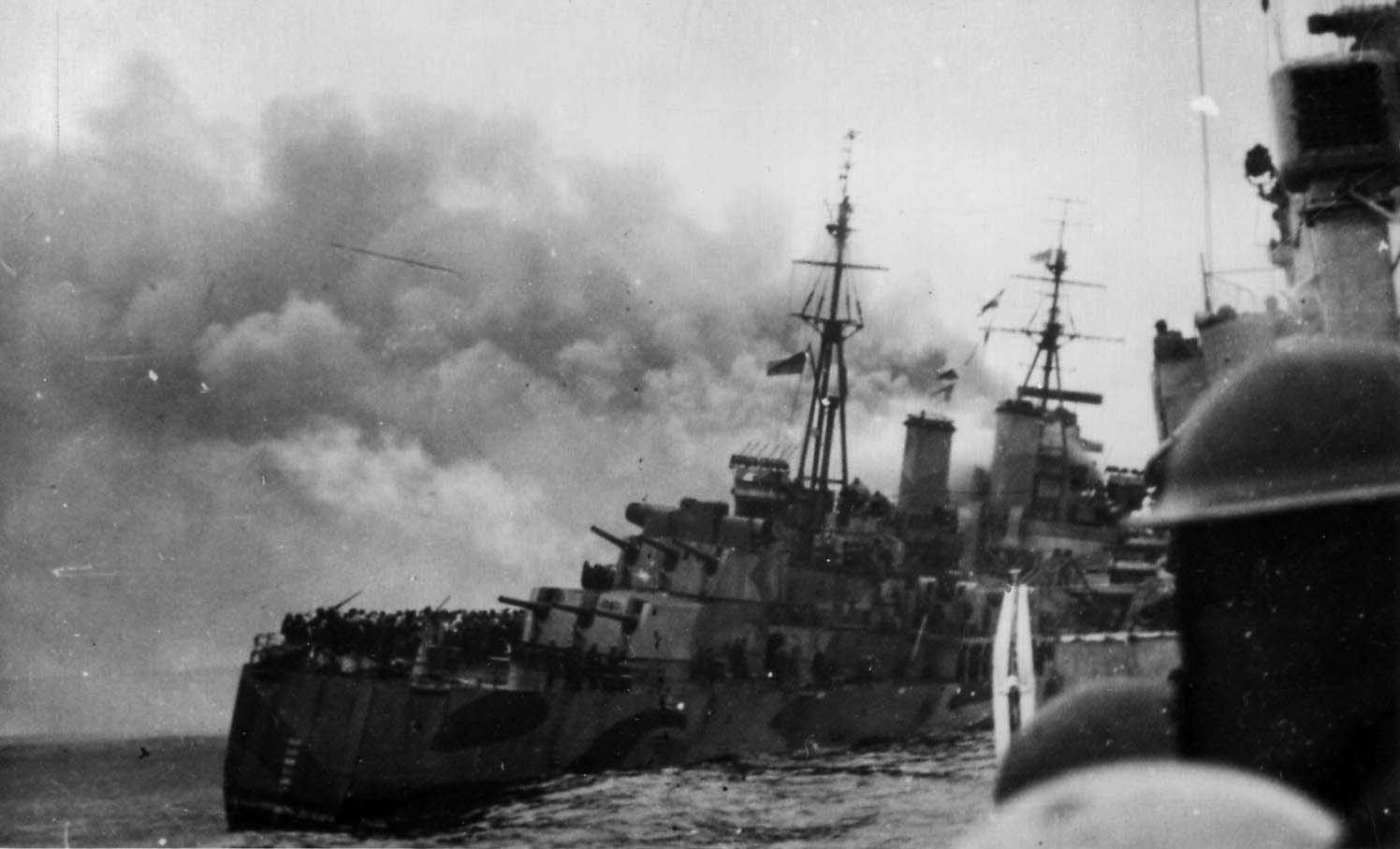
A destroyer comes alongside HMS NIGERIA after the cruiser was torpedoed on August 12.
2030 ATTACK 5
The final Axis effort for the day was carried out by 12 S79 torpedo bombers and 28 Italian Ju87Rs. This force found Force X and the merchantmen still pushing towards Malta.
Four of HMS Victorious’s Fulmars had been slated to provide cover for Pedestal at this point. However, the chaos on the carrier’s flight deck after landing-on Indomitable’s fighters had forced the section to take off too early.
The Italian attack scored no hits for the loss of two Stukas.
As this air attack unfolded, several Italian submarines were able to penetrate the destroyer screen. The cruisers HMS Nigeria and Cairo, both equipped with modern radar and aircraft direction equipment, were torpedoed. So was the vital tanker Ohio. A short time later, at 2112, the cruiser Kenya was also hit.
The submarines escaped.
Upon returning to Pantellerina at 2045, the Italian aircraft were themselves attacked by Beaufighters. The strike started a blaze in a fuel dump and destroyed five aircraft.
Nigeria limped towards safety but Cairo had to be scuttled. The loss of the convoy’s only two fighter-direction ships would be sorely felt.
Admiral Syfret was once again forced to act: Indomitable had picked up speed, reducing her vulnerability to attack. He detached the cruiser HMS Charybdis and the “Tribal” class destroyers Somali and Eskimo from her screen, ordering them to make best speed towards the weakened convoy. With most of its escorting destroyers scattered, the merchantmen of Operation Pedestal were now at the mercy of Axis air, surface and submarine attacks.
HMS Nelson, Victorious, Phoebe, Sirius and the destroyers HMS Laforey, Lightning, Lookout, Quentin and Tartar took up station outside of bomber range from Sardinia.
At 2300, HMS Rodney and Indomitable, along with the damaged Ithuriel and five other destroyers were ordered back to Gibraltar.
HMS Indomitable’s damage control crews were eventually able to restore the flight deck to a condition capable of launching and recovering aircraft: But not until well after the operation was over.
AFTER-ACTION
“By any standards, the shipboard fighters had scored a victory. The enemy had held the initiative throughout 12th August, attacking in great strength, with an escort which always outnumbered the defenders. Not until the third raid did the fighters manage to subdue the tired naval pilots, most of whom were flying their third or fourth sorties of the day.
Despite the best efforts of the Germans and Italians, five vital merchant vessels eventually reached Malta. The supplies did not completely “break” the siege, but it did give Malta enough reserves to put off the thought of surrender until the following January.
This gave the Allies plenty of time to run further supply convoys through to the beleaguered island.
HMS Indomitable had been put out of action, but her aircraft had been available at a key time for the convoy’s passage.
Once again, the pilots of the Fleet Air Arm had done what was asked of them with equipment and support not entirely up to the task.
Admiral Syfret reported:
“The work of the aircraft carriers (HMS INDOMITABLE, Captain T H Troubridge, and HMS VICTORIOUS, Captain H C Bovell) under the command of Rear-Admiral Lyster, was excellently performed, while that of their fighters was magnificent. Flying at great heights, constantly chasing the faster JU 88s, warning the fleet of approaching formations, breaking up the latter, and in the later stages doing their work in the face of superior enemy fighter forces, they were grand. The fact that 39 [enemy aircraft] certainties were shot down by them and the probability that at least the same number were incapacitated is a remarkable measure of the success of the carriers, their teamwork and their fighters and of the able and inspiring leadership of Rear-Admiral A L St G Lyster, CB, CVO, DSO”
Captain Bovel of the HMS Victorious would also note:
“This is the first time that an attempt has been made to control so many fighters simultaneously. On the whole… fighter direction was remarkably successful.”

Outnumbered at least two-to-one for much of the day, the Fleet Air Arm was singularly responsible for the minimal damage Pedestal had sustained until the night of the 11th.
The British carriers had lost seven fighters in air combat. Three Fulmars, three Hurricanes and a Martlet had been shot down.
But the CAP had not deviated from its primary purpose …. to break up and disrupt the axis attackers in order to prevent effective attacks against the ships. This meant the FAA fighters avoided being drawn away from the defence of the fleet in the hope of an easy kill.
“The losses suffered by Force F were regrettably heavy and the number of merchant ships which reached Malta disappointingly small. But I have no fault to find with the personnel of the fleet because better results were not achieved. On the contrary, Commanding Officers, generally, have praised the fine bearing and spirit shown by their ships’ companies, many of whom were very young and to whom battle was a new experience. I am proud to associate myself with these tributes, and in particular give credit to those whose duties kept them below decks during submarine, air and E-Boat attacks.

Propaganda own-goal … The tale of Ohio’s courageous struggle has pushed the story of the air defence of the Pedestal convoy into obscurity.
Minute by Director of Gunnery and Anti-Aircraft Warfare
[ADM 199/ 1242] 5 March 1943
Lessons learnt from Operation ‘Pedestal’;
The outstanding feature of this operation was that the four heavy air attacks, by a total of some 120 aircraft, achieved so little while the convoy was fully escorted. The only damage to the convoy was DEUCALION near missed and reduced in speed for a time, and to the escort, FORESIGHT damaged by torpedo, and INDOMITABLE by bombs.
2. This successful defence was partly due to the improved A.A. armament of the merchant ships, all of whom carried Oerlikons, whose tracer ammunition provides an excellent deterrent to close and accurate air attack.
3. Few of the warships engaged had had previous experience of heavy scale air attacks, and on the whole their A.A. fire control equipment [was] out of date…
4. Even so, the effect of the A.A. fire put up must make the German and Italian Air Forces begin to realise that air attack in daylight is becoming less and less profitable. Their “interest” in air attack by night will correspondingly increase and it is essential that the fleet should be equipped without delay to deal with night air attack.
5. Contributory factors toward the comparative immunity of the convoy were 5.1. The unusually large proportion of fighters in the Carriers. 5.2. The good fighter direction. 5.3. The large number of screening destroyers, which enabled an all round screen to be used, thus preventing the torpedo aircraft finding an easy way in to attack the convoy.
6. When the fleet contains several units capable of engaging aircraft formations at long range, there appears to be a need for a Fleet Air Defence Officer to co-ordinate the long range gunfire of the fleet with the Fighter Defence, thus ensuring that no enemy formation is left unfired at. This matter has been raised on a separate paper …

REPAIRS
“I looked up and saw Indomitable slowly entering harbour and turning to starboard to come alongside the southern mole. She had her glistening Royal Marine Band sounding forth on the sunlit flight deck. “Christ!” said Bully. “The band’s on top of her lift and that’s 20 feet off the flight deck. And look at those scars on her side.” We walked round to the mole and went aboard. There I found Paddy Brownlee and we went round the ship together. Butch Judd, Mike Hankey and six other Hurricane pilots were missing from air operations. Three Albacore aircrew had also been killed by the near miss in her wardroom and 70 more injured. The dockyard men had begun to pick off human remains stuck to the underside of the shattered lift. “What’s that awful smell, Paddy?” I asked. “That’s‘Junior’ Young’s rhino horns and hooves. The bomb spread them around the lift well,” replied Paddy.
After burying her dead and patching up as much damage as possible while at Gibraltar, HMS Indomitable was ordered to Liverpool for full repars.
Work would take from August 30 to February 11, 1943.
She would re-enter service with eight additional twin and two single 20mm Oerlikons.
Hugh Popham gives the following account of returning to Indomitable after being damaged in his book, Sea Flight: The Wartime Memoirs of a Fleet Air Arm Pilot
Indom went straight into dry-dock, for apart from the three direct hits she had received, she had been near-missed by several more bombs, and it was likely she had suffered underwater damage. From the air we had been able to gather a superficial idea of her punishment: it hardly prepared us for the savage disorder we found when we returned aboard. The main hits had been for’ard of the for’ard lift and aft of the after lift. The former had pierced the flight-deck and exploded in the mouth of the hangar, killing, or wounding with flash-burns, many of the ratings working on the aircraft. The force of the explosion raised the seventy-ton lift, which was up, two feet above flight-deck level, where it stuck jammed on its chains, like a cork half out of a bottle, and started a fire in the torpedo-store where, after a time, the torpedoes began to cook off. The latter also pierced the flight-deck, buckling the after lift, and laying waste the officers’ cabin flats. A third thousand-pounder had struck the side of the ship just above the water-line where it had burst on impact, wrecked the wardroom anteroom, and-killed the half-dozen officers— mostly off-duty pilots and observers of the Albacore squadrons, but including my cabin-mate, The Boy— who were there at the time. Considering the amount of damage and the weight of bombs, casualties had been fairly light, the worst being among our own squadron maintenance crews. But the ship herself was strange to us, the run of her that was as familiar as home broken and interrupted by the jagged rents in her plates, the charred and splintered woodwork, the great, flapping tarpaulin anchored across the missing bulkheads in the anteroom. The strangeness of it all was enhanced by the faces that were missing; their death, during our absence, cut them off from us, for no ghosts could live among these draughty ruins: was enhanced also by the break in normal squadron life.
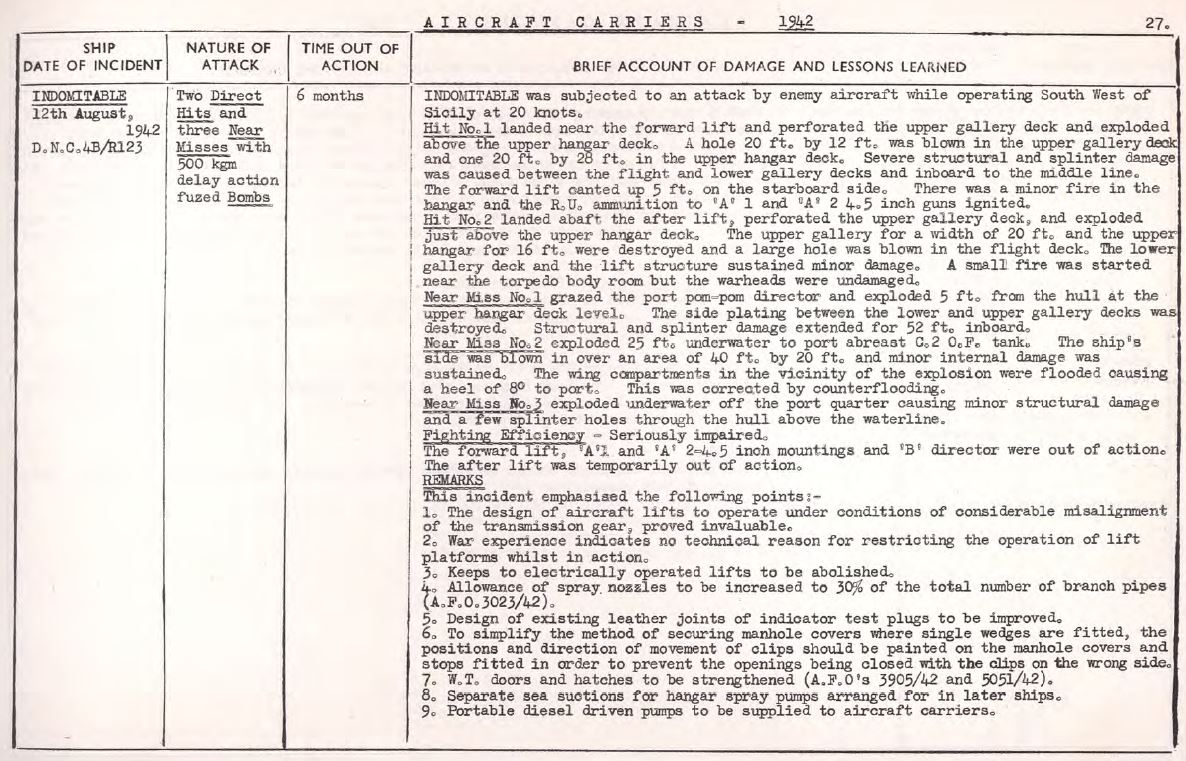
CLICK on the image above to be taken to the pdf source. CLICK HERE to be taken to armouredcarriers.com analysis of HMS Indomitable’s battle damage.

MORE ON INDOMITABLE

HMS Indomitable, Damage Control
Shock and awe
Operation Pedestal convoy bomb damage, August 12, 1942

HMS Indomitable
Lessons Learned
Part 3: Armoured flight deck carrier modifications