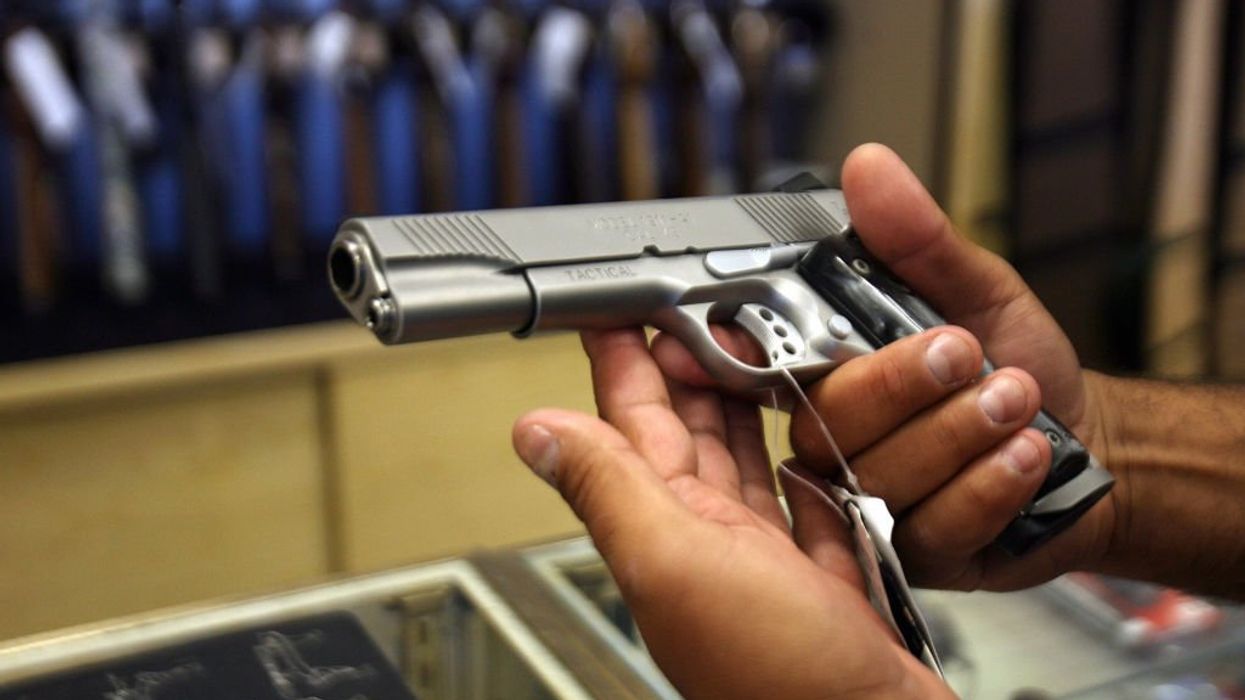
s shown below, I’d change this graphic to show the silhouette of a Marlin. (MN Gun Owners Caucus/X)
“[Minnesota’s] House File 3570 was referred to the House Committee on Public Safety Finance and Policy and would ban so called ‘assault weapons by expanding upon an existing statute used to define these firearms,” NRA-ILA reported Wednesday. “The bill would also prohibit the sale or transfer of ‘assault weapons’, establish a buyback program, and call for an appropriation from the general fund.”
“HF 3570 uses a broad list of different firearms to define ‘semiautomatic military-style assault weapon’,” NRA continued. “Additionally, varying models of a specific gun or models similar to those listed in the bill are prohibited. Modifications and accessories like protruding grips and barrel shrouds, are features that would also cause a gun to be banned. The transfer of semiautomatic military-style assault weapons is prohibited, with very limited exceptions for law enforcement and the military.”
It’s like Minnesota Democratic–Farmer–Labor Party Second Amendment haters have taken all the various iterations of semi auto bans from “by name” to “by characteristics” and added steroids to the mix. Whereas 1994’s federal ban included semi-automatic rifles able to accept detachable magazines with two or more of the “evil” mods like folding stocks, pistol grips, flash hiders and the like, taking a page from California, HF 3570 reduces rejection criteria to “one or more.”
It also lines out a section ceding that “a firearm is not a ‘semiautomatic military-style assault weapon’ if it is generally recognized as particularly suitable for or readily adaptable to sporting purposes under United States Code.” While Jews for the Preservation of Firearms Ownership was the first to warn about the Nazi origins of the “sporting purposes” term, the elimination of even that tells us much about the authoritarian mindset of Minnesota’s violence monopolists.
HF 3570 adds another curious disqualifier, “thumbhole stocks.” That’s because initially, thumbhole stocks were offered as stability and comfort workarounds to the federal pistol grip ban. So, California and other Democrat states decided their priority was for firearms to be less steady and therefore less accurate, ludicrously in the name of “commonsense gun safety.”
And naturally, no attack on armed citizens would be complete without special carveouts for the “Only Ones” expected to enforce the infringements.
(b) Semiautomatic military-style assault weapon also includes any…
Then go down to line 3.5 and it includes:
…rimfire rifle with a fixed magazine that has the capacity to accept more than ten rounds of ammunition;
And the Marlin advertises a 14 + 1 capacity.
This is what these maniacs are demonizing as a “weapon of war” that “has no business on our streets” and no other purpose but the mass slaughter of innocents. After all, you can’t hunt deer with it! All that’s missing is some lefty vet saying it’s the same gun he carried in Iraq and Afghanistan.
And Minnesota’s not alone—California’s right with them on “large capacity magazines,” albeit they exempt “.22 caliber tube ammunition feeding devices or tubular magazines contained in a lever-action firearm” (emphasis added)—at least until the grabbers decide otherwise. And it would appear to be the same in New York, while Illinois, surprisingly, hasn’t “caught up” yet.
It’s interesting to note the backgrounds of the bill’s authors, Leigh Finke, Esther Agbaje, Alicia ‘Liish’ Kozlowski, Larry Kraft, and Samantha Sencer-Mura, DFL stalwarts and darlings of the prohibitionists all, and not a farmer or a laborer in the bunch. (That’s OK—it’s not like Antifa is comprised of those workers” they say they champion.) Ask them about the specifics of what they’re banning, aside from “everything,” and it’s highly likely that an on-the-spot challenge would result in a “shoulder thing that goes up” answer.
While HF 3570 is in its initial stages and has a long way to go, the dominant DFL is using momentum it gained getting due process-denying “red flag” gun confiscations mandated beginning this year. Meanwhile, Minnesota’s denying 18 to 20-year-old adults their right to carry firearms is being challenged.
Don’t look to formerly NRA-endorsed Gov. Tim Walz to honor any of the promises he made before he decided he didn’t need them anymore. That’s what happens when gun owners are led to believe a Democrat Fudd believes in their rights or has anyone’s interests at heart but his own.
The question now is, when is the Supreme Court going to use Bruen to put a stop to this nonsense? They will, won’t they?
About David Codrea:
David Codrea is the winner of multiple journalist awards for investigating/defending the RKBA and a long-time gun owner rights advocate who defiantly challenges the folly of citizen disarmament. He blogs at “The War on Guns: Notes from the Resistance,” is a regularly featured contributor to Firearms News, and posts on Twitter: @dcodrea and Facebook.
The war on regulation in California is escalating.
Gun violence prevention advocates say it’s saving lives, while gun rights supporters argue it’s regulation overkill.
“If you ask me if it was something that made shooting difficult, yes it was,” said Stolfi.
Stolfi is using a World War 2 era M-1 carbine for target practice.
“The imposition of needing a background check, and vendors not wanting to send ammunition to California, it became problematic for me to find this ammunition for this rifle with ease,” said Stolfi.
The Cloverdale resident has been buying gun powder and primers to hand load cartridges for many of his rifles since the tighter ammo restrictions were put in place.
Experts expect the case that is challenging state law requiring background checks for purchasing ammunition to go all the way to the U.S. Supreme Court. For Bradley Stolfi, he supports common sense gun regulation.
“I think every firearm should require a background check and it should be thorough,” said Stolfi.
But a state law implemented in 2019 requiring in-person background checks for ammunition isn’t one of them.
“That incurred a substantial cost in all the materials I needed to do it,” said Stolfi.
Many hunters and gun owners say the restrictions violate their 2nd amendment right to bear arms. A federal judge recently agreed, overturning the law.
But days later, the 9th Circuit Court of Appeals in a 2-to-1 vote put a hold on that ruling.
“We have seen a California that is a far safer place today than it was 30 years ago. Background checks work for firearms. Background checks work for ammunition,” said Steve Lindley.
Lindley has a law enforcement background, and now works for Brady United Against Gun Violence.
“We’re not trying to prevent anybody from purchasing a firearm or purchasing ammunition. What we’re trying to do is keeping firearms and ammunition out of the hands of people who are prohibited or are a danger to our communities,” said Lindley.
“There’s a small number of people out there that shouldn’t have access to ammunition, and that’s more of a problem than is being addressed by just making it more difficult to get the ammunition,” said Stolfi.
The stay issued by the Court of Appeals means background checks for ammunition can once again proceed for now.
“Background checks, safe storage, those type of things all compounded together, make a significant difference,” said Lindley.
But Stolfi believes rather than making it more difficult to purchase ammunition, banning high-capacity magazines, would have more of an impact in saving lives.
“I don’t see any need for any magazine to be able to hold more than 10. That’s going to get me in a lot of trouble with guys I know, but that’s what I think,” said Stolfi.
Stolfi is aiming to find that balance between restrictions and gun rights enshrined in the Constitution.
California Attorney General Rob Bonta, a Democrat, posted on X saying the ruling by the court of appeals means the state’s “life-saving ammunition laws will remain in effect as we continue to defend them in court.”
It’s unclear when the case will be heard.
However the Ninth Circuit Court of Appeals rules, legal experts say the case will likely reach the U.S. Supreme Court.
Several major credit card companies have decided to move forward with a plan to track purchases made at gun retailers in California, CBS News reported Monday.
American Express, Visa, and Mastercard will implement a new merchant code for firearm and ammunition retailers, allowing banks to track “suspicious” purchases to comply with a new California law. Adopting the code will not provide information about the specific items purchased at the retailer, as credit card companies do not record data at an SKU level.
Retailers are assigned merchant category codes based on the types of items they sell. According to Mastercard’s quick reference booklet, gun stores are currently assigned the “miscellaneous” or “durable goods” merchant category code. Other businesses listed under those codes include gas lighting fixtures, musical instruments, fireworks, fire extinguishers, grave markers, luggage, and wood chips.
In 2022, the International Organization for Standardization approved a unique code for firearm retailers. California then passed a law requiring retailers to adopt the ISO’s new code by May 2025.
The three major credit card companies previously agreed to assign the new code to gun retailers to allow banks to track firearm purchases more easily. In September 2022, 24 Republican state attorneys general wrote a letter to the companies, urging them to reconsider, Blaze News previously reported. According to the AGs, implementing a unique code could violate citizens’ rights.
“Categorizing the constitutionally protected right to purchase firearms unfairly singles out law-abiding merchants and consumers alike,” the letter argued.
Supporters of the law believe that the implementation of a unique code could prevent mass shooting incidents. Conservatives argue that the move will infringe on Second Amendment rights and potentially cause banks to flag and report so-called suspicious purchase patterns that target law-abiding Americans.
In March 2023, the companies agreed to halt their plans to implement the new code, citing pressure from Republican politicians, Blaze News previously reported.
On Monday, CBS News stated that American Express, Visa, and Mastercard have since reversed course and once again plan to adopt the new code to comply with California’s law.
The news outlet reported that the credit card companies told congressional Democrats last month that the new code would be available and ready for use in California by May 2025.
Mastercard executive Tucker Foote wrote to lawmakers, “The applicable standalone merchants in California primarily engaged in the sale of firearms will be required to utilize the code.”
Visa senior vice president Robert B. Thomson III’s comments to lawmakers seemed to indicate that the company will continue to pause the adoption of the code at least until California’s new law goes into effect in 2025. CBS News reported that Thomson assured Democrats that Visa would endeavor to comply with the state’s rule.
Thomson wrote, “With respect to the [firearm merchant code], there continues to be a tremendous amount of regulatory and legislative uncertainty.”
“Given the conflicting state laws on this topic and the likelihood that other states will enact legislation to either restrict or mandate the code, our implementation pause remains in effect,” Thomson added.
The Second Amendment Foundation and a District Attorney in Pennsylvania have filed a federal lawsuit against Attorney General Merrick Garland, the heads of the FBI and ATF, and the U.S. Government, challenging the federal prohibition on gun ownership by medical marijuana users.
The lawsuit was filed in U.S. District Court for the Western District of Pennsylvania. In addition to Garland, the lawsuit names FBI Director Christopher Wray and ATF Director Steven Dettelbach as defendants. SAF is joined by Warren County, Pa. District Attorney Robert Greene, who has served in that office since 2013 and currently possesses a medical marijuana ID card under Pennsylvania law. They are represented by attorneys Adam Kraut, who serves as SAF executive director, and Joshua Prince of Bechtelsville, Pa.
The lawsuit challenges restrictions contained in 18 U.S.C. §§ 922(g)(3), (d)(3), which prohibit firearms purchases and possession by persons who use marijuana or other controlled substances.
“Medicinal marijuana has been adopted by 38 states despite federal inaction on the issue,” said Kraut, who is also a practicing attorney in Pennsylvania. “With the increasing acceptance of medical cannabis, millions of Americans are forced to choose between the exercise of their Second Amendment rights or treating their symptoms with a substance that disenfranchises them from their constitutionally guaranteed right to keep and bear arms.
Such a choice is incompatible with the constitution and finds no basis in this country’s history and tradition. We look forward to vindicating the rights of medical marijuana users.”
“The use of medical marijuana should not translate to an automatic surrender of one’s Second Amendment rights,” added SAF founder and Executive Vice President Alan M. Gottlieb. “The current restrictions unquestionably and arbitrarily infringe on the right to keep and bear arms, and the restriction lacks any director or analogous historical support, as required by the Supreme Court’s 2022 Bruen ruling.”
Second Amendment Foundation
The Second Amendment Foundation (www.saf.org) is the nation’s oldest and largest tax-exempt education, research, publishing and legal action group focusing on the Constitutional right and heritage to privately own and possess firearms. Founded in 1974, The Foundation has grown to more than 720,000 members and supporters and conducts many programs designed to better inform the public about the consequences of gun control.
Research suggests it’s largely because they’re anxious about their ability to protect their families, insecure about their place in the job market and beset by racial fears
Since the 2008 election of President Obama, the number of firearms manufactured in the U.S. has tripled, while imports have doubled. This doesn’t mean more households have guns than ever before—that percentage has stayed fairly steady for decades. Rather, more guns are being stockpiled by a small number of individuals. Three percent of the population now owns half of the country’s firearms, says a recent, definitive study from the Injury Control Research Center at Harvard University.
So, who is buying all these guns—and why?
The short, broad-brush answer to the first part of that question is this: men, who on average possess almost twice the number of guns female owners do. But not all men. Some groups of men are much more avid gun consumers than others. The American citizen most likely to own a gun is a white male—but not just any white guy. According to a growing number of scientific studies, the kind of man who stockpiles weapons or applies for a concealed-carry license meets a very specific profile.
These are men who are anxious about their ability to protect their families, insecure about their place in the job market, and beset by racial fears. They tend to be less educated. For the most part, they don’t appear to be religious—and, suggests one study, faith seems to reduce their attachment to guns. In fact, stockpiling guns seems to be a symptom of a much deeper crisis in meaning and purpose in their lives. Taken together, these studies describe a population that is struggling to find a new story—one in which they are once again the heroes.
WHATEVER HAPPENED TO HARD WORK?
When Northland College sociologist Angela Stroud studied applications for licenses to carry concealed firearms in Texas, which exploded after President Obama was elected, she found applicants were overwhelmingly dominated by white men. In interviews, they told her that they wanted to protect themselves and the people they love.
“When men became fathers or got married, they started to feel very vulnerable, like they couldn’t protect families,” she says. “For them, owning a weapon is part of what it means to be a good husband and a good father.” That meaning is “rooted in fear and vulnerability—very motivating emotions.”
But Stroud also discovered another motivation: racial anxiety. “A lot of people talked about how important Obama was to get a concealed-carry license: ‘He’s for free health care, he’s for welfare.’ They were asking, ‘Whatever happened to hard work?’” Obama’s presidency, they feared, would empower minorities to threaten their property and families.
The insight Stroud gained from her interviews is backed up by many, many studies. A 2013 paper by a team of United Kingdom researchers found that a one-point jump in the scale they used to measure racism increased the odds of owning a gun by 50 percent. A 2016 study from the University of Illinois at Chicago found that racial resentment among whites fueled opposition to gun control. This drives political affiliations: A 2017 study in the Social Studies Quarterly found that gun owners had become 50 percent more likely to vote Republican since 1972—and that gun culture had become strongly associated with explicit racism.
For many conservative men, the gun feels like a force for order in a chaotic world, suggests a study published in December of last year. In a series of three experiments, Steven Shepherd and Aaron C. Kay asked hundreds of liberals and conservatives to imagine holding a handgun—and found that conservatives felt less risk and greater personal control than liberal counterparts.
This wasn’t about familiarity with real-world guns—gun ownership and experience did not affect results. Instead, conservative attachment to guns was based entirely on ideology and emotions.
WHO WANTS TO BE A HERO?
That’s an insight echoed by another study published last year. Baylor University sociologists Paul Froese and F. Carson Mencken created a “gun empowerment scale” designed to measure how a nationally representative sample of almost 600 owners felt about their weapons. Their study found that people at the highest level of their scale—the ones who felt most emotionally and morally attached to their guns—were 78 percent white and 65 percent male.
“We found that white men who have experienced economic setbacks or worry about their economic futures are the group of owners most attached to their guns,” says Froese. “Those with high attachment felt that having a gun made them a better and more respected member of their communities.”
That wasn’t true for women and non-whites. In other words, they may have suffered setbacks—but women and people of color weren’t turning to guns to make themselves feel better. “This suggests that these owners have other sources of meaning and coping when facing hard times,” notes Froese—often, religion. Indeed, Froese and Mencken found that religious faith seemed to put the brakes on white men’s attachment to guns.
For these economically insecure, irreligious white men, “the gun is a ubiquitous symbol of power and independence, two things white males are worried about,” says Froese. “Guns, therefore, provide a way to regain their masculinity, which they perceive has been eroded by increasing economic impotency.”
Both Froese and Stroud found pervasive anti-government sentiments among their study participants. “This is interesting because these men tend to see themselves as devoted patriots, but make a distinction between the federal government and the ‘nation,’ says Froese. “On that point, I expect that many in this group see the ‘nation’ as being white.”
Investing guns with this kind of moral and emotional meaning has many consequences, the researchers say. “Put simply, owners who are more attached to their guns are most likely to believe that guns are a solution to our social ills,” says Froese. “For them, more ‘good’ people with guns would drastically reduce violence and increase civility. Again, it reflects a hero narrative, which many white men long to feel a part of.”
Stroud’s work echoes this conclusion. “They tell themselves all kinds of stories about criminals and criminal victimization,” she says. “But the story isn’t just about criminals. It’s about the good guy—and that’s how they see themselves: ‘I work hard, I take care of my family, and there are people who aren’t like that.’ When we tell stories about the Other, we’re really telling stories about ourselves.”
HOW TO SAVE A WHITE MAN’S LIFE
Unfortunately, the people most likely to be killed by the guns of white men aren’t the “bad guys,” presumably criminals or terrorists. It’s themselves—and their families.
White men aren’t just the Americans most likely to own guns; according to the Centers for Disease Control and Prevention, they’re also the people most likely to put them in their own mouths and pull the trigger, especially when they’re in some kind of economic distress. A white man is three times more likely to shoot himself than a black man—while the chances that a white man will be killed by a black man are extremely slight. Most murders and shoot-outs don’t happen between strangers. They unfold within social networks, among people of the same race.
A gun in the home is far more likely to kill or wound the people who live there than is a burglar or serial killer. Most of the time, according to every single study that’s ever been done about interpersonal gun violence, the dead and wounded know the people who shot them. A gun in the home makes it five times more likely that a woman will be killed by her husband. Every week in America, 136 children and teenagers are shot—and more often than not, it’s a sibling, friend, parent, or relative who holds the gun. For every homicide deemed justified by the police, guns are used in 78 suicides. As a new study published this month in JAMA Internal Medicine once again shows us, restrictive gun laws don’t prevent white men from defending themselves and their families. Instead, those laws stop them from shooting themselves and each other.
What are the solutions? That and many other studies suggest that restricting the flow of guns and ammunition would certainly save lives. But no law can address the absence of meaning and purpose that many white men appear to feel, which they might be able to gain through social connection to people who never expected to have the economic security and social power that white men once enjoyed.
“Ridicule of working-class white people is not helpful,” says Angela Stroud. “We need to push the ‘good guys’ to have a deeper connection to other people. We need to reimagine who we are in relation to each other.”
The views expressed are those of the author(s) and are not necessarily those of Scientific American.
Jeremy Adam Smith is editor of Greater Good magazine and author or co-editor of four books, including The Compassionate Instinct and Are We Born Racist? Credit: Auey Santos