Category: Gun Fearing Wussies

There are some significant changes due to take effect early next month in the Empire State.
New York is switching from a jurisdiction in which the Federal Bureau of Investigation (FBI) conducts firearms-related NICS background checks, to one in which the New York State Police will conduct all firearm and ammunition-related background checks using both NICS and a pending “statewide license and record database.” This shift is occurring due to legislation enacted last year, NY Exec. Law § 228, which authorizes the state police to act as the “point of contact” for background checks required under “18 U.S.C. sec. 922(t), all federal regulations and applicable guidelines adopted pursuant thereto, and the national instant criminal background check system for the purchase of firearms and ammunition.”
That law directs the Superintendent of State Police to establish a “centralized bureau” for firearm and ammunition background checks. NY Exec. Law § 228(7) specifies that, within 60 days of July 15, 2023, the superintendent must “notify each licensed dealer holding a permit to sell firearms” to submit requests for background checks to the state police, which appears to be an indirect way of setting a deadline of September 13 (the date the 60-day period expires) for the system to be operational.
Section § 228(5) allows the state to charge fees for background checks using this state database, which fees cannot “exceed the total amount of direct and indirect costs incurred by the bureau in performing such background check.” One source indicates that these fees will add an additional $9 (firearms) and $2.50 (ammunition) to purchases and transfers.
The shift to a state “point of contact” jurisdiction occurs in tandem with a second change, a related but separate development under a state law that mandates background checks for ammunition transfers by “sellers of ammunition.” This background check requirement dates back to the SAFE Act of 2013 and requires that a state database for ammunition background checks be used (federal law, 28 C.F.R. 25.6, limits the use of the NICS system for checks “only in connection with a proposed firearm transfer as required by the Brady Act. FFLs are strictly prohibited from initiating a NICS background check for any other purpose”).
This ammunition background check requirement comes with a statutory precondition and grace period before it may take effect. Specifically, the state police superintendent must first “certify” that “the statewide license and record database established pursuant to [NY Penal Law § 400.02] and the statewide license and record database established for ammunition sales are operational,” followed by a 30-day period after which the ammunition background check requirement is in effect. In a classic example of the New York’s legislature’s signature style of “pass gun control laws first, figure out if they work later,” it became apparent once the SAFE Act was passed that the ammunition background check mandate was unachievable at the time. The-then police superintendent advised that his agency lacked the technology to implement the requirement and had “no idea when ammunition background checks… will begin across the state.”
A further complication is that the entire ammunition background check database project was placed in abeyance due to a 2015 memorandum of understanding (MOU). The agreement, entered into by the Cuomo Administration and then-Republican Senate Majority Leader John Flanagan, promised that no state money would be spent on implementing the ammunition background check database until a cost plan had been approved by the parties. The MOU further stipulated that any certification of the database as operational would not be made until the parties had approved a plan on its implementation. Last year, however, Governor Kathy Hochul indicated she was aware of the “old MOU that was signed related to ammunition sales after laws were passed the decade ago, it was an administration document between the prior administration and the Senate Republicans,” but decided to ignore it – “we are literally tearing it up and New York will now require and conduct background checks for all ammunition purchases.”
There is no indication on either the state police or the governor’s websites that the certification of the statewide license and record database as operational has occurred. However, the NY State Police website currently advises that the “background check requirements imposed on all retail sellers of ammunition are scheduled to take effect on September 13, 2023.”

Monterey Park, California was in the headlines back in January when a man opened fire at a Chinese New Year celebration at a local dance facility, killing 11 people. Now the town is making news again with council members approving an ordinance prohibiting gun sales from taking place within 1,000 feet of “sensitive receptors” like schools and private dwellings; placing most of the community off-limits to lawful firearm transfers.
“I know that as a parent and as a teacher in this community, I think that it is very important to keep our families and our residencies and also our schools safe,” said Mayor Jose Sanchez before casting his vote. “This is one way, I think, for us to try to send a message to not just our community but to our nation as a whole of the necessary measures that we need when it comes to gun control.
The only message that Monterey Park is sending is that its leaders are eager and willing to violate the fundamental civil rights of its residents by making it harder for them to lawfully purchase and possess a firearm. Maybe a near-total prohibition on gun sales is the “necessary measure” that Sanchez thinks is needed, but in taking this step the mayor and city council are basically acknowledging that none of California’s current restrictions, including “universal” background checks and a 10-day waiting period on all gun transfers, are keeping criminals away from guns.
Not that the new ordinance is going to stop those criminals either. They’ll continue to get ahold of guns through the same illicit means they always have; theft, straw purchases, black market sales, and even crafting their own. And for now, at least, a few retailers already operating inside the city limits will still be allowed to conduct business, though it sounds like there are more restrictions on the horizon.
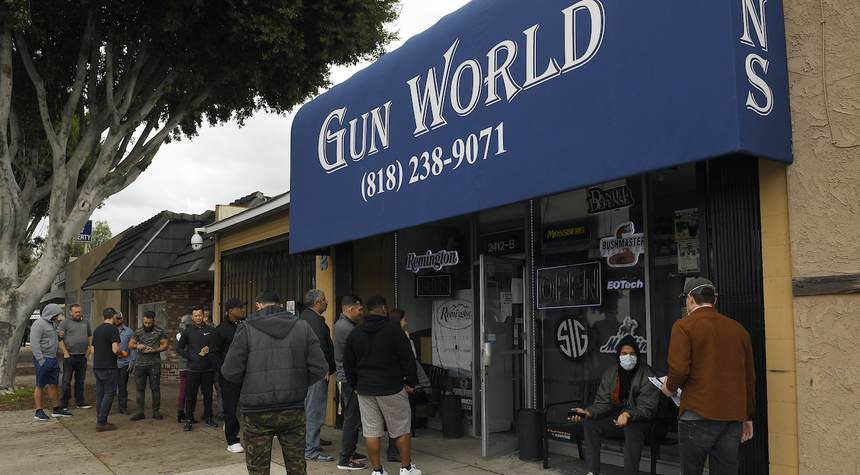
Locally, there are a few retailers already in the area considered not compliant with these 1,000-foot buffer zones, but their existence before the ordinance is considered “legal non-conforming” and are allowed to remain. Neither EuroArms on West Valley Boulevard nor Caps Armory on Monterey Pass Road elected to comment. A call to Big 5 on South Atlantic Boulevard corporate office had not been returned.
For some council members, the new ordinance, months in the making, was only the first step.
Councilmember Thomas Wong proposed an effort to collaborate countywide to expand the buffer zone restrictions to more cities.
“Maybe we can look at efforts to encourage (Los Angeles) to pass it and share this ordinance language and the research with our neighboring cities to encourage them to adopt similar restrictions in their own communities, so that a store doesn’t open up just outside of our borders that otherwise would not be allowed to open up,” he said.
Clearly Wong isn’t just trying to limit gun stores from operating in areas of Monterey Park zoned for commercial use. If he’s talking about getting other communities in Los Angeles County to put similar restrictions in place, he’s hoping to turn the entirety of L.A. County into a “health protection zone” where sales can be banned outright. As it is, L.A. County supervisors have imposed a ban on gun stores in unincorporated areas of the county located within 1,000 feet of schools, daycares, parks, and other FFLs, so Wong is well on his way to getting his wish.
Will this make Monterey Park free of guns or crime? Absolutely not. Chicago and Washington, D.C. are just two examples of major metropolitan areas that have no retail gun stores inside their city limits and more than their share of violent crimes, and if L.A. County officials ever decided to do the same I don’t think the results would be any different.
The senseless murders in Monterey Park were horrifying, but responding to this terrible crime by making it harder for responsible residents to exercise their fundamental right to armed self-defense is an awful approach. Not only does this move violate the fundamental civil liberties of those who live there, but in doing so it makes the community a more inviting target in the future for those violent criminals who prefer their victims be unarmed and defenseless.
SAN JOSE, Calif. (KGO) — The City of San Jose is calling it a victory in the fight against gun violence a judge upholding the city’s Gun Harm Reduction Ordinance.
In 2022, the city of San Jose passed the first-of-its-kind ordinance requiring gun owners to have liability insurance.
The challenges against it began immediately with the city facing a lawsuit from groups like the National Association for Gun Rights.
Late last week a court dismissed the Second Amendment claims.
In effect since the start of 2023, gun owners have to have liability insurance and pay a fee of $25.
That fee would go to a nonprofit with the money to be used for firearm safety training, suicide prevention and more.
From the time the ordinance was announced it has faced backlash.
In January 2022, Harmeet K. Dhillon who represented the National Association for Gun Rights spoke at a press conference held to announce the lawsuit:
“It’s going to be the law-abiding citizens who actually deter crime by having weapons in their homes who are going to be the ones who bear the burden of this unconstitutional ordinance,” Dhillon said last year.
Along with the National Association for Gun Rights, plaintiffs also included the Howard Jarvis Taxpayers Association.
Attorney Tamarah Prevost, a partner with Bay Area firm Cotchett, Pitre and McCarthy, took on the city’s case pro bono.
“We felt very confident that the ordinance was constitutional,” Prevost said. “The city did a lot of work on the front end to really craft something that it believed would be upheld, because the city is not taking guns away from people. It isn’t banning certain guns.”
The case was being fought as the U.S. Supreme Court came down with the Bruen Decision, one of the most significant cases regarding the Second Amendment.
The decision changed Second Amendment analysis in the courts and in turn, impacted the fight over the San Jose ordinance.
“We had to change gears and the judge had to change gears and apply a different legal standard that came down from the U.S. Supreme Court,” Prevost said. “The ordinance had to be evaluated based on historic precedent, what the framers in the 1800s would have thought of at the time, and whether an ordinance has historic roots as it were.”
With the change, Brady, a nonprofit that pushes for gun safety, was looked to by the court to weigh in.
The federal judge ruled Thursday that the insurance requirement for gun owners does not restrict gun firearm possession or use.
In a statement sent to ABC7 the National Gun Rights Association for Gun Rights said:
“This ruling is what happens when judges rely more on anti-gun groups like Brady than the actual ruling authorities here – namely the U.S. Constitution and the U.S. Supreme Court. This ruling makes a mockery of the Supreme Court’s Bruen standard with the claim that requiring an annual tax just to exercise a Second Amendment right somehow doesn’t actually violate that right.”
The statement goes on to say:
“No one would argue that having to pay $25 a year to petition your government or speak your mind wouldn’t violate those rights – and yet that is exactly what this court has claimed when it comes to the right to keep and bear arms. This is a truly astounding example of bad-faith judicial acrobatics.”
The $25 fee that was also part of the ordinance still hasn’t been completely worked out by the city. As a result, the court said the fee is not ready for judicial review yet allowing the plaintiffs time to file an amended complaint.
The Howard Jarvis Taxpayers Association’s, chief counsel Timothy A. Bittle sent ABC7 this statement:
“The ruling last week by the federal District Court on the City’s latest motion to dismiss our Consolidated Amended Complaint in the San Jose gun fee case is nothing new. This is the third time the City has moved for dismissal and the third time its motion has been granted, but with leave for plaintiffs to file an amended complaint.
This revolving door of amended complaints and motions to dismiss is due to the City’s long delay in implementing the gun fee ordinance. The ordinance requires gun owners to annually pay a fee of an unspecified amount to a nonprofit organization that the City will designate. However, the City has yet to fix the final amount of the fee, set a date for payment of the fee to commence, or identify a nonprofit organization to collect the fee.
The City has argued in its motions to dismiss that, until these steps are taken, plaintiffs’ legal challenge is premature. The Court has repeatedly granted the City’s motion, setting a date by which the City is “expected” to take the necessary steps, followed by a specific deadline for plaintiffs to file an amended complaint. When the City fails to take the necessary steps by the expected date, plaintiffs ask the City to stipulate to an extension of time for the filing of their amended complaint. The City refuses. We file an amended complaint. The City files a motion to dismiss, and round and round we go.
Fortunately, in again granting us leave to amend this time, the Judge did not impose a date certain for us to file our amended complaint, but rather gave us an open-ended deadline of 14 days after the City reports that the necessary actions have been taken.”
While it’s still not entirely clear yet whether appeals or amended complaints will be made by the plaintiffs, Prevost says she and the City of San Jose are ready to continue fighting.
“We are going to fight for the constitutionality of this law until the very end,” she said. “It may go up to the U.S. Supreme Court, we’re prepared for that.”
The Indianapolis City-County Council passed Mayor Joe Hogsett’s gun control plan on Monday night. The decision is in response to concerns over violent crime in the city.
Unveiled in May, Hogsett’s plan splits into two parts. The first proposes stricter gun restrictions, subject to state law changes.
These include:
- Raising the handgun purchasing age to 21
- Mandating handgun licenses
- Banning concealed carry w/o license
- Banning so-called “assault weapons”
A 2011 state preemption law currently blocks cities from regulating guns. Despite this, the council voted along party lines, 18-5, in favor of Hogsett’s gun control proposals.
The second part, unanimously approved, targets serious offenders.
Indianapolis will hire three federal prosecutors. They’ll report to the Southern District of Indiana’s U.S. Attorney’s Office’s Violent Crimes Unit. The unit focuses on serious violent and gun crimes.
The city’s corporation counsel’s office will fund the new prosecutors. This year’s budget allocates $225,000 for their salaries, with future costs covered by the office.
Mayor Hogsett praised the council’s decision.
“Tonight’s Council votes on Proposals 149 and 156 prove that Indianapolis and its leadership won’t back down from taking bold steps to protect residents and neighborhoods,” said the mayor on Monday night.
“I applaud the Council’s bipartisan support for funding our partnership with U.S. Attorney Zach Myers, holding the worst of the worst offenders to account,” he continued.
“I also wish to thank those who approved our common-sense gun safety measures, increasing the purchasing age to 21, requiring handgun licenses, and removing the concealed carry of firearms. Tonight we are sending a clear message of where we stand about the causes of gun violence and the proliferation of illegal weapons on our streets,” he concluded.
Every Republican councilor, totaling five, opposed the gun control measures.
During the council meeting, Minority Leader Brian Mowery articulated his disapproval.
“I’m voting against this because I disagree with the toothless language and the policy itself, but also because it likely violates state statute and the state constitution,” he said, according to the IndyStar.
He further expressed concerns about the proposal likely contravening state statute and the constitution. Mowery cited the opinion of the Indiana Office of the Attorney General, stating that the proposal breaches the state preemption law.
There’s no doubt it does violate the state’s preemption law. As such, one can argue it isn’t worth the paper it’s printed on. That said, the second proposal — the hiring of prosecutors — may help to put and keep bad guys behind bars.
We’ll see. As always, stay tuned for updates.
From the moment Birchwood Casey introduced its line of Shoot-N-C targets, gun people were in big trouble, because this is a target that simply cannot tell a lie and won’t allow the user to stretch the truth even a little bit.
It ain’t fair! No more tales from Uncle Ned about shooting sub-MOA groups from his vintage Model 94 .30-30 at 100 yards using iron sights. Your best buddy “Dead-eye” suddenly became kind of scarce at the range every Saturday morning.
Then along came Champion’s VisiShot targets, also capable of showing bullet impact spots. The deck is stacked against braggarts.
This is why I loved such targets from the get-go. From the shooting bench, one needs only to view the target through a spotting scope or binoculars and viola!, there is no need for guesswork about where to shift one’s sights, or how many clicks need to be applied, either up or down, right or left.
I’ve used these targets almost exclusively over the past few decades to illustrate various gun reviews, because they don’t lie. They’re great teaching tools as well as a means to keep everybody honest about their shooting abilities.
Now and then, I may substitute a tin can or a playing card for a change of pace, but at the end of the day, these high-visibility targets, which consist of a couple of layers of material that instantly show bullet strikes, are tough to beat. I wish I’d have invented the things.
Several years ago, I drove to a meadow just east of Snoqualmie Pass with my pal Brian Lull a week before the deer season opener to check the zero on our rifles. With the targets set approximately 120 yards away and slightly uphill, we both confirmed where our rifles put bullets, out of cold barrels. As I recall, I was shooting 180-grain Nosler AccuBonds ahead of a full dose of H110 through my .30-06, and my bullets were striking about 2 inches high and were spot-on in terms of windage. The following weekend, we both notched tags on Snake River mule deer bucks at better than 200 yards.
Variety
There are so many variations of these targets it is impossible to list them all. You’ll find traditional round targets with bull’s eyes, 12×18-inch silhouettes, 7- and 9-inch oval silhouettes, square 8-inch sight-in targets with a grid of 1-inch squares, and so on, and so on.
In my work, they make for some great photos. I’ve used them with different handguns to illustrate how accurate they might be with different loads, and on occasion with different rifles I may be shooting in preparation for a hunt.
Trust me, if you’re shooting poorly, these targets will shame you into additional practice!
The only downside I’ve experienced is that they sometimes seem prone to not sticking to the target backing as well as I might like. I’ve taken to stapling them down on cardboard after pressing them down. Thus anchored, they stay put through multiple hits.
VisiShot targets I’ve used don’t have the adhesive, so I simply stapled them to cardboard. In terms of performance, they did the same thing; each time a bullet punched through, a bright yellow or orange spot appeared, depending upon the target brand.
In the Cards
I mentioned playing cards before. Sure, I’ve used them as targets and so have many other people, for a variety of reasons in the beginning, but when the smoke clears, we all ended up with conversation pieces.
Of course, aces are the most popular cards, followed by the various face cards including Jokers, and then you work down the numbers. I saw an image of an Ace of Spades apparently punctured by Elmer Keith, using a .44-caliber revolver, and the body of the spade was pretty near shot completely out.
If you’re shooting a .22-caliber rifle or pistol, try a business card. They’re smaller and more challenging, and anybody who can consistently punch holes through one at 25 yards is one dead-eye sonofagun! Sometime between now and this fall’s grouse and cottontail rabbit seasons, I will have been to the range with my RugerMKIV pistol and 10/22 rifle brushing up my skills.
Be prepared to go through several decks of cards once you get into the habit. It really is addictive, and if you do it right — that is, concentrate on trigger squeeze, sight alignment and your breathing — by the time you’ve gone through the first deck, your marksmanship will definitely be improved. If not, well, there’s always Friday night bowling.
The importance of these exercises cannot be overstated. One never knows when an opportunity or emergency will arise, and you will need to shoot accurately, and maybe fast. (See below!)
Albuquerque ‘Crack Down’
Following a fatal triple homicide (“mass shooting”) in Farmington, New Mexico, Albuquerque Mayor Tim Keller announced this summer his administration will be “cracking down on guns.”
He said so in his “State of the City” address, according to KOB News.
“We are going to triangulate existing restrictions around schools to aggressively target any crime with a gun anywhere in downtown Albuquerque,” Keller, a Democrat, stated.
This could be interesting, because New Mexico has a state constitutional provision which says the following: “No law shall abridge the right of the citizen to keep and bear arms for security and defense, for lawful hunting and recreational use and for other lawful purposes, but nothing herein shall be held to permit the carrying of concealed weapons. No municipality or county shall regulate, in any way, an incident of the right to keep and bear arms.”
This is what we call a preemption law, but unlike other states, New Mexico’s provision is part of the state constitution. It is supposed to prevent politicians like Keller from doing what he’s just announced he will be doing. He may, or may not, be challenged, but the bottom line here is whether anything Albuquerque does this summer will have any effect on the violent crime rate.
Crime in Albuquerque is already down this year, according to KRQE News. Mayor Keller noted in his address that violent crime is down 8% from last year and property crime is down a whopping 140%. Over the previous 17 months, he said last month, 170 murder suspects had been arrested, which is a promising revelation. No rational person likes violent crime, particularly if he or she is a gun owner, since ultimately, it is gun owners who somehow wind up being penalized.
Keep Your Wits
Who’s heard a witty saying worth sharing? Wyatt Earp reportedly said, “Fast is fine, but accuracy is final,” along with “You must learn to be slow in a hurry.”
There was a line of dialogue in an old Kirk Douglas western many years ago which has always made sense to me: “Get it out fast, and put it away slow.” People who disagree, or simply laugh at the concept, have probably never encountered a bear on the trail.
“Never holster an empty gun” was a tidbit that got my attention somewhere way back in the last century. Ever try to shoot small game only to hear an embarrassing “click?” It only needs to happen once. It’s a lesson that stays with you.
Anybody else? Send replies to insider@americanhandgunner.com

As many of the country’s police departments grapple with dips in funding, reputational crises, lack of morale and a struggle to keep numbers in most departments at approved levels—all as violent crime surges—many businesses and citizens are opting to hire their own private police forces of sorts: armed guards.
According to the Security Industry Association, there are around double the number of security guards employed across the country than there was two decades ago. As of 2021, there are two police officers for every one thousand civilians—and 3.1 guards for that same amount.
While “private policing” is hardly a new concept, it has gained significant traction across the United States since the 2020 riots. In and around 2020, more than 20 major cities slashed their police budgets, even as lawlessness swelled. Further, Left-leaning cities in recent years have introduced an abundance of criminal-friendly policies, such as “bail reform” and early prisoner releases.
With more criminals on the streets, those who can afford more security tap into the billion-dollar private security arena; meanwhile, the middle and lower classes—especially in cities mandated by gun control activism and anti-Second Amendment legislation—are left in even more desperate situations as law-enforcement resources are stretched thin and as these same officials also do all they can to prevent average citizens from obtaining the means to defend themselves.
Perhaps there is no more significant example than Beverly Hills, Calif. This uber-affluent, ultra-anti-gun enclave has reacted to rising crime by hiring even more private security. One private security firm was even hired to provide armed safety personnel at public schools in the city—schools frequented by the children of the rich and famous.
An ad on Jooble even reads: “Urgent! Armed security jobs in Beverly Hills, CA.”
Beverly Hills also contracted several other firms to patrol the area in cars and on foot to help the police safeguard the “luxury capital of the world.”
Meanwhile, well-off residents and business associations in upper-class communities spanning San Francisco and New York to Chicago, Portland and Seattle—all pockets saddled with hostile and restrictive private gun ownership laws—have also turned to independent companies to deter criminal activity.
Even in Washington, D.C., the national beacon for propelling an anti-firearm disposition, [what entity?] has turned to contract security officers out of concern for declining personnel numbers in the strained police resources. And next door in Maryland, the Downtown Annapolis Partnership has begrudgingly admitted they now need to use taxpayer funds to retain private guards to protect prominent areas—guards they cleverly call “safety ambassadors.”
In other words, the unspoken motto from most Left-leaning enclaves is, “We have the money to hire protection, but guns are bad, and if you aren’t rich like us, you are on your own.”
Moreover, wealthy sectors are already at an advantage, as these cities can generally entice more police officers because they have higher tax earnings, which generally means they can offer better wages and benefits.
Thus, if holding down crime is such a struggle for them, imagine the reality most of urban America now has to confront.
What is a better solution? How about enabling all Americans, regardless of social status or wealth, to have the same fighting chance to protect themselves and those they love?
The same political leaders who are quick to espouse “equality” and, in the next breath, champion hefty gun control legislation are the same ones hiring armed private guards. America is supposed to be a land of opportunity and equal rights, not a land where the elites are protected while the average citizens struggle to remain safe.

U.S.A. – New York Attorney General Letitia James has taken legal action against Mean Arms, a Georgia-based gun accessory manufacturer, for their alleged involvement in the illegal possession of assault weapons in New York. The lawsuit follows the tragic incident in Buffalo, where a shooter used Mean Arms’ magazine lock, known as the MA Lock, to replace magazines in his AR-15 and carried out a mass shooting that claimed the lives of 10 individuals.
According to the lawsuit, Mean Arms deceptively promotes the MA Lock as a device that makes weapons compliant with New York’s gun laws. However, it is alleged that the lock can be effortlessly removed, allowing the shooter to add 30-round detachable magazines to the firearm used in the massacre. The Attorney General argues that Mean Arms’ marketing practices and instructions on how to remove the lock contribute to the illegal possession of assault weapons in the state.
Attorney General James danced in the blood of the Buffalo shooting, calling it “one of the darkest days in the history of New York and the nation.” While dramatically claiming that the harm caused cannot be undone, and she aims to seek “justice” for the lives lost by the acts of a madman by now pursuing legal action against Mean Arms.
The NY lawsuit seeks several “remedies”, including a halt to Mean Arms’ operations in New York, restitution, damages, and civil penalties for the company’s alleged violations of state laws. Moreover, the Attorney General intends to force Mean Arms to issue corrective statements regarding the misleading claims made about the MA Lock.

Mean Arms’ MA Lock is designed to lock a detachable magazine in place on a semiautomatic rifle using a shear bolt mechanism. However, the New York Attorney General’s office found that the company provides instructions on how to easily remove the lock on the packaging itself. Online videos also demonstrate the removal process, which involves using a #2 speed out drill bit and a power drill.
The lawsuit reveals that the Buffalo shooter had purchased a semiautomatic rifle with the MA Lock installed and a 10-round magazine in January 2022. Using the common tools and a power drill, he removed the lock, enabling him to attach multiple illegal, under New York law, 30-round detachable magazines. This modification allowed the shooter to continue firing 30 rounds without reloading, as would be the case with the NY arbitrary number of 10 rounds, and according to the AG, that somehow contributed to the increased “lethality” of the attack.
Attorney General James’ legal bullying of Mean Arms is part of her ongoing efforts to claim she is doing something to curb “gun violence” and to force “responsible gun safety laws” on New York. In recent months, her office has wasted taxpayer monies on a statewide gun buyback program and cracked down on online ammunition sellers for “illegal” shipping.
While the lawsuit claims to hold Mean Arms accountable, it is worth noting that laws like New York’s, banning so-called high-capacity magazines have faced legal challenges. Various federal courts, including the 9th Circuit Court of Appeals, have ruled such bans to be unconstitutional, citing the Second Amendment right to bear arms.
The lawsuit against Mean Arms, however, underscores the Attorney General’s commitment to doing the dirty work of gun banners. The legal action has garnered support from advocacy groups like Everytown for Gun Safety, as well as local leaders, including U.S. Representative Brian Higgins and Buffalo Mayor Byron W. Brown.
By Fred Riehl and AI technology. Note: This article was generated using AI technology and may contain some automated content and analysis.