Category: Gear & Stuff


Categories
A mighty good looking blade there!

Categories
The BANNED Italian Switchblade!
I glanced at my buzzing phone between crises at work. There was a kid with an ear infection screaming in Room 2, and the elderly man with chest pain in 3 was very likely having a heart attack. The lady in 4 was sobbing hysterically. Her husband of three decades had moved out the night before, and she had no place else to turn. It was, in short, a fairly typical day at the office.
The message read, “Can I borrow a .22 rifle to chase squirrels? My old hunting buddy and I got access to a nice piece of woods, and we’d like to go walk around a bit. Dad.”
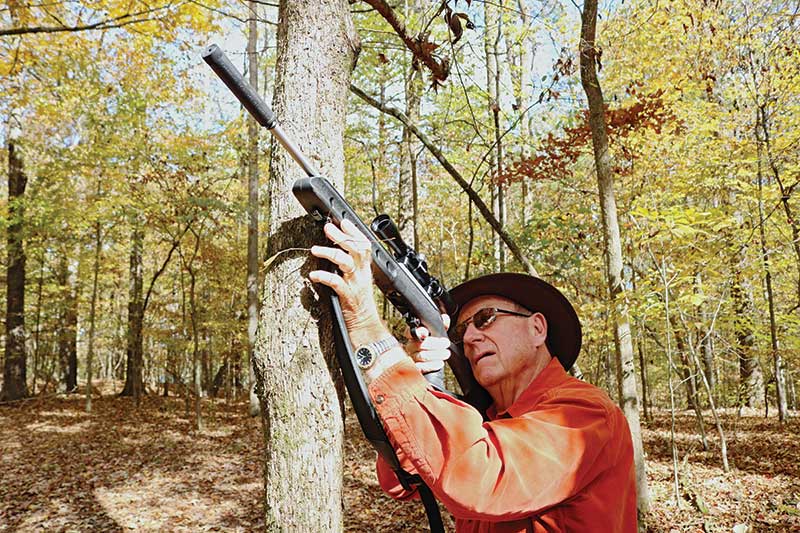
Everybody has a father. I am blessed with a dad.
Role Model, Inspiration, Hero
My father is an indispensable part of my success today. He and mom sacrificed when I was a kid and loved me even when I was unlovely. He lived the example of the Southern Christian gentleman and showed me what it meant to be a man. I never once heard him curse. If everybody had a dad like mine the planet would be a much more peaceful, respectful and productive place.
Dad was a football star in college and even earned a spread in Sports Illustrated. I take after my mom and apparently didn’t inherit any of that. He could have handily beat up everybody else’s dad. However, short of protecting his family I could not imagine anything provoking him to violence.
He and I split the cost of my first Daisy BB gun when I was 7. He gave me my first .22 rifle and 12-gauge shotgun. He taught me the basics of rifle marksmanship and wing shooting as well as how to talk to turkeys.
By the time I left for college, 13 wild turkeys had fallen to my Browning Auto-5 while hunting at his side. Christmas and Thanksgiving dinners were seldom without one. The musty sweet smell of the Army-issue field jacket he wore on hunting trips when I was a kid is burned indelibly into my memory. He would undoubtedly push back at the characterization, but if I took a clean piece of paper and designed the perfect dad he would look like mine.
Dad already has a splendid .22 rifle—a gorgeous Winchester 63 with a tubular magazine in the stock he got for Christmas when he was a kid. The gun shot straight enough for my mom to use it to clip sprigs of mistletoe out of towering Mississippi Delta oak trees for use as Christmas decorations back in the day. A closely held family secret was my mom was always the best shot in the family.
I borrowed his rifle for an article a couple of years ago, and, oddly, it never found its way back home. Dad could have just admonished me to give him his gun back. Instead, he just asked to scrounge one of mine. That’s the kind of guy he is.
After a literal lifetime spent squeezing triggers for fun and money I have tasted both the good stuff and the bad. However, this time was special. Here was my excuse to build my dad the ultimate Information Age counter-squirrel rifle.
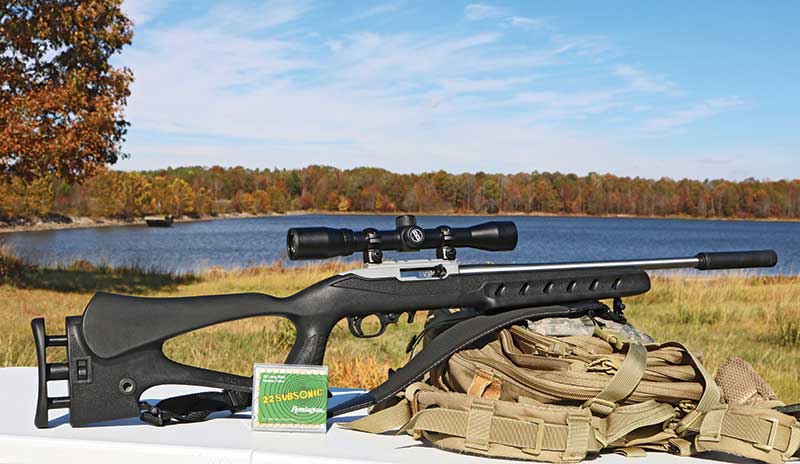
A sound suppressed Ruger 10/22 rifle is the ideal Information Age counter-squirrel weapon. The stainless steel
construction combined with the indestructible carbon fiber stock from Archangel make the gun essentially weatherproof.
Foundation
Naturally the chassis is a Ruger 10/22. This classic, simple, ubiquitous self-loading .22 rifle is reliable and customizable unlike anything else on the market. It is also surprisingly inexpensive. Ruger makes so many of them mass production keeps the costs down. Spare parts and aftermarket cool-guy stuff are everywhere. In my dad’s competent hands, the Ruger 10/22 would be pure death to tree-dwelling rodents.
Standard Ruger 10/22 stocks are not bad, but this is for my dad. I want it to be perfect, so I looked to Archangel. Archangel produces a bewildering array of indestructible carbon fiber aftermarket stocks for an equally bewildering array of disparate weapons. For the old standby 10/22, their options run the gamut. They can transform your humble 10/22 into the spitting image of a German HK G36 combat rifle or set you up with a heavy target stock sporting multiple adjustments.
As this rifle was to be toted operationally in the field I opted for the midrange version. This stock incorporates a handy thumbwheel adjustment for length of pull yet remains sufficiently lightweight for easy carry. The stock free floats the barrel for accuracy, is festooned with sling sockets, and also includes a handy carrying compartment for a few spare .22 rounds or some emergency M&M’s.
I mounted glass on the top without a fuss. Neither Dad nor I have quite the visual acuity we once did, and a proper optical sight sure makes it easier to drop rounds on target. All Ruger 10/22 rifles come equipped with a sturdy sight rail, and the receivers are drilled and tapped from the factory.
Magazines range from standard helical feed 10-rounders up to 50-round drums with banana mags of various capacities liberally interspersed. New 10/22 rifles come standard with extended magazine release levers. Modern 10/22 fire control groups and barrel bands are polymer, but you will not wear out these components.
In a timeless tribute to the innate toxicity of testosterone, my dad and his best friend, both well into their 70’s, were recently hanging out at their hunting camp when an armadillo had the poor grace to make an unscheduled appearance. Dad produced his Ruger .22 Magnum revolver and, 6 rounds later, both my dad and his buddy were well and truly deafened. The armadillo, naturally, escaped unscathed. After some vigorous admonishment by his physician son, Dad now keeps a pair of muffs in his pickup truck.
A lifetime’s exposure to gunfire and chainsaws has already taken a toll on Dad’s hearing. You only get so much, and every time you are exposed to excessive noise you lose a little. It is imperative you safeguard every bit of it.
Hearing protection can be tough to manage when in the field hunting, particularly when there are multiple hunters involved. Sound suppressors are the obvious answer. Regrettably, however, civilian ownership requires the same onerous paperwork and $200 transfer tax fully automatic machineguns and grenade launchers might.
Sound suppressors should really be sold over the counter in blister packs at your local Shop-n-Grab. In America you are statistically at greater risk of succumbing to a shark attack or toothpick injury than a criminal assault with a suppressed weapon. (No kidding. I looked it up.) The only place Bad Guys use sound suppressors is on the screen at your local movie theater. However, there is a way to optimize this labyrinthine process.
If you transfer a sound suppressor to yourself as an individual then no one else may legally possess the item. However, if you form a trust it is possible to include more than one person as trustees. Details are available online, and the process is not particularly difficult or expensive. As such, I created a trust for both Dad and me allowing us to share legal possession of a .22 caliber can. The processing time takes about forever, but the resulting convenience makes the wait worthwhile.

The AATS1022 stock from Archangel sports an easily adjustable length of pull to accommodate different shooters.
The stock is functional and lightweight for optimal use in the field.
Practical Tactical
The resulting optimized squirrel rifle will easily keep its rounds within a tennis ball out to 50 meters or more in Dad’s capable hands. He used his Winchester 63 to drop swamp rabbits on the run when I was a kid. Dad’s the one who taught me to shoot, after all.
When stoked with subsonic ammo Dad’s squirrel gun is easy on the ears and even allows multiple shots at the same rat. With the can in place the bullet may agitate the squirrel, but the source of the shot is all but impossible to ascertain. The rifle is lightweight enough to tote long distances, and the Archangel stock allows the gun to be adjusted to fit your particular anatomy. While not just dirt cheap, this rig still remains within the means of most American shooters.
Solutions
There is indeed a great deal wrong with our nation today. Among our many resplendent social ills, one of our greatest shortcomings is how few American men these days are signing up to be good old-fashioned dads. The job is grueling and the pay sucks, but the unfiltered adoration from a job well done makes up for the suffering.
Dad invested his life in me. As a result, I understood the value of hard work, discipline, good citizenship, and character in a world rapidly becoming bereft of same. Everybody has a father. Lamentably, fewer modern Americans have a real dad. Dad, enjoy your new rifle. The tree rats won’t stand a chance.
Archangel
43 North 48th Avenue
Phoenix, AZ 85043
(800) 438-2547
https://promagindustries.com/archangel/
Sturm, Ruger & Co.
411 Sunapee Street
Newport, NH 03773
(336) 949-5200
https://www.ruger.com/