Sorry but this film does not want to be up loaded. So here is the address & just upload it. Grumpy
Categories
Sorry but this film does not want to be up loaded. So here is the address & just upload it. Grumpy

President Donald J. Trump. (Photo: Twitter)
Before we continue with our regularly scheduled programming, a quick message from our commander-in-chief:
“They will overturn everything that we’ve done and they’ll do it quickly and violently, and violently. There’s violence. When you look at Antifa and you look at some of these groups — these are violent people.”
— President Donald Trump, August 2018, on what could happen if the GOP loses in the upcoming midterms.
Now that we have talked until we are blue in the face about guns, we have to talk about what to feed them. What I am about to say will no doubt ruffle feathers. But let’s try to be civil. This is only one man’s opinion. And if you don’t agree with me, you can always tune back in next week, after you let me know in the comments section that I am an idiot and my mother worked in the less savory districts of Bangkok.
Seriously, on the ammo issue, this is probably going to be controversial. I have a different experience than most people and a different skill set. My personal needs are obviously tailored to me, as yours should be tailored o you. This time, it probably doesn’t mean I think your ammo pile is too small. It means I think it is ridiculously over-sized for the task at hand. Mine is too, so hear me out…

The kind of ammo stash that makes fire departments nervous.
If we are talking about someone starting to prep, and in this case preparing for a Mongolian horde event, the easy answer is to tell them to snag one million rounds! Preferably in a Dr. Evil voice. But the reality is that is too much, especially when we are talking solely about the amount one will need.
I have a massive stockpile, as I am sure most of you do too. But that is more a hedge against inflation than an insurance policy for Antifa. I have the storage space, so no harm no foul. If you could go back 10 years and buy Facebook stock or .22 LR, that you had to keep until today, which one would you prefer? Me too.
The one thing I see over and over again in prepping circles is a belief that a mountain of ammo is all you need. Absolutely not true! In fact, I believe that most people would be better off with 300 rounds and the skills of having shot 20,000 as opposed to 20,000 stockpiled and the skills of having shot 300.
For my personal TEOTWAWKI (Total End Of The World As We Know It) stash, I only count 500 rounds of 77-grain 5.56 and an additional 300 rounds of 6.5 Creedmoor. My pistol isn’t even coming with me unless I am taking my truck and half of that Creedmoor is to cache in short order. Everything else, including all the extra boomsticks, is for barter, to bury, or expendable. Because in my experience, mobility is a lot more important than firepower. If my skills won’t get a resupply as needed with that loadout, I’m not going to make it anyway.
If I was planning an Urban Defense, like we are right now, I would actually upscale those numbers a bit. You still have to keep it sane because apartments are small and bullets are heavy. Not to mention expensive when you buy them in quantity. It changes a little bit both being in a defensive position and being in the concrete jungle.

For your centerfire rifle, I feel like 1,000 rounds is enough. Have I used more than that in a day of Urban Combat? Absolutely. By a factor of three on some really nasty occasions. But that was mostly in a street fight, where cover was sometimes scarce and the enemy had mountains of ammo to throw back. If someone starts chucking basketball-sized “Dishka” (DShK 1938) rounds past you, you do whatever is needed to shut that thing down.
On normal types of combat operations, 2-3 magazines was more likely, so 60-90 rounds. It turns out, experience and hitting what you are aiming at are important things. If you ask most guys from assault-type units what they took with them by the end of the war, 4 magazines is the most common answer. If you splay out 300 bad guys in front of your building, I’m betting your problems will stop. And if you think my suggestion is light, the cost and space aren’t that high to double it.

For your pistol or pistols, 200 rounds per gun is a good starting point. Or 500 rounds if you only have one. At close range, or against an area target, your pistol is going to work good enough. Two hundred is a big enough figure that your barista pressed into service can’t spend it all at once. It is a strange idea to have half as many pistol rounds as rifle rounds but in this context it makes sense. If you are only arming yourself (because you don’t trust anyone else or you’re on your own), I would reduce this down to 100 max, and add 500 to the rifle.

For the shotgun, ammo is super heavy. It isn’t going to be fun to move around, and if it comes time to escape, this would be my last choice. But you are going to be using it if the human wave closes in, so have enough to feed it. I would use 150 Buckshot and 50 slugs as a solid count.

For rimfire, go a little heavier. Given your defensive position, rimfire punches well above its weight class. At nearly one-third of the weight of rifle or pistol, you can get a little froggy here. Not my choice for fighting in a phone booth, but it beats a knife any day. I like a nice round figure of 5,000 here, which happens to be a full case.
So there we are. Your total urban defense ammo loadout by my calculation costs you just over $1,200 dollars. If you happen to have more on hand, awesome. But between now and when you need it, I strongly recommend you use some of that extra ammo to hone your skills.
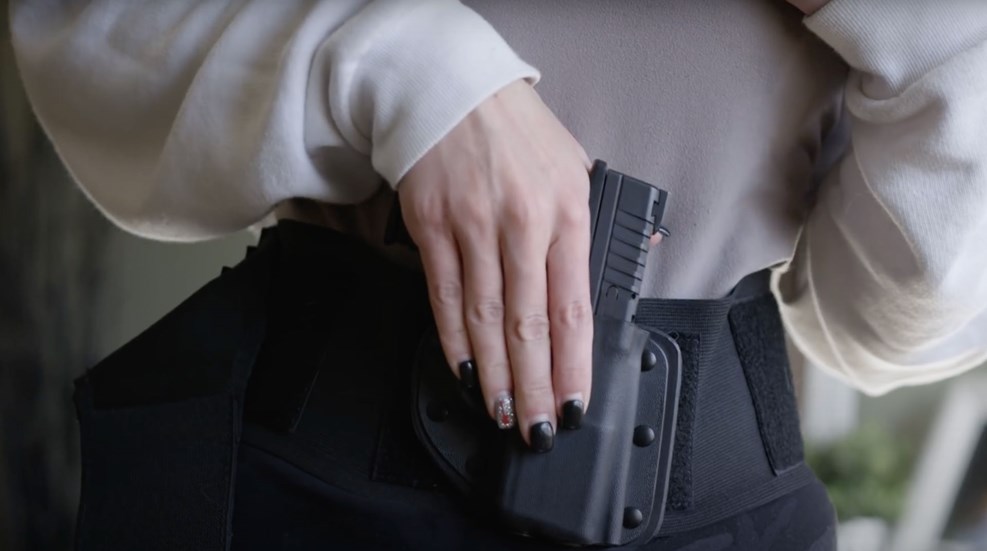
One of the most common questions I am asked as a firearms instructor is, “What gun would you recommend for self-defense?” As all instructors should, I go through the pros and cons of the different actions, makes and models so that the student can make an informed decision. There is no one-size-fits-all defensive firearm.
The natural follow-up question should be, “What type of holster should I wear?” Unfortunately, that follow-up question is seldom asked. However, there are as many holster options as there are handguns. I now ask that follow-up when I am asked the first question. After discussing the pros and cons of handgun choices, I ask the student or new shooter, “How to you plan on carrying your self-defense gun?” The answer is always the same, “I am not sure,” or “I have not really given it much thought.” Decisions on the right gun and holster type should go hand-in-hand.
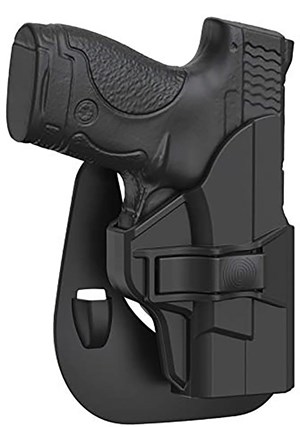
Outside the Waistband Holster
Outside the waistband (OWB) holsters are usually worn on the strong side of the individual. Many individuals who live in open carry states prefer the outside the waistband holster.
The most common OWB holster is the traditional belt holster. This type attaches and secures the holster to the body by sliding through the belt loops or snapping over the belt. The belt holster provides the most secure and strongest base for drawing your firearm.
Another type of outside the waistband holster is the paddle holster. This type of holster is attached to a paddle that slips over the belt and pants with the paddle inside the waistband, and the holster outside the pants and belt. These are beneficial because they can be easily removed and locked in your vehicle if entering a place where firearms are prohibited, such as a U.S. Post Office.
Outside the waistband holsters allow the carrier to access her firearm from a natural position and are easily concealed by an outer garment. This type of carry allows you to easily access the firearm from a natural position. As you walk or if you are just standing, your arms naturally hang to your side with your hand reaching near or about waist level. Carrying a firearm on your belt outside the waistband is also very comfortable. However, during warm weather you’ll have to keep that jacket or coat on if you wish to carry concealed. You’ll also need two hands to draw your firearm; one to clear your clothing and one to draw the firearm.
Inside the Waistband Holster
Like the outside the waistband, the inside the waistband (IWB) holster is usually worn on the dominant hand side of the individual. This type of holster is placed inside the waistband, next to your body. The holster is secured by clips that attach to your pants or belt. The firearm is then concealed by covering it with an outer shirt. A properly fitted inside the waistband holster provides the best concealment of the firearm with minimum printing, or visible outline of the firearm. The inside the waistband holster also usually rides higher on the hip, eliminating the need for special or additional clothing to try and conceal the firearm.
Many people report that inside the waistband holsters are not as comfortable as outside the waistband holsters. The wearer may need to purchase larger-sized pants to accommodate the extra room needed for the holster. Additionally, like the outside the waistband holster, the inside the waistband holster also takes two hands to draw. One hand is needed to clear the clothing from the holster and the other hand is used to draw the firearm.
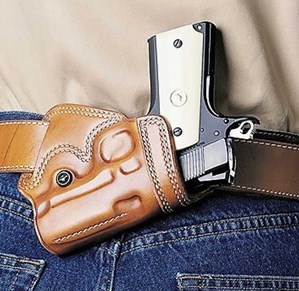
Small of the Back Holster
There are two types of small of the back holsters. One can be worn outside of the belt and the other inside, both sitting in the middle of the small of the back. These holsters are usually attached to the belt. Small of the back holsters are easy to conceal, especially with a jacket. However, they are only comfortable when standing or walking.
The small of the back holster is a less common form of carry because there are many cons. First, it is relatively slow to draw compared to the other types of holsters. This is because your firearm is more difficult to access due to the excessive arm and hand movement needed to reach your firearm. This type of holster also tends to be very uncomfortable while seated and can be almost impossible to draw while sitting in a vehicle.
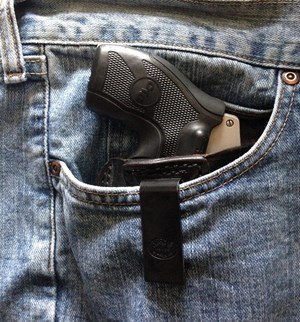
Pocket Holster
Pocket holsters are growing in popularity. Pocket holsters are small enough to fit in the front pocket of your pants. This type of holster allows for quick and easy access to your firearm. It is a very comfortable carry, whether you are sitting, standing or walking. The pocket holster is carried in the pocket on the strong side or dominant hand side. This type of holster is easily concealable, regardless of the outside temperature. It also can be carried in the pocket of any type of clothing, such as suits, jeans, shorts, dresses, etc.
There are a few downsides to using a pocket holster. The number one drawback is that it is only compatible with small-frame revolvers or micro pistols. Small handguns usually mean a small ammunition capacity. Many feel that the limited ammunition capacity is a fair trade-off for always having a firearm for self-defense. Those individuals who use a pocket holster are seldom without protection.
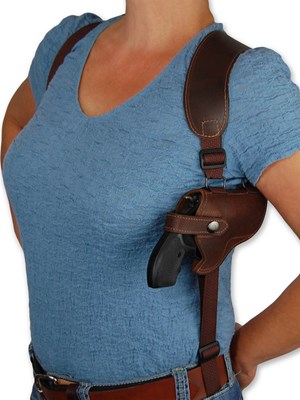
Shoulder Holster
Shoulder holsters are usually carried when wearing a suit, vest, jacket or other type of outer garment. It seems that everyone who has tried a shoulder holster eventually settled on another type of holster. If properly fitted, the shoulder holster can be comfortable to wear. Unfortunately, if it is not properly fitted, it can be very uncomfortable by adding stress on the shoulders or back.
The biggest benefit to a shoulder holster is that it is easy to accessorize with extra magazines, speed loaders, flashlights, etc. Another benefit is that the firearm is easily accessed by the wearer. The firearm is worn opposite of the dominant hand and can be drawn with one hand. The wearer reaches across the body with their strong hand to grip the firearm and draw from the holster.
There are several cons to using shoulder holsters. The most obvious is the need of an outer garment for concealment. The biggest obstacle with the shoulder holster has to do with safety. When teaching firearm classes, we stress muzzle control and keeping the muzzle pointed in a safe direction in every single situation. Shoulder holsters often violate this cardinal safety rule. Most shoulder holsters are positioned so that the barrel is pointed to the rear. This causes the muzzle of the firearm to “sweep” anyone or anything that is behind the wearer. Other shoulder holsters point the muzzle straight down but cause the same safety violation if the wearer bends over.
Some gun ranges and clubs prohibit the use of shoulder holsters while on the premises for this reason. The other safety issue with the shoulder holster is the act of drawing the firearm. As the gun is removed from the holster to cover the target, the firearm can sweep across unintended objects, including other individuals in the area.
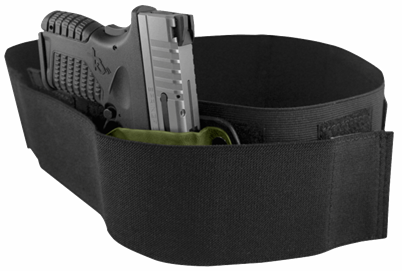 Belly Bands
Belly bands are a unique style of firearm retention holsters. A belly band is an adjustable elastic band that wraps around the waist to fit any body shape or size. They are typically very lightweight and comfortable to wear. Belly bands can hold just about any pistol or revolver that is designed for concealed carry.
The belly band offers great firearm retention and safely protects the trigger. All the wearer needs to do is access their firearm by raising their outer garment with their non-dominant hand and drawing the firearm with their dominant hand. There are also belly bands that not only offer pockets for handguns and extra magazines, but pockets for other items such as a mini flashlight and nonlethal methods of self-protection such as pepper spray.
Like any firearm retention system, there are disadvantages to wearing a belly band. In hotter climates, belly bands can be uncomfortable. Some people who wear a belly band in the cooler months tend to opt for a different holster style in the summer. Another disadvantage to belly bands is that accessing the firearm can take longer than accessing from other types of holsters.
Choosing and training with your holster is just as important as training with your firearm. After all, you can be very proficient with your firearm, but if you cannot access it quickly to defend yourself when needed, you could be in trouble. All shooters, new and old, need to practice drawing from their holster. Also, just like all shooters should try different handguns to find the one that best fits their needs, they should know the pros and cons of different holsters and try out a few different options.
